EP2131748B1 - Dispositif médical pour appliquer des sutures en bourse - Google Patents
Dispositif médical pour appliquer des sutures en bourse Download PDFInfo
- Publication number
- EP2131748B1 EP2131748B1 EP08744841.1A EP08744841A EP2131748B1 EP 2131748 B1 EP2131748 B1 EP 2131748B1 EP 08744841 A EP08744841 A EP 08744841A EP 2131748 B1 EP2131748 B1 EP 2131748B1
- Authority
- EP
- European Patent Office
- Prior art keywords
- purse string
- plate
- suture
- surgical instrument
- tissue
- Prior art date
- Legal status (The legal status is an assumption and is not a legal conclusion. Google has not performed a legal analysis and makes no representation as to the accuracy of the status listed.)
- Not-in-force
Links
Images


Classifications
-
- A—HUMAN NECESSITIES
- A61—MEDICAL OR VETERINARY SCIENCE; HYGIENE
- A61B—DIAGNOSIS; SURGERY; IDENTIFICATION
- A61B17/00—Surgical instruments, devices or methods
- A61B17/04—Surgical instruments, devices or methods for suturing wounds; Holders or packages for needles or suture materials
- A61B17/0469—Suturing instruments for use in minimally invasive surgery, e.g. endoscopic surgery
-
- A—HUMAN NECESSITIES
- A61—MEDICAL OR VETERINARY SCIENCE; HYGIENE
- A61B—DIAGNOSIS; SURGERY; IDENTIFICATION
- A61B17/00—Surgical instruments, devices or methods
- A61B17/11—Surgical instruments, devices or methods for performing anastomosis; Buttons for anastomosis
- A61B17/1114—Surgical instruments, devices or methods for performing anastomosis; Buttons for anastomosis of the digestive tract, e.g. bowels or oesophagus
-
- A—HUMAN NECESSITIES
- A61—MEDICAL OR VETERINARY SCIENCE; HYGIENE
- A61B—DIAGNOSIS; SURGERY; IDENTIFICATION
- A61B17/00—Surgical instruments, devices or methods
- A61B17/11—Surgical instruments, devices or methods for performing anastomosis; Buttons for anastomosis
- A61B2017/1142—Purse-string sutures
-
- A—HUMAN NECESSITIES
- A61—MEDICAL OR VETERINARY SCIENCE; HYGIENE
- A61B—DIAGNOSIS; SURGERY; IDENTIFICATION
- A61B17/00—Surgical instruments, devices or methods
- A61B17/12—Surgical instruments, devices or methods for ligaturing or otherwise compressing tubular parts of the body, e.g. blood vessels or umbilical cord
- A61B2017/12004—Surgical instruments, devices or methods for ligaturing or otherwise compressing tubular parts of the body, e.g. blood vessels or umbilical cord for haemostasis, for prevention of bleeding
-
- A—HUMAN NECESSITIES
- A61—MEDICAL OR VETERINARY SCIENCE; HYGIENE
- A61B—DIAGNOSIS; SURGERY; IDENTIFICATION
- A61B17/00—Surgical instruments, devices or methods
- A61B17/30—Surgical pincettes, i.e. surgical tweezers without pivotal connections
- A61B2017/306—Surgical pincettes, i.e. surgical tweezers without pivotal connections holding by means of suction
Definitions
- the present application generally relates to a surgical instrument for applying purse string sutures to human tissue and, more particularly, to a surgical instrument and method in which multiple purse string sutures are secured to human tissue from within a vessel so as to close an end of a tubular vessel.
- the surgical instrument of the present application may be used to apply purse-string sutures prior to an end-to-end anastomosis procedure during laparoscopic or open abdominal surgery to remove portions of the colon, for example.
- each portion of the colon or other vessel to be reconnected is usually provided with a purse-string suture.
- Purse string sutures are continuous, circular inverting sutures, used to close a tubular section of tissue, e.g., intestinal tissue, prior to the performance of the end-to-end anastomosis with a suturing instrument.
- a purse string suture is a single thread stitched to surround an opening of the tubular section and then is pulled tight (like a purse-string) to close the hole.
- a purse string suture is attached to a surgical needle that is used by a surgeon to manually stitch the purse string suture about the periphery of the tubular section of tissue.
- a purse string suture is a suture loosely placed around cut end of a vessel (e.g., any end of an intestinal organ) in a manner to act as a purse string so that after the purse string suture is stitched to the tissue, the ends of the purse string suture can be pulled to tighten the stitches and draw the tissue together (e.g., like closing a purse). Then, the purse string suture is wrapped and tightened about the tubular section of tissue. In the manual stitching of the purse string suture, it can be difficult to obtain uniform penetration of the purse string suture into the tissue.
- a surgeon may alternatively use a purse string device to apply the suture.
- Purse string suture devices are known that comprise a pair of serrated tissue clamping jaws provided with teeth for clamping the tissue to be sutured therebetween. Such devices include needle passages which extend through the teeth on each jaw for receiving a needle attached to a suture to be threaded through the tissue.
- the tissue to be sutured is clamped between the jaws and the needle is manually passed through the needle passages in both jaws to thread the suture through the tissue. Thereafter, the jaws are opened and the purse string suture is tightened and wrapped to draw the tissue together.
- Many variations of this device that use a clamping mechanism are known, so as to clamp the end of a vessel tube and apply the suture to close the opening.
- Another obstacle is the size of the device. It is not always possible to use such devices in the desired place within the human body cavity due to size of the device and lack of maneuverability of the surgeon within the cavity. For example, it is not always desirable to create an opening in the human body large enough to place the clamp-like purse string suture device in position to apply the suture. As such, depending on the location of the vessel, size of the vessel, etc., it is often difficult, if not virtually impossible, to place a suitable purse string suture in a manner so as to insure a desirable reconnection of the vessel. This is true, for example, in low colon anastomosis where it may be difficult to place the purse string suture on a distal end of the vessel especially using less invasive laparoscopic purse-string suturing techniques.
- US 5891159 discloses an automatic purse string suture device that enables a surgeon to install a purse string suture in tissue structures.
- the device is comprised of an applicator having an elongated structure with protrusions extending from the distal edge thereof, and a means for advancing a needle through a passage to pass a suture through tissue that has conformed to the distal edge of the device.
- US 5425737 discloses a purse string suturing instrument including a pair of elongated jaws each having a row of teeth, the jaws being hinged together at one end to clamp tissue therebetween.
- the jaws are positioned around the tissue to be sutured, the teeth bend the tissue therebetween, and a length of suture is inserted through passageways provided in the teeth to form stitches in the tissue.
- a surgical instrument for applying purse string sutures to tissue.
- the invention provides a surgical instrument for applying purse string sutures to tissue as defined in claim 1.
- the first and second purse-string sutures may be applied by pulling the suture wires through the tissues to thread sutures that may be attached to the suture wires through the tissue as well. Subsequently, the sutures can be tightened to close an opening of the tissue.
- the surgical instrument may include two purse string plates, push plates, suture and a shaft.
- the two purse string plates are connected by a disc connector positioned between the two purse string plates.
- Each purse string plate has notches or openings in a perimeter of the purse string plate for receiving tissue and through which a suture wire may pass.
- the push plates may advance respective suture wires through the notches of the two purse string plates and into a first and second portion of the tissue.
- Buckle bridges may be present along the length of the shaft of the device to hold the suture wire in place while advancing the suture wire through the notches of the purse string plate.
- Suture is within the first push plate and connected to an end of the suture wire that will pass through one of the purse string plates.
- Suture is also within the second push plate and connected to an end of the suture wire that will pass through the other one of the purse string plates.
- the shaft may apply suction to the purse string plates to draw the tissue into the respective notches of the purse string plates so that the respective suture wires may pass through the tissue. Subsequently, the suture wires may be pulled through the tissue to pull the sutures attached to the suture wires through the tissue and create two purse-string sutures.
- the surgical instrument of the present application may be used to automatically apply multiple purse string sutures from within a vessel to close an opening at an end of a tubular vessel. Being able to apply the suture from inside of a vessel allows for less invasive surgical techniques to be used in instances of colorectal surgery, for example. Further, having the ability to apply multiple purse string sutures facilitates performing an end-to-end anastomosis procedure of the lower colon using laparoscopic procedures.
- a medical device for applying purse string sutures to an internal wall of a vessel to facilitate anastomosis of the vessel.
- the device may be used, for example, to apply two purse string sutures to the colon by inserting the device into the anus and applying the purse string sutures internally to the colon.
- the purse string sutures may be set prior to excising a portion of the colon.
- the medical device presented herein may apply one or more purse string sutures to any vessel or hollow tube-like tissue, such as to an intestinal tissue or intestinal vessel (e.g., colon).
- any vessel or hollow tube-like tissue such as to an intestinal tissue or intestinal vessel (e.g., colon).
- FIG. 1 is an example illustration of a medical device 100 for applying purse string sutures.
- the device 100 includes a housing 102 with a front end 102a and a back end 102b.
- Two purse string plates 104 and 106 are located at the front end 102a of the housing 102, and a plate protector 108 surrounds the housing 102 including surrounding the two purse string plates 104 and 106 (or referred to jointly as a plate unit).
- the purse string plates 104 and 106 may be circular in shape and may have, for example, a 33mm diameter (103.62mm circumference) or a 29mm diameter (91.06mm circumference). Other sizes and shapes are also possible and may be used depending on a size of the vessel to which the medical device 100 will be inserted.
- the plates may be substantially circular or have an elliptical or oval shape as well.
- a center guide post or shaft 110 extends from the purse string plate 106 to the back end 102b of the housing 102.
- the center guide post 110 is connected to the purse string plate 104 through a connector 112. Suction may be applied through the center guide post 110 to the purse string plates 104 and 106.
- Two suture wires 114 and two suture wires 116 are within the housing 102 and held in place by buckle bridges 118.
- the suture wires 114 extend between purse string plate 104 and a specimen suture plate 120, while the suture wires 116 extend between the purse string plate 106 and a distal suture plate 122.
- the suture wires 114 and 116 are advanced through openings within perimeters or outer surfaces of the purse string plate 104 and 106 by the specimen suture plate 120 and the distal suture plate 122.
- a turn-knob 124 may be used to push a plate 126 that advances push rods 128 and 130, which contact the specimen suture plate 120.
- the rods 128 and 130 pass through the distal suture plate 122 and contact the specimen suture plate 120.
- the rods 128 and 130 will advance the specimen suture plate 120 forward, which in turn, advances the suture wires 114 into the purse string plate 104.
- the push plate 126 is advanced forward and contacts the distal suture plate 122, by further turning the turn-knob 124 the plate 126 will advance the distal suture plate 122 forward, which advances the suture wires 116 into the purse string plate 106.
- the specimen suture plate 120 and the distal suture plate 122 push and advance the suture wires 114 and 116 forward, while the push plate 126 pushes and advances both the push rods 128 and 130 and the distal suture plate 122 forward.
- only one push rod may be used to push the specimen suture plate 120.
- the guide post 110 will rotate by turning the turn-knob 124 so that the push plate 126, which may be threaded, can advance along the guide post 110.
- a turn-knob 124 is described as advancing the push plate 126, other mechanisms are possible as well.
- a plunger mechanism may be attached to the push plate 126 so that by pushing the plunger, the push plate 126 advances forward.
- the suture wires 114 and 116 may have a length of about 110-120 mm so as to be able to traverse through an entire length of the perimeter of the purse string plates 104 and 106 (e.g., each disc may have a 33 mm diameter and a 103.62 mm circumference). It follows that the initial distance between the distal suture plate 122 and the purse string plate 106 is also about 110-120 mm to allow the suture wires 114 and 116 to be fully advanced through the purse string plate 106.
- the purse string plates 104 and 106 and the suture wires 114 and 116 may be any desired size and length depending upon the size of the vessel into which the purse string suture will be applied.
- FIG 2 is an example illustration of a purse string plate 200 (e.g., reference number 104 or 106 in Figure 1 ).
- the purse string plate 200 may comprise plastic or other suitable materials.
- the purse string plate 200 is a circular disc, however, the purse string plate 200 may be other shapes as well.
- the purse string plate 200 includes multiple slots, such as slot 202.
- the purse string plate 200 may include any number of slots depending on a desired number of stitchings to be placed into the tissue.
- the slots are openings within a perimeter of the purse string plate 200 to receive portions of the tissue.
- a suture wire as described above, can be advanced through the slot and through the tissue within the slot. Between the slots are flanges or protrusions, such as flange 204.
- One flange 204 within the plate 200 is designed to receive the suture wire and provide an opening to direct the suture wire outside of the plate 200.
- the flange 204 includes two tapered wire tunnels.
- One tunnel 206 is designed to receive one of the suture wires and another tunnel 208 is designed to receive the other suture wire 114.
- the tunnels 206 and 208 are tapered so as to provide a larger opening to receive the wire and a smaller opening to direct the suture wire outward.
- Another flange 210 is designed to direct the suture wires 114 outside of the purse string disc. In this manner, each of the suture wires 114 will traverse through half of the purse string disc.
- Each remaining flange, such as flange 212 includes a tapered tunnel to facilitate direction of the suture wire around the perimeter of the plate 200.
- FIG 3A illustrates two suture wires, wires 214a-b, advanced through the flanges of the plate 200.
- Each wire 214a-b traverses through half of the plate 200.
- the medical device 100 can be inserted into a vessel, and the slots of the plate 200 are designed to receive an internal portion of the vessel's tissue wall.
- Figure 3B Portions of a specimen wall 216, e.g., internal wall of a colon, can be received into the slots using a suction means (described below).
- the suture wire 214a can be advanced through the tunnels within each slot and through the portion of the specimen wall contained within each slot.
- Another suture (e.g., 214b) is advanced through the opposite half of the disc 200 as well (shown in Figure 3A ).
- FIGs 4A and 4B illustrate examples of a specimen suture plate 402 and a distal suture plate 414 of the medical device shown in Figure 1 .
- the specimen suture plate 402 is a 2-layer hollow plate and has a suture 404 preloaded within the plate 402. Each end of the suture 404 is connected to a separate suture wire within a window 412 in the front side of the specimen suture plate 402 within the medical device (e.g., in Figure 1 , a suture within the specimen suture disc 120 is connected to the suture wires 114).
- the suture 404 can be glued or crimped to the suture wire.
- Figure 5 illustrates the ends of the suture 404 connected to suture wires.
- the specimen suture plate 402 is advanced forward by push rods 128 and 130 in Figure 1 , and in turn, the specimen suture plate 402 advances a suture wire into a purse string plate.
- the specimen suture plate 402 includes an opening 408 for the suture wire connected to the distal suture plate 414 so that when the specimen suture plate 402 is advanced forward, the suture wire connected to the distal suture plate 414 remains in place.
- the specimen suture plate 402 includes an opening 410 for the center guide post as well.
- the specimen suture plate 402 includes a knife 406 to cut the buckle bridges holding the suture wire in place as the specimen suture disc 402 is advanced forward.
- the buckle bridges may be plastic or other material that can be cut and set aside as the specimen suture plate 402 advances forward.
- the distal suture plate 414 has a suture 416 preloaded within the plate 414.
- the suture is connected to a suture wire at 418 within the medical device (e.g., in Figure 1 , a suture within the distal suture plate 122 is connected to the suture wires 116).
- the distal suture plate 414 is advanced forward by a push plate (e.g., plate 126 in Figure 1 ), and in turn, the distal suture plate 414 advances a suture wire into a purse string plate.
- the distal suture plate 414 includes an opening 410 for the center guide post and two openings 420 and 422 for the push rods 128 and 130.
- the distal suture plate 414 includes a knife 424 to cut the buckle bridges holding the suture wire in place as the distal suture plate 414 is advanced forward.
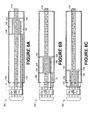
- Figures 6A-6C illustrate an example operation of the medical device, as shown in Figure 1 .
- the medical device 100 is placed within the vessel.
- the device 100 can be inserted into the colon through the anus.
- suction is activated through the center guide post 110. In doing so, suction is applied to the slots of the purse string plate 104 and 106.
- the disc protector 108 is then partially retracted so as to expose the purse string plate 104 and 106.
- the plate protector 108 may include a spring mechanism, so that the disc protector can be manually retracted.
- the plate protector 108 could simply be held in place by the surgeon, and once a suture is to be placed, the surgeon may slide the plate protector 108 away from the front end of the device 100.
- the plate protector 108 may screw downward from a housing of the medical device 100.
- the plate protector 108 may snap into two positions; a first position to cover the purse string discs, and a second position to expose the purse string discs to a specimen wall.
- Suction will be applied through the guide post 110 and draw a tissue wall of the specimen into the open slots of the purse string plate 104 and 106. As shown, openings are present within portions of the housing so as to enable the specimen to be received into the slots of the purse string plate 104 and 106. Suction may be applied through the center guide post 110 and the purse string plate connector 112 simultaneously to both purse string plate 104 and 106. Suction is applied to the vessel wall, however, only when the plate protector 108 is retracted. Suction is deactivated when the purse string plate connector 112 is snapped, opening suction to the peritoneal cavity (described below). The plate protector 108 is provided to allow a smooth surface to pass along the vessel wall when inserting the device 100, rather than inserting the device 100 into the vessel and exposing the notches/slots of the purse string plate 104 and 106 to the entire vessel wall.
- the turn-knob 124 can be rotated to advance the push plate 126 so as to advance the specimen suture plate 120.
- the push rods 128 and 130 will pass through the distal suture plate 122 so as to only advance the specimen suture plate 120, which in turn, advances the two suture wires 114.
- Ball bearings or other mechanisms can be used to facilitate advancement of the suture disc 120.
- the buckle bridges 118 keep the suture wires 114 from bending while advancing, and the knife on the specimen suture plate 120 breaks the buckle bridges as the specimen suture plate 120 advances.
- the suture wires 114 advance through the specimen that has been received into the slots of the purse string plate 104 using suction.
- the suture wire 114 will advance out of the purse string plate 104 through a side of the plate 104 and be visible on an anterior external vessel wall.
- Each end of the suture wires 114 can be grasped with a laparoscopic grasper and pulled out through a cannula.
- a suture is attached to the other ends of the suture wires 114, so that by pulling the two ends of the suture wires out of the purse string plate 104, the suture is placed into the specimen.
- the wires can be cut off and an extracorporeal knot is then tied to close an opening of the specimen.
- the advancement of the plate 126 initially advanced only the specimen suture plate 120 by advancing the push rods 128 and 130 through the openings 420 in the distal suture plate 122. Once the plate 126 contacts the distal suture disc 122, the distal suture plate 122 is advanced simultaneously with the specimen suture plate 120. This is shown in Figure 6B .
- the distal suture plate 122 will, in turn, advance the suture wires 116.
- the buckle bridges 118 keep the suture wires 116 from bending while advancing, and the knife 422 on the distal suture plate 122 breaks the buckle bridges as the distal suture plate 122 advances.
- the suture wires 116 advance through the specimen that has been received into the slots of the purse string plate 106 using suction.
- the suture wires 116 will advance out of the purse string plate 106 through a side of the plate 106 and be visible on an anterior external vessel wall.
- the two ends of the suture wires 116 can be grasped with a laparoscopic grasper and pulled out through a cannula.
- a suture is attached to the two other ends of the suture wires 116, so that by pulling the suture wires out of the purse string plate 106, the suture is placed into the specimen.
- the wires can be cut off and an extracorporeal knot can later be tied to close the distal end of the vessel.
- Figure 6C illustrates both the specimen suture plate 120 and the distal suture plate 122 being fully advanced and the suture wires 114 and 116 being placed within the purse string plate 104 and 106 and the specimen.
- purse string suture wires Once the purse string suture wires have been pulled through/removed, two purse string sutures are placed in the specimen wall.
- the portion of the specimen to be removed e.g., the rectum between the purse string plates, is cut using laparoscopic scissors.
- the purse string plate connector 112 is snapped by a laparoscopic grasper, separating the purse string plate 104 from the device 100.
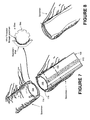
- An example is shown in Figure 7 .
- the plate 104 acts as a cap to seal the opening of the specimen.
- the suture can be tied around the plate 104 to close the opening of the specimen for the time being.
- each flange on distal purse string plate 106 may include an opening on an underside of the flange so that when the device 100 is removed from the specimen, the suture may slide through the opening of the flanges and remain in the specimen. In this manner, the device 100 including the distal purse string plate 106 can be removed from the specimen without altering the suture that was placed in the distal end.
- the distal end purse string sutures can be applied by pulling the suture wires 116 with a laparoscopic grasper and an extracorporeal knot can be tied to close the vessel, as shown in Figure 8 .
- the seal of the distal end may be less than that of the proximal end because the plate 104 is still present in the proximal end of the specimen to fully seal the opening. This is beneficial because the proximal end of the specimen will usually include contents, e.g., stool, and so it is important to ensure that no leakage occurs at the proximal end. In contrast, the distal end may include less or no contents, and thus providing a substantially sealed opening is sufficient.
- the portion of the colon to be excised can now be extracted.
- the plate 104 is also removed with the excised portion.
- an anvil is placed in the proximal bowel.
- An end-to-end anastomosis stapler cartridge can then be advanced to the purse string suture 116, and the suture 116 is tied around the center post of the stapler to perform the connection between the proximal and distal ends of the specimen.
- the medical device of the present application can have many benefits and applications for laparoscopic surgery to remove portions of the colon, for example.
- the medical device allows for less invasive procedures to be taken, since the device is inserted through an existing orifice and fewer incisions are needed. Further, the device automates a procedure that can be difficult at times due to placement of the sutures within areas of the human body cavity that are not very accessible. Further, the device provides for a means to simultaneously divide the vessel and occlude the cut proximal end to prevent leakage of the vessel's contents.
- the medical device automatically applies purse string sutures in that the medical device eliminates the manual application of sutures to the tissue by a surgeon, and quickly and accurately applies a suture to tissue with minimal steps and typically in less time than manual suturing.
- the medical device 100 may include multiple purse string plates, however, only one suture may be applied. Other examples are possible as well.
Landscapes
- Health & Medical Sciences (AREA)
- Life Sciences & Earth Sciences (AREA)
- Surgery (AREA)
- Heart & Thoracic Surgery (AREA)
- Engineering & Computer Science (AREA)
- Biomedical Technology (AREA)
- Nuclear Medicine, Radiotherapy & Molecular Imaging (AREA)
- Medical Informatics (AREA)
- Molecular Biology (AREA)
- Animal Behavior & Ethology (AREA)
- General Health & Medical Sciences (AREA)
- Public Health (AREA)
- Veterinary Medicine (AREA)
- Surgical Instruments (AREA)
- Materials For Medical Uses (AREA)
Claims (15)
- Instrument chirurgical (100) pour appliquer des sutures en bourse à un tissu, comprenant :une première plaque de suture en bourse (104, 200) présentant des encoches (202) autour de son périmètre pour recevoir un tissu et à travers lesquelles un premier fil de suture (114) peut passer ;une première plaque de poussée (120) pour faire avancer le premier fil de suture à travers les encoches de la première plaque de bourse et dans le tissu afin de permettre l'application d'une première suture en bourse ;une seconde plaque de suture en bourse (106, 200) ayant des encoches (202) autour de son périmètre pour recevoir le tissu et à travers lesquelles un second fil de suture (116) peut passer ;une deuxième plaque de poussée (122) pour faire avancer le second fil de suture à travers les encoches de la seconde plaque de suture en bourse et dans le tissu afin de permettre l'application d'une seconde suture en bourse ; etun logement (102) pour loger l'instrument chirurgical, dans lequel le logement a une extrémité avant (102a) et une extrémité arrière (102b) et dans lequel la première plaque et la seconde plaque de suture en bourse sont situées à l'extrémité avant du boîtier, la paire de plaques de suture en bourse étant configurée pour permettre l'application de deux sutures en bourse axialement espacées sur le tissu environnant.
- Instrument chirurgical selon la revendication 1, dans lequel la première et la seconde plaque de suture en bourse se présentent sous la forme d'un premier et d'un second disque circulaire.
- Instrument chirurgical selon la revendication 1 ou la revendication 2, comprenant en outre un montant de guidage (110) à travers lequel une aspiration est appliquée à la première plaque de suture en bourse et à la seconde plaque de suture en bourse pour aspirer le tissu dans les encoches de la première plaque de suture en bourse et de la seconde plaque de suture en bourse.
- Instrument chirurgical selon la revendication 3, comprenant un raccord de disques (112) positionné entre la première plaque de suture en bourse et la seconde plaque de suture en bourse et à travers lequel une aspiration est appliquée à la première plaque de suture en bourse.
- Instrument chirurgical selon l'une quelconque des revendications précédentes, comprenant en outre des tiges de poussée (128, 130) pour faire avancer la première plaque de poussée.
- Instrument chirurgical selon l'une quelconque des revendications précédentes, comprenant en outre un protecteur de disques (108) entourant la première plaque de suture en bourse et la seconde plaque de suture en bourse.
- Instrument chirurgical selon la revendication 6 lorsqu'elle dépend de la revendication 3, dans lequel le montant de guidage applique une aspiration à la première plaque de suture en bourse et à la seconde plaque de suture en bourse pour aspirer le tissu dans les encoches de la première plaque de suture en bourse et de la seconde plaque de suture en bourse lorsque le protecteur de disques est rétracté.
- Instrument chirurgical selon l'une quelconque des revendications précédentes, comprenant en outre une troisième plaque de poussée (126) pour faire avancer la deuxième plaque de poussée.
- Instrument chirurgical selon l'une quelconque des revendications précédentes, comprenant en outre :une suture dans la première plaque de poussée raccordée à une extrémité du premier fil de suture ; etune suture dans la deuxième plaque de poussée raccordée à une extrémité du second fil de suture.
- Instrument chirurgical selon la revendication 9, dans lequel le premier fil de suture est avancé à travers la moitié des encoches de la première plaque de suture en bourse et comprenant en outre un autre fil de suture avancé par la première plaque de poussée à travers l'autre moitié des encoches de la première plaque de suture en bourse.
- Instrument chirurgical selon la revendication 1, comprenant en outre un arbre (110) à travers lequel une aspiration est appliquée à la première plaque de suture en bourse pour aspirer le tissu dans les encoches de la plaque de suture en bourse.
- Instrument chirurgical selon la revendication 1 ou la revendication 11, dans lequel les encoches du périmètre de la première plaque de suture en bourse sont formées entre des saillies (204), dans lequel les saillies comprennent un passage à travers lequel le fil de suture peut passer.
- Instrument chirurgical selon la revendication 12, dans lequel le passage à l'intérieur des saillies à travers lequel le fil de suture peut passer est un passage aminci ayant une extrémité pour recevoir le fil de suture avec un diamètre plus grand que l'extrémité pour faire sortir le fil de suture.
- Instrument chirurgical selon la revendication 12 ou la revendication 13, dans lequel l'une des saillies de la première plaque de suture en bourse comprend une ouverture (206, 208) pour diriger le fil de suture à l'intérieur des saillies restantes de la première plaque de suture en bourse et dans lequel l'une des saillies de la première plaque de suture en bourse comprend une ouverture (206, 208) pour diriger le fil de suture à l'extérieur de la première plaque de suture en bourse.
- Instrument chirurgical selon la revendication 12, 13 ou 14, comprenant en outre :des ponts à boucles (118) pour maintenir le fil de suture en place dans le logement tout en faisant avancer le fil de suture à travers les encoches de la première plaque de suture en bourse.
Applications Claiming Priority (2)
| Application Number | Priority Date | Filing Date | Title |
|---|---|---|---|
| US11/696,677 US7981124B2 (en) | 2007-04-04 | 2007-04-04 | Medical device for applying purse string sutures |
| PCT/US2008/058991 WO2008124383A2 (fr) | 2007-04-04 | 2008-04-01 | Dispositif médical pour appliquer des sutures en bourse |
Publications (3)
| Publication Number | Publication Date |
|---|---|
| EP2131748A2 EP2131748A2 (fr) | 2009-12-16 |
| EP2131748A4 EP2131748A4 (fr) | 2012-09-12 |
| EP2131748B1 true EP2131748B1 (fr) | 2015-09-09 |
Family
ID=39827624
Family Applications (1)
| Application Number | Title | Priority Date | Filing Date |
|---|---|---|---|
| EP08744841.1A Not-in-force EP2131748B1 (fr) | 2007-04-04 | 2008-04-01 | Dispositif médical pour appliquer des sutures en bourse |
Country Status (3)
| Country | Link |
|---|---|
| US (1) | US7981124B2 (fr) |
| EP (1) | EP2131748B1 (fr) |
| WO (1) | WO2008124383A2 (fr) |
Families Citing this family (6)
| Publication number | Priority date | Publication date | Assignee | Title |
|---|---|---|---|---|
| US8827136B2 (en) * | 2010-08-11 | 2014-09-09 | Covidien Lp | Endoscopic purse string surgical device |
| US9149271B2 (en) * | 2010-11-22 | 2015-10-06 | The Board Of Trustees Of The Leland Stanford, Jr. University | Device and method for treatment of hemorrhoids |
| GB201208024D0 (en) * | 2012-05-08 | 2012-06-20 | Berry Alexander C | Suturing device |
| CN104546044B (zh) * | 2014-04-18 | 2017-03-15 | 北京派尔特医疗科技股份有限公司 | 一种荷包成型装置 |
| CN105250000B (zh) * | 2014-07-16 | 2018-09-25 | 北京派尔特医疗科技股份有限公司 | 一种荷包缝合装置 |
| US20210393259A1 (en) * | 2018-10-19 | 2021-12-23 | NICE Surgical Solutions Pte. Ltd. | Devices and methods for minimally invasive surgical procedures |
Family Cites Families (53)
| Publication number | Priority date | Publication date | Assignee | Title |
|---|---|---|---|---|
| US4304236A (en) * | 1977-05-26 | 1981-12-08 | United States Surgical Corporation | Stapling instrument having an anvil-carrying part of particular geometric shape |
| US4198982A (en) * | 1978-03-31 | 1980-04-22 | Memorial Hospital For Cancer And Allied Diseases | Surgical stapling instrument and method |
| US4345600A (en) * | 1980-08-04 | 1982-08-24 | Senco Products, Inc. | Purse-stringer |
| US4602636A (en) * | 1983-03-08 | 1986-07-29 | Joint Medical Products Corporation | Suture wire with integral needle-like tip |
| US4592354A (en) * | 1983-10-11 | 1986-06-03 | Senmed, Inc. | Tissue retention spool for intraluminal anastomotic surgical stapling instrument and methods |
| US4602635A (en) | 1983-11-14 | 1986-07-29 | Mulhollan James S | Remote surgical knot tier and method of use |
| US4667673A (en) * | 1984-03-12 | 1987-05-26 | American Cyanamid Company | Anastomotic device applicator and method |
| GB8422863D0 (en) | 1984-09-11 | 1984-10-17 | Univ London | Sewing machine |
| US4917114A (en) * | 1986-10-17 | 1990-04-17 | United States Surgical Corporation | Surgical fastener and surgical stapling apparatus |
| US4749114A (en) | 1986-11-10 | 1988-06-07 | United States Surgical Corporation | Purse string applicator and method of affixing a purse string |
| US5285944A (en) * | 1987-05-26 | 1994-02-15 | United States Surgical Corporation | Surgical stapler apparatus |
| US4773420A (en) * | 1987-06-22 | 1988-09-27 | U.S. Surgical Corporation | Purse string applicator |
| US4821939A (en) | 1987-09-02 | 1989-04-18 | United States Surgical Corporation | Staple cartridge and an anvilless surgical stapler |
| IT1216042B (it) | 1988-03-09 | 1990-02-22 | Carlo Rebuffat | Strumento automatico per suture a borsa di tabacco ad uso chirurgico. |
| US4930674A (en) * | 1989-02-24 | 1990-06-05 | Abiomed, Inc. | Surgical stapler |
| USD322478S (en) * | 1989-05-25 | 1991-12-17 | United States Surgical Corporation | Surgical purse string applicator |
| US5549122A (en) * | 1989-07-26 | 1996-08-27 | Detweilwer; Mark B. | Methods of surgical mammalian vessel anastomosis |
| US5080663A (en) | 1990-09-26 | 1992-01-14 | Univerity College London | Sewing device |
| US5122156A (en) * | 1990-12-14 | 1992-06-16 | United States Surgical Corporation | Apparatus for securement and attachment of body organs |
| US5222963A (en) * | 1991-01-17 | 1993-06-29 | Ethicon, Inc. | Pull-through circular anastomosic intraluminal stapler with absorbable fastener means |
| GR920100358A (el) * | 1991-08-23 | 1993-06-07 | Ethicon Inc | Οργανο συρραφής χειρουργικής αναστομώσεως. |
| US5443198A (en) * | 1991-10-18 | 1995-08-22 | United States Surgical Corporation | Surgical fastener applying apparatus |
| US5197649A (en) * | 1991-10-29 | 1993-03-30 | The Trustees Of Columbia University In The City Of New York | Gastrointestinal endoscoptic stapler |
| US5282810A (en) * | 1992-04-08 | 1994-02-01 | American Cyanamid Company | Surgical anastomosis device |
| US5425737A (en) | 1992-04-08 | 1995-06-20 | American Cyanamid Co. | Surgical purse string suturing instrument and method |
| US5188636A (en) | 1992-05-07 | 1993-02-23 | Ethicon, Inc. | Purse string suture instrument |
| US5484451A (en) | 1992-05-08 | 1996-01-16 | Ethicon, Inc. | Endoscopic surgical instrument and staples for applying purse string sutures |
| US5242457A (en) | 1992-05-08 | 1993-09-07 | Ethicon, Inc. | Surgical instrument and staples for applying purse string sutures |
| US5722981A (en) * | 1993-10-08 | 1998-03-03 | Tahoe Surgical Instruments | Double needle ligature device |
| US5490856A (en) * | 1993-12-14 | 1996-02-13 | Untied States Surgical Corporation | Purse string stapler |
| US5496332A (en) * | 1994-10-20 | 1996-03-05 | Cordis Corporation | Wound closure apparatus and method for its use |
| WO1997007745A1 (fr) * | 1995-08-24 | 1997-03-06 | Nobles-Lai Engineering, Inc. | Procede et appareil pour suturer |
| US6117144A (en) * | 1995-08-24 | 2000-09-12 | Sutura, Inc. | Suturing device and method for sealing an opening in a blood vessel or other biological structure |
| US5814054A (en) * | 1996-09-23 | 1998-09-29 | Symbiosis Corporation | Automatic needle-passer suturing instrument |
| US5891159A (en) | 1997-05-02 | 1999-04-06 | Cardiothoratic Systems, Inc. | Automatic purse string suture device |
| US5951590A (en) * | 1998-06-09 | 1999-09-14 | Goldfarb; Michael A. | Soft tissue suture anchor |
| US6126058A (en) * | 1998-06-19 | 2000-10-03 | Scimed Life Systems, Inc. | Method and device for full thickness resectioning of an organ |
| US6083241A (en) * | 1998-11-23 | 2000-07-04 | Ethicon Endo-Surgery, Inc. | Method of use of a circular stapler for hemorrhoidal procedure |
| EP1196092A1 (fr) * | 1999-06-18 | 2002-04-17 | Radi Medical Systems Ab | Outil, dispositif de fermeture, systeme et procede de fermeture de plaie |
| IL132635A0 (en) * | 1999-10-28 | 2001-03-19 | Niti Alloys Tech Ltd | Shape memory alloy clip and method of use thereof |
| US6193129B1 (en) * | 2000-01-24 | 2001-02-27 | Ethicon Endo-Surgery, Inc. | Cutting blade for a surgical anastomosis stapling instrument |
| US6663643B2 (en) | 2000-03-27 | 2003-12-16 | Onux Medical, Inc. | Surgical suturing instrument and method of use |
| US6997931B2 (en) | 2001-02-02 | 2006-02-14 | Lsi Solutions, Inc. | System for endoscopic suturing |
| US7083629B2 (en) | 2001-05-30 | 2006-08-01 | Satiety, Inc. | Overtube apparatus for insertion into a body |
| US7128748B2 (en) * | 2002-03-26 | 2006-10-31 | Synovis Life Technologies, Inc. | Circular stapler buttress combination |
| WO2004032766A2 (fr) * | 2002-10-04 | 2004-04-22 | Tyco Healthcare Group Lp | Agrafeuse chirurgicale |
| WO2005009216A2 (fr) * | 2003-07-16 | 2005-02-03 | Tyco Healthcare Group, Lp | Dispositif d'agrafage chirurgical dote d'un tendeur de tissus |
| US7320693B2 (en) * | 2003-08-21 | 2008-01-22 | Pollak Stanley B | Methods and instruments for closing laparoscopic trocar puncture wounds |
| JP4212494B2 (ja) * | 2004-03-02 | 2009-01-21 | 日本シャーウッド株式会社 | 医療用縫合具 |
| US7318830B2 (en) | 2004-04-12 | 2008-01-15 | Mayoral Jaime L | Apparatus and method of use of a circular surgical stapler |
| CA2566794A1 (fr) * | 2004-05-17 | 2005-12-08 | Datascope Investment Corp. | Systeme d'agrafage chirurgical |
| EP1773177A4 (fr) | 2004-06-30 | 2009-03-25 | James V Sitzmann | Dispositifs medicaux destines aux interventions chirurgicales a invasivite minimale et a d'autres operations internes |
| JP4614451B2 (ja) * | 2005-12-26 | 2011-01-19 | 日本シャーウッド株式会社 | 医療用縫合具 |
-
2007
- 2007-04-04 US US11/696,677 patent/US7981124B2/en not_active Expired - Fee Related
-
2008
- 2008-04-01 EP EP08744841.1A patent/EP2131748B1/fr not_active Not-in-force
- 2008-04-01 WO PCT/US2008/058991 patent/WO2008124383A2/fr not_active Ceased
Also Published As
| Publication number | Publication date |
|---|---|
| EP2131748A2 (fr) | 2009-12-16 |
| EP2131748A4 (fr) | 2012-09-12 |
| WO2008124383A3 (fr) | 2008-12-11 |
| US20080249544A1 (en) | 2008-10-09 |
| US7981124B2 (en) | 2011-07-19 |
| WO2008124383A2 (fr) | 2008-10-16 |
Similar Documents
| Publication | Publication Date | Title |
|---|---|---|
| US5591180A (en) | Surgical suturing apparatus | |
| US6024747A (en) | Device and method for suturing blood vessels and the like | |
| US8425538B2 (en) | Suturing device for sealing a puncture in an anatomical structure | |
| US6436109B1 (en) | Device and method for suturing blood vessels and the like | |
| EP2230987B1 (fr) | Systèmes médicaux de suture de perforations par voie endoscopique | |
| EP2496148B1 (fr) | Clamps plans pour anastomose | |
| US5997555A (en) | Device and method for suturing blood vessels | |
| EP1229841B1 (fr) | Systeme de fermeture de plaies | |
| US8460314B2 (en) | Application of procedure through natural orifice | |
| CA2613577C (fr) | Clamp a tissu pour excision endoluminale locale de tissu | |
| US20090082785A1 (en) | Anvil Delivery Device Accessory | |
| WO2014178046A1 (fr) | Suture pouvant être fixée et poussée par une tige | |
| KR20140114838A (ko) | 유체 유동을 차단 또는 촉진시키기 위한 장치들 및 방법들 | |
| EP3866704B1 (fr) | Dispositifs d'interventions chirurgicales minimalement invasives | |
| US7981124B2 (en) | Medical device for applying purse string sutures | |
| US20040167547A1 (en) | Surgical suture placement device | |
| JP2012024607A (ja) | 縫合器 | |
| US20110112553A1 (en) | Wound closure device | |
| CN119488666A (zh) | 扩张器及血管鞘 | |
| US11602339B2 (en) | Laparoscopic purse string suture device | |
| JP2024519881A (ja) | 吻合部を形成するためのシステム、装置および方法 |
Legal Events
| Date | Code | Title | Description |
|---|---|---|---|
| PUAI | Public reference made under article 153(3) epc to a published international application that has entered the european phase |
Free format text: ORIGINAL CODE: 0009012 |
|
| 17P | Request for examination filed |
Effective date: 20091009 |
|
| AK | Designated contracting states |
Kind code of ref document: A2 Designated state(s): AT BE BG CH CY CZ DE DK EE ES FI FR GB GR HR HU IE IS IT LI LT LU LV MC MT NL NO PL PT RO SE SI SK TR |
|
| DAX | Request for extension of the european patent (deleted) | ||
| A4 | Supplementary search report drawn up and despatched |
Effective date: 20120813 |
|
| RIC1 | Information provided on ipc code assigned before grant |
Ipc: A61B 17/04 20060101AFI20120807BHEP |
|
| GRAP | Despatch of communication of intention to grant a patent |
Free format text: ORIGINAL CODE: EPIDOSNIGR1 |
|
| INTG | Intention to grant announced |
Effective date: 20150326 |
|
| GRAS | Grant fee paid |
Free format text: ORIGINAL CODE: EPIDOSNIGR3 |
|
| GRAA | (expected) grant |
Free format text: ORIGINAL CODE: 0009210 |
|
| AK | Designated contracting states |
Kind code of ref document: B1 Designated state(s): AT BE BG CH CY CZ DE DK EE ES FI FR GB GR HR HU IE IS IT LI LT LU LV MC MT NL NO PL PT RO SE SI SK TR |
|
| REG | Reference to a national code |
Ref country code: GB Ref legal event code: FG4D |
|
| REG | Reference to a national code |
Ref country code: AT Ref legal event code: REF Ref document number: 747443 Country of ref document: AT Kind code of ref document: T Effective date: 20150915 Ref country code: CH Ref legal event code: EP |
|
| REG | Reference to a national code |
Ref country code: IE Ref legal event code: FG4D |
|
| REG | Reference to a national code |
Ref country code: DE Ref legal event code: R096 Ref document number: 602008040078 Country of ref document: DE |
|
| REG | Reference to a national code |
Ref country code: NL Ref legal event code: MP Effective date: 20150909 |
|
| PG25 | Lapsed in a contracting state [announced via postgrant information from national office to epo] |
Ref country code: NO Free format text: LAPSE BECAUSE OF FAILURE TO SUBMIT A TRANSLATION OF THE DESCRIPTION OR TO PAY THE FEE WITHIN THE PRESCRIBED TIME-LIMIT Effective date: 20151209 Ref country code: GR Free format text: LAPSE BECAUSE OF FAILURE TO SUBMIT A TRANSLATION OF THE DESCRIPTION OR TO PAY THE FEE WITHIN THE PRESCRIBED TIME-LIMIT Effective date: 20151210 Ref country code: LV Free format text: LAPSE BECAUSE OF FAILURE TO SUBMIT A TRANSLATION OF THE DESCRIPTION OR TO PAY THE FEE WITHIN THE PRESCRIBED TIME-LIMIT Effective date: 20150909 Ref country code: LT Free format text: LAPSE BECAUSE OF FAILURE TO SUBMIT A TRANSLATION OF THE DESCRIPTION OR TO PAY THE FEE WITHIN THE PRESCRIBED TIME-LIMIT Effective date: 20150909 Ref country code: FI Free format text: LAPSE BECAUSE OF FAILURE TO SUBMIT A TRANSLATION OF THE DESCRIPTION OR TO PAY THE FEE WITHIN THE PRESCRIBED TIME-LIMIT Effective date: 20150909 |
|
| REG | Reference to a national code |
Ref country code: LT Ref legal event code: MG4D |
|
| REG | Reference to a national code |
Ref country code: AT Ref legal event code: MK05 Ref document number: 747443 Country of ref document: AT Kind code of ref document: T Effective date: 20150909 |
|
| PG25 | Lapsed in a contracting state [announced via postgrant information from national office to epo] |
Ref country code: ES Free format text: LAPSE BECAUSE OF FAILURE TO SUBMIT A TRANSLATION OF THE DESCRIPTION OR TO PAY THE FEE WITHIN THE PRESCRIBED TIME-LIMIT Effective date: 20150909 Ref country code: SE Free format text: LAPSE BECAUSE OF FAILURE TO SUBMIT A TRANSLATION OF THE DESCRIPTION OR TO PAY THE FEE WITHIN THE PRESCRIBED TIME-LIMIT Effective date: 20150909 Ref country code: HR Free format text: LAPSE BECAUSE OF FAILURE TO SUBMIT A TRANSLATION OF THE DESCRIPTION OR TO PAY THE FEE WITHIN THE PRESCRIBED TIME-LIMIT Effective date: 20150909 |
|
| PG25 | Lapsed in a contracting state [announced via postgrant information from national office to epo] |
Ref country code: NL Free format text: LAPSE BECAUSE OF FAILURE TO SUBMIT A TRANSLATION OF THE DESCRIPTION OR TO PAY THE FEE WITHIN THE PRESCRIBED TIME-LIMIT Effective date: 20150909 |
|
| PG25 | Lapsed in a contracting state [announced via postgrant information from national office to epo] |
Ref country code: CZ Free format text: LAPSE BECAUSE OF FAILURE TO SUBMIT A TRANSLATION OF THE DESCRIPTION OR TO PAY THE FEE WITHIN THE PRESCRIBED TIME-LIMIT Effective date: 20150909 Ref country code: IS Free format text: LAPSE BECAUSE OF FAILURE TO SUBMIT A TRANSLATION OF THE DESCRIPTION OR TO PAY THE FEE WITHIN THE PRESCRIBED TIME-LIMIT Effective date: 20160109 Ref country code: SK Free format text: LAPSE BECAUSE OF FAILURE TO SUBMIT A TRANSLATION OF THE DESCRIPTION OR TO PAY THE FEE WITHIN THE PRESCRIBED TIME-LIMIT Effective date: 20150909 Ref country code: IT Free format text: LAPSE BECAUSE OF FAILURE TO SUBMIT A TRANSLATION OF THE DESCRIPTION OR TO PAY THE FEE WITHIN THE PRESCRIBED TIME-LIMIT Effective date: 20150909 Ref country code: EE Free format text: LAPSE BECAUSE OF FAILURE TO SUBMIT A TRANSLATION OF THE DESCRIPTION OR TO PAY THE FEE WITHIN THE PRESCRIBED TIME-LIMIT Effective date: 20150909 |
|
| PG25 | Lapsed in a contracting state [announced via postgrant information from national office to epo] |
Ref country code: RO Free format text: LAPSE BECAUSE OF FAILURE TO SUBMIT A TRANSLATION OF THE DESCRIPTION OR TO PAY THE FEE WITHIN THE PRESCRIBED TIME-LIMIT Effective date: 20150909 Ref country code: AT Free format text: LAPSE BECAUSE OF FAILURE TO SUBMIT A TRANSLATION OF THE DESCRIPTION OR TO PAY THE FEE WITHIN THE PRESCRIBED TIME-LIMIT Effective date: 20150909 Ref country code: PL Free format text: LAPSE BECAUSE OF FAILURE TO SUBMIT A TRANSLATION OF THE DESCRIPTION OR TO PAY THE FEE WITHIN THE PRESCRIBED TIME-LIMIT Effective date: 20150909 Ref country code: PT Free format text: LAPSE BECAUSE OF FAILURE TO SUBMIT A TRANSLATION OF THE DESCRIPTION OR TO PAY THE FEE WITHIN THE PRESCRIBED TIME-LIMIT Effective date: 20160111 |
|
| REG | Reference to a national code |
Ref country code: DE Ref legal event code: R097 Ref document number: 602008040078 Country of ref document: DE |
|
| PLBE | No opposition filed within time limit |
Free format text: ORIGINAL CODE: 0009261 |
|
| STAA | Information on the status of an ep patent application or granted ep patent |
Free format text: STATUS: NO OPPOSITION FILED WITHIN TIME LIMIT |
|
| 26N | No opposition filed |
Effective date: 20160610 |
|
| PG25 | Lapsed in a contracting state [announced via postgrant information from national office to epo] |
Ref country code: SI Free format text: LAPSE BECAUSE OF FAILURE TO SUBMIT A TRANSLATION OF THE DESCRIPTION OR TO PAY THE FEE WITHIN THE PRESCRIBED TIME-LIMIT Effective date: 20150909 Ref country code: BE Free format text: LAPSE BECAUSE OF NON-PAYMENT OF DUE FEES Effective date: 20160430 Ref country code: DK Free format text: LAPSE BECAUSE OF FAILURE TO SUBMIT A TRANSLATION OF THE DESCRIPTION OR TO PAY THE FEE WITHIN THE PRESCRIBED TIME-LIMIT Effective date: 20150909 |
|
| REG | Reference to a national code |
Ref country code: CH Ref legal event code: PL |
|
| PG25 | Lapsed in a contracting state [announced via postgrant information from national office to epo] |
Ref country code: LU Free format text: LAPSE BECAUSE OF FAILURE TO SUBMIT A TRANSLATION OF THE DESCRIPTION OR TO PAY THE FEE WITHIN THE PRESCRIBED TIME-LIMIT Effective date: 20160401 Ref country code: BE Free format text: LAPSE BECAUSE OF FAILURE TO SUBMIT A TRANSLATION OF THE DESCRIPTION OR TO PAY THE FEE WITHIN THE PRESCRIBED TIME-LIMIT Effective date: 20150909 |
|
| REG | Reference to a national code |
Ref country code: IE Ref legal event code: MM4A |
|
| REG | Reference to a national code |
Ref country code: FR Ref legal event code: ST Effective date: 20161230 |
|
| PG25 | Lapsed in a contracting state [announced via postgrant information from national office to epo] |
Ref country code: CH Free format text: LAPSE BECAUSE OF NON-PAYMENT OF DUE FEES Effective date: 20160430 Ref country code: LI Free format text: LAPSE BECAUSE OF NON-PAYMENT OF DUE FEES Effective date: 20160430 Ref country code: FR Free format text: LAPSE BECAUSE OF NON-PAYMENT OF DUE FEES Effective date: 20160502 |
|
| PG25 | Lapsed in a contracting state [announced via postgrant information from national office to epo] |
Ref country code: IE Free format text: LAPSE BECAUSE OF NON-PAYMENT OF DUE FEES Effective date: 20160401 |
|
| PGFP | Annual fee paid to national office [announced via postgrant information from national office to epo] |
Ref country code: GB Payment date: 20170427 Year of fee payment: 10 Ref country code: DE Payment date: 20170427 Year of fee payment: 10 |
|
| PG25 | Lapsed in a contracting state [announced via postgrant information from national office to epo] |
Ref country code: HU Free format text: LAPSE BECAUSE OF FAILURE TO SUBMIT A TRANSLATION OF THE DESCRIPTION OR TO PAY THE FEE WITHIN THE PRESCRIBED TIME-LIMIT; INVALID AB INITIO Effective date: 20080401 Ref country code: CY Free format text: LAPSE BECAUSE OF FAILURE TO SUBMIT A TRANSLATION OF THE DESCRIPTION OR TO PAY THE FEE WITHIN THE PRESCRIBED TIME-LIMIT Effective date: 20150909 |
|
| PG25 | Lapsed in a contracting state [announced via postgrant information from national office to epo] |
Ref country code: MC Free format text: LAPSE BECAUSE OF FAILURE TO SUBMIT A TRANSLATION OF THE DESCRIPTION OR TO PAY THE FEE WITHIN THE PRESCRIBED TIME-LIMIT Effective date: 20150909 Ref country code: TR Free format text: LAPSE BECAUSE OF FAILURE TO SUBMIT A TRANSLATION OF THE DESCRIPTION OR TO PAY THE FEE WITHIN THE PRESCRIBED TIME-LIMIT Effective date: 20150909 Ref country code: MT Free format text: LAPSE BECAUSE OF NON-PAYMENT OF DUE FEES Effective date: 20160430 |
|
| PG25 | Lapsed in a contracting state [announced via postgrant information from national office to epo] |
Ref country code: BG Free format text: LAPSE BECAUSE OF FAILURE TO SUBMIT A TRANSLATION OF THE DESCRIPTION OR TO PAY THE FEE WITHIN THE PRESCRIBED TIME-LIMIT Effective date: 20150909 |
|
| REG | Reference to a national code |
Ref country code: DE Ref legal event code: R119 Ref document number: 602008040078 Country of ref document: DE |
|
| GBPC | Gb: european patent ceased through non-payment of renewal fee |
Effective date: 20180401 |
|
| PG25 | Lapsed in a contracting state [announced via postgrant information from national office to epo] |
Ref country code: DE Free format text: LAPSE BECAUSE OF NON-PAYMENT OF DUE FEES Effective date: 20181101 |
|
| PG25 | Lapsed in a contracting state [announced via postgrant information from national office to epo] |
Ref country code: GB Free format text: LAPSE BECAUSE OF NON-PAYMENT OF DUE FEES Effective date: 20180401 |