EP2133473A1 - Sweeping brush cover and sweeping machine with such a cover - Google Patents

Sweeping brush cover and sweeping machine with such a cover Download PDF

Info

Publication number
EP2133473A1
EP2133473A1 EP08010782A EP08010782A EP2133473A1 EP 2133473 A1 EP2133473 A1 EP 2133473A1 EP 08010782 A EP08010782 A EP 08010782A EP 08010782 A EP08010782 A EP 08010782A EP 2133473 A1 EP2133473 A1 EP 2133473A1
Authority
EP
European Patent Office
Prior art keywords
sweeping brush
sweeping
shield element
adjusting means
cover according
Prior art date
Legal status (The legal status is an assumption and is not a legal conclusion. Google has not performed a legal analysis and makes no representation as to the accuracy of the status listed.)
Withdrawn
Application number
EP08010782A
Other languages
German (de)
French (fr)
Inventor
Marcel Boschung
Kurt Wuillemin
Current Assignee (The listed assignees may be inaccurate. Google has not performed a legal analysis and makes no representation or warranty as to the accuracy of the list.)
Boschung Engineering AG
Original Assignee
Boschung Engineering AG
Priority date (The priority date is an assumption and is not a legal conclusion. Google has not performed a legal analysis and makes no representation as to the accuracy of the date listed.)
Filing date
Publication date
Application filed by Boschung Engineering AG filed Critical Boschung Engineering AG
Priority to EP08010782A priority Critical patent/EP2133473A1/en
Publication of EP2133473A1 publication Critical patent/EP2133473A1/en
Withdrawn legal-status Critical Current

Links

Images

Classifications

    • EFIXED CONSTRUCTIONS
    • E01CONSTRUCTION OF ROADS, RAILWAYS, OR BRIDGES
    • E01HSTREET CLEANING; CLEANING OF PERMANENT WAYS; CLEANING BEACHES; DISPERSING OR PREVENTING FOG IN GENERAL CLEANING STREET OR RAILWAY FURNITURE OR TUNNEL WALLS
    • E01H1/00Removing undesirable matter from roads or like surfaces, with or without moistening of the surface
    • E01H1/02Brushing apparatus, e.g. with auxiliary instruments for mechanically loosening dirt
    • E01H1/05Brushing apparatus, e.g. with auxiliary instruments for mechanically loosening dirt with driven brushes
    • E01H1/056Brushing apparatus, e.g. with auxiliary instruments for mechanically loosening dirt with driven brushes having horizontal axes
    • EFIXED CONSTRUCTIONS
    • E01CONSTRUCTION OF ROADS, RAILWAYS, OR BRIDGES
    • E01HSTREET CLEANING; CLEANING OF PERMANENT WAYS; CLEANING BEACHES; DISPERSING OR PREVENTING FOG IN GENERAL CLEANING STREET OR RAILWAY FURNITURE OR TUNNEL WALLS
    • E01H5/00Removing snow or ice from roads or like surfaces; Grading or roughening snow or ice
    • E01H5/04Apparatus propelled by animal or engine power; Apparatus propelled by hand with driven dislodging or conveying levelling elements, conveying pneumatically for the dislodged material
    • E01H5/08Apparatus propelled by animal or engine power; Apparatus propelled by hand with driven dislodging or conveying levelling elements, conveying pneumatically for the dislodged material dislodging essentially by driven elements
    • E01H5/09Apparatus propelled by animal or engine power; Apparatus propelled by hand with driven dislodging or conveying levelling elements, conveying pneumatically for the dislodged material dislodging essentially by driven elements the elements being rotary or moving along a closed circular path, e.g. rotary cutter, digging wheels
    • E01H5/092Brushing elements

Definitions

  • the invention relates to a sweeping brush cover according to the preamble of claim 1. Furthermore, the invention relates to a sweeping brush assembly with such sweeping brush cover and a so-equipped sweeper. Furthermore, the invention relates to a method for covering a sweeping brush.
  • sweeping brushes In cleaning vehicles, especially in sweeper vehicles for snow removal, large, cylindrical or cylindrical sweeping brushes are used. These sweeping brushes with bristles of steel or plastic can be several meters long and are operated at considerable speeds and the appropriately equipped sweeping vehicles are used, for example, for clearing snow on airport runways or on roads. Such a vehicle is eg off EP-A-0 288 436 known and in FIG. 8 shown. Above the sweeping brush, a cover is provided as a rigid, curved shield. It is also known to form the cover of two rigid shield parts, which are pivotable to each other, or to provide a single, pivotable, rigid shield, which is to be adapted to the operating in the sweeping brush by wearing the bristles reducing brush diameter.
  • the cavity formed by pivoting rigid shield parts in various forms above the brush can fill with snow and it can form ice, which is disadvantageous.
  • By turning in while panning its shape-changing cavity is also the routing of the entrained by the brush snow different depending on the brush diameter.
  • the invention is based on the object to provide a sweeping brush cover which does not have these disadvantages.
  • the shield element is formed from a plastic, which results in a cover which is advantageous in terms of weight and can provide a smooth surface without high processing costs during manufacture, to which snow does not adhere.
  • a plastic which results in a cover which is advantageous in terms of weight and can provide a smooth surface without high processing costs during manufacture, to which snow does not adhere.
  • an ultra-high molecular weight polyethylene is used, if necessary with a wear-optimizing additive, in particular of glass particles.
  • the adjusting means on guides, in particular two coupled parallelogram guides, which adjust the front and the rear end of the shield element in the course of bending to adapt to the diameter of the sweeping brush so that in most or all bending situations, there is a cavity extending continuously rearward to the outlet above the sweeping brush.
  • Such adjustment means have the advantage that they require little installation space above the brush.
  • the adjusting means are further designed so that the outlet side, a rotation of the element takes place in order to better adapt to the sweeping brush shape.
  • the invention is further based on the object to provide a sweeping brush assembly and a sweeper, which do not have the disadvantages mentioned.
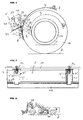
  • FIG. 8 shows a basically known Kehrblasmaschine 15, which is used in particular for removing snow from the surface 5 to be cleaned.
  • the sweeper for this purpose has a sweeping brush 10, which is arranged as a substantially cylindrical roller and is rotationally driven in the direction of the arrow shown.
  • the sweeping brush 10 may have a width of several meters and is provided with sweeping bristles of steel and / or plastic.
  • a rigid shield which prevents the sweeping brush mitgeschörderten snow that dissolves from the sweeping brush, to be thrown free upwards.
  • This and the other known shields have the disadvantages mentioned in the introduction.
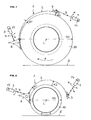
  • FIG. 1 shows a state in which the sweeping brush is new or practically new and has the diameter D1.
  • FIG. 2 shows a practically completely worn sweeping brush, in which the diameter is only D2.
  • the sweeping brush cover in this case has a non-rigid, elastically bendable, or curved, plate-shaped shield element 2, which is bent to adapt to the substantially cylindrical shape of the sweeping brush roller.
  • the elastic plate-shaped element 2 covers the sweeping brush in its upper region and extends from the inlet side E to the outlet side A.
  • a wedge-shaped element 6 is provided on the inlet side, which, seen in the direction of rotation of the brush, before the element 2 comes to rest and thus forms the inlet E in this embodiment.
  • the elastically, and seen from the longitudinal axis L of the sweeping brush ago, convexly curved element 2 is held by adjusting means and is adjustable by this in its curvature or curvature.
  • the elastic element 2 may consist of a metal sheet, but is preferably formed of a plastic material. In this case, preferably an ultra-high molecular weight polyethylene is used, which for example has a molecular weight of> 5x10 6 g / mol. Such a material, the material TIVAR® ® is eg 1000 from Quadrant.
  • the curved plate-shaped element 2 can in the basic form of FIG. 1 be bent for the sweeping brush with the basic diameter D1, so that the element 2, the in FIG. 1 has shown basic form and this retains itself and starting from this until the further bent shape of FIG. 2 is deformed by the adjustment.
  • the element 2 can not be pre-bent and thus flat, so that the curved shape of FIG. 1 imposed by the adjustment and is maintained by this and the element 2 would spring back into its planar basic shape, if it were not held by the adjusting means in the curved shape.
  • the adjusting effect the further curvature to the maximum curved end position of the FIG. 2 ,
  • the adjusting means are shown schematically and have the means 3 and 4, which are each driven to pivot about axes 13 and 14, as this is indicated by the arrows a, or which are driven by means of shafts 13, 14 are pivotally driven accordingly.
  • the adjusting means 3, 4 longitudinally adjustable members, which are adjustable according to the arrows b in their length adjustable.
  • the adjusting means 3 engages the inlet-side wedge 6. This is just an example. If no wedge 6 is provided, the adjusting means acts essentially directly on the element 2. Such is shown for the adjusting means 4, which acts on the outlet side of the element 2 via a holder 7. This holder 7 may be attached to the element 2 in any manner.
  • FIG. 2 shows correspondingly reduced to its minimum usable diameter D2 sweeping brush. It can be seen that by pivoting the adjusting means 3 upwards and Longitudinal adjustment of the adjusting means 3, the element 2 on the inlet side gradually more and more to adapt to the decreasing diameter of the sweeping brush is bent. At the same time takes place with the adjusting means 4, which is pivoted downwards and also driven in its length, a bend of the element 2 within its elastic bending range for adjusting the outlet side of the element 2 to the decreasing sweeping brush diameter.
  • the bending is preferably carried out in such a way that the cavity between the sweeping brush circumference and the sweeping brush directed towards the inside of the curved element 3 from the inlet side to the outlet side is greater.
  • this is shown with the two distances d1 and d2, which show this preferred adjustment of the adjusting means and the sweeping brush cover both with a large sweeping brush diameter and with a low sweeping brush diameter. Since, however, by the adjusting means within the limits of the bending stress of the element 2 whose curvature is freely selectable, a different geometry of the cavity can be selected. For the discharge-side removal of the snow swept by the sweeping brush, however, the preferred embodiment is the most suitable.
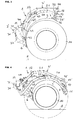
  • FIGS. 3 to 6 show, again in side view, a preferred embodiment of the adjusting means for bending the element.
  • FIG. 7 shows the corresponding embodiment in a view from above of the sweeping brush 10 and the sweeping brush cover 1.
  • the longitudinal extent of the sweeping brush 10 in FIG. 7 clearly visible and it is shown that in each case left and right of the sweeping brush 10 and the element 2 are arranged adjusting means.
  • the FIGS. 3 and 4 show the adjusting completely or show the adjustment means for the inlet side and the outlet side.
  • FIGS. 3 to 7 the inlet-side adjusting means 3 'is formed by a first parallelogram and the outlet-side adjusting means 4' is formed by a second parallelogram.
  • the outlet-side adjusting means 4' is formed by a second parallelogram.
  • FIG. 7 shows a preferred embodiment, wherein in each case two parallelogram 4 'are combined with one drive 12 and accordingly also two parallelogram 3', which, however, in FIG. 7 are not designated.
  • a larger number of adjusting means could be provided, so in particular another pair of parallelogram arrangements, which eg in FIG. 7 centered would be.
  • the mentioned drive 12 which is formed in each case by a pneumatic cylinder or hydraulic cylinder or electric drive or a hand crank drive, engages on the one hand on a stationary, in particular fixed to the chassis of the sweeping brush assembly connectable or connected, support 11, which also provides axes of rotation for the Parallelogramman extract ,
  • the drive 12 is pivotally mounted about the axis 40 to the support 11.
  • the drive 12 is also pivotable about the axis 43 connected to the lower parallelogram 20 of the parallelogram 4 '. This has an upper parallelogram 21.
  • the upper lever 21 is rotatably connected to the support 11 via the axis 41, while the lower lever 20 is rotatably connected to this support 11 via the axis 42.
  • the upper parallelogram assembly 4 'for the outlet side of the element 2 is closed by the lever 22, which is connected by means of the axes 46 and 47 pivotally connected to the upper lever 21 and to the lower lever 20.
  • An extension of the lever 22 is pivotally attached to the bracket 7 via the axle 28, which is fixed to the element 2. This is so in FIG. 5 shown.
  • a preferred modification is shown in which the holder 7 is given an additional rotation about the axis of rotation 28 'in order to allow an even better adaptation of the outlet side of the element 2 by an additional bending of the outlet region of the element 2.
  • a lever 17 is provided with the axis of rotation 17 ', which causes via pins 18 and 19 and the lever 16, a corresponding rotation of the holder 7 from the Parallelogrammamba, as compared in the FIGS. 3 and 4 is easy to see.
  • a rotation could also be effected by a separate drive or another arrangement of the levers 16, 17.
  • FIGS. 3 and 4 show the upper parallelogram 4 'separately in the two extreme positions for the non-worn sweeping brush 10 and for the virtually completely worn sweeping brush.
  • FIG. 5 on the other hand, for better understanding, the parallelogram arrangement 4 'and the two sweeping brush diameters are shown in the same figure. Accordingly, two surfaces 5 are shown.
  • the parallelogram 4 is shown with solid lines for the large sweeping brush diameter and with broken lines for the small sweeping brush diameter. It can be seen how, by adjusting the parallelogram, the element 2 moves on the outlet side and thus is increasingly bent starting from the position with a large sweeping brush diameter, wherein in addition the outlet side is adapted to the decreasing sweeping brush diameter. In the FIGS. 3 and 4 can be seen how this is effected by the extension of the drive element 12.
  • FIGS. 3 and 4 and in particular for better illustration in the FIG. 6
  • the lower parallelogram 3 'can be seen which has a first lever 30 which is articulated via a pivot axis 31 on the fixed support 11 and is attached via a further pivot axis 32 to the element 2, which in the illustrated Example via the wedge 6, which is attached to the element 2.
  • the second lever 33 of the parallelogram 3 ' is articulated via the axis 34 pivotally mounted on the fixed support 11 and on the axis 35 in turn on the element 2 and in this embodiment on the wedge 6.
  • FIG. 6 clearly seen how the parallelogram 3 'moves the wedge 6 substantially parallel to the surface 5 and the element 2 increasingly convex bends with decreasing sweeping brush diameter and the inlet side of the change in size of the brush tracks.
  • FIGS. 3 and 4 it can be seen that the two parallelogram assemblies 3 'and 4' are drive-connected, so that the drive 12 actuates both parallelogram arrangements. In the example shown, this is done via a connecting member 45 which engages with one end on the lower lever 20 of the parallelogram 4 ', this in the example shown on the axis 43, and which is hinged at its other end to the lever 33, this over an axis 46th
  • the flexible element 2 is in the illustrated embodiments, a single and integrally formed element, which is preferred.
  • the element could, however, too be made of several parts, so in particular along the length of the sweeping brush 10 consist of several individual sections with their own adjusting means.

Landscapes

  • Engineering & Computer Science (AREA)
  • Architecture (AREA)
  • Civil Engineering (AREA)
  • Structural Engineering (AREA)
  • Brushes (AREA)

Abstract

The cover (1) has a convex plate-type shield element (2), possibly just one, made in one piece, for mounting over the cylindrical brush (10), driven to rotate it round its longitudinal axis, and an adjusting element (3, 3', 4, 4', 12) for it, by which the elastic bending capability of the shield element can be adjusted to make it fit the diameter of the brush.

Description

Hintergrundbackground

Die Erfindung betrifft eine Kehrbürstenabdeckung gemäss Oberbegriff des Anspruchs 1. Ferner betrifft die Erfindung eine Kehrbürstenanordnung mit einer solchen Kehrbürstenabdeckung und ein so ausgerüstetes Kehrfahrzeug. Weiter betrifft die Erfindung ein Verfahren zur Abdeckung einer Kehrbürste.The invention relates to a sweeping brush cover according to the preamble of claim 1. Furthermore, the invention relates to a sweeping brush assembly with such sweeping brush cover and a so-equipped sweeper. Furthermore, the invention relates to a method for covering a sweeping brush.

Stand der TechnikState of the art

Bei Reinigungsfahrzeugen, insbesondere bei Kehrblasfahrzeugen zur Schneeräumung, kommen grosse, walzen- bzw. zylinderförmige Kehrbürsten zum Einsatz. Diese Kehrbürsten mit Borsten aus Stahl oder Kunststoff können mehrere Meter lang sein und werden mit erheblichen Drehzahlen betrieben und die entsprechend ausgerüsteten Kehrfahrzeuge werden z.B. zur Schneeräumung auf Flughafenpisten oder auf Strassen eingesetzt. Ein solches Fahrzeug ist z.B. aus EP-A-0 288 436 bekannt und in Figur 8 dargestellt. Über der Kehrbürste ist eine Abdeckung als starrer, gekrümmter Schutzschild vorgesehen. Es ist auch bekannt, die Abdeckung aus zwei starren Schutzschildteilen zu bilden, welche zueinander verschwenkbar sind, oder ein einzelnes, schwenkbares, starres Schutzschild vorzusehen, womit eine Anpassung an den sich im Betrieb der Kehrbürste durch Verschleiss der Borsten reduzierenden Kehrbürstendurchmesser erfolgen soll. Da im Betrieb erhebliche Mengen von Schnee durch die Bürste mitgerissen und zwischen Bürste und Bürstenabdeckung gefördert werden, kann sich der durch Verschwenken von starren Schutzschildteilen in verschiedener Form bildende Hohlraum oberhalb der Bürste mit Schnee füllen und es kann Eisbildung auftreten, was nachteilig ist. Durch den sich beim Schwenken in seiner Form ändernden Hohlraum ist ferner die Wegführung des von der Bürste mitgeführten Schnees je nach Bürstendurchmesser unterschiedlich.In cleaning vehicles, especially in sweeper vehicles for snow removal, large, cylindrical or cylindrical sweeping brushes are used. These sweeping brushes with bristles of steel or plastic can be several meters long and are operated at considerable speeds and the appropriately equipped sweeping vehicles are used, for example, for clearing snow on airport runways or on roads. Such a vehicle is eg off EP-A-0 288 436 known and in FIG. 8 shown. Above the sweeping brush, a cover is provided as a rigid, curved shield. It is also known to form the cover of two rigid shield parts, which are pivotable to each other, or to provide a single, pivotable, rigid shield, which is to be adapted to the operating in the sweeping brush by wearing the bristles reducing brush diameter. Since significant amounts of snow are entrained during operation by the brush and conveyed between the brush and brush cover, the cavity formed by pivoting rigid shield parts in various forms above the brush can fill with snow and it can form ice, which is disadvantageous. By turning in while panning its shape-changing cavity is also the routing of the entrained by the brush snow different depending on the brush diameter.

Darstellung der ErfindungPresentation of the invention

Der Erfindung liegt die Aufgabe zu Grunde, eine Kehrbürstenabdeckung zu schaffen, welche diese Nachteile nicht aufweist.The invention is based on the object to provide a sweeping brush cover which does not have these disadvantages.

Dies wird bei der Kehrbürstenabdeckung der eingangs genannten Art mit den kennzeichnenden Merkmalen des Anspruchs 1 erreicht.This is achieved in the sweeping brush cover of the type mentioned above with the characterizing features of claim 1.

Durch ein biegbares Schildelement und die Verstellmittel kann eine sehr gute Anpassung der Abdeckung bzw. deren Wölbung an die jeweilige Bürstengrösse erfolgen, ohne dass dabei "Ecken" bzw. unerwünschte Hohlräume verschiedener Form oberhalb der Bürste entstehen. Im Gegenteil ist eine genaue Formanpassung durch das Biegen möglich und es kann ein sich progressiv in Förderrichtung öffnender Spalt zwischen Abdeckung und Bürste durch die Verstellmittel erzeugt werden. Die glatte, ohne Schwenkachsen ausgeführte innere Oberfläche des elastisch biegbaren Schildelementes begünstigt das Abführen des Schnees.By means of a bendable shield element and the adjustment means, a very good adaptation of the cover or its curvature to the respective brush size can take place without "corners" or undesirable cavities of different shape arising above the brush. On the contrary, a precise shape adjustment by the bending is possible and it can be generated by the adjusting means a gap which opens progressively in the conveying direction between the cover and the brush. The smooth, running without pivot axes inner surface of the elastically bendable shield element favors the removal of the snow.

Bevorzugterweise ist das Schildelement aus einem Kunststoff gebildet, was eine gewichtsmässig vorteilhafte Abdeckung ergibt und ohne hohen Bearbeitungsaufwand bei der Herstellung eine glatte Oberfläche bereitstellen kann, an welcher Schnee nicht haftet. Bevorzugt findet ein ultrahochmolekulares Polyethylen Verwendung, allenfalls mit einem verschleissoptimierenden Zusatz, insbesondere aus Glaspartikeln.Preferably, the shield element is formed from a plastic, which results in a cover which is advantageous in terms of weight and can provide a smooth surface without high processing costs during manufacture, to which snow does not adhere. Preferably, an ultra-high molecular weight polyethylene is used, if necessary with a wear-optimizing additive, in particular of glass particles.

Bevorzugt weisen die Verstellmittel Führungen auf, insbesondere zwei gekoppelte Parallelogrammführungen, welche das vordere und das hintere Ende des Schutzschildelementes im Verlauf der Biegung zur Anpassung an den Durchmesser der Kehrbürste so verstellen, dass sich bei den meisten oder allen Biegestellungen ein sich stetig nach hinten zum Auslass erweiternder Hohlraum oberhalb der Kehrbürste ergibt. Solche Verstellmittel haben den Vorteil, dass sie wenig Einbauraum oberhalb der Bürste benötigen. Bevorzugt sind die Verstellmittel ferner so ausgeführt, dass auslassseitig eine Drehung des Elements erfolgt, um dieses noch besser an die Kehrbürstenform anzupassen.Preferably, the adjusting means on guides, in particular two coupled parallelogram guides, which adjust the front and the rear end of the shield element in the course of bending to adapt to the diameter of the sweeping brush so that in most or all bending situations, there is a cavity extending continuously rearward to the outlet above the sweeping brush. Such adjustment means have the advantage that they require little installation space above the brush. Preferably, the adjusting means are further designed so that the outlet side, a rotation of the element takes place in order to better adapt to the sweeping brush shape.

Der Erfindung liegt weiter die Aufgabe zu Grunde, eine Kehrbürstenanordnung sowie ein Kehrfahrzeug zu schaffen, welche die genannten Nachteile nicht aufweisen.The invention is further based on the object to provide a sweeping brush assembly and a sweeper, which do not have the disadvantages mentioned.

Diese Aufgaben werden mit den Merkmalen des Anspruchs 11 bzw. des Anspruchs 12 gelöst; ein Verfahren zur Abdeckung einer Kehrbürste ist durch Anspruch 13 definiert.These objects are achieved with the features of claim 11 and claim 12; a method for covering a sweeping brush is defined by claim 13.

Kurze Darstellung der ZeichnungenShort illustration of the drawings

Im Folgenden werden Ausführungsbeispiele der Erfindung anhand der Zeichnungen näher erläutert. Dabei zeigt

  • Figur 1 in schematischer Seitenansicht eine Kehrbürste im Neuzustand mit einer erfindungsgemässen Abdeckung;
  • Figur 2 die schematische Darstellung von Figur 1 mit abgenützter Kehrbürste;
  • Figur 3 in schematischer Seitenansicht eine Kehrbürste im Neuzustand und eine Abdeckung mit von Parallelogrammanordnungen gebildeten Verstellmitteln;
  • Figur 4 die Ansicht von Figur 3 mit abgenützter Kehrbürste;
  • Figur 5 die Ausführungsform der Figuren 3 und 4 mit dem oberen Parallelogramm in den beiden Endstellungen;
  • Figur 6 die Ausführungsform der Figuren 3 und 4 mit dem unteren Parallelogramm in den beiden Endstellungen;
  • Figur 7 eine Ansicht auf eine Kehrbürste und eine Kehrbürstenabdeckung von oben; und
  • Figur 8 eine Darstellung eines Kehrblasfahrzeuges in Seitenansicht.
In the following, embodiments of the invention will be explained in more detail with reference to the drawings. It shows
  • FIG. 1 in a schematic side view of a sweeping brush when new with a cover according to the invention;
  • FIG. 2 the schematic representation of FIG. 1 with worn sweeping brush;
  • FIG. 3 a schematic side view of a sweeping brush when new and a cover with adjusting means formed by Parallelogrammanordnungen;
  • FIG. 4 the view of FIG. 3 with worn sweeping brush;
  • FIG. 5 the embodiment of the FIGS. 3 and 4 with the upper parallelogram in the two end positions;
  • FIG. 6 the embodiment of the FIGS. 3 and 4 with the lower parallelogram in the two end positions;
  • FIG. 7 a view of a sweeping brush and a sweeping brush cover from above; and
  • FIG. 8 a representation of a Kehrblasfahrzeuges in side view.

Wege zur Ausführung der ErfindungWays to carry out the invention

Figur 8 zeigt eine grundsätzlich bekannte Kehrblasmaschine 15, welche insbesondere zum Entfernen von Schnee von der zu reinigenden Oberfläche 5 verwendet wird. Neben einem Pflug weist die Kehrmaschine dazu eine Kehrbürste 10 auf, welche als im Wesentlichen zylindrische Walze liegend angeordnet ist und drehend in der Richtung des dargestellten Pfeils angetrieben ist. Damit wird der vom Schneepflug nicht entfernte Schnee mit der Kehrbürste von der Oberfläche 5 gelöst und durch eine Blaseinrichtung weggeblasen. Die Kehrbürste 10 kann eine Breite von mehreren Metern aufweisen und ist mit Kehrborsten aus Stahl und/oder Kunststoff versehen. Über der Kehrbürste ist nach diesem Stand der Technik ein starres Schild vorgesehen, welches von der Kehrbürste mitgeförderten Schnee, der sich von der Kehrbürste löst, daran hindert, frei nach oben hin weggeschleudert zu werden. Dieses und die weiteren bekannten Schilde weisen die eingangs erwähnten Nachteile auf. FIG. 8 shows a basically known Kehrblasmaschine 15, which is used in particular for removing snow from the surface 5 to be cleaned. In addition to a plow, the sweeper for this purpose has a sweeping brush 10, which is arranged as a substantially cylindrical roller and is rotationally driven in the direction of the arrow shown. Thus, the snow not removed from the snowplough is released with the sweeping brush from the surface 5 and blown away by a blowing device. The sweeping brush 10 may have a width of several meters and is provided with sweeping bristles of steel and / or plastic. About the sweeping brush is provided according to this state of the art, a rigid shield, which prevents the sweeping brush mitgeschörderten snow that dissolves from the sweeping brush, to be thrown free upwards. This and the other known shields have the disadvantages mentioned in the introduction.

Im Folgenden wird das erfindungsgemässe Schutzschild, bzw. die Kehrbürstenabdeckung 1 anhand der Figuren 1-7 näher erläutert. Bei allen Ausführungsformen wird von "oben" und von "unten" mit Bezugnahme auf die zu reinigende Fläche 5 gesprochen, welche unten liegt. Mit Bezug auf die Drehrichtung der Kehrbürste wird von der Einlaufseite gesprochen, wo die Borsten in den Bereich hineingelangen, der durch die Kehrbürstenabdeckung abgedeckt ist, bzw. es wird von der Auslaufseite gesprochen, wo die Borsten der Kehrbürste wiederum den von der Kehrbürstenabdeckung abgedeckten Bereich verlassen.In the following, the protective shield according to the invention, or the sweeping brush cover 1, will be described on the basis of FIG Figures 1-7 explained in more detail. In all embodiments is spoken of "top" and "bottom" with reference to the surface to be cleaned 5, which lies down. With reference to the direction of rotation of the sweeping brush is spoken of the inlet side, where the bristles get into the area covered by the sweeping brush cover, or it is spoken from the outlet side, where the bristles of the sweeping brush in turn leave the area covered by the sweeping brush cover.

Anhand der Figuren 1 und 2 wird eine erste Ausführungsform erläutert. Die Figuren zeigen eine schematische Seitenansicht der Kehrbürste 10, welche auf der zu reinigenden Fläche 5 aufliegt. Durch den nicht dargestellten Kehrbürstenantrieb wird die Kehrbürste in Richtung des Pfeiles A rotierend angetrieben. Figur 1 zeigt dabei einen Zustand, in welchem die Kehrbürste neu oder praktisch neu ist und den Durchmesser D1 aufweist. Figur 2 zeigt eine praktisch vollständig abgenützte Kehrbürste, bei welcher der Durchmesser nur noch D2 beträgt. Die Kehrbürstenabdeckung weist dabei ein nicht starres, elastisch biegbares, bzw. gebogenes, plattenförmiges Schildelement 2 auf, welches zur Anpassung an die im Wesentlichen zylindrische Form der Kehrbürstenwalze gebogen ist. Das elastische plattenförmige Element 2 deckt dabei die Kehrbürste in ihrem oberen Bereich ab und erstreckt sich von der Einlaufseite E bis zur Auslaufseite A. Bei einer bevorzugten und dargestellten Ausführungsform ist einlaufseitig ein keilförmiges Element 6 vorgesehen, welches, in Drehrichtung der Bürste gesehen, noch vor dem Element 2 zu liegen kommt und somit in dieser Ausführung den Einlauf E bildet. Das elastisch, und von der Längsachse L der Kehrbürste her gesehen, konvex gebogene Element 2 wird durch Verstellmittel gehalten und ist durch diese in seiner Biegung bzw. Krümmung einstellbar. Das elastische Element 2 kann aus einem Metallblech bestehen, ist aber bevorzugt aus einem Kunststoffmaterial gebildet. Dabei kommt bevorzugterweise ein ultrahochmolekulares Polyethylen zur Anwendung, welches z.B. ein Molekulargewicht von > 5x10⁶ g/mol aufweist. Ein solches Material ist z.B. das Material TIVAR® 1000 der Firma Quadrant. Es kann auch ein solches Material mit verschleissoptimierendem Zusatz verwendet werden, insbesondere einem Glaskugelzusatz. Ein solches Material ist unter dem Handelsnamen TIVAR® CERAM P, ebenfalls von der Firma Quadrant, bekannt. Das gebogene plattenförmige Element 2 kann in die Grundform von Figur 1 für die Kehrbürste mit dem Grunddurchmesser D1 vorgebogen sein, so dass das Element 2 die in Figur 1 gezeigte Grundform aufweist und diese selber beibehält und von dieser ausgehend bis zur weiter gebogenen Form von Figur 2 durch die Verstellmittel verformt wird. Das Element 2 kann aber auch nicht vorgebogen und somit eben sein, so dass ihm die gekrümmte Form von Figur 1 durch die Verstellmittel aufgezwungen und durch diese aufrechterhalten wird und das Element 2 in seine ebene Grundform zurückfedern würde, wenn es nicht durch die Verstellmittel in der gekrümmten Form gehalten würde. Auch in diesem Fall bewirken die Verstellmittel die weitere Krümmung bis zur maximal gekrümmten Endstellung der Figur 2.Based on Figures 1 and 2 a first embodiment will be explained. The figures show a schematic side view of the sweeping brush 10, which rests on the surface 5 to be cleaned. By sweeping brush drive, not shown, the sweeping brush is driven to rotate in the direction of arrow A. FIG. 1 shows a state in which the sweeping brush is new or practically new and has the diameter D1. FIG. 2 shows a practically completely worn sweeping brush, in which the diameter is only D2. The sweeping brush cover in this case has a non-rigid, elastically bendable, or curved, plate-shaped shield element 2, which is bent to adapt to the substantially cylindrical shape of the sweeping brush roller. The elastic plate-shaped element 2 covers the sweeping brush in its upper region and extends from the inlet side E to the outlet side A. In a preferred and illustrated embodiment, a wedge-shaped element 6 is provided on the inlet side, which, seen in the direction of rotation of the brush, before the element 2 comes to rest and thus forms the inlet E in this embodiment. The elastically, and seen from the longitudinal axis L of the sweeping brush ago, convexly curved element 2 is held by adjusting means and is adjustable by this in its curvature or curvature. The elastic element 2 may consist of a metal sheet, but is preferably formed of a plastic material. In this case, preferably an ultra-high molecular weight polyethylene is used, which for example has a molecular weight of> 5x10 6 g / mol. Such a material, the material TIVAR® ® is eg 1000 from Quadrant. It is also possible to use such a material with a wear-optimizing additive, in particular a glass ball additive. Such a material is available under the trade name TIVAR® ® CERAM P, also known by the company Quadrant. The curved plate-shaped element 2 can in the basic form of FIG. 1 be bent for the sweeping brush with the basic diameter D1, so that the element 2, the in FIG. 1 has shown basic form and this retains itself and starting from this until the further bent shape of FIG. 2 is deformed by the adjustment. However, the element 2 can not be pre-bent and thus flat, so that the curved shape of FIG. 1 imposed by the adjustment and is maintained by this and the element 2 would spring back into its planar basic shape, if it were not held by the adjusting means in the curved shape. Also in this case, the adjusting effect the further curvature to the maximum curved end position of the FIG. 2 ,

In den Figuren 1 und 2 sind die Verstellmittel schematisch dargestellt und weisen die Mittel 3 und 4 auf, welche jeweils um Achsen 13 bzw. 14 angetrieben schwenkbar sind, wie diese mit den Pfeilen a angedeutet ist, oder welche mittels Wellen 13, 14 angetrieben entsprechend schwenkbar sind. Ferner weisen die Verstellmittel 3, 4 längsverstellbare Glieder auf, welche gemäss den Pfeilen b in ihrer Länge angerieben verstellbar sind. In dem dargestellten Beispiel greift das Verstellmittel 3 an dem einlaufseitigen Keil 6 an. Dies ist lediglich als Beispiel zu verstehen. Wenn kein Keil 6 vorgesehen ist, so greift das Verstellmittel im Wesentlichen direkt am Element 2 an. Solches ist für das Verstellmittel 4 gezeigt, welches über eine Halterung 7 auslaufseitig am Element 2 angreift. Diese Halterung 7 kann auf beliebige Weise an dem Element 2 befestigt sein.In the Figures 1 and 2 the adjusting means are shown schematically and have the means 3 and 4, which are each driven to pivot about axes 13 and 14, as this is indicated by the arrows a, or which are driven by means of shafts 13, 14 are pivotally driven accordingly. Furthermore, the adjusting means 3, 4 longitudinally adjustable members, which are adjustable according to the arrows b in their length adjustable. In the illustrated example, the adjusting means 3 engages the inlet-side wedge 6. This is just an example. If no wedge 6 is provided, the adjusting means acts essentially directly on the element 2. Such is shown for the adjusting means 4, which acts on the outlet side of the element 2 via a holder 7. This holder 7 may be attached to the element 2 in any manner.

Ausgehend von dem Durchmesser D1 von Figur 1, ergibt sich im Betrieb der Kehrbürste eine Verringerung des Durchmessers durch deren Verschleiss. Figur 2 zeigt entsprechend die auf ihren minimal verwendbaren Durchmesser D2 verkleinerte Kehrbürste. Es ist ersichtlich, dass durch Schwenken des Verstellmittels 3 nach oben hin und Längsverstellung des Verstellmittels 3 das Element 2 einlassseitig nach und nach zur Anpassung an den abnehmenden Durchmesser der Kehrbürste mehr und mehr gebogen wird. Gleichzeitig erfolgt mit dem Verstellmittel 4, welches nach unten verschwenkt wird und ebenfalls angetrieben in seiner Länge verstellt wird, eine Biegung des Elementes 2 innerhalb seines elastischen Biegebereiches zur Anpassung der Auslaufseite des Elementes 2 an den abnehmenden Kehrbürstendurchmesser. Die Biegung erfolgt dabei bevorzugterweise derart, dass der Hohlraum zwischen dem Kehrbürstenumfang und der zur Kehrbürste hin gerichteten Innenseite des gebogenen Elementes 3 von der Einlaufseite zur Auslaufseite hin grösser wird. In den Figuren ist dies mit den beiden Abständen d1 und d2 dargestellt, welche sowohl bei grossem Kehrbürstendurchmesser als auch bei geringem Kehrbürstendurchmesser diese bevorzugte Einstellung der Verstellmittel bzw. der Kehrbürstenabdeckung zeigen. Da indes durch die Verstellmittel innerhalb der Grenzen der Biegebeanspruchung des Elementes 2 dessen Wölbung frei wählbar ist, kann auch eine andere Geometrie des Hohlraumes gewählt werden. Für die auslaufseitige Abfuhr des von der Kehrbürste mitgenommenen Schnees ist indes die bevorzugte Ausgestaltung am geeignetsten.Starting from the diameter D1 of FIG. 1 , results in the operation of the sweeping brush a reduction in the diameter by the wear. FIG. 2 shows correspondingly reduced to its minimum usable diameter D2 sweeping brush. It can be seen that by pivoting the adjusting means 3 upwards and Longitudinal adjustment of the adjusting means 3, the element 2 on the inlet side gradually more and more to adapt to the decreasing diameter of the sweeping brush is bent. At the same time takes place with the adjusting means 4, which is pivoted downwards and also driven in its length, a bend of the element 2 within its elastic bending range for adjusting the outlet side of the element 2 to the decreasing sweeping brush diameter. The bending is preferably carried out in such a way that the cavity between the sweeping brush circumference and the sweeping brush directed towards the inside of the curved element 3 from the inlet side to the outlet side is greater. In the figures, this is shown with the two distances d1 and d2, which show this preferred adjustment of the adjusting means and the sweeping brush cover both with a large sweeping brush diameter and with a low sweeping brush diameter. Since, however, by the adjusting means within the limits of the bending stress of the element 2 whose curvature is freely selectable, a different geometry of the cavity can be selected. For the discharge-side removal of the snow swept by the sweeping brush, however, the preferred embodiment is the most suitable.

Die Figuren 3 bis 6 zeigen, wiederum in Seitenansicht, eine bevorzugte Ausgestaltung der Verstellmittel zur Biegung des Elementes 2. Figur 7 zeigt die entsprechende Ausführungsform in einer Ansicht von oben auf die Kehrbürste 10 und die Kehrbürstenabdeckung 1. Dabei ist die Längserstreckung der Kehrbürste 10 in Figur 7 gut ersichtlich und es ist dargestellt, dass jeweils links und rechts von der Mitte der Kehrbürste 10 bzw. des Elementes 2 Verstellmittel angeordnet sind. Dies ist eine bevorzugte Ausführungsform. Es könnten indes entlang der Länge des Elementes 2 auch weitere Verstellmittel angeordnet sein oder es könnte allenfalls nur ein, insbesondere ein mittig angeordnetes, Verstellmittel vorgesehen sein. Die Figuren 3 und 4 zeigen die Verstellmittel vollständig bzw. zeigen die Verstellmittel für die Einlaufseite und die Auslaufseite. In den Figuren 5 und 6 sind die Verstellmittel 3' bzw. 4' dieser Ausführungsform zur besseren Erläuterung getrennt dargestellt, wobei Figur 5 das Verstellmittel 4' zeigt, welches auslaufseitig auf das Element 2 einwirkt und Figur 6 das Verstellmittel 3' zeigt, welches einlaufseitig auf das gebogene Element 2 einwirkt. In der bevorzugten Ausführungsform der Figuren 3 bis 7 wird das einlaufseitige Verstellmittel 3' von einer ersten Parallelogrammanordnung gebildet und das auslaufseitige Verstellmittel 4' wird von einer zweiten Parallelogrammanordnung gebildet. In den Seitenansichten der Figuren 3 bis 6 ist jeweils nur eine Parallelogrammanordnung 3' bzw. 4' ersichtlich. In Figur 7, welche die Kehrbürstenabdeckung in ihrer Längserstreckung darstellt, ist aber ersichtlich, dass mehrere solche Parallelogrammanordnungen entlang der Länge der Abdeckung vorgesehen sind. Figur 7 zeigt dabei eine bevorzugte Ausgestaltung, wobei jeweils zwei Parallelogrammanordnungen 4' mit jeweils einem Antrieb 12 zusammengefasst sind und entsprechend auch zwei Parallelogrammanordnungen 3', welche indes in Figur 7 nicht bezeichnet sind. Natürlich könnte auch eine grössere Anzahl von Verstellmitteln vorgesehen sein, so insbesondere ein weiteres Paar von Parallelogrammanordnungen, welches z.B. in Figur 7 mittig angeordnet wäre.The FIGS. 3 to 6 show, again in side view, a preferred embodiment of the adjusting means for bending the element. 2 FIG. 7 shows the corresponding embodiment in a view from above of the sweeping brush 10 and the sweeping brush cover 1. In this case, the longitudinal extent of the sweeping brush 10 in FIG. 7 clearly visible and it is shown that in each case left and right of the sweeping brush 10 and the element 2 are arranged adjusting means. This is a preferred embodiment. It could, however, be arranged along the length of the element 2 also further adjusting means or it could possibly only one, in particular a centrally disposed, adjusting means may be provided. The FIGS. 3 and 4 show the adjusting completely or show the adjustment means for the inlet side and the outlet side. In the Figures 5 and 6 the adjusting means 3 'and 4' of this embodiment are shown separately for ease of explanation, wherein FIG. 5 the adjusting means 4 'shows, which acts on the outlet side on the element 2 and FIG. 6 the adjusting means 3 'shows, which acts on the inlet side on the curved element 2. In the preferred embodiment of FIGS. 3 to 7 the inlet-side adjusting means 3 'is formed by a first parallelogram and the outlet-side adjusting means 4' is formed by a second parallelogram. In the side views of the FIGS. 3 to 6 in each case only one parallelogram 3 'or 4' can be seen. In FIG. 7 however, which illustrates the sweeping brush cover in its longitudinal extent, it will be appreciated that a plurality of such parallelogram arrangements are provided along the length of the cover. FIG. 7 shows a preferred embodiment, wherein in each case two parallelogram 4 'are combined with one drive 12 and accordingly also two parallelogram 3', which, however, in FIG. 7 are not designated. Of course, a larger number of adjusting means could be provided, so in particular another pair of parallelogram arrangements, which eg in FIG. 7 centered would be.

Mit den Figuren 3 bis 6 wird nun die Funktion der Parallelogrammanordnungen erläutert. Der erwähnte Antrieb 12, welcher z.B. jeweils von einem Pneumatikzylinder oder Hydraulikzylinder oder Elektroantrieb oder einem Handkurbelantrieb gebildet wird, greift einerseits an einer ortsfesten, insbesondere fest mit dem Chassis der Kehrbürstenanordnung verbindbaren bzw. verbundenen, Abstützung 11 an, welche auch Drehachsen für die Parallelogrammanordnungen bereitstellt. Der Antrieb 12 ist dabei um die Achse 40 schwenkbar an der Abstützung 11 befestigt. Der Antrieb 12 ist ferner schwenkbar über die Achse 43 mit dem unteren Parallelogrammhebel 20 der Parallelogrammanordnung 4' verbunden. Diese weist einen oberen Parallelogrammhebel 21 auf. Der obere Hebel 21 ist über die Achse 41 drehbar mit der Abstützung 11 verbunden, während der untere Hebel 20 über die Achse 42 drehbar mit dieser Abstützung 11 verbunden ist. Die obere Parallelogrammanordnung 4' für die Auslassseite des Elementes 2 wird durch den Hebel 22 abgeschlossen, welcher mittels der Achsen 46 und 47 schwenkbar mit dem oberen Hebel 21 bzw. mit dem unteren Hebel 20 verbunden ist. Ein Fortsatz des Hebels 22 ist über die Achse 28 schwenkbar an der Halterung 7 befestigt, welche an dem Element 2 fixiert ist. Dies ist so in Figur 5 dargestellt. In den Figuren 3 und 4 ist eine bevorzugte Abwandlung gezeigt, bei welcher der Halterung 7 eine zusätzliche Drehung um die Drehachse 28' verliehen wird, um eine noch bessere Anpassung der Auslaufseite des Elementes 2 durch eine zusätzliche Biegung des Auslaufbereichs des Elements 2 zu ermöglichen. Dazu ist ein Hebel 17 mit der Drehachse 17' vorgesehen, welcher über Zapfen 18 und 19 und den Hebel 16 eine entsprechende Verdrehung der Halterung 7 aus der Parallelogrammbewegung bewirkt, wie dies im Vergleich der Figuren 3 und 4 einfach ersichtlich ist. Eine solche Verdrehung könnte indes auch durch einen separaten Antrieb oder eine andere Anordnung der Hebel 16, 17 bewirkt werden. Die Figuren 3 und 4 zeigen die obere Parallelogrammanordnung 4' separat in den beiden Extremstellungen für die nicht abgenützte Kehrbürste 10 bzw. für die praktisch vollständig abgenützte Kehrbürste. Figur 5 hingegen zeigt zum besseren Verständnis die Parallelogrammanordnung 4' und die beiden Kehrbürstendurchmesser in derselben Figur. Entsprechend sind auch zwei Oberflächen 5 dargestellt. Die Parallelogrammanordnung 4' wird dabei mit ausgezogenen Linien für den grossen Kehrbürstendurchmesser dargestellt und mit unterbrochenen Linien für den kleinen Kehrbürstendurchmesser. Es ist ersichtlich, wie durch Verstellung des Parallelogramms das Element 2 auslaufseitig bewegt und damit ausgehend von der Stellung bei grossem Kehrbürstendurchmesser zunehmend gebogen wird, wobei zusätzlich die Auslaufseite an den abnehmenden Kehrbürstendurchmesser angepasst wird. In den Figuren 3 und 4 ist ersichtlich, wie dies durch die Verlängerung des Antriebselementes 12 bewirkt wird.With the FIGS. 3 to 6 The function of the parallelogram arrangements will now be explained. The mentioned drive 12, which is formed in each case by a pneumatic cylinder or hydraulic cylinder or electric drive or a hand crank drive, engages on the one hand on a stationary, in particular fixed to the chassis of the sweeping brush assembly connectable or connected, support 11, which also provides axes of rotation for the Parallelogrammanordnungen , The drive 12 is pivotally mounted about the axis 40 to the support 11. The drive 12 is also pivotable about the axis 43 connected to the lower parallelogram 20 of the parallelogram 4 '. This has an upper parallelogram 21. The upper lever 21 is rotatably connected to the support 11 via the axis 41, while the lower lever 20 is rotatably connected to this support 11 via the axis 42. The upper parallelogram assembly 4 'for the outlet side of the element 2 is closed by the lever 22, which is connected by means of the axes 46 and 47 pivotally connected to the upper lever 21 and to the lower lever 20. An extension of the lever 22 is pivotally attached to the bracket 7 via the axle 28, which is fixed to the element 2. This is so in FIG. 5 shown. In the FIGS. 3 and 4 a preferred modification is shown in which the holder 7 is given an additional rotation about the axis of rotation 28 'in order to allow an even better adaptation of the outlet side of the element 2 by an additional bending of the outlet region of the element 2. For this purpose, a lever 17 is provided with the axis of rotation 17 ', which causes via pins 18 and 19 and the lever 16, a corresponding rotation of the holder 7 from the Parallelogrammbewegung, as compared in the FIGS. 3 and 4 is easy to see. However, such a rotation could also be effected by a separate drive or another arrangement of the levers 16, 17. The FIGS. 3 and 4 show the upper parallelogram 4 'separately in the two extreme positions for the non-worn sweeping brush 10 and for the virtually completely worn sweeping brush. FIG. 5 on the other hand, for better understanding, the parallelogram arrangement 4 'and the two sweeping brush diameters are shown in the same figure. Accordingly, two surfaces 5 are shown. The parallelogram 4 'is shown with solid lines for the large sweeping brush diameter and with broken lines for the small sweeping brush diameter. It can be seen how, by adjusting the parallelogram, the element 2 moves on the outlet side and thus is increasingly bent starting from the position with a large sweeping brush diameter, wherein in addition the outlet side is adapted to the decreasing sweeping brush diameter. In the FIGS. 3 and 4 can be seen how this is effected by the extension of the drive element 12.

In den Figuren 3 und 4, und insbesondere zur besseren Darstellung in der Figur 6 zusätzlich in alleiniger Darstellung, ist weiter die untere Parallelogrammanordnung 3' ersichtlich, welche einen ersten Hebel 30 aufweist, der über eine Schwenkachse 31 an der festen Abstützung 11 angelenkt ist und über eine weitere Schwenkachse 32 an dem Element 2 befestigt ist, was in dem dargestellten Beispiel über den Keil 6 erfolgt, der am Element 2 befestigt ist. Der zweite Hebel 33 der Parallelogrammanordnung 3' ist über die Achse 34 schwenkbar an der festen Abstützung 11 angelenkt und über die Achse 35 wiederum am Element 2 bzw. in dieser Ausführung am Keil 6. Es ist insbesondere in Figur 6 gut ersichtlich, wie die Parallelogrammanordnung 3' den Keil 6 im Wesentlichen parallel zur Fläche 5 bewegt und das Element 2 bei abnehmendem Kehrbürstendurchmesser zunehmend konvex biegt und dessen Einlaufseite der Grössenänderung der Bürste nachführt.In the FIGS. 3 and 4 , and in particular for better illustration in the FIG. 6 In addition, in a sole representation, is further the lower parallelogram 3 'can be seen, which has a first lever 30 which is articulated via a pivot axis 31 on the fixed support 11 and is attached via a further pivot axis 32 to the element 2, which in the illustrated Example via the wedge 6, which is attached to the element 2. The second lever 33 of the parallelogram 3 'is articulated via the axis 34 pivotally mounted on the fixed support 11 and on the axis 35 in turn on the element 2 and in this embodiment on the wedge 6. It is particularly in FIG. 6 clearly seen how the parallelogram 3 'moves the wedge 6 substantially parallel to the surface 5 and the element 2 increasingly convex bends with decreasing sweeping brush diameter and the inlet side of the change in size of the brush tracks.

In den Figuren 3 und 4 ist ersichtlich, dass die beiden Parallelogrammanordnungen 3' und 4' antriebsverbunden sind, so dass der Antrieb 12 beide Parallelogrammanordnungen betätigt. In dem gezeigten Beispiel erfolgt dies über ein Verbindungsglied 45, welches mit einem Ende am unteren Hebel 20 der Parallelogrammanordnung 4' angreift, dies im gezeigten Beispiel an der Achse 43, und welches mit seinem anderen Ende am Hebel 33 angelenkt ist, dies über eine Achse 46.In the FIGS. 3 and 4 it can be seen that the two parallelogram assemblies 3 'and 4' are drive-connected, so that the drive 12 actuates both parallelogram arrangements. In the example shown, this is done via a connecting member 45 which engages with one end on the lower lever 20 of the parallelogram 4 ', this in the example shown on the axis 43, and which is hinged at its other end to the lever 33, this over an axis 46th

Das biegsame Element 2 ist in den dargestellten Ausführungen ein einziges und einstückig ausgeführtes Element, was bevorzugt ist. Das Element könnte indes auch aus mehreren Teilen ausgeführt sein, so insbesondere entlang der Länge der Kehrbürste 10 aus mehreren einzelnen Abschnitten mit eigenen Verstellmitteln bestehen.The flexible element 2 is in the illustrated embodiments, a single and integrally formed element, which is preferred. The element could, however, too be made of several parts, so in particular along the length of the sweeping brush 10 consist of several individual sections with their own adjusting means.

Claims (16)

Kehrbürstenabdeckung (1) für eine im Wesentlichen zylindrische, um ihre Längsachse drehend angetriebene Kehrbürste (10), welche Kehrbürstenabdeckung verstellbar ist, um sich an die verschleissabhängige Durchmesseränderung der Kehrbürste anzupassen, dadurch gekennzeichnet, dass die Kehrbürstenabdeckung mindestens ein zur Anordnung über der Kehrbürste konvex gebogenes plattenförmiges Schildelement (2) und Verstellmittel (3, 4, 3', 4', 12) für das Schildelement aufweist, durch welche das Schildelement in seiner elastischen Biegung veränderbar ist, um es an den Kehrbürstendurchmesser anzupassen.A sweeping brush cover (1) for a substantially cylindrical sweeping brush (10) driven to rotate about its longitudinal axis, which sweeping brush cover is adjustable to accommodate the wear-dependent change in diameter of the sweeping brush, characterized in that the sweeping brush cover has at least one convexly bent over the sweeping brush for placement plate-shaped shield element (2) and adjusting means (3, 4, 3 ', 4', 12) for the shield element, by which the shield element is variable in its elastic bending to adapt it to the sweeping brush diameter. Kehrbürstenabdeckung nach Anspruch 1, dadurch gekennzeichnet, dass ein einziges einstückiges Schildelement (2) vorgesehen ist.Sweeping brush cover according to claim 1, characterized in that a single integral shield element (2) is provided. Kehrbürstenabdeckung nach Anspruch 1 oder 2, dadurch gekennzeichnet, dass das Schildelement aus Kunststoff gebildet ist.Sweeping brush cover according to claim 1 or 2, characterized in that the shield element is formed from plastic. Kehrbürstenabdeckung nach einem der Ansprüche 1 bis 3, dadurch gekennzeichnet, dass das Schildelement von den Verstellmitteln, bezogen auf die Kehrbürstendrehrichtung, einlaufseitig und auslaufseitig gehalten wird, insbesondere durch die Verstellmittel ausschliesslich einlaufseitig und auslaufseitig gehalten wird.Sweeping brush cover according to one of claims 1 to 3, characterized in that the shield element is held by the adjusting means, based on the sweeping brush rotation direction on the inlet side and outlet side, in particular by the adjustment exclusively on the inlet side and outlet side. Kehrbürstenabdeckung nach einem der Ansprüche 1 bis 4, dadurch gekennzeichnet, dass, bezogen auf die Kehrbürstendrehrichtung, einlaufseitig ein dem Schildelement vorangehender Einlaufkeil (6) vorgesehen ist, insbesondere ein Einlaufkeil, an dem eines der Verstellmittel (3, 3') angreift.Sweeping brush cover according to one of claims 1 to 4, characterized in that , based on the sweeping brush rotation direction, the inlet side of the shield element preceding inlet wedge (6) is provided, in particular an inlet wedge, on which one of the adjusting means (3, 3 ') attacks. Kehrbürstenabdeckung nach einem der Ansprüche 1 bis 5, dadurch gekennzeichnet, dass durch die Verstellmittel die Biegung des Schildelements derart anpassbar ist, dass sich zwischen Kehrbürste und der ihr zugewandten Innenfläche des Schildelementes ein, bezogen auf die Drehrichtung der Kehrbürste, im Wesentlichen vom Einlauf zum Auslauf stetig vergrössernder Hohlraum ergibt.Sweeping brush cover according to one of claims 1 to 5, characterized in that the deflection of the shield element so adaptable by the adjusting means is that between the sweeping brush and the inner surface of the shield element facing her, based on the direction of rotation of the sweeping brush, substantially from the inlet to the outlet steadily increasing cavity results. Kehrbürstenabdeckung nach einem der Ansprüche 1 bis 6, dadurch gekennzeichnet, dass die zur Biegung an einander gegenüberliegenden Stellen des Schildelementes angreifende Verstellmittel von jeweils zwei Antriebsanordnungen (3, 4, 3', 4' 12), insbesondere zwei Parallelogrammanordnungen (3', 4'), gebildet werden, wovon die eine Anordnung auf die Einlaufseite des Schildelementes einwirkt und die andere Anordnung auf die Auslaufseite einwirkt.Sweeping brush cover according to one of claims 1 to 6, characterized in that the bending means acting on opposite points of the shield element adjusting means of two drive assemblies (3, 4, 3 ', 4' 12), in particular two Parallelogrammanordnungen (3 ', 4' ), of which one arrangement acts on the inlet side of the shield element and the other arrangement acts on the outlet side. Kehrbürstenabdeckung nach Anspruch 7, dadurch gekennzeichnet, dass jeweils zwei Parallelogrammanordnungen vorgesehen sind, welche antriebsmässig verbunden sind.Sweeping brush cover according to claim 7, characterized in that in each case two parallelogram arrangements are provided which are drivingly connected. Kehrbürstenabdeckung nach einem der Ansprüche 1 bis 8, dadurch gekennzeichnet, dass durch eines der Verstellmittel (4') eine Drehung des Elements (2) um eine auslaufseitig an diesem vorgesehene Achse (28') bewirkbar ist.Sweeping brush cover according to one of claims 1 to 8, characterized in that by one of the adjusting means (4 ') a rotation of the element (2) about an outlet side provided on this axis (28') is effected. Kehrbürstenabdeckung nach einem der Ansprüche 1 bis 9, dadurch gekennzeichnet, dass entlang der Längserstreckung der Kehrbürste bzw. des Schildelementes mehrere Verstellmittel angeordnet sind und insbesondere mehrere Paare von Verstellmitteln angeordnet sind.Sweeping brush cover according to one of claims 1 to 9, characterized in that along the longitudinal extension of the sweeping brush or the shield element a plurality of adjusting means are arranged and in particular a plurality of pairs of adjusting means are arranged. Kehrbürstenanordnung umfassend eine im Wesentlichen zylindrischen Kehrbürste (10), einen Antrieb zur Drehung der Kehrbürste um deren Längsachse und eine Kehrbürstenabdeckung nach einem der Ansprüche 1 bis 10.Sweeping brush assembly comprising a substantially cylindrical sweeping brush (10), a drive for rotating the sweeping brush about its longitudinal axis and a sweeping brush cover according to one of claims 1 to 10. Kehrfahrzeug mit Rädern und einem Fahrantrieb mit einer Kehrbürstenanordnung nach Anspruch 11.Sweeping vehicle with wheels and a traction drive with a sweeping brush arrangement according to claim 11. Verfahren zum teilweisen Abdecken einer rotierend angetriebenen, im Wesentlichen zylindrischen Kehrbürste eines Kehrfahrzeugs, dadurch gekennzeichnet, dass die Abdeckung von einem biegbaren, gewölbt gebogenen Element (2) gebildet ist, dessen Biegung durch Verstellmittel (3, 4, 3', 4', 12) zur Anpassung an den sich verschleissabhängig ändernden Kehrbürstendruchmesser verändert wird.Method for partially covering a rotationally driven, substantially cylindrical sweeping brush of a sweeping vehicle, characterized in that the cover is formed by a bendable curved element (2), the bending of which is changed by adjusting means (3, 4, 3 ', 4', 12) for adaptation to the brushing wheel diameter which changes as a function of the wear. Verfahren nach Anspruch 13, dadurch gekennzeichnet, dass ein einziges, einstückiges Schildelement (2) aus Kunststoff in seiner Biegung verändert wird.A method according to claim 13, characterized in that a single, one-piece shield element (2) made of plastic is changed in its bending. Verfahren nach einem der Ansprüche 13 oder 14, dadurch gekennzeichnet, dass durch die Verstellmittel die Biegung des Schildelements derart anpassbar ist, dass sich zwischen Kehrbürste und der ihr zugewandten Innenfläche des Schildelementes ein, bezogen auf die Drehrichtung der Kehrbürste, im Wesentlichen vom Einlauf zum Auslauf stetig vergrössernder Hohlraum ergibt.Method according to one of claims 13 or 14, characterized in that by the adjusting the bending of the shield element is adaptable such that between sweeping brush and the inner surface of the shield element facing it, based on the direction of rotation of the sweeping brush, substantially from the inlet to the outlet steadily increasing cavity results. Verfahren nach einem der Ansprüche 13 bis 15, dadurch gekennzeichnet, dass an dem auslaufseitigen Endbereich des Elements (2) eine zusätzliche Biegung erfolgt.Method according to one of claims 13 to 15, characterized in that at the outlet end portion of the element (2) takes place an additional bend.
EP08010782A 2008-06-13 2008-06-13 Sweeping brush cover and sweeping machine with such a cover Withdrawn EP2133473A1 (en)

Priority Applications (1)

Application Number Priority Date Filing Date Title
EP08010782A EP2133473A1 (en) 2008-06-13 2008-06-13 Sweeping brush cover and sweeping machine with such a cover

Applications Claiming Priority (1)

Application Number Priority Date Filing Date Title
EP08010782A EP2133473A1 (en) 2008-06-13 2008-06-13 Sweeping brush cover and sweeping machine with such a cover

Publications (1)

Publication Number Publication Date
EP2133473A1 true EP2133473A1 (en) 2009-12-16

Family

ID=39884937

Family Applications (1)

Application Number Title Priority Date Filing Date
EP08010782A Withdrawn EP2133473A1 (en) 2008-06-13 2008-06-13 Sweeping brush cover and sweeping machine with such a cover

Country Status (1)

Country Link
EP (1) EP2133473A1 (en)

Citations (7)

* Cited by examiner, † Cited by third party
Publication number Priority date Publication date Assignee Title
US501352A (en) * 1893-07-11 Street-sweeper
US2700783A (en) * 1953-07-16 1955-02-01 Parker Sweeper Company Adjustable hood for sweepers
US3212118A (en) * 1962-10-19 1965-10-19 Charles C Anderson Road sweeper
US3287834A (en) * 1964-04-06 1966-11-29 Eithel G Hopkins Motor grader mold board attachment
DE2161485A1 (en) * 1970-12-10 1972-06-29 Dendix Brushes Ltd., Chepstow, Monmouthshire (Großbritannien) Snow removal device
EP0288436A1 (en) 1987-04-23 1988-10-26 Reberle reg. Treuunternehmen Schaan Apparatus for cleaning hard top ground surfaces
US6311355B1 (en) * 2000-09-05 2001-11-06 Pairia Vammas Oy Sweeper

Patent Citations (7)

* Cited by examiner, † Cited by third party
Publication number Priority date Publication date Assignee Title
US501352A (en) * 1893-07-11 Street-sweeper
US2700783A (en) * 1953-07-16 1955-02-01 Parker Sweeper Company Adjustable hood for sweepers
US3212118A (en) * 1962-10-19 1965-10-19 Charles C Anderson Road sweeper
US3287834A (en) * 1964-04-06 1966-11-29 Eithel G Hopkins Motor grader mold board attachment
DE2161485A1 (en) * 1970-12-10 1972-06-29 Dendix Brushes Ltd., Chepstow, Monmouthshire (Großbritannien) Snow removal device
EP0288436A1 (en) 1987-04-23 1988-10-26 Reberle reg. Treuunternehmen Schaan Apparatus for cleaning hard top ground surfaces
US6311355B1 (en) * 2000-09-05 2001-11-06 Pairia Vammas Oy Sweeper

Similar Documents

Publication Publication Date Title
DE3528038C2 (en)
EP2339072B1 (en) Rear milling cutter for a snow groomer
EP2213183A1 (en) Device for providing filter tow material and device for producing filters
DE102015209852A1 (en) Door handle system for a motor vehicle door
DE102017113775A1 (en) Draper cutting unit with multipiece auger
EP2021548B1 (en) Waved clearing bar
DE29603461U1 (en) Halfpiperreamer
DE3226273C2 (en) Snow blower
DE10062329C1 (en) Suction sweeping unit
EP1925746B1 (en) Piste preparation device for a tracked vehicle
EP3097763A1 (en) Vehicle with articulated steering and suction hose
EP3727955B1 (en) Arrangement of nozzle units for a wiper arm, wiper arm and use of a nozzle unit
WO2010052145A1 (en) Segment body and scraper for a conveyor belt scraper
EP1824716A1 (en) Wiper system
AT412003B (en) SNOW PLOW WITH A MULTIPLE SHARE SEGMENT
EP3243961B1 (en) Universal slider for cleaning of floor
EP2133473A1 (en) Sweeping brush cover and sweeping machine with such a cover
DE60102095T2 (en) Motorized sweeper
EP4491804A1 (en) Milling box with snow flow regulation system for snow-operated vehicles
DE19856338B4 (en) Scraper for conveyor belts
EP1254593B1 (en) Soil working tool for comminuting coarsely worked fields
EP1342402B1 (en) Method for adjusting guiding plates and chopper to carry out the method
EP3284866B1 (en) Clearing device with a sweeping and blowing assembly
DE202017102036U1 (en) Front sweeping unit with a suction mouth
DE202019102625U1 (en) Harvester

Legal Events

Date Code Title Description
PUAI Public reference made under article 153(3) epc to a published international application that has entered the european phase

Free format text: ORIGINAL CODE: 0009012

AK Designated contracting states

Kind code of ref document: A1

Designated state(s): AT BE BG CH CY CZ DE DK EE ES FI FR GB GR HR HU IE IS IT LI LT LU LV MC MT NL NO PL PT RO SE SI SK TR

AX Request for extension of the european patent

Extension state: AL BA MK RS

AKY No designation fees paid
REG Reference to a national code

Ref country code: DE

Ref legal event code: 8566

STAA Information on the status of an ep patent application or granted ep patent

Free format text: STATUS: THE APPLICATION IS DEEMED TO BE WITHDRAWN

18D Application deemed to be withdrawn

Effective date: 20100617