EP2134017B1 - Verfahren und System zur Datenkommunikation - Google Patents
Verfahren und System zur Datenkommunikation Download PDFInfo
- Publication number
- EP2134017B1 EP2134017B1 EP08008747.1A EP08008747A EP2134017B1 EP 2134017 B1 EP2134017 B1 EP 2134017B1 EP 08008747 A EP08008747 A EP 08008747A EP 2134017 B1 EP2134017 B1 EP 2134017B1
- Authority
- EP
- European Patent Office
- Prior art keywords
- base stations
- quantization
- bits
- soft
- interference
- Prior art date
- Legal status (The legal status is an assumption and is not a legal conclusion. Google has not performed a legal analysis and makes no representation as to the accuracy of the status listed.)
- Active
Links
Images






Classifications
-
- H—ELECTRICITY
- H04—ELECTRIC COMMUNICATION TECHNIQUE
- H04L—TRANSMISSION OF DIGITAL INFORMATION, e.g. TELEGRAPHIC COMMUNICATION
- H04L1/00—Arrangements for detecting or preventing errors in the information received
- H04L1/004—Arrangements for detecting or preventing errors in the information received by using forward error control
- H04L1/0045—Arrangements at the receiver end
- H04L1/0047—Decoding adapted to other signal detection operation
- H04L1/0048—Decoding adapted to other signal detection operation in conjunction with detection of multiuser or interfering signals, e.g. iteration between CDMA or MIMO detector and FEC decoder
-
- H—ELECTRICITY
- H04—ELECTRIC COMMUNICATION TECHNIQUE
- H04L—TRANSMISSION OF DIGITAL INFORMATION, e.g. TELEGRAPHIC COMMUNICATION
- H04L25/00—Baseband systems
- H04L25/02—Details ; arrangements for supplying electrical power along data transmission lines
- H04L25/06—DC level restoring means; Bias distortion correction ; Decision circuits providing symbol by symbol detection
- H04L25/067—DC level restoring means; Bias distortion correction ; Decision circuits providing symbol by symbol detection providing soft decisions, i.e. decisions together with an estimate of reliability
Definitions
- the present invention relates to a method and a system for multi-user detection.
- the invention relates especially to a method, a system and a communication means for processing data for transmission in a wireless communication system using for multi-user detection through base station cooperation.
- Optimum maximum likelihood detection (MLD) [2, 3] is prohibitively complex for multiple-input multiple-output (MI-MO) scenarios employing higher-order modulation.
- Linear receivers [4-7] are less effective in decoupling the incoming multiplexed data streams, and offer low spatial diversity for full-rank systems.
- Iterative receivers [8-10] with soft decision feedback offer the best compromise between complexity and performance, and they have been universally adopted as a strategy of choice.
- the invention relates especially to advanced receiver techniques for uplink communication.
- the invention is not limited to this case and also relates to a down link communication.
- a method for interference mitigation in an uplink of high reuse cellular networks is disclosed by S.Khattak et al. "Distributed iterative detection in an Interference limited cellular network", Vehicular Technology Conference 2007, VTC2007-Spring IEEE 65th, 1 April 2007, pages 2349 - 2353, ISBN: 978-1-4244-0266-3 .
- Neighbouring base stations are proposed to cooperate by exchanging information while performing classical single user detection. This information exchange can be iterative, improving the estimate of the desired signal with each step. To reduce the required communication band width for the backhaul, only exchange of the detected bits for the nearest mobile terminal at each base station is suggested.
- this object is achieved by a method according to claim 1, a communication system according to claim 11 and a logical node according to claim 12.
- the invention proposes a method for multi-user detection through base station cooperation. This method is characterized in, that the base stations are situated at different geographical locations and that the base stations exchange detected data iteratively while performing separate detection and decoding of their received data streams.
- the invention deals with multi-user detection through base station cooperation in an uplink, interference-limited, high frequency reuse scenario.
- Distributed iterative detection is an interference mitigation technique in which the base stations at different geographical locations exchange detected data iteratively while performing separate detection and decoding of their received data streams.
- Advantages implementations of the invention utilize DID receive strategies and proposes to exchange between base stations especially, preferably only the processed information for their associated mobile terminals.
- the resulting backhaul traffic is considerably lower than that of existing cooperative multi-user detection strategies.
- single-antenna interference cancellation techniques are employed to generate local estimates of the dominant interferers at each base station, which are then combined with their independent re-ceived copies from other base stations, resulting in more effective interference suppression.
- OCI cell interference
- An embodiment of the invention proposes to exchange between base stations mainly the processed information for their associated mobile terminals.
- the communication system, the logical node and the mobile user equipment it is proposed to exchange between base stations only the processed information for their associated mobile terminals.
- An embodiment of the invention further includes, that local estimates of the dominant interferers of at least two base stations are calculated
- This embodiment of the invention has several advantages. For e.g. its results in more effective interference suppression.
- the communication system, the logical node and the mobile user equipment local estimates of the dominant interferers of most base station are generated, wherein the local estimates are then combined with their independent received copies from other base stations.
- the communication system, the logical node and the mobile user equipment single-antenna interference cancellation techniques are employed to generate the local estimates of the dominant interferers at each base station.
- LLRs log-likelihood ratios
- the level 7 of the soft bit is a very weak 0 and the level 0 of the soft bit is a very strong 0.
- the communication system, the logical node and the mobile user equipment in asymmetric multi-user detection is realized.
- the resource management of the cellular network can detect (e.g., via signal strength indicators) groups of MTs that are strongly received at several base stations.
- Advantageous embodiment of the invention especially relate to a decentralized implementation.
- DID distributed iterative detection
- the communication system, the logical node and the mobile user equipment single-user detection is applied to interference-reduced signal by applying parallel interference cancellation. Further improvements can be achieved by repeated application of this procedure.
- the invention includes further improvement with respect to conventional single-user detection in different scenarios with varying strength of the user coupling through a channel.
- SAIC single-antenna interference cancellation
- JMLD joint maximum likelihood detection
- Section 2 presents a preferred system model, where a preferred coupling among users/cells and the channel model are described.
- Section 3 discusses in detail various components of distributed iterative receivers.
- Section 4 different decentralized detection strategies are compared.
- Section 5 we examine the effect of quantization of reliability information.
- Various quantization strategies are compared in terms of information loss and necessary backhaul traffic. Numerical results are presented in Section 6.
- the invention can be integrated into different communication and handling standards.
- N is the number of receive antennas and M is the number of transmit antennas corresponding to the number of BSs and cochannel MTs, respectively.
- a block of K s symbol vectors S(k] [S 1,k ,S 2,k , ... ,S M,k] T (corresponding to one respective codeword) is transmitted synchronously by all M users.
- n E ⁇ n 2 ⁇ .
- the received signal-to-noise ratio is defined as the ratio of received signal power at the nearest BS and the noise power.
- the considered synchronous model is admittedly somewhat optimistic and was recently criticized due to the impossibility to compensate different delays to different mobiles (positions) simultaneously.
- the reason to ignore synchronization errors is twofold. First, it allows to study the possible improvement through base station cooperation without other disturbing effects to obtain bounds (the degradation from nonideal synchronization should thereafter be included as a second step). Second, for OFDM transmission or frequency domain equalization that we envisage in order to obtain parallel flat channels enabling separate JMLD on each subcarrier, we argue that it is possible to keep the interference due to timing and frequency synchronization errors at acceptable levels.
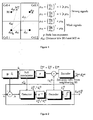
- Figure 1 shows an example setup showing a rectangular grid of 4 cells, with power control assumed with respect to associated BS.
- the setup for performing distributed detection with information exchange between base stations is shown in Figure 2 . It comprises one input for the signal r l generated by the mobile terminals and received at the base station antenna. In addition, it contains a communication interface for exchanging information with the neighboring base stations. This information is either in the form of hard bits û l or likelihood ratios L l d ⁇ 2 of the locally detected signal and corresponding quantities about the estimates of the interfering signals delivered from other base stations.
- This communication interface is capable of not only transmitting information about the detected data stream to the other base stations, but also receiving information from these base stations.
- the receiver processing during initial processing involves either SAIC/JMLD or conventional single-user detection followed by decoding. In subsequent iterations, interference subtraction is performed followed by conventional single-user detection and decoding. Different components of the distributed multi-user receiver are discussed in what follows:
- the interference subtractor is not activated during the first pass and r l is fed directly into the detector.
- the interference-reduced signal y l and its corresponding noise value are sent to a demapper to compute the a posteriori probability, usually expressed as an L -value [28]. If m d data streams (each with q bits/sample) are to be detected, the a posteriori probabilities L d1 (X k
- Y l ) of the coded bits X k ⁇ ⁇ 1 ⁇ for k 1 ... qm d , conditioned on the input signal y l , are given as L d ⁇ 1 x k
- y l P ⁇ x k - 1
- x k - 1 .
- the product terms in (7) are the a priori information about the bits belonging to a certain symbol vector. Since we do not make use of any a priori information in the demapper, these terms cancel out.
- the L -values at the output of the demapper can now be obtained by taking the natural logarithm of the ratio of likelihood functions p(y l
- y l ln ⁇ ⁇ x ⁇ X k , + 1 p y l
- the signal y l at the detector input contains not only m d signals that are to be detected at a BS, but also noise and weak interference.
- the number of cochannel interferers from the surrounding cells can be quite large. We therefore make the simplifying assumption that the distribution of the effective noise due to the (M - m d ) interferers together with the receiver noise is Gaussian.
- the second term in (11) is a correction of the coarse approximation with the max-operation and can be neglected for most cases, leading to the max-log approximation.
- the APP at the detector output at the /th BS as given in (9) can then be simplified to L d ⁇ 1 x k
- the detector and decoder in our receiver form a serially concatenated system.
- the APP vector L d1 (for each detected stream) at the demapper output is sent after deinterleaving as a priori information L a2 to the maximum a posteriori (MAP) decoder.
- the MAP decoder delivers another vector L d2 of APP values about the information as well as the coded bits.
- the decoded APP values received from neighboring BS are combined with local information to generate reliable symbol estimates before interference subtraction. It is therefore critical that the dominant interferers are correctly evaluated.
- the variance of this estimate is equal to the power of the estimation error and it adds to the receiver noise as described in Section 3.1.
- the error power e i 2 depends upon the extent of quantization of the LLR values (see Section 5). If only hard bits are transferred, ⁇ i ⁇ A and the estimated symbol error becomes zero, resulting in degraded performance.
- the decentralized detection problem is treated as parallel interference cancellation by implementing information exchange between the BSs.
- To keep complexity and backhaul low only the signal from the associated MT is detected and exchanged between the BSs, while the rest of the received signals are treated as part of the receiver noise.
- Figure 2 showing the receiver for BS I, where only the desired data s d is detected with single-user detection and transmitted out to other BSs.
- the APPs at the output of the soft detector are approximated as L d ⁇ 1 x k
- the decoded estimates of the desired streams are exchanged after quantization.
- the incoming decoded data streams from the neighboring BS are used to reconstruct the interference energy. Since only the desired data stream is detected, no local estimates of the strongest interferers L i d ⁇ 2 are available.
- This implementation is especially useful in the case of low-frequency reuse.
- the performance of the basic distributed detection receiver degrades for asymmetrical channels encountered in high-frequency reuse networks when dominant interferers are present and the SIR ⁇ 0 dB.
- the error propagation encountered in the basic DID scheme is reduced by improving the initial estimate through single-antenna interference cancellation.
- all the detected data streams are decoded, in this approach only the decoded APPs for the desired users are exchanged between the BSs to limit the amount of backhaul.
- the APPs for the dominant interferers are not discarded, but used in conjunction with reliability information from other BSs to cancel the interference.
- the performance of this scheme is, however, limited by the number of nondetected weak interferers and/or by the quantization of the exchanged reliability information. Therefore, also the number of required exchanges between the BSs to reach convergence is slightly higher than for the unconstrained scheme described next.
- the performance curves for SAIC aided DID to converge even if the SIR is around or below 0 dB (this is similar to the situation in spatial multiplexing with strong coupling among the streams). Since a BS does not receive multiple copies of the desired signal from several neighboring BSs, there is a loss of array gain and spatial diversity for the desired signals.
- a posteriori probabilities at the decoder are preferably quantized before transmission causing quantization noise, which is equivalent to information loss in the system. By increasing the number of quantization levels, this loss will decrease at the cost of added backhaul, which has to stay within guaranteed limits from the network operator's standpoint.
- L -values The information content associated with L -values varies with their magnitude. While single-bit quantization will incur little information loss at high reliability values, it leads to considerable degradation in performance for L -values having their mean close to zero. Therefore, L -values following a bimodal Gaussian distribution should not simply be represented using uniform quantization. Even nonuniform quantization according to [32, 33] applied directly to the L-values by minimizing the mean square error (MSE) between the quantized and nonquantized densities is not optimum as we will show. In what follows we develop a quantization strategy based on information-theoretic concepts, such as "soft bits" and mutual information. Representation of the L-values with these quantities takes the saturation of the information content (with increasing magnitude of the L-values) into account and improves the backhaul efficiency
- Mutual information l(X;L) between two variables x and l measures the average reduction in uncertainty about x when l is known and vice versa [34].
- Figure 3 shows L -value /, soft-bit ⁇ (/), and mutual information I( l ) representations of the LLR plotted as a function of the magnitude
- the optimal quantization scheme due to Lloyd [32] and Max [33] was applied to the L -value density of the decoder output.
- the reconstruction levels r i are determined through an iterative process after the initial decision levels d , have been set.
- Figure 4 shows Comparison of the distribution of L -values represented in the original bimodal Gaussian form or by soft bits or mutual information.
- I non-quant was found with p L
- x + 1 ) evaluating (21).
- ⁇ i 1 R 1 - ln ⁇ 1 + e - r i ⁇ erf ⁇ l - ⁇ L 2 ⁇ ⁇ L
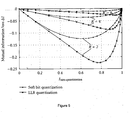
- Figure 5 shows Mutual information loss ⁇ l(X; L ) for nonuniform quantization levels determined in the LLR and soft-bit domains (1-3 quantization bits).
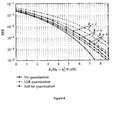
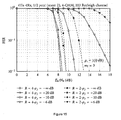
- Figure 6 shows BER after soft combining of L -values for quantized information exchange with optimized levels in either the soft-bit or LLR domain.
- the number of symbols in each block is fixed to 504.
- a narrowband flat fading i.i.d. Rayleigh channel model is assumed with an independent channel for each symbol. It is further assumed that the receiver has perfect channel knowledge for the desired user signal as well as the interfering signals.
- a half-rate memory two-parallel concatenated con-volutional code with generator polynomials (7, 5) 8 is used in all simulations with either 4-QAM or 16-QAM modulation.
- the number of information exchanges between neighboring base stations is fixed to five unless otherwise stated.
- FIG 7 shows FER curves for different receive strategies in decentralized detection: distributed iterative detection (DID), SAIC-aided DID (SAIC), DID with unconstrained backhaul (DID-UB).
- DID distributed iterative detection
- SAIC SAIC-aided DID
- DID-UB DID with unconstrained backhaul
- Figure 8 shows an effect of path loss of the dominant interferer p i , SAIC-DID.
- Figure 9 illustrates the iterative behavior of the SAIC-based receive strategy.
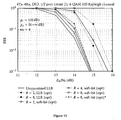
- Figure 11 depicts a 2 x 2 cell network in comparison to a 3 x 3 cell network for different values of the normalized path loss p i .
- the number of dominant received signals at each BS is fixed to 4.
- the set ⁇ l is defined according to (32), with the modulo operation ensuring that symmetry conditions are incorporated; that is, each MT is received by 4 BSs, while each BS receives 4 MTs.
- the performance for a 2 x 2 cell network with greater mutual-coupling is only slightly worse than in a 3 x 3 cell setup.
- the mutual-coupling in a 3 x 3 cell setup can be increased by symmetrically placing the dominant interferers on either side of the leading diagonal.
- the resulting difference in performance between the setups of two sizes is further reduced (dashed lines). This suggests that for a given number of dominant interferers m l and couplings p i , the performance depends on the sizes of the cycles that are formed by exchanging information among the BSs.
- Figure 11 shows SAIC-DID performance comparison for 2 ⁇ 2 and 3 ⁇ 3 cells setup. Each MT is received strongly at 4 BSs, while each BS receives signals from 4 MTs. The two curves for 3 x 3 cell setup give the bounds for different possible combinations of couplings within the setup.
- Figure 12 shows Effect of path loss of the dominant interferer p i for different modulation orders.
- FIG 15 shows the degradation in the performance of the receiver in the presence of additional weak interferes.
- the performance deteriorates sharply if p j > -10dB. This is due to the fact that the product constellation of the three stronger streams is quite densely populated and any small additional noise may result in a large change in the demap-per output estimates, thereby making the decoder less effective.
- Figure 15 shows FER for SAIC-DID in the presence of a weak interferer.
- p j represents the path loss of the weak interferer.
- Figure 16 shows optimum nonuniform quantization levels obtained by optimization in the L -value domain.
- Figure 17 shows optimum nonuniform quantization levels obtained by optimization in the "soft-bit" domain.
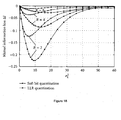
- Figure 18 shows mutual information loss ⁇ l(X;L) for 1-3 quantization bits as a function of the variance of the L -values.
- Outer cell interference in future cellular networks can be suppressed through base station cooperation.
- Preferred embodiments of the invention include an alternative strategy to the distributed antenna system (DAS) for mitigating OCI which we termed as distributed iterative detection (DID).
- DAS distributed antenna system
- DID distributed iterative detection
- An interesting feature of this approach is the fact that no special centralized processing units are needed.
- the quantization of reliability information does not result in a pronounced performance loss and sometimes even hard bits can be exchanged without undue degradation.
- To minimize backhaul it is further proposed that only those bits that have changed signs between iterations be exchanged. The result is a considerable reduction in backhaul traffic between base stations. The scheme is limited by (undetected) background interference.
- the current invention improves multi-user detection through an effective base station cooperation.
- Base stations situated at different geographical locations are utilized for an effective data exchange, thus resulting backhaul traffic.
Landscapes
- Engineering & Computer Science (AREA)
- Computer Networks & Wireless Communication (AREA)
- Signal Processing (AREA)
- Power Engineering (AREA)
- Mobile Radio Communication Systems (AREA)
Claims (12)
- Verfahren für die Mehrnutzerdetektion durch das Zusammenwirken von Basisstationen, wobei die Basisstationen an unterschiedlichen geographischen Orten gelegen sind und wobei die Basisstationen eine verteilte iterative Detektion als eine Störungsmilderungstechnik durch Nutzung einer iterativen Störungssubtraktion und durch iteratives Austauschen detektierter Daten nutzen, während sie eine getrennte Detektion und Decodierung ihrer empfangenen Datenströme ausführen,
wobei die verarbeiteten Informationen für ihre zugeordneten mobilen Endgeräte zwischen den Basisstationen in Form von Wahrscheinlichkeitsverhältnissen, L-Werten, des lokal detektierten Signals und entsprechender Größen über Schätzwerte von von den anderen Basisstationen gelieferten Störsignalen, die als ungleichförmig quantisierte Soft-Bits in Bezug auf die Anzahl der Quantisierungsebenen und die Anzahl der Quantisierungsbits repräsentiert werden, ausgetauscht werden. - Verfahren nach Anspruch 1, dadurch gekennzeichnet, dass aus den Soft-Bits optimale Rekonstruktions- und Entscheidungsebenen zum Quantisieren der L-Werte berechnet werden, wobei eine abschließende Quantisierung aus den über L-Wert = 2 tanh-1 (λ), mit λ als dem Soft-Bit, rückabgebildeten L-Werten stattfindet.
- Verfahren nach Anspruch 1, dadurch gekennzeichnet, dass zwischen den Basisstationen nur die verarbeiteten Informationen für ihre zugeordneten mobilen Endgeräte ausgetauscht werden.
- Verfahren nach einem der vorhergehenden Ansprüche, dadurch gekennzeichnet, dass die lokalen Schätzwerte der dominierenden Störer wenigstens zweier Basisstationen berechnet werden.
- Verfahren nach Anspruch 4, dadurch gekennzeichnet, dass die lokalen Schätzwerte der dominierenden Störer der meisten Basisstationen erzeugt werden, wobei die lokalen Schätzwerte daraufhin mit ihren unabhängig empfangenen Kopien von anderen Basisstationen kombiniert werden.
- Verfahren nach Anspruch 4 oder 5, dadurch gekennzeichnet, dass wenigstens einige der lokalen Schätzwerte mit ihren unabhängig empfangenen Kopien von anderen Basisstationen kombiniert werden.
- Verfahren nach Anspruch 6, dadurch gekennzeichnet, dass die meisten der lokalen Schätzwerte mit ihren unabhängig empfangenen Kopien von anderen Basisstationen kombiniert werden.
- Verfahren nach Anspruch 7, dadurch gekennzeichnet, dass alle lokalen Schätzwerte mit ihren unabhängig empfangenen Kopien von anderen Basisstationen kombiniert werden.
- Verfahren nach einem der Ansprüche 4 bis 8, dadurch gekennzeichnet, dass zum Erzeugen der lokalen Schätzwerte der dominierenden Störer bei jeder Basisstation Einzelantennenstörungs-Auslöschungstechniken genutzt werden.
- Verfahren nach einem der vorhergehenden Ansprüche, dadurch gekennzeichnet, dass zwischen Iterationen nur diejenigen Soft-Bits, die geänderte Vorzeichen aufweisen, ausgetauscht werden.
- Kommunikationssystem, das eine Kommunikation zwischen mehreren Kommunikationsvorrichtungen ausführen kann, dadurch gekennzeichnet, dass es Mittel zum Ausführen des Verfahrens nach einem der vorhergehenden Ansprüche enthält.
- Logikknoten, der in einem Kommunikationssystem nach Anspruch 11 implementiert werden kann, dadurch gekennzeichnet, dass er ein Mittel zum Ausführen des Verfahrens nach einem der Ansprüche 1 bis 10 enthält.
Priority Applications (3)
| Application Number | Priority Date | Filing Date | Title |
|---|---|---|---|
| EP08008747.1A EP2134017B1 (de) | 2008-05-09 | 2008-05-09 | Verfahren und System zur Datenkommunikation |
| ES08008747.1T ES2540916T3 (es) | 2008-05-09 | 2008-05-09 | Procedimiento y sistema de comunicación de datos |
| US12/436,565 US8412260B2 (en) | 2008-05-09 | 2009-05-06 | Method and system for data communication |
Applications Claiming Priority (1)
| Application Number | Priority Date | Filing Date | Title |
|---|---|---|---|
| EP08008747.1A EP2134017B1 (de) | 2008-05-09 | 2008-05-09 | Verfahren und System zur Datenkommunikation |
Publications (2)
| Publication Number | Publication Date |
|---|---|
| EP2134017A1 EP2134017A1 (de) | 2009-12-16 |
| EP2134017B1 true EP2134017B1 (de) | 2015-04-01 |
Family
ID=40289395
Family Applications (1)
| Application Number | Title | Priority Date | Filing Date |
|---|---|---|---|
| EP08008747.1A Active EP2134017B1 (de) | 2008-05-09 | 2008-05-09 | Verfahren und System zur Datenkommunikation |
Country Status (3)
| Country | Link |
|---|---|
| US (1) | US8412260B2 (de) |
| EP (1) | EP2134017B1 (de) |
| ES (1) | ES2540916T3 (de) |
Families Citing this family (17)
| Publication number | Priority date | Publication date | Assignee | Title |
|---|---|---|---|---|
| IT1403065B1 (it) | 2010-12-01 | 2013-10-04 | Andrew Wireless Systems Gmbh | Distributed antenna system for mimo signals. |
| US8396368B2 (en) | 2009-12-09 | 2013-03-12 | Andrew Llc | Distributed antenna system for MIMO signals |
| ES2416065T3 (es) * | 2008-09-26 | 2013-07-30 | Vodafone Holding Gmbh | Procedimiento y dispositivo para la cuantificación de cocientes de probabilidad |
| US8599768B2 (en) * | 2009-08-24 | 2013-12-03 | Intel Corporation | Distributing group size indications to mobile stations |
| IT1398025B1 (it) | 2010-02-12 | 2013-02-07 | Andrew Llc | Distributed antenna system for mimo communications. |
| WO2011099907A1 (en) * | 2010-02-15 | 2011-08-18 | Telefonaktiebolaget L M Ericsson (Publ) | Macro diversity using likelihood values |
| WO2011148964A1 (ja) * | 2010-05-25 | 2011-12-01 | 京セラ株式会社 | 受信装置、基地局及び無線通信端末 |
| EP2622757B1 (de) | 2010-10-01 | 2018-11-07 | CommScope Technologies LLC | Verteiltes antennensystem für mimo-signale |
| GB2486494A (en) * | 2010-12-17 | 2012-06-20 | Vodafone Ip Licensing Ltd | Interference detection in mobile telecommunications networks |
| US8787483B1 (en) * | 2011-10-25 | 2014-07-22 | Marvell International Ltd. | Method and apparatus for detecting a desired signal in the presence of an interfering signal |
| US9312968B2 (en) | 2013-06-07 | 2016-04-12 | Samsung Electronics Co., Ltd. | Computing system with power estimation mechanism and method of operation thereof |
| US9716601B2 (en) | 2015-04-24 | 2017-07-25 | Samsung Electronics Co., Ltd | Method and apparatus for soft detection of high order QAM symbols in MIMO channels |
| CN106656406B (zh) * | 2015-10-29 | 2019-07-19 | 电信科学技术研究院 | 一种非正交多址接入中信号检测方法及装置 |
| KR102504550B1 (ko) * | 2015-12-28 | 2023-02-28 | 삼성전자주식회사 | 저밀도 패리티 검사 코드를 지원하는 통신 시스템에서 신호를 수신하는 장치 및 방법 |
| US10404501B2 (en) * | 2016-04-06 | 2019-09-03 | Nippon Telegraph And Telephone Corporation | Wireless communication system and communication method |
| CN107809299B (zh) * | 2017-10-23 | 2019-04-16 | 哈尔滨工业大学 | 多用户共享接入技术上行链路的先串后并多用户检测方法 |
| US12381763B2 (en) * | 2021-02-16 | 2025-08-05 | Nvidia Corporation | Technique to perform demodulation of wireless communications signal data |
Citations (1)
| Publication number | Priority date | Publication date | Assignee | Title |
|---|---|---|---|---|
| US20070054621A1 (en) * | 2003-12-23 | 2007-03-08 | Peter Larsson | Advanced multi-sensor processing |
Family Cites Families (35)
| Publication number | Priority date | Publication date | Assignee | Title |
|---|---|---|---|---|
| US7430257B1 (en) * | 1998-02-12 | 2008-09-30 | Lot 41 Acquisition Foundation, Llc | Multicarrier sub-layer for direct sequence channel and multiple-access coding |
| US6426978B1 (en) * | 1998-10-01 | 2002-07-30 | Ericsson Inc. | Digital communication systems and methods for differential and/or amplitude encoding and decoding secondary symbols |
| US6775260B1 (en) * | 1999-02-25 | 2004-08-10 | Texas Instruments Incorporated | Space time transmit diversity for TDD/WCDMA systems |
| US20030206577A1 (en) * | 2000-03-21 | 2003-11-06 | Liberti Joseph Charles | Combined adaptive spatio-temporal processing and multi-user detection for CDMA wireless systems |
| US6771688B1 (en) * | 2000-09-19 | 2004-08-03 | Lucent Technologies Inc. | Segmented architecture for multiple sequence detection and identification in fading channels |
| US7103537B2 (en) * | 2000-10-13 | 2006-09-05 | Science Applications International Corporation | System and method for linear prediction |
| US6985545B2 (en) * | 2000-12-26 | 2006-01-10 | Nortel Networks Limited | Apparatus and method to provide spectrum sharing for two or more RF signals occupying an overlapping RF bandwidth |
| US7912014B2 (en) * | 2001-09-28 | 2011-03-22 | At&T Intellectual Property Ii, Lp | Method and apparatus for reducing interference in multiple-input-multiple-output (MIMO) systems |
| US7154936B2 (en) * | 2001-12-03 | 2006-12-26 | Qualcomm, Incorporated | Iterative detection and decoding for a MIMO-OFDM system |
| AU2003903826A0 (en) * | 2003-07-24 | 2003-08-07 | University Of South Australia | An ofdm receiver structure |
| JP4412926B2 (ja) * | 2002-09-27 | 2010-02-10 | 株式会社エヌ・ティ・ティ・ドコモ | 適応等化装置及びそのプログラム |
| TW200522751A (en) * | 2003-03-05 | 2005-07-01 | Interdigital Tech Corp | Received communication signal processing methods and components for wireless communication equipment |
| US7496128B2 (en) * | 2003-03-08 | 2009-02-24 | Regents Of The University Of Minnesota | Multi-user interference resilient ultra wideband (UWB) communication |
| US7463703B2 (en) * | 2003-04-14 | 2008-12-09 | Bae Systems Information And Electronic Systems Integration Inc | Joint symbol, amplitude, and rate estimator |
| PL1625697T3 (pl) * | 2003-05-15 | 2013-03-29 | Ericsson Telefon Ab L M | Kasowanie interferencji w bezprzewodowych sieciach przekaźnikowych |
| FI20030845A0 (fi) * | 2003-06-05 | 2003-06-05 | Nokia Corp | Tiedonkäsittelymenetelmä, vastaanotin ja verkkolaite |
| GB2403106B (en) * | 2003-06-18 | 2007-08-15 | Motorola Inc | Arrangement and method for iterative decoding |
| FI20031079A0 (fi) * | 2003-07-16 | 2003-07-16 | Nokia Corp | Menetelmä tiedonsiirtoresurssien kontrolloimiseksi, sekä kontrolleri |
| DE10345541A1 (de) * | 2003-09-30 | 2005-04-28 | Siemens Ag | Verfahren zum Einstellen der Übertragungsparameter von in einer Gruppe zusammengefassten, breitbandigen Übertragungskanälen |
| US7373128B2 (en) * | 2003-12-15 | 2008-05-13 | Interdigital Technology Corporation | Inter-cellular interference cancellation |
| US7701917B2 (en) * | 2004-02-05 | 2010-04-20 | Qualcomm Incorporated | Channel estimation for a wireless communication system with multiple parallel data streams |
| US7466773B2 (en) * | 2004-02-19 | 2008-12-16 | Broadcom Corporation | WLAN receiver having an iterative decoder |
| US7519898B2 (en) * | 2004-03-25 | 2009-04-14 | Krishna Rama Narayanan | Iterative decoding of linear block codes by adapting the parity check matrix |
| US8265549B2 (en) * | 2004-05-18 | 2012-09-11 | Atc Technologies, Llc | Satellite communications systems and methods using radiotelephone |
| US7526037B2 (en) * | 2004-12-31 | 2009-04-28 | Broadcom Corporation | Reduced complexity detector for multiple-antenna systems |
| US20060209993A1 (en) * | 2005-02-18 | 2006-09-21 | Wei Lu | Demodulator and receiver for pre-coded partial response signals |
| EP2106084B1 (de) * | 2005-05-04 | 2012-02-15 | Panasonic Corporation | Datenübertragungen in einem Mobilkommunikationssystem, wobei Diversity und Konstellationsumordnung eines 16-QAM-Schemas eingesetzt werden |
| US8467466B2 (en) * | 2005-11-18 | 2013-06-18 | Qualcomm Incorporated | Reduced complexity detection and decoding for a receiver in a communication system |
| WO2007123766A2 (en) * | 2006-03-31 | 2007-11-01 | The Regents Of The University Of California | Spread-spectrum receiver and reception method |
| US7961640B2 (en) * | 2006-10-26 | 2011-06-14 | Qualcomm Incorporated | Method and apparatus for codebook exchange in a multiple access wireless communication system |
| US7978635B2 (en) * | 2007-03-21 | 2011-07-12 | Qualcomm Incorporated | H-ARQ acknowledgment detection validation by re-decoding |
| US8462867B2 (en) * | 2007-08-31 | 2013-06-11 | Qualcomm Incorporated | Near soft-output maximum-likelihood detection for multiple-input multiple-output systems |
| US8861423B2 (en) * | 2008-01-18 | 2014-10-14 | Intel Corporation | Interference mitigation by overhearing |
| US20100299287A1 (en) * | 2009-05-22 | 2010-11-25 | Alcatel-Lucent Usa Inc. | Monitoring time-varying network streams using state-space models |
| US8811977B2 (en) * | 2010-05-06 | 2014-08-19 | At&T Mobility Ii Llc | Device-driven intelligence and feedback for performance optimization and planning of a service network |
-
2008
- 2008-05-09 ES ES08008747.1T patent/ES2540916T3/es active Active
- 2008-05-09 EP EP08008747.1A patent/EP2134017B1/de active Active
-
2009
- 2009-05-06 US US12/436,565 patent/US8412260B2/en not_active Expired - Fee Related
Patent Citations (1)
| Publication number | Priority date | Publication date | Assignee | Title |
|---|---|---|---|---|
| US20070054621A1 (en) * | 2003-12-23 | 2007-03-08 | Peter Larsson | Advanced multi-sensor processing |
Also Published As
| Publication number | Publication date |
|---|---|
| EP2134017A1 (de) | 2009-12-16 |
| US20090279442A1 (en) | 2009-11-12 |
| ES2540916T3 (es) | 2015-07-14 |
| US8412260B2 (en) | 2013-04-02 |
Similar Documents
| Publication | Publication Date | Title |
|---|---|---|
| EP2134017B1 (de) | Verfahren und System zur Datenkommunikation | |
| Khattak et al. | Distributed iterative multiuser detection through base station cooperation | |
| Xu et al. | Massive MIMO, non-orthogonal multiple access and interleave division multiple access | |
| US9042428B2 (en) | Efficient frequency domain (FD) MMSE equalization weight updates in a multi-stage parallel interference cancellation receiver | |
| KR100932456B1 (ko) | 직교주파수분할다중접속 시스템의 셀간 간섭 완화 장치 및방법 | |
| JP4889756B2 (ja) | 無線アクセスシステム及び移動局装置 | |
| KR100690873B1 (ko) | Mimo시스템의 복호장치 및 방법 | |
| US20110044382A1 (en) | Receiving apparatus and communication system | |
| CN102487315A (zh) | 多源多中继协作通信方法、通信设备及协作通信系统 | |
| CN105340232B (zh) | 改进的用于无线通信网络的接收器 | |
| US8724746B2 (en) | System and method for signaling and detecting in wireless communications systems | |
| US20120147942A1 (en) | System and Method for Signaling and Detecting in Wireless Communications Systems | |
| Ahmed et al. | Tight upper bound performance of full-duplex MIMO-BICM-IDD systems in the presence of residual self-interference | |
| Uchoa et al. | Iterative detection and decoding algorithms for block-fading channels using LDPC codes | |
| Khattak et al. | Low backhaul distributed detection strategies for an interference limited uplink cellular system | |
| Li et al. | Parallel multiple candidate interference cancellation with distributed iterative multi-cell detection and base station cooperation | |
| EP1906559B1 (de) | Verfahren zur Reduktion von Störungen in einem Mobilfunknetz und Basisstation eines Mobilfunknetzes | |
| CN115776431B (zh) | 一种基于消息传递的突发干扰场景下目标信号估计与解调方法 | |
| Wang et al. | Iterative MIMO subspace detection based on parallel interference cancellation | |
| Khattak et al. | On the impact of user positions on multiuser detection in distributive antenna systems | |
| Ssettumba et al. | Decentralized and Centralized IDD Schemes for Cell-Free Networks | |
| Aguerri et al. | Partial compute-compress-and-forward for limited backhaul uplink multicell processing | |
| Thomas et al. | Detection using Block QR decomposition for MIMO HetNets | |
| Ssettumba et al. | Iterative Detection and Decoding Schemes with LLR Refinements in Cell-Free Massive MIMO Networks | |
| Le et al. | Selective cooperative decoding based on a hard‐decision‐aided log‐likelihood ratio approximation |
Legal Events
| Date | Code | Title | Description |
|---|---|---|---|
| PUAI | Public reference made under article 153(3) epc to a published international application that has entered the european phase |
Free format text: ORIGINAL CODE: 0009012 |
|
| AK | Designated contracting states |
Kind code of ref document: A1 Designated state(s): AT BE BG CH CY CZ DE DK EE ES FI FR GB GR HR HU IE IS IT LI LT LU LV MC MT NL NO PL PT RO SE SI SK TR |
|
| AX | Request for extension of the european patent |
Extension state: AL BA MK RS |
|
| 17P | Request for examination filed |
Effective date: 20100607 |
|
| AKX | Designation fees paid |
Designated state(s): AT BE BG CH CY CZ DE DK EE ES FI FR GB GR HR HU IE IS IT LI LT LU LV MC MT NL NO PL PT RO SE SI SK TR |
|
| 17Q | First examination report despatched |
Effective date: 20101025 |
|
| REG | Reference to a national code |
Ref country code: DE Ref legal event code: R079 Ref document number: 602008037391 Country of ref document: DE Free format text: PREVIOUS MAIN CLASS: H04L0001000000 Ipc: H04L0025060000 |
|
| GRAJ | Information related to disapproval of communication of intention to grant by the applicant or resumption of examination proceedings by the epo deleted |
Free format text: ORIGINAL CODE: EPIDOSDIGR1 |
|
| GRAP | Despatch of communication of intention to grant a patent |
Free format text: ORIGINAL CODE: EPIDOSNIGR1 |
|
| GRAP | Despatch of communication of intention to grant a patent |
Free format text: ORIGINAL CODE: EPIDOSNIGR1 |
|
| RIC1 | Information provided on ipc code assigned before grant |
Ipc: H04L 1/00 20060101ALI20141009BHEP Ipc: H04L 25/06 20060101AFI20141009BHEP |
|
| INTG | Intention to grant announced |
Effective date: 20141030 |
|
| GRAS | Grant fee paid |
Free format text: ORIGINAL CODE: EPIDOSNIGR3 |
|
| GRAA | (expected) grant |
Free format text: ORIGINAL CODE: 0009210 |
|
| AK | Designated contracting states |
Kind code of ref document: B1 Designated state(s): AT BE BG CH CY CZ DE DK EE ES FI FR GB GR HR HU IE IS IT LI LT LU LV MC MT NL NO PL PT RO SE SI SK TR |
|
| REG | Reference to a national code |
Ref country code: GB Ref legal event code: FG4D |
|
| REG | Reference to a national code |
Ref country code: CH Ref legal event code: EP |
|
| REG | Reference to a national code |
Ref country code: IE Ref legal event code: FG4D |
|
| REG | Reference to a national code |
Ref country code: AT Ref legal event code: REF Ref document number: 719666 Country of ref document: AT Kind code of ref document: T Effective date: 20150515 |
|
| REG | Reference to a national code |
Ref country code: DE Ref legal event code: R096 Ref document number: 602008037391 Country of ref document: DE Effective date: 20150521 |
|
| REG | Reference to a national code |
Ref country code: ES Ref legal event code: FG2A Ref document number: 2540916 Country of ref document: ES Kind code of ref document: T3 Effective date: 20150714 |
|
| REG | Reference to a national code |
Ref country code: NL Ref legal event code: VDEP Effective date: 20150401 |
|
| REG | Reference to a national code |
Ref country code: AT Ref legal event code: MK05 Ref document number: 719666 Country of ref document: AT Kind code of ref document: T Effective date: 20150401 |
|
| REG | Reference to a national code |
Ref country code: LT Ref legal event code: MG4D |
|
| PG25 | Lapsed in a contracting state [announced via postgrant information from national office to epo] |
Ref country code: NL Free format text: LAPSE BECAUSE OF FAILURE TO SUBMIT A TRANSLATION OF THE DESCRIPTION OR TO PAY THE FEE WITHIN THE PRESCRIBED TIME-LIMIT Effective date: 20150401 |
|
| PG25 | Lapsed in a contracting state [announced via postgrant information from national office to epo] |
Ref country code: HR Free format text: LAPSE BECAUSE OF FAILURE TO SUBMIT A TRANSLATION OF THE DESCRIPTION OR TO PAY THE FEE WITHIN THE PRESCRIBED TIME-LIMIT Effective date: 20150401 Ref country code: PT Free format text: LAPSE BECAUSE OF FAILURE TO SUBMIT A TRANSLATION OF THE DESCRIPTION OR TO PAY THE FEE WITHIN THE PRESCRIBED TIME-LIMIT Effective date: 20150803 Ref country code: LT Free format text: LAPSE BECAUSE OF FAILURE TO SUBMIT A TRANSLATION OF THE DESCRIPTION OR TO PAY THE FEE WITHIN THE PRESCRIBED TIME-LIMIT Effective date: 20150401 Ref country code: NO Free format text: LAPSE BECAUSE OF FAILURE TO SUBMIT A TRANSLATION OF THE DESCRIPTION OR TO PAY THE FEE WITHIN THE PRESCRIBED TIME-LIMIT Effective date: 20150701 Ref country code: FI Free format text: LAPSE BECAUSE OF FAILURE TO SUBMIT A TRANSLATION OF THE DESCRIPTION OR TO PAY THE FEE WITHIN THE PRESCRIBED TIME-LIMIT Effective date: 20150401 Ref country code: CZ Free format text: LAPSE BECAUSE OF FAILURE TO SUBMIT A TRANSLATION OF THE DESCRIPTION OR TO PAY THE FEE WITHIN THE PRESCRIBED TIME-LIMIT Effective date: 20150401 |
|
| PG25 | Lapsed in a contracting state [announced via postgrant information from national office to epo] |
Ref country code: GR Free format text: LAPSE BECAUSE OF FAILURE TO SUBMIT A TRANSLATION OF THE DESCRIPTION OR TO PAY THE FEE WITHIN THE PRESCRIBED TIME-LIMIT Effective date: 20150702 Ref country code: AT Free format text: LAPSE BECAUSE OF FAILURE TO SUBMIT A TRANSLATION OF THE DESCRIPTION OR TO PAY THE FEE WITHIN THE PRESCRIBED TIME-LIMIT Effective date: 20150401 Ref country code: LV Free format text: LAPSE BECAUSE OF FAILURE TO SUBMIT A TRANSLATION OF THE DESCRIPTION OR TO PAY THE FEE WITHIN THE PRESCRIBED TIME-LIMIT Effective date: 20150401 Ref country code: IS Free format text: LAPSE BECAUSE OF FAILURE TO SUBMIT A TRANSLATION OF THE DESCRIPTION OR TO PAY THE FEE WITHIN THE PRESCRIBED TIME-LIMIT Effective date: 20150801 |
|
| REG | Reference to a national code |
Ref country code: CH Ref legal event code: PL |
|
| REG | Reference to a national code |
Ref country code: DE Ref legal event code: R097 Ref document number: 602008037391 Country of ref document: DE |
|
| PG25 | Lapsed in a contracting state [announced via postgrant information from national office to epo] |
Ref country code: EE Free format text: LAPSE BECAUSE OF FAILURE TO SUBMIT A TRANSLATION OF THE DESCRIPTION OR TO PAY THE FEE WITHIN THE PRESCRIBED TIME-LIMIT Effective date: 20150401 Ref country code: LI Free format text: LAPSE BECAUSE OF NON-PAYMENT OF DUE FEES Effective date: 20150531 Ref country code: MC Free format text: LAPSE BECAUSE OF FAILURE TO SUBMIT A TRANSLATION OF THE DESCRIPTION OR TO PAY THE FEE WITHIN THE PRESCRIBED TIME-LIMIT Effective date: 20150401 Ref country code: IT Free format text: LAPSE BECAUSE OF NON-PAYMENT OF DUE FEES Effective date: 20150509 Ref country code: CH Free format text: LAPSE BECAUSE OF NON-PAYMENT OF DUE FEES Effective date: 20150531 Ref country code: DK Free format text: LAPSE BECAUSE OF FAILURE TO SUBMIT A TRANSLATION OF THE DESCRIPTION OR TO PAY THE FEE WITHIN THE PRESCRIBED TIME-LIMIT Effective date: 20150401 |
|
| PLBE | No opposition filed within time limit |
Free format text: ORIGINAL CODE: 0009261 |
|
| STAA | Information on the status of an ep patent application or granted ep patent |
Free format text: STATUS: NO OPPOSITION FILED WITHIN TIME LIMIT |
|
| REG | Reference to a national code |
Ref country code: IE Ref legal event code: MM4A |
|
| PG25 | Lapsed in a contracting state [announced via postgrant information from national office to epo] |
Ref country code: RO Free format text: LAPSE BECAUSE OF NON-PAYMENT OF DUE FEES Effective date: 20150401 Ref country code: PL Free format text: LAPSE BECAUSE OF FAILURE TO SUBMIT A TRANSLATION OF THE DESCRIPTION OR TO PAY THE FEE WITHIN THE PRESCRIBED TIME-LIMIT Effective date: 20150401 Ref country code: SK Free format text: LAPSE BECAUSE OF FAILURE TO SUBMIT A TRANSLATION OF THE DESCRIPTION OR TO PAY THE FEE WITHIN THE PRESCRIBED TIME-LIMIT Effective date: 20150401 |
|
| 26N | No opposition filed |
Effective date: 20160105 |
|
| PG25 | Lapsed in a contracting state [announced via postgrant information from national office to epo] |
Ref country code: IE Free format text: LAPSE BECAUSE OF NON-PAYMENT OF DUE FEES Effective date: 20150509 |
|
| PGRI | Patent reinstated in contracting state [announced from national office to epo] |
Ref country code: IT Effective date: 20160412 |
|
| REG | Reference to a national code |
Ref country code: FR Ref legal event code: PLFP Year of fee payment: 9 |
|
| PG25 | Lapsed in a contracting state [announced via postgrant information from national office to epo] |
Ref country code: SI Free format text: LAPSE BECAUSE OF FAILURE TO SUBMIT A TRANSLATION OF THE DESCRIPTION OR TO PAY THE FEE WITHIN THE PRESCRIBED TIME-LIMIT Effective date: 20150401 |
|
| PG25 | Lapsed in a contracting state [announced via postgrant information from national office to epo] |
Ref country code: BE Free format text: LAPSE BECAUSE OF FAILURE TO SUBMIT A TRANSLATION OF THE DESCRIPTION OR TO PAY THE FEE WITHIN THE PRESCRIBED TIME-LIMIT Effective date: 20150401 |
|
| PG25 | Lapsed in a contracting state [announced via postgrant information from national office to epo] |
Ref country code: MT Free format text: LAPSE BECAUSE OF FAILURE TO SUBMIT A TRANSLATION OF THE DESCRIPTION OR TO PAY THE FEE WITHIN THE PRESCRIBED TIME-LIMIT Effective date: 20150401 |
|
| REG | Reference to a national code |
Ref country code: FR Ref legal event code: PLFP Year of fee payment: 10 |
|
| PG25 | Lapsed in a contracting state [announced via postgrant information from national office to epo] |
Ref country code: HU Free format text: LAPSE BECAUSE OF FAILURE TO SUBMIT A TRANSLATION OF THE DESCRIPTION OR TO PAY THE FEE WITHIN THE PRESCRIBED TIME-LIMIT; INVALID AB INITIO Effective date: 20080509 Ref country code: BG Free format text: LAPSE BECAUSE OF FAILURE TO SUBMIT A TRANSLATION OF THE DESCRIPTION OR TO PAY THE FEE WITHIN THE PRESCRIBED TIME-LIMIT Effective date: 20150401 |
|
| PG25 | Lapsed in a contracting state [announced via postgrant information from national office to epo] |
Ref country code: CY Free format text: LAPSE BECAUSE OF FAILURE TO SUBMIT A TRANSLATION OF THE DESCRIPTION OR TO PAY THE FEE WITHIN THE PRESCRIBED TIME-LIMIT Effective date: 20150401 Ref country code: SE Free format text: LAPSE BECAUSE OF FAILURE TO SUBMIT A TRANSLATION OF THE DESCRIPTION OR TO PAY THE FEE WITHIN THE PRESCRIBED TIME-LIMIT Effective date: 20150401 |
|
| PG25 | Lapsed in a contracting state [announced via postgrant information from national office to epo] |
Ref country code: TR Free format text: LAPSE BECAUSE OF FAILURE TO SUBMIT A TRANSLATION OF THE DESCRIPTION OR TO PAY THE FEE WITHIN THE PRESCRIBED TIME-LIMIT Effective date: 20150401 |
|
| PG25 | Lapsed in a contracting state [announced via postgrant information from national office to epo] |
Ref country code: LU Free format text: LAPSE BECAUSE OF NON-PAYMENT OF DUE FEES Effective date: 20150509 |
|
| REG | Reference to a national code |
Ref country code: FR Ref legal event code: PLFP Year of fee payment: 11 |
|
| PGFP | Annual fee paid to national office [announced via postgrant information from national office to epo] |
Ref country code: DE Payment date: 20250521 Year of fee payment: 18 |
|
| PGFP | Annual fee paid to national office [announced via postgrant information from national office to epo] |
Ref country code: GB Payment date: 20250521 Year of fee payment: 18 Ref country code: ES Payment date: 20250627 Year of fee payment: 18 |
|
| PGFP | Annual fee paid to national office [announced via postgrant information from national office to epo] |
Ref country code: IT Payment date: 20250527 Year of fee payment: 18 |
|
| PGFP | Annual fee paid to national office [announced via postgrant information from national office to epo] |
Ref country code: FR Payment date: 20250528 Year of fee payment: 18 |