EP2134238B1 - Chirurgische endoluminale und transluminale vorrichtungen - Google Patents
Chirurgische endoluminale und transluminale vorrichtungen Download PDFInfo
- Publication number
- EP2134238B1 EP2134238B1 EP08742981.7A EP08742981A EP2134238B1 EP 2134238 B1 EP2134238 B1 EP 2134238B1 EP 08742981 A EP08742981 A EP 08742981A EP 2134238 B1 EP2134238 B1 EP 2134238B1
- Authority
- EP
- European Patent Office
- Prior art keywords
- access device
- access
- wall
- surgical site
- accordance
- Prior art date
- Legal status (The legal status is an assumption and is not a legal conclusion. Google has not performed a legal analysis and makes no representation as to the accuracy of the status listed.)
- Active
Links
Images






Classifications
-
- A—HUMAN NECESSITIES
- A61—MEDICAL OR VETERINARY SCIENCE; HYGIENE
- A61B—DIAGNOSIS; SURGERY; IDENTIFICATION
- A61B17/00—Surgical instruments, devices or methods
- A61B17/34—Trocars; Puncturing needles
- A61B17/3417—Details of tips or shafts, e.g. grooves, expandable, bendable; Multiple coaxial sliding cannulas, e.g. for dilating
-
- A—HUMAN NECESSITIES
- A61—MEDICAL OR VETERINARY SCIENCE; HYGIENE
- A61B—DIAGNOSIS; SURGERY; IDENTIFICATION
- A61B1/00—Instruments for performing medical examinations of the interior of cavities or tubes of the body by visual or photographical inspection, e.g. endoscopes; Illuminating arrangements therefor
- A61B1/00002—Operational features of endoscopes
- A61B1/00043—Operational features of endoscopes provided with output arrangements
- A61B1/00045—Display arrangement
- A61B1/00052—Display arrangement positioned at proximal end of the endoscope body
-
- A—HUMAN NECESSITIES
- A61—MEDICAL OR VETERINARY SCIENCE; HYGIENE
- A61B—DIAGNOSIS; SURGERY; IDENTIFICATION
- A61B1/00—Instruments for performing medical examinations of the interior of cavities or tubes of the body by visual or photographical inspection, e.g. endoscopes; Illuminating arrangements therefor
- A61B1/012—Instruments for performing medical examinations of the interior of cavities or tubes of the body by visual or photographical inspection, e.g. endoscopes; Illuminating arrangements therefor characterised by internal passages or accessories therefor
- A61B1/018—Instruments for performing medical examinations of the interior of cavities or tubes of the body by visual or photographical inspection, e.g. endoscopes; Illuminating arrangements therefor characterised by internal passages or accessories therefor for receiving instruments
-
- A—HUMAN NECESSITIES
- A61—MEDICAL OR VETERINARY SCIENCE; HYGIENE
- A61B—DIAGNOSIS; SURGERY; IDENTIFICATION
- A61B1/00—Instruments for performing medical examinations of the interior of cavities or tubes of the body by visual or photographical inspection, e.g. endoscopes; Illuminating arrangements therefor
- A61B1/04—Instruments for performing medical examinations of the interior of cavities or tubes of the body by visual or photographical inspection, e.g. endoscopes; Illuminating arrangements therefor combined with photographic or television appliances
- A61B1/042—Instruments for performing medical examinations of the interior of cavities or tubes of the body by visual or photographical inspection, e.g. endoscopes; Illuminating arrangements therefor combined with photographic or television appliances characterised by a proximal camera, e.g. a CCD camera
-
- A—HUMAN NECESSITIES
- A61—MEDICAL OR VETERINARY SCIENCE; HYGIENE
- A61B—DIAGNOSIS; SURGERY; IDENTIFICATION
- A61B17/00—Surgical instruments, devices or methods
- A61B17/22—Implements for squeezing-off ulcers or the like on inner organs of the body; Implements for scraping-out cavities of body organs, e.g. bones; for invasive removal or destruction of calculus using mechanical vibrations; for removing obstructions in blood vessels, not otherwise provided for
- A61B17/22031—Gripping instruments, e.g. forceps, for removing or smashing calculi
-
- A—HUMAN NECESSITIES
- A61—MEDICAL OR VETERINARY SCIENCE; HYGIENE
- A61B—DIAGNOSIS; SURGERY; IDENTIFICATION
- A61B17/00—Surgical instruments, devices or methods
- A61B17/34—Trocars; Puncturing needles
- A61B17/3417—Details of tips or shafts, e.g. grooves, expandable, bendable; Multiple coaxial sliding cannulas, e.g. for dilating
- A61B17/3421—Cannulas
-
- A—HUMAN NECESSITIES
- A61—MEDICAL OR VETERINARY SCIENCE; HYGIENE
- A61B—DIAGNOSIS; SURGERY; IDENTIFICATION
- A61B17/00—Surgical instruments, devices or methods
- A61B17/00234—Surgical instruments, devices or methods for minimally invasive surgery
-
- A—HUMAN NECESSITIES
- A61—MEDICAL OR VETERINARY SCIENCE; HYGIENE
- A61B—DIAGNOSIS; SURGERY; IDENTIFICATION
- A61B17/00—Surgical instruments, devices or methods
- A61B17/34—Trocars; Puncturing needles
- A61B17/3417—Details of tips or shafts, e.g. grooves, expandable, bendable; Multiple coaxial sliding cannulas, e.g. for dilating
- A61B17/3421—Cannulas
- A61B17/3431—Cannulas being collapsible, e.g. made of thin flexible material
-
- A—HUMAN NECESSITIES
- A61—MEDICAL OR VETERINARY SCIENCE; HYGIENE
- A61B—DIAGNOSIS; SURGERY; IDENTIFICATION
- A61B17/00—Surgical instruments, devices or methods
- A61B17/34—Trocars; Puncturing needles
- A61B17/3474—Insufflating needles, e.g. Veress needles
-
- A—HUMAN NECESSITIES
- A61—MEDICAL OR VETERINARY SCIENCE; HYGIENE
- A61B—DIAGNOSIS; SURGERY; IDENTIFICATION
- A61B17/00—Surgical instruments, devices or methods
- A61B17/00234—Surgical instruments, devices or methods for minimally invasive surgery
- A61B2017/00238—Type of minimally invasive operation
- A61B2017/00278—Transorgan operations, e.g. transgastric
-
- A—HUMAN NECESSITIES
- A61—MEDICAL OR VETERINARY SCIENCE; HYGIENE
- A61B—DIAGNOSIS; SURGERY; IDENTIFICATION
- A61B17/00—Surgical instruments, devices or methods
- A61B17/00234—Surgical instruments, devices or methods for minimally invasive surgery
- A61B2017/00292—Surgical instruments, devices or methods for minimally invasive surgery mounted on or guided by flexible, e.g. catheter-like, means
- A61B2017/003—Steerable
-
- A—HUMAN NECESSITIES
- A61—MEDICAL OR VETERINARY SCIENCE; HYGIENE
- A61B—DIAGNOSIS; SURGERY; IDENTIFICATION
- A61B17/00—Surgical instruments, devices or methods
- A61B2017/00367—Details of actuation of instruments, e.g. relations between pushing buttons, or the like, and activation of the tool, working tip, or the like
- A61B2017/00398—Details of actuation of instruments, e.g. relations between pushing buttons, or the like, and activation of the tool, working tip, or the like using powered actuators, e.g. stepper motors, solenoids
-
- A—HUMAN NECESSITIES
- A61—MEDICAL OR VETERINARY SCIENCE; HYGIENE
- A61B—DIAGNOSIS; SURGERY; IDENTIFICATION
- A61B17/00—Surgical instruments, devices or methods
- A61B2017/00535—Surgical instruments, devices or methods pneumatically or hydraulically operated
- A61B2017/00544—Surgical instruments, devices or methods pneumatically or hydraulically operated pneumatically
-
- A—HUMAN NECESSITIES
- A61—MEDICAL OR VETERINARY SCIENCE; HYGIENE
- A61B—DIAGNOSIS; SURGERY; IDENTIFICATION
- A61B17/00—Surgical instruments, devices or methods
- A61B2017/00831—Material properties
- A61B2017/00867—Material properties shape memory effect
-
- A—HUMAN NECESSITIES
- A61—MEDICAL OR VETERINARY SCIENCE; HYGIENE
- A61B—DIAGNOSIS; SURGERY; IDENTIFICATION
- A61B17/00—Surgical instruments, devices or methods
- A61B2017/00831—Material properties
- A61B2017/00902—Material properties transparent or translucent
- A61B2017/00907—Material properties transparent or translucent for light
-
- A—HUMAN NECESSITIES
- A61—MEDICAL OR VETERINARY SCIENCE; HYGIENE
- A61B—DIAGNOSIS; SURGERY; IDENTIFICATION
- A61B90/00—Instruments, implements or accessories specially adapted for surgery or diagnosis and not covered by any of the groups A61B1/00 - A61B50/00, e.g. for luxation treatment or for protecting wound edges
- A61B90/36—Image-producing devices or illumination devices not otherwise provided for
- A61B90/361—Image-producing devices, e.g. surgical cameras
- A61B2090/3614—Image-producing devices, e.g. surgical cameras using optical fibre
-
- A—HUMAN NECESSITIES
- A61—MEDICAL OR VETERINARY SCIENCE; HYGIENE
- A61B—DIAGNOSIS; SURGERY; IDENTIFICATION
- A61B90/00—Instruments, implements or accessories specially adapted for surgery or diagnosis and not covered by any of the groups A61B1/00 - A61B50/00, e.g. for luxation treatment or for protecting wound edges
- A61B90/36—Image-producing devices or illumination devices not otherwise provided for
- A61B90/361—Image-producing devices, e.g. surgical cameras
-
- A—HUMAN NECESSITIES
- A61—MEDICAL OR VETERINARY SCIENCE; HYGIENE
- A61B—DIAGNOSIS; SURGERY; IDENTIFICATION
- A61B90/00—Instruments, implements or accessories specially adapted for surgery or diagnosis and not covered by any of the groups A61B1/00 - A61B50/00, e.g. for luxation treatment or for protecting wound edges
- A61B90/36—Image-producing devices or illumination devices not otherwise provided for
- A61B90/37—Surgical systems with images on a monitor during operation
-
- A—HUMAN NECESSITIES
- A61—MEDICAL OR VETERINARY SCIENCE; HYGIENE
- A61B—DIAGNOSIS; SURGERY; IDENTIFICATION
- A61B90/00—Instruments, implements or accessories specially adapted for surgery or diagnosis and not covered by any of the groups A61B1/00 - A61B50/00, e.g. for luxation treatment or for protecting wound edges
- A61B90/40—Apparatus fixed or close to patients specially adapted for providing an aseptic surgical environment
Definitions
- the present invention relates to an access device according to the preamble of claim 1.
- the present invention is directed to surgical access ports for use in endoluminal or transluminal procedures, such as through the human esophagus or lower gastrointestinal tract.
- An access device according to the preamble of claim 1 is known from US 5,738,628 A .
- a variety of devices are known in the art for assisting surgical procedures - including cannulas for accessing internal cavities of a patient, and other devices, such as endoscopes.
- Endoscopy is a term for a range of medical procedures that allow a doctor to observe the inside of the body without performing major surgery.
- An endoscope e.g., a fibrescope
- An endoscope is a long tube with a lens at the distal end and an eyepiece and/or camera at the proximal end. The end with the lens is inserted into a patient. Light is transmitted through the tube (via bundles of optical fibres) to illuminate the surgical site, and the eyepiece magnifies the area so the doctor can visualize the surgical site.
- an endoscope is inserted through one of the body's natural openings, such as the mouth, urethra or anus, but depending on the particular procedure, may require a small incision through the skin.
- endoscopes are used to perform simple surgical procedures, such as tubal ligation ("tying" of the female fallopian tubes); locating, sampling or removing foreign objects or tumors from the lungs or digestive tract; removal of the gallbladder; taking small samples of tissue for diagnostic purposes (biopsy).
- a range of endoscopes have been developed for many parts of the body. Each has its own name, depending on the part of the body it is intended to investigate.
- an arthroscope is inserted through a small incision to examine a skeletal joint.
- a bronchoscope is inserted down the trachea (windpipe) to examine the lungs.
- a colonoscope is inserted through the anus to examine the colon.
- a gastroscope is inserted down the esophagus to examine the stomach.
- a hysteroscope is inserted through the cervix to examine the uterus.
- a laparoscope is inserted through a small incision to examine the abdominal organs.
- a cystoscope is inserted via the urethra to examine the urethra and urinary bladder.
- Such procedures can be carried out with one or more instruments used in conjunction with an endoscope. Such procedures often also require an opening through which the endoscope and/or instruments can pass.
- Such working channels can be natural openings-- e.g. the mouth and esophagus, or artificial openings such as an incision made in the abdomen of a patient.
- Some endoscopes may be configured with an integral working channel. Such working channels are often small, and may or may not be suitable for a particular instrument to be inserted therethrough. Moreover, it can prove difficult to obtain good working instruments in very small sizes. Further, imaging through fibers can be limiting - often due to low resolution images. If an endoscope is provided with an imaging chip on a scope having a circular cross-section, this can restrict the size and quality of images obtained therefrom. Moreover, if insufflation is required for a particular procedure, insufflation through an endoscope is typically maintained with mechanical seals. Even state-of-the-art mechanical seals typically present difficulty for a surgeon due to substantial friction, which results in difficult manipulation and restricted instrument access.
- the invention provides an access device in accordance with claim 1 adapted and configured to be inserted through a natural biological orifice.
- the access device can include at least one control element for manipulation of the curvature of the access device.
- two individual control elements can be used to control orthogonal motion - e.g., with respect to X and Y axes.
- Such control elements can further be provided in one or more opposing pairs.
- Such control elements can be, for example flexible or semi-rigid rods, wires or ribbons. Manipulation of the curvature of the entire access device can be controlled, or alternatively, the curvature of only the distal tip can be controlled, depending on the precise implementation.
- One or more image sensors can be arranged in the distal end portion of the access device, which are adapted and configured to capture images of a region distal the distal end portion of the access device. If multiple image sensors are provided, they can facilitate stereoscopic imaging of the subject region.
- One or more working channels can be provided in the wall of the access device, and one or more of said working channels can be configured and adapted to provide irrigation to a surgical site. Alternatively or additionally, one or more of said working channels can be configured and adapted to provide drainage to a surgical site and one or more channels can be configured to allow a surgical instrument to pass therethrough.
- One or more light sources can be arranged in the distal end portion of the access device, and adapted and configured to illuminate a region distal the distal end portion of the access device.
- illumination means can be provided in the wall of the access device.
- one or more guide elements adapted and configured to guide surgical instruments in the lumen of the access device can be provided.
- One or more pressure sensing channels can be arranged in the wall of the access device, and be configured and adapted to be in fluid communication with a surgical site.
- Devices in accordance with the invention can be of any length desired or required.
- the length of the body can be between about 30cm and about 50cm, depending on the precise application.
- a range of length between about 30cm and 40cm is particularly advantageous for a transesophageal access route for an endoluminal intra-gastric procedure-accessing a patient's stomach or duodenum.
- the length of the body can be between about 40cm and 50cm, which range of length is particularly advantageous for transluminal access to internal organs via a trans-gastric route-that is, accessing a an organ through the wall of a patient's stomach.
- devices in accordance with the invention can be in the range of about 15cm to about 20cm for use as an anoscope and transanal access to the rectum, and can be up to about 160cm in length for use as, or in conjunction with, a colonoscope, depending on the precise implementation.
- a device provided with integral optics and illumination is between about 90cm and 130cm in length, preferably about 110cm in length.
- Internal diameters of access devices in accordance with the invention can be any size that is practical for the application, but preferably range between about 10mm and 20mm, and in a preferred embodiment, between 15mm and 18mm.
- Access devices can further comprise an integral image display provided in the proximal end portion thereof.
- an insertion device can be provided for inserting access devices in accordance with the invention.
- Such insertion devices can have a tip portion to facilitate insertion of the access device through a natural orifice.
- the tip can taper to a substantially blunt end and/or can include a dilating element.
- the tip portion can include at least one transparent region.
- the insertion device can be provided with illuminating means for illuminating a region distal the insertion device.
- the insertion device can be configured and adapted to interface with an endoscope to facilitate guidance of the user during insertion.
- the insertion device can further include an integral lens arranged in a distal end portion thereof.
- the devices presented herein may be used as surgical access ports, particularly for endoluminal or transluminal medical procedures.
- the devices described and set forth herein can incorporate any feature from the following U.S. Patent applications and patents: U.S. Patent Application Serial No. 11/517,929, filed September 8, 2006 (U.S. Patent Publication No. US 2007/0088275, published April 19, 2007 ), which is a continuation-in-part of U.S. Patent Application Serial No. 10/776,923, filed February 11, 2004 (now U.S. Patent No. 7,338,473 ), which is a continuation-in-part of U.S. Patent Application Serial No. 10/739,872, filed December 18, 2003 (now U.S. Patent No.
- Figures 1a-1c illustrate a first embodiment of an access device 100 in accordance with the invention.
- This embodiment has a generally elliptical cross-section, as can be seen at its proximal end 101 ( Figure 1b ).
- this access device 100 is sufficiently flexible to navigate a natural body orifice through which it is intended to be inserted.
- the access device 100 includes an insufflation input 120a, and a pressure sensing channel having proximal and distal openings 110a, 110b, respectively.
- the body of the access device 100 includes a lumen 170, and can be embodied so as to include manipulating elements 180, such as wires, to effect curvature of the access device 100, when desired.
- An image sensor 130 may be provided at the distal end region, as may be at least one light source 140.
- the at least one light source may be one or more light-emitting diodes (LEDs), and that one or more CMOS, CCD or other small image sensors may be mounted at the distal end of the device and used as image sensors.
- Images can be transmitted to the external environment through conductive elements provided on or within the access device 100, or can be provided wirelessly, such as by radio frequency transmission to a receiver.
- the access device might not contain integrated optics and that known types of viewing devices may be inserted through the central lumen or a working channel of the access device for viewing purposes.
- Devices in accordance with the invention can be of any length desired or required.
- the length of the body can be between about 30cm and about 50cm, depending on the precise application.
- a range of length between about 30 cm and 40 cm is particularly advantageous for a transesophageal access route for an endoluminal intra-gastric procedure.
- the length of the body can be between about 40cm and 50cm, which range of length is particularly advantageous for transluminal access to internal organs via a trans-gastric rout-that is, accessing of an organ through the wall of a patient's stomach.
- devices in accordance with the invention can be in the range of about 15 cm to about 20 cm for use as an anoscope and transanal access to the rectum, and can be up to about 160cm in length for use as, or in conjunction with, a colonoscope, depending on the precise implementation.
- a device provided with integral optics and illumination is between about 90 cm and 130 cm in length, preferably about 110cm in length.
- Internal diameters of access devices in accordance with the invention can be any size that is practical for the application, but preferably range between about 10mm and 20mm, and in a preferred embodiment, between 15mm and 18mm.
- Additional features that can be incorporated into access devices in accordance with the invention include, but are not limited to having an outer cross-sectional shape ranging from circular, through an elliptical shape to near linear in shape.
- one or more fluid seals 120b are provided to seal between instruments passing through the lumen 170, and the wall of the lumen, in order to maintain pressure within an operative space.
- Various embodiments of access devices having fluid seals are set forth in the documents referenced above.
- mechanical sealing can additionally be incorporated into different embodiments of access devices described therein, as well as into those described in connection with the present invention, such mechanical seals can equally be absent, allowing substantially unencumbered movement of instruments through and within such access devices.
- the access device 100 of Figure 1 or any access device set forth herein can be provided with a fluid seal, as described in the documents referenced above.
- the subject access devices can further include one or more of the following features: one or more endoscopes; one or more working channels; illumination capability; and/or the capability to be steered by a user.
- Incorporation of non-mechanical seals into endoluminal and transluminal access devices in accordance with the invention can allow for easier, safer procedures as well as new approaches to procedures.
- Nozzles in accordance with the invention can be embodied in a variety of suitable manners.
- Nozzles can be provided that are substantially annular in configuration, or alternatively, if desired, a plurality of discrete nozzle apertures can be defined in place one such annular nozzle. These discrete nozzle apertures can be arranged as necessary, about the wall of the access device, to form an effective barrier to proximal egress of insufflation gas from a surgical site.
- Such discrete nozzles can each be substantially round in shape, or alternatively can be oblong or another shape.
- the nozzles can be placed at regular intervals about the circumference of the lumen, can extend part way around, or can be spaced from each other in groups.
- nozzles or groups of nozzles can be provided in access devices in accordance with the invention, with such nozzles being located in one region, or in a plurality of regions along the length of the access device.
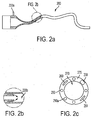
- FIGS 2a-2c illustrate a further embodiment of an access device 200, in accordance with the invention.
- the access device 200 includes an insufflation fluid input 220a, which is in fluid communication with a fluid seal 220b.
- the fluid seal may be positioned within the proximal housing of the device or may be positioned at any desired location between the proximal housing and the distal tip of the device.
- a lumen 270 serves as a working channel for passage of surgical instruments and the like, and is defined by the wall 275 of the access device 200.
- the wall 275 itself also houses additional working channels, such as an irrigation port 260, drainage port 261 and pressure sensing port 210a. Additional ports can be used for additional functions, as desired or required.
- illumination can be provided by way of one or more light sources, which can be provided directly in the wall 275, or whose light can be transmitted through the wall 275, to the distal end thereof by one or more fiber optic elements 250.
- one or more optional image sensors 230 can be provided in the wall 275 in order to capture images of a surgical site.
- the foregoing and following embodiments can be flexible or rigid, as desired or required.
- the foregoing and below-described access devices allow a user to pass a plurality of surgical instruments through a natural lumen into the human body.
- natural openings include, for example, the mouth and esophagus, the anus and rectum or vagina.
- Entrance through such natural openings can provide access into the digestive tract without surgical incisions penetrating the external abdominal wall.
- gastrointestinal pressures can be maintained within the organ(s), such as the stomach, without any interference with inserted instruments which would typically be caused by mechanical seals used in a typical endoscope, colonoscope, trocar, cannula or other access systems.
- manipulation of surgical instruments is less encumbered, as compared with more conventional devices having mechanical seals.
- the subject access devices suffer less from frictional resistance between inserted instruments and the access device. Reducing such interference and friction is advantageous, and may reduce torque and other forces transmitted from the inserted instrument through the access device to surrounding tissue, which can cause trauma and prolong healing and recovery.
- the access device may also allow crossing of paths of the inserted instruments, as when switching hands, without having to retract and then reinsert an instrument.
- Endoscopic surgical or exploratory access via a transesophageal or transanal route can be intraluminal-that is, it can be used for accessing the natural lumen itself (e.g., the esophagus, stomach, rectum, colon), or can be transluminal, that is-used to access other anatomy through the wall of such structures.
- Such an approach can be referred to as Natural Orifice Transluminal Endoscopic SurgeryTM ("NOTES").
- NOTES Natural Orifice Transluminal Endoscopic Surgery
- Such access can allow for imaging, insertion of one or more surgical instruments, removal of a tissue specimen, or insufflation of the lumen (e.g., the stomach).
- access to a patient's peritoneum can be achieved through an internal endoluminal route.
- insufflation of the peritoneum is possible using access devices in accordance with the invention. The following is a sample list of minimally-invasive procedures that can be accomplished by surgeons operating through access devices as described herein:
- Devices in accordance with the invention can allow, in general, for new approaches to accessing anatomy. Any instrument inserted through the lumen of an access device equipped with one or more fluid seals in accordance with the invention will experience markedly reduced frictional resistance, due to replacement of mechanical seals with fluid seals. It may, at times, prove useful to include one or more mechanical valves, such as for example a duckbill valve or other so-called “zero seal” intended to seal the access device when no instrument is inserted therethrough. However, typically the number of such valves will be reduced if not eliminated, for every fluid seal that is used. Without mechanical seals protruding into a lumen of access devices in accordance with the invention, more space for instruments is available, while free insertion and movement of the instruments is not hampered by mechanical seals.
- mechanical valves such as for example a duckbill valve or other so-called “zero seal” intended to seal the access device when no instrument is inserted therethrough.
- gas such as carbon dioxide
- gas can be supplied to such fluid seals in a continuous manner- thereby insufflating an operative space while also sealing the operative space.
- gas such as carbon dioxide
- Such a continuous flow of insufflation gas is distinct from prior systems, in that prior insufflation technologies operate in a cyclic manner-alternately insufflating and sensing pressure. Such systems do not allow for insufflation when pressure is being sensed.
- a further advantage to access devices in accordance with the invention is that maintaining a pressure barrier in an access device, between an insufflated space and the surrounding environment without the use of elastomeric seals provides the capability for safe relief from pressure buildup from any possible system failures or sources of additional pressure.
- Bucking is the phenomenon where a patient tightens his diaphragm while his abdomen is insufflated. This tightening dramatically increases pressure within the abdomen. Further, if used in laparoscopic procedure, fluid seals incorporated with devices constructed in accordance with the invention all use of open type instrumentation.
- access devices in accordance with the invention allow for more freedom in instrument design. Because contact seals are not required, instruments inserted through access devices in accordance with the invention do not need to conform to the shape and size of such mechanical seals. Accordingly, instruments having a non-symmetrical shape can be used, which may be more efficient and cost-effective, and multiple instruments can be inserted simultaneously to improve manipulation through the access device.
- the absence of mechanical seals reduces the likelihood of smudging of optical components of surgical instruments inserted through access devices constructed in accordance with the invention.
- devices in accordance with the present invention can be provided with various cross-sectional shapes, including, but not limited to circular, elliptical, or as set forth above, cross-sectional shapes that approach a linear morphology when not in use. If embodied in an elliptical shape, access devices in accordance with the invention advantageously allow insertion of instruments of various sizes, such as instruments having an oblong cross-section. An elliptical cross-section can also allow for insertion of the access device in regions of the anatomy that would otherwise not allow insertion of an access device having a round cross-sectional shape.
- Surgical instruments that can be used through access devices in accordance with the invention include, but are not limited to rigid or flexible versions of the following, depending on the procedure: graspers, scissors, snares, staplers, ultrasonic imaging devices, ultrasonic cutting and/or coagulating devices, vessel sealing devices, RF devices, microwave energy delivery devices glue delivery devices and suturing devices.
- Access devices in accordance with the invention can further incorporate various imaging technologies.
- One or more image sensors can be utilized for image acquisition, which sensors can be incorporated into an access device, for example at or near the distal end thereof.
- standard fiber optic imaging technology may be inserted through the fluid seal or may be incorporated into a wall of the access device, such that an objective (lens) is at the distal end portion of the access device, and an image sensor and/or eyepiece is provided elsewhere, such as at the proximal end thereof.
- imaging devices can be embodied so as to obtain still images, but video images can alternatively or additionally be obtained to allow for real-time guidance of a procedure, and can allow for guidance during insertion of the access device itself.
- illumination can be provided in the subject access devices in the form of integrated fiber-optics, connected to an external light source and/or integrated sources of light, such as LEDs (light-emitting diodes) integrated into the distal end portion of the access device.
- LEDs light-emitting diodes
- Capability for infrared imaging for diagnostic purposes can further be provided, in the form of an optical sensor capable of capturing light in the infrared region, and additionally, if needed, an infrared light source.
- FIGS 3a-3d illustrate a surgical access device 300 in accordance with the invention, which is flexible and manipulable, as with foregoing embodiments.
- One or more fluid seals 320b are provided therein, to which fluid (such as compressed air or inert gas, or in the case of arthroscopic or other surgery which utilizes liquid, saline or other suitable biocompatible liquid) is supplied via a fluid input 320a.
- a sensing input 310 is also provided, as described above in connection with other embodiments.
- instrument guides 385 shown in the end view of Figure 3c
- Figure 3a surgical or exploratory instruments 305a, 305b, 305c pass through the guides 385, and thereby are prevented from moving undesirably, or unnecessarily interfering with one another.
- an insertion device 390 can be provided, which is inserted into the access device 300, prior to insertion in a patient.
- the insertion device 390 includes a tip 395, which facilitates insertion into a patient.
- Tip 395 may be blunt or sharp, rounded or pointed or such other configuration as appropriate for the intended insertion.
- Tip 395 also may be transparent to provide optical viewing during or after insertion.
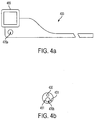
- a proximal display 489 such as an LCD display
- access devices in accordance with the invention, such as access device 400 of Figures 4a and 4b .
- Such displays 489 can be integrated with respective access devices, or can be attached thereto in order to provide optimum viewing nearer the location in which the procedure is taking place, rather than on a display mounted far from the operating table.
- Such displays can provide high resolution direct images of the anatomy.
- the display 489 receives images from an image sensor 430 arranged in the distal end region of the access device 400.
- video signals from the image sensor 430 can be additionally output to display monitors by one or more wired and/or wireless connections.
- images may alternatively or additionally be displayed on a traditional monitor in the vicinity.
- illumination elements 451 may also be provided at the distal end region of the access device 400, and can include light sources, such as light-emitting diodes (LEDs) or alternatively or additionally, fiberoptic conduits that deliver light from an external light source. It is preferable, generally, that such illumination elements 451 be capable of providing bright, controllable illumination and be relatively small in size.
- the foregoing elements can be provided directly in a wall of the access device 400, which has a lumen 470, running therethrough, with openings 470a ( Figure 4a ), 470b at proximal and distal ends of the access device 400, respectively.
- access devices in accordance with the invention allows the ability to use new flexible instruments of different shapes, geometries and mechanics. Such instruments might otherwise not be satisfactorily sealable with conventional sealing techniques.
- the absence of mechanical seals also can allow for passage of instrument drive and steering mechanisms, as well as for tissue manipulation, repair and/or retrieval.
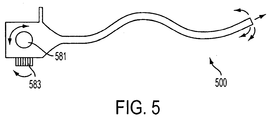
- FIG. 5 illustrates a further embodiment of an access device 500 in accordance with the invention.
- the access device 500 includes control knobs 581, 583, which manipulate control elements provided within the access device 500. When the control elements are placed in tension, the access device will tend to bend toward that control element. Conversely, when a control element is placed in compression, the access device 500, will tend to bend away from that control element.
- two controls 581, 583 control bending of the access device in two orthogonal directions, such as "X" and "Y" in a Cartesian coordinate system.
- Figure 6 is an enlarged cross-sectional view of a distal end portion of an access device 600, in accordance with the invention, through which an insertion device 660 has been inserted.
- the insertion device 660 may receive an endoscope 670 therethrough, which views the insertion site through one or more transparent windows or lenses 665.
- the lenses 665 can also be adapted to provide illumination to the insertion site.
- the insertion device 660 may terminate in an elongate tip 661, which may facilitate dilation of a natural orifice through which the insertion device 660 and access device 600 assembly pass during insertion.
- the contour 663 of the insertion device provides a relatively smooth transition to the diameter of the access device 600 from that of the tip 661.
- Figures 7a-7d illustrate rigid and flexible access devices 700a, 700b, respectively, that are particularly configured and adapted for transanal insertion into the rectum of a patient.
- Features for these embodiments can be any of those set forth in connection with foregoing embodiments, including but not limited to use with an insertion device, incorporation of one or more fluid seals or insufflation means and/or steerability (in the case of flexible access devices).
- instrument guides 785 can be provided.
- irrigation channels 781, illumination capability 783, visualization components, such as one or more image sensors 787, or fiber optics to allow image transmission, and drainage capacity, such as in the form of drainage channels 789 can be incorporated.
- the foregoing elements can be arranged within the wall 775 of the access devices 700a, 700b, as with the embodiment described in connection with Figures 2a-2c , for example.
- an insertion device 790 can be utilized to facilitate insertion into the body of a patient.
- FIG 8 is a side view of a further embodiment of an access device 800 constructed in accordance with the invention.
- the access device 800 has a distal end 870 with open distal side portion 875.
- This embodiment allows instrumentation to be oriented to act on the side as an alternative to or in addition to through a distal end aperture.
- This arrangement is particularly advantageous when performing a procedure on the wall of a passage, such as the esophagus, stomach or duodenum, for example.
- a wall of such passage can be sucked via vacuum or pulled by mechanical means into contact with the access device 800 to facilitate a procedure.
- steps including cutting, stapling and removal of tissue can be carried out. Vacuum can be applied in a number of ways, in accordance with the invention.
- suction is applied directly through the access device 800.
- a single pump can be provided, which is adapted and configured to both provide insufflation pressure to the access device 800 and to provide suction to the access device 800.
- Use of a single pump allows for more streamlined surgical equipment and controls-reducing unnecessary clutter in the operating room and reducing cost by obviating a second pumping device.
- separate pumps can be connected to the access device 800, and selectively activated in order to switch between insufflation and suction.
- a secondary suction device can be utilized-either inserted through a central internal lumen of the access device 800 or external thereto.
- the access device 800 can be flexible to allow manipulation through the anatomy of a patient, as seen in Figure 9 .
- the overall shape of the access device 800 can be preformed, as illustrated, so that the device has a tendency to revert to a shape that facilitates insertion and/or comfortable retention in the patient.
- the entire access device 800, or a portion thereof, such as the distal end portion, can be steerable to aid insertion of the access device and procedures performed therewith.
- a fluid seal can be provided in the proximal end portion 815 of the access device 800, or additionally or alternatively at one or more other locations throughout the length of the access device 800.
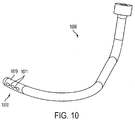
- Figure 10 is a side view of another embodiment of an access device 1000 constructed in accordance with the invention.
- the access device 1000 is similar to that of Figures 8 and 9 , but includes at its distal end 1070, a side-grasping feature with undulating grasping elements 1071.
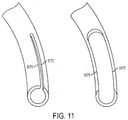
- the side-grasping elements can be straight grasping elements 1171 as illustrated in Figure 11 .
- Figure 12 illustrates the side grasping elements in closed, open and grasping positions, respectively.
- the grasping elements can be used to engage a wall of a passage, internal organ or other element, for example, to move the wall or steady the wall for another step, such as a puncture or incision.
- Actuation can be effected in any suitable manner.
- tension within the wall 1079 of the distal end 1071 is adjusted to effect closure or opening of the grasping elements 1071.
- Such tension can be adjusted by way of, for example, shape-memory alloy ribs 1278 arranged within the wall of the distal end 1070.
- Such ribs 1278 can have a first shape at normal room and/or body temperatures.
- the ribs 1278 can be electrically connected to a power source, such that when voltage is applied, resistive heating of the ribs 1278 effects a change in shape of the ribs to a second shape.
- the normal state of the ribs can be open or closed.
- the grasping elements 1071 can be actuated by providing one or more control elements (e.g., wires) terminating in a plurality of ends that terminate in or near the grasping elements 1071, within the wall 1079 of the distal end 1071. Accordingly, applying compression to such control cables will cause the grasping elements to close.
- control elements e.g., wires
- Figures 13a and 13b illustrate a distal end portion 1370 of a surgical access device constructed in accordance with the invention having a steerable distal end portion 1370.
- Control elements 1310 such as wires are provided within or adjacent the wall 1379 of the access device.
- the control elements 1310 are anchored in one or more locations 1320 to the wall of the access device. Although illustrated within the lumen 1340 of the access device, the control elements 1310 are provided with in the wall 1379.
- Tension applied to one or more control elements 1310 effects a change in curvature of the distal end portion 1370. In conjunction with applied rotation to the entire access device by a surgeon, navigation through the patient's anatomy is facilitated.
- FIG. 14 illustrates an endoluminal and transluminal access device 1400 being used in a trans-gastric cholecystectomy (removal of gall bladder).
- the access device 1400 is inserted by way of the esophagus 1490 of a patient, into the stomach 1420 of the patient. Access is made by way of an incision through the wall of the stomach 1420, into the abdominal cavity 1410. An incision is made in any suitable manner, but preferably by an endoscopic cutting implement placed through the lumen of the access device 1400, which induces coagulation, such as by electrocautery or ultrasonic vibrations.
- a second access device 1450 is inserted through the navel or umbilicus 1411 of the patient. This mode of external access obscures any scarring that may occur. Naturally, the trans-esophageal entry of the access device 1400 carries no risk of visible scarring.
- the cavity Prior to or upon entering the abdominal cavity 1410, the cavity may be insufflated by way of the access device 1400.
- the abdominal cavity can be insufflated by way of the second access device 1450 and/or still another element, such as a veress needle.
- a flexible endoscope 1405 is inserted through the transluminal access device 1400. Any number of additional instruments that can physically fit through the lumen of the access device 1400 can be inserted therethrough, and the fluid seal formed by the access device 1400 will maintain a seal around the instruments. An entire cholecystectomy can be performed via this access device 1400. At present it is more effective to close the incision made in the stomach wall by accessing the stomach 1420 from the outside, and for this reason, the second access device 1450 is used with a surgical stapler 1457 to close the incision made in the stomach. Therefore, the second access device 1450 is also used during the cholecystectomy. Through the channel of the second access device, an endoscope, grasper shears or any other necessary instrument can be inserted.
- the gall bladder Upon severing the cystic duct, vascular tissue and connecting tissue, the gall bladder can be removed by either the transluminal access device 1400 or the second access device 1450. If necessary, the gall bladder can be separated into smaller pieces for removal, as by a morcellator or the like.
- a method not according to the invention for performing a cholecystectomy includes the steps of:
- the second access device can have, for example, a diameter of 21 mm.
- the endoscope can be flexible and can have a diameter, for example, of about 10mm.
- the cystic duct and artery can be exposed with dissectors, such as 5mm dissectors.
- One or more graspers can be inserted through the second access device to manipulate the gallbladder. Clips can be applied with a 5mm clip applier.
- the scissors can be 5mm scissors, for example. Dissecting and removing the gallbladder can be accomplished with shears, such as ultrasonic shears.
- the gallbladder can be removed through the second access device. Alternatively, the gallbladder can be removed from the first access device, and can be removed from either access device whole or morcellated.
- Figure 15 illustrates one embodiment of a distal end portion of an access device in accordance with the invention.
- the access device of Figure 15 includes a frangible tip 1510 that maintains sterility of the lumen of the access device during insertion through a cavity, such as the gastrointestinal tract, until a point when the tip is ruptured or intentionally cut.
- the frangible tip may have any shape, and may include lines of weakness 1513, such as regions of decreased material thickness or score lines.
- instruments such as endoscopes inserted through the access device benefit from a sterile path essentially the entire way to the surgical site. This reduces or eliminates any problems in sterilizing equipment, such as endoscopes with working channels.
- utilizing access devices in accordance with the invention eliminates the need for using endoscopes with integral working channels, because instruments can be inserted in parallel with the endoscope while maintaining a seal around all instruments. Even though sterility using access devices in accordance with the invention is enhanced as compared with simply inserting such instruments through a particular bodily opening, by including a sealed tip, sterility of a working channel is further enhanced.
- tips or seals can be provided at the distal end of access devices in accordance with the invention, such as a removable cap, a sheath capable of being remotely withdrawn proximally, away from the distal tip or hinged hemispheric shutters, that function similarly to an eyelid and close over the distal opening of the lumen.
- Transluminal access can be made through the rectum, colon, stomach (as illustrated in Figure 14 ), esophagus or vagina, for example.
- Instruments that can be inserted through access devices in accordance with the invention include, but are not limited to dissectors, clip appliers, shears, automatic suturing devices, endoscopes, graspers, morcellators, suction tubes, electrocautery or coagulation devices, specimen retrieval tools, surgical staplers, as well as specialized tools for specific procedures.
- Surgical procedures which may be performed with devices set forth herein include: cholecystectomy, appendectomy bariatric procedures, such as adjustable gastric banding (lap band), gastrectomy, such as sleeve gastrectomy, any of a variety of procedures to alleviate gastroesophageal reflux disease (GERD), tubal ligation, oophorectomy, nephrectomy, prostatectomy, colorectal procedures, hernia repair, gynecological resection, resection of the spleen, and splenectomy.
- gastroesophageal reflux disease GEF
- tubal ligation oophorectomy
- nephrectomy nephrectomy
- prostatectomy colorectal procedures
- hernia repair hernia repair
- gynecological resection resection of the spleen
- splenectomy resection of the spleen
- Such procedures can mitigate damage caused by or aide recovery from such conditions as obesity, diabetes, gastroesophageal reflux disease (GERD), gallstones, appendicitis, colon disease, ideopathic thrombocytopenia purpura (ITP) and other diseases.
- GGI gastroesophageal reflux disease
- ITP ideopathic thrombocytopenia purpura
- the access devices of the present invention provide, among other things, access devices with superior properties including the capability to provide substantially frictionless sealing of instruments passing therethrough. Endoluminal and transluminal procedures advantageously require less time for recovery than traditional procedures, among other benefits.
Landscapes
- Health & Medical Sciences (AREA)
- Life Sciences & Earth Sciences (AREA)
- Surgery (AREA)
- Animal Behavior & Ethology (AREA)
- Public Health (AREA)
- Engineering & Computer Science (AREA)
- Biomedical Technology (AREA)
- Heart & Thoracic Surgery (AREA)
- Medical Informatics (AREA)
- Molecular Biology (AREA)
- Veterinary Medicine (AREA)
- General Health & Medical Sciences (AREA)
- Nuclear Medicine, Radiotherapy & Molecular Imaging (AREA)
- Pathology (AREA)
- Physics & Mathematics (AREA)
- Biophysics (AREA)
- Optics & Photonics (AREA)
- Radiology & Medical Imaging (AREA)
- Orthopedic Medicine & Surgery (AREA)
- Vascular Medicine (AREA)
- Endoscopes (AREA)
- Surgical Instruments (AREA)
Claims (11)
- Zugangseinrichtung (200; 300), umfassend:einen proximalen Gehäuseabschnitt, einen länglichen Körperabschnitt, welcher sich von dem proximalen Gehäuseabschnitt distal erstreckt und eine rohrförmige Wand (275) hat, welche ein zentrales Lumen (270) definiert, um für den Durchgang von chirurgischen Instrumenten zu der Operationsstelle Platz zu bieten; undein Mittel (220a), welches dem proximalen Gehäuseabschnitt operativ zugeordnet ist, um eine unter Druck stehende Fluidströmung zu liefern, dadurch gekennzeichnet, dassdie Zugangseinrichtung (200; 300) dazu angepasst und konfiguriert ist, durch eine natürliche Öffnung in ein natürliches Lumen von einem Körper eines Patienten eingeführt zu werden, um Zugang zu einer Operationsstelle in einer Körperhöhle durch eine Wand von dem natürlichen Lumen zu gewinnen, wobei der längliche Körperabschnitt ein länglicher flexibler Körperabschnitt ist und für einen transluminalen Zugang zu der Operationsstelle konfiguriert und dimensioniert ist, und die Zugangseinrichtung (200; 300) ferner ein Düsenmittel umfasst, welches innerhalb der rohrförmigen Wand von dem flexiblen Körperabschnitt um den Umfang von dem zentralen Lumen (270) herum ausgebildet ist, um unter Druck stehendes Fluid in das zentrale Lumen (270) von dem flexiblen Körperabschnitt zu leiten, um eine Druckdifferenz in einem Gebiet innerhalb eines Bereichs innerhalb des zentralen Lumens (270) zu entwickeln, wobei die Druckdifferenz eine Barriere gegen den Austritt von unter Druck stehendem Fluid von der Operationsstelle durch das zentrale Lumen (270) von dem flexiblen Körperabschnitt bildet, während sie eine Fluiddichtung (220b) um chirurgische Instrumente bildet, welche durch das zentrale Lumen (270) von dem flexiblen Körperabschnitt zu der Operationsstelle passieren, unddas Mittel (220a) operativ dem proximalen Gehäuseabschnitt zugeordnet ist, um eine unter Druck stehende Fluidströmung dem Düsenmittel zu liefern.
- Zugangseinrichtung (200; 300) nach Anspruch 1, ferner umfassend wenigstens ein Steuerelement für eine Manipulation von der Krümmung von der Zugangseinrichtung (200; 300).
- Zugangseinrichtung (200; 300) nach Anspruch 1 oder 2, ferner umfassend einen Bildsensor (230), welcher in dem distalen Endabschnitt von der Zugangseinrichtung (200) angeordnet ist, welcher dafür angepasst und konfiguriert ist, Bilder von einem Bereich distal des distalen Endabschnitts von der Zugangseinrichtung (200) aufzunehmen.
- Zugangseinrichtung (200; 300) nach einem der Ansprüche 1 bis 3, ferner umfassend einen oder mehrere Arbeitskanäle (210a, 260, 261, 270), welche in der Wand (275) von der Zugangseinrichtung (200) vorgesehen sind.
- Zugangseinrichtung (200; 300) nach Anspruch 4, wobei einer von den Arbeitskanälen (210a, 260, 261, 270) eine Spülöffnung (260) zum Spülen einer Operationsstelle ist.
- Zugangseinrichtung (200; 300) nach einem der Ansprüche 4 oder 5, wobei einer von den Arbeitskanälen (210a, 260, 261, 270) eine Dränageöffnung (261) ist, um eine Operationsstelle zu leeren.
- Zugangseinrichtung (200; 300) nach einem der Ansprüche 1 bis 6, ferner umfassend ein Beleuchtungsmittel (250), welches in der Wand (275) von der Zugangseinrichtung (200) vorgesehen ist.
- Zugangseinrichtung (200; 300) nach einem der Ansprüche 1 bis 7, ferner umfassend ein Führungselement, welches dafür angepasst und konfiguriert ist, chirurgische Instrumente in dem Lumen von der Zugangseinrichtung (200; 300) zu führen.
- Zugangseinrichtung (200; 300) nach einem der Ansprüche 1 bis 8, ferner umfassend einen in der Wand (275) von der Zugangseinrichtung (200) angeordneten Druckmesskanal (210a), welcher dazu konfiguriert und angepasst ist, mit einer Operationsstelle in Fluidverbindung zu stehen.
- Zugangseinrichtung (200; 300) nach einem der Ansprüche 1 bis 9, wobei die Länge von dem Körper zwischen etwa 30 cm und etwa 40 cm beträgt.
- Zugangseinrichtung (200; 300) nach einem der Ansprüche 1 bis 10, ferner umfassend eine Einführeinrichtung (390), welche einen Spitzenabschnitt (395) hat, um ein Einführen von der Zugangseinrichtung (300) durch eine natürliche Öffnung zu erleichtern.
Applications Claiming Priority (3)
| Application Number | Priority Date | Filing Date | Title |
|---|---|---|---|
| US92383207P | 2007-04-17 | 2007-04-17 | |
| US95981107P | 2007-07-16 | 2007-07-16 | |
| PCT/US2008/004934 WO2008130582A2 (en) | 2007-04-17 | 2008-04-17 | Endoluminal and transluminal surgical methods and devices |
Publications (2)
| Publication Number | Publication Date |
|---|---|
| EP2134238A2 EP2134238A2 (de) | 2009-12-23 |
| EP2134238B1 true EP2134238B1 (de) | 2016-08-03 |
Family
ID=39670911
Family Applications (1)
| Application Number | Title | Priority Date | Filing Date |
|---|---|---|---|
| EP08742981.7A Active EP2134238B1 (de) | 2007-04-17 | 2008-04-17 | Chirurgische endoluminale und transluminale vorrichtungen |
Country Status (3)
| Country | Link |
|---|---|
| US (2) | US9155557B2 (de) |
| EP (1) | EP2134238B1 (de) |
| WO (1) | WO2008130582A2 (de) |
Families Citing this family (89)
| Publication number | Priority date | Publication date | Assignee | Title |
|---|---|---|---|---|
| US20100081864A1 (en) * | 2008-09-30 | 2010-04-01 | Ethicon Endo-Surgery, Inc. | Methods and devices for performing gastrectomies and gastroplasties |
| US8647349B2 (en) | 2006-10-18 | 2014-02-11 | Hologic, Inc. | Systems for performing gynecological procedures with mechanical distension |
| US20080146872A1 (en) | 2006-11-07 | 2008-06-19 | Gruber William H | Mechanical distension systems for performing a medical procedure in a remote space |
| US8025656B2 (en) | 2006-11-07 | 2011-09-27 | Hologic, Inc. | Methods, systems and devices for performing gynecological procedures |
| US9259233B2 (en) | 2007-04-06 | 2016-02-16 | Hologic, Inc. | Method and device for distending a gynecological cavity |
| US9095366B2 (en) | 2007-04-06 | 2015-08-04 | Hologic, Inc. | Tissue cutter with differential hardness |
| WO2008124650A1 (en) | 2007-04-06 | 2008-10-16 | Interlace Medical, Inc. | Method, system and device for tissue removal |
| US20090270895A1 (en) * | 2007-04-06 | 2009-10-29 | Interlace Medical, Inc. | Low advance ratio, high reciprocation rate tissue removal device |
| US9050036B2 (en) | 2007-06-19 | 2015-06-09 | Minimally Invasive Devices, Inc. | Device for maintaining visualization with surgical scopes |
| US20090093675A1 (en) * | 2007-10-09 | 2009-04-09 | Wilson-Cook Medical Inc. | Systems, devices and methods having an overtube for accessing a bodily opening |
| WO2009073577A2 (en) * | 2007-11-29 | 2009-06-11 | Surgiquest, Inc. | Surgical instruments with improved dexterity for use in minimally invasive surgical procedures |
| US8974379B2 (en) | 2008-03-06 | 2015-03-10 | Cook Medical Technologies Llc | Medical systems for accessing an internal bodily opening |
| JP5528432B2 (ja) | 2008-05-15 | 2014-06-25 | クック メディカル テクノロジーズ エルエルシー | 身体開口部にアクセスするためのシステム、装置、及び方法 |
| US20090287045A1 (en) * | 2008-05-15 | 2009-11-19 | Vladimir Mitelberg | Access Systems and Methods of Intra-Abdominal Surgery |
| US20100022824A1 (en) | 2008-07-22 | 2010-01-28 | Cybulski James S | Tissue modification devices and methods of using the same |
| US20100121139A1 (en) * | 2008-11-12 | 2010-05-13 | Ouyang Xiaolong | Minimally Invasive Imaging Systems |
| WO2010068265A1 (en) | 2008-12-10 | 2010-06-17 | Minimally Invasive Devices, Llc | Systems and methods for optimizing and maintaining visualization of a surgical field during the use of surgical scopes |
| DE102009016859B4 (de) * | 2009-04-08 | 2018-06-14 | Erbe Elektromedizin Gmbh | Wasserstrahlchirurgieinstrument |
| US20100262079A1 (en) * | 2009-04-13 | 2010-10-14 | Tyco Healthcare Group Lp | Bendable veress needle assembly |
| US20100274081A1 (en) * | 2009-04-22 | 2010-10-28 | Tyco Healthcare Group Lp | Visual veress needle assembly |
| US11903602B2 (en) | 2009-04-29 | 2024-02-20 | Hologic, Inc. | Uterine fibroid tissue removal device |
| US8834361B2 (en) | 2009-05-15 | 2014-09-16 | Cook Medical Technologies Llc | Systems, devices and methods for accessing a bodily opening |
| US9138207B2 (en) | 2009-05-19 | 2015-09-22 | Teleflex Medical Incorporated | Methods and devices for laparoscopic surgery |
| US9492063B2 (en) | 2009-06-18 | 2016-11-15 | Endochoice Innovation Center Ltd. | Multi-viewing element endoscope |
| EP2442706B1 (de) | 2009-06-18 | 2014-11-12 | EndoChoice Innovation Center Ltd. | Mehrkamera-endoskop |
| US11547275B2 (en) | 2009-06-18 | 2023-01-10 | Endochoice, Inc. | Compact multi-viewing element endoscope system |
| US9901244B2 (en) | 2009-06-18 | 2018-02-27 | Endochoice, Inc. | Circuit board assembly of a multiple viewing elements endoscope |
| US9706903B2 (en) | 2009-06-18 | 2017-07-18 | Endochoice, Inc. | Multiple viewing elements endoscope system with modular imaging units |
| US9713417B2 (en) | 2009-06-18 | 2017-07-25 | Endochoice, Inc. | Image capture assembly for use in a multi-viewing elements endoscope |
| US11864734B2 (en) | 2009-06-18 | 2024-01-09 | Endochoice, Inc. | Multi-camera endoscope |
| US9402533B2 (en) | 2011-03-07 | 2016-08-02 | Endochoice Innovation Center Ltd. | Endoscope circuit board assembly |
| US9101287B2 (en) | 2011-03-07 | 2015-08-11 | Endochoice Innovation Center Ltd. | Multi camera endoscope assembly having multiple working channels |
| US9101268B2 (en) | 2009-06-18 | 2015-08-11 | Endochoice Innovation Center Ltd. | Multi-camera endoscope |
| US8926502B2 (en) | 2011-03-07 | 2015-01-06 | Endochoice, Inc. | Multi camera endoscope having a side service channel |
| US9872609B2 (en) | 2009-06-18 | 2018-01-23 | Endochoice Innovation Center Ltd. | Multi-camera endoscope |
| US9642513B2 (en) | 2009-06-18 | 2017-05-09 | Endochoice Inc. | Compact multi-viewing element endoscope system |
| US10165929B2 (en) | 2009-06-18 | 2019-01-01 | Endochoice, Inc. | Compact multi-viewing element endoscope system |
| US11278190B2 (en) | 2009-06-18 | 2022-03-22 | Endochoice, Inc. | Multi-viewing element endoscope |
| WO2012077116A1 (en) | 2010-12-09 | 2012-06-14 | Peermedical Ltd. | Flexible electronic circuit board for a multi-camera endoscope |
| US12137873B2 (en) | 2009-06-18 | 2024-11-12 | Endochoice, Inc. | Compact multi-viewing element endoscope system |
| WO2011037635A1 (en) * | 2009-09-25 | 2011-03-31 | St. Jude Medical Puerto Rico Llc | Vascular access to closure sheath and methods |
| EP2482869B1 (de) | 2009-09-29 | 2019-09-25 | SurgiQuest, Incorporated | Multmodales chirurgisches gasverabreichungssystem für laparoskopische eingriffe |
| US9078562B2 (en) | 2010-01-11 | 2015-07-14 | Minimally Invasive Devices, Inc. | Systems and methods for optimizing and maintaining visualization of a surgical field during the use of surgical scopes |
| US8721539B2 (en) | 2010-01-20 | 2014-05-13 | EON Surgical Ltd. | Rapid laparoscopy exchange system and method of use thereof |
| EP2525720A1 (de) | 2010-01-20 | 2012-11-28 | EON Surgical Ltd. | System für den einsatz eines länglichen elements in einer körperhöhle |
| US9775642B2 (en) * | 2010-05-24 | 2017-10-03 | Conmed Corporation | Devices and methods for automated surgery |
| US9421032B2 (en) * | 2010-06-16 | 2016-08-23 | Covidien Lp | Seal port with blood collector |
| US12220105B2 (en) | 2010-06-16 | 2025-02-11 | Endochoice, Inc. | Circuit board assembly of a multiple viewing elements endoscope |
| US8838206B2 (en) * | 2010-06-30 | 2014-09-16 | Reza S. Mohajer | Veress needle with illuminated tip and cavity penetration indicator |
| EP2600759A4 (de) | 2010-08-04 | 2013-08-28 | Minimally Invasive Devices Llc | Systeme und verfahren zur optimierung und bewahrung der ansicht eines chirurgischen felds während der verwendung von chirurgischen endoskopen |
| JP5816287B2 (ja) | 2010-09-19 | 2015-11-18 | イーオン サージカル リミテッド | マイクロ腹腔鏡デバイス及びその配置 |
| US9560953B2 (en) | 2010-09-20 | 2017-02-07 | Endochoice, Inc. | Operational interface in a multi-viewing element endoscope |
| EP4233680B1 (de) | 2010-09-20 | 2025-06-18 | EndoChoice, Inc. | Distaler endoskopabschnitt umfassend eine einheitliche flüssigkeitskanal-komponente |
| EP2635932B1 (de) | 2010-10-28 | 2019-06-05 | EndoChoice Innovation Center Ltd. | Optische systeme für multi-sensor-endoskope |
| US12204087B2 (en) | 2010-10-28 | 2025-01-21 | Endochoice, Inc. | Optical systems for multi-sensor endoscopes |
| WO2012075487A2 (en) | 2010-12-03 | 2012-06-07 | Minimally Invasive Devices, Llc | Devices, systems, and methods for performing endoscopic surgical procedures |
| EP3420886B8 (de) | 2010-12-09 | 2020-07-15 | EndoChoice, Inc. | Multikameraendoskop mit flexibler elektronischer leiterplatte |
| CN103491854B (zh) | 2011-02-07 | 2016-08-24 | 恩多卓斯创新中心有限公司 | 用于多摄影机内窥镜的多元件罩 |
| WO2012122263A2 (en) | 2011-03-08 | 2012-09-13 | Surgiquest, Inc. | Trocar assembly with pneumatic sealing |
| DE102011107612A1 (de) * | 2011-06-30 | 2013-01-03 | Siegfried Riek | Trokarsystem |
| CA2798729A1 (en) | 2011-12-13 | 2013-06-13 | Peermedical Ltd. | Rotatable connector for an endoscope |
| CA2798716A1 (en) | 2011-12-13 | 2013-06-13 | Endochoice Innovation Center Ltd. | Removable tip endoscope |
| US9560954B2 (en) | 2012-07-24 | 2017-02-07 | Endochoice, Inc. | Connector for use with endoscope |
| WO2014151824A1 (en) | 2013-03-14 | 2014-09-25 | Minimally Invasive Devices, Inc. | Fluid dispensing control systems and methods |
| US9833350B2 (en) | 2013-03-15 | 2017-12-05 | Ez-Off Weightloss, Llc | Anchorable size-varying gastric balloons for weight loss |
| EP2967818B1 (de) | 2013-03-15 | 2018-05-16 | Ez Off Weightloss, LLC | System für mageneinschränkung und malabsorption |
| US9993142B2 (en) | 2013-03-28 | 2018-06-12 | Endochoice, Inc. | Fluid distribution device for a multiple viewing elements endoscope |
| US9986899B2 (en) | 2013-03-28 | 2018-06-05 | Endochoice, Inc. | Manifold for a multiple viewing elements endoscope |
| US10499794B2 (en) | 2013-05-09 | 2019-12-10 | Endochoice, Inc. | Operational interface in a multi-viewing element endoscope |
| US10219799B2 (en) | 2013-08-05 | 2019-03-05 | Endo-Tagss, Llc | Transabdominal gastric device and method |
| US10258372B2 (en) | 2013-08-05 | 2019-04-16 | Endo-Tagss, Llc | Transabdominal gastric surgery system and method |
| US9655758B2 (en) | 2013-11-11 | 2017-05-23 | Covidien Lp | Devices and methods facilitating sleeve gastrectomy procedures |
| US9801748B2 (en) | 2013-11-08 | 2017-10-31 | Covidien Lp | Devices and methods for facilitating sleeve gastrectomy procedures |
| US11547446B2 (en) | 2014-01-13 | 2023-01-10 | Trice Medical, Inc. | Fully integrated, disposable tissue visualization device |
| US10342579B2 (en) | 2014-01-13 | 2019-07-09 | Trice Medical, Inc. | Fully integrated, disposable tissue visualization device |
| CN108024695B (zh) | 2015-08-11 | 2021-05-04 | 特里斯医疗有限公司 | 完全集成的一次性组织可视化装置 |
| EP3522826B1 (de) | 2016-10-04 | 2022-05-11 | EZ-OFF Weight loss, LLC | Hüllenverankerbarer magenballon für gewichtsverlust |
| WO2019191705A1 (en) | 2018-03-29 | 2019-10-03 | Trice Medical, Inc. | Fully integrated endoscope with biopsy capabilities and methods of use |
| EP3946528A4 (de) * | 2019-03-29 | 2022-12-28 | Fisher & Paykel Healthcare Limited | Messung des drucks in der chirurgischen gasversorgung |
| US11622754B2 (en) | 2019-06-28 | 2023-04-11 | Endiatx, Inc. | Ingestible device with propulsion and imaging capabilities |
| US20230056943A1 (en) * | 2019-12-13 | 2023-02-23 | Dinesh Vyas | Stapler apparatus and methods for use |
| US12290258B2 (en) * | 2019-12-13 | 2025-05-06 | Dinesh Vyas | Stapler apparatus and methods for use |
| US11589864B2 (en) | 2019-12-13 | 2023-02-28 | Dinesh Vyas | Stapler apparatus and methods for use |
| US11331157B2 (en) | 2020-03-19 | 2022-05-17 | Verb Surgical Inc. | Integrated robotic insufflation and smoke evacuation |
| JP7830345B2 (ja) * | 2020-04-10 | 2026-03-16 | ボストン サイエンティフィック サイムド,インコーポレイテッド | 医療装置の遠位先端 |
| IT202000018649A1 (it) * | 2020-07-30 | 2022-01-30 | Sapi Med S P A | Dispositivo medicale |
| WO2022225529A1 (en) * | 2021-04-23 | 2022-10-27 | Wake Forest University Health Sciences | Minimally invasive appendectomy device and method |
| US12491004B2 (en) | 2021-10-26 | 2025-12-09 | Medos International Sarl | Flexible surgical access port |
| US12508014B2 (en) | 2021-11-01 | 2025-12-30 | Medos International Sarl | Anchors and anchoring systems |
Family Cites Families (17)
| Publication number | Priority date | Publication date | Assignee | Title |
|---|---|---|---|---|
| US5226876A (en) * | 1990-10-11 | 1993-07-13 | Wilson Cook Medical, Inc. | Operating channel/insufflation port assemblies |
| US5408998A (en) * | 1994-03-10 | 1995-04-25 | Ethicon Endo-Surgery | Video based tissue oximetry |
| US5738628A (en) * | 1995-03-24 | 1998-04-14 | Ethicon Endo-Surgery, Inc. | Surgical dissector and method for its use |
| DE19815598B4 (de) * | 1998-04-07 | 2007-01-18 | Stm Medizintechnik Starnberg Gmbh | Flexibles Zugangsrohr mit Stülpschlauchsystem |
| US6059797A (en) * | 1998-06-17 | 2000-05-09 | Ensurg, Inc. | Self-disposing ligating band dispenser |
| US6234958B1 (en) * | 1998-11-30 | 2001-05-22 | Medical Access Systems, Llc | Medical device introduction system including medical introducer having a plurality of access ports and methods of performing medical procedures with same |
| WO2001074260A1 (en) * | 2000-03-24 | 2001-10-11 | Johns Hopkins University | Peritoneal cavity device and method |
| WO2004043275A1 (en) * | 2002-11-08 | 2004-05-27 | Tyco Healthcare Group, Lp | Self sealing cannula |
| US7854724B2 (en) * | 2003-04-08 | 2010-12-21 | Surgiquest, Inc. | Trocar assembly with pneumatic sealing |
| US7338473B2 (en) * | 2003-04-08 | 2008-03-04 | Surgiquest, Incorporated | Pneumoseal trocar arrangement |
| US7285112B2 (en) * | 2003-04-08 | 2007-10-23 | Surgiquest, Incorporated | Gas flow trocar arrangement |
| US7182752B2 (en) * | 2003-04-08 | 2007-02-27 | Surgiquest, Incorporated | Continuous gas flow trocar assembly |
| JP2005245772A (ja) * | 2004-03-04 | 2005-09-15 | Olympus Corp | 気腹システム |
| CA2662417C (en) | 2006-09-08 | 2015-02-10 | Surgiquest, Incorporated | Trocar assembly with pneumatic sealing |
| US7806870B2 (en) | 2006-10-06 | 2010-10-05 | Surgiquest, Incorporated | Elastically deformable surgical access device having telescoping guide tube |
| US7798998B2 (en) * | 2006-10-06 | 2010-09-21 | Surgiquest, Inc. | Elastically deformable surgical access device |
| US20100261962A1 (en) * | 2007-03-21 | 2010-10-14 | Friedberg Joseph S | Natural orifice transluminal endoscopic surgery overtube and method of introducing multiple endoscopes |
-
2008
- 2008-04-17 WO PCT/US2008/004934 patent/WO2008130582A2/en not_active Ceased
- 2008-04-17 US US12/148,234 patent/US9155557B2/en active Active
- 2008-04-17 EP EP08742981.7A patent/EP2134238B1/de active Active
-
2012
- 2012-11-01 US US13/666,231 patent/US9084628B2/en active Active
Also Published As
| Publication number | Publication date |
|---|---|
| US20130060091A1 (en) | 2013-03-07 |
| WO2008130582A3 (en) | 2008-12-24 |
| WO2008130582A2 (en) | 2008-10-30 |
| US20080262302A1 (en) | 2008-10-23 |
| US9155557B2 (en) | 2015-10-13 |
| US9084628B2 (en) | 2015-07-21 |
| EP2134238A2 (de) | 2009-12-23 |
Similar Documents
| Publication | Publication Date | Title |
|---|---|---|
| EP2134238B1 (de) | Chirurgische endoluminale und transluminale vorrichtungen | |
| US12484764B2 (en) | Medical device kit with endoscope accessory | |
| US9789268B2 (en) | Transvaginal specimen extraction device | |
| US8608652B2 (en) | Vaginal entry surgical devices, kit, system, and method | |
| EP2598039B1 (de) | Chirurgischer endobag | |
| CN111629643B (zh) | 内窥镜外套管和内窥镜 | |
| US6908427B2 (en) | Flexible endoscope capsule | |
| US9107572B2 (en) | Surgical method utilizing transluminal endoscope and instruments | |
| JP3192239U (ja) | 外科用内視鏡 | |
| US20090259097A1 (en) | Cannula visualization arrangement | |
| US20130324795A1 (en) | Three-dimensional retractor | |
| WO2009008902A2 (en) | Vacuum stabilized overtube for endoscopic surgery | |
| US20110160539A1 (en) | Expandable member dissection port | |
| WO2006113108A2 (en) | Surgical instrument kit for intra-abdominal surgical method | |
| US8021355B2 (en) | System, kit, and method of transgastric removal of visceral fat and other related methods | |
| WO1993008867A2 (en) | Apparatus for laparoscopic and endoscopic surgery | |
| CN116115278A (zh) | 一种腹腔镜经自然腔道单孔操作通道装置 | |
| WO2009021297A1 (en) | Conductor platform for natural orifice surgery | |
| WO2008095270A1 (en) | Laparoscopic trocar with flexible endoscopic system | |
| CA2639862A1 (en) | Use of a transluminal endoscope and instruments | |
| WO2010088634A2 (en) | Surgical method and apparatus | |
| EP2519162A1 (de) | Sezierport mit expandierbarem element |
Legal Events
| Date | Code | Title | Description |
|---|---|---|---|
| PUAI | Public reference made under article 153(3) epc to a published international application that has entered the european phase |
Free format text: ORIGINAL CODE: 0009012 |
|
| 17P | Request for examination filed |
Effective date: 20091009 |
|
| AK | Designated contracting states |
Kind code of ref document: A2 Designated state(s): AT BE BG CH CY CZ DE DK EE ES FI FR GB GR HR HU IE IS IT LI LT LU LV MC MT NL NO PL PT RO SE SI SK TR |
|
| DAX | Request for extension of the european patent (deleted) | ||
| 17Q | First examination report despatched |
Effective date: 20130617 |
|
| REG | Reference to a national code |
Ref country code: DE Ref legal event code: R079 Ref document number: 602008045432 Country of ref document: DE Free format text: PREVIOUS MAIN CLASS: A61B0001018000 Ipc: A61B0001000000 |
|
| GRAP | Despatch of communication of intention to grant a patent |
Free format text: ORIGINAL CODE: EPIDOSNIGR1 |
|
| RIC1 | Information provided on ipc code assigned before grant |
Ipc: A61B 1/018 20060101ALI20160205BHEP Ipc: A61B 90/00 20160101ALI20160205BHEP Ipc: A61B 17/00 20060101ALI20160205BHEP Ipc: A61B 17/22 20060101ALI20160205BHEP Ipc: A61B 1/04 20060101ALI20160205BHEP Ipc: A61B 1/00 20060101AFI20160205BHEP Ipc: A61B 17/34 20060101ALI20160205BHEP |
|
| INTG | Intention to grant announced |
Effective date: 20160224 |
|
| GRAS | Grant fee paid |
Free format text: ORIGINAL CODE: EPIDOSNIGR3 |
|
| GRAA | (expected) grant |
Free format text: ORIGINAL CODE: 0009210 |
|
| AK | Designated contracting states |
Kind code of ref document: B1 Designated state(s): AT BE BG CH CY CZ DE DK EE ES FI FR GB GR HR HU IE IS IT LI LT LU LV MC MT NL NO PL PT RO SE SI SK TR |
|
| REG | Reference to a national code |
Ref country code: GB Ref legal event code: FG4D |
|
| REG | Reference to a national code |
Ref country code: CH Ref legal event code: EP Ref country code: AT Ref legal event code: REF Ref document number: 816794 Country of ref document: AT Kind code of ref document: T Effective date: 20160815 |
|
| REG | Reference to a national code |
Ref country code: IE Ref legal event code: FG4D |
|
| REG | Reference to a national code |
Ref country code: DE Ref legal event code: R096 Ref document number: 602008045432 Country of ref document: DE |
|
| REG | Reference to a national code |
Ref country code: NL Ref legal event code: MP Effective date: 20160803 |
|
| REG | Reference to a national code |
Ref country code: LT Ref legal event code: MG4D |
|
| REG | Reference to a national code |
Ref country code: AT Ref legal event code: MK05 Ref document number: 816794 Country of ref document: AT Kind code of ref document: T Effective date: 20160803 |
|
| PG25 | Lapsed in a contracting state [announced via postgrant information from national office to epo] |
Ref country code: FI Free format text: LAPSE BECAUSE OF FAILURE TO SUBMIT A TRANSLATION OF THE DESCRIPTION OR TO PAY THE FEE WITHIN THE PRESCRIBED TIME-LIMIT Effective date: 20160803 Ref country code: NL Free format text: LAPSE BECAUSE OF FAILURE TO SUBMIT A TRANSLATION OF THE DESCRIPTION OR TO PAY THE FEE WITHIN THE PRESCRIBED TIME-LIMIT Effective date: 20160803 Ref country code: HR Free format text: LAPSE BECAUSE OF FAILURE TO SUBMIT A TRANSLATION OF THE DESCRIPTION OR TO PAY THE FEE WITHIN THE PRESCRIBED TIME-LIMIT Effective date: 20160803 Ref country code: NO Free format text: LAPSE BECAUSE OF FAILURE TO SUBMIT A TRANSLATION OF THE DESCRIPTION OR TO PAY THE FEE WITHIN THE PRESCRIBED TIME-LIMIT Effective date: 20161103 Ref country code: LT Free format text: LAPSE BECAUSE OF FAILURE TO SUBMIT A TRANSLATION OF THE DESCRIPTION OR TO PAY THE FEE WITHIN THE PRESCRIBED TIME-LIMIT Effective date: 20160803 Ref country code: IS Free format text: LAPSE BECAUSE OF FAILURE TO SUBMIT A TRANSLATION OF THE DESCRIPTION OR TO PAY THE FEE WITHIN THE PRESCRIBED TIME-LIMIT Effective date: 20161203 |
|
| PG25 | Lapsed in a contracting state [announced via postgrant information from national office to epo] |
Ref country code: LV Free format text: LAPSE BECAUSE OF FAILURE TO SUBMIT A TRANSLATION OF THE DESCRIPTION OR TO PAY THE FEE WITHIN THE PRESCRIBED TIME-LIMIT Effective date: 20160803 Ref country code: GR Free format text: LAPSE BECAUSE OF FAILURE TO SUBMIT A TRANSLATION OF THE DESCRIPTION OR TO PAY THE FEE WITHIN THE PRESCRIBED TIME-LIMIT Effective date: 20161104 Ref country code: PT Free format text: LAPSE BECAUSE OF FAILURE TO SUBMIT A TRANSLATION OF THE DESCRIPTION OR TO PAY THE FEE WITHIN THE PRESCRIBED TIME-LIMIT Effective date: 20161205 Ref country code: SE Free format text: LAPSE BECAUSE OF FAILURE TO SUBMIT A TRANSLATION OF THE DESCRIPTION OR TO PAY THE FEE WITHIN THE PRESCRIBED TIME-LIMIT Effective date: 20160803 Ref country code: ES Free format text: LAPSE BECAUSE OF FAILURE TO SUBMIT A TRANSLATION OF THE DESCRIPTION OR TO PAY THE FEE WITHIN THE PRESCRIBED TIME-LIMIT Effective date: 20160803 Ref country code: AT Free format text: LAPSE BECAUSE OF FAILURE TO SUBMIT A TRANSLATION OF THE DESCRIPTION OR TO PAY THE FEE WITHIN THE PRESCRIBED TIME-LIMIT Effective date: 20160803 Ref country code: PL Free format text: LAPSE BECAUSE OF FAILURE TO SUBMIT A TRANSLATION OF THE DESCRIPTION OR TO PAY THE FEE WITHIN THE PRESCRIBED TIME-LIMIT Effective date: 20160803 |
|
| REG | Reference to a national code |
Ref country code: FR Ref legal event code: PLFP Year of fee payment: 10 |
|
| PG25 | Lapsed in a contracting state [announced via postgrant information from national office to epo] |
Ref country code: EE Free format text: LAPSE BECAUSE OF FAILURE TO SUBMIT A TRANSLATION OF THE DESCRIPTION OR TO PAY THE FEE WITHIN THE PRESCRIBED TIME-LIMIT Effective date: 20160803 Ref country code: RO Free format text: LAPSE BECAUSE OF FAILURE TO SUBMIT A TRANSLATION OF THE DESCRIPTION OR TO PAY THE FEE WITHIN THE PRESCRIBED TIME-LIMIT Effective date: 20160803 |
|
| REG | Reference to a national code |
Ref country code: DE Ref legal event code: R097 Ref document number: 602008045432 Country of ref document: DE |
|
| PG25 | Lapsed in a contracting state [announced via postgrant information from national office to epo] |
Ref country code: BG Free format text: LAPSE BECAUSE OF FAILURE TO SUBMIT A TRANSLATION OF THE DESCRIPTION OR TO PAY THE FEE WITHIN THE PRESCRIBED TIME-LIMIT Effective date: 20161103 Ref country code: SK Free format text: LAPSE BECAUSE OF FAILURE TO SUBMIT A TRANSLATION OF THE DESCRIPTION OR TO PAY THE FEE WITHIN THE PRESCRIBED TIME-LIMIT Effective date: 20160803 Ref country code: BE Free format text: LAPSE BECAUSE OF FAILURE TO SUBMIT A TRANSLATION OF THE DESCRIPTION OR TO PAY THE FEE WITHIN THE PRESCRIBED TIME-LIMIT Effective date: 20160803 Ref country code: DK Free format text: LAPSE BECAUSE OF FAILURE TO SUBMIT A TRANSLATION OF THE DESCRIPTION OR TO PAY THE FEE WITHIN THE PRESCRIBED TIME-LIMIT Effective date: 20160803 Ref country code: CZ Free format text: LAPSE BECAUSE OF FAILURE TO SUBMIT A TRANSLATION OF THE DESCRIPTION OR TO PAY THE FEE WITHIN THE PRESCRIBED TIME-LIMIT Effective date: 20160803 |
|
| PLBE | No opposition filed within time limit |
Free format text: ORIGINAL CODE: 0009261 |
|
| STAA | Information on the status of an ep patent application or granted ep patent |
Free format text: STATUS: NO OPPOSITION FILED WITHIN TIME LIMIT |
|
| 26N | No opposition filed |
Effective date: 20170504 |
|
| PG25 | Lapsed in a contracting state [announced via postgrant information from national office to epo] |
Ref country code: SI Free format text: LAPSE BECAUSE OF FAILURE TO SUBMIT A TRANSLATION OF THE DESCRIPTION OR TO PAY THE FEE WITHIN THE PRESCRIBED TIME-LIMIT Effective date: 20160803 |
|
| REG | Reference to a national code |
Ref country code: CH Ref legal event code: PL |
|
| REG | Reference to a national code |
Ref country code: IE Ref legal event code: MM4A |
|
| PG25 | Lapsed in a contracting state [announced via postgrant information from national office to epo] |
Ref country code: MC Free format text: LAPSE BECAUSE OF FAILURE TO SUBMIT A TRANSLATION OF THE DESCRIPTION OR TO PAY THE FEE WITHIN THE PRESCRIBED TIME-LIMIT Effective date: 20160803 |
|
| PG25 | Lapsed in a contracting state [announced via postgrant information from national office to epo] |
Ref country code: LU Free format text: LAPSE BECAUSE OF NON-PAYMENT OF DUE FEES Effective date: 20170417 Ref country code: CH Free format text: LAPSE BECAUSE OF NON-PAYMENT OF DUE FEES Effective date: 20170430 Ref country code: LI Free format text: LAPSE BECAUSE OF NON-PAYMENT OF DUE FEES Effective date: 20170430 |
|
| REG | Reference to a national code |
Ref country code: FR Ref legal event code: PLFP Year of fee payment: 11 |
|
| PG25 | Lapsed in a contracting state [announced via postgrant information from national office to epo] |
Ref country code: IE Free format text: LAPSE BECAUSE OF NON-PAYMENT OF DUE FEES Effective date: 20170417 |
|
| PG25 | Lapsed in a contracting state [announced via postgrant information from national office to epo] |
Ref country code: MT Free format text: LAPSE BECAUSE OF NON-PAYMENT OF DUE FEES Effective date: 20170417 |
|
| PG25 | Lapsed in a contracting state [announced via postgrant information from national office to epo] |
Ref country code: HU Free format text: LAPSE BECAUSE OF FAILURE TO SUBMIT A TRANSLATION OF THE DESCRIPTION OR TO PAY THE FEE WITHIN THE PRESCRIBED TIME-LIMIT; INVALID AB INITIO Effective date: 20080417 |
|
| PG25 | Lapsed in a contracting state [announced via postgrant information from national office to epo] |
Ref country code: CY Free format text: LAPSE BECAUSE OF NON-PAYMENT OF DUE FEES Effective date: 20160803 |
|
| PG25 | Lapsed in a contracting state [announced via postgrant information from national office to epo] |
Ref country code: TR Free format text: LAPSE BECAUSE OF FAILURE TO SUBMIT A TRANSLATION OF THE DESCRIPTION OR TO PAY THE FEE WITHIN THE PRESCRIBED TIME-LIMIT Effective date: 20160803 |
|
| PGFP | Annual fee paid to national office [announced via postgrant information from national office to epo] |
Ref country code: DE Payment date: 20250319 Year of fee payment: 18 |
|
| PGFP | Annual fee paid to national office [announced via postgrant information from national office to epo] |
Ref country code: IT Payment date: 20250326 Year of fee payment: 18 |
|
| PGFP | Annual fee paid to national office [announced via postgrant information from national office to epo] |
Ref country code: GB Payment date: 20260325 Year of fee payment: 19 |
|
| PGFP | Annual fee paid to national office [announced via postgrant information from national office to epo] |
Ref country code: FR Payment date: 20260323 Year of fee payment: 19 |