EP2134264B1 - Dispositif de protection actif des berges d'incision - Google Patents
Dispositif de protection actif des berges d'incision Download PDFInfo
- Publication number
- EP2134264B1 EP2134264B1 EP07858620A EP07858620A EP2134264B1 EP 2134264 B1 EP2134264 B1 EP 2134264B1 EP 07858620 A EP07858620 A EP 07858620A EP 07858620 A EP07858620 A EP 07858620A EP 2134264 B1 EP2134264 B1 EP 2134264B1
- Authority
- EP
- European Patent Office
- Prior art keywords
- incision
- layer
- surgical
- window
- borders
- Prior art date
- Legal status (The legal status is an assumption and is not a legal conclusion. Google has not performed a legal analysis and makes no representation as to the accuracy of the status listed.)
- Active
Links
Images


Classifications
-
- A—HUMAN NECESSITIES
- A61—MEDICAL OR VETERINARY SCIENCE; HYGIENE
- A61B—DIAGNOSIS; SURGERY; IDENTIFICATION
- A61B17/00—Surgical instruments, devices or methods
- A61B17/02—Surgical instruments, devices or methods for holding wounds open, e.g. retractors; Tractors
-
- A—HUMAN NECESSITIES
- A61—MEDICAL OR VETERINARY SCIENCE; HYGIENE
- A61B—DIAGNOSIS; SURGERY; IDENTIFICATION
- A61B46/00—Surgical drapes
-
- A—HUMAN NECESSITIES
- A61—MEDICAL OR VETERINARY SCIENCE; HYGIENE
- A61B—DIAGNOSIS; SURGERY; IDENTIFICATION
- A61B17/00—Surgical instruments, devices or methods
- A61B17/02—Surgical instruments, devices or methods for holding wounds open, e.g. retractors; Tractors
- A61B17/0293—Surgical instruments, devices or methods for holding wounds open, e.g. retractors; Tractors with ring member to support retractor elements
-
- A—HUMAN NECESSITIES
- A61—MEDICAL OR VETERINARY SCIENCE; HYGIENE
- A61B—DIAGNOSIS; SURGERY; IDENTIFICATION
- A61B17/00—Surgical instruments, devices or methods
- A61B2017/00831—Material properties
- A61B2017/00889—Material properties antimicrobial, disinfectant
-
- A—HUMAN NECESSITIES
- A61—MEDICAL OR VETERINARY SCIENCE; HYGIENE
- A61B—DIAGNOSIS; SURGERY; IDENTIFICATION
- A61B17/00—Surgical instruments, devices or methods
- A61B2017/00831—Material properties
- A61B2017/00893—Material properties pharmaceutically effective
-
- A—HUMAN NECESSITIES
- A61—MEDICAL OR VETERINARY SCIENCE; HYGIENE
- A61B—DIAGNOSIS; SURGERY; IDENTIFICATION
- A61B90/00—Instruments, implements or accessories specially adapted for surgery or diagnosis and not covered by any of the groups A61B1/00 - A61B50/00, e.g. for luxation treatment or for protecting wound edges
- A61B90/08—Accessories or related features not otherwise provided for
- A61B2090/0801—Prevention of accidental cutting or pricking
- A61B2090/08021—Prevention of accidental cutting or pricking of the patient or his organs
-
- A—HUMAN NECESSITIES
- A61—MEDICAL OR VETERINARY SCIENCE; HYGIENE
- A61B—DIAGNOSIS; SURGERY; IDENTIFICATION
- A61B90/00—Instruments, implements or accessories specially adapted for surgery or diagnosis and not covered by any of the groups A61B1/00 - A61B50/00, e.g. for luxation treatment or for protecting wound edges
- A61B90/08—Accessories or related features not otherwise provided for
- A61B2090/0815—Implantable devices for insertion in between organs or other soft tissues
- A61B2090/0816—Implantable devices for insertion in between organs or other soft tissues for preventing adhesion
Definitions
- the present invention relates to a device for active protection of the incision banks.
- the surgical border drapes usually employed are made from a sterile soft nonwoven material.
- the lower face in contact with the skin of the patient is able to absorb body secretions such as bleeding while the upper face is impermeable to fluids.
- Such fields are for example described in the documents WO 2005/110082 (3M), WO 00/71183 (3M), EP 0.812.893 (MEDICAL CONCEPTS DEVELOPMENT), EP 0.240.097 (SURGIKOS) EP 0.136.900 (SURGIKOS) or FR 2,012,584 (TJ SMITH et al). These fields can be adhesive so as to perfectly stay in place throughout the procedure and close the incision area as close as possible.
- the document GB 2.221.620 discloses a dressing comprising a fibrous substrate whose surface is covered with a pharmacologically acceptable alginate. This type of dressing is however not specifically adapted to protect the incision margins and prevent the development of infections during surgery.
- the document GB 2,377,177 (Acordis) relates to a dressing comprising a layer of an ultra-absorbent material and a layer of a material having hemostatic properties.
- these different layers are not specifically configured so that the one having hemostatic properties can come to cover the upper part and the lower part of an incision.
- the main technical problem to be solved by the invention is to effectively protect the incision margins efficiently, quickly and durably without the practitioner having to perform complex manipulations.
- the inner face of the edges of the incision window is covered with a single layer of a material impermeable to the passage of body secretions and is therefore not adapted to absorb incisional secretions.
- the borders have no other specific layer impregnated with an antiseptic haemostatic product.
- the document US 4,089,331 does not specify that the borders are configured to come into contact with the incision margins and cover the upper part and the lower part of the incision when setting up a retractor.
- the protective device which is the subject of the invention is intended to be used during surgical operations in order to protect the incision banks. It is set up after the incision operation.
- the protection device comprises a surgical border field 1 equipped with an incision window 2, partial or total, through which the surgeon will perform his intervention.
- the surgical border field 1 can be made in one piece, but is advantageously formed of a male part 1a and a female part 1b separable ( figure 1a ), the incision window 2 being arranged at the junction between said male part 1a and said female part 1b ( figure 1b ).
- the use of a separable two-part surgical field simplifies its design and placement by the surgeon.
- the male part 1a and the female part 1b of the surgical edge field 1 are held in position by an adjustable fastening device for adjusting the position of said male portion relative to said female portion and varying the size of said incision window.
- the adjustable fixing device is preferably formed by adhesive fixing lugs 1c arranged on the male part 1a and able to adhere to the female part 1b.
- the adhesive areas may optionally be protected by a removable protective paper that the operator will remove just before setting up.
- Other Equivalent adjustable fastening device may be used by those skilled in the art, for example loop and hook strips (VELCRO®), or male elements fitting into female elements.
- the female part 1b and the male 1a are straight-edged, with incisions 1d on each side arranged so that the edges of the incision window 2 can be easily introduced into the surgical bank while maintaining the fixation lugs 1c outside the patient's body.
- Incisions 1d are advantageously configured so that about 4/5 th of the field can be introduced into the surgical bank.
- the incisions 1d are precut so that the practitioner can introduce all or part of the edges of the incision window 2 in the surgical bank, at his convenience.
- Surgical border field 1 comprises a base structure 3 made of a sterile nonwoven material of the cellulose wadding type, monolayer or multi-layer. Any other material known to those skilled in the art and suitable for the manufacture of a surgical border field may be employed.
- the basic structure 3 has a width of between 20 cm and 40 cm, a total length of between 20 and 60 cm and a thickness ranging from 1 mm to 2 mm. However, these dimensions are not limiting and can be adapted by the skilled person depending on the type of surgery performed.
- the upper face of the surgical border field 1 is waterproofed.
- This waterproofing can be done by means of a plastic film, a material impervious to liquids, a hydrophobic material or any other material suitable for the skilled person.
- the inner face of the edges of the incision window 2 is covered with means 4 to protect the incision banks.
- this protection means 4 comprises a layer 4b impregnated with a haemostatic antiseptic and / or bactericidal and / or antibacterial and / or antibiotic and / or having an acidic pH.
- the protection means 4 comprises a first layer 4a of a material for absorbing the incisional secretions and the second layer 4b impregnated with an antiseptic haemostatic product and / or bactericidal and / or antibacterial and / or antibiotic and / or having an acidic pH.
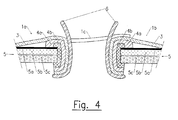
- the second layer 4b is arranged so that it comes into contact with the incision banks 5 during the positioning of the surgical border field 1 around the incision.
- the term "incision margins" means the cutaneous plane 5a and / or the subcutaneous plane 5b and / or the bony, muscular or fascial plane 5c.
- the first layer 4a and the second layer 4b are disposed immediately adjacent the edges of the incision window 2 so as to allow the surgeon to rapidly protect the incision margins 5 by simply folding said borders in the body of the patient.
- the second layer 4a is advantageously arranged so that it comes into contact with said banks and covers the upper part and the lower part of the incision when placing in place of a retractor 6. Indeed, throughout the intervention, the latter comes to impact and perfectly maintain in position the protection device object of the invention against the banks 5, without the edges of the incision window 2 come to hinder the surgeon.
- the first layer 4a can be of any conventional type.
- Absorbent materials commonly encountered are, for example, cellulose pulp, highly absorbent polymers, absorbent foam materials, absorbent nonwoven fibers. It is possible to combine these different materials so as to have different properties with respect to the liquid absorption capacity, the distribution capacity, and the storage capacity.
- the material used is preferably, but not necessarily, a sterile thick absorbent HYDRE® type pad.
- the second layer 4b is preferably produced by means of a sterile compress of the HYDREX® type impregnated with an antiseptic and / or bactericidal and / or antibacterial and / or antibiotic haemostatic product and / or having an acidic pH. Any other material or equivalent coating capable of being impregnated with such products may be used by those skilled in the art. This impregnation is intended to prevent the development of infections, abscesses of walls or hematomas.
- hemostatic products such as SURGICEL® or PANGEN®, etc.
- oxygen peroxide and antiseptics based on silver ions Calcium alginate, Piliostigma Reticulatum, bacteriostatic agents, bactericidal agents, antibiotic molecules, acidic pH molecules, etc.
- the second layer 4b completely or partially covers the first layer 4b.
- the first layer 4a is wider than the second layer 4b so that said first layer can effectively absorb and store bleeds or other bodily secretions.
- the first layer 4a has a length substantially equal to the width of the surgical border field 1 (and of the male portion 1a and female 1b), a width of about 10 cm and a thickness ranging from 4 mm to 6 mm.
- the second layer 4b also has a length substantially equal to the width of the surgical border field 1 (and the male portion 1a and female 1b), a width of about 5 cm and a thickness ranging from 4 mm to 6 mm.
- these dimensions are not limiting and can be adapted by the skilled person depending on the type of surgery performed.
Landscapes
- Health & Medical Sciences (AREA)
- Life Sciences & Earth Sciences (AREA)
- Surgery (AREA)
- Heart & Thoracic Surgery (AREA)
- Engineering & Computer Science (AREA)
- Biomedical Technology (AREA)
- Medical Informatics (AREA)
- Molecular Biology (AREA)
- Animal Behavior & Ethology (AREA)
- General Health & Medical Sciences (AREA)
- Public Health (AREA)
- Veterinary Medicine (AREA)
- Nuclear Medicine, Radiotherapy & Molecular Imaging (AREA)
- Surgical Instruments (AREA)
- Materials For Medical Uses (AREA)
Description
- La présente invention a pour objet un dispositif de protection actif des berges d'incision.
- Elle concerne le domaine technique des accessoires de chirurgie permettant de protéger les berges d'incision lors d'une intervention chirurgicale. Elle concerne plus particulièrement le domaine technique des champs de bordure chirurgicaux.
- Lors des opérations de chirurgie, il est courant d'employer des champs de bordure chirurgicaux équipés de fenêtres d'incision au travers desquelles sont réalisés les actes chirurgicaux. Ces champs se placent sur la peau du patient et ont pour but d'isoler et de protéger la zone d'incision contre toute contamination. Ils forment une barrière efficace entre le corps du patient et l'atmosphère du bloc opératoire.
- Les champs de bordure chirurgicaux habituellement employés sont fabriqués à partir d'un matériau stérile souple non tissé. Généralement, la face inférieure en contact avec la peau du patient est apte à absorber les sécrétions corporelles telles que les saignements tandis que la face supérieure est imperméable aux fluides. Il est courant d'employer des champs cutanés chirurgicaux iodés ou imprégnés d'une substance antimicrobienne, ayant un effet rémanent sur les microbes présents sur la peau du patient (essentiellement les staphylocoques cutanés). De tels champs sont par exemple décrits dans les documents
WO 2005/110082 (3M),WO 00/71183 EP 0.812.893 (MEDICAL CONCEPTS DEVELOPMENT),EP 0.240.097 (SURGIKOS),EP 0.136.900 (SURGIKOS) ou encoreFR 2.012.584 - Bien que couramment employés, ces champs de bordure chirurgicaux ne sont pas totalement efficaces dans la mesure où ils ne sont que cutanés et ne protègent pas les berges d'incision. En effet, dès que la peau est incisée, un saignement même minime de ces tissus et l'exposition prolongée à l'air fait que ces berges d'incision présentent un risque de voir se développer des infections, des abcès ou des hématomes tout à fait néfastes pour la santé du patient.
- Pour tenter de résoudre ce problème technique, on connaît par le document
WO 99/03416 - Le document
US 4.089.331 (THE KANDALL COMPANY) tente également d'apporter une solution en proposant d'utiliser une compresse stérile rapportée à l'extrémité d'un drap chirurgical, le long du bord de la fenêtre d'incision. Cette compresse est aménagée de manière à être dans une position de rangement avant l'incision - rangée dans une poche spécifique ou rabattue sur le dessus du drap - et dans une position venant recouvrir les berges d'incision après l'incision. La conception de ce dispositif apparaît être particulièrement complexe du fait qu'il faille prévoir une poche de rangement ou un dispositif permettant de maintenir la compresse en position rabattue. De plus, la longueur de la compresse ne peut être facilement ajustée de sorte que ladite compresse peut gêner l'intervention du praticien lorsqu'elle n'est pas adaptée à la profondeur de l'incision. Également, cette compresse n'est pas particulièrement efficace contre les infections ou contre la formation d'abcès ou d'hématomes. - Le document
GB 2.221.620 - Le document
GB 2.377.177 - Face aux inconvénients de l'art antérieur et en particulier ceux du dispositif décrit dans
US 4.089.331 (THE KANDALL COMPANY), le problème technique principal que vise à résoudre l'invention est de protéger efficacement, rapidement et durablement les berges d'incision sans que le praticien n'ait à effectuer des manipulations complexes. - La solution proposée par l'invention est un dispositif de protection actif des berges d'incision destiné à éviter le développement des infections, comportant un champ de bordure chirurgical dans lequel est aménagée une fenêtre d'incision totale ou partielle, et dans lequel :
- la face interne des bordures de la fenêtre d'incision est recouverte d'une première couche d'un matériau destiné à absorber les secrétions d'incision et d'une seconde couche imprégnée d'un produit hémostatique antiseptique ayant pour but d'éviter le développement des infections,
- la seconde couche vient couvrir partiellement la première couche, ladite première couche étant plus large que ladite seconde couche,
- la seconde couche est aménagée de manière à ce qu'elle puisse venir au contact des berges d'incision et recouvre la partie supérieure et la partie inférieure de l'incision lors de la mise en place d'un écarteur.
- Ces caractéristiques techniques permettent au praticien de disposer directement les bordures de la fenêtre d'incision au niveau des berges d'incision pour protéger efficacement ces dernières.
- Dans la compresse décrite dans le document
US 4.089.331 (THE KANDALL COMPANY), la face interne des bordures de la fenêtre d'incision est recouverte d'une unique couche d'un matériau imperméable au passage des sécrétions corporelles et qui n'est donc pas adaptée pour absorber les sécrétions d'incision. De plus, les bordures ne comportent aucune autre couche spécifique imprégnée d'un produit hémostatique antiseptique. Également, le documentUS 4.089.331 (THE KANDALL COMPANY) ne précise pas que les bordures sont configurées pour venir au contact des berges d'incision et recouvrir la partie supérieure et la partie inférieure de l'incision lors de la mise en place d'un écarteur. - D'autres avantages et caractéristiques de l'invention apparaîtront mieux à la lecture de la description d'un mode de réalisation préférée qui va suivre, en référence aux dessins annexés, réalisés à titre d'exemples indicatifs et non limitatifs et sur lesquels :
- la
figure 1a est une vue schématique montrant les différents éléments constitutifs du champ de bordure chirurgicale conforme à l'invention, - la
figure 1b est une vue schématique montrant les différents éléments constitutifs de lafigure 1 a aménagés de manière à former le champ de bordure chirurgicale conforme à l'invention, - la
figure 2 est une vue schématique montrant, de face, l'agencement des différents éléments constitutifs de la partie femelle du champ de bordure chirurgicale conforme à l'invention, - la
figure 3 est une vue en coupe selon A-A de la partie femelle du champ de bordure chirurgical représenté sur lafigure 2 , - la
figure 4 est une vue schématique montrant, en coupe, le dispositif de protection de l'invention mis en place contre les berges d'incision. - Le dispositif de protection objet de l'invention est destiné à être utilisé lors d'opérations chirurgicales dans le but de protéger les berges d'incision. Il est mis en place après l'opération d'incision.
- En se rapportant aux
figures 1a et1b , le dispositif de protection conforme à l'invention comporte un champ de bordure chirurgical 1 équipé d'une fenêtre d'incision 2, partielle ou totale, au travers de laquelle le chirurgien réalisera son intervention. - Le champ de bordure chirurgical 1 peut être réalisé en une seule pièce, mais est avantageusement formé d'une partie mâle 1a et d'une partie femelle 1b séparables (
figure 1a ), la fenêtre d'incision 2 étant aménagée au niveau de la jonction entre ladite partie mâle 1a et ladite partie femelle 1b (figure 1b ). L'utilisation d'un champ chirurgical en deux parties séparables simplifie sa conception et sa mise en place par le chirurgien. - Selon une caractéristique avantageuse de l'invention permettant d'adapter la taille de la fenêtre d'incision 2 à la taille de l'incision à réaliser, la partie mâle 1a et la partie femelle 1b du champ de bordure chirurgical 1 sont maintenues en position par un dispositif de fixation réglable permettant d'ajuster la position de ladite partie mâle par rapport à ladite partie femelle et de faire varier la taille de ladite fenêtre d'incision.
- En se référant aux
figures 1a et1b , le dispositif de fixation réglable est préférentiellement formé par des pattes de fixation 1c adhésives agencées sur la partie mâle 1a et aptes à adhérer sur la partie femelle 1b. Les zones adhésives peuvent éventuellement être protégées par un papier de protection amovible que l'opérateur enlèvera juste avant la mise en place. Tout autre dispositif de fixation réglable équivalent peut être utilisé par l'homme du métier, par exemple des bandes à boucles et à crochet (VELCRO®), ou des éléments mâles s'insérant dans des éléments femelles. - Conformément aux
figures 1a ,1b et2 , la partie femelle 1 b et la mâle 1 a sont à bordures droites, avec des incisions 1d sur chaque coté aménagées de manière à ce que les bordures de la fenêtre d'incision 2 puissent être facilement introduites dans la berge chirurgicale tout en maintenant les pattes de fixation 1c à l'extérieur du corps du patient. Les incisions 1d sont avantageusement configurées de manière à ce qu'environ les 4/5ème du champ puisse être introduit dans la berge chirurgicale. Selon une caractéristique avantageuse de l'invention, les incisions 1d sont prédécoupées de manière à ce que le praticien puisse introduire tout ou partie des bordures de la fenêtre d'incision 2 dans la berge chirurgicale, à sa convenance. - Le champ de bordure chirurgical 1 comporte une structure de base 3 réalisée dans un matériau stérile non tissé du type ouate de cellulose, mono-couche ou multi-couches. Tout autre matériau connu de l'homme du métier et convenant à la fabrication d'un champ de bordure chirurgical peut être employé. La structure de base 3 a une largeur comprise entre 20 cm et 40 cm, une longueur totale comprise entre 20 et 60 cm et une épaisseur variant de 1 mm à 2 mm. Toutefois, ces dimensions ne sont pas limitatives et peuvent être adaptées par l'homme du métier en fonction du type d'intervention chirurgicale réalisée.
- Dans le but d'isoler efficacement le corps du patient de l'environnement extérieur et notamment de l'introduction d'un fluide contaminé, la face supérieure du champ de bordure chirurgical 1 est imperméabilisée. Cette imperméabilisation peut se faire au moyen d'un film plastique, d'un matériau imperméable aux liquides, d'un matériau hydrophobe ou tout autre matériau convenant à l'homme du métier.
- Sur les
figures 2 et 3 , seule est représentée la partie femelle 1b du champ de bordure chirurgicale 1. Toutefois, les caractéristiques représentées s'appliquent également à la partie mâle 1a ou au champ de bordure 1 dans le cas où celui-ci est réalisé en une seule pièce. - Conformément à l'invention et en se rapportant aux
figures 1a et1b , la face interne des bordures de la fenêtre d'incision 2 est recouverte d'un moyen 4 pour protéger les berges d'incision. - Conformément à l'invention, ce moyen de protection 4 comporte une couche 4b imprégnée d'un produit hémostatique antiseptique et/ou bactéricide et/ou antibactérien et/ou antibiotique et/ou présentant un pH acide.
- Selon une caractéristique avantageuse de l'invention représentée sur la
figure 2 et permettant d'optimiser la protection des berges d'incision, le moyen de protection 4 comporte une première couche 4a d'un matériau destiné à absorber les secrétions d'incision et la seconde couche 4b imprégnée d'un produit hémostatique antiseptique et/ou bactéricide et/ou antibactérien et/ou antibiotique et/ou présentant un pH acide. - En se rapportant à la
figure 4 , la seconde couche 4b est aménagée de manière à ce qu'elle vienne au contact des berges d'incision 5 lors de la mise en position du champ de bordure chirurgical 1 autour de l'incision. Par « berges d'incision », on entend au sens de la présente invention le plan cutané 5a et/ou le plan sous-cutané 5b et/ou le plan osseux, musculaire ou aponévrotique 5c. - Selon une caractéristique avantageuse de l'invention représentée sur les figures, la première couche 4a et la seconde couche 4b sont disposées immédiatement adjacent aux bordures de la fenêtre d'incision 2 de façon à permettre au chirurgien de protéger rapidement les berges d'incision 5 par le simple rabattement desdites bordures dans le corps du patient.
- Et dans le but de protéger parfaitement les berges d'incision 5, la seconde couche 4a est avantageusement aménagée de manière à ce qu'elle vienne en contact desdites berges et recouvre la partie supérieure et la partie inférieure de l'incision lors de la mise en place d'un écarteur 6. En effet, tout au long de l'intervention, ce dernier vient impacter et parfaitement maintenir en position le dispositif de protection objet de l'invention contre les berges 5, sans que les bordures de la fenêtre d'incision 2 viennent gêner le chirurgien.
- La première couche 4a peut être de n'importe quel type conventionnel. Les matériaux absorbants couramment rencontrés sont par exemple la pâte de cellulose, des polymères hautement absorbants, des matériaux mousse absorbants, des fibres non tissées absorbantes. Il est possible de combiner ces différents matériaux de manière à avoir des propriétés différentes en ce qui concerne la capacité d'absorption de liquide, la capacité de répartition, et la capacité de stockage. Le matériau utilisé est de préférence, mais pas nécessairement, une compresse stérile épaisse absorbante de type HYDRE®.
- La seconde couche 4b est préférentiellement réalisée par l'intermédiaire d'une compresse stérile de type HYDREX® imprégnée d'un produit hémostatique antiseptique et/ou bactéricide et/ou antibactérien et/ou antibiotique et/ou présentant un pH acide. Tout autre matériau ou revêtement équivalent apte à être imprégné de tels produits peut être utilisé par l'homme du métier. Cette imprégnation a pour but d'éviter le développement des infections, des abcès de parois ou encore des hématomes. Parmi les produits d'imprégnation utilisables, on peut citer à titre d'exemple non limitatif : les produits hémostatiques tels que SURGICEL® ou PANGEN®, ...), peroxyde d'oxygène les antiseptiques à base d'ions d'Argent, alginate de Calcium, Piliostigma Reticulatum, les agents bactériostatiques, les agents bactéricides, les molécules antibiotiques, les molécules à pH acide, etc. Ces différents produits d'imprégnation peuvent être utilisés seuls ou en combinaison.
- La seconde couche 4b vient couvrir totalement ou partiellement la première couche 4b. En se rapportant aux
figures 2 et 3 , la première couche 4a est plus large que la seconde couche 4b afin que ladite première couche puisse absorber et stocker efficacement les saignements ou autres sécrétions corporelles. En pratique, la première couche 4a a une longueur sensiblement égale à la largeur du champ de bordure chirurgicale 1 (et de la partie mâle 1a et femelle 1 b), une largeur d'environ 10 cm et une épaisseur variant de 4 mm à 6 mm. La seconde couche 4b a également une longueur sensiblement égale à la largeur du champ de bordure chirurgicale 1 (et de la partie mâle 1a et femelle 1b), une largeur d'environ 5 cm et une épaisseur variant de 4 mm à 6 mm. Toutefois, ces dimensions ne sont pas limitatives et peuvent être adaptées par l'homme du métier en fonction le type d'intervention chirurgicale réalisée.
Claims (10)
- Dispositif de protection actif des berges d'incision (5) destiné à éviter le développement des infections, comportant un champ de bordure chirurgical (1) dans lequel est aménagée une fenêtre d'incision (2) totale ou partielle, se caractérisant par le fait que :- la face interne des bordures de la fenêtre d'incision (2) est recouverte d'une première couche (4a) d'un matériau destiné à absorber les secrétions d'incision et d'une seconde couche (4b) imprégnée d'un produit hémostatique antiseptique ayant pour but d'éviter le développement des infections,- la seconde couche (4b) vient couvrir partiellement la première couche (4a), ladite première couche étant plus large que ladite seconde couche,- la seconde couche (4b) est aménagée de manière à ce qu'elle puisse venir au contact des berges d'incision (5) et recouvre la partie supérieure et la partie inférieure de l'incision lors de la mise en place d'un écarteur (6).
- Dispositif selon la revendication 1, dans lequel le champ de bordure chirurgical (1) est formé d'une partie mâle (1a) et d'une partie femelle (1 b) séparables, la fenêtre d'incision (2) étant aménagée au niveau de la jonction entre les deux dites parties.
- Dispositif selon la revendication 2, dans lequel la partie mâle (1a) et la partie femelle (1b) du champs de bordure chirurgicale (1) sont maintenues en position par un dispositif de fixation réglable permettant d'ajuster la position de ladite partie mâle par rapport à ladite partie femelle et de faire varier la taille de la fenêtre d'incision (2).
- Dispositif selon la revendication 3, dans lequel le dispositif de fixation réglable est formé par des pattes de fixation (1c) adhésives agencées sur la partie mâle (1a) et aptes à adhérer sur la partie femelle (1 b).
- Dispositif selon la revendication 4, dans lequel la partie femelle (1b) et la partie mâle (1a) sont à bordures droites, avec des incisions (1d) sur chaque côté aménagées de manière à ce que les bordures de la fenêtre d'incision (2) puissent être introduites dans la berge chirurgicale tout en maintenant les pattes de fixation (1c) à l'extérieur du corps du patient.
- Dispositif selon la revendication 5, dans lequel les incision (1d) sont configurées de manière à ce qu'environ les 4/5ème du champ de bordure chirurgical (1) puisse être introduite dans la berge chirurgicale.
- Dispositif selon l'une des revendications 5 ou 6, dans lequel les incision (1d) sont prédécoupées de manière à ce que tout ou partie des bordures de la fenêtre d'incision (2) puisse être introduite dans la berge chirurgicale.
- Dispositif selon l'une des revendications précédentes, dans lequel la première couche (4a) et la seconde couche (4b) sont disposées immédiatement adjacent aux bordures de la fenêtre d'incision (2).
- Dispositif selon l'une des revendications précédentes, dans lequel la couche (4b) imprégnée d'un produit hémostatique antiseptique et également imprégné d'un produit bactéricide et/ou antibactérien et/ou antibiotique et/ou présentant un pH acide.
- Dispositif selon l'une des revendications précédentes, dans lequel la face supérieure du champ de bordure chirurgical (1) est imperméabilisée.
Applications Claiming Priority (2)
| Application Number | Priority Date | Filing Date | Title |
|---|---|---|---|
| FR0609220A FR2907330B1 (fr) | 2006-10-20 | 2006-10-20 | Dispositif de protection des berges d'incision. |
| PCT/FR2007/052197 WO2008047059A2 (fr) | 2006-10-20 | 2007-10-18 | Dispositif de protection actif des berges d'incision |
Publications (2)
| Publication Number | Publication Date |
|---|---|
| EP2134264A2 EP2134264A2 (fr) | 2009-12-23 |
| EP2134264B1 true EP2134264B1 (fr) | 2012-12-19 |
Family
ID=38042684
Family Applications (1)
| Application Number | Title | Priority Date | Filing Date |
|---|---|---|---|
| EP07858620A Active EP2134264B1 (fr) | 2006-10-20 | 2007-10-18 | Dispositif de protection actif des berges d'incision |
Country Status (4)
| Country | Link |
|---|---|
| EP (1) | EP2134264B1 (fr) |
| ES (1) | ES2401737T3 (fr) |
| FR (1) | FR2907330B1 (fr) |
| WO (1) | WO2008047059A2 (fr) |
Cited By (1)
| Publication number | Priority date | Publication date | Assignee | Title |
|---|---|---|---|---|
| FR3009946A1 (fr) * | 2013-09-05 | 2015-03-06 | Gilles Touati | Dispositif comprenant un champ operatoire associe a des palettes d'ecarteur chirurgical |
Families Citing this family (5)
| Publication number | Priority date | Publication date | Assignee | Title |
|---|---|---|---|---|
| US8646456B2 (en) | 2007-12-20 | 2014-02-11 | Gilles Touati | Antibacterial agent, and device used for active protection of incision margins and incorporating such an antibacterial agent |
| EP2467081A4 (fr) | 2009-08-21 | 2015-05-06 | 3M Innovative Properties Co | Procédés et produits de réduction d'un trauma tissulaire à l'aide de matériaux répartissant les contraintes absorbant l'eau |
| US10092366B2 (en) | 2009-08-21 | 2018-10-09 | 3M Innovative Properties Company | Products for reducing tissue trauma using water-resistant stress-distributing materials |
| US10342628B2 (en) | 2012-09-21 | 2019-07-09 | 3M Innovative Properties Company | Incision protection |
| CN112890890B (zh) * | 2021-01-25 | 2022-04-29 | 锦州医科大学附属第一医院 | 一种肝胆外科用手术拉钩 |
Family Cites Families (10)
| Publication number | Priority date | Publication date | Assignee | Title |
|---|---|---|---|---|
| US4089331A (en) * | 1976-12-06 | 1978-05-16 | The Kendall Company | Surgical drape with fenestration liner |
| DE2657520C3 (de) * | 1976-12-18 | 1979-08-23 | Firet B.V., Veenendaal (Niederlande) | Medizinisches Abdecktuch |
| NZ209534A (en) | 1983-09-30 | 1987-01-23 | Surgikos Inc | Antimicrobial fabric for surgical drape |
| US4643181A (en) | 1986-04-04 | 1987-02-17 | Surgikos, Inc. | Antimicrobial dressing or drape material |
| GB8818114D0 (en) * | 1988-07-29 | 1988-09-01 | Johnson & Johnson | Haemostatic wound dressing material |
| US5649550A (en) | 1996-02-26 | 1997-07-22 | Medical Creative Technologies, Inc. | Surgical retractor liner and integral drape assembly |
| US5829442A (en) | 1996-06-12 | 1998-11-03 | Medical Concepts Development, Inc. | Antimicrobial containing solventless hot melt adhesive composition |
| WO2000071183A1 (fr) | 1999-05-21 | 2000-11-30 | 3M Innovative Properties Company | Articles antimicrobiens |
| GB2377177A (en) * | 2001-07-05 | 2003-01-08 | Acordis Speciality Fibres Ltd | Wound dressing comprising gel forming and superabsorbent layers |
| US20050249791A1 (en) | 2004-05-07 | 2005-11-10 | 3M Innovative Properties Company | Antimicrobial articles |
-
2006
- 2006-10-20 FR FR0609220A patent/FR2907330B1/fr not_active Expired - Fee Related
-
2007
- 2007-10-18 EP EP07858620A patent/EP2134264B1/fr active Active
- 2007-10-18 WO PCT/FR2007/052197 patent/WO2008047059A2/fr not_active Ceased
- 2007-10-18 ES ES07858620T patent/ES2401737T3/es active Active
Cited By (1)
| Publication number | Priority date | Publication date | Assignee | Title |
|---|---|---|---|---|
| FR3009946A1 (fr) * | 2013-09-05 | 2015-03-06 | Gilles Touati | Dispositif comprenant un champ operatoire associe a des palettes d'ecarteur chirurgical |
Also Published As
| Publication number | Publication date |
|---|---|
| ES2401737T3 (es) | 2013-04-24 |
| WO2008047059A2 (fr) | 2008-04-24 |
| FR2907330A1 (fr) | 2008-04-25 |
| EP2134264A2 (fr) | 2009-12-23 |
| FR2907330B1 (fr) | 2009-11-27 |
| WO2008047059A3 (fr) | 2008-06-19 |
Similar Documents
| Publication | Publication Date | Title |
|---|---|---|
| CA2710397C (fr) | Agent antibacterien et dispositif actif des berges d'incision integrant un tel agent antibacterien | |
| CA2879529C (fr) | Article destine a venir en contact avec un liquide, notamment pansement | |
| JP7055175B2 (ja) | 局所陰圧閉鎖療法のための装置および方法 | |
| EP2134264A2 (fr) | Dispositif de protection actif des berges d'incision | |
| AU2009210401C1 (en) | Adhesive bandage having a selectively placed layer | |
| MX2015001820A (es) | Dispositivo con aposito integrado. | |
| EP3119466B1 (fr) | Nécessaire pour le maintien et la protection de cathéters placés sur une zone du corps d'un patient | |
| CN104334113A (zh) | 填充的手术薄膜 | |
| EP3651679B1 (fr) | Ensemble comportant un dispositif aspirant adapté pour être placé sur une plaie et/ou une incision | |
| FR3009946A1 (fr) | Dispositif comprenant un champ operatoire associe a des palettes d'ecarteur chirurgical | |
| WO2013001210A1 (fr) | Pansement pour recouvrir une partie saillante | |
| EP3082675B1 (fr) | Article pour absorber un liquide physiologique, notamment pansement | |
| FR2925340A1 (fr) | Agent antibacterien. | |
| FR2926454A1 (fr) | Dispositif de protection des berges d'incision equipe d'un element permettant d'aspirer les secretions d'incision | |
| EP3082701B1 (fr) | Article pour absorber un liquide physiologique, notamment pansement | |
| FR2531627A1 (fr) | Complexe absorbant a usage medical | |
| KR101433890B1 (ko) | 창상 피복재용 케이스 | |
| KR102472100B1 (ko) | 항균성이 향상된 수술용 시트 | |
| BE879068A (fr) | Perfectionnements aux articles absorbants, notamment du type pansement et couche a jeter | |
| US20140031753A1 (en) | Thoracostomy devices and methods of use | |
| FR3148724A1 (fr) | Dispositif de protection de la partie proximale d’un cathéter | |
| FR2919796A1 (fr) | Bandeau absorbant pour balai et dispositif de nettoyage | |
| WO2002028278A1 (fr) | Dispositif de protection contre la contamination cutanee | |
| WO2019106317A1 (fr) | Complexe multicouche pour la manipulation d'un liquide, dispositif sanitaire, medical, chirurgical ou hygienique comprenant un tel complexe, et procede de fabrication associe |
Legal Events
| Date | Code | Title | Description |
|---|---|---|---|
| PUAI | Public reference made under article 153(3) epc to a published international application that has entered the european phase |
Free format text: ORIGINAL CODE: 0009012 |
|
| 17P | Request for examination filed |
Effective date: 20090520 |
|
| AK | Designated contracting states |
Kind code of ref document: A2 Designated state(s): AT BE BG CH CY CZ DE DK EE ES FI FR GB GR HU IE IS IT LI LT LU LV MC MT NL PL PT RO SE SI SK TR |
|
| DAX | Request for extension of the european patent (deleted) | ||
| 17Q | First examination report despatched |
Effective date: 20100714 |
|
| GRAP | Despatch of communication of intention to grant a patent |
Free format text: ORIGINAL CODE: EPIDOSNIGR1 |
|
| GRAS | Grant fee paid |
Free format text: ORIGINAL CODE: EPIDOSNIGR3 |
|
| GRAA | (expected) grant |
Free format text: ORIGINAL CODE: 0009210 |
|
| AK | Designated contracting states |
Kind code of ref document: B1 Designated state(s): AT BE BG CH CY CZ DE DK EE ES FI FR GB GR HU IE IS IT LI LT LU LV MC MT NL PL PT RO SE SI SK TR |
|
| REG | Reference to a national code |
Ref country code: GB Ref legal event code: FG4D Free format text: NOT ENGLISH |
|
| REG | Reference to a national code |
Ref country code: CH Ref legal event code: EP |
|
| REG | Reference to a national code |
Ref country code: AT Ref legal event code: REF Ref document number: 588943 Country of ref document: AT Kind code of ref document: T Effective date: 20130115 |
|
| REG | Reference to a national code |
Ref country code: DE Ref legal event code: R096 Ref document number: 602007027546 Country of ref document: DE Effective date: 20130221 |
|
| REG | Reference to a national code |
Ref country code: ES Ref legal event code: FG2A Ref document number: 2401737 Country of ref document: ES Kind code of ref document: T3 Effective date: 20130424 |
|
| PG25 | Lapsed in a contracting state [announced via postgrant information from national office to epo] |
Ref country code: LT Free format text: LAPSE BECAUSE OF FAILURE TO SUBMIT A TRANSLATION OF THE DESCRIPTION OR TO PAY THE FEE WITHIN THE PRESCRIBED TIME-LIMIT Effective date: 20121219 Ref country code: SE Free format text: LAPSE BECAUSE OF FAILURE TO SUBMIT A TRANSLATION OF THE DESCRIPTION OR TO PAY THE FEE WITHIN THE PRESCRIBED TIME-LIMIT Effective date: 20121219 Ref country code: FI Free format text: LAPSE BECAUSE OF FAILURE TO SUBMIT A TRANSLATION OF THE DESCRIPTION OR TO PAY THE FEE WITHIN THE PRESCRIBED TIME-LIMIT Effective date: 20121219 |
|
| REG | Reference to a national code |
Ref country code: NL Ref legal event code: T3 |
|
| REG | Reference to a national code |
Ref country code: AT Ref legal event code: MK05 Ref document number: 588943 Country of ref document: AT Kind code of ref document: T Effective date: 20121219 |
|
| REG | Reference to a national code |
Ref country code: LT Ref legal event code: MG4D |
|
| PG25 | Lapsed in a contracting state [announced via postgrant information from national office to epo] |
Ref country code: SI Free format text: LAPSE BECAUSE OF FAILURE TO SUBMIT A TRANSLATION OF THE DESCRIPTION OR TO PAY THE FEE WITHIN THE PRESCRIBED TIME-LIMIT Effective date: 20121219 Ref country code: LV Free format text: LAPSE BECAUSE OF FAILURE TO SUBMIT A TRANSLATION OF THE DESCRIPTION OR TO PAY THE FEE WITHIN THE PRESCRIBED TIME-LIMIT Effective date: 20121219 Ref country code: GR Free format text: LAPSE BECAUSE OF FAILURE TO SUBMIT A TRANSLATION OF THE DESCRIPTION OR TO PAY THE FEE WITHIN THE PRESCRIBED TIME-LIMIT Effective date: 20130320 |
|
| PG25 | Lapsed in a contracting state [announced via postgrant information from national office to epo] |
Ref country code: SK Free format text: LAPSE BECAUSE OF FAILURE TO SUBMIT A TRANSLATION OF THE DESCRIPTION OR TO PAY THE FEE WITHIN THE PRESCRIBED TIME-LIMIT Effective date: 20121219 Ref country code: IS Free format text: LAPSE BECAUSE OF FAILURE TO SUBMIT A TRANSLATION OF THE DESCRIPTION OR TO PAY THE FEE WITHIN THE PRESCRIBED TIME-LIMIT Effective date: 20130419 Ref country code: EE Free format text: LAPSE BECAUSE OF FAILURE TO SUBMIT A TRANSLATION OF THE DESCRIPTION OR TO PAY THE FEE WITHIN THE PRESCRIBED TIME-LIMIT Effective date: 20121219 Ref country code: AT Free format text: LAPSE BECAUSE OF FAILURE TO SUBMIT A TRANSLATION OF THE DESCRIPTION OR TO PAY THE FEE WITHIN THE PRESCRIBED TIME-LIMIT Effective date: 20121219 Ref country code: BG Free format text: LAPSE BECAUSE OF FAILURE TO SUBMIT A TRANSLATION OF THE DESCRIPTION OR TO PAY THE FEE WITHIN THE PRESCRIBED TIME-LIMIT Effective date: 20130319 |
|
| PG25 | Lapsed in a contracting state [announced via postgrant information from national office to epo] |
Ref country code: PT Free format text: LAPSE BECAUSE OF FAILURE TO SUBMIT A TRANSLATION OF THE DESCRIPTION OR TO PAY THE FEE WITHIN THE PRESCRIBED TIME-LIMIT Effective date: 20130419 Ref country code: RO Free format text: LAPSE BECAUSE OF FAILURE TO SUBMIT A TRANSLATION OF THE DESCRIPTION OR TO PAY THE FEE WITHIN THE PRESCRIBED TIME-LIMIT Effective date: 20121219 Ref country code: PL Free format text: LAPSE BECAUSE OF FAILURE TO SUBMIT A TRANSLATION OF THE DESCRIPTION OR TO PAY THE FEE WITHIN THE PRESCRIBED TIME-LIMIT Effective date: 20121219 |
|
| PLBE | No opposition filed within time limit |
Free format text: ORIGINAL CODE: 0009261 |
|
| STAA | Information on the status of an ep patent application or granted ep patent |
Free format text: STATUS: NO OPPOSITION FILED WITHIN TIME LIMIT |
|
| PG25 | Lapsed in a contracting state [announced via postgrant information from national office to epo] |
Ref country code: DK Free format text: LAPSE BECAUSE OF FAILURE TO SUBMIT A TRANSLATION OF THE DESCRIPTION OR TO PAY THE FEE WITHIN THE PRESCRIBED TIME-LIMIT Effective date: 20121219 |
|
| 26N | No opposition filed |
Effective date: 20130920 |
|
| PG25 | Lapsed in a contracting state [announced via postgrant information from national office to epo] |
Ref country code: CY Free format text: LAPSE BECAUSE OF FAILURE TO SUBMIT A TRANSLATION OF THE DESCRIPTION OR TO PAY THE FEE WITHIN THE PRESCRIBED TIME-LIMIT Effective date: 20121219 |
|
| REG | Reference to a national code |
Ref country code: DE Ref legal event code: R097 Ref document number: 602007027546 Country of ref document: DE Effective date: 20130920 |
|
| PG25 | Lapsed in a contracting state [announced via postgrant information from national office to epo] |
Ref country code: MC Free format text: LAPSE BECAUSE OF FAILURE TO SUBMIT A TRANSLATION OF THE DESCRIPTION OR TO PAY THE FEE WITHIN THE PRESCRIBED TIME-LIMIT Effective date: 20121219 |
|
| REG | Reference to a national code |
Ref country code: IE Ref legal event code: MM4A |
|
| PG25 | Lapsed in a contracting state [announced via postgrant information from national office to epo] |
Ref country code: IE Free format text: LAPSE BECAUSE OF NON-PAYMENT OF DUE FEES Effective date: 20131018 |
|
| PG25 | Lapsed in a contracting state [announced via postgrant information from national office to epo] |
Ref country code: LU Free format text: LAPSE BECAUSE OF NON-PAYMENT OF DUE FEES Effective date: 20131018 Ref country code: HU Free format text: LAPSE BECAUSE OF FAILURE TO SUBMIT A TRANSLATION OF THE DESCRIPTION OR TO PAY THE FEE WITHIN THE PRESCRIBED TIME-LIMIT; INVALID AB INITIO Effective date: 20071018 |
|
| PG25 | Lapsed in a contracting state [announced via postgrant information from national office to epo] |
Ref country code: MT Free format text: LAPSE BECAUSE OF FAILURE TO SUBMIT A TRANSLATION OF THE DESCRIPTION OR TO PAY THE FEE WITHIN THE PRESCRIBED TIME-LIMIT Effective date: 20121219 |
|
| REG | Reference to a national code |
Ref country code: FR Ref legal event code: PLFP Year of fee payment: 9 |
|
| REG | Reference to a national code |
Ref country code: FR Ref legal event code: PLFP Year of fee payment: 10 |
|
| REG | Reference to a national code |
Ref country code: FR Ref legal event code: PLFP Year of fee payment: 11 |
|
| REG | Reference to a national code |
Ref country code: FR Ref legal event code: PLFP Year of fee payment: 12 |
|
| PGFP | Annual fee paid to national office [announced via postgrant information from national office to epo] |
Ref country code: CZ Payment date: 20190918 Year of fee payment: 13 |
|
| PG25 | Lapsed in a contracting state [announced via postgrant information from national office to epo] |
Ref country code: CZ Free format text: LAPSE BECAUSE OF NON-PAYMENT OF DUE FEES Effective date: 20201018 |
|
| P01 | Opt-out of the competence of the unified patent court (upc) registered |
Effective date: 20230525 |
|
| REG | Reference to a national code |
Ref country code: CH Ref legal event code: U11 Free format text: ST27 STATUS EVENT CODE: U-0-0-U10-U11 (AS PROVIDED BY THE NATIONAL OFFICE) Effective date: 20251101 |
|
| PGFP | Annual fee paid to national office [announced via postgrant information from national office to epo] |
Ref country code: NL Payment date: 20251028 Year of fee payment: 19 |
|
| PGFP | Annual fee paid to national office [announced via postgrant information from national office to epo] |
Ref country code: DE Payment date: 20251015 Year of fee payment: 19 |
|
| PGFP | Annual fee paid to national office [announced via postgrant information from national office to epo] |
Ref country code: GB Payment date: 20251023 Year of fee payment: 19 |
|
| PGFP | Annual fee paid to national office [announced via postgrant information from national office to epo] |
Ref country code: IT Payment date: 20251008 Year of fee payment: 19 |
|
| PGFP | Annual fee paid to national office [announced via postgrant information from national office to epo] |
Ref country code: FR Payment date: 20251016 Year of fee payment: 19 |
|
| PGFP | Annual fee paid to national office [announced via postgrant information from national office to epo] |
Ref country code: TR Payment date: 20251006 Year of fee payment: 19 Ref country code: BE Payment date: 20251020 Year of fee payment: 19 |
|
| PGFP | Annual fee paid to national office [announced via postgrant information from national office to epo] |
Ref country code: CH Payment date: 20251101 Year of fee payment: 19 |
|
| PGFP | Annual fee paid to national office [announced via postgrant information from national office to epo] |
Ref country code: ES Payment date: 20251110 Year of fee payment: 19 |