EP2134265B1 - Outils à utiliser dans le traitement de l'incontinence urinaire masculine - Google Patents
Outils à utiliser dans le traitement de l'incontinence urinaire masculine Download PDFInfo
- Publication number
- EP2134265B1 EP2134265B1 EP07821942A EP07821942A EP2134265B1 EP 2134265 B1 EP2134265 B1 EP 2134265B1 EP 07821942 A EP07821942 A EP 07821942A EP 07821942 A EP07821942 A EP 07821942A EP 2134265 B1 EP2134265 B1 EP 2134265B1
- Authority
- EP
- European Patent Office
- Prior art keywords
- urinary incontinence
- male urinary
- treating male
- spiral section
- surgical passer
- Prior art date
- Legal status (The legal status is an assumption and is not a legal conclusion. Google has not performed a legal analysis and makes no representation as to the accuracy of the status listed.)
- Not-in-force
Links
- 206010046543 Urinary incontinence Diseases 0.000 title claims abstract description 21
- 238000011282 treatment Methods 0.000 title description 6
- -1 polypropylene Polymers 0.000 claims abstract description 9
- 239000004743 Polypropylene Substances 0.000 claims abstract description 6
- 229920001155 polypropylene Polymers 0.000 claims abstract description 6
- 241000287107 Passer Species 0.000 claims description 37
- 229910001220 stainless steel Inorganic materials 0.000 claims description 8
- 239000010935 stainless steel Substances 0.000 claims description 8
- 230000007423 decrease Effects 0.000 claims description 3
- 229920002994 synthetic fiber Polymers 0.000 claims description 3
- 230000003247 decreasing effect Effects 0.000 claims 1
- 238000000034 method Methods 0.000 abstract description 19
- 210000003708 urethra Anatomy 0.000 abstract description 15
- 210000000689 upper leg Anatomy 0.000 abstract description 7
- 238000013459 approach Methods 0.000 abstract description 6
- 210000004197 pelvis Anatomy 0.000 abstract description 4
- 238000013461 design Methods 0.000 abstract description 2
- 210000003205 muscle Anatomy 0.000 description 15
- 238000001356 surgical procedure Methods 0.000 description 12
- 239000004033 plastic Substances 0.000 description 11
- 229920003023 plastic Polymers 0.000 description 11
- 210000002640 perineum Anatomy 0.000 description 10
- 230000006835 compression Effects 0.000 description 8
- 238000007906 compression Methods 0.000 description 8
- 206010021639 Incontinence Diseases 0.000 description 7
- 206010066218 Stress Urinary Incontinence Diseases 0.000 description 7
- 210000003414 extremity Anatomy 0.000 description 7
- 239000000463 material Substances 0.000 description 7
- 230000003202 urodynamic effect Effects 0.000 description 7
- 238000002224 dissection Methods 0.000 description 6
- 239000004677 Nylon Substances 0.000 description 5
- 210000000988 bone and bone Anatomy 0.000 description 5
- 210000003195 fascia Anatomy 0.000 description 5
- 229920001778 nylon Polymers 0.000 description 5
- 208000015181 infectious disease Diseases 0.000 description 4
- 238000003780 insertion Methods 0.000 description 4
- 230000037431 insertion Effects 0.000 description 4
- 239000012528 membrane Substances 0.000 description 4
- 238000011472 radical prostatectomy Methods 0.000 description 4
- 239000004698 Polyethylene Substances 0.000 description 3
- 230000023597 hemostasis Effects 0.000 description 3
- 239000007924 injection Substances 0.000 description 3
- 238000002347 injection Methods 0.000 description 3
- 230000007774 longterm Effects 0.000 description 3
- 229920000573 polyethylene Polymers 0.000 description 3
- 229930186147 Cephalosporin Natural products 0.000 description 2
- FAPWRFPIFSIZLT-UHFFFAOYSA-M Sodium chloride Chemical compound [Na+].[Cl-] FAPWRFPIFSIZLT-UHFFFAOYSA-M 0.000 description 2
- 230000003187 abdominal effect Effects 0.000 description 2
- NIXOWILDQLNWCW-UHFFFAOYSA-N acrylic acid group Chemical group C(C=C)(=O)O NIXOWILDQLNWCW-UHFFFAOYSA-N 0.000 description 2
- 235000021028 berry Nutrition 0.000 description 2
- 229940124587 cephalosporin Drugs 0.000 description 2
- 150000001780 cephalosporins Chemical class 0.000 description 2
- 238000002710 external beam radiation therapy Methods 0.000 description 2
- 208000014674 injury Diseases 0.000 description 2
- 238000001990 intravenous administration Methods 0.000 description 2
- 238000012986 modification Methods 0.000 description 2
- 230000004048 modification Effects 0.000 description 2
- 230000003387 muscular Effects 0.000 description 2
- 230000002980 postoperative effect Effects 0.000 description 2
- 210000003689 pubic bone Anatomy 0.000 description 2
- 210000004061 pubic symphysis Anatomy 0.000 description 2
- 210000004706 scrotum Anatomy 0.000 description 2
- 210000005070 sphincter Anatomy 0.000 description 2
- 210000004003 subcutaneous fat Anatomy 0.000 description 2
- 238000002560 therapeutic procedure Methods 0.000 description 2
- 210000001519 tissue Anatomy 0.000 description 2
- 208000003200 Adenoma Diseases 0.000 description 1
- 206010002091 Anaesthesia Diseases 0.000 description 1
- 102000008186 Collagen Human genes 0.000 description 1
- 108010035532 Collagen Proteins 0.000 description 1
- 206010028980 Neoplasm Diseases 0.000 description 1
- 206010060862 Prostate cancer Diseases 0.000 description 1
- 208000000236 Prostatic Neoplasms Diseases 0.000 description 1
- 206010065584 Urethral stenosis Diseases 0.000 description 1
- 208000027418 Wounds and injury Diseases 0.000 description 1
- 210000000577 adipose tissue Anatomy 0.000 description 1
- 238000001949 anaesthesia Methods 0.000 description 1
- 230000037005 anaesthesia Effects 0.000 description 1
- 230000002421 anti-septic effect Effects 0.000 description 1
- 230000004888 barrier function Effects 0.000 description 1
- 230000003115 biocidal effect Effects 0.000 description 1
- 210000004204 blood vessel Anatomy 0.000 description 1
- 239000004067 bulking agent Substances 0.000 description 1
- 229920001436 collagen Polymers 0.000 description 1
- 238000010276 construction Methods 0.000 description 1
- 230000006378 damage Effects 0.000 description 1
- 229940070259 deflux Drugs 0.000 description 1
- 238000001514 detection method Methods 0.000 description 1
- 201000010099 disease Diseases 0.000 description 1
- 208000037265 diseases, disorders, signs and symptoms Diseases 0.000 description 1
- 230000009977 dual effect Effects 0.000 description 1
- 230000004064 dysfunction Effects 0.000 description 1
- 230000007159 enucleation Effects 0.000 description 1
- 230000003628 erosive effect Effects 0.000 description 1
- 238000011156 evaluation Methods 0.000 description 1
- 210000004907 gland Anatomy 0.000 description 1
- PCHJSUWPFVWCPO-UHFFFAOYSA-N gold Chemical compound [Au] PCHJSUWPFVWCPO-UHFFFAOYSA-N 0.000 description 1
- 230000002439 hemostatic effect Effects 0.000 description 1
- 238000009434 installation Methods 0.000 description 1
- 210000002414 leg Anatomy 0.000 description 1
- 238000002504 lithotomy Methods 0.000 description 1
- 238000005259 measurement Methods 0.000 description 1
- 230000003340 mental effect Effects 0.000 description 1
- 210000005036 nerve Anatomy 0.000 description 1
- 230000036407 pain Effects 0.000 description 1
- 210000003049 pelvic bone Anatomy 0.000 description 1
- 230000000149 penetrating effect Effects 0.000 description 1
- 210000003899 penis Anatomy 0.000 description 1
- 238000000554 physical therapy Methods 0.000 description 1
- 229920001296 polysiloxane Polymers 0.000 description 1
- 230000000750 progressive effect Effects 0.000 description 1
- 230000002035 prolonged effect Effects 0.000 description 1
- 238000011321 prophylaxis Methods 0.000 description 1
- 210000002307 prostate Anatomy 0.000 description 1
- 238000011471 prostatectomy Methods 0.000 description 1
- 230000005855 radiation Effects 0.000 description 1
- 238000001959 radiotherapy Methods 0.000 description 1
- 210000001139 rectus abdominis Anatomy 0.000 description 1
- 238000002271 resection Methods 0.000 description 1
- 238000012216 screening Methods 0.000 description 1
- 210000003491 skin Anatomy 0.000 description 1
- 239000011780 sodium chloride Substances 0.000 description 1
- 239000000243 solution Substances 0.000 description 1
- 238000007920 subcutaneous administration Methods 0.000 description 1
- 230000008733 trauma Effects 0.000 description 1
- 230000000472 traumatic effect Effects 0.000 description 1
- 238000002604 ultrasonography Methods 0.000 description 1
- 201000001988 urethral stricture Diseases 0.000 description 1
- 230000002485 urinary effect Effects 0.000 description 1
- 210000002700 urine Anatomy 0.000 description 1
- 230000002792 vascular Effects 0.000 description 1
- XLYOFNOQVPJJNP-UHFFFAOYSA-N water Substances O XLYOFNOQVPJJNP-UHFFFAOYSA-N 0.000 description 1
Images





Classifications
-
- A—HUMAN NECESSITIES
- A61—MEDICAL OR VETERINARY SCIENCE; HYGIENE
- A61F—FILTERS IMPLANTABLE INTO BLOOD VESSELS; PROSTHESES; DEVICES PROVIDING PATENCY TO, OR PREVENTING COLLAPSING OF, TUBULAR STRUCTURES OF THE BODY, e.g. STENTS; ORTHOPAEDIC, NURSING OR CONTRACEPTIVE DEVICES; FOMENTATION; TREATMENT OR PROTECTION OF EYES OR EARS; BANDAGES, DRESSINGS OR ABSORBENT PADS; FIRST-AID KITS
- A61F2/00—Filters implantable into blood vessels; Prostheses, i.e. artificial substitutes or replacements for parts of the body; Appliances for connecting them with the body; Devices providing patency to, or preventing collapsing of, tubular structures of the body, e.g. stents
- A61F2/0004—Closure means for urethra or rectum, i.e. anti-incontinence devices or support slings against pelvic prolapse
- A61F2/0031—Closure means for urethra or rectum, i.e. anti-incontinence devices or support slings against pelvic prolapse for constricting the lumen; Support slings for the urethra
- A61F2/0036—Closure means for urethra or rectum, i.e. anti-incontinence devices or support slings against pelvic prolapse for constricting the lumen; Support slings for the urethra implantable
- A61F2/0045—Support slings
-
- A—HUMAN NECESSITIES
- A61—MEDICAL OR VETERINARY SCIENCE; HYGIENE
- A61B—DIAGNOSIS; SURGERY; IDENTIFICATION
- A61B17/00—Surgical instruments, devices or methods
-
- A—HUMAN NECESSITIES
- A61—MEDICAL OR VETERINARY SCIENCE; HYGIENE
- A61B—DIAGNOSIS; SURGERY; IDENTIFICATION
- A61B17/00—Surgical instruments, devices or methods
- A61B17/04—Surgical instruments, devices or methods for suturing wounds; Holders or packages for needles or suture materials
-
- A—HUMAN NECESSITIES
- A61—MEDICAL OR VETERINARY SCIENCE; HYGIENE
- A61B—DIAGNOSIS; SURGERY; IDENTIFICATION
- A61B17/00—Surgical instruments, devices or methods
- A61B17/04—Surgical instruments, devices or methods for suturing wounds; Holders or packages for needles or suture materials
- A61B17/06—Needles ; Sutures; Needle-suture combinations; Holders or packages for needles or suture materials
- A61B17/06066—Needles, e.g. needle tip configurations
-
- A—HUMAN NECESSITIES
- A61—MEDICAL OR VETERINARY SCIENCE; HYGIENE
- A61B—DIAGNOSIS; SURGERY; IDENTIFICATION
- A61B17/00—Surgical instruments, devices or methods
- A61B17/04—Surgical instruments, devices or methods for suturing wounds; Holders or packages for needles or suture materials
- A61B17/06—Needles ; Sutures; Needle-suture combinations; Holders or packages for needles or suture materials
- A61B17/06066—Needles, e.g. needle tip configurations
- A61B17/06109—Big needles, either gripped by hand or connectable to a handle
-
- A—HUMAN NECESSITIES
- A61—MEDICAL OR VETERINARY SCIENCE; HYGIENE
- A61F—FILTERS IMPLANTABLE INTO BLOOD VESSELS; PROSTHESES; DEVICES PROVIDING PATENCY TO, OR PREVENTING COLLAPSING OF, TUBULAR STRUCTURES OF THE BODY, e.g. STENTS; ORTHOPAEDIC, NURSING OR CONTRACEPTIVE DEVICES; FOMENTATION; TREATMENT OR PROTECTION OF EYES OR EARS; BANDAGES, DRESSINGS OR ABSORBENT PADS; FIRST-AID KITS
- A61F2/00—Filters implantable into blood vessels; Prostheses, i.e. artificial substitutes or replacements for parts of the body; Appliances for connecting them with the body; Devices providing patency to, or preventing collapsing of, tubular structures of the body, e.g. stents
-
- A—HUMAN NECESSITIES
- A61—MEDICAL OR VETERINARY SCIENCE; HYGIENE
- A61B—DIAGNOSIS; SURGERY; IDENTIFICATION
- A61B17/00—Surgical instruments, devices or methods
- A61B2017/00743—Type of operation; Specification of treatment sites
- A61B2017/00805—Treatment of female stress urinary incontinence
-
- A—HUMAN NECESSITIES
- A61—MEDICAL OR VETERINARY SCIENCE; HYGIENE
- A61B—DIAGNOSIS; SURGERY; IDENTIFICATION
- A61B17/00—Surgical instruments, devices or methods
- A61B17/04—Surgical instruments, devices or methods for suturing wounds; Holders or packages for needles or suture materials
- A61B17/06—Needles ; Sutures; Needle-suture combinations; Holders or packages for needles or suture materials
- A61B17/06066—Needles, e.g. needle tip configurations
- A61B2017/061—Needles, e.g. needle tip configurations hollow or tubular
-
- A—HUMAN NECESSITIES
- A61—MEDICAL OR VETERINARY SCIENCE; HYGIENE
- A61F—FILTERS IMPLANTABLE INTO BLOOD VESSELS; PROSTHESES; DEVICES PROVIDING PATENCY TO, OR PREVENTING COLLAPSING OF, TUBULAR STRUCTURES OF THE BODY, e.g. STENTS; ORTHOPAEDIC, NURSING OR CONTRACEPTIVE DEVICES; FOMENTATION; TREATMENT OR PROTECTION OF EYES OR EARS; BANDAGES, DRESSINGS OR ABSORBENT PADS; FIRST-AID KITS
- A61F2250/00—Special features of prostheses classified in groups A61F2/00 - A61F2/26 or A61F2/82 or A61F9/00 or A61F11/00 or subgroups thereof
- A61F2250/0058—Additional features; Implant or prostheses properties not otherwise provided for
- A61F2250/0078—Gender-specific, e.g. different for male and female patients
Definitions
- the following surgical procedure concerns urology; and especially the treatment of male post-operative urinary incontinence; a condition that mainly occurs after prostate surgery.
- PCs Prostate cancer
- the AUS is an expensive mechanical device that can fail and requires manual opening to empty the bladder and therefore dexterity and/or mental capacity to use the device.
- surgical revision or replacement may be required due to mechanical failure, infection or cuff erosion.
- the 5-year reoperation rate has been reported to range between 17% to 57%.
- Sling devices are usually secured either over the rectus abdominalis fascia/muscles after retropubic passage, or at each inferior pubic ramus with the use of bone screws in order to avoid a separate suprapubic incision.
- Results from clinical series assessing the intermediate- and long-term outcome of sling procedures indicate that success rates may compare favorably with those obtained after AUS placement. Yet, no randomized study comparing the results of both procedures are currently available.
- Periurethral injections have been developed for decades. Different materials have been used: collagen, Macroplastique®, autologous fat, Deflux®, but results are disappointing. And cure rates roughly reach 40%. Surgical urethral compression has been used since 1961, at first with acrylic prostheses designed by BERRY. Later, in 1968 KAUFFMAN invented an inflatable silicone prosthesis with polytetrafluoethylene fasteners.
- US-2003/212305 discloses a surgical passer for use in treating male urinary incontinence according to the preamble of claim 1.
- a surgical passer as defined in claim 1.
- a transobturator technique was developed. The feasibility study of the surgical procedure has been conducted on cadavers. This approach helped to design specific instruments to pass around the ischio-pubic branches of the male pelvis from inside to outside (i.e from the suburethral space to the thigh fold).
- the inside-out transobturator sling technique of the present invention uses specific instruments and a polypropylene mesh with two arms that are passed inside to outside through the obturator foramens, pulled for compressing the bulbar urethra upward, and tied to each other across the midline. Cure was defined by no pad use and improvement by a number of pads/d 2 and reduced by at least 50%.
- the surgical procedure utilizes specifically designed instruments allowing, via an inside-out transobturator approach, placement of a compressive polypropylene mesh at the level of the bulbar urethra.
- the designed instruments include a pair of helical passers, a guide and a specifically-shaped synthetic mesh.
- the instruments used for the inside-out transobturator sling procedure of the present invention include passers which are pairs of stainless steel instruments that are specific for the left and right sides. They comprise a handle, a vertical segment, and a flat curved segment ending with a conic section formed by curled segments that enable the intraoperative attachment of a hollow polyethylene tube.
- the flat curved segment is perpendicular to the handle's axis and comprises three segments: a proximal, linear segment, an intermediate, open circular segment with a 3cm radius, and a terminal, open circular segment having a shorter radius and ending with a conic section formed by curled segments that enable the intra-operative attachment of a hollow polyethylene tube.
- the hollow plastic tubes are used to ease the passage of each arm of the mesh through the obturator foramens.
- a guide which is a stainless steel device including a semi-circular gutter with a blunt end and with a 'bayonet' shape intended to avoid any traumatic compression of the bulbous urethra during insertion of the passers. It is intended to act both as a shoe-horn for slipping in each passer alongside the gutter and as a barrier for preventing entry of the passers into the pelvic cavity. Its proximal portion bears two small wings that are parallel to the gutter's plane, and serve for holding the device.
- a monofilament, macroporous, low density polypropylene mesh (Gynemesh PS®, Ethicon, Somerville, NJ, USA) is cut in the operating theater according to a preset frame.
- the mesh comprises a central portion that is 3 cm large and having two lateral arms. Its ventral extremity is linear while its dorsal end is rounded.
- the mesh bears the two lateral arms that arise mainly from the dorsal aspect of the mesh.
- the width of the proximal portion of each ann progressively decreases from 4 cm to 2 cm over a 2.5cm distance.
- the specific instruments have been designed enabling the two mesh lateral arms to be I) easily passed around the inferior pubic rami, ii) pulled downward for compressing the bulbar urethra upward, and iii) tied to each other for maintaining sling tension.
- the inside-out transobturator approach for male sling insertion bears a minimal risk of harming any sensitive structure in the male pelvis.
- an inside-out route is used, as compared with an outside-in one, which carries a lower risk of penetrating the pelvic space.
- the transobturator approach minimizes the risk of bladder, bowel, and vessel injuries, which can be observed during a blind, retropubic passage of a needle through the pelvic space C particularly in post-radical prostatectomy patients.
- this approach allows for avoidance of bone anchors and related issues including osseous infection and pain.
- the transobturator sling for treating male SUI of the present invention allows to tie up the two transobturator mesh arms to each other, thus preventing any risk of mesh 'slippage'.
- the inside-out transobturator sling includes a mesh having two lateral arms that are initially passed from either side of the urethral bulb through the obturator foramens, then rotated around the inferior pubic rami, and finally pulled and bound to each other across the midline so that the central portion of the mesh exerts an upward bulbar urethra compression.
- Transsection of the subcutaneous fat and Colle's superficial perineal fascia allows to gain access to the bulbospongious muscle, which is freed ventrally to the pubic symphysis and dorsally to the central body of the perineum. Further dissection is conducted laterally to expose the ischiocavernous muscles.
- the bulbospongious and ischiocavernous muscles delineate, on either side of the urethral bulb, a triangular space.
- the inferior layer of the median perineal aponeurosis which is located in depth at this space, is carefully dissected.
- Cautious hemostasis of the small perforating vessels of the urethral bulb is done by electrocauterisation.
- the bulbar urethra is reflected on the left side using a retractor, thus providing access to the median perineal plane.
- Metzenbaum scissors are used to open up the inferior layer of the median perineal aponeurosis in the anterior portion of the triangular space, just lateral to the bulb. Scissors transect the muscular plane and then perforate the upper layer of the median perineal aponeurosis.
- the guide is inserted through the scissors-initiated dissection path with a 45° angle relative to the urethral sagittal plane in order to come into contact with the upper part of the ischiopubic branch.
- the guide is introduced further and perforates the right internus obturator muscle and obturator membrane.
- the open side of the guide must be facing the operator.
- the distal linear segment of the passer is slipped along the gutter of the guide so as to pass through the obturator membrane.
- a hollow plastic tube is attached to the tip of the passer and the device assembled with the tube is rotated backward
- the plastic tube becomes externalized at the perineal level and is subsequently freed from its supporting passer.
- the tube bridges the perineum with the right outer aspect of the obturator foramen.
- the same technique, using the left passer and a second plastic tube, is applied to the left side.
- the dorsal extremity of the mesh is attached to the central body of the perineum using a 2/0 non-absorbable suture.
- a nylon wire is passed through the tip of the left arm of the mesh; both ends of the wire are introduced into the left hollow tube (at the perineal level).
- the left arm of the mesh By pulling on both wire ends (at the external obturator level), the left arm of the mesh is attracted into the tube. Pulling of the wire is stopped just before the proximal, larger portion of the arm enters the tube. Hemostatic forceps are used to grasp and lock the wire's ends at their exit from the tube and the same manoeuver is applied to the right arm of the mesh. The most ventral portion of the mesh is then fixed to the aponeurosis of the ischiocavernous muscles by one separate stitch of 2/0 non-absorbable suture to either lateral side of the mesh. Unfolding of the mesh is achieved by slightly pulling on the plastic tubes; the mesh then appears to cover the bulbous urethra.
- a urodynamic evaluation is performed and the bladder is filled with 300 mL of normal saline. Thanks to a dual channel urodynamic urethral catheter, the urethral pressure profile (UPP) is recorded and the abdominal leak point pressure (ALPP) and maximal urethral pressure (MUP) are measured.
- UPP urethral pressure profile
- ALPP abdominal leak point pressure
- MUP maximal urethral pressure
- the two arms of the mesh are tied to each other by a triple knot; the latter is sutured to the mesh covering the urethral bulb and excess ann ends are cut off.
- the urodynamic urethral catheter is removed and the Foley catheter is re-introduced into the bladder. Insertion of the catheter should be easy, ideally without resistance. Hemostasis is completed when necessary, and the different tissue layers (Colle's fascia, subcutaneous fat, and skin) are closed plane by plane using polyglactin suture.
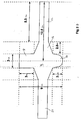
- each helical passer is made of three parts: a handle 22, a vertical segment 24 and a horizontal segment 26 formed in a spiral.
- the handle 22 has a height of 8 to 15 cm. It can be either made of stainless steel or any other material such as plastic.
- the vertical segment 24 measures from 2 to 6 cm; preferably 4 cm, with a diameter of 2.5 to 4.5 mm in section. It can also be made of stainless steel. It can either be connected to the handle unless it is formed integrally as one piece.
- the segment 26 is spirally shaped in a horizontal plane, perpendicular to the vertical segment 24. Segment 26 measures 6 to 10 cm - preferably 8.5, with a diameter of 2.5 to 4.5 mm in section. It is also made of stainless steel. The spiral is divided into four parts as shown in Fig 1C .
- the first part 28 is a 2-cm long linear segment which makes a 101 angle with the sagittal plane of the vertical segment 26.
- the second part 30 is a 4-cm long, circular segment of a circle of 3-cm of radius.
- the third part 32 is a 2.5-cm long, circular segment of a circle of 1.6-cm of radius.
- the fourth part 34 is the tip that can have three different shapes.
- Segment 34a is a 2 cm conic segment formed by three curled segments enabling the attachment of a tube ('tube-passing' needle) ( Fig 1Ci ).
- Segment 34b is an eyelet of 0.5 to 1.5 mm through which a string is passed ('stringpassing' needle) ( Fig 1Cii ).
- segment 34c the very end of the tip is flat and is 5-mm shorter. This spiral of 1.5 to 3.5 mm of diameter can receive a hollow tube whose distal end is sharply pointed and measures 5 mm ('tube-supporting' needle) ( Fig 1Ciii ).
- the "introducer” or “guide” as shown in Figures 2A, 2B and 2C is an 8 to 12-cm long instrument with a semi-cylindrical hollow gutter of a 3 to 5-mm diameter. It is made of stainless steel, and has a blunt atraumatic tip 36.
- the body 38 of the introducer is not straight right but wiggles on its center creating a distance one centimeter between the proximal and the distal ends. This particular shape is intended to prevent any important compression of the bulbar urethra during the procedure.
- the proximal extremity 40 of the guide is winged 42, 44 to serve as the handle.
- the accurate guide or introducer acts as a shoehorn to avoid any intrusion into the pelvis during the procedure.
- the mesh shown in Figure 2D is made of synthetic material preferably low density polypropylene. It can be either cut or shaped in the operating room from a proper metallic frame or be included in a ready to use set.
- the prosthesis comprises a central part 46 of 5 to 10-cm long and 2 to 5-cm in width. Its anterior end 48 is linear but the posterior extremity 50 is rounded.
- the mesh is laterally prolonged by two lateral arms 52, 54 of 10 to 15 cm in length. The width of the lateral ann progressively decreases at 56 in a distance of 2 to 4 cm, from 4 cm to 2 cm. Thus the latter segment measures from 8 to 13 cm.
- the arms 52, 54 of the mesh do not arise from the middle of the prosthesis but are more posterior.
- Additional materials to those aforementioned include two polyethylene hollow tubes. These tubes have from 25 to 40 cm of length with an outer diameter of 3.8 to 4.6 mm. The inner diameter measures from 2.8 to 3.8 mm. Two nylon guide wires are used of 60 to 100 cm long, and 0.5 to 1.3 mm in section.
- the surgical procedure can be carried out under general or spinal anaesthesia. And antibioprophylaxis is achieved by per-operative intravenous administration of 2g of a third generation cephalosporin.
- the patient is installed in gynecologic position; thighs are put in hyper flexion up to 1101 with an additional slight abduction as shown in Figures 3 through 14 .
- Sterile draping of the operative field is achieved after proper cleansing of the perineum up to the hypogastric region with a standard antiseptic solution. Care is taken to maintain an easy access to the penis and the perineum all along when surgery proceeds.
- a 16-French Foley catheter is inserted first. Afterwards the scrotum is temporarily suspended by stitches on both inner thighs to improve the access of the perineum. Then a 6-cm long median incision is performed from behind the scrotum as it stops 2-cm away from the anal margin.
- Colle's fascia Fig 3
- Transaction of Colle's fascia reveals the bulbo spongious muscle. Thereafter the bulbo spongious muscle is dissected upwards to the pubic symphysis and downwards to the central body of the perineum. Dissection is then conducted laterally to the ischio cavernous muscles. These muscles- ischio cavernous and bulbo cavernous- limit a triangular space which dissection gives access to the median perineal aponeurosis. At that stage, it is reminded that the important blood vessels and nerves run along the inner aspect of ischio cavernous muscles. Cautious hemostasis of small perforating vessels is realized by the electrocautery.
- the right side is started first.
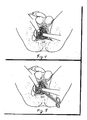
- the bulbar urethra is reclined on the left side using a Faraboeuf retractor; thus giving sight to the median perineal plane ( Fig 4 ).
- Metzebaum scissors are used to open up the median perineal aponeurosis.
- the incision goes from the upper part of the triangular space to the lateral edge of the bulb.
- Scissors transect the muscular plane before perforating the upper aspect of the median perineal aponeurosis ( Fig. 5 ).
- the guide is inserted through that plane with a 451 angle to come in contact with the upper aspect of the ischio pubic branch.
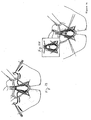
- the blunt tip of the guide is then used to pass through both the internal obturator muscle and the obturator membrane ( Fig. 6 ). Afterwards the helical passer is slid into the gutter of the guide to perforate the obturator membrane ( Fig 7-8 ). At that time the guide is removed and a rotation movement going forwards is applied to the passer as its distal end 34 appears at the junction between the ischio pubic branch and the pubic bone ( Fig. 8 ). The 30-cm long hollow plastic tube 58 is then clipped on the extremity of the passer and the device is rotated backwards. At that time the tube bridges the median perineal incision and the upper aspect the ischio pubic branch ( Fig 9 ). Thereafter the same procedure is also conducted on the opposite side.
- the proximal extremity of the mesh (M) is brought in contact with the bulb ( Fig 10A ). Then this rounded extremity of the mesh fixed with a 2/0 non-absorbable sutures (Mersuture ⁇ ) to the central body of the perineum ( Fig. 10B ).
- the nylon guide wires 60 are then attached to the arm of the mesh and altogether passed throughout the tube until it reaches the larger part (the 2 to 4-cm long proximal part)( Fig. 11A, 11B, 11C ).
- a Christophe grip is used to temporarily fasten the plastic tube and the mesh together. The same procedure is then conducted on the opposite side ( Figs. 11-12 ). Afterwards the anterior part of the mesh is fixed with two stitches of 2/0 non- absorbable suture to the aponeurosis of ischio cavernous muscles ( Fig. 12 ). A slight tension on the guide wire unfolds the mesh.
- the bladder is filled with 300 mL of saline.
- the urodynamic urethral catheter assesses an initial abdominal leak point pressure (ALPP) and a maximal closure pressure (PCM).
Landscapes
- Health & Medical Sciences (AREA)
- Life Sciences & Earth Sciences (AREA)
- Surgery (AREA)
- General Health & Medical Sciences (AREA)
- Public Health (AREA)
- Biomedical Technology (AREA)
- Heart & Thoracic Surgery (AREA)
- Veterinary Medicine (AREA)
- Engineering & Computer Science (AREA)
- Animal Behavior & Ethology (AREA)
- Molecular Biology (AREA)
- Nuclear Medicine, Radiotherapy & Molecular Imaging (AREA)
- Medical Informatics (AREA)
- Urology & Nephrology (AREA)
- Cardiology (AREA)
- Oral & Maxillofacial Surgery (AREA)
- Transplantation (AREA)
- Vascular Medicine (AREA)
- Surgical Instruments (AREA)
- Prostheses (AREA)
Abstract
Claims (20)
- By-pass chirurgical à utiliser dans le traitement de l'incontinence urinaire masculine, ledit by-pass chirurgical comprenant:une poignée (22),un segment droit (24) présentant deux extrémités, une extrémité du segment (24) s'étendant à partir de ladite poignée (22),une section hélicoïdale (26) présentant deux extrémités, une extrémité de la section hélicoïdale (26) étant contiguë à l'autre extrémité dudit segment droit (24),une première partie (28) de la section hélicoïdale (26) s'étendant à partir dudit segment droit (24) qui est une partie linéaire,une deuxième partie (30) de la section hélicoïdale (26) s'étendant à partir de ladite première partie (28) qui est une partie circulaire,une troisième partie (32) de ladite section hélicoïdale (26) s'étendant à partir de ladite deuxième partie (30) qui est une partie circulaire dont le rayon est inférieur à un rayon de ladite deuxième partie (30), etune quatrième partie (34) de ladite section hélicoïdale (26) s'étendant à partir de ladite troisième partie (32), ladite quatrième partie (34) se terminant en une extrémité libre,caractérisé en ce que ladite section hélicoïdale (26) est plane, et en ce que ladite section hélicoïdale (26) s'étend dans un plan qui est perpendiculaire audit segment droit (24).
- By-pass chirurgical à utiliser dans le traitement de l'incontinence urinaire masculine selon la revendication 1, dans lequel au moins ledit segment (24) et ladite section hélicoïdale (26) sont en acier inoxydable.
- By-pass chirurgical à utiliser dans le traitement de l'incontinence urinaire masculine selon la revendication 1, dans lequel ledit segment droit (24) mesure entre 2 cm et 6 cm et présente un diamètre compris entre 2,5 mm et 4,5 mm.
- By-pass chirurgical à utiliser dans le traitement de l'incontinence urinaire masculine selon la revendication 3, dans lequel ladite première partie (28) de ladite section hélicoïdale (26) présente une longueur de 2 cm et forme un angle de 10° avec un plan sagittal dudit segment droit (24).
- By-pass chirurgical à utiliser dans le traitement de l'incontinence urinaire masculine selon la revendication 3, dans lequel ladite deuxième partie (30) de ladite section hélicoïdale (26) présente un rayon de 3 cm.
- By-pass chirurgical à utiliser dans le traitement de l'incontinence urinaire masculine selon la revendication 5, dans lequel ladite troisième partie (32) de ladite section hélicoïdale (26) présente un rayon de 1,6 cm.
- By-pass chirurgical à utiliser dans le traitement de l'incontinence urinaire masculine selon la revendication 1, dans lequel ladite extrémité libre comprend trois segments froncés (34a).
- By-pass chirurgical à utiliser dans le traitement de l'incontinence urinaire masculine selon la revendication 1, dans lequel ladite extrémité libre comprend un billet (34b).
- By-pass chirurgical à utiliser dans le traitement de l'incontinence urinaire masculine selon la revendication 1, dans lequel ladite extrémité libre est plate.
- By-pass chirurgical à utiliser dans le traitement de l'incontinence urinaire masculine selon la revendication 1, dans lequel ladite poignée (22) est intégrée avec ledit segment droit (24).
- Dispositif pour traiter l'incontinence urinaire masculine, comprenant:un by-pass chirurgical selon l'une quelconque des revendications précédentes; etun guide pour introduire ledit by-pass chirurgical utilisé dans le traitement de l'incontinence urinaire masculine, ledit guide comprenant:un corps allongé (38) comprenant une gouttière creuse semi-cylindrique,une extrémité proximale et une extrémité distale qui s'étendent parallèlement l'une à l'autre et qui sont décalées d'un centimètre,deux ailes (42, 44) qui sont situées à ladite extrémité distale de manière à servir de poignée, etune pointe non traumatique émoussée (36) à ladite extrémité proximale.
- Dispositif selon la revendication 11, dans lequel ledit corps allongé (38) du guide est constitué d'acier inoxydable.
- Dispositif selon la revendication 11, dans lequel une longueur du corps allongé (38) du guide est comprise entre 8 cm et 12 cm.
- Dispositif selon la revendication 11, dans lequel un diamètre dudit corps allongé (38) du guide est compris entre 3 mm et 5 mm.
- Dispositif selon l'une quelconque des revendications 11 à 14, comprenant en outre une structure de support utilisée dans le traitement de l'incontinence urinaire masculine, ladite structure de support comprenant:un corps de maillage comprenant une partie centrale (46) qui présente une extrémité antérieure (48) et une extrémité postérieure arrondie (50), etdeux bras latéraux (52, 54) qui s'étendent à partir du corps de maille, une largeur des deux bras latéraux (52, 54) diminuant initialement lorsqu'une distance augmente à partir de la partie centrale (46) jusqu'à s'étendre à une largeur constante lorsque la distance augmente à partir de la partie centrale (46), les deux bras latéraux (52, 54) étant situés plus près de ladite extrémité postérieure (50) de ladite partie centrale (46) que ladite extrémité antérieure (48) de ladite partie centrale (46).
- Dispositif selon la revendication 15, dans lequel ledit corps de maille de la structure de support est un matériau synthétique.
- Dispositif selon la revendication 16, dans lequel ledit matériau synthétique est du polypropylène à faible densité.
- Dispositif selon la revendication 15, dans lequel ladite partie centrale (46) de la structure de support présente une longueur comprise entre 5 cm et 10 cm, et une largeur comprise entre 2 cm et 5 cm.
- Dispositif selon la revendication 15, dans lequel chacun desdits deux bras latéraux (52, 54) de la structure de support s'étend sur une longueur comprise entre 10 cm et 15 cm.
- Dispositif selon la revendication 19, dans lequel la largeur de chacun desdits deux bras latéraux (52, 54) de la structure de support diminue initialement de 4 cm à 2 cm.
Applications Claiming Priority (2)
| Application Number | Priority Date | Filing Date | Title |
|---|---|---|---|
| US90443107P | 2007-03-02 | 2007-03-02 | |
| PCT/EP2007/061582 WO2008107026A2 (fr) | 2007-03-02 | 2007-10-29 | Technique chirurgicale et outils à utiliser dans le traitement de l'incontinence urinaire masculine |
Publications (2)
| Publication Number | Publication Date |
|---|---|
| EP2134265A2 EP2134265A2 (fr) | 2009-12-23 |
| EP2134265B1 true EP2134265B1 (fr) | 2012-06-13 |
Family
ID=39467204
Family Applications (1)
| Application Number | Title | Priority Date | Filing Date |
|---|---|---|---|
| EP07821942A Not-in-force EP2134265B1 (fr) | 2007-03-02 | 2007-10-29 | Outils à utiliser dans le traitement de l'incontinence urinaire masculine |
Country Status (11)
| Country | Link |
|---|---|
| US (1) | US9198747B2 (fr) |
| EP (1) | EP2134265B1 (fr) |
| JP (1) | JP5001382B2 (fr) |
| KR (1) | KR101328421B1 (fr) |
| CN (1) | CN101677815B (fr) |
| AU (1) | AU2007348667B2 (fr) |
| BR (1) | BRPI0721423A2 (fr) |
| CA (1) | CA2677386C (fr) |
| MX (1) | MX2009009186A (fr) |
| WO (1) | WO2008107026A2 (fr) |
| ZA (1) | ZA200905424B (fr) |
Cited By (2)
| Publication number | Priority date | Publication date | Assignee | Title |
|---|---|---|---|---|
| USD980424S1 (en) | 2020-04-29 | 2023-03-07 | Coloplast A/S | Tissue anchor |
| US11944288B2 (en) | 2020-04-29 | 2024-04-02 | Coloplast A/S | Tissue anchor system including a fixation device and a delivery tool |
Families Citing this family (10)
| Publication number | Priority date | Publication date | Assignee | Title |
|---|---|---|---|---|
| FR2906131B1 (fr) * | 2006-09-21 | 2009-04-24 | Cl Medical Sarl | Ensemble chirurgical de traitement de l'incontinence urinaire chez l'homme |
| RU2483697C2 (ru) | 2006-10-18 | 2013-06-10 | Колопласт А/С | Имплантируемые устройства для лечения недержания и способы их применения |
| FR2919996B1 (fr) * | 2007-08-17 | 2010-09-10 | Cl Medical | Implant de soutien de l'uretre d'un homme et ensemble chirurgical de traitement de l'incontinence urinaire chez un homme comprenant un tel implant |
| CN102813535B (zh) * | 2012-08-08 | 2014-12-24 | 薛运章 | 肠系膜上血管悬吊装置 |
| US9241779B2 (en) | 2012-11-02 | 2016-01-26 | Coloplast A/S | Male incontinence treatment system |
| US10111651B2 (en) | 2012-11-02 | 2018-10-30 | Coloplast A/S | System and method of anchoring support material to tissue |
| US9480546B2 (en) | 2013-08-05 | 2016-11-01 | Coloplast A/S | Hysteropexy mesh apparatuses and methods |
| US9522000B2 (en) | 2013-11-08 | 2016-12-20 | Coloplast A/S | System and a method for surgical suture fixation |
| US10022116B2 (en) | 2014-12-04 | 2018-07-17 | Coloplast A/S | Method of fixating an implantable material in a patient |
| US11419634B2 (en) * | 2018-08-17 | 2022-08-23 | Empress Medical, Inc. | Causing ischemia in tumors |
Citations (3)
| Publication number | Priority date | Publication date | Assignee | Title |
|---|---|---|---|---|
| FR820187A (fr) * | 1936-09-23 | 1937-11-05 | Appareil pour l'enrobage répété et continu des os et des tendons avec des rubans et des cordes resorbables, ou avec toutes autres ligatures | |
| WO1990003766A1 (fr) * | 1988-10-04 | 1990-04-19 | Peter Emanuel Petros | Instrument chirurgical, prothese et son procede d'utilisation |
| WO2003105727A1 (fr) * | 2002-06-12 | 2003-12-24 | Scimed Life Systems, Inc. | Frondes medicales |
Family Cites Families (17)
| Publication number | Priority date | Publication date | Assignee | Title |
|---|---|---|---|---|
| US2008251A (en) * | 1932-12-14 | 1935-07-16 | Hillebrand Hubert | Surgical instrument |
| SE503271C2 (sv) * | 1994-08-30 | 1996-04-29 | Medscand Ab | Instrumentarium för behandling av urininkontinens hos kvinnor samt sätt för sådan behandling |
| WO1997016121A1 (fr) * | 1995-10-31 | 1997-05-09 | Karl Christopher Texler | Instrument chirurgical |
| US5935138A (en) * | 1997-09-24 | 1999-08-10 | Ethicon, Inc. | Spiral needle for endoscopic surgery |
| AUPQ362199A0 (en) * | 1999-10-22 | 1999-11-18 | Kaladelfos, George | Intra-vaginal sling placement device |
| US6605097B1 (en) * | 2000-10-18 | 2003-08-12 | Jorn Lehe | Apparatus and method for treating female urinary incontinence |
| US6911003B2 (en) * | 2002-03-07 | 2005-06-28 | Ams Research Corporation | Transobturator surgical articles and methods |
| US7357773B2 (en) * | 2002-03-07 | 2008-04-15 | Ams Research Corporation | Handle and surgical article |
| WO2003075792A1 (fr) * | 2002-03-07 | 2003-09-18 | Ams Research Corporation | Articles chirurgicaux trans-obturateurs et procedes associes |
| US7094199B2 (en) * | 2002-07-23 | 2006-08-22 | Sherwood Services Ag | Ivs obturator instrument and procedure |
| US8097007B2 (en) * | 2002-08-02 | 2012-01-17 | C. R. Bard, Inc. | Self-anchoring sling and introducer system |
| EP1542596B1 (fr) * | 2002-08-29 | 2010-11-24 | Université de Liège | Procedes destines au traitement chirurgical de l'incontinence urinaire feminine |
| JP4467440B2 (ja) * | 2003-07-25 | 2010-05-26 | ユニベルシテ・ド・リエージュ | 女性尿失禁の外科治療用装置 |
| AU2004279388B2 (en) * | 2003-10-03 | 2010-10-14 | Boston Scientific Limited | Systems for a delivering a medical implant to an anatomical location in a patient |
| ES2573672T3 (es) * | 2005-02-04 | 2016-06-09 | Boston Scientific Scimed Inc. | Diseño de aguja para sling transobturador masculino |
| WO2008033950A2 (fr) * | 2006-09-13 | 2008-03-20 | C. R. Bard, Inc. | Système de soutien urétral |
| WO2008042433A1 (fr) * | 2006-10-03 | 2008-04-10 | Boston Scientific Scimed, Inc. | dispositif coaxial de placement d'un implant sur la partie pelvienne d'un patient |
-
2007
- 2007-10-29 BR BRPI0721423-5A2A patent/BRPI0721423A2/pt not_active Application Discontinuation
- 2007-10-29 CN CN200780051976XA patent/CN101677815B/zh not_active Expired - Fee Related
- 2007-10-29 US US11/976,801 patent/US9198747B2/en not_active Expired - Fee Related
- 2007-10-29 MX MX2009009186A patent/MX2009009186A/es active IP Right Grant
- 2007-10-29 KR KR1020097018242A patent/KR101328421B1/ko not_active Expired - Fee Related
- 2007-10-29 EP EP07821942A patent/EP2134265B1/fr not_active Not-in-force
- 2007-10-29 AU AU2007348667A patent/AU2007348667B2/en not_active Ceased
- 2007-10-29 WO PCT/EP2007/061582 patent/WO2008107026A2/fr not_active Ceased
- 2007-10-29 CA CA2677386A patent/CA2677386C/fr not_active Expired - Fee Related
- 2007-10-29 JP JP2009552077A patent/JP5001382B2/ja not_active Expired - Fee Related
-
2009
- 2009-08-03 ZA ZA200905424A patent/ZA200905424B/xx unknown
Patent Citations (3)
| Publication number | Priority date | Publication date | Assignee | Title |
|---|---|---|---|---|
| FR820187A (fr) * | 1936-09-23 | 1937-11-05 | Appareil pour l'enrobage répété et continu des os et des tendons avec des rubans et des cordes resorbables, ou avec toutes autres ligatures | |
| WO1990003766A1 (fr) * | 1988-10-04 | 1990-04-19 | Peter Emanuel Petros | Instrument chirurgical, prothese et son procede d'utilisation |
| WO2003105727A1 (fr) * | 2002-06-12 | 2003-12-24 | Scimed Life Systems, Inc. | Frondes medicales |
Cited By (4)
| Publication number | Priority date | Publication date | Assignee | Title |
|---|---|---|---|---|
| USD980424S1 (en) | 2020-04-29 | 2023-03-07 | Coloplast A/S | Tissue anchor |
| US11944288B2 (en) | 2020-04-29 | 2024-04-02 | Coloplast A/S | Tissue anchor system including a fixation device and a delivery tool |
| USD1030055S1 (en) | 2020-04-29 | 2024-06-04 | Coloplast A/S | Tissue anchor delivery tool |
| US12357297B2 (en) | 2020-04-29 | 2025-07-15 | Coloplast A/S | Method of preparing a suture fixation device for use in surgery to treat pelvic organ prolapse |
Also Published As
| Publication number | Publication date |
|---|---|
| CN101677815A (zh) | 2010-03-24 |
| KR20090127128A (ko) | 2009-12-09 |
| MX2009009186A (es) | 2009-09-07 |
| AU2007348667A9 (en) | 2009-10-08 |
| WO2008107026A2 (fr) | 2008-09-12 |
| CA2677386A1 (fr) | 2008-09-12 |
| CA2677386C (fr) | 2013-07-09 |
| EP2134265A2 (fr) | 2009-12-23 |
| US20080210247A1 (en) | 2008-09-04 |
| WO2008107026A3 (fr) | 2008-12-04 |
| AU2007348667B2 (en) | 2012-09-06 |
| BRPI0721423A2 (pt) | 2014-03-25 |
| US9198747B2 (en) | 2015-12-01 |
| JP5001382B2 (ja) | 2012-08-15 |
| KR101328421B1 (ko) | 2013-11-14 |
| ZA200905424B (en) | 2010-05-26 |
| AU2007348667A2 (en) | 2009-10-22 |
| JP2010519987A (ja) | 2010-06-10 |
| CN101677815B (zh) | 2011-10-19 |
| AU2007348667A1 (en) | 2008-09-12 |
Similar Documents
| Publication | Publication Date | Title |
|---|---|---|
| CA2677386C (fr) | Technique chirurgicale et outils a utiliser dans le traitement de l'incontinence urinaire masculine | |
| US8720446B2 (en) | Sacrocolpopexy support and method of implantation | |
| US9370363B2 (en) | Anchor assembly for an implantable, pelvic support device | |
| EP1581162B1 (fr) | Appareil pour l'ajustement d'implants en polymere a surface souple | |
| KR101428996B1 (ko) | 수술용품 및 골반질환 치료방법 | |
| ES2436207T3 (es) | Instrumento quirúrgico para tratar incontinencia urinaria femenina | |
| US5840011A (en) | Implant for suspension of the urinary bladder in cases of incontinence of urine in women | |
| KR101050359B1 (ko) | 여성 요실금 외과 치료용 장치 | |
| ES2305304T3 (es) | Kit de instrumento quirurgico para tratar incontinencia urinaria femenina. | |
| US20180243065A1 (en) | Partial cuff | |
| US9999491B2 (en) | Puncture device and puncture apparatus | |
| EP2608736B1 (fr) | Auxiliaire de centrage pour un support implantable | |
| RU2243729C1 (ru) | Способ лечения недержания мочи у мужчин | |
| US20090227832A1 (en) | Implant for treatment of male urinary stress incontinence | |
| US20230240826A1 (en) | Procedure for repairing and treating pelvic prolapse in a female patient, a medical instrument for perforation of the cervix, a procedure for removing tendon tissue of a tendon from a human or animal body, and a procedure for the preparation of tendon tissue | |
| McCrea | Ureteral management following removal of the bladder and lower bowel for carcinoma |
Legal Events
| Date | Code | Title | Description |
|---|---|---|---|
| PUAI | Public reference made under article 153(3) epc to a published international application that has entered the european phase |
Free format text: ORIGINAL CODE: 0009012 |
|
| 17P | Request for examination filed |
Effective date: 20091002 |
|
| AK | Designated contracting states |
Kind code of ref document: A2 Designated state(s): AT BE BG CH CY CZ DE DK EE ES FI FR GB GR HU IE IS IT LI LT LU LV MC MT NL PL PT RO SE SI SK TR |
|
| 17Q | First examination report despatched |
Effective date: 20110216 |
|
| GRAP | Despatch of communication of intention to grant a patent |
Free format text: ORIGINAL CODE: EPIDOSNIGR1 |
|
| DAX | Request for extension of the european patent (deleted) | ||
| RTI1 | Title (correction) |
Free format text: TOOLS FOR USE IN TREATMENT OF MALE URINARY INCONTINENCE |
|
| GRAS | Grant fee paid |
Free format text: ORIGINAL CODE: EPIDOSNIGR3 |
|
| GRAA | (expected) grant |
Free format text: ORIGINAL CODE: 0009210 |
|
| AK | Designated contracting states |
Kind code of ref document: B1 Designated state(s): AT BE BG CH CY CZ DE DK EE ES FI FR GB GR HU IE IS IT LI LT LU LV MC MT NL PL PT RO SE SI SK TR |
|
| REG | Reference to a national code |
Ref country code: GB Ref legal event code: FG4D |
|
| REG | Reference to a national code |
Ref country code: AT Ref legal event code: REF Ref document number: 561618 Country of ref document: AT Kind code of ref document: T Effective date: 20120615 Ref country code: CH Ref legal event code: EP |
|
| RAP2 | Party data changed (patent owner data changed or rights of a patent transferred) |
Owner name: CENTRE HOSPITALIER UNIVERSITAIRE DE LIEGE Owner name: UNIVERSITE DE LIEGE |
|
| REG | Reference to a national code |
Ref country code: IE Ref legal event code: FG4D |
|
| REG | Reference to a national code |
Ref country code: DE Ref legal event code: R096 Ref document number: 602007023419 Country of ref document: DE Effective date: 20120809 |
|
| REG | Reference to a national code |
Ref country code: NL Ref legal event code: T3 |
|
| PG25 | Lapsed in a contracting state [announced via postgrant information from national office to epo] |
Ref country code: CY Free format text: LAPSE BECAUSE OF FAILURE TO SUBMIT A TRANSLATION OF THE DESCRIPTION OR TO PAY THE FEE WITHIN THE PRESCRIBED TIME-LIMIT Effective date: 20120613 Ref country code: SE Free format text: LAPSE BECAUSE OF FAILURE TO SUBMIT A TRANSLATION OF THE DESCRIPTION OR TO PAY THE FEE WITHIN THE PRESCRIBED TIME-LIMIT Effective date: 20120613 Ref country code: FI Free format text: LAPSE BECAUSE OF FAILURE TO SUBMIT A TRANSLATION OF THE DESCRIPTION OR TO PAY THE FEE WITHIN THE PRESCRIBED TIME-LIMIT Effective date: 20120613 Ref country code: LT Free format text: LAPSE BECAUSE OF FAILURE TO SUBMIT A TRANSLATION OF THE DESCRIPTION OR TO PAY THE FEE WITHIN THE PRESCRIBED TIME-LIMIT Effective date: 20120613 |
|
| REG | Reference to a national code |
Ref country code: AT Ref legal event code: MK05 Ref document number: 561618 Country of ref document: AT Kind code of ref document: T Effective date: 20120613 |
|
| REG | Reference to a national code |
Ref country code: LT Ref legal event code: MG4D Effective date: 20120613 |
|
| PG25 | Lapsed in a contracting state [announced via postgrant information from national office to epo] |
Ref country code: SI Free format text: LAPSE BECAUSE OF FAILURE TO SUBMIT A TRANSLATION OF THE DESCRIPTION OR TO PAY THE FEE WITHIN THE PRESCRIBED TIME-LIMIT Effective date: 20120613 Ref country code: LV Free format text: LAPSE BECAUSE OF FAILURE TO SUBMIT A TRANSLATION OF THE DESCRIPTION OR TO PAY THE FEE WITHIN THE PRESCRIBED TIME-LIMIT Effective date: 20120613 Ref country code: GR Free format text: LAPSE BECAUSE OF FAILURE TO SUBMIT A TRANSLATION OF THE DESCRIPTION OR TO PAY THE FEE WITHIN THE PRESCRIBED TIME-LIMIT Effective date: 20120914 |
|
| PG25 | Lapsed in a contracting state [announced via postgrant information from national office to epo] |
Ref country code: IS Free format text: LAPSE BECAUSE OF FAILURE TO SUBMIT A TRANSLATION OF THE DESCRIPTION OR TO PAY THE FEE WITHIN THE PRESCRIBED TIME-LIMIT Effective date: 20121013 Ref country code: EE Free format text: LAPSE BECAUSE OF FAILURE TO SUBMIT A TRANSLATION OF THE DESCRIPTION OR TO PAY THE FEE WITHIN THE PRESCRIBED TIME-LIMIT Effective date: 20120613 Ref country code: SK Free format text: LAPSE BECAUSE OF FAILURE TO SUBMIT A TRANSLATION OF THE DESCRIPTION OR TO PAY THE FEE WITHIN THE PRESCRIBED TIME-LIMIT Effective date: 20120613 Ref country code: AT Free format text: LAPSE BECAUSE OF FAILURE TO SUBMIT A TRANSLATION OF THE DESCRIPTION OR TO PAY THE FEE WITHIN THE PRESCRIBED TIME-LIMIT Effective date: 20120613 Ref country code: CZ Free format text: LAPSE BECAUSE OF FAILURE TO SUBMIT A TRANSLATION OF THE DESCRIPTION OR TO PAY THE FEE WITHIN THE PRESCRIBED TIME-LIMIT Effective date: 20120613 Ref country code: RO Free format text: LAPSE BECAUSE OF FAILURE TO SUBMIT A TRANSLATION OF THE DESCRIPTION OR TO PAY THE FEE WITHIN THE PRESCRIBED TIME-LIMIT Effective date: 20120613 |
|
| PG25 | Lapsed in a contracting state [announced via postgrant information from national office to epo] |
Ref country code: IT Free format text: LAPSE BECAUSE OF FAILURE TO SUBMIT A TRANSLATION OF THE DESCRIPTION OR TO PAY THE FEE WITHIN THE PRESCRIBED TIME-LIMIT Effective date: 20120613 Ref country code: PT Free format text: LAPSE BECAUSE OF FAILURE TO SUBMIT A TRANSLATION OF THE DESCRIPTION OR TO PAY THE FEE WITHIN THE PRESCRIBED TIME-LIMIT Effective date: 20121015 Ref country code: PL Free format text: LAPSE BECAUSE OF FAILURE TO SUBMIT A TRANSLATION OF THE DESCRIPTION OR TO PAY THE FEE WITHIN THE PRESCRIBED TIME-LIMIT Effective date: 20120613 |
|
| PLBE | No opposition filed within time limit |
Free format text: ORIGINAL CODE: 0009261 |
|
| STAA | Information on the status of an ep patent application or granted ep patent |
Free format text: STATUS: NO OPPOSITION FILED WITHIN TIME LIMIT |
|
| PG25 | Lapsed in a contracting state [announced via postgrant information from national office to epo] |
Ref country code: ES Free format text: LAPSE BECAUSE OF FAILURE TO SUBMIT A TRANSLATION OF THE DESCRIPTION OR TO PAY THE FEE WITHIN THE PRESCRIBED TIME-LIMIT Effective date: 20120924 Ref country code: DK Free format text: LAPSE BECAUSE OF FAILURE TO SUBMIT A TRANSLATION OF THE DESCRIPTION OR TO PAY THE FEE WITHIN THE PRESCRIBED TIME-LIMIT Effective date: 20120613 |
|
| 26N | No opposition filed |
Effective date: 20130314 |
|
| PG25 | Lapsed in a contracting state [announced via postgrant information from national office to epo] |
Ref country code: MC Free format text: LAPSE BECAUSE OF NON-PAYMENT OF DUE FEES Effective date: 20121031 |
|
| REG | Reference to a national code |
Ref country code: DE Ref legal event code: R097 Ref document number: 602007023419 Country of ref document: DE Effective date: 20130314 |
|
| PG25 | Lapsed in a contracting state [announced via postgrant information from national office to epo] |
Ref country code: BG Free format text: LAPSE BECAUSE OF FAILURE TO SUBMIT A TRANSLATION OF THE DESCRIPTION OR TO PAY THE FEE WITHIN THE PRESCRIBED TIME-LIMIT Effective date: 20120913 |
|
| PG25 | Lapsed in a contracting state [announced via postgrant information from national office to epo] |
Ref country code: MT Free format text: LAPSE BECAUSE OF FAILURE TO SUBMIT A TRANSLATION OF THE DESCRIPTION OR TO PAY THE FEE WITHIN THE PRESCRIBED TIME-LIMIT Effective date: 20120613 |
|
| PG25 | Lapsed in a contracting state [announced via postgrant information from national office to epo] |
Ref country code: TR Free format text: LAPSE BECAUSE OF FAILURE TO SUBMIT A TRANSLATION OF THE DESCRIPTION OR TO PAY THE FEE WITHIN THE PRESCRIBED TIME-LIMIT Effective date: 20120613 |
|
| PG25 | Lapsed in a contracting state [announced via postgrant information from national office to epo] |
Ref country code: LU Free format text: LAPSE BECAUSE OF NON-PAYMENT OF DUE FEES Effective date: 20121029 |
|
| PG25 | Lapsed in a contracting state [announced via postgrant information from national office to epo] |
Ref country code: HU Free format text: LAPSE BECAUSE OF FAILURE TO SUBMIT A TRANSLATION OF THE DESCRIPTION OR TO PAY THE FEE WITHIN THE PRESCRIBED TIME-LIMIT Effective date: 20071029 |
|
| REG | Reference to a national code |
Ref country code: FR Ref legal event code: PLFP Year of fee payment: 9 |
|
| REG | Reference to a national code |
Ref country code: FR Ref legal event code: PLFP Year of fee payment: 10 |
|
| REG | Reference to a national code |
Ref country code: FR Ref legal event code: PLFP Year of fee payment: 11 |
|
| REG | Reference to a national code |
Ref country code: FR Ref legal event code: PLFP Year of fee payment: 12 |
|
| PGFP | Annual fee paid to national office [announced via postgrant information from national office to epo] |
Ref country code: NL Payment date: 20201028 Year of fee payment: 14 |
|
| PGFP | Annual fee paid to national office [announced via postgrant information from national office to epo] |
Ref country code: IE Payment date: 20201022 Year of fee payment: 14 Ref country code: GB Payment date: 20201022 Year of fee payment: 14 Ref country code: DE Payment date: 20201022 Year of fee payment: 14 Ref country code: CH Payment date: 20201021 Year of fee payment: 14 Ref country code: FR Payment date: 20201022 Year of fee payment: 14 |
|
| PGFP | Annual fee paid to national office [announced via postgrant information from national office to epo] |
Ref country code: BE Payment date: 20201028 Year of fee payment: 14 |
|
| REG | Reference to a national code |
Ref country code: DE Ref legal event code: R119 Ref document number: 602007023419 Country of ref document: DE |
|
| REG | Reference to a national code |
Ref country code: CH Ref legal event code: PL |
|
| REG | Reference to a national code |
Ref country code: NL Ref legal event code: MM Effective date: 20211101 |
|
| REG | Reference to a national code |
Ref country code: BE Ref legal event code: MM Effective date: 20211031 |
|
| GBPC | Gb: european patent ceased through non-payment of renewal fee |
Effective date: 20211029 |
|
| PG25 | Lapsed in a contracting state [announced via postgrant information from national office to epo] |
Ref country code: NL Free format text: LAPSE BECAUSE OF NON-PAYMENT OF DUE FEES Effective date: 20211101 Ref country code: GB Free format text: LAPSE BECAUSE OF NON-PAYMENT OF DUE FEES Effective date: 20211029 Ref country code: DE Free format text: LAPSE BECAUSE OF NON-PAYMENT OF DUE FEES Effective date: 20220503 Ref country code: BE Free format text: LAPSE BECAUSE OF NON-PAYMENT OF DUE FEES Effective date: 20211031 |
|
| PG25 | Lapsed in a contracting state [announced via postgrant information from national office to epo] |
Ref country code: LI Free format text: LAPSE BECAUSE OF NON-PAYMENT OF DUE FEES Effective date: 20211031 Ref country code: CH Free format text: LAPSE BECAUSE OF NON-PAYMENT OF DUE FEES Effective date: 20211031 |
|
| PG25 | Lapsed in a contracting state [announced via postgrant information from national office to epo] |
Ref country code: FR Free format text: LAPSE BECAUSE OF NON-PAYMENT OF DUE FEES Effective date: 20211031 |
|
| PG25 | Lapsed in a contracting state [announced via postgrant information from national office to epo] |
Ref country code: IE Free format text: LAPSE BECAUSE OF NON-PAYMENT OF DUE FEES Effective date: 20211029 |