EP2135181B1 - Mandataire pour protocole de lancement de session couplé à une passerelle - Google Patents
Mandataire pour protocole de lancement de session couplé à une passerelle Download PDFInfo
- Publication number
- EP2135181B1 EP2135181B1 EP08744979.9A EP08744979A EP2135181B1 EP 2135181 B1 EP2135181 B1 EP 2135181B1 EP 08744979 A EP08744979 A EP 08744979A EP 2135181 B1 EP2135181 B1 EP 2135181B1
- Authority
- EP
- European Patent Office
- Prior art keywords
- message
- access gateway
- mobile device
- ggsn
- edge proxy
- Prior art date
- Legal status (The legal status is an assumption and is not a legal conclusion. Google has not performed a legal analysis and makes no representation as to the accuracy of the status listed.)
- Active
Links
Images





Classifications
-
- H—ELECTRICITY
- H04—ELECTRIC COMMUNICATION TECHNIQUE
- H04W—WIRELESS COMMUNICATION NETWORKS
- H04W12/00—Security arrangements; Authentication; Protecting privacy or anonymity
- H04W12/06—Authentication
- H04W12/062—Pre-authentication
-
- H—ELECTRICITY
- H04—ELECTRIC COMMUNICATION TECHNIQUE
- H04W—WIRELESS COMMUNICATION NETWORKS
- H04W92/00—Interfaces specially adapted for wireless communication networks
- H04W92/04—Interfaces between hierarchically different network devices
- H04W92/10—Interfaces between hierarchically different network devices between terminal device and access point, i.e. wireless air interface
Definitions
- the present disclosure relates generally to a session initiation protocol (SIP) proxy coupled to a gateway for protecting SIP infrastructure.
- SIP session initiation protocol
- IP Internet protocol
- IMS Internet protocol
- P-CSCF proxy call session control function
- edge proxy can enable policy and charging to be implemented according to the session description protocol (SDP) and the presence and value of other session initiation protocol (SIP) headers.
- SDP session description protocol
- SIP session initiation protocol
- the SDP will typically be negotiated using SIP.
- SIP headers can be manipulated in attempts to circumvent operator policies.
- 3GPP 3 rd Generation Partnership Project
- 3GPP IMS security does not prevent attacks from authentic IMS users.
- attacks on SIP infrastructure may be difficult to stop using conventional approaches.
- prevention of such attacks is desirable in order to preserve operator policies.
- US 2002/191597 discloses a method of enabling charging information generated within a GPRS access network to be associated with charging information generated within an IP Multimedia Core Network Subsystem, IMSS, the charging information relating to a multimedia call facilitated by the IMSS and carried by the GPRS network.
- IMSS IP Multimedia Core Network Subsystem
- a method can include: (i) performing an initial authentication with a mobile device in an access gateway, the access gateway being a point of attachment; (ii) forwarding a first message from the mobile device to an edge proxy; (iii) receiving a second message from the edge proxy; and (iv) returning a modified version of the second message to the edge proxy for a final authentication of the mobile device.
- a method can include: (i) receiving in an edge proxy, a first message from a mobile device via an access gateway; (ii) sending a second message to the access gateway; and (iii) receiving a modified version of the second message for a final authentication of the mobile device.
- a session initiation protocol (SIP) proxy or "edge" proxy may be coupled to an access gateway or point of attachment for protecting SIP infrastructure.
- IP Internet protocol
- VoIP voice over Internet protocol
- QoS direct quality of service
- GPRS general packet radio service
- a network can employ UMTS 2.5GHz and/or 3GHz standards, for example.
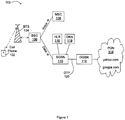
- Cell phone 102 calls can be received/transmitted by Base Transceiver Station (BTS) 104, which can interface with Base Station Controller (BSC) 106.
- BTS Base Transceiver Station
- BSC Base Station Controller
- MSC Mobile Switching Center
- SGSN Serving GPRS Support Node
- Gateway GPRS Support Node (GGSN) 112 can be a server and/or part of a switch/router, and may represent a point of attachment or "gateway," for example.
- Example GGSN components are shown below in Figure 9 .
- cell phone 102 can be any device (e.g., a laptop, handset, or another type of phone) that can access the Internet (e.g., Public Data Network (PDN) 114).
- PDN Public Data Network
- IP services that can be supplied to a mobile user of cell phone 102 can include services available via GGSN 112, such as QoS, IP address allocation, security, policy, and billing/charging.
- SGSN 110 can provide wireless service control for a user (e.g., a user of cell phone 102).
- Such service control can include a user authentication via Home Location Registry (HLR) 116, user profile download via HLR 116 and/or Domain Name Service (DNS) 118.
- HLR Home Location Registry
- DNS Domain Name Service
- Once an authentic user connection is established the user information can be retrieved from a database stored on HLR 116. For example, a determination of the types of service that a particular user is authorized to utilize can occur in this fashion.
- other parameters can also be supplied, such as QoS profile, access mode, and/or Access Point Name (APN).
- An APN is essentially a logical name referring to a GGSN and an external network.
- Cell phone 102 can have a user initially identified by IMSI (International Mobile Subscriber Identifier). With such information, SGSN 110 can retrieve the appropriate subscriber information for this user (e.g., credentials used to challenge the user during authentication, the user's mobile subscriber integrated services digital network (MSISDN), which is an E. 164 telephone number associated to cell phone 102 or an APN that the user is attempting to access from PDN 114).
- MSISDN mobile subscriber integrated services digital network
- Such an APN may be provided via one server coupled to an actual web site (e.g., yahoo.com or google.com) that the user wishes to access.
- SGSN 110 can determine which of several possible GGSNs (e.g., GGSN 112) should be utilized for the connection. Each such GGSN may be able to support a subset of all APNs or other local settings and/or configurations of the APNs allocated to a particular GGSN, for example.
- GTP 120 can be used to set up a user connection between SGSN 110 and GGSN 112.
- GTP 120 Among the parameters in GTP 120 are Mobile Station IP (MSIP) address, QoS, access mode, access location, MSISDN, and billing/charging characteristics, to name just a few.
- this parameter information can be stored in GGSN 112.
- SGSN 110 receives an activation or access request (e.g., initiated via cell phone 102)
- SGSN 110 can pass such associated GTP 120 to GGSN 112.
- the parameter information can be stored in GGSN 112 as part of a Packet Data Protocol (PDP), which can be a GTP session or context for each user.
- PDP Packet Data Protocol
- a closer integration between a proxy call session control function (P-CSCF) or edge proxy (EP) and the access gateway (e.g., GGSN) can facilitate prevention of the manipulation of SIP headers.
- information may be passed between an access gateway (e.g., GGSN/packet data serving node (PDSN)) and a P-CSCF (or EP) in order to detect attacks on the SIP infrastructure.
- a CSCF may be based upon a specific usage of the SIP for initiating, managing, and terminating multimedia sessions between IP multimedia subsystem (IMS) terminals.
- IMS IP multimedia subsystem
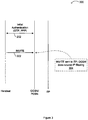
- a handset can be indicated on the left, a point of attachment or gateway (e.g., GGSN/PDSN) in the middle, and an SIP proxy (e.g., EP) on the right side.
- Initial authentication 202 GTP, or point-to-point protocol (PPP)
- PPP point-to-point protocol
- GGSN/PDSN can know a subscriber identification (ID) associated with the radio link and allocated IP (204).
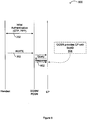
- a second example operation in a call flow using an edge proxy is shown and indicated by the general reference character 300.
- the same or similar reference numbers shown in different Figures can indicate the same or similar events/elements.
- an initial authentication can be followed by an invite 302.
- any suitable SIP message e.g., register
- GGSN may perform source IP filtering (304) prior to the message reaching the EP.
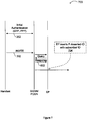
- a third example operation in a call flow using an edge proxy is shown and indicated by the general reference character 400. Once the SIP message (e.g., invite) reaches the EP, the EP now knows that the invite came from GGSN (404).
- EP can now query GGSN for the IMSI, MSISDN, access method, access location and/or subscriber identification associated with that IP (504).
- GGSN having established a user session, can cache an IP address allocated along with associated IMSI, MSISDN and access information provided by the SGSN, which may have authenticated the user.
- the GGSN may be further operable to receive updated subscriber information from the SGSN (e.g., if the user changes an access type or access location). In such circumstances, the GGSN may be operable to update its cached information with the latest received information.
- the GGSN can include typical source address "spoofing" prevention.
- a response 602 can then be provided by GGSN/PDSN to EP.
- the response can include subscriber ID (604), for example corresponding to the cached MSISDN.
- subscriber ID (604)
- subscriber ID (604)
- subscriber ID 704
- P-Asserted-ID 704
- FIG. 8 an example flow diagram using an edge proxy is shown and indicated by the general reference character 800.
- the flow can begin (802), and an initial authentication can be performed (804).
- a handset may discover EP details during this authentication, and IP address allocation (e.g., GTP, PPP, dynamic host configuration protocol (DHCP)) can be made.
- IP address allocation e.g., GTP, PPP, dynamic host configuration protocol (DHCP)
- the handset can then send an SIP message to the EP (806).
- SIP message can include register, invite, or any suitable SIP message.
- the SIP message can then be passed through the point of attachment (808).
- points of attachment can include GGSN or PDSN, for example.
- An SIP message can then be sent from the EP to the point of attachment, and a response can be received (810).
- a query message may be sent to the GGSN, and a response concerning access (e.g., user identification, cell, etc.) can be returned to the EP.
- the EP may forward messages using normal SIP procedures (812), and the flow can complete (814).
- a GGSN can act as an interface between a GPRS backbone network and external packet data networks (e.g., a radio network and the IP network).
- the GGSN can convert GPRS packets coming from the SGSN into the appropriate PDP format (e.g., IP or X.25), and may send the packets out on the corresponding packet data network.
- PDP addresses of incoming data packets may be converted to the Global System for Mobile Communications (GSM) address of the destination user.
- GSM Global System for Mobile Communications
- the readdressed packets can then be sent to a responsible SGSN.
- a GGSN can store the current SGSN address of the user, as well as the associated user profile in a location register.
- the GGSN may also perform authentication and charging functions.
- One GGSN component may be single board computer 902, which can include relatively high-performance, standards-based application processors for carrier-grade telecom and Internet applications.
- Telecom adapter 904 can support T1/E1/J1 and T3 for communication and networking applications, as well as software solutions.
- Ethernet switch 906 can provide increased bandwidth and network performance.
- redundant host packet-based platform 908 can be bundled with Ethernet switches and power supplies, for example.
- a P-CSCF or EP When a P-CSCF or EP receives an SIP message from a user agent (UA) or SIP client (e.g., a handset), the EP can utilize the source IP address of the SIP message to query the GGSN, which then can return the MSISDN and IMSI to the P-CSCF.
- the querying of the GGSN can be over a secure tunnel, allowing the EP and GGSN to be geographically separated.
- the EP can include information received from the GGSN when proxying SIP messages to other SIP elements.
- P-Asserted-ID This information can be formatted as a "P-Asserted-ID" header, as shown below in Table 1: Table 1: P-Asserted-ID sip: 234150999999999@ims.mnc015.mcc234.IMSI.3gppnetwork.org P-Asserted-ID tel: +447769999999
- S-CSCF serving call session control function
- visited network differentiation can be allowed, even when the EP includes or is located in a home network.
- the EP when the EP receives an SIP message possibly containing access network information populated by the client (e.g., BSC 106 of Figure 1 ), the EP can query the GGSN to provide the visited network in which the user is located. In this case, the user may be tunneled from a visited SGSN to a home GGSN that connects to the EP.
- the GGSN can receive the SGSN mobile country code (MCC) mobile network code (MNC) over its GTP interface.
- MCC mobile country code
- MNC mobile network code
- the EP can add a "P-Visited-Network-ID" of a predefined format (e.g., P-Visited-Network-ID: "MCC:235 MNC:015") according to the information received from the SGSN.
- P-Visited-Network-ID "MCC:235 MNC:015"
- the home network can use this information to deliver location-based subscription restrictions, or location-based service differentiation. In this fashion, roaming partner evaluation can be accommodated without IMS roaming being deployed. This is in contrast to conventional IMS specifications, which may have the P-Visited-Network-ID set to a network in which the EP is located, and may allow users to attempt to circumvent roaming restrictions by tunneling to a home GGSN rather than locally breaking out at a visited GGSN.
- Particular embodiments can allow for the policing of the P-Access-Network-Info, which can include a definition of a type of access network (e.g., WiFi, code division multiple access (CDMA)), as provided by a UA, and as may be defined in IETF (Internet Engineering Task Force) RFC 3455.
- a type of access network e.g., WiFi, code division multiple access (CDMA)
- CDMA code division multiple access
- IETF Internet Engineering Task Force
- particular embodiments can address a user attempting to interfere with IMS operation by spoofing the P-Access-Network-Info (e.g., including an incorrect radio technology, such as preferential rating of an IMS called signal over 802.11 compared to CDMA, or signaling in incorrect call identity in order to indicate that the user is located in their home cell when they are in another location).
- the GGSN may be queried by the EP to provide location attributes for a user.
- the GGSN may provide cell global identity and radio access type information, which the EP can use to handle a malformed request, for example. In this fashion, an EP can deny access, or otherwise handle such an improper request.
- Cell global index (CGI) may be a concatenation of the location area identity and cell identity.
- 3GPP may be utilized for definitions of transports of the CGI from SGSN to GGSN.
- a user accessing via a roaming network that may only support IPv4 can use intra-site automatic tunnel addressing protocol (ISATAP) to access home-based IPv6 services.
- ISATAP intra-site automatic tunnel addressing protocol
- a gateway can support enhanced functionality in particular embodiments.
- the "c line" can correspond to an ISATAP address, and can be used to attack the network since requests for policy enforcement based on the IPv6 session description protocol (SDP) may not be enforced at the GGSN.
- the IPv6 enabled EP can send a policy request containing the SDP, as well as a second identifier (e.g., IMSI or MSISDN), to the GGSN.
- a second identifier e.g., IMSI or MSISDN
- the GGSN can recognize that it is being requested to perform policy on a non-allocated IP address, and may send a special control packet to the IPv6 address corresponding to the "c line" in the negotiated SDP.
- the packet may be routed to the ISATAP router where the packet can be encapsulated and sent towards the GGSN.
- the GGSN may include functionality to detect the tunneling of such a specialized packet. If the IP address corresponds to the MSISDN or IMSI included in the request, then the GGSN can install a policy for the flow to the ISATAP router, or the GGSN can reject the request.
- the interface between EP and GGSN may be used to make up for legacy user agents deployed in the field that may not include a quality report events package, as is a common situation in conventional mobile-to-mobile systems.
- the GGSN can include functionality to derive media quality, as may be found in a quality report events package. For example, media loss rate and delay factor, or via an interface and defined procedure for querying the access network, may be provided to the EP.
- the EP may then support the events package to allow publishing of the quality (e.g., VoIP statistics) on behalf of a non-supportive UA.
- an EP may request the GGSN to begin reporting QoS for a particular media stream, and the EP may originate an associated message.
- an enhanced interface between EP and an access gateway may be utilized to provide enhanced functionality. Accordingly, attacks on the IMS infrastructure may be prevented, and the network may support additional functionality not currently provided by the deployed UAs.
- gateways e.g., PDSN, broadband-remote access server (B-RAS), cable modem termination system (CMTS)
- messaging protocols e.g., Hyper Text Transfer Protocol (HTTP)
- HTTP Hyper Text Transfer Protocol
- routines of particular embodiments can be implemented using any suitable programming language including C, C++, Java, assembly language, etc.
- Different programming techniques can be employed, such as procedural or object oriented.
- the routines can execute on a single processing device or multiple processors. Although the steps, operations, or computations may be presented in a specific order, this order may be changed in different particular embodiments. In some particular embodiments, multiple steps shown as sequential in this specification can be performed at the same time.
- the sequence of operations described herein can be interrupted, suspended, or otherwise controlled by another process, such as an operating system, kernel, etc.
- the routines can operate in an operating system environment or as stand-alone routines occupying all, or a substantial part, of the system processing. Functions can be performed in hardware, software, or a combination of both. Unless otherwise stated, functions may also be performed manually, in whole or in part.
- a "computer-readable medium” for purposes of particular embodiments may be any medium that can contain, store, communicate, propagate, or transport the program for use by or in connection with the instruction execution system, apparatus, system, or device.
- the computer readable medium can be, by way of example only but not by limitation, an electronic, magnetic, optical, electromagnetic, infrared, or semiconductor system, apparatus, system, device, propagation medium, or computer memory.
- control logic in software or hardware or a combination of both.
- the control logic when executed by one or more processors, may be operable to perform that what is described in particular embodiments.
- a “processor” or “process” includes any human, hardware and/or software system, mechanism or component that processes data, signals, or other information.
- a processor can include a system with a general-purpose central processing unit, multiple processing units, dedicated circuitry for achieving functionality, or other systems. Processing need not be limited to a geographic location, or have temporal limitations. For example, a processor can perform its functions in "real time,” “offline,” in a “batch mode,” etc. Portions of processing can be performed at different times and at different locations, by different (or the same) processing systems.
- Particular embodiments may be implemented by using a programmed general purpose digital computer, by using application specific integrated circuits, programmable logic devices, field programmable gate arrays, optical, chemical, biological, quantum or nanoengineered systems, components and mechanisms may be used.
- the functions of particular embodiments can be achieved by any means as is known in the art.
- Distributed, networked systems, components, and/or circuits can be used.
- Communication, or transfer, of data may be wired, wireless, or by any other means.
Landscapes
- Engineering & Computer Science (AREA)
- Computer Security & Cryptography (AREA)
- Computer Networks & Wireless Communication (AREA)
- Signal Processing (AREA)
- Mobile Radio Communication Systems (AREA)
Claims (15)
- Procédé comprenant de :effectuer (804) une authentification initiale (202) avec un appareil mobile dans une passerelle d'accès, la passerelle d'accès étant un point de raccordement ;transférer (808) un premier message (302) depuis l'appareil mobile à un serveur proxy de périphérie via la passerelle d'accès ;recevoir (810) un deuxième message (504) via un tunnel sécurisé depuis le serveur proxy de périphérie, le deuxième message (504) demandant à la passerelle d'accès de fournir des informations de réseau visité pour un utilisateur de l'appareil mobile ; etrépondre (810) au deuxième message en fournissant (604) les informations de réseau visité depuis la passerelle d'accès au serveur proxy de périphérie en vue d'utilisation dans une authentification finale de l'appareil mobile.
- Procédé selon la revendication 1, dans lequel effectuer l'authentification initiale comprend d'utiliser au moins un parmi un General Packet Radio Service (GPRS), un protocole de tunnelisation (GTP) ou un protocole de tunnelisation point à point (PPP).
- Procédé comprenant de :recevoir, dans un serveur proxy de périphérie, un premier message (404) depuis un appareil mobile, transmis via une passerelle d'accès ;envoyer un deuxième message (504) via un tunnel sécurisé à une passerelle d'accès, le deuxième message (504) demandant à la passerelle d'accès de fournir des informations de réseau visité pour un utilisateur de l'appareil mobile ; etrecevoir une réponse (602) au deuxième message (504) depuis la passerelle d'accès, qui inclut les informations de réseau visité en vue d'utilisation dans une authentification finale de l'appareil mobile.
- Procédé selon l'une des revendications 1 ou 3, dans lequel chacun des premiers et deuxièmes messages comprend un message de protocole d'initiation de session (SIP).
- Procédé selon l'une des revendications 1 ou 3, dans lequel la passerelle comprend un noeud de support de passerelle GPRS (GGSN) ou un noeud de service de données de paquet (PDSN).
- Procédé selon l'une des revendications 1 ou 3, dans lequel le serveur proxy de périphérie comprend une fonction de contrôle de session d'appel proxy (P-CSCF).
- Procédé selon l'une des revendications 1 ou 3, comprenant en outre de retourner un message SIP au service mobile.
- Procédé selon l'une des revendications 1 ou 3, dans lequel le premier message comprend un message d'invitation ou d'enregistrement.
- Procédé selon l'une des revendications 1 ou 3, dans lequel le deuxième message requête à la passerelle est formé en utilisant une adresse IP dérivée du premier message.
- Procédé selon l'une des revendications 1 ou 3, comprenant en outre de refuser ou d'accepter un accès au réseau.
- Procédé selon l'une des revendications 1 ou 3, comprenant en outre d'analyser une identité supposée depuis la passerelle d'accès.
- Procédé selon l'une des revendications 1 ou 3, comprenant en outre de dériver des statistiques de qualité de media dans la passerelle d'accès.
- Procédé selon l'une des revendications 1 ou 3, comprenant en outre d'accéder à des services depuis un réseau domestique.
- Appareil pour protéger une infrastructure de protocole d'initiation de session (SIP), l'appareil comprenant :des moyens pour effectuer une authentification initiale avec un appareil mobile dans une passerelle d'accès, la passerelle d'accès étant un point de raccordement ;des moyens pour transférer un premier message depuis l'appareil mobile à un serveur proxy de périphérie via la passerelle d'accès ;des moyens pour recevoir un deuxième message via un tunnel sécurisé depuis le serveur proxy de périphérie, le deuxième message demandant à la passerelle d'accès de fournir des informations de réseau visité pour un utilisateur de l'appareil mobile ; etdes moyens pour répondre au deuxième message en fournissant les informations de réseau visité depuis la passerelle d'accès au serveur proxy de périphérie en vue d'utilisation dans une authentification finale de l'appareil mobile.
- Appareil pour protéger une infrastructure de protocole d'initiation de session (SIP), l'appareil comprenant :des moyens pour recevoir, dans un serveur proxy de périphérie, un premier message depuis un appareil mobile, transmis via une passerelle d'accès ;des moyens pour envoyer un deuxième message via un tunnel sécurisé à une passerelle d'accès, le deuxième message demandant à la passerelle d'accès de fournir des informations de réseau visité pour un utilisateur de l'appareil mobile ; etdes moyens pour recevoir une réponse au deuxième message depuis la passerelle d'accès, qui inclut les informations de réseau visité en vue d'utilisation dans une authentification finale de l'appareil mobile.
Applications Claiming Priority (2)
| Application Number | Priority Date | Filing Date | Title |
|---|---|---|---|
| US11/786,343 US7764963B2 (en) | 2007-04-11 | 2007-04-11 | GW coupled SIP proxy |
| PCT/US2008/059203 WO2008127877A1 (fr) | 2007-04-11 | 2008-04-03 | Mandataire pour protocole de lancement de session couplé à une passerelle |
Publications (3)
| Publication Number | Publication Date |
|---|---|
| EP2135181A1 EP2135181A1 (fr) | 2009-12-23 |
| EP2135181A4 EP2135181A4 (fr) | 2016-06-01 |
| EP2135181B1 true EP2135181B1 (fr) | 2018-06-06 |
Family
ID=39854183
Family Applications (1)
| Application Number | Title | Priority Date | Filing Date |
|---|---|---|---|
| EP08744979.9A Active EP2135181B1 (fr) | 2007-04-11 | 2008-04-03 | Mandataire pour protocole de lancement de session couplé à une passerelle |
Country Status (4)
| Country | Link |
|---|---|
| US (1) | US7764963B2 (fr) |
| EP (1) | EP2135181B1 (fr) |
| CN (1) | CN101652778B (fr) |
| WO (1) | WO2008127877A1 (fr) |
Families Citing this family (3)
| Publication number | Priority date | Publication date | Assignee | Title |
|---|---|---|---|---|
| US9154526B2 (en) * | 2007-06-08 | 2015-10-06 | At&T Intellectual Property I, Lp | System for communicating with an internet protocol multimedia subsystem network |
| US8233401B2 (en) | 2007-08-13 | 2012-07-31 | Cisco Technology, Inc. | Using an IP registration to automate SIP registration |
| KR20100130712A (ko) * | 2009-06-04 | 2010-12-14 | 에스케이 텔레콤주식회사 | 전자화폐 송금 시스템 및 전자화폐 송금 방법 |
Family Cites Families (17)
| Publication number | Priority date | Publication date | Assignee | Title |
|---|---|---|---|---|
| US6304567B1 (en) * | 1996-11-26 | 2001-10-16 | Lucent Technologies Inc. | Methods and apparatus for providing voice communications through a packet network |
| US6937597B1 (en) * | 1999-02-26 | 2005-08-30 | Lucent Technologies Inc. | Signaling method for internet telephony |
| US7170863B1 (en) * | 2001-02-12 | 2007-01-30 | Nortel Networks Limited | Push-to-talk wireless telecommunications system utilizing a voice-over-IP network |
| GB0112202D0 (en) * | 2001-05-18 | 2001-07-11 | Nokia Corp | Charging in communication networks |
| GB2376845B (en) * | 2001-06-19 | 2006-02-08 | Ericsson Telefon Ab L M | Association of charging between communication systems |
| US6970909B2 (en) * | 2001-10-11 | 2005-11-29 | The Trustees Of Columbia University In The City Of New York | Multi-protocol data communication system supporting wireless telephony and content delivery |
| US7606556B2 (en) * | 2002-05-06 | 2009-10-20 | Nokia Corporation | System and method for handling sessions of specific type in communication networks |
| US7290141B2 (en) | 2002-06-27 | 2007-10-30 | Nokia, Inc. | Authentication of remotely originating network messages |
| US20040187021A1 (en) * | 2003-02-10 | 2004-09-23 | Rasanen Juha A. | Mobile network having IP multimedia subsystem (IMS) entities and solutions for providing simplification of operations and compatibility between different IMS entities |
| US7203482B2 (en) | 2003-05-02 | 2007-04-10 | Steven Blumenthal | Authentication of mobile devices via proxy device |
| GB0315278D0 (en) * | 2003-06-30 | 2003-08-06 | Nokia Corp | A method for optimising handover between communication networks |
| CN1581791B (zh) * | 2003-08-01 | 2011-06-15 | 华为技术有限公司 | 在通信网络中提供可靠的传输服务质量的方法 |
| GB2414629B (en) * | 2004-05-25 | 2009-02-18 | Vodafone Plc | Communications networks |
| US7421582B2 (en) | 2004-05-28 | 2008-09-02 | Motorola, Inc. | Method and apparatus for mutual authentication at handoff in a mobile wireless communication network |
| US8238326B2 (en) * | 2004-11-18 | 2012-08-07 | Ruckus Wireless, Inc. | Maintaining consistent network connections while moving through wireless networks |
| CA2504499A1 (fr) | 2005-04-18 | 2006-10-18 | Telefonaktiebolaget L M Ericsson (Publ) | Methode de controle de la qualite du service dans un systeme multimedia ip |
| US7620058B2 (en) * | 2005-05-03 | 2009-11-17 | At&T Intellectual Property I, L.P. | System and method for configuring and operating a network based telephone system |
-
2007
- 2007-04-11 US US11/786,343 patent/US7764963B2/en active Active
-
2008
- 2008-04-03 CN CN2008800113943A patent/CN101652778B/zh active Active
- 2008-04-03 EP EP08744979.9A patent/EP2135181B1/fr active Active
- 2008-04-03 WO PCT/US2008/059203 patent/WO2008127877A1/fr not_active Ceased
Non-Patent Citations (1)
| Title |
|---|
| None * |
Also Published As
| Publication number | Publication date |
|---|---|
| CN101652778A (zh) | 2010-02-17 |
| US7764963B2 (en) | 2010-07-27 |
| WO2008127877A1 (fr) | 2008-10-23 |
| US20080254794A1 (en) | 2008-10-16 |
| EP2135181A4 (fr) | 2016-06-01 |
| EP2135181A1 (fr) | 2009-12-23 |
| CN101652778B (zh) | 2013-03-06 |
Similar Documents
| Publication | Publication Date | Title |
|---|---|---|
| JP5178843B2 (ja) | 継続した認証方法の選定 | |
| JP5016359B2 (ja) | Ipマルチメディアサブシステムへのアクセスを与える方法 | |
| US8230493B2 (en) | Allowing differential processing of encrypted tunnels | |
| US9560082B2 (en) | Method and network device establishing a binding between a plurality of separate sessions in a network | |
| US9042308B2 (en) | System and method for connecting a wireless terminal to a network via a gateway | |
| CN106664550B (zh) | 管理移动电信网络中的用户的订阅的方法 | |
| EP2238712B1 (fr) | Règles de contrôle de politiques et de facturation fondées sur un protocole de mobilité | |
| EP3113524B1 (fr) | Procédés et appareil permettant de prendre en charge des demandes de connectivité de services d'urgence par l'intermédiaire de réseaux sans fil non sécurisés | |
| US9848020B2 (en) | User plane control in IMS | |
| US20080120700A1 (en) | Attachment solution for multi-access environments | |
| US7620808B2 (en) | Security of a communication system | |
| WO2003039170A1 (fr) | Filtrage de messages de signalisation de protocole de tunnellisation (gtp) du service general de radiocommunication en mode paquet (gprs) | |
| US8582553B2 (en) | Policy management in a roaming or handover scenario in an IP network | |
| EP3158781A1 (fr) | Informations de localisation dans des réseaux d'accès gérés | |
| US7327724B2 (en) | Method, network device, and terminal device for controlling context activation | |
| EP1864464B1 (fr) | Appareil et procede de telecommunication | |
| EP2135181B1 (fr) | Mandataire pour protocole de lancement de session couplé à une passerelle | |
| US20060221986A1 (en) | An Arrangement, a Functional Means and a Method in a Network Supporting Communication of Packet Data | |
| CN100484290C (zh) | 一种业务接入中实现pdp地址分配的方法 |
Legal Events
| Date | Code | Title | Description |
|---|---|---|---|
| PUAI | Public reference made under article 153(3) epc to a published international application that has entered the european phase |
Free format text: ORIGINAL CODE: 0009012 |
|
| 17P | Request for examination filed |
Effective date: 20090928 |
|
| AK | Designated contracting states |
Kind code of ref document: A1 Designated state(s): AT BE BG CH CY CZ DE DK EE ES FI FR GB GR HR HU IE IS IT LI LT LU LV MC MT NL NO PL PT RO SE SI SK TR |
|
| DAX | Request for extension of the european patent (deleted) | ||
| RA4 | Supplementary search report drawn up and despatched (corrected) |
Effective date: 20160503 |
|
| RIC1 | Information provided on ipc code assigned before grant |
Ipc: G06F 17/30 20060101AFI20160427BHEP Ipc: H04W 92/10 20090101ALI20160427BHEP Ipc: H04W 12/06 20090101ALI20160427BHEP |
|
| STAA | Information on the status of an ep patent application or granted ep patent |
Free format text: STATUS: REQUEST FOR EXAMINATION WAS MADE |
|
| R17P | Request for examination filed (corrected) |
Effective date: 20090928 |
|
| GRAP | Despatch of communication of intention to grant a patent |
Free format text: ORIGINAL CODE: EPIDOSNIGR1 |
|
| STAA | Information on the status of an ep patent application or granted ep patent |
Free format text: STATUS: GRANT OF PATENT IS INTENDED |
|
| INTG | Intention to grant announced |
Effective date: 20171107 |
|
| GRAS | Grant fee paid |
Free format text: ORIGINAL CODE: EPIDOSNIGR3 |
|
| GRAA | (expected) grant |
Free format text: ORIGINAL CODE: 0009210 |
|
| STAA | Information on the status of an ep patent application or granted ep patent |
Free format text: STATUS: THE PATENT HAS BEEN GRANTED |
|
| AK | Designated contracting states |
Kind code of ref document: B1 Designated state(s): AT BE BG CH CY CZ DE DK EE ES FI FR GB GR HR HU IE IS IT LI LT LU LV MC MT NL NO PL PT RO SE SI SK TR |
|
| REG | Reference to a national code |
Ref country code: GB Ref legal event code: FG4D |
|
| REG | Reference to a national code |
Ref country code: CH Ref legal event code: EP Ref country code: AT Ref legal event code: REF Ref document number: 1006858 Country of ref document: AT Kind code of ref document: T Effective date: 20180615 |
|
| REG | Reference to a national code |
Ref country code: IE Ref legal event code: FG4D |
|
| REG | Reference to a national code |
Ref country code: DE Ref legal event code: R096 Ref document number: 602008055523 Country of ref document: DE |
|
| REG | Reference to a national code |
Ref country code: NL Ref legal event code: MP Effective date: 20180606 |
|
| REG | Reference to a national code |
Ref country code: LT Ref legal event code: MG4D |
|
| PG25 | Lapsed in a contracting state [announced via postgrant information from national office to epo] |
Ref country code: SE Free format text: LAPSE BECAUSE OF FAILURE TO SUBMIT A TRANSLATION OF THE DESCRIPTION OR TO PAY THE FEE WITHIN THE PRESCRIBED TIME-LIMIT Effective date: 20180606 Ref country code: LT Free format text: LAPSE BECAUSE OF FAILURE TO SUBMIT A TRANSLATION OF THE DESCRIPTION OR TO PAY THE FEE WITHIN THE PRESCRIBED TIME-LIMIT Effective date: 20180606 Ref country code: ES Free format text: LAPSE BECAUSE OF FAILURE TO SUBMIT A TRANSLATION OF THE DESCRIPTION OR TO PAY THE FEE WITHIN THE PRESCRIBED TIME-LIMIT Effective date: 20180606 Ref country code: NO Free format text: LAPSE BECAUSE OF FAILURE TO SUBMIT A TRANSLATION OF THE DESCRIPTION OR TO PAY THE FEE WITHIN THE PRESCRIBED TIME-LIMIT Effective date: 20180906 Ref country code: FI Free format text: LAPSE BECAUSE OF FAILURE TO SUBMIT A TRANSLATION OF THE DESCRIPTION OR TO PAY THE FEE WITHIN THE PRESCRIBED TIME-LIMIT Effective date: 20180606 Ref country code: CY Free format text: LAPSE BECAUSE OF FAILURE TO SUBMIT A TRANSLATION OF THE DESCRIPTION OR TO PAY THE FEE WITHIN THE PRESCRIBED TIME-LIMIT Effective date: 20180606 Ref country code: BG Free format text: LAPSE BECAUSE OF FAILURE TO SUBMIT A TRANSLATION OF THE DESCRIPTION OR TO PAY THE FEE WITHIN THE PRESCRIBED TIME-LIMIT Effective date: 20180906 |
|
| REG | Reference to a national code |
Ref country code: DE Ref legal event code: R079 Ref document number: 602008055523 Country of ref document: DE Free format text: PREVIOUS MAIN CLASS: G06F0017300000 Ipc: G06F0016000000 |
|
| PG25 | Lapsed in a contracting state [announced via postgrant information from national office to epo] |
Ref country code: HR Free format text: LAPSE BECAUSE OF FAILURE TO SUBMIT A TRANSLATION OF THE DESCRIPTION OR TO PAY THE FEE WITHIN THE PRESCRIBED TIME-LIMIT Effective date: 20180606 Ref country code: LV Free format text: LAPSE BECAUSE OF FAILURE TO SUBMIT A TRANSLATION OF THE DESCRIPTION OR TO PAY THE FEE WITHIN THE PRESCRIBED TIME-LIMIT Effective date: 20180606 Ref country code: GR Free format text: LAPSE BECAUSE OF FAILURE TO SUBMIT A TRANSLATION OF THE DESCRIPTION OR TO PAY THE FEE WITHIN THE PRESCRIBED TIME-LIMIT Effective date: 20180907 |
|
| REG | Reference to a national code |
Ref country code: AT Ref legal event code: MK05 Ref document number: 1006858 Country of ref document: AT Kind code of ref document: T Effective date: 20180606 |
|
| PG25 | Lapsed in a contracting state [announced via postgrant information from national office to epo] |
Ref country code: NL Free format text: LAPSE BECAUSE OF FAILURE TO SUBMIT A TRANSLATION OF THE DESCRIPTION OR TO PAY THE FEE WITHIN THE PRESCRIBED TIME-LIMIT Effective date: 20180606 |
|
| PG25 | Lapsed in a contracting state [announced via postgrant information from national office to epo] |
Ref country code: AT Free format text: LAPSE BECAUSE OF FAILURE TO SUBMIT A TRANSLATION OF THE DESCRIPTION OR TO PAY THE FEE WITHIN THE PRESCRIBED TIME-LIMIT Effective date: 20180606 Ref country code: IS Free format text: LAPSE BECAUSE OF FAILURE TO SUBMIT A TRANSLATION OF THE DESCRIPTION OR TO PAY THE FEE WITHIN THE PRESCRIBED TIME-LIMIT Effective date: 20181006 Ref country code: SK Free format text: LAPSE BECAUSE OF FAILURE TO SUBMIT A TRANSLATION OF THE DESCRIPTION OR TO PAY THE FEE WITHIN THE PRESCRIBED TIME-LIMIT Effective date: 20180606 Ref country code: EE Free format text: LAPSE BECAUSE OF FAILURE TO SUBMIT A TRANSLATION OF THE DESCRIPTION OR TO PAY THE FEE WITHIN THE PRESCRIBED TIME-LIMIT Effective date: 20180606 Ref country code: CZ Free format text: LAPSE BECAUSE OF FAILURE TO SUBMIT A TRANSLATION OF THE DESCRIPTION OR TO PAY THE FEE WITHIN THE PRESCRIBED TIME-LIMIT Effective date: 20180606 Ref country code: PL Free format text: LAPSE BECAUSE OF FAILURE TO SUBMIT A TRANSLATION OF THE DESCRIPTION OR TO PAY THE FEE WITHIN THE PRESCRIBED TIME-LIMIT Effective date: 20180606 Ref country code: RO Free format text: LAPSE BECAUSE OF FAILURE TO SUBMIT A TRANSLATION OF THE DESCRIPTION OR TO PAY THE FEE WITHIN THE PRESCRIBED TIME-LIMIT Effective date: 20180606 |
|
| PG25 | Lapsed in a contracting state [announced via postgrant information from national office to epo] |
Ref country code: IT Free format text: LAPSE BECAUSE OF FAILURE TO SUBMIT A TRANSLATION OF THE DESCRIPTION OR TO PAY THE FEE WITHIN THE PRESCRIBED TIME-LIMIT Effective date: 20180606 |
|
| REG | Reference to a national code |
Ref country code: DE Ref legal event code: R097 Ref document number: 602008055523 Country of ref document: DE |
|
| PLBE | No opposition filed within time limit |
Free format text: ORIGINAL CODE: 0009261 |
|
| STAA | Information on the status of an ep patent application or granted ep patent |
Free format text: STATUS: NO OPPOSITION FILED WITHIN TIME LIMIT |
|
| 26N | No opposition filed |
Effective date: 20190307 |
|
| PG25 | Lapsed in a contracting state [announced via postgrant information from national office to epo] |
Ref country code: DK Free format text: LAPSE BECAUSE OF FAILURE TO SUBMIT A TRANSLATION OF THE DESCRIPTION OR TO PAY THE FEE WITHIN THE PRESCRIBED TIME-LIMIT Effective date: 20180606 Ref country code: SI Free format text: LAPSE BECAUSE OF FAILURE TO SUBMIT A TRANSLATION OF THE DESCRIPTION OR TO PAY THE FEE WITHIN THE PRESCRIBED TIME-LIMIT Effective date: 20180606 |
|
| REG | Reference to a national code |
Ref country code: CH Ref legal event code: PL |
|
| REG | Reference to a national code |
Ref country code: BE Ref legal event code: MM Effective date: 20190430 |
|
| PG25 | Lapsed in a contracting state [announced via postgrant information from national office to epo] |
Ref country code: LU Free format text: LAPSE BECAUSE OF NON-PAYMENT OF DUE FEES Effective date: 20190403 Ref country code: MC Free format text: LAPSE BECAUSE OF FAILURE TO SUBMIT A TRANSLATION OF THE DESCRIPTION OR TO PAY THE FEE WITHIN THE PRESCRIBED TIME-LIMIT Effective date: 20180606 |
|
| PG25 | Lapsed in a contracting state [announced via postgrant information from national office to epo] |
Ref country code: CH Free format text: LAPSE BECAUSE OF NON-PAYMENT OF DUE FEES Effective date: 20190430 Ref country code: LI Free format text: LAPSE BECAUSE OF NON-PAYMENT OF DUE FEES Effective date: 20190430 |
|
| PG25 | Lapsed in a contracting state [announced via postgrant information from national office to epo] |
Ref country code: BE Free format text: LAPSE BECAUSE OF NON-PAYMENT OF DUE FEES Effective date: 20190430 |
|
| PG25 | Lapsed in a contracting state [announced via postgrant information from national office to epo] |
Ref country code: TR Free format text: LAPSE BECAUSE OF FAILURE TO SUBMIT A TRANSLATION OF THE DESCRIPTION OR TO PAY THE FEE WITHIN THE PRESCRIBED TIME-LIMIT Effective date: 20180606 |
|
| PG25 | Lapsed in a contracting state [announced via postgrant information from national office to epo] |
Ref country code: IE Free format text: LAPSE BECAUSE OF NON-PAYMENT OF DUE FEES Effective date: 20190403 |
|
| PG25 | Lapsed in a contracting state [announced via postgrant information from national office to epo] |
Ref country code: PT Free format text: LAPSE BECAUSE OF FAILURE TO SUBMIT A TRANSLATION OF THE DESCRIPTION OR TO PAY THE FEE WITHIN THE PRESCRIBED TIME-LIMIT Effective date: 20181008 |
|
| PG25 | Lapsed in a contracting state [announced via postgrant information from national office to epo] |
Ref country code: HU Free format text: LAPSE BECAUSE OF FAILURE TO SUBMIT A TRANSLATION OF THE DESCRIPTION OR TO PAY THE FEE WITHIN THE PRESCRIBED TIME-LIMIT; INVALID AB INITIO Effective date: 20080403 Ref country code: MT Free format text: LAPSE BECAUSE OF FAILURE TO SUBMIT A TRANSLATION OF THE DESCRIPTION OR TO PAY THE FEE WITHIN THE PRESCRIBED TIME-LIMIT Effective date: 20180606 |
|
| P01 | Opt-out of the competence of the unified patent court (upc) registered |
Effective date: 20230525 |
|
| PGFP | Annual fee paid to national office [announced via postgrant information from national office to epo] |
Ref country code: DE Payment date: 20250313 Year of fee payment: 18 |
|
| PGFP | Annual fee paid to national office [announced via postgrant information from national office to epo] |
Ref country code: FR Payment date: 20250402 Year of fee payment: 18 |
|
| PGFP | Annual fee paid to national office [announced via postgrant information from national office to epo] |
Ref country code: GB Payment date: 20260306 Year of fee payment: 19 |