EP2135992A1 - Glättende pressvorrichtung sowie glättendes band - Google Patents
Glättende pressvorrichtung sowie glättendes band Download PDFInfo
- Publication number
- EP2135992A1 EP2135992A1 EP08722903A EP08722903A EP2135992A1 EP 2135992 A1 EP2135992 A1 EP 2135992A1 EP 08722903 A EP08722903 A EP 08722903A EP 08722903 A EP08722903 A EP 08722903A EP 2135992 A1 EP2135992 A1 EP 2135992A1
- Authority
- EP
- European Patent Office
- Prior art keywords
- paper web
- wet paper
- smoothing
- layer
- resin layer
- Prior art date
- Legal status (The legal status is an assumption and is not a legal conclusion. Google has not performed a legal analysis and makes no representation as to the accuracy of the status listed.)
- Granted
Links
Images




Classifications
-
- D—TEXTILES; PAPER
- D21—PAPER-MAKING; PRODUCTION OF CELLULOSE
- D21F—PAPER-MAKING MACHINES; METHODS OF PRODUCING PAPER THEREON
- D21F3/00—Press section of machines for making continuous webs of paper
- D21F3/02—Wet presses
- D21F3/04—Arrangements thereof
-
- D—TEXTILES; PAPER
- D21—PAPER-MAKING; PRODUCTION OF CELLULOSE
- D21F—PAPER-MAKING MACHINES; METHODS OF PRODUCING PAPER THEREON
- D21F7/00—Other details of machines for making continuous webs of paper
- D21F7/08—Felts
- D21F7/083—Multi-layer felts
-
- D—TEXTILES; PAPER
- D21—PAPER-MAKING; PRODUCTION OF CELLULOSE
- D21F—PAPER-MAKING MACHINES; METHODS OF PRODUCING PAPER THEREON
- D21F7/00—Other details of machines for making continuous webs of paper
- D21F7/08—Felts
- D21F7/086—Substantially impermeable for transferring fibrous webs
Definitions
- the present invention relates to a smoothing press apparatus and a smoothing belt for use in a closed-draw-type papermaking machine. More specifically, the present invention is concerned with a smoothing press apparatus and a smoothing belt for transferring wet paper web, while one surface thereof is being held by the smoothing belt, and for smoothing the surface of the wet paper web.
- Papermaking machines generally include a wire part, a press part and a drier part.
- the wire part, the press part and the drier part are arranged in the order named along the direction in which the wet paper web is transferred.
- the wet paper web is transferred by being delivered successively to papermaking transfer tools disposed respectively in the wire part, the press part and the drier part.
- the wet paper web is pressed to squeeze water out, and is finally dried in the drier part.
- the press part includes a press apparatus comprising a plurality of press devices which are arranged in line along the direction in which the wet paper web is transferred.
- Each of the press devices comprises a pair of paper transfer felts in the form of endless belts and a press.
- the press has parts disposed in vertically facing relation to each other with portions of the paper transfer felts being interposed therebetween.
- the press may comprise a pair of rolls (i.e., a roll press) or a roll and a shoe (i.e., a shoe press).
- the wet paper web is transferred by the paper transfer felts which travel in the same direction at substantially the same speed.
- the roll and the roll or the roll and the shoe
- the press apparatus disposed in the press part includes a smoothing press apparatus in its final stage.
- the smoothing press apparatus presses the wet paper web transferred by a smoothing belt and also presses the smoothing belt, thereby smoothing the surface of the wet paper web.
- Papermaking machines which incorporate the above press devices include a roll-press papermaking machine and a shoe-press papermaking machine.
- the roll-press papermaking machine has a press apparatus disposed in a press part.
- the press apparatus includes a pair of rolls for holding and pressing portions of paper transfer felts which hold the wet paper web between the paper transfer felts.
- the shoe-press papermaking machine has a press apparatus disposed in a press part.
- the press apparatus includes a roll and a shoe for holding and pressing portions of paper transfer felts which hold the wet paper web between the paper transfer felts.
- Papermaking machines are classified into open-draw-type papermaking machines and closed-draw-type papermaking machines.
- the open-draw-type papermaking machines include a zone in which the wet paper web is transferred without being held by transfer felts and transfer belts (i.e., the wet paper web is transferred alone).
- the closed-draw-type papermaking machines transfer the wet paper web while one surface or both surfaces of the wet paper web is being held by transfer felts and transfer belts at all times. Since the wet paper web is transferred while being held by the transfer felts and the transfer belts, the closed-draw-type papermaking machines can produce paper at high speeds. At the same time, at least one surface of the wet paper web is held in contact with the transfer felts or the transfer belts in the closed-draw-type papermaking machines. As a result, the surface of the wet paper web, which is held in contact with the transfer felts or the transfer belts, may possibly have its smoothness lowered.
- closed-draw-type papermaking machines available in recent years often use a shoe press having a high water squeezing capability and a high papermaking efficiency. Therefore, it has been difficult to increase the smoothness of the surface of the wet paper web in such closed-draw-type papermaking machines.
- a closed-draw-type papermaking machine incorporating a smoothing press is proposed in International Publication WO 2004/101885 .
- wet paper web is transferred while one surface thereof is being held by an elastic member, and the wet paper web and the elastic member are pressed by a pair of press rolls to smooth the surface of the wet paper web.
- the smoothing press of the papermaking machine disclosed in International Publication WO 2004/101885 employs the elastic member which holds one surface of the wet paper web and which is pressed, together with the wet paper web, by a pair of press rolls.
- the elastic member comprises a paper feeding belt, which does not have air permeability, or a surface property improving felt which is permeable to air.
- a rubber belt is illustrated as an example of the paper feeding belt which does not have air permeability.
- a felt which is slightly permeable to air with a permeability of less than 10 cm 3 /(Sec ⁇ cm 2 ) is illustrated as an example of the surface property improving felt.
- Papermaking machines according to the background art are not necessarily good enough to meet the above demands, and remain to be improved.
- the present invention has been made in view of the above problems. It is an object of the present invention to provide a smoothing press apparatus and a smoothing belt, for use in a closed-draw-type papermaking machine, which are capable of smoothing wet paper web surfaces and of producing paper at high speeds.
- a smoothing press apparatus and a smoothing belt according to the present invention are characterized in having at least one of arrangements 1 through 6 described below.
- a smoothing press apparatus adapted to be disposed in a press part of a closed-draw-type papermaking machine, comprising a first press roll having a smooth surface, a second press roll having a smooth surface and disposed in facing relation to the first press roll, a smoothing belt for smoothing a surface of a wet paper web by being pressed, together with the wet paper web, by the first press roll and the second press roll, and a paper transfer felt for transferring the wet paper web and for delivering same to the smoothing belt, wherein the smoothing belt comprises a base body, a first batt layer disposed on a wet paper web side surface of the base body, a second batt layer disposed on a roll side surface of the base body, and a porous thin film layer, disposed on a wet paper web side surface of the first batt layer, for direct contact with the wet paper web.
- the porous thin film layer of the smoothing belt comprises a foamed resin layer.
- the foamed resin layer is formed by mixing a polyurethane resin, a plurality of types of surfactants having different hydrophilic degrees, and a powder of inorganic compound with a solvent, and forming a mixture, and impregnating the first batt layer from the wet paper web side surface with the mixture to form an impregnated layer, and holding the impregnated layer in contact with water.
- the foamed resin layer has a wet paper web side surface polished to open air bubbles therein and make itself smooth.
- the surfactants comprise a plurality of types of surfactants selected from anionic surfactants including carboxylate, sulfuric ester salt, sulfonate, phosphoric ester salt, etc. and polyethylene glycol-based and multiple alcohol-based nonionic surfactants, and have hydrophilic degrees by way of HLB (Hydrophile Lyophile Balance) which are different by at least 1 or greater.
- anionic surfactants including carboxylate, sulfuric ester salt, sulfonate, phosphoric ester salt, etc.
- polyethylene glycol-based and multiple alcohol-based nonionic surfactants and have hydrophilic degrees by way of HLB (Hydrophile Lyophile Balance) which are different by at least 1 or greater.
- the powder of inorganic compound comprises a mixture of one or a plurality of materials selected from sodium bicarbonate, sodium carbonate, sodium chloride and sodium nitrate.
- the wet paper web is transferred by the permeable paper transfer felt, and is delivered to the smoothing belt which has the foamed resin layer on the wet paper web side surface of the first batt layer.
- the smoothing belt and the wet paper web are pressed by the pair of press rolls to smooth the surface of the wet paper web.
- a nip pressure is applied to the wet paper web when the wet paper web is held between the paper transfer felt and the smoothing belt.
- the wet paper web which is transferred generally has such a characteristic that it sticks to a smoother surface and a harder surface. Therefore, the wet paper web which is transferred by the paper transfer felt is reliably delivered to the smoothing belt which has a high hardness and a smooth surface. Since the wet paper web is pressed, together with the smoothing belt, by the pair of press rolls and is held in contact with the smooth surface of the smoothing belt, the surfaces of the wet paper web are smoothed.
- the smoothing belt has the foamed resin layer on the wet paper web side surface of the first batt layer. Therefore, a bulky and smooth wet paper web surface can be obtained even in high-speed papermaking processes by the shock absorbing capability (cushioning capability) of the first batt layer and the denseness of the foamed resin layer.
- the foamed resin layer has uniform, dense, minute, and continuous open pores. Therefore, the foamed resin layer is effective to provide a capability for attracting the wet paper web through the minute pores and also to provide a surface smoothness.
- the wet paper web can reliably be received from the paper transfer felt, the wet paper web which is obtained is bulky and has a good surface smoothness. At the same time, the foamed resin layer is highly durable even in high-speed papermaking processes.
- the smoothing press apparatus according to the present invention is also characterized in having an arrangement 7 or an arrangement 8 described below.
- the porous thin film layer of the smoothing belt comprises an open-pore resin layer having funnel-shaped open pores which are progressively spread toward the wet paper web side surface, and a porosity ranging from 3 % to 30 % on the wet paper web side surface.
- the porous thin film layer of the smoothing belt comprises an open-pore resin layer having inverted-funnel-shaped open pores which are progressively spread inwardly from the wet paper web side surface, and a porosity ranging from 1 % to 10 % on the wet paper web side surface.
- the wet paper web transferred by the paper transfer felt is reliably delivered to the smoothing belt which has a high hardness and a smooth surface. Since the wet paper web is pressed, together with the smoothing belt, by the pair of press rolls and is held in contact with the smooth surface of the smoothing belt, the surfaces of the wet paper web are smoothed.
- the smoothing belt has the foamed resin layer on the wet paper web side surface of the first batt layer. Therefore, a wet paper web which is bulky and has a smooth surface can be obtained even in high-speed papermaking processes by the cushioning capability of the first batt layer and the denseness of the open-pore resin layer.
- a smoothing belt according to the present invention is adapted to be disposed in a smoothing press apparatus, for smoothing a surface of a wet paper web by being pressed, together with the wet paper web, by a pair of press rolls.
- the smoothing belt comprises a base body, a first batt layer disposed on a wet paper web side surface of the base body, a second batt layer disposed on a roll side surface of the base body, and a porous thin film layer, disposed on a wet paper web side surface of the first batt layer, for direct contact with the wet paper web.
- the porous thin film layer preferably comprises a foamed resin layer formed by mixing a polyurethane resin, a plurality of types of surfactants having different hydrophilic degrees, and a powder of inorganic compound with a solvent, and forming a mixture, and impregnating the first batt layer from the wet paper web side surface with the mixture to form an impregnated layer, and holding the impregnated layer in contact with water.
- the foamed resin layer is preferably applied in an amount ranging from 50 g/m 2 to 150 g/m 2 , and the smoothing belt preferably has an air permeability ranging from 1 cm 3 /cm 2 /sec. to 5 cm 3 /cm 2 /sec.
- the foamed resin layer preferably has a wet paper web side surface polished to open air bubbles therein and make itself smooth.
- the surfactants preferably comprise a plurality of types of surfactants selected from anionic surfactants including carboxylate, sulfuric ester salt, sulfonate, phosphoric ester salt, etc. and polyethylene glycol-based and multiple alcohol-based nonionic surfactants, and have hydrophilic degrees by way of HLB (Hydrophile Lyophile Balance) which are different by at least 1 or greater.
- HLB Hydrophilic degrees by way of HLB (Hydrophile Lyophile Balance) which are different by at least 1 or greater.
- the powder of inorganic compound comprises a mixture of one or a plurality of materials selected from sodium bicarbonate, sodium carbonate, sodium chloride and sodium nitrate.
- the porous thin film layer of the smoothing belt preferably comprises an open-pore resin layer having funnel-shaped open pores which are progressively spread toward the wet paper web side surface, and a porosity ranging from 3 % to 30 % on the wet paper web side surface.
- the porous thin film layer of the smoothing belt preferably comprises an open-pore resin layer having inverted-funnel-shaped open pores which are progressively spread inwardly from the wet paper web side surface, and a porosity ranging from 1 % to 10 % on the wet paper web side surface.
- the wet paper web is transferred by the paper transfer felt and is delivered to the smoothing belt.
- the wet paper web is pressed, together with the smoothing belt, by the pair of press rolls, so that the surfaces of the wet paper are smoothed.
- the wet paper web is thus reliably delivered from the paper transfer felt to the smoothing belt, and the wet paper web, which has a high surface smoothness and is bulky, can be produced at high speeds.
- Fig. 1 is a schematic view of a closed-draw-type papermaking machine which incorporates a smoothing press apparatus and a smoothing belt according to a first embodiment of the present invention
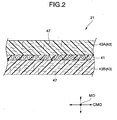
- Fig. 2 is a vertical cross-sectional view of a paper transfer felt
- Fig. 3 is a vertical cross-sectional view of the smoothing belt.
- the closed-draw-type papermaking machine includes a press part 11 and a drier part 13 which are arranged in line in the order named along the direction in which a wet paper web W is transferred.
- the press part 11 has a smoothing press apparatus 100 disposed therein.
- the smoothing press apparatus 100 comprises a smoothing press 17 which is disposed as a press in a final stage in the press part 11 downstream of final water-squeezing press rolls 15A, 15B of the press part 11.
- the water-squeezing press rolls 15A, 15B are disposed in facing relation to each other across a transfer path for the wet paper web W.
- a transfer felt 19 and a paper transfer felt 21 hold the wet paper web W between the transfer felt 19 and a paper transfer felt 21 and transfer the wet paper web W.
- the water-squeezing press rolls 15A, 15B hold and press the transfer felt 19 and the paper transfer felt 21, together with the wet paper web W, thereby squeezing water out of the wet paper web W.
- the smoothing press 17 serves to smooth the surfaces of the wet paper web W, from which water has been squeezed, and to transfer the wet paper web W to the drier part 13.
- the smoothing press 17 comprises a first press roll 23 and a second press roll 25 which are disposed in facing relation to each other across the transfer path for the wet paper web W. Both the first press roll 23 and the second press roll 25 have a high surface hardness and smooth surfaces.
- the paper transfer felt 21 transfers the wet paper web W and delivers the wet paper web W to a smoothing belt 27.
- the smoothing belt 27 runs while holding one surface of the wet paper web W.
- the first press roll 23 and the second press roll 25 hold and press the smoothing belt 27 and the wet paper web W between the roll 23 and the roll 25 for thereby smoothing the surfaces (both surfaces) of the wet paper web W.
- a pair of transfer rolls 29A, 29B is disposed between the water-squeezing press rolls 15A, 15B and the smoothing press 17.
- the transfer rolls 29A, 29B generate a nip pressure by pressing the wet paper web W, which is transferred by the paper transfer felt 21, while the wet paper web W is being held between the paper transfer felt 21 and the smoothing belt 27.
- the transfer rolls 29A, 29B deliver the wet paper web W to the smoothing belt 27.
- the paper transfer felt 21 includes batt layers 43, consisting of staple fibers 47, which are intertwiningly integrated with both surfaces of a base body 41 by needle punching.
- the paper transfer felt 21 is made of a permeable felt including a first batt layer 43A disposed on a wet paper web side surface and a second batt layer 43B disposed on a roll side surface.
- the smoothing belt 27 used in the smoothing press apparatus 100 according to the present embodiment will be described in detail below.
- the smoothing belt 27 includes batt layers 43, which consist of staple fibers 47, which are intertwiningly integrated with both surfaces of a base body 41 by needle punching.
- the smoothing belt 27 comprises the base body 41, a first batt layer 43A disposed on a wet paper web side surface of the base body 41, and a second batt layer 43B disposed on a roll side surface of the base body 41.
- a porous thin film layer 45 is disposed on a wet paper web side surface of the first batt layer 43A for direct contact with the wet paper web W.
- the base body 41 is made of a woven fabric of yarns in an MD (Machine Direction) direction (in other words, a direction in which the wet paper web W runs (flows)) and yarns in a CMD (Cross Machine Direction) direction (in other words, a widthwise direction).
- MD Machine Direction
- CMD Cross Machine Direction
- the base body 41 may comprise both yarns superimposed, rather than woven, or a film or a knitted material, or a spirally wound narrow ribbon. If the base body 41 comprises the film or the knitted material, then the base body 41 is made of polyamide, polyester, aromatic polyamide, aromatic polyimide, high-polymer polyethylene, or the like.
- the present invention employs a suitable method of forming the porous thin film layer 45.
- a polyurethane resin and a plurality of types of surfactants, having different hydrophilic degrees (HLB: Hydrophile Lyophile Balance), and a powder of inorganic compound are mixed with a solvent, so that a mixture is formed.
- the first batt layer 43A is impregnated from the wet paper web side surface thereof with the mixture to form an impregnated layer, which is then held in contact with water to form a foamed resin layer.
- the first batt layer 43A is impregnated from the wet paper web side surface thereof with the mixture to form an impregnated layer, so that the mixture seeps in the first batt layer 43A.
- the mixture is also put on the first batt layer 43A, and the first batt layer 43A is then held in contact with water to extract the solvent and the powder of inorganic compound to convert the impregnated layer into a porous foamed resin layer.
- the above method is generally called a wet-type film forming method.
- the foamed resin layer can be formed in and on the first batt layer 43A according to this method.
- the resin of the foamed resin layer which serves as the porous thin film layer 45 according to the present invention, comprises a resin for forming foam, such as a polyurethane resin, a polyvinyl chloride resin, a polyvinyl alcohol resin, an acrylic resin, or the like.
- a resin for forming foam such as a polyurethane resin, a polyvinyl chloride resin, a polyvinyl alcohol resin, an acrylic resin, or the like.
- Particularly suitable are polyurethanes such as polyester-based polyurethane which is of high mechanical strength, polyether-based polyurethane, polycarbonate-based polyurethane, etc.
- the resin of the foamed resin layer according to the present invention should preferably comprise an aqueous resin or an emulsion resin having a solid content ranging from 20 weight % to 50 weight % and a viscosity ranging from 10,000 cp to 200,000 cp at 25°C.
- the foamed resin layer according to the present invention can have closed pores opened and simultaneously increase the smoothness of the surface of the smoothing belt 27 when the wet paper web side surface of the formed resin layer is polished.
- the surfactants for forming the mixture comprise a plurality of types of surfactants selected from anionic surfactants including carboxylate, sulfuric ester salt, sulfonate, phosphoric ester salt, etc., and polyethylene glycol-based and multiple alcohol-based nonionic surfactants.
- the plurality of types of surfactants have different HLB values where the hydrophilic degrees by way of HLBs (Hydrophile Lyophile Balances) are different by at least 1 or greater.
- Hydrophilic surfactants with high HLB values have a property to promote the formation of a film according to the wet-type film forming method.
- lyophilic (hydrophobic) surfactants with low HLB values have a property to suppress the formation of a film according to the wet-type film forming method.
- pore diameters in a certain range can be obtained by using together hydrophilic surfactants with high HLB values and lyophilic surfactants with low HLB values.
- the diameters of the pores of the foamed resin layer can be held to a range from 20 ⁇ m to 100 ⁇ m by using a plurality of types of surfactants.
- the amount of the surfactant used according to the present invention should preferably be in a range from 1 weight % to 5 weight % with respect to the amount of the resin of the foamed resin layer. The reasons are that if the amount of the surfactant is 1 weight % smaller than the amount of the resin of the foamed resin layer, then its ability to form the foamed resin layer will become lowered, and if the amount of the surfactant is 5 weight % greater than the amount of the resin of the foamed resin layer, then the mixture will be foamed excessively and will poorly impregnate the wet paper web side surface of first batt layer 43A.
- the powder of inorganic compound used according to the present invention should preferably be a mixture of one or a plurality of materials selected from sodium bicarbonate, sodium carbonate, sodium chloride and sodium nitrate.
- the mixture is easily dissolvable in water, hardly dissolvable in a solvent, and forms good pores according to the wet-type film forming method.
- sodium bicarbonate is preferable as the powder of inorganic compound.
- the first batt layer 43A is impregnated from the wet paper web side surface thereof with the mixture, and an impregnated layer and a stacked layer thereon are formed. Thereafter, the impregnated layer and the stacked layer thereon are brought into contact with water to extract the solvent and the powder of inorganic compound, thereby opening the pores.
- the region including the impregnated layer and the stacked layer thereon is held in good contact with water, the minute and continuous pores are produced.
- the impregnated layer in the first batt layer 43A is late in contacting water, part of the powder of inorganic compound may remain left therein. However, any powder of inorganic compound which may remain left will not impair the function of the smoothing belt 27.
- the solvent used according to the present invention should preferably be of a material capable of uniformly dispersing the foamed resin layer, the plurality of surfactants of different HLBs, and the powder of inorganic compound, and the solvent should preferably be of the material capable of keeping the mixture dispersed stably.
- the solvent should preferably comprise dimethylformamide (DMF) which keeps the mixture dispersed stably and which is of excellent extractability by water (i.e., miscibility with water, dissolvability into water) and which is easy to handle.
- DMF dimethylformamide
- the smoothing belt 27 will have high air permeability and a low hardness, so that lowering the smoothness of the wet paper web side surface of the smoothing belt 27. As a result, it will be difficult to receive the wet paper web W from the paper transfer felt, and the wet paper web W will not have a good surface smoothness.
- the applied amount of foamed resin layer is greater than 150 g/m 2 , then the shock absorbing capability (cushioning capability) of the first batt layer 43A of the smoothing belt 27 will be lowered, so that failing to produce a bulky wet paper web surface in high-speed papermaking processes.
- the foamed resin layer according to the present invention is applied in an amount ranging from 50 g/m 2 to 150 g/m 2 .
- the smoothing belt 27 has an air permeability ranging from 1 cm 3 /cm 2 /sec. to 5 cm 3 /cm 2 /sec.
- a sequence for forming the foamed resin layer according to the first embodiment of the present invention will be described by way of example below. However, the present invention is not limited to the sequence described below.
- the foamed resin layer which is a porous thin film layer For forming the foamed resin layer which is a porous thin film layer according to the present invention, 100 parts of an aqueous polyurethane resin (having an active ingredient concentration of 30 %), 120 parts of DMF as a solvent, 1 part of EMULGEN 105 (manufactured by KAO Corporation: HLB 9.7) and 1 part of EMULGEN 106 (manufactured by KAO Corporation: HLB 10.5) as nonionic surfactants (polyoxyethylene lauryl ether) are mixed together in the order named, and are stirred with 80 parts of a powder of sodium bicarbonate being added thereto, so that a mixture is produced.
- an aqueous polyurethane resin having an active ingredient concentration of 30 %)
- 120 parts of DMF as a solvent
- 1 part of EMULGEN 105 manufactured by KAO Corporation: HLB 9.7
- EMULGEN 106 manufactured by KAO Corporation: HLB 10.5
- the mixture is applied to impregnate the first batt layer 43A from its surface and to enter in the first batt layer 43A. Furthermore, the mixture is also stacked on the first batt layer 43A.
- the assembly is passed through a coagulating tank filled with water, so that the impregnated layer is converted into a foamed resin layer.
- the size of the coagulating tank and the time during which the assembly is kept in contact with water may be appropriately determined depending on the thickness of the impregnated layer.
- the wet paper web surface of the foamed resin layer is polished with a polishing paper, a grid brush, or the like. The denseness and smoothness of the wet paper web surface of the foamed resin layer are thus adjusted.
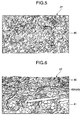
- Fig. 5 shows the surface of the foamed resin layer of the smoothing belt 27 according to the first embodiment.
- Fig. 6 shows a cross section of the smoothing belt 27 including the foamed resin layer according to the first embodiment.
- the foamed resin layer has a pore diameter ranging from 50 ⁇ m to 100 ⁇ m, and is applied in an amount of 100 g/m 2 , and has a thickness of 500 ⁇ m, and has an air permeability of 2.3 cm 3 /cm 2 /sec.
- a smoothing press apparatus 200 and smoothing belts 127, 127A according to a second embodiment of the present invention will be described below with reference to Figs. 3 , 4 , 7 through 11 .
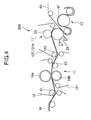
- Fig. 4 is a schematic view of a closed-draw-type papermaking machine which incorporates a smoothing press apparatus 200 according to the second embodiment.
- Fig. 7 is a view showing a surface of an open-pore resin layer (porous thin film layer 45) according to the second embodiment
- Fig. 8 is an enlarged view of an open pore 48
- Fig. 9 is an enlarged cross-sectional view of a smoothing belt 127 including the open-pore resin layer according to the second embodiment.
- Fig. 10 is a vertical cross-sectional view of a smoothing belt 127A according to a modification of the second embodiment
- Fig. 11 is a plan view of the smoothing belt 127A shown in Fig. 10 .
- the smoothing press apparatus 200 according to the second embodiment is of a structure similar to the smoothing press apparatus 100 according to the first embodiment.
- a suction roll 123 is used in place of the pair of transfer rolls 29A, 29B.
- a paper transfer felt 121 may be the same as the paper transfer felt 21 according to the first embodiment.
- the smoothing belts 127, 127A are different in structure from the smoothing belt 27 according to the first embodiment. Other details are identical to those of the smoothing press apparatus 100 according to the first embodiment. Identical parts are denoted by identical or corresponding reference characters, and their description will be simplified or omitted.
- the smoothing belts 127, 127A include batt layers 43, consisting of staple fibers 47, which are intertwiningly integrated with both surfaces of a base body 41 by needle punching.
- the smoothing belts 127, 127A include a first batt layer 43A disposed on a wet paper web side surface and a second batt layer 43B disposed on a roll side surface.
- a porous thin film layer 45 is disposed on a wet paper web side surface of the first batt layer 43A for direct contact with the wet paper web W.
- the porous thin film layer 45 comprises an open-pore resin layer.
- the wet paper web W is attracted by a suction roll 61 and has one surface held by the transfer felt 19.
- the wet paper web W is attracted by a suction roll 63 and is transferred by the paper transfer felt 121.
- the wet paper web W is then attracted by the suction roll 123 and is transferred from the paper transfer felt 121 to the smoothing belt 127 (or the smoothing belt 127A).
- the paper transfer felt 121 comprises a permeable felt which is of the same structure as the paper transfer felt 21 according to the first embodiment, and has a relatively rough surface.
- An open-pore resin layer which comprises the porous thin film layer 45 is disposed on a wet paper web side surface of the smoothing belt 127 (or the smoothing belt 127A). Therefore, the surface of the smoothing belt 127 (or the smoothing belt 127A) is extremely smooth.
- the wet paper web W has such a characteristic that it sticks to a smoother surface when it is nipped.
- the attraction by the suction roll 123 acts on the wet paper web W through the open-pore resin layer of the smoothing belt 127 (or the smoothing belt 127A). Accordingly, the wet paper web W is reliably transferred by the smoothing belt 127 (or the smoothing belt 127A).
- the wet paper web W is supplied to the smoothing press 17 while one surface thereof is being held by the smoothing belt 127 (or the smoothing belt 127A). Since the wet paper web W is pressed, together with the smoothing belt 127 (or the smoothing belt 127A), by the first press roll 23 and the second press roll 25, both surfaces of the wet paper web W are smoothed.
- one of the surfaces of the wet paper web W is held in contact with the surface of the open-pore resin layer (porous resin layer 45) of the smoothing belt 127 (or the smoothing belt 127A) which has an extremely smooth surface.
- the other surface of the wet paper web W is held in contact with the second press roll 25 and is smoothed by the second press roll 25 having the surface, which is of a high surface hardness and which is smooth. Therefore, the wet paper web W obtains an extremely small surface roughness.
- the wet paper web W is further transferred by a canvas 65 to the drier part 13 in which the wet paper web W is dried by a drier 67.
- the open-pore resin layer (porous resin layer 45) of the smoothing belts 127, 127A according to the second embodiment has its pores opened from the surface of a resin seat by a pore opening means such as a laser (e.g., a carbon-dioxide gas laser) or an ultrahigh-pressure water jet applied to the resin sheet.
- the ultrahigh-pressure water jet comprises a water jet ejected from a nozzle having a diameter of 0.2 mm under a pressure ranging from 9.8 ⁇ 10 7 Pa to 2.9 ⁇ 10 8 Pa (1,000 to 3,000 kgf/cm 2 ), for example.
- the open pores may be arranged at random (or in a grid pattern or a staggered pattern at a pitch ranging from 0.5 mm to 5 mm) in the resin sheet.
- the porosity of the open-pore resin layer of the smoothing belts 127, 127A is appropriately adjusted by the diameter of the pores and the pitch of the pores.
- the porosity of the open-pore resin layer according to the present invention refers to the ratio of the area of the pores to the wet paper web side surface on which the open-pore resin layer is held in direct contact with the wet paper web W.
- the porous resin layer 45 of the smoothing belt 127 shown in Figs. 8 and 9 has funnel-shaped open pores 48 which are progressively spread toward the wet paper web side surface. With these open pores 48, the porous resin layer 45 should preferably comprise an open-pore resin layer having a porosity ranging from 3 % to 30 % on the wet paper web side surface.
- the porous resin layer 45 of the smoothing belt 127A shown in Figs. 10 and 11 has inverted-funnel-shaped open pores 48 which are progressively spread inwardly from the wet paper web side surface. With these open pores 48, the porous resin layer 45 should preferably comprise an open-pore resin layer having a porosity ranging from 1 % to 10 % on the wet paper web side surface.
- the porosity of the open-pore resin layer is lower than the above range (the range from 3 % to 30 % if the open pores 48 are funnel-shaped, and the range from 1 % to 10 % if the open pores 48 are inverted-funnel-shaped), then the wet paper web W is transferred from the paper transfer felt 121 in poor conditions.
- the porosity of the open-pore resin layer is greater than the above range (the range from 3 % to 30 % if the open pores 48 are funnel-shaped, and the range from 1 % to 10 % if the pores 48 are inverted-funnel-shaped), then the open pores 48 will leave marks on the surface of the wet paper web W and will have its smoothness impaired.
- the open-pore resin layer can reliably receive the wet paper web W from the paper transfer felt. If the open-pore resin layer has funnel-shaped open pores 48 which are progressively spread toward the wet paper web side surface, then the open pores 48 may leave marks on the surface of the wet paper web W.
- the open-pore resin layer has a prominent capability for attracting the wet paper web W through the suction roll 123, the open-pore resin layer is advantageous in that it can reliably receive the wet paper web W from the paper transfer felt 121.
- the open pores 48 are funnel-shaped such that they are progressively spread toward the wet paper web side surface.
- the diameter of the open pores in the open-pore resin layer is 500 ⁇ m in the upper portion of the funnel-shaped open pores and 200 ⁇ m in the lower portion of the funnel-shaped open pores.
- the open pores in the open-pore resin layer of the smoothing belt 127 shown in Fig. 7 are arranged in a grid pattern in which the open pores 48 are disposed at a pitch of 2 mm.
- the open-pore resin layer has an air permeability of 10 cm 3 /cm 2 /sec. and a porosity of 3 %.
- the open-pore resin layer has inverted-funnel-shaped open pores 48 and has a smooth surface
- the open pores 48 will not leave marks on the surface of the wet paper web. Therefore, the wet paper web W which is produced is bulky and has a good surface smoothness.
- the open-pore resin layer is capable of attracting the wet paper web W through the suction roll 123, the open-pore resin layer can reliably receive the wet paper web W from the paper transfer felt 121, and makes the wet paper web W highly durable in high-speed papermaking processes.
- the resin sheet may comprise a resin sheet made of polyurethane, polyamide, polyester, aromatic polyamide, aromatic polyimide, high-polymer polyethylene, or the like.
- the resin sheet has a thickness in the range from 0.1 mm to 5 mm.
- the smoothing belts 127, 127A according to the second embodiment include batt layers 43 which are intertwiningly integrated with a wet paper web side surface and a roll side surface of a base body 41 by needle punching. Thereafter, the resin sheet is laminated.
- the resin sheet is thermally activated and joined to the surface of the first batt layer 43A which is integrally combined with the wet paper web side surface of the base body 41. Thereafter, pores may be opened in the resin sheet by a pore opening means.
- a resin sheet with open pores, which are opened therein, may be joined (laminated) to the surface of the first batt layer 43A.
- an open-pore resin layer porous thin film layer 45
- funnel-shaped open pores 48 which are progressively spread toward the wet paper web side surface.
- the smoothing belt 127A shown in Fig. 10 includes an open-pore resin layer (porous thin film layer 45) having inverted-funnel-shaped open pores 48 which are progressively spread inwardly from the wet paper web side surface.
- a resin sheet with open pores opened therein may be turned upside down, and be then joined to the surface of the first batt layer 43A.
- a sequence for forming the open-pore resin layer on the smoothing belts 127, 127A according to the second embodiment of the present invention will be described by way of example below. However, the present invention is not limited to the sequence described below.
- a polyurethane resin sheet (a sheet of thermoplastic polyurethane having a thickness of 0.3 mm) is thermally activated by being irradiated with infrared rays.
- the resin sheet is placed on the surface of the first batt layer 43A, and the assembly is passed between a pair of rolls. The resin sheet is thus joined (laminated) to the first batt layer 43A.
- a carbon-dioxide laser beam is applied to the surface of the resin sheet, so that the open pores 48 are formed therein.
- the open pores 48 are funnel shaped which are progressively spread toward the sheet surface ( Figs. 8 and 9 ).
- an adhesive may be used.
- thermal activation and an adhesive may be used in combination.
- the open pores 48 may be inverted-funnel-shaped ( Fig. 10 ) which are progressively spread inwardly from the wet paper web side surface.
- a carbon-dioxide laser beam is applied to the surface of a sheet of polyurethane resin to form open pores therein.
- the open pores 48 are funnel-shaped which are progressively spread toward the surface of the sheet.
- the resin sheet is turned upside down, and is thermally activated by being irradiated with infrared rays. As shown in Fig. 3 , the resin sheet is placed on the surface of the first batt layer 43A, and the assembly is passed between a pair of rolls. The resin sheet is thus joined (laminated) to the first batt layer 43A.
- a suction effect provided by the suction roll 123 acts through the smoothing belt 127 (or the smoothing belt 127A) on the wet paper web W as compared with the smoothing belt 27 having the foamed resin layer according to the first embodiment.
- the wet paper web W can reliably be transferred from the paper transfer felt to the smoothing belt 127 (or the smoothing belt 127A).
- the smoothing belt 127 (or the smoothing belt 127A) can thus appropriately be used in high-speed papermaking processes.
- the present invention is not limited to the embodiments described above, but may be modified or improved.
- Materials, shapes, dimensions, numerical values, forms, numbers, positions, etc. of the components in the embodiments described above are optional insofar as they can achieve the present invention, and are not limitative in nature.
- the smoothing press apparatus according to the present invention is applicable to closed-draw-type papermaking machines which are capable of performing papermaking processes at high speeds.
Landscapes
- Paper (AREA)
Applications Claiming Priority (2)
| Application Number | Priority Date | Filing Date | Title |
|---|---|---|---|
| JP2007114817A JP5199601B2 (ja) | 2007-03-29 | 2007-03-29 | スムージングベルト |
| PCT/JP2008/055864 WO2008126688A1 (ja) | 2007-03-29 | 2008-03-27 | スムージングプレス装置およびスムージングベルト |
Publications (3)
| Publication Number | Publication Date |
|---|---|
| EP2135992A1 true EP2135992A1 (de) | 2009-12-23 |
| EP2135992A4 EP2135992A4 (de) | 2011-03-16 |
| EP2135992B1 EP2135992B1 (de) | 2018-01-24 |
Family
ID=39863795
Family Applications (1)
| Application Number | Title | Priority Date | Filing Date |
|---|---|---|---|
| EP08722903.5A Not-in-force EP2135992B1 (de) | 2007-03-29 | 2008-03-27 | Glättendes band |
Country Status (4)
| Country | Link |
|---|---|
| EP (1) | EP2135992B1 (de) |
| JP (1) | JP5199601B2 (de) |
| CN (1) | CN101668895B (de) |
| WO (1) | WO2008126688A1 (de) |
Families Citing this family (2)
| Publication number | Priority date | Publication date | Assignee | Title |
|---|---|---|---|---|
| US11098450B2 (en) * | 2017-10-27 | 2021-08-24 | Albany International Corp. | Methods for making improved cellulosic products using novel press felts and products made therefrom |
| JP7627159B2 (ja) | 2021-03-26 | 2025-02-05 | 日本フエルト株式会社 | 製紙用フェルト |
Family Cites Families (11)
| Publication number | Priority date | Publication date | Assignee | Title |
|---|---|---|---|---|
| US4657806A (en) * | 1985-03-25 | 1987-04-14 | Albany International Corp. | Wet press papermakers felt |
| JPS61252389A (ja) * | 1985-04-25 | 1986-11-10 | 市川毛織株式会社 | 抄紙用加圧ベルト |
| US4851281A (en) * | 1987-04-14 | 1989-07-25 | Huyck Corporation | Papermakers' felt having compressible elastomer elements and methods of producing same |
| TW538175B (en) * | 1999-07-08 | 2003-06-21 | Heimbach Gmbh Thomas Josef | Transfer belt for a paper making machine |
| FI20020804A0 (fi) * | 2002-04-26 | 2002-04-26 | Tamfelt Oyj Abp | Järjestely paperikoneen puristinosalla |
| JP4133433B2 (ja) * | 2003-02-26 | 2008-08-13 | イチカワ株式会社 | 抄紙用プレスフェルト |
| CN101694076A (zh) * | 2003-05-13 | 2010-04-14 | 王子制纸株式会社 | 造纸机的压榨装置和造纸方法 |
| US7156956B2 (en) * | 2003-08-11 | 2007-01-02 | Albany International Corp. | Paper industry process belt with a surface structure composed of a porous membrane |
| JP2006176904A (ja) * | 2004-12-21 | 2006-07-06 | Ichikawa Co Ltd | 抄紙搬送フェルトおよび該抄紙搬送フェルトを備えた抄紙機のプレス装置 |
| JP2006214058A (ja) * | 2005-02-07 | 2006-08-17 | Ichikawa Co Ltd | 抄紙搬送フェルトおよび該抄紙搬送フェルトを備えた抄紙機のプレス装置 |
| JP2007009389A (ja) * | 2005-05-31 | 2007-01-18 | Ichikawa Co Ltd | スムージングプレス装置 |
-
2007
- 2007-03-29 JP JP2007114817A patent/JP5199601B2/ja not_active Expired - Fee Related
-
2008
- 2008-03-27 EP EP08722903.5A patent/EP2135992B1/de not_active Not-in-force
- 2008-03-27 CN CN2008800099113A patent/CN101668895B/zh not_active Expired - Fee Related
- 2008-03-27 WO PCT/JP2008/055864 patent/WO2008126688A1/ja not_active Ceased
Also Published As
| Publication number | Publication date |
|---|---|
| WO2008126688A1 (ja) | 2008-10-23 |
| JP2008248461A (ja) | 2008-10-16 |
| EP2135992A4 (de) | 2011-03-16 |
| JP5199601B2 (ja) | 2013-05-15 |
| CN101668895B (zh) | 2012-09-26 |
| EP2135992B1 (de) | 2018-01-24 |
| CN101668895A (zh) | 2010-03-10 |
Similar Documents
| Publication | Publication Date | Title |
|---|---|---|
| US6616814B2 (en) | Shoe press belt for paper machines | |
| US6712940B2 (en) | Papermachine belt | |
| US5071697A (en) | Structure for extracting water from a paper web in a papermaking process | |
| US7481907B2 (en) | Paper transporting felt, and press apparatus of paper machine having paper transporting felt | |
| US6605188B2 (en) | Transfer belt for a paper machine | |
| JP4041056B2 (ja) | 湿紙搬送用ベルト | |
| JP2000273786A (ja) | 抄紙用プレスフェルト | |
| EP2213789A1 (de) | Filz zur papierherstellung | |
| US20090199988A1 (en) | Press fabric for a machine for the production of web material | |
| EP2135992A1 (de) | Glättende pressvorrichtung sowie glättendes band | |
| EP2042652B1 (de) | Papiermaschinenbespannstoff | |
| JP2006214058A (ja) | 抄紙搬送フェルトおよび該抄紙搬送フェルトを備えた抄紙機のプレス装置 | |
| JP2008248461A5 (de) | ||
| JP2010185148A (ja) | 製紙用プレスフェルト及びその製造方法 | |
| JP4133433B2 (ja) | 抄紙用プレスフェルト | |
| JP4522212B2 (ja) | 抄紙搬送フェルトおよび該抄紙搬送フェルトを備えた抄紙機のプレス装置 | |
| JP4712508B2 (ja) | シュープレス用の抄紙搬送フェルトおよび該抄紙搬送フェルトを備えたシュープレス型抄紙機のプレス装置 | |
| EP1662043A2 (de) | Papiertransportfiltz | |
| JP2006052477A (ja) | シュープレス用の抄紙搬送フェルトおよび該抄紙搬送フェルトを備えたシュープレス型抄紙機のプレス装置 | |
| JP2003003379A (ja) | シート構造体とその製造方法 | |
| JP2007046196A (ja) | 抄紙用プレスフェルト | |
| JP2024004315A (ja) | 吸液ロール用シート及び吸液ロール | |
| JP2016124170A (ja) | 繊維積層体及び繊維積層体の製造方法 | |
| JP2005105439A (ja) | 繊維ウエブの製造方法、およびこの繊維ウエブを用いた不織布の製造方法 | |
| WO2000052263A1 (en) | Transfer fabric |
Legal Events
| Date | Code | Title | Description |
|---|---|---|---|
| PUAI | Public reference made under article 153(3) epc to a published international application that has entered the european phase |
Free format text: ORIGINAL CODE: 0009012 |
|
| 17P | Request for examination filed |
Effective date: 20090925 |
|
| AK | Designated contracting states |
Kind code of ref document: A1 Designated state(s): AT BE BG CH CY CZ DE DK EE ES FI FR GB GR HR HU IE IS IT LI LT LU LV MC MT NL NO PL PT RO SE SI SK TR |
|
| DAX | Request for extension of the european patent (deleted) | ||
| A4 | Supplementary search report drawn up and despatched |
Effective date: 20110214 |
|
| 17Q | First examination report despatched |
Effective date: 20170308 |
|
| GRAP | Despatch of communication of intention to grant a patent |
Free format text: ORIGINAL CODE: EPIDOSNIGR1 |
|
| INTG | Intention to grant announced |
Effective date: 20170816 |
|
| GRAS | Grant fee paid |
Free format text: ORIGINAL CODE: EPIDOSNIGR3 |
|
| GRAA | (expected) grant |
Free format text: ORIGINAL CODE: 0009210 |
|
| AK | Designated contracting states |
Kind code of ref document: B1 Designated state(s): AT BE BG CH CY CZ DE DK EE ES FI FR GB GR HR HU IE IS IT LI LT LU LV MC MT NL NO PL PT RO SE SI SK TR |
|
| REG | Reference to a national code |
Ref country code: GB Ref legal event code: FG4D |
|
| REG | Reference to a national code |
Ref country code: CH Ref legal event code: EP |
|
| REG | Reference to a national code |
Ref country code: AT Ref legal event code: REF Ref document number: 965866 Country of ref document: AT Kind code of ref document: T Effective date: 20180215 |
|
| REG | Reference to a national code |
Ref country code: IE Ref legal event code: FG4D |
|
| REG | Reference to a national code |
Ref country code: DE Ref legal event code: R096 Ref document number: 602008053851 Country of ref document: DE |
|
| REG | Reference to a national code |
Ref country code: NL Ref legal event code: MP Effective date: 20180124 |
|
| REG | Reference to a national code |
Ref country code: LT Ref legal event code: MG4D |
|
| REG | Reference to a national code |
Ref country code: AT Ref legal event code: MK05 Ref document number: 965866 Country of ref document: AT Kind code of ref document: T Effective date: 20180124 |
|
| PG25 | Lapsed in a contracting state [announced via postgrant information from national office to epo] |
Ref country code: NL Free format text: LAPSE BECAUSE OF FAILURE TO SUBMIT A TRANSLATION OF THE DESCRIPTION OR TO PAY THE FEE WITHIN THE PRESCRIBED TIME-LIMIT Effective date: 20180124 |
|
| PG25 | Lapsed in a contracting state [announced via postgrant information from national office to epo] |
Ref country code: LT Free format text: LAPSE BECAUSE OF FAILURE TO SUBMIT A TRANSLATION OF THE DESCRIPTION OR TO PAY THE FEE WITHIN THE PRESCRIBED TIME-LIMIT Effective date: 20180124 Ref country code: NO Free format text: LAPSE BECAUSE OF FAILURE TO SUBMIT A TRANSLATION OF THE DESCRIPTION OR TO PAY THE FEE WITHIN THE PRESCRIBED TIME-LIMIT Effective date: 20180424 Ref country code: ES Free format text: LAPSE BECAUSE OF FAILURE TO SUBMIT A TRANSLATION OF THE DESCRIPTION OR TO PAY THE FEE WITHIN THE PRESCRIBED TIME-LIMIT Effective date: 20180124 Ref country code: HR Free format text: LAPSE BECAUSE OF FAILURE TO SUBMIT A TRANSLATION OF THE DESCRIPTION OR TO PAY THE FEE WITHIN THE PRESCRIBED TIME-LIMIT Effective date: 20180124 Ref country code: CY Free format text: LAPSE BECAUSE OF FAILURE TO SUBMIT A TRANSLATION OF THE DESCRIPTION OR TO PAY THE FEE WITHIN THE PRESCRIBED TIME-LIMIT Effective date: 20180124 |
|
| PG25 | Lapsed in a contracting state [announced via postgrant information from national office to epo] |
Ref country code: LV Free format text: LAPSE BECAUSE OF FAILURE TO SUBMIT A TRANSLATION OF THE DESCRIPTION OR TO PAY THE FEE WITHIN THE PRESCRIBED TIME-LIMIT Effective date: 20180124 Ref country code: SE Free format text: LAPSE BECAUSE OF FAILURE TO SUBMIT A TRANSLATION OF THE DESCRIPTION OR TO PAY THE FEE WITHIN THE PRESCRIBED TIME-LIMIT Effective date: 20180124 Ref country code: PL Free format text: LAPSE BECAUSE OF FAILURE TO SUBMIT A TRANSLATION OF THE DESCRIPTION OR TO PAY THE FEE WITHIN THE PRESCRIBED TIME-LIMIT Effective date: 20180124 Ref country code: GR Free format text: LAPSE BECAUSE OF FAILURE TO SUBMIT A TRANSLATION OF THE DESCRIPTION OR TO PAY THE FEE WITHIN THE PRESCRIBED TIME-LIMIT Effective date: 20180425 Ref country code: BG Free format text: LAPSE BECAUSE OF FAILURE TO SUBMIT A TRANSLATION OF THE DESCRIPTION OR TO PAY THE FEE WITHIN THE PRESCRIBED TIME-LIMIT Effective date: 20180424 Ref country code: IS Free format text: LAPSE BECAUSE OF FAILURE TO SUBMIT A TRANSLATION OF THE DESCRIPTION OR TO PAY THE FEE WITHIN THE PRESCRIBED TIME-LIMIT Effective date: 20180524 Ref country code: AT Free format text: LAPSE BECAUSE OF FAILURE TO SUBMIT A TRANSLATION OF THE DESCRIPTION OR TO PAY THE FEE WITHIN THE PRESCRIBED TIME-LIMIT Effective date: 20180124 |
|
| REG | Reference to a national code |
Ref country code: DE Ref legal event code: R097 Ref document number: 602008053851 Country of ref document: DE |
|
| PG25 | Lapsed in a contracting state [announced via postgrant information from national office to epo] |
Ref country code: IT Free format text: LAPSE BECAUSE OF FAILURE TO SUBMIT A TRANSLATION OF THE DESCRIPTION OR TO PAY THE FEE WITHIN THE PRESCRIBED TIME-LIMIT Effective date: 20180124 Ref country code: EE Free format text: LAPSE BECAUSE OF FAILURE TO SUBMIT A TRANSLATION OF THE DESCRIPTION OR TO PAY THE FEE WITHIN THE PRESCRIBED TIME-LIMIT Effective date: 20180124 Ref country code: RO Free format text: LAPSE BECAUSE OF FAILURE TO SUBMIT A TRANSLATION OF THE DESCRIPTION OR TO PAY THE FEE WITHIN THE PRESCRIBED TIME-LIMIT Effective date: 20180124 |
|
| REG | Reference to a national code |
Ref country code: CH Ref legal event code: PL |
|
| PG25 | Lapsed in a contracting state [announced via postgrant information from national office to epo] |
Ref country code: SK Free format text: LAPSE BECAUSE OF FAILURE TO SUBMIT A TRANSLATION OF THE DESCRIPTION OR TO PAY THE FEE WITHIN THE PRESCRIBED TIME-LIMIT Effective date: 20180124 Ref country code: CZ Free format text: LAPSE BECAUSE OF FAILURE TO SUBMIT A TRANSLATION OF THE DESCRIPTION OR TO PAY THE FEE WITHIN THE PRESCRIBED TIME-LIMIT Effective date: 20180124 Ref country code: MC Free format text: LAPSE BECAUSE OF FAILURE TO SUBMIT A TRANSLATION OF THE DESCRIPTION OR TO PAY THE FEE WITHIN THE PRESCRIBED TIME-LIMIT Effective date: 20180124 Ref country code: DK Free format text: LAPSE BECAUSE OF FAILURE TO SUBMIT A TRANSLATION OF THE DESCRIPTION OR TO PAY THE FEE WITHIN THE PRESCRIBED TIME-LIMIT Effective date: 20180124 |
|
| PLBE | No opposition filed within time limit |
Free format text: ORIGINAL CODE: 0009261 |
|
| STAA | Information on the status of an ep patent application or granted ep patent |
Free format text: STATUS: NO OPPOSITION FILED WITHIN TIME LIMIT |
|
| REG | Reference to a national code |
Ref country code: BE Ref legal event code: MM Effective date: 20180331 |
|
| GBPC | Gb: european patent ceased through non-payment of renewal fee |
Effective date: 20180424 |
|
| REG | Reference to a national code |
Ref country code: IE Ref legal event code: MM4A |
|
| PG25 | Lapsed in a contracting state [announced via postgrant information from national office to epo] |
Ref country code: LU Free format text: LAPSE BECAUSE OF NON-PAYMENT OF DUE FEES Effective date: 20180327 |
|
| 26N | No opposition filed |
Effective date: 20181025 |
|
| PG25 | Lapsed in a contracting state [announced via postgrant information from national office to epo] |
Ref country code: IE Free format text: LAPSE BECAUSE OF NON-PAYMENT OF DUE FEES Effective date: 20180327 |
|
| PG25 | Lapsed in a contracting state [announced via postgrant information from national office to epo] |
Ref country code: GB Free format text: LAPSE BECAUSE OF NON-PAYMENT OF DUE FEES Effective date: 20180424 Ref country code: SI Free format text: LAPSE BECAUSE OF FAILURE TO SUBMIT A TRANSLATION OF THE DESCRIPTION OR TO PAY THE FEE WITHIN THE PRESCRIBED TIME-LIMIT Effective date: 20180124 Ref country code: LI Free format text: LAPSE BECAUSE OF NON-PAYMENT OF DUE FEES Effective date: 20180331 Ref country code: CH Free format text: LAPSE BECAUSE OF NON-PAYMENT OF DUE FEES Effective date: 20180331 Ref country code: BE Free format text: LAPSE BECAUSE OF NON-PAYMENT OF DUE FEES Effective date: 20180331 |
|
| PG25 | Lapsed in a contracting state [announced via postgrant information from national office to epo] |
Ref country code: FR Free format text: LAPSE BECAUSE OF NON-PAYMENT OF DUE FEES Effective date: 20180331 |
|
| PG25 | Lapsed in a contracting state [announced via postgrant information from national office to epo] |
Ref country code: MT Free format text: LAPSE BECAUSE OF NON-PAYMENT OF DUE FEES Effective date: 20180327 |
|
| PG25 | Lapsed in a contracting state [announced via postgrant information from national office to epo] |
Ref country code: TR Free format text: LAPSE BECAUSE OF FAILURE TO SUBMIT A TRANSLATION OF THE DESCRIPTION OR TO PAY THE FEE WITHIN THE PRESCRIBED TIME-LIMIT Effective date: 20180124 |
|
| PG25 | Lapsed in a contracting state [announced via postgrant information from national office to epo] |
Ref country code: PT Free format text: LAPSE BECAUSE OF FAILURE TO SUBMIT A TRANSLATION OF THE DESCRIPTION OR TO PAY THE FEE WITHIN THE PRESCRIBED TIME-LIMIT Effective date: 20180124 Ref country code: HU Free format text: LAPSE BECAUSE OF FAILURE TO SUBMIT A TRANSLATION OF THE DESCRIPTION OR TO PAY THE FEE WITHIN THE PRESCRIBED TIME-LIMIT; INVALID AB INITIO Effective date: 20080327 |
|
| P01 | Opt-out of the competence of the unified patent court (upc) registered |
Effective date: 20230522 |
|
| PGFP | Annual fee paid to national office [announced via postgrant information from national office to epo] |
Ref country code: FI Payment date: 20240320 Year of fee payment: 17 Ref country code: DE Payment date: 20240320 Year of fee payment: 17 |
|
| REG | Reference to a national code |
Ref country code: DE Ref legal event code: R119 Ref document number: 602008053851 Country of ref document: DE |
|
| PG25 | Lapsed in a contracting state [announced via postgrant information from national office to epo] |
Ref country code: FI Free format text: LAPSE BECAUSE OF NON-PAYMENT OF DUE FEES Effective date: 20250327 |
|
| PG25 | Lapsed in a contracting state [announced via postgrant information from national office to epo] |
Ref country code: DE Free format text: LAPSE BECAUSE OF NON-PAYMENT OF DUE FEES Effective date: 20251001 |