EP2139228A1 - Procédé de régulation de troncature, dispositif de correction par troncature, capteur d'image et dispositif électronique - Google Patents
Procédé de régulation de troncature, dispositif de correction par troncature, capteur d'image et dispositif électronique Download PDFInfo
- Publication number
- EP2139228A1 EP2139228A1 EP09710707A EP09710707A EP2139228A1 EP 2139228 A1 EP2139228 A1 EP 2139228A1 EP 09710707 A EP09710707 A EP 09710707A EP 09710707 A EP09710707 A EP 09710707A EP 2139228 A1 EP2139228 A1 EP 2139228A1
- Authority
- EP
- European Patent Office
- Prior art keywords
- opb
- region
- clamp
- value
- effective pixel
- Prior art date
- Legal status (The legal status is an assumption and is not a legal conclusion. Google has not performed a legal analysis and makes no representation as to the accuracy of the status listed.)
- Withdrawn
Links
Images




Classifications
-
- H—ELECTRICITY
- H04—ELECTRIC COMMUNICATION TECHNIQUE
- H04N—PICTORIAL COMMUNICATION, e.g. TELEVISION
- H04N25/00—Circuitry of solid-state image sensors [SSIS]; Control thereof
-
- H—ELECTRICITY
- H04—ELECTRIC COMMUNICATION TECHNIQUE
- H04N—PICTORIAL COMMUNICATION, e.g. TELEVISION
- H04N25/00—Circuitry of solid-state image sensors [SSIS]; Control thereof
- H04N25/70—SSIS architectures; Circuits associated therewith
- H04N25/76—Addressed sensors, e.g. MOS or CMOS sensors
- H04N25/77—Pixel circuitry, e.g. memories, A/D converters, pixel amplifiers, shared circuits or shared components
-
- H—ELECTRICITY
- H04—ELECTRIC COMMUNICATION TECHNIQUE
- H04N—PICTORIAL COMMUNICATION, e.g. TELEVISION
- H04N25/00—Circuitry of solid-state image sensors [SSIS]; Control thereof
- H04N25/60—Noise processing, e.g. detecting, correcting, reducing or removing noise
- H04N25/63—Noise processing, e.g. detecting, correcting, reducing or removing noise applied to dark current
- H04N25/633—Noise processing, e.g. detecting, correcting, reducing or removing noise applied to dark current by using optical black pixels
-
- H—ELECTRICITY
- H04—ELECTRIC COMMUNICATION TECHNIQUE
- H04N—PICTORIAL COMMUNICATION, e.g. TELEVISION
- H04N25/00—Circuitry of solid-state image sensors [SSIS]; Control thereof
- H04N25/70—SSIS architectures; Circuits associated therewith
- H04N25/76—Addressed sensors, e.g. MOS or CMOS sensors
- H04N25/78—Readout circuits for addressed sensors, e.g. output amplifiers or A/D converters
Definitions
- the present invention relates to a clamp control method, a clamp correction device, an image sensor, and an electronic apparatus, and relates to a clamp control method, a clamp correction device, an image sensor, and an electronic apparatus in which a left/right offset can be improved in an image sensor having a relatively large chip size, having a large number of pixels, and stitching exposure being performed thereon.
- CMOS Complementary Metal Oxide Semiconductor
- CMOS image sensors having a large chip size and having a large number of pixels of more than ten million have conventionally existed.
- an area to be exposed at a time is limited in a manufacturing process, and thus stitching exposure is performed in twice for the left and right in an ordinary case.
- stitching exposure is performed in twice for the left and right in an ordinary case.
- Patent Document 1 discloses a technique of performing clamp correction by using the following both signals (1) and (2) in order to eliminate an offset difference that occurs between the left and right of an imaging region of a CCD (Charge Coupled Device) or a CMOS image sensor of a CDS (Correlated Double Sampling) method.
- Signal (1) is a signal of a left/right dummy pixel (a signal independent of a photoelectric converting unit in extra HCCD is adopted).
- Signal (2) is a signal of a left/right OB pixel (optical black pixel: a light-shielded pixel in which a signal dependent on a photoelectric converting unit is adopted).
- signals (1) and (2) are required to be subtracted from pixel signals in an effective pixel region. Also required are two systems of circuits for the left and right to perform CDS, A/D conversion, OB clamp, and the like. Accordingly, a circuit configuration is complicated and a circuit area increases.
- Patent Document 2 discloses a technique of maintaining an OPB (Optical Black) level of an imaging device as a DC level of an image signal at a constant value in accordance with a reference level in a CMOS image sensor of a current output method of outputting a pixel signal as a current signal.
- Patent Document 2 describes an embodiment in which an OPB region is placed next to a photo sensor area region.
- Patent Document 2 discloses a technique of feeding back a clamp current to an image signal so that a difference between a detected output level and a predetermined reference voltage value becomes substantially zero.
- Patent Document 3 discloses a technique using the following black level correcting method and gain correcting method as a technique for a solid-state imaging device including a CCD.
- the black level correcting method pixel information for a screen read in units of lines is output while being divided for a plurality of channels. The black level of the pixel information read from an image sensor is detected in each channel, and the black level of the pixel information is corrected in each channel.
- the gain correcting method a gain difference between channels of pixel information read from the image sensor is detected, and the gain difference between the channels is corrected.
- Patent Document 3 discloses a technique capable of performing black level correction independently for left and right channels.
- Patent Document 4 discloses the following technique. That is, an OB (OPB) area is provided on both left and right sides of an effective pixel region, which is divided into a plurality of regions. First and second OB signals indicating an optical black level are output from first and second OB areas from image signals output from a plurality of split imaging areas of a solid-state imaging device. Any of those OB signals is subtracted, whereby OB clamp of image signals is performed. Also, Patent Document 4 discloses a technique of calculating an average value of OB signals in respective blocks in each OB area.
- OOB OB
- the technique according to Patent Document 4 adopts a method for subtracting an optical black level in an OB (OPB) region from image signals output from respective split imaging areas on the left and right. Therefore, in the technique according to Patent Document 4, an imaging process in the imaging area is necessary, and the time for calculating a correction value is taken.
- OOB optical black level in an OB
- the present invention has been made in view of those circumstances. That is, the present invention is directed to enabling easy control of horizontal clamp independently for the left and right without complication and to realizing high-quality imaging without unnaturalness as a whole with low power consumption in an image sensor having a relatively large chip size and having a large number of pixels.
- the present invention is directed to performing a clamp correction process of a black level in a case where an electrophysical characteristic slightly differs in the left and right of a same effective pixel region due to a difference in manufacturing conditions in a CMOS image sensor of a column-parallel AD method.
- the above-described effective pixel region having a slight difference in electrophysical characteristic is virtually divided into left and right regions, a left horizontal OPB region and a right horizontal OPB region are provided to the left and right of the entire effective pixel region including the left and right regions, data signals are alternately input one row by one to an OPB clamp correction circuit from an input unit in accordance with a predetermined scanning order, a clamp correction value is determined and is given as a lower limit value of a row signal level of the effective pixel region before row scanning of the effective pixel region, and a series of data is internally processed, whereby corrected results can be output from an output unit, and clamp correction can be performed independently for the virtually determined left and right effective pixel regions at high precision in a short time.
- the present invention is characterized in that the number of pixels in each row of the respective left and right horizontal OPB regions is quite smaller than the number of pixels in each row of the effective pixel region, that an average value of pixel signals constituting a row of each OPB region is calculated in a short time by an average value calculating circuit in the OPB clamp correction circuit, that a zero correction is performed by subtracting the value, that the value is used as a lower limit value of a black level of a next row in the left and right effective pixel regions defined for convenience, and that clamp correction is sequentially performed in this way on the respective corresponding effective pixel regions to the last row. Also, the present invention considers a case where a defective pixel exists in the OPB region.
- Scanning in the horizontal direction is performed in the order of a left OPB region, a left effective pixel region, a right effective pixel region, and a right OPB region; or in the order of the left OPB region, the left effective pixel region, the right OPB region, and the right effective pixel region; or in the order of the left OPB region, the right OPB region, the left effective pixel region, and the right effective pixel region.
- average values of row pixels in the left and right OPB regions are calculated by first and second average value calculating circuits and are held in first and second data holding circuits. The average values are called at scanning of respective next rows, clamp correction is performed so that the values become zero by subtracting the values themselves by a subtracting circuit, and the values are set as lower limit values of a black level of a row in the corresponding effective pixel regions.
- OPB clamp correction is a process of correcting brightness of black (lower limit value of dynamic range) measured in an imaging area by adopting, as a reference value of a signal level, a black in a long and thin region constituted by pixels that have a photoelectric converting unit but that are light-shielded outside an imaging area of an image sensor.
- a black level measured in the imaging area is a little higher than a black level in the OPB region, and thus a dynamic range from white to black in the imaging area is slight narrower than a design value. Therefore, a correction process of extending the dynamic range of the imaging area using a black level value in the OPB region is necessary.
- the CMOS image sensor of the column-parallel AD method is mainly characterized in that signal processing of subtracting a signal level of the OPB region from pixel signals in the effective pixel region is not performed unlike in the CCD image sensor, and that a lower limit value of black in the effective pixel region is set after a lower limit value of black in the OPB region is set.
- the lowest limit value of black in the OPB region is slightly floating from black in theory (zero level) in an ordinary case.
- control of horizontal clamp can be easily realized independently for the left and right without complication in an image sensor having a relatively large chip size and a large number of pixels, so that high-quality imaging without unnaturalness as a whole can be realized with low power consumption.
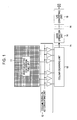
- Figs. 1 and 2 illustrate configuration examples of a clamp system in a CMOS image sensor of a column-parallel AD method to which the present invention is applied.
- Fig. 1 illustrates a configuration example of a main part of an entire configuration of a CMOS image sensor of the column-parallel AD method including a left/right-independent OPB clamp correction unit to which the present invention is applied.
- the entire CMOS image sensor is configured to include a photoelectric conversion pixel unit 11, a column-parallel AD converting unit 12, a column scanning unit 13, a data operation unit 14 including a clamp circuit and the like, and an I/O converting unit 15.
- the data operation unit 14 including a clamp circuit and the like to which the present invention is applied is placed in a subsequent stage of the column-parallel AD converting unit 12, between the column scanning unit 13 and the I/O converting unit 15.
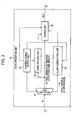
- Fig. 2 illustrates a configuration example of the data operation unit 14 shown between a1 and a2 in Fig. 1 in the viewpoint of a flow of signal data.
- the data operation unit 14 is configured to include a selector unit 21, a control signal output unit 22, a data holding unit 23, a clamp correction unit 24, and an adding unit 25.
- the data operation unit 14 in the example in Fig. 2 has a configuration of constantly holding data of the preceding row and calling the data as necessary, for example.
- Fig. 3 is a diagram illustrating a vertical clamp method based on a vertical OPB method among conventional clamp methods.
- the image sensor illustrated in Fig. 3 is a CMOS image sensor of the column-parallel AD method, the image sensor having a relatively large chip size, having a large number of pixels, and left/right stitching exposure being performed thereon.
- a long and thin vertical OPB region 32 is placed along a horizontal direction above or below (above in the example in Fig. 3 ) an entire effective pixel region 31.
- the electrophysical characteristics on the left and right are not at all the same. Therefore, the effective pixel region 31 is virtually divided into two left effective pixel region 31L and right effective pixel region 31R on the left and right.
- the conventional vertical clamp method is a method including an averaging process in step S1 and a lower limit value process in S2 described below.
- the averaging process in step S1 is a process of detecting individual OPB values of pixels in the vertical OPB region 32, calculating a sum of the OPB values in the entire vertical OPB region 32, and obtaining an average value by dividing the sum by a total number of pixels in the region.
- the lower limit value process in step S2 is a process of zero-correcting the average value obtained in the averaging process in step S1 and setting the corrected value as a lower limit value of a black level in the entire effective pixel region 31 placed below the vertical OPB region 32.
- the averaging process in step S1 is a process of averaging the OPB values of all the pixels in the vertical OPB region 32 and sets the average value as an OPB value of the entire vertical OPB region.
- the lower limit value process in step S2 is a process of applying the value as a lower limit value of a black level in the entire screen of the effective pixel region 31.
- Such a conventional vertical clamp method has a disadvantage of being incapable of executing a clamp correction process independently for the above-described vertical left and right effective pixel regions (left effective pixel region 31L and right effective pixel region 31R in the example in Fig. 3 ).
- Fig. 4 is a diagram illustrating a horizontal clamp method based on a horizontal OPB method among the conventional clamp methods.
- the sensor in Fig. 4 is also a CMOS sensor that is basically the same as the sensor in Fig. 3 .
- a long and thin horizontal OPB region 33 is provided along a vertical direction on any of left and right sides (left side in the example in Fig. 4 ) of the effective pixel region 31.
- the conventional horizontal clamp method in Fig. 4 is a method of performing clamp correction on the entire effective pixel region 31 one row after another by ignoring unbalanced characteristics on the left and right. Therefore, the conventional horizontal clamp method in Fig. 4 is capable of executing a finer clamp correction compared to the conventional vertical clamp method in Fig. 3 .
- the conventional horizontal clamp method in Fig. 4 is incapable of performing a correct clamp correction when a difference in physical characteristic exists between the left and right, and as a result, an offset may occur between left and right images.
- the conventional horizontal clamp method is a method including repetition of an averaging deviation process in step S21 and a lower limit value process in S22 described below.
- the averaging deviation process in the first-time step S21 is a process of calculating an average value by dividing a sum of pixel signals in the first row in the horizontal OPB region 33 by the number of pixels and obtaining a difference value ⁇ 0 from a reference value at the first horizontal scanning.
- the lower limit value process in the first-time step S22 is a process of holding the value until next scanning without reflecting it on the row of the effective pixel region in the same scanning period and supplying the value to set the lower limit value of a signal level in the next row in the effective pixel region 31 such that the value becomes zero.
- the averaging deviation process in step S21 is a process of averaging OPB values of row pixels in the horizontal OPB region 33, setting the average value as an OPB value of the row, and obtaining a difference value ⁇ with respect to the reference value of the OPB value in this row.
- the lower limit value process in step S22 is a process of obtaining zero by subtracting the difference value ⁇ from the difference value ⁇ and applying zero as the OPB value of the next row in the effective pixel region 31.
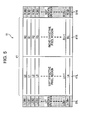
- Fig. 5 is a diagram illustrating a concept of a left/right-independent clamp control method according to example 1 of the present invention, and is an enlarged view of a pixel unit based on the left/right-independent clamp method using horizontal OPB.
- FIG. 5 illustrates a configuration example of the photoelectric conversion pixel unit 11 in a case where example 1 of the present invention (example 1 of the left/right-independent clamp method) is applied.
- an effective pixel region 41 is divided into a left effective pixel region 41L and a right effective pixel region 41R in n+1 rows (n is an integer value of 1 or more). Furthermore, a left horizontal OPB region 51L functions for clamp correction of the left effective pixel region 41L, and a right horizontal OPB region 51R functions for clamp correction of the right effective pixel region 41R.
- the left horizontal OPB region 51L is constituted by rows L0B0 to L0Bn
- the right horizontal OPB region 51R is constituted by rows R0B0 to R0Bn
- the left effective pixel region 41L is constituted by rows L0 to Ln
- the right effective pixel region 41R is constituted by rows R0 to Rn.
- Fig. 6 is a diagram illustrating an operation example in a case where a point defect (defective pixel) exists in operations according to example 1 of the present invention illustrated in Fig. 5 , that is, example 1 of the left/right-independent clamp control method.
- step S31 the clamp correction unit 24 averages OPB values of pixels included in a target row, each of the rows L0B0 to L0Bn in the left horizontal OPB region 51L sequentially being the target row (the process so far is called an averaging process).
- the clamp correction unit 24 sets the average value as an OPB value of the target row and obtains a difference value ⁇ with respect to the reference value (e.g., zero) of the OPB value in the target row.
- step S32 the clamp correction unit 24 sets the difference value ⁇ as the OPB value of the next row (row next to the target row) in the left effective pixel region 41L.
- step S31-a the clamp correction unit 24 averages OPB values of pixels except the defective pixel(s) among the pixels included in the target row.
- step S31-b the clamp correction unit 24 adopts, as an OPB value (average value) of the target row, a normal OPB value in the preceding row instead of the target row.
- the clamp correction unit 24 executes an averaging process. That is, the clamp correction unit 24 averages OPB values of pixels included in a target row, each of the rows R0B0 to R0Bn in the right horizontal OPB region 51R sequentially being the target row. The clamp correction unit 24 sets the average value as an OPB value of the target row and obtains a difference value ⁇ with respect to the reference value (e.g., zero) of the OPB value in the target row.
- the reference value e.g., zero
- step S42 the clamp correction unit 24 sets the difference value ⁇ as the OPB value of the next row (row next to the target row) in the right effective pixel region 41R.
- step S41-a the clamp correction unit 24 averages OPB values of pixels except the defective pixel(s) among the pixels included in the target row.
- step S41-b the clamp correction unit 24 adopts, as an OPB value (average value) of the target row, a normal OPB value in the preceding row instead of the target row.
- steps S31 and S32 (S31-a or S31-b as necessary) and processes in steps S41 and S42 (S41-a or S41-b as necessary) are repeatedly executed for the rows to the last row.
- the order of horizontal scanning is not particularly limited.
- an order of the left horizontal OPB region 51L ⁇ the left effective pixel region 41L ⁇ the right effective pixel region 41R ⁇ the right horizontal OPB region 51R can be adopted.
- an order of the left horizontal OPB region 51L ⁇ the right horizontal OPB region 51R ⁇ the left effective pixel region 41L ⁇ the right effective pixel region 41R can be adopted.
- the entire region is scanned from the top to the bottom.
- the horizontal clamp correction method based on example 1 of the present invention includes the following series of processes. That is, in step S31, the clamp correction unit 24 calculates, by a first average value calculating unit (e.g., an average value calculating unit 76L in Fig. 13 ), a difference value ⁇ of row pixels in the same scanning row (target row) in the left horizontal OPB region 51L. The difference value ⁇ is held in a first data holding unit (e.g., a data holding unit 78L in Fig. 13 ).
- a first average value calculating unit e.g., an average value calculating unit 76L in Fig. 13
- the difference value ⁇ is held in a first data holding unit (e.g., a data holding unit 78L in Fig. 13 ).
- the clamp correction unit 24 calls the difference value ⁇ from the first data holding unit and performs clamp correction so that the value becomes zero (or approximately zero) by subtracting the difference value from the difference value itself by a subtracting unit (e.g., the adding unit 25 in Fig. 2 ).
- the clamp correction unit 24 sets the correction value as a lower limit value of a black level of a corresponding row (row next to the target row) in the left effective pixel region 41L.
- the clamp correction unit 24 calculates, by a second average value calculating unit (e.g., an average value calculating unit 76R in Fig. 13 ), a difference value ⁇ of row pixels in the same scanning row (target row) in the right horizontal OPB region 51R.
- the difference value ⁇ is held in a second data holding unit (e.g., a data holding unit 78R in Fig. 13 ).
- the clamp correction unit 24 calls the difference value ⁇ from the second data holding unit and performs clamp correction so that the value becomes zero by subtracting the difference value itself by the subtracting unit (e.g., the subtracting unit 80 in Fig. 13 ).
- the clamp correction unit 24 sets the correction value as a lower limit value of a black level of a corresponding row (row next to the target row) in the right effective pixel region 41R.
- clamp correction can be executed independently for each of the left and right effective pixel regions (left effective pixel region 41L and right effective pixel region 41R in the example in Fig. 6 )
- step S31-a or S41-a, or step S31-b or S41-b is executed to eliminate an influence of the value of the defective pixel.
- the following process is executed as a process in step S31-a or S41-a.
- a process of calculating a sum of OPB values of pixels in the target row by eliminating the OPB value(s) of the defective pixel(s), and then dividing the sum by a value obtained by subtracting the number of defective pixels from the number of all pixels in the target row is executed. Accordingly, an influence of the defective pixel(s) on the OPB average value is eliminated.
- the following process is executed as a process in step S31-b or S41-b.
- An averaged OPB value of the target row is not used for a clamp process, and instead, the nearest normal averaged OPB value held in a data holding circuit (a circuit having a storage function such as a memory, e.g., the data holding unit 78L or 78R in Fig. 13 ) is adopted as an OPB value of the target row.
- a data holding circuit a circuit having a storage function such as a memory, e.g., the data holding unit 78L or 78R in Fig. 13
- update of the data holding unit 78L is not performed.
- a process of performing row clamp correction in the effective pixel region so that the difference value becomes zero by using the value is executed.
- Fig. 7 illustrates an example difference from that in Fig. 6 in example 1 of the present invention, that is, an operation example in a case where the number of scanning lines in an OPB region is larger than the number of horizontal scanning lines in an effective pixel region.
- clamp correction can be executed from the first row in the effective pixel region.
- the left horizontal OPB region 51L and the right horizontal OPB region 51R have scanning lines the number of which is larger than the number of horizontal scanning lines in the effective pixel region 41.
- step S51 a process of averaging OPB values of pixels included in a target row, the respective rows in the left horizontal OPB region 51L sequentially being the target row, is executed, that is, an averaging process is executed.
- the clamp correction unit 24 sets the average value as an OPB value of the target row and obtains a difference value ⁇ with respect to the reference value (e.g., zero) of the OPB value in the target row.
- step S52 the clamp correction unit 24 sets the difference value ⁇ as the OPB value of the next row (row next to the target row) in the left effective pixel region 41L.
- step S51-a the clamp correction unit 24 averages OPB values of pixels except the defective pixel(s) among the pixels included in the target row.
- step S51-b the clamp correction unit 24 adopts, as an OPB value (average value) of the target row, a normal OPB value in the preceding row instead of the target row.
- the clamp correction unit 24 executes an averaging process. That is, the clamp correction unit 24 averages OPB values of pixels included in a target row, each of the rows in the right horizontal OPB region 51R sequentially being the target row. The clamp correction unit 24 sets the average value as an OPB value of the target row and obtains a difference value ⁇ with respect to the reference value (e.g., zero) of the OPB value in the target row.
- the reference value e.g., zero
- step S62 the clamp correction unit 24 sets the difference value ⁇ as the OPB value of the next row (row next to the target row) in the right effective pixel region 41R.
- step S61-a the clamp correction unit 24 averages OPB values of pixels except the defective pixel(s) among the pixels included in the target row.
- step S61-b the clamp correction unit 24 adopts, as an OPB value (average value) of the target row, a normal OPB value in the preceding row instead of the target row.
- steps S51 and S52 (S51-a or S51-b as necessary) and processes in steps S61 and S62 (S61-a or S61-b as necessary) are repeatedly executed for the rows to the last row.
- Fig. 8 is a timing chart illustrating an example of data processing according to the present invention and illustrating how data processing for horizontal clamp correction is performed over time.
- the scanning order in the horizontal direction is the left horizontal OPB region 51L ⁇ the left effective pixel region 41L ⁇ the right effective pixel region 41R ⁇ the right horizontal OPB region 51R. That is, in Fig. 8 , a period A indicates a left horizontal OPB scanning period, a period B indicates a left effective pixel region scanning period, a period C indicates a right effective pixel region scanning period, and a period D indicates a right horizontal OPB scanning period.
- step S31 including step S31-a or S31-b as necessary
- step S41 including step S41-a or S41-b as necessary
- step S51 including step S51-a or S51-b as necessary
- step S61 including step S61-a or S61-b as necessary
- a series of processes "read” ⁇ "subtraction” ⁇ “output data" in Fig. 8 correspond to the process in step S32 or S42 in the example in Fig. 6 , and correspond to the process in step S52 or S62 in the example in Fig. 7 .
- the averaging process in the period A and the averaging process in the period D are executed in different times without overlapping with each other in time series. Therefore, if pieces of data after the averaging processes are immediately held in the data holding circuit, the same averaging process circuit can be used for the averaging process in the period A and the averaging process in the period D. Therefore, only one averaging process circuit is necessary, as an average value calculating unit 76 illustrated in Fig. 12 described below.
- Fig. 9 is a timing chart illustrating an example of data processing according to the present invention different from the example in Fig. 8 and illustrating how data processing for horizontal clamp correction is performed over time.
- the scanning order in the horizontal direction is the left horizontal OPB region 51L ⁇ the right horizontal OPB region 51R ⁇ the left effective pixel region 41L ⁇ the right effective pixel region 41R. That is, in Fig. 9 , a period A indicates a left horizontal OPB scanning period, a period D indicates a right horizontal OPB scanning period, a period B indicates a left effective pixel region scanning period, and a period C indicates a right effective pixel region scanning period.
- the averaging process in the period A and the averaging process in the period D are executed in different times without overlapping with each other in time series. Therefore, if pieces of data after the averaging processes are immediately held in the data holding circuit, the same averaging process circuit can be used for the averaging process in the period A and the averaging process in the period D. Therefore, only one averaging process circuit is necessary, as the average value calculating unit 76 illustrated in Fig. 12 described below.
- Fig. 10 is a timing chart illustrating an example of data processing according to the present invention different from the examples in Figs. 8 and 9 and illustrating how data processing for horizontal clamp correction is performed over time.
- the scanning order in the horizontal direction is the left horizontal OPB region 51L ⁇ the left effective pixel region 41L ⁇ the right horizontal OPB region 51R ⁇ the right effective pixel region 41R. That is, in Fig. 10 , a period A indicates a left horizontal OPB scanning period, a period B indicates a left effective pixel region scanning period, a period D indicates a right horizontal OPB scanning period, and period C indicates a right effective pixel region scanning period.
- the averaging process on the row pixels in the left OPB region 51L and the right OPB region 51R should be ended before clamp correction of the row in the left effective pixel region 41L and the right effective pixel region 41R corresponding to the next scanning.
- Fig. 11 is a flowchart illustrating an example of a process realized by an OPB clamp correction process method of the present invention, that is, the method corresponding to Fig. 6 or 7 and the method in a case where a point defect (defective pixel) exists (hereinafter referred to as clamp correction process).
- i indicates a pixel position in the horizontal direction in a target row in the left horizontal OPB region 51L and indicates an integer value of 1 to m (m is an integer value of 2 or more).
- j indicates a row number of a target row in the left horizontal OPB region 51L and indicates an integer value of 0 to n-1 (n is an integer value of 1 or more).
- step S83 the clamp correction unit 24 obtains a reference value (e.g., zero).
- step S84 the clamp correction unit 24 obtains an OPB value ⁇ (i, j) of a pixel (i, j) in the left horizontal OPB region 51L.
- step S85 the clamp correction unit 24 calculates a total value ⁇ (i, j) ( ⁇ (i-1, j)+ ⁇ (i, j)) of the pixel OPB in the left horizontal OPB region 51L.
- step S87 the clamp correction unit 24 determines whether i>m.
- step S87 If i is equal to or smaller than m, a NO determination is made in the process in step S87, the process returns to step S84, and the process thereafter is repeated.
- repetition of a loop process from step S84 to 87 causes the OPB values ⁇ (i, j) (i is 1 to m) of the respective pixels (i, j) included in a target row in the left horizontal OPB region 51L to be obtained and the total value ⁇ (i, j) (i is 1 to m) to be calculated.
- step S88 the clamp correction unit 24 determines whether a defective pixel exists.
- step S88 If no defective pixel exists in the target row (j-th row) in the left horizontal OPB region 51L, a NO determination is made in the process in step S88, and the process proceeds to step S89.
- step S89 the clamp correction unit 24 averages the OPB values ⁇ (i, j) (i is 1 to m) in the target row. That is, the clamp correction unit 24 calculates ⁇ (i, j)/m.
- step S90 the clamp correction unit 24 sets an average value of the target row, that is, ⁇ (i, j)/m ⁇ in the present case where no defective pixel exists, as an OPB value of the target row.
- step S91 the clamp correction unit 24 calculates a difference value ⁇ i with respect to the reference value (e.g., zero) of the OPB value of the target row.
- step S92 the clamp correction unit 24 holds the difference value ⁇ i in the holding circuit.
- the difference value ⁇ i in a case where no defective pixel exists may be held as the process in step S92.
- step S93 the clamp correction unit 24 reads the latest difference value ⁇ (in the present case, the difference value ⁇ i held in the preceding process in step S92) from the holding circuit, and sets the difference value ⁇ as the OPB value of the next row (j+1-th row, which is the row next to the target row) in the left effective pixel region 41L.
- step S95 the clamp correction unit 24 determines whether j ⁇ n.
- step S82 If the process target row number j is less than n, the process returns to step S82, and the processes thereafter are repeated.
- step S88 In a case where a defective pixel exists in the target row (j-th row) in the left horizontal OPB region 51L, an YES determination is made in the process in step S88, and the process proceeds to step S96.
- step S96 the clamp correction unit 24 determines whether all the pixels in the target row (j-th row) in the left horizontal OPB region 51L are defective.
- step S96 If one or some (not all) of the pixels in the target row (j-th row) in the left horizontal OPB region 51L are defective, a NO determination is made in step S96, and the process proceeds to step S97.
- step S97 the clamp correction unit 24 averages OPB values of pixels except the defective pixel(s) among the pixels included in the target row. That is, the clamp correction unit 24 calculates ⁇ (i, j)- ⁇ b(p/m)/m-k) ⁇ .
- k indicates the number of defective pixels (k ⁇ m).
- ⁇ b(p, j) indicates a total value of the OPB values ⁇ b(p, j) of the defective pixels (p is 1 to k). Then, the process proceeds to step S90.
- step S90 the clamp correction unit 24 sets the average value of the target row, that is, ⁇ (i, j)- ⁇ b(p, j)/m-k ⁇ in the present case where a defective pixel exists, as an OPB value of the target row.
- step S91 the clamp correction unit 24 calculates a difference value ⁇ i with respect to the reference value (e.g., zero) of the OPB value of the target row.
- step S92 the clamp correction unit 24 holds the difference value ⁇ i in the holding circuit.
- the process in step S92 may be omitted because a defective pixel exists in the present case.
- step S93 the clamp correction unit 24 reads the latest difference value ⁇ from the holding circuit, and sets the difference value ⁇ as the OPB value of the next row (j+1-th row, which is the row next to the target row) in the left effective pixel region 41L.
- the difference value ⁇ i held in the preceding process in step S92 is the latest difference value ⁇ .
- the difference value ⁇ i-q held in the process in step S92 when the row of the preceding number i-q (q is an integer value of 1 or more) with no defective pixel is a target row serves as the latest difference value ⁇ .
- step S96 In a case where all the pixels in the target row (j-th row) in the left horizontal OPB region 51L are defective pixels, an YES determination is made in the process in step S96, and the process proceeds to step S93.
- step S93 the clamp correction unit 24 reads the latest difference value ⁇ from the holding circuit, and sets the difference value ⁇ as the OPB value of the next row (j+1-th row, which is the row next to the target row) in the left effective pixel region 41L.
- the difference value ⁇ i-q held in the process in step S92 when the row of the preceding number i-q (q is an integer value of 1 or more) with no defective pixel is a target row serves as the latest difference value ⁇ .
- Fig. 11 illustrates only the clamp correction process related to the left horizontal OPB region 51L and the left effective pixel region 41L. Therefore, note that the processes corresponding to steps S81 to S97 for the right horizontal OPB region 51R and the right effective pixel region 41R (processes in which "left” is replaced by "right") are executed before or after the processes of steps S81 to S97 for the left horizontal OPB region 51L and the left effective pixel region 41L for the j-th target row are executed.
- two holding circuits may be provided, and all difference values ⁇ i may be held in one of the holding circuits regardless of the presence/absence of a defective pixel, and difference values ⁇ i may be held in the other holding circuit only when no defective pixel exists or when a defective pixel exists. That is, in this case, the latest difference value ⁇ is held in the other holding circuit.
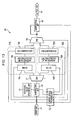
- Fig. 12 illustrates a configuration example of the clamp correction unit 24 based horizontal OPB related to Figs. 2 , 8 , and 9 .
- the clamp correction unit 24 in the example in Fig. 12 is provided with one data input unit 71 and one data output unit 81. Also, the clamp correction unit 24 is provided with two subtracting units 74 and 80, switches 77 and 79, a filter 75, an average value calculating unit 76, a control signal providing unit 72, a reference value providing unit 73, and left and right data holding units 78L and 78R.
- the switches 77 and 79 perform switch between input and output of left OPB data and right OPB data (difference value ⁇ of left and right).
- the filter 75 eliminates an abnormal value of a pixel signal in a row (target row) in the left horizontal OPB region 51L or the right horizontal OPB region 51R. That is, an OPB value of a defective pixel is eliminated.
- the average value calculating unit 76 calculates an average value of OPB values of normal pixels (to be exact, an average value of difference values ⁇ calculated by subtraction of the reference value from the reference value providing unit 73) in a target row in the left horizontal OPB region 51L or the right horizontal OPB region 51R.
- the data holding unit 78L holds OPB data in the left horizontal OPB region 51L (left difference value ⁇ ).
- the data holding unit 78R holds OPB data in the right horizontal OPB region 51R (right difference value ⁇ ).
- a holding amount of the data holding units 78L and 78R is not limited to the amount corresponding to a target row, and a result of the preceding row is also held, for example.
- the subtracting unit 74 subtracts the reference value provided from the reference value providing unit 73 from data input to the input unit 71 and outputs a result.
- the subtracting unit 74 subtracts the reference value from the values of left and right OPB pixels signals (OPB values) sequentially input by the input unit 71 at different times in time series. Among the respective values in the target row obtained thereby, an abnormal value (OPB value of a defective pixel) larger than a predetermined value is eliminated by the filter 75. An averaging process of pixel data (except an abnormal value) in a row (target row) in the left horizontal OPB region 51L or the right horizontal OPB region 51R is executed.
- the OPB data of the left horizontal OPB region 51L (left difference value ⁇ ) is held in the data holding unit 78L via the switch 77 on the basis of a control signal from the control signal providing unit 72.
- the OPB data of the right horizontal OPB region 51R (right difference value ⁇ ) is held in the data holding unit 78R via the switch 77 on the basis of a control signal from the control signal providing unit 72.
- the OPB data of the left horizontal OPB region 51L (left difference value ⁇ ) is called from the data holding unit 78L and is input to the subtracting unit 80 via the switch 79.
- the value is input to the subtracting unit 80 again, the left difference value ⁇ is canceled to zero (subtract itself), and a subtraction result is output from the output unit 81 such that the subtraction result is constantly zero. Accordingly, a lower limit value of a black level for each row in the left effective pixel region 41L is set.
- the OPB data of the right horizontal OPB region 51R (right difference value ⁇ ) is called from the data holding unit 78R and is input to the subtracting unit 80 via the switch 79.
- the value is input to the subtracting unit 80 again, the right difference value ⁇ is canceled to zero (subtract itself), and a subtraction result is output from the output unit 81 such that the subtraction result is constantly zero. Accordingly, a lower limit value of a black level for each row in the right effective pixel region 41R is set.
- the block (signal processing unit) illustrated in Fig. 12 is a unit where a correction process for the left effective pixel region 41L and the right effective pixel region 41R is executed. It is needless to say that this process is applied also to more effective pixel regions that are virtually defined.
- Fig. 13 illustrates a configuration example of the clamp correction circuit based horizontal OPB related to Figs. 2 , and 10 .
- the clamp correction unit 24 in the example in Fig. 13 is provided with one data input unit 71 and one data output unit 81. Also, the clamp correction unit 24 is provided with two subtracting units 74 and 80, switches 77 and 79, left and right filters 75L and 75R, left and right average value calculating units 76L and 76R, a control signal providing unit 72, a reference value providing unit 73, and left and right data holding units 78L and 78R.
- the switches 77 and 79 perform switch between input and output of left OPB data and right OPB data (difference value ⁇ of left and right).
- the filter 75L eliminates an abnormal value of a pixel signal in a row (target row) in the left horizontal OPB region 51L. That is, an OPB value of a defective pixel is eliminated.
- the average value calculating unit 76L calculates an average value of OPB values of normal pixels (to be exact, an average value of difference values ⁇ calculated by subtraction of the reference value from the reference value providing unit 73) in a target row in the left horizontal OPB region 51L.
- the data holding unit 78L holds OPB data in the left horizontal OPB region 51L (left difference value ⁇ ).
- a holding amount of the data holding unit 78L is not limited to the amount corresponding to a target row, and a result of the preceding row is also held, for example.
- the filter 75R eliminates an abnormal value of a pixel signal in a row (target row) in the right horizontal OPB region 51R. That is, an OPB value of a defective pixel is eliminated.
- the average value calculating unit 76R calculates an average value of OPB values of normal pixels (to be exact, an average value of difference values ⁇ calculated by subtraction of the reference value from the reference value providing unit 73) in a target row in the right horizontal OPB region 51R.
- the data holding unit 78R holds OPB data in the right horizontal OPB region 51R (right difference value ⁇ ).
- a holding amount of the data holding unit 78R is not limited to the amount corresponding to a target row, and a result of the preceding row is also held, for example.
- the subtracting unit 74 subtracts the reference value provided from the reference value providing unit 73 from data input to the input unit 71 and outputs a result.
- the subtracting unit 80 subtracts the output value itself of the switch 79 and outputs zero.
- the subtracting unit 74 subtracts the reference value from the values of left and right OPB pixels signals (OPB values) sequentially input by the input unit 71 at different times in time series.
- the respective values for the left horizontal OPB region 51L are input to the filter 75L on the basis of a control signal from the control signal providing unit 72.
- An abnormal value (OPB value of a defective pixel) larger than a predetermined value is eliminated by the filter 75L.
- An averaging process of pixel data (except an abnormal value) in a row (target row) in the left horizontal OPB region 51L is executed.
- the OPB data of the left horizontal OPB region 51L (left difference value ⁇ ) is held in the data holding unit 78L.
- the OPB data of the left horizontal OPB region 51L (left difference value ⁇ ) is called from the data holding unit 78L and is input to the subtracting unit 80 via the switch 79.
- the value is input to the subtracting unit 80 again, the left difference value ⁇ is canceled to zero (subtract itself), and a subtraction result is output from the output unit 81 such that the subtraction result is constantly zero. Accordingly, a lower limit value of a black level for each row in the left effective pixel region 41L is set.
- the respective values for the right horizontal OPB region 51R are input to the filter 75R on the basis of a control signal from the control signal providing unit 72.
- An abnormal value (OPB value of a defective pixel) larger than a predetermined value is eliminated by the filter 75R.
- An averaging process of pixel data (except an abnormal value) in a row (target row) in the right horizontal OPB region 51R is executed.
- the OPB data of the right horizontal OPB region 51R (right difference value ⁇ ) is held in the data holding unit 78R.
- the OPB data of the right horizontal OPB region 51R (right difference value ⁇ ) is called from the data holding unit 78R and is input to the subtracting unit 80 via the switch 79.
- the value is input to the subtracting unit 80 again, the left difference value ⁇ is canceled to zero (subtract itself), and a subtraction result is output from the output unit 81 such that the subtraction result is constantly zero. Accordingly, a lower limit value of a black level for each row in the right effective pixel region 41R is set.
- the clamp correction unit 24 in the example in Fig. 13 is provided with a left horizontal OPB data processing unit 91L including the filter 75L, the average value calculating unit 76L, and the data holding unit 78L, and a right horizontal OPB data processing unit 91R including the filter 75R, the average value calculating unit 76R, and the data holding unit 78R.
- the switches 77 and 79 are switched on the basis of a control signal from the control signal providing unit 72.
- a left difference value ⁇ from the left horizontal OPB data processing unit 91L (OPB data of the left horizontal OPB region 51L) and a right difference value ⁇ from the right horizontal OPB data processing unit 91R (OPB data of the right horizontal OPB region 51R) are alternately output and are input to the subtracting unit 80.
- the operation of the subtracting unit 80 is as described above.
- the block (signal processing unit) illustrated in Fig. 12 is a unit where a correction process for the left effective pixel region 41L and the right effective pixel region 41R is executed. It is needless to say that this process is applied also to more effective pixel regions that are virtually defined.
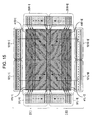
- Fig. 14 is a diagram illustrating an operation of example 2 in a case where an example of a vertical/horizontal-combined left/right-independent OPB clamp control method is adopted as example 2 of the present invention.
- the effective pixel region 41 is divided into the left effective pixel region 41L and the right effective pixel region 41R. Furthermore, in the clamp correction for the left effective pixel region 41L, a left vertical OPB region 101L functions for a process at rough adjustment whereas the left horizontal OPB region 51L functions for a process at fine adjustment. Likewise, in the clamp correction for the right effective pixel region 41R, a right vertical OPB region 101R functions for a process at rough adjustment whereas the right horizontal OPB region 51R functions for a process at fine adjustment.
- steps S401 and S402 are executed.
- step S401 the clamp correction unit 24 executes a process of averaging OPB values of all the pixels included in the left vertical OPB region 101L, that is, an averaging process.
- the clamp correction unit 24 sets the average value as an OPB value of the left vertical OPB region 101L and obtains a difference value ⁇ with respect to a reference value (e.g., zero) of the OPB value of the left vertical OPB region 101L.
- step S402 the clamp correction unit 24 sets the difference value ⁇ as an OPB value of the whole pixels in the left effective pixel region 41L.
- steps S201 steps S201-a or S201-b as necessary
- steps S201 and S202 are executed.
- the processes in steps S201 (step S201-a or S201-b as necessary) and S202 are basically the same as the processes in steps S31 (step S31-a or S31-b as necessary) and S32 in Fig. 6 or the processes in steps S51 (step S51-a or S51-b as necessary) and S52 in Fig. 7 .
- steps S501 and S502 are executed.
- step S501 the clamp correction unit 24 executes a process of averaging OPB values of all the pixels included in the right vertical OPB region 101R, that is, an averaging process.
- the clamp correction unit 24 sets the average value as an OPB value of the right vertical OPB region 101R and obtains a difference value ⁇ with respect to a reference value (e.g., zero) of the OPB value of the right vertical OPB region 101R.
- step S402 the clamp correction unit 24 sets the difference value ⁇ as an OPB value of the whole pixels in the right effective pixel region 41R.
- steps S301 and S302 are executed.
- the processes in steps S301 (step S301-a or S301-b as necessary) and S302 are basically the same as the processes in steps S41 (step S41-a or S41-b as necessary) and S42 in Fig. 6 or the processes in steps S61 (step S61-a or S61-b as necessary) and S62 in Fig. 7 .
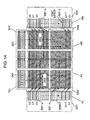
- Fig. 15 is a diagram illustrating an operation of example 3 in a case where an example of a left/right/upper/lower four-region 1/2 upper/lower reading left/right-independent OPB clamp control method is adopted as example 3 of the present invention.
- the photoelectric conversion pixel unit 11 of the example in Fig. 15 is divided into an upper region [I] and a lower region [II], and each of the regions [I] and [II] has the same configuration as that in Fig. 14 .
- the region [I] of the effective pixel region 41 is divided into a left effective pixel region 41L-I and a right effective pixel region 41R-I. Furthermore, in the clamp correction for the left effective pixel region 41L-I, a left vertical OPB region 101L-I functions for a process at rough adjustment whereas a left horizontal OPB region 51L-I functions for a process at fine adjustment. Likewise, in the clamp correction for the right effective pixel region 41R-I, a right vertical OPB region 101R-I functions for a process at rough adjustment whereas a right horizontal OPB region 51R-I functions for a process at fine adjustment.
- the region [II] of the effective pixel region 41 is divided into a left effective pixel region 41L-II and a right effective pixel region 41R-II. Furthermore, in the clamp correction for the left effective pixel region 41L-II, a left vertical OPB region 101L-II functions for a process at rough adjustment whereas a left horizontal OPB region 51L-II functions for a process at fine adjustment. Likewise, in the clamp correction for the right effective pixel region 41R-II, a right vertical OPB region 101R-II functions for a process at rough adjustment whereas a right horizontal OPB region 51R-II functions for a process at fine adjustment.
- OPB clamp correction can be performed on the CMOS image sensor having the effective pixel region 41 that is larger than in examples 1 and 2.
- the effective pixel region 41 is divided into four upper/lower/left/right regions.
- the respective OPB regions are placed for the upper/lower/left/right regions of the effective pixel region 41.
- the left vertical OPB region 101L-I, the right vertical OPB region 101R-I, the left horizontal OPB region 51L-I, and the right horizontal OPB region 51R-I perform the same correction as the OPB clamp correction (clamp correction process) described with reference to Fig. 14 on the respective columns and respective rows in the upper-left and upper-right effective pixel regions 41L-I and 41R-I.
- the left vertical OPB region 101L-II, the right vertical OPB region 101R-II, the left horizontal OPB region 51L-II, and the right horizontal OPB region 51R-II perform the same correction as the OPB clamp correction (clamp correction process) described with reference to Fig. 14 on the respective columns and respective rows in the upper-left and upper-right effective pixel regions 41L-II and 41R-II.
- the present invention described above can produce the following first to fifth advantages.
- the number of row pixels in the horizontal OPB regions placed on the left and right is quite smaller than the number of row pixels in the effective pixel region. For this reason, even when a defective pixel exists, an averaging process of OPB values of row pixels in the horizontal OPB regions can be completed by next row scanning. Thus, an OPB correction process in units of rows can be performed.
- clamp correction can be performed without executing an operating process on respective pixel signals in the effective pixel region unlike in the CCD image sensor, so that the clamp correction can be executed with high precision in a short time.
- the second advantage is an advantage that offset control can be executed independently for the left and right by using both rough adjustment and fine adjustment.
- the third advantage is an advantage that outputting signals from the effective pixel region need not be performed through multiple channels (two or more outputs) and only a single channel is necessary, which simplifies an entire circuit configuration.
- the fourth advantage is an advantage that signal processing such as an OPB value averaging process is simplified by changing a scanning order so that an OPB region is scanned before a corresponding effective pixel region.
- the fifth advantage is an advantage that offset correction can be performed independently for respective effective pixel regions by defining four virtual regions in an image sensor (70 mm for movies) having an effective pixel region of a larger area with further development of the above-described thoughts.
- a solid-state imaging device (image sensor) to which the present invention is applied is applicable to a camera portion of various electronic apparatuses having a shooting function.
- the electronic apparatuses include a digital still camera, a digital video camera, a notebook personal computer, and a mobile phone.
- the solid-state imaging device to which the present invention is applied is applicable to a camera portion of electronic apparatuses in various fields for capturing images or videos, video signals input to or generated in those electronic apparatuses.
- examples of electronic apparatuses to which such a camera is applied are described.
- the present invention is applicable to a digital still camera, which is an example of an electronic apparatus.
- This digital still camera is manufactured to include a solid-state imaging device to which the present invention is applied in addition to an image capturing lens, a display unit, a control switch, a menu switch, a shutter, and the like.
- the present invention is applicable to a notebook personal computer, which is an example of an electronic apparatus.
- a main body thereof includes a keyboard operated to input characters and the like, and a main body cover thereof includes a camera portion.
- This notebook personal computer is manufactured by using the solid-state imaging device to which the present invention is applied in the camera portion.
- the present invention is applicable to a mobile terminal apparatus, which is an example of an electronic apparatus.
- This mobile terminal apparatus includes an upper casing and a lower casing. Statuses of the mobile terminal apparatus include an open status and a closed status of those two casings.
- This mobile terminal apparatus includes a connecting portion (hinge portion here), a display, a sub-display, a picture light, a camera portion, and the like in addition to the above-described upper casing and lower casing, and is manufactured by using the solid-state imaging device to which the present invention is applied in the camera portion.
- the present invention is applicable to a digital video camera, which is an example of an electronic apparatus.
- the digital video camera is manufactured to include the solid-state imaging device to which the present invention is applied in addition to a main body portion, a subject shooting lens on a front-directed side surface, a shooting start/stop switch, and a monitor.
- An embodiment of the present invention is not limited to the above-described embodiment, and various changes are acceptable without deviating from the gist of the present invention.
Landscapes
- Engineering & Computer Science (AREA)
- Multimedia (AREA)
- Signal Processing (AREA)
- Transforming Light Signals Into Electric Signals (AREA)
- Solid State Image Pick-Up Elements (AREA)
Applications Claiming Priority (3)
| Application Number | Priority Date | Filing Date | Title |
|---|---|---|---|
| JP2008033204 | 2008-02-14 | ||
| JP2009015286A JP5418810B2 (ja) | 2008-02-14 | 2009-01-27 | クランプ制御方法、クランプ補正装置、イメージセンサ、および、電子機器 |
| PCT/JP2009/052362 WO2009101996A1 (fr) | 2008-02-14 | 2009-02-13 | Procédé de régulation de troncature, dispositif de correction par troncature, capteur d'image et dispositif électronique |
Publications (2)
| Publication Number | Publication Date |
|---|---|
| EP2139228A1 true EP2139228A1 (fr) | 2009-12-30 |
| EP2139228A4 EP2139228A4 (fr) | 2012-04-25 |
Family
ID=40957027
Family Applications (1)
| Application Number | Title | Priority Date | Filing Date |
|---|---|---|---|
| EP09710707A Withdrawn EP2139228A4 (fr) | 2008-02-14 | 2009-02-13 | Procédé de régulation de troncature, dispositif de correction par troncature, capteur d'image et dispositif électronique |
Country Status (7)
| Country | Link |
|---|---|
| US (1) | US8310568B2 (fr) |
| EP (1) | EP2139228A4 (fr) |
| JP (1) | JP5418810B2 (fr) |
| KR (1) | KR20100112067A (fr) |
| CN (1) | CN101682701B (fr) |
| TW (1) | TWI399976B (fr) |
| WO (1) | WO2009101996A1 (fr) |
Cited By (1)
| Publication number | Priority date | Publication date | Assignee | Title |
|---|---|---|---|---|
| RU2412554C1 (ru) * | 2010-01-25 | 2011-02-20 | Учреждение Российской академии наук Институт физики полупроводников им. А.В. Ржанова Сибирского отделения РАН (ИФП СО РАН) | Способ компенсации дефектных фоточувствительных элементов многоэлементного фотоприемника |
Families Citing this family (18)
| Publication number | Priority date | Publication date | Assignee | Title |
|---|---|---|---|---|
| TWI393428B (zh) * | 2009-04-20 | 2013-04-11 | 原相科技股份有限公司 | 影像校正方法及使用此方法的影像處理系統 |
| JP5557232B2 (ja) * | 2009-06-15 | 2014-07-23 | 防衛省技術研究本部長 | 赤外線撮像素子モジュール |
| JP5901188B2 (ja) * | 2011-09-12 | 2016-04-06 | キヤノン株式会社 | 撮像装置及び画像処理方法 |
| KR101407311B1 (ko) * | 2012-10-31 | 2014-06-13 | 엘지디스플레이 주식회사 | 터치표시장치 및 이의 광센서모듈 복구방법 |
| JP6110154B2 (ja) | 2013-02-13 | 2017-04-05 | 浜松ホトニクス株式会社 | 固体撮像装置及び固体撮像装置の製造方法 |
| JP6037170B2 (ja) * | 2013-04-16 | 2016-11-30 | ソニー株式会社 | 固体撮像装置およびその信号処理方法、並びに電子機器 |
| JP2015082732A (ja) * | 2013-10-22 | 2015-04-27 | 株式会社東芝 | 固体撮像装置 |
| KR102105409B1 (ko) | 2013-12-09 | 2020-05-29 | 삼성전자주식회사 | 이종의 아날로그-디지털 컨버터를 포함하는 이미지 센서 |
| JP2016178533A (ja) * | 2015-03-20 | 2016-10-06 | キヤノン株式会社 | 放射線撮像装置及び放射線撮像システム |
| JP6733229B2 (ja) * | 2016-03-15 | 2020-07-29 | 株式会社リコー | 固体撮像装置、画像読取装置および画像形成装置 |
| JP6779038B2 (ja) * | 2016-06-01 | 2020-11-04 | キヤノン株式会社 | 撮像素子及びその制御方法、撮像装置及びその制御方法 |
| JP6758925B2 (ja) * | 2016-06-01 | 2020-09-23 | キヤノン株式会社 | 撮像装置及びその制御方法 |
| JP6815777B2 (ja) * | 2016-07-25 | 2021-01-20 | キヤノン株式会社 | 撮像装置及び撮像装置の制御方法 |
| JP6900227B2 (ja) * | 2017-04-10 | 2021-07-07 | キヤノン株式会社 | 撮像装置及び撮像装置の駆動方法 |
| JP2020017910A (ja) | 2018-07-27 | 2020-01-30 | ソニーセミコンダクタソリューションズ株式会社 | ストリーキング補正回路、撮像装置、及び、電子機器 |
| US10785431B2 (en) * | 2018-11-27 | 2020-09-22 | Semiconductor Components Industries, Llc | Image sensors having dark pixels and imaging pixels with different sensitivities |
| EP4564842A3 (fr) * | 2019-03-29 | 2025-10-08 | Nikon Corporation | Élément de capture d'image et appareil de capture d'image |
| US11206392B1 (en) * | 2020-07-16 | 2021-12-21 | Omnivision Technologies, Inc. | Image sensor with frame level black level calibration |
Family Cites Families (15)
| Publication number | Priority date | Publication date | Assignee | Title |
|---|---|---|---|---|
| JP4329128B2 (ja) * | 1996-07-12 | 2009-09-09 | ソニー株式会社 | 固体撮像装置、固体撮像装置の駆動方法およびカメラ |
| US6337713B1 (en) * | 1997-04-04 | 2002-01-08 | Asahi Kogaku Kogyo Kabushiki Kaisha | Processor for image-pixel signals derived from divided sections of image-sensing area of solid-type image sensor |
| EP1033868A1 (fr) * | 1999-03-01 | 2000-09-06 | Canon Kabushiki Kaisha | Dispositif de prise d'images |
| JP4655383B2 (ja) | 2001-02-23 | 2011-03-23 | ソニー株式会社 | イメージセンサの画像信号処理装置 |
| JP3697172B2 (ja) | 2001-03-29 | 2005-09-21 | キヤノン株式会社 | 信号処理装置及び信号処理方法並びに撮像装置 |
| US7050098B2 (en) * | 2001-03-29 | 2006-05-23 | Canon Kabushiki Kaisha | Signal processing apparatus and method, and image sensing apparatus having a plurality of image sensing regions per image frame |
| US7245318B2 (en) * | 2001-11-09 | 2007-07-17 | Canon Kabushiki Kaisha | Imaging apparatus that corrects an imbalance in output levels of image data |
| JP3969190B2 (ja) * | 2002-05-30 | 2007-09-05 | ソニー株式会社 | 撮像信号処理方法、撮像信号処理装置、撮像装置 |
| JP2005101829A (ja) * | 2003-09-24 | 2005-04-14 | Sanyo Electric Co Ltd | 信号処理装置 |
| JP2005176115A (ja) | 2003-12-12 | 2005-06-30 | Canon Inc | 撮像装置 |
| JP4581814B2 (ja) * | 2005-04-26 | 2010-11-17 | ソニー株式会社 | 固体撮像装置、固体撮像装置の駆動方法および撮像装置 |
| JP4827508B2 (ja) * | 2005-12-02 | 2011-11-30 | キヤノン株式会社 | 撮像システム |
| JP2007259135A (ja) * | 2006-03-23 | 2007-10-04 | Fujifilm Corp | 撮像装置およびその駆動方法 |
| JP4770577B2 (ja) * | 2006-05-12 | 2011-09-14 | ソニー株式会社 | 固体撮像装置 |
| JP4420004B2 (ja) * | 2006-09-29 | 2010-02-24 | 日本ビクター株式会社 | 撮像装置 |
-
2009
- 2009-01-27 JP JP2009015286A patent/JP5418810B2/ja not_active Expired - Fee Related
- 2009-02-06 TW TW098103938A patent/TWI399976B/zh not_active IP Right Cessation
- 2009-02-13 EP EP09710707A patent/EP2139228A4/fr not_active Withdrawn
- 2009-02-13 US US12/594,972 patent/US8310568B2/en not_active Expired - Fee Related
- 2009-02-13 CN CN2009800004391A patent/CN101682701B/zh not_active Expired - Fee Related
- 2009-02-13 WO PCT/JP2009/052362 patent/WO2009101996A1/fr not_active Ceased
- 2009-02-13 KR KR1020097021327A patent/KR20100112067A/ko not_active Ceased
Cited By (1)
| Publication number | Priority date | Publication date | Assignee | Title |
|---|---|---|---|---|
| RU2412554C1 (ru) * | 2010-01-25 | 2011-02-20 | Учреждение Российской академии наук Институт физики полупроводников им. А.В. Ржанова Сибирского отделения РАН (ИФП СО РАН) | Способ компенсации дефектных фоточувствительных элементов многоэлементного фотоприемника |
Also Published As
| Publication number | Publication date |
|---|---|
| US20100128150A1 (en) | 2010-05-27 |
| JP5418810B2 (ja) | 2014-02-19 |
| KR20100112067A (ko) | 2010-10-18 |
| JP2009219107A (ja) | 2009-09-24 |
| CN101682701B (zh) | 2013-02-20 |
| US8310568B2 (en) | 2012-11-13 |
| TW200952475A (en) | 2009-12-16 |
| CN101682701A (zh) | 2010-03-24 |
| TWI399976B (zh) | 2013-06-21 |
| EP2139228A4 (fr) | 2012-04-25 |
| WO2009101996A1 (fr) | 2009-08-20 |
Similar Documents
| Publication | Publication Date | Title |
|---|---|---|
| EP2139228A1 (fr) | Procédé de régulation de troncature, dispositif de correction par troncature, capteur d'image et dispositif électronique | |
| US8462234B2 (en) | Image pickup apparatus and dark current correction method therefor | |
| US9407842B2 (en) | Image pickup apparatus and image pickup method for preventing degradation of image quality | |
| US10205898B2 (en) | Minimizing a data pedestal level in an image sensor | |
| JP2008278394A (ja) | 撮像装置、欠陥画素補正装置およびこれらにおける処理方法ならびにプログラム | |
| US7924319B2 (en) | Signal processing apparatus allowing an increase in pixels without an increase in driving frequency and circuit area | |
| KR20160136272A (ko) | 촬상 소자, 제어 방법 및 촬상 장치 | |
| US8502893B2 (en) | Imaging apparatus, flash determination method, and recording medium | |
| JP5686267B2 (ja) | 撮像素子 | |
| JP2011114473A (ja) | 画素欠陥補正装置 | |
| JP2011120111A (ja) | 固体撮像装置および電子情報機器 | |
| JP2012075050A (ja) | 固体撮像素子、撮像装置、黒レベル決定方法 | |
| CN112040114A (zh) | 图像传感器和包括图像传感器的图像处理系统 | |
| JP5299159B2 (ja) | 撮像装置およびプログラム | |
| JP4931546B2 (ja) | 固体撮像装置及び撮像装置 | |
| US7489356B2 (en) | Image pickup apparatus | |
| US20150264330A1 (en) | Solid state imaging device and camera system | |
| JP2022165682A (ja) | 信号処理装置、光電変換装置、撮像システム及び信号処理装置の制御方法 | |
| JP2010178384A (ja) | 画像信号処理回路、カメラ、及び画像信号処理方法 | |
| JP4998092B2 (ja) | 固体撮像回路およびカメラシステム | |
| JP2005354669A (ja) | 画像処理装置及び画像処理方法 | |
| JP4880777B2 (ja) | 画像処理方法および撮像装置モジュール | |
| JP2011101170A (ja) | Ccd型固体撮像素子のスミア補正方法及び撮像装置 | |
| JP2011014995A (ja) | 撮像装置 | |
| JP2007214771A (ja) | 画像信号処理装置 |
Legal Events
| Date | Code | Title | Description |
|---|---|---|---|
| PUAI | Public reference made under article 153(3) epc to a published international application that has entered the european phase |
Free format text: ORIGINAL CODE: 0009012 |
|
| 17P | Request for examination filed |
Effective date: 20091012 |
|
| AK | Designated contracting states |
Kind code of ref document: A1 Designated state(s): AT BE BG CH CY CZ DE DK EE ES FI FR GB GR HR HU IE IS IT LI LT LU LV MC MK MT NL NO PL PT RO SE SI SK TR |
|
| DAX | Request for extension of the european patent (deleted) | ||
| A4 | Supplementary search report drawn up and despatched |
Effective date: 20120326 |
|
| RIC1 | Information provided on ipc code assigned before grant |
Ipc: H04N 5/217 20110101ALI20120320BHEP Ipc: H04N 5/335 20110101AFI20120320BHEP |
|
| 17Q | First examination report despatched |
Effective date: 20120405 |
|
| STAA | Information on the status of an ep patent application or granted ep patent |
Free format text: STATUS: THE APPLICATION IS DEEMED TO BE WITHDRAWN |
|
| 18D | Application deemed to be withdrawn |
Effective date: 20150728 |