EP2139835B1 - Procédé pour produire des composés carbonyle optiquement actifs - Google Patents
Procédé pour produire des composés carbonyle optiquement actifs Download PDFInfo
- Publication number
- EP2139835B1 EP2139835B1 EP08736312.3A EP08736312A EP2139835B1 EP 2139835 B1 EP2139835 B1 EP 2139835B1 EP 08736312 A EP08736312 A EP 08736312A EP 2139835 B1 EP2139835 B1 EP 2139835B1
- Authority
- EP
- European Patent Office
- Prior art keywords
- optically active
- process according
- carbon monoxide
- aryl
- hydrogen
- Prior art date
- Legal status (The legal status is an assumption and is not a legal conclusion. Google has not performed a legal analysis and makes no representation as to the accuracy of the status listed.)
- Active
Links
- 0 *[C@](CC1)P(CCP(C(CC2)C#C)[C@@]2c2ccccc2)[C@]1c1ccccc1 Chemical compound *[C@](CC1)P(CCP(C(CC2)C#C)[C@@]2c2ccccc2)[C@]1c1ccccc1 0.000 description 3
- NHOGLJMKPDRYHI-GMTAPVOTSA-N C[C@H](CO)PCCP1[C@H](C)COC[C@H]1C Chemical compound C[C@H](CO)PCCP1[C@H](C)COC[C@H]1C NHOGLJMKPDRYHI-GMTAPVOTSA-N 0.000 description 1
- XFIALTWJZRBKQY-QBQKZGEHSA-N C[C@H]([C@H]1OC(C)(C)O[C@@H]1[C@@H](C)P(c1ccccc1)c1ccccc1)P(c1ccccc1)c1ccccc1 Chemical compound C[C@H]([C@H]1OC(C)(C)O[C@@H]1[C@@H](C)P(c1ccccc1)c1ccccc1)P(c1ccccc1)c1ccccc1 XFIALTWJZRBKQY-QBQKZGEHSA-N 0.000 description 1
Classifications
-
- C—CHEMISTRY; METALLURGY
- C07—ORGANIC CHEMISTRY
- C07C—ACYCLIC OR CARBOCYCLIC COMPOUNDS
- C07C29/00—Preparation of compounds having hydroxy or O-metal groups bound to a carbon atom not belonging to a six-membered aromatic ring
- C07C29/17—Preparation of compounds having hydroxy or O-metal groups bound to a carbon atom not belonging to a six-membered aromatic ring by hydrogenation of carbon-to-carbon double or triple bonds
- C07C29/172—Preparation of compounds having hydroxy or O-metal groups bound to a carbon atom not belonging to a six-membered aromatic ring by hydrogenation of carbon-to-carbon double or triple bonds with the obtention of a fully saturated alcohol
-
- C—CHEMISTRY; METALLURGY
- C07—ORGANIC CHEMISTRY
- C07B—GENERAL METHODS OF ORGANIC CHEMISTRY; APPARATUS THEREFOR
- C07B53/00—Asymmetric syntheses
-
- C—CHEMISTRY; METALLURGY
- C07—ORGANIC CHEMISTRY
- C07C—ACYCLIC OR CARBOCYCLIC COMPOUNDS
- C07C29/00—Preparation of compounds having hydroxy or O-metal groups bound to a carbon atom not belonging to a six-membered aromatic ring
- C07C29/56—Preparation of compounds having hydroxy or O-metal groups bound to a carbon atom not belonging to a six-membered aromatic ring by isomerisation
-
- C—CHEMISTRY; METALLURGY
- C07—ORGANIC CHEMISTRY
- C07C—ACYCLIC OR CARBOCYCLIC COMPOUNDS
- C07C45/00—Preparation of compounds having >C = O groups bound only to carbon or hydrogen atoms; Preparation of chelates of such compounds
- C07C45/61—Preparation of compounds having >C = O groups bound only to carbon or hydrogen atoms; Preparation of chelates of such compounds by reactions not involving the formation of >C = O groups
- C07C45/62—Preparation of compounds having >C = O groups bound only to carbon or hydrogen atoms; Preparation of chelates of such compounds by reactions not involving the formation of >C = O groups by hydrogenation of carbon-to-carbon double or triple bonds
-
- C—CHEMISTRY; METALLURGY
- C07—ORGANIC CHEMISTRY
- C07B—GENERAL METHODS OF ORGANIC CHEMISTRY; APPARATUS THEREFOR
- C07B2200/00—Indexing scheme relating to specific properties of organic compounds
- C07B2200/07—Optical isomers
-
- C—CHEMISTRY; METALLURGY
- C07—ORGANIC CHEMISTRY
- C07C—ACYCLIC OR CARBOCYCLIC COMPOUNDS
- C07C2601/00—Systems containing only non-condensed rings
- C07C2601/12—Systems containing only non-condensed rings with a six-membered ring
- C07C2601/14—The ring being saturated
Definitions
- the present invention relates to a continuous process for the preparation of optically active carbonyl compounds by asymmetric hydrogenation of ⁇ , ⁇ -unsaturated carbonyl compounds in the presence of soluble in the reaction mixture, optically active transition metal catalysts having at least one carbon monoxide ligand.
- the present invention relates to a process for producing optically active aldehydes or ketones, in particular citronellal by asymmetric hydrogenation of the corresponding optically active ⁇ , ⁇ -unsaturated aldehydes or ketones in the presence of carbon monoxide.
- the EP-A 0 000 315 relates to a process for the preparation of optically active citronellal by hydrogenation of geranial or neral in the presence of a catalyst complex of rhodium and a chiral phosphine dissolved in the reaction system.
- a problem in the implementation by means of soluble catalysts catalyzed (homogeneous catalytic) reactions is the often insufficient stability of the catalyst complexes used or the resulting catalytically active metal or transition metal complex compound.
- homogeneous catalytic reactions with complex transition metal catalysts can only be used on an industrial scale in an economical manner in special cases.
- the JP-A 52078812 describes a process for the hydrogenation of ⁇ , ⁇ -unsaturated aldehydes such as crotonaldehyde, cinnamaldehyde or ⁇ -methylcinnamaldehyde on homogeneous Rh catalysts under hydroformylation conditions in the presence of a triarylphosphine, a tertiary amine in stoichiometric amount and carbon monoxide.
- the WO 2006/040096 discloses a process for preparing optically active carbonyl compounds by asymmetric hydrogenation of ⁇ , ⁇ -unsaturated carbonyl compounds in the presence of reaction-soluble, optically active transition metal catalysts having at least one carbon monoxide ligand characterized in that the catalyst is reacted with a carbon monoxide and hydrogen-containing gas mixture pretreated and / or performs the asymmetric hydrogenation in the presence of the reaction mixture additionally supplied carbon monoxide.
- the reaction is carried out in such a way that the catalyst is pretreated with a gas mixture containing carbon monoxide and hydrogen and the subsequent hydrogenation additionally carried out in the presence of carbon monoxide, the carbon monoxide concentration of the reaction mixture during the hydrogenation is often difficult to control.
- the pretreatment is usually carried out using significantly higher carbon monoxide concentrations than the asymmetric hydrogenation, so that large quantities of carbon monoxide, which originate from the pretreatment of the catalyst, can be introduced into the hydrogenation and have unfavorable effects there.
- Object of the present invention was therefore that in the above WO 2006/040096 disclosed processes to improve that the pretreatment of the catalyst and the implementation of the asymmetric hydrogenation can be carried out in a technically simple manner below the optimal for the individual steps carbon monoxide concentrations.
- the improved process should make it possible to carry out the asymmetric hydrogenation under the most constant carbon monoxide concentration.
- asymmetric hydrogenation in the context of the present invention means a To understand hydrogenation in which the two enantiomeric forms of the hydrogenation product are not obtained in equal parts.
- At least one carbon monoxide ligand catalyst having a pretreatment of a catalyst precursor with a carbon monoxide and hydrogen-containing gas mixture by.
- the asymmetric hydrogenation according to the invention is carried out in the presence of the reaction mixture additionally supplied carbon monoxide.
- the inventive method is characterized in that the said pretreatment of the catalyst precursor with a gas mixture comprising 30 to 70 vol .-% carbon monoxide, 30 to 70% by volume of hydrogen and 0 to 5 vol .-% of further gases, wherein supplement the said volume fractions to 100 vol.%, carry out at a pressure of 50 to 90 bar, remove excess carbon monoxide from the catalyst thus obtained before use in asymmetric hydrogenation and asymmetric hydrogenation in the presence of hydrogen having a carbon monoxide content of 100 to 1200 ppm.
- a gas mixture comprising 30 to 70 vol .-% carbon monoxide, 30 to 70% by volume of hydrogen and 0 to 5 vol .-% of further gases, wherein supplement the said volume fractions to 100 vol.%, carry out at a pressure of 50 to 90 bar, remove excess carbon monoxide from the catalyst thus obtained before use in asymmetric hydrogenation and asymmetric hydrogenation in the presence of hydrogen having a carbon monoxide content of 100 to 1200 ppm.
- transition metal catalysts which are to be used according to the invention and which are soluble in the reaction mixture have at least one CO ligand, at least in a catalytic cycle or in a preform preceding the actual catalytic cycle, and it is unimportant whether these catalyst forms have at least one CO ligand represents active catalyst form.
- the catalyst form having at least one CO ligand and stabilized by the reaction mixture additionally stabilizes carbon monoxide in an advantageous manner.
- C 6 -C 10 aryl is, for example, phenyl or naphthyl.
- C 7 -C 12 aralkyl is, for example, phenylmethyl, 1-phenylethyl, 2-phenylethyl, 1-phenylpropyl, 2-phenylpropyl or 3-phenylpropyl.
- C 3 -C 9 -Hetaryl is, for example, 2-furyl, 3-furyl, 2-pyrroyl, 3-pyrroyl, 2-thienyl, 3-thienyl, 2-pyridyl, 3-pyridyl, 4-pyridyl, 2-indolyl, 3-indolyl, 4-indolyl, 5-indolyl, 6-indolyl, 7-indolyl.
- C 7 -C 12 -Alkylaryl represents, for example, 1-methylphenyl, 2-methylphenyl, 3-methylphenyl, 1-ethylphenyl, 2-ethylphenyl, 3-ethylphenyl, 1-propylphenyl, 2-propylphenyl, 3-propylphenyl, 1-iso Propylphenyl, 2-iso-propylphenyl, 3-iso-propylphenyl, 1-butylphenyl, 2-butylphenyl, 3-butylphenyl, 1-iso-butylphenyl, 2-iso-butylphenyl, 3-iso-butylphenyl, 1-sec-butylphenyl, 2-sec-butylphenyl, 3-sec-butylphenyl, 1-tert-butylphenyl, 2-tert-butylphenyl, 3-tert-butylphenyl, 1- (1-pentenyl) phenyl, 2- (1
- halogen is to be understood as meaning fluorine, chlorine, bromine or iodine, preferably fluorine, chlorine or bromine.
- the process according to the invention is suitable, for example, for preparing the following compounds of the formulas (I-1) to (I-25) which have been mentioned by way of example in optically active form:
- aldehydes or ketones of the formulas (I ') or (III) which can be prepared according to the invention in optically active form, the following compounds may be mentioned:
- the aldehydes of the formula (III) are according to the invention by asymmetric, i. enantioselective hydrogenation of the corresponding ⁇ , ⁇ -unsaturated aldehydes of the formula (IV) or (V) accessible.
- the compounds of the formulas (IV) and (V) represent E / Z double bond isomers to one another.
- the optically active aldehydes of the formula (III) are accessible starting from both double bond isomers of the formulas (IV) and (V).
- the enantiomeric form of the catalyst i.
- (+) - or (-) - enantiomer of the catalyst or the (+) - or (-) - enantiomers of the chiral ligand used obtained in accordance with the invention from the E or Z double bond isomers used preferably one of the enantiomers of the optically active aldehyde.
- mixtures of the two double bond isomers can also be reacted in accordance with the invention. This gives mixtures of the two enantiomers of the desired target compound.
- the process according to the invention is particularly preferably suitable for the preparation of optically active citronellal of the formula (VI) by asymmetric hydrogenation of neral of the formula (VII) or geranial of the formula (VIII)
- mixtures of geranial and neral in accordance with the invention, wherein, as described above, mixtures of D- or L-citronellal are present which are optically active if the two enantiomers are not present in equal parts therein.
- the preparation according to the invention is particularly preferably D-citronellal by asymmetric hydrogenation of neral or geranial.
- the preparation process according to the invention is carried out in the presence of an optically active transition metal catalyst which has at least one carbon monoxide ligand and is soluble in the reaction mixture.
- Such catalysts are obtainable, for example, by reaction of at least one suitable transition metal compound soluble in the reaction mixture with an optically active ligand which has at least one phosphorus and / or arsenic atom.
- Preferred transition metal compounds are those of the metals of VIII.
- Subgroup of the Periodic Table of the Elements in particular Ru, Rh, Pd, Ir and Pt.
- Subgroup of the periodic table according to the invention are Rh and Ir.
- Suitable compounds of said transition metals are, in particular, those which are soluble in the chosen reaction medium, for example salts or complex compounds with suitable ligands such as carbonyl, acetylacetonate, hydroxy, cyclooctadiene, norbornadiene, cyclooctene, methoxy, acetyl or other aliphatic or aromatic carboxylates.
- suitable ligands such as carbonyl, acetylacetonate, hydroxy, cyclooctadiene, norbornadiene, cyclooctene, methoxy, acetyl or other aliphatic or aromatic carboxylates.
- Transition metal compounds which are preferred in the process according to the invention are Rh (I) and Rh (III) and Rh (0) compounds, Ir (I), Ir (III), Ir (IV) and Ir (0) compounds , Ru (II), Ru (III), Ru (IV) and Ru (0) compounds, Pd (II), Pd (IV) and Pd (0) compounds, and Pt (II) -, Pt (IV) and Pt (0) compounds.
- Leave aside Transition-metal compounds which have no CO ligand can also be used in the context of the process according to the invention as starting compound for the preparation of the catalysts to be used according to the invention. These are converted into the desired catalysts under the conditions of the preforming or the hydrogenation conditions according to the invention optionally to be carried out with the addition of carbon monoxide.
- transition metal compounds which can be used according to the invention are: RhCl 3 , Rh 2 (OAc) 4 , [Rh (cod) Cl] 2 , Rh (CO) 2 acac, [Rh (cod) OH] 2 , [Rh (cod) OMe ] 2 , Rh 4 (CO) 12 , Rh 6 (CO) 16 or Ir 4 (CO) 12 , [Ir (cod) Cl] 2 , where "acac” is an acetylacetonate and “cod” is a cyclooctadiene Ligands is.
- the transition metal compounds mentioned are used according to the invention usually in an amount of from about 0.01 to about 1 mol%, preferably from about 0.05 to about 0.5 mol%, in particular from about 0.02 to about 0.2 mol%. % (based on the transition metal atoms contained) in relation to the amount of substrate to be hydrogenated.
- the ratio of the amount of transition metal compound used as precursor of the homogeneous catalyst according to the invention to the amount of substrate to be hydrogenated is advantageously chosen such that a catalyst concentration in the range from about 100 ppm to 10000 ppm, in particular in the range of about 200 ppm up to 5000 ppm is maintained.
- the said transition metal compounds are contacted according to the invention with another compound which is optically active, preferably substantially enantiomerically pure (i.e., has an enantiomeric excess of at least about 99%) and at least one phosphorus and / or arsenic atom, preferably at least one phosphorus atom.
- This compound referred to as the chiral ligand, forms in the reaction mixture or in the preforming mixture with the transition metal compound used the transition metal catalyst to be used according to the invention.
- Suitable chiral ligands in the context of the present invention are those compounds as described, for example, in: I. Ojima (ed.), Catalytic Asymmetry Synthesis, Wiley-VCh, 2nd edition, 2000 or in EN Jacobsen, A. Pfaltz, H. Yamamoto (ed.), Comprehensive Asymmetric Catalysis, 2000, Springer or in W. Tang, X. Zhang, Chem. Rev. 2003, 103, 3029-3069 are described.
- Ph is phenyl
- Cy is cyclohexyl
- xyl is xylyl
- Tol is p-tolyl
- Bn is benzyl
- Particularly preferred ligands according to the invention are those of the structural formulas (1) to (13) and (37), (38), (41), (43), (49), (50), (51), (52), (65 ), (66), (67), (68), (69), (71), (72), (73), (74), (75), (83), (84), (85), (86), (87).
- Particularly preferred ligands within the scope of the process according to the invention are those of the general formula (IX), in particular the compounds of the formula (1) referred to hereinafter as "chiraphos".
- the selected chiral ligands can be used according to the invention in each case in the form of their two enantiomers.
- a particularly preferred ligand according to the invention is (R, R) -chiraphos (ent (1)).
- chiral ligands having two phosphorus atoms these are advantageously used in an amount of about 1 to about 10 mol, preferably about 1 to about 4 mol, very particularly preferably 1 to 2 mol per mol equivalent of metal in the transition metal used Connection is included.
- the actual precatalysts containing at least one carbon monoxide ligand can be obtained by contacting and then pretreating with a mixture of hydrogen and carbon monoxide as described below.
- a catalyst precursor with a gas mixture comprising 30 to 70% by volume carbon monoxide, 30 to 70% by volume hydrogen and 0 to 5 vol .-% of other gases, wherein said volume percentages to 100 vol .-% complement, at a pressure of 50 to 90 bar before.
- This pretreatment is also referred to below as preforming as in the context of the present invention.
- catalyst precursor is to be understood as meaning those compounds which are obtainable by contacting or reacting at least one transition metal compound which is soluble in the reaction mixture as described above with an optically active ligand as mentioned above which contains at least one phosphorus and / or or arsenic atom.
- the substrate to be asymmetrically hydrogenated in a suitable inert solvent or solvent medium, for example ether, tetrahydrofuran, toluene, chlorobenzene, octadecanol, biphenyl ether, under the reaction conditions.
- a suitable inert solvent or solvent medium for example ether, tetrahydrofuran, toluene, chlorobenzene, octadecanol, biphenyl ether, under the reaction conditions.
- the solution medium may also be the substrate to be reacted, the product or any high-boiling by-products obtained during the reaction.
- the resulting solution is, advantageously in a suitable pressure reactor or autoclave, at a pressure in the range of 50 to 90 bar (in each case absolute), a gas mixture as described
- the preforming according to step a) is carried out with a gas mixture comprising 30 to 70% by volume of carbon monoxide, 30 to 70% by volume of hydrogen and 0 to 5% by volume of further gases, the proportions by volume being increased 100% by volume, very particularly preferably with a gas mixture comprising 30 to 60% by volume of carbon monoxide, 40 to 70% by volume of hydrogen and 0 to 5% by volume of further gases and particularly preferably with a gas mixture comprising 40 to 60% by volume of carbon monoxide, 40 to 60% by volume of hydrogen and 0 to 5% by volume of further gases, with the abovementioned proportions by volume in each case corresponding to 100% by volume.
- a particularly preferred gas mixture for preforming is so-called synthesis gas, which usually consists of about 35 to 55% by volume of carbon monoxide and about 45 to 65% by volume of hydrogen and optionally traces of other gases.
- the preforming of the catalyst according to the invention is usually carried out at temperatures of about 25 ° C to about 100 ° C, preferably at about 40 ° C to about 80 ° C, more preferably at 50-70 ° C. If the preformation is carried out in the presence of the substrate to be asymmetrically hydrogenated, the temperature is advantageously chosen so that no isomerization of the double bond to be hydrogenated occurs to any extent.
- the preforming is usually completed after about 1 to about 24 hours, often after about 1 to about 12 hours.
- step b) of the process according to the invention excess carbon monoxide is separated from the catalyst obtained by preforming or pretreatment with said gas mixture before use in the asymmetric hydrogenation.
- excess carbon monoxide is to be understood as meaning carbon monoxide which is contained in the reaction mixture obtained by preforming in step a) in gaseous or dissolved form and is not bound to the transition metal catalyst or its precursor. Accordingly, the excess, not bound to the catalyst carbon monoxide removed at least substantially, ie to an extent that any residual amounts of dissolved carbon monoxide in the following hydrogenation not disturbing. This is usually guaranteed if about 90%, preferably about 95% or more of the carbon monoxide used for the preforming according to step b) of the inventive method are separated.
- excess carbon monoxide is completely removed from the catalyst obtained by preforming.
- the separation of the excess carbon monoxide from the catalyst obtained in step a) or from the reaction mixture containing the catalyst according to step b) of the process according to the invention is carried out by depressurizing the catalyst or the mixture containing the catalyst obtained by preforming according to step a) Pressure in the range of 1 to 3 bar, most preferably to a pressure in the range of about 1 to about 2 bar, more preferably to atmospheric pressure, so that gaseous, unbound carbon monoxide escapes from the product of the preforming.
- the abovementioned expansion of the preformed catalyst can be carried out, for example, by using a high-pressure separator, as is known per se to the person skilled in the art.
- a high-pressure separator in which the liquid is in the continuous phase, are described, for example, in: Perry's Chemical Engineers' Handbook, 1997, 7th Ed., McGraw-Hill, pp. 14.95 and 14.96 ; the prevention of a possible drop rash is described on pages 14.87 to 14.90.
- the relaxation of the preformed catalyst can take place in one or two stages until the desired pressure is reached, the temperature usually dropping to 10 to 40 ° C.
- step c) the asymmetric hydrogenation of the selected substrate in the presence of hydrogen having a carbon monoxide content of 100 to 1200 ppm is carried out in step c) of the process according to the invention.
- the addition of additional carbon monoxide to the reaction mixture of the asymmetric hydrogenation can be carried out in various ways:
- the carbon monoxide can be added to the hydrogen used for asymmetric hydrogenation or metered directly into the reaction solution in gaseous form.
- Another possibility is, for example, to add to the reaction mixture compounds that easily release carbon monoxide, such as formates or oxalyl compounds.
- the proportion of carbon monoxide in the hydrogen used is within the scope of a preferred embodiment of the method according to the invention about 300 to 1000 ppm, more preferably 400 to 800 ppm.
- the asymmetric hydrogenation according to the invention is advantageously carried out at a pressure of about 1 to about 300 bar, preferably from about 10 to about 100 bar, in particular at about 50 to about 100 bar, more preferably at about 60 to about 100 bar and a temperature of typically about 0 ° C to about 100 ° C, preferably about 0 ° C to about 30 ° C, especially at about 10 ° C to about 30 ° C.
- Suitable solvents are, for example, those mentioned for carrying out the preforming according to the invention.
- the asymmetric hydrogenation is carried out in the same solvent as the optionally previously performed preforming.
- Suitable reaction vessels for carrying out the asymmetric hydrogenation according to the invention are in principle all those which permit reactions under the conditions mentioned, in particular pressure and temperature, and are suitable for hydrogenation reactions, such as, for example, autoclaves, tubular reactors, bubble columns, etc.
- Gas circulation reactors are known to those skilled in the art and, for example, in P. Trambouze, J.-P. Euzen, Chemical Reactors, Ed. Technip, 2004, pp. 280-283 and P. Zehner, R. Benfer, Chem. Eng. Sci. 1996, 51, 1735-1744 as well as B. in the EP 1 140 349 described.
- the gas or gas mixture to be used parallel to the educts introduced into the reactor and / or the circulating reaction mixture or the catalyst by means of a simple nozzle or enter a two-fluid nozzle in the gas circulation reactor.
- the two-fluid nozzle is distinguished by the fact that liquid and gas to be introduced into the reactor reach the nozzle mouth through two separate nested tubes under pressure, where they are combined with one another.
- the process according to the invention can be carried out with good success with and without the addition of tertiary amines.
- the process according to the invention is carried out in the absence, i. without addition of additional tertiary amines or in the presence of only catalytic amounts of additional tertiary amines.
- the amount of amine used may be between 0.5 and 500 molar equivalents, based on the amount of metal used, but preferably 1 to 100 molar equivalents, based on the amount of metal used.
- the choice of tertiary amine is not critical. In addition to short-chain alkylamines, such as triethylamine and long-chain alkyl amines, such as tridodecylamine, can be used.
- the hydrogenation process according to the invention is carried out in the presence of a tertiary amine, preferably tridodecylamine, in an amount of about 2 to 30 molar equivalents, preferably about 5 to 20 molar equivalents and more preferably 5 to 15 molar equivalents the amount of transition metal used.
- a tertiary amine preferably tridodecylamine
- the reaction is stopped when the target compound in the desired yield and optical activity, i. is present with the desired enantiomeric excess (ee) in the reaction mixture, as the expert can determine by routine investigations, for example by means of chromatographic methods.
- the hydrogenation is completed after about 1 to about 150 hours, often after about 2 to about 24 hours.
- optically active carbonyl compounds in particular optically active aldehydes in high yields and enantiomeric excesses.
- the desired asymmetrically hydrogenated compounds are obtained in an enantiomeric excess of at least 80% ee, often with an enantiomeric excess of from about 85 to about 99% ee.
- the maximum achievable enantiomeric excess may depend on the purity of the substrate used, in particular with regard to the isomeric purity of the double bond to be hydrogenated.
- suitable starting substances in particular those having an isomer ratio of at least about 90:10, preferably at least about 95: 5 with respect to the E / Z double bond isomers.
- the inventive method is characterized by the fact that the homogeneous catalysts used are stabilized by the additionally introduced into the reaction system carbon monoxide, which on the one hand the life of the catalysts is significantly increased and on the other hand, the reusability of the homogeneous catalysts is made possible.
- the resulting reaction product can be prepared by methods known to those skilled in the art, e.g. Remove more from the reaction mixture by distillation, for example by means of a fine film evaporator, Sambays or the like and use the remaining catalyst, optionally after repeated, as described above preforming, in the context of further reactions.
- the inventive method is operated continuously and is particularly suitable for reactions on an industrial scale.
- the pretreatment of the catalyst precursor (preforming) according to step a) to be carried out according to the invention and the actual asymmetric hydrogenation in step c) are advantageously carried out in separate reaction vessels.
- the excess carbon monoxide can be removed from the catalyst, for example by relaxation of the applied pressure for preforming.
- the hydrogenation can also take place in several, preferably in two or three, particularly preferably in two, hydrogenation reactors connected in series. Different or identical reactor types can be used.
- the asymmetric hydrogenation is carried out, for example, in a cascade of two gas circulation reactors, one acting as the main reactor and the second as the postreactor.
- a pressure gradient to be set as desired.
- neral or geranial preferably neral, which contains up to about 5 mol%, preferably up to about 2 mol% of the respective double bond isomer, is converted to optically active citronellal.
- Rh 2 (OAc) 4 preference is given to using a compound of the rhodium which is soluble in the reaction mixture, in particular Rh 2 (OAc) 4 , [Rh (cod) Cl] 2 , Rh (CO) 2 acac, [Rh (cod) OH] 2 , [Rh (cod) OMe] 2 , Rh 4 (CO) 12 or Rh 6 (CO) 16 and as chiral ligands (R, R) -Chiraphos or (S, S) -Chiraphos ((2R, 3R) - (+) -2,3-bis (diphenylphosphino) butane or (2S, 3S) - (-) - 2,3-bis (diphenylphosphino) butane) in a molar ratio of about 1: 1 to about 1: 4 based on rhodium.
- Rh 2 (OAc) 4 preference is given to using a compound of the rhodium which is soluble in
- neral containing up to about 5 mol%, preferably up to about 2 mol%, of geranial in the presence of Rh (OAc) 3 , [Rh (cod) Cl] 2 , Rh (CO) 2 acac, [Rh (cod) OH] 2 , [Rh (cod) OMe] 2 , Rh 4 (CO) 12 or Rh 6 (CO) 16 and (R, R) -chiraphos to D-citronellal ,
- the addition of solvents is dispensed with and the said reactions are carried out in the substrate or product to be reacted and optionally in high-boiling by-products as solvent medium.
- the continuous reaction procedure is subject to reuse or recycling of the homogeneous catalyst stabilized according to the invention.
- a further aspect of the present invention relates to a process for the preparation of optically active menthol using optically active citronellal prepared by the process according to the invention.
- the preparation of optically active menthol starting from optically active citronellal is known.
- a key step here is the cyclization of optically active citronellal to optically active isopulegol, such as in the EP-A 1 225 163 described.
- optically active citronellal prepared according to the invention can be cyclized, as shown schematically below for the preparation of L-menthol of the formula (XIII), in the presence of a suitable acid, in particular a Lewis acid, to give L-isopulegol of the formula (XII) and subsequently known to those skilled in the art, for example by catalytic hydrogenation such as in the J. Am. Chem. Soc. 1984, 106, 5208-5217 or Synthesis 1991, 665-680 , hydrogenated to L-menthol.
- R-citronellal is prepared by hydrogenation of geranial or neral according to the invention, preferably Neral forth, the thus obtained R-citronellal cyclized according to step ii) to L-isopulegol and hydrogenated in step iii) the thus obtained L-isopulegol to L-menthol.
- the ratio of hydrogen to carbon monoxide was adjusted to 1: 1 in the preforming reactor at a pressure of 80 bar and a temperature of 60 ° C.
- the discharge of the preforming reactor was expanded to atmospheric pressure in a high-pressure separator and then compressed to 80 bar in the hydrogenation reactor.
- 60 NI / h H 2 (with 245 ppm CO) were introduced into the hydrogenation reactors at 20 ° C., so that a CO value of about 600 ppm was established in the offgas of the hydrogenation reactor.
- the hydrogenation reactor was charged with 60.3 NI / h H 2 with 265 ppm CO, with a CO value of about 1300 ppm occurring in the exhaust gas of the hydrogenation catalyst.
- a CO value of about 1300 ppm occurring in the exhaust gas of the hydrogenation catalyst.
- 2.87 mol (441.9 g) of D-citronellal were isolated within 5 days.
- the yield of D-citronellal was based on the cis-citral used 90%.
Landscapes
- Chemical & Material Sciences (AREA)
- Organic Chemistry (AREA)
- Chemical Kinetics & Catalysis (AREA)
- Organic Low-Molecular-Weight Compounds And Preparation Thereof (AREA)
- Low-Molecular Organic Synthesis Reactions Using Catalysts (AREA)
- Catalysts (AREA)
Claims (17)
- Procédé continu de fabrication de composés de carbonyle optiquement actifs de formule (I)
 R1, R2 représentent chacun un radical alkyle non ramifié, ramifié ou cyclique de 1 à 25 atomes de carbone, qui peut éventuellement porter une ou plusieurs doubles liaisons éthyléniques et/ou un ou plusieurs substituants identiques ou différents choisis dans le groupe constitué par les substituants OR4, NR5R6, halogène, aryle en C6-C10 et hétaryle en C3-C9, et qui peut former conjointement avec R3 un cycle de 5 à 25 éléments, à condition que R1 et R2 soient différents,R3 représente l'hydrogène ou un radical alkyle non ramifié, ramifié ou cyclique de 1 à 25 atomes de carbone, qui peut éventuellement porter une ou plusieurs doubles liaisons éthyléniques et/ou un ou plusieurs substituants identiques ou différents choisis dans le groupe constitué par les substituants OR4, NR5R6, halogène, aryle en C6-C10 et hétaryle en C3-C9, ou représente OR7 ou NR8R9,
R4, R5, R6 signifiant chacun indépendamment les uns des autres hydrogène, alkyle en C1-C6, aryle en C6-C10, aralkyle en C7-C12 ou alkylaryle en C7-C12, et
R5 et R6 pouvant également signifier ensemble une chaîne alkylène de 2 à 5 atomes de carbone, qui peut être interrompue par N ou 0, et
R7 représentant un radical alkyle non ramifié, ramifié ou cyclique de 1 à 25 atomes de carbone, qui peut éventuellement porter une ou plusieurs doubles liaisons éthyléniques et un ou plusieurs substituants identiques ou différents choisis dans le groupe constitué par les substituants OR4, NR5R6, halogène, aryle en C6-C10 et hétaryle en C3-C9, et pouvant former conjointement avec R1 ou R2 un cycle de 5 à 25 éléments,
et
R8 représentant un radical alkyle non ramifié, ramifié ou cyclique de 1 à 25 atomes de carbone, qui peut éventuellement porter une ou plusieurs doubles liaisons éthyléniques et un ou plusieurs substituants identiques ou différents choisis dans le groupe constitué par les substituants OR4, NR5R6, halogène, aryle en C6-C10 et hétaryle en C3-C9, et pouvant former conjointement avec R1, R2 ou R9 un cycle de 5 à 25 éléments, et
R9 représentant hydrogène, alkyle en C1-C6, aryle en C6-C10, aralkyle en C7-C12 ou alkylaryle en C7-C12, ou pouvant former conjointement avec R8 un cycle de 5 à 25 éléments, et* désigne un atome de carbone asymétrique,par hydrogénation asymétrique d'aldéhydes ou de cétones α,β-insaturés de formule (II)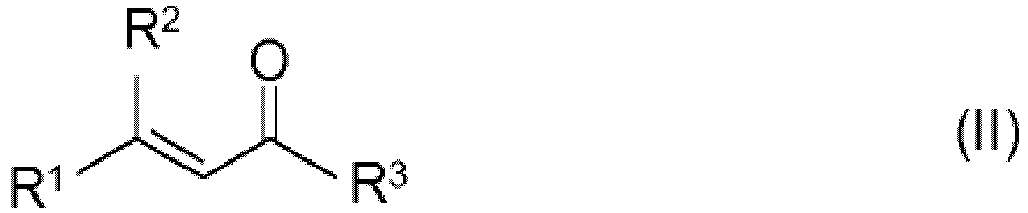
en présence de catalyseurs de métaux de transition optiquement actifs, solubles dans le mélange réactionnel, qui comprennent au moins un ligand monoxyde de carbone, un précurseur de catalyseur étant prétraité avec un mélange gazeux contenant du monoxyde de carbone et de l'hydrogène pour la fabrication du catalyseur optiquement actif comprenant au moins un ligand monoxyde de carbone à utiliser à chaque fois, et l'hydrogénation asymétrique étant réalisée en présence de monoxyde de carbone en outre introduit dans le mélange réactionnel, selon les étapes successives suivantes :a) le prétraitement du précurseur de catalyseur avec un mélange gazeux comprenant 30 à 70 % en volume de monoxyde de carbone, 30 à 70 % en volume d'hydrogène et 0 à 5 % en volume d'autres gaz, la somme des proportions volumiques indiquées étant de 100 % en volume, est réalisé à une pression de 50 à 90 bar,b) le monoxyde de carbone en excès est séparé du catalyseur ainsi obtenu avant l'utilisation dans l'hydrogénation asymétrique, par détente du catalyseur prétraité selon l'étape a) à une pression dans la plage allant de 1 à 3 bar, etc) l'hydrogénation asymétrique est réalisée en présence d'hydrogène à une teneur en monoxyde de carbone de 100 à 1 200 ppm,et le produit de réaction obtenu est séparé du mélange réactionnel et le catalyseur restant est utilisé après le prétraitement selon l'étape a) pour des réactions ultérieures. - Procédé selon la revendication 1 pour la fabrication d'aldéhydes optiquement actifs de formule (III)
 R10 représente un radical alkyle non ramifié ou ramifié de 2 à 25 atomes de carbone, qui peut éventuellement comprendre 1 à 5 doubles liaisons éthyléniques, et* désigne un atome de carbone asymétrique,par hydrogénation asymétrique d'aldéhydes α,β-insaturés de formule (IV) ou (V)

- Procédé selon la revendication 2, pour la fabrication de citronellal optiquement actif de formule (VI)


- Procédé selon la revendication 3 pour la fabrication de D-citronellal par hydrogénation asymétrique de néral.
- Procédé selon l'une quelconque des revendications 1 à 4, caractérisé en ce qu'un précurseur de catalyseur de métal de transition est utilisé, qui peut être obtenu par réaction d'au moins un composé de métal de transition soluble dans le mélange réactionnel avec un ligand optiquement actif, qui comprend au moins un atome de phosphore et/ou d'arsenic.
- Procédé selon la revendication 5, caractérisé en ce qu'en tant que ligand optiquement actif, un composé de formule générale (IX), (X) ou (XI)
 R11, R12 représentent chacun indépendamment l'un de l'autre un radical alkyle non ramifié, ramifié ou cyclique de 1 à 20 atomes de carbone, qui peut éventuellement porter une ou plusieurs, généralement 1 à environ 4, doubles liaisons éthyléniques, et/ou un ou plusieurs, généralement 1 à environ 4, substituants identiques ou différents choisis dans le groupe constitué par les substituants OR19, NR20R21, halogène, aryle en C6-C10 et hétaryle en C3-C9, et R11 et R12 peuvent former ensemble un cycle de 4 à 20 éléments, qui peut contenir un ou plusieurs, généralement 1 ou 2, atomes 0, etR13, R14 signifient chacun indépendamment l'un de l'autre hydrogène ou alkyle en C1 à C4 linéaire ou ramifié, etR15, R16, R17, R18 représentent chacun aryle en C6 à C10, qui peut éventuellement porter un ou plusieurs, généralement 1 à 8, de préférence 1 à 4, substituants choisis dans le groupe constitué par les substituants alkyle en C1 à C4, aryle en C6 à C10, alcoxy en C1 à C4 et amino, etest utilisé.
R19, R20, R21 signifient chacun indépendamment les uns des autres hydrogène, alkyle en C1-C4, aryle en C6-C10, aralkyle en C7-C12 ou alkylaryle en C7-C12, R20, R21 pouvant également signifier ensemble une chaîne alkylène de 2 à 5 atomes de carbone, qui peut être interrompue par N ou 0, - Procédé selon la revendication 5 ou 6, caractérisé en ce que le composé de métal de transition est un composé d'un métal du groupe de transition VIII du tableau périodique des éléments.
- Procédé selon l'une quelconque des revendications 5 à 7, caractérisé en ce qu'un composé du métal rhodium ou iridium est utilisé.
- Procédé selon l'une quelconque des revendications 5 à 8, caractérisé en ce que le composé de métal de transition est un composé de rhodium.
- Procédé selon l'une quelconque des revendications 5 à 9, caractérisé en ce qu'un ligand optiquement actif de formule (IX) est utilisé, les radicaux R11, R12 et R15 à R18 ayant les significations indiquées précédemment.
- Procédé selon l'une quelconque des revendications 5 à 10, qu'en tant que ligand optiquement actif, le ligand de formule (1) (S,S-chiraphos) ou ent-(1) (R,R-chiraphos)

- Procédé selon l'une quelconque des revendications 1 à 11, caractérisé en ce que l'hydrogénation asymétrique est réalisée à une pression de 10 à 100 bar.
- Procédé selon l'une quelconque des revendications 1 à 12, caractérisé en ce que le prétraitement du précurseur de catalyseur selon l'étape a) est réalisé avec un mélange gazeux comprenant 40 à 60 % en volume de monoxyde de carbone, 60 à 40 % en volume d'hydrogène et 0 à 5 % en volume d'autres gaz, la somme des proportions volumiques étant de 100 % en volume.
- Procédé selon l'une quelconque des revendications 1 à 13, caractérisé en ce que l'hydrogénation asymétrique selon l'étape c) est réalisée en présence d'hydrogène ayant une teneur en monoxyde de carbone de 400 à 800 ppm.
- Procédé selon l'une quelconque des revendications 1 à 14, caractérisé en ce que l'hydrogénation asymétrique selon l'étape c) est réalisée dans un réacteur à circulation de gaz.
- Procédé selon la revendication 15, caractérisé en ce que les aldéhydes ou cétones α,β-insaturés et l'hydrogène à mettre en réaction sont introduits dans le réacteur à circulation de gaz par une buse à deux composants.
- Procédé de fabrication de menthol optiquement actif, comprenant les étapes suivantes :i) la fabrication de citronellal optiquement actif selon l'une quelconque des revendications 1 à 16,ii) la cyclisation du citronellal optiquement actif ainsi fabriqué en isopulégol optiquement actif en présence d'un acide de Lewis, etiii) l'hydrogénation de l'isopulégol optiquement actif ainsi fabriqué en menthol optiquement actif.
Priority Applications (1)
| Application Number | Priority Date | Filing Date | Title |
|---|---|---|---|
| EP08736312.3A EP2139835B1 (fr) | 2007-04-25 | 2008-04-17 | Procédé pour produire des composés carbonyle optiquement actifs |
Applications Claiming Priority (3)
| Application Number | Priority Date | Filing Date | Title |
|---|---|---|---|
| EP07106922 | 2007-04-25 | ||
| PCT/EP2008/054644 WO2008132057A1 (fr) | 2007-04-25 | 2008-04-17 | Procédé pour produire des composés carbonyle optiquement actifs |
| EP08736312.3A EP2139835B1 (fr) | 2007-04-25 | 2008-04-17 | Procédé pour produire des composés carbonyle optiquement actifs |
Publications (2)
| Publication Number | Publication Date |
|---|---|
| EP2139835A1 EP2139835A1 (fr) | 2010-01-06 |
| EP2139835B1 true EP2139835B1 (fr) | 2017-05-10 |
Family
ID=39592078
Family Applications (1)
| Application Number | Title | Priority Date | Filing Date |
|---|---|---|---|
| EP08736312.3A Active EP2139835B1 (fr) | 2007-04-25 | 2008-04-17 | Procédé pour produire des composés carbonyle optiquement actifs |
Country Status (6)
| Country | Link |
|---|---|
| US (1) | US7973198B2 (fr) |
| EP (1) | EP2139835B1 (fr) |
| JP (1) | JP5479320B2 (fr) |
| CN (1) | CN101675020B (fr) |
| ES (1) | ES2636840T3 (fr) |
| WO (1) | WO2008132057A1 (fr) |
Families Citing this family (20)
| Publication number | Priority date | Publication date | Assignee | Title |
|---|---|---|---|---|
| DE102008015773A1 (de) * | 2008-03-26 | 2009-10-01 | Albert-Ludwigs-Universität Freiburg | Verfahren zur decarboxylativen Hydroformylierung alpha,beta-ungesättigter Carbonsäuren |
| KR101095103B1 (ko) * | 2010-06-15 | 2011-12-16 | 율촌화학 주식회사 | 암모니아 보란계 화합물 수소 저장체로부터의 수소 발생 장치 및 방법, 이에 이용되는 촉매, 방출 수소의 이용 장치 |
| JP5560464B2 (ja) * | 2010-11-29 | 2014-07-30 | 高砂香料工業株式会社 | 不斉水素化触媒 |
| JP5913352B2 (ja) * | 2010-11-29 | 2016-04-27 | 高砂香料工業株式会社 | 不斉水素化触媒、およびそれを用いた光学活性カルボニル化合物の製造方法 |
| DE102013103563A1 (de) * | 2013-04-10 | 2014-10-16 | Basf Se | Verfahren zur Herstellung von Citronellal |
| EP3233778B1 (fr) * | 2014-12-19 | 2019-02-20 | Basf Se | Procédé de fabrication de composés carbonyle optiques actifs |
| CN105218335B (zh) * | 2015-10-20 | 2017-06-16 | 万华化学集团股份有限公司 | 一种由柠檬醛不对称催化氢化制备手性香茅醛的方法 |
| CN105541579B (zh) * | 2015-12-30 | 2018-07-17 | 浙江新和成股份有限公司 | 一种制备光学活性羰基化合物的方法 |
| JP7098532B2 (ja) | 2016-05-06 | 2022-07-11 | ビーエーエスエフ ソシエタス・ヨーロピア | P-キラルホスフィン配位子及び不斉合成へのその使用 |
| MY205693A (en) | 2018-09-05 | 2024-11-07 | Basf Se | Reactor for carrying out a gas-liquid two-phase high-pressure reaction with a foaming medium |
| WO2020048998A1 (fr) | 2018-09-05 | 2020-03-12 | Basf Se | Procédé de mise en œuvre d'une réaction biphasique gaz/liquide à haute pression |
| WO2020048975A1 (fr) | 2018-09-05 | 2020-03-12 | Basf Se | Production continue d'un composé carbonyle optiquement actif par hydrogénation asymétrique |
| EP3846927B1 (fr) | 2018-09-05 | 2022-11-23 | Basf Se | Réacteur destiné à la mise en oeuvre d'une réaction entre deux fluides non miscibles de densité différente |
| CN111056932A (zh) * | 2019-12-09 | 2020-04-24 | 万华化学集团股份有限公司 | 一种制备光学活性香茅醛的方法 |
| WO2021114021A1 (fr) * | 2019-12-09 | 2021-06-17 | 万华化学集团股份有限公司 | Procédé de préparation pour un citronellal optiquement actif |
| CN110872217A (zh) * | 2019-12-09 | 2020-03-10 | 万华化学集团股份有限公司 | 一种光学活性的香茅醛的制备方法 |
| CN111004102B (zh) * | 2019-12-23 | 2022-11-04 | 万华化学集团股份有限公司 | 一种制备光学活性香茅醛的方法及用于该方法的催化剂 |
| CN111056933B (zh) * | 2019-12-24 | 2022-11-08 | 万华化学集团股份有限公司 | 一种制备光学活性香茅醛的方法及用于该方法的催化剂体系 |
| EP4136065B1 (fr) | 2020-04-14 | 2024-04-24 | Basf Se | Hydrogénation de l-sorbose |
| WO2025191084A1 (fr) | 2024-03-15 | 2025-09-18 | Basf Se | Composés rhodium-carbonyle destinés à être utilisés en tant que catalyseurs d'hydrogénation sélectifs |
Family Cites Families (8)
| Publication number | Priority date | Publication date | Assignee | Title |
|---|---|---|---|---|
| JPS5278812A (en) * | 1975-12-26 | 1977-07-02 | Nikki Chem Co Ltd | Selective production method of saturated aldehyde |
| FR2396735A1 (fr) * | 1977-07-04 | 1979-02-02 | Rhone Poulenc Ind | Procede de preparation de citronellal optiquement actif |
| JPH05278812A (ja) | 1992-04-06 | 1993-10-26 | Murata Mach Ltd | スタッカクレーン |
| DE19854637A1 (de) | 1998-11-26 | 2000-05-31 | Basf Ag | Reaktor zur kontinuierlichen Durchführung von Gas-Flüssig-, Flüssig-Flüssig- oder Gas-Flüssig-Fest-Reaktionen |
| JP4676617B2 (ja) | 2001-01-18 | 2011-04-27 | 高砂香料工業株式会社 | イソプレゴールの製造方法 |
| DE102004049631A1 (de) * | 2004-10-11 | 2006-04-20 | Basf Ag | Verfahren zur Herstellung optisch aktiver Carbonylverbindungen |
| DE102005036340A1 (de) | 2005-07-29 | 2007-02-01 | Basf Ag | Verfahren zur Herstellung optisch aktiver Bis-Phosphinylalkane |
| DE102005040655A1 (de) | 2005-08-26 | 2007-03-01 | Basf Ag | Verfahren zur Herstellung von angereichertem Isopulegol |
-
2008
- 2008-04-17 WO PCT/EP2008/054644 patent/WO2008132057A1/fr not_active Ceased
- 2008-04-17 ES ES08736312.3T patent/ES2636840T3/es active Active
- 2008-04-17 EP EP08736312.3A patent/EP2139835B1/fr active Active
- 2008-04-17 US US12/597,025 patent/US7973198B2/en active Active
- 2008-04-17 JP JP2010504637A patent/JP5479320B2/ja active Active
- 2008-04-17 CN CN2008800136150A patent/CN101675020B/zh active Active
Also Published As
| Publication number | Publication date |
|---|---|
| US20100152494A1 (en) | 2010-06-17 |
| WO2008132057A1 (fr) | 2008-11-06 |
| JP2010525008A (ja) | 2010-07-22 |
| EP2139835A1 (fr) | 2010-01-06 |
| CN101675020A (zh) | 2010-03-17 |
| CN101675020B (zh) | 2013-11-06 |
| JP5479320B2 (ja) | 2014-04-23 |
| US7973198B2 (en) | 2011-07-05 |
| ES2636840T3 (es) | 2017-10-09 |
Similar Documents
| Publication | Publication Date | Title |
|---|---|---|
| EP2139835B1 (fr) | Procédé pour produire des composés carbonyle optiquement actifs | |
| EP1802561B1 (fr) | Procede pour preparer des composes de carbonyle optiquement actifs | |
| EP3233778B1 (fr) | Procédé de fabrication de composés carbonyle optiques actifs | |
| EP4103571B1 (fr) | Hydroformylation basse pression de diisobutène | |
| EP2545026A1 (fr) | Procédé de préparation de diesters d'acides alpha, oméga-dicarboxyliques linéaires | |
| EP3319951B1 (fr) | Procede d'hydroformylation de 2 butadienes substitues et destine a la fabrications de produits secondes, en particulier d'ambroxol | |
| DE102004057277A1 (de) | Verfahren zur Herstellung von Menthol | |
| EP2254895A1 (fr) | Composés de phosphore contenant des groupes imidazole | |
| WO2001058589A1 (fr) | COMPOSES DU PHOSPHORE, DE L'ARSENIC ET DE L'ANTIMOINE A BASE DE CORPS DE BASE BICYCLO `2.2.N! DIARYLANNELES | |
| WO2021001240A1 (fr) | Hydrogénation d'esters en vue d'obtenir des alcools en présence d'un complexe de ru-pnn | |
| EP0780157A1 (fr) | Complexe de ruthénium avec des ligands phosphinoxazoline chiral et bidentés pour l'hydrogénation transfert énantiosélective des cetones prochirales | |
| DE102009016651B4 (de) | Verfahren zur Herstellung von Aldehyden | |
| WO2014135413A1 (fr) | Dérivés oxo du limonène | |
| DE69707533T2 (de) | Verfahren zur Herstellung von 3-Formyl-tetrahydrofuran | |
| EP1604966B1 (fr) | Procédé de préparation tricyclo-[5.2.1.0 2,6]-décène diméthylol | |
| DE3875281T2 (de) | Herstellung von pseudoiononen. | |
| DE60103263T2 (de) | Einstufiges verfahren zur herstellung von 1,3 diol | |
| DE69813297T2 (de) | Asymmetrische hydrierung | |
| EP1595885A2 (fr) | Composés diphosphorés chiraux et leurs complexes avec des métaux de transition | |
| EP3847151B1 (fr) | Procédé continu pour préparer un composé carbonylé optiquement actif par hydrogénation asymétrique | |
| DE10041571A1 (de) | Verfahren der katalytischen Spaltung von Lactonen | |
| EP1280811A1 (fr) | Procede d'hydroformylation, composes pontes du phosphore, de l'arsenic et de l'antimoine et catalyseur comprenant un complexe de ces composes pontes | |
| EP2657216B1 (fr) | Procédé de basculement du farnésol au nérolidol en présence d'alpha-bisabolol | |
| EP2855409B1 (fr) | Procédé de préparation de mélanges | |
| DE10124390A1 (de) | Verfahren zur Herstellung von 2-Ethylheptanol aus 2-Ethyliden-6-hepten-5-olid |
Legal Events
| Date | Code | Title | Description |
|---|---|---|---|
| PUAI | Public reference made under article 153(3) epc to a published international application that has entered the european phase |
Free format text: ORIGINAL CODE: 0009012 |
|
| 17P | Request for examination filed |
Effective date: 20091125 |
|
| AK | Designated contracting states |
Kind code of ref document: A1 Designated state(s): AT BE BG CH CY CZ DE DK EE ES FI FR GB GR HR HU IE IS IT LI LT LU LV MC MT NL NO PL PT RO SE SI SK TR |
|
| DAX | Request for extension of the european patent (deleted) | ||
| 17Q | First examination report despatched |
Effective date: 20150417 |
|
| GRAP | Despatch of communication of intention to grant a patent |
Free format text: ORIGINAL CODE: EPIDOSNIGR1 |
|
| INTG | Intention to grant announced |
Effective date: 20161201 |
|
| GRAS | Grant fee paid |
Free format text: ORIGINAL CODE: EPIDOSNIGR3 |
|
| GRAA | (expected) grant |
Free format text: ORIGINAL CODE: 0009210 |
|
| AK | Designated contracting states |
Kind code of ref document: B1 Designated state(s): AT BE BG CH CY CZ DE DK EE ES FI FR GB GR HR HU IE IS IT LI LT LU LV MC MT NL NO PL PT RO SE SI SK TR |
|
| REG | Reference to a national code |
Ref country code: GB Ref legal event code: FG4D Free format text: NOT ENGLISH |
|
| REG | Reference to a national code |
Ref country code: AT Ref legal event code: REF Ref document number: 892155 Country of ref document: AT Kind code of ref document: T Effective date: 20170515 Ref country code: CH Ref legal event code: EP |
|
| REG | Reference to a national code |
Ref country code: IE Ref legal event code: FG4D Free format text: LANGUAGE OF EP DOCUMENT: GERMAN |
|
| REG | Reference to a national code |
Ref country code: DE Ref legal event code: R096 Ref document number: 502008015301 Country of ref document: DE |
|
| REG | Reference to a national code |
Ref country code: NL Ref legal event code: FP |
|
| REG | Reference to a national code |
Ref country code: LT Ref legal event code: MG4D |
|
| REG | Reference to a national code |
Ref country code: ES Ref legal event code: FG2A Ref document number: 2636840 Country of ref document: ES Kind code of ref document: T3 Effective date: 20171009 |
|
| PG25 | Lapsed in a contracting state [announced via postgrant information from national office to epo] |
Ref country code: LT Free format text: LAPSE BECAUSE OF FAILURE TO SUBMIT A TRANSLATION OF THE DESCRIPTION OR TO PAY THE FEE WITHIN THE PRESCRIBED TIME-LIMIT Effective date: 20170510 Ref country code: FI Free format text: LAPSE BECAUSE OF FAILURE TO SUBMIT A TRANSLATION OF THE DESCRIPTION OR TO PAY THE FEE WITHIN THE PRESCRIBED TIME-LIMIT Effective date: 20170510 Ref country code: HR Free format text: LAPSE BECAUSE OF FAILURE TO SUBMIT A TRANSLATION OF THE DESCRIPTION OR TO PAY THE FEE WITHIN THE PRESCRIBED TIME-LIMIT Effective date: 20170510 Ref country code: GR Free format text: LAPSE BECAUSE OF FAILURE TO SUBMIT A TRANSLATION OF THE DESCRIPTION OR TO PAY THE FEE WITHIN THE PRESCRIBED TIME-LIMIT Effective date: 20170811 Ref country code: NO Free format text: LAPSE BECAUSE OF FAILURE TO SUBMIT A TRANSLATION OF THE DESCRIPTION OR TO PAY THE FEE WITHIN THE PRESCRIBED TIME-LIMIT Effective date: 20170810 |
|
| PG25 | Lapsed in a contracting state [announced via postgrant information from national office to epo] |
Ref country code: SE Free format text: LAPSE BECAUSE OF FAILURE TO SUBMIT A TRANSLATION OF THE DESCRIPTION OR TO PAY THE FEE WITHIN THE PRESCRIBED TIME-LIMIT Effective date: 20170510 Ref country code: IS Free format text: LAPSE BECAUSE OF FAILURE TO SUBMIT A TRANSLATION OF THE DESCRIPTION OR TO PAY THE FEE WITHIN THE PRESCRIBED TIME-LIMIT Effective date: 20170910 Ref country code: PL Free format text: LAPSE BECAUSE OF FAILURE TO SUBMIT A TRANSLATION OF THE DESCRIPTION OR TO PAY THE FEE WITHIN THE PRESCRIBED TIME-LIMIT Effective date: 20170510 Ref country code: LV Free format text: LAPSE BECAUSE OF FAILURE TO SUBMIT A TRANSLATION OF THE DESCRIPTION OR TO PAY THE FEE WITHIN THE PRESCRIBED TIME-LIMIT Effective date: 20170510 Ref country code: BG Free format text: LAPSE BECAUSE OF FAILURE TO SUBMIT A TRANSLATION OF THE DESCRIPTION OR TO PAY THE FEE WITHIN THE PRESCRIBED TIME-LIMIT Effective date: 20170810 |
|
| PG25 | Lapsed in a contracting state [announced via postgrant information from national office to epo] |
Ref country code: SK Free format text: LAPSE BECAUSE OF FAILURE TO SUBMIT A TRANSLATION OF THE DESCRIPTION OR TO PAY THE FEE WITHIN THE PRESCRIBED TIME-LIMIT Effective date: 20170510 Ref country code: DK Free format text: LAPSE BECAUSE OF FAILURE TO SUBMIT A TRANSLATION OF THE DESCRIPTION OR TO PAY THE FEE WITHIN THE PRESCRIBED TIME-LIMIT Effective date: 20170510 Ref country code: RO Free format text: LAPSE BECAUSE OF FAILURE TO SUBMIT A TRANSLATION OF THE DESCRIPTION OR TO PAY THE FEE WITHIN THE PRESCRIBED TIME-LIMIT Effective date: 20170510 Ref country code: EE Free format text: LAPSE BECAUSE OF FAILURE TO SUBMIT A TRANSLATION OF THE DESCRIPTION OR TO PAY THE FEE WITHIN THE PRESCRIBED TIME-LIMIT Effective date: 20170510 Ref country code: CZ Free format text: LAPSE BECAUSE OF FAILURE TO SUBMIT A TRANSLATION OF THE DESCRIPTION OR TO PAY THE FEE WITHIN THE PRESCRIBED TIME-LIMIT Effective date: 20170510 |
|
| REG | Reference to a national code |
Ref country code: DE Ref legal event code: R097 Ref document number: 502008015301 Country of ref document: DE |
|
| PG25 | Lapsed in a contracting state [announced via postgrant information from national office to epo] |
Ref country code: IT Free format text: LAPSE BECAUSE OF FAILURE TO SUBMIT A TRANSLATION OF THE DESCRIPTION OR TO PAY THE FEE WITHIN THE PRESCRIBED TIME-LIMIT Effective date: 20170510 |
|
| PLBE | No opposition filed within time limit |
Free format text: ORIGINAL CODE: 0009261 |
|
| STAA | Information on the status of an ep patent application or granted ep patent |
Free format text: STATUS: NO OPPOSITION FILED WITHIN TIME LIMIT |
|
| 26N | No opposition filed |
Effective date: 20180213 |
|
| REG | Reference to a national code |
Ref country code: FR Ref legal event code: PLFP Year of fee payment: 11 |
|
| PG25 | Lapsed in a contracting state [announced via postgrant information from national office to epo] |
Ref country code: SI Free format text: LAPSE BECAUSE OF FAILURE TO SUBMIT A TRANSLATION OF THE DESCRIPTION OR TO PAY THE FEE WITHIN THE PRESCRIBED TIME-LIMIT Effective date: 20170510 |
|
| PG25 | Lapsed in a contracting state [announced via postgrant information from national office to epo] |
Ref country code: MT Free format text: LAPSE BECAUSE OF FAILURE TO SUBMIT A TRANSLATION OF THE DESCRIPTION OR TO PAY THE FEE WITHIN THE PRESCRIBED TIME-LIMIT Effective date: 20170510 |
|
| PG25 | Lapsed in a contracting state [announced via postgrant information from national office to epo] |
Ref country code: MC Free format text: LAPSE BECAUSE OF FAILURE TO SUBMIT A TRANSLATION OF THE DESCRIPTION OR TO PAY THE FEE WITHIN THE PRESCRIBED TIME-LIMIT Effective date: 20170510 |
|
| REG | Reference to a national code |
Ref country code: BE Ref legal event code: MM Effective date: 20180430 |
|
| REG | Reference to a national code |
Ref country code: IE Ref legal event code: MM4A |
|
| PG25 | Lapsed in a contracting state [announced via postgrant information from national office to epo] |
Ref country code: LU Free format text: LAPSE BECAUSE OF NON-PAYMENT OF DUE FEES Effective date: 20180417 |
|
| PG25 | Lapsed in a contracting state [announced via postgrant information from national office to epo] |
Ref country code: BE Free format text: LAPSE BECAUSE OF NON-PAYMENT OF DUE FEES Effective date: 20180430 |
|
| PG25 | Lapsed in a contracting state [announced via postgrant information from national office to epo] |
Ref country code: IE Free format text: LAPSE BECAUSE OF NON-PAYMENT OF DUE FEES Effective date: 20180417 |
|
| REG | Reference to a national code |
Ref country code: AT Ref legal event code: MM01 Ref document number: 892155 Country of ref document: AT Kind code of ref document: T Effective date: 20180417 |
|
| PG25 | Lapsed in a contracting state [announced via postgrant information from national office to epo] |
Ref country code: AT Free format text: LAPSE BECAUSE OF NON-PAYMENT OF DUE FEES Effective date: 20180417 |
|
| PG25 | Lapsed in a contracting state [announced via postgrant information from national office to epo] |
Ref country code: TR Free format text: LAPSE BECAUSE OF FAILURE TO SUBMIT A TRANSLATION OF THE DESCRIPTION OR TO PAY THE FEE WITHIN THE PRESCRIBED TIME-LIMIT Effective date: 20170510 |
|
| PG25 | Lapsed in a contracting state [announced via postgrant information from national office to epo] |
Ref country code: PT Free format text: LAPSE BECAUSE OF FAILURE TO SUBMIT A TRANSLATION OF THE DESCRIPTION OR TO PAY THE FEE WITHIN THE PRESCRIBED TIME-LIMIT Effective date: 20170510 Ref country code: HU Free format text: LAPSE BECAUSE OF FAILURE TO SUBMIT A TRANSLATION OF THE DESCRIPTION OR TO PAY THE FEE WITHIN THE PRESCRIBED TIME-LIMIT; INVALID AB INITIO Effective date: 20080417 |
|
| PG25 | Lapsed in a contracting state [announced via postgrant information from national office to epo] |
Ref country code: CY Free format text: LAPSE BECAUSE OF FAILURE TO SUBMIT A TRANSLATION OF THE DESCRIPTION OR TO PAY THE FEE WITHIN THE PRESCRIBED TIME-LIMIT Effective date: 20170510 |
|
| P01 | Opt-out of the competence of the unified patent court (upc) registered |
Effective date: 20230404 |
|
| PGFP | Annual fee paid to national office [announced via postgrant information from national office to epo] |
Ref country code: NL Payment date: 20250424 Year of fee payment: 18 |
|
| PGFP | Annual fee paid to national office [announced via postgrant information from national office to epo] |
Ref country code: DE Payment date: 20250428 Year of fee payment: 18 |
|
| PGFP | Annual fee paid to national office [announced via postgrant information from national office to epo] |
Ref country code: ES Payment date: 20250513 Year of fee payment: 18 |
|
| PGFP | Annual fee paid to national office [announced via postgrant information from national office to epo] |
Ref country code: FR Payment date: 20250424 Year of fee payment: 18 |
|
| PGFP | Annual fee paid to national office [announced via postgrant information from national office to epo] |
Ref country code: CH Payment date: 20250501 Year of fee payment: 18 |
|
| PGFP | Annual fee paid to national office [announced via postgrant information from national office to epo] |
Ref country code: GB Payment date: 20260225 Year of fee payment: 19 |