EP2140253B1 - Interface utilisateur destinée à être utilisée lors des contrôles de sécurité et comportant des fonctions d'amélioration d'image, et dispositif mettant en uvre ladite interface - Google Patents
Interface utilisateur destinée à être utilisée lors des contrôles de sécurité et comportant des fonctions d'amélioration d'image, et dispositif mettant en uvre ladite interface Download PDFInfo
- Publication number
- EP2140253B1 EP2140253B1 EP08714598.3A EP08714598A EP2140253B1 EP 2140253 B1 EP2140253 B1 EP 2140253B1 EP 08714598 A EP08714598 A EP 08714598A EP 2140253 B1 EP2140253 B1 EP 2140253B1
- Authority
- EP
- European Patent Office
- Prior art keywords
- image
- interest
- area
- receptacle
- user
- Prior art date
- Legal status (The legal status is an assumption and is not a legal conclusion. Google has not performed a legal analysis and makes no representation as to the accuracy of the status listed.)
- Active
Links
Images






Classifications
-
- G—PHYSICS
- G06—COMPUTING OR CALCULATING; COUNTING
- G06T—IMAGE DATA PROCESSING OR GENERATION, IN GENERAL
- G06T11/00—Two-dimensional [2D] image generation
-
- G—PHYSICS
- G06—COMPUTING OR CALCULATING; COUNTING
- G06V—IMAGE OR VIDEO RECOGNITION OR UNDERSTANDING
- G06V20/00—Scenes; Scene-specific elements
-
- G—PHYSICS
- G06—COMPUTING OR CALCULATING; COUNTING
- G06T—IMAGE DATA PROCESSING OR GENERATION, IN GENERAL
- G06T2200/00—Indexing scheme for image data processing or generation, in general
- G06T2200/24—Indexing scheme for image data processing or generation, in general involving graphical user interfaces [GUIs]
-
- G—PHYSICS
- G06—COMPUTING OR CALCULATING; COUNTING
- G06T—IMAGE DATA PROCESSING OR GENERATION, IN GENERAL
- G06T2207/00—Indexing scheme for image analysis or image enhancement
- G06T2207/10—Image acquisition modality
- G06T2207/10116—X-ray image
-
- G—PHYSICS
- G06—COMPUTING OR CALCULATING; COUNTING
- G06T—IMAGE DATA PROCESSING OR GENERATION, IN GENERAL
- G06T2207/00—Indexing scheme for image analysis or image enhancement
- G06T2207/30—Subject of image; Context of image processing
- G06T2207/30108—Industrial image inspection
- G06T2207/30112—Baggage; Luggage; Suitcase
Definitions
- the present invention relates generally to security systems and, more particularly, to a user interface providing image enhancement capabilities for use in screening luggage, mail parcels or cargo containers to identify certain objects located therein or for screening persons to identify certain objects located thereon and to a method and system for implementing such a user interface.
- security-screening systems at airports make use of devices generating penetrating radiation, such as x-ray devices, to scan individual pieces of luggage to generate an image conveying the contents of the luggage.
- the image is displayed on a screen and is examined by a human operator whose task it is to identify, on the basis of the image, potentially threatening objects located in the luggage.
- a deficiency with current systems is that they are entirely reliant on the human operator to identify potentially threatening objects.
- the performance of the human operator greatly varies according to such factors as poor training and fatigue.
- the process of detection and identification of threatening objects is highly susceptible to human error.
- the invention provides a method for facilitating visual identification of a prohibited object in an image during security screening.
- the method comprises receiving data conveying an image of the contents of a receptacle derived from an apparatus that scans the receptacle with penetrating radiation.
- the method also comprises receiving information from an automated threat detection processor indicating an area of interest in the image potentially containing a prohibited object.
- the method also comprises processing the image to generate an enhanced image in which portions outside the area of interest are visually de-emphasized.
- the method also comprises displaying the enhanced image on a display device.
- the enhanced image displayed to the user conveys the area of interest in a visually contrasting manner relative to portions of the image outside the area of interest.
- the attention of screening operators is led to an area of the enhanced image identified as an area of interest and that likely represents a higher risk of hiding a potential threat there by facilitating visual identification of a prohibited object in an image.
- the method comprises receiving information from an automated threat detection processor indicating a plurality of areas of interest in the image potentially containing respective prohibited objects.
- the method also comprises processing the image to generate the enhanced image in which portions outside the areas of interest are visually de-emphasized.
- portions of the enhanced image inside the area of interest are visually emphasized.
- generating an enhanced image by concurrently de-emphasizing portions of the image outside the area of interest and emphasizing portions of the image inside the area of interest, provides an improved visual cue for directing the visual attention of a screener to an area of the image most likely to contain a prohibited object.
- the method comprises providing a user control allowing a user to select either one of the image conveyed by the data received and the enhanced image to be displayed on the display device.
- the method comprises providing a user control allowing a user to select a level of enhancement from a set of possible levels of enhancement.
- the method comprises processing the image to generate the enhanced image such that portions outside the area of interest in the enhanced image are visually de-emphasized at least in part based on the selected level of enhancement.
- the method comprises processing the image to generate the enhanced image such that portions inside the area of interest in the enhanced image are visually emphasized at least in part based on the selected level of enhancement.
- the method comprises providing a first user control and a second user control for allowing a user to select a first level of enhancement and a second level of enhancement from a set of possible levels of enhancement.
- the method comprises processing the image to generate the enhanced image such that portions inside the area of interest in the enhanced image are visually emphasized at least in part based on the selected second level of enhancement and portions outside the area of interest are visually de-emphasized at least in part based on the selected first level of enhancement.
- the method comprises providing a user control allowing a user to select a level of enlargement from a set of possible levels of enlargement.
- the method also comprises processing the image to generate the enhanced image such that portions inside the area of interest are enlarged at least in part based on the selected level of enlargement such that features of the portion of the enhanced image inside the area of interest appear on a larger scale than features in portions of the enhanced image outside the area of interest.
- the invention provides and apparatus suitable for implementing a user interface for facilitating visual identification of a prohibited object in an image during security screening in accordance with the above described method.
- the invention provides a computer readable storage medium including a program element suitable for execution by a CPU for implementing a graphical user interface module for facilitating visual identification of a prohibited object in the image during security screening in accordance with the above described method.
- the invention provides a system for detecting the presence of one or more prohibited objects in a receptacle.
- the system includes an image generation apparatus, an automated threat detection processor, a display module and an apparatus for implementing a user interface module.
- the image generation apparatus is suitable for scanning a receptacle with penetrating radiation to generate data conveying an image of contents of the receptacle.
- the automated threat detection processor is in communication with the image generation apparatus and is adapted for processing the image to identify an area of interest in the image potentially containing a prohibited object.
- the apparatus is in communication with the image generation apparatus, the automated threat detection processor and the display module and implements a user interface module for facilitating visual identification of a prohibited object in an image during security screening.
- the apparatus comprises a first input for receiving the data conveying the image of the contents of the receptacle and a second input for receiving information indicating the area of interest in the image.
- the apparatus also comprises a processing unit in communication with the first input and the second input.
- the processing unit is operative for implementing the user interface module.
- the user interface module is adapted for processing the image to generate an enhanced image in which portions outside the area of interest are visually de-emphasized and for displaying the enhanced image on the display module.
- the invention provides a client-server system for implementing a graphical user interface module for facilitating visual identification of a prohibited object in an image during security screening.
- the client-server system comprising a client system and a server system operative to exchange messages over a data network.
- the server system stores a program element for execution by a CPU.
- the program element comprises a first program element component executed on the server system for receiving data conveying an image of the contents of a receptacle derived from an apparatus that scans the receptacle with penetrating radiation and for receiving information from an automated threat detection processor indicating an area of interest in the image potentially containing a prohibited object.
- the program element also comprises a second program element component executed on the server system for processing the image to generate an enhanced image in which portions outside the area of interest are visually de-emphasized.
- the program element comprises a third program element component executed on the server system for sending messages to the client system for causing the client system to display the enhanced image on a display device.
- the invention provides an apparatus for implementing a user interface module for facilitating visual identification of a prohibited object in an image during security screening.
- the apparatus comprises means for receiving data conveying an image of the contents of a receptacle derived from an apparatus that scans the receptacle with penetrating radiation.
- the apparatus also comprises means for receiving information from an automated threat detection processor indicating an area of interest in the image potentially containing a prohibited object.
- the apparatus also comprises means for processing the image to generate an enhanced image in which portions outside the area of interest are visually de-emphasized.
- the apparatus also comprises means for releasing a display signal, the display signal being suitable for causing a display device to display the enhanced image.
- the invention provides a method for facilitating visual identification of a prohibited object in an image during security screening.
- the method comprises receiving data conveying an image of the contents of a receptacle derived from an apparatus that scans the receptacle with penetrating radiation.
- the method also comprises receiving information from an automated threat detection processor indicating an area of interest in the image potentially containing a prohibited object.
- the method also comprises processing the image to generate an enhanced image in which features appearing inside the area of interest are visually emphasized.
- the method also comprises displaying the enhanced image on a display device.
- the method comprises providing a user control allowing a user to select either one of the received image and the enhanced image for display on the display device.
- the invention provides and apparatus suitable for implementing a user interface for facilitating visual identification of a prohibited object in an image during security screening in accordance with the above described method.
- the invention provides a computer readable storage medium including a program element suitable for execution by a CPU for implementing a graphical user interface module for facilitating visual identification of a prohibited object in the image during security screening in accordance with the above described method.
- the invention provides a system for detecting the presence of one or more prohibited objects in a receptacle.
- the system includes an image generation apparatus, an automated threat detection processor, a display module and an apparatus for implementing a user interface module.
- the image generation apparatus is suitable for scanning a receptacle with penetrating radiation to generate data conveying an image of contents of the receptacle.
- the automated threat detection processor is in communication with the image generation apparatus and is adapted for processing the image to identify an area of interest in the image potentially containing a prohibited object.
- the apparatus is in communication with the image generation apparatus, the automated threat detection processor and the display module and implements a user interface module for facilitating visual identification of a prohibited object in an image during security screening.
- the apparatus comprises a first input for receiving the data conveying the image of the contents of the receptacle and a second input for receiving information indicating the area of interest in the image.
- the apparatus also comprises a processing unit in communication with the first input and the second input.
- the processing unit is operative for implementing the user interface module.
- the user interface module is adapted for processing the image to generate an enhanced image in which features appearing inside the area of interest are visually emphasized and for displaying the enhanced image on the display module.
- the invention provides a client-server system for implementing a graphical user interface module for facilitating visual identification of a prohibited object in an image during security screening.
- the client-server system comprising a client system and a server system operative to exchange messages over a data network.
- the server system stores a program element for execution by a CPU.
- the program element comprises a first program element component executed on the server system for receiving data conveying an image of the contents of a receptacle derived from an apparatus that scans the receptacle with penetrating radiation and information from an automated threat detection processor indicating an area of interest in the image potentially containing a prohibited object.
- the program element also comprises a second program element component executed on the server system for processing the image to generate an enhanced image in which features appearing inside the area of interest are visually emphasized.
- the program element also comprises a third program element component executed on the server system for sending messages to the client system for causing the client system to display the enhanced image on a display device.
- the invention provides an apparatus for implementing a user interface module for facilitating visual identification of a prohibited object in an image during security screening.
- the apparatus comprises means for receiving data conveying an image of the contents of a receptacle derived from an apparatus that scans the receptacle with penetrating radiation.
- the apparatus also comprises means for receiving information from an automated threat detection processor indicating an area of interest in the image potentially containing a prohibited object.
- the apparatus also comprises means for processing the image to generate an enhanced image in which features appearing inside the area of interest are visually emphasized.
- the apparatus also comprises means for displaying the enhanced image on a display module.
- the invention provides a method for facilitating visual identification of prohibited objects in images associated with previously screened receptacles.
- the method comprises providing a plurality of records associated to respective previously screened receptacles.
- Each record includes an image of the contents of a receptacle derived from an apparatus that scans the receptacle with penetrating radiation and information derived from an automated threat detection processor and indicating an area of interest in the image potentially containing a prohibited object.
- the method also comprises displaying on a displaying device a first viewing space conveying a set of thumbnail images, each thumbnail image in the set of thumbnail images being derived from a record in the plurality of records.
- the method also comprises enabling a user to select at least one thumbnail image in the set of thumbnail images.
- the method also comprises displaying on the display device a second viewing space conveying an enhanced image derived from a certain record in the plurality of records corresponding to the selected at least one thumbnail image.
- the enhanced image is an enhanced previous image.
- the method further comprises receiving data conveying a current image of the contents of a currently screened receptacle derived from an apparatus that scans the currently screened receptacle with penetrating radiation.
- the method also includes receiving information from an automated threat detection processor indicating an area of interest in the current image potentially containing a prohibited object.
- the method also includes processing the current image to generate an enhanced current image in which portions outside the area of interest are visually de-emphasized.
- the method also includes enabling the user to select between the enhanced previous image and the enhanced current image.
- the method also includes displaying the selected on of the enhanced current image and the enhanced previous image on a display module.
- the invention provides a computer readable storage medium including a program element suitable for execution by a CPU for implementing a graphical user interface module for facilitating visual identification of a prohibited object in the image during security screening in accordance with the above described method.
- the invention provides an apparatus suitable for implementing a user interface for facilitating visual identification of a prohibited object in an image during security screening.
- the apparatus comprises a memory and a processing unit.
- the memory is suitable for storing a plurality of records associated to respective previously screened receptacles, each record including: an image of the contents of a receptacle derived from an apparatus that scans the receptacle with penetrating radiation; and information derived from an automated threat detection processor and indicating an area of interest in the image potentially containing a prohibited object.
- the processing unit is in communication with the memory unit and implements the user interface module.
- the user interface module is adapted for displaying on a displaying device a first viewing space conveying a set of thumbnail images, each thumbnail image in the set of thumbnail images being derived from a record in the plurality of records.
- the user interface module is also adapted for enabling a user to select at least one thumbnail image in the set of thumbnail images.
- the user interface module is also adapted for displaying on the display device a second viewing space conveying an enhanced image derived from a certain record in the plurality of records corresponding to the selected at least one thumbnail image.
- the invention provides a method for displaying information associated to a receptacle for use in detecting the presence of a threat in the receptacle during security screening.
- the method comprises receiving data conveying an image of the contents of a receptacle derived from an apparatus that scans the receptacle with penetrating radiation.
- the method also comprises receiving data conveying a level confidence that a threat has been detected in the receptacle.
- the method also comprises deriving a perceived level of threat associated with the receptacle at least in part based on the level confidence.
- the method also comprises displaying a screening image derived at least in part based on the data conveying the image of the contents of a receptacle.
- the method also comprises displaying concurrently with the screening image a threat probability scale, the threat probability scale conveying the perceived level of threat associated with the receptacle in graphical format.
- the invention provides and apparatus suitable for implementing a user interface for displaying information associated to a receptacle for use in detecting the presence of a threat in the receptacle during security screening in accordance with the above described method.
- the invention provides a computer readable storage medium including a program element suitable for execution by a CPU for implementing a graphical user interface module for displaying information associated to a receptacle for use in detecting the presence of a threat in the receptacle during security screening in accordance with the above described method.
- FIG. 1 Shown in Figure 1 is a system 100 for screening a receptacle in accordance with a specific example of implementation of the present invention.
- receptacle as used for the purposes of the present description, is used to broadly describe an entity adapted for receiving objects therein such as, for example, a luggage item, a cargo container or a mail parcel.
- the expression “luggage item” is used to broadly describe luggage, suitcases, handbags, backpacks, briefcases, boxes, parcels or any other similar type of item suitable for containing objects therein.
- the system 100 includes an image generation apparatus 102, an automated threat detection processor 106 in communication with the image generation apparatus 102 and an output module 108.
- the image generation apparatus 102 is adapted for scanning a receptacle 104 to generate data conveying an image of contents of the receptacle 104.
- the automated threat detection processor 106 receives the data conveying the image of contents of the receptacle 104 and processes that image to identify an area of interest in the image potentially containing a prohibited object.
- the automated threat detection processor 106 receives and processes the image from the image generation apparatus 102 in combination with a plurality of images associated with prohibited objects to detect a presence of at least one prohibited object in the receptacle 104.
- the plurality of images is stored in a database of prohibited objects 110.
- the automated threat detection processor 106 releases information indicating an area of interest in the image and, optionally, information conveying the identity of a prohibited object potentially detected in the receptacle 104. Examples of the manner in which the information indicating an area of interest in the image can be derived will be described later on in the specification.
- the output module 108 receives the data conveying the image of the contents of the receptacle from the image generation apparatus 102 and the information indicating the area of interest in the image from the automated threat detection processor 106.
- the output module 108 processes the image to generate an enhanced image based at least in part on the area of interest in the image conveyed by the information released by the automated threat detection processor 106.
- the output module 108 generates an enhanced image so that an operator's attention can be focused on areas of the image most likely to contain prohibited objects.
- the enhanced image displayed to the user conveys the area of interest in a visually contrasting manner relative to portions of the image outside the area of interest.
- the output module 108 may process the image to generate an enhanced image in which portions outside the area of interest are visually de-emphasized or in which features appearing inside the area of interest are visually emphasized.
- the output module 108 may process the image to generate an enhanced image in which portions outside the area of interest are visually de-emphasized and in which features appearing inside the area of interest are visually emphasized.
- the output module 108 then displays the enhanced image on a display module.
- the system 100 provides assistance to the human security personnel using the system by facilitating visual identification of a prohibited object in an image during security screening. More specifically, displaying the enhanced image allows focussing an operator's attention to areas most likely to contain a prohibited object thereby improving the security personnel's efficiency and productivity.
- the image generation apparatus 102 uses penetrating radiation or emitted radiation to generate data conveying an image of the contents of the receptacle 104.
- penetrating radiation or emitted radiation include, without being limited to, x-ray, gamma ray, computed tomography (CT scans), thermal imaging, TeraHertz and millimeter wave devices.
- CT scans computed tomography
- the image generation apparatus 102 is a conventional x-ray machine suitable for generating data conveying an x-ray image of the receptacle 104.
- the x-ray image conveys, amongst others, material density information in relation to objects within the receptacle.
- the data generated by the image generation apparatus 102 and conveying an image of the contents of the receptacle 104 may convey as a two-dimensional (2-D) image or a three-dimensional (3-D) image and may be in any suitable format. Possible formats include, without being limited to, JPEG, GIF, TIFF and bitmap amongst others.
- the database of prohibited objects 110 includes a plurality of entries associated to respective prohibited objects that the system 100 is designed to detect.
- a target image for each entry associated to a prohibited object at least one image (hereinafter referred to as a "target image") is provided in the database of prohibited objects 110.
- the format of the target images will depend upon the image processing algorithm implemented by the automated threat detection processor 106. More specifically, the format of the target images is such that a comparison operation can be performed by the automated threat detection processor 106 between the target images and data conveying an image of contents of the receptacle 104.
- a set of images is provided in the database of prohibited objects 110.
- images depicting the prohibited object in various orientations may be provided.
- characteristics of the prohibited object are provided. Such characteristics may include, without being limited to, the name of the prohibited object, its associated threat level, the recommended handling procedure when such a prohibited object is detected and any other suitable information.
- the threat level information associated to the target object convey the relative threat level of a prohibited object compared to other prohibited objects in the database of prohibited objects 110. For example, a gun would be given a relatively high threat level while a metallic nail file would be given a relatively low level threat level and a pocket knife would be given a threat level between that of the nail file and the gun.
- each entry in the database of prohibited objects 110 is also associated to a respective prohibited object identifier data element.
- the prohibited object typically constitutes a potential threat to the safety of the passenger or aircraft.
- the prohibited object is typically an object that is normally not permitted to be sent through the mail, such as guns (in Canada) for example, due to registration requirements/permits and so on.
- the database of prohibited objects 110 includes one or more entries associated to objects which are not prohibited but which may represent potential threats. For example, the presence of a metal plate or a metal canister in a piece of luggage going through luggage security screening is not prohibited in itself. However such objects may conceal one or more dangerous objects. As such, it is desirable to be able to detect the presence of such objects in receptacle such as to bring them to the attention of the security screeners.
- the specific design and content of the database of prohibited objects 110 may vary from one implementation to the next.
- the design of the database is not critical to the present invention and as such will not be described further here.
- database of prohibited objects 110 has been shown in Figure 1 to be a component separate from the automated threat detection processor 106, it will be appreciated that in certain embodiments the database of prohibited objects 110 may be part of automated threat detection processor 106. In addition, it will also be appreciated that in certain implementations, a same database of prohibited objects 110 may be shared between multiple threat detection processors 106. It will also be appreciated that in alternative examples of implementation of the present invention database of prohibited objects 110 may be omitted.
- the output module 108 displays to a user of the system 100 a user interface conveying an enhanced image of contents of the receptacle 104 for facilitating visual identification of a prohibited object.
- the output module 108 includes an output device 202 and an apparatus implementing a user interface module 200.
- the output device 202 may be any device suitable for conveying an enhanced image of contents of the receptacle to a user of the system 100.
- the output device 202 is in communication with the apparatus implementing a user interface module 200 and includes a display unit adapted for displaying in visual format information related to the presence of a prohibited object in the receptacle 104.
- the display unit may be part of a computing station or may be integrated into a hand-held portable device for example.
- the output device 202 includes a printer adapted for displaying in printed format information related to the presence of a prohibited object in the receptacle 104.
- the apparatus implementing a user interface module 200 receives data conveying an image of the contents of a receptacle derived from the image generation apparatus 102.
- the apparatus 200 also receives information from the automated threat detection processor 106 indicating an area of interest in the image potentially containing a prohibited object.
- the information received from the automated threat detection processor 106 also conveys a level of confidence associated to the area of interest that the area of interest contains a prohibited object.
- the information received from the automated threat detection processor 106 also conveys an identification of the prohibited object potentially detected in the image.
- the information received from the automated threat detection processor 106 conveying the area of interest includes location information conveying a location in the image of the contents of a receptacle derived from the image generation apparatus 102.
- the location information is an (X,Y) pixel location conveying the center of an area in the image.
- the area of interest is established based on the center location (X,Y) provided by the automated threat detection processor 106 in combination with a shape for the area.
- the shape of the area may be pre-determined in which case it may be of any suitable geometric shape and will have any suitable size.
- the shape and/or size of the area of interest may be determined by the user on the basis of a user configuration command.
- the shape and/or size of the area of interest is determined on the basis of information provided by the automated threat detection processor 106.
- the information may convey a plurality of (X,Y) pixel locations defining an area in the image of the contents of a receptacle.
- the information received will convey both the shape of the area of interest in the image and the position of the area of interest in that image.
- the automated threat detection processor 106 may provide an indication of a type of prohibited object potentially identified in the receptacle being screened in addition to a location of that potentially prohibited object in the image. Based on this potentially identified prohibited object, an area of interest having a shape and size conditioned on the basis of the potentially identified prohibited object may be determined.
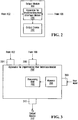
- FIG. 2 A functional block diagram of apparatus 200 is depicted in figure 3 of the drawings.
- the apparatus 200 is adapted for communicating with output device 202 including a display screen for causing the latter to display the user interface module generated by the apparatus 200.
- the apparatus 200 for implementing a user interface releases a signal at output 310 for causing the output device 202 to convey the user interface to a user of the system.
- the apparatus 200 implements a user interface module for facilitating visual identification of a prohibited object in an image during security screening.
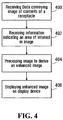
- data is received conveying an image of the contents of a receptacle derived from an apparatus that scans the receptacle with penetrating radiation such as the image generation apparatus 102 depicted in figure 1 .
- information is received from an automated threat detection processor (such as automated threat detection processor 106 depicted in figure 1 ) indicating an area of interest in the image potentially containing a prohibited object.
- the image received at step 400 is processed the image to generate an enhanced image.
- step 404 portions of the image outside the area of interest, conveyed by the information received at step 402, are visually de-emphasized.
- steps 404 features appearing inside the area of interest, conveyed by the information received at step 402 are visually emphasized.
- the portions of the image outside the area of interest are visually de-emphasized and features appearing inside the area of interest are visually emphasized.
- the enhanced image is caused to be displayed on a display module.
- the apparatus 200 suitable for implementing the above described process includes a first input 304, a second input 306, a processing unit 300 and an output 310.
- the apparatus 200 further includes a user input 308.
- the first input 304 is for receiving data conveying an image of the contents of a receptacle derived from an apparatus that scans the receptacle with penetrating radiation.
- the image signal is derived from a signal generated by the image generation apparatus 102 (shown in figure 1 ).
- the second input 306 is for receiving information from an automated threat detection processor indicating an area of interest in the image potentially containing a prohibited object.
- the information is provided by the automated threat detection processor 106.
- the type of information received at the second input 306 depends on the specific implementation of the automated threat detection processor 106 and may vary from one implementation to the next. Examples of the type of information that may be received include information on the position of the prohibited object detected within the image, information about the level of confidence of the detection and data allowing identifying the prohibited object detected.
- the user input 308, which is an optional feature, is for receiving signals from a user input device, the signals conveying commands for controlling the type information displayed by the user interface module or for annotating the information displayed.
- Any suitable user input device for providing user commands may be used such as, for example, a mouse, keyboard, pointing device, speech recognition unit or touch sensitive screen.
- the processing unit 300 is in communication with the first input 304, the second input 306 and the user input 308 and implements a user interface module for facilitating visual identification of a prohibited object in an image of contents of a receptacle.
- the processing unit 300 is adapted for processing the image received at the first input 304 to generate an enhanced image based at least in part on the information received at the second input 306 and optionally on commands received at the user input 308.
- the processing unit 300 is adapted for generating an image mask on the basis of the information received indicating an area of interest in the image.
- the image mask includes a first enhancement area corresponding to the area of interest and a second enhancement area corresponding to portions of the image outside the area of interest.
- the image mask allows applying a different type of image enhancement processing to portions of the image corresponding to the first enhancement area and the second enhancement area to generate an enhanced image.
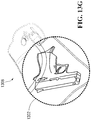
- Figures 13a to 13g depict various illustrative examples of images and corresponding enhanced images generated by the processing unit 300 in accordance with specific examples of implementation of the invention.
- Figure 13a depicts a first exemplary image 400 conveying contents of a receptacle that was generated by an x-ray machine.
- the processing unit 300 processes the first exemplary image 400 to derive information conveying an area of interest, denoted as area of interest 402 in the figure.
- Figure 13b depicts an enhanced version of the image of figure 13a , herein referred to as enhanced image 450 resulting from the application of an image mask include ant enhancement area corresponding to the area of interest 402.
- the enhanced image 450 is such that portions 404 of the image which lie outside the area of interest 402 have been visually de-emphasized and features appearing inside the area of interest 402 have been visually emphasized.
- Figure 13c depicts a second exemplary image 410 conveying contents of another receptacle that was generated by an x-ray machine.
- the processing unit 300 processes the second exemplary image 410 to derive information conveying a plurality of areas of interest, denoted as areas of interest 462a 462b and 462c in the figure.
- Figure 13d depicts an enhanced version of the image of figure 13c , herein referred to as enhanced image 460.
- the enhanced image 450 is such that portions 464 of the image which lie outside the areas of interest 462a 462b and 462c have been visually de-emphasized and features appearing inside the areas of interest 462a 462b and 462c have been visually emphasized.
- Figure 13e depicts a third example of an illustrative image 1300 conveying contents of a receptacle.
- the processing unit 300 processes the image 1300 to derive information conveying an area of interest, denoted as area of interest 1302 in the figure.
- Figure 13f depicts a first enhanced version of the image of figure 13e , herein referred to as enhanced image 1304.
- the enhanced image 1304 is such that portions of the image which lie outside the area of interest 1302 have been visually de-emphasized.
- the de-emphasis is illustrated in the figure by the features appearing in portions of the image that lie outside the area of interest being presented in dotted lines.
- Figure 13g depicts a second enhanced version of the image of figure 13e , herein referred to as enhanced image 1306.
- the enhanced image 1306 is such that features appearing inside the area of interest 1302 have been visually emphasized.
- the emphasis is illustrated in the figure by the features appearing in the area of interest being enlarged such that features of the enhanced image 1306 located inside the area of interest 1302 appear on a larger scale than features in portions of the enhanced image located outside the area of interest.
- the processing unit 300 processes the image received at input 304 to generate an enhanced image wherein portions outside the area of interest, conveyed by the information received at second input 306, are visually de-emphasized.
- Any suitable image manipulation technique for de-emphasizing the visual appearance of portions of the image outside the area of interest may be used by the processing unit 300. Such image manipulation techniques are well-known in the art and as such will not be described in detail here.
- the processing unit 300 processes the image to attenuate portions of the image outside the area of interest. In a non-limiting example, the processing unit 300 processes the image to reduce contrasts between feature information appearing in portions of the image outside the area of interest and background information appearing in portions of the image outside the area of interest. Alternatively, the processing unit 300 processes the image to remove features from portions of the image outside the area of interest. In yet another alternative embodiment, the processing unit 300 processes the image to remove all features appearing in portions of the image outside the area of interest such that only features in the areas of interest remain in the enhanced image.
- the processing unit 300 processes the image to overlay or replace portions of the image outside the area of interest with a pre-determined visual pattern.
- the pre-determined visual pattern may be a suitable textured pattern of may be a uniform pattern.
- the uniform pattern may be a uniform color or other uniform pattern.
- the processing unit 300 processes the image to modify color information associated to features of the image appearing outside the area of interest.
- portions of the image outside the area of interest are converted into grayscale or other monochromatic color palette.
- the processing unit 300 processes the image to reduce the resolution associated to portions of the image outside the area of interest. This type of image manipulation results in portions of the enhanced image outside the area of interest appearing blurred compared to portions of the image inside the area of interest.
- the processing unit 300 processes the image to shrink portions of the image outside the area of interest such that at least some features of the enhanced image located inside the area of interest appear on a larger scale than features in portions of the enhanced image located outside the area of interest.
- the processing unit 300 processes the image received at input 304 to generate an enhanced image wherein features appearing inside the area of interest, conveyed by the information received at step 402 are visually emphasized.
- Any image manipulation suitable technique for emphasizing the visual appearance of features of the image inside the area of interest may be used. Such image manipulation techniques are well-known in the art and as such will not be described in detail here.
- the processing unit 300 processes the image to increase contrasts between feature information appearing in portions of the image inside the area of interest and background information appearing in portions of the image inside the area of interest. For example, contour lines defining objects inside the area of interest are made to appear darker and/or thicker compared to the background.
- contrast-stretching tools with settings highlighting the metallic content of portions of the image inside the area of interest are used to enhance the appearance of such features.
- the processing unit 300 processes the image to overlay portions of the image inside the area of interest with a pre-determined visual pattern.
- the pre-determined visual pattern may be a suitable textured pattern or may be a uniform pattern.
- the uniform pattern may be a uniform color or other uniform pattern.
- portions of the image inside the area of interest are highlighted by overlaying the area of interest with a brightly colored pattern.
- the visual pattern has transparent properties in that a user can see features of the image in portions of the image inside the area through the visual pattern once the pattern is overlaid in the image.
- the processing unit 300 processes the image to modify color information associated to features of the image appearing inside the area of interest.
- colors for features of the image appearing inside the area of interest may be made to appear brighter or may be replaced by other more visually contrasting colors.
- color associated to metallic objects in an x-ray image may be made to appear more prominently by either replacing it with a different color or changing an intensity of the color.
- the processing unit 300 may transform features appearing in blue inside the area of interest such that these same features appear in red in the enhanced image.
- processing unit 300 processes the image to enlarge a portion of the image inside the area of interest such that at least some features of the enhanced image located inside the area of interest appear on a larger scale than features in portions of the enhanced image located outside the area of interest.
- Figure 13g of the drawings depicts an enhanced image derived from the image depicted in figure 13e wherein the area of interest 1302 has been enlarged relative to the portions of the image outside the area of interest.
- the resulting enhanced image 1306 is such that the features inside the area of interest 1302 appear on a different scale that the features appearing in the portions of the image outside the area of interest 1302.
- processing the image may include modifying color information associated to features of the image appearing inside the area of interest and enlarging a portion of the image inside the area of interest.
- processing the image may include modifying color information associated to features of the image appearing inside the area of interest and enlarging a portion of the image inside the area of interest.
- exemplary techniques for emphasizing portions of the image inside the area of interest are not meant as an exhaustive list of such techniques and that other suitable techniques may be used without detracting from the spirit of the invention.
- embodiments of the invention may also concurrently de-emphasize portions of the image outside the area of interest and emphasize features of the image inside the area of interest without detracting from the spirit of the invention.
- the processing unit 300 processes the image received at input 304 to modify portions of areas surrounding the area of interest to generate the enhanced image.
- the processing unit 300 modifies portions of areas surrounding the area of interest includes applying a blurring function to the edges surrounding the area of interest.
- the edges of the area of interest are blurred.
- blurring the edges of the area of interest accentuates the contrast between the area of interest and the portions of the image outside the area of interest.
- the processing unit 300 is adapted for receiving at input 306 information from an automated threat detection processor, such as automated threat detection processor 106, indicating a plurality of areas of interest in the image potentially containing respective prohibited objects.
- the processing unit 300 then processes the image received at input 304 to generate the enhanced image.
- the processing of the image is performed using the same principles as those described above with reference to information conveying a single area of interest.
- the person skilled in the art will readily appreciate, in light of the present description, the manner in which the processing unit 300 may be adapted for processing information conveying a plurality of areas of interest without required further guidance.
- the output 310 is for releasing a signal for causing the output device 202 (shown in figure 2 ) to display the graphical user interface module implemented by processing unit 300.
- a graphical user interface module implemented by apparatus 200 in accordance with a specific example of implementation is described in greater detail herein below with reference to figure 5 .
- FIG. 5 there is shown a display generated by a graphical user interface module implemented in accordance with a non-limiting implementation on the invention.
- the user interface module provides a viewing window 500 including a viewing space 570 for displaying an enhanced image 502 wherein areas of interest 504a and 504b are displayed to the user in a visually contrasting manner relative to portions of the image outside the areas of interest 506. In this fashion, an operator's attention can be focused on the areas interest 504a and 504b of the image which are the areas most likely to contain prohibited objects.
- portions of the image outside the areas of interest 504a and 504b have been de-emphasized.
- portions of the image outside the areas of interest 504a and 504b generally designated with reference numeral 506, have been attenuated by reducing contrasts between the features and the background. These portions appear paler relative to the areas of interest 504a and 504b.
- features depicted in the areas of interest 504a and 504b have also been emphasized by using contrast-stretching tools to increase the level of contrast between the features depicted in the areas of interest 504a and 504b and the background.
- edges 508a and 508b surrounding the area of interest 504a and 504b have been blurred to accentuates the contrast between the areas of interest 504a and 504b and the portions of the image outside the areas of interest 504a and 504b.
- the location of the areas of interest 504a and 504b was derived on the basis of the information received at input 306 (shown in figure 3 ) from the automated threat detection processor 106.
- the user interface module also provides a set of controls 510 512 514 516 550 518 and 520 for allowing a user to providing commands for modifying features of the graphical user interface module to change the appearance of the enhanced image 502 displayed in the viewing window 500.
- the controls in the set of controls 510 512 514 516 550 518 allow the user to change the appearance of the enhanced image displayed in the viewing window 500 by using an input device in communication with the apparatus 200 (shown in figure 3 ) through user input 308.
- the controls in the set of controls 510 512 514 516 550 518 are in the form of a buttons that can be selectively actuated by a user. Examples of user input devices include, without being limited to, a mouse, a keyboard, a pointing device, a speech recognition unit and a touch sensitive screen.
- the controls may be provided as a physical button (or key) on a keyboard or other input device that can be selectively actuated by a user. In such an implementation, the physical button (or key) is in communication with the apparatus 200 (shown in figure 3 ) through user input 308. Suitable forms of user controls other than buttons may also be used.
- functionality is provided to the user for allowing the latter to select for display in viewing window 500 the "original" image received at input 304 of apparatus 200 (shown in figure 3 ) or the enhanced image generated by apparatus 200.
- such functionality is enabled by displaying a control on the user interface allowing a user to effect the selection.
- this control is embodied as control button 510 which may be actuated by the user via a user input device to toggle between the enhanced image and the "original" image for display in viewing window 500.
- functionality is also provided to the user for allowing the latter to select a level of enlargement from a set of possible levels of enlargement to be applied to the image in order to derive the enhanced image for display in the viewing window 500.
- the functionality allows the user to independently control the scale of features appearing in areas of interest 504a and 504b relative to the scale of features in portions of the image outside the areas of interest 504a and 504b.
- such functionality may be enabled by displaying a control on the user interface allowing a user to effect the selection of the level of enlargement.
- this control is embodied as control buttons 512 and 514 which may be actuated by the user via a user input device.
- the enlargement factor ("zoom-in”) to be applied to the areas of interest 504a and 504b by the processing unit 300 (shown in figure 3 ) is increased and by actuating button 512 the enlargement factor ("zoom-out") to be applied to the areas of interest 504a and 504b is decreased.
- the set of possible levels of enlargement includes at least two levels of enlargement.
- one of the levels of enlargement is a "NIL" level wherein features of the portion of the enhanced image inside the area of interest appear on a same scale as features in portions of the enhanced image outside the area of interest.
- the set of possible levels of enlargement includes two or more distinct levels of enlargement other that the "NIL" level.
- the enhanced image is such that portions inside the areas of interest are enlarged at least in part based on the selected level of enlargement.
- functionality is also provided to the user for allowing the latter to select a zoom level to be applied to derive the enhanced image 502 for display in the viewing window 500.
- the functionality allows the user to change the zoom amount to be applied to the image depicted in the viewing space of viewing window 500.
- This zoom level functionality differs from the level of enlargement functionality described above, and enabled by buttons 512 and 514, in that the zoom level functionality affects the entire image with a selected zoom level. In other words, modifying the zoom level does not affect the relative scale between the areas of interest and portions of the image outside the area of interest remains.
- such functionality may be enabled by displaying a control on the user interface allowing a user to effect the selection of the zoom level. Any suitable type of control for allowing a user to select a zoom level may be envisaged in specific implementations of the user interface module.
- the set of possible levels of enhancement includes at least two levels of enhancement.
- one of the levels of enhancement is a "NIL" level wherein the areas of interest are not emphasized and the portions of the images outside the areas of interest are not de-emphasized.
- the set of possible levels of enlargement includes two or more distinct levels of enhancement other that the "NIL" level.
- each level of enhancement in the set of levels of enhancement is adapted for causing an enhanced image to be derived wherein:
- the different levels of enhancement may cause the processing unit 300 to apply different types of image processing functions or different degrees of image processing such as to modify the appearance of the enhanced image depicted in the viewing window 500.
- this allows the user to adapt the appearance of the enhanced image 502 based on either user preferences or in order to view an image in a different manner to facilitate visual identification of a prohibited object.
- the above-described functionality may be enabled by providing a control on the user interface allowing a user to effect the selection of the level of enhancement. In figure 5 this control is embodied as control button 550 which may be actuated by the user via a user input device.
- the type of enhancement to be applied by the processing unit 300 is modified based on a set of predetermined levels of enhancement.
- a control in the form of a drop-down menu providing a set of possible levels of enhancement is provided. The user is able to select a level of enhancement from the set of levels of enhancement to modify the type of enhancement to be applied by the processing unit 300 (shown in figure 3 ) to generate the enhanced image. It will be readily apparent to the person skilled in the art that other type of controls for allowing a user to select a level of enhancement from a set of levels of enhancement may be envisaged.
- functionality is also provided to the user for allowing the latter to independently control the amount of enhancement to be applied to the area(s) of interest of the images and the amount of enhancement to be applied to portions of the image outside of the area(s) of interest.
- the above-described functionality may be enabled by providing on a user interface a first user control for enabling the user to select a first selected level of enhancement, and a second user control is provided for allowing a user to select a second level of enhancement.
- the processing unit generates the enhanced image such that:
- the user interface module is adapted for displaying a control 518 for allowing a user to modify other configuration elements of the user interface.
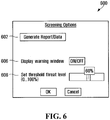
- actuating control 518 causes the user interface module to display a control window 600 of the type depicted in figure 6 allowing a user to select screening options.
- the user is enabled to select between the following screening options:
- the setting threshold sensitivity/confidence level 608 may only be made available to user having certain privileges (examples screening supervisors or security directors).
- the user interface module may include some type of user identification functionality, such as a login process, to identify the user of the screening system.
- the user interface module upon selection by the user of the setting threshold sensitivity/confidence level 608 option, may prompt the user to enter a password for allowing the user to modify the detection sensitivity level of the screening system.
- the user interface module is adapted for displaying a control 520 for allowing a user to login/log-out of the system in order to provide user identification functionality.
- Manners in which user identification functionality can be provided are well-known in the art and are not critical to the present invention and as such will not be described further here.
- the user interface module is adapted to allow the user to add complementary information to the information being displayed on the user interface.
- the user is enabled to insert markings in the form of text and/or visual indicators in the image displayed on the user interface.
- the marked-up image may then be transmitted to a third party location, such as a checking station, so that the checking station is alerted to verify the marked portion of the receptacle to locate a prohibited object.
- the user input 308 (depicted in figure 3 ) receives signals from a user input device, the signals conveying commands for marking the image displayed in the user interface.
- Any suitable user input device for providing user commands may be used such as, for example, a mouse, keyboard, pointing device, speech recognition unit or touch sensitive screen.
- a mouse keyboard
- pointing device pointing device
- speech recognition unit touch sensitive screen
- apparatus 200 shown in figure 3 is adapted for storing information associated with receptacles so that this information may be accessed at a later time. More specifically, for a given receptacle, the apparatus 200 is adapted for receiving at first input 304 data conveying an image of the contents of the receptacle derived from an apparatus that scans the receptacle with penetrating radiation and at second input 306 information from an automated threat detection processor indicating an area of interest in the image potentially containing a prohibited object.
- the processing unit 300 of apparatus 200 is adapted for generating a record associated to the screened receptacle.
- the record includes the image of the contents of the receptacle received at the first input 304 and the information received at second input 306.
- the record may also include additional information such as for example a time stamp, identification data conveying the type of prohibited object potentially detected, the level of confidence of the detection, a level of risk data element, an identification of the screener , the location of the screening station, identification information associated to the owner of the receptacle and/or any other suitable type of information that may be of interest to a user of the system for later retrieval.
- the record is then stored in memory 350 for later access.
- the generation of a record may be effected for all receptacles being screened or for selected receptacles only. In practical implementations of the inventions, in particular in areas where traffic levels are high and a large number of receptacles are screened, it may be preferred to selectively store the images of the receptacles rather than storing images for all the receptacles.
- the selection of which images to store may be effected by the user of the user interface by providing a suitable control on the user interface for receiving user command to that effect. Alternatively, the selection of which images may be effected in the basis of information received from the automated threat detection processor 106. For example, a record may be generated for a given object when a prohibited object was potentially detected in the receptacle as could be conveyed by a signal received from the automated threat detection processor 106.
- FIG. 7 of the drawings A process for facilitating visual identification of prohibited objects in images associated with previously screened receptacles is depicted in figure 7 of the drawings.
- a plurality of records associated to previously screened receptacles are provided.
- apparatus 200 enables step 700 by providing the memory 350 for storing a plurality of records associated to respective previously screened receptacles.
- each record includes an image of the contents of a receptacle derived from an apparatus that scans the receptacle with penetrating radiation and information derived from an automated threat detection processor and indicating an area of interest in the image potentially containing a prohibited object.
- a set of thumbnail images derived from the plurality of records is displayed in viewing space 572.
- processing unit 300 is adapted for displaying a set of thumbnail images 522 in viewing space 572, each thumbnail image 526a 526b 526c in the set of thumbnail images 522 being derived from a record in the plurality of records stored in memory unit 350 (shown in figure 3 ).
- a user is enabled to select at least one thumbnail image from the set of thumbnail images 522.
- the selection may be effected on the basis of the images themselves or by allowing the user to specify either a time or time period associated to the records.
- the user can select thumbnail image from the set of thumbnail images 522 using a user-input device to actuate the desired thumbnail image.
- Any suitable user input device for providing user commands may be used such as, for example, a mouse, keyboard, pointing device, speech recognition unit or touch sensitive screen.
- an enhanced image derived from a record corresponding to the selected thumbnail image is displayed in a second viewing space 570. More specifically, in response to a selection of a thumbnail image from the set of thumbnail images, an enhanced image derived from the certain record corresponding to the selected thumbnail image is displayed in viewing space 570. When multiple thumbnail images are selected, the corresponding enhanced images may be displayed concurrently with another or may be displayed separately in viewing space 570.
- the enhanced image derived from the certain record corresponding to the selected thumbnail image may be derived in a similar manner as that described previously in the present specification. For example, for a given record in the database of records including a certain image and information conveying a certain area of interest in the image, portions of the certain image outside the certain area of interest may be visually de-emphasized to generate the enhanced image. In a second example of implementation, features appearing inside the certain area of interest are visually emphasized to generate the enhanced image. In yet another example, the portions of the image outside the certain area of interest are visually de-emphasized and features appearing inside the certain area of interest are visually emphasized to generate the enhanced image. The manner in which the portions of the certain image outside the certain area of interest may be visually de-emphasized and features appearing inside the certain area of interest may visually emphasized have been previously described in the present applicable and as such will not be described further here.
- functionality is also provided to the user for allowing the latter to scroll through a plurality of thumbnail images so the different sets of the thumbnail images may be displayed in viewing space 572.
- such functionality may be enabled by displaying a control on the user interface allowing a user to scroll through plurality of thumbnail images.
- this control is embodied as scrolling controls 524 which may be actuated by the user via a suitable user input device.
- each thumbnail image in the set of thumbnail images conveys information derived from an associated time stamp data element. In the example depicted in figure 5 , this is done by displaying timing information 528.
- Each thumbnail image in the set of thumbnail images conveys information derived from an associated level of risk data element. It will be readily apparent to the person skilled in the art that any suitable additional type of information may be displayed or conveyed in connection with the thumbnail images without detracting from the spirit of the invention.
- the user interface module implemented by apparatus 200 includes functionality for enabling a user to select between an enhanced image associated to a previously screened receptacle, herein referred to as enhanced previous image, and an enhanced image associated with a receptacle currently being screened.
- the selected image is then displayed in viewing space 570. More specifically, data conveying a current image of the contents of a currently screened receptacle derived from an apparatus that scans the currently screened receptacle with penetrating radiation is received at first input 304 of apparatus 200 (shown in figure 2 ).
- the processing unit 300 is adapted for processing the current image to generate an enhanced current image in which portions outside the area of interest are visually de-emphasized.
- the user interface module enables the user to select between an enhanced previous image and the enhanced current image by providing a user operable control (not show in the figures) to effect the selection.
- this perceived level of threat is derived based on a confidence level data element received from an automated threat detection processor such as automated threat detection processor 106 depicted in figure 1 .
- the confidence level conveys a likelihood that a threat was positively detected in the receptacle.
- the perceived level of threat may be the confidence level or may be conditioned on the basis of external actors such as a national emergency status for example.
- the perceived level of threat is conveyed through the use of a graphical threat probability scale 590 including various graduated levels of threats.
- the perceived level of threat is also conveyed through the use of a message at the top of the screen.
- the message to be displayed is conditioned on the basis of the confidence level and on the basis of a threshold sensitivity/confidence level.
- the threshold/sensitivity level may be a parameter of the user interface configurable by the user or may be a predetermined value.
- a warning message of the type: "DANGER: OPEN BAG” or "SEARCH REQUIRED” may be displayed. If the confidence level is below the threshold sensitivity/confidence level, either no message may be displayed or an alternative message of the type" NO THREAT DETECTED - SEARCH AT YOUR DISCRETION" may be displayed.
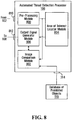
- the automated threat detection processor 106 shown in figure 1 will now be described in greater detail with reference to Figure 8 .
- the automated threat detection processor 106 includes a first input 810, a second input 814, an output 812 and a processing unit, generally comprising a pre-processing module 800, an image comparison module 802, an area of interest locator module 804 and an output signal generator module 806.
- either one or both of the region of the interest locator module 804 and the image comparison module 802 may generate information conveying an area of interest.
- the area of interest locator module 804 is adapted for generating information conveying one or more regions of interest based on characteristics inherent to the image conveying contents of a receptacle.
- the characteristics inherent to the image include, without being limited to, density information conveyed by an x-ray type image example.
- the image comparison module 802 is adapted for generating information conveying one or more regions of interest based on a comparison between the image conveying contents of a receptacle and images in a database of target objects. It will readily appreciated that specific examples of implementation may omit either one of the image comparison module 802 and the area of interest locator module 804 for implementing the functionality for generating information conveying an area of interest.
- the first input 810 is for receiving data conveying an image of the contents of a receptacle from the image generation apparatus 102 (shown in Figure 1 ).
- the second input 814 is for receiving target images from the database of prohibited objects 110. It will be appreciated that in embodiments where the database of prohibited objects 110 is part of automated threat detection processor 106, the second input 314 may be omitted.
- the output 312 is for releasing information for transmittal to output module 108 indicating an area of interest in the image potentially containing a prohibited object.
- the information released also conveys a level of confidence that the area of interest contains a prohibited object as well as the identity of the prohibited object potentially detected.
- the processing unit of the automated threat detection processor 106 receives the data conveying an image of the contents of the receptacle 104 from the first input 810 and processes that image to derive an area of interest in the image and, optionally, to identify a prohibited object in the receptacle 104.
- the processing unit of the automated threat detection processor 106 generates and releases at output 812 information conveying an area of interest in the image an optionally information conveying the identity of a detected prohibited object.
- the pre-processing module 800 receives the data conveying an image of the contents of the receptacle 104 via the first input 810.
- the pre-processing module 800 processes the data in order to enhance the image, remove extraneous information therefrom and remove noise artefacts in order to obtain more accurate comparison results.
- the complexity of the requisite level of pre-processing and the related trade-offs between speed and accuracy depend on the application. Examples of pre-processing may include, without being limited to, brightness and contrast manipulation, histogram modification, noise removal and filtering amongst others.
- the pre-processing module 800 may actually be external to the automated threat detection processor 106, e.g., it may be integrated as part of the image generation apparatus 102 or as an external component. It will also be appreciated that the pre-processing module 800 (and hence step 901) may be omitted in certain embodiments of the present invention. As part of step 901, the pre-processing module 800 releases data conveying a modified image of the contents of the receptacle 104 for processing by the image comparison module 802 and by the area of interest locator module 804.
- the area of interest locator module 804 processes the data conveying the modified image received from the pre-processing module 800 (or the data conveying an image of the contents of the receptacle received via the first input 810) to generate information conveying an area of interest in the image.
- the area of interest in the image is an area that potentially contains a prohibited object. Any suitable method to determine an area of the image of (or modified image of) contents of a receptacle that potentially contains a prohibited object may be used.
- the area of interest locator module 804 is adapted for generating information conveying area of interest based on characteristics inherent to the input image.
- the image is an x-ray image conveying information related to the material density associated to contents of the receptacle.
- the area of interest locator module 804 is adapted to process the image and identify areas including a certain concentration of elements characterized by a certain material density, say for example metallic-type elements, and label these areas as areas of interest. Characteristics such as the size of the area exhibited the certain density may also be taken into account to identify an area of interest. It will be apparent to the person skilled in the art that other suitable methods for identifying regions of interest in an image may be used. Many such methods are known in the art and as such will not be described further here.
- the image comparison module 802 verifies whether there remain any unprocessed target images in the database of prohibited objects 110. In the affirmative, the image comparison module 802 proceeds to step 903 where the next target image is accessed and the image comparison module 802 then proceeds to step 904. If at step 902 all target images in the database of prohibited objects 110 have been processed, the image comparison module 802 proceeds to step 908 and the process is completed.
- the image comparison module 802 compares the image (or modified image) of the contents of the receptacle 104 against the target image accessed at step 903 to determine whether a match exists.
- the comparison may be effected using any image processing algorithm suitable for comparing two images.
- the comparison may make use of the area of interest information generated by the area of interest locator module to limit the comparison operation to the area of interest. Examples of algorithms that can be used to perform image processing and comparison include without being limited to:
- the image comparison module 802 includes an edge detector to perform part of the comparison at step 904.
- the comparison performed at step 904 includes effecting a correlation operation between the image (or modified image) of contents of the receptacle and the target images in the database 110.
- the correlation operation is performed by an optical correlator.
- the correlation operation is performed by a digital correlator.
- a combination of methods is used to effect the comparison of step 904. The results of the comparisons are then combined to obtain a joint comparison result.
- the image comparison module 802 then proceeds to step 906 where the result of the comparison effected at step 904 is processed to determine whether a match exists between the image (or modified image) of the contents of receptacle 104 and the target image.
- the comparison at step 904 generates a score conveying a likelihood that there is a match between a portion of the image (or modified image) of the contents of receptacle 104 and the target image.
- a match is detected of the score obtained by the comparison at step 904 is above a certain threshold score. This score can also be considered as the confidence level associated to detection of a match.
- the image comparison module 802 returns to step 902.
- the image comparison module 802 triggers the output signal generator module 806 to execute step 910. Then, the image comparison module 802 returns to step 902 to continue processing with respect to the next target image.
- the output signal generator module 806 generates information conveying the presence of a prohibited object in the receptacle 104, and the information is released at output 812.
- the information conveys positioning information associated to the prohibited object within the image received at input 810.
- the positioning information conveys an area of interest in the image where the prohibited object is potentially located which was derived either from the area of interest locator module 804 or the image comparison module 802.
- the information may be conveyed in any suitable format.
- the information may convey a plurality of (X,Y) pixel locations defining an area in the image of the contents of a receptacle.
- the information conveys an (X,Y) pixel location conveying the center of an area in the image.
- the information released also conveys a level of confidence that the area of interest contains a prohibited object.
- an identification of the prohibited object potentially detected in the image is also provided.
- a system for screening people includes components similar to those described in connection with the system depicted in Figure 1 .
- the image generation apparatus 102 is configured to scan a person and possibly to scan the person along various axes and/or views to generate multiple images associated to the person.
- the image or images associated with the person convey information related to the objects carried by the person.
- Each image is then processed in accordance with the method described in the present specification to facilitate visual identification of a prohibited object on the person.
- database of prohibited objects 110 may further include entries associated to non-prohibited objects and/or objects that do not represent a potential threat.
- Such entries may be used to detect objects commonly carried by people such as cell-phones, watches and rings, for example, which are not prohibited and not threatening.
- identifying such objects unnecessary manual verifications can be avoided.
- Certain portions of the apparatus 200 for implementing a user interface can be implemented on a general purpose digital computer 1300, of the type depicted in Figure 10 , including a processing unit 1302 and a memory 1304 connected by a communication bus.
- the memory includes data 1308 and program instructions 1306.
- the processing unit 1302 is adapted to process the data 1308 and the program instructions 1306 in order to implement the functional blocks described in the specification and depicted in the drawings.
- the digital computer 1300 may also comprise an I/O interface 1310 for receiving or sending data elements to external devices.
- certain portions of the automated threat detection processor 106 can also be implemented on a general purpose digital computer having a similar structure as that described in connection with figure 10 .
- Certain portions of the automated threat detection processor 106 and of the apparatus 200 for implementing a user interface may be implemented on a same general purpose digital computer without detracting from the spirit of the invention.
- the above-described automated threat detection processor 106 can be implemented on a dedicated hardware platform where electrical/optical components implement the functional blocks described in the specification and depicted in the drawings. Specific implementations may be realized using ICs, ASICs, DSPs, FPGA, an optical correlator, digital correlator or other suitable hardware platform.
- FIG. 11 Other alternative implementations of the automated threat detection processor 106 and the apparatus 200 for implementing a user interface can be implemented as a combination of dedicated hardware and software such as apparatus 1000 of the type depicted in Figure 11 .
- an implementation comprises dedicated image processing hardware module 1008 and a general purpose computing unit 1006 including a CPU 1012 and a memory 1014 connected by a communication bus.
- the memory includes data 1018 and program instructions 1016.
- the CPU 1012 is adapted to process the data 1018 and the program instructions 1016 in order to implement the functional blocks described in the specification and depicted in the drawings.
- the CPU 1012 is also adapted to exchange data with the dedicated image processing hardware module 1008 over communication link 1010 to make use of the image processing capabilities of the dedicated image processing hardware module 1008.
- the apparatus 1000 may also comprise I/O interfaces 1002 1004 for receiving or sending data elements to external devices.
- the screening system 100 may also be of a distributed nature where the images of contents of receptacles are obtained at one location or more locations and transmitted over a network to a server unit implementing the method described above.
- the server unit may then transmit a signal for causing an output unit to display information to the user.
- the output unit may be located in the same location where the images of contents of receptacles were obtained or in the same location as the server unit or in yet another location.
- the output unit is part of a centralized screening facility.
- Figure 12 illustrates a network-based client-server system 1100 for system for screening receptacles.
- the client-server system 1100 includes a plurality of client systems 1102, 1104, 1106 and 1108 connected to a server system 1110 through network 1112.
- the communication links 1114 between the client systems 1102, 1104, 1106 and 1108 and the server system 1110 can be metallic conductors, optical fibres or wireless, without departing from the spirit of the invention.
- the network 1112 may be any suitable network including but not limited to a global public network such as the Internet, a private network and a wireless network.
- the server 1110 may be adapted to process and issue signals concurrently using suitable methods known in the computer related arts.
- the server system 1110 includes a program element 1116 for execution by a CPU.
- Program element 1116 includes functionality to implement the methods described above, including a method for displaying information associated to a receptacle and for facilitating visual identification of a prohibited object in an image during security screening, and includes the necessary networking functionality to allow the server system 1110 to communicate with the client systems 1102, 1104, 1106 and 1108 over network 1112.
- the client systems 1102, 1104, 1106 and 1108 include display units responsive to signals received from the server system 1110 for displaying a user interface module implementation by the server system 1110.
Landscapes
- Engineering & Computer Science (AREA)
- Physics & Mathematics (AREA)
- General Physics & Mathematics (AREA)
- Theoretical Computer Science (AREA)
- Multimedia (AREA)
- Apparatus For Radiation Diagnosis (AREA)
- Image Processing (AREA)
- Analysing Materials By The Use Of Radiation (AREA)
Claims (10)
- Procédé mis en oeuvre par ordinateur pour faciliter l'identification visuelle d'objets interdits dans des images, ledit procédé comprenant :- la fourniture d'une pluralité d'enregistrements associés à des réceptacles préalablement passés au crible au niveau d'un point de contrôle de sécurité, les enregistrements de la pluralité d'enregistrements incluant des données acheminant :i. une image du contenu d'un réceptacle dérivée d'un appareil qui balaie le réceptacle avec un rayonnement pénétrant ;ii. un élément de données de niveau de risque acheminant un niveau de menace perçue associé au réceptacle ;- le traitement d'enregistrements de ladite pluralité d'enregistrements pour afficher sur un dispositif d'affichage un premier espace de visualisation (572) acheminant une séquence de vignettes (522), la séquence de vignettes étant associée à des réceptacles passés au crible sur une période de temps à partir des réceptacles préalablement passés au crible au niveau du point de contrôle de sécurité, dans lequel chaque vignette achemine des informations dérivées d'un élément de données de niveau de risque associé ;- la réception d'informations fournies par un utilisateur par le biais d'une entrée, les informations fournies servant à sélectionner un réceptacle parmi les réceptacles passés au crible au niveau du point de contrôle de sécurité sur la période de temps en sélectionnant une vignette dans la séquence de vignettes acheminées dans le premier espace de visualisation ; et- le traitement des informations fournies par l'utilisateur pour amener le deuxième espace de visualisation (570) à acheminer une image améliorée du réceptacle sélectionné, dans lequel l'image améliorée est dérivée en traitant des données dans un enregistrement de la pluralité d'enregistrements associé à la vignette sélectionnée et des informations reçues depuis un processeur de détection de menace automatisé indiquant une zone d'intérêt dans l'image contient potentiellement un objet interdit, dans lequel l'image améliorée achemine la zone d'intérêt d'une manière visuellement contrastante par rapport à des parties de l'image à l'extérieur de la zone d'intérêt,dans lequel ledit deuxième espace de visualisation (570) est affiché en même temps que le premier espace de visualisation (572) de telle sorte que l'image améliorée du réceptacle sélectionné est affichée en même temps que la séquence de vignettes associées à des réceptacles passés au crible sur la période de temps au niveau du point de contrôle de sécurité.
- Procédé selon la revendication 1, dans lequel le procédé comprend l'affichage d'une commande actionnable par utilisateur (524) pour permettre à l'utilisateur de modifier la séquence de vignettes affichées dans le premier espace de visualisation en modifiant la période de temps.
- Procédé selon la revendication 2, dans lequel ladite commande actionnable par utilisateur (524) est une commande de défilement.
- Procédé selon la revendication 1, dans lequel le procédé comprend le fait de dériver l'image améliorée au moins en partie en traitant des données acheminant une image du réceptacle sélectionné sur la base des informations indiquant une zone d'intérêt associée à la vignette sélectionnée.
- Procédé selon la revendication 4, dans lequel le procédé comprend le fait de dériver l'image améliorée au moins en partie en traitant les données acheminant l'image du réceptacle sélectionné pour accentuer visuellement des parties de l'image améliorée à l'intérieur de la certaine zone d'intérêt.
- Procédé selon l'une quelconque des revendications 1 à 5, dans lequel les vignettes de la séquence de vignettes acheminées dans le premier espace de visualisation acheminent des informations de niveau de menace associées aux réceptacles préalablement passés au crible auxquels les vignettes de la séquence de vignettes sont associées.
- Procédé selon l'une quelconque des revendications 1 à 6, dans lequel les enregistrements associés à des réceptacles préalablement passés au crible incluent des éléments de données d'estampille temporelle.
- Procédé selon l'une quelconque des revendications 1 à 7, dans lequel les informations reçues depuis le processeur de détection de menace automatisé indiquant la zone d'intérêt dans l'image contenant potentiellement l'objet interdit sont incluses dans les enregistrements.
- Appareil pour faciliter l'identification visuelle d'objets interdits dans des images, ledit appareil comprenant une unité de traitement mettant en oeuvre le procédé selon l'une quelconque des revendications 1 à 8.
- Support de stockage lisible par ordinateur stockant un élément de programme approprié pour exécution par une CPU, ledit élément de programme mettant en oeuvre un système pour faciliter l'identification visuelle d'objets interdits dans des images conformément au procédé selon l'une quelconque des revendications 1 à 8.
Applications Claiming Priority (3)
| Application Number | Priority Date | Filing Date | Title |
|---|---|---|---|
| CA2583557A CA2583557C (fr) | 2007-03-30 | 2007-03-30 | Methode, appareil et systeme servant a faciliter l'identification visuelle des objets interdits dans les images a un poste de verification de securite |
| US11/694,338 US8494210B2 (en) | 2007-03-30 | 2007-03-30 | User interface for use in security screening providing image enhancement capabilities and apparatus for implementing same |
| PCT/CA2008/000275 WO2008119151A1 (fr) | 2007-03-30 | 2008-02-11 | Interface utilisateur destinée à être utilisée lors des contrôles de sécurité et comportant des fonctions d'amélioration d'image, et dispositif mettant en œuvre ladite interface |
Publications (3)
| Publication Number | Publication Date |
|---|---|
| EP2140253A1 EP2140253A1 (fr) | 2010-01-06 |
| EP2140253A4 EP2140253A4 (fr) | 2011-04-27 |
| EP2140253B1 true EP2140253B1 (fr) | 2019-09-18 |
Family
ID=39807740
Family Applications (1)
| Application Number | Title | Priority Date | Filing Date |
|---|---|---|---|
| EP08714598.3A Active EP2140253B1 (fr) | 2007-03-30 | 2008-02-11 | Interface utilisateur destinée à être utilisée lors des contrôles de sécurité et comportant des fonctions d'amélioration d'image, et dispositif mettant en uvre ladite interface |
Country Status (2)
| Country | Link |
|---|---|
| EP (1) | EP2140253B1 (fr) |
| WO (1) | WO2008119151A1 (fr) |
Families Citing this family (10)
| Publication number | Priority date | Publication date | Assignee | Title |
|---|---|---|---|---|
| CA2676903C (fr) | 2006-09-18 | 2012-02-21 | Optosecurity Inc. | Procede et appareil servant a determiner le statut de menace d'un produit liquide |
| EP2210084A4 (fr) | 2007-10-01 | 2012-03-21 | Optosecurity Inc | Procede et dispositifs pour estimer l'etat de menace d'un article a un point de controle de securite |
| EP2331944B1 (fr) | 2008-09-05 | 2014-03-12 | Optosecurity Inc. | Procédé et système d exécution d'une inspection aux rayons x d'un produit liquide à un poste de contrôle de sécurité |
| US8831331B2 (en) | 2009-02-10 | 2014-09-09 | Optosecurity Inc. | Method and system for performing X-ray inspection of a product at a security checkpoint using simulation |
| WO2010145016A1 (fr) | 2009-06-15 | 2010-12-23 | Optosecurity Inc. | Procédé et appareil d'évaluation du niveau de menace de bagages |
| EP2459990A4 (fr) | 2009-07-31 | 2017-08-09 | Optosecurity Inc. | Procede et systeme d'identification d'un produit liquide dans des bagages ou d'autres conteneurs |
| DE102011004185A1 (de) | 2011-02-16 | 2012-08-16 | Siemens Aktiengesellschaft | Untersuchungsvorrichtung zur Untersuchung eines als Person und/oder Behälter ausgebildeten Untersuchungsgegenstands |
| CN108959345A (zh) * | 2018-04-11 | 2018-12-07 | 北京航星机器制造有限公司 | 一种安检图像记录快速回溯的方法和设备 |
| KR102166841B1 (ko) * | 2018-11-26 | 2020-10-16 | 한국전자기술연구원 | 영상 화질 개선 시스템 및 그 방법 |
| JP7623929B2 (ja) * | 2021-12-02 | 2025-01-29 | 株式会社日立製作所 | システムおよびプログラム |
Citations (1)
| Publication number | Priority date | Publication date | Assignee | Title |
|---|---|---|---|---|
| US20050259116A1 (en) * | 2004-05-24 | 2005-11-24 | Kabushiki Kaisha Toshiba | Medical image display apparatus |
Family Cites Families (14)
| Publication number | Priority date | Publication date | Assignee | Title |
|---|---|---|---|---|
| US4379348A (en) * | 1980-09-23 | 1983-04-05 | North American Philips Corporation | X-Ray security screening system having magnification |
| US6373979B1 (en) * | 1999-01-29 | 2002-04-16 | Lg Electronics, Inc. | System and method for determining a level of similarity among more than one image and a segmented data structure for enabling such determination |
| AU2002303207B2 (en) * | 2001-04-03 | 2009-01-22 | L-3 Communications Security And Detection Systems, Inc. | A remote baggage screening system, software and method |
| US7012256B1 (en) * | 2001-12-21 | 2006-03-14 | National Recovery Technologies, Inc. | Computer assisted bag screening system |
| US6856272B2 (en) * | 2002-08-28 | 2005-02-15 | Personnel Protection Technoloties Llc | Methods and apparatus for detecting threats in different areas |
| US7634138B2 (en) * | 2002-12-20 | 2009-12-15 | Eastman Kodak Company | Method for generating an image of a detected subject |
| US7286634B2 (en) * | 2002-12-23 | 2007-10-23 | Select Technologies, Llc | Method and apparatus for improving baggage screening examination |
| US6952163B2 (en) * | 2003-06-11 | 2005-10-04 | Quantum Magnetics, Inc. | Combined systems user interface for centralized monitoring of a screening checkpoint for passengers and baggage |
| US7248749B2 (en) * | 2003-07-29 | 2007-07-24 | Ge Medical Systems Global Technology Company, Llc | Method and apparatus for signal-to-noise ratio dependent image processing |
| US7356174B2 (en) * | 2004-05-07 | 2008-04-08 | General Electric Company | Contraband detection system and method using variance data |
| US7729523B2 (en) * | 2004-12-21 | 2010-06-01 | General Electric Company | Method and system for viewing image data |
| US20060269135A1 (en) * | 2005-03-15 | 2006-11-30 | Ramsay Thomas E | System and method for identifying objects of interest in image data |
| WO2006119609A1 (fr) | 2005-05-11 | 2006-11-16 | Optosecurity Inc. | Interface utilisateur et appareil pour controle de bagages, de recipients, de colis ou de personnes |
| CA2608119A1 (fr) * | 2005-05-11 | 2006-11-16 | Optosecurity Inc. | Procede et systeme d'inspection de bagages, de conteneurs de fret ou de personnes |
-
2008
- 2008-02-11 EP EP08714598.3A patent/EP2140253B1/fr active Active
- 2008-02-11 WO PCT/CA2008/000275 patent/WO2008119151A1/fr not_active Ceased
Patent Citations (1)
| Publication number | Priority date | Publication date | Assignee | Title |
|---|---|---|---|---|
| US20050259116A1 (en) * | 2004-05-24 | 2005-11-24 | Kabushiki Kaisha Toshiba | Medical image display apparatus |
Also Published As
| Publication number | Publication date |
|---|---|
| WO2008119151A1 (fr) | 2008-10-09 |
| EP2140253A1 (fr) | 2010-01-06 |
| EP2140253A4 (fr) | 2011-04-27 |
Similar Documents
| Publication | Publication Date | Title |
|---|---|---|
| US8494210B2 (en) | User interface for use in security screening providing image enhancement capabilities and apparatus for implementing same | |
| CA2640884C (fr) | Procedes et systemes pour une utilisation dans le filtrage de securite, avec capacite de traitement en parallele | |
| US20080152082A1 (en) | Method and apparatus for use in security screening providing incremental display of threat detection information and security system incorporating same | |
| EP2140253B1 (fr) | Interface utilisateur destinée à être utilisée lors des contrôles de sécurité et comportant des fonctions d'amélioration d'image, et dispositif mettant en uvre ladite interface | |
| US11276213B2 (en) | Neural network based detection of items of interest and intelligent generation of visualizations thereof | |
| US20070058037A1 (en) | User interface for use in screening luggage, containers, parcels or people and apparatus for implementing same | |
| US20080062262A1 (en) | Apparatus, method and system for screening receptacles and persons | |
| KR101995294B1 (ko) | 영상 분석 장치 및 방법 | |
| EP3772722B1 (fr) | Système et procédé de traitement d'image par rayons x et programme correspondant | |
| US20180196158A1 (en) | Inspection devices and methods for detecting a firearm | |
| KR102158967B1 (ko) | 영상 분석 장치, 영상 분석 방법 및 기록 매체 | |
| WO2008019473A1 (fr) | Procédé et dispositif de contrôle de sécurité à affichage graduel de données de détection de menace et système de sécurité le comprenant | |
| Andrews et al. | Representation-learning for anomaly detection in complex x-ray cargo imagery | |
| Zou et al. | Dangerous objects detection of X-ray images using convolution neural network | |
| Bandyopadhyay et al. | Identifications of concealed weapon in a human body | |
| CA2583557C (fr) | Methode, appareil et systeme servant a faciliter l'identification visuelle des objets interdits dans les images a un poste de verification de securite | |
| US20230230298A1 (en) | Systems and methods of generating playlists/sequences of images | |
| AU2006246250A2 (en) | User interface for use in screening luggage, containers, parcels or people and apparatus for implementing same | |
| Sebernegg | Benign object detection and distractor removal in 2d baggage scans | |
| Muthukkumarasamy et al. | Intelligent illicit object detection system for enhanced aviation security | |
| CA2608121A1 (fr) | Interface utilisateur et appareil pour controle de bagages, de recipients, de colis ou de personnes | |
| Rameshan et al. | Multimodal learning based threat detection in dual view, dual energy x-ray images | |
| Lin et al. | Object recognition based on foreground detection using X-ray imaging | |
| Nag et al. | Detecting Items Hidden Inside a Body | |
| Praveena et al. | Triple Threat: YOLO Model Variants for Reinventing X-Ray Security |
Legal Events
| Date | Code | Title | Description |
|---|---|---|---|
| PUAI | Public reference made under article 153(3) epc to a published international application that has entered the european phase |
Free format text: ORIGINAL CODE: 0009012 |
|
| 17P | Request for examination filed |
Effective date: 20091028 |
|
| AK | Designated contracting states |
Kind code of ref document: A1 Designated state(s): AT BE BG CH CY CZ DE DK EE ES FI FR GB GR HR HU IE IS IT LI LT LU LV MC MT NL NO PL PT RO SE SI SK TR |
|
| AX | Request for extension of the european patent |
Extension state: AL BA MK RS |
|
| A4 | Supplementary search report drawn up and despatched |
Effective date: 20110324 |
|
| 17Q | First examination report despatched |
Effective date: 20131018 |
|
| STAA | Information on the status of an ep patent application or granted ep patent |
Free format text: STATUS: EXAMINATION IS IN PROGRESS |
|
| RAP1 | Party data changed (applicant data changed or rights of an application transferred) |
Owner name: VANDERLANDE APC INC. |
|
| GRAP | Despatch of communication of intention to grant a patent |
Free format text: ORIGINAL CODE: EPIDOSNIGR1 |
|
| STAA | Information on the status of an ep patent application or granted ep patent |
Free format text: STATUS: GRANT OF PATENT IS INTENDED |
|
| INTG | Intention to grant announced |
Effective date: 20190405 |
|
| GRAJ | Information related to disapproval of communication of intention to grant by the applicant or resumption of examination proceedings by the epo deleted |
Free format text: ORIGINAL CODE: EPIDOSDIGR1 |
|
| STAA | Information on the status of an ep patent application or granted ep patent |
Free format text: STATUS: EXAMINATION IS IN PROGRESS |
|
| GRAR | Information related to intention to grant a patent recorded |
Free format text: ORIGINAL CODE: EPIDOSNIGR71 |
|
| GRAS | Grant fee paid |
Free format text: ORIGINAL CODE: EPIDOSNIGR3 |
|
| STAA | Information on the status of an ep patent application or granted ep patent |
Free format text: STATUS: GRANT OF PATENT IS INTENDED |
|
| GRAA | (expected) grant |
Free format text: ORIGINAL CODE: 0009210 |
|
| STAA | Information on the status of an ep patent application or granted ep patent |
Free format text: STATUS: THE PATENT HAS BEEN GRANTED |
|
| INTC | Intention to grant announced (deleted) | ||
| AK | Designated contracting states |
Kind code of ref document: B1 Designated state(s): AT BE BG CH CY CZ DE DK EE ES FI FR GB GR HR HU IE IS IT LI LT LU LV MC MT NL NO PL PT RO SE SI SK TR |
|
| AX | Request for extension of the european patent |
Extension state: AL BA MK RS |
|
| INTG | Intention to grant announced |
Effective date: 20190809 |
|
| REG | Reference to a national code |
Ref country code: GB Ref legal event code: FG4D |
|
| REG | Reference to a national code |
Ref country code: CH Ref legal event code: EP |
|
| REG | Reference to a national code |
Ref country code: DE Ref legal event code: R096 Ref document number: 602008061214 Country of ref document: DE |
|
| REG | Reference to a national code |
Ref country code: AT Ref legal event code: REF Ref document number: 1181922 Country of ref document: AT Kind code of ref document: T Effective date: 20191015 |
|
| REG | Reference to a national code |
Ref country code: IE Ref legal event code: FG4D |
|
| REG | Reference to a national code |
Ref country code: NL Ref legal event code: MP Effective date: 20190918 |
|
| PG25 | Lapsed in a contracting state [announced via postgrant information from national office to epo] |
Ref country code: HR Free format text: LAPSE BECAUSE OF FAILURE TO SUBMIT A TRANSLATION OF THE DESCRIPTION OR TO PAY THE FEE WITHIN THE PRESCRIBED TIME-LIMIT Effective date: 20190918 Ref country code: LT Free format text: LAPSE BECAUSE OF FAILURE TO SUBMIT A TRANSLATION OF THE DESCRIPTION OR TO PAY THE FEE WITHIN THE PRESCRIBED TIME-LIMIT Effective date: 20190918 Ref country code: BG Free format text: LAPSE BECAUSE OF FAILURE TO SUBMIT A TRANSLATION OF THE DESCRIPTION OR TO PAY THE FEE WITHIN THE PRESCRIBED TIME-LIMIT Effective date: 20191218 Ref country code: NO Free format text: LAPSE BECAUSE OF FAILURE TO SUBMIT A TRANSLATION OF THE DESCRIPTION OR TO PAY THE FEE WITHIN THE PRESCRIBED TIME-LIMIT Effective date: 20191218 Ref country code: SE Free format text: LAPSE BECAUSE OF FAILURE TO SUBMIT A TRANSLATION OF THE DESCRIPTION OR TO PAY THE FEE WITHIN THE PRESCRIBED TIME-LIMIT Effective date: 20190918 Ref country code: FI Free format text: LAPSE BECAUSE OF FAILURE TO SUBMIT A TRANSLATION OF THE DESCRIPTION OR TO PAY THE FEE WITHIN THE PRESCRIBED TIME-LIMIT Effective date: 20190918 |
|
| REG | Reference to a national code |
Ref country code: LT Ref legal event code: MG4D |
|
| PG25 | Lapsed in a contracting state [announced via postgrant information from national office to epo] |
Ref country code: GR Free format text: LAPSE BECAUSE OF FAILURE TO SUBMIT A TRANSLATION OF THE DESCRIPTION OR TO PAY THE FEE WITHIN THE PRESCRIBED TIME-LIMIT Effective date: 20191219 Ref country code: LV Free format text: LAPSE BECAUSE OF FAILURE TO SUBMIT A TRANSLATION OF THE DESCRIPTION OR TO PAY THE FEE WITHIN THE PRESCRIBED TIME-LIMIT Effective date: 20190918 |
|
| REG | Reference to a national code |
Ref country code: AT Ref legal event code: MK05 Ref document number: 1181922 Country of ref document: AT Kind code of ref document: T Effective date: 20190918 |
|
| PG25 | Lapsed in a contracting state [announced via postgrant information from national office to epo] |
Ref country code: PT Free format text: LAPSE BECAUSE OF FAILURE TO SUBMIT A TRANSLATION OF THE DESCRIPTION OR TO PAY THE FEE WITHIN THE PRESCRIBED TIME-LIMIT Effective date: 20200120 Ref country code: PL Free format text: LAPSE BECAUSE OF FAILURE TO SUBMIT A TRANSLATION OF THE DESCRIPTION OR TO PAY THE FEE WITHIN THE PRESCRIBED TIME-LIMIT Effective date: 20190918 Ref country code: EE Free format text: LAPSE BECAUSE OF FAILURE TO SUBMIT A TRANSLATION OF THE DESCRIPTION OR TO PAY THE FEE WITHIN THE PRESCRIBED TIME-LIMIT Effective date: 20190918 Ref country code: NL Free format text: LAPSE BECAUSE OF FAILURE TO SUBMIT A TRANSLATION OF THE DESCRIPTION OR TO PAY THE FEE WITHIN THE PRESCRIBED TIME-LIMIT Effective date: 20190918 Ref country code: IT Free format text: LAPSE BECAUSE OF FAILURE TO SUBMIT A TRANSLATION OF THE DESCRIPTION OR TO PAY THE FEE WITHIN THE PRESCRIBED TIME-LIMIT Effective date: 20190918 Ref country code: AT Free format text: LAPSE BECAUSE OF FAILURE TO SUBMIT A TRANSLATION OF THE DESCRIPTION OR TO PAY THE FEE WITHIN THE PRESCRIBED TIME-LIMIT Effective date: 20190918 Ref country code: RO Free format text: LAPSE BECAUSE OF FAILURE TO SUBMIT A TRANSLATION OF THE DESCRIPTION OR TO PAY THE FEE WITHIN THE PRESCRIBED TIME-LIMIT Effective date: 20190918 Ref country code: ES Free format text: LAPSE BECAUSE OF FAILURE TO SUBMIT A TRANSLATION OF THE DESCRIPTION OR TO PAY THE FEE WITHIN THE PRESCRIBED TIME-LIMIT Effective date: 20190918 |
|
| PG25 | Lapsed in a contracting state [announced via postgrant information from national office to epo] |
Ref country code: SK Free format text: LAPSE BECAUSE OF FAILURE TO SUBMIT A TRANSLATION OF THE DESCRIPTION OR TO PAY THE FEE WITHIN THE PRESCRIBED TIME-LIMIT Effective date: 20190918 Ref country code: IS Free format text: LAPSE BECAUSE OF FAILURE TO SUBMIT A TRANSLATION OF THE DESCRIPTION OR TO PAY THE FEE WITHIN THE PRESCRIBED TIME-LIMIT Effective date: 20200224 Ref country code: CZ Free format text: LAPSE BECAUSE OF FAILURE TO SUBMIT A TRANSLATION OF THE DESCRIPTION OR TO PAY THE FEE WITHIN THE PRESCRIBED TIME-LIMIT Effective date: 20190918 |
|
| REG | Reference to a national code |
Ref country code: DE Ref legal event code: R097 Ref document number: 602008061214 Country of ref document: DE |
|
| PLBE | No opposition filed within time limit |
Free format text: ORIGINAL CODE: 0009261 |
|
| STAA | Information on the status of an ep patent application or granted ep patent |
Free format text: STATUS: NO OPPOSITION FILED WITHIN TIME LIMIT |
|
| PG2D | Information on lapse in contracting state deleted |
Ref country code: IS |
|
| PG25 | Lapsed in a contracting state [announced via postgrant information from national office to epo] |
Ref country code: DK Free format text: LAPSE BECAUSE OF FAILURE TO SUBMIT A TRANSLATION OF THE DESCRIPTION OR TO PAY THE FEE WITHIN THE PRESCRIBED TIME-LIMIT Effective date: 20190918 Ref country code: IS Free format text: LAPSE BECAUSE OF FAILURE TO SUBMIT A TRANSLATION OF THE DESCRIPTION OR TO PAY THE FEE WITHIN THE PRESCRIBED TIME-LIMIT Effective date: 20200119 |
|
| 26N | No opposition filed |
Effective date: 20200619 |
|
| PG25 | Lapsed in a contracting state [announced via postgrant information from national office to epo] |
Ref country code: SI Free format text: LAPSE BECAUSE OF FAILURE TO SUBMIT A TRANSLATION OF THE DESCRIPTION OR TO PAY THE FEE WITHIN THE PRESCRIBED TIME-LIMIT Effective date: 20190918 |
|
| REG | Reference to a national code |
Ref country code: CH Ref legal event code: PL |
|
| REG | Reference to a national code |
Ref country code: BE Ref legal event code: MM Effective date: 20200229 |
|
| PG25 | Lapsed in a contracting state [announced via postgrant information from national office to epo] |
Ref country code: LU Free format text: LAPSE BECAUSE OF NON-PAYMENT OF DUE FEES Effective date: 20200211 Ref country code: MC Free format text: LAPSE BECAUSE OF FAILURE TO SUBMIT A TRANSLATION OF THE DESCRIPTION OR TO PAY THE FEE WITHIN THE PRESCRIBED TIME-LIMIT Effective date: 20190918 |
|
| PG25 | Lapsed in a contracting state [announced via postgrant information from national office to epo] |
Ref country code: LI Free format text: LAPSE BECAUSE OF NON-PAYMENT OF DUE FEES Effective date: 20200229 Ref country code: CH Free format text: LAPSE BECAUSE OF NON-PAYMENT OF DUE FEES Effective date: 20200229 |
|
| PG25 | Lapsed in a contracting state [announced via postgrant information from national office to epo] |
Ref country code: IE Free format text: LAPSE BECAUSE OF NON-PAYMENT OF DUE FEES Effective date: 20200211 Ref country code: FR Free format text: LAPSE BECAUSE OF NON-PAYMENT OF DUE FEES Effective date: 20200229 |
|
| PG25 | Lapsed in a contracting state [announced via postgrant information from national office to epo] |
Ref country code: BE Free format text: LAPSE BECAUSE OF NON-PAYMENT OF DUE FEES Effective date: 20200229 |
|
| PG25 | Lapsed in a contracting state [announced via postgrant information from national office to epo] |
Ref country code: TR Free format text: LAPSE BECAUSE OF FAILURE TO SUBMIT A TRANSLATION OF THE DESCRIPTION OR TO PAY THE FEE WITHIN THE PRESCRIBED TIME-LIMIT Effective date: 20190918 Ref country code: MT Free format text: LAPSE BECAUSE OF FAILURE TO SUBMIT A TRANSLATION OF THE DESCRIPTION OR TO PAY THE FEE WITHIN THE PRESCRIBED TIME-LIMIT Effective date: 20190918 Ref country code: CY Free format text: LAPSE BECAUSE OF FAILURE TO SUBMIT A TRANSLATION OF THE DESCRIPTION OR TO PAY THE FEE WITHIN THE PRESCRIBED TIME-LIMIT Effective date: 20190918 |
|
| PGFP | Annual fee paid to national office [announced via postgrant information from national office to epo] |
Ref country code: DE Payment date: 20250212 Year of fee payment: 18 |
|
| PGFP | Annual fee paid to national office [announced via postgrant information from national office to epo] |
Ref country code: GB Payment date: 20250221 Year of fee payment: 18 |