EP2143234B1 - Medienerkennung und paketverteilung bei einer mehpunktkonferenz - Google Patents
Medienerkennung und paketverteilung bei einer mehpunktkonferenz Download PDFInfo
- Publication number
- EP2143234B1 EP2143234B1 EP08746991A EP08746991A EP2143234B1 EP 2143234 B1 EP2143234 B1 EP 2143234B1 EP 08746991 A EP08746991 A EP 08746991A EP 08746991 A EP08746991 A EP 08746991A EP 2143234 B1 EP2143234 B1 EP 2143234B1
- Authority
- EP
- European Patent Office
- Prior art keywords
- audio
- active
- audio signals
- conference
- packets
- Prior art date
- Legal status (The legal status is an assumption and is not a legal conclusion. Google has not performed a legal analysis and makes no representation as to the accuracy of the status listed.)
- Active
Links
Images

Classifications
-
- H—ELECTRICITY
- H04—ELECTRIC COMMUNICATION TECHNIQUE
- H04M—TELEPHONIC COMMUNICATION
- H04M3/00—Automatic or semi-automatic exchanges
- H04M3/42—Systems providing special services or facilities to subscribers
- H04M3/56—Arrangements for connecting several subscribers to a common circuit, i.e. affording conference facilities
- H04M3/563—User guidance or feature selection
- H04M3/565—User guidance or feature selection relating to time schedule aspects
-
- H—ELECTRICITY
- H04—ELECTRIC COMMUNICATION TECHNIQUE
- H04N—PICTORIAL COMMUNICATION, e.g. TELEVISION
- H04N7/00—Television systems
- H04N7/14—Systems for two-way working
- H04N7/15—Conference systems
- H04N7/152—Multipoint control units therefor
-
- H—ELECTRICITY
- H04—ELECTRIC COMMUNICATION TECHNIQUE
- H04M—TELEPHONIC COMMUNICATION
- H04M3/00—Automatic or semi-automatic exchanges
- H04M3/42—Systems providing special services or facilities to subscribers
- H04M3/56—Arrangements for connecting several subscribers to a common circuit, i.e. affording conference facilities
- H04M3/568—Arrangements for connecting several subscribers to a common circuit, i.e. affording conference facilities audio processing specific to telephonic conferencing, e.g. spatial distribution, mixing of participants
- H04M3/569—Arrangements for connecting several subscribers to a common circuit, i.e. affording conference facilities audio processing specific to telephonic conferencing, e.g. spatial distribution, mixing of participants using the instant speaker's algorithm
-
- H—ELECTRICITY
- H04—ELECTRIC COMMUNICATION TECHNIQUE
- H04M—TELEPHONIC COMMUNICATION
- H04M7/00—Arrangements for interconnection between switching centres
- H04M7/006—Networks other than PSTN/ISDN providing telephone service, e.g. Voice over Internet Protocol (VoIP), including next generation networks with a packet-switched transport layer
Definitions
- This invention relates generally to communication systems and more particularly to media detection and packet distribution in a multipoint conference.
- a multipoint control unit (MCU) (sometimes referred to as a multipoint conference unit) may be used to couple communication equipment used at the various conference sites, thereby allowing users from distributed geographic locations to participate in a teleconference.
- a MCU may receive and distribute multiple audio and video signals to and from multiple conference sites.
- a conference site may not have sufficient equipment to broadcast or display each of the signals generated by the remote conference sites participating in the videoconference. Accordingly, it may be necessary to switch between the audio and/or video signals broadcasted at a local conference site.
- the present invention provides a method and multipoint control unit for distributing media packets in a multipoint conference that substantially eliminates or greatly reduces at least some of the disadvantages and problems associated with previous methods and systems.
- a method for distributing media packets in a multipoint conference includes receiving a plurality of audio signals.
- Each of the plurality of audio signals includes audio packets, wherein one or more audio packets from each of the plurality of audio signals is coded with an audiometric, the audiometric including an acoustic measurement from a conference site.
- the method further includes, for each of the plurality of audio signals, extracting an audiometric from one or more audio packets and selecting an active audio signal based on the extracted audiometrics.
- the method includes determining a change in the active audio signal and in response to determining a change in the active audio signal, updating a media forwarding table, the media forwarding table including a directory for routing one or more of the plurality of audio signals.
- the method further includes distributing audio packets to one or more conference sites in accordance with the media forwarding table.
- the method may also include receiving a plurality of video signals, wherein each of the plurality of video signals associated with one or more of the plurality of audio signals.
- An active video signal may be selected based on the one or more active audio signals.
- the method may further include distributing one or more of the video signals in accordance with the media forwarding table.
- a multipoint control unit for distributing media packets in a multipoint conference which includes an interface operable to receive a plurality of audio signals.
- Each of the plurality of audio signals includes audio packets, wherein one or more audio packets from each of the plurality of audio signals is coded with an audiometric, the audiometric including an acoustic measurement from a conference site.
- the multipoint control unit also includes a conference control processor operable to extract one or more audiometrics from one or more audio packets for each of the plurality of audio signals and select one or more active audio signals based on the one or more extracted audiometrics.
- the conference control processor is further operable to determine a change in the active audio signal and in response to determining a change in an active audio signal, update a media forwarding table, the media forwarding table including a directory for routing one or more of the plurality of audio signals.
- the conference control processor may also distribute audio packets to one or more conference sites in accordance with the media forwarding table.
- EP 1 720 283 A2 describes a static media forwarding table
- a technical advantage of one embodiment of the present invention is a dynamic media forwarding table which allows for the routing of signals based on changes in signal characteristics.
- Another technical advantage is the ability to distribute video signals based on associated audio signals.
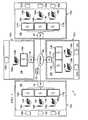
- FIGURE 1 is a block diagram illustrating a communication system 10 for conducting a conference between a plurality of remote locations.
- the illustrated embodiment includes a communication network 100 that may support conferencing between remotely located sites 102 using conference equipment 106.
- Sites 102 may include any suitable number of users 104 that may participate in multiple videoconferences.
- MCU multipoint control unit
- a "conference" may include any communication session between a plurality of users transmitted using any audio and/or video means, including signals, data or messages transmitted through voice and/or video devices, text chat, and instant messaging.
- Communication network 100 represents communication equipment, including hardware and any appropriate controlling logic for interconnecting elements coupled to communication network 100.
- communication network 100 may be any network capable of transmitting audio and/or video telecommunication signals, data, and/or messages, including signals, data, or messages transmitted through text chat, instant messaging, and e-mail.
- communication network 100 may include all or a portion of, a radio access network; a public switched telephone network (PSTN); a public or private data network; a local area network (LAN); a metropolitan area network (MAN); a wide area network (WAN); a local, regional, or global communication or computer network such as the Internet; a wireline or wireless network; an enterprise intranet; or any combination of the preceding.
- PSTN public switched telephone network
- LAN local area network
- MAN metropolitan area network
- WAN wide area network
- Internet a local, regional, or global communication or computer network
- wireline or wireless network an enterprise intranet; or any combination of the preceding.
- communication network 100 may include routers, hubs, switches, gateways, call controllers, and or any other suitable components in any suitable form or arrangements. Additionally, communication network 102 may represent any hardware and/or software configured to communicate information in the form of packets, cells, frames, segments or other portions of data. Although communication network 100 is illustrated as a single network, communication network 100 may include any number or configuration of networks. Moreover, communication system 10 may include any number or configuration of communication networks 100.
- User 104 represents one or more individuals or groups of individuals who may be present for the videoconference. Users 104 participate in the videoconference using any suitable device and/or component, such as audio Internet Protocol (IP) phones, video phone appliances, personal computer (PC) based video phones, and streaming clients. During the videoconference, users 104 may engage in the session as speakers or participate as non-speakers.
- IP Internet Protocol
- PC personal computer
- MCU 120 serves as an intermediary during a multipoint conference.
- MCU acts as a bridge which interconnects data signals from various conference sites.
- MCU 120 may collect audio and/or video signals transmitted by conference participants through their endpoints and distribute such signals to other participants of the multipoint conference at remote sites 102.
- MCU may assign particular audio and/or video signals to particular monitors 110 or loudspeakers at a remote site 102.
- MCU 120 may be configured to support any number of conference endpoints communicating on any number of conferences.
- MCU 120 may include, any bridging or switching device used in support of multipoint conferencing, including videoconferencing.
- MCU 120 may include hardware, software and/or embedded logic such as, for example, one or more codecs.
- MCU may be in the form of customer provided equipment (CPE, e.g. beyond the network interface) or may be embedded in a network such as communication network 102.
- CPE customer provided equipment
- sites 102 include conference equipment 106 which facilitates conferencing among users 104.
- Conference equipment 106 may include any suitable elements to establish and facilitate a videoconference.
- conference equipment 106 may include loudspeakers, user interfaces, controllers, or a speakerphone.
- conference equipment 106 includes conference manager 107, microphones 108, cameras 109, and monitors 110.
- conference equipment 106 may include one or more network interfaces, memories, processors, codecs, or any other suitable hardware or software for videoconferencing between remote locations.
- conference equipment 106 may include any suitable dedicated conferencing devices.
- conference equipment 106 may establish a videoconference session using any suitable technology and/or protocol, such as Session Initiation Protocol (SIP) or H.323. Additionally, conference equipment 106 may support and be interoperable with other video systems supporting other standards, such as H.261, H.263, and/or H.264.
- SIP Session Initiation Protocol
- H.323 H.323
- conference equipment 106 may support and be interoperable with other video systems supporting other standards, such as H.261, H.263, and/or H.264.
- Conference managers (“CM”) 107 may communicate information and signals to and from communication network 100 and a conference site 102.
- CM 107 may include any suitable hardware or software for managing a conference.
- CM 107 may include one or more processors, memories, interfaces, or codecs.
- CM 107 may transmit and receive signals containing conference data to and from a site 102.
- the transmitted signals may be audio-video (A/V) signals that carry video data in addition to audio data.
- the A/V signals may be an analog or a digital signal and may be compressed or uncompressed.
- the A/V signals are signals including media (audio and video) packets transmitted using Real-time Transport Protocol (RTP).
- RTP Real-time Transport Protocol
- RTP is a standardized packet format for transmitting audio and video packets over the Internet. While each CM 107 is depicted as residing at a site 102, a CM 107 may be located anywhere within system 10.
- Microphone 108 may be any acoustic to electric transducer or sensor operable to convert sound into an electrical signal.
- microphone 108 may capture the voice of a user at a local site 102 and transform it into an audio signal for transmission to a remote site 102. While in the illustrated embodiment, there is a microphone 108 for each user 104 a particular site 102 may have more or less microphones than users 104. Additionally, in certain embodiments microphones 108 may be combined with any other component of conference equipment 106 such as, for example, cameras 109.
- microphone 108 and/or CM 107 may be operable to encode audio signals, with an audiometric.
- an audiometric is a confidence value or acoustic measurement which may be used to determine an active signal.
- An active signal is a signal which corresponds to a conference participant currently speaking (i.e. the active speaker).
- An audiometric may be measured and/or calculated based on the relative loudness (i.e. decibel level) of a particular voice.
- the audiometric may also be defined based on acoustic data collected by multiple microphones 108 at a particular site 10. For example, the audiometric for a particular audio signal may be weighted based on the decibel profile at a conference site.
- microphones 108a-108c may all pick up sound waves associated with the voice of user 104a. Because user 104a is closest to microphone 108a, the decibel level will be highest at microphone 108a, lower at microphone 108b, and lowest at microphone 108c. If each microphone 108a-108c were to individually assign an audiometric to the audio signal each produces, then there may be uncertainty as to whether the low decibel level at microphone 108c is due to user 104c speaking with a soft voice or whether microphone 108c is picking up residual sound waves from another speaker. However, given the decibel profile (i.e.
- the audiometrics encoded for the signal generated by microphone 108c may be weighted to account for the decibel profile at the site. It should be noted that the audiometrics for a particular signal are dynamic. Accordingly, once user 104a stops speaking or another user 104 begins to speak, the audiometrics encoded in the respective audio packets for each signal may be adjusted accordingly.
- Cameras 109 may include any suitable hardware and/or software to facilitate capturing an image of user 104 and the surrounding area. In certain embodiments, cameras 109 may capture and transmit the image of user 104 as a video signal. Depending on the embodiment, the transmitted video signal may include a separate signal (e.g., each camera 109 transmits its own signal) or a combined signal (e.g., the signal from multiple sources are combined into one video signal).
- Monitors 110 may include any suitable hardware and/or software to facilitate receiving a video signal and displaying the image of a remote user 104 to users 104 at a local conference site.
- monitors 110 may include a notebook PC, a wall mounted monitor, a floor mounted monitor, or a free standing monitor.
- Monitors 110 may display the image of user 104 using any suitable technology that provides a realistic image, such as high definition, high-power compression hardware, and efficient encoding/decoding standards.
- users 104 at sites 102a and 102d participate in a conference.
- a video signal is generated for each camera 109 and is assigned to a monitor 110.
- This assignment may persist for the duration of the conference.
- a remote user may always be displayed on the same local monitor. This may make it easier for local users to identify who and where the remote user is positioned.
- camera 109a may be assigned to right monitor 110i
- middle camera 109b may be assigned to left monitor 110h
- top camera 109c may be assigned to left monitor 110h.
- left monitor 110h has both middle camera 109b and top camera 109c assigned to it, the monitor may switch between cameras 109b and 108c based on which user last spoke, or which user is currently speaking the loudest. Thus, as various users 104 speak during the conference, the video signal displayed on each monitor 110 may change to display the image of the last speaker.
- system 10 may include any suitable number of sites 102 and may facilitate a videoconference between any suitable number of sites 102.
- sites 102 may include any suitable number of microphones 108, cameras 109, and displays 110 to facilitate a videoconference.
- the videoconference between sites 102 may be point-to-point conferences or multipoint conferences. For point-to-point conferences, the number of displays 110 at local site 102 is less than the number of cameras 109 at remote site 102. For multipoint conferences, the aggregate number of cameras 109 at remote sites 102 is greater than the number of displays 110 at local site 102.
- the operations of system 10 may be performed by more, fewer, or other components. Additionally, operations of system 10 may be performed using any suitable logic.
- FIGURE 2 illustrates the components and operation of a MCU 220 in accordance with a particular embodiment.
- MCU 220 includes interface 230, conference control processor (CCP) 240, and memory 260.
- MCU 220 may be similar to MCU 120 illustrated in FIGURE 1 .
- Also illustrated in FIGURE 2 are A/V input signals 210 and A/V output signals 212.
- Interface 230 is capable of communicating information and signals to and receiving information and signals from a communication network such as communication network 100 of FIGURE 1 . As illustrated, interface 230 is operable to receive one or more A/V input signals 210 from one or more sites participating in a conference and transmit one or more A/V output signals 212 to one or more other sites participating in the conference. It should be noted that A/V input signals 210 may be substantially similar to A/V output signals 212. Interface 230 represents any port or connection, real or virtual, including any suitable hardware and/or software that allow MCU 230 to exchange information and signals with other devices in a communication system. Accordingly, interface 230 may be or include an Ethernet driver, universal serial bus (USB) drive, network card and/or firewall.
- USB universal serial bus
- Memory 260 may store CCP instructions and/or any other information used by MCU 220.
- Memory 260 may include any collection and arrangement of volatile or non-volatile, local or remote devices suitable for storing data. Examples of memory 260 include, but are not limited to random access memory (RAM) devices, dynamic random access memory (DRAM), read only memory (ROM) devices, magnetic storage devices, optical storage devices, flash memory, or any other suitable data storage devices.
- RAM random access memory
- DRAM dynamic random access memory
- ROM read only memory
- magnetic storage devices magnetic storage devices
- optical storage devices optical storage devices
- flash memory or any other suitable data storage devices.
- CCP 240 controls the operation of MCU 220.
- CCP 240 processes information and signals received from cameras or other conference equipment at sites participating in a conference.
- CCP 240 may include any suitable hardware, software, or both that operate to control and process signals.
- CCP 240 may include multiple processing layers arranged in a protocol stack which perform various tasks associated with the processing of media signals.
- CCP 240 includes media layer 242, switching layer 244, and call control layer 246.
- each of the layers may be operable to perform one or more signal processing functions.
- the illustrated protocol stack includes three layers, CCP 240 may include any number of processing layers.
- each of the processing layers may include a separate processor, memory, hardware, or software for carrying out the recited functionality. Examples of CCP 240 include, but are not limited to, application-specific integrated circuits (ASICs), field-programmable gate arrays (FGPAs), digital signal processors (DSPs), and any other suitable specific or general purpose processors.
- ASICs application-specific integrated circuits
- Media layer 242 may be a low level processing layer that receives one or more A/V signals and extracts any relevant information for higher level processing. More specifically, media layer 242 may detect A/V signals from one or more sites participating in a particular conference and extract audiometrics from audio packets in a media signal. As previously noted, an audiometric may be a confidence value which may be used to determine an active speaker. In the embodiment of CCP 240 represented in FIGURE 2 , media layer 242 interfaces with switching layer 244. Accordingly, media layer 242 may forward the extracted audiometric to switching layer 244 for further processing.
- media layer 242 maintains media forwarding table 243.
- Media forwarding table 243 may be a directory, listing, or other index for routing A/V signals to conference sites.
- media forwarding table 243 may indicate that A/V signals from site 102c should be directed to sites 102a and 102b.
- Media forwarding table 243 may further indicate that an A/V signal associated with a particular user 104 should be directed to a particular monitor 110 and/or loudspeaker at sites 102a and 102b.
- the media forwarding table may maintain separate routing listings for audio signals and their associated video signals.
- media forwarding table 243 may be dynamic. Thus, it may be modified or updated in response to a change in the active speaker(s) and/or according to any suitable user preferences. Thus, for example, when a conference participant, such as user 104g at site 102c, begins to speak, media forwarding table 243 may be updated so that the audio and video signals associated with user 104g are broadcasted on monitor 110d at site 102b.
- FIGURE 2 illustrates media forwarding table 243 as a component of media layer 242
- media forwarding table may be stored or reside anywhere within MCU 220 or be accessible to MCU 220 via communications with other components in a communication system, such as communication system 10 of FIGURE 1 .
- switching layer 244 is a higher level processing layer operable to analyze audiometric data forwarded by processing layer 242.
- switching layer 244 may determine an active speaker based on audiometrics from various audio signals associated with a particular conference. Based on the active speaker, switching layer 244 may determine which of a plurality of signals to broadcast at various sites participating in a conference. For purposes of this specification, audio and video signal(s) selected for broadcasting may be referred to as the active audio and active video signals, respectively.
- switching layer 244 may update media forwarding table 243. This may be performed by communicating a status message containing relevant information to media layer 242. Such information may include an update, change or status confirmation regarding the active audio and active video signals. Responsive to the status message, media layer 242 may modify media forwarding table 243 so that the audio and video signals associated with the active speaker are properly routed.
- Call control layer 246, as illustrated in FIGURE 2 is a processing layer for managing communications to and from conference sites.
- call control layer may decode address information and route communications from one conference site to another.
- call control layer 246 may connect the site to one or more remote sites for a conference.
- MCU 220 may receive A/V input signals 210 from multiple conference sites at interface 230.
- A/V input signals 210 may be a stream of media packets which include audio and video data generated at a local site for broadcast at a remote site.
- the audio data may include an audiometric which may be extracted from the audio packets to provide a confidence metric which may be used to determine an active speaker.
- interface 230 may forward the signals to CCP 240 for processing.
- Media layer 242 may then detect whether the A/V signals are associated with a particular conference. Following detection, media layer 242 may extract the audiometric(s) from audio packets in the audio signals.
- media layer 242 may forward the audiometric to the switching layer 244.
- the switching layer 244 may then determine an active signal(s) based on one or more audiometrics and update or modify media forwarding table 243 so that the active signal(s) may be broadcasted at remote conference sites.
- media layer 242 may forward audio and/or video packets associated with A/V input signal 210 so that they are distributed to the conference sites in accordance with the media forwarding table. The packets may then be distributed (as A/V output signal 212) through interface 230.
- interface 230 may maintain a Linux kernel utilizing Netfilter software.
- Netfilter is an open-source packet filtering framework which operates within a Linux kernel. Using Netfilter hooks, interface 230 may detect and intercept A/V packets associated with a particular conference before they enter the processing layers of CCP 240. The Linux kernel may then extract the audiometrics encoded in the audio packets and, similar to medial layer 242, present the audiometrics to switching layer 244. Switching layer 244 may, as previously described, make corresponding switching decisions.
- the Linux kernel may also maintain a media forwarding table, similar to media forwarding table 243, for routing the active audio and active video signals to conference sites.
- the Linux kernel may separate RTP data packets and RTP control protocol (RTCP) packets. RTCP packets partner with RTP in sending and receiving multimedia data, however they do not transport any data itself.
- the Linux kernel may forward the RTCP packets to CCP 240 for processing by an application. Because A/V packets are intercepted before reaching CCP 240, performing the signal processing and forwarding at interface 230 may reduce communication latency and jitter.
- switching decisions may be implemented in a manner which conserves media processing by MCU 220.
- media data transmitted from an inactive conference site to MCU 220 may be compressed or limited to an audio signal.
- media processor 242 may recognize that certain media packets are associated with an inactive site and decline to process the information.
- media layer 242 and/or interface 230 may send a request to a codec at the conference site associated with the signal to send an instantaneous decoder refresh (IDR) frame.
- the IDR frame may contain information necessary for a codec at the MCU to initiate processing and displaying of the audio and/or video signals from the site.
- MCU 220 may initiate processing of the signal and thereby transmit the signal in accordance with media forwarding table 243.
- the old i.e. previously active signal
- MCU resources may be conserved as less media processing may be necessary.
- the selection of an active signal may be performed in a similar manner whether signal processing is performed by interface 230 or by CCP 240.
- the active speaker may be determined based on the audiometrics associated with the packets of various audio signals.
- each microphone 107 may generate an audio signal consisting of packets of audio data coded with an audiometric.
- Switching layer 244 and/or interface 230 may determine the active speaker by comparing the audiometrics associated with the packets of each signal.
- the packets in each of the respective signals from which an audiometric is extracted have approximately the same timestamps. This may ensure that the audiometrics used to select an active signal are from packets generated at approximately same time.
- an active audio signal corresponding to an active speaker may be selected. For example, the audio signal including the packet(s) with the highest audiometric(s) may be selected as the signal corresponding to the active speaker.
- switching layer 244 and/or interface 230 may rank the signals according to their audiometrics. Thus, if a conference site has multiple monitors and/or loudspeakers, the signals associated with the most likely active speakers may be broadcasted.
- the active speaker may change any number of times during the course of a conference. Therefore, switching layer 244 and/or interface 230 may constantly monitor the audiometrics of signals associated with a conference. Because an audio signal may consist of numerous packets, each of which may be coded with an audiometric, the determination of an active speaker may be performed on a packet-by-packet basis. However, switching/updating active video and active audio signals according to data in a particular group of packets from multiple audio signals may not provide the best user experience. This is because certain occurrences such as a sneeze, cough, or phone ring may produce packets which encoded with audiometrics which may be indicative of an active speaker.
- the sensitivity of a packet-by-packet active speaker determination may cause for a conference participant to be wrongly designated as an active speaker which may lead to audio and video signals associated with that participant to be improperly designated as the active audio and active video signals. Because the active audio and/or active video designation may only be momentary, events such as a sneeze may cause flickering of monitors or loudspeakers speakers at remote conference sites.
- an active speaker may be determined based on audio packets generated over 200 millisecond intervals or another specified or programmed time interval.
- the 200 milliseconds serves as a damping period to ensure that a particular signal is not designated active as a result of a sudden rise in the audiometric(s) associated with the signal.
- a conference participant may be designated as an active speaker if the audiometrics from the audio signal associated with the participant indicate that the participant has remained active for 200 milliseconds.
- switching layer 244 and/or interface 230 may employ any suitable algorithm for determining an active speaker over a given damping period.
- the signal(s) having the highest average audiometric values over a 200 millisecond interval may be selected as the active signal(s). This may account for pauses or other breaks in speech that produce audio packets encoded with low audiometrics. While the foregoing operation(s) of switching layer 244 and/or interface 230 have been described using a 200 millisecond damping period, a damping period of any length may be implemented.
- audio and video signals may be separately designated as active.
- different damping intervals for audio and video signals may be employed.
- the audio signal generated by a microphone associated with a conference participant may be designated as active while the corresponding video signal generated by a camera associated with the participant is inactive.
- an audio signal may be designated as active every 200 milliseconds.
- the associated video signal may be designated as active every 2 seconds. Therefore, a participant at a site may hear the voice of a remote participant prior to the image of the participant appearing on a local monitor.
- Employing different damping intervals for audio and video signals may enhance user experience by limiting flickering on monitors while simultaneously allowing conference participants to hear a speaker at a remote site. Additionally, maintaining a shorter damping period for audio signals, as compared to video signals, may prevent local participants from missing communications from remote conference participants.
- switching layer 244 and/or interface 230 may employ different protocols for determining an active video signal as opposed to an active audio signal.
- switching layer 244 may, in conjunction with memory 260, maintain an archive of the active audio signals.
- the archive may thereby be used to select the active video signal.
- the archive might record each occasion a change in the active audio signal occurs.
- the archive may record the active audio signal after each audio damping period. Thus, if the audio damping period is 200 milliseconds and the damping period for video signals is 2 seconds, then the active video may be based on the previous ten archive entries.
- the video signal associated with that audio signal may be selected as the active video signal.
- the video signal designated as active may be the one which is associated with the audio signal that was active for a majority the video damping period. It should be noted that, as with audio signals, more than a single video signal may be designated as active. Additionally, while specific methods for selecting an active video signal have been described, various other methods for selecting an active video signal based on an active audio signal(s) may be implemented.
- the method begins at step 300 where a plurality of audio and video signals are received.
- the signals may be received by an interface, such as interface 230.
- the audio signals may consist of a plurality of packets transporting audio data generated by one or more microphones at remote sites for broadcasting at local conference sites.
- One or more of the packets in each of the audio signals may be coded with an audiometric which provides a confidence value for determining an active speaker.
- the packets are forwarded to CCP 240 for processing. Audiometrics are then extracted from packets in each of the signals at step 304.
- the extraction step may be performed by media layer 242.
- an active audio signal may be selected.
- the selection may be made by switching layer 244 and may be based on a comparison of the extracted audiometrics.
- the comparison may include on audiometrics extracted from packets having a particular timestamp. Accordingly, the determination of an active audio signal may be based on the signal having the highest audiometric for the particular timestamp or having the highest audiometrics over a range of timestamps. Additionally, switching layer 244 may select multiple signals to be active or rank the signals based on their audiometrics. Switching layer may also select an active video signal at step 308 based on the selection of the active audio signal.
- switching layer 244 may determine whether to update the media forwarding table 243 at step 310. This determination may be based on a change in the active audio signal(s) which requires re-routing of the audio and/or video signals among the sites participating in the conference. If the media forwarding table is to be updated, switching layer 244 may communicate the update to media layer 242 which may thereby modify the media forwarding table at step 312.
- media layer 242 may, at step 314, distribute the packets associated with the active audio and/or active video signals to one or more of the participating conference sites. The packets may be distributed based on the routing parameters in the media forwarding table 243. In certain embodiments, media layer 242 may, based on the media forwarding table, distribute/route packets to particular monitors and/or loudspeakers at a conference site.
- the method may include more, fewer, or other steps.
- media layer 242 may distribute packets in accordance with media forwarding table 243 as soon as the packets are received.
- media layer 240 may proceed by routing the packets according to the updated table. Accordingly, steps may be performed in any suitable order without departing from the scope of the invention.
Landscapes
- Engineering & Computer Science (AREA)
- Signal Processing (AREA)
- Multimedia (AREA)
- Computer Networks & Wireless Communication (AREA)
- Computer Vision & Pattern Recognition (AREA)
- Telephonic Communication Services (AREA)
- Two-Way Televisions, Distribution Of Moving Picture Or The Like (AREA)
- Packages (AREA)
Claims (14)
- Verfahren zum Verteilen von Medienpaketen bei einer Mehrpunkt-Konferenz, wobei das Verfahren umfasst:Empfangen einer Vielzahl von Audiosignalen, wobei jedes der Vielzahl von Audiosignalen Audiopakete enthält, wobei eines oder mehrere Audiopakete von jedem der Vielzahl von Audiosignalen mit einer Audiometrie codiert ist, wobei die Audiometrie eine Akustikmessung von einem Konferenzort enthält;Extrahieren einer oder mehrerer Audiometrien aus einem oder mehreren Audiopaketen für jedes der Vielzahl von Audiosignalen;Auswählen eines oder mehrerer aktiver Audiosignale auf der Grundlage der einen oder der mehreren extrahierten Audiometrien;Ermitteln einer Veränderung in den aktiven Audiosignalen, Aktualisieren einer Medienweiterleitungstabelle im Ansprechen auf das Ermitteln einer Änderung in den aktiven Audiosignalen, wobei die Medienweiterleitungstabelle ein Verzeichnis zum Routen eines oder mehrerer der Vielzahl von Audiosignalen enthält; undVerteilen von Audiopaketen an einen oder mehrere Konferenzorte gemäß der Medienweiterleitungstabelle.
- Verfahren nach Anspruch 1, das des Weiteren umfasst:Empfangen einer Vielzahl von Videosignalen, wobei jedes der Vielzahl von Videosignalen mit einem oder mehreren der Vielzahl von Audiosignalen assoziiert ist;Auswählen eines aktiven Videosignals auf der Grundlage des einen oder der mehreren aktiven Audiosignale; undVerteilen eines oder mehrere der Videosignale gemäß der Medienweiterleitungstabelle, wobei die Medienweiterleitungstabelle ein Verzeichnis zum Routen eines oder mehrerer der Vielzahl von Videosignalen enthält.
- Verfahren nach Anspruch 2, das des Weiteren umfasst:Ermitteln einer Veränderung in dem aktiven Videosignal; undAktualisieren der Medienweiterleitungstabelle im Ansprechen auf das Ermitteln einer Veränderung in dem aktiven Videosignal.
- Verfahren nach Anspruch 2, wobei das Auswählen eines aktiven Videosignals auf der Grundlage eines oder mehrerer aktiver Audiosignale das Auswählen eines aktiven Videosignals auf der Grundlage eines Archivs umfasst, wobei das Archiv eine Aufzeichnung eines oder mehrerer aktiver Audiosignale enthält.
- Verfahren nach Anspruch 2, das des Weiteren das Anzeigen des aktiven Videosignals an einem Konferenzort umfasst.
- Verfahren nach Anspruch 1, wobei das Auswählen eines oder mehrerer aktiver Audiosignale auf der Grundlage der einen oder mehreren Audiometrien das Vergleichen einer Vielzahl von Audiometrien von jedem der Vielzahl von Audiosignalen umfasst, wobei die Vielzahl von Audiometrien aus Audiopaketen extrahiert werden, die über ein vorgegebenes Zeitintervall erzeugt worden sind.
- Verfahren nach Anspruch 1, das des Weiteren umfasst: Rundsenden des einen oder der mehreren aktiven Audiosignale an einem fernen Konferenzort.
- Verfahren nach Anspruch 1, wobei die Audiometrie eine Dezibel-Messung an einem Konferenzort umfasst.
- Verfahren nach Anspruch 1, wobei die Audiometrie auf der Grundlage einer Vielzahl von Akustikmessungen an einem Konferenzort gewichtet wird.
- Verfahren nach Anspruch 1, das des Weiteren umfasst:Klassifizieren der Vielzahl von Audiosignalen gemäß den extrahierten Audiometrien.
- Verfahren nach Anspruch 1, das des Weiteren umfasst: im Ansprechen auf das Ermitteln einer Veränderung in dem aktiven Audiosignal, Empfangen eines momentanen Decoder-Auffrischungs-Frames vor dem Verteilen von Audiopaketen an einen oder mehrere Konferenzorte gemäß der Medienweiterleitungstabelle.
- Mehrpunkt-Steuereinheit zum Verteilen von Medienpaketen bei einer Mehrpunkt-Konferenz, die aufweist:eine Schnittstelle; undeinen Konferenzsteuerungsprozessor, der so betreibbar ist, dass er ein Verfahren nach einem der vorhergehenden Ansprüche durchführt.
- Computerlesbares Medium mit Code zum Verteilen von Medienpaketen bei einer Mehrpunkt-Konferenz, wobei der Code, wenn er von einem Computer gelesen und ausgeführt wird, veranlasst, dass der Computer ein Verfahren nach einem der Ansprüche 1 bis 11 durchführt.
- Mehrpunkt-Steuereinheit zum Verteilen von Medienpaketen bei einer Mehrpunkt-Konferenz, die aufweist:eine Einrichtung zum Empfangen einer Vielzahl von Audiosignalen, wobei jedes der Vielzahl von Audiosignalen Audiopakete enthält, wobei eines oder mehrere Audiopakete von jedem der Vielzahl von Audiosignalen mit einer Audiometrie codiert ist, wobei die Audiometrie eine Akustikmessung von einem Konferenzort enthält;eine Einrichtung zum Extrahieren einer oder mehrerer Audiometrien aus einem oder mehreren Audiopaketen für jedes der Vielzahl von Audiosignalen;eine Einrichtung zum Auswählen eines oder mehrerer aktiver Audiosignale auf der Grundlage der einen oder der mehreren extrahierten Audiometrien;eine Einrichtung zum Ermitteln einer Veränderung in den aktiven Audiosignalen;eine Einrichtung zum Aktualisieren einer Medienweiterleitungstabelle im Ansprechen auf das Ermitteln einer Änderung in den aktiven Audiosignalen, wobei die Medienweiterleitungstabelle ein Verzeichnis zum Routen eines oder mehrerer der Vielzahl von Audiosignalen enthält; undeine Einrichtung zum Verteilen von Audiopaketen an einen oder mehrere Konferenzorte gemäß der Medienweiterleitungstabelle.
Applications Claiming Priority (2)
| Application Number | Priority Date | Filing Date | Title |
|---|---|---|---|
| US11/799,019 US8264521B2 (en) | 2007-04-30 | 2007-04-30 | Media detection and packet distribution in a multipoint conference |
| PCT/US2008/061711 WO2008137373A1 (en) | 2007-04-30 | 2008-04-28 | Media detection and packet distribution in a multipoint conference |
Publications (2)
| Publication Number | Publication Date |
|---|---|
| EP2143234A1 EP2143234A1 (de) | 2010-01-13 |
| EP2143234B1 true EP2143234B1 (de) | 2011-01-26 |
Family
ID=39777162
Family Applications (1)
| Application Number | Title | Priority Date | Filing Date |
|---|---|---|---|
| EP08746991A Active EP2143234B1 (de) | 2007-04-30 | 2008-04-28 | Medienerkennung und paketverteilung bei einer mehpunktkonferenz |
Country Status (6)
| Country | Link |
|---|---|
| US (3) | US8264521B2 (de) |
| EP (1) | EP2143234B1 (de) |
| CN (1) | CN101675623B (de) |
| AT (1) | ATE497289T1 (de) |
| DE (1) | DE602008004755D1 (de) |
| WO (1) | WO2008137373A1 (de) |
Families Citing this family (20)
| Publication number | Priority date | Publication date | Assignee | Title |
|---|---|---|---|---|
| US8334891B2 (en) | 2007-03-05 | 2012-12-18 | Cisco Technology, Inc. | Multipoint conference video switching |
| US8264521B2 (en) * | 2007-04-30 | 2012-09-11 | Cisco Technology, Inc. | Media detection and packet distribution in a multipoint conference |
| US20090268008A1 (en) * | 2008-04-24 | 2009-10-29 | Cisco Technology Inc. | Media conference switching in a multi-device configuration |
| US8717407B2 (en) * | 2010-05-13 | 2014-05-06 | Lifesize Communications, Inc. | Telepresence between a multi-unit location and a plurality of single unit locations |
| US8897134B2 (en) * | 2010-06-25 | 2014-11-25 | Telefonaktiebolaget L M Ericsson (Publ) | Notifying a controller of a change to a packet forwarding configuration of a network element over a communication channel |
| EP2448265A1 (de) | 2010-10-26 | 2012-05-02 | Google, Inc. | Lippensynchronisation in einer Videokonferenz |
| US8995306B2 (en) | 2011-04-06 | 2015-03-31 | Cisco Technology, Inc. | Video conferencing with multipoint conferencing units and multimedia transformation units |
| US8581958B2 (en) * | 2011-04-18 | 2013-11-12 | Hewlett-Packard Development Company, L.P. | Methods and systems for establishing video conferences using portable electronic devices |
| US9210302B1 (en) | 2011-08-10 | 2015-12-08 | Google Inc. | System, method and apparatus for multipoint video transmission |
| US9232244B2 (en) * | 2011-12-23 | 2016-01-05 | Cisco Technology, Inc. | Efficient frame forwarding in large scale real-time screen content sharing meetings |
| US8917309B1 (en) | 2012-03-08 | 2014-12-23 | Google, Inc. | Key frame distribution in video conferencing |
| US8791982B1 (en) | 2012-06-27 | 2014-07-29 | Google Inc. | Video multicast engine |
| US8681203B1 (en) | 2012-08-20 | 2014-03-25 | Google Inc. | Automatic mute control for video conferencing |
| US20140114664A1 (en) * | 2012-10-20 | 2014-04-24 | Microsoft Corporation | Active Participant History in a Video Conferencing System |
| CN103905776B (zh) * | 2012-12-26 | 2018-01-16 | 华为技术有限公司 | 码流处理方法和系统、多点控制单元 |
| US9549015B2 (en) * | 2014-04-15 | 2017-01-17 | Lattice Semiconductor Corporation | Communication of multimedia data streams over multiple communication lanes |
| CN104506450A (zh) * | 2014-11-06 | 2015-04-08 | 小米科技有限责任公司 | 媒体资源反馈方法及装置 |
| US9609275B2 (en) | 2015-07-08 | 2017-03-28 | Google Inc. | Single-stream transmission method for multi-user video conferencing |
| CN106559636A (zh) * | 2015-09-25 | 2017-04-05 | 中兴通讯股份有限公司 | 一种视频通信方法、装置及系统 |
| US10425727B2 (en) * | 2016-03-17 | 2019-09-24 | Sonova Ag | Hearing assistance system in a multi-talker acoustic network |
Family Cites Families (77)
| Publication number | Priority date | Publication date | Assignee | Title |
|---|---|---|---|---|
| US5007046A (en) | 1988-12-28 | 1991-04-09 | At&T Bell Laboratories | Computer controlled adaptive speakerphone |
| DE69029759T2 (de) | 1989-05-15 | 1997-07-17 | International Business Machines Corp., Armonk, N.Y. | Flexible Schnittstelle für Beglaubigungsdienste in einem verteilten Datenverarbeitungssystem |
| US5560008A (en) | 1989-05-15 | 1996-09-24 | International Business Machines Corporation | Remote authentication and authorization in a distributed data processing system |
| US5058153A (en) | 1989-12-27 | 1991-10-15 | Carew Edward C | Noise mitigation and mode switching in communications terminals such as telephones |
| US6594688B2 (en) * | 1993-10-01 | 2003-07-15 | Collaboration Properties, Inc. | Dedicated echo canceler for a workstation |
| US5436896A (en) * | 1994-03-17 | 1995-07-25 | At&T Corp. | Conference bridge for packetized speech-signal networks |
| US5920562A (en) | 1996-11-22 | 1999-07-06 | Sprint Communications Co. L.P. | Systems and methods for providing enhanced services for telecommunication call |
| FR2722596A1 (fr) | 1994-07-13 | 1996-01-19 | France Telecom | Systeme de controle d'acces limites a des places horaires autorisees et renouvables au moyen d'un support de memorisation portable |
| US5473363A (en) * | 1994-07-26 | 1995-12-05 | Motorola, Inc. | System, method and multipoint control unit for multipoint multimedia conferencing |
| WO1996011446A2 (en) | 1994-10-10 | 1996-04-18 | Philips Electronics N.V. | Database system with local information remotely supported with dynamic information |
| CA2138302C (en) | 1994-12-15 | 1999-05-25 | Michael S. Fortinsky | Provision of secure access to external resources from a distributed computing environment |
| DE19515681A1 (de) | 1995-04-28 | 1996-10-31 | Sel Alcatel Ag | Verfahren, System und Teilnehmereinrichtung zum manipulationssicheren Trennen von Nachrichtenströmen |
| GB9515336D0 (en) | 1995-07-26 | 1995-09-20 | Int Computers Ltd | Multi-media services system |
| US5844600A (en) * | 1995-09-15 | 1998-12-01 | General Datacomm, Inc. | Methods, apparatus, and systems for transporting multimedia conference data streams through a transport network |
| US5764887A (en) | 1995-12-11 | 1998-06-09 | International Business Machines Corporation | System and method for supporting distributed computing mechanisms in a local area network server environment |
| US5668857A (en) | 1996-03-29 | 1997-09-16 | Netspeed, Inc. | Communication server apparatus and method |
| US5928323A (en) | 1996-05-30 | 1999-07-27 | Sun Microsystems, Inc. | Apparatus and method for dynamically generating information with server-side software objects |
| US5848098A (en) | 1996-07-09 | 1998-12-08 | Lucent Technologies, Inc. | Personal base station extension calling arrangement |
| US6332153B1 (en) | 1996-07-31 | 2001-12-18 | Vocaltec Communications Ltd. | Apparatus and method for multi-station conferencing |
| US5864665A (en) | 1996-08-20 | 1999-01-26 | International Business Machines Corporation | Auditing login activity in a distributed computing environment |
| US7145898B1 (en) | 1996-11-18 | 2006-12-05 | Mci Communications Corporation | System, method and article of manufacture for selecting a gateway of a hybrid communication system architecture |
| US6122631A (en) | 1997-03-28 | 2000-09-19 | International Business Machines Corporation | Dynamic server-managed access control for a distributed file system |
| JP3848725B2 (ja) | 1997-04-04 | 2006-11-22 | 富士通株式会社 | 双方向通信システム |
| EP1850505A3 (de) | 1997-04-24 | 2014-06-18 | Ntt Mobile Communications Network Inc. | Verfahren und System zur mobilen Kommunikation |
| JP3529621B2 (ja) | 1997-05-12 | 2004-05-24 | 株式会社東芝 | ルータ装置、データグラム転送方法及び通信システム |
| US6128649A (en) | 1997-06-02 | 2000-10-03 | Nortel Networks Limited | Dynamic selection of media streams for display |
| US5983273A (en) | 1997-09-16 | 1999-11-09 | Webtv Networks, Inc. | Method and apparatus for providing physical security for a user account and providing access to the user's environment and preferences |
| US6393481B1 (en) | 1997-10-06 | 2002-05-21 | Worldcom, Inc. | Method and apparatus for providing real-time call processing services in an intelligent network |
| US5974566A (en) | 1997-10-07 | 1999-10-26 | International Business Machines Corporation | Method and apparatus for providing persistent fault-tolerant proxy login to a web-based distributed file service |
| US6148068A (en) | 1997-10-20 | 2000-11-14 | Nortel Networks Limited | System for managing an audio conference |
| JP3812123B2 (ja) | 1998-02-12 | 2006-08-23 | 富士ゼロックス株式会社 | 認証方法および装置 |
| US6078809A (en) | 1998-02-27 | 2000-06-20 | Motorola, Inc. | Method and apparatus for performing a multi-party communication in a communication system |
| US6418125B1 (en) * | 1998-06-18 | 2002-07-09 | Cisco Technology, Inc. | Unified mixing, speaker selection, and jitter buffer management for multi-speaker packet audio systems |
| US6453362B1 (en) | 1998-08-12 | 2002-09-17 | International Business Machines Corporation | Systems, methods and computer program products for invoking server applications using tickets registered in client-side remote object registries |
| US6535604B1 (en) | 1998-09-04 | 2003-03-18 | Nortel Networks Limited | Voice-switching device and method for multiple receivers |
| US6546425B1 (en) | 1998-10-09 | 2003-04-08 | Netmotion Wireless, Inc. | Method and apparatus for providing mobile and other intermittent connectivity in a computing environment |
| US6986157B1 (en) | 1998-12-21 | 2006-01-10 | 3Com Corporation | Method and system for dynamic service registration in a data-over-cable system |
| US6327276B1 (en) * | 1998-12-22 | 2001-12-04 | Nortel Networks Limited | Conferencing over LAN/WAN using a hybrid client/server configuration |
| US7006616B1 (en) * | 1999-05-21 | 2006-02-28 | Terayon Communication Systems, Inc. | Teleconferencing bridge with EdgePoint mixing |
| GB9915312D0 (en) * | 1999-06-30 | 1999-09-01 | Nortel Networks Corp | Conference circuit for encoded digital audio |
| US7079499B1 (en) | 1999-09-08 | 2006-07-18 | Nortel Networks Limited | Internet protocol mobility architecture framework |
| US6401211B1 (en) | 1999-10-19 | 2002-06-04 | Microsoft Corporation | System and method of user logon in combination with user authentication for network access |
| US6678733B1 (en) | 1999-10-26 | 2004-01-13 | At Home Corporation | Method and system for authorizing and authenticating users |
| US6760759B1 (en) | 1999-11-24 | 2004-07-06 | Mtel Limited | System to support mobile visual communications |
| US6300973B1 (en) | 2000-01-13 | 2001-10-09 | Meir Feder | Method and system for multimedia communication control |
| US7054268B1 (en) | 2000-02-04 | 2006-05-30 | Nokia Mobile Phones, Inc. | Method and arrangement for transferring information in a packet radio service with application-based choice of release mode |
| US6590604B1 (en) | 2000-04-07 | 2003-07-08 | Polycom, Inc. | Personal videoconferencing system having distributed processing architecture |
| US6662211B1 (en) * | 2000-04-07 | 2003-12-09 | Lucent Technologies Inc. | Method and system for providing conferencing services in a telecommunications system |
| US6501739B1 (en) * | 2000-05-25 | 2002-12-31 | Remoteability, Inc. | Participant-controlled conference calling system |
| US6819652B1 (en) | 2000-06-21 | 2004-11-16 | Nortel Networks Limited | Method and apparatus for processing control messages in a communications system |
| AU2001272701A1 (en) | 2000-07-26 | 2002-02-05 | Eyeball Network Games Inc. | System and method for adaptable, scalable multimedia broadcasting over a network |
| US7007098B1 (en) * | 2000-08-17 | 2006-02-28 | Nortel Networks Limited | Methods of controlling video signals in a video conference |
| US7103556B2 (en) | 2000-11-02 | 2006-09-05 | Jpmorgan Chase Bank, N.A. | System and method for aggregate portfolio client support |
| US7039027B2 (en) | 2000-12-28 | 2006-05-02 | Symbol Technologies, Inc. | Automatic and seamless vertical roaming between wireless local area network (WLAN) and wireless wide area network (WWAN) while maintaining an active voice or streaming data connection: systems, methods and program products |
| US7266091B2 (en) * | 2001-02-28 | 2007-09-04 | The Trustees Of Columbia University In City Of New York | System and method for conferencing in inter/intranet telephony |
| US7161939B2 (en) * | 2001-06-29 | 2007-01-09 | Ip Unity | Method and system for switching among independent packetized audio streams |
| US20030048353A1 (en) | 2001-08-07 | 2003-03-13 | Michael Kenoyer | System and method for high resolution videoconferencing |
| US6978001B1 (en) * | 2001-12-31 | 2005-12-20 | Cisco Technology, Inc. | Method and system for controlling audio content during multiparty communication sessions |
| GB2384932B (en) | 2002-01-30 | 2004-02-25 | Motorola Inc | Video conferencing system and method of operation |
| US20030174657A1 (en) * | 2002-03-18 | 2003-09-18 | Wenlong Qin | Method, system and computer program product for voice active packet switching for IP based audio conferencing |
| US20030185369A1 (en) * | 2002-03-29 | 2003-10-02 | Oliver Neal C. | Telephone conference bridge provided via a plurality of computer telephony resource algorithms |
| US20030223562A1 (en) * | 2002-05-29 | 2003-12-04 | Chenglin Cui | Facilitating conference calls by dynamically determining information streams to be received by a mixing unit |
| US7362349B2 (en) * | 2002-07-10 | 2008-04-22 | Seiko Epson Corporation | Multi-participant conference system with controllable content delivery using a client monitor back-channel |
| GB0301033D0 (en) | 2003-01-16 | 2003-02-19 | Sony Uk Ltd | Networks and methods and devices therefor |
| US7454460B2 (en) * | 2003-05-16 | 2008-11-18 | Seiko Epson Corporation | Method and system for delivering produced content to passive participants of a videoconference |
| US20050018828A1 (en) * | 2003-07-25 | 2005-01-27 | Siemens Information And Communication Networks, Inc. | System and method for indicating a speaker during a conference |
| US8659636B2 (en) | 2003-10-08 | 2014-02-25 | Cisco Technology, Inc. | System and method for performing distributed video conferencing |
| CA2537944C (en) | 2003-10-08 | 2010-11-30 | Cisco Technology, Inc. | System and method for performing distributed video conferencing |
| US20050099492A1 (en) * | 2003-10-30 | 2005-05-12 | Ati Technologies Inc. | Activity controlled multimedia conferencing |
| US7567270B2 (en) * | 2004-04-22 | 2009-07-28 | Insors Integrated Communications | Audio data control |
| US20060221869A1 (en) * | 2005-03-29 | 2006-10-05 | Teck-Kuen Chua | System and method for audio multicast |
| US8971511B2 (en) * | 2006-03-31 | 2015-03-03 | Cisco Technology, Inc. | Method and apparatus for enhancing speaker selection |
| ATE527810T1 (de) * | 2006-05-11 | 2011-10-15 | Global Ip Solutions Gips Ab | Tonmischung |
| US7848265B2 (en) * | 2006-09-21 | 2010-12-07 | Siemens Enterprise Communications, Inc. | Apparatus and method for automatic conference initiation |
| US20080159507A1 (en) * | 2006-12-27 | 2008-07-03 | Nokia Corporation | Distributed teleconference multichannel architecture, system, method, and computer program product |
| US8334891B2 (en) * | 2007-03-05 | 2012-12-18 | Cisco Technology, Inc. | Multipoint conference video switching |
| US8264521B2 (en) * | 2007-04-30 | 2012-09-11 | Cisco Technology, Inc. | Media detection and packet distribution in a multipoint conference |
-
2007
- 2007-04-30 US US11/799,019 patent/US8264521B2/en active Active
-
2008
- 2008-04-28 WO PCT/US2008/061711 patent/WO2008137373A1/en not_active Ceased
- 2008-04-28 CN CN200880014096XA patent/CN101675623B/zh not_active Expired - Fee Related
- 2008-04-28 AT AT08746991T patent/ATE497289T1/de not_active IP Right Cessation
- 2008-04-28 EP EP08746991A patent/EP2143234B1/de active Active
- 2008-04-28 DE DE602008004755T patent/DE602008004755D1/de active Active
-
2012
- 2012-09-10 US US13/608,708 patent/US8736663B2/en active Active
-
2014
- 2014-05-22 US US14/284,883 patent/US9509953B2/en active Active
Also Published As
| Publication number | Publication date |
|---|---|
| US8264521B2 (en) | 2012-09-11 |
| US20140253675A1 (en) | 2014-09-11 |
| DE602008004755D1 (de) | 2011-03-10 |
| WO2008137373A1 (en) | 2008-11-13 |
| EP2143234A1 (de) | 2010-01-13 |
| CN101675623B (zh) | 2013-03-27 |
| US9509953B2 (en) | 2016-11-29 |
| ATE497289T1 (de) | 2011-02-15 |
| CN101675623A (zh) | 2010-03-17 |
| US20080266384A1 (en) | 2008-10-30 |
| US20130047192A1 (en) | 2013-02-21 |
| US8736663B2 (en) | 2014-05-27 |
Similar Documents
| Publication | Publication Date | Title |
|---|---|---|
| US8264521B2 (en) | Media detection and packet distribution in a multipoint conference | |
| US8379076B2 (en) | System and method for displaying a multipoint videoconference | |
| US7707247B2 (en) | System and method for displaying users in a visual conference between locations | |
| CN101627576B (zh) | 多点会议视频切换 | |
| JP4372558B2 (ja) | 電気通信システム | |
| RU2398361C2 (ru) | Интеллектуальный способ, система и узел ограничения аудио | |
| US6963353B1 (en) | Non-causal speaker selection for conference multicast | |
| JP5129989B2 (ja) | 会議レイアウト制御及び制御プロトコル | |
| US8599235B2 (en) | Automatic display latency measurement system for video conferencing | |
| US20070291667A1 (en) | Intelligent audio limit method, system and node | |
| EP3070876A1 (de) | Verfahren und system zur verbesserung von telekonferenzdiensten | |
| US9154395B2 (en) | Method and system for optimizing a jitter buffer | |
| US20210336813A1 (en) | Videoconferencing server for providing videoconferencing by using multiple videoconferencing terminals and camera tracking method therefor | |
| JP2020036225A (ja) | 情報処理装置、情報処理方法及び情報処理プログラム | |
| EP4583502A1 (de) | Verfahren zur verwaltung von multimedia in einem virtuellen konferenzsystem, zugehöriges system, zugehöriges multimediaverwaltungsmodul und zugehöriger virtueller konferenzserver | |
| MX2007006912A (es) | Control de modelo de conferencia y protocolo de control. | |
| MX2007006914A (es) | Metodo, sistema y nodo de limite de audio inteligentes. |
Legal Events
| Date | Code | Title | Description |
|---|---|---|---|
| PUAI | Public reference made under article 153(3) epc to a published international application that has entered the european phase |
Free format text: ORIGINAL CODE: 0009012 |
|
| 17P | Request for examination filed |
Effective date: 20091030 |
|
| AK | Designated contracting states |
Kind code of ref document: A1 Designated state(s): AT BE BG CH CY CZ DE DK EE ES FI FR GB GR HR HU IE IS IT LI LT LU LV MC MT NL NO PL PT RO SE SI SK TR |
|
| GRAP | Despatch of communication of intention to grant a patent |
Free format text: ORIGINAL CODE: EPIDOSNIGR1 |
|
| DAX | Request for extension of the european patent (deleted) | ||
| GRAS | Grant fee paid |
Free format text: ORIGINAL CODE: EPIDOSNIGR3 |
|
| GRAA | (expected) grant |
Free format text: ORIGINAL CODE: 0009210 |
|
| AK | Designated contracting states |
Kind code of ref document: B1 Designated state(s): AT BE BG CH CY CZ DE DK EE ES FI FR GB GR HR HU IE IS IT LI LT LU LV MC MT NL NO PL PT RO SE SI SK TR |
|
| REG | Reference to a national code |
Ref country code: GB Ref legal event code: FG4D |
|
| REG | Reference to a national code |
Ref country code: CH Ref legal event code: EP |
|
| REG | Reference to a national code |
Ref country code: IE Ref legal event code: FG4D |
|
| REF | Corresponds to: |
Ref document number: 602008004755 Country of ref document: DE Date of ref document: 20110310 Kind code of ref document: P |
|
| REG | Reference to a national code |
Ref country code: DE Ref legal event code: R096 Ref document number: 602008004755 Country of ref document: DE Effective date: 20110310 |
|
| REG | Reference to a national code |
Ref country code: SE Ref legal event code: TRGR |
|
| REG | Reference to a national code |
Ref country code: NL Ref legal event code: VDEP Effective date: 20110126 |
|
| REG | Reference to a national code |
Ref country code: NO Ref legal event code: T2 Effective date: 20110126 |
|
| LTIE | Lt: invalidation of european patent or patent extension |
Effective date: 20110126 |
|
| PG25 | Lapsed in a contracting state [announced via postgrant information from national office to epo] |
Ref country code: LT Free format text: LAPSE BECAUSE OF FAILURE TO SUBMIT A TRANSLATION OF THE DESCRIPTION OR TO PAY THE FEE WITHIN THE PRESCRIBED TIME-LIMIT Effective date: 20110126 Ref country code: PT Free format text: LAPSE BECAUSE OF FAILURE TO SUBMIT A TRANSLATION OF THE DESCRIPTION OR TO PAY THE FEE WITHIN THE PRESCRIBED TIME-LIMIT Effective date: 20110526 Ref country code: HR Free format text: LAPSE BECAUSE OF FAILURE TO SUBMIT A TRANSLATION OF THE DESCRIPTION OR TO PAY THE FEE WITHIN THE PRESCRIBED TIME-LIMIT Effective date: 20110126 Ref country code: LV Free format text: LAPSE BECAUSE OF FAILURE TO SUBMIT A TRANSLATION OF THE DESCRIPTION OR TO PAY THE FEE WITHIN THE PRESCRIBED TIME-LIMIT Effective date: 20110126 Ref country code: ES Free format text: LAPSE BECAUSE OF FAILURE TO SUBMIT A TRANSLATION OF THE DESCRIPTION OR TO PAY THE FEE WITHIN THE PRESCRIBED TIME-LIMIT Effective date: 20110507 Ref country code: GR Free format text: LAPSE BECAUSE OF FAILURE TO SUBMIT A TRANSLATION OF THE DESCRIPTION OR TO PAY THE FEE WITHIN THE PRESCRIBED TIME-LIMIT Effective date: 20110427 |
|
| PG25 | Lapsed in a contracting state [announced via postgrant information from national office to epo] |
Ref country code: BG Free format text: LAPSE BECAUSE OF FAILURE TO SUBMIT A TRANSLATION OF THE DESCRIPTION OR TO PAY THE FEE WITHIN THE PRESCRIBED TIME-LIMIT Effective date: 20110426 Ref country code: BE Free format text: LAPSE BECAUSE OF FAILURE TO SUBMIT A TRANSLATION OF THE DESCRIPTION OR TO PAY THE FEE WITHIN THE PRESCRIBED TIME-LIMIT Effective date: 20110126 Ref country code: CY Free format text: LAPSE BECAUSE OF FAILURE TO SUBMIT A TRANSLATION OF THE DESCRIPTION OR TO PAY THE FEE WITHIN THE PRESCRIBED TIME-LIMIT Effective date: 20110126 Ref country code: FI Free format text: LAPSE BECAUSE OF FAILURE TO SUBMIT A TRANSLATION OF THE DESCRIPTION OR TO PAY THE FEE WITHIN THE PRESCRIBED TIME-LIMIT Effective date: 20110126 Ref country code: NL Free format text: LAPSE BECAUSE OF FAILURE TO SUBMIT A TRANSLATION OF THE DESCRIPTION OR TO PAY THE FEE WITHIN THE PRESCRIBED TIME-LIMIT Effective date: 20110126 Ref country code: SI Free format text: LAPSE BECAUSE OF FAILURE TO SUBMIT A TRANSLATION OF THE DESCRIPTION OR TO PAY THE FEE WITHIN THE PRESCRIBED TIME-LIMIT Effective date: 20110126 Ref country code: AT Free format text: LAPSE BECAUSE OF FAILURE TO SUBMIT A TRANSLATION OF THE DESCRIPTION OR TO PAY THE FEE WITHIN THE PRESCRIBED TIME-LIMIT Effective date: 20110126 Ref country code: PL Free format text: LAPSE BECAUSE OF FAILURE TO SUBMIT A TRANSLATION OF THE DESCRIPTION OR TO PAY THE FEE WITHIN THE PRESCRIBED TIME-LIMIT Effective date: 20110126 |
|
| PG25 | Lapsed in a contracting state [announced via postgrant information from national office to epo] |
Ref country code: EE Free format text: LAPSE BECAUSE OF FAILURE TO SUBMIT A TRANSLATION OF THE DESCRIPTION OR TO PAY THE FEE WITHIN THE PRESCRIBED TIME-LIMIT Effective date: 20110126 Ref country code: DK Free format text: LAPSE BECAUSE OF FAILURE TO SUBMIT A TRANSLATION OF THE DESCRIPTION OR TO PAY THE FEE WITHIN THE PRESCRIBED TIME-LIMIT Effective date: 20110126 |
|
| PG25 | Lapsed in a contracting state [announced via postgrant information from national office to epo] |
Ref country code: MC Free format text: LAPSE BECAUSE OF NON-PAYMENT OF DUE FEES Effective date: 20110430 Ref country code: SK Free format text: LAPSE BECAUSE OF FAILURE TO SUBMIT A TRANSLATION OF THE DESCRIPTION OR TO PAY THE FEE WITHIN THE PRESCRIBED TIME-LIMIT Effective date: 20110126 Ref country code: CZ Free format text: LAPSE BECAUSE OF FAILURE TO SUBMIT A TRANSLATION OF THE DESCRIPTION OR TO PAY THE FEE WITHIN THE PRESCRIBED TIME-LIMIT Effective date: 20110126 Ref country code: RO Free format text: LAPSE BECAUSE OF FAILURE TO SUBMIT A TRANSLATION OF THE DESCRIPTION OR TO PAY THE FEE WITHIN THE PRESCRIBED TIME-LIMIT Effective date: 20110126 |
|
| PLBE | No opposition filed within time limit |
Free format text: ORIGINAL CODE: 0009261 |
|
| STAA | Information on the status of an ep patent application or granted ep patent |
Free format text: STATUS: NO OPPOSITION FILED WITHIN TIME LIMIT |
|
| PG25 | Lapsed in a contracting state [announced via postgrant information from national office to epo] |
Ref country code: MT Free format text: LAPSE BECAUSE OF FAILURE TO SUBMIT A TRANSLATION OF THE DESCRIPTION OR TO PAY THE FEE WITHIN THE PRESCRIBED TIME-LIMIT Effective date: 20110126 |
|
| 26N | No opposition filed |
Effective date: 20111027 |
|
| REG | Reference to a national code |
Ref country code: IE Ref legal event code: MM4A |
|
| REG | Reference to a national code |
Ref country code: DE Ref legal event code: R097 Ref document number: 602008004755 Country of ref document: DE Effective date: 20111027 |
|
| PG25 | Lapsed in a contracting state [announced via postgrant information from national office to epo] |
Ref country code: IE Free format text: LAPSE BECAUSE OF NON-PAYMENT OF DUE FEES Effective date: 20110428 |
|
| PG25 | Lapsed in a contracting state [announced via postgrant information from national office to epo] |
Ref country code: IT Free format text: LAPSE BECAUSE OF FAILURE TO SUBMIT A TRANSLATION OF THE DESCRIPTION OR TO PAY THE FEE WITHIN THE PRESCRIBED TIME-LIMIT Effective date: 20110126 |
|
| REG | Reference to a national code |
Ref country code: CH Ref legal event code: PL |
|
| PG25 | Lapsed in a contracting state [announced via postgrant information from national office to epo] |
Ref country code: LI Free format text: LAPSE BECAUSE OF NON-PAYMENT OF DUE FEES Effective date: 20120430 Ref country code: CH Free format text: LAPSE BECAUSE OF NON-PAYMENT OF DUE FEES Effective date: 20120430 |
|
| PG25 | Lapsed in a contracting state [announced via postgrant information from national office to epo] |
Ref country code: LU Free format text: LAPSE BECAUSE OF NON-PAYMENT OF DUE FEES Effective date: 20110428 |
|
| PG25 | Lapsed in a contracting state [announced via postgrant information from national office to epo] |
Ref country code: IS Free format text: LAPSE BECAUSE OF FAILURE TO SUBMIT A TRANSLATION OF THE DESCRIPTION OR TO PAY THE FEE WITHIN THE PRESCRIBED TIME-LIMIT Effective date: 20110126 |
|
| PG25 | Lapsed in a contracting state [announced via postgrant information from national office to epo] |
Ref country code: TR Free format text: LAPSE BECAUSE OF FAILURE TO SUBMIT A TRANSLATION OF THE DESCRIPTION OR TO PAY THE FEE WITHIN THE PRESCRIBED TIME-LIMIT Effective date: 20110126 |
|
| PG25 | Lapsed in a contracting state [announced via postgrant information from national office to epo] |
Ref country code: HU Free format text: LAPSE BECAUSE OF FAILURE TO SUBMIT A TRANSLATION OF THE DESCRIPTION OR TO PAY THE FEE WITHIN THE PRESCRIBED TIME-LIMIT Effective date: 20110126 |
|
| REG | Reference to a national code |
Ref country code: FR Ref legal event code: PLFP Year of fee payment: 8 |
|
| REG | Reference to a national code |
Ref country code: FR Ref legal event code: PLFP Year of fee payment: 9 |
|
| REG | Reference to a national code |
Ref country code: FR Ref legal event code: PLFP Year of fee payment: 10 |
|
| REG | Reference to a national code |
Ref country code: FR Ref legal event code: PLFP Year of fee payment: 11 |
|
| PGFP | Annual fee paid to national office [announced via postgrant information from national office to epo] |
Ref country code: NO Payment date: 20200429 Year of fee payment: 13 |
|
| REG | Reference to a national code |
Ref country code: NO Ref legal event code: MMEP |
|
| PG25 | Lapsed in a contracting state [announced via postgrant information from national office to epo] |
Ref country code: NO Free format text: LAPSE BECAUSE OF NON-PAYMENT OF DUE FEES Effective date: 20210430 |
|
| P01 | Opt-out of the competence of the unified patent court (upc) registered |
Effective date: 20230525 |
|
| PGFP | Annual fee paid to national office [announced via postgrant information from national office to epo] |
Ref country code: GB Payment date: 20240429 Year of fee payment: 17 |
|
| PGFP | Annual fee paid to national office [announced via postgrant information from national office to epo] |
Ref country code: DE Payment date: 20250313 Year of fee payment: 18 |
|
| PGFP | Annual fee paid to national office [announced via postgrant information from national office to epo] |
Ref country code: FR Payment date: 20250402 Year of fee payment: 18 |
|
| PGFP | Annual fee paid to national office [announced via postgrant information from national office to epo] |
Ref country code: SE Payment date: 20250415 Year of fee payment: 18 |
|
| GBPC | Gb: european patent ceased through non-payment of renewal fee |
Effective date: 20250428 |
|
| PG25 | Lapsed in a contracting state [announced via postgrant information from national office to epo] |
Ref country code: GB Free format text: LAPSE BECAUSE OF NON-PAYMENT OF DUE FEES Effective date: 20250428 |