EP2143565B1 - Papier de sécurité et son procédé de fabrication - Google Patents
Papier de sécurité et son procédé de fabrication Download PDFInfo
- Publication number
- EP2143565B1 EP2143565B1 EP09009275A EP09009275A EP2143565B1 EP 2143565 B1 EP2143565 B1 EP 2143565B1 EP 09009275 A EP09009275 A EP 09009275A EP 09009275 A EP09009275 A EP 09009275A EP 2143565 B1 EP2143565 B1 EP 2143565B1
- Authority
- EP
- European Patent Office
- Prior art keywords
- paper
- opening
- security paper
- security
- produced
- Prior art date
- Legal status (The legal status is an assumption and is not a legal conclusion. Google has not performed a legal analysis and makes no representation as to the accuracy of the status listed.)
- Expired - Lifetime
Links
Images


Classifications
-
- B—PERFORMING OPERATIONS; TRANSPORTING
- B42—BOOKBINDING; ALBUMS; FILES; SPECIAL PRINTED MATTER
- B42D—BOOKS; BOOK COVERS; LOOSE LEAVES; PRINTED MATTER CHARACTERISED BY IDENTIFICATION OR SECURITY FEATURES; PRINTED MATTER OF SPECIAL FORMAT OR STYLE NOT OTHERWISE PROVIDED FOR; DEVICES FOR USE THEREWITH AND NOT OTHERWISE PROVIDED FOR; MOVABLE-STRIP WRITING OR READING APPARATUS
- B42D25/00—Information-bearing cards or sheet-like structures characterised by identification or security features; Manufacture thereof
- B42D25/40—Manufacture
-
- D—TEXTILES; PAPER
- D21—PAPER-MAKING; PRODUCTION OF CELLULOSE
- D21H—PULP COMPOSITIONS; PREPARATION THEREOF NOT COVERED BY SUBCLASSES D21C OR D21D; IMPREGNATING OR COATING OF PAPER; TREATMENT OF FINISHED PAPER NOT COVERED BY CLASS B31 OR SUBCLASS D21G; PAPER NOT OTHERWISE PROVIDED FOR
- D21H21/00—Non-fibrous material added to the pulp, characterised by its function, form or properties; Paper-impregnating or coating material, characterised by its function, form or properties
- D21H21/14—Non-fibrous material added to the pulp, characterised by its function, form or properties; Paper-impregnating or coating material, characterised by its function, form or properties characterised by function or properties in or on the paper
- D21H21/40—Agents facilitating proof of genuineness or preventing fraudulent alteration, e.g. for security paper
-
- B—PERFORMING OPERATIONS; TRANSPORTING
- B42—BOOKBINDING; ALBUMS; FILES; SPECIAL PRINTED MATTER
- B42D—BOOKS; BOOK COVERS; LOOSE LEAVES; PRINTED MATTER CHARACTERISED BY IDENTIFICATION OR SECURITY FEATURES; PRINTED MATTER OF SPECIAL FORMAT OR STYLE NOT OTHERWISE PROVIDED FOR; DEVICES FOR USE THEREWITH AND NOT OTHERWISE PROVIDED FOR; MOVABLE-STRIP WRITING OR READING APPARATUS
- B42D25/00—Information-bearing cards or sheet-like structures characterised by identification or security features; Manufacture thereof
- B42D25/20—Information-bearing cards or sheet-like structures characterised by identification or security features; Manufacture thereof characterised by a particular use or purpose
- B42D25/29—Securities; Bank notes
-
- B—PERFORMING OPERATIONS; TRANSPORTING
- B42—BOOKBINDING; ALBUMS; FILES; SPECIAL PRINTED MATTER
- B42D—BOOKS; BOOK COVERS; LOOSE LEAVES; PRINTED MATTER CHARACTERISED BY IDENTIFICATION OR SECURITY FEATURES; PRINTED MATTER OF SPECIAL FORMAT OR STYLE NOT OTHERWISE PROVIDED FOR; DEVICES FOR USE THEREWITH AND NOT OTHERWISE PROVIDED FOR; MOVABLE-STRIP WRITING OR READING APPARATUS
- B42D25/00—Information-bearing cards or sheet-like structures characterised by identification or security features; Manufacture thereof
- B42D25/40—Manufacture
- B42D25/405—Marking
- B42D25/43—Marking by removal of material
-
- D—TEXTILES; PAPER
- D21—PAPER-MAKING; PRODUCTION OF CELLULOSE
- D21H—PULP COMPOSITIONS; PREPARATION THEREOF NOT COVERED BY SUBCLASSES D21C OR D21D; IMPREGNATING OR COATING OF PAPER; TREATMENT OF FINISHED PAPER NOT COVERED BY CLASS B31 OR SUBCLASS D21G; PAPER NOT OTHERWISE PROVIDED FOR
- D21H25/00—After-treatment of paper not provided for in groups D21H17/00 - D21H23/00
- D21H25/005—Mechanical treatment
-
- D—TEXTILES; PAPER
- D21—PAPER-MAKING; PRODUCTION OF CELLULOSE
- D21H—PULP COMPOSITIONS; PREPARATION THEREOF NOT COVERED BY SUBCLASSES D21C OR D21D; IMPREGNATING OR COATING OF PAPER; TREATMENT OF FINISHED PAPER NOT COVERED BY CLASS B31 OR SUBCLASS D21G; PAPER NOT OTHERWISE PROVIDED FOR
- D21H27/00—Special paper not otherwise provided for, e.g. made by multi-step processes
-
- B42D2035/36—
-
- B—PERFORMING OPERATIONS; TRANSPORTING
- B42—BOOKBINDING; ALBUMS; FILES; SPECIAL PRINTED MATTER
- B42D—BOOKS; BOOK COVERS; LOOSE LEAVES; PRINTED MATTER CHARACTERISED BY IDENTIFICATION OR SECURITY FEATURES; PRINTED MATTER OF SPECIAL FORMAT OR STYLE NOT OTHERWISE PROVIDED FOR; DEVICES FOR USE THEREWITH AND NOT OTHERWISE PROVIDED FOR; MOVABLE-STRIP WRITING OR READING APPARATUS
- B42D25/00—Information-bearing cards or sheet-like structures characterised by identification or security features; Manufacture thereof
- B42D25/30—Identification or security features, e.g. for preventing forgery
- B42D25/333—Watermarks
-
- B—PERFORMING OPERATIONS; TRANSPORTING
- B42—BOOKBINDING; ALBUMS; FILES; SPECIAL PRINTED MATTER
- B42D—BOOKS; BOOK COVERS; LOOSE LEAVES; PRINTED MATTER CHARACTERISED BY IDENTIFICATION OR SECURITY FEATURES; PRINTED MATTER OF SPECIAL FORMAT OR STYLE NOT OTHERWISE PROVIDED FOR; DEVICES FOR USE THEREWITH AND NOT OTHERWISE PROVIDED FOR; MOVABLE-STRIP WRITING OR READING APPARATUS
- B42D25/00—Information-bearing cards or sheet-like structures characterised by identification or security features; Manufacture thereof
- B42D25/30—Identification or security features, e.g. for preventing forgery
- B42D25/346—Perforations
Definitions
- the invention relates to a security paper for the production of security or value documents, such as banknotes, ID cards and the like.
- Security documents or documents of value are often provided with various authenticity features for the purposes of security, which permit verification of the authenticity of the security paper or value document and at the same time serve as protection against unauthorized reproduction.
- security paper here refers to the unprinted paper, which is usually in quasi-endless form and is further processed at a later time.
- a "document of value” is a document that has been completed for its intended use.
- Value documents within the meaning of the present invention are, in particular, bank notes, shares, bonds, certificates, vouchers, checks, high-quality admission tickets, but also other papers which are subject to counterfeiting, such as passports and other identification documents, as well as product security elements such as labels, seals, packaging and the like.
- the simplified term “security paper” or "value document” below includes all such documents and product security means.
- the publication WO 95/10420 describes a document of value, in which after its production a continuous opening is punched, which is then closed on one side with a cover projecting the opening on all sides.
- the cover film is transparent at least in a partial area, so that when attempting to copy the document of value, the substrate shines through and reproduced by the copying machine accordingly.
- counterfeits can be easily recognized.
- the hole created by punching can be generated by a counterfeiter as well.
- this area can subsequently be punched out analogously to the real value document and closed again with a suitable cover film. Such counterfeits are difficult to recognize.
- the remedy is in the document WO 03/054297 has been proposed already to produce a through opening during papermaking.
- Such an opening which is produced during sheet formation, has characteristic irregularities in the edge region which subsequently can not be produced on the finished paper.
- the irregularities are manifested in particular by the absence of a sharp cutting edge or by irregular attachment of fibers in the edge region and by protruding into the opening of individual fibers. Openings produced in this way have a similarly high security value as a watermark produced during papermaking or a security thread embedded in papermaking.
- GB-A-2 390 056 discloses a security paper with an embedded film element, which is visible in partial areas by papermaking window areas.
- GB-A-1604 463 discloses a security paper having an embedded film element which has an opening created by cutting or punching in the region of the film element.
- the object of the invention is to provide a security paper which avoids the disadvantages of the prior art.
- the security paper is intended to ensure high counterfeit security of the openings produced in papermaking with high reproducibility connect in the manufacture and good recognizability of the authenticity features formed by the openings.
- a generic security paper includes at least two through openings wherein a first one of the through openings is formed during papermaking and has characteristic irregularities in the periphery, and a second of the through openings is made after papermaking by cutting or punching with a sharply defined edge area is.
- the outline shapes of the first and second through openings are preferably in a sense context.
- the outline shapes of the first and the second through opening represent information that is related or complementary to one another, such as a picture motif, characters or an encoding.
- the second, sharply defined opening is produced by laser cutting.
- the sharply delimited edge surfaces of the second opening can run parallel and perpendicular to the paper surface.
- the second opening is formed with edge surfaces inclined towards the surface normal. This can be achieved, for example, in laser cutting by a suitable choice of the beam divergence and the beam inclination relative to the paper surface.
- beam divergence and beam tilt to the paper surface can be adjusted so that the second aperture is against the surface normal different inclined edge surfaces is generated.
- Flattened edges result in a smoother transition between a covering foil arranged over the openings and the paper substrate, and thus, inter alia, a lower susceptibility to soiling.
- differently inclined edge surfaces offer advantages in laminating the opening on both sides with foils, and in particular minimize the problem of air entrapment in the case of mutual lamination.
- the openings with inclined edge surfaces with respect to vertical edge surfaces on an additional visual effect, since they appear different sizes depending on the viewing direction.
- the security paper has a predetermined paper thickness and a thin point with reduced paper thickness, wherein at least the second through opening is introduced in the region of the thin point.
- the thin spot may in particular comprise a watermark.
- the two openings are expediently closed on at least one side of the security paper with a film element.
- the openings are even closed on both sides with a foil. In this case, possible problems of air entrapment can be minimized by the above-mentioned inclined edges.
- a generic security paper contains at least one through opening, wherein the edge surface of the through opening has first, sharply delimited partial areas and second partial areas with characteristic irregularities.
- First and second portions preferably alternate with each other along the contour of the opening.
- first and second portions alternate with each other along the contour of the opening in an irregular sequence.
- first and second partial regions each extend through the entire paper thickness. It can also be provided that first and second subareas follow one another in a direction along the thickness of the security paper and supplement one another to the through opening. For example, in one edge portion, sharply defined portions may extend through 90% of the paper thickness while the edge surface is irregular for the remaining 10% of the paper thickness. Such edge portions may also be combined with other edge portions in which first or second portions extend completely through the entire paper thickness.
- Such a sequence of first and second partial areas along the thickness of the security paper can be produced, for example, by producing a continuous opening with characteristic edge irregularities during papermaking, and modifying the edge area of the opening thus created after papermaking by cutting or punching and characterized sharply limited, at least in some areas.
- the modification is preferably produced by laser cutting, wherein here too the above-mentioned possibilities of inclination of the edge surfaces exist.
- the sequence of first and second portions along the thickness of the security paper may also be created, for example, by defining a piece of paper having the desired shape of the opening with broken, sharply defined cut lines in the security paper, and then tearing the piece of paper thus defined out of the security paper . in particular blown out or pulled out.
- the piece of paper is preferably defined by laser cutting, in turn, there are the above-mentioned possibilities of inclination of the edge surfaces.
- a further possibility of generating the sequence of first and second partial areas is that a sharply delimited thin spot having the shape of the desired opening is produced in the security paper, and that the piece of paper formed in the region of the thin spot by the residual paper thickness is torn out of the security paper, in particular blown out or pulled out. Also, the sharply defined thin spot is produced in a preferred process control by laser cutting, if desired, with inclined edge surfaces, as explained above.
- the security paper has a predetermined paper thickness and a thin area with reduced paper thickness, for example a watermark, wherein the through opening is introduced in the region of the thin point.
- the through opening is suitably closed on one or even on both sides of the security paper with a film element.
- a generic security paper contains at least one through opening produced during papermaking, which has characteristic irregularities in the edge region.
- the through-hole is combined with an engraving created by laser etching, which complements the aperture to a projection image.
- the through opening is closed on one or even on both sides of the security paper with a film element.
- a generic security paper contains an embedded film element, which is visible in partial areas by papermaking-made window areas.
- the security paper further has, in the region of the film element, an opening produced by papermaking by cutting or punching with a sharply delimited edge area.
- the sharply defined opening is arranged above and / or directly next to the film element.
- the sharply defined opening is formed with the exception of a possible overlap region with the film element continuously.
- the window areas are arranged according to a preferred embodiment on a first main surface of the security paper, while the sharply defined opening extends from the opposite major surface of the security paper to the film element.
- the film element may be a security element, in particular a security thread or a security band.
- the sharply defined opening is advantageously produced by laser cutting.
- the edge surfaces of the opening may be inclined, as explained above.
- the security paper has a predetermined paper thickness and a thin location with reduced paper thickness, for example a watermark, wherein the sharply defined opening is introduced in the region of the thin location.
- the well-defined opening is suitably closed on one or even on both sides of the security paper with a film element.
- the invention also includes a value document, such as a banknote, an identity card and the like, with a security paper of the type described.
- a value document such as a banknote, an identity card and the like
- the security paper or document of value according to the invention can be used for the counterfeiting of goods of any kind.
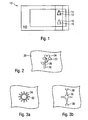
- Fig.1 shows a schematic representation of a banknote 10, which has two through openings 12 and 16, respectively.
- the first of the through openings 12 was produced during the production of the security paper used for the banknote 10 and has a fibrous, irregular edge region 14.
- Such an edge 14 is characteristic of the openings already made in the sheet formation and can not be subsequently produced by punching or cutting the paper.
- the second through opening 16 was produced only after the papermaking by laser cutting or by means of a punching tool and has a sharply delimited edge region 18.
- the two through openings 12 and 16 show, spatially separated, twice the same information, in the embodiment of Fig.1 one isosceles triangle each. It is understood that instead of the triangle also more complex shapes can be used, the outlines of which represent, for example, a number sequence or a simple graphic.
- the observer can establish the relationship of the two forms through the second opening 16 formed with clear contours and recognize the information without any doubt.
- the viewer's attention and attention are directed to the difference between the two openings.
- the high counterfeiting security of the irregularly bounded opening 12 is thus combined with the clear recognizability of the sharply edged opening 16.
- the section of the Fig. 2 shows a plan view of a security paper 20 according to a further embodiment of the invention.
- the security paper 20 has a first paper-made opening 22 with an irregular edge area 24 and a second opening 26 produced by laser cutting with a sharp edge 28. Again, the outline of the two openings 22 and 26 with each other in a context of meaning. In contrast to the embodiment of Fig.1 However, they do not present the same information, but form complementary parts of an overall information.
- the illustrated motif is adapted to the different edge properties of the two openings.
- Fig. 2 a flower motif in which the flower through the first, irregularly bounded opening 22 and the stem and the leaves through the second, sharply edged opening 26 are formed. Since flowers look very different and variable in nature, the overall picture looks very realistic. At the same time a high protection against counterfeiting is ensured by the use of the two opening forms.
- Figures 3 and 4 show further embodiments of designs in which the outline shapes of an irregularly bounded first opening and a sharply edged second opening in a meaningful context.
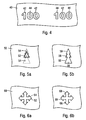
- Fig. 3 (a) shows a sun in the form of a circular, irregularly edged first opening 32 with radially outward pointing rays, which are formed by laser-cut or punched triangular openings 34.
- the beams formed by the second openings 34 represent in this embodiment, a dependent of the first opening motif.
- the irregularly bounded, star-shaped, first opening 36 is a major motif from which the sharply edged, circular, second openings 38 depend graphically.
- Fig. 4 shows a further embodiment of the invention, in which the irregularly bounded openings 42 and the sharply edged openings 44 in each case complement the denomination "100" of a banknote 40.
- the denomination of the banknote is applied again clearly readable elsewhere, for example, printed.
- only one of the designs of the Fig. 4 can be used or it can be provided both at different locations of the bill and possibly other designs.
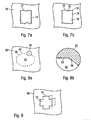
- FIG. 5 (a) shows a plan view of a security paper 50, in the paper making initially a first, irregularly bounded opening 52 has been introduced.
- the opening 52 is modified after papermaking by laser cutting with two sharply edged openings 54 whose positions in Fig. 5 (a) dashed lines are shown.
- an irregularly bounded opening 62 in the form of a predetermined figure for example in the form of in FIG Fig. 6 (a) shown four-headed figure, generated in a security paper 60.
- the irregular edge region 64 of this figure is then partially recut with a laser.
- Fig. 6 (b) illustrates, there is thus a through opening 66, which on the one hand has partial regions 68 with an irregular edge and, on the other hand, partial regions 69 with a sharp edge.
- the ratio and the sequence of subregions 68, 69 can be chosen arbitrarily.
- Fig. 7 shows a further embodiment in which, as in the embodiment of Fig. 6 Initially, an irregularly bounded opening 72 is inserted into a security paper 70, as in Fig. 7 (a) shown. After papermaking, the aperture 72 is completely re-cut with a laser (reference numeral 74), the size of the re-cut 74 being selected to be slightly smaller than the size of the aperture 72. In this way, a through opening 76 is formed, which has portions 78 with an irregular edge and portions 79 with a sharp edge in an irregular sequence, as in FIG Fig. 7 (b) shown.
- a laser reference numeral 74
- a sequence of regular and irregular marginal areas can also be achieved without the involvement of an opening already created in papermaking.
- the desired shape of a through opening 82 can be cut out of a security paper 80 by means of a laser in such a way that the cut lines 84 do not form a continuous cut curve, but rather through uncut cuts 86 are interrupted, as in Fig. 8 (a) shown.
- the sections 86 form holding webs, which initially prevent the release of the cut-out shape.
- the cut-out shape can then be blown out, for example, with an air jet or pulled out by means of vacuum.
- the edge region to the opening 82 thus has a sequence of irregular subregions 88 and sharply cut subareas 89, the relative size and sequence of which can be selected almost arbitrarily by the cutting guide during laser cutting.
- the security paper 90 has a continuous opening 92 with an irregular, fibrous edge, which is produced during papermaking.
- the opening 92 is combined with engraving lines 94 created by laser etching.
- the engraving lines 94 are formed by locally thinned areas in the security paper 90, such as in the document WO 98/03348 described, whose disclosure content is included in this description in this respect. Location and arrangement of the engraving lines 94 are inventively chosen so that they complement the opening 92 to a projection view.
- the engraving lines 94 When viewed in incident light, the engraving lines 94 are virtually invisible, where the flat shape of the opening 92 determines the appearance. If, on the other hand, the security paper is viewed in transmitted light, the engraving lines 94 clearly emerge due to the smaller paper thickness and supplement the two-dimensional opening 92 into a three-dimensional projection representation. The combination of the irregular opening 92 with the engraving lines 94 thus leads to an optically conspicuous interplay between 2D and 3D representation.
- the security paper with a film element such as an embedded security thread or a one-sided covered film strip provided.
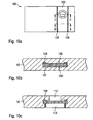
- Figure 10 shows by way of example a security paper 100 in which a film strip 102 is embedded. It puts Figure 10 (a) a supervision of the security paper that FIGS. 10 (b) and 10 (c) show cross sections through the security paper of Fig. 10 (a) along the lines BB and CC. Before being embedded in the security paper on the underside 104, the film strip 102 was coated over its entire surface with hot-sealing lacquer 107. On the other hand 106, on the other hand, only traces 108 on the edge of the film have been provided with heat-sealing lacquer, so that the middle film region of the upper side 106 remains uncoated.
- a nonwoven fabric now forms on both sides of the film.
- a window 110 for example by means of electrotypes, is recessed on the lower side 104 of the foil strip in which the foil element becomes visible.
- the fiber fleece is fixed except for the recessed window 110 in the drying section.
- the opposite front side 106 on the other hand, only the heat-sealing lacquer-covered edge regions 108 are fixed in the drying section.
- a mold 112 is cut out with a laser over the recessed window 110 of the opposite side 104, as best seen in the cross-sectional view of FIG Fig. 10 (c) to recognize.
- the laser parameters are chosen so that only the paper, but not the film strip 110 is cut. This can be achieved, for example, by performing the laser cutting with a laser wavelength for which the film strip 102 is transparent and non-absorbent.
- the cut-out mold 112 can then be removed with a suction device, since no connection of the cut piece of paper with the film has been achieved due to the lack of heat-sealing lacquer coating on the front side 106 and the non-stick film surface.
- FIGS. 11 (b) and 11 (c) show cross sections through the security paper of 11 (a) along the lines BB and CC.
- Embedded in the security paper 120 is a security thread 122, which is primarily visible in the paper-made generated areas 124 of the paper back, as in FIG Figure 11 (b) shown.
- a sharp-edged opening 126 is inserted into the paper substrate with a laser and extends over the security thread 122.
- the laser parameters are selected so that, although the paper substrate 120, but not the security thread 122 is cut by the laser.
- the security thread 122 is then recognizable from both sides, as in FIG Figure 11 (c) shown.
- FIGS. 12 Unlike Figure 11 is in the embodiment of Fig. 12 the surface of the security thread 122 can be seen only in the window areas 124. Such a configuration is particularly suitable when the laser radiation could damage or undesirably affect the film material of the security thread 122. Typically, because the security thread is oscillating, the opening 128 in this configuration can not be perfectly centered on the security thread 122, as shown in FIGS FIGS. 12 (a) and (c) indicated Passerschwankept indicated.
- Figure 13 shows a design in which a sharp-edged opening 132 is produced in the region of a thin spot 134 of the security paper 130 with a laser.
- the thin spot 134 can be produced, for example, by a suctioned short-forming layer (a paper layer produced by spraying the pulp onto a round screen) or by means of electrotypes. Since the paper thickness is reduced in the region of the thin spot 134, can be used in laser cutting with lower laser power. As a result, higher cutting speeds are achieved, so that more complex shapes can be realized.
- This modification can be combined with all embodiments in which a laser is used to inscribe a sharply edged opening in a paper substrate.
- a thin spot 142 of predetermined shape is produced in the paper substrate 140 by means of a laser.
- the paper material is vaporized, burned or otherwise removed. It is just removed so much material that still a small residual thickness 144 of the substrate remains, as in Fig. 14 (a) shown. Depending on the thickness tolerance of the substrate can be removed in some places so much that no material is no longer available. Since the thin spot is produced by laser cutting, the peripheral surface 146 is sharply defined and smooth.
- the piece of paper 144 remaining after the laser treatment is then removed by blowing out or sucking it out. Since it is only a very thin paper layer, the piece of paper 144 tears at the edges and thereby creates an irregular portion 148 in the edge surface of the now continuous opening 145, as in the cross-sectional view of Figure 14 (b) and the supervision of Fig. 14 (c) shown.
- the sharply defined portion 146 and the characteristically irregular shaped portion 148 follow each other.
- the through opening 145 appears from opposite sides of the security paper with varying degrees of impression, depending on whether the sharp bounded edge area 146 or the irregular edge area 148 is adjacent to the paper surface.
- a thin paper 151 produced in the security paper 150 such as a watermark.
- this thin spot 151 is then, as in Related to Fig. 14 described with the laser generates a second sharply edged thin spot 152, which leaves only a small residual thickness 154 of the paper substrate, as in Fig. 15 (a) shown.
- This remaining paper piece 154 is torn out by blowing or sucking, so that an irregular edge surface 158 is formed on the underside of the paper substrate 150, as in FIG Figure 15 (b) shown.
- the edge region 156 produced by laser cutting is sharply delimited.
- the resulting through opening 160 is embedded in a watermark area 151, which clearly appears when viewed in phantom, see Figure 15 (c) , It is understood that the shape of the opening 160 and the watermark area 151 may also be correlated with each other.
- the edge surface of the opening 160 has, along a direction extending through the paper thickness, successively a sharply delimited subregion 156 and a characteristically irregularly shaped subregion 158. Again, when viewed from opposite sides of the security paper, the through opening 160 will appear to have a different impression depending on whether the sharp bounded edge area 156 or the irregular edge area 158 is adjacent the paper surface.
- the sharp-edged opening can be generated by a punching tool instead of a laser. Also, it is not necessary for the edge surfaces of the laser-cut apertures to be parallel and perpendicular to the paper surface, as shown in the figures for ease of illustration. Rather, it can be beneficial to skew the laser source and / or the paper as it cuts so that "flattened" edges are created.
- Fig. 16 shows in (a) and (b) two embodiments in which sharp-edged, laser-cut openings 172 and 174 are introduced into paper substrates 170.
- the slope of the marginal surfaces 178 of the apertures can be adjusted as desired by choosing an appropriate beam divergence and beam tilt.
- the openings 172 and 174 are each covered with a film 176.
- the flattened edges result in a smoother transition between the film 176 and the paper substrate 170.
- Such edge shapes significantly reduce the susceptibility of the openings to fouling.
Landscapes
- Engineering & Computer Science (AREA)
- Manufacturing & Machinery (AREA)
- Mechanical Engineering (AREA)
- Business, Economics & Management (AREA)
- Accounting & Taxation (AREA)
- Finance (AREA)
- Credit Cards Or The Like (AREA)
- Laser Beam Processing (AREA)
- Paper (AREA)
Claims (23)
- Papier de sécurité pour la fabrication de documents de sécurité ou de valeur, tels que des billets de banque, des cartes d'identité et analogues, comportant un élément incorporé formant feuille, qui est visible dans des zones partielles, à travers des zones formant fenêtre fabriquées par voie papetière, caractérisé en ce que le papier de sécurité présente, dans la zone de l'élément formant feuille, une ouverture, produite par découpage ou estampage après la fabrication du papier, et comportant une zone marginale nettement délimitée, qui est disposée au-dessus et/ou immédiatement à côté des zones formant fenêtre, fabriquées par voie papetière.
- Papier de sécurité selon la revendication 1, caractérisé en ce que l'ouverture nettement délimitée est continue, à l'exception d'une éventuelle zone de chevauchement avec l'élément formant feuille.
- Papier de sécurité selon la revendication 1 ou 2, caractérisé en ce que les zones formant fenêtre sont disposées sur une première surface principale du papier de sécurité, et l'ouverture nettement délimitée s'étend, à partir de la surface principale opposée du papier de sécurité, jusqu'à l'élément formant feuille.
- Papier de sécurité selon au moins l'une des revendications 1 à 3, caractérisé en ce que l'élément formant feuille représente un élément de sécurité, en particulier un fil de sécurité ou une bande de sécurité.
- Papier de sécurité selon au moins l'une des revendications 1 à 4, caractérisé en ce que l'ouverture nettement délimitée est produite par découpage laser.
- Papier de sécurité selon au moins l'une des revendications 1 à 5, caractérisé en ce que le papier de sécurité présente une épaisseur de papier prédéterminée et une zone mince dont l'épaisseur de papier est réduite, l'ouverture nettement délimitée étant incorporée dans la zone mince.
- Papier de sécurité selon la revendication 6, caractérisé en ce que la zone mince comprend un filigrane.
- Papier de sécurité selon au moins l'une des revendications 1 à 7, caractérisé en ce que l'ouverture nettement délimitée est configurée avec des faces latérales inclinées par rapport à la normal à la surface.
- Papier de sécurité selon la revendication 8, caractérisé en ce que l'ouverture nettement délimitée présente des faces latérales, ayant des inclinaisons différentes par rapport à la normale à la surface.
- Papier de sécurité selon au moins l'une des revendications 1 à 9, caractérisé en ce que l'ouverture nettement délimitée est, sur une face ou sur les deux faces du papier de sécurité, obturée par un élément formant feuille.
- Procédé de fabrication d'un papier de sécurité comportant un élément incorporé formant feuille, en particulier selon l'une des revendications 1 à 10 dans lequel- pendant la fabrication du papier, on incorpore un élément formant feuille dans le papier de sécurité,- on produit des zones formant fenêtre, dans lesquelles l'élément formant feuille est rendu visible, et- après la fabrication du papier, on produit par découpage ou estampage dans la zone de l'élément formant feuille au-dessus et/ou immédiatement à côté des zones formant fenêtre, une ouverture comportant une zone marginale nettement délimitée.
- Procédé selon la revendication 11, caractérisé en ce que l'ouverture nettement délimitée est produite par découpage laser.
- Procédé selon la revendication 11 ou 12, caractérisé en ce qu'une ouverture continue, nettement délimitée, est produite immédiatement à côté de l'élément formant feuille.
- Procédé selon la revendication 12, caractérisé en ce que l'ouverture nettement délimitée chevauche l'élément formant feuille, les paramètres laser étant ajustés de façon que le laser ne coupe que le substrat du papier, mais non pas l'élément formant feuille.
- Procédé selon au moins l'une des revendications 11 à 14, caractérisé en ce que l'élément formant feuille est, avant son incorporation, revêtu en pleine surface sur une surface principale avec un vernis de thermosoudage, et on applique sur une deuxième surface principale opposée, seulement sur le bord de la feuille, une trace de vernis de thermosoudage, de façon que la partie centrale de l'élément formant feuille reste non revêtue.
- Procédé selon la revendication 15, caractérisé en ce que les zones formant fenêtre sont produites sur la surface principale entièrement revêtue.
- Procédé selon la revendication 15 ou 16, caractérisé en ce que l'ouverture nettement délimitée est produite dans la zone centrale de la surface principale qui n'est revêtue que sur le bord.
- Procédé selon au moins l'une des revendications 15 à 17, caractérisé en ce que l'ouverture nettement délimitée est produite par découpage laser.
- Procédé selon la revendication 18, caractérisé en ce que la divergence et l'inclinaison du faisceau, par rapport à la surface du papier, sont ajustées de telle sorte que l'ouverture nettement délimitée soit produite avec des faces latérales inclinées par rapport à la normale à la surface.
- Procédé selon la revendication 18 ou 19, caractérisé en ce que la divergence et l'inclinaison du faisceau par rapport à la surface du papier sont ajustées de telle sorte que l'ouverture nettement délimitée soit produite avec des faces latérales présentant différentes inclinaisons par rapport à la normale à la surface.
- Procédé selon au moins l'une des revendications 11 à 20, caractérisé en ce que l'ouverture nettement délimitée est, sur une face ou sur les deux faces du papier de sécurité, obturée par un élément formant feuille.
- Utilisation d'un papier de sécurité selon au moins l'une des revendications 1 à 10 ou d'un papier de sécurité pouvant être fabriqué selon l'une des revendications 11 à 21, pour la protection d'articles de nature quelconque contre les falsifications.
- Document de valeur, tel qu'un billet de banque, une carte d'identité ou analogues, comportant un papier de sécurité selon au moins l'une des revendications 1 à 10 ou pouvant être fabriqué selon l'une des revendications 11 à 21.
Applications Claiming Priority (2)
| Application Number | Priority Date | Filing Date | Title |
|---|---|---|---|
| DE102005022018A DE102005022018A1 (de) | 2005-05-12 | 2005-05-12 | Sicherheitspapier und Verfahren zu seiner Herstellung |
| EP06724688A EP1904311B1 (fr) | 2005-05-12 | 2006-05-03 | Papier de surete et procede pour le produire |
Related Parent Applications (2)
| Application Number | Title | Priority Date | Filing Date |
|---|---|---|---|
| EP06724688.4 Division | 2006-05-03 | ||
| EP06724688A Division EP1904311B1 (fr) | 2005-05-12 | 2006-05-03 | Papier de surete et procede pour le produire |
Publications (2)
| Publication Number | Publication Date |
|---|---|
| EP2143565A1 EP2143565A1 (fr) | 2010-01-13 |
| EP2143565B1 true EP2143565B1 (fr) | 2012-12-12 |
Family
ID=37056417
Family Applications (2)
| Application Number | Title | Priority Date | Filing Date |
|---|---|---|---|
| EP06724688A Expired - Lifetime EP1904311B1 (fr) | 2005-05-12 | 2006-05-03 | Papier de surete et procede pour le produire |
| EP09009275A Expired - Lifetime EP2143565B1 (fr) | 2005-05-12 | 2006-05-03 | Papier de sécurité et son procédé de fabrication |
Family Applications Before (1)
| Application Number | Title | Priority Date | Filing Date |
|---|---|---|---|
| EP06724688A Expired - Lifetime EP1904311B1 (fr) | 2005-05-12 | 2006-05-03 | Papier de surete et procede pour le produire |
Country Status (9)
| Country | Link |
|---|---|
| US (1) | US20080216976A1 (fr) |
| EP (2) | EP1904311B1 (fr) |
| CN (2) | CN101892612A (fr) |
| AT (1) | ATE520543T1 (fr) |
| BR (1) | BRPI0612347A2 (fr) |
| DE (1) | DE102005022018A1 (fr) |
| ES (1) | ES2368498T3 (fr) |
| RU (1) | RU2408466C2 (fr) |
| WO (1) | WO2006119896A2 (fr) |
Families Citing this family (63)
| Publication number | Priority date | Publication date | Assignee | Title |
|---|---|---|---|---|
| DE102004021247A1 (de) * | 2004-04-30 | 2005-11-24 | Giesecke & Devrient Gmbh | Sicherheitselement und Verfahren zu seiner Herstellung |
| DE102004021246A1 (de) | 2004-04-30 | 2005-11-24 | Giesecke & Devrient Gmbh | Sicherheitselement und Verfahren zu seiner Herstellung |
| RU2377133C2 (ru) | 2004-04-30 | 2009-12-27 | Гизеке Унд Девриент Гмбх | Материал монтажной пленки и способы его изготовления |
| DE102004039355A1 (de) | 2004-08-12 | 2006-02-23 | Giesecke & Devrient Gmbh | Sicherheitselement und Verfahren zu seiner Herstellung |
| DE102004022080A1 (de) | 2004-05-05 | 2005-11-24 | Giesecke & Devrient Gmbh | Wertdokument mit visuell erkennbaren Kennzeichnungen |
| DE102004022079A1 (de) * | 2004-05-05 | 2005-11-24 | Giesecke & Devrient Gmbh | Wertdokument mit Seriennummer |
| DE102004035979A1 (de) | 2004-07-14 | 2006-02-02 | Giesecke & Devrient Gmbh | Sicherheitselement und Verfahren zu seiner Herstellung |
| DE102004038542A1 (de) | 2004-08-06 | 2006-02-23 | Giesecke & Devrient Gmbh | Datenträger mit Sicherheitselement und Verfahren zu seiner Herstellung |
| US20070246933A1 (en) * | 2004-08-12 | 2007-10-25 | Giesecke & Devrient Gmbh | Security Element Comprising a Support |
| DE102004049118A1 (de) * | 2004-10-07 | 2006-04-13 | Giesecke & Devrient Gmbh | Sicherheitselement und Verfahren zu seiner Herstellung |
| DE102004056553B4 (de) * | 2004-11-23 | 2013-03-14 | Giesecke & Devrient Gmbh | Sicherheitsanordnung für Sicherheitsdokumente und Verfahren zum Herstellen der Sicherheitsdokumente |
| DE102004063217A1 (de) * | 2004-12-29 | 2006-07-13 | Giesecke & Devrient Gmbh | Sicherheitsmerkmal für Wertdokumente |
| DE102005028162A1 (de) * | 2005-02-18 | 2006-12-28 | Giesecke & Devrient Gmbh | Sicherheitselement und Verfahren zu seiner Herstellung |
| DE102005045566A1 (de) * | 2005-03-23 | 2006-09-28 | Giesecke & Devrient Gmbh | Mehrlagiges Sicherheitspapier |
| DE102005025095A1 (de) * | 2005-06-01 | 2006-12-07 | Giesecke & Devrient Gmbh | Datenträger und Verfahren zu seiner Herstellung |
| DE102005032815A1 (de) | 2005-07-12 | 2007-01-18 | Giesecke & Devrient Gmbh | Verfahren zur Herstellung eines Sicherheitspapiers, Papiersieb und Formelement für Papiersieb |
| DE102005032997A1 (de) * | 2005-07-14 | 2007-01-18 | Giesecke & Devrient Gmbh | Gitterbild und Verfahren zu seiner Herstellung |
| DE102005061749A1 (de) | 2005-12-21 | 2007-07-05 | Giesecke & Devrient Gmbh | Optisch variables Sicherheitselement und Verfahren zu seiner Herstellung |
| DE102005062132A1 (de) | 2005-12-23 | 2007-07-05 | Giesecke & Devrient Gmbh | Sicherheitselement |
| DE102006015023A1 (de) | 2006-03-31 | 2007-10-04 | Giesecke & Devrient Gmbh | Sicherheitselement und Verfahren zu seiner Herstellung |
| DE102006029850A1 (de) | 2006-06-27 | 2008-01-03 | Giesecke & Devrient Gmbh | Sicherheitselement |
| DE102006029852A1 (de) * | 2006-06-27 | 2008-01-03 | Giesecke & Devrient Gmbh | Verfahren zum Aufbringen einer Mikrostruktur, Werkzeugform und Gegenstand mit Mikrostruktur |
| DE102006039305A1 (de) * | 2006-07-21 | 2008-01-24 | Giesecke & Devrient Gmbh | Sicherheitsfaden mit optisch variablem Sicherheitsmerkmal |
| DE102006050047A1 (de) * | 2006-10-24 | 2008-04-30 | Giesecke & Devrient Gmbh | Durchsichtssicherheitselement mit Mikrostrukturen |
| DE102006055680A1 (de) | 2006-11-23 | 2008-05-29 | Giesecke & Devrient Gmbh | Sicherheitselement mit Metallisierung |
| DE102006058513A1 (de) * | 2006-12-12 | 2008-06-19 | Giesecke & Devrient Gmbh | Entwässerungssieb und Verfahren zu seiner Herstellung |
| DE102007029203A1 (de) | 2007-06-25 | 2009-01-08 | Giesecke & Devrient Gmbh | Sicherheitselement |
| DE102007029204A1 (de) * | 2007-06-25 | 2009-01-08 | Giesecke & Devrient Gmbh | Sicherheitselement |
| DE102007034716A1 (de) | 2007-07-23 | 2009-01-29 | Giesecke & Devrient Gmbh | Sicherheitselement |
| DE102007039591A1 (de) | 2007-08-22 | 2009-02-26 | Giesecke & Devrient Gmbh | Gitterbild |
| DE102007058169A1 (de) | 2007-11-30 | 2009-06-10 | Ovd Kinegram Ag | Vorrichtung und Verfahren zur Herstellung eines Fensters in einem Wertdokument oder Sicherheitsdokument |
| DE102007061828A1 (de) * | 2007-12-20 | 2009-06-25 | Giesecke & Devrient Gmbh | Sicherheitselement und Verfahren zu seiner Herstellung |
| DE102007061827A1 (de) | 2007-12-20 | 2009-06-25 | Giesecke & Devrient Gmbh | Sicherheitselement und Verfahren zu seiner Herstellung |
| DE102007061979A1 (de) | 2007-12-21 | 2009-06-25 | Giesecke & Devrient Gmbh | Sicherheitselement |
| DE102007062089A1 (de) | 2007-12-21 | 2009-07-02 | Giesecke & Devrient Gmbh | Verfahren zum Erzeugen einer Mikrostruktur |
| DE102008008685A1 (de) | 2008-02-12 | 2009-08-13 | Giesecke & Devrient Gmbh | Sicherheitselement und Verfahren zu seiner Herstellung |
| DE102008009296A1 (de) * | 2008-02-15 | 2009-08-20 | Giesecke & Devrient Gmbh | Sicherheitselement und Verfahren zu seiner Herstellung |
| DE102008013167A1 (de) | 2008-03-07 | 2009-09-10 | Giesecke & Devrient Gmbh | Sicherheitselement und Verfahren zu seiner Herstellung |
| DE102008016795A1 (de) | 2008-04-02 | 2009-10-08 | Giesecke & Devrient Gmbh | Verfahren zum Erzeugen einer mikrooptischen Moiré-Vergrößerungsanordnung |
| DE102008027952A1 (de) | 2008-06-12 | 2009-12-17 | Giesecke & Devrient Gmbh | Sicherheitselement mit gerasterter Schicht aus Rasterelementen |
| DE102008028187A1 (de) | 2008-06-12 | 2009-12-17 | Giesecke & Devrient Gmbh | Sicherheitselement mit optisch variablem Element. |
| DE102008029638A1 (de) * | 2008-06-23 | 2009-12-24 | Giesecke & Devrient Gmbh | Sicherheitselement |
| DE102008031325A1 (de) | 2008-07-02 | 2010-01-07 | Giesecke & Devrient Gmbh | Sicherheitselement sowie Verfahren zu seiner Herstellung |
| DE102008032224A1 (de) | 2008-07-09 | 2010-01-14 | Giesecke & Devrient Gmbh | Sicherheitselement |
| DE102008046511A1 (de) | 2008-09-10 | 2010-03-11 | Giesecke & Devrient Gmbh | Darstellungsanordnung |
| DE102008062475A1 (de) * | 2008-12-16 | 2010-06-17 | Giesecke & Devrient Gmbh | Sicherheitselement und Sicherheitspapier |
| DE102009035361A1 (de) * | 2009-07-30 | 2011-02-03 | Giesecke & Devrient Gmbh | Sicherheitselement für einen zu schützenden Gegenstand sowie zu schützender Gegenstand mit einem solchen Sicherheitselement |
| DE102009035413A1 (de) | 2009-07-31 | 2011-02-03 | Giesecke & Devrient Gmbh | Identifikationsdokument mit einer personalisierten visuellen Kennzeichnung sowie Verfahren zu dessen Herstellung |
| DE102009041583A1 (de) | 2009-09-15 | 2011-03-17 | Giesecke & Devrient Gmbh | Dünnschichtelement mit Interferenzschichtaufbau |
| DE102009042022A1 (de) | 2009-09-21 | 2011-03-24 | Giesecke & Devrient Gmbh | Langgestrecktes Sicherheitselement mit maschinenlesbaren magnetischen Bereichen |
| GB201002260D0 (en) | 2010-02-10 | 2010-03-31 | Rue De Int Ltd | Security element for document of value |
| DE102010053052A1 (de) * | 2010-12-01 | 2012-06-06 | Giesecke & Devrient Gmbh | Datenträger mit Kennzeichnung |
| US9708773B2 (en) | 2011-02-23 | 2017-07-18 | Crane & Co., Inc. | Security sheet or document having one or more enhanced watermarks |
| GB201108475D0 (en) * | 2011-05-20 | 2011-07-06 | British American Tobacco Co | Smoking article wrapper |
| DE102011115133A1 (de) * | 2011-10-07 | 2013-04-11 | Giesecke & Devrient Gmbh | Verfahren und Vorrichtung zum Herstellen eines blattförmigen Substrates |
| TW201438607A (zh) | 2012-10-16 | 2014-10-16 | British American Tobacco Co | 菸品包裝紙及製作菸品之方法 |
| WO2014087028A1 (fr) | 2012-12-05 | 2014-06-12 | Pasaban, S.A. | Système laser pour découpage de fenêtres dans un papier de sécurité |
| DE102015000690A1 (de) * | 2015-01-20 | 2016-07-21 | Giesecke & Devrient Gmbh | Datenträger mit einem Fenstersicherheitsfaden |
| DE102015003785A1 (de) * | 2015-03-23 | 2016-09-29 | Giesecke & Devrient Gmbh | Verfahren zum Herstellen eines Fensters in einem Papiersubstrat mit einem Sicherheitselement |
| CN105256663B (zh) * | 2015-10-15 | 2018-01-26 | 温州钞发纸业有限公司 | 一种漏空带金银线防伪纸的加工方法 |
| CN111511572B (zh) * | 2017-12-14 | 2022-05-17 | 克瑞尼股份有限公司 | 用于在造纸机制成的孔上方表面施加安全装置的方法 |
| FR3080324B1 (fr) * | 2018-04-23 | 2022-04-01 | Oberthur Fiduciaire Sas | Feuille securisee |
| GB2576573C (en) | 2018-08-24 | 2024-02-21 | Hid Cid Ltd | A security sheet and a security booklet |
Family Cites Families (60)
| Publication number | Priority date | Publication date | Assignee | Title |
|---|---|---|---|---|
| GB1604463A (en) * | 1976-09-24 | 1981-12-09 | Bank Of England | Security devices |
| IT1069243B (it) * | 1976-12-23 | 1985-03-25 | Fibrostampa Srl | Macchina in tondo perfezionata per la fabbricazione di carta con so vraspessori |
| DE3048733C2 (de) * | 1980-12-23 | 1983-06-16 | GAO Gesellschaft für Automation und Organisation mbH, 8000 München | "Ausweiskarte und Verfahren zur Herstellung derselben" |
| IN157644B (fr) * | 1981-02-19 | 1986-05-10 | Portals Ltd | |
| AT386159B (de) * | 1985-10-11 | 1988-07-11 | Oesterr Nationalbank | Verfahren und vorrichtung zur herstellung von echtheits-(codierungs)-merkmalen auf wertpapieren |
| GB8912750D0 (en) * | 1989-06-02 | 1989-07-19 | Portals Ltd | Security paper |
| GB2250474B (en) * | 1990-12-04 | 1994-04-20 | Portals Ltd | Security articles |
| GB2260772B (en) * | 1991-10-25 | 1995-05-10 | Portals Ltd | Method for making sheet materials and security paper |
| WO1994020679A1 (fr) * | 1993-03-02 | 1994-09-15 | Arjo Wiggins S.A. | Papier de securite comportant des zones localisees d'epaisseur et d'opacite reduites et son procede de fabrication |
| DE4314380B4 (de) * | 1993-05-01 | 2009-08-06 | Giesecke & Devrient Gmbh | Sicherheitspapier und Verfahren zu seiner Herstellung |
| US5393099A (en) * | 1993-05-21 | 1995-02-28 | American Bank Note Holographics, Inc. | Anti-counterfeiting laminated currency and method of making the same |
| DE4334847A1 (de) | 1993-10-13 | 1995-04-20 | Kurz Leonhard Fa | Wertdokument mit Fenster |
| US6036230A (en) * | 1994-10-11 | 2000-03-14 | Oesterreichische National Bank | Paper, especially security paper |
| NL1003663C1 (nl) | 1996-07-23 | 1998-01-28 | Karel Johan Schell | Werkwijze ter beveiliging van een papierdun waarde- of identificatiedocument. |
| GB9828770D0 (en) * | 1998-12-29 | 1999-02-17 | Rue De Int Ltd | Security paper |
| PT1144201E (pt) * | 1999-01-21 | 2003-07-31 | Iai Bv | Documento de seguranca com um padrao de perfuracao |
| DE10131708B4 (de) * | 2001-06-29 | 2007-02-22 | Infineon Technologies Ag | Integrierte Schaltung zum Empfang eines Taktsignals, insbesondere für eine Halbleiterspeicherschaltung |
| DE10148122A1 (de) * | 2001-09-28 | 2003-04-24 | Giesecke & Devrient Gmbh | Sicherheitspapier |
| DE10163381A1 (de) | 2001-12-21 | 2003-07-03 | Giesecke & Devrient Gmbh | Sicherheitspapier sowie Verfahren und Vorrichtung zu seiner Herstellung |
| DE10226114A1 (de) * | 2001-12-21 | 2003-07-03 | Giesecke & Devrient Gmbh | Sicherheitselement für Sicherheitspapiere und Wertdokumente |
| DE10206357A1 (de) * | 2002-02-14 | 2003-08-28 | Giesecke & Devrient Gmbh | Sicherheitselement und Sicherheitsdokument mit einem solchen Sicherheitselement |
| DE10207622A1 (de) * | 2002-02-22 | 2003-09-04 | Giesecke & Devrient Gmbh | Sicherheitsdokument und Sicherheitselement für ein Sicherheitsdokument |
| GB2388377B (en) * | 2002-05-09 | 2004-07-28 | Rue De Int Ltd | A paper sheet incorporating a security element and a method of making the same |
| FR2839917B1 (fr) * | 2002-05-22 | 2004-10-08 | Arjo Wiggins | Article forme a partir d'au moins un jet de matiere fibreuse comportant au moins une zone d'epaisseur nulle et procede de fabrication dudit article |
| GB2390056B (en) * | 2002-06-25 | 2005-08-31 | Rue Internat Ltd De La | Improvements in substrates |
| MXPA05000756A (es) * | 2002-07-18 | 2005-04-28 | Giesecke & Devrient Gmbh | Documento de valor. |
| RU2207417C1 (ru) * | 2002-08-14 | 2003-06-27 | Объединение государственных предприятий и организаций по производству государственных знаков (Объединение "Гознак") | Способ изготовления бумаги, защищенной от подделки, и бумага, защищенная от подделки |
| DE10342252A1 (de) * | 2003-09-11 | 2005-04-07 | Giesecke & Devrient Gmbh | Foliensicherheitselement |
| DE102004021247A1 (de) * | 2004-04-30 | 2005-11-24 | Giesecke & Devrient Gmbh | Sicherheitselement und Verfahren zu seiner Herstellung |
| EP2287011B1 (fr) * | 2004-04-30 | 2017-06-28 | Giesecke & Devrient GmbH | Elément de sécurité et son procédé de fabrication |
| RU2377133C2 (ru) * | 2004-04-30 | 2009-12-27 | Гизеке Унд Девриент Гмбх | Материал монтажной пленки и способы его изготовления |
| DE102004039355A1 (de) * | 2004-08-12 | 2006-02-23 | Giesecke & Devrient Gmbh | Sicherheitselement und Verfahren zu seiner Herstellung |
| DE102004021246A1 (de) * | 2004-04-30 | 2005-11-24 | Giesecke & Devrient Gmbh | Sicherheitselement und Verfahren zu seiner Herstellung |
| DE102004022079A1 (de) * | 2004-05-05 | 2005-11-24 | Giesecke & Devrient Gmbh | Wertdokument mit Seriennummer |
| DE102004035979A1 (de) * | 2004-07-14 | 2006-02-02 | Giesecke & Devrient Gmbh | Sicherheitselement und Verfahren zu seiner Herstellung |
| DE102004038542A1 (de) * | 2004-08-06 | 2006-02-23 | Giesecke & Devrient Gmbh | Datenträger mit Sicherheitselement und Verfahren zu seiner Herstellung |
| US20070246933A1 (en) * | 2004-08-12 | 2007-10-25 | Giesecke & Devrient Gmbh | Security Element Comprising a Support |
| DE102004063217A1 (de) * | 2004-12-29 | 2006-07-13 | Giesecke & Devrient Gmbh | Sicherheitsmerkmal für Wertdokumente |
| DE102005028162A1 (de) * | 2005-02-18 | 2006-12-28 | Giesecke & Devrient Gmbh | Sicherheitselement und Verfahren zu seiner Herstellung |
| DE102005045566A1 (de) * | 2005-03-23 | 2006-09-28 | Giesecke & Devrient Gmbh | Mehrlagiges Sicherheitspapier |
| DE102005025095A1 (de) * | 2005-06-01 | 2006-12-07 | Giesecke & Devrient Gmbh | Datenträger und Verfahren zu seiner Herstellung |
| DE102005032815A1 (de) * | 2005-07-12 | 2007-01-18 | Giesecke & Devrient Gmbh | Verfahren zur Herstellung eines Sicherheitspapiers, Papiersieb und Formelement für Papiersieb |
| DE102005032997A1 (de) * | 2005-07-14 | 2007-01-18 | Giesecke & Devrient Gmbh | Gitterbild und Verfahren zu seiner Herstellung |
| DE102005061749A1 (de) * | 2005-12-21 | 2007-07-05 | Giesecke & Devrient Gmbh | Optisch variables Sicherheitselement und Verfahren zu seiner Herstellung |
| DE102005062132A1 (de) * | 2005-12-23 | 2007-07-05 | Giesecke & Devrient Gmbh | Sicherheitselement |
| US20070241551A1 (en) * | 2006-04-18 | 2007-10-18 | Graff Jacob C | Automatic Bookmark |
| DE102006039305A1 (de) * | 2006-07-21 | 2008-01-24 | Giesecke & Devrient Gmbh | Sicherheitsfaden mit optisch variablem Sicherheitsmerkmal |
| DE102006050047A1 (de) * | 2006-10-24 | 2008-04-30 | Giesecke & Devrient Gmbh | Durchsichtssicherheitselement mit Mikrostrukturen |
| DE102006055680A1 (de) * | 2006-11-23 | 2008-05-29 | Giesecke & Devrient Gmbh | Sicherheitselement mit Metallisierung |
| DE102006058513A1 (de) * | 2006-12-12 | 2008-06-19 | Giesecke & Devrient Gmbh | Entwässerungssieb und Verfahren zu seiner Herstellung |
| DE102007025939A1 (de) * | 2007-06-04 | 2008-12-11 | Giesecke & Devrient Gmbh | Sicherheitselement zur Absicherung von Wertdokumenten |
| DE102007029204A1 (de) * | 2007-06-25 | 2009-01-08 | Giesecke & Devrient Gmbh | Sicherheitselement |
| FR2918679B1 (fr) * | 2007-07-11 | 2017-12-01 | Arjowiggins Licensing Sas | Procede de fabrication d'un materiau en feuille. |
| FR2918680B1 (fr) * | 2007-07-11 | 2009-10-16 | Arjowiggins Licensing Soc Par | Procede de fabrication d'un materiau en feuille. |
| FR2922227B1 (fr) * | 2007-10-12 | 2009-12-18 | Arjowiggins Licensing Sas | Feuille comprenant au moins un filigrane observable que d'une face de la feuille |
| DE102007061828A1 (de) * | 2007-12-20 | 2009-06-25 | Giesecke & Devrient Gmbh | Sicherheitselement und Verfahren zu seiner Herstellung |
| DE102007061979A1 (de) * | 2007-12-21 | 2009-06-25 | Giesecke & Devrient Gmbh | Sicherheitselement |
| FR2925864B1 (fr) * | 2007-12-28 | 2012-08-31 | Arjowiggins Licensing Sas | Feuille de securite comportant un support coextrude |
| DE102008013167A1 (de) * | 2008-03-07 | 2009-09-10 | Giesecke & Devrient Gmbh | Sicherheitselement und Verfahren zu seiner Herstellung |
| FR2929962B1 (fr) * | 2008-04-11 | 2021-06-25 | Arjowiggins Licensing Sas | Procede de fabrication d'une feuille comportant une sous- epaisseur ou une sur-epaisseur au niveau d'un ruban et feuille associee. |
-
2005
- 2005-05-12 DE DE102005022018A patent/DE102005022018A1/de not_active Withdrawn
-
2006
- 2006-05-03 EP EP06724688A patent/EP1904311B1/fr not_active Expired - Lifetime
- 2006-05-03 CN CN2010101901473A patent/CN101892612A/zh active Pending
- 2006-05-03 AT AT06724688T patent/ATE520543T1/de active
- 2006-05-03 CN CN2006800158004A patent/CN101171145B/zh not_active Expired - Fee Related
- 2006-05-03 RU RU2007144576/12A patent/RU2408466C2/ru not_active IP Right Cessation
- 2006-05-03 US US11/913,658 patent/US20080216976A1/en not_active Abandoned
- 2006-05-03 EP EP09009275A patent/EP2143565B1/fr not_active Expired - Lifetime
- 2006-05-03 BR BRPI0612347-3A patent/BRPI0612347A2/pt not_active IP Right Cessation
- 2006-05-03 ES ES06724688T patent/ES2368498T3/es not_active Expired - Lifetime
- 2006-05-03 WO PCT/EP2006/004113 patent/WO2006119896A2/fr not_active Ceased
Also Published As
| Publication number | Publication date |
|---|---|
| EP1904311B1 (fr) | 2011-08-17 |
| WO2006119896A2 (fr) | 2006-11-16 |
| ES2368498T3 (es) | 2011-11-17 |
| RU2408466C2 (ru) | 2011-01-10 |
| EP2143565A1 (fr) | 2010-01-13 |
| BRPI0612347A2 (pt) | 2010-11-03 |
| DE102005022018A1 (de) | 2006-11-16 |
| CN101171145A (zh) | 2008-04-30 |
| CN101892612A (zh) | 2010-11-24 |
| WO2006119896A3 (fr) | 2007-05-10 |
| US20080216976A1 (en) | 2008-09-11 |
| ATE520543T1 (de) | 2011-09-15 |
| RU2007144576A (ru) | 2009-06-20 |
| EP1904311A2 (fr) | 2008-04-02 |
| CN101171145B (zh) | 2013-09-25 |
Similar Documents
| Publication | Publication Date | Title |
|---|---|---|
| EP1904311B1 (fr) | Papier de surete et procede pour le produire | |
| EP1468141B2 (fr) | Papier de surete, procede et dispositif de fabrication associes | |
| EP2379339B1 (fr) | Support de donnees avec une zone transparent | |
| EP2681054B1 (fr) | Corps composite et procédé de production d'un corps composite muni d'un signe de sécurité située à l'intérieur | |
| WO2011000878A1 (fr) | Élément de sécurité et procédé de production correspondant | |
| EP3342602B1 (fr) | Substrat pour documents de valeurs multicouche | |
| EP3215371B1 (fr) | Support de données comprenant un élément de sécurité transparent | |
| WO2020126072A1 (fr) | Élément de sécurité optiquement variable | |
| EP2580069A1 (fr) | Support de données présentant une zone caractéristique | |
| EP2753754B2 (fr) | Procédé de fabrication d'un papier de sécurité et fil à microlentilles | |
| EP3268235B1 (fr) | Procédé servant à fabriquer un substrat de document de valeur, substrat de document de valeur ainsi obtenu et document de valeur | |
| EP2566702B1 (fr) | Support de données doté d'un substrat en polymère présentant une zone à motif | |
| EP2448766B1 (fr) | Élément de sécurité et procédé de production correspondant | |
| EP3247571A1 (fr) | Support de données pourvu d'un fil de sécurité visible dans des fenêtres | |
| WO2011015295A2 (fr) | Papier de sûreté comportant un filigrane | |
| EP2439074B1 (fr) | Papier de sécurité doté de filigranes | |
| EP1497496A1 (fr) | Document-valeur | |
| WO2011076361A1 (fr) | Élément de sécurité et procédé de fabrication correspondant | |
| EP2295234B1 (fr) | Billet de banque en film composite et son procédé de fabrication | |
| EP3279006A1 (fr) | Procédé de fabrication d'un élément de sécurité | |
| EP3072703B1 (fr) | Procede de fabrication d'une fenetre dans un substrat de papier comprenant un element de securite | |
| EP3174731A1 (fr) | Composite multicouche et procédé fabrication de celui-ci ainsi que composite multicouche pour document de sécurité et/ou de valeur |
Legal Events
| Date | Code | Title | Description |
|---|---|---|---|
| PUAI | Public reference made under article 153(3) epc to a published international application that has entered the european phase |
Free format text: ORIGINAL CODE: 0009012 |
|
| AC | Divisional application: reference to earlier application |
Ref document number: 1904311 Country of ref document: EP Kind code of ref document: P |
|
| AK | Designated contracting states |
Kind code of ref document: A1 Designated state(s): AT BE BG CH CY CZ DE DK EE ES FI FR GB GR HU IE IS IT LI LT LU LV MC NL PL PT RO SE SI SK TR |
|
| 17P | Request for examination filed |
Effective date: 20100713 |
|
| 17Q | First examination report despatched |
Effective date: 20100812 |
|
| GRAP | Despatch of communication of intention to grant a patent |
Free format text: ORIGINAL CODE: EPIDOSNIGR1 |
|
| GRAP | Despatch of communication of intention to grant a patent |
Free format text: ORIGINAL CODE: EPIDOSNIGR1 |
|
| GRAS | Grant fee paid |
Free format text: ORIGINAL CODE: EPIDOSNIGR3 |
|
| GRAA | (expected) grant |
Free format text: ORIGINAL CODE: 0009210 |
|
| AC | Divisional application: reference to earlier application |
Ref document number: 1904311 Country of ref document: EP Kind code of ref document: P |
|
| AK | Designated contracting states |
Kind code of ref document: B1 Designated state(s): AT BE BG CH CY CZ DE DK EE ES FI FR GB GR HU IE IS IT LI LT LU LV MC NL PL PT RO SE SI SK TR |
|
| REG | Reference to a national code |
Ref country code: GB Ref legal event code: FG4D Free format text: NOT ENGLISH |
|
| REG | Reference to a national code |
Ref country code: CH Ref legal event code: EP |
|
| REG | Reference to a national code |
Ref country code: AT Ref legal event code: REF Ref document number: 588142 Country of ref document: AT Kind code of ref document: T Effective date: 20121215 |
|
| REG | Reference to a national code |
Ref country code: IE Ref legal event code: FG4D Free format text: LANGUAGE OF EP DOCUMENT: GERMAN |
|
| REG | Reference to a national code |
Ref country code: DE Ref legal event code: R096 Ref document number: 502006012319 Country of ref document: DE Effective date: 20130207 |
|
| REG | Reference to a national code |
Ref country code: SE Ref legal event code: TRGR |
|
| REG | Reference to a national code |
Ref country code: NL Ref legal event code: T3 |
|
| PG25 | Lapsed in a contracting state [announced via postgrant information from national office to epo] |
Ref country code: ES Free format text: LAPSE BECAUSE OF FAILURE TO SUBMIT A TRANSLATION OF THE DESCRIPTION OR TO PAY THE FEE WITHIN THE PRESCRIBED TIME-LIMIT Effective date: 20130323 Ref country code: FI Free format text: LAPSE BECAUSE OF FAILURE TO SUBMIT A TRANSLATION OF THE DESCRIPTION OR TO PAY THE FEE WITHIN THE PRESCRIBED TIME-LIMIT Effective date: 20121212 Ref country code: LT Free format text: LAPSE BECAUSE OF FAILURE TO SUBMIT A TRANSLATION OF THE DESCRIPTION OR TO PAY THE FEE WITHIN THE PRESCRIBED TIME-LIMIT Effective date: 20121212 |
|
| REG | Reference to a national code |
Ref country code: LT Ref legal event code: MG4D |
|
| PG25 | Lapsed in a contracting state [announced via postgrant information from national office to epo] |
Ref country code: GR Free format text: LAPSE BECAUSE OF FAILURE TO SUBMIT A TRANSLATION OF THE DESCRIPTION OR TO PAY THE FEE WITHIN THE PRESCRIBED TIME-LIMIT Effective date: 20130313 Ref country code: LV Free format text: LAPSE BECAUSE OF FAILURE TO SUBMIT A TRANSLATION OF THE DESCRIPTION OR TO PAY THE FEE WITHIN THE PRESCRIBED TIME-LIMIT Effective date: 20121212 Ref country code: SI Free format text: LAPSE BECAUSE OF FAILURE TO SUBMIT A TRANSLATION OF THE DESCRIPTION OR TO PAY THE FEE WITHIN THE PRESCRIBED TIME-LIMIT Effective date: 20121212 |
|
| PG25 | Lapsed in a contracting state [announced via postgrant information from national office to epo] |
Ref country code: SK Free format text: LAPSE BECAUSE OF FAILURE TO SUBMIT A TRANSLATION OF THE DESCRIPTION OR TO PAY THE FEE WITHIN THE PRESCRIBED TIME-LIMIT Effective date: 20121212 Ref country code: EE Free format text: LAPSE BECAUSE OF FAILURE TO SUBMIT A TRANSLATION OF THE DESCRIPTION OR TO PAY THE FEE WITHIN THE PRESCRIBED TIME-LIMIT Effective date: 20121212 Ref country code: CZ Free format text: LAPSE BECAUSE OF FAILURE TO SUBMIT A TRANSLATION OF THE DESCRIPTION OR TO PAY THE FEE WITHIN THE PRESCRIBED TIME-LIMIT Effective date: 20121212 Ref country code: IS Free format text: LAPSE BECAUSE OF FAILURE TO SUBMIT A TRANSLATION OF THE DESCRIPTION OR TO PAY THE FEE WITHIN THE PRESCRIBED TIME-LIMIT Effective date: 20130412 Ref country code: BG Free format text: LAPSE BECAUSE OF FAILURE TO SUBMIT A TRANSLATION OF THE DESCRIPTION OR TO PAY THE FEE WITHIN THE PRESCRIBED TIME-LIMIT Effective date: 20130312 |
|
| PG25 | Lapsed in a contracting state [announced via postgrant information from national office to epo] |
Ref country code: RO Free format text: LAPSE BECAUSE OF FAILURE TO SUBMIT A TRANSLATION OF THE DESCRIPTION OR TO PAY THE FEE WITHIN THE PRESCRIBED TIME-LIMIT Effective date: 20121212 Ref country code: PL Free format text: LAPSE BECAUSE OF FAILURE TO SUBMIT A TRANSLATION OF THE DESCRIPTION OR TO PAY THE FEE WITHIN THE PRESCRIBED TIME-LIMIT Effective date: 20121212 Ref country code: PT Free format text: LAPSE BECAUSE OF FAILURE TO SUBMIT A TRANSLATION OF THE DESCRIPTION OR TO PAY THE FEE WITHIN THE PRESCRIBED TIME-LIMIT Effective date: 20130412 |
|
| PLBE | No opposition filed within time limit |
Free format text: ORIGINAL CODE: 0009261 |
|
| STAA | Information on the status of an ep patent application or granted ep patent |
Free format text: STATUS: NO OPPOSITION FILED WITHIN TIME LIMIT |
|
| PG25 | Lapsed in a contracting state [announced via postgrant information from national office to epo] |
Ref country code: DK Free format text: LAPSE BECAUSE OF FAILURE TO SUBMIT A TRANSLATION OF THE DESCRIPTION OR TO PAY THE FEE WITHIN THE PRESCRIBED TIME-LIMIT Effective date: 20121212 |
|
| 26N | No opposition filed |
Effective date: 20130913 |
|
| PG25 | Lapsed in a contracting state [announced via postgrant information from national office to epo] |
Ref country code: CY Free format text: LAPSE BECAUSE OF FAILURE TO SUBMIT A TRANSLATION OF THE DESCRIPTION OR TO PAY THE FEE WITHIN THE PRESCRIBED TIME-LIMIT Effective date: 20121212 |
|
| BERE | Be: lapsed |
Owner name: GIESECKE & DEVRIENT G.M.B.H. Effective date: 20130531 |
|
| PG25 | Lapsed in a contracting state [announced via postgrant information from national office to epo] |
Ref country code: MC Free format text: LAPSE BECAUSE OF FAILURE TO SUBMIT A TRANSLATION OF THE DESCRIPTION OR TO PAY THE FEE WITHIN THE PRESCRIBED TIME-LIMIT Effective date: 20121212 |
|
| REG | Reference to a national code |
Ref country code: DE Ref legal event code: R097 Ref document number: 502006012319 Country of ref document: DE Effective date: 20130913 |
|
| REG | Reference to a national code |
Ref country code: IE Ref legal event code: MM4A |
|
| PG25 | Lapsed in a contracting state [announced via postgrant information from national office to epo] |
Ref country code: BE Free format text: LAPSE BECAUSE OF NON-PAYMENT OF DUE FEES Effective date: 20130531 |
|
| PG25 | Lapsed in a contracting state [announced via postgrant information from national office to epo] |
Ref country code: IE Free format text: LAPSE BECAUSE OF NON-PAYMENT OF DUE FEES Effective date: 20130503 |
|
| REG | Reference to a national code |
Ref country code: AT Ref legal event code: MM01 Ref document number: 588142 Country of ref document: AT Kind code of ref document: T Effective date: 20130503 |
|
| PG25 | Lapsed in a contracting state [announced via postgrant information from national office to epo] |
Ref country code: AT Free format text: LAPSE BECAUSE OF NON-PAYMENT OF DUE FEES Effective date: 20130503 |
|
| PG25 | Lapsed in a contracting state [announced via postgrant information from national office to epo] |
Ref country code: TR Free format text: LAPSE BECAUSE OF FAILURE TO SUBMIT A TRANSLATION OF THE DESCRIPTION OR TO PAY THE FEE WITHIN THE PRESCRIBED TIME-LIMIT Effective date: 20121212 |
|
| PG25 | Lapsed in a contracting state [announced via postgrant information from national office to epo] |
Ref country code: HU Free format text: LAPSE BECAUSE OF FAILURE TO SUBMIT A TRANSLATION OF THE DESCRIPTION OR TO PAY THE FEE WITHIN THE PRESCRIBED TIME-LIMIT; INVALID AB INITIO Effective date: 20060503 Ref country code: LU Free format text: LAPSE BECAUSE OF NON-PAYMENT OF DUE FEES Effective date: 20130503 |
|
| REG | Reference to a national code |
Ref country code: FR Ref legal event code: PLFP Year of fee payment: 11 |
|
| REG | Reference to a national code |
Ref country code: FR Ref legal event code: PLFP Year of fee payment: 12 |
|
| PGFP | Annual fee paid to national office [announced via postgrant information from national office to epo] |
Ref country code: IT Payment date: 20170824 Year of fee payment: 12 |
|
| REG | Reference to a national code |
Ref country code: DE Ref legal event code: R081 Ref document number: 502006012319 Country of ref document: DE Owner name: GIESECKE+DEVRIENT CURRENCY TECHNOLOGY GMBH, DE Free format text: FORMER OWNER: GIESECKE & DEVRIENT GMBH, 81677 MUENCHEN, DE |
|
| PGFP | Annual fee paid to national office [announced via postgrant information from national office to epo] |
Ref country code: IT Payment date: 20170524 Year of fee payment: 12 Ref country code: SE Payment date: 20170523 Year of fee payment: 12 |
|
| REG | Reference to a national code |
Ref country code: CH Ref legal event code: PCAR Free format text: NEW ADDRESS: BELLERIVESTRASSE 203 POSTFACH, 8034 ZUERICH (CH) |
|
| REG | Reference to a national code |
Ref country code: CH Ref legal event code: PUE Owner name: GIESECKE+DEVRIENT CURRENCY TECHNOLOGY GMBH, DE Free format text: FORMER OWNER: GIESECKE AND DEVRIENT GMBH, DE |
|
| REG | Reference to a national code |
Ref country code: NL Ref legal event code: PD Owner name: GIESECKE+DEVRIENT CURRENCY TECHNOLOGY GMBH; DE Free format text: DETAILS ASSIGNMENT: CHANGE OF OWNER(S), ASSIGNMENT; FORMER OWNER NAME: GIESECKE & DEVRIENT GMBH Effective date: 20171205 |
|
| REG | Reference to a national code |
Ref country code: GB Ref legal event code: 732E Free format text: REGISTERED BETWEEN 20180118 AND 20180124 |
|
| REG | Reference to a national code |
Ref country code: FR Ref legal event code: PLFP Year of fee payment: 13 |
|
| REG | Reference to a national code |
Ref country code: FR Ref legal event code: TP Owner name: GIESECKE+DEVRIENT CURRENCY TECHNOLOGY GMBH, DE Effective date: 20180530 |
|
| REG | Reference to a national code |
Ref country code: DE Ref legal event code: R119 Ref document number: 502006012319 Country of ref document: DE |
|
| REG | Reference to a national code |
Ref country code: SE Ref legal event code: EUG |
|
| PG25 | Lapsed in a contracting state [announced via postgrant information from national office to epo] |
Ref country code: SE Free format text: LAPSE BECAUSE OF NON-PAYMENT OF DUE FEES Effective date: 20180504 |
|
| PG25 | Lapsed in a contracting state [announced via postgrant information from national office to epo] |
Ref country code: IT Free format text: LAPSE BECAUSE OF NON-PAYMENT OF DUE FEES Effective date: 20180503 Ref country code: DE Free format text: LAPSE BECAUSE OF NON-PAYMENT OF DUE FEES Effective date: 20181201 |
|
| PGFP | Annual fee paid to national office [announced via postgrant information from national office to epo] |
Ref country code: NL Payment date: 20190521 Year of fee payment: 14 |
|
| PGFP | Annual fee paid to national office [announced via postgrant information from national office to epo] |
Ref country code: FR Payment date: 20190521 Year of fee payment: 14 |
|
| PGFP | Annual fee paid to national office [announced via postgrant information from national office to epo] |
Ref country code: CH Payment date: 20190523 Year of fee payment: 14 |
|
| PGFP | Annual fee paid to national office [announced via postgrant information from national office to epo] |
Ref country code: GB Payment date: 20190523 Year of fee payment: 14 |
|
| REG | Reference to a national code |
Ref country code: NL Ref legal event code: MM Effective date: 20200601 |
|
| PG25 | Lapsed in a contracting state [announced via postgrant information from national office to epo] |
Ref country code: CH Free format text: LAPSE BECAUSE OF NON-PAYMENT OF DUE FEES Effective date: 20200531 Ref country code: LI Free format text: LAPSE BECAUSE OF NON-PAYMENT OF DUE FEES Effective date: 20200531 |
|
| PG25 | Lapsed in a contracting state [announced via postgrant information from national office to epo] |
Ref country code: NL Free format text: LAPSE BECAUSE OF NON-PAYMENT OF DUE FEES Effective date: 20200601 |
|
| GBPC | Gb: european patent ceased through non-payment of renewal fee |
Effective date: 20200503 |
|
| PG25 | Lapsed in a contracting state [announced via postgrant information from national office to epo] |
Ref country code: FR Free format text: LAPSE BECAUSE OF NON-PAYMENT OF DUE FEES Effective date: 20200531 Ref country code: GB Free format text: LAPSE BECAUSE OF NON-PAYMENT OF DUE FEES Effective date: 20200503 |