EP2144090A2 - Atténuation des ondes de flexion - Google Patents
Atténuation des ondes de flexion Download PDFInfo
- Publication number
- EP2144090A2 EP2144090A2 EP09251762A EP09251762A EP2144090A2 EP 2144090 A2 EP2144090 A2 EP 2144090A2 EP 09251762 A EP09251762 A EP 09251762A EP 09251762 A EP09251762 A EP 09251762A EP 2144090 A2 EP2144090 A2 EP 2144090A2
- Authority
- EP
- European Patent Office
- Prior art keywords
- information
- seismic
- component
- seismic information
- flexural wave
- Prior art date
- Legal status (The legal status is an assumption and is not a legal conclusion. Google has not performed a legal analysis and makes no representation as to the accuracy of the status listed.)
- Withdrawn
Links
- 230000010365 information processing Effects 0.000 claims abstract description 44
- XLYOFNOQVPJJNP-UHFFFAOYSA-N water Substances O XLYOFNOQVPJJNP-UHFFFAOYSA-N 0.000 claims abstract description 24
- 238000012937 correction Methods 0.000 claims abstract description 22
- 230000003044 adaptive effect Effects 0.000 claims abstract description 18
- 238000007667 floating Methods 0.000 claims abstract description 14
- 238000000034 method Methods 0.000 claims description 84
- 239000006185 dispersion Substances 0.000 claims description 23
- 238000012545 processing Methods 0.000 claims description 20
- 230000001133 acceleration Effects 0.000 claims description 17
- 230000003595 spectral effect Effects 0.000 claims description 4
- 238000003672 processing method Methods 0.000 abstract description 7
- 230000008569 process Effects 0.000 description 27
- 238000001914 filtration Methods 0.000 description 12
- 238000003384 imaging method Methods 0.000 description 4
- 238000001615 p wave Methods 0.000 description 3
- 239000011435 rock Substances 0.000 description 3
- 238000004891 communication Methods 0.000 description 2
- 230000008878 coupling Effects 0.000 description 2
- 238000010168 coupling process Methods 0.000 description 2
- 238000005859 coupling reaction Methods 0.000 description 2
- 238000006073 displacement reaction Methods 0.000 description 2
- 230000001902 propagating effect Effects 0.000 description 2
- 230000001629 suppression Effects 0.000 description 2
- 239000004215 Carbon black (E152) Substances 0.000 description 1
- 230000004913 activation Effects 0.000 description 1
- 239000000654 additive Substances 0.000 description 1
- 230000000996 additive effect Effects 0.000 description 1
- 238000003491 array Methods 0.000 description 1
- 230000004888 barrier function Effects 0.000 description 1
- 230000008901 benefit Effects 0.000 description 1
- 230000015572 biosynthetic process Effects 0.000 description 1
- 230000006835 compression Effects 0.000 description 1
- 238000007906 compression Methods 0.000 description 1
- 238000004590 computer program Methods 0.000 description 1
- 239000004020 conductor Substances 0.000 description 1
- 230000001419 dependent effect Effects 0.000 description 1
- 230000009977 dual effect Effects 0.000 description 1
- 230000008030 elimination Effects 0.000 description 1
- 238000003379 elimination reaction Methods 0.000 description 1
- 238000005516 engineering process Methods 0.000 description 1
- 238000004880 explosion Methods 0.000 description 1
- 238000005755 formation reaction Methods 0.000 description 1
- 229930195733 hydrocarbon Natural products 0.000 description 1
- 150000002430 hydrocarbons Chemical class 0.000 description 1
- 238000012986 modification Methods 0.000 description 1
- 230000004048 modification Effects 0.000 description 1
- 230000003287 optical effect Effects 0.000 description 1
- 239000002245 particle Substances 0.000 description 1
- 238000007781 pre-processing Methods 0.000 description 1
- 230000000135 prohibitive effect Effects 0.000 description 1
- 230000009467 reduction Effects 0.000 description 1
- 239000013049 sediment Substances 0.000 description 1
- 230000001360 synchronised effect Effects 0.000 description 1
- 230000009466 transformation Effects 0.000 description 1
- 238000000844 transformation Methods 0.000 description 1
Images


Classifications
-
- G—PHYSICS
- G01—MEASURING; TESTING
- G01V—GEOPHYSICS; GRAVITATIONAL MEASUREMENTS; DETECTING MASSES OR OBJECTS; TAGS
- G01V1/00—Seismology; Seismic or acoustic prospecting or detecting
- G01V1/28—Processing seismic data, e.g. for interpretation or for event detection
Definitions
- the present disclosure generally relates to seismic prospecting and in particular to methods and apparatus for acquiring and processing geophysical information.
- seismic exploration is used in many cases to generate images of subsurface structures by recording energy in the form of vibrations after the energy has been imparted into the earth and has reflected or refracted from geologic formations.
- seismic waves travel through the ground and reflect off rocks in the subsurface. Boundaries between different rocks often reflect seismic waves, and information relating to these waves is collected and processed to generate a representation or "pictures" of the subsurface. Any number of exploration systems may be used to gather the desired information for processing. Dynamite explosions, vibrator trucks, air guns or the like may be used to create the seismic waves, and sensors such as velocity geophones, accelerometers and/or hydrophones may be laid out in lines, or towed in the case of hydrophones, for measuring the amplitude of waves due to the seismic source, reflected off rock boundaries, and then returning to the deployed sensors.
- sensors such as velocity geophones, accelerometers and/or hydrophones may be laid out in lines, or towed in the case of hydrophones, for measuring the amplitude of waves due to the seismic source, reflected off rock boundaries, and then returning to the deployed sensors.
- a two-dimensional image which is called a seismic line, is essentially a cross-sectional view of the earth oriented parallel to a line of sensors such as geophones.
- the information may also be collected as an intersecting grid of seismic lines referred to as a 3-D seismic volume.
- Seismic prospecting today generally results in an extremely vast amount of information to be processed in order to obtain a subsurface image.
- Information in the form of signals representing acquired seismic information often includes additional noise signals that may often require processing the information to obtain the more desirable seismic information. Removal of the noise portion of the signal simplifies processing of the desirable seismic information.
- Attenuating the flexural waves includes receiving the seismic information using an information processing device interface, the seismic information having a plurality of directional components acquired using a multi-axis motion sensor coupled to ice floating on a body of water, the seismic information including desired seismic information and the flexural wave information.
- a noise model of the flexural wave information may be generated using at least one of the plurality of seismic information directional components using an information processing device.
- the noise model is improved using an adaptive correction filter, and the improved noise model is applied to at least one directional component of the received seismic information to attenuate the flexural wave information wave in the seismic information.
- a computer-readable medium having computer executable instructions stored thereon, that when executed using a computer, perform a method for attenuating flexural wave information in seismic information including receiving the seismic information using an information processing device interface, the seismic information having a plurality of directional components acquired using a multi-axis motion sensor coupled to ice floating on a body of water, the seismic information including desired seismic information and the flexural wave information.
- a noise model of the flexural wave information may be generated using at least one of the plurality of seismic information directional components using an information processing device.
- the noise model is improved using an adaptive correction filter, and the improved noise model is applied to at least one directional component of the received seismic information to attenuate the flexural wave information wave in the seismic information.
- FIG. 1 is a non-limiting example of a seismic survey system for generating geophysical information used for imaging earth subsurface structures
- FIG. 2 is a non-limiting example of a geophysical information processing method for attenuating flexural wave information in seismic information
- FIG. 3 illustrates another non-limiting example of a geophysical information processing method for attenuating flexural wave information in seismic information
- FIG. 4 illustrates a non-limiting example of a system used for carrying out several disclosed methods for attenuating flexural wave information in seismic information.
- an information processing device means any device that transmits, receives, manipulates, converts, calculates, modulates, transposes, carries, stores or otherwise utilizes information.
- an information processing device includes a computer that executes programmed instructions for performing various methods.
- Geophysical information means information relating to the location, shape, extent, depth, content, type, properties of and/or number of geologic bodies. Geophysical information includes, but is not necessarily limited to marine and land seismic information. Seismic information as used herein includes, but is not limited to, one or more or any combination of the following, analog signals, digital signals, recorded data, data structures, database information, parameters relating to surface geology, source type, source location, receiver location, receiver type, time of source activation, source duration, source frequency, energy amplitude, energy phase, energy frequency, wave acceleration, wave velocity and/or wave direction.
- Geophysical information may be used for many purposes.
- geophysical information such as seismic information may be used to generate an image of subterranean structures
- Imaging as used herein includes any representation of a subsurface structure including, but not limited to, graphical representations, mathematical or numerical representation, strip charts or any other process output representative of the subsurface structure.
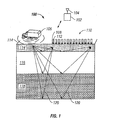
- FIG. 1 is a non-limiting example of a seismic survey system 100 for generating geophysical information used for imaging earth subsurface structures, which information may be used in the methods described herein.
- the system 100 includes a central controller/recorder 102 in communication with a seismic acquisition array 110, known as a spread laid out on a sheet of ice 114 above a body of water 116.
- the body of water 116 covers a media of interest 118 that may include a sediment bed.
- the media of interest 118 carries seismic waves 120 generated by a seismic source 106.
- the seismic acquisition array 110 includes spaced apart sensor stations 108, and each sensor station may include a number of sensors 112.
- the seismic source 106 imparts acoustic energy in the form of seismic waves 120 into the earth and media of interest 118, and the energy is received at the sensors 112 after reflection and refraction at boundaries such as those found in earth subsurface structures.
- the array 110 may communicate with the central controller/recorder 102 using wireless technology as shown using an antenna 104 at the central controller/recorder to receive geophysical information.
- the array may utilize not-shown electrical conductor cables for communicating geophysical information among the sensor stations 108 as well as to and from the recorder station 102.
- the sensors 112 may include several sensors for measuring geophysical information.
- the sensors 112 may include 3-component sensors for obtaining 3-component energy known as 3C seismic.
- the sensors 112 may include motion sensors such as accelerometers and/or velocity geophones to capture seismic information at the sensor station.
- three-component digital accelerometers may be employed to gather acceleration information in digital form at the sensor stations.
- three-component velocity geophones may be used.
- processing techniques may be used to convert the acceleration and/or the velocity information to desired units for further processing.
- Additional sensors may be used for gathering additional geophysical information useful in conducting the seismic survey.
- additional sensors include, microphones, hydrophones pressure sensors, magnetometers, global position systems, timing devices or any combination of sensors useful in obtaining geophysical information.
- gathered seismic information includes any one or combination of P-wave information, S-wave information, pressure information, temperature, timing information, shot information, location information and orientation information.
- P-wave information P-wave information
- S-wave information pressure information
- temperature temperature
- timing information time
- shot information location information
- orientation information orientation information
- Geophysical information may include recorded seismic information having both desired signals and undesired signals or noise that are each recorded using seismic sensors.
- Some noise signals are media dependent energy waves and have unique characteristics depending on whether the wave media is land, water or ice.
- flexural waves When a layer of ice on water is excited with a seismic source, strong waves propagating on the surface called flexural waves are generated. The exact nature of these waves is determined by the thickness of the ice and depth of the water below it. Flexural waves are distinguished from land-media Rayleigh waves, which are sometimes referred to as ground roll. Rayleigh ground-roll waves have a propagation velocity relatively independent of their frequency. On the other hand, flexural waves are strongly reverse dispersive in that the higher frequencies of the flexural waves travel faster than the lower frequencies. Both types of surface waves have a propagation velocity much slower than the normal compressional or p-waves in the waves in the surface media. One reason for the difference between Rayleigh and flexural waves is that the water layer does not support shear wave propagation.
- flexural waves on ice exhibit a dual mode of wave propagation.
- Flexural waves propagate by virtue of both compressional p-waves and shear or s-waves in a synchronized fashion.
- In the direction of propagation (in-line horizontal) p-waves are observed, whereas vertical motion results from s-waves.
- the resulting surface particle motion is described by elliptical trajectories with the vertical and horizontal displacement components having a 90° phase relationship.
- the noise is in the form of flexural waves generated in an ice sheet where the ice sheet is floating on a body of water above a terrain of interest.
- Flexural waves may be directly suppressed in various ways.
- the use of vertically polarized sources such as vibrators in place of impulse non-polarized sources such as dynamite reduces horizontally propagating compressional waves and thus the flexural waves themselves.
- the use of vibrator arrays which can directionally cancel residual horizontal modes, reduces flexural waves.
- the ice layer over the water may be sliced with an ice saw to create an ice gap. The ice gap provides an acoustic barrier to interfere with the flexural wave propagation perpendicular to the ice gap.
- Methods disclosed herein utilize an adaptive filtering paradigm to estimate a desired signal S from an observed signal S', where the observed signal 5' includes the desired signal S combined with noise N.
- the desired signal S includes seismic information useful in the imaging of a subterranean structure.
- Time-varying signals represented by ⁇ are related to an offset distance x and time t, e.g., ⁇ (x,t).
- ⁇ would therefore need further notations for each component x (horizontal), y(horizontal) and z(vertical).
- x in ⁇ (x,t) as a general spatial dimension for offset and the use functional notation S and S' to represent these signals for simplicity.
- An acquired or observed multi-component seismic signal S' includes a desired or true seismic signal S corrupted by multi-component undesirable signals or noise N.
- the multi-component signal S includes a vertical component V that includes seismic information.
- the desired vertical signal may be represented by Sv and the noise in the vertical signal may be represented by Nv.
- the acquired vertical signal may be a raw signal, meaning that there is little or no preprocessing or filtering. Equation 1 represents the vertical component of the acquired signal.
- V Sv + Nv
- Horizontal components of a multi-component acquired signal S may include a cross-line H x component, an in-line H i component, and a radial H r component that may be computed using energy arrival information.
- the signal cross-line component H x is perpendicular to the direction of flexural wave propagation and the in-line H i component in parallel with the direction of propagation. So, in theory the dominant noise will be in the H component.
- the flexural wave may include reflections causing the noise to exhibit an altered direction of propagation, and where three component sensors having horizontal sensors, in some cases the sensors may be oriented such that the direction of propagation and arrival angle may be angularly displaced from H i .
- a radial horizontal component Hr may be computed and used instead or in conjunction with H x and H i .
- the dominant azimuthal noise arrival angle is represented by ⁇ .
- a band limiting filtering process is represented by B(N').
- a dispersion removal process for the primary signal ⁇ may be represented by D( ⁇ )
- a dispersion removal process for the model N' may be represented by D(N').
- Components of the signal S may be rotated.
- a horizontal component phase rotation process may be represented by H(B(N')) in the case of rotating band-limited model N', or the horizontal component phase rotation process may be represented by H(B(D(N'))) in the case of rotating band-limited model N'.
- the phase rotation may include any useful angle of rotation. In several examples herein, the phase rotation is 90°.
- a dispersion restoration process may then be represented by D -1 ( ⁇ ), by D D -1 (N') or by D -1 (B(D(N'))).
- a filtering process F(N') represents a filter for improving the noise model N' approximation of the true noise N.
- the filtering process F(N') is an adaptive process, which may include one or more iterations for improving N'.
- the improved noise model, represented by N" is more representative of the true noise N. Equation 2 shows the relationship between N, N' and N".
- N ⁇ N ⁇ F N ⁇
- equation 3 may be modified as shown in equation 4.
- Sv ⁇ V - N ⁇ v S ⁇ v + N v - F N ⁇ v
- F(N') may be determined by defining a least squares problem, which finds an approximate solution. This class of solutions is known to minimize the sum of squares of specified error. In several examples, other known data processing may be used to determine F(N').
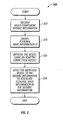
- FIG. 2 illustrates a non-limiting example of a geophysical information processing method 200 for attenuating flexural wave information in seismic information.
- the method 200 may be used for processing raw common shot gathers to remove flexural noise.
- Geophysical information gathered using a system 100 as described above and shown in FIG. 1 is received for processing 200.
- the information may be entered into or received by an information processing device as described below and shown in FIG. 4 .
- the geophysical information received includes multi-component seismic information relating to directional components vertical V, cross-line horizontal H x , and in-line horizontal H i information.
- Hr may be received for processing.
- the exemplary method of FIG. 2 further includes modeling flexural wave information N' 204.
- the flexural wave information model N' may be improved using an adaptive correction filter F(N') to generate an improved model N" 206.
- the improved model N" may then be applied to the seismic information to attenuate flexural wave information in the seismic information.
- FIG. 3 shows another non-limiting example of a geophysical information processing method 300 for attenuating flexural wave information in seismic information.
- the method 300 includes some processing similar to that described above and shown in FIG. 2 with additional filtering added.
- geophysical information gathered using a system 100 as described above and shown in FIG. 1 is received for processing 302.
- the information may be entered into or received by an information processing device as described below and shown in FIG. 4 .
- the geophysical information received includes multi-component seismic information relating to directional components vertical V, cross-line horizontal H x , and in-line horizontal H 1 information.
- the geophysical information received includes multi-component seismic information relating to directional components vertical V, a horizontal radial component H r .
- the horizontal radial component H r may be estimated using the cross-line horizontal H x , and inline horizontal H i information.
- the method 300 may optionally include removing flexural wave dispersion using a dispersion correction process D( ⁇ ) 302 for removing dispersion information.
- the dispersion correction process D( ⁇ ) may include locally warping the time axis directly.
- the dispersion correction process D( ⁇ ) may include compressing the noise wavelet by spectral phase shifting. These particular examples are for illustration only, and other dispersion correction processes D( ⁇ ) may be used without further discussion. These other dispersion correction processes are considered within the scope of the disclosure.
- the dispersion process D may be applied to modeled noise (N')
- the method 300 further includes modeling flexural noise N' by band limiting vertical and horizontal information to the noise bandwidth using a band limiting process B(N') 306.
- V, H x and H i are each independently band limited.
- V and H r is each band limited.
- the band limit frequency range may be any useful range for limiting the seismic information for modeling the flexural noise.
- the band limiting process B(N') includes a one-dimension (1 D) Fourier filtering techniques, e.g. frequency only.
- the band limiting process B(N') includes a two-dimensional (2D) Fourier filtering techniques, e.g. frequency wave number (FK).
- the band limiting process B(N') includes using Tau-P or radial trace filtering methods.
- the band limiting process B(N') includes band limiting each of the directional components V, H x , H i and/or H r to a non-dispersive noise bandwidth of about 5 to 30 Hz.
- the method 300 further includes rotating the phase of the filtered horizontal components 90° using a phase rotation process H(B(N')) or H(B(D(N'))) 308.
- a phase rotation process H(B) includes using a discrete Hilbert transform.
- the method 300 may further include adaptively determining a corrective filter F(N') used to improve the model N' using noise model data from the horizontal components H x , H i or H r 310.
- the noise model data may be based on the predominantly in-line horizontal component H i .
- the noise model data may be based on the radial component H r computed from in-line and cross-line horizontal components H i and H x .
- H r may be computed using direction of arrival ⁇ of the received seismic wave.
- the noise model data may be based on both H i and H x in a multi-component adaptive process.
- the method 300 may further include approximating S.
- S v which is the denoised vertical 5', by subtracting the resulting filtered or improved noise model N" from the vertical (raw) component V 312.
- Inverting time warping/phase transformations on denoised vertical component using D -1 (B(d(N'))) 314 may be performed when the optional dispersion removal D(N') is implemented.
- the methods described above and shown in FIGS. 2 and 3 may be carried out using a computer system using one or more programs and utilizing the principles of the discussion above. Any available recorded seismic information, where the seismic information is gathered using multi-component sensors may be used for the method.
- the sensors used may be a three-component (3C) sensor, such as sensor 112 described above and shown in FIG. 1 for allowing the vertical, radial horizontal, in-line horizontal and cross-line horizontal components of the surface displacement to be acquired.
- 3C three-component
- Attenuating or removal of flexural wave noise from vertical seismic information component may be performed by the disclosed processing method alone by processing raw shot gathers or traces.
- acquisition of seismic information on ice is separately performed using three (3) component sensors.
- raw common shot gathers for use in the method are gathered at sensors receiving seismic energy generated using a non-impulse seismic source.
- FIG. 4 illustrates a non-limiting example of an information processing system 400 that may be used to carry out the methods disclosed herein. Geophysical information may be gathered from a system 100 as described above and shown in FIG. 1 .
- the system 400 may include one or more or any combination of the components shown in FIG. 4 .
- the system 400 may include one or more processing devices such as a computer and a storage device 402.
- the computer may be selected from any number of useful computer devices, examples of which include, but are not limited to, laptop computers 404, desk top computers 406, mainframes 408 and the like. While a laptop-type is shown, the processing unit need not include user interface devices.
- the computer 404 may include a display, keyboard and or other input/output devices such as printers/plotters, a mouse, touch screen, audio output and input or any other suitable user interface.
- the computer 404, 406, 408 may be in communication with the storage device 402 via any known interface.
- An information processing device interface 412 for entering information into the computer 404, 406, 408 may be any acceptable interface.
- the interface may include the use of a network interface 410.
- the storage device 402 may be any useful storage device having a computer-readable media. Instructions for carrying out the disclosed method may be stored on computer- readable media in the computer 404, 406, 408 or may be stored on an external storage device 402.
- a method for attenuating flexural wave information from seismic information includes receiving the seismic information using an information processing device interface, the seismic information having a plurality of directional components acquired using a multi-axis motion sensor coupled to ice floating on a body of water, the seismic information including desired seismic information and the flexural wave information.
- a noise model of the flexural wave information may be generated using at least one of the plurality of seismic information directional components using an information processing device.
- the noise model is improved using an adaptive correction filter, and the improved noise model is applied to at least one directional component of the received seismic information to attenuate the flexural wave information wave in the seismic information.
- a method for attenuating flexural wave information from seismic information includes, receiving the seismic information using an information processing device interface, the seismic information having a plurality of directional components, wherein the plurality of directional components includes a vertical component V, a cross-line horizontal directional component Hx, an in-line horizontal directional component Hi an/or a horizontal radial component Hr.
- the modeling may include using Hx, Hi and/or Hr.
- a method for attenuating flexural wave information from seismic information includes receiving the seismic information using an information processing device interface, the seismic information having a plurality of directional components acquired using a multi-axis motion sensor coupled to ice floating on a body of water, wherein the multi-axis motion sensor recording the seismic information includes a velocity sensor and the seismic information includes velocity information.
- the multi-axis motion sensor recording the seismic information may an acceleration sensor and the seismic information includes acceleration information.
- the multi-axis motion sensor may be an acceleration sensor that includes three orthogonal digital accelerometers.
- a method for attenuating flexural wave or noise information from seismic information includes using a band filter to limit seismic information in each of the plurality of components to a band containing the noise.
- the band containing the noise has a frequency range of about 5 Hz to about 30 Hz.
- the band filter may include at least one of a 1 D frequency filter, a 2D FK filter, a Tau-P filter, and a radial trace filter.
- a method for attenuating flexural wave information from seismic information includes removing flexural wave dispersion in the seismic information using dispersion correction.
- Removing flexural wave dispersion in the seismic information may be performed by locally warping a time axis and/or by compressing a noise wavelet using spectral phase shifting.
- dispersion correction is removed after applying an improved model to the seismic information.
- a method for attenuating flexural wave information from seismic information includes rotating a phase of at least one of the plurality of directional components. Where at least one on the plurality of directional components includes a horizontal component, one embodiment may include rotating a phase of the horizontal component 90 degrees.
- a method for attenuating flexural wave information from seismic information includes applying an improved noise model to at least one directional component of the received seismic information by subtracting the improved model from a vertical directional component of the seismic information.
- an apparatus for attenuating flexural wave information from seismic information includes an information processing device.
- An information processing device interface receives the seismic information for processing in the information processing device.
- the seismic information may have a plurality of directional components acquired using a multi-axis motion sensor coupled to ice floating on a body of water, the seismic information includes the flexural wave information.
- the information processing device generates a noise model of the flexural wave information using at least one of the plurality of seismic information directional components and uses an adaptive correction filter to improve the noise model.
- the information processing device applies the improved noise model to at least one directional component of the received seismic information to attenuate the flexural wave information wave in the seismic information.
- an apparatus for attenuating flexural wave information from seismic information includes an information processing device interface that receives the seismic information for processing in an information processing device.
- the seismic information may have a plurality of directional components acquired using a multi-axis motion sensor coupled to ice floating on a body of water.
- the multi-axis motion sensor recording the seismic information may include a velocity sensor and the seismic information includes velocity information
- the multi-axis motion sensor may include an acceleration sensor and the seismic information includes acceleration information.
- the multi- axis motion sensor may include an acceleration sensor having three orthogonal accelerometers.
- a method for attenuating flexural wave information from seismic information includes receiving the seismic information using an information processing device interface, the seismic information having a vertical directional component and at least one horizontal component, the vertical directional component and at least one horizontal directional component acquired using a multi-axis motion sensor coupled to ice floating on a body of water.
- the seismic information includes desired seismic information and the flexural wave information.
- the embodiment includes generating a noise model of the flexural wave information at least in part by band limiting each of the vertical directional component and the at least one horizontal component using an information processing device implementing a band filter to provide a band limited vertical directional component and a band limited horizontal directional component.
- a phase of the band limited horizontal directional component is rotated by 90 degrees.
- the noise model is improved using an adaptive correction filter using the rotated band limited horizontal directional component.
- the improved noise model is subtracted from the band limited vertical directional component to attenuate the flexural wave information wave in the band limited vertical directional component of the seismic information.
- a computer-readable medium having computer executable instructions stored thereon, that when executed using a computer, perform a method that includes receiving the seismic information using an information processing device interface, the seismic information having a plurality of directional components acquired using a multi-axis motion sensor coupled to ice floating on a body of water, the seismic information including desired seismic information and the flexural wave information.
- the instructions include instructions for generating a noise model of the flexural wave information using at least one of the plurality of seismic information directional components using an information processing device.
- the instructions in this particular embodiment further include improving the noise model using an adaptive correction filter, and applying the improved noise model to at least one directional component of the received seismic information to attenuate the flexural wave information wave in the seismic information.
Landscapes
- Engineering & Computer Science (AREA)
- Remote Sensing (AREA)
- Physics & Mathematics (AREA)
- Life Sciences & Earth Sciences (AREA)
- Acoustics & Sound (AREA)
- Environmental & Geological Engineering (AREA)
- Geology (AREA)
- General Life Sciences & Earth Sciences (AREA)
- General Physics & Mathematics (AREA)
- Geophysics (AREA)
- Geophysics And Detection Of Objects (AREA)
Applications Claiming Priority (1)
| Application Number | Priority Date | Filing Date | Title |
|---|---|---|---|
| US12/170,309 US7864628B2 (en) | 2008-07-09 | 2008-07-09 | Flexural wave attenuation |
Publications (2)
| Publication Number | Publication Date |
|---|---|
| EP2144090A2 true EP2144090A2 (fr) | 2010-01-13 |
| EP2144090A3 EP2144090A3 (fr) | 2013-05-29 |
Family
ID=41211888
Family Applications (1)
| Application Number | Title | Priority Date | Filing Date |
|---|---|---|---|
| EP09251762.2A Withdrawn EP2144090A3 (fr) | 2008-07-09 | 2009-07-08 | Atténuation des ondes de flexion |
Country Status (4)
| Country | Link |
|---|---|
| US (2) | US7864628B2 (fr) |
| EP (1) | EP2144090A3 (fr) |
| CN (1) | CN101634715B (fr) |
| CA (1) | CA2671274A1 (fr) |
Families Citing this family (11)
| Publication number | Priority date | Publication date | Assignee | Title |
|---|---|---|---|---|
| US8553497B2 (en) * | 2008-08-11 | 2013-10-08 | Exxonmobil Upstream Research Company | Removal of surface-wave noise in seismic data |
| US9304221B2 (en) | 2011-04-04 | 2016-04-05 | Westerngeco L.L.C. | Determining an indication of wavefield velocity |
| US20120250460A1 (en) * | 2011-04-04 | 2012-10-04 | Pascal Edme | Noise attenuation using rotation data |
| US20140200820A1 (en) * | 2013-01-11 | 2014-07-17 | Westerngeco L.L.C. | Wavefield extrapolation and imaging using single- or multi-component seismic measurements |
| US10353100B2 (en) * | 2013-03-21 | 2019-07-16 | Westerngeco L.L.C. | Processing seismic data to attenuate vibration noise |
| US20160209539A1 (en) * | 2014-11-14 | 2016-07-21 | Schlumberger Technology Corporation | Method for Separating Multi-Modal Acoustic Measurements for Evaluating Multilayer Structures |
| RU2646528C1 (ru) * | 2016-12-07 | 2018-03-05 | Федеральное государственное бюджетное учреждение науки Институт физики Земли им. О.Ю. Шмидта Российской академии наук (ИФЗ РАН) | Способ поиска полезных ископаемых на шельфе морей, покрытых льдом |
| US11249214B2 (en) * | 2018-05-30 | 2022-02-15 | Saudi Arabian Oil Company | Noise suppression of seafloor geophone seismic data |
| CN112557514B (zh) * | 2020-12-22 | 2021-09-21 | 中国海洋大学 | 手持式海底沉积物样品剖面声学全自动测量装置 |
| CN113687308B (zh) * | 2021-09-07 | 2023-12-19 | 哈尔滨工程大学 | 一种基于弯曲波的冰上震源定位方法 |
| CN117216931B (zh) * | 2023-07-17 | 2024-11-08 | 哈尔滨工程大学 | 一种在厚度缓变海冰中的声传播波形预测方法及装置 |
Citations (1)
| Publication number | Priority date | Publication date | Assignee | Title |
|---|---|---|---|---|
| US4935905A (en) | 1989-08-04 | 1990-06-19 | Terra Linda Canada, Inc. | Method and apparatus for seismic exploration |
Family Cites Families (15)
| Publication number | Priority date | Publication date | Assignee | Title |
|---|---|---|---|---|
| GB1415706A (en) | 1973-07-24 | 1975-11-26 | Ici Ltd | Marine seismic prospecting |
| US4139074A (en) | 1976-10-12 | 1979-02-13 | Texas Instruments Incorporated | Seismic exploration system for ice covered areas |
| US4458341A (en) * | 1981-04-23 | 1984-07-03 | Goebel Vaughn S | Method and apparatus for seismic exploration |
| CA1212337A (fr) | 1983-07-22 | 1986-10-07 | Texas Instruments Incorporated | Attenuation des bruits inherents a un systeme d'exploration sismique sur un banc de glace a la derive |
| US4616348A (en) | 1983-10-31 | 1986-10-07 | Chevron Research Company | Method of attenuating sea ice flexure noise during seismic surveys of permafrost regions |
| US4621347A (en) | 1983-10-31 | 1986-11-04 | Chevron Research Company | Method of attenuating sea ice flexure noise during seismic surveys of permafrost regions involving a precursor aerial and/or satellite mapping step |
| US4890264A (en) * | 1988-03-21 | 1989-12-26 | Atlantic Richfield Company | Seismic exploration method and apparatus for cancelling non-uniformly distributed noise |
| US5408441A (en) * | 1993-08-20 | 1995-04-18 | Halliburton Company | Method for seismic exploration in artic regions |
| US5572483A (en) * | 1995-07-25 | 1996-11-05 | Western Atlas International, Inc. | Method of reducing noise in seismic signals by adaptive filtering of a noise reference |
| US5754492A (en) * | 1996-02-12 | 1998-05-19 | Pgs Tensor, Inc. | Method of reverberation removal from seismic data and removal of dual sensor coupling errors |
| US5774417A (en) * | 1996-10-25 | 1998-06-30 | Atlantic Richfield Company | Amplitude and phase compensation in dual-sensor ocean bottom cable seismic data processing |
| US5781503A (en) * | 1997-01-29 | 1998-07-14 | Exxon Production Research Company | Method for attenuating surface wavetrains in seismic data |
| GB9806847D0 (en) * | 1998-03-30 | 1998-05-27 | Geco Prakla Uk Ltd | Ground roll attenuation method |
| RU2308743C2 (ru) * | 2002-03-20 | 2007-10-20 | Инпут/Аутпут, Инк. | Способ фильтрации сейсмических сигналов и устройство для его осуществления |
| CN1601304A (zh) * | 2004-10-26 | 2005-03-30 | 大庆油田有限责任公司 | 偶极横波测井地应力多频反演方法 |
-
2008
- 2008-07-09 US US12/170,309 patent/US7864628B2/en not_active Expired - Fee Related
-
2009
- 2009-07-08 EP EP09251762.2A patent/EP2144090A3/fr not_active Withdrawn
- 2009-07-08 CA CA 2671274 patent/CA2671274A1/fr not_active Abandoned
- 2009-07-08 CN CN 200910173310 patent/CN101634715B/zh not_active Expired - Fee Related
-
2010
- 2010-11-29 US US12/955,179 patent/US9188688B2/en not_active Expired - Fee Related
Patent Citations (1)
| Publication number | Priority date | Publication date | Assignee | Title |
|---|---|---|---|---|
| US4935905A (en) | 1989-08-04 | 1990-06-19 | Terra Linda Canada, Inc. | Method and apparatus for seismic exploration |
Also Published As
| Publication number | Publication date |
|---|---|
| EP2144090A3 (fr) | 2013-05-29 |
| US20100008186A1 (en) | 2010-01-14 |
| US7864628B2 (en) | 2011-01-04 |
| US9188688B2 (en) | 2015-11-17 |
| CN101634715B (zh) | 2013-06-12 |
| US20110085414A1 (en) | 2011-04-14 |
| CA2671274A1 (fr) | 2010-01-09 |
| CN101634715A (zh) | 2010-01-27 |
Similar Documents
| Publication | Publication Date | Title |
|---|---|---|
| US9188688B2 (en) | Flexural wave attenuation | |
| CA2733699C (fr) | Procede de separation et de propagation vers le haut et vers le bas de champs de pressions et de champ de velocites verticaux emanant de capteurs de pression et de capteurs de mouvement triaxial dans des flutes sismiques remorquees | |
| US7953556B2 (en) | Geophone noise attenuation and wavefield separation using a multi-dimensional decomposition technique | |
| CN102016643B (zh) | 用于衰减双传感器地震拖缆中的低频噪声的方法 | |
| AU2005200195B2 (en) | System for combining signals of pressure sensors and particle motion sensors in marine seismic streamers | |
| CN101556339B (zh) | 对不规则接收机位置海洋地震拖缆数据进行消重影的方法 | |
| CN103582827B (zh) | 使用旋转数据的噪声衰减 | |
| EP2780740B1 (fr) | Retrait de bruit d'une représentation sismique 3d | |
| CN103245969B (zh) | 用于在震源虚反射去除之后确定源特征波形的方法和系统 | |
| CN102062874B (zh) | 用于海洋地震拖缆数据的完全带宽消幻影的方法 | |
| US9274239B2 (en) | Wavefield deghosting | |
| US20060250890A1 (en) | Method for deghosting and water layer multiple reflection attenuation in marine seismic data | |
| EP2730949A2 (fr) | Procédé d'atténuation de bruit d'interférence et appareil | |
| MXPA04006979A (es) | Metodos para exploracion sismica que utiliza un detector de movimiento y datos de detector de presion. | |
| CN102147481B (zh) | 用于三维表面相关多次波预测中的数据重建的基于倾角的校正 | |
| CA2273728C (fr) | Methode ponderee pour combiner les traces de capteurs jumeles employant le filtre backus | |
| CN102121997A (zh) | 用于海洋地震拖缆数据的完全带宽源消幻影的方法 | |
| MX2010005019A (es) | Metodo para el calculo de atributos sismicos a partir de señales sismicas. | |
| EP2299296B1 (fr) | Procédé de combinaison de signaux de pression et capteurs de mouvement de particules dans des flûtes sismiques marines | |
| EP2587279A2 (fr) | Traitement de données sismiques à composantes multiples | |
| HK1140823A (en) | Flexural wave attenuation | |
| AU2009245480B2 (en) | Method for attenuating low frequency noise in a dual-sensor seismic streamer |
Legal Events
| Date | Code | Title | Description |
|---|---|---|---|
| PUAI | Public reference made under article 153(3) epc to a published international application that has entered the european phase |
Free format text: ORIGINAL CODE: 0009012 |
|
| AK | Designated contracting states |
Kind code of ref document: A2 Designated state(s): AT BE BG CH CY CZ DE DK EE ES FI FR GB GR HR HU IE IS IT LI LT LU LV MC MK MT NL NO PL PT RO SE SI SK SM TR |
|
| PUAL | Search report despatched |
Free format text: ORIGINAL CODE: 0009013 |
|
| RIC1 | Information provided on ipc code assigned before grant |
Ipc: G01V 1/28 20060101AFI20130411BHEP |
|
| AK | Designated contracting states |
Kind code of ref document: A3 Designated state(s): AT BE BG CH CY CZ DE DK EE ES FI FR GB GR HR HU IE IS IT LI LT LU LV MC MK MT NL NO PL PT RO SE SI SK SM TR |
|
| AX | Request for extension of the european patent |
Extension state: AL BA RS |
|
| RIC1 | Information provided on ipc code assigned before grant |
Ipc: G01V 1/28 20060101AFI20130425BHEP |
|
| 17P | Request for examination filed |
Effective date: 20131127 |
|
| RBV | Designated contracting states (corrected) |
Designated state(s): AT BE BG CH CY CZ DE DK EE ES FI FR GB GR HR HU IE IS IT LI LT LU LV MC MK MT NL NO PL PT RO SE SI SK SM TR |
|
| STAA | Information on the status of an ep patent application or granted ep patent |
Free format text: STATUS: THE APPLICATION IS DEEMED TO BE WITHDRAWN |
|
| 18D | Application deemed to be withdrawn |
Effective date: 20170201 |