EP2146181A2 - Interféromètre d'incidence oblique - Google Patents
Interféromètre d'incidence oblique Download PDFInfo
- Publication number
- EP2146181A2 EP2146181A2 EP09165179A EP09165179A EP2146181A2 EP 2146181 A2 EP2146181 A2 EP 2146181A2 EP 09165179 A EP09165179 A EP 09165179A EP 09165179 A EP09165179 A EP 09165179A EP 2146181 A2 EP2146181 A2 EP 2146181A2
- Authority
- EP
- European Patent Office
- Prior art keywords
- measurement
- oblique incidence
- optical path
- incidence interferometer
- light
- Prior art date
- Legal status (The legal status is an assumption and is not a legal conclusion. Google has not performed a legal analysis and makes no representation as to the accuracy of the status listed.)
- Withdrawn
Links
Images


Classifications
-
- G—PHYSICS
- G01—MEASURING; TESTING
- G01B—MEASURING LENGTH, THICKNESS OR SIMILAR LINEAR DIMENSIONS; MEASURING ANGLES; MEASURING AREAS; MEASURING IRREGULARITIES OF SURFACES OR CONTOURS
- G01B9/00—Measuring instruments characterised by the use of optical techniques
- G01B9/02—Interferometers
- G01B9/02055—Reduction or prevention of errors; Testing; Calibration
- G01B9/02062—Active error reduction, i.e. varying with time
- G01B9/02067—Active error reduction, i.e. varying with time by electronic control systems, i.e. using feedback acting on optics or light
- G01B9/02069—Synchronization of light source or manipulator and detector
-
- G—PHYSICS
- G01—MEASURING; TESTING
- G01B—MEASURING LENGTH, THICKNESS OR SIMILAR LINEAR DIMENSIONS; MEASURING ANGLES; MEASURING AREAS; MEASURING IRREGULARITIES OF SURFACES OR CONTOURS
- G01B11/00—Measuring arrangements characterised by the use of optical techniques
- G01B11/24—Measuring arrangements characterised by the use of optical techniques for measuring contours or curvatures
- G01B11/2441—Measuring arrangements characterised by the use of optical techniques for measuring contours or curvatures using interferometry
-
- G—PHYSICS
- G01—MEASURING; TESTING
- G01B—MEASURING LENGTH, THICKNESS OR SIMILAR LINEAR DIMENSIONS; MEASURING ANGLES; MEASURING AREAS; MEASURING IRREGULARITIES OF SURFACES OR CONTOURS
- G01B9/00—Measuring instruments characterised by the use of optical techniques
- G01B9/02—Interferometers
- G01B9/02015—Interferometers characterised by the beam path configuration
- G01B9/02022—Interferometers characterised by the beam path configuration contacting one object by grazing incidence
-
- G—PHYSICS
- G01—MEASURING; TESTING
- G01B—MEASURING LENGTH, THICKNESS OR SIMILAR LINEAR DIMENSIONS; MEASURING ANGLES; MEASURING AREAS; MEASURING IRREGULARITIES OF SURFACES OR CONTOURS
- G01B2290/00—Aspects of interferometers not specifically covered by any group under G01B9/02
- G01B2290/35—Mechanical variable delay line
Definitions
- the present invention relates to an oblique incidence interferometer.
- An oblique incidence interferometer according to the state of the art is disclosed in Japanese Unexamined Patent Application Publication No. 2008-32690 .
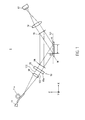
- Fig. 10 is a schematic structural drawing of such an oblique incidence interferometer.
- a oblique incidence interferometer 100 includes a light source 101, a lens 102, a collimate lens 103, a beam dividing element 104, a beam combining element 105, a lens 106, and an image pickup device 107.
- a beam emitted from the light source 101 enters the beam dividing element 104 via the lens 102 and the collimator lens 103 to be divided into two beams.
- One of the divided beams is irradiated to the surface of measurement object W in an oblique direction.
- the light reflected from the measurement object W is superimposed by the beam combining element 105 with the other beam divided by the beam dividing element 104.
- the superimposed beam is fed to the image pickup device 107 and images thereof are picked up by the image pickup device 107 as interference fringe images.
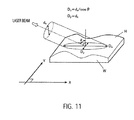
- Fig. 11 is a drawing illustrating a measurement range of the oblique incidence interferometer 100.
- a laser beam beam diameter: dx
- the measurement region does not vary in a lateral direction (Y-direction in Fig. 11 ) even the incident angle ⁇ changes.
- arrangement of a collimate lens with a large diameter is required by enlarging a distance from a light source, causing a problem in that a size of the apparatus increases.
- An oblique incidence interferometer comprises a light source configured to emit coherent light, and a light collimating unit configured to collimate light from the light source to form a collimated beam.
- a propagation direction of the collimated beam is oblique to an object plane.
- the interferometer further comprises a beam dividing unit, a beam combining unit and an image pickup device.
- the beam dividing unit is configured to divide the collimated beam into a measurement beam and a reference beam.
- the beam combining unit is configured to superimpose the measurement beam reflected by the measurement object with the reference beam.
- the image pickup device is configured to pick up images of interference fringes representing a surface shape of the measurement object.
- the oblique incidence interferometer further comprises measurement range enlarging means arranged between the light collimating unit and the beam dividing unit.
- the measurement range enlarging means is adapted to parallel shift temporally or spatially separated portions of the collimated beam in a lateral direction.
- the lateral direction is parallel to the object plane and perpendicular to the propagation direction of the collimated beam. The portions of the collimated beam are shifted to a different extent.
- An oblique incidence interferometer comprises a light source configured to emit coherent light, and a light collimating unit configured to collimate light from the light source to form a collimated beam.
- a propagation direction of the collimated beam is oblique to an object plane.
- the interferometer further comprises a beam dividing unit, a beam combining unit and an image pickup device.
- the beam dividing unit is configured to divide the collimated beam into a measurement beam and a reference beam.
- the beam combining unit is configured to superimpose the measurement beam reflected by the measurement object with the reference beam.
- the image pickup device is configured to pick up images of interference fringes representing a surface shape of the measurement object.
- the oblique incidence interferometer comprises measurement range expanding means for enlarging a light measurement range on the measurement object in a lateral direction of the measurement range.
- the beam measurement range on the measurement object can be expanded also in a lateral direction of the measurement range, so that the measurement range can be expanded without increasing a size of apparatus.
- the measurement range expanding means comprise an optical path shift member for moving parallel a proceeding direction of the coherent light by causing the coherent light from the light source to pass through the optical path shift member and a drive unit configured to rotate the optical path shift member.
- the optical path shift member is a plane-parallel plate.
- the oblique incidence interferometer further comprises control means adapted to control the drive unit such that a predetermined periodic time of the rotation of the optical path shift member is provided.
- the control means is further adapted to control the image pickup unit such that an integration time of the image pickup unit is longer than the periodic time of the rotation of the optical path shift member.
- the drive unit is configured to rotatively reciprocate the optical path shift member by a predetermined angle.
- the drive unit is configured to continuously rotate the optical path shift member in one direction.
- the oblique incidence interferometer further comprises an angle detector adapted to produce a pulse signal per every rotation of the optical path shift member, and a control unit.
- the control unit is adapted to control the image pickup device such that images are picked up only at an instance of the rotation of the optical path shift member by a predetermined angle in synchronization with the pulse signal.
- the oblique incidence interferometer further comprises a shutter and a control unit for opening and closing the shutter according to the rotation angle of the optical path shift member.
- the oblique incidence interferometer further comprises an angle detector adapted to produce a pulse signal per every rotation of the optical path shift member.
- the control unit is adapted to open and close the shutter in synchronization with the pulse signal.
- the measurement range expanding means is a beam diameter enlarging member adapted to enlarge a diameter of the collimated beam passing through the beam diameter enlarging member only in the lateral direction.
- the beam diameter enlarging member is an anamorphic prism.
- the anamorphic prism comprises a pair of prisms and means for changing a magnification ratio of the anamorphic prism by changing an angular orientation of the prisms and/or a distance between the prisms.
- the light source comprises a laser.
- a light source adapted to emit coherent light is operated.
- the coherent light emitted by the light source is collimated to form a collimated beam.
- a propagation direction of the collimated beam is oblique to a measurement objective surface of a measurement object.
- the collimated beam is divided into a measurement beam and a reference beam.
- the measurement beam reflected by the measurement object is superimposed with the reference beam.
- Images of interference fringes representing a shape of the measurement objective surface are picked up.
- temporally or spatially separated portions of the collimated beam are parallel shifted in a lateral direction.
- the lateral direction is parallel to the measurement objective surface and perpendicular to the propagation direction of the collimated beam.
- the portions of the collimated beam are shifted to a different extent.
- Fig. 1 is a schematic structural drawing of an oblique incidence interferometer 1 according to a first embodiment
- Fig. 2 is a block diagram illustrating measurement range enlarging means 10 of the oblique incidence interferometer 1
- Fig. 3 is an enlarged view of an optical path shift member 13.
- a substantially vertical direction to the measurement objective surface H of the measurement object W is assumed to be in a Z-direction and two directions perpendicular to the Z-direction are assumed to be in an X-direction and in a Y-direction.
- the oblique incidence interferometer 1 includes a light source 11, a light collimating unit 12, an optical path shift member 13, a beam dividing unit 14, a beam combining unit 15, a lens 16, an image pickup device 17, and a control unit 18.
- the measurement objective surface H of the measurement object W can be aligned with an object plane 101 of the oblique incidence interferometer 1.
- the object plane 101 can be parallel to the X-direction and the Y-direction.
- the lens 16 can be configured such that light rays from points lying in the object plane 101 are focused at the image pickup device 17, such that a sharp image of an object located at the object plane 101 can be obtained by means of the image pickup device 17.
- the location of the object plane 101 depends on optical properties of the lens 16 such as the focal length thereof, and on the relative arrangement of the lens 16 and the image pickup unit 17.
- the lens 16 and the image pickup unit 17 can be arranged such that a bisector of an angle between the optical axis of the light collimating unit 12 and the optical axis of the lens 16 is a normal of the object plane 101.
- the oblique incidence interferometer 1 can comprise means for holding the measurement object W and for aligning the measurement objective surface of the measurement object W with the object plane.
- a substrate holder (not shown) of a type known to persons skilled in the art can be employed.
- the oblique incidence interferometer 1 also includes measurement range enlarging means 10 for enlarging the light measurement range on the measurement object W in a lateral direction of the measurement range, and the measurement range enlarging means 10 includes the optical path shift member 13, a drive unit 131, the image pickup device 17, and the control unit 18, etc.
- the light source 11 emits coherent light, such as laser, in an oblique direction to the measurement object W.
- the light source 11 may use a laser source outputting laser light, such as He-Ne laser, having favorable coherence.
- the light emitted from the light source 11 is caused to expand with an N.A. of about 0.1 and enter the light collimating unit 12 via an optical fiber 11a.
- the light collimating unit 12 is a collimator lens, for example, configured to collimate the coherent light from the light source 11 to have a larger beam diameter.
- the light emitted from the light source 11 is collimated by the light collimating unit 12 and then, enters the beam dividing unit 14 via the optical path shift member 13 (described later).
- the beam dividing unit 14 is configured to divide the collimated beam or the incident parallel light that has passed through the optical path shift member 13 from the light collimating unit 12 into two beams.
- the beam dividing unit 14 may use a beam splitter or a diffraction grating, for example. With one beam of the two beams divided by the beam dividing unit 14, the measurement objective surface H of the measurement object W is irradiated. The beam is assumed to be a measurement beam. The measurement beam is reflected from the measurement objective surface H to enter the beam combining unit 15.
- the other beam of the two beams divided by the beam dividing unit 14 enters the beam combining unit 15.
- the second beam is referred as a reference beam serving as a measurement reference.
- the optical path shift member 13 is arranged in the optical path between the light collimating unit 12 and the beam dividing unit 14, and is formed of optical glass with parallel planes, for example, thus being a plane-parallel plate.
- the optical path shift member 13 includes a rotatable shaft 132 and a drive unit 131 for rotating the rotatable shaft 132 arranged at one end of the optical path shift member 13.
- the optical path shift member 13 reciprocates rotatively by a predetermined angle in synchronization with the rotation of the rotatable shaft 132.
- the parallel light incident in the optical path shift member 13 from the light collimating unit 12 is periodically refracted in the optical path by passing through the continuously rotatively reciprocating optical path shift member 13, so that the irradiation region of the measurement beam, with which the measurement object W is irradiated, is to be parallel shifted periodically in the lateral direction of the irradiation region by a shift amount S. That is, the optical path shift member 13 causes coherent light from the light source 11 to pass therethrough to parallel shift the proceeding direction of the coherent light.
- the extent to which the propagation direction of light of the collimated beam is shifted by the optical path shift member 13 relative to its original propagation direction depends on the point of time at which the light passes through the optical path shift member 13.
- temporally separated portions of the collimated beam from the collimating unit 12 are parallel shifted to a different extent by the optical path shift member.
- the temporally separated portions of the collimated beam pass through the optical path shift member 13 at different points of time.
- the optical path of the temporally separated portions of the collimated beam before entering the optical path shift member 13 can be substantially the same, since the arrangement of the light source 11, the optical fiber 11 and the light collimating unit 12 can be fixed while a measurement is performed.
- the extent to which their propagation direction is parallel shifted in the lateral direction can be substantially the same.
- the drive unit 131 may be a galvanometer or a motor, for example, and is driven based on a control signal from the control unit 18 to rotatively reciprocate the optical path shift member 13 by a predetermined angle.
- Fig. 4 is a drawing illustrating a relationship between the optical path shift member 13 and the irradiation region on the measurement object W.
- the beam dividing unit 14 and the beam combining unit 15 are omitted.
- the optical path shift member 13 is rotated by an angle of ⁇ ° so that the light from the light collimating unit 12 enters the incidence plane 13a at an incident angle ⁇ °, the light is refracted during entering the optical path shift member 13 and during being emitted therefrom to move parallel in Y-direction by a shift amount S.
- the Y-direction is substantially parallel to the object plane 101 and the measurement objective surface H of the measurement object W. Moreover, since the propagation direction of the collimated beam from the light collimating unit 12 is within a plane parallel to the X-direction and the Z-direction, the Y-direction is substantially perpendicular to the propagation direction of the collimated beam. Hence, by parallel shifting the propagation direction of the collimated beam in the Y-direction, the collimated beam is shifted into a lateral direction parallel to the object plane 101 and perpendicular to the propagation direction of the collimated beam.
- the light emitted from the optical path shift member 13 by moving parallel is divided by the beam dividing unit 14, and the measurement object W is irradiated with the measurement beam at a position P2 on the measurement object W, so that the images thereof are picked up as interference fringe images at a position p2 on the imaging plane 17a of the image pickup device 17.
- a method for calculating the shift amount S will herein be described in detail.
- Fig. 5 is a drawing illustrating a state wherein light enters the optical path shift member 13 at an incident angle ⁇ , where the refractive index of the optical path shift member 13 is denoted as n and thickness thereof is denoted as t.
- Fig. 6 is a graph illustrating a relationship between the thickness t, the incident angle ⁇ , and the shift amount S of the optical path shift member 13.
- the shift amount (mm) is plotted in ordinates and the incident angle (deg) in abscissa.
- the beam combining unit 15 superimposes the measurement beam reflected from the measurement objective surface H with the reference beam.
- the beam combining unit 15 is formed of a beam splitter, for example, in the same way as the beam dividing unit 14, to form interference fringes by superimposing the measurement beam with the reference beam.
- the interference fringes formed by the beam combining unit 15 are focused by the lens 16, so that the images of the interference fringes representing the surface shape of the measurement object W are picked up by the image pickup device 17.
- the image pickup device 17 receives images of the interference fringes on the irradiation region, which continuously moves parallel.
- An integration time of the image pickup device 17 can be longer than a periodic time of the moving cycle of the optical path shift member 13.
- the control unit 18 includes a CPU (central processing unit), an ROM (read only memory), and an RAM (random access memory) (any on of these is not shown), etc.
- the control unit 18, as illustrated in Fig. 2 is connected to the drive unit 131 and the image pickup device 17, etc.
- the ROM of the control unit 18 stores a control program for controlling the drive unit 131 and the image pickup device 17 and various processing programs, and the CPU exercises control over operations of the drive unit 131 and the image pickup device 17 in cooperation with the control program and various processing programs.
- control unit 18 functions as control means for continuously moving the irradiation region on the measurement object W in parallel in the lateral direction of the irradiation region by rotating the optical path shift member 13, so that the image pickup device 17 integrally receives images of the interference fringes on the irradiation region, which continuously moves parallel, for a period longer than the moving cycle of the optical path shift member 13.
- control unit 18 rotatively reciprocates the optical path shift member 13 by a predetermined angle at a high speed by driving the drive unit 131.
- the control unit 18 also causes the image pickup device 17 to receive images of the interference fringes, which moves on the image pickup device 17 at high speed to follow the reciprocation of the irradiation range on the measurement object W.
- the integration time of the image pickup device 17 can be adequately longer than the periodic time of the moving cycle based on a moving frequency (fHz). For example, when the interference fringes reciprocate at a frequency of 1 kHz, the image pickup device 17 integrally receives images for a period of about over ten times the inverse of the frequency (0.01 sec).
- the control unit 18 also executes computing processing to determine the surface shape of the measurement object W based on the interference fringe images obtained by receiving the images with the image pickup device 17.
- An analyzing method for numerically analyzing the obtained interference fringes may include a Fourier analysis method and a phase shift method.
- the light emitted from the light source 11 is periodically refracted in accordance with rotation of the optical path shift member 13 by passing through the continuously rotating optical path shift member 13, so that from the optical path shift member 13, light with an optical path having been periodically moved by the shift amount S is emitted.
- the light with an optical path having been periodically moved by the shift amount S impinges on the measurement objective surface H of the measurement object W, so that the irradiation region is also moved parallel continuously. That is, the irradiation region reciprocates in parallel in the lateral direction.
- the interference fringes moving at high speed emerge to follow the reciprocation of the irradiation range on the measurement object W and these interference fringe images are integrally received by the image pickup device 17.
- the measurement range can be enlarged.
- the beam measurement range on the measurement object W can be enlarged also in the lateral direction of the measurement range while maintaining a distance between the light source 11 and the light collimating unit 12, so that the measurement range can be enlarged without increasing a size of the apparatus.
- Fig. 7 is a drawing illustrating a relationship between the optical path shift member 13 of an oblique incidence interferometer 2 according the second embodiment and the irradiation region on the measurement object W.
- the beam dividing unit 14 and the beam combining unit 15 are omitted.
- Fig. 8 is a block diagram illustrating measurement range expanding means 20 of the oblique incidence interferometer 2.
- the measurement range expanding means 20 of the oblique incidence interferometer 2 includes the optical path shift member 13, the drive unit 131, the image pickup device 17, a shutter 21, an angle detector 22, and a control unit 28.
- the shutter 21 is arranged on an optical axis directly in front of the image pickup device 17 and is opened/closed in accordance with the angle of rotation of the optical path shift member 13.
- the angle detector 22 is formed of an encoder, for example, to produce a pulse signal per every rotation of the optical path shift member 13 by a predetermined angle.
- the control unit 28 drives a rotation shaft 132 by controlling the drive unit 131 to rotate the optical path shift member 13 in one direction at predetermined high speed.
- control unit 28 opens/closes the shutter 21 in synchronization with the pulse signal produced by the angle detector 22 to cause the image pickup device 17 to integrally and selectively receive images of the interference fringes of the irradiation region continuously moving parallel.
- the control unit 28 opens the shutter 21 (see Fig. 7(b) (c) ).
- the control unit 28 closes the shutter 21 (see Fig. 7(a) ).
- the control unit 28 may also cause the image pickup device 17 to pick up images of the interference fringes of the irradiation region only at an instance of the rotation of the optical path shift member 13 by a predetermined angle in synchronization with the pulse signal produced by the angle detector 22.
- Fig. 9 is a drawing illustrating a relationship between a beam diameter enlarging member 31 of an oblique incidence interferometer 3 and an irradiation region on the measurement object W.
- the beam dividing unit 14 and the beam combining unit 15 are omitted.
- Measurement range enlarging means 30 of the oblique incidence interferometer 3 is the beam diameter enlarging member 31 wherein coherent light from the light source 11 is caused to pass through the beam diameter enlarging member 31 to enlarge the diameter of the coherent light only in one direction.
- the direction into which the beam diameter is enlarged can be a lateral direction parallel to the object plane 101 and perpendicular to the propagation direction of the collimated beam, such as the Y-direction.
- the beam diameter enlarging member 31 may use an anamorphic prism, for example.
- the anamorphic prism includes a pair of prisms 31a and 31b, and is an optical element configured to emit a beam in a direction parallel to an incident beam after a magnification ratio of the outgoing beam to the incident beam is changed in a specific direction of the beam cross-section (i.e., compression or elongation).
- the anamorphic prism can cause a collimated beam with an optional diameter to pass through the anamorphic prism after only one direction of the beam is enlarged while the beam direction perpendicular to one direction is maintained as it is.
- the anamorphic prism is configured to change the magnification ratio a by about two to four times by changing angles and a distance between the two prisms 31a and 31b.
- a propagation direction of light propagating along the line 202 in Fig. 9 is parallel shifted into the negative Y-direction to a smaller extent that light propagating along the line 203.
- a propagation direction of portions of the collimated beam which are temporally separated but not spatially separated can be parallel shifted into the negative Y-direction to substantially the same extent, since the arrangement of the beam enlarging member 31 can be substantially fixed during the duration of a measurement.
- the oblique incidence interferometer 3 of the embodiment only the beam direction perpendicular to a plane of incidence is enlarged for irradiating the measurement object W therewith by causing a beam to pass through the beam diameter enlarging member 31, so that the same advantage as the advantages of the first and second embodiments can be obtained. Also, it is not necessary to cause the optical component to be driven to simplify the configuration.
- the measurement range enlarging means of the present invention may also be incorporated in a Mach-Zehnder oblique incidence interferometer, for example.
- an oblique incidence interferometer includes a light source configured to emit coherent light in an oblique direction to a measurement object; a light collimating unit configured to collimate the coherent light from the light source; a beam dividing unit configured to divide the collimated beam from the light collimating unit into a measurement beam and a reference beam; a beam combining unit configured to combine the measurement beam reflected by the measurement object with the reference beam; and an image pickup device configured to pick up images of interference fringes representing a surface shape of the measurement object, wherein the oblique incidence interferometer includes measurement range expanding means for enlarging a light measurement range on the measurement object in a lateral direction of the measurement range.
- the measurement range expanding means includes an optical path shift member arranged between the light collimating unit and the beam dividing unit for moving parallel a proceeding direction of the coherent light by causing the coherent light from the light source to pass through the optical path shift member; a drive unit configured to rotate the optical path shift member; and controlling means for causing the image pickup device to integrally receive images of interference fringes of an irradiation region, which continuously moves parallel, for a period of time longer than a moving cycle of the optical path shift member by continuously rotating the optical path shift member to continuously move parallel the irradiation region on the measurement object in a lateral direction of the irradiation region.
- the drive unit is configured to rotatively reciprocate the optical path shift member by a predetermined angle.
- the drive unit is configured to continuously rotate the optical path shift member in one direction.
- the oblique incidence interferometer according to the preceding paragraph further includes a shutter configured to be opened/closed according to the rotation angle of the optical path shift member, wherein the controlling means is configured to cause the image pickup device to selectively and integrally receive images of the interference fringes of the irradiation region, which continuously moves parallel, by controlling the opening/closing of the shutter.
- the measurement range expanding means is a beam diameter enlarging member, which is arranged between the light collimating unit and the beam dividing unit, and causes the coherent light from the light source to pass through the beam diameter enlarging member to enlarge a diameter of the coherent light only in one direction.
- the beam diameter enlarging member is an anamorphic prism.
Landscapes
- Physics & Mathematics (AREA)
- General Physics & Mathematics (AREA)
- Engineering & Computer Science (AREA)
- Automation & Control Theory (AREA)
- Optics & Photonics (AREA)
- Instruments For Measurement Of Length By Optical Means (AREA)
- Length Measuring Devices By Optical Means (AREA)
Applications Claiming Priority (1)
| Application Number | Priority Date | Filing Date | Title |
|---|---|---|---|
| JP2008186967A JP5361268B2 (ja) | 2008-07-18 | 2008-07-18 | 斜入射干渉計 |
Publications (2)
| Publication Number | Publication Date |
|---|---|
| EP2146181A2 true EP2146181A2 (fr) | 2010-01-20 |
| EP2146181A3 EP2146181A3 (fr) | 2010-07-28 |
Family
ID=41137719
Family Applications (1)
| Application Number | Title | Priority Date | Filing Date |
|---|---|---|---|
| EP09165179A Withdrawn EP2146181A3 (fr) | 2008-07-18 | 2009-07-10 | Interféromètre d'incidence oblique |
Country Status (3)
| Country | Link |
|---|---|
| US (1) | US20100014098A1 (fr) |
| EP (1) | EP2146181A3 (fr) |
| JP (1) | JP5361268B2 (fr) |
Cited By (1)
| Publication number | Priority date | Publication date | Assignee | Title |
|---|---|---|---|---|
| TWI795552B (zh) * | 2018-04-27 | 2023-03-11 | 日商日立造船股份有限公司 | 測量方法以及測量裝置 |
Families Citing this family (5)
| Publication number | Priority date | Publication date | Assignee | Title |
|---|---|---|---|---|
| US7812959B1 (en) * | 2007-03-22 | 2010-10-12 | University Of South Florida | Total internal reflection holographic microscope |
| CN105277338B (zh) * | 2014-07-04 | 2018-10-26 | 中国科学院长春光学精密机械与物理研究所 | 大数值孔径移相式双针孔衍射干涉仪及其测试方法 |
| JP6528377B2 (ja) * | 2014-08-29 | 2019-06-12 | 日亜化学工業株式会社 | 照明装置 |
| CN109781510A (zh) * | 2019-03-18 | 2019-05-21 | 合肥工业大学 | 一种利用等倾干涉原理的摩擦磨损试验机 |
| WO2020217448A1 (fr) * | 2019-04-26 | 2020-10-29 | 株式会社島津製作所 | Dispositif d'imagerie d'image d'interférence |
Family Cites Families (11)
| Publication number | Priority date | Publication date | Assignee | Title |
|---|---|---|---|---|
| JPH0432729A (ja) * | 1990-05-30 | 1992-02-04 | Denki Kagaku Keiki Kk | フーリエ変換形分光分析装置 |
| JPH0642930A (ja) * | 1992-04-22 | 1994-02-18 | Nec Corp | リード高さ測定方法および装置 |
| JP3600881B2 (ja) * | 1993-12-27 | 2004-12-15 | 株式会社ニコン | 干渉計及びステージ装置 |
| JP2001241916A (ja) * | 2000-02-28 | 2001-09-07 | Fuji Photo Optical Co Ltd | 斜入射干渉計用光学系およびこれを用いた装置 |
| JP2001241914A (ja) * | 2000-02-28 | 2001-09-07 | Fuji Photo Optical Co Ltd | 斜入射干渉計用光学系およびこれを用いた装置 |
| JP2004163212A (ja) * | 2002-11-12 | 2004-06-10 | Tateyama Machine Kk | 非接触式形状測定装置 |
| DE20306542U1 (de) * | 2003-04-25 | 2003-08-28 | Oculus Optikgeräte GmbH, 35582 Wetzlar | Vorrichtung zur Projektion eines Lichtstrahls |
| WO2006083911A2 (fr) * | 2005-02-01 | 2006-08-10 | Purdue Research Foundation | Procede et appareil de detection interferometrique en quadrature par contraste de phase d'un dosage immunologique |
| US7663092B2 (en) * | 2005-02-01 | 2010-02-16 | Purdue Research Foundation | Method and apparatus for phase contrast quadrature interferometric detection of an immunoassay |
| JP4897572B2 (ja) * | 2006-06-30 | 2012-03-14 | 株式会社ミツトヨ | 斜入射干渉計 |
| US7619720B1 (en) * | 2007-12-04 | 2009-11-17 | Itt Manufacturing Enterprises, Inc. | Sequentially addressable radius measurements of an optical surface using a range finder |
-
2008
- 2008-07-18 JP JP2008186967A patent/JP5361268B2/ja not_active Expired - Fee Related
-
2009
- 2009-07-10 EP EP09165179A patent/EP2146181A3/fr not_active Withdrawn
- 2009-07-16 US US12/458,592 patent/US20100014098A1/en not_active Abandoned
Cited By (1)
| Publication number | Priority date | Publication date | Assignee | Title |
|---|---|---|---|---|
| TWI795552B (zh) * | 2018-04-27 | 2023-03-11 | 日商日立造船股份有限公司 | 測量方法以及測量裝置 |
Also Published As
| Publication number | Publication date |
|---|---|
| JP2010025732A (ja) | 2010-02-04 |
| US20100014098A1 (en) | 2010-01-21 |
| EP2146181A3 (fr) | 2010-07-28 |
| JP5361268B2 (ja) | 2013-12-04 |
Similar Documents
| Publication | Publication Date | Title |
|---|---|---|
| EP2146181A2 (fr) | Interféromètre d'incidence oblique | |
| EP1873481B1 (fr) | Interféromètre à incidence oblique | |
| US7423741B2 (en) | Method for visualizing a mark on a spectacle lens | |
| JP2014508969A (ja) | 蛍光顕微鏡検査法における照明位相制御のためのシステムおよび方法 | |
| KR101651762B1 (ko) | 거리 계측 장치 | |
| US10835991B2 (en) | Laser beam irradiating device | |
| JP4593625B2 (ja) | 角度測定装置及び方法 | |
| CN103292739B (zh) | 一种无执行机构的曲面形状精密测量装置与方法 | |
| JP2006349534A (ja) | 動体測定用干渉計装置および動体測定用光干渉計測方法 | |
| JPH1096611A (ja) | 形状測定装置 | |
| JP2012220341A (ja) | 形状測定装置、形状測定方法、及びそのプログラム | |
| CN117730238A (zh) | 内部小平面之间的平行度的基于光学的验证 | |
| JP5514641B2 (ja) | レーザー干渉バンプ測定器 | |
| JP6217748B2 (ja) | 屈折率測定装置 | |
| JP2006268004A (ja) | 顕微鏡装置 | |
| CN104180764A (zh) | 间隙测定装置 | |
| JP4616692B2 (ja) | 変位検出装置 | |
| JP2005049317A (ja) | 干渉計 | |
| JP4739806B2 (ja) | 光ビーム測定装置および方法 | |
| KR100280006B1 (ko) | 렌즈특성 검사장치 | |
| JP2005156385A (ja) | 赤外顕微鏡及びその測定位置確定方法 | |
| JP2008196901A (ja) | 光波干渉測定装置 | |
| KR101924888B1 (ko) | 마이켈슨 간섭계와 이것을 이용한 간섭무늬 획득방법 | |
| JP2011021921A (ja) | 干渉計及び面形状測定方法 | |
| KR102116618B1 (ko) | 광학 시편 표면 검사 장치 및 그 제어 방법 |
Legal Events
| Date | Code | Title | Description |
|---|---|---|---|
| PUAI | Public reference made under article 153(3) epc to a published international application that has entered the european phase |
Free format text: ORIGINAL CODE: 0009012 |
|
| AK | Designated contracting states |
Kind code of ref document: A2 Designated state(s): AT BE BG CH CY CZ DE DK EE ES FI FR GB GR HR HU IE IS IT LI LT LU LV MC MK MT NL NO PL PT RO SE SI SK SM TR |
|
| PUAL | Search report despatched |
Free format text: ORIGINAL CODE: 0009013 |
|
| AK | Designated contracting states |
Kind code of ref document: A3 Designated state(s): AT BE BG CH CY CZ DE DK EE ES FI FR GB GR HR HU IE IS IT LI LT LU LV MC MK MT NL NO PL PT RO SE SI SK SM TR |
|
| 17P | Request for examination filed |
Effective date: 20110128 |
|
| STAA | Information on the status of an ep patent application or granted ep patent |
Free format text: STATUS: THE APPLICATION HAS BEEN WITHDRAWN |
|
| 18W | Application withdrawn |
Effective date: 20120410 |