EP2146247A1 - Resiststrukturierungsverfahren und Photomaskenherstellung - Google Patents
Resiststrukturierungsverfahren und Photomaskenherstellung Download PDFInfo
- Publication number
- EP2146247A1 EP2146247A1 EP09007999A EP09007999A EP2146247A1 EP 2146247 A1 EP2146247 A1 EP 2146247A1 EP 09007999 A EP09007999 A EP 09007999A EP 09007999 A EP09007999 A EP 09007999A EP 2146247 A1 EP2146247 A1 EP 2146247A1
- Authority
- EP
- European Patent Office
- Prior art keywords
- sulfonate
- group
- polymer
- bis
- resist
- Prior art date
- Legal status (The legal status is an assumption and is not a legal conclusion. Google has not performed a legal analysis and makes no representation as to the accuracy of the status listed.)
- Granted
Links
Images
Classifications
-
- G—PHYSICS
- G03—PHOTOGRAPHY; CINEMATOGRAPHY; ANALOGOUS TECHNIQUES USING WAVES OTHER THAN OPTICAL WAVES; ELECTROGRAPHY; HOLOGRAPHY
- G03F—PHOTOMECHANICAL PRODUCTION OF TEXTURED OR PATTERNED SURFACES, e.g. FOR PRINTING, FOR PROCESSING OF SEMICONDUCTOR DEVICES; MATERIALS THEREFOR; ORIGINALS THEREFOR; APPARATUS SPECIALLY ADAPTED THEREFOR
- G03F7/00—Photomechanical, e.g. photolithographic, production of textured or patterned surfaces, e.g. printing surfaces; Materials therefor, e.g. comprising photoresists; Apparatus specially adapted therefor
- G03F7/004—Photosensitive materials
- G03F7/039—Macromolecular compounds which are photodegradable, e.g. positive electron resists
- G03F7/0392—Macromolecular compounds which are photodegradable, e.g. positive electron resists the macromolecular compound being present in a chemically amplified positive photoresist composition
-
- H—ELECTRICITY
- H10—SEMICONDUCTOR DEVICES; ELECTRIC SOLID-STATE DEVICES NOT OTHERWISE PROVIDED FOR
- H10P—GENERIC PROCESSES OR APPARATUS FOR THE MANUFACTURE OR TREATMENT OF DEVICES COVERED BY CLASS H10
- H10P76/00—Manufacture or treatment of masks on semiconductor bodies, e.g. by lithography or photolithography
- H10P76/20—Manufacture or treatment of masks on semiconductor bodies, e.g. by lithography or photolithography of masks comprising organic materials
- H10P76/204—Manufacture or treatment of masks on semiconductor bodies, e.g. by lithography or photolithography of masks comprising organic materials of organic photoresist masks
-
- H—ELECTRICITY
- H10—SEMICONDUCTOR DEVICES; ELECTRIC SOLID-STATE DEVICES NOT OTHERWISE PROVIDED FOR
- H10P—GENERIC PROCESSES OR APPARATUS FOR THE MANUFACTURE OR TREATMENT OF DEVICES COVERED BY CLASS H10
- H10P76/00—Manufacture or treatment of masks on semiconductor bodies, e.g. by lithography or photolithography
- H10P76/20—Manufacture or treatment of masks on semiconductor bodies, e.g. by lithography or photolithography of masks comprising organic materials
- H10P76/204—Manufacture or treatment of masks on semiconductor bodies, e.g. by lithography or photolithography of masks comprising organic materials of organic photoresist masks
- H10P76/2041—Photolithographic processes
Definitions
- the present invention relates to a photo resist used for fine processing of a semiconductor, a photo mask blank, and so forth, in particular, a resist patterning process with regard to a chemically-amplified type resist used in a KrF excimer laser, an EUV, and an electronic beam, and a method for manufacturing a photo mask.
- a positive resist having been actually used is based on a mechanism with which it is made soluble into an alkaline developer by eliminating an acid-labile protecting group, which protects an acidic functional group at side chain of a base polymer, by an acid as its catalyst that is generated by exposing a high energy beam to an acid generator. Accordingly, a molecular weight of a base polymer added in a resist composition does not change before and after a light-exposure.
- control of a resist pattern profile is based on whether or not dissolution properties of polymers in a resist film after the light-exposure can be controlled at a micro level. Accordingly, from a considerably early stage of practical use of a chemically-amplified resist, control of the molecular weight dispersion of a base polymer has been drawing an attention (Japanese Patent Laid-Open Application No. H5-132513 ).
- a base polymer obtained by radical polymerization of polyhydroxystyrene an acrylic acid derivative protected by an acid labile group, and further a unit not dissolvable in an alkaline developer such as styrene
- a use of a base polymer slightly larger than a comparative example of polyhydroxystyrene is disclosed in Japanese Patent Laid-Open Application No. H7-209868 .
- Mw of about 10,000 it was found that a considerably large amount of scum were formed in the case of Mw of about 10,000, if a conventional method was followed. Accordingly, as disclosed in Japanese Patent Laid-Open Application No. 2008-122932 and so forth, Mw of about 5,000 to 9,000 are generally used in many cases.
- a resist using a base polymer which is a copolymer of hydroxystyrene and a cycloolefin containing an aromatic ring and is insolubilized into an alkaline developer by protecting with an acetal protecting group
- a base polymer which is a copolymer of hydroxystyrene and a cycloolefin containing an aromatic ring and is insolubilized into an alkaline developer by protecting with an acetal protecting group
- the resist disclosed there had Mw of specifically about 9,000 to 15,000, and yet they showed no problem of the scum as mentioned above.
- Resist compositions disclosed in Japanese Patent Laid-Open Application No. 2007-132998 , Japanese Patent Laid-Open Application No. 2008-95009 , and so on are useful materials to form fine patterns especially by a high energy beam such as an electronic beam and an EUV, and its important application is for processing of a photo mask blank.
- a circuit drawn on a photo mask is projected with a reduced size by one-fourth in a exposure.
- this does not mean that a line width of the mask pattern may allow to be 4-folds relative to an intended pattern rule, and it is processed to a more complicated pattern (a pattern applied with a so-called OPC, Optical Proximity Correction, and the like) than an actual circuit pattern in order to correct a light diffraction and the like.
- a line edge roughness Fluctuation of a line width of a resolved resist pattern is called as a line edge roughness. Even though a fine resist pattern is separated, lithography may not be performed as designed as far as a line edge roughness is large.
- This problem of a line edge roughness had already been noted in the formation of a pattern with about 0.2 micrometers, and been generally solved by selection of materials such as an acid-generator, a basic compound, and the like, and by control of an amount of an additive.
- a solution by an acid-generator and a basic compound is merely an operation to increase slightly a diffusion length of an acid. Given that a maximum resolution is attained by control of a diffusion length of an acid, there is a trade-off relationship with resolution.
- a main object of the present invention is, in a resist composition with a high resolution and a high etching resistance containing, as a base polymer, a copolymer formed of a hydroxystyrene protected by an acid labile group and a cyclic olefin having an aromatic ring, to provide a resist patterning process to be used for processing of a semiconductor having a further reduced line edge roughness with a pattern rule of 65 nanometers or less and even 45 nanometers or less and for precision processing of a photo mask blank and the like for it.
- Inventors of the present invention investigated extensively to achieve the above-mentioned object and found that a resist pattern with a high resolution and a small line edge roughness may be obtained even if a pattern with a minimum line width or space width is 65 nanometers or less is formed, when a chemically-amplified positive resist composition is made by using a base polymer having a weight-average molecular weight of less than those that have been considered to be best in the past, namely 4,000 to 7,000, in particular 4,500 to 5,500, wherein the polymer comprises one or more monomer unit represented by the following general formula (1), and one or more monomer unit represented by the following general formula (2) and/or one or more monomer unit represented by the following general formula (3), wherein the sum of the monomers represented by the formulae (1) to (3) relative to total monomer units of the polymer is 95 mol % or more, the amount of monomer units with t being one or more is 70 mol % or more relative to total monomer unit of the formula(1) when two or more monomers represented
- the present invention is a resist patterning process with a minimum line width or a minimum space width being 65 nanometers or less on a processing substrate, comprising a step of coating a chemically-amplified positive resist composition containing a base polymer on a processing substrate; a step of removing an excess solvent component remained in a coated layer by heating to obtain a resist film; pattern-exposing a high energy beam; and a step of developing by using a developer, if necessary after a light-exposure and then a heat-treatment, wherein the base polymer is a polymer comprising at least one or more monomer unit represented by the following general formula (1) (however, it always contains a unit with t being one or more): wherein R 1 represents any of a hydrogen atom or a methyl group; and R 2 represents a hydrocarbon group, or an alkoxy hydrocarbon group, having 1 to 6 carbon atoms, wherein t represents an integer of 0 to 2; and s represents an integer of 0 to 4, and 0
- a line edge roughness could be made smaller than those of conventional ones, and a high resolution could be obtained without forming round heads, by lowering its molecular weight rather than by controlling of amounts of an acid generator and a basic compound.
- the weight-average molecular weight is preferably 4,500 to 5,500.
- the acid labile protecting group to protect a phenolic hydroxyl group in the monomer unit represented by general formula (1) is preferably an acetal group represented by the general formula (4): wherein R 5 represents a hydrogen atom, or a linear, a branched, or a cyclic alkyl group having 1 to 10 carbon atoms; and Y represents a linear, a branched, or a cyclic (including polycyclic) alkyl group having 1 to 30 carbon atoms.
- the present invention is a method for producing a photo mask for manufacturing of a semiconductor device with a pattern rule of 65 nanometers or less, wherein the method includes a step of processing a photo mask blank by forming a resist pattern on the mask blank by the resist patterning process according to any of the above.
- a high resolution and a small line edge roughness may be attained simultaneously. Accordingly, a high reliability may be rendered to a process for producing a photo mask used to manufacture a semiconductor by a pattern rule of 65 nanometers or less, in particular 45 nanometers or less, where securing a reliability has been difficult.
- a composition containing, as a base polymer, a polymer containing a styrene unit having a hydroxyl group and an hydroxyl group protected by an acid-decomposable group, and an indene unit and/or an acenaphthalene unit, whose weight-average molecular weight is 4,000 to 7,000, in particular 4,500 to 5,500, is used to form a resist pattern.
- a resist pattern having an excellent line edge roughness (LER) could be obtained even when a pattern with a minimum line width (width of a remaining resist pattern) or a minimum space width (width between a remaining resist pattern and a resist pattern) being 65 nanometers or less is formed.
- a resist pattern with an excellent LER could be obtained even when a pattern with 45 nanometers or less is formed.
- improvement of a reliability of lithography in production of a photo mask for manufacturing a semiconductor with a pattern rule of 65 nanometers or less, or even a pattern rule of 45 nanometers or less could be attained.
- the present invention further improved a resist composition having a high etching resistance disclosed in Japanese Patent Laid-Open Application No. 2007-132998 , Japanese Patent Laid-Open Application No. 2008-95009 , and so on by inventors of the present invention, thereby enabled easy manufacturing of a semiconductor with a pattern rule of 65 nanometers or less, in particular a semiconductor requiring an extremely fine resist pattern such as 45 nanometers or less, where a high precision is difficult to be obtained, and production of a photo mask used therein.
- a base polymer used in a resist composition of the present invention is a base polymer mainly composed of the followings. Namely, it is a base polymer comprising at least one or more monomer unit represented by the following general formula (1) (however, it always contains a unit with t being one or more): wherein R 1 represents a hydrogen atom or a methyl group; and R 2 represents a hydrocarbon group, or an alkoxy hydrocarbon group, having 1 to 6 carbon atoms, wherein t represents an integer of 0 to 2; and s represents an integer of 0 to 4, and one or more monomer unit represented by the following general formula (2); wherein R 3 represents any of a hydroxyl group, a hydrocarbon group, or an alkoxy hydrocarbon group, having 1 to 6 carbon atoms , wherein u represents an integer of 0 to 4 and/or one or more monomer unit represented by the following general formula (3); wherein R 4 represents a hydroxyl group, a hydrocarbon group, or an alkoxy hydrocarbon group, having
- the sum of units represented by the general formulae (1) to (3) is 95 mol % or more and preferably 98 mol % or more relative to total monomer units in the polymer, and in addition, when the units represented by the general formula (1) contains 2 or more monomer units, the content of the unit with t being one or more (however, here it means the sum of a protected and an unprotected hydroxyl group) relative to total units represented by the formula (1) is 70 mol % or more, preferably 85 mol% or more, and more preferably 100 mol %, and in addition, the sum of monomer units represented by the general formulae (2) and (3) is 5 to 30 mol % relative to the total monomer units in the polymer.
- Basic skeleton of the base polymer as mentioned above is composed of mainly any of the following; a styrene unit (the above general formula (1)) and an indene unit (the above general formula (2)); a styrene unit and an acenaphthylene unit (the above general formula (3)); or a styrene unit, the indene unit, and the acenaphthylene unit.
- it may contain other unit like a (meth)acrylic acid ester protected with an acid labile group such as tertiary alkyl group or having an acid-stable group.
- the styrene unit contains a hydrogen group or a methyl group in its ⁇ -position (R 1 ), wherein the unit contains a hydroxyl group or a hydroxyl group optionally protected by an acid labile group in the amount of preferably 70 mol % or more, more preferably 80 mol % or more, and further more preferably 100 mol %, relative to total styrene units. Further, in a polymer protected by an acid labile group, the content of a unit having an unprotected hydroxyl group is 5 mol % or more and 80 mol % or less, and preferably 30 mol % or more and 80 mol % or less, relative to total monomer units of the polymer.
- the content of a unit having a hydroxyl group protected by an acid labile group is more than 0 mol % and 50 mol % or less, and more preferably 10 mol % or more and 30 mol % or less, relative to total monomer units of the polymer.
- substituent group which may be substituted in the styrene unit, may be exemplified by a hydrocarbon group having 1 to 6 carbon atoms or an alkoxy hydrocarbon group.
- hydrocarbon group include a methyl group, an ethyl group, a propyl group, a butyl group, a pentyl group, a cyclopentyl group, a hexyl group, a cyclohexyl group, and a phenyl group, including its isomers.
- any of the indene unit and the acenaphthlene unit may be substituted by a hydroxyl group, a hydrocarbon group having 1 to 6 carbon atoms, or an alkoxy hydrocarbon group.
- the hydrocarbon group include a methyl group, an ethyl group, a propyl group, a butyl group, a pentyl group, a cyclopentyl group, a hexyl group, a cyclohexyl group, and a phenyl group, including its isomers.
- these units render a high etching resistance to a resist layer obtained from a resist composition, and in addition, it is assumed from the results of the present invention that they also render an effect of a desirable pattern profile in a low molecular weight.
- the content of these units is preferably 5 to 30 mol %, and more preferably 5 to 20 mol %, relative to total monomer units in the polymer. When the content is less than 5 mol %, the property that an etching resistance is high is not clearly seen, and when the content is more than 30 mol %, to control its molecular weight and to have reproducibility of polymerization are sometimes difficult.
- the weight-average molecular weight of the base polymer as mentioned above is preferably 4,000 to 7,000, and more preferably 4,500 to 5,500 as measured by a generally used method using a gel permeation chromatography (GPC) with polystyrene as a standard sample.
- GPC gel permeation chromatography
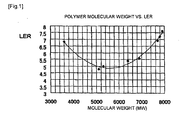
- the weight-average molecular weight is less than 4,000, a resolution is decreased due to round pattern heads and a line edge roughness is deteriorated, as has been known in past. On the contrary, when it is more than 7,000, a phenomenon that a line edge roughness is clearly seen appears easily. Accordingly, the weight-average molecular weight is preferably 4,000 or more and 7,000 or less, and more and most preferably in an extremely narrow range of 4,500 or more and 5,500 or less.
- its molecular weight distribution is preferably 1.0 to 2.0, in particular in a narrow dispersion range of 1.0 to 1.8.
- Mw/Mn molecular weight distribution
- an acetal group, a tertiary alkyl group, and the like may be used, but an acetal group represented by the following general formula (4) is preferable because it gives a high resolution: wherein R 5 represents a hydrogen atom, or a linear, a branched, or a cyclic alkyl group having 1 to 10 carbon atoms; and Y represents a linear, a branched, or a cyclic (including polycyclic) alkyl group having 1 to 30 carbon atoms.
- Y in the formula (4) is a linear, a branched, or a cyclic (including polycyclic) alkyl group having 1 to 30 carbon atoms, preferably it includes a polycyclic alkyl group having 7 to 30 carbon atoms.
- Y includes a polycyclic alkyl group, it is preferable that a secondary carbon atom constituting the polycyclic structure form a bond with an acetal oxygen atom. Because, if the bond is formed on a tertiary carbon atom in a cyclic structure, a polymer becomes labile, thereby lacking in a storage stability as a resist composition and leading to deterioration of a resolution.
- Tg glass transition temperature
- R 5 represents a hydrogen atom, or a linear, a branched, or a cyclic alkyl group having 1 to 10 carbon atoms, and may be arbitrarily selected according to design of sensitivity of the decomposable group to an acid. For example, when the design is made to decompose by a strong acid with securing a relatively high stability, a hydrogen atom may be selected. When the design is made to have a high sensitivity to a change in pH by utilizing a relatively high reactivity, a linear alkyl group may be selected.
- a carbon atom having a bond with the acetal carbon as R 5 is preferably a secondary carbon, though it depends on a combination of an acid-generator and a basic compound contained in a resist composition.
- R 5 bonded with an acetal carbon by a secondary carbon include an isopropyl group, a sec-butyl group, a cyclopentyl group, and cyclohexyl group.
- Production of the polymer as mentioned above may be done by a number of polymerization methods known in skills in the art, namely by a radical polymerization method and a cationic polymerization method.
- a radical polymerization a monomer pre-introduced by an acid-decomposable group (in this case, an acid labile protecting group is introduced to a phenolic OH group) is used, in a similar manner to polymerization of a (meth)acrylic acid derivative already protected by an acid-decomposable protecting group and an acetoxy styrene (for example, Japanese Patent Laid-Open Publication No.
- the above-mentioned radical polymerization method and de-acetoxylation reaction are well known, and are also disclosed in Japanese Patent Laid-Open Application No. 2007-132998 , Japanese Patent Laid-Open Application No. 2008-95009 .
- As a base for an alkaline hydrolysis an aqueous ammonia solution, triethyl amine, and the like may be used.
- the reaction temperature is -20 to 100°C, and preferably 0 to 60°C, and the reaction time is 0.2 to 100 hours, and preferably 0.5 to 30 hours.
- a method for protecting the polymer after polymerization As a method for protecting the polymer after polymerization, a method using a vinyl ether and an acid catalyst (for example, Japanese Patent Laid-Open Application No. 2008-95009 ), a method using an acetal-forming agent containing a haloalkoxy group and a base (for example, Japanese Patent Laid-Open Application No. 2007-132998 ), and the like are known, and any of them may be used here.
- the acid catalyst to be used in the reaction may be exemplified by methanesulfonic acid, trifluoroacetic acid, oxalic acid, methanesulfonic acid pyridine salt, and the like.
- the reaction temperature is preferably 5 to 20°C, and the reaction time is 0.2 to 10 hours and preferably 0.5 to 5 hours.
- an acetal-forming agent represented by the following general formula (5): wherein X represents a chlorine atom, a bromine atom, an iodine atom; and Y" represents an alkyl group having 1 to 30 carbon atoms or an aryl group, is added dropwise into a polymer solution in the presence of a basic compound such as triethyl amine and the like.
- the reaction temperature is preferably -20 to 50°C, and the reaction time is 0.2 to 10 hours and preferably 0.5 to 5 hours, though they are just rough indications, and thus the method is not restricted to these methods.
- a polymer containing, as an alkaline-soluble group, a hydroxyl group with.improved acidity due to a presence of a fluorine atom near to it such as a (meth)acrylate ester type (Japanese Patent Laid-Open Publication No. 2007-297590 ) and a hydroxystyrene type (Japanese Patent Laid-Open Publication No. S62-240953 ), has been known. These materials change a state of a resist film surface and have an effect to improve an inner homogeneity of a pattern surface.
- a generally used polymer such as hydroxystyrene-(meth)acryolate ester copolymer may also be added in such a range as not to impair effects of the present invention.
- the content of such a polymer is preferably not more than 30% by weight, and more preferably 10% or less by weight, relative to total polymers, though it is not necessary to be added if intended only to have the effects of the present invention.
- Examples of an organic solvent to dissolve a solid component in order to make a chemically-amplified positive resist composition of the present invention applicable for coating include butyl acetate, amyl acetate, cyclohexyl acetate, 3-methoxybutyl acetate, methyl ethyl ketone, methyl amyl ketone, cyclohexanone, cyclopentanone, 3-ethoxyetyl propionate, 3-ethoxymetyl propionate, 3-methoxymetyl propionate, methyl acetoacetate, ethyl acetoacetate, diacetone alcohol, methyl pyruvate, ethyl pyruvate, propyleneglycol monomethyl ether, propyleneglycol monoethyl ether, propyleneglycol monomethyl ether propionate, propyleneglycol monoethyl ether propionate, ethyleneglycol monomethyl ether, ethyleneglycol mono
- a propyleneglycol alkyl ether acetate and a lactic acid alkyl ester are preferable. These solvents may be used singly or in a mixture of two or more kinds.
- a preferable example of the mixed solvent is that of a propyleneglycol alkyl ether acetate and a lactic acid alkyl ester.
- an alkyl group of a propyleneglycol alkyl ether acetate is the one having 1 to 4 carbon atoms, and for example, a methyl group, an ethyl group, a propyl group, and the like may be mentioned, while a methyl group and an ethyl group are preferable.
- a propyleneglycol alkyl ether acetate has a 1,2-, and a 1,3-substituted form, and there are three isomers depending on a combinations of positions of substituents, wherein they may be used singly or a mixture thereof.
- An alkyl group in the lactic acid alkyl ester is the one having 1 to 4 carbon atoms, and may include, for example, a methyl group, an ethyl group, and a propyl group, but a methyl group and an ethyl group are preferable.
- a propyleneglycol alkyl ether acetate is preferably selected mainly as the organic solvent because the amount of an acid-generator to be added is relatively controlled to be low, in this case, its content is preferably 50% or more by weight relative to total solvents.
- a lactic acid alkyl ester or propyleneglycol monoalkyl ether is preferably selected as a co-solvent to be added.
- a lactic acid alkyl ester or propyleneglycol monoalkyl ether having a hydroxyl group is preferably selected mainly as the organic solvent because the amount of an acid-generator to be added is relatively large, in this case, the content of each or mixture of them is preferably 50% or more by weight relative to total solvents.
- a mixed solvent of a propyleneglycol alkyl ether acetate and a lactic acid alkyl ester and/or propyleneglycol monoalkyl ether is used as a solvent, their sum is preferably 50% or more, and more preferably 80% or more by weight relative to total solvents.
- the content of a propyleneglycol alkyl ether acetate be 20 to 95% by weight and a lactic acid alkyl ester and/or propyleneglycol monoalkyl ether be 5 to 80% by weight, the rate is decided by calculating the amount of the acid-generator to be added as described above.
- the content of a propyleneglycol alkyl ether acetate is too small, there are problems of deterioration of coating properties and the like, and when it is too much, there are problems of insufficient solubility and formation of particles and foreign matters.
- the amount of these solvents to be added relative to 100 parts by weight of a solid component in a chemically-amplified positive resist composition is 300 to 2,000 parts by weight, and preferably 400 to 1,000 parts by weight, but not restricted to them as far as the concentration is such that a conventional coating method is applicable.
- any compound may be used as far as it generates an acid by irradiation of a high energy beam.
- An photo acid-generator with types of a sulfonium salt, an iodonium salt, a sulfonyl diazomethane, an N-sulfonyl oxyimide type, and the like may be used preferably. These will be explained in detail in the following, and may be used singly or as a mixture of two or more kinds.
- a sulfonium salt is formed of a sulfonium cation and a sulfonate, bis(substituted alkylsulfonyl) imide, or tris(substituted alkylsulfonyl) methide.
- sulfonium cation examples include triphenyl sulfonium, 4-tert-butoxyphenyl diphenyl sulfonium, bis(4-tert-butoxyphenyl) phenyl sulfonium, tris(4-tert-butoxyphenyl) sulfonium, 3-tert-butoxyphenyl diphenyl sulfonium, bis(3-tert-butoxyphenyl) phenyl sulfonium, tris(3-tert-butoxyphenyl) sulfonium, 3,4-di-tert-butoxyphenyl diphenyl sulfonium, bis(3,4-di-tert-butoxyphenyl) phenyl sulfonium, tris(3,4-di-tert-butoxyphenyl) sulfonium, diphenyl (4-thiophenoxyphenyl) sulfonium, 4-ter
- sulfonate examples include trifluoromethane sulfonate, pentafluoroethane sulfonate, heptafluoropropane sulfonate, nonafluorobutane sulfonate, tridecafluorohexane sulfonate, perfluoro(4-ethylcyclohexane) sulfonate, heptadecafluorooctane sulfonate, 2,2,2-trifluoroethane sulfonate, pentafluorobenzene sulfonate, 4-(trifluoromethyl)benzene sulfonate, 4-fluorobenzene sulfonate, mesitylene sulfonate, 2,4,6-trisiopropylbenzene sulfonate, toluene sulfonate, benzene sulfonate, 4-
- Examples of the bis(substituted alkylsulfonyl) imide include bis(trifluoromethylsulfonyl) imide, bis(pentafluoroethylsulfonyl) imide, bis(heptafluoropropylsulfonyl) imide, and perfluoro(1,3-propylenebissulfonyl) imide.
- Examples of tris(substituted alkylsulfonyl) methide include tris(trifluoromethylsulfonyl) methide. Sulfonium salts formed of combinations of the above may be exemplified.
- An iodonium salt is formed of an iodonium cation and a sulfonate, bis(substituted alkylsulfonyl) imide, or tris(substituted alkylsulfonyl) methide.
- the iodonium cation include diphenyl iodonium, bis(4-tert-butylphenyl) iodonium, 4-tert-butoxyphenyl phenyl iodonium, and 4-methoxyphenyl phenyl iodonium.
- sulfonate examples include trifluoromethane sulfonate, pentafluoroethane sulfonate, heptafluoropropane sulfonate, nonafluorobutane sulfonate, tridecafluorohexane sulfonate, perfluoro(4-ethylcyclohexane) sulfonate, heptadecafluorooctane sulfonate, 2,2,2-trifluoroethane sulfonate, pentafluorobenzene sulfonate, 4-(trifluoromethyl)benzene sulfonate,4-fluorobenzene sulfonate, mesitylene sulfonate, 2,4,6-trisiopropylbenzene sulfonate, toluene sulfonate, benzene sulfonate,
- Examples of the bis(substituted alkylsulfonyl) imide include bis(trifluoromethylsulfonyl) imide, bis(pentafluoroethylsulfonyl) imide, bis(heptafluoropropylsulfonyl) imide, and perfluoro(1,3-propylenebissulfonyl) imide.
- Examples of tris(substituted alkylsulfonyl) methide include tris(trifluoromethylsulfonyl) methide.
- sulfonyl diazomethane examples include a bissulfonyl diazomethane and a sulfonylcarbonyl diazomethane such as bis(ethylsulfonyl) diazomethane, bis(1-methylpropylsulfonyl) diazomethane, bis(2-methylpropylsulfonyl) diazomethane, bis(1,1-dimethylethylsulfonyl) diazomethane, bis(cyclohexylsulfonyl) diazomethane, bis(perfluoroisopropylsulfonyl) diazomethane, bis(phenylsulfonyl) diazomethane, bis(4-methylphenylsulfonyl) diazomethane, bis(2,4-dimethylphenylsulfonyl) diazomethane, bis(4-acetyloxyphenyls
- Examples of the photo acid-generator in the type of an N-sulfonyloxydicarboxy imide include combinations of an imide skeleton such as succinic imide, naphthalene dicarboxy imide, phthalic imide, cyclohexyl dicarboxy imide, 5-norbornene-2,3-dicarboxy imide, and 7-oxabicylco[2.2.1]-5-heptene-2,3-dicaboxy imide with trifluoromethane sulfonate, pentafluoroethane sulfonate, heptafluoropropane sulfonate, nonafluorobutane sulfonate, tridecafluorohexane sulfonate, perfluoro(4-ethylcyclohexane) sulfonate, heptadecafluorooctane sulfonate, 2,2,2-tri
- An acid-generator in the type of an O-arylsulfonyl oxim compound or of an O-alkylsulfonium oxim compound may be exemplified by, a glyoxime derivative type, an oxime sulfonate type having a long conjugated system via a thiophene and an cyclohexadine group, an oxime sulfonate type with an improved stability by an electron-withdrawing group such as a trifluoromethyl group, an oxime sulfonate type using a phenyl acetonitrile and a substituted acetonitrile derivative, and a bisoxime sulfonate type.
- Examples of the photo acid-generator in the type of a glyoxime derivative include bis-O-(p-toluenesulfonyl)- ⁇ -dimetyl glyoxime, bis-O-(p-toluenesulfonyl)- ⁇ -diphenyl glyoxime, bis-O-(p-toluenesulfonyl)- ⁇ -dicyclohexyl glyoxime, bis-O-(p-toluenesulfonyl)-2,3-pentanedione dioxime, bis-O-(n-butanesulfonyl)- ⁇ -dimetyl glyoxime, bis-O-(n-butanesulfonyl)- ⁇ -diphenyl glyoxime, bis-O-(n-butanesulfonyl)- ⁇ -dicyclohexyl glyoxime, bis-O-(methan
- Examples of the photo acid-generator in the type of an oxime sulfonate having a long conjugated system via a thiophene and an cyclohexadine group include (5-(p-toluenesulfonyl)oxyimino-5H-thiophene-2-iridene)phenyl acetonitrile, (5-(10-camphorsulfonyl)oxyimino-5H-thiophene-2-iridene)phenyl acetonitrile, (5-n-octanesulfonyloxyimino-5H-thiophene-2-iridene)phenyl acetonitrile, (5-(p-toluenesulfonyl)oxyimino-5H-thiophene-2-iridene)(2-methylphenyl) acetonitrile, (5-(10-camphorsulfonyl)oxyimino-5H-thiophene-2
- an oxime sulfonate represented by the following formula (Ox-1) may be mentioned: wherein R 401 represents a substituted or an unsubstituted haloalkylsulfonyl group having 1 to 10 carbon atoms or a halobenzene sulfonyl group; R 402 represents a haloalkyl group having 1 to 11 carbon atoms; and Ar 401 represents a substituted or an unsubstituted aromatic group or a heteroaromatic group.
- Examples of the oxime sulfonate type using a substituted acetonitrile derivative include ⁇ -(p-toluenesulfonyloxyimino)-phenyl acetonitrile, ⁇ -(p-chlorobenzenesulfonyloxyimino)-phenyl acetonitrile, ⁇ -(4-nitrobenzenesulfonyloxyimino)-phenyl acetonitrile, ⁇ -(4-nitro-2-trifluoromethylbenzenesulfonyloxyimino)-phenyl acetonitrile, ⁇ -(benzenesulfonyloxyimino)-4-chlorophenyl acetonitrile, ⁇ -(benzenesulfonyloxyimino)-2,4-dichlorophenyl acetonitrile, ⁇ -(benzenesulfonyloxyimino)-2,6
- bisoxime sulfonate examples include bis( ⁇ -(p-toluenesulfonyloxy)imino)-p-phenylene diacetonitrile, bis( ⁇ -(benzenesulfonyloxy)imino)-p-phenylene diacetonitrile, bis( ⁇ -(methanesulfonyloxy)imino)-p-phenylene diacetonitrile, bis( ⁇ -(butanesulfonyloxy)imino)-p-phenylene diacetonitrile, bis( ⁇ -(10-camphorsulfonyloxy)imino)-p-phenylene diacetonitrile, bis( ⁇ -(trifluoromethanesulfonyloxy)imino)-p-phenylene diacetonitrile, bis( ⁇ -(4-methoxybenzenesulfonyloxy)imino)-p-phenyl-ene diaceton
- a sulfonium salt, a bissulfonyl diazomethane, an N-sulfonyloxy imide, and an oxime-O-sulfonate have preferable sensitivity and stability.
- bissulfonyl diazomethane examples include bis(tert-butylsulfonyl) diazomethane, bis(cyclohexylsulfonyl) diazomethane, bis(2,4-dimethylphenylsulfonyl) diazomethane, bis(4-n-hexyloxyphenylsulfonyl) diazomethane, bis(2-methyl-4-n-hexyloxyphenylsulfonyl) diazomethane, bis(2,5-dimethyl-4-n-hexyloxyphenylsulfonyl) diazomethane, bis(3,5-dimethyl-4-n-hexyloxyphenylsulfonyl) diazomethane, bis(2-methyl-5-isopropyl-4-n-hexyloxy)phenylsulfonyl diazomethane, and bis(4-tert-butylphenyl
- N-sulfonyl oxyimide examples include N-camphorsulfonyloxy-5-norbornene-2,3-dicarboxylic imide, N-p-toluenesulfonyloxy-5-norbornene-2,3-dicarboxylic imide, (5-(10-camphorsulfonyl)oxyimino-5H-thiophene-2-iridene)(2-methylphenyl) acetonitrile, and (5-(p-toluenesulfonyl)oxyimino-5H-thiophene-2-iridene)(2-methylphenyl) acetonitrile.
- the amount of the photo acid-generator in a chemically-amplified resist composition of the present invention is not particularly restricted, but it is 0.1 to 15 parts by weight, and preferably 2.0 to 10.0 parts by weight, relative to 100 parts by weight of a base polymer.
- the amount of the photo acid-generator is too much, there are risks of deterioration of a resolution power and formation of foreign materials during development and resist removal.
- These photo acid-generators may be used singly or as a mixture of two or more kinds. Further, by using an photo acid-generator having low transmittance at a light-exposure wavelength, transmittance in a resist film may be controlled by its addition amount.
- a resist composition used in the present invention may contain a basic compound.
- a basic compound capable of suppressing the diffusion rate of an acid generated from a photo acid-generator into a resist film is suitable.
- the diffusion rate of an acid in a resist film is suppressed thereby leading to increase in the resolution power, to suppress a sensitivity change after a light-exposure, to reduce dependency on a substrate and an environment, and to improve an exposure latitude, a pattern profile, and the like.
- the basic compound may be exemplified by a primary, a secondary, and a tertiary aliphatic amine, a mixed amine, an aromatic amine, a heterocyclic amine, a nitrogen-containing amine compound having a carboxy group, a nitrogen-containing amine compound having a sulfonyl group, a nitrogen-containing amine compound having a hydroxyl group, a nitrogen-containing amine compound having a hydroxyphenyl group, an alcoholic nitrogen-containing compound, an amide derivative, an imide derivative, and the like.
- the primary aliphatic amine include ammonia, methylamine, ethylamine, n-propylamine, isoprpylamine, n-butylamine, isobutylamine, sec-butylamine, tert-butylamine, pentylamine, tert-amylamine, cyclopentylamine, hexylamine, cyclohexylamine, heptylamine, octylamine, nonylamine, decylamine, dodecylamine, cetylamine, methylenediamine, ethylenediamine, and tetraethylenepentamine.
- secondary aliphatic amine examples include dimethylamine, diethylamine, di-n-propylamine, diisopropylamine, di-n-butylamine, diisobutylamine, di-sec-butylamine, dipentylamine, dicyclopentylamine, dihexylamine, dicyclohexylamine, diheptylamine, dioctylamine, dinonylamine, didecylamine, didodecylamine, dicetylamine, N,N-dimethylmethylene diamine, N,N-dimethylethylene diamine, and N,N-dimethyltetraethylene pentamine.
- tertiary aliphatic amine examples include trimethylamine, triethylamine, tri-n-propylamine, triisopropylamine, tri-n-butylamine, triisobutylamine, tri-sec-butylamine, tripentylamine, tricyclopentylamine, trihexylamine, tricyclohexylamine, triheptylamine, trioctylamine, trinonylamine, tridecylamine, tridodecylamine, tricetylamine, N,N,N',N'-tetramethylmethylene diamine, N,N,N',N'-tetramethylethylene diamine, and N,N,N',N'-tetramethyltetraethylene pentamine.
- the mixed amine may be exemplified by dimethyletylamine, methylethylpropylamine, benzylamine, phenetylamine, benzyldimethylamine, and the like.
- aromatic amine and the heterocyclic amine include an aniline derivative (such as aniline, N-methylaniline, N-ethylaniline, N-propylaniline, N,N-dimethylaniline, 2-methylaniline, 3-methylaniline, 4-methylaniline, ethylaniline, propylaniline, trimethylaniline, 2-nitroaniline, 3-nitroaniline, 4-nitroaniline, 2,4-dinitroaniline, 2,6-dinitroaniline, 3,5-dinitroaniline, and N,N-dimethyltoluidine), diphenyl(p-tolyl)amine, methyldiphenylamine, triphenylamine, phenylenediamine, naphthylamine, diaminonaphthalene,
- examples of the nitrogen-containing compound having a carboxy group include amino benzoic acid, indole carboxylic acid, and an amino acid derivative (such as nicotinic acid, alanine, arginine, aspartic acid, glutamic acid, glycine, histidine, isoleucine, glycyl leucine, leucine, methionine, phenylalanine, threonine, lysine, 3-aminopyrazine-2-carboxylic acid, and methoxy alanine).
- examples of the nitrogen-containing compound having a sulfonyl group include 3-pyridinesulfonic acid and pyridinium p-toluenesulfonate.
- Examples of the nitrogen-containing compound having a hydroxyl group, the nitrogen-containing compound having a hydroxyphenyl group, and the alcoholic nitrogen-containing compound include 2-hydroxy pyridine, amino cresol, 2,4-quinoline diol, 3-indole methanol hydrate, monoethanol amine, diethanol amine, triethanol amine, N-ethyl diethanol amine, N,N-diethyl ethanol amine, triisopropanol amine, 2,2'-imino diethanol, 2-amino ethanol, 3-amino-1-propanol, 4-amino-1-butanol, 4-(2-hydroxyethyl)morpholine, 2-(2-hydroxyethyl)pyridine, 1-(2-hydroxyethyl)piperazine, 1-[2-(2-hydroxyethoxy)ethyl]piperazine, piperidine ethanol, 1-(2-hydroxyethyl)pyrrolidine, 1-(2-hydroxyethyl)-2-pyrrolidinone, 3-piperidin
- Examples of the amide derivative include formamide, N-methyl formamide, N,N-dimethyl formamide, acetamide, N-methyl acetamide, N,N-dimethyl acetamide, propione amide, and benzamide.
- Examples of the imide derivative include phthalimide, succine imide, and maleimide.
- a compound selected from the basic compounds represented by the following general formula (B)-1 may be added singly, or in a combination of one or two or more kinds.
- N(X') n (Y') 3-n (B)-1 In the formula, n represents 1, 2, and 3.
- the side-chain X' may be the same or different, and represented by the following general formulae (X')-1 to (X')-3:
- the side chain Y' may be the same or different, representing a hydrogen atom, a linear, a branched, or a cyclic alkyl group having 1 to 20 carbon atoms, and optionally containing an ether group or a hydroxyl group. Further, X' may form a ring by connecting with each other.
- each of R 300 , R 302 , and R 305 represents a linear or a branched alkylene group having 1 to 4 carbon atoms
- each of R 301 and R 304 represents a hydrogen atom, a linear, a branched, or a cyclic alkyl group having 1 to 20 carbon atoms, and optionally containing one or more kinds of groups selected from a hydroxyl group, an ether group, an ester group, and a lactone ring
- R 303 represents a single bond, a linear or a branched alkylene group having 1 to 4 carbon atoms
- R 306 represents a linear, a branched, or a cyclic alkyl group having 1 to 20 carbon atoms, and optionally containing one or more kinds of groups selected from a hydroxyl group, an ether group, an ester group, and a lactone ring.
- Specific examples of the compound represented by the general formula (B)-1 include tris(2-methoxymethoxyethyl) amine, tris[2-(2-methoxyethoxy)ethyl] amine, tris[2-(2-methoxyethoxymethoxy)ethyl] amine, tris[2-(1-methoxyethoxy)ethyl] amine, tris[2-(1-ethoxyethoxy)ethyl] amine, tris[2-(1-ethoxypropoxy)ethyl] amine, tris ⁇ 2-[2-(2-hydroxyethoxy)ethoxy]ethyl ⁇ amine, 4,7,13,16,21,24-hexaoxa-1,10-diazabicyclo[8.8.8]hexacosane, 4,7,13,18-tetraoxa-1,10-diazabicyclo[8.5.5]eicosane, 1,4,10,13-tetrao
- a basic compound having an amine oxide structure in which a nitrogen atom in the above examples is oxidized may be used as the basic component.
- These basic compounds may be used singly or in a combination of two or more kinds. Its blending amount is 0 to 2 parts by weight, and preferably 0.01 to 2 parts by weight in particular, relative to 100 parts by weight of a solid component in a resist composition. When the amount is more than 3 parts by weight, there is a risk of too lowering a sensitivity.
- a resist composition of the present invention may contain a surfactant to obtain a highly smooth resist film when coated.
- a surfactant may be added, and the examples of it include a polyoxyethylene alkyl ether such as polyoxyethylene lauryl ether, polyoxyethylene stearyl ether, polyoxyethylene cetyl ether, and polyoxyethylene olein ether; a polyoxyethylene alkylaryl ether such as polyoxyethylene octylphenol ether and polyoxyethylene nonylphenol ether; a polyoxyethylene polyoxypropylene block copolymer; a sorbitane fatty acid ester such as sorbitane monolaurate, sorbitane monopalmitate, and sorbitane monostearate; a nonionic surfactant of a polyoxyethylene sorbitane fatty acid ester such as polyoxyethylene sorbitane monolaurate, polyoxyethylene sorbitane monopalmitate, polyoxyethylene sorbitane monostearate
- FC430, Surflon S-381, Surfinol E1004, KH-20, and KH-30 are preferable. These may be used singly or in a combination of two or more kinds.
- the amount of a surfactant to be added in a chemically-amplified positive resist composition of the present invention is 2 parts or less, and preferably 1 part or less, relative to 100 parts by weight of a solid component in a resist composition.
- a lithography technology known to those skilled in the art may be used.
- a chemically-amplified positive resist composition of the present invention is coated on a substrate for manufacturing of an integrated circuit and a photo mask blank (the outermost surface is formed of Si, SiO 2 , SiN, SiON, TiN, WSi, BPSG, SOG, an organic anti-reflection layer, a chrome compound, a molybdenum-silicon compound, and the like) by an arbitrary method such as a spin coat, a roll coat, a flow coat, a dip coat, a spray coat, a doctor coat, and the like with a film thickness of 0.1 to 2.0 micrometers, and then pre-baked on a hot plate at 60 to 150°C for 1 to 10 minutes, and preferably at 80 to 120°C for 1 to 5 minutes.
- an intended pattern is obtained by a light-exposure through a prescribed mask using a light source selected from a UV beam, a deep-UV beam, an electronic beam, an excimer laser, a ⁇ -ray, a synchrotron radiation beam, and the like, preferably a light with a wavelength of 300 nanometers or less.
- the exposure dose is about 1 mJ/cm 2 to about 200 mJ/cm 2 , and preferably about 10 mJ/cm 2 to about 100 mJ/cm 2 .
- post-exposure bake is done at 60 to 150°C for 1 to 5 minutes, and preferably at 80 to 120°C for 1 to 3 minutes.
- TMAH tetramethyl ammonium hydroxide
- a resist composition of the present invention is most suitable for fine patterning by a high energy beam, in particular, a KrF excimer laser beam, an electron beam, a soft X-ray, an X-ray, a ⁇ -ray, and a synchrotron radiation beam.
- a resist pattern with a high resolution and a small line edge roughness may be obtained by a method as mentioned above. Accordingly, the present invention is suitably used to produce a photo mask for manufacturing a semiconductor with a pattern rule of 65 nanometers or less, in particular, a pattern rule of 45 nanometers or less.
- Any publicly known method may be used for processing of a photo mask blank using an above-mentioned resist pattern as an etching mask, but, in general, a dry etching of an oxygen-containing chlorine-type is used when the outermost surface is a chrome compound, and a fluorine-type dry etching is used when the outermost surface is formed of a transition metal-a silicon compound.
- Molecular weights of polymers are measured by using a gel permeation chromatography with a HLC-8120GPC (manufactured by Tosoh Corp.) in terms of a polystyrene standard sample.
- a mixed solution of 970 g of methanol and 180 g of water was poured dropwise into the reaction solution with agitation, and after 30 minutes, a lower layer (polymer layer) was concentrated under reduced pressure, and then redissolved into 0.45 liter of methanol and 0.54 liter of tetrahydrofurane. It was added by 160 g of triethylamine and 30 g of water, and then the deprotection reaction was carried out by heating at 60°C for 40 hours.
- the deprotected reaction solution was concentrated under reduced pressure, dissolved by adding 548 g of methanol and 112 g of acetone, and then added by 990 g of hexane dropwise with agitation.
- a mixed solution of 1,600 g of methanol and 370 g of water was poured dropwise into the reaction solution with agitation, and after 30 minutes, a lower layer (polymer layer) was concentrated under reduced pressure, and then redissolved into 0.48 liter of methanol and 0.54 liter of tetrahydrofurane. It was added by 160 g of triethylamine and 30 g of water, and then the deprotection reaction was carried out by heating at 60°C for 40 hours.
- the deprotected reaction solution was concentrated under reduced pressure, dissolved by adding 548 g of methanol and 112 g of acetone, and then added by 990 g of hexane dropwise with agitation.
- a mixed solution of 968 g of methanol and 120 g of water was poured dropwise into the reaction solution with agitation, and after 30 minutes, a lower layer (polymer layer) was concentrated under reduced pressure, and then redissolved into 0.48 liter of methanol and 0.54 liter of tetrahydrofurane. It was added by 160 g of triethylamine and 30 g of water, and then the deprotection reaction was carried out by heating at 60°C for 40 hours.
- the deprotected reaction solution was concentrated under reduced pressure, dissolved by adding 548 g of methanol and 112 g of acetone, and then added by 990 g of hexane dropwise with agitation.
- the obtained white solid was filtered, and then dried under reduced pressure at 40°C to obtain 282 g of a white polymer.
- This polymer was redissolved into 0.5 liter of methanol and 0.6 liter of tetrahydrofurane, added by 160 g of triethylamine and 30 g of water, and then the deprotection reaction was carried out by heating at 60°C.
- the reaction solution was neutralized by acetic acid, concentrated, dissolved into 0.5 liter of acetone, and then poured into 10 liters of water in a similar manner to those as mentioned above.
- the precipitated solid was filtered and dried to obtain 182 g of a white polymer.
- a 13 C-NMR, a 1 H-NMR, and a GPC of the polymer thus obtained were measured to obtain the following analysis results.
- the deprotected reaction solution was concentrated under reduced pressure, dissolved by adding 365 g of methanol and 75 g of acetone, and then added by 990 g of hexane dropwise with agitation. After 30 minutes, a lower layer (polymer layer) was concentrated under reduced pressure, neutralized by 65 g of acetic acid, concentrated, dissolved into 0.15 liter of acetone, and then poured into 10 liters of water in a similar manner to those as mentioned above. The precipitated solid was filtered and dried to obtain 184 g of a white polymer. A 13 C-NMR, a 1 H-NMR, and a GPC of the polymer thus obtained were measured to obtain the following analysis results. Copolymer composition ratio:
- Each of resist compositions obtained was filtered through a filter with 0.02 micrometer pore size made of a nylon resin, and then this resist solution was applied on a mask blanks by spin coating with 0.15 micrometer in thickness.
- this mask blanks was baked on a hot plate at 90°C for 10 minutes, exposed by an electron beam irradiator (EBM-5000plus, manufactured by NuFlare Technology, Inc., acceleration voltage of 50 keV), baked at 90°C for 10 minutes as PEB (PEB: post exposure bake), and then developed by an aqueous 2.38% tetramethyl ammonium hydroxide to obtain a positive pattern (Examples 1 to 4, and Comparative Examples 1 to 4).
- EBM-5000plus electron beam irradiator
- PEB post exposure bake
- Resist patterns thus obtained were evaluated as following. Exposure dose to resolve a top and a bottom of 1:1 line-and-space with 0.02 micrometer was taken as an optimum exposure dose (sensitivity: Eop), and the resolved minimum line width of the line-and-space whose resist pattern was separated and moreover not fallen down with this exposure dose was taken as the resolution of the evaluating resist. The resolved resist pattern profile was observed at the cross section of the resist by a scanning electron microscope.
- a line width (CD) of a space part of a 1:1 line-and-space pattern with 0.40 micrometer and 0.20 micrometer was measured by a CD-SEM. The measurement was made at each 20 spots of the pattern made on the substrate, and the variance of the space line width was measured as the line edge roughness (LER). Three-sigma value of the CD values at total 40 spots obtained was taken as LER. When this line edge roughness (LER) is smaller, the line edge roughness (LER) of the resist pattern on the mask blanks is smaller and thus better.
- Fig. 1 A relationship between the molecular weight (Mw) of the polymer and the line edge roughness (LER) is shown in Fig. 1 .
- Mw molecular weight
- LER line edge roughness
Landscapes
- Physics & Mathematics (AREA)
- Spectroscopy & Molecular Physics (AREA)
- General Physics & Mathematics (AREA)
- Materials For Photolithography (AREA)
- Addition Polymer Or Copolymer, Post-Treatments, Or Chemical Modifications (AREA)
- Exposure And Positioning Against Photoresist Photosensitive Materials (AREA)
Applications Claiming Priority (1)
| Application Number | Priority Date | Filing Date | Title |
|---|---|---|---|
| JP2008181848 | 2008-07-11 |
Publications (2)
| Publication Number | Publication Date |
|---|---|
| EP2146247A1 true EP2146247A1 (de) | 2010-01-20 |
| EP2146247B1 EP2146247B1 (de) | 2015-04-15 |
Family
ID=41119893
Family Applications (1)
| Application Number | Title | Priority Date | Filing Date |
|---|---|---|---|
| EP09007999.7A Active EP2146247B1 (de) | 2008-07-11 | 2009-06-18 | Resiststrukturierungsverfahren und Photomaskenherstellung |
Country Status (7)
| Country | Link |
|---|---|
| US (1) | US8110335B2 (de) |
| EP (1) | EP2146247B1 (de) |
| JP (1) | JP5385017B2 (de) |
| KR (1) | KR101446814B1 (de) |
| CN (1) | CN101625523B (de) |
| SG (1) | SG158797A1 (de) |
| TW (1) | TWI435172B (de) |
Cited By (3)
| Publication number | Priority date | Publication date | Assignee | Title |
|---|---|---|---|---|
| WO2012098822A1 (en) | 2011-01-18 | 2012-07-26 | Fujifilm Corporation | Chemical amplification resist composition, resist film using the composition, resist-coated mask blanks, resist pattern forming method, photomask and polymer compound |
| WO2020183183A1 (en) * | 2019-03-13 | 2020-09-17 | Nanotronix Inc | Photoresist composition comprising a polymer comprising a fused aromatic ring structure |
| EP4513270A1 (de) * | 2023-08-09 | 2025-02-26 | Shin-Etsu Chemical Co., Ltd. | Chemisch verstärkte positivresistzusammensetzung und verfahren zur bildung einer resiststruktur |
Families Citing this family (19)
| Publication number | Priority date | Publication date | Assignee | Title |
|---|---|---|---|---|
| JP4575479B2 (ja) * | 2008-07-11 | 2010-11-04 | 信越化学工業株式会社 | 化学増幅型ポジ型レジスト組成物及びパターン形成方法 |
| JP5381905B2 (ja) * | 2009-06-16 | 2014-01-08 | 信越化学工業株式会社 | 化学増幅ポジ型フォトレジスト材料及びレジストパターン形成方法 |
| JP5124535B2 (ja) * | 2009-07-03 | 2013-01-23 | 富士フイルム株式会社 | 感活性光線性又は感放射性樹脂組成物及びそれを用いたパターン形成方法 |
| JP5598351B2 (ja) * | 2010-02-16 | 2014-10-01 | 信越化学工業株式会社 | 電子線用又はeuv用化学増幅ポジ型レジスト組成物及びパターン形成方法 |
| KR101406382B1 (ko) * | 2011-03-17 | 2014-06-13 | 이윤형 | 화학증폭형 포지티브 감광형 유기절연막 조성물 및 이를 이용한 유기절연막의 형성방법 |
| JP5715892B2 (ja) * | 2011-06-17 | 2015-05-13 | サンアプロ株式会社 | 光酸発生剤及びフォトリソグラフィー用樹脂組成物 |
| US9341945B2 (en) | 2013-08-22 | 2016-05-17 | Taiwan Semiconductor Manufacturing Company, Ltd. | Photoresist and method of formation and use |
| JP6046646B2 (ja) * | 2014-01-10 | 2016-12-21 | 信越化学工業株式会社 | オニウム塩、化学増幅型ポジ型レジスト組成物、及びパターン形成方法 |
| KR102194820B1 (ko) | 2014-06-10 | 2020-12-24 | 삼성디스플레이 주식회사 | 수지 조성물, 이를 사용하는 표시 장치의 제조 방법 및 그 방법으로 제조된 표시 장치 |
| KR102736419B1 (ko) * | 2016-11-17 | 2024-11-29 | 주식회사 동진쎄미켐 | 고해상도 포지티브 감광성 수지 조성물 |
| KR102349972B1 (ko) * | 2018-03-28 | 2022-01-10 | 동우 화인켐 주식회사 | 하드마스크용 조성물 및 이를 이용한 패턴 형성 방법 |
| JP7176469B2 (ja) * | 2018-11-28 | 2022-11-22 | 信越化学工業株式会社 | イソシアヌル酸骨格及びポリエーテル骨格を含むシロキサンポリマー、感光性樹脂組成物、パターン形成方法、及び光半導体素子の製造方法 |
| JP2022135905A (ja) * | 2021-03-03 | 2022-09-15 | Jsr株式会社 | 感放射線性樹脂組成物及びレジストパターンの形成方法 |
| KR102704400B1 (ko) * | 2021-08-25 | 2024-09-05 | 삼성에스디아이 주식회사 | 중합체, 하드마스크 조성물, 및 패턴 형성 방법 |
| JP7841387B2 (ja) * | 2022-08-10 | 2026-04-07 | 信越化学工業株式会社 | 化学増幅ポジ型レジスト組成物及びレジストパターン形成方法 |
| JP7697915B2 (ja) | 2022-09-22 | 2025-06-24 | 信越化学工業株式会社 | ポリマー、化学増幅ポジ型レジスト組成物、レジストパターン形成方法、及びマスクブランク |
| US20240329532A1 (en) | 2023-03-17 | 2024-10-03 | Shin-Etsu Chemical Co., Ltd. | Acetal modifier, polymer, chemically amplified positive resist composition, and resist pattern forming process |
| JP2025005767A (ja) | 2023-06-28 | 2025-01-17 | 信越化学工業株式会社 | アセタール修飾剤、ポリマー、化学増幅ポジ型レジスト組成物及びレジストパターン形成方法 |
| JP2025174111A (ja) | 2024-05-16 | 2025-11-28 | 信越化学工業株式会社 | 化学増幅ポジ型レジスト組成物及びレジストパターン形成方法 |
Citations (9)
| Publication number | Priority date | Publication date | Assignee | Title |
|---|---|---|---|---|
| JPS62240953A (ja) | 1986-03-11 | 1987-10-21 | Res Dev Corp Of Japan | レジスト |
| JPH05132513A (ja) | 1991-11-11 | 1993-05-28 | Shin Etsu Chem Co Ltd | t−ブトキシカルボニル基で部分エステル化された狭分散性ポリヒドロキシスチレン及びその製造方法 |
| JPH07209868A (ja) | 1993-12-03 | 1995-08-11 | Japan Synthetic Rubber Co Ltd | 感放射線性樹脂組成物 |
| JP2002062652A (ja) | 2000-08-14 | 2002-02-28 | Shin Etsu Chem Co Ltd | レジスト材料及びパターン形成方法 |
| EP1783551A2 (de) * | 2005-11-08 | 2007-05-09 | Shinetsu Chemical Co., Ltd. | Resistzusammensetzung und Verfahren zur Herstellung von Mustern |
| JP2007297590A (ja) | 2006-04-04 | 2007-11-15 | Shin Etsu Chem Co Ltd | レジスト材料及びこれを用いたパターン形成方法 |
| US20080096128A1 (en) * | 2006-10-20 | 2008-04-24 | Shin-Etsu Chemical Co., Ltd. | Resist composition and patterning process |
| JP2008095009A (ja) | 2006-10-13 | 2008-04-24 | Shin Etsu Chem Co Ltd | 高分子化合物、レジスト材料及びこれを用いたパターン形成方法 |
| JP2008122932A (ja) | 2006-10-17 | 2008-05-29 | Shin Etsu Chem Co Ltd | レジスト材料及びこれを用いたパターン形成方法 |
Family Cites Families (17)
| Publication number | Priority date | Publication date | Assignee | Title |
|---|---|---|---|---|
| US7704668B1 (en) * | 1998-08-04 | 2010-04-27 | Rohm And Haas Electronic Materials Llc | Photoresist compositions and methods and articles of manufacture comprising same |
| JP3991223B2 (ja) * | 2003-02-13 | 2007-10-17 | 信越化学工業株式会社 | 新規スルホニルジアゾメタン化合物、光酸発生剤、並びにそれを用いたレジスト材料及びパターン形成方法 |
| JP3683261B2 (ja) * | 2003-03-03 | 2005-08-17 | Hoya株式会社 | 擬似欠陥を有する反射型マスクブランクス及びその製造方法、擬似欠陥を有する反射型マスク及びその製造方法、並びに擬似欠陥を有する反射型マスクブランクス又は反射型マスクの製造用基板 |
| JP3981830B2 (ja) * | 2003-05-26 | 2007-09-26 | 信越化学工業株式会社 | レジスト材料及びパターン形成方法 |
| JP4305637B2 (ja) * | 2003-06-19 | 2009-07-29 | 信越化学工業株式会社 | 高分子化合物及びポジ型レジスト材料並びにこれを用いたパターン形成方法 |
| JP4642452B2 (ja) * | 2004-12-14 | 2011-03-02 | 信越化学工業株式会社 | ポジ型レジスト材料及びこれを用いたパターン形成方法 |
| JP4396849B2 (ja) * | 2005-01-21 | 2010-01-13 | 信越化学工業株式会社 | ネガ型レジスト材料及びパターン形成方法 |
| US7541131B2 (en) * | 2005-02-18 | 2009-06-02 | Fujifilm Corporation | Resist composition, compound for use in the resist composition and pattern forming method using the resist composition |
| TWI392969B (zh) * | 2005-03-22 | 2013-04-11 | Fujifilm Corp | 正型光阻組成物及使用它之圖案形成方法 |
| KR101334046B1 (ko) * | 2005-07-01 | 2013-12-02 | 시바 홀딩 인크 | 설포늄염 개시제 |
| JP5223168B2 (ja) * | 2006-03-20 | 2013-06-26 | 信越化学工業株式会社 | 化学増幅ポジ型レジスト材料並びにこれを用いたパターン形成方法 |
| US7771913B2 (en) * | 2006-04-04 | 2010-08-10 | Shin-Etsu Chemical Co., Ltd. | Resist composition and patterning process using the same |
| US7851130B2 (en) * | 2006-09-19 | 2010-12-14 | Fujifilm Corporation | Photosensitive composition, compound for use in the photosensitive composition, and pattern-forming method using the photosensitive composition |
| JP2008107817A (ja) * | 2006-09-29 | 2008-05-08 | Fujifilm Corp | レジスト組成物およびこれを用いたパターン形成方法 |
| KR101242332B1 (ko) * | 2006-10-17 | 2013-03-12 | 신에쓰 가가꾸 고교 가부시끼가이샤 | 레지스트 재료 및 이것을 이용한 패턴 형성 방법 |
| JP5054041B2 (ja) * | 2008-02-08 | 2012-10-24 | 信越化学工業株式会社 | ポジ型レジスト材料並びにこれを用いたパターン形成方法 |
| JP4575479B2 (ja) * | 2008-07-11 | 2010-11-04 | 信越化学工業株式会社 | 化学増幅型ポジ型レジスト組成物及びパターン形成方法 |
-
2009
- 2009-06-10 JP JP2009138741A patent/JP5385017B2/ja active Active
- 2009-06-15 US US12/457,544 patent/US8110335B2/en active Active
- 2009-06-18 EP EP09007999.7A patent/EP2146247B1/de active Active
- 2009-07-01 SG SG200904470-2A patent/SG158797A1/en unknown
- 2009-07-10 KR KR1020090063013A patent/KR101446814B1/ko active Active
- 2009-07-10 TW TW098123529A patent/TWI435172B/zh active
- 2009-07-10 CN CN200910140186.XA patent/CN101625523B/zh active Active
Patent Citations (10)
| Publication number | Priority date | Publication date | Assignee | Title |
|---|---|---|---|---|
| JPS62240953A (ja) | 1986-03-11 | 1987-10-21 | Res Dev Corp Of Japan | レジスト |
| JPH05132513A (ja) | 1991-11-11 | 1993-05-28 | Shin Etsu Chem Co Ltd | t−ブトキシカルボニル基で部分エステル化された狭分散性ポリヒドロキシスチレン及びその製造方法 |
| JPH07209868A (ja) | 1993-12-03 | 1995-08-11 | Japan Synthetic Rubber Co Ltd | 感放射線性樹脂組成物 |
| JP2002062652A (ja) | 2000-08-14 | 2002-02-28 | Shin Etsu Chem Co Ltd | レジスト材料及びパターン形成方法 |
| EP1783551A2 (de) * | 2005-11-08 | 2007-05-09 | Shinetsu Chemical Co., Ltd. | Resistzusammensetzung und Verfahren zur Herstellung von Mustern |
| JP2007132998A (ja) | 2005-11-08 | 2007-05-31 | Shin Etsu Chem Co Ltd | レジスト材料及びパターン形成方法 |
| JP2007297590A (ja) | 2006-04-04 | 2007-11-15 | Shin Etsu Chem Co Ltd | レジスト材料及びこれを用いたパターン形成方法 |
| JP2008095009A (ja) | 2006-10-13 | 2008-04-24 | Shin Etsu Chem Co Ltd | 高分子化合物、レジスト材料及びこれを用いたパターン形成方法 |
| JP2008122932A (ja) | 2006-10-17 | 2008-05-29 | Shin Etsu Chem Co Ltd | レジスト材料及びこれを用いたパターン形成方法 |
| US20080096128A1 (en) * | 2006-10-20 | 2008-04-24 | Shin-Etsu Chemical Co., Ltd. | Resist composition and patterning process |
Cited By (5)
| Publication number | Priority date | Publication date | Assignee | Title |
|---|---|---|---|---|
| WO2012098822A1 (en) | 2011-01-18 | 2012-07-26 | Fujifilm Corporation | Chemical amplification resist composition, resist film using the composition, resist-coated mask blanks, resist pattern forming method, photomask and polymer compound |
| EP2666057A4 (de) * | 2011-01-18 | 2014-07-30 | Fujifilm Corp | Chemisch verstärkte lackzusammensetzung, lackfilm mit der zusammensetzung, lackbeschichtete maskenrohlinge, verfahren zur formung einer lackstruktur, fotomaske und polymerverbindung |
| US9625813B2 (en) | 2011-01-18 | 2017-04-18 | Fujifilm Corporation | Chemical amplification resist composition, resist film using the composition, resist-coated mask blanks, resist pattern forming method, photomask and polymer compound |
| WO2020183183A1 (en) * | 2019-03-13 | 2020-09-17 | Nanotronix Inc | Photoresist composition comprising a polymer comprising a fused aromatic ring structure |
| EP4513270A1 (de) * | 2023-08-09 | 2025-02-26 | Shin-Etsu Chemical Co., Ltd. | Chemisch verstärkte positivresistzusammensetzung und verfahren zur bildung einer resiststruktur |
Also Published As
| Publication number | Publication date |
|---|---|
| JP5385017B2 (ja) | 2014-01-08 |
| CN101625523A (zh) | 2010-01-13 |
| KR20100007795A (ko) | 2010-01-22 |
| US8110335B2 (en) | 2012-02-07 |
| TW201015218A (en) | 2010-04-16 |
| KR101446814B1 (ko) | 2014-10-01 |
| JP2010039474A (ja) | 2010-02-18 |
| EP2146247B1 (de) | 2015-04-15 |
| TWI435172B (zh) | 2014-04-21 |
| SG158797A1 (en) | 2010-02-26 |
| US20100009271A1 (en) | 2010-01-14 |
| CN101625523B (zh) | 2012-09-19 |
Similar Documents
| Publication | Publication Date | Title |
|---|---|---|
| EP2146247B1 (de) | Resiststrukturierungsverfahren und Photomaskenherstellung | |
| CN101477307B (zh) | 光掩模坯料、抗蚀图案成形方法以及光掩模制备方法 | |
| TWI467331B (zh) | 化學增強型光阻組成物、以及使用其之圖型形成方法及光罩基板 | |
| KR100882408B1 (ko) | 화학 증폭 포지티브형 레지스트 재료 및 이를 이용한 패턴 형성 방법 | |
| JP6569466B2 (ja) | 化学増幅ポジ型レジスト組成物及びパターン形成方法 | |
| KR100587452B1 (ko) | 신규 술포닐디아조메탄 화합물, 광산발생제 및 그것을이용한 레지스트 재료 및 패턴 형성 방법 | |
| JP4420226B2 (ja) | 化学増幅ポジ型レジスト材料及びパターン形成方法 | |
| KR100721089B1 (ko) | 레지스트용 중합체, 레지스트 재료 및 패턴 형성 방법 | |
| KR100574000B1 (ko) | 신규 설포닐디아조메탄 화합물, 광산발생제 및 그를이용한 레지스트 재료, 및 패턴 형성방법 | |
| KR100759204B1 (ko) | 신규 술포닐디아조메탄 화합물, 광산 발생제 및 이것을사용한 레지스트 재료 및 패턴 형성 방법 | |
| KR100895768B1 (ko) | 신규 술포닐디아조메탄 화합물, 광산 발생제 및 이것을 사용한 레지스트 재료 및 패턴 형성 방법 | |
| JP3991222B2 (ja) | 新規スルホニルジアゾメタン化合物、光酸発生剤、並びにそれを用いたレジスト材料及びパターン形成方法 | |
| JP3991214B2 (ja) | 新規スルホニルジアゾメタン化合物、光酸発生剤、並びにそれを用いたレジスト材料及びパターン形成方法 | |
| JP4000473B2 (ja) | 化学増幅ポジ型レジスト材料用の光酸発生剤、並びにそれを用いたレジスト材料及びパターン形成方法 | |
| JP3991213B2 (ja) | 新規スルホニルジアゾメタン化合物、光酸発生剤、並びにそれを用いたレジスト材料及びパターン形成方法 |
Legal Events
| Date | Code | Title | Description |
|---|---|---|---|
| PUAI | Public reference made under article 153(3) epc to a published international application that has entered the european phase |
Free format text: ORIGINAL CODE: 0009012 |
|
| AK | Designated contracting states |
Kind code of ref document: A1 Designated state(s): AT BE BG CH CY CZ DE DK EE ES FI FR GB GR HR HU IE IS IT LI LT LU LV MC MK MT NL NO PL PT RO SE SI SK TR |
|
| AX | Request for extension of the european patent |
Extension state: AL BA RS |
|
| 17P | Request for examination filed |
Effective date: 20091221 |
|
| GRAP | Despatch of communication of intention to grant a patent |
Free format text: ORIGINAL CODE: EPIDOSNIGR1 |
|
| INTG | Intention to grant announced |
Effective date: 20140723 |
|
| GRAS | Grant fee paid |
Free format text: ORIGINAL CODE: EPIDOSNIGR3 |
|
| GRAA | (expected) grant |
Free format text: ORIGINAL CODE: 0009210 |
|
| AK | Designated contracting states |
Kind code of ref document: B1 Designated state(s): AT BE BG CH CY CZ DE DK EE ES FI FR GB GR HR HU IE IS IT LI LT LU LV MC MK MT NL NO PL PT RO SE SI SK TR |
|
| REG | Reference to a national code |
Ref country code: GB Ref legal event code: FG4D Ref country code: CH Ref legal event code: EP |
|
| REG | Reference to a national code |
Ref country code: IE Ref legal event code: FG4D |
|
| REG | Reference to a national code |
Ref country code: AT Ref legal event code: REF Ref document number: 722309 Country of ref document: AT Kind code of ref document: T Effective date: 20150515 |
|
| REG | Reference to a national code |
Ref country code: DE Ref legal event code: R096 Ref document number: 602009030621 Country of ref document: DE Effective date: 20150528 |
|
| REG | Reference to a national code |
Ref country code: NL Ref legal event code: VDEP Effective date: 20150415 |
|
| REG | Reference to a national code |
Ref country code: AT Ref legal event code: MK05 Ref document number: 722309 Country of ref document: AT Kind code of ref document: T Effective date: 20150415 |
|
| REG | Reference to a national code |
Ref country code: LT Ref legal event code: MG4D |
|
| PG25 | Lapsed in a contracting state [announced via postgrant information from national office to epo] |
Ref country code: NL Free format text: LAPSE BECAUSE OF FAILURE TO SUBMIT A TRANSLATION OF THE DESCRIPTION OR TO PAY THE FEE WITHIN THE PRESCRIBED TIME-LIMIT Effective date: 20150415 |
|
| PG25 | Lapsed in a contracting state [announced via postgrant information from national office to epo] |
Ref country code: PT Free format text: LAPSE BECAUSE OF FAILURE TO SUBMIT A TRANSLATION OF THE DESCRIPTION OR TO PAY THE FEE WITHIN THE PRESCRIBED TIME-LIMIT Effective date: 20150817 Ref country code: HR Free format text: LAPSE BECAUSE OF FAILURE TO SUBMIT A TRANSLATION OF THE DESCRIPTION OR TO PAY THE FEE WITHIN THE PRESCRIBED TIME-LIMIT Effective date: 20150415 Ref country code: ES Free format text: LAPSE BECAUSE OF FAILURE TO SUBMIT A TRANSLATION OF THE DESCRIPTION OR TO PAY THE FEE WITHIN THE PRESCRIBED TIME-LIMIT Effective date: 20150415 Ref country code: FI Free format text: LAPSE BECAUSE OF FAILURE TO SUBMIT A TRANSLATION OF THE DESCRIPTION OR TO PAY THE FEE WITHIN THE PRESCRIBED TIME-LIMIT Effective date: 20150415 Ref country code: LT Free format text: LAPSE BECAUSE OF FAILURE TO SUBMIT A TRANSLATION OF THE DESCRIPTION OR TO PAY THE FEE WITHIN THE PRESCRIBED TIME-LIMIT Effective date: 20150415 Ref country code: NO Free format text: LAPSE BECAUSE OF FAILURE TO SUBMIT A TRANSLATION OF THE DESCRIPTION OR TO PAY THE FEE WITHIN THE PRESCRIBED TIME-LIMIT Effective date: 20150715 |
|
| PG25 | Lapsed in a contracting state [announced via postgrant information from national office to epo] |
Ref country code: IS Free format text: LAPSE BECAUSE OF FAILURE TO SUBMIT A TRANSLATION OF THE DESCRIPTION OR TO PAY THE FEE WITHIN THE PRESCRIBED TIME-LIMIT Effective date: 20150815 Ref country code: AT Free format text: LAPSE BECAUSE OF FAILURE TO SUBMIT A TRANSLATION OF THE DESCRIPTION OR TO PAY THE FEE WITHIN THE PRESCRIBED TIME-LIMIT Effective date: 20150415 Ref country code: GR Free format text: LAPSE BECAUSE OF FAILURE TO SUBMIT A TRANSLATION OF THE DESCRIPTION OR TO PAY THE FEE WITHIN THE PRESCRIBED TIME-LIMIT Effective date: 20150716 Ref country code: LV Free format text: LAPSE BECAUSE OF FAILURE TO SUBMIT A TRANSLATION OF THE DESCRIPTION OR TO PAY THE FEE WITHIN THE PRESCRIBED TIME-LIMIT Effective date: 20150415 |
|
| REG | Reference to a national code |
Ref country code: DE Ref legal event code: R097 Ref document number: 602009030621 Country of ref document: DE |
|
| PG25 | Lapsed in a contracting state [announced via postgrant information from national office to epo] |
Ref country code: DK Free format text: LAPSE BECAUSE OF FAILURE TO SUBMIT A TRANSLATION OF THE DESCRIPTION OR TO PAY THE FEE WITHIN THE PRESCRIBED TIME-LIMIT Effective date: 20150415 Ref country code: EE Free format text: LAPSE BECAUSE OF FAILURE TO SUBMIT A TRANSLATION OF THE DESCRIPTION OR TO PAY THE FEE WITHIN THE PRESCRIBED TIME-LIMIT Effective date: 20150415 Ref country code: MC Free format text: LAPSE BECAUSE OF FAILURE TO SUBMIT A TRANSLATION OF THE DESCRIPTION OR TO PAY THE FEE WITHIN THE PRESCRIBED TIME-LIMIT Effective date: 20150415 |
|
| REG | Reference to a national code |
Ref country code: CH Ref legal event code: PL |
|
| PLBE | No opposition filed within time limit |
Free format text: ORIGINAL CODE: 0009261 |
|
| STAA | Information on the status of an ep patent application or granted ep patent |
Free format text: STATUS: NO OPPOSITION FILED WITHIN TIME LIMIT |
|
| PG25 | Lapsed in a contracting state [announced via postgrant information from national office to epo] |
Ref country code: LU Free format text: LAPSE BECAUSE OF FAILURE TO SUBMIT A TRANSLATION OF THE DESCRIPTION OR TO PAY THE FEE WITHIN THE PRESCRIBED TIME-LIMIT Effective date: 20150618 Ref country code: PL Free format text: LAPSE BECAUSE OF FAILURE TO SUBMIT A TRANSLATION OF THE DESCRIPTION OR TO PAY THE FEE WITHIN THE PRESCRIBED TIME-LIMIT Effective date: 20150415 Ref country code: SK Free format text: LAPSE BECAUSE OF FAILURE TO SUBMIT A TRANSLATION OF THE DESCRIPTION OR TO PAY THE FEE WITHIN THE PRESCRIBED TIME-LIMIT Effective date: 20150415 Ref country code: RO Free format text: LAPSE BECAUSE OF NON-PAYMENT OF DUE FEES Effective date: 20150415 Ref country code: CZ Free format text: LAPSE BECAUSE OF FAILURE TO SUBMIT A TRANSLATION OF THE DESCRIPTION OR TO PAY THE FEE WITHIN THE PRESCRIBED TIME-LIMIT Effective date: 20150415 |
|
| 26N | No opposition filed |
Effective date: 20160118 |
|
| REG | Reference to a national code |
Ref country code: IE Ref legal event code: MM4A |
|
| PG25 | Lapsed in a contracting state [announced via postgrant information from national office to epo] |
Ref country code: IE Free format text: LAPSE BECAUSE OF NON-PAYMENT OF DUE FEES Effective date: 20150618 Ref country code: CH Free format text: LAPSE BECAUSE OF NON-PAYMENT OF DUE FEES Effective date: 20150630 Ref country code: LI Free format text: LAPSE BECAUSE OF NON-PAYMENT OF DUE FEES Effective date: 20150630 |
|
| REG | Reference to a national code |
Ref country code: FR Ref legal event code: PLFP Year of fee payment: 8 |
|
| PG25 | Lapsed in a contracting state [announced via postgrant information from national office to epo] |
Ref country code: SI Free format text: LAPSE BECAUSE OF FAILURE TO SUBMIT A TRANSLATION OF THE DESCRIPTION OR TO PAY THE FEE WITHIN THE PRESCRIBED TIME-LIMIT Effective date: 20150415 |
|
| PG25 | Lapsed in a contracting state [announced via postgrant information from national office to epo] |
Ref country code: BE Free format text: LAPSE BECAUSE OF FAILURE TO SUBMIT A TRANSLATION OF THE DESCRIPTION OR TO PAY THE FEE WITHIN THE PRESCRIBED TIME-LIMIT Effective date: 20150415 |
|
| PG25 | Lapsed in a contracting state [announced via postgrant information from national office to epo] |
Ref country code: MT Free format text: LAPSE BECAUSE OF FAILURE TO SUBMIT A TRANSLATION OF THE DESCRIPTION OR TO PAY THE FEE WITHIN THE PRESCRIBED TIME-LIMIT Effective date: 20150415 |
|
| REG | Reference to a national code |
Ref country code: FR Ref legal event code: PLFP Year of fee payment: 9 |
|
| PG25 | Lapsed in a contracting state [announced via postgrant information from national office to epo] |
Ref country code: HU Free format text: LAPSE BECAUSE OF FAILURE TO SUBMIT A TRANSLATION OF THE DESCRIPTION OR TO PAY THE FEE WITHIN THE PRESCRIBED TIME-LIMIT; INVALID AB INITIO Effective date: 20090618 Ref country code: BG Free format text: LAPSE BECAUSE OF FAILURE TO SUBMIT A TRANSLATION OF THE DESCRIPTION OR TO PAY THE FEE WITHIN THE PRESCRIBED TIME-LIMIT Effective date: 20150415 |
|
| PG25 | Lapsed in a contracting state [announced via postgrant information from national office to epo] |
Ref country code: CY Free format text: LAPSE BECAUSE OF FAILURE TO SUBMIT A TRANSLATION OF THE DESCRIPTION OR TO PAY THE FEE WITHIN THE PRESCRIBED TIME-LIMIT Effective date: 20150415 Ref country code: SE Free format text: LAPSE BECAUSE OF FAILURE TO SUBMIT A TRANSLATION OF THE DESCRIPTION OR TO PAY THE FEE WITHIN THE PRESCRIBED TIME-LIMIT Effective date: 20150415 |
|
| PG25 | Lapsed in a contracting state [announced via postgrant information from national office to epo] |
Ref country code: TR Free format text: LAPSE BECAUSE OF FAILURE TO SUBMIT A TRANSLATION OF THE DESCRIPTION OR TO PAY THE FEE WITHIN THE PRESCRIBED TIME-LIMIT Effective date: 20150415 |
|
| REG | Reference to a national code |
Ref country code: FR Ref legal event code: PLFP Year of fee payment: 10 |
|
| PG25 | Lapsed in a contracting state [announced via postgrant information from national office to epo] |
Ref country code: MK Free format text: LAPSE BECAUSE OF FAILURE TO SUBMIT A TRANSLATION OF THE DESCRIPTION OR TO PAY THE FEE WITHIN THE PRESCRIBED TIME-LIMIT Effective date: 20150415 |
|
| PGFP | Annual fee paid to national office [announced via postgrant information from national office to epo] |
Ref country code: DE Payment date: 20250429 Year of fee payment: 17 |
|
| PGFP | Annual fee paid to national office [announced via postgrant information from national office to epo] |
Ref country code: GB Payment date: 20250501 Year of fee payment: 17 |
|
| PGFP | Annual fee paid to national office [announced via postgrant information from national office to epo] |
Ref country code: IT Payment date: 20250522 Year of fee payment: 17 |
|
| PGFP | Annual fee paid to national office [announced via postgrant information from national office to epo] |
Ref country code: FR Payment date: 20250508 Year of fee payment: 17 |