EP2146257A2 - Dispositif d'obtention d'informations temporelles et montre radio contrôlée - Google Patents
Dispositif d'obtention d'informations temporelles et montre radio contrôlée Download PDFInfo
- Publication number
- EP2146257A2 EP2146257A2 EP20090164359 EP09164359A EP2146257A2 EP 2146257 A2 EP2146257 A2 EP 2146257A2 EP 20090164359 EP20090164359 EP 20090164359 EP 09164359 A EP09164359 A EP 09164359A EP 2146257 A2 EP2146257 A2 EP 2146257A2
- Authority
- EP
- European Patent Office
- Prior art keywords
- waveform data
- value
- time
- section
- estimated
- Prior art date
- Legal status (The legal status is an assumption and is not a legal conclusion. Google has not performed a legal analysis and makes no representation as to the accuracy of the status listed.)
- Granted
Links
Images





Classifications
-
- G—PHYSICS
- G04—HOROLOGY
- G04R—RADIO-CONTROLLED TIME-PIECES
- G04R20/00—Setting the time according to the time information carried or implied by the radio signal
- G04R20/08—Setting the time according to the time information carried or implied by the radio signal the radio signal being broadcast from a long-wave call sign, e.g. DCF77, JJY40, JJY60, MSF60 or WWVB
- G04R20/10—Tuning or receiving; Circuits therefor
Definitions
- the present invention relates a time information obtaining device to receive a standard time radio wave so as to obtain time information thereof, and a radio clock mounted with the time information obtaining device.
- a standard time radio wave having a long wave is transmitted from transmitting stations.
- standard time radio waves of 40kHz and 60kHz which are performed with an amplitude modulation, are transmitted from a transmitting station located in Fukushima prefecture and in Saga prefecture, respectively.
- the standard time radio wave contains a sequence of codes which configure a time code indicating year/ month/ day/ hour/ minute, so that the time code is transmitted in 60 seconds per one period. That is to say, a period of the time code is 60 seconds.
- a reception circuit of the radio clock comprises a band-pass filter (BPF) to receive the standard time radio wave received by an antenna and to extract only a standard time radio wave signal; a demodulation circuit to demodulate the standard time radio wave signal which has been performed with an amplitude modulation by an envelope detection, and the like; and a processing circuit to read the time code included in the signal which is demodulated by the demodulation circuit.
- BPF band-pass filter
- a synchronization is performed at the rising of the demodulated signal, a binarization is performed at a predetermined sampling period, and a TCO data having a unit of time length (1 second) which is a binary bit sequence is obtained. Further, the processing circuit measures the pulse width (that is to say, the time during a bit "1", and a bit "0") of the TCO data, determines either one of the codes of "P", "0", and "1" according to the size of the width, and obtains the time information based on the sequence of the determined code.
- the conventional processing circuit undergoes the process of: second synchronization processing; minute synchronization processing; a code incorporation; and a matching judgment, from the starting of the reception of the standard time radio wave to the obtaining of the time information.
- the processing circuit is required to undergo the processing again from the beginning.
- the processing has to be performed over and over again due to the influence of the noises included in the signal, which results in the time until the time information can be obtained being extremely long.
- the second synchronization is to detect the rising of the code which happens every 1 second, among the codes indicated by the TCO data.
- the second synchronization By repeating the second synchronization, one can detect the portion where a position marker "P0" positioned at an ending of a frame, and a marker "M” positioned at a beginning of the frame are continued. The continued portion is to appear every 1 minute (60 seconds).
- the position of the marker "M” is where the data of the beginning frame exists among the TCO data. This detection is referred to as the minute synchronization.
- the incorporation of the codes is thereafter started. After the data for 1 frame is obtained, a parity bit is checked, and whether it is an impossible value (a value in which the year/ month/ day/ minute/ second cannot be realized), or not is judged (the matching judgment). For example, since the minute synchronization is to detect the beginning of the frame, the minute synchronization may take 60 seconds. Of course, in order to detect the beginning of the plurality of frames, it may take several times longer.
- a demodulated signal is performed with a binarization at a predetermined sampling interval (50ms) so as to obtain the TCO data. Further, a data group which comprises a binary bit sequence for every 1 second (20 samples) is listed.
- the device disclosed in US2005/0195690A1 performs a comparison of the bit sequence with a template of the binary bit sequence indicating the code "P: position marker", a template of the binary bit sequence indicating the code "1”, and a template of the binary bit sequence indicating the code "0”, respectively, so as to obtain the correlation thereof. Thus, it is judged which of the codes "P", “1", and "0” the bit sequence corresponds to based on the correlation.
- the TCO data which is the binary bit sequence is obtained so as to perform the matching with the template.
- the obtained TCO data is likely to contain a lot of errors. Accordingly, one had to perform fine adjustments to a filter to remove the noises from the demodulated signal, and a threshold of the AD converter, so as to improve the quality of the TCO data.
- the present invention is made for the purpose of providing: a time information obtaining device in which the beginning position of the codes of the standard time radio wave can be specified and the codes included in the standard time radio wave can be suitably obtained, without being influenced by the state of the electric intensity and the noises of the signals; and a radio clock comprising the time information obtaining device.
- a time information obtaining device comprising a reception section to receive a standard time radio wave; and an input waveform data generation section to generate input waveform data having one or more unit of time length, based on data having the unit of time length, wherein the data comprises a value which is obtained by sampling a signal including a time code output from the reception section in a predetermined sampling period and by each sample point being described by a plurality of bits, and wherein the unit of time length is a time corresponding to one code which configures the time code, wherein the time information obtaining device comprises:
- a radio clock comprising:
- a time correction device in a radio clock in which the standard time radio wave of a long wave band is received; a signal thereof is detected; a sequence of codes indicating a time code which is included in the detected signal is extracted; and the time is corrected based on the sequence of the codes.
- the standard time radio wave is transmitted from predetermined transmitting stations.
- standard time radio waves of 40kHz and 60kHz which are performed with an amplitude modulation, are transmitted from a transmitting station located in Fukushima prefecture and in Saga prefecture, respectively.
- the standard time radio wave contains a sequence of codes which configure a time code indicating year/ month/ day/ hour/ minute, so that the time code is transmitted in 60 seconds per 1 period. Since 1 code takes a unit of time length (1 second), 1 period may contain 60 codes.
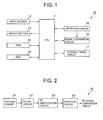
- FIG. 1 is a block diagram showing the configuration of the radio clock according to the present embodiment.
- the radio clock 10 comprises a central processing unit (CPU) 11, an input section 12, a display section 13, a read only memory (ROM) 14, a random access memory (RAM) 15, a reception circuit 16, an internal timing circuit 17, and a signal comparison circuit 18.
- CPU central processing unit
- ROM read only memory
- RAM random access memory
- the CPU 11 reads programs stored in the ROM 14 at a predetermined timing, or according to an operation signal input from the input section 12. Further, the CPU 11 expands the read programs in the RAM 15 to execute an instruction and data transmission to each section which configures the radio clock 10, based on the expanded programs. To put it concretely, for example, the CPU 11 controls the reception circuit 16 for every predetermined length of time so that the reception circuit 16 receives the standard time radio wave. Further, the CPU 11 specifies the sequence of the codes included in the standard time radio wave signal among digital data based on the signal obtained by the reception circuit 16, to execute processing of correcting the present time measured by the internal timing circuit 17 based on the specified sequence of the codes, and processing of transmitting the present time measured by the internal timing circuit 17 to the display section 13, and the like.
- estimated code data including predetermined codes, having 1 or more units of time length, is generated.
- the generated estimated code data is compared with input waveform data which is obtained from the standard time radio wave received by the reception circuit 16, thereby the values of the beginning of a second; the beginning of a minute; various codes including hour, minute, year/ month/ day, are specified.
- the year/ month/ day and the hour/ minute are specified, thereby errors in the internal timing circuit 17 are calculated, and the present time in the internal timing circuit 17 is corrected.
- the input section 12 comprises a switch to instruct an execution of various functions of the radio clock 10. When the switch is operated, the input section 12 outputs the corresponding operation signal to the CPU 11.
- the display section 13 comprises an analog gnomon mechanism which is controlled by a dial plate and CPU 11; and a liquid crystal panel, and displays the present time measured by the internal timing circuit 17.
- the ROM 14 stores system programs and application programs to operate the radio clock 10 and to realize predetermined functions.
- the programs to realize the predetermined functions include a program to control the signal comparison circuit 18 for detection processing of a second pulse; detection processing of a minute beginning position; and obtaining (decoding) processing of values indicating various codes, which will be described later.
- the RAM 15 is utilized as a working area of the CPU 11, and temporarily stores the programs and data read by the ROM 14, and data processed by the CPU 11.
- the reception circuit 16 comprises an antenna circuit and a detection circuit, and the like.
- the reception circuit 16 obtains a signal demodulated from the standard time radio wave received by the antenna circuit to output the obtained signal to the signal comparison circuit 18.
- the internal timing circuit 17 comprises an oscillation circuit and times the present time by measuring the clock signal output from the oscillation circuit so as to output the data of the measured present time to the CPU 11.
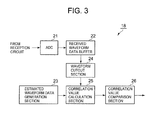
- FIG. 2 is a block diagram showing the configuration example of the reception circuit 16 according to the present embodiment.
- the reception circuit 16 comprises an antenna circuit 50 to receive the standard time radio wave; a filter circuit 51 to remove noises from a signal of the standard time radio wave (a standard time radio wave signal) received by the antenna circuit 50; an RF amplification circuit 52 to amplify a high-frequency signal which is the output of the filter circuit 51; and a detection circuit 53 to detect the signal output from the RF amplification circuit 52 and to demodulate the standard time radio wave signal.
- the signal demodulated by the detection circuit 53 is output to the signal comparison circuit 18.
- FIG. 3 is a block diagram showing the configuration of the signal comparison circuit 18 according to the present embodiment.
- the signal comparison circuit 18 according to the present embodiment comprises an AD converter (ADC) 21; a received waveform data buffer 22; an estimated waveform data generation section 23; a waveform cutout section 24; a correlation value calculation section 25; and a correlation value comparison section 26.
- ADC AD converter
- the ADC 21 converts the signal output from the reception circuit 16 to digital data, the value of which is described by a plurality of bits, so as to output the digital data at a predetermined sampling interval.
- the above mentioned sampling interval is 50 ms, and thereby data of 20 samples can be obtained per 1 second.
- the received waveform data buffer 22 sequentially stores the data.
- the received waveform data buffer 22 can store data of a plurality of unit of time length (1 second each) (for example, data of 10 units of time (10 seconds)), and when data is to be further stored, data is deleted in order from the old ones.
- the estimated waveform data generation section 23 generates estimated waveform data having a predetermined time length, to be an object of the comparison, which is used in each of the processing described later.
- the estimated waveform data which is generated in the estimated waveform data generation section 23 will be described in detail in each of the processing.
- the waveform cutout section 24 extracts the input waveform data having the time length which is the same as that of the estimated waveform data, from the received waveform data buffer 22.
- the correlation value calculation section 25 calculates the correlation value of each of the plurality of pieces of the estimated waveform data, and the input waveform data.
- the present embodiment employs a covariance value in order to obtain the correlation, as described later.
- the correlation value comparison section 26 compares the correlation values calculated by the correlation value calculation section 25 to specify the optimal value thereof.
- FIG. 4 is a flow chart showing the outline of the processing executed in the radio clock according to the present embodiment.
- the processing shown in FIG. 4 is executed mainly by the CPU 11 and the signal comparison circuit 18 based on the instruction of the CPU 11.
- the CPU 11 and the signal comparison circuit 18 detect the second pulse position (step 401).
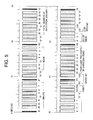
- FIG. 5 is a diagram illustrating the format of the standard time radio wave signal.
- the standard time radio wave signal is transmitted in a predetermined format.
- the codes indicating "P", “1", and “0" of a unit of time length of 1 second are in sequence.
- 60 seconds configure 1 frame, and 1 frame comprises 60 codes.
- position markers "P1", “P2", ..., or markers "M” arrive every 10 seconds.
- the code "P” has 20% of duty (in which the first 20% is of a high-level, and the remaining 80% is of a low-level); the code “1” has 50% of duty; and the code “0” has 80% of duty.
- the pieces of code data having duty 80% which correspond to the code "1" are continued by a predetermined number thereof, and a plurality of pieces of estimated waveform data in which each of the pieces of code data is shifted by 50 mn is generated, as will be described later.
- the correlation values of the plurality of pieces of estimated waveform data and the input waveform data are calculated, and the second pulse position (the beginning position of a second) is judged to be the timing at which the estimated waveform data indicating the optimal correlation value rises from a low-level to a high-level.
- step 402 the CPU 11, and the like, detect the beginning position of a minute, that is to say, the beginning position of the standard time radio wave signal of 1 frame, as mentioned above (step 402). Also in step 402, in the present embodiment, the estimated waveform data having 2 units of time length, in which 2 codes of "P" are continuous is generated, so as to calculate the correlation value of the estimated waveform data and the plurality of pieces of input waveform data. The processing in step 402 will also be described later.
- the CPU 11, and the like decode various codes (the code of a ones digit of a minute (M1), the code of a tens digit of a minute (M10), and other codes of day/ hour, day of week, and the like) of the standard time radio wave signal, based on the comparison of the estimated waveform data and the input waveform data (step 403-405).
- the decoding processing (which is the detection processing of the values) will also be described later.
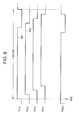
- FIG. 6 is a diagram exemplifying the portion of the estimated waveform data which is used in the second synchronization according to the present embodiment.
- a part for 1 second which corresponds to the first unit of time length of respective pieces of the estimated waveform data is described.
- the broken line indicated by the reference number 600 represents the beginning of the estimated waveform data.
- data having 4 units of time length in which 4 pieces of data having the code "0" of a unit of time length are continuous as shown in FIG. 6 is generated by the estimated waveform data generation section 23.
- 20 pieces of estimated waveform data P(1,j)-P(20,j) are generated by the estimated waveform generation section 23, in which each position of the beginning of the code "0" (where the rising from the low-level to the high-level arrives) is respectively shifted by 50 ms each.
- the first estimated code data P(1,j) rises from the low-level to the high-level at the beginning of the data (refer to reference number 600).
- the second estimated code data P(2,j) rises from the low-level to the high-level at a position where 50 ms lapsed from the beginning of the data.
- the rising positions from the low-level to the high-level of the third estimated code data P(3,j), the fourth estimated code data P(4,j), ..., are thereafter shifted further later by a position corresponding to 50 ms each.
- FIG. 7 is a flow chart showing the detection (the second synchronization) of the second pulse position in detail according to the present embodiment.
- FIG. 8 is a diagram schematically showing the detection processing of the second pulse position according to the present embodiment.
- the estimated waveform data generation section 23 generates 20 pieces of estimated waveform data P(1,j)-P(20,j) of 4 units of time length (4 seconds), in which each position of the beginning of the code "0" (where the rising from the low-level to the high-level arrives) is respectively shifted by 50 ms each, according to the instruction of the CPU 11 in the above described manner (step 701, reference number 801 in FIG. 8 ).
- the waveform cutout section 24 cuts out data of 4 units of time length (4 seconds) from the reception waveform data buffer 22, so as to generate input waveform data Sn(j), according to the instruction of the CPU 11 (step 702, reference number 800 in FIG. 8 ).
- Sn(j) is data including 80 samples.
- the waveform cutout section 24 may extract sample data sequentially in an order of Sn(1), Sn(2), ..., in a state where not all of the data of 4 units of time length is stored in the received waveform data buffer 22.
- the correlation value calculation section 25 calculates the covariance value C(p) according to the following formulae by using the input waveform data Sn(j), the mean value thereof Sm, the estimated waveform data P(p,j), and the mean value thereof Pm.
- the reference numbers 80-1 to 80-20 respectively indicate a covariance value calculation section.
- C(p) 1 / N ⁇ ⁇ ( Sn j ⁇ P p ⁇ j - Sm ⁇ Pm
- the correlation value calculation section 25 may calculate Sn(j) ⁇ P(p,j), and may repeat accumulating the multiplication results to the addition results.
- the correlation value calculation section 25 may calculate the mean value Sm to reduce Sm ⁇ Pm from the accumulation results.
- the correlation value comparison section 26 compares the correlation values C(1)-C(20), so as to detect the optimal value C(x) (in this case, the maximum value) (refer to step 704, reference number 81 in FIG. 8 ).
- the CPU 11 accepts the optimal value C(x) to judge whether the optimal value is valid or not (step 705).
- the covariance value is obtained from insufficient samples of population, although the C(x) indicating the maximum value among the obtained covariance values C(p) is supposed to be the waveform having the highest correlation, the obtained maximum value may appear by an accidental factor by some noises. In order to eliminate such cases, for example, a false detection may be avoided by providing the following judgment criteria in step 705.
- the judgment of validity is not limited to the above mentioned method.
- the mean value or the standard deviation of the correlation value even the local maximum value of the correlation value may be judged to be insignificant as long as it is less than the mean value.
- a general significance level for example, 5 %) in statistics may be used.
- the CPU 11 judges the beginning position of the code "0" indicating the optimal value C(x), that is to say, the rising position from the low-level to the high-level, to be the second pulse position (step 706).
- the CPU 11 stores the information pertaining to the second pulse position in the RAM 15.
- the second pulse position is used in the processing of detection of the minute beginning position, and the like, which will be described below.
- FIG. 9 is a flow chart showing the detection (the minute synchronization) of the minute beginning position in detail according to the present embodiment.
- the second pulse position (the beginning position of the second) has already been determined by the second synchronization. Further, as shown in FIG. 5 , before and after the minute beginning position (60 seconds and 1 second), the code "P" of duty 20% is continuous. Thus, in the minute synchronization, the estimated waveform data of 2 units of time length in a state where the code "P" of duty 20% is continuous is generated.
- 60 pieces of input waveform data of 2 units of time length (2 seconds), each of which starting from the second pulse position (the second beginning position), are generated.
- the correlation values are calculated from the estimated waveform data and the 60 pieces of input waveform data, respectively, so that 60 correlation values (covariance values) C(1)-C(60) can be obtained.
- the estimated waveform data generation section 23 generates the estimated waveform data P(j) of 2 units of time length in the state where the 2 pieces of code data of duty 20% is continuous, according to the instruction of the CPU 11 (step 901).
- the estimated waveform data (refer to reference number 1000) is in a state where 2 waveforms, in which the first 200 ms (20%) is of a high-level, and the remaining part is of a low-level in a unit of time length (1 second), are in sequence.
- a parameter "i" to specify the second beginning position is initialized, and the waveform cutout section 24 obtains the input waveform data Sn(i,j) of 2 units of time length (2 seconds) in the second beginning position from the received waveform data buffer 22, according to the instruction of the CPU 11 (step 903).
- the correlation value calculation section 25 calculates the correlation value (the covariance value) C(i) of the input waveform data Sn(i,j) and the estimated waveform data P(j) (step 904).
- the calculation of the covariance value is performed in the same manner as in the second synchronization processing, thus the description thereof is omitted.
- the CPU 11 judges whether the parameter "i" is 60 or not (step 905), and when it is judged to be No in step 905, the parameter "i" is incremented (step 906).
- the waveform cutout section 24 obtains the input waveform data Sn(i,j) of 2 units of time length (2 seconds) in the next second beginning position (that is to say, a position located after the second beginning position of the previous input waveform data by 20 samples), according to the instruction of the CPU 11.
- the covariance values are thereafter calculated for the newly obtained input waveform data Sn(i,j) and the estimated waveform data P(j).
- FIG. 10 is a diagram showing the outline of the input waveform data and the estimated waveform data in the detection processing of the minute beginning position according to the present embodiment.
- the input waveform data Sn(1,j) comprises data of 1001 and 1002 which is 2 units of time length from a certain second beginning position.
- the next input waveform data Sn(2,j) comprises data of 1002 and 1003 which is 2 units of time length from the next second beginning position.
- Sn(n-1,j) and Sn(n,j) are data in a state where the second beginning position is shifted by a unit of time length (1 second).
- the ending input waveform data Sn(60,j) comprises data of 1059 and 1060 which is 2 units of time length, and which is shifted from the beginning input waveform data Sn(1,j) by 59 seconds.
- the covariance values are calculated for the input waveform data S(1,j), S(2,j), S(3,j), ..., S(60,j), and the estimated waveform data, respectively.
- the estimated waveform data with which the covariance values are calculated from Sn(1,j), Sn(2,j), Sn(3,j), ..., Sn(60,j) is described as P(1,j), P(2,j), P(3,j), ..., P(60,j), for convenience of illustration, however the estimated waveform data actually has the same value P(j).
- the correlation value comparison section 26 compares the correlation values C(1)-C(60), so as to detect the optimal value C(x) (in this case, the maximum value) (step 907).
- the CPU 11 accepts the optimal value C(x) to judge whether the optimal value is valid or not (step 908).
- the judgment whether the optimal value is valid or not is also performed in the same manner as in the second synchronization processing (step 705 in FIG. 7 ).
- the process returns to step 902.
- the waveform cutout section 24 obtains another input waveform data which is different from the data used in the previous processing, stored in the received waveform buffer 22, according to the instruction of the CPU 11.
- step 908 the CPU 11 judges the beginning position of the second code "P", that is to say, the rising position from the second low-level to the high-level, in the input waveform data indicated by the optimal value C(x), to be the beginning position of a minute (step 909).
- the CPU 11 stores the information pertaining to the beginning position of a minute in the RAM 15.
- the decoding processing of the codes which configure the time code is described.
- positions of various codes such as year, day, day of week, hour, minute, and the like, in the time code are determined. Accordingly, codes included in the input signal waveform at a specific position are estimated, the correlation value (the covariance value) between the estimated waveform data based on the estimation and the input waveform data including the specific position of the input signal waveform is calculated. Further, the values indicating the codes such as year, day, day of week, hour, minute, and the like, included in the above mentioned time code can be determined from the values of the codes corresponding to the estimated waveform data, the correlation value of which was optimal.
- the ones digit of a minute comprises any one value of "0"-"9".
- this is described by a BCD code of 4 bits.
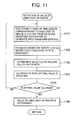
- FIG. 11 is a flow chart showing the decoding processing of the ones digit of a minute in detail according to the present embodiment.
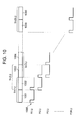
- FIG. 12 is a diagram schematically showing the above decoding processing.
- the waveform cutout section 24 cuts out data of 4 units of time length (4 seconds) located at a position corresponding to the ones digit of a minute, from the received waveform data buffer 22, to generate the input waveform data Sn(j), according to the instruction of the CPU 11 (step 1101, reference number 1200 in FIG. 12 ).
- the correlation value comparison section 26 compares the correlation values C(1)-C(10), so as to detect the optimal value C(x) (in this case, the maximum value) (step 1104).
- the CPU 11 accepts the optimal value C(x) to judge whether the optimal value is valid or not (step 1105).
- step 1105 the CPU 11 determines the value of the estimated code data indicating the optimal value C(x), to be the value of the ones digit of a minute (step 1106).
- the CPU 11 stores the value of the ones digit of a minute in the RAM 15.
- FIG. 13 is a flow chart showing the decoding processing of the ones digit of a minute in detail according to another embodiment of the present invention. In the example shown in FIG.
- the CPU 11 initializes the parameter "i" to specify the numbering of the input waveform data to "1" (step 1301). Subsequently, the waveform cutout section 24 cuts out data of 4 units of time length (4 seconds) located at a position corresponding to the ones digit of a minute, from the received waveform data buffer 22, to generate the input waveform data Si(j), according to the instruction of the CPU 11 (step 1302). Incidentally, the standard time radio wave is sequentially output from the reception circuit 16, and the output standard time radio wave is stored in the received waveform data buffer 22.
- the input waveform data Si(j) obtained in step 1302 which is executed at a certain processing timing is different from the input waveform data S(i+1) (j) obtained in step 1302 which is executed at the next processing timing, in that the difference in values indicating the ones digit of a minute is 1 second (the latter is larger than the former by "1").
- the estimated waveform data generation section 23 generates 10 pieces of estimated waveform data Pi(1,j)-Pi(10,j) having 4 units of time length (4 seconds), based on the parameter "i" according to the instruction of the CPU 11 (step 1303).
- FIG. 14 is a diagram illustrating the relationship between the input waveform data Si(j) and the estimated waveform data Pi(1,j)-Pi(10,j).
- the input waveform data S2(j) shows the value which appears 1 second later than that of the input waveform data S1(j).
- the input waveform data S3(j) shows the value which appears 1 second later than that of the input waveform data S2(j).
- the correlation value comparison section 26 compares the correlation values C(1)-C(10), so as to detect the optimal value C(x) (in this case, the maximum value) (step 1308).
- the CPU 11 accepts the optimal value C(x) to judge whether the optimal value is valid or not (step 1309).
- step 1309 the CPU 11 determines the value of the estimated code data indicating the optimal value C(x), to be the value of the ones digit of a minute (step 1310).
- the CPU 11 stores the value of the ones digit of a minute in the RAM 15.
- step 1309 the process returns to step 1301.
- the correlation values are calculated for a a plurality of pieces of input waveform data, and the corresponding correlation values (the covariance values) of input waveform data are accumulated, thereby the values (the mean values to be specific) are compared. Accordingly, one can handle a large number of samples of the input waveform data, thus can obtain suitable covariance values without depending on the quality of the signals.
- the tens digit of a minute takes the values from “0" to "5". In the time code, this is described by a BCD code of 3 bits. That is to say, minutes ranging from "0" to "59” are described by 3 bits of the tens digit and 4 bits of the ones digit.
- the waveform cutout section 24 cuts out data of 3 units of time length (3 seconds) located at a position corresponding to the tens digit of a minute from the reception waveform data buffer 22, so as to generate input waveform data Sn(j), according to the instruction of the CPU 11. Further, in step 1102 of FIG. 11 , the estimated waveform data P(1,j)-P(10,j) each indicating "0"-"9" is generated. On the other hand, in the processing to detect the value of tens digit of a minute, the estimated waveform data generation section 23 may generate the estimated waveform data P(1,j)-P(6,j) each indicating "0"-"5". Further, the data length of the estimated waveform data is 3 units of time length (3 seconds).
- a plurality of pieces of input waveform data may be used to realize a further suitable matching by the accumulation effect.
- the tens digit of a minute is incremented every 10 minutes. Accordingly, by obtaining the input waveform data in a range where the tens digit of a minute does not change, the same estimated waveform data can be used during the detection processing of the tens digit of a minute.
- FIG. 15 is a flow chart showing the detection processing of the tens digit of a minute in detail according to another embodiment of the present invention.
- the estimated waveform data generation section 23 generates 6 pieces of estimated waveform data P(1,j)-P(6,j) having 3 units of time length (3 seconds), according to the instruction of the CPU 11 (step 1501).
- the CPU 11 initializes the parameter "i" to specify the numbering of the input waveform data to "1" (step 1502). Subsequently, the waveform cutout section 24 cuts out data of 3 units of time length (3 seconds) located at a position corresponding to the tens digit of a minute, from the received waveform data buffer 22, to generate the input waveform data Si(j), according to the instruction of the CPU 11 (step 1503). In step 1503 which is to be executed for the first time, the data at which the value of the ones digit is "0" is obtained. Thereby, when K ⁇ 10 is satisfied, the same estimated waveform data P(1,j)-P(6,j) can be used while steps 1503-1506 are repeated.
- Steps 1507-1509 are performed in the same manner as steps 1307-1309 in FIG. 13 .
- the process is returned to step 1502.
- the CPU 11 determines the value of the estimated code data indicating the optimal value C(x), to be the value of the tens digit of a minute (step 1510).
- the CPU 11 stores the value of the tens digit of a minute in the RAM 15.
- the values of the ones digit and the tens digit of an hour can also be specified in almost the same manner as those of the tens digit of a minute.
- the estimated waveform data generation section 23 When the value of the ones digit of an hour is detected, the estimated waveform data generation section 23 generates the estimated waveform data P(1,j)-P(10,j) having 4 units of time length, and when the value of the tens digit of an hour is detected, the estimated waveform data generation section 23 generates the estimated waveform data P(1,j)-P(3,j) having 2 units of time length, each indicating "0"-"2".
- the values of other codes can also be obtained by specifying the values for each digit.
- the value of the day of the week can also be obtained by specifying either one of the values ranging from "0" to "6".
- the CPU 11 can obtain the accurate present time. Incidentally, the normal present time is to be practically obtained at the timing when the decoding of a minute and an hour is completed.
- the CPU 11 corrects the present time internally timed by the internal timing circuit 17 based on the accurate present time obtained by the decoding.
- the corrected present time is displayed by the display section 13.
- the waveform cutout section 24 when the second synchronization point is detected, the waveform cutout section 24 generates the input waveform data having 4 units of time length, based on data having a unit of time length, wherein the data is a value which is described by each sample point being described by a plurality of bits, and the unit of time length is a time corresponding to one code configuring the time code. Further, the estimated waveform data generation section 23 generates a plurality of pieces of estimated waveform data having the same time length (4 units of time length) as the input waveform data, in which data corresponding to the code "0" configuring the time code is in sequence, and the waveform thereof is sequentially shifted by 1 sample, respectively.
- the correlation calculation section 25 calculates the correlation values (the covariance values) between the input waveform data and the plurality of pieces of estimated waveform data, respectively, and the correlation value comparison section 26 compares the calculated correlation values to calculate the optimal values thereof.
- the CPU 11 detects the second beginning position (the second synchronization point) based on the estimated waveform data indicating the optimal values.
- the second synchronization point can suitably be detected even in a state where the electric intensity is weak or many noises are contained in the signal. Further, by performing the comparison with the estimated waveform data in which the second beginning position is shifted, the processing time can be reduced.
- the position where the value corresponding to a low-level is shifted to a value corresponding to a high-level is determined to be the beginning position of a second in the time code.
- the beginning position of a second can suitably be determined without depending on the form of the input waveform data which is likely to be influenced by the noises, and the like.
- the waveform cutout section 24 when the beginning position of a minute is detected, the waveform cutout section 24 generates 60 pieces of input waveform data having 2 units of time length, each starting from the beginning position of a second, respectively.
- the estimated waveform data generation section 23 generates the estimated waveform data having the 2 units of time length which is the same as that of the input waveform data, in which the waveform thereof contains a vicinity of the beginning position of a minute in the time code, that is to say, the continuous codes "P".
- the correlation values of each of the plurality of pieces of the input waveform data and the estimated waveform data are calculated.
- 60 pieces of input waveform data is generated from the beginning positions of each second among 60 seconds, and each thereof is compared with the estimated waveform data, thereby the beginning positions of a minute can be specified with significant accuracy.
- the waveform data cutout section 24 when the codes which configure the time code is decoded, the waveform data cutout section 24 generates input waveform data having 1 or more units of time length, which includes 1 or more codes to indicate a value configuring any one of a year, a month, a day, an hour, and a minute in the time code. For example, when the ones digit of a minute is to be decoded, the input waveform data having 4 units of time length is generated, and when the tens digit of a minute is to be decoded, the input waveform data having 3 units of time length is generated.
- the estimated waveform data generation section 23 generates a plurality of pieces of estimated waveform data each having the same time length as that of the input waveform data, and each of which indicates the possible value of the input waveform data. For example, when the ones digit of a minute is to be decoded, 10 pieces of estimated waveform data having 4 units of time length and which indicate either one value ranging from “0" to "9" are generated. Further, when the tens digit of a minute is to be decoded, 6 pieces of estimated waveform data having 3 units of time length and which indicate either one value ranging from "0" to "5" are generated.
- the correlation values between the input waveform data and the plurality of pieces of estimated waveform data are compared, thus the value of the estimated waveform data indicating the optimal correlation value can be specified. That is to say, the value can be quickly specified by using a pattern matching even in the decoding of the codes configuring the time code.
- the value which indicates the codes more accurately can be specified.
- the values of ones digit of a minute in the time code are respectively increased, as the estimated waveform data at the occasion of the repetition. This is because the ones digit of a minute is increased by "1" when the processing is repeated. Accordingly, by also increasing the values of the estimated waveform data, the suitable matching can be realized.
- the waveform rises from a low-level to a high-level at a beginning position of a second of the standard time radio wave signal (a second synchronization point). Accordingly, the position having the form thereof is specified to be the second synchronization point.
- the present invention is of course also applicable in a case where the beginning position of a second falls from a high-level to a low-level.
- the input waveform data may be generated for a plurality of times, and the correlation values (the covariance values) may be calculated between the input waveform data and the plurality of pieces of estimated waveform data, respectively. Further, the correlation values of the relevant estimated waveform data (the same estimated waveform data) may be accumulated, so as to eventually refer to the accumulated correlation values, thereby the optimal values may be detected.
- the input waveform data may be generated for a plurality of times, and the correlation values (the covariance values) may be calculated between the input waveform data and the plurality of pieces of estimated waveform data, respectively. Further, the correlation values of the relevant estimated waveform data (the same estimated waveform data) may be accumulated, so as to eventually refer to the accumulated correlation values, thereby the optimal values may be detected.
- the estimated waveform data in which 4 pieces of data of the code "0" is in sequence is generated, among the codes which configure the standard time radio wave signal in Japan. This is because the code "0" has the highest probability of being included in the time code.
- the estimated waveform data to be generated is not particularly limited to this, and estimated waveform data in which data of the code "1" is in sequence may be generated.
- the data length of the time length of the estimated waveform data is not particularly limited to 4 units of time length, and it may be longer or shorter.
- the estimated waveform data in which 2 codes "p" are in sequence is generated.
- the estimated waveform data to be generated is not particularly limited to this.
- the estimated waveform data may include the code having another form.
- the covariance value is used as the correlation value, however, the correlation value is not particularly limited to this.
- a residual which is the summation of an absolute value of a difference may be used as the correlation value.
- a mutual correlation coefficient may be used instead of the covariance value or the residual.
Landscapes
- Physics & Mathematics (AREA)
- General Physics & Mathematics (AREA)
- Electric Clocks (AREA)
- Electromechanical Clocks (AREA)
Applications Claiming Priority (1)
| Application Number | Priority Date | Filing Date | Title |
|---|---|---|---|
| JP2008185515A JP4544351B2 (ja) | 2008-07-17 | 2008-07-17 | 時刻情報取得装置、および、電波時計 |
Publications (3)
| Publication Number | Publication Date |
|---|---|
| EP2146257A2 true EP2146257A2 (fr) | 2010-01-20 |
| EP2146257A3 EP2146257A3 (fr) | 2010-11-03 |
| EP2146257B1 EP2146257B1 (fr) | 2013-01-09 |
Family
ID=41263973
Family Applications (1)
| Application Number | Title | Priority Date | Filing Date |
|---|---|---|---|
| EP20090164359 Active EP2146257B1 (fr) | 2008-07-17 | 2009-07-02 | Dispositif d'obtention d'informations temporelles et montre radio contrôlée |
Country Status (4)
| Country | Link |
|---|---|
| US (1) | US8310900B2 (fr) |
| EP (1) | EP2146257B1 (fr) |
| JP (1) | JP4544351B2 (fr) |
| CN (1) | CN101630142B (fr) |
Cited By (1)
| Publication number | Priority date | Publication date | Assignee | Title |
|---|---|---|---|---|
| EP2323002A3 (fr) * | 2009-09-25 | 2011-10-26 | Casio Computer Co., Ltd. | Appareil d'acquisition d'informations temporelles et montre radio-contrôlée |
Families Citing this family (8)
| Publication number | Priority date | Publication date | Assignee | Title |
|---|---|---|---|---|
| JP4835739B2 (ja) * | 2009-09-29 | 2011-12-14 | カシオ計算機株式会社 | 時刻情報取得装置、および、電波時計 |
| US8446800B2 (en) * | 2010-04-16 | 2013-05-21 | Casio Computer Co., Ltd | Time information acquisition apparatus and radio wave timepiece |
| JP5067452B2 (ja) | 2010-07-06 | 2012-11-07 | カシオ計算機株式会社 | 時刻情報取得装置および電波時計 |
| JP5104922B2 (ja) * | 2010-07-27 | 2012-12-19 | カシオ計算機株式会社 | 時刻情報取得装置および電波時計 |
| JP5263270B2 (ja) * | 2010-11-26 | 2013-08-14 | カシオ計算機株式会社 | 時刻情報取得装置、および、電波時計 |
| JP5821324B2 (ja) * | 2011-06-24 | 2015-11-24 | 富士通株式会社 | 時刻誤差検出装置および方法 |
| JP2017151036A (ja) * | 2016-02-26 | 2017-08-31 | セイコーエプソン株式会社 | 時刻情報受信装置、電波修正時計およびタイムコード種別判定方法 |
| JP6803241B2 (ja) * | 2017-01-13 | 2020-12-23 | アズビル株式会社 | 時系列データ処理装置および処理方法 |
Citations (2)
| Publication number | Priority date | Publication date | Assignee | Title |
|---|---|---|---|---|
| US20050019569A1 (en) | 2003-07-25 | 2005-01-27 | Weyerhaeuser Company | Glyoxal crosslinked cellulosic fibers having improved brightness and color |
| US20050195690A1 (en) | 2004-03-05 | 2005-09-08 | Oki Electric Industry Co., Ltd. | Standard time signal receiving time device and decoding method of time code signal |
Family Cites Families (14)
| Publication number | Priority date | Publication date | Assignee | Title |
|---|---|---|---|---|
| US1422384A (en) * | 1921-09-06 | 1922-07-11 | Cassius M Garrison | Power propulsion device |
| US5133064A (en) * | 1987-04-27 | 1992-07-21 | Hitachi, Ltd. | Data processing system generating clock signal from an input clock, phase locked to the input clock and used for clocking logic devices |
| JP2725896B2 (ja) * | 1991-01-29 | 1998-03-11 | 三菱電機株式会社 | ユニークワード検出装置 |
| JP3079198B2 (ja) * | 1993-03-04 | 2000-08-21 | セイコークロック株式会社 | 電波修正時計 |
| US6346911B1 (en) | 2000-03-30 | 2002-02-12 | Motorola, Inc. | Method and apparatus for determining time in a GPS receiver |
| JP3523159B2 (ja) * | 2000-07-31 | 2004-04-26 | リズム時計工業株式会社 | 電波修正時計及びその秒信号検出方法 |
| JP3905763B2 (ja) * | 2002-01-22 | 2007-04-18 | ジェコー株式会社 | 標準電波デコード回路及びそれを用いた電波時計 |
| DE10361593A1 (de) * | 2003-12-30 | 2005-07-28 | Atmel Germany Gmbh | Verfahren zur Bestimmung des Sekundenbeginns aus einem gesendeten Zeitzeichensignal |
| JP4264496B2 (ja) * | 2004-08-31 | 2009-05-20 | Okiセミコンダクタ株式会社 | 標準電波受信装置及びタイムコード復号方法 |
| US7411870B2 (en) * | 2004-09-30 | 2008-08-12 | Casio Computer Co., Ltd. | Radio-wave timepieces and time information receivers |
| JP2006177927A (ja) * | 2004-11-25 | 2006-07-06 | Seiko Instruments Inc | 電波修正時計 |
| JP2007139703A (ja) * | 2005-11-22 | 2007-06-07 | Casio Comput Co Ltd | 時刻受信装置及び電波時計 |
| JP4882610B2 (ja) * | 2005-12-20 | 2012-02-22 | セイコーエプソン株式会社 | 電波修正時計および電波修正時計の時刻修正方法 |
| US7903501B2 (en) * | 2007-07-10 | 2011-03-08 | Seiko Epson Corporation | Radio-controlled timepiece and control method for a radio-controlled timepiece |
-
2008
- 2008-07-17 JP JP2008185515A patent/JP4544351B2/ja active Active
-
2009
- 2009-07-02 EP EP20090164359 patent/EP2146257B1/fr active Active
- 2009-07-08 US US12/499,240 patent/US8310900B2/en active Active
- 2009-07-15 CN CN2009101517777A patent/CN101630142B/zh active Active
Patent Citations (2)
| Publication number | Priority date | Publication date | Assignee | Title |
|---|---|---|---|---|
| US20050019569A1 (en) | 2003-07-25 | 2005-01-27 | Weyerhaeuser Company | Glyoxal crosslinked cellulosic fibers having improved brightness and color |
| US20050195690A1 (en) | 2004-03-05 | 2005-09-08 | Oki Electric Industry Co., Ltd. | Standard time signal receiving time device and decoding method of time code signal |
Cited By (2)
| Publication number | Priority date | Publication date | Assignee | Title |
|---|---|---|---|---|
| EP2323002A3 (fr) * | 2009-09-25 | 2011-10-26 | Casio Computer Co., Ltd. | Appareil d'acquisition d'informations temporelles et montre radio-contrôlée |
| US8264915B2 (en) | 2009-09-25 | 2012-09-11 | Casio Computer Co., Ltd | Time information-acquiring apparatus and radio wave timepiece |
Also Published As
| Publication number | Publication date |
|---|---|
| CN101630142B (zh) | 2011-11-09 |
| EP2146257B1 (fr) | 2013-01-09 |
| US8310900B2 (en) | 2012-11-13 |
| JP2010025651A (ja) | 2010-02-04 |
| US20100014388A1 (en) | 2010-01-21 |
| CN101630142A (zh) | 2010-01-20 |
| EP2146257A3 (fr) | 2010-11-03 |
| JP4544351B2 (ja) | 2010-09-15 |
Similar Documents
| Publication | Publication Date | Title |
|---|---|---|
| EP2146257B1 (fr) | Dispositif d'obtention d'informations temporelles et montre radio contrôlée | |
| US7428190B2 (en) | Time reception apparatus and wave clock | |
| US8000173B2 (en) | Time correcting apparatus and radio controlled timepiece | |
| US8264915B2 (en) | Time information-acquiring apparatus and radio wave timepiece | |
| CN101794113B (zh) | 时刻信息取得装置以及电波表 | |
| JP4544347B2 (ja) | 時刻情報取得装置および電波時計 | |
| JP2012112857A (ja) | 時刻情報取得装置、および、電波時計 | |
| JP4905536B2 (ja) | 時刻情報取得装置、および、電波時計 | |
| US8379490B2 (en) | Time information-acquiring apparatus and radio wave timepiece | |
| JP4678057B2 (ja) | 時刻情報受信装置、電波時計およびプログラム | |
| JP5316375B2 (ja) | 時刻情報取得装置、および、電波時計 | |
| JP5408025B2 (ja) | 時刻情報取得装置、および、電波時計 | |
| JP4905531B2 (ja) | 時刻情報取得装置、および、電波時計 | |
| JP5353108B2 (ja) | 時刻受信装置、電波修正時計および時刻受信装置の制御方法 | |
| JP4905523B2 (ja) | 時刻情報取得装置、および、電波時計 | |
| JP5012947B2 (ja) | 時刻情報取得装置、および、電波時計 | |
| JP5407705B2 (ja) | 時刻情報取得装置、および、電波時計 | |
| JP5382243B2 (ja) | 時刻受信装置、電波修正時計および時刻受信装置の制御方法 | |
| JP2011226849A (ja) | 時刻情報取得装置、および、電波時計 |
Legal Events
| Date | Code | Title | Description |
|---|---|---|---|
| PUAI | Public reference made under article 153(3) epc to a published international application that has entered the european phase |
Free format text: ORIGINAL CODE: 0009012 |
|
| 17P | Request for examination filed |
Effective date: 20090702 |
|
| AK | Designated contracting states |
Kind code of ref document: A2 Designated state(s): AT BE BG CH CY CZ DE DK EE ES FI FR GB GR HR HU IE IS IT LI LT LU LV MC MK MT NL NO PL PT RO SE SI SK SM TR |
|
| PUAL | Search report despatched |
Free format text: ORIGINAL CODE: 0009013 |
|
| AK | Designated contracting states |
Kind code of ref document: A3 Designated state(s): AT BE BG CH CY CZ DE DK EE ES FI FR GB GR HR HU IE IS IT LI LT LU LV MC MK MT NL NO PL PT RO SE SI SK SM TR |
|
| GRAP | Despatch of communication of intention to grant a patent |
Free format text: ORIGINAL CODE: EPIDOSNIGR1 |
|
| RIN1 | Information on inventor provided before grant (corrected) |
Inventor name: ABE, HIDEO |
|
| GRAS | Grant fee paid |
Free format text: ORIGINAL CODE: EPIDOSNIGR3 |
|
| GRAA | (expected) grant |
Free format text: ORIGINAL CODE: 0009210 |
|
| AK | Designated contracting states |
Kind code of ref document: B1 Designated state(s): AT BE BG CH CY CZ DE DK EE ES FI FR GB GR HR HU IE IS IT LI LT LU LV MC MK MT NL NO PL PT RO SE SI SK SM TR |
|
| REG | Reference to a national code |
Ref country code: GB Ref legal event code: FG4D |
|
| REG | Reference to a national code |
Ref country code: AT Ref legal event code: REF Ref document number: 593103 Country of ref document: AT Kind code of ref document: T Effective date: 20130115 Ref country code: CH Ref legal event code: EP |
|
| REG | Reference to a national code |
Ref country code: IE Ref legal event code: FG4D |
|
| REG | Reference to a national code |
Ref country code: DE Ref legal event code: R096 Ref document number: 602009012602 Country of ref document: DE Effective date: 20130307 |
|
| PG25 | Lapsed in a contracting state [announced via postgrant information from national office to epo] |
Ref country code: SI Free format text: LAPSE BECAUSE OF FAILURE TO SUBMIT A TRANSLATION OF THE DESCRIPTION OR TO PAY THE FEE WITHIN THE PRESCRIBED TIME-LIMIT Effective date: 20130109 |
|
| REG | Reference to a national code |
Ref country code: NL Ref legal event code: VDEP Effective date: 20130109 |
|
| REG | Reference to a national code |
Ref country code: AT Ref legal event code: MK05 Ref document number: 593103 Country of ref document: AT Kind code of ref document: T Effective date: 20130109 |
|
| REG | Reference to a national code |
Ref country code: LT Ref legal event code: MG4D |
|
| PG25 | Lapsed in a contracting state [announced via postgrant information from national office to epo] |
Ref country code: BE Free format text: LAPSE BECAUSE OF FAILURE TO SUBMIT A TRANSLATION OF THE DESCRIPTION OR TO PAY THE FEE WITHIN THE PRESCRIBED TIME-LIMIT Effective date: 20130109 Ref country code: BG Free format text: LAPSE BECAUSE OF FAILURE TO SUBMIT A TRANSLATION OF THE DESCRIPTION OR TO PAY THE FEE WITHIN THE PRESCRIBED TIME-LIMIT Effective date: 20130409 Ref country code: NO Free format text: LAPSE BECAUSE OF FAILURE TO SUBMIT A TRANSLATION OF THE DESCRIPTION OR TO PAY THE FEE WITHIN THE PRESCRIBED TIME-LIMIT Effective date: 20130409 Ref country code: AT Free format text: LAPSE BECAUSE OF FAILURE TO SUBMIT A TRANSLATION OF THE DESCRIPTION OR TO PAY THE FEE WITHIN THE PRESCRIBED TIME-LIMIT Effective date: 20130109 Ref country code: SE Free format text: LAPSE BECAUSE OF FAILURE TO SUBMIT A TRANSLATION OF THE DESCRIPTION OR TO PAY THE FEE WITHIN THE PRESCRIBED TIME-LIMIT Effective date: 20130109 Ref country code: ES Free format text: LAPSE BECAUSE OF FAILURE TO SUBMIT A TRANSLATION OF THE DESCRIPTION OR TO PAY THE FEE WITHIN THE PRESCRIBED TIME-LIMIT Effective date: 20130420 Ref country code: LT Free format text: LAPSE BECAUSE OF FAILURE TO SUBMIT A TRANSLATION OF THE DESCRIPTION OR TO PAY THE FEE WITHIN THE PRESCRIBED TIME-LIMIT Effective date: 20130109 Ref country code: IS Free format text: LAPSE BECAUSE OF FAILURE TO SUBMIT A TRANSLATION OF THE DESCRIPTION OR TO PAY THE FEE WITHIN THE PRESCRIBED TIME-LIMIT Effective date: 20130509 |
|
| PG25 | Lapsed in a contracting state [announced via postgrant information from national office to epo] |
Ref country code: PL Free format text: LAPSE BECAUSE OF FAILURE TO SUBMIT A TRANSLATION OF THE DESCRIPTION OR TO PAY THE FEE WITHIN THE PRESCRIBED TIME-LIMIT Effective date: 20130109 Ref country code: PT Free format text: LAPSE BECAUSE OF FAILURE TO SUBMIT A TRANSLATION OF THE DESCRIPTION OR TO PAY THE FEE WITHIN THE PRESCRIBED TIME-LIMIT Effective date: 20130509 Ref country code: LV Free format text: LAPSE BECAUSE OF FAILURE TO SUBMIT A TRANSLATION OF THE DESCRIPTION OR TO PAY THE FEE WITHIN THE PRESCRIBED TIME-LIMIT Effective date: 20130109 Ref country code: NL Free format text: LAPSE BECAUSE OF FAILURE TO SUBMIT A TRANSLATION OF THE DESCRIPTION OR TO PAY THE FEE WITHIN THE PRESCRIBED TIME-LIMIT Effective date: 20130109 Ref country code: GR Free format text: LAPSE BECAUSE OF FAILURE TO SUBMIT A TRANSLATION OF THE DESCRIPTION OR TO PAY THE FEE WITHIN THE PRESCRIBED TIME-LIMIT Effective date: 20130410 Ref country code: FI Free format text: LAPSE BECAUSE OF FAILURE TO SUBMIT A TRANSLATION OF THE DESCRIPTION OR TO PAY THE FEE WITHIN THE PRESCRIBED TIME-LIMIT Effective date: 20130109 |
|
| PG25 | Lapsed in a contracting state [announced via postgrant information from national office to epo] |
Ref country code: HR Free format text: LAPSE BECAUSE OF FAILURE TO SUBMIT A TRANSLATION OF THE DESCRIPTION OR TO PAY THE FEE WITHIN THE PRESCRIBED TIME-LIMIT Effective date: 20130109 |
|
| PG25 | Lapsed in a contracting state [announced via postgrant information from national office to epo] |
Ref country code: RO Free format text: LAPSE BECAUSE OF FAILURE TO SUBMIT A TRANSLATION OF THE DESCRIPTION OR TO PAY THE FEE WITHIN THE PRESCRIBED TIME-LIMIT Effective date: 20130109 Ref country code: EE Free format text: LAPSE BECAUSE OF FAILURE TO SUBMIT A TRANSLATION OF THE DESCRIPTION OR TO PAY THE FEE WITHIN THE PRESCRIBED TIME-LIMIT Effective date: 20130109 Ref country code: SK Free format text: LAPSE BECAUSE OF FAILURE TO SUBMIT A TRANSLATION OF THE DESCRIPTION OR TO PAY THE FEE WITHIN THE PRESCRIBED TIME-LIMIT Effective date: 20130109 Ref country code: DK Free format text: LAPSE BECAUSE OF FAILURE TO SUBMIT A TRANSLATION OF THE DESCRIPTION OR TO PAY THE FEE WITHIN THE PRESCRIBED TIME-LIMIT Effective date: 20130109 Ref country code: CZ Free format text: LAPSE BECAUSE OF FAILURE TO SUBMIT A TRANSLATION OF THE DESCRIPTION OR TO PAY THE FEE WITHIN THE PRESCRIBED TIME-LIMIT Effective date: 20130109 |
|
| PLBE | No opposition filed within time limit |
Free format text: ORIGINAL CODE: 0009261 |
|
| STAA | Information on the status of an ep patent application or granted ep patent |
Free format text: STATUS: NO OPPOSITION FILED WITHIN TIME LIMIT |
|
| PG25 | Lapsed in a contracting state [announced via postgrant information from national office to epo] |
Ref country code: CY Free format text: LAPSE BECAUSE OF FAILURE TO SUBMIT A TRANSLATION OF THE DESCRIPTION OR TO PAY THE FEE WITHIN THE PRESCRIBED TIME-LIMIT Effective date: 20130109 |
|
| 26N | No opposition filed |
Effective date: 20131010 |
|
| PG25 | Lapsed in a contracting state [announced via postgrant information from national office to epo] |
Ref country code: IT Free format text: LAPSE BECAUSE OF FAILURE TO SUBMIT A TRANSLATION OF THE DESCRIPTION OR TO PAY THE FEE WITHIN THE PRESCRIBED TIME-LIMIT Effective date: 20130109 |
|
| REG | Reference to a national code |
Ref country code: DE Ref legal event code: R097 Ref document number: 602009012602 Country of ref document: DE Effective date: 20131010 |
|
| PG25 | Lapsed in a contracting state [announced via postgrant information from national office to epo] |
Ref country code: MC Free format text: LAPSE BECAUSE OF FAILURE TO SUBMIT A TRANSLATION OF THE DESCRIPTION OR TO PAY THE FEE WITHIN THE PRESCRIBED TIME-LIMIT Effective date: 20130109 |
|
| REG | Reference to a national code |
Ref country code: CH Ref legal event code: PL |
|
| REG | Reference to a national code |
Ref country code: IE Ref legal event code: MM4A |
|
| PG25 | Lapsed in a contracting state [announced via postgrant information from national office to epo] |
Ref country code: CH Free format text: LAPSE BECAUSE OF NON-PAYMENT OF DUE FEES Effective date: 20130731 Ref country code: LI Free format text: LAPSE BECAUSE OF NON-PAYMENT OF DUE FEES Effective date: 20130731 |
|
| PG25 | Lapsed in a contracting state [announced via postgrant information from national office to epo] |
Ref country code: IE Free format text: LAPSE BECAUSE OF NON-PAYMENT OF DUE FEES Effective date: 20130702 |
|
| PG25 | Lapsed in a contracting state [announced via postgrant information from national office to epo] |
Ref country code: SM Free format text: LAPSE BECAUSE OF FAILURE TO SUBMIT A TRANSLATION OF THE DESCRIPTION OR TO PAY THE FEE WITHIN THE PRESCRIBED TIME-LIMIT Effective date: 20130109 |
|
| PG25 | Lapsed in a contracting state [announced via postgrant information from national office to epo] |
Ref country code: TR Free format text: LAPSE BECAUSE OF FAILURE TO SUBMIT A TRANSLATION OF THE DESCRIPTION OR TO PAY THE FEE WITHIN THE PRESCRIBED TIME-LIMIT Effective date: 20130109 Ref country code: MT Free format text: LAPSE BECAUSE OF FAILURE TO SUBMIT A TRANSLATION OF THE DESCRIPTION OR TO PAY THE FEE WITHIN THE PRESCRIBED TIME-LIMIT Effective date: 20130109 |
|
| PG25 | Lapsed in a contracting state [announced via postgrant information from national office to epo] |
Ref country code: LU Free format text: LAPSE BECAUSE OF NON-PAYMENT OF DUE FEES Effective date: 20130702 Ref country code: MK Free format text: LAPSE BECAUSE OF FAILURE TO SUBMIT A TRANSLATION OF THE DESCRIPTION OR TO PAY THE FEE WITHIN THE PRESCRIBED TIME-LIMIT Effective date: 20130109 Ref country code: HU Free format text: LAPSE BECAUSE OF FAILURE TO SUBMIT A TRANSLATION OF THE DESCRIPTION OR TO PAY THE FEE WITHIN THE PRESCRIBED TIME-LIMIT; INVALID AB INITIO Effective date: 20090702 |
|
| REG | Reference to a national code |
Ref country code: FR Ref legal event code: PLFP Year of fee payment: 8 |
|
| REG | Reference to a national code |
Ref country code: FR Ref legal event code: PLFP Year of fee payment: 9 |
|
| REG | Reference to a national code |
Ref country code: FR Ref legal event code: PLFP Year of fee payment: 10 |
|
| PGFP | Annual fee paid to national office [announced via postgrant information from national office to epo] |
Ref country code: GB Payment date: 20250529 Year of fee payment: 17 |
|
| PGFP | Annual fee paid to national office [announced via postgrant information from national office to epo] |
Ref country code: FR Payment date: 20250610 Year of fee payment: 17 |
|
| PGFP | Annual fee paid to national office [announced via postgrant information from national office to epo] |
Ref country code: DE Payment date: 20250528 Year of fee payment: 17 |