EP2146272A1 - Conversion d'une session Remote Desktop Protocol et affichage de la session sur plusieurs écrans - Google Patents
Conversion d'une session Remote Desktop Protocol et affichage de la session sur plusieurs écrans Download PDFInfo
- Publication number
- EP2146272A1 EP2146272A1 EP08012870A EP08012870A EP2146272A1 EP 2146272 A1 EP2146272 A1 EP 2146272A1 EP 08012870 A EP08012870 A EP 08012870A EP 08012870 A EP08012870 A EP 08012870A EP 2146272 A1 EP2146272 A1 EP 2146272A1
- Authority
- EP
- European Patent Office
- Prior art keywords
- arithmetic unit
- client
- server
- rdp
- unit
- Prior art date
- Legal status (The legal status is an assumption and is not a legal conclusion. Google has not performed a legal analysis and makes no representation as to the accuracy of the status listed.)
- Withdrawn
Links
- 238000006243 chemical reaction Methods 0.000 title 1
- 238000000034 method Methods 0.000 claims abstract description 26
- 238000005516 engineering process Methods 0.000 claims abstract description 12
- 238000012545 processing Methods 0.000 claims description 45
- 238000004801 process automation Methods 0.000 description 6
- 230000006870 function Effects 0.000 description 4
- 239000000126 substance Substances 0.000 description 4
- 238000013461 design Methods 0.000 description 2
- 238000011161 development Methods 0.000 description 2
- 230000018109 developmental process Effects 0.000 description 2
- 230000002452 interceptive effect Effects 0.000 description 2
- 230000005540 biological transmission Effects 0.000 description 1
- 238000004891 communication Methods 0.000 description 1
- 230000001419 dependent effect Effects 0.000 description 1
- 238000004880 explosion Methods 0.000 description 1
- 239000012530 fluid Substances 0.000 description 1
- 230000010365 information processing Effects 0.000 description 1
- 239000013589 supplement Substances 0.000 description 1
- 238000012546 transfer Methods 0.000 description 1
- 238000012800 visualization Methods 0.000 description 1
Images


Classifications
-
- H—ELECTRICITY
- H04—ELECTRIC COMMUNICATION TECHNIQUE
- H04L—TRANSMISSION OF DIGITAL INFORMATION, e.g. TELEGRAPHIC COMMUNICATION
- H04L67/00—Network arrangements or protocols for supporting network services or applications
- H04L67/01—Protocols
- H04L67/08—Protocols specially adapted for terminal emulation, e.g. Telnet
-
- H—ELECTRICITY
- H04—ELECTRIC COMMUNICATION TECHNIQUE
- H04L—TRANSMISSION OF DIGITAL INFORMATION, e.g. TELEGRAPHIC COMMUNICATION
- H04L67/00—Network arrangements or protocols for supporting network services or applications
- H04L67/01—Protocols
- H04L67/12—Protocols specially adapted for proprietary or special-purpose networking environments, e.g. medical networks, sensor networks, networks in vehicles or remote metering networks
-
- H—ELECTRICITY
- H04—ELECTRIC COMMUNICATION TECHNIQUE
- H04L—TRANSMISSION OF DIGITAL INFORMATION, e.g. TELEGRAPHIC COMMUNICATION
- H04L69/00—Network arrangements, protocols or services independent of the application payload and not provided for in the other groups of this subclass
- H04L69/08—Protocols for interworking; Protocol conversion
Definitions
- the present invention relates in a first aspect to a computer network according to the preamble of claim 1.
- the invention relates to a method of operating a computer network according to the preamble of claim 9.
- Generic computer networks have a first, a second and a third arithmetic unit.
- An information technology network is provided, via which a data exchange is possible, at least between the first and the second and between the second and the third arithmetic unit.
- the first processor has an RDP server installed.
- the second processor runs an RDP client.
- the first and the second arithmetic unit are designed so that they allow a structure and the operation of an RDP-compliant first client-server connection.
- the Remote Desktop Protocol hereafter called RDP
- RDP is a well-known way to implement terminal services.
- at least two arithmetic units which can also be referred to as systems, must be provided.
- a system acts as a terminal server.
- the second system is used as a so-called terminal client.
- the terminal server it is possible for the terminal server to generate a screen output on the terminal client.
- user interface inputs such as a mouse or keyboard input, can be received from the terminal server via the terminal client.
- the terminal client only functions as an input and output medium or interface for processes that run on the terminal server.
- terminal clients used in industrial environments has other, sometimes more sophisticated requirements for the clients or the entire system itself than is necessary in an office environment.
- terminal clients are used to display and edit process images in the field. This results in increased demands on the hardware of the terminal clients as well as on the functionality.
- the hardware When used, for example in an explosion-proof area, it must be ensured when using the hardware that no ignitable sparks occur.
- the corresponding devices When used, for example in an explosion-proof area, it must be ensured when using the hardware that no ignitable sparks occur.
- the corresponding devices must be specially certified, whereby the use of standard components is usually not possible.
- An example of another software-based requirement that occurs through the use of terminal clients in process automation is that information displayed on a terminal client should be displayed on more than one of these clients. It should also be possible to enter data via each of these clients. This requirement is clarified if it is taken into account that, for example, chemical plants can have a length of 40 m to 100 m. It should be possible at various points of the chemical plant to read the current data of the plant or to influence the processes that take place in the chemical plant, influence. This requires a so-called mirroring of the session, which runs on a terminal client. Mirroring means that all inputs and outputs of this session are possible in parallel on at least two different arithmetic units that can act as terminal clients.
- a screen of the hardware of a terminal client is no longer sufficient for this purpose.
- desktop spanning being operated via a computing unit several screens. These screens then display the so-called extended desktop.
- the conventional processor units for terminal clients have only one screen and dedicated graphics processing. In non-explosion protected areas this can be realized simply by another graphics card in the hardware of the terminal client. For the reasons described, however, this hardware change is not possible with the hardware of special terminal clients approved for explosion-proof areas.
- RDP supports the configuration and processing of advanced desktops
- RDP does not provide a solution to the problem described because it was not originally designed for use in an industrial environment.
- An object of the invention is to provide a computer network which complements the functionality of the RDP without interfering with the RDP.
- a method for operating such a computer network is to be provided.
- the object is achieved by a method for operating a computer network according to the features of claim 9.
- a generic computer network according to the invention is further developed in that the second processor has a server for a second terminal server protocol different from RDP and the third processor is configured as a client for the second terminal server protocol. Furthermore, the second and the third computing device are set up to set up and operate a second client-server connection based on the second terminal server protocol. In addition, the second arithmetic unit for transmitting information which are transmitted from the first arithmetic unit to the second arithmetic unit via the first client-server connection via the second client-server connection to the third arithmetic unit.
- a basic idea of the invention can be seen to supplement the functionality of the RDP by the use of a second terminal server protocol.
- the server for the second terminal server protocol on the first processor, which is usually a central server. Therefore, this server is provided for the second terminal server protocol on the second arithmetic unit.
- On the third arithmetic unit then again runs a terminal client as on the second arithmetic unit, but not according to RDP but according to the second terminal server protocol used.
- the second terminal server protocol care is taken to enable it to have the additional functionality not provided by RDP. If, for example, session mirroring is required, then the VNC protocol or NetOP can be used. Of course, other terminal server protocols which have the desired functionality can be used.
- a second client-server connection is set up with the protocol used. This makes it possible, data and information, which is transmitted from the second processing unit via the first client-server connection, which is operated after the RDP, also to the third processing unit.
- the second and third arithmetic unit are designed as thin clients.
- Another possibility is to use a fat client instead of a thin client. Since the differences are fluid between these two types of client, an exact division of the system used is often only hardly possible.
- a thin client itself often has no own operating system, but has only a very slimmed down BIOS variant.
- the fat client for example, has additional storage facilities on the client so there is no need to reload all the information about the network at startup.
- Second server terminal protocol depends on the required functionality with which the RDP is to be supplemented. If, for example, it is required that a session mirroring should be possible, then a second server protocol is selected which makes it possible to mirror a session running on the second arithmetic unit. In this case, it is preferable if this session can be mirrored not only to the third arithmetic unit but also to an arbitrary number of further arithmetic units. So it is possible, for example, in a chemical reactor with a length of 100 or more meters, for example, every 25 m provide an input and output option. Thus, the parameters of the reactor can be viewed and changed at different locations.
- the second arithmetic unit has two graphics processing devices.
- the two graphics processing devices it is possible on the one hand for the two graphics processing devices to be physically present in the second arithmetic unit.
- Another possibility is to emulate a graphics processor on the second processor. Graphics processing devices in the sense of the invention can be understood as the functionality of a graphics card with the corresponding graphics chip sets. When emulating a graphics processing device, it is particularly important that the graphics buffer from which a screen is being serviced be rendered emulated. Part of the processing of the emulated graphics processing device may also be performed by the existing graphics processing device, provided that it has the additional computing capacity for this.
- the second and the third arithmetic unit for using a screen of the third arithmetic unit as another screen are designed for the second processing unit.
- the second client-server connection is set up such that the data required for using the screen of the third processor as a further screen for the second processor can be transmitted.
- the second arithmetic unit requests an extended desktop from the first arithmetic unit.
- This request runs through the first client-server connection.
- the extended desktop is designed to be displayed on two screens. In principle, however, it is also possible to request and execute a display on more than two screens.
- the second processing unit analyzes the data and information that it has received on the extended desktop via the first client-server connection.
- a part of the extended desktop is the second arithmetic unit on its own screen.
- a first graphics processing device is used in the second arithmetic unit.
- a screen of the third processor is used.
- the second processor prepares the data for the further part of the extended desktop in a second graphics processing device.
- this graphics processing device can be both physically present and also emulated only software-based on the second processing unit.
- the processed data of the second graphics processing device are sent via the second client-server connection to the third processor.
- the client for the second terminal server protocol on the third arithmetic unit subsequently displays the received data on the screen. If the second or third arithmetic unit are now placed next to one another, the two screens can be viewed as an extended desktop.
- the first and the second processing unit for processing and processing data for a extended desktop through the first client-server connection.
- the second and third arithmetic units are also for processing and processing at least part of the data for the extended desktop the second client-server connection designed. This also allows input of data on the extended desktop on the second and the third processor.
- the first, second and third arithmetic units are connected by an information technology network.
- This can be implemented, for example, based on Ethernet. Accordingly, no direct connection of the arithmetic units with each other is necessary, but the connection can be made via a switch or other network parts.
- a network protocol for example, TCP / IP can be used.
- other network protocols may also be used, at least for the parts of the network used to establish and maintain the second client-server connection. This may allow additional functionality that is not possible with RDP over TCP / IP.
- an RDP server runs on a first computer unit.
- an RDP client is available on a second processor. It is possible to exchange data via an information technology network between the first and the second processing unit.
- an RDP-compliant first client-server connection for information output and / or input is established between the first and the second arithmetic unit.
- This first client-server connection allows the RDP client to request a session from the RDP server.
- a session is used to enable the information output or input on the second processing unit.
- the essential processes for processing the applications called in the session do not run on the second processor itself, but on the first processor that contains the RDP server.
- a data exchange via an information technology network is possible between the second arithmetic unit and a third arithmetic unit.
- another terminal server runs in a terminal server protocol different from the RDP.
- the third processor has a client for the second terminal server protocol.
- a second client-server connection based on the second appointment server protocol is set up between the second and third arithmetic unit.
- This client-server connection in turn provides an information and / or input possible.
- information is transmitted from the second processor to the third processor, which has received the second processor from the first processor via the first client-server connection.
- the functionality of the RDP can thus be extended. This makes it possible for a session to be mirrored by the second processor to the third processor via the second client-server connection.
- a VNC derivative may be used as a possible terminal server protocol.
- the mirroring in the session is not limited by the second arithmetic unit to just one further arithmetic unit. It is also possible to provide the session for a plurality of further arithmetic units, each of which establishes a client-server connection with the second arithmetic unit.
- an extended desktop can be transmitted by the first processor via the first client-server connection to the second processor. For example, this would be explicitly requested by the second processor via the first client-server connection.
- Part of this extended desktop is displayed on a screen of the second processor.
- Another part of the extended desktop is transferred to the third processor via the second client-server connection.
- This additional part of the extended desktop is also displayed on the screen of the third processor.
- the second arithmetic unit to emulate the graphics processing device for the further part of the extended desktop in a software-based manner.
- the second processing unit After the second processing unit has received the data for the extended desktop, it analyzes the data and forwards a part of the data to a graphics processor provided in the second processor. This prepares the data so that they can be displayed on the screen of the second processing unit. Similarly, the second processing unit forwards another part of the extended desktop data to a second graphics processing device. This can additionally be provided physically in the second arithmetic unit.
- the edition This second graphics processing device is transmitted via the second client-server connection to the third processor.
- the output of the second graphics processing device can also be regarded as the content of its graphics buffer. Basically, such a design also makes it possible to display an extended desktop on more than two screens.
- the input on the extended desktop can also be processed via the two arithmetic units.
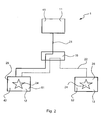
- Fig. 1 the structure of a computer network 1 according to the invention is shown.
- the first arithmetic unit 11, the second arithmetic unit 12 and the third arithmetic unit 13 are connected to each other via an information technology network.
- the information technology network is in Fig. 1 shown as star wiring.
- network connections 17, 18 and 19 lead to a central switch 16.
- other cabling structures such as in a bus system, or cascading systems are possible.
- the information technology network serves to be able to transfer arbitrary data between the individual computing units 11, 12, 13.
- at least one communication between the first arithmetic unit 11 and the second Arithmetic unit 12 and between the second arithmetic unit 12 and the third arithmetic unit 13 are made possible.
- An RDP server 41 runs on the first arithmetic unit 11, which may be, for example, a central server.
- a corresponding RDP client 42 is provided on the second arithmetic unit 12, which can be realized, for example, by a robust embodiment of a thin client.
- This RDP client 42 is configured to request a session from the RDP server 41 provided on the first arithmetic unit 11.
- a first client-server connection 21 is established between the RDP server 41 and the RDP client 42.
- This first client-server connection 21 is based on the RDP protocol.
- the RDP clients and the RDP server are preferably version 6.0, as this version already contains many functions necessary for process automation.
- a terminal server 51 which operates with another terminal server protocol different from RDP.
- VNC derivatives are suitable for this purpose. In order to enable a mirroring or mirroring function of the session of the second arithmetic unit 12, this must be supported by the second terminal server protocol used.
- the third arithmetic unit 13 runs a client 52 for the second terminal server protocol.
- This client 52 establishes a second client-server connection 22 to the second terminal server protocol server 51 on the second arithmetic unit 12.
- the mirroring functionality of the second terminal server protocol is now realized.
- the data of the session of the second arithmetic unit 12 is transmitted to the third arithmetic unit 13.
- the same screen content 24 can be displayed on the screens of the two arithmetic units 12 and 13.
- the terminal server protocol used is also designed for the transmission of inputs on the desktop, these inputs are also transmitted via the second client-server connection 22. This will be a complete mirroring of Session and thus of the desktop 25 to the desktop 26 of the third arithmetic unit 13 reached.
- FIG. 3 is a similar schematic representation as in FIG Fig. 2 shown. This illustration in Fig. 3 serves to explain the functionality of an extended desktop on two different computing units of a computer network 1 according to the invention.
- an RDP server 41 is provided on the first arithmetic unit 11.
- an RDP client 42 is also set up on the second arithmetic unit 12. This connects to the RDP server 41 of the first processing unit 11 and requests a so-called extended desktop.
- An extended desktop can be a user interface in which at least two screens are next to one another and thus represent a common output and input medium extending beyond the screen boundaries. If, for example, a desktop extending over the two screens is to be displayed on the two adjacent screens, then the extended desktop represents a desktop with double X resolution Desktops on the first screen and the second part of the desktop on the second screen.
- extended desktops can be used if the process images are so detailed that they can no longer be displayed with sufficient accuracy on a screen.
- Another use of an extended desktop in process automation is, for example, to display a process image on one part of the desktop, and status information about errors, engine speeds, flow velocities, alarm histories, or a history of sizes, which is displayed diagrammatically on the second part of the desktop to spend.
- an arithmetic unit with two graphics cards and two screens is needed to display an extended desktop.
- these arithmetic units require special approvals and usually represent special developments for small batches. Therefore, it is not worthwhile to develop arithmetic units especially for the purpose of the extended desktop.
- two arithmetic units 12 and 13 can be used to simulate an extended desktop.
- a server 51 for a second terminal server protocol is provided on the second arithmetic unit 12.
- a client 52 is provided for the terminal server protocol. This client 52 connects to the terminal server 51, so that there is a second client-server connection 22.
- the second arithmetic unit 12 requests an extended desktop via the first client-server connection 21.
- a part of this desktop 31 is displayed on the screen of the second arithmetic unit 12 via a graphics processing of the second arithmetic unit 12.
- a further part 32 of the extended desktop is made available to the server 51 for the second terminal server protocol via a second graphics processing.
- this second part of the extended desktop 32 is transmitted to the third arithmetic unit 13.
- the second part 32 is displayed on the screen of the third arithmetic unit 13.
- the screen of the second processing unit 12 is placed next to the screen of the third processing unit 13, so is the functionality of an extended desktop 31, 32 given.
- the first part of the extended desktop 31 on the screen of the second processor 12 and the second part of the extended desktop 32 on the screen of the third processor 13 are shown.
- the RDP client 42 receives the information for the extended desktop 31, 32.
- the RDP client 42 distributes the incoming data to the appropriate graphics cards.
- the left-hand part of the extended desktop 31 is transmitted to the graphics processing device, which can also be called a graphics card, located in the second arithmetic unit 12.
- the second, in this case the left-hand part of the extended desktop 32 is fed to a second graphics card, which can be made virtually.
- the output of this graphics card in particular its frame buffer in the main memory, is supplied to the third processor 13 via the second client-server connection 22.
- the third arithmetic unit 13 then outputs the received data to its screen.
Landscapes
- Engineering & Computer Science (AREA)
- Computer Networks & Wireless Communication (AREA)
- Signal Processing (AREA)
- Computer Security & Cryptography (AREA)
- Health & Medical Sciences (AREA)
- Computing Systems (AREA)
- General Health & Medical Sciences (AREA)
- Medical Informatics (AREA)
- Computer And Data Communications (AREA)
- Digital Computer Display Output (AREA)
Priority Applications (3)
| Application Number | Priority Date | Filing Date | Title |
|---|---|---|---|
| EP08012870A EP2146272A1 (fr) | 2008-07-16 | 2008-07-16 | Conversion d'une session Remote Desktop Protocol et affichage de la session sur plusieurs écrans |
| PCT/EP2009/005178 WO2010006793A1 (fr) | 2008-07-16 | 2009-07-16 | Conversion d'une session de protocole de bureau à distance, et sa représentation sur plusieurs écrans |
| DE202009017849U DE202009017849U1 (de) | 2008-07-16 | 2009-07-16 | Computernetzwerk |
Applications Claiming Priority (1)
| Application Number | Priority Date | Filing Date | Title |
|---|---|---|---|
| EP08012870A EP2146272A1 (fr) | 2008-07-16 | 2008-07-16 | Conversion d'une session Remote Desktop Protocol et affichage de la session sur plusieurs écrans |
Publications (1)
| Publication Number | Publication Date |
|---|---|
| EP2146272A1 true EP2146272A1 (fr) | 2010-01-20 |
Family
ID=39796827
Family Applications (1)
| Application Number | Title | Priority Date | Filing Date |
|---|---|---|---|
| EP08012870A Withdrawn EP2146272A1 (fr) | 2008-07-16 | 2008-07-16 | Conversion d'une session Remote Desktop Protocol et affichage de la session sur plusieurs écrans |
Country Status (3)
| Country | Link |
|---|---|
| EP (1) | EP2146272A1 (fr) |
| DE (1) | DE202009017849U1 (fr) |
| WO (1) | WO2010006793A1 (fr) |
Families Citing this family (1)
| Publication number | Priority date | Publication date | Assignee | Title |
|---|---|---|---|---|
| CN116737307B (zh) * | 2023-08-16 | 2023-12-01 | 北京淳中科技股份有限公司 | 一种界面显示方法、装置、电子设备及存储介质 |
Citations (2)
| Publication number | Priority date | Publication date | Assignee | Title |
|---|---|---|---|---|
| US20030191799A1 (en) | 2000-03-14 | 2003-10-09 | Netilla Networks, Inc. | Apparatus and accompanying methods for providing, through a centralized server site, a secure, cost-effective, web-enabled, integrated virtual office environment remotely accessible through a network-connected web browser |
| WO2004027598A2 (fr) * | 2002-09-16 | 2004-04-01 | Siemens Aktiengesellschaft | Systeme de liaison de processus virtuelle par l'intermediaire d'un protocole rdp (remote desktop protocol) |
-
2008
- 2008-07-16 EP EP08012870A patent/EP2146272A1/fr not_active Withdrawn
-
2009
- 2009-07-16 WO PCT/EP2009/005178 patent/WO2010006793A1/fr not_active Ceased
- 2009-07-16 DE DE202009017849U patent/DE202009017849U1/de not_active Expired - Lifetime
Patent Citations (2)
| Publication number | Priority date | Publication date | Assignee | Title |
|---|---|---|---|---|
| US20030191799A1 (en) | 2000-03-14 | 2003-10-09 | Netilla Networks, Inc. | Apparatus and accompanying methods for providing, through a centralized server site, a secure, cost-effective, web-enabled, integrated virtual office environment remotely accessible through a network-connected web browser |
| WO2004027598A2 (fr) * | 2002-09-16 | 2004-04-01 | Siemens Aktiengesellschaft | Systeme de liaison de processus virtuelle par l'intermediaire d'un protocole rdp (remote desktop protocol) |
Non-Patent Citations (2)
| Title |
|---|
| FREDRIK HÜBINETTE: "Win2VNC A dual-screen hack", 8 February 2008 (2008-02-08), pages 1 - 2, XP002500912, Retrieved from the Internet <URL:http://web.archive.org/web/20080208070421/http://fredrik.hubbe.net/win2vnc.html> [retrieved on 20081023] * |
| YUEDONG ZHANG ET AL: "Redar: A Remote Desktop Architecture for the Distributed Virtual Personal Computing", GRID AND COOPERATIVE COMPUTING, 2006. GCC 2006. FIFTH INTERNATIONAL CO NFERENCE, IEEE, PI, 1 October 2006 (2006-10-01), pages 1 - 8, XP031031008, ISBN: 978-0-7695-2694-2 * |
Also Published As
| Publication number | Publication date |
|---|---|
| WO2010006793A1 (fr) | 2010-01-21 |
| DE202009017849U1 (de) | 2010-11-04 |
Similar Documents
| Publication | Publication Date | Title |
|---|---|---|
| DE69833777T2 (de) | Webschnittstelle für eine programmierbare steuerung | |
| DE60125913T2 (de) | Datenübertragungsverfahren und vorrichtung | |
| EP2979144B1 (fr) | Appareil de terrain, puce de communication et procédé d'accès au web sur un appareil de terrain | |
| DE102008019040B4 (de) | Verfahren und Steuergerät zur Steuerung eines Automatisierungssystems | |
| DE69328132T2 (de) | Verfahren zur Anbindung eines offenen Kommunikationssystems an ein Privatnetzwerk | |
| DE69805087T2 (de) | Verfahren und system zur synchronisierten erfassung, verarbeitung und zuteilung von instrumentationsdaten und zur synchronisierten steuerung in einem client-server netzwerk | |
| DE202011108505U1 (de) | Computersystem zum selektiven Vor-Rendern eines Off-Screen-Inhalts | |
| EP2724494A1 (fr) | Procédé de fonctionnement d'un appareil de terrain, ainsi qu'appareil de terrain | |
| EP2182418A2 (fr) | Procédé et dispositif d'accès à un module de fonctionnement d'un système d'automatisation | |
| EP3637205A1 (fr) | Déclenchement de l'image sur une station client de l'opérateur | |
| DE10243782A1 (de) | Parametrier-/Diagnosesystem für Feldgeräte | |
| DE19717167A1 (de) | Webbrowser-basiertes Konferenzsystem | |
| DE60130478T2 (de) | Gerätesteuerungsverfahren und vorrichtung | |
| DE10132038A1 (de) | Automatisierungssystem und Verfahren zur Anlagenvisualisierung | |
| WO2004044739A1 (fr) | Dispositif pour elaborer et/ou configurer un systeme d'automatisation | |
| EP1442340A1 (fr) | Chargement de donnees dans un systeme d'automatisation | |
| EP2146272A1 (fr) | Conversion d'une session Remote Desktop Protocol et affichage de la session sur plusieurs écrans | |
| DE102010040055A1 (de) | System zur Kommunikation von mehreren Clients mit mehreren Feldgeräten in der Automatisierungstechnik | |
| EP3151217A1 (fr) | Systeme d'apprentissage pour operateur | |
| DE102018208379A1 (de) | Vorrichtung und Verfahren zur Steuerung einer Konfiguration von zumindest einem Gerät bzw. Anlagenkomponente | |
| DE102012201255A1 (de) | Arbeitsfluss-Management-System für Computernetze | |
| EP2862075B1 (fr) | Simulation d'un système complexe | |
| EP3770704A1 (fr) | Système d'automatisation décentralisée en nuage | |
| EP1435025B1 (fr) | Systeme et procede pour acceder a un appareil, en particulier a un appareil d'automatisation pourvu d'une interface normalisee | |
| EP4625077A1 (fr) | Système de commande pour une installation technique, unité de projection et procédé de fonctionnement |
Legal Events
| Date | Code | Title | Description |
|---|---|---|---|
| PUAI | Public reference made under article 153(3) epc to a published international application that has entered the european phase |
Free format text: ORIGINAL CODE: 0009012 |
|
| 17P | Request for examination filed |
Effective date: 20090806 |
|
| AK | Designated contracting states |
Kind code of ref document: A1 Designated state(s): AT BE BG CH CY CZ DE DK EE ES FI FR GB GR HR HU IE IS IT LI LT LU LV MC MT NL NO PL PT RO SE SI SK TR |
|
| AX | Request for extension of the european patent |
Extension state: AL BA MK RS |
|
| AKX | Designation fees paid |
Designated state(s): CH DE FR GB IT LI |
|
| STAA | Information on the status of an ep patent application or granted ep patent |
Free format text: STATUS: THE APPLICATION HAS BEEN WITHDRAWN |
|
| 18W | Application withdrawn |
Effective date: 20110104 |