EP2146289A1 - Capture, stockage et individualisation d'images - Google Patents
Capture, stockage et individualisation d'images Download PDFInfo
- Publication number
- EP2146289A1 EP2146289A1 EP08075635A EP08075635A EP2146289A1 EP 2146289 A1 EP2146289 A1 EP 2146289A1 EP 08075635 A EP08075635 A EP 08075635A EP 08075635 A EP08075635 A EP 08075635A EP 2146289 A1 EP2146289 A1 EP 2146289A1
- Authority
- EP
- European Patent Office
- Prior art keywords
- video
- sequences
- images
- individual
- identification
- Prior art date
- Legal status (The legal status is an assumption and is not a legal conclusion. Google has not performed a legal analysis and makes no representation as to the accuracy of the status listed.)
- Withdrawn
Links
Images



Classifications
-
- G—PHYSICS
- G11—INFORMATION STORAGE
- G11B—INFORMATION STORAGE BASED ON RELATIVE MOVEMENT BETWEEN RECORD CARRIER AND TRANSDUCER
- G11B27/00—Editing; Indexing; Addressing; Timing or synchronising; Monitoring; Measuring tape travel
- G11B27/02—Editing, e.g. varying the order of information signals recorded on, or reproduced from, record carriers
- G11B27/031—Electronic editing of digitised analogue information signals, e.g. audio or video signals
- G11B27/034—Electronic editing of digitised analogue information signals, e.g. audio or video signals on discs
-
- G—PHYSICS
- G06—COMPUTING OR CALCULATING; COUNTING
- G06F—ELECTRIC DIGITAL DATA PROCESSING
- G06F16/00—Information retrieval; Database structures therefor; File system structures therefor
- G06F16/70—Information retrieval; Database structures therefor; File system structures therefor of video data
- G06F16/73—Querying
- G06F16/738—Presentation of query results
- G06F16/739—Presentation of query results in form of a video summary, e.g. the video summary being a video sequence, a composite still image or having synthesized frames
-
- G—PHYSICS
- G06—COMPUTING OR CALCULATING; COUNTING
- G06F—ELECTRIC DIGITAL DATA PROCESSING
- G06F16/00—Information retrieval; Database structures therefor; File system structures therefor
- G06F16/70—Information retrieval; Database structures therefor; File system structures therefor of video data
- G06F16/78—Retrieval characterised by using metadata, e.g. metadata not derived from the content or metadata generated manually
-
- G—PHYSICS
- G06—COMPUTING OR CALCULATING; COUNTING
- G06F—ELECTRIC DIGITAL DATA PROCESSING
- G06F16/00—Information retrieval; Database structures therefor; File system structures therefor
- G06F16/70—Information retrieval; Database structures therefor; File system structures therefor of video data
- G06F16/78—Retrieval characterised by using metadata, e.g. metadata not derived from the content or metadata generated manually
- G06F16/783—Retrieval characterised by using metadata, e.g. metadata not derived from the content or metadata generated manually using metadata automatically derived from the content
- G06F16/7837—Retrieval characterised by using metadata, e.g. metadata not derived from the content or metadata generated manually using metadata automatically derived from the content using objects detected or recognised in the video content
- G06F16/784—Retrieval characterised by using metadata, e.g. metadata not derived from the content or metadata generated manually using metadata automatically derived from the content using objects detected or recognised in the video content the detected or recognised objects being people
-
- G—PHYSICS
- G11—INFORMATION STORAGE
- G11B—INFORMATION STORAGE BASED ON RELATIVE MOVEMENT BETWEEN RECORD CARRIER AND TRANSDUCER
- G11B27/00—Editing; Indexing; Addressing; Timing or synchronising; Monitoring; Measuring tape travel
- G11B27/10—Indexing; Addressing; Timing or synchronising; Measuring tape travel
- G11B27/19—Indexing; Addressing; Timing or synchronising; Measuring tape travel by using information detectable on the record carrier
- G11B27/28—Indexing; Addressing; Timing or synchronising; Measuring tape travel by using information detectable on the record carrier by using information signals recorded by the same method as the main recording
Definitions
- the present invention relates generally to the field of capturing images and personalizing the captured images. More specifically, the present invention relates to the field of image capturing in places like entertainment or holiday parks, theme parks, places for particular games, etc. whereby the captured images and image sequences are to be linked to one or more individuals. The present invention relates also to the adding of images of any kind to a given image sequence. The present invention is particularly, but not exclusively, useful for all kinds of applications of image capturing in public places and in other places, visited by a larger number of people.
- the visitor can introduce his identification card in a reader or the identification card may be detected e.g. by a RFID-reader, installed in the neighbourhood of a particular attraction.
- One or more cameras positioned close to that attraction, start shooting one or more film sequences of the visitors enjoying the attraction.
- the film sequences are provided with an identification signal, corresponding to the information on the identification card so that film sequences from the same attraction or from different attractions can be linked with a particular visitor.
- the images of one or more film sequences, with the same identification may then be joined together into a single video, which can be obtained by the visitor concerned.
- Such a system is disclosed in e.g. US 5 655 053 and in US 5 576 838 . However, such systems present a number of inconveniences.
- the visitor From the entry in the park, the visitor has to show his interest in a video and he has to ask for an identification card. He has to present his identification card at each attraction of which he wants a video sequence. The identification card can be lost or the visitor can forget to introduce the card in a card reader. An effect of surprise is also excluded because the visitor knows where and when a film will be made.
- a first possibility of improving the system consists in an automatically filming of all visitors at different locations of the park and putting the different film sequences containing images of a particular visitor together by using facial recognition of that visitor.
- Using such a technique makes it possible to obtain a video of the visit to the park relating to a particular visitor.
- Such a system presents however the drawback that the visitor has not always his face directed to the camera or his face may be changing while he is e.g. laughing, etc. so that it may be difficult to use facial recognition at certain moments, in particular when visitors are participating in an attraction. Further it may also be desirable to make use of computer vision algorithms e.g. for inserting other images within the video sequences.
- the above objective is accomplished by a method and device according to the present invention.
- the present invention provides a method for producing a video product regarding an individual, the video product being based on at least one video sequence, each video sequence comprising one or more sub-sequences of images.
- the method comprises detecting and storing an identification or a corresponding code (ID) of the individual, valid for all video sequences, determining track information, linked with the identification (ID) and valid for all sub-sequences within a given video sequence, shooting and storing sub-sequences of images of the individual, mounting the sub-sequences of images corresponding to a single track information into a video sequence and labelling the video sequence with the identification or corresponding code (ID) and mounting video sequences of images having the first identification into the video product.
- the identification may be based on facial recognition.
- the video sequences may be analyzed and a score, based on that analysis, may be given to each video sequence.
- This analysis may be directed to an attitude or a movement of the individual or to the general quality of the images.
- the sequences may be selected on the basis on the given score.
- the sequences may be further analyzed for particular information. Such particular information may be contained in an attitude or a movement of the individual. Virtual content may be selected and added based on the results of the further analysis for particular information.
- the present invention provides also a video product, obtained by applying one of the methods described above.
- the present invention provides further a computer software product, which, when loaded on a computer, makes this computer execute any of the methods described above.
- the present invention provides further a system for producing a video product regarding an individual moving around in one or more locations.
- the system comprises, in at least one location, a video capturing and recording system, whereby each video capturing and recording system comprises a detector for detecting the face of the individual and for detecting identification features of the individual, storing means for storing the identification features or a corresponding code, means for determining track information regarding the individual and in relation to the location, one or more cameras for shooting one or more sub-sequences of images of the individual on the basis of the track information, means for putting the sub-sequences of images together into a sequence of images, and means for labelling the sequences of images with the identification of the individual.
- the system may further comprise a video combining system which comprises a detector for detecting the face of the individual and for detecting identification features of the individual and means for retrieving among the available sequences the sequences, labelled with the identification of the individual.
- Each video capturing and recording system may further comprise a means for analyzing the sequences for particular characteristics and means for labelling the sequences with a score, based on the results of this analysis.
- the video combining system may further comprise means for selecting sequences on the basis on their score.
- the video combining system may further comprise means for analyzing the sequences for particular information.
- the video combining system may further comprise means for selecting and adding virtual content to one or more video sequences based on the presence of particular information.
- the present invention provides also a method for adding virtual content to images of a video sequence.
- the method comprises the steps of detecting a particular information in the images of an individual or an object contained in the video sequence and, when such a particular information is detected, adding the virtual content to the images of the video sequence.
- the added virtual content is determined by the content of the image.
- the particular information in the image may be constituted by a change in the expression of a face.
- the particular information in the image of the individual may be constituted by a particular movement of the individual.
- the particular information may be constituted by the way the object is seen in the image, by the form of the object or the movement of the object.
- the virtual content may comprise the image of a personage.
- the method may further comprise modifying the content of the virtual content, this modifying being determined by detecting further particular information in the images contained in the video sequence.
- Modifying the virtual content may comprise modifying the expression on the face of the personage.
- Modifying the virtual content may comprise inducing a movement of the personage.
- the present invention provides also a DVD comprising a video reportage of an event whereby the video reportage is obtained according to any of the methods above.
- the present invention provides also a computer program product, directly loadable into the memory of a computer, comprising software program portions for executing any of the methods above, when said computer program product is run on a computer.
- the present invention provides also a video system for adding virtual content to images of a video sequence.
- the video system comprises detecting means for detecting a particular information in the image of an individual or an object contained in the video sequence and adding means for, when such a particular information is detected, adding virtual content to the images of the video sequence.
- the detecting circuit may comprise means for facial recognition.
- the video system may comprise means for determining the virtual content on the basis of the detected particular information.
- the video system may comprise means for modifying the virtual content based on the detection of further particular information in the images of an individual contained in the video sequence.
- Coupled should not be interpreted as being restricted to direct connections only.
- the terms “coupled” and “connected”, along with their derivatives, may be used, but it should be understood that these terms are not intended as synonyms for each other.
- the scope of the expression “a device A coupled to a device B” should not be limited to devices or systems wherein an output of device A is directly connected to an input of device B. It means that there exists a path between an output of A and an input of B which may be a path including other devices or means.
- Coupled may mean that two or more elements are either in direct physical or electrical contact or that two or more elements are not in direct contact with each other but yet still co-operate or interact with each other.
- a processor with the necessary instructions for carrying out such a method or element of a method forms a means for carrying out the method or the element of a method.
- an element of an apparatus embodiment described herein is an example of a means for carrying out the function performed by the element for the purpose of carrying out the invention.
- an attraction park, a theme park, etc. has different attractions and other places of interest (like restaurants, terraces, panoramic views, etc), each of them being particular suited for video shooting. All such places and attractions are called hereafter locations.
- each location in the park is normally provided with a video capturing and recording system (in the drawing: 100, 200, etc.).
- a video combining and editing system (500) is situated in the neighbourhood of the exit of the park.
- the video capturing and monitoring systems which are situated at different locations within the park (e.g. an attraction, a game, etc.) have a plurality of cameras.
- a video capturing and recording system is illustrated as one unit, the different elements being directly connected one to the other. It is clear that some elements of a video capturing and recording system may be grouped with elements of another video capturing and recording system. It is also possible to centralize some or all of the different steps foreseen in the video capturing and recording systems (e.g. analyzing, storing, labelling) in a central computer system whereby data are to be transmitted between the decentralized video capturing and recording systems and the central computer.
- an exemplary video capturing and recording system e.g. system 100, which is installed around a location with a splash ride attraction.
- One or more of the cameras (110) are so situated that they are supervising the embarkation station of the attraction and the other cameras (120) are situated along the track of the splash ride.
- the cameras (110) at the embarkation station take one or more images of a visitor V. From this image a first identification (ID) of the visitor is deducted (111), e.g. some facial characteristics and these characteristics are stored (112). It is also possible to link these characteristics with a code, representing these characteristics and store the characteristics and/or the code in a central memory so that at any time from the code the characteristics can be deducted and vice versa.
- ID first identification
- some track information is determined for the identified visitor (113), which in case of the splash ride can be e.g. the position of the visitor V in a boat, e.g. the second row.
- the track information can be used to control the different cameras (120) so that they follow the visitor V during the attraction.
- Another possibility consists in using the track information for labelling the sub-sequences, taken at the splash ride attraction and containing images of visitor V, with a code, representing the track information.
- the sub-sequences relating to visitor V are put together in a single sequence relating to the splash ride attraction and are labelled (122) with the identification signal (ID) corresponding to the first identification signal which is unique and indicates that the video sequence contains images of visitor V
- ID identification signal
- Information identifying the visited attraction may also be stored on the same video sequence.
- a score (124) may be given to certain images indicating the quality of the image or the suitability of the image to be further processed, etc.
- the same process is repeated at other locations of the attraction park whereby, possibly, another track information is used, e.g. the colour of the jacket of visitor V, the position of visitor V in another attraction, the height of the visitor, etc..
- another track information e.g. the colour of the jacket of visitor V, the position of visitor V in another attraction, the height of the visitor, etc..
- a number of sequences of visitor V are obtained.
- the identification of visitor V is repeated so that all these sequences are labelled with an identification corresponding to the first identification (ID) of visitor V.
- ID first identification
- Each of the sequences consists of one or more sub-sequences, obtained on the basis of a corresponding track information.
- a video combining and editing system 500
- the video sequences are sent to the video combining and editing system using well-known techniques, e.g. data transmission.
- the video combining and editing system comprises a camera or cameras (510) used for making one or more images of visitor V.
- the system further comprises a circuit for face detection and detection of face features (551) in order to deduct from the images again the identification (ID) of visitor V.
- ID identification
- the stored sequences, labelled with this identification or its corresponding code are retrieved (553).
- a selection or ranking of the sequences may be done on the basis of the score given in the different video capturing and recording systems at different locations (554).
- the video combining and editing system may also comprise an editing circuit, in which the images of the sequences may be adapted or improved e.g. taking away a shadow on a face or brighten the teeth of a person, applying a sepia filtering, etc.
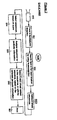
- FIG. 3 A general method for preparing such virtual content is shown in Figure 3 and comprises the following steps:
- the real images are analysed for particular information (555), corresponding to the particular information conditions assigned during the preparation of the virtual content (602).
- particular information are: how is the visitor reacting to a particular attraction or to different events (e.g. is he laughing, is he cheering, is he throwing his arms in the air, etc.), how is the visitor reacting to his environment (e.g. is he shaking hands, etc.).
- virtual content may be selected and added with the real images (556).
- Figure 4 illustrates an exemplary method how such a selection and such an addition can be done. The method may contain the following steps:
- the added virtual content may relate to certain themes of the park or to the visited attractions.
- the virtual image may represent e.g. Sinbad the Sailor, sitting or staying on the boat behind visitor V.
- other virtual personages may inserted in the video sequence e.g. Cinderella, Mickey, etc.
- the system may comprise also the necessary software so that these virtual personages can react to different attitudes or actions of the visitor V in the video sequence: e.g. they may laugh when the visitor is laughing, throw their arms in the air when the visitor is throwing his arms in the air, start a feigned attack when the face of the visitor expresses fear, walk with the visitor when he starts walking, etc.
- this video may also contain further general video fragments of the whole park or detailed video fragments of one or more attractions.
- a personalized video is obtained containing images of the visitor on one or more attractions and interacting with one or more virtual personages or other living beings like animals.
- Another example of application of the present invention can be found in a video registration of the attendance at a particular party. Images of a particular person may be taken at different locations of the party in order to get a number of sequences, which may then be combined into a video.
- the video sequences of the real party may be mixed with virtual images whereby the effect can be obtained of participants of the party, discussing with one or the other virtual personage like Laurel or Hardy, whereby the attitude and/or action of the virtual personage is influenced by the attitude and/or action of one or more of the participants of the party.
- a further example of application of the present invention is in the area of active sport, e.g. diving.
- Diving schools often provide the divers with a video of their diving experience.
- Such a video can be processed in order to include in the images Neptune, the god of the sea, with his trident with as result a virtual discussion between the diver and Neptune.
- a virtual meeting between the diver and one or more mermaids can be arranged.
- the diver may influence, often without realizing it, the kind of virtual image inserted in the video (Neptune or a mermaid) and the behaviour or reaction of the person in the virtual image.
- virtual content is added to images of human beings.
- the same process of adding virtual content to a video sequence may also be used for adding virtual content to real images of an animal and, very generally, the present invention covers also the adding of virtual content to real images of objects.
- objects particular information may be constituted by the way the object is seen in the image (e.g. when the image shows a top view of a table, a virtual tap-dancer may be added for dancing on the table) or by the movement of the object (e.g. Cinderella in a swing or in a carousel).
- circuit in which video processing is done by electronic circuitry.
- video processing can be performed by one or more circuits but also by a computer, running the necessary software and such embodiments are also part of the present invention.
- means when used in the description and in the claims, is meant one or more circuits or a computer or processor, driven by the necessary software.
Landscapes
- Engineering & Computer Science (AREA)
- Multimedia (AREA)
- Theoretical Computer Science (AREA)
- General Engineering & Computer Science (AREA)
- Databases & Information Systems (AREA)
- Physics & Mathematics (AREA)
- Data Mining & Analysis (AREA)
- General Physics & Mathematics (AREA)
- Library & Information Science (AREA)
- Computational Linguistics (AREA)
- Television Signal Processing For Recording (AREA)
- Indexing, Searching, Synchronizing, And The Amount Of Synchronization Travel Of Record Carriers (AREA)
- Processing Or Creating Images (AREA)
Priority Applications (2)
| Application Number | Priority Date | Filing Date | Title |
|---|---|---|---|
| EP08075635A EP2146289A1 (fr) | 2008-07-16 | 2008-07-16 | Capture, stockage et individualisation d'images |
| PCT/BE2009/000040 WO2010006387A2 (fr) | 2008-07-16 | 2009-07-16 | Saisie, stockage et individualisation d'images |
Applications Claiming Priority (1)
| Application Number | Priority Date | Filing Date | Title |
|---|---|---|---|
| EP08075635A EP2146289A1 (fr) | 2008-07-16 | 2008-07-16 | Capture, stockage et individualisation d'images |
Publications (1)
| Publication Number | Publication Date |
|---|---|
| EP2146289A1 true EP2146289A1 (fr) | 2010-01-20 |
Family
ID=40070780
Family Applications (1)
| Application Number | Title | Priority Date | Filing Date |
|---|---|---|---|
| EP08075635A Withdrawn EP2146289A1 (fr) | 2008-07-16 | 2008-07-16 | Capture, stockage et individualisation d'images |
Country Status (2)
| Country | Link |
|---|---|
| EP (1) | EP2146289A1 (fr) |
| WO (1) | WO2010006387A2 (fr) |
Cited By (3)
| Publication number | Priority date | Publication date | Assignee | Title |
|---|---|---|---|---|
| US20110256886A1 (en) * | 2009-11-18 | 2011-10-20 | Verizon Patent And Licensing Inc. | System and method for providing automatic location-based imaging using mobile and stationary cameras |
| US9918048B2 (en) | 2009-11-18 | 2018-03-13 | Verizon Patent And Licensing Inc. | System and method for providing automatic location-based imaging |
| US9984309B2 (en) | 2015-09-30 | 2018-05-29 | International Business Machines Corporation | Classifying and grouping electronic images |
Families Citing this family (1)
| Publication number | Priority date | Publication date | Assignee | Title |
|---|---|---|---|---|
| US12505587B2 (en) | 2022-08-15 | 2025-12-23 | Universal City Studios Llc | Show effect system for amusement park attraction system |
Citations (3)
| Publication number | Priority date | Publication date | Assignee | Title |
|---|---|---|---|---|
| US5576838A (en) | 1994-03-08 | 1996-11-19 | Renievision, Inc. | Personal video capture system |
| WO2004072897A2 (fr) * | 2003-02-06 | 2004-08-26 | Centerframe, L.L.C. | Obtention d'images caracteristiques de personnes dans un lieu public |
| WO2008127598A1 (fr) * | 2007-04-13 | 2008-10-23 | Yourday, Inc. | Systeme de capture et de gestion d'images video personnalisees sur un reseau |
Family Cites Families (2)
| Publication number | Priority date | Publication date | Assignee | Title |
|---|---|---|---|---|
| EP1938208A1 (fr) * | 2005-09-30 | 2008-07-02 | Philips Intellectual Property & Standards GmbH | Annotation de visages dans une video en continu |
| US8116537B2 (en) * | 2007-04-04 | 2012-02-14 | Sony Corporation | Image recording device, player device, imaging device, player system, method of recording image, and computer program |
-
2008
- 2008-07-16 EP EP08075635A patent/EP2146289A1/fr not_active Withdrawn
-
2009
- 2009-07-16 WO PCT/BE2009/000040 patent/WO2010006387A2/fr not_active Ceased
Patent Citations (4)
| Publication number | Priority date | Publication date | Assignee | Title |
|---|---|---|---|---|
| US5576838A (en) | 1994-03-08 | 1996-11-19 | Renievision, Inc. | Personal video capture system |
| US5655053A (en) | 1994-03-08 | 1997-08-05 | Renievision, Inc. | Personal video capture system including a video camera at a plurality of video locations |
| WO2004072897A2 (fr) * | 2003-02-06 | 2004-08-26 | Centerframe, L.L.C. | Obtention d'images caracteristiques de personnes dans un lieu public |
| WO2008127598A1 (fr) * | 2007-04-13 | 2008-10-23 | Yourday, Inc. | Systeme de capture et de gestion d'images video personnalisees sur un reseau |
Cited By (5)
| Publication number | Priority date | Publication date | Assignee | Title |
|---|---|---|---|---|
| US20110256886A1 (en) * | 2009-11-18 | 2011-10-20 | Verizon Patent And Licensing Inc. | System and method for providing automatic location-based imaging using mobile and stationary cameras |
| US9417312B2 (en) * | 2009-11-18 | 2016-08-16 | Verizon Patent And Licensing Inc. | System and method for providing automatic location-based imaging using mobile and stationary cameras |
| US9918048B2 (en) | 2009-11-18 | 2018-03-13 | Verizon Patent And Licensing Inc. | System and method for providing automatic location-based imaging |
| US9984309B2 (en) | 2015-09-30 | 2018-05-29 | International Business Machines Corporation | Classifying and grouping electronic images |
| US10534978B2 (en) | 2015-09-30 | 2020-01-14 | International Business Machines Corporation | Classifying and grouping electronic images |
Also Published As
| Publication number | Publication date |
|---|---|
| WO2010006387A3 (fr) | 2010-03-04 |
| WO2010006387A2 (fr) | 2010-01-21 |
Similar Documents
| Publication | Publication Date | Title |
|---|---|---|
| US12149819B2 (en) | Autonomous media capturing | |
| US6608563B2 (en) | System for automated photo capture and retrieval | |
| JP5738569B2 (ja) | 画像処理プログラム、装置、システムおよび方法 | |
| WO2019050916A1 (fr) | Techniques de rendu de graphiques animés tridimensionnels à partir d'une vidéo | |
| KR20130088059A (ko) | 오브젝트의 정보를 표시하는 정보 처리 장치, 정보 처리 방법 및 기록 매체 | |
| CN110162667A (zh) | 视频生成方法、装置及存储介质 | |
| CN108416832B (zh) | 媒体信息的显示方法、装置和存储介质 | |
| EP2146289A1 (fr) | Capture, stockage et individualisation d'images | |
| Peretz | The off-screen: an investigation of the cinematic frame | |
| JP2009088729A (ja) | 合成画像出力装置および合成画像出力処理プログラム | |
| JP7160707B2 (ja) | 仮想キャラクタを含む画像を提供するための方法 | |
| Sheehan | Against the image: Herzog and the troubling politics of the screen animal | |
| WO2022182221A1 (fr) | Détection et partage vidéo de temps forts sportifs | |
| CN111640199B (zh) | 一种ar特效数据生成的方法及装置 | |
| Novick et al. | The utep agent system | |
| TWI549499B (zh) | A system for automatically recording motion data and a method thereof | |
| JP4894213B2 (ja) | 撮影装置、およびプログラム | |
| CN112738498A (zh) | 一种虚拟游览系统及方法 | |
| Plantinga | Alternative realities | |
| Eitzen | Fooling with the Amish: Amish Mafia, Entertaining Fakery, and the Evolution of Reality TV | |
| Yamamoto et al. | Pukapucam: enhance travel logging experience through third-person view camera attached to balloons | |
| Tricart | VR as a Storytelling Tool | |
| JP2026023987A (ja) | システム | |
| JPH0596062A (ja) | 見物施設の仮想体験装置 | |
| Haber et al. | How to Get the Part... Without Falling Apart!: Featuring the Haber Phrase Technique for Actors |
Legal Events
| Date | Code | Title | Description |
|---|---|---|---|
| PUAI | Public reference made under article 153(3) epc to a published international application that has entered the european phase |
Free format text: ORIGINAL CODE: 0009012 |
|
| AK | Designated contracting states |
Kind code of ref document: A1 Designated state(s): AT BE BG CH CY CZ DE DK EE ES FI FR GB GR HR HU IE IS IT LI LT LU LV MC MT NL NO PL PT RO SE SI SK TR |
|
| AX | Request for extension of the european patent |
Extension state: AL BA MK RS |
|
| AKY | No designation fees paid | ||
| REG | Reference to a national code |
Ref country code: DE Ref legal event code: 8566 |
|
| STAA | Information on the status of an ep patent application or granted ep patent |
Free format text: STATUS: THE APPLICATION IS DEEMED TO BE WITHDRAWN |
|
| 18D | Application deemed to be withdrawn |
Effective date: 20100721 |