EP2146307A2 - Procédé de coordination de machines agricoles mobiles - Google Patents
Procédé de coordination de machines agricoles mobiles Download PDFInfo
- Publication number
- EP2146307A2 EP2146307A2 EP09005499A EP09005499A EP2146307A2 EP 2146307 A2 EP2146307 A2 EP 2146307A2 EP 09005499 A EP09005499 A EP 09005499A EP 09005499 A EP09005499 A EP 09005499A EP 2146307 A2 EP2146307 A2 EP 2146307A2
- Authority
- EP
- European Patent Office
- Prior art keywords
- machine
- machines
- simulated
- operations
- simulation
- Prior art date
- Legal status (The legal status is an assumption and is not a legal conclusion. Google has not performed a legal analysis and makes no representation as to the accuracy of the status listed.)
- Granted
Links
Images



Classifications
-
- A—HUMAN NECESSITIES
- A01—AGRICULTURE; FORESTRY; ANIMAL HUSBANDRY; HUNTING; TRAPPING; FISHING
- A01D—HARVESTING; MOWING
- A01D41/00—Combines, i.e. harvesters or mowers combined with threshing devices
- A01D41/12—Details of combines
-
- A—HUMAN NECESSITIES
- A01—AGRICULTURE; FORESTRY; ANIMAL HUSBANDRY; HUNTING; TRAPPING; FISHING
- A01B—SOIL WORKING IN AGRICULTURE OR FORESTRY; PARTS, DETAILS, OR ACCESSORIES OF AGRICULTURAL MACHINES OR IMPLEMENTS, IN GENERAL
- A01B79/00—Methods for working soil
- A01B79/005—Precision agriculture
-
- A—HUMAN NECESSITIES
- A01—AGRICULTURE; FORESTRY; ANIMAL HUSBANDRY; HUNTING; TRAPPING; FISHING
- A01D—HARVESTING; MOWING
- A01D43/00—Mowers combined with apparatus performing additional operations while mowing
- A01D43/06—Mowers combined with apparatus performing additional operations while mowing with means for collecting, gathering or loading mown material
-
- A—HUMAN NECESSITIES
- A01—AGRICULTURE; FORESTRY; ANIMAL HUSBANDRY; HUNTING; TRAPPING; FISHING
- A01D—HARVESTING; MOWING
- A01D91/00—Methods for harvesting agricultural products
-
- G—PHYSICS
- G06—COMPUTING OR CALCULATING; COUNTING
- G06Q—INFORMATION AND COMMUNICATION TECHNOLOGY [ICT] SPECIALLY ADAPTED FOR ADMINISTRATIVE, COMMERCIAL, FINANCIAL, MANAGERIAL OR SUPERVISORY PURPOSES; SYSTEMS OR METHODS SPECIALLY ADAPTED FOR ADMINISTRATIVE, COMMERCIAL, FINANCIAL, MANAGERIAL OR SUPERVISORY PURPOSES, NOT OTHERWISE PROVIDED FOR
- G06Q10/00—Administration; Management
- G06Q10/04—Forecasting or optimisation specially adapted for administrative or management purposes, e.g. linear programming or "cutting stock problem"
- G06Q10/047—Optimisation of routes or paths, e.g. travelling salesman problem
-
- G—PHYSICS
- G06—COMPUTING OR CALCULATING; COUNTING
- G06Q—INFORMATION AND COMMUNICATION TECHNOLOGY [ICT] SPECIALLY ADAPTED FOR ADMINISTRATIVE, COMMERCIAL, FINANCIAL, MANAGERIAL OR SUPERVISORY PURPOSES; SYSTEMS OR METHODS SPECIALLY ADAPTED FOR ADMINISTRATIVE, COMMERCIAL, FINANCIAL, MANAGERIAL OR SUPERVISORY PURPOSES, NOT OTHERWISE PROVIDED FOR
- G06Q50/00—Information and communication technology [ICT] specially adapted for implementation of business processes of specific business sectors, e.g. utilities or tourism
- G06Q50/02—Agriculture; Fishing; Forestry; Mining
Definitions
- the present invention relates to a method for coordinating a plurality of mobile agricultural machines that need to share a resource or temporarily collaborate to perform a task.
- a method of this kind is for example off WO00 / 35265 known.
- a transport vehicle here represents a resource that is shared by two harvesters by the latter overloaded crop to the transport vehicle. For overloading, the transport vehicle must temporarily meet with one of the harvesters.
- the coordination effort is small and it is sufficient if some time in advance during the harvesting operation It can be estimated when in a harvester the tank receiving the crop will be full so that the transport vehicle can be directed in time to a location where the harvester is likely to be located when the tank is full. If a transport vehicle needs to be available at all times to get started when a harvester needs one, then the transport vehicles have long downtime between uses, which is uneconomical. Decreasing the number of transport vehicles provided, then reduce their downtime, in return, but then occasionally the standstill of a harvester must be accepted because no transport vehicle is available in time for unloading.
- the object of the present invention is to provide a method for coordinating agricultural machines which avoids the disadvantages described above and allows all machines to be operated with a maximum of utilization.
- the shared resource may be a vehicle, for example a transport vehicle, if the machines whose operations are simulated are harvesters, or it may be a stationary infrastructure such as a warehouse, a drying station, a mill or the like, especially when the machines whose operations are simulated are the transport vehicles.
- a vehicle for example a transport vehicle, if the machines whose operations are simulated are harvesters, or it may be a stationary infrastructure such as a warehouse, a drying station, a mill or the like, especially when the machines whose operations are simulated are the transport vehicles.
- using the shared resource is preferably an exchange of material between one of the machines and the resource, preferably the transhipment of crop.
- a time difference between the present and the point in time at which the actual current working state should have been reached according to the simulated process can be determined.
- the working state may be characterized by the value of at least one operating variable, such as the current location of the machine, the amount of loaded material, in particular crop, or the like.
- Such a prognosis may be based, for example, on the assumption that the time taken to make use of the simulated sequence changes by the determined time difference, or that the actual workflow is accelerated or slower than the simulated factor by a factor which is consistent with the determined time difference. If a time forecast in this way increases the utilization of the resource Conflicts because the resource is occupied by another machine at the predicted time, then a re-simulation of the workflows is required not only for the machine that deviated from the originally simulated procedure but also for the others in order to resolve the resource conflict.
- the first machine is a harvester
- an over-loading of the crop onto a transport vehicle (as a second machine) is required earlier than provided in an original simulation
- a fourth machine of the first type exists for which a collision with the second machine is easier to implement than for the first machine, and if this fourth machine exists, a workflow for it
- the fourth machine is simulated and signaled to it, which contains a meeting with the second machine.
- a deviation between the actual and the simulated working state may also occur in the transport vehicle, for example because of an accident or a traffic jam, so that this assumes the role of the first vehicle in the sense of the method defined above.
- the method checks whether a fourth machine of the same type as the first one, that is to say another transport vehicle, exists, which can be directed in time to the harvester in order to unload it.
- the harvester is on an area to be harvested and the simulation shows that collision with the haulage machine at the harvested area is not possible before harvested crop on the area exceeds the capacity of a harvester tank, then as a result
- the simulation also a coincidence be provided off the surface to be harvested, that is, the harvester can leave the area to be harvested and come to meet the transport vehicle to start with the reloading of the crop at the earliest possible time.
- the harvester when at the time of a simulation, the harvester is on a surface to be harvested, a collision with the transport machine on the surface to be harvested is not possible before harvested crop on the surface exceeds the capacity of the tank and the area completely harvested.
- the harvester waits idly for the arrival of the transport vehicle, or that the harvester initially opposes the transport vehicle in order subsequently to return to a not yet harvested remainder of the area.
- the simulation may provide for the discarding of a remainder of the crop still on the surface at the time of the simulation, for example in such a way that, although the remaining area is harvested, a temporary overflow of the tank and thus the loss of crop are accepted becomes.
- the simulation of the workflow for one of the machines preferably includes not only establishing a hitting point with another machine, but also defining a path to be traveled by the machine, at least until this hitting.
- the machine for which the simulation is being carried out is a transport machine, then, to determine the path, as far as it passes over an agricultural area, it is preferable to use a map of this area which specifies non-traveling parts of the area.
- the path established as part of a machine workflow is conveniently displayed to the driver aboard the machine.
- This can be in the form of a card, in particular if the route passes over roads, which applies especially to a transport machine usually for at least part of the route to be laid between a meeting point with a harvester and an infrastructure facility.
- the simulations of the work processes of all machines preferably take place on the basis of a list of the respective ready-to-use machines. So it is possible if a collision between two machines required for one of the machines to continue their work proves to be unfeasible to select another suitable collision machine from the list.
- each machine reports each change in its operational readiness to the directory, so that, for example in the event of a breakdown of the machine, at least part of the work processes of the other machines can be re-simulated, taking into account the change.
- a new simulation is necessary for a machine intended for a collision with the failed machine.
- a new simulation is desirable because they now have to take over as far as possible the tasks of the failed machine with.
- a re-simulation may be desirable, as the failure gives the remaining machines the possibility of an earlier access than originally provided on the common resource can open.
- the invention also relates to a control device having a processing unit and an interface for communication with a plurality of mobile agricultural machines, which is configured to carry out a method as described above.
- This control device can be implemented centrally, separately from the agricultural machines or also on board one of the machines; in the latter case, the device itself may be provided with a user interface for displaying the path established for the machine concerned.
- Another object of the invention is a computer program product with program code means, which enable a programmable data processing device to carry out the method described above.
- the computer program product may be in the form of a data carrier on which program instructions are recorded in readable form by the data processing device, which enable the data processing device to execute the method.
- a system of agricultural machines to be coordinated in accordance with the present invention comprises, for example, as shown in FIG Fig. 1
- a device for coordinating the vehicles 1 to 4 comprises a central processing unit 5 in the form of a suitably programmed computer system, which in the case considered here is stationary in one Building 6 is located. Modifications in which the central processing unit 5 is incorporated in one of the machines to be coordinated, or is delocalized on more of these machines, are also contemplated.
- Fig. 2 shows in more detail the structure of the central and decentralized processing units 5, 8.
- the central processing unit 5 comprises a CPU 9, a radio interface 7, a machine database 10, in which the system belonging to machines 1 to 4, information on their operational capability and their for resource planning relevant data, a geographic database 11 containing geographic data on the area of planned use of the machines 1 to 4, a simulation database 12 for storing simulated operations of an employment of the machines 1-4, and a user interface with a display screen 13 and an input tool (not shown) connected via a bus.
- the user interface may still be equipped with a loudspeaker 14, whose function will be discussed in more detail later.
- the decentralized processing units 8 of the machines 1 to 4 likewise each comprise a radio interface 7, a CPU 9, the user interface and a GPS decoder 15 for determining the position of the machine.
- the central processing unit 5 is given arable land to be harvested by a user at a given date. This can be done, for example, by the central processing unit 5 displaying on its display screen 13 a map representation of the intended application area generated from the data of the geographical database 11 and a user marking, for example with the aid of a mouse, arable land to be harvested.
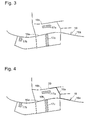
- a screen display is exemplary in Fig. 3 shown. Roads accessible by the machines are indicated at 16a, 16b, ... in the map, and at 17a, 17b, 17c for field crops to be harvested.
- the reference numeral 18 denotes an infrastructure such as a drying station, a warehouse or a mill at which the tractors 3, 4 are to collect the crop.
- the geographical database 11 contains only information about its location and size relative to the arable areas 17a, 17b, 17c, so that for a simulation of the harvesting operation, in particular for estimating the time required for harvesting an area, flat-rate estimates of the area per unit area must be resorted to be introduced amount of crop.
- the geographic database 11 also contains information on the quantities harvested in the previous operations on the areas 17, on the basis of which a more precise forecast of the crop quantity is possible.
- the central processing unit 5 starts to simulate a harvesting operation including the movements of all the involved machines 1 to 4. For this purpose, it selects for each combine harvester 1, 2 a first to be harvested area under the arable areas 17a to 17c, calculates the Time that combines 1, 2 need to travel from a point of origin, such as infrastructure 18, to reach the selected arable land and the time they are expected to spend to fill their grain tank on the field.
- the data required therefor such as the typical speeds of the combine harvester 1, 2 on a road and on a field, the expected area yield for the areas 17a, 17b, 17c and the loading capacity of the grain tank are recorded in the machine database 10. Since the method is applied to the surfaces 17a, 17b, 17c for the first time, the geographical database initially only contains blanket estimates of the areal density of the crop given by the manufacturer.
- the central processing unit 5 determines a route and travel times for the tugs 3, 4, which at the time at which the tanks of the combine harvester 1, 2 are expected to be full in the field, to the tank contents to take over and create the infrastructure facility 18.
- these simulations preparing the harvesting operation include all movements of the machines 1 to 4 from the breaking up of the machines to the complete harvesting of the fields 17 and the return of the machines to their location.
- the simulations capture only a shorter time span, for example for a combine harvester only up to the next but one or over-the-second overloading.
- a quality assessment of a simulation which is purely based on the operating costs incurred during the simulation period, would not lead to a satisfactory result. It is therefore a more complex one Evaluation function that takes into account that the cost of introducing crop from arable land far away from infrastructure 18 such as 17b is necessarily higher than from a near neighbor such as 17c.
- the central processing unit 5 After the central processing unit 5 completes the simulations and selects one of them, it transmits driving instructions corresponding to the selected simulation to the machines 1-4. These driving instructions take the form of a map image highlighting the path to be traveled by the receiving machine.
- Fig. 4 shows in map form the driving instructions to the combine harvester 1, 2.
- the combine harvester 1, whose path 19a is shown as a solid line is sent to one of the arable area 17a closely adjacent point 20 on the next to the field surface 17a passing road 16b.
- This path 19a is optimized using conventional route planning algorithms in terms of its economy, length or travel time.
- a path from the point 20 to the field area 17a is not included in the instructions, since no path leading to the field area 17a is included in the geographical database 11.
- the driver of the combine harvester 1 is therefore forced to find a path from the point 20 to the field surface 17a itself. In fact, such a path exists, and as the combine 1 travels with it and, as otherwise continuously during its operation, its position determined by the GPS decoder 15 to the central processing unit 5 receives this knowledge of the existence of the dirt road 21 and adds it to the geographic database 11.
- the update of the geographical database 11 changes the conditions on which the original simulations of the harvesting process were based. Since there is the possibility that a re-simulation of the harvesting process based on the geographical database 11 updated by the lane 21 will lead to a more economical process than the one originally selected, the central processing unit 5 responds to the change of the database 11 by starting from the current one Positions of the machines 1 to 4 and processing states of the surfaces 17a to 17c again simulated possible crops, among these selects the most economical and possibly sends changed driving instructions to the machines.
- Fig. 6 again shows this information in the form of a map that can be displayed on the display screen 13 of the combine harvester 1;
- the driver receives the information in the form of voice instructions, which are transmitted via the loudspeaker 14 of the local processing unit 8 and alert him to deviations from the intended route or required steering maneuvers. For example, at point 22, when the field surface 17a is reached, the driver is instructed to drive straight on along the narrow side of the surface 17a; on reaching corner 23, he is instructed to make a 90 degree right turn, etc.
- voice prompts may be dispensable, they are very helpful if several combine harvester are divided for processing an equal area and boundaries between the areas to be machined by the individual combine harvester areas are not yet recognizable or a combine harvester, instead of driving along the edge of a surface to be harvested, must drive in the middle of them at a predetermined course.
- the combine harvester 1 Based on position data and data on the current tank level, which the combine harvester 1 continuously delivers back to the central processing unit 5 on its way from point 22 to the meeting point 24, it continuously adapts its prognosis about the location of the meeting point 24 and the time at which the combine 1 picks it up will reach. From this any resulting changes in the distance to be traveled by the tug 3 to the meeting point 24 and the times at which the tug 3 should have reached certain points of this route are transmitted to them in real time as driving instructions.
- the central processing unit 5 determines the area yield of the area 17a from the fill level data supplied by the combine 1 and stores this, possibly even spatially resolved, in the geographical database 11. These records of the area yield allow a more accurate yield prognosis if the method is used in a later harvest is applied again to the surface 17a. The reliability of the simulations is therefore always better with repeated application of the method.
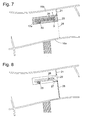
- Fig. 7 shows the meeting of the combine harvester 1 and the tractor 3 at the point 24.
- Driving instructions of the central processing unit 5 to the tractor 3, as this is to leave the arable area 17a after the crop has been overrun by the combine harvester 1, are in Fig. 7 shown as dashed line 25.
- the central processing unit 5 has the tractor 3 to leave the arable area 17a on the field 21, since no other option is specified in the geographical database 11.
- the tractor driver can recognize on site that another dirt road 26 exists, which connects the arable area 17a directly to the road 16a. Since the lane 26 is obviously a shorter connection to the infrastructure 18 than the path 19a on which it has reached the arable area 17a, the lorry driver uses the lane 26.
- the central processing unit 5 Based on the position feedback of the lorry 3, the central processing unit 5 recognizes that the lane 26 exists and complements it in the geographic database 11. Further, it marks the path traveled by the loaded tractor 3 on the field surface 17a in the database 11 as navigated as in Fig. 8 symbolized by a hatched area 27.
- the central processing unit 5 executes a new simulation run.
- FIG Fig. 8 A point at which the grain tank of the combine harvester 1 is full for the second time is in FIG Fig. 8 denoted by 28.
- the tug 3 has been determined to be on the path 19a (see FIG Fig. 4 ) is to travel from the infrastructure device 18 to the transfer point 28 and back, wherein the path of the tractor 3 from the transfer point 28 back to the dirt road 21 on the field surface 17 a is shown as a dashed line 29.
- the central processing unit 5 for the tractor 3 provides the route 29, since it avoids the already traveled area 27 and thus prevents unnecessary compaction of the arable area 17a.
- the driver of the tractor 3 can recognize from the fact that the map image now displayed on his screen 14 shows the dirt road 26, that the central processing unit 5 has taken into account the existence of this path in the simulation, but has decided against its use. Therefore, the driver follows the instruction of the central processing unit 5 this time.
- Fig. 8 shows, when the combine harvester 1 reaches the Kochladeddling 28, only a small remainder of the surface 17 a unre harvested. If the tractor 3 is late due to an unforeseen incident on the way to the transfer point 28, the central processing unit 5 detects this at the latest on the basis of position feedback, which receives them continuously from all machines 1 to 4, but preferably already based on a fault message, the driver of the tractor 3 due to the incident by radio to the central processing unit 5 sends.
- the central processing unit 5 triggers again a simulation run to determine how the failure of the tractor 3 can be compensated with the least possible loss of efficiency. If possible, such a compensation will be based on turning off another tractor to unload the combine 1 at point 28.
- the rule that the central processing unit 5 assesses the economic viability of various alternative simulations is designed to also take into account the expected sales revenue of the crop and to consider simulations that are incomplete of the crop, if this results in a significant reduction in operating costs, which offsets a reduced sales revenue.
- This may mean, for example, that the central processing unit 5 in the simulation run performed after failure of the tractor 3 selects a simulation as optimal, in which the combine harvester 1, instead of waiting for a tractor at point 28, passes the transfer point 28 without stopping, the surface 17 a completely harvested, whereby losses of crop material that no longer fits into the tank can be accepted, and then immediately makes its way to the next area 17c to be harvested.
- the time available for bringing a tractor forward is increased by the time that the combine harvester 1 transfers on the way between the surfaces 17a, 17c, so that in this case it is relative it is easy to find a simulation where the combine harvester 1 can be unloaded without waiting.
- a meeting point between the tractor and the combine harvester 1 may also be established on the road 16a between the areas 17a, 17c, if there is sufficient space, for example in a parking lot, where combine harvesters and tugs can stand next to each other without hindering traffic.
- the driver of the tractor 3 or any other of the machines reports an incident to the central processing unit via his user interface, then he can also, if foreseeable, also send an indication of the expected duration of the incident. It is obvious that changes in the workflow of the Machines that the central processing unit 5 simulates on the basis of the incident message, will be less serious if the failure of the reporting machine is limited in time, as if to expect a total failure. In particular, by sending a temporary incident message to a driver, it is possible to briefly interrupt his work for urgent needs without the central processing unit 5 accepting a failure of the machine and initiating a new simulation run, which proves to be superfluous as soon as the driver his machine starts moving again.
- the combine harvester 2 was sent to the surface 17b at the beginning of the harvesting operation in the dashed path 19b. In the time that the combine harvester 1 needed for the surface 17a, the harvester 2 has harvested the surface 17b. On the basis of the sizes of the surfaces 17a, 17b and their distances from the infrastructure device 18, it was already foreseen in the first simulation run performed before the beginning of the harvesting operation that both combine harvesters 1, 2 would have to harvest the surface 17c together, the combine harvester 1 having a northern part 17c1 and the combine harvester 2 has been assigned a southern part 17c2 (see Fig. 9 ). The combine harvester 2 will therefore, after processing the surface 17b on the in Fig.
Landscapes
- Business, Economics & Management (AREA)
- Engineering & Computer Science (AREA)
- Life Sciences & Earth Sciences (AREA)
- Environmental Sciences (AREA)
- Human Resources & Organizations (AREA)
- Strategic Management (AREA)
- Economics (AREA)
- Theoretical Computer Science (AREA)
- Marketing (AREA)
- General Physics & Mathematics (AREA)
- General Business, Economics & Management (AREA)
- Physics & Mathematics (AREA)
- Tourism & Hospitality (AREA)
- Agronomy & Crop Science (AREA)
- Marine Sciences & Fisheries (AREA)
- Primary Health Care (AREA)
- Soil Sciences (AREA)
- General Health & Medical Sciences (AREA)
- Animal Husbandry (AREA)
- Health & Medical Sciences (AREA)
- Mining & Mineral Resources (AREA)
- Mechanical Engineering (AREA)
- Development Economics (AREA)
- Game Theory and Decision Science (AREA)
- Entrepreneurship & Innovation (AREA)
- Operations Research (AREA)
- Quality & Reliability (AREA)
- Management, Administration, Business Operations System, And Electronic Commerce (AREA)
- Testing And Monitoring For Control Systems (AREA)
Applications Claiming Priority (1)
| Application Number | Priority Date | Filing Date | Title |
|---|---|---|---|
| DE200810020494 DE102008020494A1 (de) | 2008-04-23 | 2008-04-23 | Verfahren zum Koordinieren von fahrbaren landwirtschaftlichen Maschinen |
Publications (3)
| Publication Number | Publication Date |
|---|---|
| EP2146307A2 true EP2146307A2 (fr) | 2010-01-20 |
| EP2146307A3 EP2146307A3 (fr) | 2010-04-21 |
| EP2146307B1 EP2146307B1 (fr) | 2012-05-23 |
Family
ID=41111713
Family Applications (1)
| Application Number | Title | Priority Date | Filing Date |
|---|---|---|---|
| EP20090005499 Active EP2146307B1 (fr) | 2008-04-23 | 2009-04-20 | Procédé de coordination de machines agricoles mobiles |
Country Status (2)
| Country | Link |
|---|---|
| EP (1) | EP2146307B1 (fr) |
| DE (1) | DE102008020494A1 (fr) |
Cited By (64)
| Publication number | Priority date | Publication date | Assignee | Title |
|---|---|---|---|---|
| EP2605200A1 (fr) | 2011-12-15 | 2013-06-19 | CLAAS Selbstfahrende Erntemaschinen GmbH | Methode pour la planification d'une chaîne des tâches agricoles |
| US9772625B2 (en) | 2014-05-12 | 2017-09-26 | Deere & Company | Model referenced management and control of a worksite |
| US10064335B2 (en) | 2013-10-28 | 2018-09-04 | Cnh Industrial America Llc | Unloading systems |
| US10114348B2 (en) | 2014-05-12 | 2018-10-30 | Deere & Company | Communication system for closed loop control of a worksite |
| US11079725B2 (en) | 2019-04-10 | 2021-08-03 | Deere & Company | Machine control using real-time model |
| US11178818B2 (en) | 2018-10-26 | 2021-11-23 | Deere & Company | Harvesting machine control system with fill level processing based on yield data |
| US11234366B2 (en) | 2019-04-10 | 2022-02-01 | Deere & Company | Image selection for machine control |
| US11240961B2 (en) | 2018-10-26 | 2022-02-08 | Deere & Company | Controlling a harvesting machine based on a geo-spatial representation indicating where the harvesting machine is likely to reach capacity |
| US20220110251A1 (en) | 2020-10-09 | 2022-04-14 | Deere & Company | Crop moisture map generation and control system |
| US11467605B2 (en) | 2019-04-10 | 2022-10-11 | Deere & Company | Zonal machine control |
| US11474523B2 (en) | 2020-10-09 | 2022-10-18 | Deere & Company | Machine control using a predictive speed map |
| US11477940B2 (en) | 2020-03-26 | 2022-10-25 | Deere & Company | Mobile work machine control based on zone parameter modification |
| CN115362828A (zh) * | 2022-08-24 | 2022-11-22 | 沈阳农业大学 | 一种判断花生适宜机械化收获的方法 |
| US11589509B2 (en) | 2018-10-26 | 2023-02-28 | Deere & Company | Predictive machine characteristic map generation and control system |
| US11592822B2 (en) | 2020-10-09 | 2023-02-28 | Deere & Company | Machine control using a predictive map |
| US11635765B2 (en) | 2020-10-09 | 2023-04-25 | Deere & Company | Crop state map generation and control system |
| US11641800B2 (en) | 2020-02-06 | 2023-05-09 | Deere & Company | Agricultural harvesting machine with pre-emergence weed detection and mitigation system |
| US11650587B2 (en) | 2020-10-09 | 2023-05-16 | Deere & Company | Predictive power map generation and control system |
| US11653588B2 (en) | 2018-10-26 | 2023-05-23 | Deere & Company | Yield map generation and control system |
| US11675354B2 (en) | 2020-10-09 | 2023-06-13 | Deere & Company | Machine control using a predictive map |
| US11672203B2 (en) | 2018-10-26 | 2023-06-13 | Deere & Company | Predictive map generation and control |
| US11711995B2 (en) | 2020-10-09 | 2023-08-01 | Deere & Company | Machine control using a predictive map |
| US11727680B2 (en) | 2020-10-09 | 2023-08-15 | Deere & Company | Predictive map generation based on seeding characteristics and control |
| US11778945B2 (en) | 2019-04-10 | 2023-10-10 | Deere & Company | Machine control using real-time model |
| US11825768B2 (en) | 2020-10-09 | 2023-11-28 | Deere & Company | Machine control using a predictive map |
| US11844311B2 (en) | 2020-10-09 | 2023-12-19 | Deere & Company | Machine control using a predictive map |
| US11845449B2 (en) | 2020-10-09 | 2023-12-19 | Deere & Company | Map generation and control system |
| US11849671B2 (en) | 2020-10-09 | 2023-12-26 | Deere & Company | Crop state map generation and control system |
| US11849672B2 (en) | 2020-10-09 | 2023-12-26 | Deere & Company | Machine control using a predictive map |
| US11864483B2 (en) | 2020-10-09 | 2024-01-09 | Deere & Company | Predictive map generation and control system |
| US11874669B2 (en) | 2020-10-09 | 2024-01-16 | Deere & Company | Map generation and control system |
| US11889787B2 (en) | 2020-10-09 | 2024-02-06 | Deere & Company | Predictive speed map generation and control system |
| US11889788B2 (en) | 2020-10-09 | 2024-02-06 | Deere & Company | Predictive biomass map generation and control |
| US11895948B2 (en) | 2020-10-09 | 2024-02-13 | Deere & Company | Predictive map generation and control based on soil properties |
| US11927459B2 (en) | 2020-10-09 | 2024-03-12 | Deere & Company | Machine control using a predictive map |
| US11946747B2 (en) | 2020-10-09 | 2024-04-02 | Deere & Company | Crop constituent map generation and control system |
| US11957072B2 (en) | 2020-02-06 | 2024-04-16 | Deere & Company | Pre-emergence weed detection and mitigation system |
| US11983009B2 (en) | 2020-10-09 | 2024-05-14 | Deere & Company | Map generation and control system |
| US12013245B2 (en) | 2020-10-09 | 2024-06-18 | Deere & Company | Predictive map generation and control system |
| US12035648B2 (en) | 2020-02-06 | 2024-07-16 | Deere & Company | Predictive weed map generation and control system |
| US12058951B2 (en) | 2022-04-08 | 2024-08-13 | Deere & Company | Predictive nutrient map and control |
| US12069986B2 (en) | 2020-10-09 | 2024-08-27 | Deere & Company | Map generation and control system |
| US12069978B2 (en) | 2018-10-26 | 2024-08-27 | Deere & Company | Predictive environmental characteristic map generation and control system |
| US12082531B2 (en) | 2022-01-26 | 2024-09-10 | Deere & Company | Systems and methods for predicting material dynamics |
| US12127500B2 (en) | 2021-01-27 | 2024-10-29 | Deere & Company | Machine control using a map with regime zones |
| US12178158B2 (en) | 2020-10-09 | 2024-12-31 | Deere & Company | Predictive map generation and control system for an agricultural work machine |
| US12229886B2 (en) | 2021-10-01 | 2025-02-18 | Deere & Company | Historical crop state model, predictive crop state map generation and control system |
| US12225846B2 (en) | 2020-02-06 | 2025-02-18 | Deere & Company | Machine control using a predictive map |
| US12245549B2 (en) | 2022-01-11 | 2025-03-11 | Deere & Company | Predictive response map generation and control system |
| US12250905B2 (en) | 2020-10-09 | 2025-03-18 | Deere & Company | Machine control using a predictive map |
| US12284934B2 (en) | 2022-04-08 | 2025-04-29 | Deere & Company | Systems and methods for predictive tractive characteristics and control |
| US12295288B2 (en) | 2022-04-05 | 2025-05-13 | Deere &Company | Predictive machine setting map generation and control system |
| US12298767B2 (en) | 2022-04-08 | 2025-05-13 | Deere & Company | Predictive material consumption map and control |
| US12302791B2 (en) | 2021-12-20 | 2025-05-20 | Deere & Company | Crop constituents, predictive mapping, and agricultural harvester control |
| US12310286B2 (en) | 2021-12-14 | 2025-05-27 | Deere & Company | Crop constituent sensing |
| US12329148B2 (en) | 2020-02-06 | 2025-06-17 | Deere & Company | Predictive weed map and material application machine control |
| US12358493B2 (en) | 2022-04-08 | 2025-07-15 | Deere & Company | Systems and methods for predictive power requirements and control |
| US12386354B2 (en) | 2020-10-09 | 2025-08-12 | Deere & Company | Predictive power map generation and control system |
| US12419220B2 (en) | 2020-10-09 | 2025-09-23 | Deere & Company | Predictive map generation and control system |
| US12422847B2 (en) | 2020-10-09 | 2025-09-23 | Deere & Company | Predictive agricultural model and map generation |
| US12457929B2 (en) | 2022-08-11 | 2025-11-04 | Deere & Company | Systems and methods for predictive harvesting logistics |
| US12520759B2 (en) | 2022-01-26 | 2026-01-13 | Deere & Company | Systems and methods for predicting material dynamics |
| US12550802B2 (en) | 2020-10-08 | 2026-02-17 | Deere & Company | Predictive machine characteristic map generation and control system |
| US12582035B2 (en) | 2022-04-08 | 2026-03-24 | Deere & Company | Systems and methods for predictive power requirements and control |
Families Citing this family (8)
| Publication number | Priority date | Publication date | Assignee | Title |
|---|---|---|---|---|
| US10537061B2 (en) * | 2010-02-26 | 2020-01-21 | Cnh Industrial America Llc | System and method for controlling harvest operations |
| DE102010053331A1 (de) * | 2010-09-28 | 2012-03-29 | Lacos Computerservice Gmbh | Verfahren und Navigationsvorrichtung zur Optimierung des Transportes landwirtschaftlicher Produkte |
| DE102019006523A1 (de) * | 2019-09-17 | 2021-03-18 | Claas E-Systems Gmbh | Fahrzeug, Datenverarbeitungssystem und Betriebsverfahren dafür |
| US20220110258A1 (en) | 2020-10-09 | 2022-04-14 | Deere & Company | Map generation and control system |
| US20220110238A1 (en) | 2020-10-09 | 2022-04-14 | Deere & Company | Machine control using a predictive map |
| US12604791B2 (en) | 2022-07-06 | 2026-04-21 | Deere & Company | Machine control based upon estimated operator skill level trend |
| US12682406B2 (en) | 2022-07-08 | 2026-07-14 | Deere & Company | Agricultural system control based on progressive time horizon model output |
| CA3251707A1 (fr) | 2022-08-11 | 2024-02-15 | Deere & Company | Systèmes et procédés de logistique de récolte prédictive |
Family Cites Families (4)
| Publication number | Priority date | Publication date | Assignee | Title |
|---|---|---|---|---|
| DE19629618A1 (de) * | 1996-07-23 | 1998-01-29 | Claas Ohg | Routenplanungssystem für landwirtschaftliche Arbeitsfahrzeuge |
| US6216071B1 (en) | 1998-12-16 | 2001-04-10 | Caterpillar Inc. | Apparatus and method for monitoring and coordinating the harvesting and transporting operations of an agricultural crop by multiple agricultural machines on a field |
| US6687616B1 (en) * | 2002-09-09 | 2004-02-03 | Pioneer Hi-Bred International, Inc. | Post-harvest non-containerized reporting system |
| DE102005059003A1 (de) * | 2005-12-08 | 2008-03-27 | Claas Selbstfahrende Erntemaschinen Gmbh | Routenplanungssystem für landwirtschaftliche Arbeitsmaschinen |
-
2008
- 2008-04-23 DE DE200810020494 patent/DE102008020494A1/de not_active Withdrawn
-
2009
- 2009-04-20 EP EP20090005499 patent/EP2146307B1/fr active Active
Cited By (79)
| Publication number | Priority date | Publication date | Assignee | Title |
|---|---|---|---|---|
| EP2605200A1 (fr) | 2011-12-15 | 2013-06-19 | CLAAS Selbstfahrende Erntemaschinen GmbH | Methode pour la planification d'une chaîne des tâches agricoles |
| DE102011088700A1 (de) | 2011-12-15 | 2013-06-20 | Claas Selbstfahrende Erntemaschinen Gmbh | Verfahren zur Planung einer Prozesskette für einen landwirtschaftlichen Arbeitseinsatz |
| US10064335B2 (en) | 2013-10-28 | 2018-09-04 | Cnh Industrial America Llc | Unloading systems |
| US9772625B2 (en) | 2014-05-12 | 2017-09-26 | Deere & Company | Model referenced management and control of a worksite |
| US10114348B2 (en) | 2014-05-12 | 2018-10-30 | Deere & Company | Communication system for closed loop control of a worksite |
| US10705490B2 (en) | 2014-05-12 | 2020-07-07 | Deere & Company | Communication system for closed loop control of a worksite |
| US11653588B2 (en) | 2018-10-26 | 2023-05-23 | Deere & Company | Yield map generation and control system |
| US12069978B2 (en) | 2018-10-26 | 2024-08-27 | Deere & Company | Predictive environmental characteristic map generation and control system |
| US12010947B2 (en) | 2018-10-26 | 2024-06-18 | Deere & Company | Predictive machine characteristic map generation and control system |
| US11240961B2 (en) | 2018-10-26 | 2022-02-08 | Deere & Company | Controlling a harvesting machine based on a geo-spatial representation indicating where the harvesting machine is likely to reach capacity |
| US11672203B2 (en) | 2018-10-26 | 2023-06-13 | Deere & Company | Predictive map generation and control |
| US11178818B2 (en) | 2018-10-26 | 2021-11-23 | Deere & Company | Harvesting machine control system with fill level processing based on yield data |
| US12171153B2 (en) | 2018-10-26 | 2024-12-24 | Deere & Company | Yield map generation and control system |
| US12178156B2 (en) | 2018-10-26 | 2024-12-31 | Deere & Company | Predictive map generation and control |
| US11589509B2 (en) | 2018-10-26 | 2023-02-28 | Deere & Company | Predictive machine characteristic map generation and control system |
| US11467605B2 (en) | 2019-04-10 | 2022-10-11 | Deere & Company | Zonal machine control |
| US11829112B2 (en) | 2019-04-10 | 2023-11-28 | Deere & Company | Machine control using real-time model |
| US11778945B2 (en) | 2019-04-10 | 2023-10-10 | Deere & Company | Machine control using real-time model |
| US11234366B2 (en) | 2019-04-10 | 2022-02-01 | Deere & Company | Image selection for machine control |
| US11650553B2 (en) | 2019-04-10 | 2023-05-16 | Deere & Company | Machine control using real-time model |
| US12495733B2 (en) | 2019-04-10 | 2025-12-16 | Deere & Company | Predictive map and machine control |
| US11079725B2 (en) | 2019-04-10 | 2021-08-03 | Deere & Company | Machine control using real-time model |
| US11641800B2 (en) | 2020-02-06 | 2023-05-09 | Deere & Company | Agricultural harvesting machine with pre-emergence weed detection and mitigation system |
| US12035648B2 (en) | 2020-02-06 | 2024-07-16 | Deere & Company | Predictive weed map generation and control system |
| US12329148B2 (en) | 2020-02-06 | 2025-06-17 | Deere & Company | Predictive weed map and material application machine control |
| US11957072B2 (en) | 2020-02-06 | 2024-04-16 | Deere & Company | Pre-emergence weed detection and mitigation system |
| US12225846B2 (en) | 2020-02-06 | 2025-02-18 | Deere & Company | Machine control using a predictive map |
| US11477940B2 (en) | 2020-03-26 | 2022-10-25 | Deere & Company | Mobile work machine control based on zone parameter modification |
| US12550802B2 (en) | 2020-10-08 | 2026-02-17 | Deere & Company | Predictive machine characteristic map generation and control system |
| US11895948B2 (en) | 2020-10-09 | 2024-02-13 | Deere & Company | Predictive map generation and control based on soil properties |
| US11650587B2 (en) | 2020-10-09 | 2023-05-16 | Deere & Company | Predictive power map generation and control system |
| US11849671B2 (en) | 2020-10-09 | 2023-12-26 | Deere & Company | Crop state map generation and control system |
| US11849672B2 (en) | 2020-10-09 | 2023-12-26 | Deere & Company | Machine control using a predictive map |
| US11864483B2 (en) | 2020-10-09 | 2024-01-09 | Deere & Company | Predictive map generation and control system |
| US11874669B2 (en) | 2020-10-09 | 2024-01-16 | Deere & Company | Map generation and control system |
| US11871697B2 (en) | 2020-10-09 | 2024-01-16 | Deere & Company | Crop moisture map generation and control system |
| US11889787B2 (en) | 2020-10-09 | 2024-02-06 | Deere & Company | Predictive speed map generation and control system |
| US11889788B2 (en) | 2020-10-09 | 2024-02-06 | Deere & Company | Predictive biomass map generation and control |
| US11844311B2 (en) | 2020-10-09 | 2023-12-19 | Deere & Company | Machine control using a predictive map |
| US11927459B2 (en) | 2020-10-09 | 2024-03-12 | Deere & Company | Machine control using a predictive map |
| US11946747B2 (en) | 2020-10-09 | 2024-04-02 | Deere & Company | Crop constituent map generation and control system |
| US11825768B2 (en) | 2020-10-09 | 2023-11-28 | Deere & Company | Machine control using a predictive map |
| US11983009B2 (en) | 2020-10-09 | 2024-05-14 | Deere & Company | Map generation and control system |
| US12013698B2 (en) | 2020-10-09 | 2024-06-18 | Deere & Company | Machine control using a predictive map |
| US11727680B2 (en) | 2020-10-09 | 2023-08-15 | Deere & Company | Predictive map generation based on seeding characteristics and control |
| US12013245B2 (en) | 2020-10-09 | 2024-06-18 | Deere & Company | Predictive map generation and control system |
| US11711995B2 (en) | 2020-10-09 | 2023-08-01 | Deere & Company | Machine control using a predictive map |
| US12048271B2 (en) | 2020-10-09 | 2024-07-30 | Deere &Company | Crop moisture map generation and control system |
| US20220110251A1 (en) | 2020-10-09 | 2022-04-14 | Deere & Company | Crop moisture map generation and control system |
| US12069986B2 (en) | 2020-10-09 | 2024-08-27 | Deere & Company | Map generation and control system |
| US11675354B2 (en) | 2020-10-09 | 2023-06-13 | Deere & Company | Machine control using a predictive map |
| US12080062B2 (en) | 2020-10-09 | 2024-09-03 | Deere & Company | Predictive map generation based on seeding characteristics and control |
| US11474523B2 (en) | 2020-10-09 | 2022-10-18 | Deere & Company | Machine control using a predictive speed map |
| US12422847B2 (en) | 2020-10-09 | 2025-09-23 | Deere & Company | Predictive agricultural model and map generation |
| US11845449B2 (en) | 2020-10-09 | 2023-12-19 | Deere & Company | Map generation and control system |
| US11635765B2 (en) | 2020-10-09 | 2023-04-25 | Deere & Company | Crop state map generation and control system |
| US12178158B2 (en) | 2020-10-09 | 2024-12-31 | Deere & Company | Predictive map generation and control system for an agricultural work machine |
| US12193350B2 (en) | 2020-10-09 | 2025-01-14 | Deere & Company | Machine control using a predictive map |
| US12216472B2 (en) | 2020-10-09 | 2025-02-04 | Deere & Company | Map generation and control system |
| US12419220B2 (en) | 2020-10-09 | 2025-09-23 | Deere & Company | Predictive map generation and control system |
| US11592822B2 (en) | 2020-10-09 | 2023-02-28 | Deere & Company | Machine control using a predictive map |
| US12386354B2 (en) | 2020-10-09 | 2025-08-12 | Deere & Company | Predictive power map generation and control system |
| US12250905B2 (en) | 2020-10-09 | 2025-03-18 | Deere & Company | Machine control using a predictive map |
| US12271196B2 (en) | 2020-10-09 | 2025-04-08 | Deere &Company | Machine control using a predictive map |
| US12127500B2 (en) | 2021-01-27 | 2024-10-29 | Deere & Company | Machine control using a map with regime zones |
| US12229886B2 (en) | 2021-10-01 | 2025-02-18 | Deere & Company | Historical crop state model, predictive crop state map generation and control system |
| US12310286B2 (en) | 2021-12-14 | 2025-05-27 | Deere & Company | Crop constituent sensing |
| US12302791B2 (en) | 2021-12-20 | 2025-05-20 | Deere & Company | Crop constituents, predictive mapping, and agricultural harvester control |
| US12245549B2 (en) | 2022-01-11 | 2025-03-11 | Deere & Company | Predictive response map generation and control system |
| US12082531B2 (en) | 2022-01-26 | 2024-09-10 | Deere & Company | Systems and methods for predicting material dynamics |
| US12520759B2 (en) | 2022-01-26 | 2026-01-13 | Deere & Company | Systems and methods for predicting material dynamics |
| US12295288B2 (en) | 2022-04-05 | 2025-05-13 | Deere &Company | Predictive machine setting map generation and control system |
| US12284934B2 (en) | 2022-04-08 | 2025-04-29 | Deere & Company | Systems and methods for predictive tractive characteristics and control |
| US12358493B2 (en) | 2022-04-08 | 2025-07-15 | Deere & Company | Systems and methods for predictive power requirements and control |
| US12298767B2 (en) | 2022-04-08 | 2025-05-13 | Deere & Company | Predictive material consumption map and control |
| US12058951B2 (en) | 2022-04-08 | 2024-08-13 | Deere & Company | Predictive nutrient map and control |
| US12582035B2 (en) | 2022-04-08 | 2026-03-24 | Deere & Company | Systems and methods for predictive power requirements and control |
| US12457929B2 (en) | 2022-08-11 | 2025-11-04 | Deere & Company | Systems and methods for predictive harvesting logistics |
| CN115362828A (zh) * | 2022-08-24 | 2022-11-22 | 沈阳农业大学 | 一种判断花生适宜机械化收获的方法 |
Also Published As
| Publication number | Publication date |
|---|---|
| DE102008020494A1 (de) | 2009-10-29 |
| EP2146307A3 (fr) | 2010-04-21 |
| EP2146307B1 (fr) | 2012-05-23 |
Similar Documents
| Publication | Publication Date | Title |
|---|---|---|
| EP2146307B1 (fr) | Procédé de coordination de machines agricoles mobiles | |
| EP2174537B2 (fr) | Procédé de commande d'utilisation de machines agricoles | |
| EP2786325B1 (fr) | Méthode et dispositif pour coordonner un logistique de transport et système de logistique de transport | |
| EP1840690B1 (fr) | Procédé destiné à la fabrication d'un plan de route pour systèmes de machines agricoles | |
| DE69915039T2 (de) | Verfahren zur rekonfigurierung in echtzeit der flugbahnen eines flugzeuges | |
| EP2515195B1 (fr) | Système de commande d'engins de chantier | |
| DE102008021785A1 (de) | Verfahren und Vorrichtung zum Koordinieren eines Bearbeitungsvorgangs von landwirtschaftlicher Fläche | |
| EP3666050A1 (fr) | Système de travail agricole | |
| EP2605200A1 (fr) | Methode pour la planification d'une chaîne des tâches agricoles | |
| DE102010053331A1 (de) | Verfahren und Navigationsvorrichtung zur Optimierung des Transportes landwirtschaftlicher Produkte | |
| DE112016003424T5 (de) | System zur Kommunikation zwischen Werksanlagen und Maschinen | |
| DE112016003367T5 (de) | System zur drahtlosen kommunikation zwischen maschinen | |
| DE112016003365T5 (de) | System zur Kommunikation zwischen Werksanlagen und Maschinen | |
| DE102021107755A1 (de) | Systeme und verfahren zur identifizierung von maschinenfahrwegen | |
| EP0567992A2 (fr) | Méthode de surveillance du transport de biens vers des lieux de déchargement prédéterminés | |
| EP3499333B1 (fr) | Système de transport autoguidé et procédé de fonctionnement d'un système de transport autoguidé | |
| WO2020127010A1 (fr) | Procédé et système de commande d'un véhicule automobile | |
| DE102017009510A1 (de) | Verfahren zur Aktualisierung einer digitalen Karte in einem Fahrzeug | |
| EP4268559A1 (fr) | Procédé de planification et de coordination de déploiement d'une flotte de véhicules | |
| EP4270280A1 (fr) | Système d'assistance au ballotage pour machines agricoles autonomes et universelles | |
| DE102019122023A1 (de) | System und verfahren zur bestimmung der ankunft von transportlastwagen | |
| EP4108056A1 (fr) | Procédé de planification et de commande d'une chaîne de processus logistique dans l'économie agricole | |
| EP2857919B1 (fr) | Système de commande du fonctionnement d'un véhicule utilitaire agricole | |
| DE102019207807B4 (de) | Verfahren zum dezentralen Abstimmen von Fahrmanövern von mindestens zwei Kraftfahrzeugen, Computerprogrammprodukt sowie Kraftfahrzeug | |
| EP1729196B1 (fr) | Système de commande pour véhicules conduits manuellement |
Legal Events
| Date | Code | Title | Description |
|---|---|---|---|
| PUAI | Public reference made under article 153(3) epc to a published international application that has entered the european phase |
Free format text: ORIGINAL CODE: 0009012 |
|
| AK | Designated contracting states |
Kind code of ref document: A2 Designated state(s): AT BE BG CH CY CZ DE DK EE ES FI FR GB GR HR HU IE IS IT LI LT LU LV MC MK MT NL NO PL PT RO SE SI SK TR |
|
| AX | Request for extension of the european patent |
Extension state: AL BA RS |
|
| PUAL | Search report despatched |
Free format text: ORIGINAL CODE: 0009013 |
|
| AK | Designated contracting states |
Kind code of ref document: A3 Designated state(s): AT BE BG CH CY CZ DE DK EE ES FI FR GB GR HR HU IE IS IT LI LT LU LV MC MK MT NL NO PL PT RO SE SI SK TR |
|
| AX | Request for extension of the european patent |
Extension state: AL BA RS |
|
| 17P | Request for examination filed |
Effective date: 20100928 |
|
| 17Q | First examination report despatched |
Effective date: 20101026 |
|
| R17C | First examination report despatched (corrected) |
Effective date: 20101123 |
|
| REG | Reference to a national code |
Ref country code: DE Ref legal event code: R079 Ref document number: 502009003579 Country of ref document: DE Free format text: PREVIOUS MAIN CLASS: G06Q0010000000 Ipc: A01D0041120000 |
|
| RIC1 | Information provided on ipc code assigned before grant |
Ipc: G06Q 10/00 20060101ALI20110901BHEP Ipc: A01B 79/00 20060101ALI20110901BHEP Ipc: A01D 91/00 20060101ALI20110901BHEP Ipc: A01D 41/12 20060101AFI20110901BHEP Ipc: G06Q 50/00 20060101ALI20110901BHEP Ipc: A01D 43/06 20060101ALI20110901BHEP |
|
| GRAP | Despatch of communication of intention to grant a patent |
Free format text: ORIGINAL CODE: EPIDOSNIGR1 |
|
| GRAS | Grant fee paid |
Free format text: ORIGINAL CODE: EPIDOSNIGR3 |
|
| GRAA | (expected) grant |
Free format text: ORIGINAL CODE: 0009210 |
|
| AK | Designated contracting states |
Kind code of ref document: B1 Designated state(s): AT BE BG CH CY CZ DE DK EE ES FI FR GB GR HR HU IE IS IT LI LT LU LV MC MK MT NL NO PL PT RO SE SI SK TR |
|
| REG | Reference to a national code |
Ref country code: GB Ref legal event code: FG4D Free format text: NOT ENGLISH |
|
| REG | Reference to a national code |
Ref country code: CH Ref legal event code: EP |
|
| REG | Reference to a national code |
Ref country code: AT Ref legal event code: REF Ref document number: 558602 Country of ref document: AT Kind code of ref document: T Effective date: 20120615 |
|
| REG | Reference to a national code |
Ref country code: IE Ref legal event code: FG4D Free format text: LANGUAGE OF EP DOCUMENT: GERMAN |
|
| REG | Reference to a national code |
Ref country code: DE Ref legal event code: R096 Ref document number: 502009003579 Country of ref document: DE Effective date: 20120719 |
|
| REG | Reference to a national code |
Ref country code: NL Ref legal event code: VDEP Effective date: 20120523 |
|
| REG | Reference to a national code |
Ref country code: LT Ref legal event code: MG4D Effective date: 20120523 |
|
| PG25 | Lapsed in a contracting state [announced via postgrant information from national office to epo] |
Ref country code: FI Free format text: LAPSE BECAUSE OF FAILURE TO SUBMIT A TRANSLATION OF THE DESCRIPTION OR TO PAY THE FEE WITHIN THE PRESCRIBED TIME-LIMIT Effective date: 20120523 Ref country code: LT Free format text: LAPSE BECAUSE OF FAILURE TO SUBMIT A TRANSLATION OF THE DESCRIPTION OR TO PAY THE FEE WITHIN THE PRESCRIBED TIME-LIMIT Effective date: 20120523 Ref country code: SE Free format text: LAPSE BECAUSE OF FAILURE TO SUBMIT A TRANSLATION OF THE DESCRIPTION OR TO PAY THE FEE WITHIN THE PRESCRIBED TIME-LIMIT Effective date: 20120523 Ref country code: CY Free format text: LAPSE BECAUSE OF FAILURE TO SUBMIT A TRANSLATION OF THE DESCRIPTION OR TO PAY THE FEE WITHIN THE PRESCRIBED TIME-LIMIT Effective date: 20120523 Ref country code: IS Free format text: LAPSE BECAUSE OF FAILURE TO SUBMIT A TRANSLATION OF THE DESCRIPTION OR TO PAY THE FEE WITHIN THE PRESCRIBED TIME-LIMIT Effective date: 20120923 Ref country code: NO Free format text: LAPSE BECAUSE OF FAILURE TO SUBMIT A TRANSLATION OF THE DESCRIPTION OR TO PAY THE FEE WITHIN THE PRESCRIBED TIME-LIMIT Effective date: 20120823 |
|
| PG25 | Lapsed in a contracting state [announced via postgrant information from national office to epo] |
Ref country code: PT Free format text: LAPSE BECAUSE OF FAILURE TO SUBMIT A TRANSLATION OF THE DESCRIPTION OR TO PAY THE FEE WITHIN THE PRESCRIBED TIME-LIMIT Effective date: 20120924 Ref country code: GR Free format text: LAPSE BECAUSE OF FAILURE TO SUBMIT A TRANSLATION OF THE DESCRIPTION OR TO PAY THE FEE WITHIN THE PRESCRIBED TIME-LIMIT Effective date: 20120824 Ref country code: HR Free format text: LAPSE BECAUSE OF FAILURE TO SUBMIT A TRANSLATION OF THE DESCRIPTION OR TO PAY THE FEE WITHIN THE PRESCRIBED TIME-LIMIT Effective date: 20120523 Ref country code: SI Free format text: LAPSE BECAUSE OF FAILURE TO SUBMIT A TRANSLATION OF THE DESCRIPTION OR TO PAY THE FEE WITHIN THE PRESCRIBED TIME-LIMIT Effective date: 20120523 Ref country code: LV Free format text: LAPSE BECAUSE OF FAILURE TO SUBMIT A TRANSLATION OF THE DESCRIPTION OR TO PAY THE FEE WITHIN THE PRESCRIBED TIME-LIMIT Effective date: 20120523 |
|
| PG25 | Lapsed in a contracting state [announced via postgrant information from national office to epo] |
Ref country code: RO Free format text: LAPSE BECAUSE OF FAILURE TO SUBMIT A TRANSLATION OF THE DESCRIPTION OR TO PAY THE FEE WITHIN THE PRESCRIBED TIME-LIMIT Effective date: 20120523 Ref country code: CZ Free format text: LAPSE BECAUSE OF FAILURE TO SUBMIT A TRANSLATION OF THE DESCRIPTION OR TO PAY THE FEE WITHIN THE PRESCRIBED TIME-LIMIT Effective date: 20120523 Ref country code: NL Free format text: LAPSE BECAUSE OF FAILURE TO SUBMIT A TRANSLATION OF THE DESCRIPTION OR TO PAY THE FEE WITHIN THE PRESCRIBED TIME-LIMIT Effective date: 20120523 Ref country code: SK Free format text: LAPSE BECAUSE OF FAILURE TO SUBMIT A TRANSLATION OF THE DESCRIPTION OR TO PAY THE FEE WITHIN THE PRESCRIBED TIME-LIMIT Effective date: 20120523 Ref country code: DK Free format text: LAPSE BECAUSE OF FAILURE TO SUBMIT A TRANSLATION OF THE DESCRIPTION OR TO PAY THE FEE WITHIN THE PRESCRIBED TIME-LIMIT Effective date: 20120523 Ref country code: EE Free format text: LAPSE BECAUSE OF FAILURE TO SUBMIT A TRANSLATION OF THE DESCRIPTION OR TO PAY THE FEE WITHIN THE PRESCRIBED TIME-LIMIT Effective date: 20120523 |
|
| PG25 | Lapsed in a contracting state [announced via postgrant information from national office to epo] |
Ref country code: IT Free format text: LAPSE BECAUSE OF FAILURE TO SUBMIT A TRANSLATION OF THE DESCRIPTION OR TO PAY THE FEE WITHIN THE PRESCRIBED TIME-LIMIT Effective date: 20120523 Ref country code: PL Free format text: LAPSE BECAUSE OF FAILURE TO SUBMIT A TRANSLATION OF THE DESCRIPTION OR TO PAY THE FEE WITHIN THE PRESCRIBED TIME-LIMIT Effective date: 20120523 |
|
| PLBE | No opposition filed within time limit |
Free format text: ORIGINAL CODE: 0009261 |
|
| STAA | Information on the status of an ep patent application or granted ep patent |
Free format text: STATUS: NO OPPOSITION FILED WITHIN TIME LIMIT |
|
| PG25 | Lapsed in a contracting state [announced via postgrant information from national office to epo] |
Ref country code: ES Free format text: LAPSE BECAUSE OF FAILURE TO SUBMIT A TRANSLATION OF THE DESCRIPTION OR TO PAY THE FEE WITHIN THE PRESCRIBED TIME-LIMIT Effective date: 20120903 |
|
| 26N | No opposition filed |
Effective date: 20130226 |
|
| REG | Reference to a national code |
Ref country code: DE Ref legal event code: R097 Ref document number: 502009003579 Country of ref document: DE Effective date: 20130226 |
|
| PG25 | Lapsed in a contracting state [announced via postgrant information from national office to epo] |
Ref country code: BG Free format text: LAPSE BECAUSE OF FAILURE TO SUBMIT A TRANSLATION OF THE DESCRIPTION OR TO PAY THE FEE WITHIN THE PRESCRIBED TIME-LIMIT Effective date: 20120823 |
|
| REG | Reference to a national code |
Ref country code: DE Ref legal event code: R119 Ref document number: 502009003579 Country of ref document: DE Ref country code: DE Ref legal event code: R409 Ref document number: 502009003579 Country of ref document: DE |
|
| PG25 | Lapsed in a contracting state [announced via postgrant information from national office to epo] |
Ref country code: MC Free format text: LAPSE BECAUSE OF FAILURE TO SUBMIT A TRANSLATION OF THE DESCRIPTION OR TO PAY THE FEE WITHIN THE PRESCRIBED TIME-LIMIT Effective date: 20120523 |
|
| REG | Reference to a national code |
Ref country code: CH Ref legal event code: PL |
|
| REG | Reference to a national code |
Ref country code: DE Ref legal event code: R409 Ref document number: 502009003579 Country of ref document: DE |
|
| REG | Reference to a national code |
Ref country code: DE Ref legal event code: R409 Ref document number: 502009003579 Country of ref document: DE |
|
| GBPC | Gb: european patent ceased through non-payment of renewal fee |
Effective date: 20130420 |
|
| REG | Reference to a national code |
Ref country code: IE Ref legal event code: MM4A |
|
| PG25 | Lapsed in a contracting state [announced via postgrant information from national office to epo] |
Ref country code: GB Free format text: LAPSE BECAUSE OF NON-PAYMENT OF DUE FEES Effective date: 20130420 Ref country code: LI Free format text: LAPSE BECAUSE OF NON-PAYMENT OF DUE FEES Effective date: 20130430 Ref country code: CH Free format text: LAPSE BECAUSE OF NON-PAYMENT OF DUE FEES Effective date: 20130430 |
|
| REG | Reference to a national code |
Ref country code: FR Ref legal event code: ST Effective date: 20131231 |
|
| PG25 | Lapsed in a contracting state [announced via postgrant information from national office to epo] |
Ref country code: FR Free format text: LAPSE BECAUSE OF NON-PAYMENT OF DUE FEES Effective date: 20130430 |
|
| PG25 | Lapsed in a contracting state [announced via postgrant information from national office to epo] |
Ref country code: IE Free format text: LAPSE BECAUSE OF NON-PAYMENT OF DUE FEES Effective date: 20130420 |
|
| PG25 | Lapsed in a contracting state [announced via postgrant information from national office to epo] |
Ref country code: MT Free format text: LAPSE BECAUSE OF FAILURE TO SUBMIT A TRANSLATION OF THE DESCRIPTION OR TO PAY THE FEE WITHIN THE PRESCRIBED TIME-LIMIT Effective date: 20120523 |
|
| REG | Reference to a national code |
Ref country code: AT Ref legal event code: MM01 Ref document number: 558602 Country of ref document: AT Kind code of ref document: T Effective date: 20140420 |
|
| PG25 | Lapsed in a contracting state [announced via postgrant information from national office to epo] |
Ref country code: TR Free format text: LAPSE BECAUSE OF FAILURE TO SUBMIT A TRANSLATION OF THE DESCRIPTION OR TO PAY THE FEE WITHIN THE PRESCRIBED TIME-LIMIT Effective date: 20120523 |
|
| PG25 | Lapsed in a contracting state [announced via postgrant information from national office to epo] |
Ref country code: HU Free format text: LAPSE BECAUSE OF FAILURE TO SUBMIT A TRANSLATION OF THE DESCRIPTION OR TO PAY THE FEE WITHIN THE PRESCRIBED TIME-LIMIT; INVALID AB INITIO Effective date: 20090420 Ref country code: MK Free format text: LAPSE BECAUSE OF FAILURE TO SUBMIT A TRANSLATION OF THE DESCRIPTION OR TO PAY THE FEE WITHIN THE PRESCRIBED TIME-LIMIT Effective date: 20120523 Ref country code: LU Free format text: LAPSE BECAUSE OF NON-PAYMENT OF DUE FEES Effective date: 20130420 |
|
| PG25 | Lapsed in a contracting state [announced via postgrant information from national office to epo] |
Ref country code: AT Free format text: LAPSE BECAUSE OF NON-PAYMENT OF DUE FEES Effective date: 20140420 |
|
| REG | Reference to a national code |
Ref country code: DE Ref legal event code: R082 Ref document number: 502009003579 Country of ref document: DE Representative=s name: BEETZ & PARTNER MBB PATENTANWAELTE, DE Ref country code: DE Ref legal event code: R082 Ref document number: 502009003579 Country of ref document: DE Representative=s name: BEETZ & PARTNER MBB PATENT- UND RECHTSANWAELTE, DE |
|
| P01 | Opt-out of the competence of the unified patent court (upc) registered |
Effective date: 20230515 |
|
| REG | Reference to a national code |
Ref country code: DE Ref legal event code: R084 Ref document number: 502009003579 Country of ref document: DE |
|
| PGFP | Annual fee paid to national office [announced via postgrant information from national office to epo] |
Ref country code: DE Payment date: 20260422 Year of fee payment: 18 |
|
| PGFP | Annual fee paid to national office [announced via postgrant information from national office to epo] |
Ref country code: BE Payment date: 20260420 Year of fee payment: 18 |