EP2146458A1 - Procédé, système et entité de réalisation de détection d'événement - Google Patents
Procédé, système et entité de réalisation de détection d'événement Download PDFInfo
- Publication number
- EP2146458A1 EP2146458A1 EP08734103A EP08734103A EP2146458A1 EP 2146458 A1 EP2146458 A1 EP 2146458A1 EP 08734103 A EP08734103 A EP 08734103A EP 08734103 A EP08734103 A EP 08734103A EP 2146458 A1 EP2146458 A1 EP 2146458A1
- Authority
- EP
- European Patent Office
- Prior art keywords
- event
- pcc rule
- parameter
- trigger parameter
- rule
- Prior art date
- Legal status (The legal status is an assumption and is not a legal conclusion. Google has not performed a legal analysis and makes no representation as to the accuracy of the status listed.)
- Granted
Links
Images




Classifications
-
- H—ELECTRICITY
- H04—ELECTRIC COMMUNICATION TECHNIQUE
- H04L—TRANSMISSION OF DIGITAL INFORMATION, e.g. TELEGRAPHIC COMMUNICATION
- H04L69/00—Network arrangements, protocols or services independent of the application payload and not provided for in the other groups of this subclass
- H04L69/16—Implementation or adaptation of Internet protocol [IP], of transmission control protocol [TCP] or of user datagram protocol [UDP]
-
- H—ELECTRICITY
- H04—ELECTRIC COMMUNICATION TECHNIQUE
- H04L—TRANSMISSION OF DIGITAL INFORMATION, e.g. TELEGRAPHIC COMMUNICATION
- H04L12/00—Data switching networks
- H04L12/02—Details
- H04L12/14—Charging, metering or billing arrangements specially adapted for data communications, e.g. authentication, authorisation and accounting [AAA] framework
-
- H—ELECTRICITY
- H04—ELECTRIC COMMUNICATION TECHNIQUE
- H04L—TRANSMISSION OF DIGITAL INFORMATION, e.g. TELEGRAPHIC COMMUNICATION
- H04L12/00—Data switching networks
- H04L12/02—Details
- H04L12/14—Charging, metering or billing arrangements specially adapted for data communications, e.g. authentication, authorisation and accounting [AAA] framework
- H04L12/1403—Architecture for metering, charging or billing
-
- H—ELECTRICITY
- H04—ELECTRIC COMMUNICATION TECHNIQUE
- H04L—TRANSMISSION OF DIGITAL INFORMATION, e.g. TELEGRAPHIC COMMUNICATION
- H04L69/00—Network arrangements, protocols or services independent of the application payload and not provided for in the other groups of this subclass
- H04L69/16—Implementation or adaptation of Internet protocol [IP], of transmission control protocol [TCP] or of user datagram protocol [UDP]
- H04L69/168—Implementation or adaptation of Internet protocol [IP], of transmission control protocol [TCP] or of user datagram protocol [UDP] specially adapted for link layer protocols, e.g. asynchronous transfer mode [ATM], synchronous optical network [SONET] or point-to-point protocol [PPP]
-
- H—ELECTRICITY
- H04—ELECTRIC COMMUNICATION TECHNIQUE
- H04L—TRANSMISSION OF DIGITAL INFORMATION, e.g. TELEGRAPHIC COMMUNICATION
- H04L65/00—Network arrangements, protocols or services for supporting real-time applications in data packet communication
- H04L65/10—Architectures or entities
- H04L65/1016—IP multimedia subsystem [IMS]
Definitions
- the present invention relates to the policy and charging control (PCC) technology, and more particularly to a method, a system, and an entity of realizing event detection during the PCC.
- PCC policy and charging control
- IP Internet Protocol
- IP internet protocol
- 3GPP 3rd Generation Partnership Project
- FIG. 1 is a schematic view of a PCC architecture.
- the PCC architecture mainly includes a policy control and charging rules function (PCRF), a policy and charging enforcement function (PCEF), a subscription profile repository (SPR), an application function (AF), an offline charging system (OFCS), and an online charging system (OCS).
- PCRF policy control and charging rules function
- PCEF policy and charging enforcement function
- SPR subscription profile repository
- AF application function
- OFCS offline charging system
- OCS online charging system
- the PCRF decides corresponding PCC rules according to a limitation of a user's access to a network, an operator's policy, user subscription data, information of a service currently used by the user (acquired from the AF), and so on, and provides the policy to the PCEF, so that the PCEF executes the PCC rules.
- the PCC rules include detection rules for a service data flow, that is, a collection of IP flows for accomplishing a certain service such as voice, whether to perform gating, QoS corresponding to the service data flow, flow-based charging rules, and so on.
- the PCEF located in a gateway (GW), is configured to execute PCC rules delivered or designated by the PCRF. Specifically, the PCEF performs the detection and measurement of a service data flow, ensures the QoS of the service data flow, user plane traffic processing, control plane session management triggering, and so on.
- the PCRF dynamically generates or modifies corresponding PCC rules according to session information from an application layer of the AF.
- the PCRF and the PCEF are connected via a GX reference point.
- the GX reference point mainly realizes the following functions: establishing, maintaining, and terminating an IP connectivity access network (IP-CAN) session, enabling the PCEF to request PCC rules from the PCRF; enabling the PCRF to provide PCC rules to the PCEF; and negotiating a mode of establishing an IP-CAN bearer.
- IP-CAN IP connectivity access network
- the GX reference point uses a Diameter protocol defined by the Internet Engineering Task Force (IETF).
- the IP-CAN refers to an access network having a property of reserving IP service continuity, that is, keeping the service uninterrupted, when a user roams in an access network, that is, when the user changes his/her position in the access network, for example, a general packet radio service (GPRS) network, an interworking wireless local area network (I-WLAN) network, and so on.
- GPRS general packet radio service
- I-WLAN interworking wireless local area network
- the IP-CAN bearer refers to an IP transmission path having explicit rate, delay, and bit error ratio (BER), which is a path from an access network to a GW.
- BER bit error ratio
- the IP-CAN bearer is corresponding to a packet data protocol (PDP) context in a GPRS network.
- PDP packet data protocol
- IP-CAN session refers to a connection relationship between a user equipment (UE) and a packet data network (PDN), for example, an internet network identifier (ID), which is identified by an IP address of the UE and an ID of the UE.
- PDN packet data network
- ID internet network identifier
- the IP-CAN session may include one or more IP-CAN bearers.
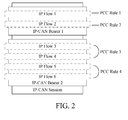
- FIG. 2 is a schematic view of a binding relationship among an IP-CAN session, IP-CAN bearers, PCC rules, and IP flows.
- FIG. 2 it is assumed that, in the establishment of the IP-CAN session, two IP-CAN bearers with different QoS requirements are established in the same IP-CAN session, so as to satisfy different QoS requirements, and each IP-CAN bearer may have a plurality of IP flows, for example, the user may download files from different servers at the same time.
- an IP-CAN bearer 1 includes two IP flows, that is, IP flow 1 and IP flow 2
- an IP-CAN bearer 2 includes four IP flows, that is, IP flow 3 to IP flow 6.
- the PCRF When determining PCC rules in the prior art, the PCRF is required to send a credit control answer (CCA) message to the PCEF/GW and carry PCC rules in the CCA message.
- CCA credit control answer
- the specific message format is shown as follows (for the sake of simplicity, not all parameters are listed):
- the event detection delivered by the PCRF to the PCEF/GW is directed to the entire IP-CAN session.
- the method in the prior art only performs event detection directed to the whole IP-CAN session, and thus causes the following defects.
- the PCRF may need to detect a status of a corresponding IP flow in a certain IP-CAN bearer or a certain PCC rule, instead of a status of the whole IP-CAN session.
- the PCEF/GW may detect IP-CAN bearers or IP flows which the PCRF is not interested in and then report the detection status thereof, but the PCRF does not need such information. In this way, redundant message exchange definitely occurs between the PCRF and the PCEF/GW, so that unnecessary load is increased between the two equipments.
- the PCRF is not interested in the situation of short-time interruption of file downloading via the IP-CAN Bearer 2 shown in FIG. 2 , but in the existing method, the PCEF/GW also reports the interruption information if the IP-CAN Bearer 2 is interrupted.
- a method of realizing event detection is provided, which is capable of performing small-granularity detection for a designated PCC rule and reducing a load of a system.
- a system of realizing event detection is provided, which is capable of performing small-granularity detection for a designated PCC rule and reducing a load of a system.
- an entity of realizing event detection is provided, which is capable of performing small-granularity detection for a designated PCC rule.
- a method of realizing event detection includes: carrying, by a PCPR, an Event-Trigger parameter bound to a designated PCC rule when sending PCC rules to a PCEF/GW; and detecting, by the PCEF/GW, the status of an IP-CAN bearer corresponding to the PCC rule associated with an event indicated by the Event-Trigger parameter after receiving the Event-Trigger parameter.
- a system of realizing event detection at least includes a PCEF/GW and a PCRF.
- the PCRPF is configured to carry an Event-Trigger parameter bound to a designated PCC rule when sending PCC rules to the PCEF/GW.
- the PCEF/GW is configured to detect a status of an IP-CAN bearer corresponding to the PCC rule associated with an event indicated by the Event-Trigger parameter after receiving the Event-Trigger parameter.
- a PCRF is provided.
- the PCRF is configured to send PCC rules to a PCEF and carry an Event-Trigger parameter bound to a designated PCC rule.
- a PCEF is provided.
- the PCEF is configured to receive a PCC rule bound to an Event-Trigger parameter, and is further configured to detect a status of an IP-CAN bearer corresponding to the PCC rule associated with an event indicated by the Event-Trigger parameter.
- the PCRF carries an Event-Trigger parameter bound to a designated PCC rule when sending PCC rules to the PCEF/GW, and the PCEF/GW detects a status of an IP-CAN bearer corresponding to the PCC rule of an event indicated by the Event-Trigger parameter after receiving the Event-Trigger parameter, so as to avoid detecting a status of an entire IP-CAN session in any situation, thereby performing small-granularity detection for the specific PCC rule, and reducing the load of the system.
- a PCRF carries an Event-Trigger parameter bound to a designated PCC rule when sending PCC rules to a PCEF/GW.
- the PCEF/GW detects a status of an IP-CAN bearer corresponding to the PCC rule associated with an event indicated by the Event-Trigger parameter after receiving the Event-Trigger parameter.
- the PCEF/GW In general, during the establishment of an IP-CAN session, after receiving an IP-CAN session establishment request from a UE, the PCEF/GW notifies the PCRF and sends a credit control request (CCR) message carrying an ID and an IP address of the UE to the PCRF.
- CCR credit control request
- the PCRF stores the information carried in the CCR message, further requests user subscription information from an SPR if the user subscription information is required, and then generates and stores a PCC rule.
- the PCRF delivers the PCC rule to the PCEF/GW through a CCA message.
- the PCEF/GW installs the rule and opens or closes a corresponding service data flow according to the rule, so as to ensure the corresponding QoS.
- the GW If the PCEF/GW performs the binding of an IP-CAN bearer to the PCC rule, the GW selects an appropriate IP-CAN bearer according to the requirement of the PCC rule. Finally, the PCEF/GW returns an IP-CAN session establishment response message to the UE.
- the CCR message further carries an IP-CAN bearer ID.
- the PCRF further needs to record a binding relationship between the PCC rule and the IP-CAN bearer ID when generating the PCC rule.
- the CCA message also indicates the binding relationship between the PCC rule and the IP-CAN bearer ID, that is, the bound PCC rule is executed on the IP-CAN bearer designated by the IP-CAN bearer ID.
- the PCEF/GW executes the PCC rule on the corresponding IP-CAN bearer according to the binding relationship between the PCC rule and the IP-CAN bearer ID of the PCRF.
- the PCEF/GW Upon receiving an IP-CAN session message initiated by the UE, the PCEF/GW requests to establish a new IP-CAN bearer, for example, establishing a second PDP context in the GPRS. During the establishment of the IP-CAN bearer, the PCEF/GW sends a CCR message to the PCRF to request a PCC rule for the IP-CAN bearer. If the PCRF performs the binding of the IP-CAN bearer to the rule, the GW further needs to report a new IP-CAN bearer ID.
- the PCRF stores information carried in the CCR message and associates the IP-CAN session with a specific AF session (one IP-CAN session may be associated with a plurality of AF sessions) by using the information received from the PCEF/GW and service information obtained from an AF. Afterwards, the PCRF generates and saves a new PCC rule according to the service information, user subscription information, operator configuration information, and other information.
- the PCRF carries the new PCC rule in a CCA message and returns the CCA message to the PCEF/GW. If the PCRF performs the binding of the IP-CAN bearer to the rule, the CCA message is further required to indicate that the PCC rule is executed on the newly established IP-CAN bearer.
- the PCEF/GW installs the rule and opens or closes a corresponding service data flow according to the rule, so as to ensure the corresponding QoS.
- the PCEF/GW returns an IP-CAN session response message to the UE.
- FIG. 2 is a schematic view of a binding relationship among an IP-CAN session, IP-CAN bearers, PCC rules, and IP flows.
- FIG. 2 it is assumed that, in the establishment of the IP-CAN session, two IP-CAN bearers with different QoS requirements are established in the same IP-CAN session, so as to satisfy different QoS requirements, and each IP-CAN bearer may have a plurality of IP flows, for example, the user may download files from different servers at the same time.
- an IP-CAN bearer 1 includes two IP flows, that is, IP flow 1 and IP flow 2
- an IP-CAN bearer 2 includes four IP flows, that is, IP flow 3 to IP flow 6.
- the PCRF not only delivers the PCC rules to the PCEF/GW, but also requests the PCEF/GW to detect certain events, for example, disconnection or recovery of connection of an IP-CAN bearer, GW failure, etc.
- the PCEF reports the event to the PCRF, and the PCRF determines a new PCC rule again according to the reported event.
- FIG. 3 is a flow chart of existing event detection and reporting. As shown in FIG. 3 , the existing method of realizing event detection includes the following steps.
- Step 300 a PCEF/GW sends a CCR message to a PCRF to request a PCC rule.
- Step 301 the PCRF returns a CCA message to the PCEF/GW.
- the CCA message carries a PCC rule, and an Event-Trigger parameter for instructing the PCEF/GW to detect a certain event.
- the specific message format is shown as follows (for the sake of simplicity, not all parameters are listed).
- the event detection delivered by the PCRF to the PCEF/GW is directed to the entire IP-CAN session.
- the Event-Trigger parameter indicates the event to be detected, and * denotes that zero to a plurality of parameters may exist.
- the content of the Event-Trigger parameter includes enumerated values of various events. If a plurality of events needs to be designated at the same time, a plurality of Event-Trigger parameters is required.
- the Charging-Rule-Install parameter indicates a rule to be executed, which is called a rule execution parameter for short.
- the parameter includes sub-parameters shown in Table 1.
- Table 1 Charging-Rule-Install :: ⁇ AVP Header: 1001 > *[ Charging-Rule-Definition ] (Definition of an installed rule, which is called a rule definition parameter for short) *[ Charging-Rule-Name ] (Name of the installed rule) *[ Charging-Rule-Base-Name ] (Name of a group of installed rules) [ Bearer-Identifier ] (IP-CAN bearer ID) *[ AVP ] (Attribute-value pair, identifying that the current parameter may be extended to include other parameters)
- the PCRF After dynamically generating the new PCC rule, the PCRF carries the new rule through the Charging-Rule-Definition sub-parameter. If the PCRF expects the PCEF/GW to execute a PCC rule that has been pre-defined on the GW, one or more corresponding PCC rules may be designated by using the Charging-Rule-Name or the Charging-Rule-Base-Name parameter. If the PCRF performs the IP-CAN bearer binding, the PCRF may further carry the Bearer-Identifier parameter for indicating that a corresponding PCC rule designated by the Charging-Rule-Definition, Charging-Rule-Name, or Charging-Rule-Base-Name is performed on the IP-CAN bearer.
- Charging-Rule-Definition The definition of the Charging-Rule-Definition sub-parameter is shown in Table 2.
- Table 2 Charging-Rule-Definition :: ⁇ AVP Header: 1003 > ⁇ Charging-Rule-Name ⁇ (Name of an installed rule) [ Service-Identifier ] (Service ID) [ Rating-Group ] (Charging group) *[ Flow-Description ] (IP quintuple definition) [ Flow-Status ] (IP flow status) [ Authorized-QoS ] (Authorized QoS) [ Reporting-Level ] (Charging reporting level) [ Online ] (Whether to perform online charging) [ Offline ] (Whether to perform offline charging) [ Metering-Method ] (Offline charging metering method) [ Precedence ] (Rule precedence) [ AF-Charging-Identifier ] (Application server charging *[ Flows ] (IP flow ID) *[ AVP ]
- Step 302 the PCEF/GW detects statuses of all IP-CAN bearers in the IP-CAN session according to the instruction from the PCRF.
- Step 303 upon detecting a certain event, the PCEF/GW reports the Event-Trigger parameter of the detected event in the IP-CAN session and the PCC rule corresponding to an IP-CAN bearer associated with the event to the PCRF.
- the PCEF/GW further reports a corresponding IP-CAN bearer ID.
- Step 304 the PCRF modifies the PCC rule or generates a new PCC rule according to the reported Event-Trigger parameter and sends the PCC rule to the PCEF/GW via a CCA message.
- the event detection may also be realized in a process of actively delivering a PCC rule by the PCRF.
- the PCRF carries an Event-Trigger parameter directed to the entire IP-CAN session in a re-authorization request (RAR) message and actively delivers a PCC rule, and then the PCEF/GW performs event detection in the entire IP-CAN session.
- RAR re-authorization request
- the RAR message is an existing message, which is a re-authorization request initiated in the case that the original rule needs to be modified due to the modification of user subscription data or change of service information.
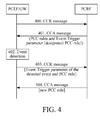
- FIG. 4 is a flow chart of event detection according to a first embodiment of the present invention. As shown in FIG. 4 , in this embodiment, a method of realizing event detection in the case that a PCEF/GW requests a PCC rule is provided, which includes the following steps.
- Step 400 the PCEF/GW sends a CCR message to a PCRF to request a PCC rule.
- Step 401 the PCRF returns a CCA message to the PCEF/GW.
- the CCA message carries PCC rules and an Event-Trigger parameter bound to a designated PCC rule.
- the PCC rules carried in the CCA message have a large range, for example, PCC rule 1, PCC rule 2, and PCC rule 3 may be carried as shown in FIG. 2 , and the PCEF/GW executes the PCC rules on designated IP-CAN bearers according to the PCC rules.
- the designated PCC rule bound to the Event-Trigger parameter carried in the CCA message has a small range, for example, the event detection is designated only for PCC rule 1. As seen from this step, the event detection requested by the PCEF/GW is directed to the designated PCC rule.
- Step 402 the PCEF/GW detects a status of an IP-CAN bearer corresponding to the designated PCC rule according to the instruction from the PCRF.
- Step 403 upon detecting a certain event, the PCEF/GW reports the Event-Trigger parameter of the detected event and the PCC rule associated with the detected event to the PCRF through a CCR message.
- Step 404 the PCRF modifies the PCC rule or generates a new PCC rule according to the reported Event-Trigger parameter and sends the PCC rule to the PCEF/GW through a CCA message.
- the CCA message may further carry a new Event-Trigger parameter that is bound to the modified PCC rule.
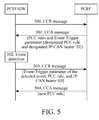
- FIG. 5 is a flow chart of event detection according to a second embodiment of the present invention.
- another method of realizing event detection in the case that a PCEF/GW requests a PCC rule is provided, in which a PCRF performs binding of an IP-CAN bearer to a PCC rule.
- the method includes the following steps.
- Step 500 the PCEF/GW sends a CCR message to the PCRF to request a PCC rule.
- Step 501 the PCRF returns a CCA message to the PCEF/GW.
- the CCA message carries PCC rules and an Event-Trigger parameter that is bound to a designated PCC rule and meanwhile bound to an IP-CAN bearer ID bound to the PCC rule.
- the event detection requested by the PCEF/GW is directed to the designated IP-CAN bearer.
- Step 502 the PCEF/GW detects a status of an IP-CAN bearer corresponding to the designated IP-CAN bearer ID according to the instruction from the PCRF.
- Step 503 upon detecting a certain event, the PCEF/GW reports the Event-Trigger parameter of the detected event, the PCC rule, and the IP-CAN bearer ID corresponding to the detected event to the PCRF.
- Step 504 the PCRF modifies the PCC rule or generates a new PCC rule according to the reported Event-Trigger parameter and sends the PCC rule to the PCEF/GW through a CCA message.
- the CCA message may further carry a new Event-Trigger parameter that is bound to the modified IP-CAN bearer ID.
- the PCRF may associate the requested event detection with a designated IP flow in a PCC rule, that is, carrying, in the CCA message, PCC rules and an Event-Trigger parameter that is bound to a designated PCC rule and further bound to a designated IP flow ID in the PCC rule, and then the PCEF detects a status of the designated IP flow in the designated PCC rule according to the instruction in the CCA message.
- the PCRF further carries a new Event-Trigger parameter bound to a modified IP flow ID in the CCA message and sends the CCA message to the PCEF/GW.
- FIG. 6 is a flow chart of event detection according to a third embodiment of the present invention. As shown in FIG. 6 , in this embodiment, a method of realizing event detection in the case that a PCRF actively delivers a PCC rule is provided, which includes the following steps.
- Step 600 the PCRF actively delivers PCC rules to a PCEF/GW through an RAR message and carries an Event-Trigger parameter bound to a designated PCC rule.
- the event detection actively delivered by the PCRF is directed to the designated PCC rule.
- Step 601 the PCEF/GW returns a re-authorization answer (RAA) message corresponding to the RAR message to the PCRF.
- RAA re-authorization answer
- Step 602 the PCEF/GW detects a status of an IP-CAN bearer corresponding to the designated PCC rule according to the instruction from the PCRF.
- Step 603 upon detecting a certain event, the PCEF/GW reports the Event-Trigger parameter of the detected event and the PCC rule associated with the detected event to the PCRF.
- Step 604 the PCRF modifies the PCC rule or generates a new PCC rule according to the reported Event-Trigger parameter and sends the PCC rule to the PCEF/GW through a CCA message.
- the CCA message may further carry a new Event-Trigger parameter that is bound to the modified PCC rule.
- FIG. 7 is a flow chart of event detection according to a fourth embodiment of the present invention. As shown in FIG. 7 , in this embodiment, another method of realizing event detection in the case that a PCRF actively delivers a PCC rule is provided, in which the PCRF performs binding of an IP-CAN bearer to a PCC rule. The method includes the following steps.
- Step 700 the PCRF actively delivers PCC rules to a PCEF/GW through an RAR message and carries an Event-Trigger parameter that is bound to a designated PCC rule and further bound to an IP-CAN bearer ID.
- the event detection actively delivered by the PCRF is directed to a designated IP-CAN bearer.
- Step 701 the PCEF/GW returns an RAA message the PCRF.
- Step 702 the PCEF/GW detects a status of an IP-CAN bearer corresponding to the designated IP-CAN bearer ID according to the instruction from the PCRF.
- Step 703 upon detecting a certain event, the PCEF/GW reports the Event-Trigger parameter of the detected event, the PCC rule associated with the detected event, and the corresponding IP-CAN bearer ID thereof to the PCRF.
- Step 704 the PCRF modifies the PCC rule or generates a new PCC rule according to the reported Event-Trigger parameter and sends the PCC rule to the PCEF/GW through a CCA message.
- the CCA message may further carry a new Event-Trigger parameter that is bound to the modified IP-CAN bearer ID.
- the PCRF may further associate the requested event detection with a designated IP flow in the PCC rule, that is, carrying, in the RAR message, PCC rules and an Event-Trigger parameter that is bound to a designated PCC rule and further bound to a designated IP flow ID in the PCC rule, and then the PCEF detects a status of the designated IP flow in the designated PCC rule according to the instruction of the CCA message.
- the PCRF may further carry a new Event-Trigger parameter bound to a modified IP flow ID through the CCA message and send it to the PCEF/GW.
- FIG. 8 is a flow chart of event detection according to a fifth embodiment of the present invention.
- a PCEF detects and reports a status of a packet flow when a PCEF/GW has the capability of detecting an IP flow, for example, detecting a corresponding Internet control message protocol (ICMP) packet.
- ICMP Internet control message protocol
- Steps 800 to 803 after establishing an IP-CAN bearer with the PCEF/GW, a UE sends an IP flow, for example, a real-time transmission protocol (RTP) flow in this embodiment, on the IP-CAN bearer, and then the PCEF/GW forwards the IP flow to an external network.
- the PCEF/GW receives an ICMP packet indicating that a route is unreachable from the external network and forwards the received ICMP packet to the UE.
- RTP real-time transmission protocol
- Step 804 after detecting that a PCRF has delivered an event directed to the currently sent IP flow, that is, receiving a trigger event from the external network including, for example, route unreachable information in this embodiment, the PCEF/GW reports the Event-Trigger parameter to the PCRF and associates the parameter with a designated IP flow in a PCC rule.
- the PCEF/GW carries the Event-Trigger parameter of the detected event, the PCC rule associated with the detected event, and the IP flow ID of the designated IP flow in a CCR message.
- Step 805 the PCRF modifies the PCC rule or generates a new PCC rule according to the reported Event-Trigger parameter and sends the PCC rule to the PCEF/GW through a CCA message.
- the CCA message may further carry a new Event-Trigger parameter that is bound to a packet flow ID in the modified PCC rule.
- Event-Trigger parameter may further be bound to an IP-CAN bearer ID or IP flow when the Event-Trigger parameter is delivered again.
- the present invention in order to realize the binding of an Event-Trigger parameter to a PCC rule, IP-CAN bearer ID, or IP flow ID, the present invention provides the following three realization methods.
- a new parameter for example, a PCC-Event-Trigger parameter is defined.
- the PCC-Event-Trigger parameter includes an Event-Trigger parameter, a PCC rule name, or IP-CAN bearer ID, or IP flow ID.
- the specific format is shown as follows.
- the PCRF performs the IP-CAN bearer binding
- zero to a plurality of IP-CAN bearer IDs is carried through the *[ Bearer-Identifier ], which indicates that the carried Event-Trigger parameters are bound to the IP-CAN bearer IDs, so that the PCEF/GW must detect statuses of the IP-CAN bearers designated by the IP-CAN bearer IDs.
- the IP flow ID (* [Flow-Identifier ]) parameter in the PCC-Event-Trigger parameter is a newly defined AVP.
- the format thereof is shown as follows.
- the CCA message or RAR message carries the following information.
- PCC-Event-Trigger parameter does not carry Bearer-Identifier, Charging-Rule-Name, Charging-Rule-Base-Name, and Flow-Identifier, it indicates that the carried Event-Trigger parameter is directed to the entire IP-CAN session, which is the same as that in the prior art.
- the Charging-Rule-Install parameter is extended, so that the Charging-Rule-Install parameter includes an Event-Trigger sub-parameter, which indicates that event detection is performed on an installed PCC rule (or rule group).
- Event-Trigger sub-parameter which indicates that event detection is performed on an installed PCC rule (or rule group).
- Event-Trigger parameter in Charging-Rule-Install is taken as a basis for event detection.
- a sub-parameter of the Charging-Rule-Install parameter that is, Charging-Rule-Definition parameter
- Charging-Rule-Definition parameter includes an Event-Trigger sub-parameter, which indicates that event detection is performed on a dynamically installed PCC rule.
- the specific format is shown as follows.
- the second method can only bind an Event-Trigger parameter to a dynamically installed PCC rule
- the PCRF is not required to designate the binding of the Event-Trigger parameter to a predefined rule, that is, the PCRF is not required to deliver event detection for the PCC rule pre-configured on the PCEF, since QoS level, charging information, detected event, and other information are generally defined in the predefined PCC rule.
- the Charging-Rule-Definition parameter may also be extended, so that a new Flow-Event-Trigger parameter is added to a sub-parameter thereof.
- the Flow-Event-Trigger parameter includes an Event-Trigger parameter and an IP flow ID. The specific format is shown as follows.
- the extended Charging-Rule-Definition parameter has the following format.
- the CCA message or RAR message carries the following information.
- the present invention binds an Event-Trigger parameter to a PCC rule and detects a status of an IP-CAN bearer corresponding to the PCC rule, so as to realize small-granularity detection for the specific PCC rule, reduce the redundant message exchange, and reduce the load of the system. Furthermore, the methods in the present invention realize small-granularity detection for a status of an IP-CAN bearer or IP flow by binding an Event-Trigger parameter to an IP-CAN ID or IP flow ID, so as to avoid the problem about too large granularity of the binding of event detection and the IP-CAN session and reduce the burden of the IP-CAN bearer detection and message exchange.
- a system of realizing event detection is further provided.
- the system at least includes a PCEF/GW and a PCRF.
- the PCRF is configured to carry an Event-Trigger parameter bound to a designated PCC rule when sending PCC rules to the PCEF/GW.
- the PCEF/GW is configured to detect a status of an IP-CAN bearer corresponding to the PCC rule associated with an event indicated by the Event-Trigger parameter after receiving the Event-Trigger parameter.
- the PCEF/GW is further configured to request a PCC rule from the PCRF. Upon detecting the occurrence of an event, the PCEF/GW further reports the Event-Trigger parameter of the detected event and the PCC rule associated with the detected event to the PCRF. The PCRF further modifies the PCC rule or generates a new PCC rule according to the reported Event-Trigger parameter and sends the PCC rule to the PCEF/GW.
- the PCRF further sends a new Event-Trigger parameter bound to the modified PCC rule to the PCEF/GW.
- the PCRF further performs the binding of an IP-CAN bearer to a PCC rule.
- the PCRF further binds the Event-Trigger parameter to an IP-CAN bearer ID of an IP-CAN bearer bound to the PCC rule, and then the PCEF/GW further detects a status of an IP-CAN bearer denoted by the designated IP-CAN bearer ID.
- the PCEF/GW further requests a PCC rule from the PCRF.
- the PCEF/GW Upon detecting the occurrence of an event, the PCEF/GW further reports the Event-Trigger parameter of the detected event and the PCC rule and the IP-CAN bearer ID corresponding to the detected event to the PCRF.
- the PCRF further modifies the PCC rule or generates a new PCC rule according to the reported Event-Trigger parameter and sends the PCC rule to the PCEF/GW.
- the PCRF further sends a new Event-Trigger parameter bound to the modified IP-CAN bearer ID to the PCEF/GW.
- the PCRF further binds the Event-Trigger parameter to a designated IP flow ID in the PCC rule, and then the PCEF/GW further detects a status of an IP flow denoted by the designated IP flow ID in the designated PCC rule.
- the PCEF/GW requests a PCC rule from the PCRF. Upon detecting the occurrence of an event, the PCEF/GW further reports the Event-Trigger parameter of the detected event, the PCC rule associated with the detected event, and the designated IP flow ID in the PCC rule to the PCRF. The PCRF further modifies the PCC rule or generates a new PCC rule according to the reported Event-Trigger parameter and sends the PCC rule to the PCEF/GW.
- the PCRF further sends a new Event-Trigger parameter bound to a modified IP flow ID to the PCEF/GW.
Landscapes
- Engineering & Computer Science (AREA)
- Computer Networks & Wireless Communication (AREA)
- Signal Processing (AREA)
- Computer Security & Cryptography (AREA)
- Mobile Radio Communication Systems (AREA)
- Data Exchanges In Wide-Area Networks (AREA)
Applications Claiming Priority (2)
| Application Number | Priority Date | Filing Date | Title |
|---|---|---|---|
| CN200710103109.8A CN101291233B (zh) | 2007-04-20 | 2007-04-20 | 一种实现事件检测的方法及系统 |
| PCT/CN2008/070745 WO2008128470A1 (fr) | 2007-04-20 | 2008-04-17 | Procédé, système et entité de réalisation de détection d'événement |
Publications (3)
| Publication Number | Publication Date |
|---|---|
| EP2146458A1 true EP2146458A1 (fr) | 2010-01-20 |
| EP2146458A4 EP2146458A4 (fr) | 2010-11-17 |
| EP2146458B1 EP2146458B1 (fr) | 2016-07-27 |
Family
ID=39875098
Family Applications (1)
| Application Number | Title | Priority Date | Filing Date |
|---|---|---|---|
| EP08734103.8A Active EP2146458B1 (fr) | 2007-04-20 | 2008-04-17 | Procédé, système et entité de réalisation de détection d'événement |
Country Status (5)
| Country | Link |
|---|---|
| US (1) | US8509091B2 (fr) |
| EP (1) | EP2146458B1 (fr) |
| CN (1) | CN101291233B (fr) |
| CA (1) | CA2682979C (fr) |
| WO (1) | WO2008128470A1 (fr) |
Cited By (4)
| Publication number | Priority date | Publication date | Assignee | Title |
|---|---|---|---|---|
| WO2010077684A1 (fr) * | 2008-12-09 | 2010-07-08 | Qualcomm Incorporated | Réalisation d'une optimisation de flux de paquet avec commande de politique et de facturation |
| WO2012004634A1 (fr) * | 2010-07-09 | 2012-01-12 | Telefonaktiebolaget L M Ericsson (Publ) | Procédé et appareil de classification de trafic |
| WO2012065657A1 (fr) | 2010-11-19 | 2012-05-24 | Telefonica, S.A. | Procédé pour un contrôle d'autorisation/blocage et de taxation de flux de données dans un réseau optimisé gx |
| EP2547046A4 (fr) * | 2010-04-29 | 2013-01-23 | Huawei Tech Co Ltd | Procédé, appareil et système de corrélation de sessions |
Families Citing this family (35)
| Publication number | Priority date | Publication date | Assignee | Title |
|---|---|---|---|---|
| CN101291233B (zh) | 2007-04-20 | 2011-04-20 | 华为技术有限公司 | 一种实现事件检测的方法及系统 |
| CN101730049B (zh) * | 2009-06-16 | 2013-03-27 | 中兴通讯股份有限公司 | 实现计费控制的方法及系统 |
| CN102036208A (zh) * | 2009-09-24 | 2011-04-27 | 中兴通讯股份有限公司 | 获取服务通用无线分组业务支持节点地址的方法及系统 |
| CN101801038B (zh) * | 2009-12-28 | 2014-04-02 | 华为技术有限公司 | 用户会话策略控制方法、装置及系统 |
| US9350876B2 (en) * | 2010-01-04 | 2016-05-24 | Tekelec, Inc. | Methods, systems, and computer readable media for detecting initiation of a service data flow using a Gx rule |
| CN102137368B (zh) * | 2010-01-26 | 2015-01-28 | 中兴通讯股份有限公司 | 增强的策略和计费控制的方法及系统、pcc系统 |
| US9319318B2 (en) | 2010-03-15 | 2016-04-19 | Tekelec, Inc. | Methods, systems, and computer readable media for performing PCRF-based user information pass through |
| US9603058B2 (en) * | 2010-03-15 | 2017-03-21 | Tekelec, Inc. | Methods, systems, and computer readable media for triggering a service node to initiate a session with a policy and charging rules function |
| CN102238512B (zh) * | 2010-04-29 | 2015-11-25 | 中兴通讯股份有限公司 | 机器类通信mtc的策略应用方法及策略和计费执行实体 |
| CN101848453B (zh) * | 2010-05-19 | 2015-01-28 | 中兴通讯股份有限公司 | 动态调整数据传输的方法和装置 |
| US8645510B2 (en) * | 2010-05-20 | 2014-02-04 | Alcatel Lucent | Method of distributing PCC rules among IP-connectivity access network (IP-CAN) bearers |
| US8406137B2 (en) * | 2010-06-28 | 2013-03-26 | Alcatel Lucent | Method and system for generating PCC rules based on service requests |
| US9749881B2 (en) * | 2010-07-21 | 2017-08-29 | Telefonaktiebolaget L M Ericsson | Technique for packet flow analysis |
| US9716629B2 (en) * | 2010-10-06 | 2017-07-25 | Nokia Solutions And Networks Oy | Capability negotiation and control |
| WO2012079647A1 (fr) * | 2010-12-17 | 2012-06-21 | Telefonaktiebolaget Lm Ericsson (Publ) | Commande de politique et/ou de facturation |
| US20120233335A1 (en) * | 2011-03-08 | 2012-09-13 | Alcatel Lucent Canada Inc. | Auxiliary host and sessions |
| WO2011157137A2 (fr) * | 2011-05-31 | 2011-12-22 | 华为技术有限公司 | Procédé de contrôle de politique, appareil et système de communication |
| WO2013097125A1 (fr) * | 2011-12-28 | 2013-07-04 | 华为技术有限公司 | Procédé, dispositif et système d'indication d'un utilisateur de pcc |
| RU2582580C2 (ru) * | 2012-01-20 | 2016-04-27 | Хуавэй Текнолоджиз Ко., Лтд. | Способ, устройство и система для управления качеством обслуживания |
| US9848090B2 (en) * | 2012-01-24 | 2017-12-19 | Alcatel Lucent | Offline charging per service data flow |
| CN104662935B (zh) * | 2012-06-25 | 2018-07-10 | 爱立信(中国)通信有限公司 | 机器对机器群的策略控制 |
| EP2936734A4 (fr) * | 2012-12-21 | 2015-12-02 | Ericsson Telefon Ab L M | Procédé et appareil de taxation de services et de contrôle dans un réseau de communication |
| US9173158B2 (en) * | 2013-03-08 | 2015-10-27 | Tellabs Operations, Inc. | Method and apparatus for improving LTE enhanced packet core architecture using openflow network controller |
| WO2015013485A2 (fr) | 2013-07-24 | 2015-01-29 | Convida Wireless, Llc | Systèmes et procédés de décompte de domaine de service |
| KR101512646B1 (ko) * | 2013-09-12 | 2015-04-16 | 에스케이 텔레콤주식회사 | 단말기 정보에 근거한 위치 변경정보 제공 제어방법 및 장치 |
| US9088508B1 (en) * | 2014-04-11 | 2015-07-21 | Level 3 Communications, Llc | Incremental application of resources to network traffic flows based on heuristics and business policies |
| CN105162610A (zh) * | 2014-06-16 | 2015-12-16 | 中兴通讯股份有限公司 | 接入网信息发送方法及装置 |
| EP3425992B1 (fr) * | 2016-03-31 | 2020-11-04 | Huawei Technologies Co., Ltd. | Procédé et dispositif de rapport d'événement |
| CN106814286B (zh) * | 2017-02-10 | 2019-12-31 | 国网山东省电力公司 | 基于多元故障采集的配电网故障定位系统、方法及服务器 |
| CN106872856B (zh) * | 2017-03-01 | 2019-12-24 | 国网山东省电力公司 | 基于多元故障采集的配电网故障主动抢修系统、方法 |
| CN110768810B (zh) * | 2018-07-25 | 2021-03-30 | 华为技术有限公司 | 确定报文流描述的方法、装置和系统 |
| CN109743789B (zh) * | 2018-11-22 | 2021-04-09 | 京信通信系统(中国)有限公司 | 一种清除Gx接口残留会话的方法和装置 |
| EP3734385B1 (fr) * | 2019-05-02 | 2022-10-05 | Siemens Aktiengesellschaft | Procédé de traitement assisté par ordinateur des messages d'état dans une installation d'automatisation |
| CN114866530B (zh) * | 2022-03-28 | 2024-04-19 | 深圳优地科技有限公司 | 升级数据包的下载方法、设备以及计算机存储介质 |
| JP7403618B1 (ja) | 2022-12-15 | 2023-12-22 | Kddi株式会社 | 通信装置 |
Family Cites Families (8)
| Publication number | Priority date | Publication date | Assignee | Title |
|---|---|---|---|---|
| CN1328877C (zh) * | 2001-12-03 | 2007-07-25 | 中兴通讯股份有限公司 | 共享线程实现和调度方法 |
| CN100397831C (zh) * | 2004-01-16 | 2008-06-25 | 华为技术有限公司 | 一种实现ip多媒体业务监听的系统及方法 |
| CN1303781C (zh) * | 2004-04-01 | 2007-03-07 | 华为技术有限公司 | 一种分组数据业务的计费控制方法 |
| CN1735023A (zh) * | 2004-08-10 | 2006-02-15 | 华为技术有限公司 | 一种进行重鉴权及重鉴权事件和触发事件的处理方法 |
| US7843860B2 (en) | 2004-11-10 | 2010-11-30 | Telefonaktiebolaget L M Ericsson (Publ) | Arrangement, nodes and a method relating to services access over a communication system |
| WO2007026268A1 (fr) | 2005-08-31 | 2007-03-08 | Nokia Corporation | Mobilite inter-acces et gestion de service |
| US9871872B2 (en) * | 2007-04-13 | 2018-01-16 | Nokia Technologies Oy | Mechanism for executing server discovery |
| CN101291233B (zh) | 2007-04-20 | 2011-04-20 | 华为技术有限公司 | 一种实现事件检测的方法及系统 |
-
2007
- 2007-04-20 CN CN200710103109.8A patent/CN101291233B/zh active Active
-
2008
- 2008-04-17 CA CA2682979A patent/CA2682979C/fr active Active
- 2008-04-17 WO PCT/CN2008/070745 patent/WO2008128470A1/fr not_active Ceased
- 2008-04-17 EP EP08734103.8A patent/EP2146458B1/fr active Active
-
2009
- 2009-10-20 US US12/582,511 patent/US8509091B2/en active Active
Non-Patent Citations (3)
| Title |
|---|
| "3rd Generation Partnership Project; Technical Specification Group Services and System Aspects; Policy and charging control architecture (Release 7)" 3GPP STANDARD; 3GPP TS 23.203, 3RD GENERATION PARTNERSHIP PROJECT (3GPP), MOBILE COMPETENCE CENTRE ; 650, ROUTE DES LUCIOLES ; F-06921 SOPHIA-ANTIPOLIS CEDEX ; FRANCE, no. V7.2.0, 1 March 2007 (2007-03-01), pages 1-72, XP050363011 * |
| NOKIA SIEMENS NETWORKS: "Removing of event triggers" 3GPP DRAFT; C3-070326, 3RD GENERATION PARTNERSHIP PROJECT (3GPP), MOBILE COMPETENCE CENTRE ; 650, ROUTE DES LUCIOLES ; F-06921 SOPHIA-ANTIPOLIS CEDEX ; FRANCE, vol. CT WG3, no. Frankfurt; 20070402, 2 April 2007 (2007-04-02), XP050031717 [retrieved on 2007-04-02] * |
| See also references of WO2008128470A1 * |
Cited By (9)
| Publication number | Priority date | Publication date | Assignee | Title |
|---|---|---|---|---|
| WO2010077684A1 (fr) * | 2008-12-09 | 2010-07-08 | Qualcomm Incorporated | Réalisation d'une optimisation de flux de paquet avec commande de politique et de facturation |
| US8325638B2 (en) | 2008-12-09 | 2012-12-04 | Qualcomm Incorporated | Performing packet flow optimization with policy and charging control |
| US8582480B2 (en) | 2008-12-09 | 2013-11-12 | Qualcomm Incorporated | Performing packet flow optimization with policy and charging control |
| EP2547046A4 (fr) * | 2010-04-29 | 2013-01-23 | Huawei Tech Co Ltd | Procédé, appareil et système de corrélation de sessions |
| US9209999B2 (en) | 2010-04-29 | 2015-12-08 | Huawei Technologies Co., Ltd. | Method, apparatus, and system for associating sessions |
| EP3276888A1 (fr) * | 2010-04-29 | 2018-01-31 | Huawei Technologies Co., Ltd. | Procédé, appareil et système d'association de sessions |
| WO2012004634A1 (fr) * | 2010-07-09 | 2012-01-12 | Telefonaktiebolaget L M Ericsson (Publ) | Procédé et appareil de classification de trafic |
| US9294380B2 (en) | 2010-07-09 | 2016-03-22 | Telefonaktiebolaget L M Ericsson (Publ) | Method and apparatus for traffic classification |
| WO2012065657A1 (fr) | 2010-11-19 | 2012-05-24 | Telefonica, S.A. | Procédé pour un contrôle d'autorisation/blocage et de taxation de flux de données dans un réseau optimisé gx |
Also Published As
| Publication number | Publication date |
|---|---|
| CA2682979C (fr) | 2012-06-12 |
| CN101291233A (zh) | 2008-10-22 |
| CA2682979A1 (fr) | 2008-10-30 |
| US20100039941A1 (en) | 2010-02-18 |
| US8509091B2 (en) | 2013-08-13 |
| EP2146458B1 (fr) | 2016-07-27 |
| WO2008128470A1 (fr) | 2008-10-30 |
| CN101291233B (zh) | 2011-04-20 |
| EP2146458A4 (fr) | 2010-11-17 |
Similar Documents
| Publication | Publication Date | Title |
|---|---|---|
| US8509091B2 (en) | Method, system and entity of realizing event detection | |
| EP2339781B1 (fr) | Procédé et système pour réaliser la commande de politique et de facturation sur la scène de multiples réseaux de données par paquets (pdn) | |
| US9503483B2 (en) | Method and apparatuses for identifying and reporting quality of service rules applicable to a communication session | |
| US8885568B2 (en) | Policy application method for machine type communication, and policy and charging enforcement function | |
| US9013979B2 (en) | High-available policy and charging-control in geographical redundancy PCRF configurations | |
| US9191960B2 (en) | Methods and apparatus for mitigating service interruption | |
| US20100186064A1 (en) | Method and device for obtaining capabilities of policy and charging enforcement function | |
| CN102625272B (zh) | 一种支持流检测功能的用量监控方法及系统 | |
| US9860752B2 (en) | Handling of authorization requests for a packet-based service in a mobile network | |
| EP2521305B1 (fr) | Procédé, dispositif et système destinés à commander une police de séance d'utilisateur | |
| US20120059944A1 (en) | Establishing a communication session | |
| CN102223240B (zh) | 提供服务方法、业务代理装置、策略和计费规则功能装置 | |
| WO2010051853A1 (fr) | Appareil de contrôle de politiques et procédé permettant de transférer des informations relatives aux règles de politiques | |
| CN101646193B (zh) | 一种状态信息的处理方法、装置、系统及客户端 | |
| CN101374260A (zh) | Pcc规则和承载关联的实现方法、装置和系统 | |
| US9820183B2 (en) | User plane congestion control | |
| CN102123035B (zh) | 策略和计费规则功能实体的选择方法、装置及系统 | |
| US9485106B2 (en) | Method for processing TDF session and PCRF | |
| JP2015511432A (ja) | 移動パケットコアネットワークにおけるセッション終了 | |
| CN103139798B (zh) | 一种保障端到端会话业务质量的方法、pcrf及af | |
| CN101296094A (zh) | 检测承载事件的方法、系统和装置 | |
| CN101572954A (zh) | 释放会话的方法、装置和系统 | |
| JP2016154389A (ja) | 移動パケットコアネットワークにおけるセッション終了 |
Legal Events
| Date | Code | Title | Description |
|---|---|---|---|
| PUAI | Public reference made under article 153(3) epc to a published international application that has entered the european phase |
Free format text: ORIGINAL CODE: 0009012 |
|
| 17P | Request for examination filed |
Effective date: 20091103 |
|
| AK | Designated contracting states |
Kind code of ref document: A1 Designated state(s): AT BE BG CH CY CZ DE DK EE ES FI FR GB GR HR HU IE IS IT LI LT LU LV MC MT NL NO PL PT RO SE SI SK TR |
|
| AX | Request for extension of the european patent |
Extension state: AL BA MK RS |
|
| DAX | Request for extension of the european patent (deleted) | ||
| A4 | Supplementary search report drawn up and despatched |
Effective date: 20101014 |
|
| RIC1 | Information provided on ipc code assigned before grant |
Ipc: H04L 29/06 20060101ALI20101008BHEP Ipc: H04L 12/14 20060101AFI20081113BHEP |
|
| 17Q | First examination report despatched |
Effective date: 20130626 |
|
| GRAP | Despatch of communication of intention to grant a patent |
Free format text: ORIGINAL CODE: EPIDOSNIGR1 |
|
| INTG | Intention to grant announced |
Effective date: 20160204 |
|
| GRAS | Grant fee paid |
Free format text: ORIGINAL CODE: EPIDOSNIGR3 |
|
| GRAA | (expected) grant |
Free format text: ORIGINAL CODE: 0009210 |
|
| AK | Designated contracting states |
Kind code of ref document: B1 Designated state(s): AT BE BG CH CY CZ DE DK EE ES FI FR GB GR HR HU IE IS IT LI LT LU LV MC MT NL NO PL PT RO SE SI SK TR |
|
| REG | Reference to a national code |
Ref country code: GB Ref legal event code: FG4D |
|
| REG | Reference to a national code |
Ref country code: CH Ref legal event code: EP |
|
| REG | Reference to a national code |
Ref country code: AT Ref legal event code: REF Ref document number: 816569 Country of ref document: AT Kind code of ref document: T Effective date: 20160815 |
|
| REG | Reference to a national code |
Ref country code: IE Ref legal event code: FG4D |
|
| REG | Reference to a national code |
Ref country code: DE Ref legal event code: R096 Ref document number: 602008045318 Country of ref document: DE |
|
| REG | Reference to a national code |
Ref country code: LT Ref legal event code: MG4D |
|
| REG | Reference to a national code |
Ref country code: NL Ref legal event code: MP Effective date: 20160727 |
|
| REG | Reference to a national code |
Ref country code: AT Ref legal event code: MK05 Ref document number: 816569 Country of ref document: AT Kind code of ref document: T Effective date: 20160727 |
|
| PG25 | Lapsed in a contracting state [announced via postgrant information from national office to epo] |
Ref country code: HR Free format text: LAPSE BECAUSE OF FAILURE TO SUBMIT A TRANSLATION OF THE DESCRIPTION OR TO PAY THE FEE WITHIN THE PRESCRIBED TIME-LIMIT Effective date: 20160727 Ref country code: FI Free format text: LAPSE BECAUSE OF FAILURE TO SUBMIT A TRANSLATION OF THE DESCRIPTION OR TO PAY THE FEE WITHIN THE PRESCRIBED TIME-LIMIT Effective date: 20160727 Ref country code: LT Free format text: LAPSE BECAUSE OF FAILURE TO SUBMIT A TRANSLATION OF THE DESCRIPTION OR TO PAY THE FEE WITHIN THE PRESCRIBED TIME-LIMIT Effective date: 20160727 Ref country code: NO Free format text: LAPSE BECAUSE OF FAILURE TO SUBMIT A TRANSLATION OF THE DESCRIPTION OR TO PAY THE FEE WITHIN THE PRESCRIBED TIME-LIMIT Effective date: 20161027 Ref country code: NL Free format text: LAPSE BECAUSE OF FAILURE TO SUBMIT A TRANSLATION OF THE DESCRIPTION OR TO PAY THE FEE WITHIN THE PRESCRIBED TIME-LIMIT Effective date: 20160727 Ref country code: IT Free format text: LAPSE BECAUSE OF FAILURE TO SUBMIT A TRANSLATION OF THE DESCRIPTION OR TO PAY THE FEE WITHIN THE PRESCRIBED TIME-LIMIT Effective date: 20160727 Ref country code: IS Free format text: LAPSE BECAUSE OF FAILURE TO SUBMIT A TRANSLATION OF THE DESCRIPTION OR TO PAY THE FEE WITHIN THE PRESCRIBED TIME-LIMIT Effective date: 20161127 |
|
| PG25 | Lapsed in a contracting state [announced via postgrant information from national office to epo] |
Ref country code: PT Free format text: LAPSE BECAUSE OF FAILURE TO SUBMIT A TRANSLATION OF THE DESCRIPTION OR TO PAY THE FEE WITHIN THE PRESCRIBED TIME-LIMIT Effective date: 20161128 Ref country code: GR Free format text: LAPSE BECAUSE OF FAILURE TO SUBMIT A TRANSLATION OF THE DESCRIPTION OR TO PAY THE FEE WITHIN THE PRESCRIBED TIME-LIMIT Effective date: 20161028 Ref country code: PL Free format text: LAPSE BECAUSE OF FAILURE TO SUBMIT A TRANSLATION OF THE DESCRIPTION OR TO PAY THE FEE WITHIN THE PRESCRIBED TIME-LIMIT Effective date: 20160727 Ref country code: LV Free format text: LAPSE BECAUSE OF FAILURE TO SUBMIT A TRANSLATION OF THE DESCRIPTION OR TO PAY THE FEE WITHIN THE PRESCRIBED TIME-LIMIT Effective date: 20160727 Ref country code: AT Free format text: LAPSE BECAUSE OF FAILURE TO SUBMIT A TRANSLATION OF THE DESCRIPTION OR TO PAY THE FEE WITHIN THE PRESCRIBED TIME-LIMIT Effective date: 20160727 Ref country code: ES Free format text: LAPSE BECAUSE OF FAILURE TO SUBMIT A TRANSLATION OF THE DESCRIPTION OR TO PAY THE FEE WITHIN THE PRESCRIBED TIME-LIMIT Effective date: 20160727 Ref country code: BE Free format text: LAPSE BECAUSE OF FAILURE TO SUBMIT A TRANSLATION OF THE DESCRIPTION OR TO PAY THE FEE WITHIN THE PRESCRIBED TIME-LIMIT Effective date: 20160727 Ref country code: SE Free format text: LAPSE BECAUSE OF FAILURE TO SUBMIT A TRANSLATION OF THE DESCRIPTION OR TO PAY THE FEE WITHIN THE PRESCRIBED TIME-LIMIT Effective date: 20160727 |
|
| PG25 | Lapsed in a contracting state [announced via postgrant information from national office to epo] |
Ref country code: EE Free format text: LAPSE BECAUSE OF FAILURE TO SUBMIT A TRANSLATION OF THE DESCRIPTION OR TO PAY THE FEE WITHIN THE PRESCRIBED TIME-LIMIT Effective date: 20160727 Ref country code: RO Free format text: LAPSE BECAUSE OF FAILURE TO SUBMIT A TRANSLATION OF THE DESCRIPTION OR TO PAY THE FEE WITHIN THE PRESCRIBED TIME-LIMIT Effective date: 20160727 |
|
| REG | Reference to a national code |
Ref country code: DE Ref legal event code: R097 Ref document number: 602008045318 Country of ref document: DE |
|
| PG25 | Lapsed in a contracting state [announced via postgrant information from national office to epo] |
Ref country code: SK Free format text: LAPSE BECAUSE OF FAILURE TO SUBMIT A TRANSLATION OF THE DESCRIPTION OR TO PAY THE FEE WITHIN THE PRESCRIBED TIME-LIMIT Effective date: 20160727 Ref country code: DK Free format text: LAPSE BECAUSE OF FAILURE TO SUBMIT A TRANSLATION OF THE DESCRIPTION OR TO PAY THE FEE WITHIN THE PRESCRIBED TIME-LIMIT Effective date: 20160727 Ref country code: CZ Free format text: LAPSE BECAUSE OF FAILURE TO SUBMIT A TRANSLATION OF THE DESCRIPTION OR TO PAY THE FEE WITHIN THE PRESCRIBED TIME-LIMIT Effective date: 20160727 Ref country code: BG Free format text: LAPSE BECAUSE OF FAILURE TO SUBMIT A TRANSLATION OF THE DESCRIPTION OR TO PAY THE FEE WITHIN THE PRESCRIBED TIME-LIMIT Effective date: 20161027 |
|
| PLBE | No opposition filed within time limit |
Free format text: ORIGINAL CODE: 0009261 |
|
| STAA | Information on the status of an ep patent application or granted ep patent |
Free format text: STATUS: NO OPPOSITION FILED WITHIN TIME LIMIT |
|
| 26N | No opposition filed |
Effective date: 20170502 |
|
| PG25 | Lapsed in a contracting state [announced via postgrant information from national office to epo] |
Ref country code: SI Free format text: LAPSE BECAUSE OF FAILURE TO SUBMIT A TRANSLATION OF THE DESCRIPTION OR TO PAY THE FEE WITHIN THE PRESCRIBED TIME-LIMIT Effective date: 20160727 |
|
| REG | Reference to a national code |
Ref country code: CH Ref legal event code: PL |
|
| REG | Reference to a national code |
Ref country code: IE Ref legal event code: MM4A |
|
| REG | Reference to a national code |
Ref country code: FR Ref legal event code: ST Effective date: 20171229 |
|
| PG25 | Lapsed in a contracting state [announced via postgrant information from national office to epo] |
Ref country code: FR Free format text: LAPSE BECAUSE OF NON-PAYMENT OF DUE FEES Effective date: 20170502 Ref country code: MC Free format text: LAPSE BECAUSE OF FAILURE TO SUBMIT A TRANSLATION OF THE DESCRIPTION OR TO PAY THE FEE WITHIN THE PRESCRIBED TIME-LIMIT Effective date: 20160727 |
|
| PG25 | Lapsed in a contracting state [announced via postgrant information from national office to epo] |
Ref country code: LU Free format text: LAPSE BECAUSE OF NON-PAYMENT OF DUE FEES Effective date: 20170417 Ref country code: LI Free format text: LAPSE BECAUSE OF NON-PAYMENT OF DUE FEES Effective date: 20170430 Ref country code: CH Free format text: LAPSE BECAUSE OF NON-PAYMENT OF DUE FEES Effective date: 20170430 |
|
| PG25 | Lapsed in a contracting state [announced via postgrant information from national office to epo] |
Ref country code: IE Free format text: LAPSE BECAUSE OF NON-PAYMENT OF DUE FEES Effective date: 20170417 |
|
| PG25 | Lapsed in a contracting state [announced via postgrant information from national office to epo] |
Ref country code: MT Free format text: LAPSE BECAUSE OF NON-PAYMENT OF DUE FEES Effective date: 20170417 |
|
| PG25 | Lapsed in a contracting state [announced via postgrant information from national office to epo] |
Ref country code: HU Free format text: LAPSE BECAUSE OF FAILURE TO SUBMIT A TRANSLATION OF THE DESCRIPTION OR TO PAY THE FEE WITHIN THE PRESCRIBED TIME-LIMIT; INVALID AB INITIO Effective date: 20080417 |
|
| PG25 | Lapsed in a contracting state [announced via postgrant information from national office to epo] |
Ref country code: CY Free format text: LAPSE BECAUSE OF NON-PAYMENT OF DUE FEES Effective date: 20160727 |
|
| PG25 | Lapsed in a contracting state [announced via postgrant information from national office to epo] |
Ref country code: TR Free format text: LAPSE BECAUSE OF FAILURE TO SUBMIT A TRANSLATION OF THE DESCRIPTION OR TO PAY THE FEE WITHIN THE PRESCRIBED TIME-LIMIT Effective date: 20160727 |
|
| P01 | Opt-out of the competence of the unified patent court (upc) registered |
Effective date: 20230524 |
|
| PGFP | Annual fee paid to national office [announced via postgrant information from national office to epo] |
Ref country code: DE Payment date: 20250305 Year of fee payment: 18 |
|
| PGFP | Annual fee paid to national office [announced via postgrant information from national office to epo] |
Ref country code: GB Payment date: 20260310 Year of fee payment: 19 |