EP2147530B1 - Procédé d'établissement d'un chemin de liaison logique dans un réseau de communication à commutation de paquets - Google Patents
Procédé d'établissement d'un chemin de liaison logique dans un réseau de communication à commutation de paquets Download PDFInfo
- Publication number
- EP2147530B1 EP2147530B1 EP08749812.7A EP08749812A EP2147530B1 EP 2147530 B1 EP2147530 B1 EP 2147530B1 EP 08749812 A EP08749812 A EP 08749812A EP 2147530 B1 EP2147530 B1 EP 2147530B1
- Authority
- EP
- European Patent Office
- Prior art keywords
- network node
- data transmission
- bandwidth
- path
- data
- Prior art date
- Legal status (The legal status is an assumption and is not a legal conclusion. Google has not performed a legal analysis and makes no representation as to the accuracy of the status listed.)
- Not-in-force
Links
Images
Classifications
-
- H—ELECTRICITY
- H04—ELECTRIC COMMUNICATION TECHNIQUE
- H04L—TRANSMISSION OF DIGITAL INFORMATION, e.g. TELEGRAPHIC COMMUNICATION
- H04L45/00—Routing or path finding of packets in data switching networks
- H04L45/12—Shortest path evaluation
- H04L45/125—Shortest path evaluation based on throughput or bandwidth
-
- H—ELECTRICITY
- H04—ELECTRIC COMMUNICATION TECHNIQUE
- H04L—TRANSMISSION OF DIGITAL INFORMATION, e.g. TELEGRAPHIC COMMUNICATION
- H04L12/00—Data switching networks
- H04L12/28—Data switching networks characterised by path configuration, e.g. LAN [Local Area Networks] or WAN [Wide Area Networks]
-
- H—ELECTRICITY
- H04—ELECTRIC COMMUNICATION TECHNIQUE
- H04L—TRANSMISSION OF DIGITAL INFORMATION, e.g. TELEGRAPHIC COMMUNICATION
- H04L45/00—Routing or path finding of packets in data switching networks
- H04L45/02—Topology update or discovery
-
- H—ELECTRICITY
- H04—ELECTRIC COMMUNICATION TECHNIQUE
- H04L—TRANSMISSION OF DIGITAL INFORMATION, e.g. TELEGRAPHIC COMMUNICATION
- H04L45/00—Routing or path finding of packets in data switching networks
- H04L45/02—Topology update or discovery
- H04L45/10—Routing in connection-oriented networks, e.g. X.25 or ATM
-
- H—ELECTRICITY
- H04—ELECTRIC COMMUNICATION TECHNIQUE
- H04L—TRANSMISSION OF DIGITAL INFORMATION, e.g. TELEGRAPHIC COMMUNICATION
- H04L45/00—Routing or path finding of packets in data switching networks
- H04L45/24—Multipath
-
- H—ELECTRICITY
- H04—ELECTRIC COMMUNICATION TECHNIQUE
- H04L—TRANSMISSION OF DIGITAL INFORMATION, e.g. TELEGRAPHIC COMMUNICATION
- H04L45/00—Routing or path finding of packets in data switching networks
- H04L45/50—Routing or path finding of packets in data switching networks using label swapping, e.g. multi-protocol label switch [MPLS]
-
- H—ELECTRICITY
- H04—ELECTRIC COMMUNICATION TECHNIQUE
- H04L—TRANSMISSION OF DIGITAL INFORMATION, e.g. TELEGRAPHIC COMMUNICATION
- H04L47/00—Traffic control in data switching networks
- H04L47/10—Flow control; Congestion control
- H04L47/12—Avoiding congestion; Recovering from congestion
- H04L47/125—Avoiding congestion; Recovering from congestion by balancing the load, e.g. traffic engineering
-
- H—ELECTRICITY
- H04—ELECTRIC COMMUNICATION TECHNIQUE
- H04L—TRANSMISSION OF DIGITAL INFORMATION, e.g. TELEGRAPHIC COMMUNICATION
- H04L2212/00—Encapsulation of packets
Definitions
- the invention is in the technical field of communication networks and relates to a method for establishing a logical connection path between a start network node and a destination network node in a connection-oriented communication network with packet switching.
- the invention further relates to a method based on the method for establishing a logical connection path for transmitting data packets between a start network node and a destination network node of a connection-oriented packet-switched communication network.
- it relates to a connection-oriented packet-switched communication network suitable for carrying out the method.
- connection-oriented communication networks prior to transmission of data, a permanent data transmission path is established between a start and a destination network node.
- a significant advantage here is the controllable behavior of the network, since resources for the data transmission paths can be reserved. The disadvantage, however, that data transmission paths are kept available even if no data is transmitted.
- no data transmission path is set up, but the data packets to be transmitted between a start and a destination network node are provided with the address of the destination network node and routed on the basis of a determined by a suitable algorithm "shortest path" to the destination network node ("hop-by-hop routing "). Since, in packet-switched networks, the data packets to be transmitted to a same destination network node always take the same data transmission path between the start and destination network nodes Data congestion occurs when the bandwidth of the data transmission path does not meet the requirements.
- connection-oriented transmission in packet-switched communication networks
- hybrid data transmission methods in modern communication networks, which represent a combination of the connection-oriented and the packet-switched data transmission methods.
- MPLS Multiprotocol Label Switching
- MPLS is based on the mechanism that data packets within an autonomous MPLS network are no longer transmitted by the destination address from a start network node to a destination network node, but with a virtual end-to-end data transmission path ("tunnel") reserved bandwidth between start and destination network nodes dynamically set up (“signaled”), then sent over the data packets. After data transmission, the data transmission path can be resolved again.
- the data packets are provided with a special MPLS header ("shim header") when entering the MPLS network, which is inserted between the Layer 2 header and the Layer 3 header (OSI model).
- the MPLS header contains a special identifier (label), by means of which the data packet is routed through the network.
- the labels are determined by means of parameters such as MAC address, IP address, ports of start network nodes and destination network nodes, data rate, delay, and jitter.
- An assignment of the data packets to labels takes place within logical classes, the so-called Forwarding Equivalence Classes (FEC), the FECs in particular determining which quality of service is assigned to a data packet.
- FEC Forwarding Equivalence Classes
- the hop-by-hop routing used in packet switching is attributed to (fast) switching along predefinable data transmission paths.
- the possibility of choosing data transmission paths avoids data congestion and satisfies quality of service requirements to a certain extent.
- LSR label switch routers
- a tunnel is a physical end-to-end data transmission path constructed of physical point-to-point data links for data transmission between the originating and destination network nodes, uniquely determined by a sequence of labels.
- CSPF Constraint Shortest Path First
- IGP Interior Gateway Protocol
- IS-IS Intermediate System to Intermediate System Protocol
- OSPF Open Shortest
- a message PATH is sent from the input side LER to the adjacent LSR in the determined data transmission path, supplemented by the latter with a so-called LABEL REQUEST and sent to the next network node in the data transmission path. This is repeated until the message reaches the output side LER.
- the output LER reads the PATH message and, in a third step, initiates resource reservation by issuing a label, generating a RESV message and sending it over the same data transmission path in the reverse direction to its immediately adjacent network node (LSR).
- This network node reads the message RESV, stores the label issued by the output side LER in its forwarding table, selects another label, replaces the previous label in the RESV with the new label and sends a modified message RESV to the next network node in the transmission path in the direction of input side LER. This is repeated until the message RESV reaches the input side LER, creating a sequence of labels for a particular transmission path with particular transmission characteristics (FEC).
- FEC transmission characteristics
- a label is thus agreed between every two adjacent network nodes within a previously determined data transmission path in such a way that adjacent network nodes each hold an identical label value in their forwarding tables.
- a same label value determines a virtual point-to-point data link between the ports of two adjacent network nodes within the virtual data transmission path.
- RSVP-TE Resource Reservation Protocol for Traffic Engineering
- the input-side LER receives data packets, these data packets are assigned to specific FECs on the basis of packet properties and labeled with a label ("push"). All data packets belonging to the same FEC are labeled with the same label. Subsequently, the data packets are sent to the next network node in the data transmission path.
- the receiving network node identifies the data packets belonging to an FEC based on the labels, changes the labels by means of the routing table ("swap"), and sends the data packets to its corresponding output port. This is repeated in the transmission path until the data packets have reached the output-side LER, where the labels are removed again ("pop").
- This sequence of labels associated with a particular FEC (“concatenation") uniquely defines a tunnel for transmission of the data packet associated with an FEC. The assignment of the labels to certain FECs determines their transmission properties for a particular transmission path.
- a significant advantage of the hybrid data transmission method exemplified by means of MPLS lies in the possibility of the targeted choice of a data transmission path for the data traffic in the network, so that in particular broadband and low-delay data paths can be made available for data transmission.
- the disadvantage is that upon receipt of a bandwidth request at the startup network node, a corresponding physical data transmission path in the network can only be established if the bandwidth request can be fulfilled based on the bandwidths present in the network. Unable to satisfy the bandwidth request because, for example, bandwidth is already reserved for other physical data transmission paths are no physical data transmission path is established and issued a corresponding error message.
- QoS quality of service
- the object of the present invention is to provide a method for establishing a logical connection path between a start network node and a destination network node in a connection-oriented packet-switched communication network with which the above-mentioned disadvantages can be avoided.
- the communication network is a network in which data transmission takes place by means of a hybrid data transmission method, which is a combination of a connection-oriented and a packet-switched data transmission method.
- the hybrid data transmission method for controlling the data transmission in the communication network can be implemented decentrally in electronic data processing devices of the network nodes, but it is equally possible for the data transmission method to be executed in a central network management device that is connected to the network nodes and suitable for electronic data processing.
- a logical end-to-end connection path with a selectable first bandwidth is set up from a start network node to a destination network node in the connection-oriented packet-switched communication network.
- a "logical end-to-end connection path" is understood here to mean a connection between start and destination network nodes that are used by different physical end-to-end data transmission paths (tunnels) from the start network node to the destination network node that are actually used for the transmission of the data packets can be realized.
- a logical connection path merely indicates the connection of data packets from start network nodes to the destination network node with a selectable first bandwidth, without the physical point-to-point data links actually used for the transmission of the data packets or the data links from the physical point-to-point links established physical end-to-end data transmission paths.
- it is thus necessary to set up ("signalize") at least one physical data transmission path realizing the logical connection path, with respective bandwidths for the physical End-to-end data transmission path based physical point-to-point data links.
- LSP Label Switched Paths
- the required first bandwidth of the logical connection path is divided by a selectable divider, resulting in a third bandwidth as a result. Subsequently, a number of physical data transmission paths corresponding to the amount of the divider is selected, under the condition that their second bandwidths correspond at least to the third bandwidth.
- the method according to the invention makes it possible in a particularly simple manner to select the physical data transmission paths
- a plurality of physical data transmission paths can advantageously be signaled from the start network node to the destination network node for a same logical connection path between start and destination network nodes, thereby fulfilling a required bandwidth for data transmission between the start network and the destination network node single physical data transmission path could not be fulfilled.
- a logical connection path can thus be set up even if no physical data transmission path alone meets the required bandwidth.
- the invention further relates to a method for transmitting data packets from a start network node to a destination network node in a connection-oriented packet-switched communication network, wherein, based on a request for a logical connection path from a start network node to a destination network node in the connection-oriented packet-switched communication network, a logical end-to-end connection path from the start network node to the destination network node according to the method described above. Subsequently, the data packets to be transmitted are distributed from the start network node to the signaled physical data transmission paths in accordance with the second bandwidths and a forwarding of the data packets to the destination network node.
- load distribution algorithm scatter algorithm
- the data packets can advantageously be transmitted to the destination network node via a logical connection path between the start and destination network nodes even if the bandwidth request for transmission of the data packets can not be met by any physical data transmission path alone.
- the data packets are distributed on the signaled physical data transmission paths using a hash algorithm. As a result, an exchange of data packets can be avoided in an advantageous manner.
- connection-oriented packet-switched communication network having a plurality of network nodes interconnected via point-to-point data links, which are set up so that they can carry out a method as described above.
- the invention extends to a machine-readable program code for a network node of a connection-oriented packet-switched communication network as described above, which contains control commands which cause the network node to carry out a method as described above.
- the invention extends to a network node of a connection-oriented packet-switched communication network, on which a machine-readable program code as described above is executed.
- the invention extends to a storage medium having a machine-readable program code stored thereon as described above.
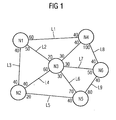
- connection-oriented packet-switched communication network comprises a plurality-in this case by way of example six-network nodes N1-N6, which are interconnected in mesh via physical point-to-point data links L1-L9.
- the bandwidths available at any given time are indicated on the respective outgoing data link of the network nodes N1-N6.
- the network node N1 is connected to the network node N4 via a physical data link L1, the network node N1 providing a bandwidth of 60 Mbps for the outbound data link L1 and the network node N4 providing a bandwidth of 40 Mbps for the outbound data link L1.
- the network node N1 is further connected via a physical data link L2 and a physical data link L3 to the network node N3 and the network node N2 data technology, the network node N1 with respect to the outgoing data link L2 a bandwidth of 50 Mbps and with respect to the outbound data link L3 a bandwidth of 40 Mbps provides.
- the network node N3 provides a bandwidth of 20 Mbps for the outgoing data link L2, and the network node N2 provides a bandwidth of 40 Mbps for the outbound data link L3. All other information on the bandwidths in the figures are to be understood in an analogous manner.
- a hybrid data transmission method is set up in the network nodes N1-N6, by which to implement a logical end-to-end connection path before transmission of data packets from a start network node to a destination network node, virtual physical end-to-end data transmission paths for data transmission from Start network node to the destination network node dynamically established which can be dismantled after the data has been transferred.
- the data transmission method is capable of establishing a logical connection path between a start network node and a destination network node by signaling one or more physical data transmission paths.
- a routing algorithm is implemented in the communication network in the network nodes N1-N6, by means of physical end-to-end data transmission paths for realizing a logical end-to-end connection path with a certain (selectable) bandwidth between a start network node and a destination network node from the start network node to the destination network node, taking into account path costs and the available bandwidths of the data links.
- a routing algorithm is based, for example, on CSPF.
- An IGP implemented in the routing algorithm such as IS-IS or OSPF, ensures a message exchange between the network nodes N1-N6, so that the network nodes N1-N6 are informed at all times about the bandwidths of the data links available in the communication network.
- the hybrid data transmission method is further capable of selecting one or more of the determined physical end-to-end data transmission paths under the condition that the sum of their bandwidths is at least as large as the bandwidth of the logical connection path.
- a signaling protocol in the form of RSVP-TE is implemented in the network nodes N1-N6, which enables the setting up (signaling) of a physical data transmission path in the form of a Label Switched Path (LSP) and the reservation of bandwidths therefor.
- LSP Label Switched Path
- the hybrid data transmission method can assign the data packets to be transmitted to a logical class (FEC), label them and send them to the signaled LSPs to distribute.
- FEC logical class
- a load distribution algorithm for example a hash algorithm
- the network nodes of a same physical data transmission path lying between a start and a destination network node are able to forward received data packets to the destination network node on the basis of the label.
- the destination network node can remove the label again.
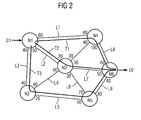
- FIG. 3 illustrates an example embodiment of a method for transmitting data packets along a logical connection path realized by a plurality of physical data transmission paths.
- Network node N1 receives as start network node a data stream D1, which is to be transmitted with a bandwidth reservation of 100 Mbps to the network node N6 as the destination network node.
- a logical connection path with a bandwidth of 100 Mbps should be established between the network node N1 and the network node N6.
- the network node N1 On the basis of the connection request, the network node N1 first determines possible physical data transmission paths (tunnels) and their bandwidths for realizing the logical connection path between the network node N1 and the network node N6. Because of the routing algorithm implemented in the communication network, the network node N1 "knows" the topology of the network and the bandwidths of all outgoing data links available at that time.
- the network node N1 determines here, for example, three tunnels T1-T3.
- the first tunnel T1 consists of the virtual data links L1 and L8 and links network node N1 and network node N6 with the interposition of network node N4.
- network node N1 provides a bandwidth of 60 Mbs
- network node N4 provides a bandwidth of 100 Mbs for the outbound data link L8 of the first tunnel T1.
- the first Tunnel T1 provide a maximum bandwidth of 60 Mbps.
- the second tunnel T2 consists of the virtual data links L2 and L7 and links network node N1 and network node N6 with the interposition of network node N3.
- network node N1 For the outgoing data link L2 of the second tunnel T2, network node N1 provides a bandwidth of 50 Mbps, and network node N3 provides a bandwidth of 30 Mbps for the outbound data link L7 of the second tunnel T2. As such, the second tunnel T2 can provide a maximum bandwidth of 30 Mbps.
- the third tunnel T3 consists of the virtual data links L3, L5 and L9 and links network node N1 and network node N6 with the interposition of network nodes N2 and N5.
- network node N1 For the outgoing data link L3 of the third tunnel T3, network node N1 provides a bandwidth of 40 Mbps, network node N2 provides a bandwidth of 20 Mbps for the outbound data link L5 of the third tunnel T3, and network node N5 provides for the outbound data link L9 of the third Tunnels T3 a bandwidth of 80 Mbps available.
- the third tunnel T3 can provide a maximum bandwidth of 20 Mbps.
- Network node N1 detects the maximum available bandwidths of the respective tunnels T1-T3 determined and recognizes that the bandwidth requirement for the data stream D1 can not be realized by a single tunnel, since only a maximum bandwidth reservation of 60 Mbps for tunnel T1 is possible.
- Network node N1 in an embodiment not belonging to the invention, selects the tunnels determined on the basis of the maximum available bandwidths on the condition that the sum of the maximum available bandwidths of the selected tunnels at least corresponds to the requested bandwidth of 100 Mbps.
- network node N1 selects the identified tunnels successively according to the highest maximum available bandwidth.
- tunnel T1 is first selected with a maximum available bandwidth of 60 Mbps.
- Node N1 notes that there is still a remaining bandwidth of 40 Mbps to reserve by means of further tunnels.
- Network node N1 selects tunnels T2 with a maximum available bandwidth of 30 Mbps based on the maximum available bandwidth.
- Network node N1 determines that a remaining bandwidth of 10 Mbps has yet to be reserved by means of further tunnels.
- Network node N1 selects tunnel T3 with a maximum available bandwidth of 20 Mbps based on the maximum available bandwidth.
- LSPs label switched paths
- the network node N1 sends a message PATH to the adjacent network node N4 on the data link L1. From this, the message PATH is supplemented with a LABEL REQUEST and sent to the network node N6 via the data link L8.
- the network node N6 reads the message PATH, assigns a label, generates a labeled message RESV and sends it via the data link L8 to the network node N4.
- the network node N4 reads this message RESV, stores the contained label in its forwarding table, selects another label, replaces the previous label in the message RESV and sends the modified message RESV to the network node N1.
- Network node N1 receives the message RESV and stores the contained label in its forwarding table.
- a virtual data link L1 is uniquely defined, and a virtual data link L8 is uniquely defined by a respective identical label in the network nodes N4 and N6. Due to the concatenated sequence of labels, the first tunnel T1 is defined. The corresponding bandwidths of the data links are reserved. The second tunnel T2 and the third tunnel T3 are each signaled in an analogous manner.
- the data packets contained in the data stream D1 are distributed by the network node N1 to the various tunnels T1-T3 according to the available maximum bandwidths.
- the data packets received by network node N1 are marked in the push method with a label, wherein the choice of the label specifies the tunnel to be used for the transmission of the data packet.
- the data packets are forwarded in the swap method until they reach the network node N6.
- the labels are removed from the data packets again.
- the data streams routed via the three tunnels T1-T3 are again combined to form a data stream D2, which, after being forwarded by network node N6, can be further transmitted, for example, by hop-by-hop routing.
- Another possibility, not belonging to the invention, of dividing x into x i is as follows: for x 1 , the maximum bandwidth available from A to B through a tunnel; then the bandwidth available on the corresponding links is reduced by x 1 ; for x 2 , based on the reduced available bandwidths, the maximum bandwidth available through a tunnel from A to B is selected; then the bandwidth available on the corresponding links is reduced by x 2 ; etc.
- a significant advantage of the latter method is that a descending sequence of numbers x 1 , x 2 , ..., x n is determined, none of the x i depends on the choice of n. Thus, no recalculation of all x i (ie all tunnels) is necessary if n is changed and the paths are optimally utilized.
- the maximum number N of tunnels should be configurable as a parameter. This also ensures that the input node consumes only a limited amount of time (and thus capacity) in the search for a possible division of the requested path into tunnels. This results in a simple abort criterion for the determination of the numbers x 1 , x 2 ,..., X n with the above-mentioned second possibility.
- a hash algorithm For the distribution of data traffic from A to B to the individual tunnels, a hash algorithm should be used. This should ensure that the load distribution takes place at the level of flows and that individual data packets of the same flow are not sent via different tunnels, since otherwise packet changes can occur due to different runtimes. This can be ensured that only data is included in the hash algorithm, which do not change under a flow (for example, IP addresses, port numbers, etc.) In the event that the x i have not chosen to be equal, it must a corresponding uneven distribution done.
- replacement paths are only to be set up end to end, then the realization of a path by means of several tunnels does not influence the replacement path finding.
- the replacement path (s) from A to B can also be realized in the form of several tunnels.
- replacement path circuits are to be local (as in MPLS Fast ReRoute, for example), each tunnel must be considered individually and corresponding local substitute paths must be used for all tunnels.
Landscapes
- Engineering & Computer Science (AREA)
- Computer Networks & Wireless Communication (AREA)
- Signal Processing (AREA)
- Data Exchanges In Wide-Area Networks (AREA)
Claims (8)
- Procédé d'établissement d'un chemin de liaison logique de bout en bout ayant une première largeur de bande sélectionnable et allant d'un noeud de réseau de départ (N1) à un noeud de réseau de destination (N6) dans un réseau de communication à commutation de paquets orienté connexion, comportant les étapes suivantes :- détermination d'une pluralité de chemins physiques de transmission de données de bout en bout (T1, T2, T3) allant du noeud de réseau de départ au noeud de réseau de destination avec des deuxièmes largeurs de bande respectivement disponibles conformément au chemin de liaison logique à établir ;- sélection d'un ou de plusieurs des chemins physiques de transmission de données déterminés (T1, T2, T3) de manière telle que les deuxièmes largeurs de bande des chemins physiques de transmission de données correspondent au total au moins à la première largeur de bande du chemin de liaison logique ;- établissement de l'au moins un chemin physique de transmission de données sélectionné (T1, T2, T3) pour établir le chemin de liaison logique ;caractérisé en ce que
la première largeur de bande du chemin de liaison logique est divisée par un diviseur sélectionnable pour établir une troisième largeur de bande et un nombre de chemins physiques de transmission de données correspondant à la valeur absolue du diviseur est sélectionné à la condition que leur deuxième largeur de bande corresponde au moins à la troisième largeur de bande. - Procédé selon la revendication 1, selon lequel un nombre maximal sélectionnable de chemins physiques de transmission de données (T1, T2, T3) est signalé.
- Procédé de transmission de paquets de données d'un noeud de réseau de départ vers un noeud de réseau de destination d'un réseau de communication à commutation de paquets orienté connexion, comportant les étapes suivantes :- établissement d'un chemin de liaison logique de bout en bout allant du noeud de réseau de départ (N1) vers le noeud de réseau de destination (N6) selon le procédé selon la revendication 1 ou 2 ;- répartition des paquets de données à transmettre du noeud de réseau de départ sur les chemins physiques de transmission de données établis (T1, T2, T3) conformément aux deuxièmes largeurs de bande et retransmission des paquets de données vers le noeud de réseau de destination.
- Procédé selon la revendication 3, selon lequel une répartition des paquets de données sur les chemins physiques de transmission de données établis (T1, T2, T3) s'effectue au moyen d'un algorithme de hachage.
- Réseau de communication à commutation de paquets orienté connexion avec une pluralité de noeuds de réseau (N1-N6) interconnectés via des liens de données respectifs (L1-L7), dans lequel les noeuds de réseau (N1-N6) sont configurés de manière appropriée pour exécuter un procédé selon l'une des revendications 1 à 4.
- Code de programme lisible par machine pour un noeud de réseau (N1-N6) d'un réseau de communication à commutation de paquets orienté connexion selon la revendication 5, lequel code contient des ordres de commande qui font exécuter au noeud de réseau (N1-N6) un procédé selon l'une des revendications 1 à 4.
- Noeud de réseau (N1-N6) d'un réseau de communication à commutation de paquets orienté connexion, dans lequel est exécuté un code de programme lisible par machine selon la revendication 6.
- Support de mémoire avec un code de programme lisible par machine selon la revendication 6 stocké dessus.
Priority Applications (1)
| Application Number | Priority Date | Filing Date | Title |
|---|---|---|---|
| SI200831035T SI2147530T1 (sl) | 2007-05-15 | 2008-04-28 | Postopek za graditev logične povezovalne poti v povezavnem paketno komutiranem komunikacijskem omrežju |
Applications Claiming Priority (2)
| Application Number | Priority Date | Filing Date | Title |
|---|---|---|---|
| DE102007022704A DE102007022704B4 (de) | 2007-05-15 | 2007-05-15 | Verfahren zum Einrichten eines logischen Verbindungspfads in einem verbindungsorientierten paketvermittelten Kommunikationsnetzwerk |
| PCT/EP2008/055190 WO2008138739A1 (fr) | 2007-05-15 | 2008-04-28 | Procédé d'établissement d'un chemin de liaison logique dans un réseau de communication à commutation de paquets, à transmission en mode connexion |
Publications (2)
| Publication Number | Publication Date |
|---|---|
| EP2147530A1 EP2147530A1 (fr) | 2010-01-27 |
| EP2147530B1 true EP2147530B1 (fr) | 2013-06-12 |
Family
ID=39683480
Family Applications (1)
| Application Number | Title | Priority Date | Filing Date |
|---|---|---|---|
| EP08749812.7A Not-in-force EP2147530B1 (fr) | 2007-05-15 | 2008-04-28 | Procédé d'établissement d'un chemin de liaison logique dans un réseau de communication à commutation de paquets |
Country Status (8)
| Country | Link |
|---|---|
| US (1) | US20100165881A1 (fr) |
| EP (1) | EP2147530B1 (fr) |
| KR (1) | KR20100021606A (fr) |
| CN (1) | CN101682567A (fr) |
| DE (1) | DE102007022704B4 (fr) |
| HR (1) | HRP20130815T1 (fr) |
| SI (1) | SI2147530T1 (fr) |
| WO (1) | WO2008138739A1 (fr) |
Families Citing this family (22)
| Publication number | Priority date | Publication date | Assignee | Title |
|---|---|---|---|---|
| FR2935056A1 (fr) * | 2008-08-14 | 2010-02-19 | St Microelectronics Rousset | Systeme de traitement de donnees disposant de moyens de traitement repartis pour exploiter des latences intrinseques du systeme |
| US9124394B2 (en) | 2008-09-30 | 2015-09-01 | Lantiq Beteiligungs-GmbH & Co. KG | Physical channel bundling in data transmission |
| DE102009040911B4 (de) * | 2008-09-30 | 2014-08-07 | Lantiq Deutschland Gmbh | Bündelung physikalischer Kanäle bei der Datenübertragung |
| JP5282628B2 (ja) * | 2009-03-30 | 2013-09-04 | 富士通株式会社 | ネットワーク監視制御装置及び監視制御方法 |
| US8619756B2 (en) * | 2009-07-15 | 2013-12-31 | Qualcomm Incorporated | Systems and methods for providing resource allocation meeting communication constraints for multi-hop network data flows |
| US8451862B2 (en) | 2009-07-15 | 2013-05-28 | Qualcomm Incorporated | Systems and methods for resource allocation serving communication requirements and fairness |
| FR2958490B1 (fr) * | 2010-03-31 | 2012-03-09 | Alcatel Lucent | Procede pour controler l'etablissement d'une connexion dans un reseau de transport |
| JP5655484B2 (ja) * | 2010-10-07 | 2015-01-21 | 富士通株式会社 | パケット伝送装置、信号終端装置、通信システム及び通信方法 |
| US8509787B2 (en) | 2011-07-07 | 2013-08-13 | Cygnus Broadband, Inc. | Communications base station with decision function for distributing traffic across multiple backhauls |
| US8750121B2 (en) * | 2011-10-28 | 2014-06-10 | Telefonaktiebolaget L M Ericsson (Publ) | Addressing the large flow problem for equal cost multi-path in the datacenter |
| US9577918B2 (en) * | 2012-11-19 | 2017-02-21 | Cray Inc. | Increasingly minimal bias routing |
| CN112187926B (zh) * | 2013-03-28 | 2023-11-14 | 柏思科技有限公司 | 通过至少一个端到端连接传输和接收数据包的方法和系统 |
| CN105637819B (zh) * | 2013-10-28 | 2019-08-27 | 柏思科技有限公司 | 用于传输广播数据的方法和系统 |
| US10846257B2 (en) | 2014-04-01 | 2020-11-24 | Endance Technology Limited | Intelligent load balancing and high speed intelligent network recorders |
| US9634867B2 (en) | 2014-05-02 | 2017-04-25 | Futurewei Technologies, Inc. | Computing service chain-aware paths |
| US10374826B2 (en) | 2014-06-30 | 2019-08-06 | Pismo Labs Technology Limited | Methods and systems for transmitting broadcast data |
| CN109803453B (zh) * | 2017-11-17 | 2023-07-07 | 华为技术有限公司 | 一种通信方法,通信设备及其通信系统 |
| EP3654594A1 (fr) * | 2018-11-15 | 2020-05-20 | Siemens Aktiengesellschaft | Procédé de transmission de données, appareil de communication, programme informatique et support lisible par ordinateur |
| US11159420B2 (en) | 2019-04-17 | 2021-10-26 | Cloudflare, Inc. | Method and apparatus of automatic route optimization in a private virtual network for client devices of a local network |
| CN113133060B (zh) * | 2019-12-30 | 2022-12-27 | 华为技术有限公司 | 接入网系统、传输方法以及相关设备 |
| CN114006679B (zh) * | 2021-12-30 | 2022-09-27 | 北京天维信通科技有限公司 | 将fec技术结合智能选路的数据处理方法和装置 |
| US12483618B2 (en) * | 2024-03-29 | 2025-11-25 | Dell Products L.P. | Rerouting of client server connections |
Family Cites Families (10)
| Publication number | Priority date | Publication date | Assignee | Title |
|---|---|---|---|---|
| US5617417A (en) * | 1994-09-07 | 1997-04-01 | Stratacom, Inc. | Asynchronous transfer mode communication in inverse multiplexing over multiple communication links |
| GB9519657D0 (en) * | 1995-09-27 | 1995-11-29 | Plessey Telecomm | Video telephony call connection |
| US6665733B1 (en) * | 1996-12-30 | 2003-12-16 | Hewlett-Packard Development Company, L.P. | Network communication device including bonded ports for increased bandwidth |
| US6563821B1 (en) * | 1997-11-14 | 2003-05-13 | Multi-Tech Systems, Inc. | Channel bonding in a remote communications server system |
| US6611874B1 (en) * | 1998-09-16 | 2003-08-26 | International Business Machines Corporation | Method for improving routing distribution within an internet and system for implementing said method |
| US6577653B1 (en) * | 1999-04-28 | 2003-06-10 | 3Com Corporation | Apparatus for and method of establishing a route utilizing multiple parallel segments in an asynchronous transfer mode network |
| US7672331B1 (en) * | 2004-02-25 | 2010-03-02 | At&T Intellectual Property Ii, L.P. | Method and apparatus for initiating routing messages in a communication network |
| US7808897B1 (en) * | 2005-03-01 | 2010-10-05 | International Business Machines Corporation | Fast network security utilizing intrusion prevention systems |
| WO2007059114A2 (fr) * | 2005-11-14 | 2007-05-24 | Conexant Systems, Inc. | Systemes et methodes de chargement binaire ameliore pour applications a latences multiples a modulation multifrequences discretes |
| US8243603B2 (en) * | 2005-12-07 | 2012-08-14 | Motorola Solutions, Inc. | Method and system for improving a wireless communication route |
-
2007
- 2007-05-15 DE DE102007022704A patent/DE102007022704B4/de not_active Expired - Fee Related
-
2008
- 2008-04-28 SI SI200831035T patent/SI2147530T1/sl unknown
- 2008-04-28 US US12/600,463 patent/US20100165881A1/en not_active Abandoned
- 2008-04-28 WO PCT/EP2008/055190 patent/WO2008138739A1/fr not_active Ceased
- 2008-04-28 HR HRP20130815AT patent/HRP20130815T1/hr unknown
- 2008-04-28 KR KR1020097026206A patent/KR20100021606A/ko not_active Abandoned
- 2008-04-28 CN CN200880015877A patent/CN101682567A/zh active Pending
- 2008-04-28 EP EP08749812.7A patent/EP2147530B1/fr not_active Not-in-force
Also Published As
| Publication number | Publication date |
|---|---|
| WO2008138739A1 (fr) | 2008-11-20 |
| EP2147530A1 (fr) | 2010-01-27 |
| DE102007022704A1 (de) | 2008-11-20 |
| DE102007022704B4 (de) | 2010-12-09 |
| US20100165881A1 (en) | 2010-07-01 |
| HRP20130815T1 (hr) | 2013-09-30 |
| CN101682567A (zh) | 2010-03-24 |
| SI2147530T1 (sl) | 2013-10-30 |
| KR20100021606A (ko) | 2010-02-25 |
Similar Documents
| Publication | Publication Date | Title |
|---|---|---|
| EP2147530B1 (fr) | Procédé d'établissement d'un chemin de liaison logique dans un réseau de communication à commutation de paquets | |
| DE60204645T2 (de) | Ressourcenverwaltung in heterogenen dienstqualitätsbasierten Paketnetzwerken | |
| EP1593241B1 (fr) | Controle d'acces a un reseau oriente paquet en fonction d'exigences de resilience | |
| DE69938570T2 (de) | Verfahren und Vorrichtung für eine reservierte und dynamische Dienstqualität in einem Kommunikationsnetz | |
| DE69919569T2 (de) | Verwaltung von verbindungsorientierten diensten über das internet-protokoll | |
| DE60026238T2 (de) | Auf vorspezifizierter Dienstgüte basierender Verbindungsaufbau durch ein Kommunikationsnetz | |
| DE60128320T2 (de) | Durchführung von MPLS auf einer ATM Plattform | |
| EP1623541B1 (fr) | Procede et noeuds de reseau pour une distribution du trafic autoregulee, autonome et decentralisee dans un reseau multivoie | |
| DE60318221T2 (de) | Netzwerk und Verfahren zur Bereitstellung von Schicht-2 virtuellen privaten Netwerken auf Basis von vermittelten virtuellen Verbindungen | |
| WO2012101054A1 (fr) | Procédé d'augmentation de la qualité de la transmission de données dans un réseau de communication à base de paquets | |
| EP3018958A1 (fr) | Système de réseau et procédé de priorisation de télégrammes en temps réel dans un réseau convergent | |
| EP2775677B1 (fr) | Procédé de transmission de paquets de données dans un réseau de données à partir d'une pluralité de noeuds de réseau | |
| DE60012736T2 (de) | Verfahren zur leitwegerzeugung für mehrfachdatenverkehr | |
| WO2000072527A1 (fr) | Procede pour la selection d'une route dans un reseau de communication | |
| DE10324370B4 (de) | Netzknoten eines paketvermittelnden Kommunikationsnetzes und Verfahren zur Verkehrsverteilung von Datenverkehr in einem paketvermittelnden Kommunikationsnetz | |
| DE602006000136T2 (de) | Vorreservierung von Ressourcen für Verbindungswege in einem Kommunikationsnetz an Kommunikation von Anschriften von Päckchen oder von Etiketten | |
| DE60203539T2 (de) | Mehrfach-domain-zugriffsregelung von datenflüssen in assoziation mit dienstqualitätskriterien | |
| WO2006133669A1 (fr) | Procede et element de reseau de communication independant destines a determiner des routes etiquetees dans un tel element de reseau de communication | |
| EP2016719B1 (fr) | Procédé, agent de réseau et gestionnaire de bande passante pour la gestion des largeurs de bande disponibles pour des connexions entre des terminaux d'un réseau de communication orienté par paquets | |
| EP1374627A1 (fr) | Procede et systeme permettant une gestion efficace des ressources dans des reseaux mpls | |
| WO2005125117A1 (fr) | Procede pour mettre des ressources en reserve pour un routage inter-domaines avec attributs de qualite de service | |
| DE10340809A1 (de) | Optimierung der Routenbestimmung in einem Netz mit Mehrwege-Routing | |
| DE10246109A1 (de) | Effizientes Label Binding für das Routing von Datenpaketen mittels Labels | |
| EP2026512A1 (fr) | Procédé et dispositif de réservation d'une ressource de communication et système de communication comprenant un tel dispositif | |
| WO2000069210A2 (fr) | Procede d'evaluation de trajets dans un reseau de communication |
Legal Events
| Date | Code | Title | Description |
|---|---|---|---|
| PUAI | Public reference made under article 153(3) epc to a published international application that has entered the european phase |
Free format text: ORIGINAL CODE: 0009012 |
|
| 17P | Request for examination filed |
Effective date: 20090925 |
|
| AK | Designated contracting states |
Kind code of ref document: A1 Designated state(s): AT BE BG CH CY CZ DE DK EE ES FI FR GB GR HR HU IE IS IT LI LT LU LV MC MT NL NO PL PT RO SE SI SK TR |
|
| AX | Request for extension of the european patent |
Extension state: AL BA MK RS |
|
| 17Q | First examination report despatched |
Effective date: 20100303 |
|
| DAX | Request for extension of the european patent (deleted) | ||
| GRAP | Despatch of communication of intention to grant a patent |
Free format text: ORIGINAL CODE: EPIDOSNIGR1 |
|
| RAP1 | Party data changed (applicant data changed or rights of an application transferred) |
Owner name: SIEMENS AKTIENGESELLSCHAFT |
|
| GRAS | Grant fee paid |
Free format text: ORIGINAL CODE: EPIDOSNIGR3 |
|
| REG | Reference to a national code |
Ref country code: DE Ref legal event code: R079 Ref document number: 502008010117 Country of ref document: DE Free format text: PREVIOUS MAIN CLASS: H04L0012560000 Ipc: H04L0012707000 |
|
| GRAA | (expected) grant |
Free format text: ORIGINAL CODE: 0009210 |
|
| AK | Designated contracting states |
Kind code of ref document: B1 Designated state(s): AT BE BG CH CY CZ DE DK EE ES FI FR GB GR HR HU IE IS IT LI LT LU LV MC MT NL NO PL PT RO SE SI SK TR |
|
| REG | Reference to a national code |
Ref country code: GB Ref legal event code: FG4D Free format text: NOT ENGLISH |
|
| RIC1 | Information provided on ipc code assigned before grant |
Ipc: H04L 12/803 20130101ALI20130507BHEP Ipc: H04L 12/707 20130101AFI20130507BHEP Ipc: H04L 12/729 20130101ALI20130507BHEP Ipc: H04L 12/46 20060101ALI20130507BHEP Ipc: H04L 12/751 20130101ALI20130507BHEP Ipc: H04L 12/723 20130101ALI20130507BHEP |
|
| REG | Reference to a national code |
Ref country code: CH Ref legal event code: EP |
|
| REG | Reference to a national code |
Ref country code: AT Ref legal event code: REF Ref document number: 617048 Country of ref document: AT Kind code of ref document: T Effective date: 20130615 |
|
| REG | Reference to a national code |
Ref country code: IE Ref legal event code: FG4D Free format text: LANGUAGE OF EP DOCUMENT: GERMAN |
|
| REG | Reference to a national code |
Ref country code: DE Ref legal event code: R096 Ref document number: 502008010117 Country of ref document: DE Effective date: 20130801 |
|
| REG | Reference to a national code |
Ref country code: HR Ref legal event code: TUEP Ref document number: P20130815 Country of ref document: HR |
|
| REG | Reference to a national code |
Ref country code: HR Ref legal event code: T1PR Ref document number: P20130815 Country of ref document: HR |
|
| PG25 | Lapsed in a contracting state [announced via postgrant information from national office to epo] |
Ref country code: NO Free format text: LAPSE BECAUSE OF FAILURE TO SUBMIT A TRANSLATION OF THE DESCRIPTION OR TO PAY THE FEE WITHIN THE PRESCRIBED TIME-LIMIT Effective date: 20130912 Ref country code: LT Free format text: LAPSE BECAUSE OF FAILURE TO SUBMIT A TRANSLATION OF THE DESCRIPTION OR TO PAY THE FEE WITHIN THE PRESCRIBED TIME-LIMIT Effective date: 20130612 Ref country code: FI Free format text: LAPSE BECAUSE OF FAILURE TO SUBMIT A TRANSLATION OF THE DESCRIPTION OR TO PAY THE FEE WITHIN THE PRESCRIBED TIME-LIMIT Effective date: 20130612 Ref country code: GR Free format text: LAPSE BECAUSE OF FAILURE TO SUBMIT A TRANSLATION OF THE DESCRIPTION OR TO PAY THE FEE WITHIN THE PRESCRIBED TIME-LIMIT Effective date: 20130913 Ref country code: ES Free format text: LAPSE BECAUSE OF FAILURE TO SUBMIT A TRANSLATION OF THE DESCRIPTION OR TO PAY THE FEE WITHIN THE PRESCRIBED TIME-LIMIT Effective date: 20130923 Ref country code: SE Free format text: LAPSE BECAUSE OF FAILURE TO SUBMIT A TRANSLATION OF THE DESCRIPTION OR TO PAY THE FEE WITHIN THE PRESCRIBED TIME-LIMIT Effective date: 20130612 |
|
| REG | Reference to a national code |
Ref country code: NL Ref legal event code: VDEP Effective date: 20130612 |
|
| REG | Reference to a national code |
Ref country code: LT Ref legal event code: MG4D |
|
| PG25 | Lapsed in a contracting state [announced via postgrant information from national office to epo] |
Ref country code: BG Free format text: LAPSE BECAUSE OF FAILURE TO SUBMIT A TRANSLATION OF THE DESCRIPTION OR TO PAY THE FEE WITHIN THE PRESCRIBED TIME-LIMIT Effective date: 20130912 |
|
| PG25 | Lapsed in a contracting state [announced via postgrant information from national office to epo] |
Ref country code: LV Free format text: LAPSE BECAUSE OF FAILURE TO SUBMIT A TRANSLATION OF THE DESCRIPTION OR TO PAY THE FEE WITHIN THE PRESCRIBED TIME-LIMIT Effective date: 20130612 |
|
| PG25 | Lapsed in a contracting state [announced via postgrant information from national office to epo] |
Ref country code: CZ Free format text: LAPSE BECAUSE OF FAILURE TO SUBMIT A TRANSLATION OF THE DESCRIPTION OR TO PAY THE FEE WITHIN THE PRESCRIBED TIME-LIMIT Effective date: 20130612 Ref country code: EE Free format text: LAPSE BECAUSE OF FAILURE TO SUBMIT A TRANSLATION OF THE DESCRIPTION OR TO PAY THE FEE WITHIN THE PRESCRIBED TIME-LIMIT Effective date: 20130612 Ref country code: IS Free format text: LAPSE BECAUSE OF FAILURE TO SUBMIT A TRANSLATION OF THE DESCRIPTION OR TO PAY THE FEE WITHIN THE PRESCRIBED TIME-LIMIT Effective date: 20131012 Ref country code: PT Free format text: LAPSE BECAUSE OF FAILURE TO SUBMIT A TRANSLATION OF THE DESCRIPTION OR TO PAY THE FEE WITHIN THE PRESCRIBED TIME-LIMIT Effective date: 20131014 Ref country code: SK Free format text: LAPSE BECAUSE OF FAILURE TO SUBMIT A TRANSLATION OF THE DESCRIPTION OR TO PAY THE FEE WITHIN THE PRESCRIBED TIME-LIMIT Effective date: 20130612 |
|
| PG25 | Lapsed in a contracting state [announced via postgrant information from national office to epo] |
Ref country code: PL Free format text: LAPSE BECAUSE OF FAILURE TO SUBMIT A TRANSLATION OF THE DESCRIPTION OR TO PAY THE FEE WITHIN THE PRESCRIBED TIME-LIMIT Effective date: 20130612 Ref country code: RO Free format text: LAPSE BECAUSE OF FAILURE TO SUBMIT A TRANSLATION OF THE DESCRIPTION OR TO PAY THE FEE WITHIN THE PRESCRIBED TIME-LIMIT Effective date: 20130612 Ref country code: NL Free format text: LAPSE BECAUSE OF FAILURE TO SUBMIT A TRANSLATION OF THE DESCRIPTION OR TO PAY THE FEE WITHIN THE PRESCRIBED TIME-LIMIT Effective date: 20130612 |
|
| REG | Reference to a national code |
Ref country code: HR Ref legal event code: ODRP Ref document number: P20130815 Country of ref document: HR Payment date: 20140331 Year of fee payment: 7 |
|
| PLBE | No opposition filed within time limit |
Free format text: ORIGINAL CODE: 0009261 |
|
| STAA | Information on the status of an ep patent application or granted ep patent |
Free format text: STATUS: NO OPPOSITION FILED WITHIN TIME LIMIT |
|
| PG25 | Lapsed in a contracting state [announced via postgrant information from national office to epo] |
Ref country code: DK Free format text: LAPSE BECAUSE OF FAILURE TO SUBMIT A TRANSLATION OF THE DESCRIPTION OR TO PAY THE FEE WITHIN THE PRESCRIBED TIME-LIMIT Effective date: 20130612 |
|
| 26N | No opposition filed |
Effective date: 20140313 |
|
| PGFP | Annual fee paid to national office [announced via postgrant information from national office to epo] |
Ref country code: HR Payment date: 20140331 Year of fee payment: 7 |
|
| REG | Reference to a national code |
Ref country code: DE Ref legal event code: R097 Ref document number: 502008010117 Country of ref document: DE Effective date: 20140313 |
|
| PGFP | Annual fee paid to national office [announced via postgrant information from national office to epo] |
Ref country code: GB Payment date: 20140409 Year of fee payment: 7 |
|
| PGFP | Annual fee paid to national office [announced via postgrant information from national office to epo] |
Ref country code: IT Payment date: 20140423 Year of fee payment: 7 Ref country code: SI Payment date: 20140328 Year of fee payment: 7 Ref country code: FR Payment date: 20140414 Year of fee payment: 7 Ref country code: DE Payment date: 20140620 Year of fee payment: 7 |
|
| PG25 | Lapsed in a contracting state [announced via postgrant information from national office to epo] |
Ref country code: MC Free format text: LAPSE BECAUSE OF FAILURE TO SUBMIT A TRANSLATION OF THE DESCRIPTION OR TO PAY THE FEE WITHIN THE PRESCRIBED TIME-LIMIT Effective date: 20130612 Ref country code: LU Free format text: LAPSE BECAUSE OF FAILURE TO SUBMIT A TRANSLATION OF THE DESCRIPTION OR TO PAY THE FEE WITHIN THE PRESCRIBED TIME-LIMIT Effective date: 20140428 |
|
| REG | Reference to a national code |
Ref country code: CH Ref legal event code: PL |
|
| REG | Reference to a national code |
Ref country code: IE Ref legal event code: MM4A |
|
| PG25 | Lapsed in a contracting state [announced via postgrant information from national office to epo] |
Ref country code: LI Free format text: LAPSE BECAUSE OF NON-PAYMENT OF DUE FEES Effective date: 20140430 Ref country code: CH Free format text: LAPSE BECAUSE OF NON-PAYMENT OF DUE FEES Effective date: 20140430 |
|
| PG25 | Lapsed in a contracting state [announced via postgrant information from national office to epo] |
Ref country code: IE Free format text: LAPSE BECAUSE OF NON-PAYMENT OF DUE FEES Effective date: 20140428 |
|
| REG | Reference to a national code |
Ref country code: AT Ref legal event code: MM01 Ref document number: 617048 Country of ref document: AT Kind code of ref document: T Effective date: 20140428 |
|
| PG25 | Lapsed in a contracting state [announced via postgrant information from national office to epo] |
Ref country code: AT Free format text: LAPSE BECAUSE OF NON-PAYMENT OF DUE FEES Effective date: 20140428 |
|
| REG | Reference to a national code |
Ref country code: DE Ref legal event code: R119 Ref document number: 502008010117 Country of ref document: DE |
|
| REG | Reference to a national code |
Ref country code: HR Ref legal event code: PBON Ref document number: P20130815 Country of ref document: HR Effective date: 20150428 |
|
| GBPC | Gb: european patent ceased through non-payment of renewal fee |
Effective date: 20150428 |
|
| PG25 | Lapsed in a contracting state [announced via postgrant information from national office to epo] |
Ref country code: IT Free format text: LAPSE BECAUSE OF NON-PAYMENT OF DUE FEES Effective date: 20150428 Ref country code: DE Free format text: LAPSE BECAUSE OF NON-PAYMENT OF DUE FEES Effective date: 20151103 Ref country code: GB Free format text: LAPSE BECAUSE OF NON-PAYMENT OF DUE FEES Effective date: 20150428 |
|
| REG | Reference to a national code |
Ref country code: FR Ref legal event code: ST Effective date: 20151231 Ref country code: SI Ref legal event code: KO00 Effective date: 20151215 |
|
| PG25 | Lapsed in a contracting state [announced via postgrant information from national office to epo] |
Ref country code: HR Free format text: LAPSE BECAUSE OF NON-PAYMENT OF DUE FEES Effective date: 20150428 Ref country code: SI Free format text: LAPSE BECAUSE OF NON-PAYMENT OF DUE FEES Effective date: 20150429 Ref country code: FR Free format text: LAPSE BECAUSE OF NON-PAYMENT OF DUE FEES Effective date: 20150430 |
|
| PG25 | Lapsed in a contracting state [announced via postgrant information from national office to epo] |
Ref country code: MT Free format text: LAPSE BECAUSE OF FAILURE TO SUBMIT A TRANSLATION OF THE DESCRIPTION OR TO PAY THE FEE WITHIN THE PRESCRIBED TIME-LIMIT Effective date: 20130612 |
|
| PG25 | Lapsed in a contracting state [announced via postgrant information from national office to epo] |
Ref country code: CY Free format text: LAPSE BECAUSE OF FAILURE TO SUBMIT A TRANSLATION OF THE DESCRIPTION OR TO PAY THE FEE WITHIN THE PRESCRIBED TIME-LIMIT Effective date: 20130612 |
|
| PG25 | Lapsed in a contracting state [announced via postgrant information from national office to epo] |
Ref country code: HU Free format text: LAPSE BECAUSE OF FAILURE TO SUBMIT A TRANSLATION OF THE DESCRIPTION OR TO PAY THE FEE WITHIN THE PRESCRIBED TIME-LIMIT; INVALID AB INITIO Effective date: 20080428 Ref country code: TR Free format text: LAPSE BECAUSE OF FAILURE TO SUBMIT A TRANSLATION OF THE DESCRIPTION OR TO PAY THE FEE WITHIN THE PRESCRIBED TIME-LIMIT Effective date: 20130612 Ref country code: BE Free format text: LAPSE BECAUSE OF FAILURE TO SUBMIT A TRANSLATION OF THE DESCRIPTION OR TO PAY THE FEE WITHIN THE PRESCRIBED TIME-LIMIT Effective date: 20140430 |