EP2149043B1 - Procédé visant à préparer un échantillon de matière fluide ou pâteuse destinée à être mesuré par fluorescence x et élément d'analyse d'échantillon approprié à un tel procédé - Google Patents
Procédé visant à préparer un échantillon de matière fluide ou pâteuse destinée à être mesuré par fluorescence x et élément d'analyse d'échantillon approprié à un tel procédé Download PDFInfo
- Publication number
- EP2149043B1 EP2149043B1 EP08758667.3A EP08758667A EP2149043B1 EP 2149043 B1 EP2149043 B1 EP 2149043B1 EP 08758667 A EP08758667 A EP 08758667A EP 2149043 B1 EP2149043 B1 EP 2149043B1
- Authority
- EP
- European Patent Office
- Prior art keywords
- sample body
- sample
- analysis
- substance
- substances
- Prior art date
- Legal status (The legal status is an assumption and is not a legal conclusion. Google has not performed a legal analysis and makes no representation as to the accuracy of the status listed.)
- Not-in-force
Links
- 239000000126 substance Substances 0.000 title claims description 52
- 238000000034 method Methods 0.000 title claims description 43
- 239000007788 liquid Substances 0.000 title claims description 35
- 238000004876 x-ray fluorescence Methods 0.000 title claims description 8
- 238000005259 measurement Methods 0.000 title description 33
- 238000002360 preparation method Methods 0.000 title description 4
- 235000011837 pasties Nutrition 0.000 claims description 21
- 238000004458 analytical method Methods 0.000 claims description 17
- 239000000463 material Substances 0.000 claims description 17
- 238000010438 heat treatment Methods 0.000 claims description 9
- 239000002245 particle Substances 0.000 claims description 9
- 229910001593 boehmite Inorganic materials 0.000 claims description 6
- 239000002734 clay mineral Substances 0.000 claims description 6
- FAHBNUUHRFUEAI-UHFFFAOYSA-M hydroxidooxidoaluminium Chemical compound O[Al]=O FAHBNUUHRFUEAI-UHFFFAOYSA-M 0.000 claims description 6
- 238000003825 pressing Methods 0.000 claims description 6
- 239000000470 constituent Substances 0.000 claims description 5
- 239000008187 granular material Substances 0.000 claims description 5
- 239000001506 calcium phosphate Substances 0.000 claims description 4
- QORWJWZARLRLPR-UHFFFAOYSA-H tricalcium bis(phosphate) Chemical compound [Ca+2].[Ca+2].[Ca+2].[O-]P([O-])([O-])=O.[O-]P([O-])([O-])=O QORWJWZARLRLPR-UHFFFAOYSA-H 0.000 claims description 4
- 229940078499 tricalcium phosphate Drugs 0.000 claims description 4
- 229910000391 tricalcium phosphate Inorganic materials 0.000 claims description 4
- 235000019731 tricalcium phosphate Nutrition 0.000 claims description 4
- 238000004519 manufacturing process Methods 0.000 claims description 3
- 238000002149 energy-dispersive X-ray emission spectroscopy Methods 0.000 claims description 2
- 229910052586 apatite Inorganic materials 0.000 claims 3
- VSIIXMUUUJUKCM-UHFFFAOYSA-D pentacalcium;fluoride;triphosphate Chemical compound [F-].[Ca+2].[Ca+2].[Ca+2].[Ca+2].[Ca+2].[O-]P([O-])([O-])=O.[O-]P([O-])([O-])=O.[O-]P([O-])([O-])=O VSIIXMUUUJUKCM-UHFFFAOYSA-D 0.000 claims 3
- 230000000717 retained effect Effects 0.000 claims 3
- OKTJSMMVPCPJKN-UHFFFAOYSA-N Carbon Chemical compound [C] OKTJSMMVPCPJKN-UHFFFAOYSA-N 0.000 claims 2
- 239000001913 cellulose Substances 0.000 claims 1
- 229920002678 cellulose Polymers 0.000 claims 1
- 239000000523 sample Substances 0.000 description 53
- 230000005855 radiation Effects 0.000 description 18
- 239000010408 film Substances 0.000 description 15
- 238000001514 detection method Methods 0.000 description 10
- ZOXJGFHDIHLPTG-UHFFFAOYSA-N Boron Chemical compound [B] ZOXJGFHDIHLPTG-UHFFFAOYSA-N 0.000 description 9
- 230000000737 periodic effect Effects 0.000 description 9
- PXHVJJICTQNCMI-UHFFFAOYSA-N Nickel Chemical compound [Ni] PXHVJJICTQNCMI-UHFFFAOYSA-N 0.000 description 8
- 229910052796 boron Inorganic materials 0.000 description 8
- 239000011777 magnesium Substances 0.000 description 8
- 238000004846 x-ray emission Methods 0.000 description 8
- PDQDCFBVYXEFSD-SRVKXCTJSA-N Leu-Leu-Asp Chemical compound CC(C)C[C@H](N)C(=O)N[C@@H](CC(C)C)C(=O)N[C@@H](CC(O)=O)C(O)=O PDQDCFBVYXEFSD-SRVKXCTJSA-N 0.000 description 7
- FYYHWMGAXLPEAU-UHFFFAOYSA-N Magnesium Chemical compound [Mg] FYYHWMGAXLPEAU-UHFFFAOYSA-N 0.000 description 7
- 229910052749 magnesium Inorganic materials 0.000 description 7
- 238000001035 drying Methods 0.000 description 6
- 238000010521 absorption reaction Methods 0.000 description 5
- 238000011088 calibration curve Methods 0.000 description 5
- 239000007787 solid Substances 0.000 description 5
- XEEYBQQBJWHFJM-UHFFFAOYSA-N Iron Chemical compound [Fe] XEEYBQQBJWHFJM-UHFFFAOYSA-N 0.000 description 4
- 230000027455 binding Effects 0.000 description 4
- 239000003921 oil Substances 0.000 description 4
- 238000001179 sorption measurement Methods 0.000 description 4
- 239000000758 substrate Substances 0.000 description 4
- 239000010936 titanium Substances 0.000 description 4
- PXGOKWXKJXAPGV-UHFFFAOYSA-N Fluorine Chemical compound FF PXGOKWXKJXAPGV-UHFFFAOYSA-N 0.000 description 3
- DGAQECJNVWCQMB-PUAWFVPOSA-M Ilexoside XXIX Chemical compound C[C@@H]1CC[C@@]2(CC[C@@]3(C(=CC[C@H]4[C@]3(CC[C@@H]5[C@@]4(CC[C@@H](C5(C)C)OS(=O)(=O)[O-])C)C)[C@@H]2[C@]1(C)O)C)C(=O)O[C@H]6[C@@H]([C@H]([C@@H]([C@H](O6)CO)O)O)O.[Na+] DGAQECJNVWCQMB-PUAWFVPOSA-M 0.000 description 3
- ATJFFYVFTNAWJD-UHFFFAOYSA-N Tin Chemical compound [Sn] ATJFFYVFTNAWJD-UHFFFAOYSA-N 0.000 description 3
- RTAQQCXQSZGOHL-UHFFFAOYSA-N Titanium Chemical compound [Ti] RTAQQCXQSZGOHL-UHFFFAOYSA-N 0.000 description 3
- 230000005284 excitation Effects 0.000 description 3
- 239000004744 fabric Substances 0.000 description 3
- 239000011737 fluorine Substances 0.000 description 3
- 229910052731 fluorine Inorganic materials 0.000 description 3
- 229910001385 heavy metal Inorganic materials 0.000 description 3
- 239000011572 manganese Substances 0.000 description 3
- 229910052759 nickel Inorganic materials 0.000 description 3
- 239000011734 sodium Substances 0.000 description 3
- 229910052708 sodium Inorganic materials 0.000 description 3
- 229910052718 tin Inorganic materials 0.000 description 3
- 239000011135 tin Substances 0.000 description 3
- 229910017518 Cu Zn Inorganic materials 0.000 description 2
- 239000000919 ceramic Substances 0.000 description 2
- 229910052729 chemical element Inorganic materials 0.000 description 2
- 210000003298 dental enamel Anatomy 0.000 description 2
- SWQJXJOGLNCZEY-UHFFFAOYSA-N helium atom Chemical compound [He] SWQJXJOGLNCZEY-UHFFFAOYSA-N 0.000 description 2
- 238000011835 investigation Methods 0.000 description 2
- 239000010687 lubricating oil Substances 0.000 description 2
- 229910052751 metal Inorganic materials 0.000 description 2
- 239000002184 metal Substances 0.000 description 2
- 229920006254 polymer film Polymers 0.000 description 2
- 229910052719 titanium Inorganic materials 0.000 description 2
- PWHULOQIROXLJO-UHFFFAOYSA-N Manganese Chemical compound [Mn] PWHULOQIROXLJO-UHFFFAOYSA-N 0.000 description 1
- 229910052770 Uranium Inorganic materials 0.000 description 1
- 238000005299 abrasion Methods 0.000 description 1
- 230000002745 absorbent Effects 0.000 description 1
- 239000002250 absorbent Substances 0.000 description 1
- 229910052782 aluminium Inorganic materials 0.000 description 1
- XAGFODPZIPBFFR-UHFFFAOYSA-N aluminium Chemical compound [Al] XAGFODPZIPBFFR-UHFFFAOYSA-N 0.000 description 1
- VXAUWWUXCIMFIM-UHFFFAOYSA-M aluminum;oxygen(2-);hydroxide Chemical compound [OH-].[O-2].[Al+3] VXAUWWUXCIMFIM-UHFFFAOYSA-M 0.000 description 1
- 230000001174 ascending effect Effects 0.000 description 1
- 230000015572 biosynthetic process Effects 0.000 description 1
- 239000012876 carrier material Substances 0.000 description 1
- 239000011248 coating agent Substances 0.000 description 1
- 238000000576 coating method Methods 0.000 description 1
- 230000000295 complement effect Effects 0.000 description 1
- 150000001875 compounds Chemical class 0.000 description 1
- 238000010276 construction Methods 0.000 description 1
- 238000007796 conventional method Methods 0.000 description 1
- 239000013078 crystal Substances 0.000 description 1
- 238000011161 development Methods 0.000 description 1
- 238000009826 distribution Methods 0.000 description 1
- 230000000694 effects Effects 0.000 description 1
- 238000000921 elemental analysis Methods 0.000 description 1
- 239000003925 fat Substances 0.000 description 1
- 239000011521 glass Substances 0.000 description 1
- 239000004519 grease Substances 0.000 description 1
- 229910052734 helium Inorganic materials 0.000 description 1
- 239000001307 helium Substances 0.000 description 1
- 238000005470 impregnation Methods 0.000 description 1
- 239000012535 impurity Substances 0.000 description 1
- 238000010348 incorporation Methods 0.000 description 1
- 229910052500 inorganic mineral Inorganic materials 0.000 description 1
- 238000009830 intercalation Methods 0.000 description 1
- 230000002687 intercalation Effects 0.000 description 1
- 229910052742 iron Inorganic materials 0.000 description 1
- 230000002045 lasting effect Effects 0.000 description 1
- 229910052748 manganese Inorganic materials 0.000 description 1
- WPBNNNQJVZRUHP-UHFFFAOYSA-L manganese(2+);methyl n-[[2-(methoxycarbonylcarbamothioylamino)phenyl]carbamothioyl]carbamate;n-[2-(sulfidocarbothioylamino)ethyl]carbamodithioate Chemical compound [Mn+2].[S-]C(=S)NCCNC([S-])=S.COC(=O)NC(=S)NC1=CC=CC=C1NC(=S)NC(=O)OC WPBNNNQJVZRUHP-UHFFFAOYSA-L 0.000 description 1
- 239000011707 mineral Substances 0.000 description 1
- 235000010755 mineral Nutrition 0.000 description 1
- 230000035515 penetration Effects 0.000 description 1
- 238000010298 pulverizing process Methods 0.000 description 1
- 238000007665 sagging Methods 0.000 description 1
- 238000005464 sample preparation method Methods 0.000 description 1
- 239000000725 suspension Substances 0.000 description 1
- 238000012360 testing method Methods 0.000 description 1
- 239000010409 thin film Substances 0.000 description 1
- 239000011573 trace mineral Substances 0.000 description 1
- 235000013619 trace mineral Nutrition 0.000 description 1
- DNYWZCXLKNTFFI-UHFFFAOYSA-N uranium Chemical compound [U][U][U][U][U][U][U][U][U][U][U][U][U][U][U][U][U][U][U][U][U][U][U][U][U][U][U][U][U][U][U][U][U][U][U][U][U][U][U][U][U][U][U][U][U][U][U][U][U][U][U][U][U][U][U][U][U][U][U][U][U][U][U][U][U][U][U][U][U][U][U][U][U][U][U][U][U][U][U][U][U][U][U][U][U][U][U][U][U][U][U][U][U][U][U][U][U][U][U][U][U][U][U][U][U][U][U][U][U][U][U][U][U][U] DNYWZCXLKNTFFI-UHFFFAOYSA-N 0.000 description 1
- XLYOFNOQVPJJNP-UHFFFAOYSA-N water Substances O XLYOFNOQVPJJNP-UHFFFAOYSA-N 0.000 description 1
- 238000000177 wavelength dispersive X-ray spectroscopy Methods 0.000 description 1
Images




Classifications
-
- G—PHYSICS
- G01—MEASURING; TESTING
- G01N—INVESTIGATING OR ANALYSING MATERIALS BY DETERMINING THEIR CHEMICAL OR PHYSICAL PROPERTIES
- G01N23/00—Investigating or analysing materials by the use of wave or particle radiation, e.g. X-rays or neutrons, not covered by groups G01N3/00 – G01N17/00, G01N21/00 or G01N22/00
- G01N23/22—Investigating or analysing materials by the use of wave or particle radiation, e.g. X-rays or neutrons, not covered by groups G01N3/00 – G01N17/00, G01N21/00 or G01N22/00 by measuring secondary emission from the material
- G01N23/2202—Preparing specimens therefor
-
- G—PHYSICS
- G01—MEASURING; TESTING
- G01N—INVESTIGATING OR ANALYSING MATERIALS BY DETERMINING THEIR CHEMICAL OR PHYSICAL PROPERTIES
- G01N1/00—Sampling; Preparing specimens for investigation
- G01N1/28—Preparing specimens for investigation including physical details of (bio-)chemical methods covered elsewhere, e.g. G01N33/50, C12Q
- G01N1/2813—Producing thin layers of samples on a substrate, e.g. smearing, spinning-on
-
- G—PHYSICS
- G01—MEASURING; TESTING
- G01N—INVESTIGATING OR ANALYSING MATERIALS BY DETERMINING THEIR CHEMICAL OR PHYSICAL PROPERTIES
- G01N1/00—Sampling; Preparing specimens for investigation
- G01N1/28—Preparing specimens for investigation including physical details of (bio-)chemical methods covered elsewhere, e.g. G01N33/50, C12Q
- G01N1/2813—Producing thin layers of samples on a substrate, e.g. smearing, spinning-on
- G01N2001/2826—Collecting by adsorption or absorption
-
- G—PHYSICS
- G01—MEASURING; TESTING
- G01N—INVESTIGATING OR ANALYSING MATERIALS BY DETERMINING THEIR CHEMICAL OR PHYSICAL PROPERTIES
- G01N2223/00—Investigating materials by wave or particle radiation
- G01N2223/07—Investigating materials by wave or particle radiation secondary emission
- G01N2223/076—X-ray fluorescence
Definitions
- the emitted secondary radiation can be examined for the presence of various elements.
- EDXRF energy-dispersive method
- WDXRF wavelength dispersive method
- the emitted secondary radiation is respectively element-specific diffracted on an analyzer crystal and measured quantitatively or qualitatively, so that several Meß réelle are required for the determination of multiple elements.
- the sample material can be examined in a solid or liquid or pasty state.
- the chemical elements to be measured can be dissolved and suspended in the liquid.
- the prerequisite for a meaningful measurement is a very homogeneous distribution of the elements to be measured within the sample.
- Solid substances are usually prepared after pulverization as compacts or enamel bodies for the investigation, which are used for irradiation and measurement in the measuring apparatus.
- the measuring process is carried out in vacuum to avoid energy losses.
- the distance between the radiation source and the examination substrate is also relevant since radiation losses occur with increasing distance. A smooth surface of the specimen as a measuring surface is therefore necessary, since the slightest level differences can cause measurement inaccuracies.
- Liquid and pasty substances are usually filled in a so-called cuvette, a kind of open plastic cylinder, wherein the lower opening is closed with a thin film.
- cuvettes are then used as the compacts or fusible bodies in the sample carrier of the measuring apparatus, wherein both the excitation radiation and the generated, to be measured secondary radiation must penetrate the film. It is a film made especially for this method of analysis. It must be stable enough to keep the liquid on a flat plane. It must also be thin enough to allow enough excitation and secondary radiation.
- filter material is an inhomogeneous, i. rough surface, which also tends to wave in liquid application and therefore leads to measurement inaccuracies.
- filter material is not suitable for several or longer lasting measuring operations, because it is damaged by the measuring process. This longer-lasting measuring operations, as in the wavelength-dispersive method, not possible.
- the DE 43 90 935 C2 describes a method for measuring ambient atmosphere in which specimens of metal or ceramic (porous, particulate or solid) are exposed for a long period of 24 hours to 30 days of a defined atmosphere, so that they the atmospheric components to be measured (NO x , CO 2 and SO 2 ) sufficiently (physically and / or chemically) bind.
- This method is geared exclusively to the measurement of gaseous samples on the constituents mentioned and is therefore not suitable for the measurement of any elements, especially not in liquid to pasty substances.
- the DE 196 18 773 C1 discloses naming further writings a method for sample preparation of vaporizable liquids for the RFA on a thin sample carrier material.
- the evaporated liquids are fed as a layer on the sample carrier the measuring method.
- the coating is achieved by applying a drop of liquid to a very thin, flexible, but tear-resistant and thermally stable polymer film and drying it by means of a heating device.
- the disclosed method aims to solve the problem of achieving a reliable sample geometry during the drying process. For this method, an improved detection limit of less than 10 ppm (instead of the previous 10 ppm) and a reduction of the scattered radiation and fluorescence background are indicated in the area of heavy metals, whereby it remains unclear how far the detection limit is actually undercut.
- a tape As a polymer film, a tape is described, as it is also known for the production of video and audio tapes.
- the strip is guided between two coils, the strip being guided, after application of the sample, through a controllable pump system for drying the applied sample via a heating device.
- a heating device This comprises a heating table with a Reparierplatte having fine holes and at the bottom of a vacuum pump can be connected to suck the sample carrier tape to the Reparierplatte.
- the dissecting plate also has a structure on the side facing the band, which serves to impress the band during the drying process by vacuum, a relief for better positioning of the sample.
- This method has the disadvantage that it is technically complicated and thus expensive to run. It is also suitable only for readily vaporizable liquids. In particular, for pasty substances that can be poorly vaporized and tend to film formation, such as lubricating oils, this method is less suitable. Also, the achievable layer thickness of the sample and thus the measurement quality and the lower detection limit continues to set a limit. This also contributes to that due to the use of a continuous sample carrier tape for a measurement under vacuum, a technically complex construction would be required.
- the object of the invention is therefore to provide a method for sample preparation of liquid to pasty substances, which overcomes the disadvantages of the prior art.
- the lower detection limit of heavy metals compared to the prior art is significantly reduced (about 1 ppm compared to about 10 ppm), the measurability of the light elements in the periodic table of boron up to and including fluorine is at all only possible, and the measurement of sodium and magnesium is reliable feasible.
- An advantageous embodiment of the method provides to use a sample body of a material whose absorbency is such that the applied substances, in particular the liquid portions, remain held under vacuum in the sample body.
- This "vacuum-tight" holding or bonding capability can be based on various alternative or complementary principles, it is essential that the absorbed substance does not escape again under vacuum. This property will be discussed further in connection with the sample body according to the invention.
- This vacuum-proof holding or binding capability has the advantage that a sample prepared in this way can be directly, i. without further preparation steps, e.g. a drying, the irradiation and measurement can be supplied.
- An advantageous development of the method in particular for the measurement of non-combustible suspended elements, provides for subjecting the sample body to a heat treatment prior to the measurement in order to measure the liquid, in particular if it is the applied (adsorbed) layer (film), the element particles to be measured on the measuring surface covering, remove by burning.
- This has the advantage that an accurate measurement of non-combustible suspended element particles is also possible in suspensions with pasty and low-volatile liquids, such as in metal abrasions in lubricating oils.
- a prerequisite for such a method are suitable test specimens which can be used in this method.
- the specimens must have a rigid consistency to ensure a stable measuring surface.
- This measuring surface must also be level and in particular smooth so as not to affect the measurement result.
- they must be suitable for uniformly admitting and absorbing liquid to pasty substances.
- a further object of the invention is therefore to provide a sample body which fulfills these requirements. This is achieved in that the sample body consists of an absorbent material.
- the sample body consists of a material that can hold or bind liquid to pasty substances so well that they are held under vacuum in the sample body and / or remain bound.
- This "vacuum-tight" holding and / or binding action can be achieved by physical and / or chemical means.
- Essential is the stability of the holding and / or binding force, which also has a vacuum against stock.
- the means with which such an effect can be achieved also include the chemical properties of the materials used, such as the ability to store liquid (intercalation compound) or to bind it in some other way.
- Such incorporation capability is achieved, for example, by using a sample of clay minerals whose material has positively and negatively charged chemical struc- tures.
- Substances whose molecules have an electric dipole character e.g. Water, fats, oils and other dipolar liquids can attach with their molecules to the corresponding oppositely charged structural components of the clay mineral.
- the specimen is a compact of granules. He is thus in a simple manner, namely by pressing in a preformed pressing device, produced. Such a specimen, with correspondingly fine grain size, still has a sufficiently smooth surface despite the finest porosity.
- the granular particles can, with appropriate chemical or mineral properties, absorb liquid or pasty substances particularly well in sufficient quantity evenly after the substance has been sucked into the interspaces of the sample body via the surface.
- Suitable materials for such granules are, for example, clay minerals or boehmite. It is essential that they can form the required absorbency and a smooth surface. Preferably, such materials are used which also have a "vacuum-tight" holding or binding action. It is advantageous if they either have no, only low or at least only defined impurities in order to avoid falsifications of measurement results.
- Fig. 1a shows the application of the liquid or pasty substance 3 on a sample body 1 (step 1 of the inventive method) with a pipette 5.
- the sample body 1 has in the example shown a round shape as the usual compacts or fusible body. However, it may also have any other shapes as appropriate for use in RFA devices.
- the application of the substance by means of a pipette 5 represents only an exemplary possibility. Of course, other application possibilities are conceivable.
- Fig. 1b shows the sample body 1, 1 'after adsorption and absorption of the substance 3 in the sample body 1 (step 2) in a schematic overview, wherein in the example shown, the impregnated area 1' for better illustration, only a portion of the sample body 1 comprises. Of course, the entire sample body 1 can be soaked by the substance 3.
- the elements to be measured contained in the absorbed substance 3 are not shown. Both the elements located in the region of the measuring surface 2 and those which are absorbed into the interior of the sample body reach the measurement.
- the depth to which absorbed elements can be measured depends on the position of the element in the periodic table, ie its own energy potential. The "heavier" an element, the more energy can release such an element by the X-rays and thus achieve a greater range of its emitted secondary radiation.
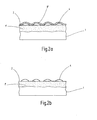
- Fig. 2a shows a more detailed view of Fig. 1b
- Element particles 4, which lie on the measuring surface 2 have an overlying layer of material, a fabric film 3', on.
- Fig. 2b shows in the same detailing as Fig. 2a a sample body 1, 1 'after a heat treatment according to claim 2.
- the cloth film 3' was burned by the heat treatment, so that the suspended element particles 4 to be measured are exposed on the measuring surface 2.
- the required shape of the specimen results from the measuring devices used for the measurement. Common are round, “tablet-shaped” specimens.
- the desired shape (and size) is achieved by the shape of the pressing devices used. It is essential that a smooth measuring surface is present.
- specimen substrates described and claimed as suitable are only examples. Of course, other substrates are well suited, such as Appatit or tricalcium phosphate.
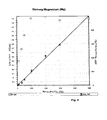
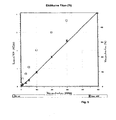
- the Fig. 3 to 9 show calibration curves for exemplarily selected elements.
- specimens of boehmite (A1 (OH) O) were used, to which in each case 150 mg of the calibration substances were applied for the measurement.
- the specimens were each prepared from 4 g of boehmite as compacts of 40 mm diameter and subjected to the RFA measurement under vacuum.
- kcps Pulse rate of measured intensities (kilo counts per second)
- Fig. 3 and 4 show calibration curves for the light elements boron (B) and magnesium (Mg), for the RFA measurements by conventional methods not at all (boron) or only very poorly (magnesium) were possible.
- the specific calibration values for these two elements are listed in Tables 1 and 2 below. In the left Column lists the element and the figure to which each table refers. ⁇ b> Table 1 ⁇ / b> B Standard name Int.Net. Conc.Chem. Conc.XRF Abs.Dev. Rel.Dev. LLD (PPM) ( Fig.
- Fig. 5 to 9 show examples of calibration curves for heavier elements (heavy metals) titanium (Ti), manganese (Mn), iron (Fe), nickel (Ni) and tin (Sn) in ascending order of their arrangement in the periodic table.
- Ti titanium
- Mn manganese
- Fe iron
- Ni nickel
- Sn tin
- Table 3 ⁇ / b> Ti Standard name Int.Net. Conc.Chem. Conc.XRF Abs.Dev. Rel.Dev. LLD (PPM) ( Fig.
Landscapes
- Physics & Mathematics (AREA)
- Health & Medical Sciences (AREA)
- Life Sciences & Earth Sciences (AREA)
- Chemical & Material Sciences (AREA)
- Analytical Chemistry (AREA)
- Biochemistry (AREA)
- General Health & Medical Sciences (AREA)
- General Physics & Mathematics (AREA)
- Immunology (AREA)
- Pathology (AREA)
- Analysing Materials By The Use Of Radiation (AREA)
Claims (11)
- Procédé d'analyse pour l'analyse de matières fluides ou pâteuses (3), non constituées exclusivement de constituants volatils, les matières (3) étant préparées par un procédé comprenant les étapes suivantes :1) la matière (3) à analyser est appliquée sur un élément d'analyse d'échantillon rigide (1) comprenant au moins une surface de mesure plane et lisse (2), l'élément d'analyse d'échantillon rigide (1) comprenant un matériau absorbant, de préférence étant constitué par un matériau absorbant,2) la matière (3) est ad- et absorbée par cet élément d'analyse d'échantillon (1),l'élément d'analyse d'échantillon (1) étant un comprimé de granulat et l'élément d'analyse d'échantillon comprenant au moins une des matières suivantes : un minéral argileux ; de la boéhmite ; de l'apatite ; du phosphate de tricalcium ; de la cellulose ; et
les matières (3) étant ensuite analysées par analyse de fluorescence X. - Procédé d'analyse selon la revendication précédente, dans lequel l'analyse de fluorescence X est une analyse de fluorescence X dispersive en longueur d'onde ou dispersive en énergie.
- Procédé d'analyse selon l'une quelconque des deux revendications précédentes, dans lequel un élément d'analyse d'échantillon (1) qui lie et/ou retient la matière à l'étape 2 de manière à ce qu'elle reste liée ou retenue même sous vide est utilisé à l'étape 1.
- Procédé d'analyse selon l'une quelconque des trois revendications précédentes, dans lequel le procédé comprend en tant qu'étape supplémentaire (troisième étape) :3) l'élément d'analyse d'échantillon (1) est soumis à un traitement thermique pour l'élimination d'un film de matière (3') sur des particules élémentaires (4) sur la surface de mesure (2).
- Procédé d'analyse selon l'une quelconque des quatre revendications précédentes, dans lequel l'élément d'analyse d'échantillon comprend du charbon actif.
- Procédé de préparation de matières fluides ou pâteuses (3), non constituées exclusivement de constituants volatils, pour l'analyse de fluorescence X, comprenant les étapes suivantes :1) la matière (3) à analyser est appliquée sur un élément d'analyse d'échantillon rigide (1) comprenant au moins une surface de mesure plane et lisse (2), l'élément d'analyse d'échantillon rigide (1) comprenant un matériau absorbant, de préférence étant constitué par un matériau absorbant,2) la matière (3) est ad- et absorbée par cet élément d'analyse d'échantillon (1),l'élément d'analyse d'échantillon (1) étant un comprimé de granulat et l'élément d'analyse d'échantillon étant constitué d'une des matières suivantes : un minéral argileux ; de la boéhmite ; de l'apatite ; du phosphate de tricalcium.
- Procédé selon la revendication précédente, dans lequel un élément d'analyse d'échantillon (1) qui lie et/ou retient la matière à l'étape 2 de manière à ce qu'elle reste liée ou retenue même sous vide est utilisé à l'étape 1.
- Procédé selon l'une quelconque des deux revendications précédentes, dans lequel le procédé comprend en tant qu'étape supplémentaire (troisième étape) :3) l'élément d'analyse d'échantillon (1) est soumis à un traitement thermique pour l'élimination d'un film de matière (3') sur des particules élémentaires (4) sur la surface de mesure (2).
- Élément d'analyse d'échantillon (1) pour l'analyse de matières fluides ou pâteuses (3) par analyse de fluorescence X selon l'une quelconque des revendications 1 à 5, comprenant au moins une surface de mesure plane et lisse (2), l'élément d'analyse d'échantillon étant constitué d'un matériau rigide absorbant, l'élément d'analyse d'échantillon (1) étant un comprimé d'un granulat et l'élément d'analyse d'échantillon étant constitué d'une des matières suivantes : un minéral argileux ; de la boéhmite ; de l'apatite ; du phosphate de tricalcium.
- Élément d'analyse d'échantillon (1) selon la revendication précédente, caractérisé en ce que le matériau rigide absorbant peut retenir et/ou lier la matière fluide à pâteuse si solidement qu'elle reste retenue ou reliée même sous vide.
- Élément d'analyse d'échantillon (1) selon l'une quelconque des deux revendications précédentes, comprenant également une matière fluide ou pâteuse (3), non constituée exclusivement de constituants volatils, préparé par un procédé selon l'une quelconque des revendications 6 à 8.
Applications Claiming Priority (3)
| Application Number | Priority Date | Filing Date | Title |
|---|---|---|---|
| DE102007023793 | 2007-05-21 | ||
| DE102007039000A DE102007039000B4 (de) | 2007-05-21 | 2007-08-17 | Verfahren für die Probenpräparation flüssiger oder pastöser Stoffe zur Messung mittels Röntgenfluoreszenz und dafür geeigneter Probenkörper |
| PCT/EP2008/004061 WO2008141812A1 (fr) | 2007-05-21 | 2008-05-21 | Procédé visant à préparer un échantillon de matière fluide ou pâteuse destinée à être mesuré par fluorescence x et élément d'analyse d'échantillon approprié à un tel procédé |
Publications (2)
| Publication Number | Publication Date |
|---|---|
| EP2149043A1 EP2149043A1 (fr) | 2010-02-03 |
| EP2149043B1 true EP2149043B1 (fr) | 2014-08-27 |
Family
ID=39917483
Family Applications (1)
| Application Number | Title | Priority Date | Filing Date |
|---|---|---|---|
| EP08758667.3A Not-in-force EP2149043B1 (fr) | 2007-05-21 | 2008-05-21 | Procédé visant à préparer un échantillon de matière fluide ou pâteuse destinée à être mesuré par fluorescence x et élément d'analyse d'échantillon approprié à un tel procédé |
Country Status (4)
| Country | Link |
|---|---|
| US (1) | US8605855B2 (fr) |
| EP (1) | EP2149043B1 (fr) |
| DE (1) | DE102007039000B4 (fr) |
| WO (1) | WO2008141812A1 (fr) |
Families Citing this family (3)
| Publication number | Priority date | Publication date | Assignee | Title |
|---|---|---|---|---|
| EP2894463A1 (fr) * | 2014-01-13 | 2015-07-15 | PANalytical B.V. | Procédé de fabrication d'une norme |
| US10193843B2 (en) | 2015-12-08 | 2019-01-29 | Samsung Electronics Co., Ltd. | Computing system with conversation modeling mechanism and method of operation thereof |
| JP6795970B2 (ja) * | 2016-12-27 | 2020-12-02 | 旭カーボン株式会社 | 液状原料油の蛍光x線元素分析用試料の作製方法 |
Family Cites Families (14)
| Publication number | Priority date | Publication date | Assignee | Title |
|---|---|---|---|---|
| NL6406917A (fr) * | 1964-06-17 | 1965-12-20 | ||
| DE2717925C3 (de) * | 1977-04-22 | 1981-09-03 | Gkss - Forschungszentrum Geesthacht Gmbh, 2000 Hamburg | Verwendung eines für die Spurenanalyse durch Röntgenfluoreszenz diedenden Anreicherungsverfahren |
| EP0172933A1 (fr) * | 1984-08-29 | 1986-03-05 | Rigaku Industrial Corporation | Méthode d'analyse par fluorescence aux rayons X des échantillons en solution |
| US4778700A (en) * | 1986-06-20 | 1988-10-18 | Knauf Fiber Glass Gmbh | Fiber glass product |
| DE4345211C2 (de) * | 1992-03-04 | 1996-08-08 | Fujitsu Ltd | Meßausrüstung zum vereinfachten Messen der Umgebungsatmosphäre |
| DE4390935C2 (de) | 1992-03-04 | 1996-08-29 | Fujitsu Ltd | Verfahren zum vereinfachten Messen der Umgebungsatmosphäre |
| DE4207745A1 (de) | 1992-03-11 | 1993-09-16 | Basf Ag | Azofarbstoffe enthaltende molekularsiebe |
| DE19618773C1 (de) | 1996-05-10 | 1997-11-06 | Sbf Wasser Und Umwelt Zweignie | Verfahren und Vorrichtung zur Probenvorbereitung und Messung des Elementgehaltes in eindampfbaren Flüssigkeiten |
| US6012325A (en) | 1997-11-05 | 2000-01-11 | The Boc Group, Inc. (A Delaware Corporation) | Method and apparatus for measuring metallic impurities contained within a fluid |
| DE10121140A1 (de) | 2001-01-02 | 2002-07-11 | Ursula Perplies | Verarbeitung von Tiermehl zu Brennstoffen |
| JP2004093272A (ja) * | 2002-08-30 | 2004-03-25 | Taisei Kiso Sekkei Kk | 液体中に含有される重金属類成分の分析測定方法および重金属類の形態分析方法 |
| KR100713742B1 (ko) * | 2003-08-01 | 2007-05-02 | 리가꾸 덴끼 고교 가부시끼가이샤 | 형광 x선 분석용 시료 보유 지지구 및 그것을 이용하는형광 x선 분석 방법 및 장치 |
| JP2005062134A (ja) * | 2003-08-20 | 2005-03-10 | Horiba Ltd | 試料の前処理方法および試料保持部材 |
| JP2006220432A (ja) * | 2005-02-08 | 2006-08-24 | Mitsubishi Electric Corp | 重金属の分析方法 |
-
2007
- 2007-08-17 DE DE102007039000A patent/DE102007039000B4/de not_active Expired - Fee Related
-
2008
- 2008-05-21 US US12/599,687 patent/US8605855B2/en not_active Expired - Fee Related
- 2008-05-21 EP EP08758667.3A patent/EP2149043B1/fr not_active Not-in-force
- 2008-05-21 WO PCT/EP2008/004061 patent/WO2008141812A1/fr not_active Ceased
Also Published As
| Publication number | Publication date |
|---|---|
| WO2008141812A1 (fr) | 2008-11-27 |
| US8605855B2 (en) | 2013-12-10 |
| DE102007039000A1 (de) | 2008-12-04 |
| EP2149043A1 (fr) | 2010-02-03 |
| DE102007039000B4 (de) | 2009-01-22 |
| US20110091012A1 (en) | 2011-04-21 |
Similar Documents
| Publication | Publication Date | Title |
|---|---|---|
| DE60003695T2 (de) | Röntgenfluoreszenzanalyse von mehrschichtigen proben | |
| DE112013005159T5 (de) | Verfahren und Vorrichtung zum Messen der Dünnfilmdicke unter Verwendung von Röntgenstrahlung | |
| DE1005743B (de) | Verfahren zur Messung der Dicke von Auflagen aus Metall oder anderen Werkstoffen mittels einer Betastrahlenquelle | |
| EP2149043B1 (fr) | Procédé visant à préparer un échantillon de matière fluide ou pâteuse destinée à être mesuré par fluorescence x et élément d'analyse d'échantillon approprié à un tel procédé | |
| DE3104468A1 (de) | Roentgenfluoreszenzspektrometer | |
| DE2850748A1 (de) | Verfahren und vorrichtung zur mikroanalyse mittels einer roentgenstrahlung | |
| EP3987279B1 (fr) | Système et procédé pour la détermination de propriétés de matériau d'un produit polycrystallin | |
| DE102009051374A1 (de) | Vorrichtung zum Refelektieren beschleunigter Elektronen | |
| DE2657439A1 (de) | Verfahren zum analysieren einer materialprobe aus einem isoliermaterial durch photoelektronische spektrometrie und probenhalter zur durchfuehrung des verfahrens | |
| DE19641815C2 (de) | Verfahren zur Bestimmung der Schichtdicke von Oberflächenschichten | |
| DE69629653T2 (de) | Methode zur bestimmung der ursache von defekten auf stahloberflächen | |
| DE102009051169A1 (de) | Phosphatelektrode, Elektrodensystem hiermit und deren Verwendung | |
| DE102019115794B4 (de) | Röntgenfluoreszenz-Kalibrierprobe und Verfahren zum Kalibrieren eines Röntgenfluoreszenz-Messgeräts | |
| DE202018103852U1 (de) | Probenhalter für Rasterelektronenmikroskope | |
| DE19618773C1 (de) | Verfahren und Vorrichtung zur Probenvorbereitung und Messung des Elementgehaltes in eindampfbaren Flüssigkeiten | |
| Klockenkämper | Totalreflexions-Röntgenfluoreszenzanalyse | |
| DE2420546A1 (de) | Porenfreie werkstuecke aus graphit und verfahren zu ihrer herstellung | |
| DE3826917A1 (de) | Verfahren zur phosphorgehaltsbestimmung in stromlos abgeschiedenen metallueberzuegen | |
| DE308106C (fr) | ||
| DE202007000756U1 (de) | Kalibrierstandard | |
| HANDSCHUH et al. | Mit Röntgen in die dritte Dimension. | |
| DE3842561C2 (fr) | ||
| AT504241B1 (de) | Verfahren zur ermittlung eines härteprofils in einsatzgehärtetem stahl | |
| DE3314281A1 (de) | Vorrichtung zum messen der dicke duenner schichten | |
| DE2355695B2 (de) | Aktivierungs-Neutronendetektor, der aus einer ausgehärteten Mischung neutronenaktivierbarer Stoffe mit einem Polykondensationsharz besteht |
Legal Events
| Date | Code | Title | Description |
|---|---|---|---|
| PUAI | Public reference made under article 153(3) epc to a published international application that has entered the european phase |
Free format text: ORIGINAL CODE: 0009012 |
|
| 17P | Request for examination filed |
Effective date: 20091021 |
|
| AK | Designated contracting states |
Kind code of ref document: A1 Designated state(s): AT BE BG CH CY CZ DE DK EE ES FI FR GB GR HR HU IE IS IT LI LT LU LV MC MT NL NO PL PT RO SE SI SK TR |
|
| AX | Request for extension of the european patent |
Extension state: AL BA MK RS |
|
| DAX | Request for extension of the european patent (deleted) | ||
| GRAP | Despatch of communication of intention to grant a patent |
Free format text: ORIGINAL CODE: EPIDOSNIGR1 |
|
| INTG | Intention to grant announced |
Effective date: 20140207 |
|
| GRAS | Grant fee paid |
Free format text: ORIGINAL CODE: EPIDOSNIGR3 |
|
| GRAA | (expected) grant |
Free format text: ORIGINAL CODE: 0009210 |
|
| AK | Designated contracting states |
Kind code of ref document: B1 Designated state(s): AT BE BG CH CY CZ DE DK EE ES FI FR GB GR HR HU IE IS IT LI LT LU LV MC MT NL NO PL PT RO SE SI SK TR |
|
| REG | Reference to a national code |
Ref country code: GB Ref legal event code: FG4D Free format text: NOT ENGLISH |
|
| REG | Reference to a national code |
Ref country code: CH Ref legal event code: EP |
|
| REG | Reference to a national code |
Ref country code: AT Ref legal event code: REF Ref document number: 684751 Country of ref document: AT Kind code of ref document: T Effective date: 20140915 |
|
| REG | Reference to a national code |
Ref country code: IE Ref legal event code: FG4D Free format text: LANGUAGE OF EP DOCUMENT: GERMAN |
|
| REG | Reference to a national code |
Ref country code: DE Ref legal event code: R096 Ref document number: 502008012150 Country of ref document: DE Effective date: 20141009 |
|
| REG | Reference to a national code |
Ref country code: LT Ref legal event code: MG4D |
|
| REG | Reference to a national code |
Ref country code: NL Ref legal event code: VDEP Effective date: 20140827 |
|
| PG25 | Lapsed in a contracting state [announced via postgrant information from national office to epo] |
Ref country code: FI Free format text: LAPSE BECAUSE OF FAILURE TO SUBMIT A TRANSLATION OF THE DESCRIPTION OR TO PAY THE FEE WITHIN THE PRESCRIBED TIME-LIMIT Effective date: 20140827 Ref country code: GR Free format text: LAPSE BECAUSE OF FAILURE TO SUBMIT A TRANSLATION OF THE DESCRIPTION OR TO PAY THE FEE WITHIN THE PRESCRIBED TIME-LIMIT Effective date: 20141128 Ref country code: NO Free format text: LAPSE BECAUSE OF FAILURE TO SUBMIT A TRANSLATION OF THE DESCRIPTION OR TO PAY THE FEE WITHIN THE PRESCRIBED TIME-LIMIT Effective date: 20141127 Ref country code: LT Free format text: LAPSE BECAUSE OF FAILURE TO SUBMIT A TRANSLATION OF THE DESCRIPTION OR TO PAY THE FEE WITHIN THE PRESCRIBED TIME-LIMIT Effective date: 20140827 Ref country code: PT Free format text: LAPSE BECAUSE OF FAILURE TO SUBMIT A TRANSLATION OF THE DESCRIPTION OR TO PAY THE FEE WITHIN THE PRESCRIBED TIME-LIMIT Effective date: 20141229 Ref country code: ES Free format text: LAPSE BECAUSE OF FAILURE TO SUBMIT A TRANSLATION OF THE DESCRIPTION OR TO PAY THE FEE WITHIN THE PRESCRIBED TIME-LIMIT Effective date: 20140827 Ref country code: BG Free format text: LAPSE BECAUSE OF FAILURE TO SUBMIT A TRANSLATION OF THE DESCRIPTION OR TO PAY THE FEE WITHIN THE PRESCRIBED TIME-LIMIT Effective date: 20141127 Ref country code: SE Free format text: LAPSE BECAUSE OF FAILURE TO SUBMIT A TRANSLATION OF THE DESCRIPTION OR TO PAY THE FEE WITHIN THE PRESCRIBED TIME-LIMIT Effective date: 20140827 |
|
| PG25 | Lapsed in a contracting state [announced via postgrant information from national office to epo] |
Ref country code: CY Free format text: LAPSE BECAUSE OF FAILURE TO SUBMIT A TRANSLATION OF THE DESCRIPTION OR TO PAY THE FEE WITHIN THE PRESCRIBED TIME-LIMIT Effective date: 20140827 Ref country code: HR Free format text: LAPSE BECAUSE OF FAILURE TO SUBMIT A TRANSLATION OF THE DESCRIPTION OR TO PAY THE FEE WITHIN THE PRESCRIBED TIME-LIMIT Effective date: 20140827 Ref country code: IS Free format text: LAPSE BECAUSE OF FAILURE TO SUBMIT A TRANSLATION OF THE DESCRIPTION OR TO PAY THE FEE WITHIN THE PRESCRIBED TIME-LIMIT Effective date: 20141227 Ref country code: LV Free format text: LAPSE BECAUSE OF FAILURE TO SUBMIT A TRANSLATION OF THE DESCRIPTION OR TO PAY THE FEE WITHIN THE PRESCRIBED TIME-LIMIT Effective date: 20140827 |
|
| PG25 | Lapsed in a contracting state [announced via postgrant information from national office to epo] |
Ref country code: NL Free format text: LAPSE BECAUSE OF FAILURE TO SUBMIT A TRANSLATION OF THE DESCRIPTION OR TO PAY THE FEE WITHIN THE PRESCRIBED TIME-LIMIT Effective date: 20140827 |
|
| PG25 | Lapsed in a contracting state [announced via postgrant information from national office to epo] |
Ref country code: CZ Free format text: LAPSE BECAUSE OF FAILURE TO SUBMIT A TRANSLATION OF THE DESCRIPTION OR TO PAY THE FEE WITHIN THE PRESCRIBED TIME-LIMIT Effective date: 20140827 Ref country code: SK Free format text: LAPSE BECAUSE OF FAILURE TO SUBMIT A TRANSLATION OF THE DESCRIPTION OR TO PAY THE FEE WITHIN THE PRESCRIBED TIME-LIMIT Effective date: 20140827 Ref country code: IT Free format text: LAPSE BECAUSE OF FAILURE TO SUBMIT A TRANSLATION OF THE DESCRIPTION OR TO PAY THE FEE WITHIN THE PRESCRIBED TIME-LIMIT Effective date: 20140827 Ref country code: RO Free format text: LAPSE BECAUSE OF FAILURE TO SUBMIT A TRANSLATION OF THE DESCRIPTION OR TO PAY THE FEE WITHIN THE PRESCRIBED TIME-LIMIT Effective date: 20140827 Ref country code: DK Free format text: LAPSE BECAUSE OF FAILURE TO SUBMIT A TRANSLATION OF THE DESCRIPTION OR TO PAY THE FEE WITHIN THE PRESCRIBED TIME-LIMIT Effective date: 20140827 Ref country code: EE Free format text: LAPSE BECAUSE OF FAILURE TO SUBMIT A TRANSLATION OF THE DESCRIPTION OR TO PAY THE FEE WITHIN THE PRESCRIBED TIME-LIMIT Effective date: 20140827 |
|
| REG | Reference to a national code |
Ref country code: DE Ref legal event code: R097 Ref document number: 502008012150 Country of ref document: DE |
|
| PG25 | Lapsed in a contracting state [announced via postgrant information from national office to epo] |
Ref country code: PL Free format text: LAPSE BECAUSE OF FAILURE TO SUBMIT A TRANSLATION OF THE DESCRIPTION OR TO PAY THE FEE WITHIN THE PRESCRIBED TIME-LIMIT Effective date: 20140827 |
|
| PLBE | No opposition filed within time limit |
Free format text: ORIGINAL CODE: 0009261 |
|
| STAA | Information on the status of an ep patent application or granted ep patent |
Free format text: STATUS: NO OPPOSITION FILED WITHIN TIME LIMIT |
|
| 26N | No opposition filed |
Effective date: 20150528 |
|
| PG25 | Lapsed in a contracting state [announced via postgrant information from national office to epo] |
Ref country code: SI Free format text: LAPSE BECAUSE OF FAILURE TO SUBMIT A TRANSLATION OF THE DESCRIPTION OR TO PAY THE FEE WITHIN THE PRESCRIBED TIME-LIMIT Effective date: 20140827 |
|
| REG | Reference to a national code |
Ref country code: CH Ref legal event code: PL |
|
| GBPC | Gb: european patent ceased through non-payment of renewal fee |
Effective date: 20150521 |
|
| PG25 | Lapsed in a contracting state [announced via postgrant information from national office to epo] |
Ref country code: CH Free format text: LAPSE BECAUSE OF NON-PAYMENT OF DUE FEES Effective date: 20150531 Ref country code: MC Free format text: LAPSE BECAUSE OF FAILURE TO SUBMIT A TRANSLATION OF THE DESCRIPTION OR TO PAY THE FEE WITHIN THE PRESCRIBED TIME-LIMIT Effective date: 20140827 Ref country code: LI Free format text: LAPSE BECAUSE OF NON-PAYMENT OF DUE FEES Effective date: 20150531 Ref country code: LU Free format text: LAPSE BECAUSE OF FAILURE TO SUBMIT A TRANSLATION OF THE DESCRIPTION OR TO PAY THE FEE WITHIN THE PRESCRIBED TIME-LIMIT Effective date: 20150521 |
|
| REG | Reference to a national code |
Ref country code: IE Ref legal event code: MM4A |
|
| REG | Reference to a national code |
Ref country code: FR Ref legal event code: ST Effective date: 20160129 |
|
| PG25 | Lapsed in a contracting state [announced via postgrant information from national office to epo] |
Ref country code: GB Free format text: LAPSE BECAUSE OF NON-PAYMENT OF DUE FEES Effective date: 20150521 Ref country code: IE Free format text: LAPSE BECAUSE OF NON-PAYMENT OF DUE FEES Effective date: 20150521 |
|
| PG25 | Lapsed in a contracting state [announced via postgrant information from national office to epo] |
Ref country code: FR Free format text: LAPSE BECAUSE OF NON-PAYMENT OF DUE FEES Effective date: 20150601 |
|
| REG | Reference to a national code |
Ref country code: AT Ref legal event code: MM01 Ref document number: 684751 Country of ref document: AT Kind code of ref document: T Effective date: 20150521 |
|
| PGFP | Annual fee paid to national office [announced via postgrant information from national office to epo] |
Ref country code: DE Payment date: 20160525 Year of fee payment: 9 |
|
| PG25 | Lapsed in a contracting state [announced via postgrant information from national office to epo] |
Ref country code: AT Free format text: LAPSE BECAUSE OF NON-PAYMENT OF DUE FEES Effective date: 20150521 |
|
| PG25 | Lapsed in a contracting state [announced via postgrant information from national office to epo] |
Ref country code: MT Free format text: LAPSE BECAUSE OF FAILURE TO SUBMIT A TRANSLATION OF THE DESCRIPTION OR TO PAY THE FEE WITHIN THE PRESCRIBED TIME-LIMIT Effective date: 20140827 |
|
| PG25 | Lapsed in a contracting state [announced via postgrant information from national office to epo] |
Ref country code: HU Free format text: LAPSE BECAUSE OF FAILURE TO SUBMIT A TRANSLATION OF THE DESCRIPTION OR TO PAY THE FEE WITHIN THE PRESCRIBED TIME-LIMIT; INVALID AB INITIO Effective date: 20080521 |
|
| PG25 | Lapsed in a contracting state [announced via postgrant information from national office to epo] |
Ref country code: BE Free format text: LAPSE BECAUSE OF NON-PAYMENT OF DUE FEES Effective date: 20150531 |
|
| PG25 | Lapsed in a contracting state [announced via postgrant information from national office to epo] |
Ref country code: TR Free format text: LAPSE BECAUSE OF FAILURE TO SUBMIT A TRANSLATION OF THE DESCRIPTION OR TO PAY THE FEE WITHIN THE PRESCRIBED TIME-LIMIT Effective date: 20140827 |
|
| REG | Reference to a national code |
Ref country code: DE Ref legal event code: R119 Ref document number: 502008012150 Country of ref document: DE |
|
| PG25 | Lapsed in a contracting state [announced via postgrant information from national office to epo] |
Ref country code: DE Free format text: LAPSE BECAUSE OF NON-PAYMENT OF DUE FEES Effective date: 20171201 |