EP2149358B1 - Utilisation d'oxygène pour le traitement de plaies - Google Patents
Utilisation d'oxygène pour le traitement de plaies Download PDFInfo
- Publication number
- EP2149358B1 EP2149358B1 EP09014450.2A EP09014450A EP2149358B1 EP 2149358 B1 EP2149358 B1 EP 2149358B1 EP 09014450 A EP09014450 A EP 09014450A EP 2149358 B1 EP2149358 B1 EP 2149358B1
- Authority
- EP
- European Patent Office
- Prior art keywords
- oxygen
- wound
- microcatheter
- containing fluid
- tissue
- Prior art date
- Legal status (The legal status is an assumption and is not a legal conclusion. Google has not performed a legal analysis and makes no representation as to the accuracy of the status listed.)
- Ceased
Links
- QVGXLLKOCUKJST-UHFFFAOYSA-N atomic oxygen Chemical compound [O] QVGXLLKOCUKJST-UHFFFAOYSA-N 0.000 title claims description 91
- 229910052760 oxygen Inorganic materials 0.000 title claims description 91
- 239000001301 oxygen Substances 0.000 title claims description 91
- 208000027418 Wounds and injury Diseases 0.000 title description 88
- 206010052428 Wound Diseases 0.000 title description 87
- 238000011282 treatment Methods 0.000 title description 8
- 239000012530 fluid Substances 0.000 claims description 45
- XLYOFNOQVPJJNP-UHFFFAOYSA-N water Substances O XLYOFNOQVPJJNP-UHFFFAOYSA-N 0.000 claims description 20
- 239000010410 layer Substances 0.000 claims description 7
- AEMRFAOFKBGASW-UHFFFAOYSA-N Glycolic acid Polymers OCC(O)=O AEMRFAOFKBGASW-UHFFFAOYSA-N 0.000 claims description 2
- 229920000954 Polyglycolide Polymers 0.000 claims description 2
- 238000004891 communication Methods 0.000 claims description 2
- 229920000747 poly(lactic acid) Polymers 0.000 claims description 2
- 229920001610 polycaprolactone Polymers 0.000 claims description 2
- 229920000642 polymer Polymers 0.000 claims description 2
- 239000002344 surface layer Substances 0.000 claims description 2
- 210000001519 tissue Anatomy 0.000 description 30
- 239000007789 gas Substances 0.000 description 14
- 239000007788 liquid Substances 0.000 description 11
- MYMOFIZGZYHOMD-UHFFFAOYSA-N Dioxygen Chemical compound O=O MYMOFIZGZYHOMD-UHFFFAOYSA-N 0.000 description 10
- 206010063560 Excessive granulation tissue Diseases 0.000 description 10
- 210000001126 granulation tissue Anatomy 0.000 description 10
- 229910001882 dioxygen Inorganic materials 0.000 description 8
- 230000029663 wound healing Effects 0.000 description 8
- 238000002347 injection Methods 0.000 description 7
- 239000007924 injection Substances 0.000 description 7
- 238000000034 method Methods 0.000 description 6
- 238000001802 infusion Methods 0.000 description 5
- 230000000699 topical effect Effects 0.000 description 5
- 230000003179 granulation Effects 0.000 description 4
- 238000005469 granulation Methods 0.000 description 4
- 231100000397 ulcer Toxicity 0.000 description 4
- 108010010803 Gelatin Proteins 0.000 description 3
- 229920005830 Polyurethane Foam Polymers 0.000 description 3
- 208000025865 Ulcer Diseases 0.000 description 3
- 239000000853 adhesive Substances 0.000 description 3
- 230000001070 adhesive effect Effects 0.000 description 3
- 230000015572 biosynthetic process Effects 0.000 description 3
- 230000001684 chronic effect Effects 0.000 description 3
- 229920000159 gelatin Polymers 0.000 description 3
- 239000008273 gelatin Substances 0.000 description 3
- 235000019322 gelatine Nutrition 0.000 description 3
- 235000011852 gelatine desserts Nutrition 0.000 description 3
- 230000001338 necrotic effect Effects 0.000 description 3
- 239000011496 polyurethane foam Substances 0.000 description 3
- 239000000243 solution Substances 0.000 description 3
- WSFSSNUMVMOOMR-UHFFFAOYSA-N Formaldehyde Chemical compound O=C WSFSSNUMVMOOMR-UHFFFAOYSA-N 0.000 description 2
- 206010040943 Skin Ulcer Diseases 0.000 description 2
- 239000002390 adhesive tape Substances 0.000 description 2
- 239000007864 aqueous solution Substances 0.000 description 2
- 239000008280 blood Substances 0.000 description 2
- 210000004369 blood Anatomy 0.000 description 2
- 230000008878 coupling Effects 0.000 description 2
- 238000010168 coupling process Methods 0.000 description 2
- 238000005859 coupling reaction Methods 0.000 description 2
- 230000006378 damage Effects 0.000 description 2
- 230000008021 deposition Effects 0.000 description 2
- 230000000694 effects Effects 0.000 description 2
- 210000000416 exudates and transudate Anatomy 0.000 description 2
- 230000003902 lesion Effects 0.000 description 2
- 239000000203 mixture Substances 0.000 description 2
- 239000004810 polytetrafluoroethylene Substances 0.000 description 2
- 229920001343 polytetrafluoroethylene Polymers 0.000 description 2
- 230000001737 promoting effect Effects 0.000 description 2
- 239000003642 reactive oxygen metabolite Substances 0.000 description 2
- 239000002904 solvent Substances 0.000 description 2
- WZUVPPKBWHMQCE-XJKSGUPXSA-N (+)-haematoxylin Chemical compound C12=CC(O)=C(O)C=C2C[C@]2(O)[C@H]1C1=CC=C(O)C(O)=C1OC2 WZUVPPKBWHMQCE-XJKSGUPXSA-N 0.000 description 1
- 206010002091 Anaesthesia Diseases 0.000 description 1
- GHXZTYHSJHQHIJ-UHFFFAOYSA-N Chlorhexidine Chemical compound C=1C=C(Cl)C=CC=1NC(N)=NC(N)=NCCCCCCN=C(N)N=C(N)NC1=CC=C(Cl)C=C1 GHXZTYHSJHQHIJ-UHFFFAOYSA-N 0.000 description 1
- 102000008186 Collagen Human genes 0.000 description 1
- 108010035532 Collagen Proteins 0.000 description 1
- 206010056340 Diabetic ulcer Diseases 0.000 description 1
- 206010015150 Erythema Diseases 0.000 description 1
- WZUVPPKBWHMQCE-UHFFFAOYSA-N Haematoxylin Natural products C12=CC(O)=C(O)C=C2CC2(O)C1C1=CC=C(O)C(O)=C1OC2 WZUVPPKBWHMQCE-UHFFFAOYSA-N 0.000 description 1
- 206010021143 Hypoxia Diseases 0.000 description 1
- 206010061218 Inflammation Diseases 0.000 description 1
- 208000031074 Reinjury Diseases 0.000 description 1
- 206010072170 Skin wound Diseases 0.000 description 1
- FAPWRFPIFSIZLT-UHFFFAOYSA-M Sodium chloride Chemical compound [Na+].[Cl-] FAPWRFPIFSIZLT-UHFFFAOYSA-M 0.000 description 1
- OUUQCZGPVNCOIJ-UHFFFAOYSA-M Superoxide Chemical compound [O-][O] OUUQCZGPVNCOIJ-UHFFFAOYSA-M 0.000 description 1
- 208000000558 Varicose Ulcer Diseases 0.000 description 1
- 230000002745 absorbent Effects 0.000 description 1
- 239000002250 absorbent Substances 0.000 description 1
- 230000001154 acute effect Effects 0.000 description 1
- 125000003545 alkoxy group Chemical group 0.000 description 1
- 238000001949 anaesthesia Methods 0.000 description 1
- 230000037005 anaesthesia Effects 0.000 description 1
- 238000004458 analytical method Methods 0.000 description 1
- 230000033115 angiogenesis Effects 0.000 description 1
- 230000009286 beneficial effect Effects 0.000 description 1
- 210000004027 cell Anatomy 0.000 description 1
- 229960003260 chlorhexidine Drugs 0.000 description 1
- 229920001436 collagen Polymers 0.000 description 1
- 230000000295 complement effect Effects 0.000 description 1
- 238000010276 construction Methods 0.000 description 1
- 230000008602 contraction Effects 0.000 description 1
- 238000001804 debridement Methods 0.000 description 1
- 230000002939 deleterious effect Effects 0.000 description 1
- 230000001419 dependent effect Effects 0.000 description 1
- 230000006866 deterioration Effects 0.000 description 1
- 208000037265 diseases, disorders, signs and symptoms Diseases 0.000 description 1
- 208000035475 disorder Diseases 0.000 description 1
- 238000004090 dissolution Methods 0.000 description 1
- 239000003814 drug Substances 0.000 description 1
- 230000002500 effect on skin Effects 0.000 description 1
- 238000005868 electrolysis reaction Methods 0.000 description 1
- YQGOJNYOYNNSMM-UHFFFAOYSA-N eosin Chemical compound [Na+].OC(=O)C1=CC=CC=C1C1=C2C=C(Br)C(=O)C(Br)=C2OC2=C(Br)C(O)=C(Br)C=C21 YQGOJNYOYNNSMM-UHFFFAOYSA-N 0.000 description 1
- 231100000321 erythema Toxicity 0.000 description 1
- 230000005284 excitation Effects 0.000 description 1
- 210000002950 fibroblast Anatomy 0.000 description 1
- 239000003349 gelling agent Substances 0.000 description 1
- 150000004820 halides Chemical class 0.000 description 1
- 229910052736 halogen Inorganic materials 0.000 description 1
- -1 halogen ions Chemical class 0.000 description 1
- 230000009931 harmful effect Effects 0.000 description 1
- 230000035876 healing Effects 0.000 description 1
- 150000002432 hydroperoxides Chemical class 0.000 description 1
- 238000002639 hyperbaric oxygen therapy Methods 0.000 description 1
- 230000007954 hypoxia Effects 0.000 description 1
- 238000010191 image analysis Methods 0.000 description 1
- 238000001727 in vivo Methods 0.000 description 1
- 230000004054 inflammatory process Effects 0.000 description 1
- 208000014674 injury Diseases 0.000 description 1
- 150000002500 ions Chemical class 0.000 description 1
- 239000002502 liposome Substances 0.000 description 1
- 230000004089 microcirculation Effects 0.000 description 1
- 238000000520 microinjection Methods 0.000 description 1
- 239000012188 paraffin wax Substances 0.000 description 1
- 229950011087 perflunafene Drugs 0.000 description 1
- UWEYRJFJVCLAGH-IJWZVTFUSA-N perfluorodecalin Chemical compound FC1(F)C(F)(F)C(F)(F)C(F)(F)[C@@]2(F)C(F)(F)C(F)(F)C(F)(F)C(F)(F)[C@@]21F UWEYRJFJVCLAGH-IJWZVTFUSA-N 0.000 description 1
- 230000002093 peripheral effect Effects 0.000 description 1
- 230000001766 physiological effect Effects 0.000 description 1
- 239000002504 physiological saline solution Substances 0.000 description 1
- 239000011148 porous material Substances 0.000 description 1
- 230000008092 positive effect Effects 0.000 description 1
- 230000035755 proliferation Effects 0.000 description 1
- 230000002035 prolonged effect Effects 0.000 description 1
- 229920006395 saturated elastomer Polymers 0.000 description 1
- 230000003068 static effect Effects 0.000 description 1
- 238000003786 synthesis reaction Methods 0.000 description 1
- TXEYQDLBPFQVAA-UHFFFAOYSA-N tetrafluoromethane Chemical compound FC(F)(F)F TXEYQDLBPFQVAA-UHFFFAOYSA-N 0.000 description 1
- 230000001225 therapeutic effect Effects 0.000 description 1
Images

Classifications
-
- A—HUMAN NECESSITIES
- A61—MEDICAL OR VETERINARY SCIENCE; HYGIENE
- A61M—DEVICES FOR INTRODUCING MEDIA INTO, OR ONTO, THE BODY; DEVICES FOR TRANSDUCING BODY MEDIA OR FOR TAKING MEDIA FROM THE BODY; DEVICES FOR PRODUCING OR ENDING SLEEP OR STUPOR
- A61M35/00—Devices for applying media, e.g. remedies, on the human body
-
- A—HUMAN NECESSITIES
- A61—MEDICAL OR VETERINARY SCIENCE; HYGIENE
- A61P—SPECIFIC THERAPEUTIC ACTIVITY OF CHEMICAL COMPOUNDS OR MEDICINAL PREPARATIONS
- A61P17/00—Drugs for dermatological disorders
- A61P17/02—Drugs for dermatological disorders for treating wounds, ulcers, burns, scars, keloids, or the like
-
- A—HUMAN NECESSITIES
- A61—MEDICAL OR VETERINARY SCIENCE; HYGIENE
- A61H—PHYSICAL THERAPY APPARATUS, e.g. DEVICES FOR LOCATING OR STIMULATING REFLEX POINTS IN THE BODY; ARTIFICIAL RESPIRATION; MASSAGE; BATHING DEVICES FOR SPECIAL THERAPEUTIC OR HYGIENIC PURPOSES OR SPECIFIC PARTS OF THE BODY
- A61H33/00—Bathing devices for special therapeutic or hygienic purposes
- A61H33/14—Devices for gas baths with ozone, hydrogen, or the like
Definitions
- the present invention relates to an apparatus for use in for treating wounds and lesions on a patient's body by introducing an oxygen-containing fluid into a tissue beneath the surface of the wound or lesion.
- Treatments based on inhalation of oxygen while considered effective, are complex and entail a risk from the potential harmful effects of prolonged hypoxia.
- Numerous wound treatment devices are known that administer oxygen gas topically to wound surfaces. Examples can be found in GB-A-2409412 , WO-A-9853778 , US-B-6179804 , US-A-4624656 , US-A-4224941 , US-A-5662625 , US-A-5810795 , FR-A-2656218 and WO-A-9741816 .
- These devices generally comprise an impermeable sheet having a peripheral region for attachment in gas-tight fashion around the wound, for example with adhesive, to form an enclosed chamber over the wound.
- the devices further comprise a gas inlet for introducing oxygen gas into the chamber above the wound, and optionally an outlet for removal of gas from the chamber.
- the devices can be operated with a static charge of gaseous oxygen, or with a continuous flow of gaseous oxygen over the wound. It will be appreciated that such devices are relatively bulky and prone to leakage, and can interfere with dressing changes and removal of wound exudates.
- US-A-6139876 describes a gelatin with increased oxygen content for use as a topical wound dressing.
- the gelatin comprises a gelling agent, a solvent, and microbubbles of oxygen in a substantially even distribution with a partial pressure exceeding normal atmospheric pressure, wherein the surface tension of the gelatin is sufficiently high to retain at least a portion of the overpressure of the oxygen throughout a predetermined period of time after having been exposed to an atmospheric environment.
- US20020160053 describes an aqueous solution for promoting the growth of tissue cells at wound sites.
- This solution comprises water containing at least 1 to 500 ppm of active oxygen and 10 to 10000 ppm of halogen ions.
- the solution is produced by electrolysis of aqueous halide solutions.
- the active oxygen can include singlet oxygen formed by excitation of triplet oxygen, superoxide formed by reduction of oxygen by a single electron, and hydroxy radical, as well as hypochlorous ions, organic peroxy radicals (ROO.), alkoxy radioals (RO.), and organic hydroperoxides (ROOH).
- ROO. organic peroxy radicals
- RO. alkoxy radioals
- ROOH organic hydroperoxides
- US-A-20050125035 describes an active suture having an internal passageway for post-surgical delivery of active fluids.
- the active fluids may comprise a wide range of medicaments, including oxygen-rich liquids to assist wound healing.
- the present invention provides an apparatus comprising: a source of an oxygen-containing fluid selected from gaseous oxygen or water containing at least 10mg per liter of dissolved oxygen; and a microcatheter having an inlet aperture in fluid communication with the source of oxygen-containing fluid and having one or more outlet apertures, wherein at least a region of the microcatheter has an effective internal diameter of less than 75 micrometers characterised in that said outlet apertures are located in a tip region of the microcatheter for injecting an effective amount of an oxygen-containing fluid selectively and directly into a layer of wound tissue located below a surface layer of a wound, for use in a method of treatment of a wound.
- the inventive apparatus is used in a method comprising the step of injecting an effective amount of an oxygen-containing fluid into said wound at a location below a surface of said wound, said step of injecting being carried out through a conduit having one or more outlets for said fluid, wherein substantially all of said outlets are positioned below the surface of the wound during said step of injecting.
- the apparatus of the present invention differs from the use of active sutures to deliver oxygen rich liquids, because the apparatus of the present invention delivers the oxygen rich liquid directly and selectively to the wound tissue below the surface of the wound, without any of the damage to surrounding healthy tissue that is caused by suturing.
- the apparatus of the present invention delivers the oxygen directly to the granulation tissue layer of the wound, where it is most effective.
- the present invention is especially useful for the treatment of chronic wounds such as ulcers that are not normally sutured.
- the apertured sutures of US-A-20050125035 deliver oxygen rich fluid nonselectively along the length of the suture. It follows also that the apertured sutures cannot be used to deliver an oxygen enriched fluid under pressure to a predetermined tissue layer under the surface of the wound, since the fluid under pressure will leak out of exposed parts of the apertured suture.
- microcatheter refers to any tubular body having a small internal and external diameter, including micro-injection needles, syringes, hollow sutures, and the like. Suitable microcatheters are described, for example, in US-B-6626885 .
- the conduit is flexible.
- the conduit has a substantially cylindrical lumen with one or more outlet apertures in a tip region thereof, but no apertures intermediate the inlet and the tip apertures, whereby all of the fluid injected into the inlet of the catheter flows out near the tip, i.e. below the surface of the wound in use.
- multiple conduits, or a single conduit with multiple outlets may be used to deliver the oxygen-containing fluid to the wound.
- the conduit is branched to permit oxygen injection at a plurality of locations beneath the surface of the wound.
- At least a tip region of the conduit is bioabsorbable, whereby the tip region can be left in the wound for resorption in vivo if necessary.
- at least the tip region of the may be made from a bioabsorbable polymer such as polylactide/polyglycolide, or poly-epsilon-caprolactone.
- the conduit can function as a flow regulator for the oxygen-containing fluid under pressure, whereby the fluid is delivered to the tip of the conduit at high pressure and low flow rate.
- the high pressure achieves a high dissolution of oxygen and resulting high concentration of the oxygen in the physiological fluid proximate to the conduit tip.
- the low flow rate inhibits liquid or gas bolus formation inside the wound.
- at least a tip region of the conduit suitably has an effective internal diameter of less than about 75 micrometers.
- at least a region of the conduit has an effective internal diameter of less than about 50 micrometers, for example from about 5 to about 40 micrometers.
- the term "effective internal diameter" refers to the equivalent open circular internal diameter.
- the said region of the conduit is located proximate to the tip (outlet) of the conduit.
- the conduit may comprise a length of tubing having internal diameter greater than about 100 micrometers, which may be branched, the end or ends of which are joined by a suitable coupling to respective microtubes (microcatheters) having internal diameter less than about 75 micrometers for flow control, the open end or ends of the microtubes being inserted below the surface of the wound.
- the microtubes are suitably bioabsorbable.
- the oxygen-containing fluid may be a liquid or a gas.
- the liquid is preferably aqueous, for example it may be water or a physiologically acceptable saline solution.
- the oxygen may be dissolved, preferably under pressure, to give a concentration of at least about 10 mgO 2 per liter, preferably at least about 20 mgO 2 per liter, for example from about 20 mgO 2 per liter to about 30 mgO 2 per liter. Oxygen concentrations in this range can be achieved by dissolving oxygen at a gas pressure of about 3 bar in water.
- the source of the fluid may be a portable pressurized reservoir containing a mixture of both fluid and oxygen bearing gas.
- the oxygen may be trapped in gaseous or dissolved form inside liposomes in the aqueous solution.
- the liquid may be a medically acceptable perfluorocarbon solvent such as perfluorodecalin containing dissolved oxygen.
- the oxygen-containing fluid may be any oxygen-containing gas.
- the gas comprises more than about 22mol.% of oxygen, more suitably at least about 40mol% oxygen, for example at least about 60mol.% oxygen, and in some embodiments it is substantially pure oxygen.
- the oxygen gas may be humidified before injection into the wound.
- the source of gaseous oxygen may comprise a pressurized oxygen tank, which may be portable.
- the source of oxygen-enriched fluid supplies the fluid at a pressure of from about 0.1 bar to about 5 bar (gauge), more suitably from about 0.5 bar to about 2 bar, for example about 1 bar.
- Suitable sources comprise an infusion pump, for example a spring-driven infusion pump. Pumps of this type are described, for example, in WO-A-0038767 , the entire content of which is incorporated herein by reference.
- the step of injecting the oxygen-containing fluid into the wound tissue is performed in substantially continuous fashion for a period of from about 1 hour to about 30 days, preferably from about 1 day to about 14 days.
- the pressure and delivery rate of the injection are adjusted to prevent the formation of a bolus of liquid or gas inside the wound.
- the effective internal diameter of the conduit, D, length of the conduit, L, the gauge pressure of the fluid used in the system, ⁇ P, and viscosity of the fluid, ⁇ all impact the delivery rate, V, according to the Hagen-Poiseuille equation.
- V ⁇ ⁇ ⁇ ⁇ PD 4 128 ⁇ ⁇ L
- Typical delivery rates per wound for gaseous oxygen are suitably about 0.5ml/hr to about 4ml/hr, typically about 1ml/hr to about 3ml/hr, for example about 2ml/hr.
- Typical delivery rates per wound for oxygen-enriched liquids are suitably about 0.05ml/hr to about 1ml/hr, typically about 0.1ml/hr to about 0.4ml/hr, for example about 0.15ml/hr.
- the conduit is arranged to deliver the oxygen below any surface necrotic tissue of the wound.
- the conduit is arranged to deliver the oxygen into or onto a granulation tissue in the wound.
- the oxygen injection is performed at a depth of from about 0.5mm to about 10mm below the surface of the wound, preferably from about 1mm to about 5 mm.
- the invention thereby provides an apparatus which provides a good method of promoting granulation tissue beneath necrotic tissue in instances were debridement would be difficult or painful for the patient.
- by injecting at this depth it ensures that the oxygenated fluid is delivered directly to healthy tissue where it may be effective.
- the wound is a chronic wound.
- Suitable chronic wounds include dermal ulcers such as a venous ulcers, diabetic ulcers or decubitis ulcers.
- the invention may also be useful for the treatment of acute wounds and burns.
- the apparatus comprises a spring driven infusion pump 1 having a valve outlet 2.
- a branched extension line 3 of PTFE tubing having an internal diameter of about 1mm has an inlet connector 4 that can be inserted in pressure-tight fashion into the pump outlet 2.
- the outlets at the ends of the branches of the extension line 3 are equipped with valves 5 and Luer-lock fittings for attachment with complementary fittings 7 on flow restrictor tubing 6.
- the flow restrictor tubing 6 is made of PVC with internal diameter about 150 micrometers.
- the length of the flow restrictor tubing is selected for the fluid being injected. For example, in this embodiment the length of the flow restrictor tubing is about 15cm for liquid injection and about 40cm for gas injection.
- the distal end 8 of the flow restrictor tubing 6 is joined in fluid-tight fashion to the inlet end of a microtube 9 formed of PTFE and having outside diameter about 150 micrometers, internal diameter about 49 micrometers, and length about 10cm.
- the tip 10 of the microtube 9 is inserted into the granulation tissue of a wound, below the necrotic surface tissue of the wound and oxygen-enriched fluid is delivered through the microtube, for example under a pump pressure of about 1 bar gauge.
- the apparatus in this embodiment is being used to inject humidified oxygen into the wound.
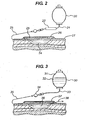
- the apparatus is generally as described in relation to Fig. 1 , in particular it comprises an infusion pump 20 that delivers oxygen gas at about 1bar gauge pressure to an extension line 21.
- a humidifier 22 is provided in the extension line.
- the humidifier comprises a moist porous material that saturates the oxygen with water vapor.
- the apparatus is shown injecting humidified oxygen through microtube 23 into wound 24 below the surface of the wound.
- the wound 24 is covered by a conventional dressing comprising an absorbent layer 25 covered by an adhesive-coated semipermeable backing layer 26 that is bonded to the skin 27 around the wound in substantially liquid-tight fashion.
- the apparatus in this embodiment is being used to inject oxygen-enriched water into the wound.
- the apparatus is generally as described in relation to Fig. 1 , in particular it comprises an infusion pump 30 that is filled with a mixture of oxygen gas 31 and water 32.
- the pump 30 delivers the water saturated with oxygen at about 1 bar gauge pressure to an extension line 33.
- the extension line 33 is joined by a suitable coupling 34 to microtube 35, which injects the oxygenated water into wound 36 below the surface of the wound.
- the wound 36 is covered by a conventional dressing 37 similar to that described in relation to Fig. 2 .
- a drain 38 is provided to remove excess fluid from the wound.
- Standard full thickness wounds were made in a porcine model. Under anaesthesia, the back and flank skin of the pig was clipped and washed using an aseptic cleanser (Chlorhexidine - 5%). The area was shaved using a razor and mopped clean using sterile swabs. Twelve full thickness wounds were created on anatomically similar sites (six on each flank). At each site a single 2.0 x 2.0cm full-thickness excisional wound was created using a scalpel.
- Oxygen bearing water was delivered using microtubing as above fed into the dorsal aspect of the wound (i.e. the edge parallel to the spine) and positioned in such a way as to allow delivery to the centre of the wound.
- the microtubing was then fixed into position using adhesive tape (SLEEK, Registered Trade Mark of Smith & Nephew Ltd). Wounds were then dressed with 6 x 5 cm polyurethane foam (TIELLE, Registered Trade Mark of Johnson & Johnson) dressings in such a way as to minimise leakage.
- Dressings and tubing were further secured by layering topper gauze over the polyurethane foam dressings on all wounds; this was further secured with adhesive tape and Elastic netting (SURGIFIX, Registered Trade Mark of Cistema d'Asti, Italy).
- Oxygen enriched water was delivered to the microcatheter at about 1 bar gauge.
- the resulting oxygen-enriched water is estimated to contain 25-30mg/l of oxygen.
- Five wounds were treated as reference examples, and received purely topical delivery (i.e. the microcatheter remained on top of the newly formed tissue). In one wound the microcatheter was embedded in the newly formed tissue (wound 19.2.10 in Table 1) resulting in oxygen being delivered from inside the wound.
- an island-type adhesive dressing comprising a sheet of hydrophilic polyurethane foam (TIELLE®, available from Johnson & Johnson Medical) was applied over the wounds.
Landscapes
- Health & Medical Sciences (AREA)
- Life Sciences & Earth Sciences (AREA)
- Engineering & Computer Science (AREA)
- Veterinary Medicine (AREA)
- Public Health (AREA)
- General Health & Medical Sciences (AREA)
- Animal Behavior & Ethology (AREA)
- Hematology (AREA)
- Heart & Thoracic Surgery (AREA)
- Biomedical Technology (AREA)
- Anesthesiology (AREA)
- Chemical Kinetics & Catalysis (AREA)
- Pharmacology & Pharmacy (AREA)
- Organic Chemistry (AREA)
- Nuclear Medicine, Radiotherapy & Molecular Imaging (AREA)
- Medicinal Chemistry (AREA)
- General Chemical & Material Sciences (AREA)
- Chemical & Material Sciences (AREA)
- Dermatology (AREA)
- Bioinformatics & Cheminformatics (AREA)
- Pharmaceuticals Containing Other Organic And Inorganic Compounds (AREA)
- Medicinal Preparation (AREA)
Claims (11)
- Appareil comprenant :une source (1, 20, 30) d'un fluide contenant de l'oxygène choisi entre de l'oxygène gazeux ou de l'eau contenant au moins 10 mg par litre d'oxygène dissous ; etun microcathéter (9, 23, 35) ayant une ouverture d'entrée en communication fluidique avec la source de fluide contenant de l'oxygène et ayant une ou plusieurs ouvertures, dans lequel au moins une région du microcathéter (9, 23, 35) présente un diamètre interne effectif de moins de 75 micromètres,caractérisé en ce que lesdites ouvertures de sortie sont situées dans une région de pointe du microcathéter pour injecter une quantité efficace d'un fluide contenant de l'oxygène sélectivement et directement dans une couche de tissu de plaie située en dessous d'une couche de surface d'une plaie.
- Appareil selon la revendication 1, dans lequel ledit fluide contenant de l'oxygène est de l'oxygène gazeux et ledit appareil comprend en outre un humidificateur (22) situé entre la source et le microcathéter (9, 23, 35) pour humidifier l'oxygène gazeux.
- Appareil selon la revendication 1 ou la revendication 2, dans lequel au moins la région de pointe du microcathéter (9, 23, 35) est bioabsorbable.
- Appareil selon la revendication 3, dans lequel au moins la région de pointe du microcathéter (9, 23, 35) est constituée d'un polymère bioabsorbable choisi entre un polylactide/polyglycolide ou une epsilon-caprolactone.
- Appareil selon l'une quelconque des revendications 1 à 3, dans lequel ladite source fournit ledit fluide contenant de l'oxygène sous une pression manométrique de 0,1 bar à 5 bars.
- Appareil selon l'une quelconque des revendications 1 à 3, dans lequel ladite source fournit ledit fluide contenant de l'oxygène sous une pression manométrique de 0,5 bar à 2 bars.
- Appareil selon l'une quelconque des revendications précédentes, dans lequel le microcathéter (9, 23, 35) n'a pas d'ouvertures entre l'ouverture d'entrée et les ouvertures de pointe.
- Appareil selon l'une quelconque des revendications précédentes, dans lequel le microcathéter (9, 23, 35) est ramifié.
- Appareil selon l'une quelconque des revendications précédentes, dans lequel le microcathéter (9, 23, 35) a un diamètre interne effectif de moins d'environ 50 micromètres.
- Appareil selon l'une quelconque des revendications précédentes, dans lequel le fluide contenant de l'oxygène est de l'eau contenant au moins 20 mg par litre d'oxygène dissous.
- Appareil selon l'une quelconque des revendications précédentes, dans lequel lesdites ouvertures de sortie sont situées pour délivrer ledit fluide contenant de l'oxygène sélectivement et directement à une couche de tissu de plaie à environ 0,5 mm à environ 10 mm en dessous de la surface de la plaie.
Priority Applications (1)
| Application Number | Priority Date | Filing Date | Title |
|---|---|---|---|
| EP15150995.7A EP2905008B2 (fr) | 2006-06-29 | 2007-06-25 | Appareil pour le traitement de plaies avec de l'oxygène |
Applications Claiming Priority (2)
| Application Number | Priority Date | Filing Date | Title |
|---|---|---|---|
| US11/477,307 US8808754B2 (en) | 2006-06-29 | 2006-06-29 | Methods for the treatment of wounds |
| EP07798976A EP2037860A2 (fr) | 2006-06-29 | 2007-06-25 | Procédés de traitement des blessures |
Related Parent Applications (1)
| Application Number | Title | Priority Date | Filing Date |
|---|---|---|---|
| EP07798976A Division EP2037860A2 (fr) | 2006-06-29 | 2007-06-25 | Procédés de traitement des blessures |
Related Child Applications (1)
| Application Number | Title | Priority Date | Filing Date |
|---|---|---|---|
| EP15150995.7A Division EP2905008B2 (fr) | 2006-06-29 | 2007-06-25 | Appareil pour le traitement de plaies avec de l'oxygène |
Publications (2)
| Publication Number | Publication Date |
|---|---|
| EP2149358A1 EP2149358A1 (fr) | 2010-02-03 |
| EP2149358B1 true EP2149358B1 (fr) | 2015-01-14 |
Family
ID=38662689
Family Applications (3)
| Application Number | Title | Priority Date | Filing Date |
|---|---|---|---|
| EP15150995.7A Ceased EP2905008B2 (fr) | 2006-06-29 | 2007-06-25 | Appareil pour le traitement de plaies avec de l'oxygène |
| EP07798976A Withdrawn EP2037860A2 (fr) | 2006-06-29 | 2007-06-25 | Procédés de traitement des blessures |
| EP09014450.2A Ceased EP2149358B1 (fr) | 2006-06-29 | 2007-06-25 | Utilisation d'oxygène pour le traitement de plaies |
Family Applications Before (2)
| Application Number | Title | Priority Date | Filing Date |
|---|---|---|---|
| EP15150995.7A Ceased EP2905008B2 (fr) | 2006-06-29 | 2007-06-25 | Appareil pour le traitement de plaies avec de l'oxygène |
| EP07798976A Withdrawn EP2037860A2 (fr) | 2006-06-29 | 2007-06-25 | Procédés de traitement des blessures |
Country Status (3)
| Country | Link |
|---|---|
| US (1) | US8808754B2 (fr) |
| EP (3) | EP2905008B2 (fr) |
| WO (1) | WO2008002855A2 (fr) |
Families Citing this family (10)
| Publication number | Priority date | Publication date | Assignee | Title |
|---|---|---|---|---|
| US7700819B2 (en) | 2001-02-16 | 2010-04-20 | Kci Licensing, Inc. | Biocompatible wound dressing |
| US7763769B2 (en) * | 2001-02-16 | 2010-07-27 | Kci Licensing, Inc. | Biocompatible wound dressing |
| EP1884223A1 (fr) † | 2006-08-04 | 2008-02-06 | IP Randwyck B.V. | Unité de stimulation d'une plaie |
| US8287506B2 (en) | 2007-10-26 | 2012-10-16 | Electrochemical Oxygen Concepts, Inc. | Apparatus and methods for controlling tissue oxygenation for wound healing and promoting tissue viability |
| US10226610B2 (en) | 2007-10-26 | 2019-03-12 | Electrochemical Oxygen Concepts, Inc. | Apparatus and methods for controlling tissue oxygenation for wound healing and promoting tissue viability |
| WO2011049633A2 (fr) | 2009-10-23 | 2011-04-28 | Amir Belson | Système portable d'oxygénothérapie topique |
| US20150343190A1 (en) * | 2014-03-05 | 2015-12-03 | Prosper Brands LLC | Method of oxygen saturation for wound treatment |
| JP7055103B2 (ja) | 2015-12-07 | 2022-04-15 | エレクトロケミカル オキシジェン コンセプツ インコーポレーテッド | 創傷治癒および組織生存能促進のために組織の酸素付加を制御する装置および方法 |
| US10702686B2 (en) | 2017-06-30 | 2020-07-07 | Electrochemical Oxygen Concepts, Inc. | Wound oxygen supply system |
| CA3176016A1 (fr) * | 2020-04-24 | 2021-10-28 | Michael Beattie | Utilisations d'eau et de gel super-oxygenes |
Family Cites Families (23)
| Publication number | Priority date | Publication date | Assignee | Title |
|---|---|---|---|---|
| US4224941A (en) | 1978-11-15 | 1980-09-30 | Stivala Oscar G | Hyperbaric treatment apparatus |
| US4624656A (en) | 1983-07-25 | 1986-11-25 | Hospitak, Inc. | Hyperbaric gas treatment device |
| FR2656218A1 (fr) | 1989-12-21 | 1991-06-28 | France Prod Oxygenes Co | Dispositif de traitement local a gaz du corps humain ou animal. |
| HU213450B (en) | 1995-04-26 | 1997-06-30 | Ladanyi Jozsef | Gel contains gelatin and process for producing it |
| US5662625A (en) | 1996-05-06 | 1997-09-02 | Gwr Medical, L.L.P. | Pressure controllable hyperbaric device |
| US5810795A (en) | 1996-05-13 | 1998-09-22 | Westwood; Joseph R. | Hyperbaric device with secondary pressure zone |
| IL120910A (en) | 1997-05-26 | 2004-01-04 | Lrr & D Ltd | Multipurpose dynamic occlusive dressing |
| AU5126499A (en) * | 1998-07-24 | 2000-02-14 | Therox, Inc. | Method and apparatus for the preparation and delivery of gas-enriched fluids |
| US6458109B1 (en) * | 1998-08-07 | 2002-10-01 | Hill-Rom Services, Inc. | Wound treatment apparatus |
| EP1146922A4 (fr) | 1998-12-29 | 2004-09-08 | Mckinley Medical Lllp | Pompe a perfusion a ressort |
| US6350253B1 (en) | 1999-07-19 | 2002-02-26 | I-Flow Corporation | Catheter for uniform delivery of medication |
| US6179804B1 (en) | 1999-08-18 | 2001-01-30 | Oxypatch, Llc | Treatment apparatus for wounds |
| JP2001139477A (ja) | 1999-11-17 | 2001-05-22 | Coherent Technology:Kk | 創傷部位の組織細胞増殖促進液 |
| JP2003523698A (ja) * | 2000-02-17 | 2003-08-05 | 松下電器産業株式会社 | 試用コンテンツと購入用コンテンツとを記録した半導体メモリカード、半導体メモリカードの記録装置及び記録再生装置並びに半導体メモリカードの販売方法 |
| US20020098246A1 (en) * | 2001-01-22 | 2002-07-25 | Howes Randolph M. | Compositions, methods, apparatuses, and systems for singlet oxygen delivery |
| US7288574B2 (en) * | 2001-07-18 | 2007-10-30 | Eckert C Edward | Two-phase oxygenated solution and method of use |
| AU2003211461C1 (en) * | 2002-03-04 | 2008-10-23 | New X-National Technology K.K. | Closed cell culture system |
| GB0325130D0 (en) | 2003-10-28 | 2003-12-03 | Smith & Nephew | Apparatus with scaffold |
| GB0325120D0 (en) | 2003-10-28 | 2003-12-03 | Smith & Nephew | Apparatus with actives |
| US8257393B2 (en) | 2003-12-04 | 2012-09-04 | Ethicon, Inc. | Active suture for the delivery of therapeutic fluids |
| JP5014798B2 (ja) * | 2003-12-04 | 2012-08-29 | エシコン・インコーポレイテッド | 治療液送達のための能動縫合糸 |
| GB2409412A (en) | 2003-12-22 | 2005-06-29 | Johnson & Johnson Medical Ltd | Hyperbaric wound treatment device |
| GB0424046D0 (en) | 2004-10-29 | 2004-12-01 | Smith & Nephew | Apparatus |
-
2006
- 2006-06-29 US US11/477,307 patent/US8808754B2/en active Active
-
2007
- 2007-06-25 EP EP15150995.7A patent/EP2905008B2/fr not_active Ceased
- 2007-06-25 EP EP07798976A patent/EP2037860A2/fr not_active Withdrawn
- 2007-06-25 WO PCT/US2007/071981 patent/WO2008002855A2/fr not_active Ceased
- 2007-06-25 EP EP09014450.2A patent/EP2149358B1/fr not_active Ceased
Also Published As
| Publication number | Publication date |
|---|---|
| EP2905008B2 (fr) | 2022-05-18 |
| EP2149358A1 (fr) | 2010-02-03 |
| WO2008002855A2 (fr) | 2008-01-03 |
| US20080003299A1 (en) | 2008-01-03 |
| EP2905008A1 (fr) | 2015-08-12 |
| US8808754B2 (en) | 2014-08-19 |
| EP2037860A2 (fr) | 2009-03-25 |
| EP2905008B1 (fr) | 2018-04-11 |
| WO2008002855A8 (fr) | 2008-03-27 |
Similar Documents
| Publication | Publication Date | Title |
|---|---|---|
| EP2149358B1 (fr) | Utilisation d'oxygène pour le traitement de plaies | |
| US11806215B2 (en) | Apparatus for wound therapy | |
| US8357130B2 (en) | Wound care apparatus | |
| Hess et al. | A review of mechanical adjuncts in wound healing: hydrotherapy, ultrasound, negative pressure therapy, hyperbaric oxygen, and electrostimulation | |
| CN110996866B (zh) | 用于伤口增压疗法的装置 | |
| US20080262413A1 (en) | Method For Supplying Oxygenated Water To Promote Internal Healing | |
| US20120046603A1 (en) | Hyperbaric dressing and method | |
| US20080140026A1 (en) | Acoustically-Aided and/or gel-aided delivery of beneficial gaseous, ionic, unstable, metastable, short-lived or reactive species for medical purposes | |
| US20240245871A1 (en) | Portable medical treatment system and method of use | |
| JP2005535393A (ja) | 一体化された注入・吸引システムとその方法 | |
| US20120065576A1 (en) | Drug delivery system | |
| US20070060834A1 (en) | Catheter control console | |
| US20220192888A1 (en) | Bandage system for wound visualization, microcurrent therapy and topical and transdermal drug delivery | |
| RU2068263C1 (ru) | Способ лечения гнойных ран | |
| JP2003516828A (ja) | イオン導入治療システム | |
| US20240189499A1 (en) | Dynamic negative pressure wound therapy system | |
| CN111298267A (zh) | 伤口镇痛缓释系统 | |
| KR102258962B1 (ko) | 비강 밀착 기구 | |
| US20220241322A1 (en) | Wound-treating gas composition, and wound-treating apparatus | |
| CN120392428A (zh) | 换药包扎辅助装置 | |
| CN115671519A (zh) | 一种用于混合痔术后的换药装置 | |
| HK1234686A1 (en) | Portable medical treatment system and method of use | |
| HK1234686B (en) | Portable medical treatment system and method of use |
Legal Events
| Date | Code | Title | Description |
|---|---|---|---|
| PUAI | Public reference made under article 153(3) epc to a published international application that has entered the european phase |
Free format text: ORIGINAL CODE: 0009012 |
|
| AC | Divisional application: reference to earlier application |
Ref document number: 2037860 Country of ref document: EP Kind code of ref document: P |
|
| AK | Designated contracting states |
Kind code of ref document: A1 Designated state(s): DE FR GB IT |
|
| 17P | Request for examination filed |
Effective date: 20100706 |
|
| 17Q | First examination report despatched |
Effective date: 20100802 |
|
| GRAP | Despatch of communication of intention to grant a patent |
Free format text: ORIGINAL CODE: EPIDOSNIGR1 |
|
| INTG | Intention to grant announced |
Effective date: 20140819 |
|
| GRAS | Grant fee paid |
Free format text: ORIGINAL CODE: EPIDOSNIGR3 |
|
| GRAP | Despatch of communication of intention to grant a patent |
Free format text: ORIGINAL CODE: EPIDOSNIGR1 |
|
| INTG | Intention to grant announced |
Effective date: 20141118 |
|
| GRAA | (expected) grant |
Free format text: ORIGINAL CODE: 0009210 |
|
| AC | Divisional application: reference to earlier application |
Ref document number: 2037860 Country of ref document: EP Kind code of ref document: P |
|
| AK | Designated contracting states |
Kind code of ref document: B1 Designated state(s): DE FR GB IT |
|
| REG | Reference to a national code |
Ref country code: GB Ref legal event code: FG4D |
|
| REG | Reference to a national code |
Ref country code: DE Ref legal event code: R096 Ref document number: 602007040082 Country of ref document: DE Effective date: 20150305 |
|
| REG | Reference to a national code |
Ref country code: DE Ref legal event code: R097 Ref document number: 602007040082 Country of ref document: DE |
|
| PLBE | No opposition filed within time limit |
Free format text: ORIGINAL CODE: 0009261 |
|
| STAA | Information on the status of an ep patent application or granted ep patent |
Free format text: STATUS: NO OPPOSITION FILED WITHIN TIME LIMIT |
|
| 26N | No opposition filed |
Effective date: 20151015 |
|
| REG | Reference to a national code |
Ref country code: FR Ref legal event code: PLFP Year of fee payment: 10 |
|
| REG | Reference to a national code |
Ref country code: FR Ref legal event code: PLFP Year of fee payment: 11 |
|
| REG | Reference to a national code |
Ref country code: DE Ref legal event code: R082 Ref document number: 602007040082 Country of ref document: DE Representative=s name: OLSWANG GERMANY LLP, DE Ref country code: DE Ref legal event code: R081 Ref document number: 602007040082 Country of ref document: DE Owner name: SYSTAGENIX WOUND MANAGEMENT, LTD., GATWICK AIR, GB Free format text: FORMER OWNER: SYSTAGENIX WOUND MANAGEMENT IP CO. BV., AMSTERDAM, NL Ref country code: DE Ref legal event code: R082 Ref document number: 602007040082 Country of ref document: DE Representative=s name: SIMMONS & SIMMONS LLP, DE |
|
| REG | Reference to a national code |
Ref country code: GB Ref legal event code: 732E Free format text: REGISTERED BETWEEN 20180215 AND 20180221 |
|
| REG | Reference to a national code |
Ref country code: FR Ref legal event code: PLFP Year of fee payment: 12 |
|
| REG | Reference to a national code |
Ref country code: DE Ref legal event code: R082 Ref document number: 602007040082 Country of ref document: DE Representative=s name: SIMMONS & SIMMONS LLP, DE |
|
| PGFP | Annual fee paid to national office [announced via postgrant information from national office to epo] |
Ref country code: IT Payment date: 20190521 Year of fee payment: 13 |
|
| PGFP | Annual fee paid to national office [announced via postgrant information from national office to epo] |
Ref country code: FR Payment date: 20190522 Year of fee payment: 13 |
|
| PG25 | Lapsed in a contracting state [announced via postgrant information from national office to epo] |
Ref country code: FR Free format text: LAPSE BECAUSE OF NON-PAYMENT OF DUE FEES Effective date: 20200630 |
|
| PG25 | Lapsed in a contracting state [announced via postgrant information from national office to epo] |
Ref country code: IT Free format text: LAPSE BECAUSE OF NON-PAYMENT OF DUE FEES Effective date: 20200625 |
|
| PGFP | Annual fee paid to national office [announced via postgrant information from national office to epo] |
Ref country code: GB Payment date: 20220519 Year of fee payment: 16 Ref country code: DE Payment date: 20220518 Year of fee payment: 16 |
|
| REG | Reference to a national code |
Ref country code: DE Ref legal event code: R119 Ref document number: 602007040082 Country of ref document: DE |
|
| GBPC | Gb: european patent ceased through non-payment of renewal fee |
Effective date: 20230625 |
|
| PG25 | Lapsed in a contracting state [announced via postgrant information from national office to epo] |
Ref country code: DE Free format text: LAPSE BECAUSE OF NON-PAYMENT OF DUE FEES Effective date: 20240103 Ref country code: GB Free format text: LAPSE BECAUSE OF NON-PAYMENT OF DUE FEES Effective date: 20230625 |