EP2149376A1 - Sedativum mit körpertemperatursenkender wirkung - Google Patents
Sedativum mit körpertemperatursenkender wirkung Download PDFInfo
- Publication number
- EP2149376A1 EP2149376A1 EP08740537A EP08740537A EP2149376A1 EP 2149376 A1 EP2149376 A1 EP 2149376A1 EP 08740537 A EP08740537 A EP 08740537A EP 08740537 A EP08740537 A EP 08740537A EP 2149376 A1 EP2149376 A1 EP 2149376A1
- Authority
- EP
- European Patent Office
- Prior art keywords
- ringer
- hypothermia
- solution
- bicarbonate ion
- composition
- Prior art date
- Legal status (The legal status is an assumption and is not a legal conclusion. Google has not performed a legal analysis and makes no representation as to the accuracy of the status listed.)
- Granted
Links
Images
Classifications
-
- A—HUMAN NECESSITIES
- A61—MEDICAL OR VETERINARY SCIENCE; HYGIENE
- A61K—PREPARATIONS FOR MEDICAL, DENTAL OR TOILETRY PURPOSES
- A61K31/00—Medicinal preparations containing organic active ingredients
- A61K31/185—Acids; Anhydrides, halides or salts thereof, e.g. sulfur acids, imidic, hydrazonic or hydroximic acids
- A61K31/19—Carboxylic acids, e.g. valproic acid
- A61K31/195—Carboxylic acids, e.g. valproic acid having an amino group
- A61K31/197—Carboxylic acids, e.g. valproic acid having an amino group the amino and the carboxyl groups being attached to the same acyclic carbon chain, e.g. gamma-aminobutyric acid [GABA], beta-alanine, epsilon-aminocaproic acid or pantothenic acid
- A61K31/198—Alpha-amino acids, e.g. alanine or edetic acid [EDTA]
-
- A—HUMAN NECESSITIES
- A61—MEDICAL OR VETERINARY SCIENCE; HYGIENE
- A61K—PREPARATIONS FOR MEDICAL, DENTAL OR TOILETRY PURPOSES
- A61K31/00—Medicinal preparations containing organic active ingredients
- A61K31/70—Carbohydrates; Sugars; Derivatives thereof
- A61K31/7004—Monosaccharides having only carbon, hydrogen and oxygen atoms
-
- A—HUMAN NECESSITIES
- A61—MEDICAL OR VETERINARY SCIENCE; HYGIENE
- A61K—PREPARATIONS FOR MEDICAL, DENTAL OR TOILETRY PURPOSES
- A61K33/00—Medicinal preparations containing inorganic active ingredients
-
- A—HUMAN NECESSITIES
- A61—MEDICAL OR VETERINARY SCIENCE; HYGIENE
- A61K—PREPARATIONS FOR MEDICAL, DENTAL OR TOILETRY PURPOSES
- A61K45/00—Medicinal preparations containing active ingredients not provided for in groups A61K31/00 - A61K41/00
- A61K45/06—Mixtures of active ingredients without chemical characterisation, e.g. antiphlogistics and cardiaca
-
- A—HUMAN NECESSITIES
- A61—MEDICAL OR VETERINARY SCIENCE; HYGIENE
- A61K—PREPARATIONS FOR MEDICAL, DENTAL OR TOILETRY PURPOSES
- A61K47/00—Medicinal preparations characterised by the non-active ingredients used, e.g. carriers or inert additives; Targeting or modifying agents chemically bound to the active ingredient
- A61K47/02—Inorganic compounds
-
- A—HUMAN NECESSITIES
- A61—MEDICAL OR VETERINARY SCIENCE; HYGIENE
- A61K—PREPARATIONS FOR MEDICAL, DENTAL OR TOILETRY PURPOSES
- A61K9/00—Medicinal preparations characterised by special physical form
- A61K9/0012—Galenical forms characterised by the site of application
- A61K9/0019—Injectable compositions; Intramuscular, intravenous, arterial, subcutaneous administration; Compositions to be administered through the skin in an invasive manner
-
- A—HUMAN NECESSITIES
- A61—MEDICAL OR VETERINARY SCIENCE; HYGIENE
- A61P—SPECIFIC THERAPEUTIC ACTIVITY OF CHEMICAL COMPOUNDS OR MEDICINAL PREPARATIONS
- A61P3/00—Drugs for disorders of the metabolism
-
- A—HUMAN NECESSITIES
- A61—MEDICAL OR VETERINARY SCIENCE; HYGIENE
- A61P—SPECIFIC THERAPEUTIC ACTIVITY OF CHEMICAL COMPOUNDS OR MEDICINAL PREPARATIONS
- A61P3/00—Drugs for disorders of the metabolism
- A61P3/12—Drugs for disorders of the metabolism for electrolyte homeostasis
-
- A—HUMAN NECESSITIES
- A61—MEDICAL OR VETERINARY SCIENCE; HYGIENE
- A61P—SPECIFIC THERAPEUTIC ACTIVITY OF CHEMICAL COMPOUNDS OR MEDICINAL PREPARATIONS
- A61P43/00—Drugs for specific purposes, not provided for in groups A61P1/00-A61P41/00
Definitions
- the present invention relates to an anti-hypothermia composition and, in particular, to an anti-hypothermia composition for preventing hypothermia caused by general anesthesia during surgical operations.
- hypothermia Human body temperature is normally maintained at about 37°C. However, the body temperature decreases when the function of the central nervous system (and, thus, the temperature regulatory center) is decreased by general anesthesia performed during surgical operations. The result is often hypothermia. Hypothermia causes complications including chillness/discomfort, shivering, tachycardia/ischemic change in ECG, delayed emergence, wound infection, delayed healing of wounds, decreased immune activity and blood coagulation disorder. Hypothermia ultimately leads to delayed postoperative recovery and decreased immune activity, increasing the risk of complications. Also, hypothermia during anesthesia is one of the factors that cause delayed awakening from anesthesia. For these reasons, prevention of hypothermia during surgical operations is medically important.
- Non-Patent Documents 1 to 3 An anti-hypothermia composition containing amino acids has also been proposed (Patent Document 1).
- the present inventors conducted studies to examine the relationship between acidosis and the time it takes for patients to awaken from anesthesia using a rat model with partial liver excision as well as a rat model of streptozotocin (STZ)-induced diabetic ketoacidosis.
- the present inventors also conducted studies to examine the ability of bicarbonated-Ringer's solution to facilitate recovery (awakening time) after anesthesia using a rat model with partial kidney excision. These studies have revealed that the time to awakening from anesthesia is significantly shorter in patients receiving the bicarbonated-Ringer's solution as compared to patients receiving the acetated-Ringer's solution or the lactated-Ringer's solution.
- the bicarbonated-Ringer's solution that contains sodium bicarbonate rather than sodium acetate or sodium lactate can directly correct acidosis since its alkalization effect does not involve the metabolic pathway of sodium acetate or sodium lactate.
- the time to awakening from anesthesia is inversely related to the blood pH: the more severe acidosis is, the more delayed the emergence from anesthesia will be. This observation suggests that quick correction of acidosis accelerates awakening of patients from anesthesia, thus facilitating the postoperative recovery of the patients.
- the present inventors conducted a study using a normal rat model and a rat model of STZ-induced diabetic ketoacidosis to determine whether or not the bicarbonated-Ringer's solution is more effective in the prevention of hypothermia during anesthesia than the acetated-Ringer's solution or the official Ringer's solution (prepared according to Japanese Pharmacopoeia) and, if so, to what degree.
- the bicarbonated-Ringer's solution and the acetated-Ringer's solution have electrolyte compositions more close to physiological state than the official Ringer's solution
- the bicarbonated-Ringer's solution and the acetated-Ringer's solution are more effective in maintaining circulatory kinetics and homeostasis than the official Ringer's solution. In normal rats, these differences are considered to be the cause of the difference in the degree of hypothermia between the group receiving the bicarbonated-Ringer's solution or the acetated-Ringer's solution and the group receiving the official Ringer's solution.
- Diabetic rats generally develop significant acidosis with a blood pH of 7.2 (ketoacidosis).
- ketoacidosis As reported in the non-patent document 4, in ketoacidosis, the alkalization effect of sodium acetate becomes less significant because the metabolism of ketone bodies produced in large quantities in ketoacidosis interferes with the metabolism of sodium acetate.
- an alkalizer used in the acetate-Ringer's solution sodium bicarbonate used as an alkalizer in the bicarbonated-Ringer's solution can supply bicarbonate ion without being involved in the metabolism.
- it can be used as an effective alkalizer in patients with metabolic disorder and organ dysfunction to correct acidosis and maintain a high blood pH that is difficult to achieve by the use of the other Ringer's solutions.
- the studies conducted by the present inventors have proven that the difference in the degree of hypothermia among the groups administered the bicarbonated-Ringer's solution, the acetated-Ringer's solution and the official Ringer's solution is mainly due to the fact that the ability of a Ringer's solution to prevent hypothermia varies depending on whether or not an alkalizer is present in the Ringer's solution, or, if it is present, the type of the alkalizer. Since the bicarbonated-Ringer's solution and the acetate-Ringer's solution have compositions more close to physiological state than the official Ringer's solution, these solutions can suppress the decrease in the biological function caused by anesthesia and, thus, the resulting hypothermia.
- the bicarbonated-Ringer's solution which can provide alkalization effect without requiring the metabolism, can bring about the alkalization effect faster than the acetated-Ringer's solution. For this reason, the bicarbonated-Ringer's solution can correct acidosis faster than the acetated-Ringer's solution in patients with diseases associated with acidosis. As a result, the decreased biological function due to acidosis can recover quickly, which helps keep the body temperature high.
- the present invention has been devised based on the foregoing knowledge.
- an anti-hypothermia composition in particular an anti-hypothermia composition that can prevent hypothermia caused by general anesthesia during surgical operations by preventing the decrease in the biological function of patients and correcting acidosis during surgical operations.
- the present invention in one aspect concerns the following:
- the anti-hypothermia composition provided by the present invention is essentially an infusion fluid containing a bicarbonate ion. More specifically, it is an infusion fluid that contains sodium bicarbonate as a major component that serves as a source of the bicarbonate ion (electrolyte).
- the anti-hypothermia composition serves to prevent the decrease in the biological function of patients and quickly correct acidosis, thus maintaining normal or near-normal blood and tissue pH. This in turn helps maintain the body temperature high, thus providing a significant advantage.
- the anti-hypothermia composition facilitates the recovery of the metabolic function by accelerating the recovery of the biological function of patients. It thus allows tissues and organs to quickly resume their normal function. As a result, increased risk of complications caused by the delayed action of body's protective mechanism or decreased immune activity can be avoided.
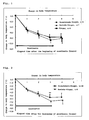
- Fig. 1 is a diagram showing the changes in body temperature in three groups of normal rats administered a Ringer's solution of the present invention, an acetate-Ringer's solution as a control and an official Ringer's solution as a control, respectively.
- Fig. 2 is a diagram showing the changes in body temperature in the two groups of STZ-induced diabetic ketoacidosis rats administered the Ringer's solution of the present invention and the acetate-Ringer's solution as a control, respectively.
- the anti-hypothermia composition provided by the present invention contains a bicarbonate ion that acts to quickly correct acidosis. More specifically, it is a preparation, preferably an infusion fluid, that contains sodium bicarbonate, a major component that serves as a source of bicarbonate ion (electrolyte), along with each or a combination of another electrolyte, glucose and an amino acid.
- the anti-hypothermia composition is provided in the form of a Ringer's solution, a maintenance solution, a starting solution, a solution for correction of dehydration, or a solution for postoperative recovery, in particular in the form of a Ringer's solution.
- the anti-hypothermia composition of the present invention containing a bicarbonate ion is provided in the form of a Ringer's solution, a type of infusion fluid used to replace the extracellular fluid, it contains a bicarbonate ion preferably at a concentration of 20 to 40 mEq/L and more preferably at a concentration of 22 to 30 mEq/L.
- it also contains other electrolytes: 130 to 145 mEq/L of sodium ion; 2 to 5 mEq/L of potassium ion; 90 to 130 mEq/L of chlorine ion; 2 to 5 mEq/L of calcium ion; 0.5 to 2.5 mEq/L of magnesium ion; and 0 to 7 mEq/L citrate ion, along with 0 to 5g/L of glucose.
- electrolytes 130 to 145 mEq/L of sodium ion; 2 to 5 mEq/L of potassium ion; 90 to 130 mEq/L of chlorine ion; 2 to 5 mEq/L of calcium ion; 0.5 to 2.5 mEq/L of magnesium ion; and 0 to 7 mEq/L citrate ion, along with 0 to 5g/L of glucose.
- the anti-hypothermia composition of the present invention containing a bicarbonate ion is provided in the form of a maintenance solution, another type of infusion fluid, it contains a bicarbonate ion preferably at a concentration of 15 to 30 mEq/L and more preferably at a concentration of 18 to 25 mEq/L.
- a bicarbonate ion preferably at a concentration of 15 to 30 mEq/L and more preferably at a concentration of 18 to 25 mEq/L.
- it also contains other electrolytes: 30 to 40 mEq/L of sodium ion; 15 to 25 mEq/L of potassium ion; and 30 to 40 mEq/L of chlorine ion, along with 40 to 80g/L of glucose.
- the anti-hypothermia composition of the present invention containing a bicarbonate ion is provided in the form of a starting solution, a solution for correction of dehydration, or a solution for postoperative recovery, it contains a bicarbonate ion and electrolytes at concentrations suitable for its intended use.
- the composition When the composition is intended as a starting solution, it preferably contains 30 to 90 mEq/L of sodium ion, 35 to 80 mEq/L of chlorine ion, 20 to 30 mEq/L of bicarbonate ion and 25 to 40g/L of glucose.
- it When it is intended as a solution for correction of dehydration, it preferably contains 60 to 90 mEq/L of sodium ion, 20 to 30 mEq/L of potassium ion, 0 to 5 mEq/L of magnesium ion, 45 to 70 mEq/L of chlorine ion, 5 to 10 mmol/L of phosphorus, 20 to 50 mEq/L of bicarbonate ion and 10 to 35g/L of glucose.
- it When it is intended as a solution for postoperative recovery, it preferably contains 30 mEq/L of sodium ion, 5 to 10 mEq/L of potassium ion, 20 to 30 mEq/L of chlorine ion, 10 to 20 mEq/L of bicarbonate ion and 30 to 50g/L glucose.
- Any electrolytes may be used suitable for the intended use.
- electrolytes include sodium chloride, sodium citrate, sodium acetate, sodium lactate, sodium dihydrogen phosphate, disodium hydrogen phosphate, sodium gluconate, sodium glycerophosphate, sodium malate, potassium chloride, dibasic potassium phosphate, potassium acetate, potassium citrate, potassium lactate, potassium glycerophosphate, potassium malate, calcium chloride, calcium lactate, calcium gluconate, calcium glycerophosphate, dibasic calcium phosphate, calcium malate, magnesium chloride, magnesium gluconate and magnesium glycerophosphate.
- sodium chloride, potassium chloride, calcium chloride, magnesium chloride, sodium bicarbonate, sodium citrate and glucose are particularly preferred.
- the anti-hypothermia composition of the present invention containing a bicarbonate ion is intended for use as an infusion fluid.
- a stable preparation containing sodium bicarbonate ion is difficult to prepare since sodium bicarbonate that serves as a source of the bicarbonate ion, an important base required to maintain the acid-base balance of extracellular fluid, tends to react with calcium and magnesium to form insoluble calcium carbonate and magnesium carbonate, and since an aqueous sodium bicarbonate solution, when left or heated, produces carbon dioxide that increases the pH of the solution.
- the infusion fluid of the present invention containing a bicarbonate ion may be prepared either upon use, or as separate solutions of sodium bicarbonate and an electrolyte, which may be contained in a two separate chambers of a container.
- a single solution-type preparation is preferred.
- the anti-hypothermia composition of the present invention containing a bicarbonate ion may be applied to any symptom or disease condition to prevent hypothermia of patients, it is particularly effective in preventing hypothermia caused by anesthesia.
- Anesthesia is generally classified into two types: general anesthesia and local anesthesia.
- General anesthesia includes inhalation anesthesia induced by isoflurane, sevoflurane and other gases that have analgesic, sedative and hypnotic effects (laughter gas) and intravenous anesthesia induced by propofol and other intravenous anesthetics.
- Local anesthesia includes tetracaine, lidocaine and dibucaine.
- the anti-hypothermia composition of the present invention containing a bicarbonate ion is particularly effective in the prevention of hypothermia caused by, of the different types of anesthesia, general anesthesia performed during surgical operations.
- the anti-hypothermia composition of the present invention containing a bicarbonate ion for use as an infusion fluid is a stable preparation that can be administered to patients who have their biological functions decreased by acidosis or other similar conditions to quickly correct acidosis, thus facilitating the recovery of their biological functions and preventing hypothermia.
- the anti-hypothermia composition of the present invention containing a bicarbonate ion can correct acidosis faster than other infusion fluids containing sodium acetate or sodium lactate. When used during surgical operations in which patients are put under general anesthesia, the composition also facilitates awakening of patients from anesthesia by quickly recovering biological functions and correcting acidosis.
- the anti-hypothermia composition of the present invention has particularly high ability to correct acidosis, it helps maintain normal or near-normal blood pH, so that the decreased biological function can recover quickly and the emergence from anesthesia can be facilitated.
- the anti-hypothermia composition of the present invention can prevent and/or ameliorate complications associated with hypothermia and can facilitate recovery of patients from surgical invasion.
- Ringer's solutions containing 20.0, 22.5, 25.0, 27.5 and 30.0 mEq/L of bicarbonate ion (HCO 3 - ) were prepared.
- the infusion preparations were prepared according to the formulations shown in Table 1 below.
- the solution was then filtered and loaded in a 500mL glass vial. The vial was autoclaved at 115°C for 15 min. In this manner, five different Ringer's solutions containing 20.0, 22.5, 25.0, 27.5 and 30.0 mEq/L of bicarbonate ion (HCO 3 - ) were prepared.
- the infusion fluids (Ringer's solutions) were analyzed for pH, insoluble material, insoluble particle count, amounts of components and carbon dioxide concentration in the vial space.
- Tables 2 and 3 The results are shown in Tables 2 and 3 below.
- each of the Ringer's solutions of the present invention did not undergo any significant changes during the storage period.
- Each solution proved to be a stable infusion fluid that did not decompose or form precipitation during the storage period.
- STZ-induced diabetic ketoacidosis rats STZ was dissolved in 0.1M citrate buffer to form an aqueous STZ solution. This solution was administered to rats from the tail vein at a dose of 100 mg/kg/mL. After 48 hours, the blood gas was measured to confirm the onset of acidosis.
- Ringer's solution of the present invention and the acetate-Ringer's solution and the official Ringer's solution as controls were prepared according to the compositions shown in Table 5 below and tested as infusion fluids. The groups tested were as shown in Table 4.
- Fig. 1 is a diagram showing the changes in body temperature in the three groups of normal rats administered the Ringer's solution of the present invention, the acetate-Ringer's solution as a control and the official Ringer's solution as a control, respectively.
- Fig. 2 is a diagram showing the changes in body temperature in the two groups of STZ-induced diabetic ketoacidosis rats administered the Ringer's solution of the present invention and the acetate-Ringer's solution as a control, respectively.
- the body temperature of the Ringer group according to the present invention was substantially the same as the body temperature of the acetate-Ringer group serving as the control at each time point ( Fig. 1 ).
- the body temperature of the Ringer group according to the present invention showed a tendency to be higher than the body temperature of the acetate Ringer group ( Fig. 2 ).
- the decrease in the body temperature ( ⁇ °C) of the Ringer group according to the present invention over the course of the anesthetic administration period was significantly smaller than that of the acetate-Ringer group. Specifically, the decrease was -5.8°C for the Ringer group according to the present invention and -6.9°C for the acetate-Ringer group (p ⁇ 0.05).
- the anti-hypothermia composition of the present invention containing a bicarbonate ion exhibits a similar anti-hypothermia effect to the acetate-Ringer's solution in normal rats, it shows higher anti-hypothermia effect than the acetate-Ringer's solution of the control when used in STZ-induced diabetic ketoacidosis rats.
- This observation suggests that the effect of the anti-hypothermia composition of the present invention containing a bicarbonate ion results from its ability to prevent the decrease in the biological function and quickly correct acidosis.
- the anti-hypothermia composition of the present invention containing a bicarbonate ion has proven to be useful in surgical operations involving general anesthesia, in particular in maintaining the body temperature of patients with metabolic acidosis during surgery.
- the anti-hypothermia composition of the present invention contains a bicarbonate ion as an essential component and serves to maintain normal or near-normal blood and tissue pH by preventing the decrease in the body function of patients and quickly correcting acidosis.
- the anti-hypothermia composition of the present invention helps keep the body temperature of patients high.
- the prompt recovery of the biological function due to the prevention of hypothermia facilitates the recovery of metabolic function and allows tissues and organs to resume their normal function quickly.
- increased risk of complication caused by the delayed action of body's protective mechanism or decreased immune activity can be avoided.
- the anti-hypothermia composition of the present invention is of significant medial importance in that it prevents hypothermia caused by general anesthesia during surgical operations.
Landscapes
- Health & Medical Sciences (AREA)
- Chemical & Material Sciences (AREA)
- Life Sciences & Earth Sciences (AREA)
- General Health & Medical Sciences (AREA)
- Veterinary Medicine (AREA)
- Public Health (AREA)
- Medicinal Chemistry (AREA)
- Animal Behavior & Ethology (AREA)
- Pharmacology & Pharmacy (AREA)
- Epidemiology (AREA)
- Inorganic Chemistry (AREA)
- Organic Chemistry (AREA)
- Bioinformatics & Cheminformatics (AREA)
- Nuclear Medicine, Radiotherapy & Molecular Imaging (AREA)
- Engineering & Computer Science (AREA)
- General Chemical & Material Sciences (AREA)
- Chemical Kinetics & Catalysis (AREA)
- Dermatology (AREA)
- Diabetes (AREA)
- Hematology (AREA)
- Obesity (AREA)
- Molecular Biology (AREA)
- Pharmaceuticals Containing Other Organic And Inorganic Compounds (AREA)
- Medicinal Preparation (AREA)
- Acyclic And Carbocyclic Compounds In Medicinal Compositions (AREA)
Applications Claiming Priority (2)
| Application Number | Priority Date | Filing Date | Title |
|---|---|---|---|
| JP2007111895 | 2007-04-20 | ||
| PCT/JP2008/057467 WO2008133157A1 (ja) | 2007-04-20 | 2008-04-17 | 体温低下抑制剤 |
Publications (3)
| Publication Number | Publication Date |
|---|---|
| EP2149376A1 true EP2149376A1 (de) | 2010-02-03 |
| EP2149376A4 EP2149376A4 (de) | 2010-05-05 |
| EP2149376B1 EP2149376B1 (de) | 2014-04-02 |
Family
ID=39925613
Family Applications (1)
| Application Number | Title | Priority Date | Filing Date |
|---|---|---|---|
| EP08740537.9A Active EP2149376B1 (de) | 2007-04-20 | 2008-04-17 | Anti-Hypothermie Zusammensetzung |
Country Status (6)
| Country | Link |
|---|---|
| US (1) | US8597691B2 (de) |
| EP (1) | EP2149376B1 (de) |
| JP (1) | JP5482999B2 (de) |
| KR (1) | KR101434329B1 (de) |
| TW (1) | TWI445540B (de) |
| WO (1) | WO2008133157A1 (de) |
Families Citing this family (7)
| Publication number | Priority date | Publication date | Assignee | Title |
|---|---|---|---|---|
| KR102633597B1 (ko) | 2013-06-05 | 2024-02-06 | 트리시다, 인크. | 경구 투여를 위한 양성자-결합 중합체 |
| IL322207A (en) | 2014-12-10 | 2025-09-01 | Tricida Inc | Proton-binding polymers for oral administration |
| US11590165B2 (en) * | 2014-12-17 | 2023-02-28 | Bausch Health Companies Inc. | Formulations of calcium and phosphate for oral inflammation |
| EP3393462B8 (de) * | 2015-12-22 | 2023-06-21 | Arizona Board of Regents on behalf of the University of Arizona | Zusammensetzungen und verfahren zur behandlung, linderung und prävention von narkose-induzierter hypothermie |
| IL262660B2 (en) | 2016-05-06 | 2024-04-01 | Tricida Inc | Compositions for and method of treating acid-base disorders |
| IL319146A (en) | 2017-11-03 | 2025-04-01 | Tricida Inc | Compositions for and method of treating acid-base disorders |
| JP6667792B2 (ja) * | 2017-11-17 | 2020-03-18 | 良弘 鈴木 | 抗癌剤の製造方法、抗癌剤及び医薬 |
Family Cites Families (8)
| Publication number | Priority date | Publication date | Assignee | Title |
|---|---|---|---|---|
| GB8619627D0 (en) * | 1986-08-12 | 1986-09-24 | Genetics Int Inc | Electrochemical assay |
| US4975281A (en) * | 1989-01-30 | 1990-12-04 | E. R. Squibb & Sons, Inc. | Anti-ulcer composition |
| WO2002045719A1 (fr) * | 2000-12-05 | 2002-06-13 | Kanagawa Academy Of Science And Technology | Remedes destines au symptome de type hibernation et agents induisant le symptome de type hibernation ou remediant a ce symptome |
| JP2004149495A (ja) * | 2002-11-01 | 2004-05-27 | Shimizu Pharmaceutical Co Ltd | 電解質代謝および酸塩基平衡を管理する方法 |
| WO2004096207A1 (ja) * | 2003-04-30 | 2004-11-11 | Ajinomoto Co., Inc. | 体温低下抑制剤 |
| AU2003227721A1 (en) | 2003-05-02 | 2004-11-23 | Paion Gmbh | Intravenous injection of non-neurotoxic plasminogen activators for the treatment of stroke |
| JP5177785B2 (ja) * | 2004-11-02 | 2013-04-10 | 味の素株式会社 | 周術期患者用薬剤 |
| EP1946763B1 (de) * | 2005-11-08 | 2013-08-21 | Ajinomoto Co., Inc. | Mittel zur förderung der erholung nach einer narkose |
-
2008
- 2008-04-16 TW TW097113823A patent/TWI445540B/zh not_active IP Right Cessation
- 2008-04-17 WO PCT/JP2008/057467 patent/WO2008133157A1/ja not_active Ceased
- 2008-04-17 EP EP08740537.9A patent/EP2149376B1/de active Active
- 2008-04-17 JP JP2009511837A patent/JP5482999B2/ja active Active
- 2008-04-17 KR KR1020097024207A patent/KR101434329B1/ko not_active Expired - Fee Related
-
2009
- 2009-10-19 US US12/581,428 patent/US8597691B2/en not_active Expired - Fee Related
Also Published As
| Publication number | Publication date |
|---|---|
| JP5482999B2 (ja) | 2014-05-07 |
| US8597691B2 (en) | 2013-12-03 |
| TWI445540B (zh) | 2014-07-21 |
| KR101434329B1 (ko) | 2014-08-27 |
| WO2008133157A1 (ja) | 2008-11-06 |
| EP2149376B1 (de) | 2014-04-02 |
| EP2149376A4 (de) | 2010-05-05 |
| KR20100017183A (ko) | 2010-02-16 |
| JPWO2008133157A1 (ja) | 2010-07-22 |
| US20100080858A1 (en) | 2010-04-01 |
| TW200906423A (en) | 2009-02-16 |
Similar Documents
| Publication | Publication Date | Title |
|---|---|---|
| US8597691B2 (en) | Anti-hypothermia composition | |
| US20090131338A1 (en) | Anesthesia arousal composition | |
| ES2052495T5 (es) | Terapia de fluidos con aniones l-lactato y/o piruvato. | |
| EP2298281B1 (de) | Infusions- und Injektionslösung enthaltend Levodopa | |
| EP2635269B1 (de) | Kombinationszusammensetzung | |
| ES2450131T3 (es) | Soluciones de diálisis esterilizadas que contienen pirofosfato | |
| ES2592938T3 (es) | Procedimientos y composiciones para reducir o evitar la calcificación vascular durante terapia de diálisis peritoneal | |
| ES2270620T3 (es) | Uso de l-carnitina y sus derivados alcanoilo como agentes osmoticos en soluciones para uso medico. | |
| JP2020536926A (ja) | L−エピネフリンの安定化注射用医薬用組成物 | |
| ES2382911T3 (es) | Método de cardioprotección y neuroprotección mediante administración intravenosa de anestésicos volátiles halogenados | |
| JP2012532852A (ja) | 2型糖尿病における食後高血糖の経頬粘膜治療の方法、および当該治療に用いられる医薬組成物 | |
| JP2004149495A (ja) | 電解質代謝および酸塩基平衡を管理する方法 | |
| WO2012005605A1 (en) | A combination composition comprising ibuprofen and paracetamol | |
| CN111701024A (zh) | 一种左旋多巴制剂及其制备方法及其应用 | |
| CN102885766B (zh) | 一种右旋酮洛芬注射液及其制备方法 | |
| RU2332215C2 (ru) | Способ анестезиологической защиты от факторов хирургической агрессии | |
| US20240042115A1 (en) | Peritoneal dialysis solution | |
| CN101953848B (zh) | 治疗癌症的药物及其用途 | |
| WO2020196381A1 (ja) | 皮下投与用輸液 |
Legal Events
| Date | Code | Title | Description |
|---|---|---|---|
| PUAI | Public reference made under article 153(3) epc to a published international application that has entered the european phase |
Free format text: ORIGINAL CODE: 0009012 |
|
| 17P | Request for examination filed |
Effective date: 20091009 |
|
| AK | Designated contracting states |
Kind code of ref document: A1 Designated state(s): AT BE BG CH CY CZ DE DK EE ES FI FR GB GR HR HU IE IS IT LI LT LU LV MC MT NL NO PL PT RO SE SI SK TR |
|
| AX | Request for extension of the european patent |
Extension state: AL BA MK RS |
|
| A4 | Supplementary search report drawn up and despatched |
Effective date: 20100401 |
|
| 17Q | First examination report despatched |
Effective date: 20100713 |
|
| REG | Reference to a national code |
Ref country code: DE Ref legal event code: R079 Ref document number: 602008031260 Country of ref document: DE Free format text: PREVIOUS MAIN CLASS: A61K0033100000 Ipc: A61K0009000000 |
|
| RIC1 | Information provided on ipc code assigned before grant |
Ipc: A61K 31/198 20060101ALI20130902BHEP Ipc: A61K 33/00 20060101ALI20130902BHEP Ipc: A61K 31/7004 20060101ALI20130902BHEP Ipc: A61K 9/00 20060101AFI20130902BHEP Ipc: A61K 45/06 20060101ALI20130902BHEP Ipc: A61K 47/02 20060101ALI20130902BHEP |
|
| GRAP | Despatch of communication of intention to grant a patent |
Free format text: ORIGINAL CODE: EPIDOSNIGR1 |
|
| INTG | Intention to grant announced |
Effective date: 20131010 |
|
| GRAS | Grant fee paid |
Free format text: ORIGINAL CODE: EPIDOSNIGR3 |
|
| GRAA | (expected) grant |
Free format text: ORIGINAL CODE: 0009210 |
|
| AK | Designated contracting states |
Kind code of ref document: B1 Designated state(s): AT BE BG CH CY CZ DE DK EE ES FI FR GB GR HR HU IE IS IT LI LT LU LV MC MT NL NO PL PT RO SE SI SK TR |
|
| AX | Request for extension of the european patent |
Extension state: AL BA MK RS |
|
| REG | Reference to a national code |
Ref country code: GB Ref legal event code: FG4D |
|
| REG | Reference to a national code |
Ref country code: AT Ref legal event code: REF Ref document number: 659632 Country of ref document: AT Kind code of ref document: T Effective date: 20140415 Ref country code: CH Ref legal event code: EP |
|
| REG | Reference to a national code |
Ref country code: IE Ref legal event code: FG4D |
|
| REG | Reference to a national code |
Ref country code: DE Ref legal event code: R096 Ref document number: 602008031260 Country of ref document: DE Effective date: 20140515 |
|
| REG | Reference to a national code |
Ref country code: AT Ref legal event code: MK05 Ref document number: 659632 Country of ref document: AT Kind code of ref document: T Effective date: 20140402 |
|
| REG | Reference to a national code |
Ref country code: NL Ref legal event code: VDEP Effective date: 20140402 |
|
| REG | Reference to a national code |
Ref country code: LT Ref legal event code: MG4D |
|
| PG25 | Lapsed in a contracting state [announced via postgrant information from national office to epo] |
Ref country code: CZ Free format text: LAPSE BECAUSE OF FAILURE TO SUBMIT A TRANSLATION OF THE DESCRIPTION OR TO PAY THE FEE WITHIN THE PRESCRIBED TIME-LIMIT Effective date: 20140402 Ref country code: LT Free format text: LAPSE BECAUSE OF FAILURE TO SUBMIT A TRANSLATION OF THE DESCRIPTION OR TO PAY THE FEE WITHIN THE PRESCRIBED TIME-LIMIT Effective date: 20140402 Ref country code: CY Free format text: LAPSE BECAUSE OF FAILURE TO SUBMIT A TRANSLATION OF THE DESCRIPTION OR TO PAY THE FEE WITHIN THE PRESCRIBED TIME-LIMIT Effective date: 20140402 Ref country code: NO Free format text: LAPSE BECAUSE OF FAILURE TO SUBMIT A TRANSLATION OF THE DESCRIPTION OR TO PAY THE FEE WITHIN THE PRESCRIBED TIME-LIMIT Effective date: 20140702 Ref country code: BG Free format text: LAPSE BECAUSE OF FAILURE TO SUBMIT A TRANSLATION OF THE DESCRIPTION OR TO PAY THE FEE WITHIN THE PRESCRIBED TIME-LIMIT Effective date: 20140702 Ref country code: FI Free format text: LAPSE BECAUSE OF FAILURE TO SUBMIT A TRANSLATION OF THE DESCRIPTION OR TO PAY THE FEE WITHIN THE PRESCRIBED TIME-LIMIT Effective date: 20140402 Ref country code: GR Free format text: LAPSE BECAUSE OF FAILURE TO SUBMIT A TRANSLATION OF THE DESCRIPTION OR TO PAY THE FEE WITHIN THE PRESCRIBED TIME-LIMIT Effective date: 20140703 Ref country code: IS Free format text: LAPSE BECAUSE OF FAILURE TO SUBMIT A TRANSLATION OF THE DESCRIPTION OR TO PAY THE FEE WITHIN THE PRESCRIBED TIME-LIMIT Effective date: 20140802 Ref country code: NL Free format text: LAPSE BECAUSE OF FAILURE TO SUBMIT A TRANSLATION OF THE DESCRIPTION OR TO PAY THE FEE WITHIN THE PRESCRIBED TIME-LIMIT Effective date: 20140402 |
|
| PG25 | Lapsed in a contracting state [announced via postgrant information from national office to epo] |
Ref country code: ES Free format text: LAPSE BECAUSE OF FAILURE TO SUBMIT A TRANSLATION OF THE DESCRIPTION OR TO PAY THE FEE WITHIN THE PRESCRIBED TIME-LIMIT Effective date: 20140402 Ref country code: AT Free format text: LAPSE BECAUSE OF FAILURE TO SUBMIT A TRANSLATION OF THE DESCRIPTION OR TO PAY THE FEE WITHIN THE PRESCRIBED TIME-LIMIT Effective date: 20140402 Ref country code: HR Free format text: LAPSE BECAUSE OF FAILURE TO SUBMIT A TRANSLATION OF THE DESCRIPTION OR TO PAY THE FEE WITHIN THE PRESCRIBED TIME-LIMIT Effective date: 20140402 Ref country code: PL Free format text: LAPSE BECAUSE OF FAILURE TO SUBMIT A TRANSLATION OF THE DESCRIPTION OR TO PAY THE FEE WITHIN THE PRESCRIBED TIME-LIMIT Effective date: 20140402 Ref country code: SE Free format text: LAPSE BECAUSE OF FAILURE TO SUBMIT A TRANSLATION OF THE DESCRIPTION OR TO PAY THE FEE WITHIN THE PRESCRIBED TIME-LIMIT Effective date: 20140402 Ref country code: LV Free format text: LAPSE BECAUSE OF FAILURE TO SUBMIT A TRANSLATION OF THE DESCRIPTION OR TO PAY THE FEE WITHIN THE PRESCRIBED TIME-LIMIT Effective date: 20140402 |
|
| REG | Reference to a national code |
Ref country code: CH Ref legal event code: PL |
|
| PG25 | Lapsed in a contracting state [announced via postgrant information from national office to epo] |
Ref country code: PT Free format text: LAPSE BECAUSE OF FAILURE TO SUBMIT A TRANSLATION OF THE DESCRIPTION OR TO PAY THE FEE WITHIN THE PRESCRIBED TIME-LIMIT Effective date: 20140804 |
|
| REG | Reference to a national code |
Ref country code: DE Ref legal event code: R097 Ref document number: 602008031260 Country of ref document: DE |
|
| REG | Reference to a national code |
Ref country code: IE Ref legal event code: MM4A |
|
| PG25 | Lapsed in a contracting state [announced via postgrant information from national office to epo] |
Ref country code: CH Free format text: LAPSE BECAUSE OF NON-PAYMENT OF DUE FEES Effective date: 20140430 Ref country code: LI Free format text: LAPSE BECAUSE OF NON-PAYMENT OF DUE FEES Effective date: 20140430 Ref country code: BE Free format text: LAPSE BECAUSE OF FAILURE TO SUBMIT A TRANSLATION OF THE DESCRIPTION OR TO PAY THE FEE WITHIN THE PRESCRIBED TIME-LIMIT Effective date: 20140402 Ref country code: EE Free format text: LAPSE BECAUSE OF FAILURE TO SUBMIT A TRANSLATION OF THE DESCRIPTION OR TO PAY THE FEE WITHIN THE PRESCRIBED TIME-LIMIT Effective date: 20140402 Ref country code: MC Free format text: LAPSE BECAUSE OF FAILURE TO SUBMIT A TRANSLATION OF THE DESCRIPTION OR TO PAY THE FEE WITHIN THE PRESCRIBED TIME-LIMIT Effective date: 20140402 Ref country code: SK Free format text: LAPSE BECAUSE OF FAILURE TO SUBMIT A TRANSLATION OF THE DESCRIPTION OR TO PAY THE FEE WITHIN THE PRESCRIBED TIME-LIMIT Effective date: 20140402 Ref country code: DK Free format text: LAPSE BECAUSE OF FAILURE TO SUBMIT A TRANSLATION OF THE DESCRIPTION OR TO PAY THE FEE WITHIN THE PRESCRIBED TIME-LIMIT Effective date: 20140402 Ref country code: RO Free format text: LAPSE BECAUSE OF FAILURE TO SUBMIT A TRANSLATION OF THE DESCRIPTION OR TO PAY THE FEE WITHIN THE PRESCRIBED TIME-LIMIT Effective date: 20140402 |
|
| PLBE | No opposition filed within time limit |
Free format text: ORIGINAL CODE: 0009261 |
|
| STAA | Information on the status of an ep patent application or granted ep patent |
Free format text: STATUS: NO OPPOSITION FILED WITHIN TIME LIMIT |
|
| 26N | No opposition filed |
Effective date: 20150106 |
|
| PG25 | Lapsed in a contracting state [announced via postgrant information from national office to epo] |
Ref country code: IT Free format text: LAPSE BECAUSE OF FAILURE TO SUBMIT A TRANSLATION OF THE DESCRIPTION OR TO PAY THE FEE WITHIN THE PRESCRIBED TIME-LIMIT Effective date: 20140402 |
|
| REG | Reference to a national code |
Ref country code: DE Ref legal event code: R097 Ref document number: 602008031260 Country of ref document: DE Effective date: 20150106 |
|
| PG25 | Lapsed in a contracting state [announced via postgrant information from national office to epo] |
Ref country code: IE Free format text: LAPSE BECAUSE OF NON-PAYMENT OF DUE FEES Effective date: 20140417 |
|
| PG25 | Lapsed in a contracting state [announced via postgrant information from national office to epo] |
Ref country code: SI Free format text: LAPSE BECAUSE OF FAILURE TO SUBMIT A TRANSLATION OF THE DESCRIPTION OR TO PAY THE FEE WITHIN THE PRESCRIBED TIME-LIMIT Effective date: 20140402 |
|
| REG | Reference to a national code |
Ref country code: FR Ref legal event code: PLFP Year of fee payment: 9 |
|
| PG25 | Lapsed in a contracting state [announced via postgrant information from national office to epo] |
Ref country code: MT Free format text: LAPSE BECAUSE OF FAILURE TO SUBMIT A TRANSLATION OF THE DESCRIPTION OR TO PAY THE FEE WITHIN THE PRESCRIBED TIME-LIMIT Effective date: 20140402 |
|
| PG25 | Lapsed in a contracting state [announced via postgrant information from national office to epo] |
Ref country code: HU Free format text: LAPSE BECAUSE OF FAILURE TO SUBMIT A TRANSLATION OF THE DESCRIPTION OR TO PAY THE FEE WITHIN THE PRESCRIBED TIME-LIMIT; INVALID AB INITIO Effective date: 20080417 Ref country code: LU Free format text: LAPSE BECAUSE OF NON-PAYMENT OF DUE FEES Effective date: 20140417 Ref country code: TR Free format text: LAPSE BECAUSE OF FAILURE TO SUBMIT A TRANSLATION OF THE DESCRIPTION OR TO PAY THE FEE WITHIN THE PRESCRIBED TIME-LIMIT Effective date: 20140402 |
|
| REG | Reference to a national code |
Ref country code: DE Ref legal event code: R082 Ref document number: 602008031260 Country of ref document: DE Representative=s name: PATENTANWAELTE STREHL, SCHUEBEL-HOPF & PARTNER, DE Ref country code: DE Ref legal event code: R082 Ref document number: 602008031260 Country of ref document: DE Representative=s name: STREHL SCHUEBEL-HOPF & PARTNER MBB PATENTANWAE, DE Ref country code: DE Ref legal event code: R081 Ref document number: 602008031260 Country of ref document: DE Owner name: EA PHARMA CO., LTD., JP Free format text: FORMER OWNER: AJINOMOTO CO., INC., TOKIO/TOKYO, JP |
|
| REG | Reference to a national code |
Ref country code: GB Ref legal event code: 732E Free format text: REGISTERED BETWEEN 20160908 AND 20160914 |
|
| REG | Reference to a national code |
Ref country code: FR Ref legal event code: TP Owner name: EA PHARMA CO., LTD., JP Effective date: 20161019 |
|
| REG | Reference to a national code |
Ref country code: FR Ref legal event code: PLFP Year of fee payment: 10 |
|
| PGFP | Annual fee paid to national office [announced via postgrant information from national office to epo] |
Ref country code: FR Payment date: 20170313 Year of fee payment: 10 |
|
| PGFP | Annual fee paid to national office [announced via postgrant information from national office to epo] |
Ref country code: GB Payment date: 20170412 Year of fee payment: 10 Ref country code: DE Payment date: 20170411 Year of fee payment: 10 |
|
| REG | Reference to a national code |
Ref country code: DE Ref legal event code: R119 Ref document number: 602008031260 Country of ref document: DE |
|
| GBPC | Gb: european patent ceased through non-payment of renewal fee |
Effective date: 20180417 |
|
| PG25 | Lapsed in a contracting state [announced via postgrant information from national office to epo] |
Ref country code: DE Free format text: LAPSE BECAUSE OF NON-PAYMENT OF DUE FEES Effective date: 20181101 |
|
| PG25 | Lapsed in a contracting state [announced via postgrant information from national office to epo] |
Ref country code: GB Free format text: LAPSE BECAUSE OF NON-PAYMENT OF DUE FEES Effective date: 20180417 |
|
| PG25 | Lapsed in a contracting state [announced via postgrant information from national office to epo] |
Ref country code: FR Free format text: LAPSE BECAUSE OF NON-PAYMENT OF DUE FEES Effective date: 20180430 |