EP2149676B1 - Innengekühlte Gasturbinenschaufel - Google Patents
Innengekühlte Gasturbinenschaufel Download PDFInfo
- Publication number
- EP2149676B1 EP2149676B1 EP09251875.2A EP09251875A EP2149676B1 EP 2149676 B1 EP2149676 B1 EP 2149676B1 EP 09251875 A EP09251875 A EP 09251875A EP 2149676 B1 EP2149676 B1 EP 2149676B1
- Authority
- EP
- European Patent Office
- Prior art keywords
- baffle
- aerofoil
- cavity
- apertures
- wall
- Prior art date
- Legal status (The legal status is an assumption and is not a legal conclusion. Google has not performed a legal analysis and makes no representation as to the accuracy of the status listed.)
- Not-in-force
Links
- 239000002826 coolant Substances 0.000 claims description 55
- 239000012530 fluid Substances 0.000 claims description 7
- 230000001419 dependent effect Effects 0.000 claims description 6
- 238000001816 cooling Methods 0.000 description 27
- 238000004519 manufacturing process Methods 0.000 description 6
- 239000002184 metal Substances 0.000 description 6
- 230000008901 benefit Effects 0.000 description 5
- 238000005266 casting Methods 0.000 description 5
- 239000000463 material Substances 0.000 description 5
- 238000000034 method Methods 0.000 description 5
- 230000008569 process Effects 0.000 description 4
- 230000003068 static effect Effects 0.000 description 4
- 230000015572 biosynthetic process Effects 0.000 description 3
- 230000000694 effects Effects 0.000 description 3
- 230000004075 alteration Effects 0.000 description 2
- 238000013459 approach Methods 0.000 description 2
- 238000010276 construction Methods 0.000 description 2
- 230000007423 decrease Effects 0.000 description 2
- 238000011161 development Methods 0.000 description 2
- 230000003647 oxidation Effects 0.000 description 2
- 238000007254 oxidation reaction Methods 0.000 description 2
- 230000036961 partial effect Effects 0.000 description 2
- 238000000926 separation method Methods 0.000 description 2
- 230000001133 acceleration Effects 0.000 description 1
- 230000002411 adverse Effects 0.000 description 1
- 238000005452 bending Methods 0.000 description 1
- 230000015556 catabolic process Effects 0.000 description 1
- 239000000919 ceramic Substances 0.000 description 1
- 239000011248 coating agent Substances 0.000 description 1
- 238000000576 coating method Methods 0.000 description 1
- 150000001875 compounds Chemical class 0.000 description 1
- 230000006835 compression Effects 0.000 description 1
- 238000007906 compression Methods 0.000 description 1
- 238000006731 degradation reaction Methods 0.000 description 1
- 238000009826 distribution Methods 0.000 description 1
- 238000005553 drilling Methods 0.000 description 1
- 230000008030 elimination Effects 0.000 description 1
- 238000003379 elimination reaction Methods 0.000 description 1
- 230000037406 food intake Effects 0.000 description 1
- 238000010348 incorporation Methods 0.000 description 1
- 238000003754 machining Methods 0.000 description 1
- 230000013011 mating Effects 0.000 description 1
- 238000002844 melting Methods 0.000 description 1
- 230000008018 melting Effects 0.000 description 1
- 238000012986 modification Methods 0.000 description 1
- 230000004048 modification Effects 0.000 description 1
- 230000009467 reduction Effects 0.000 description 1
- 230000002829 reductive effect Effects 0.000 description 1
- 230000002787 reinforcement Effects 0.000 description 1
- 230000000717 retained effect Effects 0.000 description 1
- 238000007493 shaping process Methods 0.000 description 1
- 238000005728 strengthening Methods 0.000 description 1
- 238000012546 transfer Methods 0.000 description 1
- 238000011144 upstream manufacturing Methods 0.000 description 1
Images



Classifications
-
- F—MECHANICAL ENGINEERING; LIGHTING; HEATING; WEAPONS; BLASTING
- F01—MACHINES OR ENGINES IN GENERAL; ENGINE PLANTS IN GENERAL; STEAM ENGINES
- F01D—NON-POSITIVE DISPLACEMENT MACHINES OR ENGINES, e.g. STEAM TURBINES
- F01D5/00—Blades; Blade-carrying members; Heating, heat-insulating, cooling or antivibration means on the blades or the members
- F01D5/12—Blades
- F01D5/14—Form or construction
- F01D5/18—Hollow blades, i.e. blades with cooling or heating channels or cavities; Heating, heat-insulating or cooling means on blades
- F01D5/187—Convection cooling
- F01D5/188—Convection cooling with an insert in the blade cavity to guide the cooling fluid, e.g. forming a separation wall
-
- F—MECHANICAL ENGINEERING; LIGHTING; HEATING; WEAPONS; BLASTING
- F01—MACHINES OR ENGINES IN GENERAL; ENGINE PLANTS IN GENERAL; STEAM ENGINES
- F01D—NON-POSITIVE DISPLACEMENT MACHINES OR ENGINES, e.g. STEAM TURBINES
- F01D9/00—Stators
- F01D9/02—Nozzles; Nozzle boxes; Stator blades; Guide conduits, e.g. individual nozzles
- F01D9/04—Nozzles; Nozzle boxes; Stator blades; Guide conduits, e.g. individual nozzles forming ring or sector
- F01D9/041—Nozzles; Nozzle boxes; Stator blades; Guide conduits, e.g. individual nozzles forming ring or sector using blades
-
- F—MECHANICAL ENGINEERING; LIGHTING; HEATING; WEAPONS; BLASTING
- F05—INDEXING SCHEMES RELATING TO ENGINES OR PUMPS IN VARIOUS SUBCLASSES OF CLASSES F01-F04
- F05D—INDEXING SCHEME FOR ASPECTS RELATING TO NON-POSITIVE-DISPLACEMENT MACHINES OR ENGINES, GAS-TURBINES OR JET-PROPULSION PLANTS
- F05D2230/00—Manufacture
- F05D2230/20—Manufacture essentially without removing material
- F05D2230/21—Manufacture essentially without removing material by casting
-
- F—MECHANICAL ENGINEERING; LIGHTING; HEATING; WEAPONS; BLASTING
- F05—INDEXING SCHEMES RELATING TO ENGINES OR PUMPS IN VARIOUS SUBCLASSES OF CLASSES F01-F04
- F05D—INDEXING SCHEME FOR ASPECTS RELATING TO NON-POSITIVE-DISPLACEMENT MACHINES OR ENGINES, GAS-TURBINES OR JET-PROPULSION PLANTS
- F05D2240/00—Components
- F05D2240/10—Stators
- F05D2240/12—Fluid guiding means, e.g. vanes
- F05D2240/126—Baffles or ribs
Definitions
- the present invention relates to aerofoils and more particularly to nozzle guide vanes utilised in gas turbine engines.
- Modern gas turbine engines operate at turbine gas temperatures which are significantly hotter than the melting point of the blade material used. Thus, at least high pressure turbines as well as possibly intermediate pressure turbines and low pressure turbines are cooled. During passage through the turbine it will be understood that the temperature of the gas decreases as power is extracted. In such circumstances the need to cool static or rotating parts of the engine decreases as the gas moves from the high temperature stages to the low temperature stages through to the exit nozzle for the engine.
- Typical forms of cooling include internal convection and external films.
- a high pressure turbine nozzle guide vane (NGV) consumes the greatest amount of cooling air.
- High pressure turbine blades typically use approximately half of the coolant that is required for nozzle guide vanes.
- Intermediate and low pressure stages down stream of the high pressure turbine progressively utilise and need less cooling air.
- the coolant used is high pressure air taken from a compressor.
- the coolant bypasses the combustor and is therefore relatively cool compared to the gas temperature of the working fluid.
- the coolant temperature often will be 700 to 1000K whilst working gas temperatures will be in the excess of 2000K.
- Figure 1 provides a pictorial illustration of a typical prior blade arrangement including a nozzle guide vane (NGV) and a rotor blade 2.
- a nozzle guide vane 1 comprises an outer platform 3, an inner platform 4 and an aerofoil vane 5 between.
- a rotor blade 2 comprises a shroud 6, a platform 7 with an aerofoil blade 8 between them.
- the guide vane 1 is substantially static and fixed whilst the rotor blade 2 rotates upon a rotor disc 9 secured through a blade root 10.
- a seal shroud 11 is provided in association with a support casing 12 in order to define a path across the arrangement 13 in the direction of arrowheads A.
- the vanes 1 and rotor blades 2 will generally be in assembly as indicated with the vanes stable and static whilst the rotor blades 2 rotate in the direction of arrowheads B to generate flow.
- high pressure turbine nozzle guide vanes are formed as aerofoils with cooling air bled from cavities above an outer platform and from below an inner platform.
- Document WO9961768A1 shows such a turbine nozzle guide vane according to the state of the art.
- the coolant flows to cool a leading edge of the aerofoils.
- an inlet for coolant at both ends of the aerofoil is required. It will be understood that a single feed system will need an increase in the velocity of the coolant at entry to the aerofoil causing unacceptably high entry losses and associated pressure drop.
- baffle plate mounted on a backing plate which is secured to the inside of the cavity by a series of tangs.
- the position of the baffle plate within the cooling passage cavity can easily be controlled by changing the length of the backing plate.
- the ideal location of the baffle plate is where the feed pressure and losses are balanced to give the same minimum pressure margin between the internal coolant pressure and the hot gas flow at both aerofoil root and tip locations. Unfortunately it is also advisable to avoid peaks in hot gas profile if at all possible.
- Examples of typical prior approaches to providing sheet metal baffles relate to fitting the baffle plate within a forward cooling cavity of a nozzle guide vane.
- the baffle plate is inserted through an outer platform leading edge cavity and utilises locating lugs to position the baffle plate and lock the baffle plate in place by bending over tabs or tangs which extend through apertures in a wall located at the outer end of the backing plates.
- the baffle plates are attached to the backing plates by a weld joint. To prevent flapping in use the baffle plate is generally supported and presented upon a strengthening web. Coolant air is then allowed to enter the cavity from either end through appropriate inlets with the baffle plate then preventing direct jetting therethrough.
- a further alternative is to utilise a perforated metal tube again presented within the cavity formed within the aerofoil.
- a baffle plate is incorporated into the impingement tube to prevent cooling air from passing directly through the tube from inlets either side of the cavity.
- an aerofoil having a radial axis and a hollow core to define a cavity with an inlet for fluid flow in use at each end of a radially inner and a radially outer end of the cavity, the core having a divider wall, the aerofoil characterised in that a baffle is integrally formed with the divider wall to extend across the cavity to present a flow restraint between the inlets wherein the baffle comprises an angled portion, the angle is between 15 and 75 degrees from the radial axis.
- the angle may be between 30 and 60 degrees from the radial axis.
- the angled portion may be part of the baffle which is generally straight, or U-, or V- or W-shaped.
- the coolant apertures may be provided in a surface opposite the wall and are generally arranged in a line parallel to the angled portion of the baffle.
- the aerofoil may have a second axis, perpendicular to the radial axis, the baffle comprises a portion angled to the second axis.
- the angle may be between 15 and 75 degrees from the radial axis.
- the angle may be between 30 and 60 degrees from the radial axis.
- Coolant apertures may be provided in wall and at least one of the apertures is angled approximately parallel to the baffle.
- the baffle may be orientated towards alignment with the apertures.
- the baffle may extend nearly fully across the cavity to define a predetermined available cross sectional area for fluid flow exchange either side of the baffle.
- the cavity may incorporate a plurality of baffles.
- the baffle may have a web extending to stiffen association of the baffle with the wall.
- the baffle may be perforated with holes.
- aspects of the present invention eliminate the need for a separate baffle plate. Such elimination is achieved through casting a baffle within a wall as part of the manufacturing process for the aerofoil. It will be appreciated that the aerofoil will incorporate apertures to allow development of a cooling film upon the aerofoil surfaces. These apertures may be cast into the aerofoil during a normal manufacturing process or formed by drilling post initial casting of the aerofoil. In any event aspects of the present invention ensure that the forming process for the apertures is arranged such that the baffle plate is not fouled or destroyed by this process.
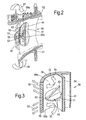
- FIG. 2 provides a cutaway side view of an aerofoil 50 in accordance with aspects of the present invention.
- the aerofoil 50 at opposed ends defines an inner platform 51 and an outer platform 52.
- a cutaway portion 53 illustrates a wall 54 in which a baffle 55 is formed. This baffle 55 is cast, or potentially cut or otherwise formed, with the wall 54.
- the opposed ends defined by the platforms 51, 52 provide inlets for coolant flows 56, 57.
- the flows 56, 57 are arranged to provide film cooling flows 58 through apertures 59 in a surface typically opposite the wall 54.
- the baffle 55 extends nearly across a cavity 60 defined by the spacing between the wall 54 and the generally opposed surface incorporating the apertures 59.
- the apertures 59 are typically angled in order to create the film cooling effect.
- the baffle 55 is orientated and positioned such that forming the apertures 59 will not compromise the baffle 55 or creation of the apertures 59.
- the wall 54 is generally a divider wall within the aerofoil 50.
- a front cavity 60 and a rear cavity 61 are normally a front cavity 60 and a rear cavity 61.
- Baffles can be presented and projected across both cavities 60, 61 but normally consideration is particularly important with regard to the leading edge or front cavity 60.
- the cavities 60, 61 act as feed passages for coolant flow.
- the baffle 55 extends substantially across the cavity 60 but a small cross sectional area 62 is retained to allow some fluid flow across the respective ends 60a, 60b of the cavity 60 for pressure balance.
- baffle 55 substantially extends laterally with webs or fillets 63 to provide strength as well as reduce the potential for vibration in the baffle 55.
- FIG 3 provides a more schematic isometric view of the first embodiment as depicted in figure 2 .
- the baffle 55 is cast with a wall 54 which is typically a divider wall within an aerofoil 50.
- the divider wall 54 separates a forward cooling cavity 60 from a rear cooling cavity 61.
- These cavities 60, 61 define passages along which as illustrated coolant flows 56, 57 are presented from inlets (not shown).
- the baffle 55 is presented intermediate along the length of the cavity 60 and extends substantially across the cavity 60. It will be appreciated that the wall 54 is relatively cool compared to the external side walls 70 of the cavity 60 whether considered as pressure or suction side walls.
- the temperature of the baffle 55 will not be as elevated and furthermore it will be appreciated that the baffle 55 is cooled by the coolant flows 56, 57 within the cavity 60.
- the baffle 55 is relatively well matched to the divider wall 54 resulting in reduced local thermal gradients in the aerofoil 50.
- the baffle 55 is cast with the wall 54 and provides a necessary interruption and restriction to flows 56, 57 along the aerofoil 50.
- the baffle 55 is formed integrally upon casting the aerofoil 50 it will be appreciated that there is a reduction in cost in comparison with forming a separate sheet metal baffle arrangement as well as assembly of that sheet metal baffle arrangement within the aerofoil.
- the creation of the baffle 55 is typically achieved through alteration to a ceramic core utilised for casting of the aerofoil 50 in use.
- baffle 55 In order to appropriately present the baffle 55 generally webs 63 are provided either side of the baffle 55. These webs 63 can comprise fillets extending laterally from the baffle 55 upon the wall 54. The webs 63 prevent the baffle 55 vibrating due to unsteady buffeting from the air flows 56, 57.
- the baffle 55 will extend substantially across a gap or spacing between the wall 54 and an opposed surface incorporating the apertures 59. Generally, the gap extends about the periphery 71 with respect to a side of the opposed surface 70 incorporating the apertures 59.
- the cross sectional area 62 as described previously is provided as a gap to allow pressure exchange between the cavity ends 60a, 60b. Small quantities of coolant can pass from the radially outer cavity 60a to the radially inner cavity 60b and vice versa. Radially inner and outer are with respect to a main rotational axis of a gas turbine engine and when the aerofoil is installed in the engine.
- the baffle 55 in terms of shape and orientation can be varied to accommodate differing aperture 59 patterns.
- the apertures 59 are arranged in order to achieve the desired film cooling 58 and can be different dependent upon aerofoil 50 configuration.
- the baffle 55 is arranged such that the process tool utilised to form or finish pre-cast apertures 59 will not damage or be influenced by the baffle 55 integrally formed with the wall 54.
- a further consideration is with regard to the natural vibration or frequency of the baffle 55.
- the shape of the baffle 55 may also be determined and designed to avoid any possibility of high cycle fatigue failure due to air flows through the apertures 59 and across the gap defined by the area 62.
- FIGS. 4 to 7 illustrate three different embodiments of a baffle in accordance with aspects of the present invention. These embodiments are provided for illustration purposes and it will be appreciated that other shapes, orientations and configurations of baffle are possible in accordance with aspects of the present invention.
- Figure 4 illustrates a first embodiment of a baffle 155 that is presented perpendicularly from a wall 154 towards a surface which is typically an external wall 170 of an aerofoil.
- the surface 170 opposite the wall 154 incorporates apertures 159 to direct coolant flows 156, 157 to generate film cooling 158.
- the baffle 155 is configured perpendicular to a general direction of the coolant flows 156, 157. Thus the baffle 155 is substantially perpendicular to a plane of the wall 154.
- the apertures 155 are typically drilled at an angle to improve the film cooling effect.
- the angles for the apertures 159 are chosen to benefit from dynamic pressure in the passages defined by the cavities 160.
- the apertures 159 are generally aligned or at least turned towards the direction of coolant flow 156, 157 in the outer as well as inner cavity sections of the cavity 160.
- the baffle 155 extends substantially across the cavity 160 to only leave a relatively small gap to an inner side of the surface 170 comprising the apertures 159. This gap allows a small available cross sectional area 162 for the coolant flows 156, 157 to be exchanged within the cavity 160.
- a perpendicular presentation of the baffle 155 is potentially the simplest configuration for cast formation and integral association with the wall 154.
- such perpendicular presentation may also be subject to the greatest potential problems vibration and therefore stressing in use.
- webs 163 are provided to prevent vibration as well as ensure robustness in use.
- FIG. 5 illustrates a second embodiment of a baffle 255 in accordance with aspects of the present invention.
- the baffle 255 again projects from a wall 254 towards an opposed surface 270 incorporating apertures 259.
- As previously coolant flows 256, 257 generally pass from inlets at opposed ends of an aerofoil.
- the coolant flows 256, 257 are arranged to provide film cooling 258.
- the baffle 255 as previously essentially divides a cavity 260 into an outer cavity section 260a and a inner cavity section 260b.
- the baffle 255 will be inclined at an angle between 30° and 60° to a perpendicular projection from a plane surface of the wall 254. Furthermore, the baffle 255 will be typically aligned with the apertures 259. Such alignment between the baffle 255 and the apertures 259 obviates or reduces the possibility of striking the baffle 255 when utilising a forming or process tool such as an electrode or laser beam to form the apertures 259. Nevertheless it will be appreciated that only half of the apertures 259 can benefit from a dynamic pressure head created within the cavity 260. It will be noted that the baffles 255 can be orientated upward or downward dependent upon requirements for an aerofoil.
- the angle can be chosen dependent upon the angle of the apertures 259 or to achieve desired separation within the cavity 260.
- the baffle 255 extends substantially fully across the cavity 260 with an open cross sectional area 252 remaining available to allow coolant flow 256, 257 exchange across the respective cavity sections 260a, 260b.
- Webs 263 or fillets are provided either side of the baffle 255 to provide support of and achieve greater strength in the baffle 255.
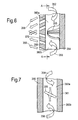
- FIGS 6, 7 and 8 provide illustrations respectively of a side and front schematic view of a third embodiment of a baffle 355 in accordance with the present invention.
- the baffle 355 extends within a cavity 360 to define an outer cavity section 360a and an inner cavity section 360b.
- the baffle 355 extends towards a surface 370 which is typically an external wall surface of an aerofoil.
- the surface 370 incorporates apertures 359 which receive coolant flows 356, 357 in order to define film cooling 358.
- the baffle 355 divides the cavity 360 in order to prevent direct jetting of the coolant flows 356, 357 across the passage defined by the cavity 360.
- a gap is provided around the baffle 355 to allow coolant flow exchange between the cavity section 360a, 360b.
- the baffle 355 in accordance with the third embodiment is generally angled to be inclined from a first side 380 to a second side 381. Such a configuration allows further coolant flow control to the apertures 359 for coolant film 358 creation.
- the baffle 355 is orientated at an angle when viewed in the direction of a wall 354 that is to say as viewed in the direction A-A.
- Such a configuration provides benefits including enabling construction of an aerofoil configuration with cooling film apertures in rows where the gap between apertures in the same row, to accommodate the baffle 355, are not in alignment with a hot gas flow over the surface 370.
- the baffle 355 will be configured to have an orientation at a compound angle which is a combination of the upward or downward orientation as depicted in figure 5 together with an inclined angle or presentation as depicted in figure 7 from the first side 380 to the second side 381 of the cavity 360.
- the aerofoil comprises a radial axis 391, when installed in an engine, with the cavity generally radially aligned at an inlet 392, 393 for fluid flow in use at each end of a radially inner and a radially outer end of the aerofoil.
- the baffle 55, 155, 255, 355 comprises an angled portion 394, which has an angle ⁇ between 15 and 75 degrees from the radial axis although the preferable range of angle is between 30 and 60 degrees.
- the angled portion is part of the baffle which is straight.
- the aerofoil is then provided with coolant apertures 359, through the wall 380, which are generally arranged in a line parallel to the angled portion of the baffle.
- the line of apertures means that a coolant flow issuing from the line of apertures creates a continuous film of coolant over the surface of the wall and aerofoil. This advantageously prevents the hot working gasses creating hot streaks on and high thermal gradients in the wall thereby extending the life of the aerofoil.
- the aerofoil has a second axis 264 that is perpendicular to the radial axis and would be generally aligned to a main rotational axis of a gas turbine engine.
- the baffle 255 again comprises at least a portion that is angled ⁇ between 15 and 75 degrees from the second axis. It is more likely that the baffle is angled between 30 and 60 degrees.
- the coolant apertures 359 are normally laser drilled and therefore angling the coolant apertures for both the first and second angles, so that they are approximately parallel to the baffle's main surfaces means that a regular and sufficient array of coolant apertures can be drilled without destroying the baffle.
- the angles of the baffle and apertures are designed for each specific aerofoil and the engine's particular gas flow regime. The present invention is believed to be adequate to allow the coolant apertures to be angled accordingly and give further flexibility in their outlet position in order to evenly distribute coolant flow and prevent hot streaks.
- baffle integral formation of a baffle reduces costs and therefore expense of manufacture and part count which will aid logistically as well as administratively simpler provision of spare parts in use. Furthermore as the cast and integrally formed baffle cannot shake loose in operation there is greater reliability of operation. Furthermore the position of the baffle can be reliably and repeatedly achieved ensuring that where machine tools are utilised to define the film cooling apertures these machining tools, such as lasers or drills, will not strike of the baffle causing damage, deflection or loss.
- a rigid structure can be provided which has less vibration problems and furthermore as there are no separate parts with respect to the baffle problems such as fretting and wear can be avoided.
- integral forming within the aerofoil the potential for mistaken build without incorporation of the baffle plate is avoided. Additionally, problems with regard to incorrect fitting can be avoided by integral casting of the baffle within the cavity.
- the core tools utilised for forming the cavity in accordance with aspects of the present invention may be simplified.
- baffles extending outwardly are generally relatively fragile and subject to damage.
- baffles in accordance with aspects of the present invention are designed and configured to accommodate differing leading and trailing edge cooling regimes in the respective cavities.
- the baffle is formed from the same material as the aerofoil and as the baffle is bathed in coolant air problems of oxidation are avoided.
- the baffle and other internal surfaces of the cavity may be protected by an appropriate coating from sulphidation.
- a curved baffle may be provided. This may take the form of a half cylindrical cross section angled upwards or downwards as described with regard to figure 5 .
- a further alternative is to provide a curved baffle in a scoop shape extending from the surface in order to create desired separation of a cavity within which coolant flows are presented. It will be appreciated that curved baffles will still typically incorporate webs to provide reinforcement and avoid vibration.
- Interval walls within an aerofoil and in particular divider walls between a front and rear cavity are particularly advantageous for presenting baffles.
- other internal walls of a cavity may be utilised to present the baffle plates as required.
- baffle plate with perforations. These perforations will take the place of one or more holes which again will allow a small proportion of coolant flow exchange across the baffle but still substantially prevent direct jetting from inlets at opposite ends of the cavity.
- Embodiments of the present invention described above illustrate a single substantial baffle extending across the cavity.
- a plurality of baffles may be provided.
- a principal baffle may be utilised along with a series of partial baffles which extend from the wall.
- These baffles may alter the gap and therefore the available cross sectional area in the spacing between the baffle 255 and the opposed surface incorporating the apertures 259.
- Such variations in the available cross sectional area allows control of coolant flow and potentially accelerates the coolant flow in the passage progressively as flow is bled off through the apertures from the cavity.
- Such acceleration in flow increases the Reynolds number of the flow and therefore the heat transfer rate within the cavity.
- a baffle might be considered as any cast feature that effectively blocks or partially blocks the passage of coolant flow within the cavity and prevents that coolant flow from passing from the inlet at one end of the cavity directly to the inlet at the other end of the cavity.
- sides of the baffle may be dished dependent upon requirements.
- An edge of the baffle may be fluted or castellated such that effectively segments are provided with gaps between rather than a continuous gap about the edge of the baffle towards an opposed surface incorporating the apertures to define film cooling.
- Partial baffles may be provided extending proportionately from a wall or walls such that the combination of baffles within the cavity prevents a direct flow path and therefore direct jetting across the cavity in use. Such an approach may allow easier cast formation in creating integral baffles.
Landscapes
- Engineering & Computer Science (AREA)
- Mechanical Engineering (AREA)
- General Engineering & Computer Science (AREA)
- Turbine Rotor Nozzle Sealing (AREA)
Claims (13)
- Schaufelblatt (150, 150, 250, 350) mit einer radialen Achse (391) und einem hohlen Kern zum Bilden eines Hohlraums (60, 160, 260, 360) mit einem Einlaß (393) für eine Strömungsmittelströmung im Betrieb an jedem Ende eines radial inneren Endes und eines radial äußeren Endes des Hohlraums, wobei der Kern eine Trennwand (54, 154, 254, 354) aufweist, und das Schaufelblatt dadurch gekennzeichnet ist, dass eine Prallplatte (55, 155, 255, 355) einstückig mit der Trennwand ausgebildet ist und sich durch den Hohlraum erstreckt, um eine Strömungsdrossel zwischen den Einlässen (393) darzustellen, wobei die Prallplatte einen abgewinkelten Teil (394) aufweist, deren Winkel (θ) zwischen 15 und 75 Grad von der radialen Achse beträgt.
- Schaufelblatt nach Anspruch 1, wobei der Winkel (θ) zwischen 30 und 60 Grad von der Radialachse beträgt.
- Schaufelblatt nach Anspruch 1 oder Anspruch 2, wobei der abgewinkelte Teil ein Teil der Prallplatte ist, die etwa gerade oder U- oder V- oder W-förmig ist.
- Schaufelblatt nach irgendeinem vorhergehenden Anspruch, wobei Kühlmittelöffnungen (59, 159, 259, 359) in einer Oberfläche gegenüber der Wand vorgesehen sind und in einer zum abgewinkelten Teil der Prallplatte etwa parallelen Linie angeordnet sind.
- Schaufelblatt nach einem der Ansprüche 1 bis 4, wobei das Schaufelblatt eine zweite Achse (264) senkrecht zu der radialen Achse hat, und die Prallplatte einen zu der zweiten Achse abgewinkelten (α) Teil hat.
- Schaufelblatt nach Anspruch 5, wobei der Winkel (α) zwischen 15 und 75 Grad von der radialen Achse beträgt.
- Schaufelblatt nach Anspruch 5, wobei der Winkel (α) zwischen 30 und 60 Grad von der radialen Achse beträgt.
- Schaufelblatt nach Anspruch 5 und irgendeinem davon abhängigen Anspruch, wobei Kühlmittelöffnungen (59, 159, 259, 359) in einer Wand (380) vorgesehen sind, und mindestens eine der Öffnungen etwa parallel zu der Prallplatte abgewinkelt (α) ist.
- Schaufelblatt nach Anspruch 5 und irgendeinem davon abhängigen Anspruch, wobei die Prallplatte zur Fluchtung mit den Öffnungen hin orientiert ist.
- Schaufelblatt nach irgendeinem vorhergehenden Anspruch, wobei die Prallplatte sich nahezu vollständig durch den Hohlraum erstreckt, um eine vorgegebene verfügbare Querschnittsfläche (62, 162, 262, 362) für den Strömungsmittelströmungsaustausch beiderseits der Prallplatte zu definieren.
- Schaufelblatt nach irgendeinem vorhergehenden Anspruch, wobei der Hohlraum eine Mehrzahl von Prallplatten enthält.
- Schaufelblatt nach irgendeinem vorhergehenden Anspruch, wobei die Prallplatte einen Steg (63, 163, 263, 363) aufweist, der zur Aussteifung der Prallplatte mit der Wand vorgesehen ist.
- Schaufelblatt nach irgendeinem vorhergehenden Anspruch, wobei die Prallplatte mit Löchern (165) perforiert ist.
Applications Claiming Priority (1)
| Application Number | Priority Date | Filing Date | Title |
|---|---|---|---|
| GBGB0813839.8A GB0813839D0 (en) | 2008-07-30 | 2008-07-30 | An aerofoil and method for making an aerofoil |
Publications (2)
| Publication Number | Publication Date |
|---|---|
| EP2149676A1 EP2149676A1 (de) | 2010-02-03 |
| EP2149676B1 true EP2149676B1 (de) | 2013-09-04 |
Family
ID=39747103
Family Applications (2)
| Application Number | Title | Priority Date | Filing Date |
|---|---|---|---|
| EP09251875.2A Not-in-force EP2149676B1 (de) | 2008-07-30 | 2009-07-24 | Innengekühlte Gasturbinenschaufel |
| EP09251874A Withdrawn EP2157282A1 (de) | 2008-07-30 | 2009-07-24 | Kühlanordnung für Schaufel |
Family Applications After (1)
| Application Number | Title | Priority Date | Filing Date |
|---|---|---|---|
| EP09251874A Withdrawn EP2157282A1 (de) | 2008-07-30 | 2009-07-24 | Kühlanordnung für Schaufel |
Country Status (3)
| Country | Link |
|---|---|
| US (2) | US8596961B2 (de) |
| EP (2) | EP2149676B1 (de) |
| GB (1) | GB0813839D0 (de) |
Families Citing this family (38)
| Publication number | Priority date | Publication date | Assignee | Title |
|---|---|---|---|---|
| GB0813839D0 (en) * | 2008-07-30 | 2008-09-03 | Rolls Royce Plc | An aerofoil and method for making an aerofoil |
| US8371814B2 (en) * | 2009-06-24 | 2013-02-12 | Honeywell International Inc. | Turbine engine components |
| GB0916432D0 (en) * | 2009-09-21 | 2009-10-28 | Rolls Royce Plc | Separator device |
| US8529193B2 (en) * | 2009-11-25 | 2013-09-10 | Honeywell International Inc. | Gas turbine engine components with improved film cooling |
| US8628293B2 (en) | 2010-06-17 | 2014-01-14 | Honeywell International Inc. | Gas turbine engine components with cooling hole trenches |
| US20120076660A1 (en) * | 2010-09-28 | 2012-03-29 | Spangler Brandon W | Conduction pedestals for a gas turbine engine airfoil |
| GB201102719D0 (en) * | 2011-02-17 | 2011-03-30 | Rolls Royce Plc | Cooled component for the turbine of a gas turbine engine |
| JP5931351B2 (ja) * | 2011-05-13 | 2016-06-08 | 三菱重工業株式会社 | タービン静翼 |
| US9074482B2 (en) * | 2012-04-24 | 2015-07-07 | United Technologies Corporation | Airfoil support method and apparatus |
| US9650900B2 (en) | 2012-05-07 | 2017-05-16 | Honeywell International Inc. | Gas turbine engine components with film cooling holes having cylindrical to multi-lobe configurations |
| US9109452B2 (en) * | 2012-06-05 | 2015-08-18 | United Technologies Corporation | Vortex generators for improved film effectiveness |
| US9322279B2 (en) * | 2012-07-02 | 2016-04-26 | United Technologies Corporation | Airfoil cooling arrangement |
| US10113433B2 (en) | 2012-10-04 | 2018-10-30 | Honeywell International Inc. | Gas turbine engine components with lateral and forward sweep film cooling holes |
| GB2515464B (en) * | 2013-04-24 | 2021-01-27 | Intelligent Energy Ltd | A water separator |
| US9617917B2 (en) | 2013-07-31 | 2017-04-11 | General Electric Company | Flow control assembly and methods of assembling the same |
| WO2015034717A1 (en) * | 2013-09-06 | 2015-03-12 | United Technologies Corporation | Gas turbine engine airfoil with wishbone baffle cooling scheme |
| WO2015112227A2 (en) | 2013-11-12 | 2015-07-30 | United Technologies Corporation | Multiple injector holes for gas turbine engine vane |
| US9982542B2 (en) * | 2014-07-21 | 2018-05-29 | United Technologies Corporation | Airfoil platform impingement cooling holes |
| GB201417476D0 (en) | 2014-10-03 | 2014-11-19 | Rolls Royce Plc | Internal cooling of engine components |
| US20160237850A1 (en) * | 2015-02-16 | 2016-08-18 | United Technologies Corporation | Systems and methods for vane cooling |
| US9849510B2 (en) | 2015-04-16 | 2017-12-26 | General Electric Company | Article and method of forming an article |
| US9976441B2 (en) | 2015-05-29 | 2018-05-22 | General Electric Company | Article, component, and method of forming an article |
| US10012092B2 (en) * | 2015-08-12 | 2018-07-03 | United Technologies Corporation | Low turn loss baffle flow diverter |
| US10184341B2 (en) | 2015-08-12 | 2019-01-22 | United Technologies Corporation | Airfoil baffle with wedge region |
| US10253986B2 (en) * | 2015-09-08 | 2019-04-09 | General Electric Company | Article and method of forming an article |
| US10739087B2 (en) * | 2015-09-08 | 2020-08-11 | General Electric Company | Article, component, and method of forming an article |
| US10087776B2 (en) * | 2015-09-08 | 2018-10-02 | General Electric Company | Article and method of forming an article |
| US10060445B2 (en) * | 2015-10-27 | 2018-08-28 | United Technologies Corporation | Cooling hole patterned surfaces |
| US10344598B2 (en) | 2015-12-03 | 2019-07-09 | General Electric Company | Trailing edge cooling for a turbine blade |
| US9976425B2 (en) * | 2015-12-21 | 2018-05-22 | General Electric Company | Cooling circuit for a multi-wall blade |
| EP3436668B1 (de) * | 2016-03-31 | 2023-06-07 | Siemens Energy Global GmbH & Co. KG | Turbinenschaufel mit verwirbelungsfunktion an einer kalten wand |
| US11021965B2 (en) | 2016-05-19 | 2021-06-01 | Honeywell International Inc. | Engine components with cooling holes having tailored metering and diffuser portions |
| US10801344B2 (en) * | 2017-12-18 | 2020-10-13 | Raytheon Technologies Corporation | Double wall turbine gas turbine engine vane with discrete opposing skin core cooling configuration |
| US10677071B2 (en) * | 2018-04-19 | 2020-06-09 | Raytheon Technologies Corporation | Turbine vane for gas turbine engine |
| DE102018206259A1 (de) | 2018-04-24 | 2019-10-24 | MTU Aero Engines AG | Leitschaufel für eine turbine einer strömungsmaschine |
| GB201806821D0 (en) | 2018-04-26 | 2018-06-13 | Rolls Royce Plc | Coolant channel |
| US20200024967A1 (en) * | 2018-07-20 | 2020-01-23 | United Technologies Corporation | Airfoil having angled trailing edge slots |
| US10774657B2 (en) | 2018-11-23 | 2020-09-15 | Raytheon Technologies Corporation | Baffle assembly for gas turbine engine components |
Family Cites Families (22)
| Publication number | Priority date | Publication date | Assignee | Title |
|---|---|---|---|---|
| US3370829A (en) * | 1965-12-20 | 1968-02-27 | Avco Corp | Gas turbine blade construction |
| BE794195A (fr) | 1972-01-18 | 1973-07-18 | Bbc Sulzer Turbomaschinen | Aube directrice refroidie pour des turbines a gaz |
| GB2159585B (en) * | 1984-05-24 | 1989-02-08 | Gen Electric | Turbine blade |
| JPS62271902A (ja) * | 1986-01-20 | 1987-11-26 | Hitachi Ltd | ガスタ−ビン冷却翼 |
| GB2189553B (en) | 1986-04-25 | 1990-05-23 | Rolls Royce | Cooled vane |
| US5704763A (en) * | 1990-08-01 | 1998-01-06 | General Electric Company | Shear jet cooling passages for internally cooled machine elements |
| US5967752A (en) | 1997-12-31 | 1999-10-19 | General Electric Company | Slant-tier turbine airfoil |
| US5971708A (en) * | 1997-12-31 | 1999-10-26 | General Electric Company | Branch cooled turbine airfoil |
| SE512085C2 (sv) * | 1998-05-28 | 2000-01-24 | Abb Ab | Rotormaskininrättning |
| US6193465B1 (en) | 1998-09-28 | 2001-02-27 | General Electric Company | Trapped insert turbine airfoil |
| US6177038B1 (en) | 1998-11-20 | 2001-01-23 | United Technologies Corporation | Method for orienting an airfoil for processing and for forming a mask for the airfoil |
| US6290463B1 (en) | 1999-09-30 | 2001-09-18 | General Electric Company | Slotted impingement cooling of airfoil leading edge |
| US6468031B1 (en) * | 2000-05-16 | 2002-10-22 | General Electric Company | Nozzle cavity impingement/area reduction insert |
| US6890153B2 (en) * | 2003-04-29 | 2005-05-10 | General Electric Company | Castellated turbine airfoil |
| GB2405451B (en) * | 2003-08-23 | 2008-03-19 | Rolls Royce Plc | Vane apparatus for a gas turbine engine |
| US6929446B2 (en) * | 2003-10-22 | 2005-08-16 | General Electric Company | Counterbalanced flow turbine nozzle |
| US7104756B2 (en) * | 2004-08-11 | 2006-09-12 | United Technologies Corporation | Temperature tolerant vane assembly |
| US7980818B2 (en) * | 2005-04-04 | 2011-07-19 | Hitachi, Ltd. | Member having internal cooling passage |
| EP1985804B1 (de) * | 2006-02-14 | 2017-06-21 | IHI Corporation | Kühlstruktur |
| US7743613B2 (en) * | 2006-11-10 | 2010-06-29 | General Electric Company | Compound turbine cooled engine |
| GB0813839D0 (en) * | 2008-07-30 | 2008-09-03 | Rolls Royce Plc | An aerofoil and method for making an aerofoil |
| GB0905736D0 (en) * | 2009-04-03 | 2009-05-20 | Rolls Royce Plc | Cooled aerofoil for a gas turbine engine |
-
2008
- 2008-07-30 GB GBGB0813839.8A patent/GB0813839D0/en not_active Ceased
-
2009
- 2009-07-24 EP EP09251875.2A patent/EP2149676B1/de not_active Not-in-force
- 2009-07-24 EP EP09251874A patent/EP2157282A1/de not_active Withdrawn
- 2009-07-27 US US12/458,905 patent/US8596961B2/en not_active Expired - Fee Related
- 2009-07-27 US US12/458,906 patent/US20100124485A1/en not_active Abandoned
Also Published As
| Publication number | Publication date |
|---|---|
| US8596961B2 (en) | 2013-12-03 |
| EP2157282A1 (de) | 2010-02-24 |
| GB0813839D0 (en) | 2008-09-03 |
| US20100124485A1 (en) | 2010-05-20 |
| US20100124484A1 (en) | 2010-05-20 |
| EP2149676A1 (de) | 2010-02-03 |
Similar Documents
| Publication | Publication Date | Title |
|---|---|---|
| US8596961B2 (en) | Aerofoil and method for making an aerofoil | |
| US6283708B1 (en) | Coolable vane or blade for a turbomachine | |
| EP1284338B1 (de) | Kühleinsatz mit tangentialer Ausströmung | |
| JP5879022B2 (ja) | タービン翼冷却回路 | |
| JP5185569B2 (ja) | 蛇行冷却回路及びシュラウドを冷却する方法 | |
| RU2426890C2 (ru) | Система входных направляющих лопастей для газотурбинного двигателя | |
| JP6739934B2 (ja) | ガスタービンのシール | |
| EP3318720B1 (de) | Gekühlte struktur für eine gasturbine, zugehörige gasturbine und verfahren zur herstellung einer gekühlten struktur | |
| EP1942251B1 (de) | Gekühlte Schaufel mit reduzierten Durchfluss durch die Abströmkantenschlitzen und zugehöriges Giessverfahren | |
| US8556576B2 (en) | Cooled IBR for a micro-turbine | |
| KR20200010091A (ko) | 복수의 냉각 통로를 포함하는 터빈 슈라우드 | |
| EP1225304B1 (de) | Kühlung der Übergangsradien einer Statorschaufel | |
| EP2458152B1 (de) | Axialdurchströmte Gasturbine | |
| JP5965633B2 (ja) | タービンロータブレードのプラットフォーム領域を冷却するための装置及び方法 | |
| US10066488B2 (en) | Turbomachine blade with generally radial cooling conduit to wheel space | |
| EP3184743B1 (de) | Turbinenschaufel mit hinterkantenkühlkreis | |
| CN110735664B (zh) | 用于具有冷却孔的涡轮发动机的部件 | |
| EP4317649B1 (de) | Turbinenschaufel mit über ein plenum an filmkühlungslöcher gekoppelten vorderkantenkühlkanälen | |
| CN111102022A (zh) | 包括与集气室连通的冷却通道的涡轮机护罩 | |
| US10760431B2 (en) | Component for a turbine engine with a cooling hole | |
| EP3508691B1 (de) | Verfahren zur herstellung eines kühlkanals für eine turbinenkomponente mit abdeckelement | |
| JP5662672B2 (ja) | タービン翼形部冷却アパーチャに関連する装置 | |
| JP5675080B2 (ja) | 翼体及びこの翼体を備えたガスタービン | |
| EP3933173B1 (de) | Einsätze für gasturbinenmotorschaufeln | |
| KR102363922B1 (ko) | 터빈 베인, 그리고 이를 포함하는 터빈 |
Legal Events
| Date | Code | Title | Description |
|---|---|---|---|
| PUAI | Public reference made under article 153(3) epc to a published international application that has entered the european phase |
Free format text: ORIGINAL CODE: 0009012 |
|
| 17P | Request for examination filed |
Effective date: 20091219 |
|
| AK | Designated contracting states |
Kind code of ref document: A1 Designated state(s): AT BE BG CH CY CZ DE DK EE ES FI FR GB GR HR HU IE IS IT LI LT LU LV MC MK MT NL NO PL PT RO SE SI SK SM TR |
|
| AX | Request for extension of the european patent |
Extension state: AL BA RS |
|
| 17Q | First examination report despatched |
Effective date: 20100212 |
|
| GRAP | Despatch of communication of intention to grant a patent |
Free format text: ORIGINAL CODE: EPIDOSNIGR1 |
|
| INTG | Intention to grant announced |
Effective date: 20130604 |
|
| RIN1 | Information on inventor provided before grant (corrected) |
Inventor name: HARROGATE, IAN WILLIAM ROBERT Inventor name: TIBBOTT, IAN |
|
| GRAS | Grant fee paid |
Free format text: ORIGINAL CODE: EPIDOSNIGR3 |
|
| GRAA | (expected) grant |
Free format text: ORIGINAL CODE: 0009210 |
|
| AK | Designated contracting states |
Kind code of ref document: B1 Designated state(s): AT BE BG CH CY CZ DE DK EE ES FI FR GB GR HR HU IE IS IT LI LT LU LV MC MK MT NL NO PL PT RO SE SI SK SM TR |
|
| REG | Reference to a national code |
Ref country code: GB Ref legal event code: FG4D |
|
| REG | Reference to a national code |
Ref country code: CH Ref legal event code: EP |
|
| REG | Reference to a national code |
Ref country code: AT Ref legal event code: REF Ref document number: 630666 Country of ref document: AT Kind code of ref document: T Effective date: 20130915 |
|
| REG | Reference to a national code |
Ref country code: IE Ref legal event code: FG4D |
|
| REG | Reference to a national code |
Ref country code: DE Ref legal event code: R096 Ref document number: 602009018500 Country of ref document: DE Effective date: 20131031 |
|
| REG | Reference to a national code |
Ref country code: AT Ref legal event code: MK05 Ref document number: 630666 Country of ref document: AT Kind code of ref document: T Effective date: 20130904 |
|
| REG | Reference to a national code |
Ref country code: NL Ref legal event code: VDEP Effective date: 20130904 |
|
| PG25 | Lapsed in a contracting state [announced via postgrant information from national office to epo] |
Ref country code: NO Free format text: LAPSE BECAUSE OF FAILURE TO SUBMIT A TRANSLATION OF THE DESCRIPTION OR TO PAY THE FEE WITHIN THE PRESCRIBED TIME-LIMIT Effective date: 20131204 Ref country code: AT Free format text: LAPSE BECAUSE OF FAILURE TO SUBMIT A TRANSLATION OF THE DESCRIPTION OR TO PAY THE FEE WITHIN THE PRESCRIBED TIME-LIMIT Effective date: 20130904 Ref country code: CY Free format text: LAPSE BECAUSE OF FAILURE TO SUBMIT A TRANSLATION OF THE DESCRIPTION OR TO PAY THE FEE WITHIN THE PRESCRIBED TIME-LIMIT Effective date: 20130821 Ref country code: LT Free format text: LAPSE BECAUSE OF FAILURE TO SUBMIT A TRANSLATION OF THE DESCRIPTION OR TO PAY THE FEE WITHIN THE PRESCRIBED TIME-LIMIT Effective date: 20130904 Ref country code: SE Free format text: LAPSE BECAUSE OF FAILURE TO SUBMIT A TRANSLATION OF THE DESCRIPTION OR TO PAY THE FEE WITHIN THE PRESCRIBED TIME-LIMIT Effective date: 20130904 Ref country code: HR Free format text: LAPSE BECAUSE OF FAILURE TO SUBMIT A TRANSLATION OF THE DESCRIPTION OR TO PAY THE FEE WITHIN THE PRESCRIBED TIME-LIMIT Effective date: 20130904 |
|
| REG | Reference to a national code |
Ref country code: NL Ref legal event code: VDEP Effective date: 20130904 |
|
| REG | Reference to a national code |
Ref country code: LT Ref legal event code: MG4D |
|
| PG25 | Lapsed in a contracting state [announced via postgrant information from national office to epo] |
Ref country code: SI Free format text: LAPSE BECAUSE OF FAILURE TO SUBMIT A TRANSLATION OF THE DESCRIPTION OR TO PAY THE FEE WITHIN THE PRESCRIBED TIME-LIMIT Effective date: 20130904 Ref country code: FI Free format text: LAPSE BECAUSE OF FAILURE TO SUBMIT A TRANSLATION OF THE DESCRIPTION OR TO PAY THE FEE WITHIN THE PRESCRIBED TIME-LIMIT Effective date: 20130904 Ref country code: LV Free format text: LAPSE BECAUSE OF FAILURE TO SUBMIT A TRANSLATION OF THE DESCRIPTION OR TO PAY THE FEE WITHIN THE PRESCRIBED TIME-LIMIT Effective date: 20130904 Ref country code: PL Free format text: LAPSE BECAUSE OF FAILURE TO SUBMIT A TRANSLATION OF THE DESCRIPTION OR TO PAY THE FEE WITHIN THE PRESCRIBED TIME-LIMIT Effective date: 20130904 Ref country code: ES Free format text: LAPSE BECAUSE OF FAILURE TO SUBMIT A TRANSLATION OF THE DESCRIPTION OR TO PAY THE FEE WITHIN THE PRESCRIBED TIME-LIMIT Effective date: 20130904 Ref country code: GR Free format text: LAPSE BECAUSE OF FAILURE TO SUBMIT A TRANSLATION OF THE DESCRIPTION OR TO PAY THE FEE WITHIN THE PRESCRIBED TIME-LIMIT Effective date: 20131205 |
|
| PG25 | Lapsed in a contracting state [announced via postgrant information from national office to epo] |
Ref country code: CY Free format text: LAPSE BECAUSE OF FAILURE TO SUBMIT A TRANSLATION OF THE DESCRIPTION OR TO PAY THE FEE WITHIN THE PRESCRIBED TIME-LIMIT Effective date: 20130904 Ref country code: BE Free format text: LAPSE BECAUSE OF FAILURE TO SUBMIT A TRANSLATION OF THE DESCRIPTION OR TO PAY THE FEE WITHIN THE PRESCRIBED TIME-LIMIT Effective date: 20130904 |
|
| PG25 | Lapsed in a contracting state [announced via postgrant information from national office to epo] |
Ref country code: EE Free format text: LAPSE BECAUSE OF FAILURE TO SUBMIT A TRANSLATION OF THE DESCRIPTION OR TO PAY THE FEE WITHIN THE PRESCRIBED TIME-LIMIT Effective date: 20130904 Ref country code: IS Free format text: LAPSE BECAUSE OF FAILURE TO SUBMIT A TRANSLATION OF THE DESCRIPTION OR TO PAY THE FEE WITHIN THE PRESCRIBED TIME-LIMIT Effective date: 20140104 Ref country code: NL Free format text: LAPSE BECAUSE OF FAILURE TO SUBMIT A TRANSLATION OF THE DESCRIPTION OR TO PAY THE FEE WITHIN THE PRESCRIBED TIME-LIMIT Effective date: 20130904 Ref country code: CZ Free format text: LAPSE BECAUSE OF FAILURE TO SUBMIT A TRANSLATION OF THE DESCRIPTION OR TO PAY THE FEE WITHIN THE PRESCRIBED TIME-LIMIT Effective date: 20130904 Ref country code: SK Free format text: LAPSE BECAUSE OF FAILURE TO SUBMIT A TRANSLATION OF THE DESCRIPTION OR TO PAY THE FEE WITHIN THE PRESCRIBED TIME-LIMIT Effective date: 20130904 Ref country code: RO Free format text: LAPSE BECAUSE OF FAILURE TO SUBMIT A TRANSLATION OF THE DESCRIPTION OR TO PAY THE FEE WITHIN THE PRESCRIBED TIME-LIMIT Effective date: 20130904 |
|
| REG | Reference to a national code |
Ref country code: DE Ref legal event code: R097 Ref document number: 602009018500 Country of ref document: DE |
|
| PG25 | Lapsed in a contracting state [announced via postgrant information from national office to epo] |
Ref country code: PT Free format text: LAPSE BECAUSE OF FAILURE TO SUBMIT A TRANSLATION OF THE DESCRIPTION OR TO PAY THE FEE WITHIN THE PRESCRIBED TIME-LIMIT Effective date: 20140106 |
|
| PLBE | No opposition filed within time limit |
Free format text: ORIGINAL CODE: 0009261 |
|
| STAA | Information on the status of an ep patent application or granted ep patent |
Free format text: STATUS: NO OPPOSITION FILED WITHIN TIME LIMIT |
|
| 26N | No opposition filed |
Effective date: 20140605 |
|
| PG25 | Lapsed in a contracting state [announced via postgrant information from national office to epo] |
Ref country code: IT Free format text: LAPSE BECAUSE OF FAILURE TO SUBMIT A TRANSLATION OF THE DESCRIPTION OR TO PAY THE FEE WITHIN THE PRESCRIBED TIME-LIMIT Effective date: 20130904 |
|
| REG | Reference to a national code |
Ref country code: DE Ref legal event code: R097 Ref document number: 602009018500 Country of ref document: DE Effective date: 20140605 |
|
| PG25 | Lapsed in a contracting state [announced via postgrant information from national office to epo] |
Ref country code: DK Free format text: LAPSE BECAUSE OF FAILURE TO SUBMIT A TRANSLATION OF THE DESCRIPTION OR TO PAY THE FEE WITHIN THE PRESCRIBED TIME-LIMIT Effective date: 20130904 |
|
| PG25 | Lapsed in a contracting state [announced via postgrant information from national office to epo] |
Ref country code: LU Free format text: LAPSE BECAUSE OF FAILURE TO SUBMIT A TRANSLATION OF THE DESCRIPTION OR TO PAY THE FEE WITHIN THE PRESCRIBED TIME-LIMIT Effective date: 20140724 |
|
| REG | Reference to a national code |
Ref country code: CH Ref legal event code: PL |
|
| REG | Reference to a national code |
Ref country code: IE Ref legal event code: MM4A |
|
| PG25 | Lapsed in a contracting state [announced via postgrant information from national office to epo] |
Ref country code: CH Free format text: LAPSE BECAUSE OF NON-PAYMENT OF DUE FEES Effective date: 20140731 Ref country code: LI Free format text: LAPSE BECAUSE OF NON-PAYMENT OF DUE FEES Effective date: 20140731 |
|
| PG25 | Lapsed in a contracting state [announced via postgrant information from national office to epo] |
Ref country code: IE Free format text: LAPSE BECAUSE OF NON-PAYMENT OF DUE FEES Effective date: 20140724 |
|
| PG25 | Lapsed in a contracting state [announced via postgrant information from national office to epo] |
Ref country code: SM Free format text: LAPSE BECAUSE OF FAILURE TO SUBMIT A TRANSLATION OF THE DESCRIPTION OR TO PAY THE FEE WITHIN THE PRESCRIBED TIME-LIMIT Effective date: 20130904 Ref country code: MC Free format text: LAPSE BECAUSE OF FAILURE TO SUBMIT A TRANSLATION OF THE DESCRIPTION OR TO PAY THE FEE WITHIN THE PRESCRIBED TIME-LIMIT Effective date: 20130904 |
|
| PG25 | Lapsed in a contracting state [announced via postgrant information from national office to epo] |
Ref country code: BG Free format text: LAPSE BECAUSE OF FAILURE TO SUBMIT A TRANSLATION OF THE DESCRIPTION OR TO PAY THE FEE WITHIN THE PRESCRIBED TIME-LIMIT Effective date: 20130904 Ref country code: MT Free format text: LAPSE BECAUSE OF FAILURE TO SUBMIT A TRANSLATION OF THE DESCRIPTION OR TO PAY THE FEE WITHIN THE PRESCRIBED TIME-LIMIT Effective date: 20130904 |
|
| REG | Reference to a national code |
Ref country code: FR Ref legal event code: PLFP Year of fee payment: 8 |
|
| PG25 | Lapsed in a contracting state [announced via postgrant information from national office to epo] |
Ref country code: HU Free format text: LAPSE BECAUSE OF FAILURE TO SUBMIT A TRANSLATION OF THE DESCRIPTION OR TO PAY THE FEE WITHIN THE PRESCRIBED TIME-LIMIT; INVALID AB INITIO Effective date: 20090724 Ref country code: TR Free format text: LAPSE BECAUSE OF FAILURE TO SUBMIT A TRANSLATION OF THE DESCRIPTION OR TO PAY THE FEE WITHIN THE PRESCRIBED TIME-LIMIT Effective date: 20130904 |
|
| REG | Reference to a national code |
Ref country code: FR Ref legal event code: CA Effective date: 20170517 |
|
| REG | Reference to a national code |
Ref country code: FR Ref legal event code: PLFP Year of fee payment: 9 |
|
| PGFP | Annual fee paid to national office [announced via postgrant information from national office to epo] |
Ref country code: FR Payment date: 20170726 Year of fee payment: 9 Ref country code: GB Payment date: 20170727 Year of fee payment: 9 Ref country code: DE Payment date: 20170727 Year of fee payment: 9 |
|
| PG25 | Lapsed in a contracting state [announced via postgrant information from national office to epo] |
Ref country code: MK Free format text: LAPSE BECAUSE OF FAILURE TO SUBMIT A TRANSLATION OF THE DESCRIPTION OR TO PAY THE FEE WITHIN THE PRESCRIBED TIME-LIMIT Effective date: 20130904 |
|
| REG | Reference to a national code |
Ref country code: DE Ref legal event code: R119 Ref document number: 602009018500 Country of ref document: DE |
|
| GBPC | Gb: european patent ceased through non-payment of renewal fee |
Effective date: 20180724 |
|
| PG25 | Lapsed in a contracting state [announced via postgrant information from national office to epo] |
Ref country code: DE Free format text: LAPSE BECAUSE OF NON-PAYMENT OF DUE FEES Effective date: 20190201 Ref country code: GB Free format text: LAPSE BECAUSE OF NON-PAYMENT OF DUE FEES Effective date: 20180724 Ref country code: FR Free format text: LAPSE BECAUSE OF NON-PAYMENT OF DUE FEES Effective date: 20180731 |