EP2149754A2 - Hausgerätvorrichtung - Google Patents
Hausgerätvorrichtung Download PDFInfo
- Publication number
- EP2149754A2 EP2149754A2 EP09165899A EP09165899A EP2149754A2 EP 2149754 A2 EP2149754 A2 EP 2149754A2 EP 09165899 A EP09165899 A EP 09165899A EP 09165899 A EP09165899 A EP 09165899A EP 2149754 A2 EP2149754 A2 EP 2149754A2
- Authority
- EP
- European Patent Office
- Prior art keywords
- unit
- grounding
- domestic appliance
- appliance device
- safety
- Prior art date
- Legal status (The legal status is an assumption and is not a legal conclusion. Google has not performed a legal analysis and makes no representation as to the accuracy of the status listed.)
- Granted
Links
Images


Classifications
-
- F—MECHANICAL ENGINEERING; LIGHTING; HEATING; WEAPONS; BLASTING
- F24—HEATING; RANGES; VENTILATING
- F24C—DOMESTIC STOVES OR RANGES ; DETAILS OF DOMESTIC STOVES OR RANGES, OF GENERAL APPLICATION
- F24C7/00—Stoves or ranges heated by electric energy
- F24C7/08—Arrangement or mounting of control or safety devices
- F24C7/082—Arrangement or mounting of control or safety devices on ranges, e.g. control panels, illumination
Definitions
- the invention relates to a domestic appliance device according to the preamble of claim 1.
- the domestic appliance device has a switch carrier and a switch, which protect the decorative part against cables in an installed state, which could touch the decorative part in the event of a defect.
- the object of the invention is in particular to provide a generic device with improved properties in terms of a cost-effective design.
- the object is achieved by the features of claim 1, while advantageous embodiments and modifications of the invention can be taken from the dependent claims.
- the invention is based on a domestic appliance device with at least one surface assembly.
- the domestic appliance device has at least one safety grounding unit which forms a safety grounding connection for the surface structural unit.
- a "safety grounding connection" for the surface assembly is to be understood in particular as an electrically conductive connection having a first endpoint formed by the surface assembly and having a second endpoint derived from a home appliance protective conductor terminal of the home appliance device and / or a home appliance protection contact of the home appliance device is formed, and for which the ohmic resistance which prevails between the first end point and the second end point, measured in a standard measurement method less than or equal to 100 ohms, in particular less than or equal to 10 ohms, in particular less than or equal to one ohm and particularly advantageously smaller or is equal to one hundred milliohms, wherein the conductive connection is in particular free of connection cables, which in an operating state an electrically conductive connection between the household appliance protection contact and / or the household appliance protective conductor terminal and a socket.
- a "standard measurement method” is to be understood in particular as a method in which a current of twenty-five amperes is conducted from a power source having an open circuit voltage below twelve volts from the first endpoint to the second endpoint via the safety grounding connection and the voltage drop between the first endpoint Domestic appliance protective conductor terminal of the domestic appliance device and / or the domestic appliance protective contact of the domestic appliance device and the surface part is measured and then by means of the voltage drop and the current an ohmic resistance of the conductive connection is calculated.
- a "domestic appliance protective conductor terminal" of the domestic appliance device and / or a “domestic appliance protective contact” of the domestic appliance device is to be understood in particular as a terminal and / or a contact of the domestic appliance device to which and / or which in an operating state a cable is connected, which is at least partially outside a device runs, in which the domestic appliance device is installed in an assembled state, and / or which is conductively connected to a power outlet.
- a carrier unit which in particular accommodates at least part of a weight force of the surface constructional unit, can be manufactured inexpensively.
- the fastening unit may have openings and, in particular, thereby be usable in a multiplicity of differently constructed devices, without creating a risk for an operator due to a defective cable connection.
- the safety grounding unit has at least one carrier unit which, in at least one operating state, receives at least part of a weight force of the surface component.
- the safety grounding unit has at least one carrier unit and at least one grounding means, which is fastened to the carrier unit in a form-locking and / or force-locking manner.
- a simple assembly can be achieved.
- a secure positioning of the grounding means can take place, whereby a robust, conductive connection between the grounding means and the carrier unit can be achieved.
- the safety grounding unit has at least one grounding means, which is designed as a spring means.
- a reliable conductive connection can be achieved with a simple assembly.
- An especially easy to assemble and reliable conductive connection can be achieved in that the safety grounding unit has at least one grounding means which is elastically deformed in an installed state by the surface assembly.
- a reliable conductive connection between the surface assembly and the carrier unit can be achieved.
- the grounding means exerts a spring force on the carrier unit and the surface assembly and that the surface assembly is securely applied to the grounding means due to the spring force.
- the safety grounding unit has at least one grounding means, which is at least partially formed from beryllium copper.
- a robust and conductive connection can be achieved.
- a high conductivity of the grounding agent can be achieved.
- a chemically resistant nature of the grounding agent can be achieved.
- an extremely elastic design of the grounding means can be achieved.
- the safety grounding unit has at least one grounding means with a curved surface area. In this way, a large contact area, in particular to the surface unit, can be achieved. In particular, a conductive connection between the surface assembly and the grounding means can be achieved, which has a low resistance.
- the safety grounding unit comprises at least one grounding means and at least one carrier unit, which is conductively connected to the surface building unit by the grounding means.
- the carrier unit can be used for grounding. Flexible manufacturability can be achieved if, during assembly, the grounding means can be installed after attachment of the surface assembly to the carrier unit.
- the safety grounding unit comprises at least one carrier unit which has a surface which is at least partially formed by a lacquer layer.
- the carrier unit can be achieved if the lacquer layer has at least one recess.
- the safety grounding unit is designed as a functional grounding unit.
- a “functional grounding unit” is to be understood in particular as meaning a grounding unit which is provided to dissipate and / or prevent a static charge of at least one component which is grounded by means of the grounding unit, and / or which is designed as an electromagnetic compatibility earthing unit.
- An “electromagnetic compatibility earthing unit” should be understood to mean, in particular, a grounding unit of a domestic appliance device which grounds at least one component of the domestic appliance device such that at least one electronic component of the domestic appliance device and particularly advantageously all electronic components of the domestic appliance device are charged by electric fields of charges which are grounded Component, in particular at a certain time, are arranged, are unimpaired in their functionality. In this way, a trouble-free functioning of the domestic appliance device can be achieved.
- the safety grounding unit has at least one carrier unit, which in an installed state has at least one through-opening to the surface constructional unit.
- the carrier unit has a passage opening "to" the surface assembly, it should be understood in particular that the carrier unit has a through opening with a first and at least a second mouth region and there is at least a first point of the first mouth region and at least a second point of the second mouth region such that a straight line connecting the two points intersects the surface unit.
- the carrier unit can be used for many different types of home appliance devices, thereby saving costs.
- the passage opening in a differently constructed home appliance device a function such. B. a holding function for a control, take over.
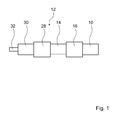
- FIG. 1 1 shows a schematic view of a domestic appliance device according to the invention with a protective conductor 32 and a safety grounding unit 12.
- the safety grounding unit 12 has a surface mounting unit 10, a grounding means 16, a carrier unit 14, a housing 28 and a protective contact 30.
- the safety grounding unit 12 forms a safety grounding connection for the surface unit 10.
- a current of twenty five amperes is passed from a power source having an open circuit voltage below twelve volts AC or DC from the grounding pad 30 to the surface package 10, and that voltage drop occurring between the grounding pad 30 and the surface package 10 occurs, measured and calculated by means of the measured voltage drop and the current an ohmic resistance
- the ohmic resistance is less than or equal to one hundred milliohms.
- the protective contact 30 is connected to a protective conductor 32, whereby the protective contact 30 is grounded. Occurs a defect of the home appliance device, in which a current-carrying line touches the surface assembly 10 and touches an operator at the same time the surface assembly 10, the remains Health of the operator due to the safety grounding unit 12 and the grounding of the protective contact 30 without damage.
- the carrier unit 14 receives at least one weight force of the surface assembly 10 in the operating state ( FIG. 2 ).
- the surface construction unit 10 which can be touched by an operator and is designed as a decorative part, is fastened to the carrier unit 14 by means of a double adhesive tape 34 and polyurethane foam 36.
- the carrier unit 14 is conductively connected to the housing 28 and secured thereto. Furthermore, the housing 28 is conductively connected to the protective contact 30.
- the safety grounding unit 12 has a grounding means 16, which is fixed to the carrier unit 14 in a positive and non-positive manner ( Figures 2 . 3 . 4 and 5 ).
- the carrier unit 14 forms a rectangular recess 38, through which a bracket 40 of a clamping means 42 of the grounding means 16 protrudes.
- the clamping means 42 clamps a partial region 44 of the carrier unit 14 and is thereby fastened non-positively with respect to a vertical direction 46 on the carrier unit 14.
- a contact surface 50 of the grounding means 16 bears against a contact surface 52 of the carrier unit 14.
- the carrier unit 14 has a metal region, which forms the contact surface 52.
- the grounding means 16 is positively secured to the carrier unit 14 with respect to a horizontal plane extending direction 48.
- the bracket 40 projecting through the recess 38 prevents movement of the contact surface 52 of the grounding means 16 in the surface extension direction 48 out of the contact surface 50 by applying a force to the grounding means 16 in the surface extension direction 48 to the grounding means 16 at one of the support unit 14 formed boundary of the recess 38 abuts.
- the grounding means 16 formed of beryllium copper is formed as a spring means and conductively connects the surface assembly 10 and the support unit 14.
- the grounding means has a curved surface region 18, which rests against the surface assembly 10 in an assembled state.
- the grounding means 16 is disposed between the support unit 14 and the surface assembly 14, and the grounding means 16 is elastically deformed by the surface assembly 10 and the support unit 14.
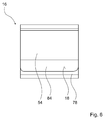
- the bracket 54 forms the curved surface area 18 (FIG. Figures 5 and 6 ).
- the grounding means 16 can be installed after attachment of the surface constructional unit 10 to the carrier unit 14.
- the grounding means 16 at a lateral region 58 (FIG. Figures 2 and 4 ) is inserted between the carrier unit 14 and the surface assembly 10 and the bracket 40 are inserted into the recess 38. This can be done in particular with tweezers.
- the carrier unit 14 has a surface 20 which is formed by a lacquer layer 22 of the carrier line 14 ( FIGS. 3 and 4 ).
- the lacquer layer 22 has a recess 24. A boundary of the recess 24 formed by the lacquer layer 22 also limits the contact surface 52 of the carrier unit 14.
- the carrier unit 14 has, in a completely installed and mounted state, a passage opening 26 to the surface assembly 10 (FIG. FIGS. 3 and 4 ).
- the passage opening 26 has a first mouth region 60 and a second mouth region 62.
- the first mouth region 60 is arranged on a first side 64 of the carrier unit 14, which faces the surface assembly 10.
- the second mouth region 62 is arranged on a second side of the carrier unit 14, which lies opposite the first side 64.
- the first mouth region 60 has a first point 68 and the second mouth region 62 has a second point 70.
- the points 68, 70 are arranged on a straight line 66 that intersects the surface unit 10 (FIG. FIGS. 2 to 4 ). Furthermore, the straight line 66 runs perpendicular to the contact surface 52.
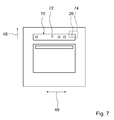
- a front surface 72 of the integrally formed surface construction unit 10 is arranged to be touchable for an operator in an operating situation ( FIGS. 7 and 2 ).
- an electronic unit 74 with a cable is arranged in an area behind the carrier unit 14 and behind the passage opening 26. If the cable detaches in the event of a defect and an uninsulated region of the cable passes through the passage opening 26 and touches the surface assembly 10, an operator is the surface assembly 10 touched, protected by the safety grounding unit 12, so that his health remains intact.
- the safety grounding unit 12 is further designed as a functional grounding unit.
- the safety grounding unit 12 conducts charges, which are applied to the surface mount unit 10, for example, by an operating process, by means of the protective conductor 32 (FIG. FIG. 1 ) away from the domestic appliance, so that electronic components such. As the electronics unit 74, remain undisturbed by the charges in their function.
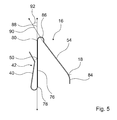
- the integrally formed grounding means 16 has a base portion 76 which, together with the bracket 40, forms the clamping means 42 ( FIG. 5 ).
- the base region 76 has a shape of a cuboid disc.
- the bracket 40 is formed on a first end portion 78 of the base portion 76.
- the second bracket 54 of the grounding means 16 is formed on a second end portion 80 of the base portion 76.
- the second end portion 80 is disposed on a side of the base portion 76 opposite to a side on which the first end portion 78 is disposed.
- One side 84 of the bracket 54 is opposite to another side 86 of the bracket, which is directly adjacent to the base portion 76 opposite.
- the curved surface area 18 is disposed on the side 84.
- the base portion 76 has a main extension direction 88 and the bracket 54 a main extension direction 90, which enclose an angle 92 of 38.1 °.
Landscapes
- Engineering & Computer Science (AREA)
- Chemical & Material Sciences (AREA)
- Combustion & Propulsion (AREA)
- Mechanical Engineering (AREA)
- General Engineering & Computer Science (AREA)
- Elimination Of Static Electricity (AREA)
- Combinations Of Kitchen Furniture (AREA)
- Electric Ovens (AREA)
- Electric Stoves And Ranges (AREA)
Abstract
Description
- Die Erfindung geht aus von einer Hausgerätvorrichtung nach dem Oberbegriff des Anspruchs 1.
- Es ist eine Hausgerätvorrichtung mit einem Dekorteil bekannt, welches ein Oberflächenteil eines Bedienbereichs bildet. Die Hausgerätvorrichtung weist einen Schalterträger und einen Schalter auf, welche in einem eingebauten Zustand das Dekorteil vor Kabeln schützen, die bei einem Defekt das Dekorteil berühren könnten.
- Die Aufgabe der Erfindung besteht insbesondere darin, eine gattungsgemäße Vorrichtung mit verbesserten Eigenschaften hinsichtlich einer kostengünstigen Bauweise bereitzustellen. Die Aufgabe wird erfindungsgemäß durch die Merkmale des Patentanspruchs 1 gelöst, während vorteilhafte Ausgestaltungen und Weiterbildungen der Erfindung den Unteransprüchen entnommen werden können.
- Die Erfindung geht aus von einer Hausgerätvorrichtung mit wenigstens einer Oberflächenbaueinheit.
- Es wird vorgeschlagen, dass die Hausgerätvorrichtung wenigstens eine Sicherheitserdungseinheit aufweist, welche eine Sicherheitserdungsverbindung für die Oberflächenbaueinheit bildet. Unter einer "Sicherheitserdungsverbindung" für die Oberflächenbaueinheit soll insbesondere eine elektrisch leitende Verbindung verstanden werden, welche einen ersten Endpunkt aufweist, welcher von der Oberflächenbaueinheit gebildet ist, und welche einen zweiten Endpunkt aufweist, welcher von einer Hausgerätschutzleiterklemme der Hausgerätvorrichtung und/oder einem Hausgerätschutzkontakt der Hausgerätvorrichtung gebildet ist, und für welche derjenige ohmsche Widerstand, welcher zwischen dem ersten Endpunkt und dem zweiten Endpunkt vorherrscht, gemessen in einem Standardmessverfahren kleiner oder gleich hundert Ohm, insbesondere kleiner oder gleich zehn Ohm, im Besonderen kleiner oder gleich einem Ohm und besonders vorteilhaft kleiner oder gleich hundert Milliohm ist, wobei die leitende Verbindung insbesondere frei ist von Anschlusskabeln, welche in einem Betriebszustand eine elektrisch leitende Verbindung zwischen dem Hausgerätschutzkontakt und/oder der Hausgerätschutzleiterklemme und einer Steckdose bilden. Unter einem "Standardmessverfahren" soll insbesondere ein Verfahren verstanden werden, bei welchem ein Strom von fünfundzwanzig Ampere aus einer Stromquelle mit einer Leerlaufspannung, welche unter zwölf Volt liegt, von dem ersten Endpunkt mittels der Sicherheitserdungsverbindung zu dem zweiten Endpunkt geleitet wird und der Spannungsabfall zwischen der Hausgerätschutzleiterklemme der Hausgerätvorrichtung und/oder dem Hausgerätschutzkontakt der Hausgerätvorrichtung und dem Oberflächenteil gemessen wird und danach mittels des Spannungsfalls und dem Strom ein ohmscher Widerstand der leitenden Verbindung berechnet wird. Unter einer "Hausgerätschutzleiterklemme" der Hausgerätvorrichtung und/oder einem "Hausgerätschutzkontakt" der Hausgerätvorrichtung soll insbesondere eine Klemme und/oder ein Kontakt der Hausgerätvorrichtung verstanden werden, an welcher und/oder welchem in einem Betriebszustand ein Kabel angeschlossen ist, welches zumindest teilweise außerhalb eines Geräts verläuft, in welche die Hausgerätvorrichtung in einem montierten Zustand eingebaut ist, und/oder welches leitend mit einer Steckdose verbunden ist. Hierdurch kann eine kostengünstige Bauweise erreicht werden. Insbesondere kann eine Trägereinheit, welche insbesondere zumindest einen Teil einer Gewichtskraft der Oberflächenbaueinheit aufnimmt, kostengünstig hergestellt werden. Im Besonderen kann die Befestigungseinheit Öffnungen aufweisen und insbesondere hierdurch in einer Vielzahl von verschieden aufgebauten Geräten einsetzbar sein, ohne dass ein Risiko für einen Bediener durch eine defekte Kabelverbindung entsteht.
- Vorzugsweise weist die Sicherheitserdungseinheit wenigstens eine Trägereinheit auf, welche in wenigstens einem Betriebszustand zumindest einen Teil einer Gewichtskraft der Oberflächenbaueinheit aufnimmt. Hierdurch kann eine einfache Bauweise erreich werden.
- Mit Vorteil weist die Sicherheitserdungseinheit wenigstens eine Trägereinheit und zumindest ein Erdungsmittel auf, welches formschlüssig und/oder kraftschlüssig an der Trägereinheit befestigt ist. Auf diese Weise kann eine einfache Montage erreicht werden. Insbesondere kann eine sichere Positionierung des Erdungsmittels erfolgen, wodurch eine robuste, leitende Verbindung zwischen dem Erdungsmittel und der Trägereinheit erreicht werden kann.
- Außerdem wird vorgeschlagen, dass die Sicherheitserdungseinheit wenigstens ein Erdungsmittel aufweist, welches als Federmittel ausgebildet ist. Hierdurch kann bei einer einfachen Montage eine zuverlässig leitende Verbindung erreicht werden. Eine besonders einfach montierbare und zuverlässig leitende Verbindung kann dadurch erreicht werden, dass die Sicherheitserdungseinheit zumindest ein Erdungsmittel aufweist, welches in einem eingebauten Zustand durch die Oberflächenbaueinheit elastisch verformt ist. Insbesondere kann eine zuverlässig leitende Verbindung zwischen der Oberflächenbaueinheit und der Trägereinheit erreicht werden. Im Besonderen kann erreicht werden, dass das Erdungsmittel eine Federkraft auf die Trägereinheit und die Oberflächenbaueinheit ausübt und dass die Oberflächenbaueinheit aufgrund der Federkraft sicher an dem Erdungsmittel anliegt.
- Vorzugsweise weist die Sicherheitserdungseinheit wenigstens ein Erdungsmittel auf, welches zumindest teilweise aus Berylliumkupfer gebildet ist. Hierdurch kann eine robuste und leitfähige Verbindung erreicht werden. Insbesondere kann eine hohe Leitfähigkeit des Erdungsmittels erreicht werden. Im Besonderen kann eine chemisch widerstandsfähige Beschaffenheit des Erdungsmittels erreicht werden. Ferner kann eine außerordentlich elastische Ausbildung des Erdungsmittels erreicht werden.
- In einer bevorzugten Ausgestaltung der Erfindung weist die Sicherheitserdungseinheit wenigstens ein Erdungsmittel mit einem gekrümmten Oberflächenbereich auf. Hierdurch kann ein großer Kontaktbereich, insbesondere zu der Oberflächenbaueinheit, erreicht werden. Insbesondere kann eine leitende Verbindung zwischen der Oberflächenbaueinheit und dem Erdungsmittel erreicht werden, welche einen geringen Widerstand aufweist.
- Vorzugsweise weist die Sicherheitserdungseinheit zumindest ein Erdungsmittel und wenigstens eine Trägereinheit auf, welche durch das Erdungsmittel leitend mit der Oberflächenbaueinheit verbunden ist. Hierdurch kann eine konstruktiv einfache Erdung erreicht werden. Insbesondere kann die Trägereinheit zu einer Erdung verwendet werden. Eine flexible Herstellbarkeit kann erreicht werden, wenn bei einer Montage das Erdungsmittel nach einer Befestigung der Oberflächenbaueinheit an der Trägereinheit einbaubar ist.
- Mit Vorteil umfasst die Sicherheitserdungseinheit wenigstens eine Trägereinheit, welche eine Oberfläche aufweist, die zumindest teilweise durch eine Lackschicht gebildet ist.
- Hierdurch kann eine kostengünstige elektrische Isolierung der Trägereinheit erreicht werden. Eine große Funktionalität, insbesondere der Trägereinheit kann erreicht werden, wenn die Lackschicht wenigstens eine Aussparung aufweist.
- Weiterhin wird vorgeschlagen, dass die Sicherheitserdungseinheit als Funktionserdungseinheit ausgebildet ist. Unter einer "Funktionserdungseinheit" soll insbesondere eine Erdungseinheit verstanden werden, welche dazu vorgesehen ist, eine statische Aufladung wenigstens eines Bauteils, welches mittels der Erdungseinheit geerdet ist, abzubauen und/oder zu verhindern, und/oder welche als Elektromagnetische-Vertäglichkeitserdungseinheit ausgebildet ist. Unter einer "Elektromagnetischen-Vertäglichkeitserdungseinheit" soll insbesondere eine Erdungseinheit einer Hausgerätvorrichtung verstanden werden, welche zumindest ein Bauteil der Hausgerätvorrichtung derart erdet, dass wenigstens ein elektronisches Bauteil der Hausgerätvorrichtung und besonders vorteilhaft alle elektronischen Bauteile der Hausgerätvorrichtung von elektrischen Feldern von Ladungen, welche auf dem geerdeten Bauteil, insbesondere zu einem bestimmten Zeitpunkt, angeordnet sind, in ihrer Funktionalität unbeeinträchtigt sind. Auf diese Weise kann ein störungsfreies Funktionieren der Hausgerätvorrichtung erreicht werden.
- Vorzugsweise weist die Sicherheitserdungseinheit wenigstens eine Trägereinheit auf, welche in einem eingebauten Zustand wenigstens eine Durchgangsöffnung zur Oberflächenbaueinheit aufweist. Darunter, dass die Trägereinheit eine Durchgangsöffnung "zur" Oberflächenbaueinheit aufweist, soll insbesondere verstanden werden, dass die Trägereinheit eine Durchgangsöffnung mit einem ersten und wenigsten einem zweiten Mündungsbereich aufweist und es zumindest einen ersten Punkt des ersten Mündungsbereichs und wenigstens einen zweiten Punkt des zweiten Mündungsbereichs gibt, so dass eine Gerade, welche die beiden Punkte verbindet, die Oberflächenbaueinheit schneidet. Hierdurch kann eine kostengünstige Bauweise erreicht werden. Insbesondere kann die Trägereinheit für viele verschiedenartig aufgebaute Hausgerätvorrichtungen verwendet werden, wodurch Kosten eingespart werden. Insbesondere kann die Durchgangsöffnung in einer verschiedenartig aufgebauten Hausgerätvorrichtung eine Funktion, wie z. B. eine Haltefunktion für ein Bedienelement, übernehmen.
- Weitere Vorteile ergeben sich aus der folgenden Zeichnungsbeschreibung. In der Zeichnung ist ein Ausführungsbeispiel der Erfindung dargestellt. Die Zeichnung, die Beschreibung und die Ansprüche enthalten zahlreiche Merkmale in Kombination. Der Fachmann wird die Merkmale zweckmäßigerweise auch einzeln betrachten und zu sinnvollen weiteren Kombinationen zusammenfassen.
- Es zeigen:
- Fig. 1
- eine schematische Ansicht einer erfindungsgemäßen Hausgerätvorrichtung,
- Fig. 2
- einen Schnitt durch die Hausgerätvorrichtung,
- Fig. 3
- eine Draufsicht auf eine Trägereinheit,
- Fig. 4
- eine Draufsicht auf die Trägereinheit und ein montiertes Erdungsmittel,
- Fig. 5
- eine Seitenansicht eines Erdungsmittels,
- Fig. 6
- eine Frontansicht des Erdungsmittels und
- Fig. 7
- eine Frontansicht eines als Backofen ausgebildeten Hausgeräts mit der Hausgerätvorrichtung.
-
Figur 1 zeigt eine schematische Ansicht einer erfindungsgemäßen Hausgerätvorrichtung mit einem Schutzleiter 32 und einer Sicherheitserdungseinheit 12. Die Sicherheitserdungseinheit 12 weist eine Oberflächenbaueinheit 10, ein Erdungsmittel 16, eine Trägereinheit 14, ein Gehäuse 28 und einen Schutzkontakt 30 auf. Die Sicherheitserdungseinheit 12 bildet eine Sicherheitserdungsverbindung für die Oberflächenbaueinheit 10. Wird ein Strom von fünfundzwanzig Ampere aus einer Stromquelle mit einer Leerlaufspannung unter zwölf Volt Wechselspannung oder Gleichspannung von dem Schutzkontakt 30 zu der Oberflächenbaueinheit 10 geleitet und derjenige Spannungsfall, welcher zwischen dem Schutzkontakt 30 und der Oberflächenbaueinheit 10 auftritt, gemessen und mittels des gemessenen Spannungsabfalls und des Stroms ein ohmscher Widerstand berechnet, so ist der ohmsche Widerstand kleiner oder gleich hundert Milliohm. In einem Betriebszustand der Hausgerätvorrichtung ist der Schutzkontakt 30 an einen Schutzleiter 32 angeschlossen, wodurch der Schutzkontakt 30 geerdet ist. Tritt ein Defekt der Hausgerätvorrichtung auf, bei welchem eine stromführende Leitung die Oberflächenbaueinheit 10 berührt und berührt ein Bediener gleichzeitig die Oberflächenbaueinheit 10, so bleibt die Gesundheit des Bediener auf Grund der Sicherheitserdungseinheit 12 und der Erdung des Schutzkontakt 30 unbeschadet. - Die Trägereinheit 14 nimmt in dem Betriebszustand zumindest eine Gewichtskraft der Oberflächenbaueinheit 10 auf (
Figur 2 ). Die für einen Bediener berührbar angeordnete und als Dekorteil ausgebildete Oberflächenbaueinheit 10 ist mittels eines Doppelklebebands 34 und Polyurethan-Schaum 36 an der Trägereinheit 14 befestigt. Die Trägereinheit 14 ist leitend mit dem Gehäuse 28 verbunden und an diesem befestigt. Ferner ist das Gehäuse 28 leitend mit dem Schutzkontakt 30 verbunden. - Ferner weist die Sicherheitserdungseinheit 12 ein Erdungsmittel 16 auf, welches form- und kraftschlüssig an der Trägereinheit 14 befestigt ist (
Figuren 2 ,3 ,4 und5 ). Hierzu bildet die Trägereinheit 14 eine rechteckförmige Ausnehmung 38, durch welche ein Bügel 40 eines Klemmmittels 42 des Erdungsmittels 16 ragt. Das Klemmmittel 42 klemmt einen Teilbereich 44 der Trägereinheit 14 ein und ist hierdurch kraftschlüssig bezüglich einer vertikalen Richtung 46 an der Trägereinheit 14 befestigt. - Eine Kontaktfläche 50 des Erdungsmittels 16 liegt an einer Kontaktoberfläche 52 der Trägereinheit 14 an. Die Trägereinheit 14 weist einen Metallbereich auf, welcher die Kontaktoberfläche 52 bildet. Das Erdungsmittel 16 ist formschlüssig bezüglich einer horizontalen Flächenerstreckungsrichtung 48 an der Trägereinheit 14 befestigt. Der durch die Ausnehmung 38 ragende Bügel 40 verhindert eine Bewegung der Kontaktoberfläche 52 des Erdungsmittels 16 in die Flächenerstreckungsrichtung 48 aus der Kontaktfläche 50 heraus dadurch, dass bei einem Ausüben einer Kraft auf das Erdungsmittel 16 in die Flächenerstreckungsrichtung 48 das Erdungsmittel 16 an einer von der Trägereinheit 14 gebildeten Berandung der Ausnehmung 38 anstößt.
- Das aus Berylliumkupfer gebildete Erdungsmittel 16 ist als Federmittel ausgebildet und verbindet die Oberflächenbaueinheit 10 und die Trägereinheit 14 leitend. Hierzu weist das Erdungsmittel einen gekrümmten Oberflächenbereich 18 auf, welcher in einem montierten Zustand an der Oberflächenbaueinheit 10 anliegt. In dem eingebauten Zustand ist das Erdungsmittel 16 zwischen der Trägereinheit 14 und der Oberflächenbaueinheit 14 angeordnet und das Erdungsmittel 16 ist von der Oberflächenbaueinheit 10 und der Trägereinheit 14 elastisch verformt. Durch die elastische Verformung ist ein Bügel 54 des Erdungsmittels 16 in eine Richtung 56, welche senkrecht zu der Richtung 46 und der Flächenerstreckungsrichtung 48 ist, auf die Kontaktfläche 50 zu in einem Vergleich zu einem freien und unbefestigten Zustand des Erdungsmittels 16 ausgelenkt. Der Bügel 54 bildet den gekrümmten Oberflächenbereich 18 (
Figuren 5 und6 ). - Bei einer Montage der Hausgerätvorrichtung ist das Erdungsmittel 16 nach einer Befestigung der Oberflächenbaueinheit 10 an der Trägereinheit 14 einbaubar. Hierzu kann das Erdungsmittel 16 an einem seitlichen Bereich 58 (
Figuren 2 und4 ) zwischen der Trägereinheit 14 und der Oberflächenbaueinheit 10 eingeführt und der Bügel 40 in die Ausnehmung 38 eingesteckt werden. Dies kann insbesondere mit einer Pinzette erfolgen. - Die Trägereinheit 14 weist eine Oberfläche 20 auf, welche durch eine Lackschicht 22 der Trägereinehit 14 gebildet ist (
Figuren 3 und 4 ). Die Lackschicht 22 weist eine Aussparung 24 auf. Eine durch die Lackschicht 22 gebildete Berandung der Aussparung 24 begrenzt außerdem die Kontaktoberfläche 52 der Trägereinheit 14. - Die Trägereinheit 14 weist in einem vollständig eingebauten und montierten Zustand eine Durchgangsöffnung 26 zur Oberflächenbaueinheit 10 auf (
Figuren 3 und 4 ). Die Durchgangsöffnung 26 weist einen ersten Mündungsbereich 60 und einen zweiten Mündungsbereich 62 auf. Der erste Mündungsbereich 60 ist an einer ersten Seite 64 der Trägereinheit 14 angeordnet, welche der Oberflächenbaueinheit 10 zugewandt ist. Der zweite Mündungsbereich 62 ist an einer zweiten Seite der Trägereinheit 14 angeordnet, welche der ersten Seite 64 gegenüberliegt. Der erste Mündungsbereich 60 weist einen ersten Punkt 68 auf und der zweite Mündungsbereich 62 weist einen zweiten Punkt 70 auf. Die Punkte 68, 70 sind auf einer Geraden 66 angeordnet, die die Oberflächenbaueinheit 10 schneidet (Figuren 2 bis 4 ). Ferner verläuft die Gerade 66 senkrecht zu der Kontaktoberfläche 52. - In einem montierten Zustand, in welchem die Hausgerätvorrichtung ein Teil eines Hausgeräts ist (
Figur 7 ), ist eine Frontfläche 72 der einstückig ausgebildeten Oberflächenbaueinheit 10 für einen Bediener in einer Bediensituation berührbar angeordnet (Figuren 7 und2 ). In einer Frontalansicht auf das Hausgerät ist in einem Bereich hinter der Trägereinheit 14 und hinter der Durchgangsöffnung 26 eine Elektronikeinheit 74 mit einem nicht näher dargestellten Kabel angeordnet. Falls sich das Kabel bei einem Defekt löst und ein unisolierter Bereich des Kabels durch die Durchgangsöffnung 26 gelangt und die Oberflächenbaueinheit 10 berührt, ist ein Bediener, welcher die Oberflächenbaueinheit 10 berührt, mittels der Sicherheitserdungseinheit 12 geschützt, so dass seine Gesundheit unversehrt bleibt. - Die Sicherheitserdungseinheit 12 ist ferner als Funktionserdungseinheit ausgebildet. Die Sicherheitserdungseinheit 12 leitet Ladungen, welche beispielsweise durch einen Bedienvorgang auf die Oberflächenbaueinheit 10 aufgebracht werden, mittels des Schutzleiters 32 (
Figur 1 ) von dem Hausgerät weg, so dass elektronische Bauteile, wie z. B. die Elektronikeinheit 74, durch die Ladungen in ihrer Funktion ungestört bleiben. - Das einstückig ausgebildete Erdungsmittel 16 weist einen Grundbereich 76 auf, welcher zusammen mit dem Bügel 40 das Klemmmittel 42 bildet (
Figur 5 ). Der Grundbereich 76 weist eine Form einer quaderförmigen Scheibe auf. Der Bügel 40 ist an einen ersten Endbereich 78 des Grundbereichs 76 angeformt. Der zweite Bügel 54 des Erdungsmittels 16 ist an einen zweiten Endbereich 80 des Grundbereichs 76 angeformt. Der zweite Endbereich 80 ist auf einer Seite des Grundbereichs 76 angeordnet, welche einer Seite, an welcher der erste Endbereich 78 angeordnet ist, gegenüberliegt. Eine Seite 84 des Bügels 54 liegt einer weiteren Seite 86 des Bügels, die unmittelbar an den Grundbereich 76 angrenzt, gegenüber. Der gekrümmte Oberflächenbereich 18 ist an der Seite 84 angeordnet. In der Seitenansicht vonFigur 5 , welche in einem eingebauten Zustand einer Ansicht entlang der Flächenerstreckungsrichtung 48 entspricht, weist der Grundbereich 76 eine Haupterstreckungsrichtung 88 und der Bügel 54 eine Haupterstreckungsrichtung 90 auf, welche einen Winkel 92 von 38,1° einschließen. -
- 10
- Oberflächenbaueinheit
- 12
- Sicherheitserdungseinheit
- 14
- Trägereinheit
- 16
- Erdungsmittel
- 18
- Oberflächenbereich
- 20
- Oberfläche
- 22
- Lackschicht
- 24
- Aussparung
- 26
- Durchgangsöffnung
- 28
- Gehäuse
- 30
- Schutzkontakt
- 32
- Schutzleiter
- 34
- Doppelklebeband
- 36
- Polyurethan-Schaum
- 38
- Ausnehmung
- 40
- Bügel
- 42
- Klemmmittel
- 44
- Teilbereich
- 46
- Richtung
- 48
- Flächenerstreckungsrichtung
- 50
- Kontaktfläche
- 52
- Kontaktoberfläche
- 54
- Bügel
- 56
- Richtung
- 58
- Bereich
- 60
- Mündungsbereich
- 62
- Mündungsbereich
- 64
- Seite
- 66
- Gerade
- 68
- Punkt
- 70
- Punkt
- 72
- Frontfläche
- 74
- Elektronikeinheit
- 76
- Grundbereich
- 78
- Endbereich
- 80
- Endbereich
- 84
- Seite
- 86
- Seite
- 88
- Haupterstreckungsrichtung
- 90
- Haupterstreckungsrichtung
- 92
- Winkel
Claims (14)
- Hausgerätvorrichtung mit wenigstens einer Oberflächenbaueinheit (10),
gekennzeichnet durch
wenigstens eine Sicherheitserdungseinheit (12), welche eine Sicherheitserdungsverbindung für die Oberflächenbaueinheit (10) bildet. - Hausgerätvorrichtung nach Anspruch 1,
dadurch gekennzeichnet,
dass die Sicherheitserdungseinheit (12) wenigstens eine Trägereinheit (14) aufweist, welche in wenigstens einem Betriebszustand zumindest einen Teil einer Gewichtskraft der Oberflächenbaueinheit (10) aufnimmt. - Hausgerätvorrichtung nach einem der Ansprüche 1 oder 2,
dadurch gekennzeichnet,
dass die Sicherheitserdungseinheit (12) wenigstens eine Trägereinheit (14) und zumindest ein Erdungsmittel (16) aufweist, welches formschlüssig und/oder kraftschlüssig an der Trägereinheit (14) befestigt ist. - Hausgerätvorrichtung nach einem der vorherigen Ansprüche,
dadurch gekennzeichnet,
dass die Sicherheitserdungseinheit (12) wenigstens ein Erdungsmittel (16) aufweist, welches als Federmittel ausgebildet ist. - Hausgerätvorrichtung nach einem der vorherigen Ansprüche,
dadurch gekennzeichnet,
dass die Sicherheitserdungseinheit (12) zumindest ein Erdungsmittel (16) aufweist, welches in einem eingebauten Zustand durch die Oberflächenbaueinheit (10) elastisch verformt ist. - Hausgerätvorrichtung nach einem der vorherigen Ansprüche,
dadurch gekennzeichnet,
dass die Sicherheitserdungseinheit (12) wenigstens ein Erdungsmittel (16) aufweist, welches zumindest teilweise aus Berylliumkupfer gebildet ist. - Hausgerätvorrichtung nach einem der vorherigen Ansprüche,
dadurch gekennzeichnet,
dass die Sicherheitserdungseinheit (12) wenigstens ein Erdungsmittel (16) mit einem gekrümmten Oberflächenbereich (18) aufweist. - Hausgerätvorrichtung nach einem der vorherigen Ansprüche,
dadurch gekennzeichnet,
dass die Sicherheitserdungseinheit (12) zumindest ein Erdungsmittel (16) und wenigstens eine Trägereinheit (14) aufweist, welche durch das Erdungsmittel (16) leitend mit der Oberflächenbaueinheit (10) verbunden ist. - Hausgerätvorrichtung nach Anspruch 8,
dadurch gekennzeichnet,
dass bei einer Montage das Erdungsmittel (16) nach einer Befestigung der Oberflächenbaueinheit (10) an der Trägereinheit (14) einbaubar ist. - Hausgerätvorrichtung nach einem der vorherigen Ansprüche,
dadurch gekennzeichnet,
dass die Sicherheitserdungseinheit (12) wenigstens eine Trägereinheit (14) umfasst, welche eine Oberfläche (20) aufweist, die zumindest teilweise durch eine Lackschicht (22) gebildet ist. - Hausgerätvorrichtung nach Anspruch 10,
dadurch gekennzeichnet,
dass die Lackschicht (22) wenigstens eine Aussparung (24) aufweist. - Hausgerätvorrichtung nach einem der vorherigen Ansprüche,
dadurch gekennzeichnet,
dass die Sicherheitserdungseinheit (12) als Funktionserdungseinheit ausgebildet ist. - Hausgerätvorrichtung nach einem der vorherigen Ansprüche,
dadurch gekennzeichnet,
dass die Sicherheitserdungseinheit (12) wenigstens eine Trägereinheit (14) aufweist, welche in einem eingebauten Zustand wenigstens eine Durchgangsöffnung (26) zur Oberflächenbaueinheit (10) aufweist. - Hausgerät mit einer Hausgerätvorrichtung nach einem der Ansprüche 1 bis 13.
Priority Applications (1)
| Application Number | Priority Date | Filing Date | Title |
|---|---|---|---|
| PL09165899T PL2149754T3 (pl) | 2008-07-22 | 2009-07-20 | Urządzenie do sprzętu domowego |
Applications Claiming Priority (1)
| Application Number | Priority Date | Filing Date | Title |
|---|---|---|---|
| DE102008040619A DE102008040619A1 (de) | 2008-07-22 | 2008-07-22 | Hausgerätvorrichtung |
Publications (3)
| Publication Number | Publication Date |
|---|---|
| EP2149754A2 true EP2149754A2 (de) | 2010-02-03 |
| EP2149754A3 EP2149754A3 (de) | 2011-07-13 |
| EP2149754B1 EP2149754B1 (de) | 2014-10-22 |
Family
ID=41328522
Family Applications (1)
| Application Number | Title | Priority Date | Filing Date |
|---|---|---|---|
| EP09165899.7A Active EP2149754B1 (de) | 2008-07-22 | 2009-07-20 | Hausgerätvorrichtung |
Country Status (3)
| Country | Link |
|---|---|
| EP (1) | EP2149754B1 (de) |
| DE (1) | DE102008040619A1 (de) |
| PL (1) | PL2149754T3 (de) |
Citations (1)
| Publication number | Priority date | Publication date | Assignee | Title |
|---|---|---|---|---|
| DE8119275U1 (de) | 1981-07-01 | 1982-09-02 | Schott Glaswerke, 6500 Mainz | Glaskeramik-kochfeld |
Family Cites Families (3)
| Publication number | Priority date | Publication date | Assignee | Title |
|---|---|---|---|---|
| DE19809224A1 (de) * | 1998-03-04 | 1999-09-09 | Bosch Siemens Hausgeraete | Haushaltsgerät |
| DE10314589B4 (de) * | 2003-03-31 | 2021-06-24 | BSH Hausgeräte GmbH | Gargerät |
| ITTO20060484A1 (it) * | 2006-06-30 | 2008-01-01 | Itw Ind Components Srl | Dispositivo di connessione elettrica a montaggio rapido e suo uso per la neutralizzazione di un terminale di uscita in alta tensione eccedente in un dispositivo accendigas elettronico per elettrodomestici, in particolare per un piano di cottura |
-
2008
- 2008-07-22 DE DE102008040619A patent/DE102008040619A1/de not_active Withdrawn
-
2009
- 2009-07-20 EP EP09165899.7A patent/EP2149754B1/de active Active
- 2009-07-20 PL PL09165899T patent/PL2149754T3/pl unknown
Patent Citations (1)
| Publication number | Priority date | Publication date | Assignee | Title |
|---|---|---|---|---|
| DE8119275U1 (de) | 1981-07-01 | 1982-09-02 | Schott Glaswerke, 6500 Mainz | Glaskeramik-kochfeld |
Also Published As
| Publication number | Publication date |
|---|---|
| EP2149754B1 (de) | 2014-10-22 |
| DE102008040619A1 (de) | 2010-01-28 |
| EP2149754A3 (de) | 2011-07-13 |
| PL2149754T3 (pl) | 2015-04-30 |
Similar Documents
| Publication | Publication Date | Title |
|---|---|---|
| DE102009016756B4 (de) | Abschirmverbinderstruktur | |
| DE112005000372T5 (de) | Verbindungsvorrichtungsbefestigungsaufbau | |
| DE202010017964U1 (de) | Elektrische Anschlussklemme | |
| EP2151908B1 (de) | Dynamoelektrische Maschine mit einem mehrteiligen Steckergehäuse | |
| DE202015102045U1 (de) | Federkraftklemmelement mit Schwenkhebel | |
| DE202008004428U1 (de) | Steckverbinder mit einer Schirmauflage | |
| DE102012104259B4 (de) | Gleichstrommotor zum Antrieb von Aggregaten eines Kraftfahrzeugs | |
| DE202013101698U1 (de) | Schutzleiterkontaktiersystem für Geräteanschlusssysteme elektrischer Geräte | |
| DE102004037083B4 (de) | Überspannungsableiter-Anordnung mit einer als Bestandteil eines Gehäuses ausführbaren Trägerplatte | |
| DE102015110417A1 (de) | Kontaktelement und damit ausgestattete Stromschiene oder Leiterplatte | |
| DE202014103376U1 (de) | Geräteanschlusssystem mit integriertem Schutzleiteranschluss für elektrische Geräte | |
| EP2978075B1 (de) | Geräteanschlusssystem mit integriertem schutzleiteranschluss für elektrische geräte und elektrogerät | |
| EP2656452A1 (de) | Elektrischer steckverbinder mit vorgeordneter kontaktklemme | |
| DE102010033179B4 (de) | Elektrische Schaltungsanordnung für ein Überspannungsgerät und ebensolches Überspannungsschutzgerät | |
| EP2149754B1 (de) | Hausgerätvorrichtung | |
| DE102016201328A1 (de) | Schraubkontakt, Leitungsverbindungssystem, Hochvoltsystem und Fahrzeug damit | |
| EP2489100B1 (de) | Schraubklemme mit abdeckung und installationsschaltgerät | |
| WO2009103447A1 (de) | Verfahren zur aufnahme eines elektrischen/elektronischen bauteils und entsprechendes montageverfahren sowie abdeckung für eine solche vorrichtung | |
| EP3796474B1 (de) | Anschlussvorrichtung zum elektrischen kontaktieren eines elektrogeräts | |
| EP2253047A1 (de) | Funktionserweiterbarer anschlussblock und modul | |
| EP2875550B1 (de) | Elektrische kontakteinrichtung zur kontaktierung eines elektrischen leiters | |
| EP2747205B1 (de) | Verfahren zum elektrisch leitenden Verbinden eines Litzenleiters mit einem Kontaktelement | |
| EP2161786B1 (de) | Kabelanschlusselement | |
| DE102005040310B3 (de) | Anschlussklemme für eine Sammelschiene | |
| DE102013104006B3 (de) | Schutzleiterkontaktiersystem |
Legal Events
| Date | Code | Title | Description |
|---|---|---|---|
| PUAI | Public reference made under article 153(3) epc to a published international application that has entered the european phase |
Free format text: ORIGINAL CODE: 0009012 |
|
| AK | Designated contracting states |
Kind code of ref document: A2 Designated state(s): AT BE BG CH CY CZ DE DK EE ES FI FR GB GR HR HU IE IS IT LI LT LU LV MC MK MT NL NO PL PT RO SE SI SK SM TR |
|
| AX | Request for extension of the european patent |
Extension state: AL BA RS |
|
| RTI1 | Title (correction) |
Free format text: HOUSEHOLD APPARATUS |
|
| PUAL | Search report despatched |
Free format text: ORIGINAL CODE: 0009013 |
|
| AK | Designated contracting states |
Kind code of ref document: A3 Designated state(s): AT BE BG CH CY CZ DE DK EE ES FI FR GB GR HR HU IE IS IT LI LT LU LV MC MK MT NL NO PL PT RO SE SI SK SM TR |
|
| AX | Request for extension of the european patent |
Extension state: AL BA RS |
|
| 17P | Request for examination filed |
Effective date: 20120113 |
|
| 17Q | First examination report despatched |
Effective date: 20130409 |
|
| GRAP | Despatch of communication of intention to grant a patent |
Free format text: ORIGINAL CODE: EPIDOSNIGR1 |
|
| INTG | Intention to grant announced |
Effective date: 20140520 |
|
| GRAS | Grant fee paid |
Free format text: ORIGINAL CODE: EPIDOSNIGR3 |
|
| GRAA | (expected) grant |
Free format text: ORIGINAL CODE: 0009210 |
|
| AK | Designated contracting states |
Kind code of ref document: B1 Designated state(s): AT BE BG CH CY CZ DE DK EE ES FI FR GB GR HR HU IE IS IT LI LT LU LV MC MK MT NL NO PL PT RO SE SI SK SM TR |
|
| REG | Reference to a national code |
Ref country code: GB Ref legal event code: FG4D Free format text: NOT ENGLISH |
|
| REG | Reference to a national code |
Ref country code: CH Ref legal event code: EP |
|
| REG | Reference to a national code |
Ref country code: AT Ref legal event code: REF Ref document number: 692842 Country of ref document: AT Kind code of ref document: T Effective date: 20141115 |
|
| REG | Reference to a national code |
Ref country code: IE Ref legal event code: FG4D Free format text: LANGUAGE OF EP DOCUMENT: GERMAN |
|
| REG | Reference to a national code |
Ref country code: DE Ref legal event code: R096 Ref document number: 502009010120 Country of ref document: DE Effective date: 20141204 |
|
| REG | Reference to a national code |
Ref country code: CH Ref legal event code: PFA Owner name: BSH HAUSGERAETE GMBH, DE Free format text: FORMER OWNER: BSH BOSCH UND SIEMENS HAUSGERAETE GMBH, DE |
|
| REG | Reference to a national code |
Ref country code: NL Ref legal event code: VDEP Effective date: 20141022 |
|
| RAP2 | Party data changed (patent owner data changed or rights of a patent transferred) |
Owner name: BSH HAUSGERAETE GMBH |
|
| REG | Reference to a national code |
Ref country code: LT Ref legal event code: MG4D |
|
| PG25 | Lapsed in a contracting state [announced via postgrant information from national office to epo] |
Ref country code: LT Free format text: LAPSE BECAUSE OF FAILURE TO SUBMIT A TRANSLATION OF THE DESCRIPTION OR TO PAY THE FEE WITHIN THE PRESCRIBED TIME-LIMIT Effective date: 20141022 Ref country code: PT Free format text: LAPSE BECAUSE OF FAILURE TO SUBMIT A TRANSLATION OF THE DESCRIPTION OR TO PAY THE FEE WITHIN THE PRESCRIBED TIME-LIMIT Effective date: 20150223 Ref country code: NO Free format text: LAPSE BECAUSE OF FAILURE TO SUBMIT A TRANSLATION OF THE DESCRIPTION OR TO PAY THE FEE WITHIN THE PRESCRIBED TIME-LIMIT Effective date: 20150122 Ref country code: FI Free format text: LAPSE BECAUSE OF FAILURE TO SUBMIT A TRANSLATION OF THE DESCRIPTION OR TO PAY THE FEE WITHIN THE PRESCRIBED TIME-LIMIT Effective date: 20141022 Ref country code: IS Free format text: LAPSE BECAUSE OF FAILURE TO SUBMIT A TRANSLATION OF THE DESCRIPTION OR TO PAY THE FEE WITHIN THE PRESCRIBED TIME-LIMIT Effective date: 20150222 Ref country code: ES Free format text: LAPSE BECAUSE OF FAILURE TO SUBMIT A TRANSLATION OF THE DESCRIPTION OR TO PAY THE FEE WITHIN THE PRESCRIBED TIME-LIMIT Effective date: 20141022 Ref country code: NL Free format text: LAPSE BECAUSE OF FAILURE TO SUBMIT A TRANSLATION OF THE DESCRIPTION OR TO PAY THE FEE WITHIN THE PRESCRIBED TIME-LIMIT Effective date: 20141022 |
|
| REG | Reference to a national code |
Ref country code: PL Ref legal event code: T3 |
|
| REG | Reference to a national code |
Ref country code: DE Ref legal event code: R081 Ref document number: 502009010120 Country of ref document: DE Owner name: BSH HAUSGERAETE GMBH, DE Free format text: FORMER OWNER: BSH BOSCH UND SIEMENS HAUSGERAETE GMBH, 81739 MUENCHEN, DE Effective date: 20150407 |
|
| PG25 | Lapsed in a contracting state [announced via postgrant information from national office to epo] |
Ref country code: SE Free format text: LAPSE BECAUSE OF FAILURE TO SUBMIT A TRANSLATION OF THE DESCRIPTION OR TO PAY THE FEE WITHIN THE PRESCRIBED TIME-LIMIT Effective date: 20141022 Ref country code: CY Free format text: LAPSE BECAUSE OF FAILURE TO SUBMIT A TRANSLATION OF THE DESCRIPTION OR TO PAY THE FEE WITHIN THE PRESCRIBED TIME-LIMIT Effective date: 20141022 Ref country code: HR Free format text: LAPSE BECAUSE OF FAILURE TO SUBMIT A TRANSLATION OF THE DESCRIPTION OR TO PAY THE FEE WITHIN THE PRESCRIBED TIME-LIMIT Effective date: 20141022 Ref country code: GR Free format text: LAPSE BECAUSE OF FAILURE TO SUBMIT A TRANSLATION OF THE DESCRIPTION OR TO PAY THE FEE WITHIN THE PRESCRIBED TIME-LIMIT Effective date: 20150123 Ref country code: LV Free format text: LAPSE BECAUSE OF FAILURE TO SUBMIT A TRANSLATION OF THE DESCRIPTION OR TO PAY THE FEE WITHIN THE PRESCRIBED TIME-LIMIT Effective date: 20141022 |
|
| REG | Reference to a national code |
Ref country code: DE Ref legal event code: R097 Ref document number: 502009010120 Country of ref document: DE |
|
| REG | Reference to a national code |
Ref country code: FR Ref legal event code: PLFP Year of fee payment: 7 |
|
| PG25 | Lapsed in a contracting state [announced via postgrant information from national office to epo] |
Ref country code: SK Free format text: LAPSE BECAUSE OF FAILURE TO SUBMIT A TRANSLATION OF THE DESCRIPTION OR TO PAY THE FEE WITHIN THE PRESCRIBED TIME-LIMIT Effective date: 20141022 Ref country code: EE Free format text: LAPSE BECAUSE OF FAILURE TO SUBMIT A TRANSLATION OF THE DESCRIPTION OR TO PAY THE FEE WITHIN THE PRESCRIBED TIME-LIMIT Effective date: 20141022 Ref country code: CZ Free format text: LAPSE BECAUSE OF FAILURE TO SUBMIT A TRANSLATION OF THE DESCRIPTION OR TO PAY THE FEE WITHIN THE PRESCRIBED TIME-LIMIT Effective date: 20141022 Ref country code: RO Free format text: LAPSE BECAUSE OF FAILURE TO SUBMIT A TRANSLATION OF THE DESCRIPTION OR TO PAY THE FEE WITHIN THE PRESCRIBED TIME-LIMIT Effective date: 20141022 Ref country code: DK Free format text: LAPSE BECAUSE OF FAILURE TO SUBMIT A TRANSLATION OF THE DESCRIPTION OR TO PAY THE FEE WITHIN THE PRESCRIBED TIME-LIMIT Effective date: 20141022 |
|
| PLBE | No opposition filed within time limit |
Free format text: ORIGINAL CODE: 0009261 |
|
| STAA | Information on the status of an ep patent application or granted ep patent |
Free format text: STATUS: NO OPPOSITION FILED WITHIN TIME LIMIT |
|
| PG25 | Lapsed in a contracting state [announced via postgrant information from national office to epo] |
Ref country code: IT Free format text: LAPSE BECAUSE OF FAILURE TO SUBMIT A TRANSLATION OF THE DESCRIPTION OR TO PAY THE FEE WITHIN THE PRESCRIBED TIME-LIMIT Effective date: 20141022 |
|
| 26N | No opposition filed |
Effective date: 20150723 |
|
| REG | Reference to a national code |
Ref country code: FR Ref legal event code: CD Owner name: BSH HAUSGERATE GMBH, DE Effective date: 20151022 |
|
| PG25 | Lapsed in a contracting state [announced via postgrant information from national office to epo] |
Ref country code: MC Free format text: LAPSE BECAUSE OF FAILURE TO SUBMIT A TRANSLATION OF THE DESCRIPTION OR TO PAY THE FEE WITHIN THE PRESCRIBED TIME-LIMIT Effective date: 20141022 Ref country code: SI Free format text: LAPSE BECAUSE OF FAILURE TO SUBMIT A TRANSLATION OF THE DESCRIPTION OR TO PAY THE FEE WITHIN THE PRESCRIBED TIME-LIMIT Effective date: 20141022 |
|
| REG | Reference to a national code |
Ref country code: CH Ref legal event code: PL |
|
| GBPC | Gb: european patent ceased through non-payment of renewal fee |
Effective date: 20150720 |
|
| PG25 | Lapsed in a contracting state [announced via postgrant information from national office to epo] |
Ref country code: LU Free format text: LAPSE BECAUSE OF FAILURE TO SUBMIT A TRANSLATION OF THE DESCRIPTION OR TO PAY THE FEE WITHIN THE PRESCRIBED TIME-LIMIT Effective date: 20150720 |
|
| REG | Reference to a national code |
Ref country code: IE Ref legal event code: MM4A |
|
| PG25 | Lapsed in a contracting state [announced via postgrant information from national office to epo] |
Ref country code: LI Free format text: LAPSE BECAUSE OF NON-PAYMENT OF DUE FEES Effective date: 20150731 Ref country code: CH Free format text: LAPSE BECAUSE OF NON-PAYMENT OF DUE FEES Effective date: 20150731 Ref country code: GB Free format text: LAPSE BECAUSE OF NON-PAYMENT OF DUE FEES Effective date: 20150720 |
|
| REG | Reference to a national code |
Ref country code: FR Ref legal event code: PLFP Year of fee payment: 8 |
|
| PG25 | Lapsed in a contracting state [announced via postgrant information from national office to epo] |
Ref country code: IE Free format text: LAPSE BECAUSE OF NON-PAYMENT OF DUE FEES Effective date: 20150720 |
|
| REG | Reference to a national code |
Ref country code: AT Ref legal event code: MM01 Ref document number: 692842 Country of ref document: AT Kind code of ref document: T Effective date: 20150720 |
|
| PG25 | Lapsed in a contracting state [announced via postgrant information from national office to epo] |
Ref country code: AT Free format text: LAPSE BECAUSE OF NON-PAYMENT OF DUE FEES Effective date: 20150720 |
|
| PG25 | Lapsed in a contracting state [announced via postgrant information from national office to epo] |
Ref country code: MT Free format text: LAPSE BECAUSE OF FAILURE TO SUBMIT A TRANSLATION OF THE DESCRIPTION OR TO PAY THE FEE WITHIN THE PRESCRIBED TIME-LIMIT Effective date: 20141022 |
|
| PG25 | Lapsed in a contracting state [announced via postgrant information from national office to epo] |
Ref country code: SM Free format text: LAPSE BECAUSE OF FAILURE TO SUBMIT A TRANSLATION OF THE DESCRIPTION OR TO PAY THE FEE WITHIN THE PRESCRIBED TIME-LIMIT Effective date: 20141022 Ref country code: HU Free format text: LAPSE BECAUSE OF FAILURE TO SUBMIT A TRANSLATION OF THE DESCRIPTION OR TO PAY THE FEE WITHIN THE PRESCRIBED TIME-LIMIT; INVALID AB INITIO Effective date: 20090720 Ref country code: BG Free format text: LAPSE BECAUSE OF FAILURE TO SUBMIT A TRANSLATION OF THE DESCRIPTION OR TO PAY THE FEE WITHIN THE PRESCRIBED TIME-LIMIT Effective date: 20141022 |
|
| REG | Reference to a national code |
Ref country code: FR Ref legal event code: PLFP Year of fee payment: 9 |
|
| PG25 | Lapsed in a contracting state [announced via postgrant information from national office to epo] |
Ref country code: BE Free format text: LAPSE BECAUSE OF NON-PAYMENT OF DUE FEES Effective date: 20150731 |
|
| PG25 | Lapsed in a contracting state [announced via postgrant information from national office to epo] |
Ref country code: MK Free format text: LAPSE BECAUSE OF FAILURE TO SUBMIT A TRANSLATION OF THE DESCRIPTION OR TO PAY THE FEE WITHIN THE PRESCRIBED TIME-LIMIT Effective date: 20141022 |
|
| REG | Reference to a national code |
Ref country code: FR Ref legal event code: PLFP Year of fee payment: 10 |
|
| PGFP | Annual fee paid to national office [announced via postgrant information from national office to epo] |
Ref country code: FR Payment date: 20220725 Year of fee payment: 14 |
|
| REG | Reference to a national code |
Ref country code: DE Ref legal event code: R084 Ref document number: 502009010120 Country of ref document: DE |
|
| PG25 | Lapsed in a contracting state [announced via postgrant information from national office to epo] |
Ref country code: FR Free format text: LAPSE BECAUSE OF NON-PAYMENT OF DUE FEES Effective date: 20230731 |
|
| PGFP | Annual fee paid to national office [announced via postgrant information from national office to epo] |
Ref country code: DE Payment date: 20250731 Year of fee payment: 17 |
|
| PGFP | Annual fee paid to national office [announced via postgrant information from national office to epo] |
Ref country code: PL Payment date: 20250707 Year of fee payment: 17 Ref country code: TR Payment date: 20250716 Year of fee payment: 17 |