EP2149886B1 - Schutz einer elektronischen Kippschaltung gegen Fehlereingaben - Google Patents
Schutz einer elektronischen Kippschaltung gegen Fehlereingaben Download PDFInfo
- Publication number
- EP2149886B1 EP2149886B1 EP09165996A EP09165996A EP2149886B1 EP 2149886 B1 EP2149886 B1 EP 2149886B1 EP 09165996 A EP09165996 A EP 09165996A EP 09165996 A EP09165996 A EP 09165996A EP 2149886 B1 EP2149886 B1 EP 2149886B1
- Authority
- EP
- European Patent Office
- Prior art keywords
- flip
- circuit
- flop
- signals
- circuits
- Prior art date
- Legal status (The legal status is an assumption and is not a legal conclusion. Google has not performed a legal analysis and makes no representation as to the accuracy of the status listed.)
- Active
Links
Images


Classifications
-
- G—PHYSICS
- G11—INFORMATION STORAGE
- G11C—STATIC STORES
- G11C29/00—Checking stores for correct operation ; Subsequent repair; Testing stores during standby or offline operation
- G11C29/04—Detection or location of defective memory elements, e.g. cell constructio details, timing of test signals
- G11C29/08—Functional testing, e.g. testing during refresh, power-on self testing [POST] or distributed testing
- G11C29/12—Built-in arrangements for testing, e.g. built-in self testing [BIST] or interconnection details
- G11C29/38—Response verification devices
-
- H—ELECTRICITY
- H03—ELECTRONIC CIRCUITRY
- H03K—PULSE TECHNIQUE
- H03K3/00—Circuits for generating electric pulses; Monostable, bistable or multistable circuits
- H03K3/02—Generators characterised by the type of circuit or by the means used for producing pulses
- H03K3/027—Generators characterised by the type of circuit or by the means used for producing pulses by the use of logic circuits, with internal or external positive feedback
- H03K3/037—Bistable circuits
- H03K3/0372—Bistable circuits of the primary-secondary type
Definitions
- the present invention generally relates to electronic circuits and, more particularly, to circuits containing synchronous flip-flops.
- the invention applies more particularly to the detection of a possible disturbance in a logical data processing path including one or more synchronous flip-flops, whether this disturbance is accidental or voluntary.
- synchronization flip-flops are used between logical gate blocks to create value storage elements (eg registers, counters, etc.). It is then desirable that the binary states manipulated by the flip-flops are reliable.
- accidental or deliberate disturbances occurring on the electronic circuit for example power peaks, laser pulses, etc.
- Static effects come mainly from deliberate disturbances (for example, laser attacks) and modify directly the internal state of a rocker without intervening on the rhythm of the signals.
- Dynamic effects cause an error in the capture of input data of a flip-flop and can come from accidental and deliberate disturbances.
- Such disturbances are particularly critical in electronic circuits manipulating data that one wishes to protect against unauthorized access (for example keys or encryption algorithms or data supposed to remain secret).
- the second signals are sampled on fronts of the first signals.
- the periods when the two circuits are locked provide, on the second signals, indicator states of a possible disturbance.
- a constant level of one of the first signals deactivates the detection.
- An electronic circuit according to claim 6 is also provided.
- a second logic circuit is interposed between the two terminals. applying the triggering signals and the respective trigger terminals of the bistable circuits.
- the first logic circuit comprises two comparators respectively comparing the level of the input of the flip-flop at the intermediate point, and the level of the intermediate point at the output of the flip-flop.
- an electronic circuit including at least one logic combination block and at least one set of master-slave synchronous flip-flops.
- not all flip-flops are controlled at the same time in comparison mode.
- the figure 1 schematically represents a synchronous latch memory 1 master-slave type (flip-flop D or D flip-flop) in an example environment.
- flip-flop 1 is associated upstream with logic elements 2 (LOGIC) and downstream to other logical processing elements 2 '.
- the flip-flop 1 comprises a data input D and outputs Q direct and NQ inverted, and an application terminal of a trigger signal or clock.
- a reset input R is used to initialize the state of the flip-flop, for example when the circuit is turned on.
- the latch 1 may, depending on its configuration, be triggered on the rising edge or on the falling edge of the signal CK. In a rising edge version, the Q output copies the D input to each rising edge of the CK signal.
- the figure 2 illustrates, in block form, the structure of a usual master slave flip-flop 1.
- a flip-flop associates two bistable circuits 11 and 12 of the transparent latch type (latch) which is also sometimes referred to as a flip-flop.
- Each circuit 11, 12 comprises a data input G1, G2, a trigger terminal and outputs Q1, Q2 direct and NQ1, NQ2 inverse.
- the bistable 11 constitutes the master circuit and the bistable 12 the slave circuit of the master-slave 1 flip-flop.
- the data input D of the flip-flop 1 is connected to the data input G1 of the first flip-flop 11.
- the inverse output NQ1 of the circuit 11 is connected to the data input G2 of the circuit 12.
- the output Q2 of the circuit 12 defines the inverse output NQ of the flip-flop 1 while the inverse output NQ2 of the circuit 12 defines the direct output Q.
- the trigger terminals of the circuits 11 and 12 receive, in a conventional master-slave flip-flop, a common clock signal . This triggering signal is sent directly to the first bistable circuit 11 and is inverted (inverter 13) to be sent to the second bistable circuit 12.
- the input G2 is connected to the output Q1 and the output Q is picked up. on the Q2 output.
- the figure 3 represents a master-slave 1 flip-flop of the type represented in figure 2 by detailing an example of constitution of the bistable circuits 11 and 12.
- Each circuit 11, 12 is formed of two inverters 111 and 112, respectively 121 and 122 in series.
- the output of each second inverter 112, 122 is looped back to the input of the first 111, 121 through a switch 113, 123.
- the respective inputs of the first inverters 111 and 121 are connected to a switch 114, 124.
- the switches 113, 114, 123 and 124 are all controlled from the same clock signal CK and are tri-state switches (on state, off state and high impedance state).
- the switches 113 and 124 are on when the signal CK is in the state 1 and are blocked when it is in the state 0 (reverse signal NCK in the high state) while the switches 114 and 123 are the opposite passers when the signal CK is low.
- the input D of the master-slave flip-flop corresponds to the input of the switch 114 and its outputs Q and NQ respectively correspond to the outputs of the inverters 122 and 121.
- FIGS. 4A, 4B, 4C, 4D, 4E, 4F, 4G, 4H, 4I and 4J illustrate, in chronograms, the operation of a master-slave flip-flop of the type represented in figure 3 .
- These figures respectively represent examples of signal trends applied to the terminals NCK, CK and D, states of the switches 114 and 123, states of the switches 113 and 124, the signal present at the input E111 of the inverter 111 , the signal at the output S112 of the inverter 112 (corresponding to the output terminal NQ1 or to the input terminal G2), the signal present at the input E121 of the inverter 121, the direct output Q and the NQ reverse output.
- FIGS. 4G, 4I and 4J illustrate the processing by flip-flop 1 of bits B1, B2, B3 and B4 of the data signal presented at input D. For simplicity, it is assumed that the data bits are each present for a complete period of the clock signal. These figures illustrate that a data bit is provided by the flip-flop with a delay period with respect to its input. In a first half-period, the data present at the input is stored by the first bistable circuit 11 while, in a second half-period, it is transferred to the second bistable circuit 12 where it is stored. To the FIGS. 4G, 4I and 4J the temporal shifts associated with the propagation delays in the inverters have been exaggerated.
- the figure 5 represents the electrical diagram of a second example of master-slave flip-flop 1 in which the bistable circuits 11 and 12 are made in the form of logic gates of NAND type.
- Each bistable circuit comprises four gates 131, 132, 133 and 134, respectively 141, 142, 143 and 144, and an inverter 135, respectively 145.
- An input of a first gate 131, 141 defines the data input G1, G2 of the bistable circuit.
- the output of this gate is connected to a first input of the gate 132 or 142.
- the respective second inputs of the gates 131 and 132, respectively 141 and 142 are connected at the output of the inverter 135, respectively 145, to receive the inverse of the clock signal CK.
- the respective outputs of the doors 131 and 132, respectively 141 and 142, are connected to a first input of the door 133, respectively 143, whose second input is connected to the output of the door 134, respectively 144.
- the output of the door 133, 143 is connected to the other input of the door 134, 144.
- the outputs of the doors 133 and 134, respectively 143 and 144 define the direct outputs Q1 and Q2, respectively inverse NQ1 and NQ2 of the bistable circuits.
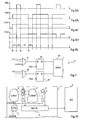
- the figure 6 is a block diagram of an embodiment of a master-slave flip-flop 3 with disturbance detection. We find the two bistable circuits 11 and 12 which, with the exception of their trip terminals, are wired in the manner of a usual master-slave flip-flop.
- the trip terminals of the circuits 11 and 12 receive separate signals, provided either directly from the outside, or shaped by a logic block 33 (LOGIC) receiving two trigger signals applied to terminals CK1 and CK2 of the flip-flop 3.
- LOGIC logic block 33
- a logic circuit 34 which interprets (combines) the respective states of the input D, the output Q and the transmission point 35 between the two bistable circuits .
- This point 35 therefore corresponds to the output value NQ1 of the bistable circuit 11 and to the input G2 of the bistable circuit 12.
- the principle implemented is to create a time window during which we consider that the combinational logic must be stable, and to create reference points within the master-slave flip-flop to check the input, output and output values. intermediate.
- the figure 7 represents an exemplary embodiment of a master-slave flip-flop 3 in which the logic circuits 33 and 34 have been detailed.
- the trigger signals applied to the terminals CK1 and CK2 are combined by an OR gate 331 whose output is connected to the tripping terminal of the first bistable circuit 11.
- the terminal CK2 is also connected, after passing through an inverter 332 at the trip terminal of the bistable circuit 12.
- the interpretation circuit 34 comprises two exclusive NOR gates 341 and 342 comparing the value (0 or 1) present at the central point 35, respectively with the value of the input D and with the value of the output Q.
- the respective outputs of the gates 341 and 342 provide two validation signals (or invalidation signals) V1 and V2 indicating respectively a dynamic or static disturbance.
- gate 331 The role of gate 331 is to activate or not the detection mechanism within the rocker. If the flip-flop must permanently detect any disturbances, this door can be omitted.
- the signals CK1 and CK2 are then generated directly by a control circuit and the inverter 332 can then also be omitted.
- FIGS. 8A, 8B, 8C, 8D and 8E are chronograms illustrating the operation of the master-slave Figures 6 and 7 .
- These figures show exemplary steps respectively triggering signals applied to the terminals CK1 and CK2, the output signal S331 of the gate 331 (trigger signal of the circuit 11), the output S332 of the inverter 332 (trigger signal of the circuit 12), and windows for transferring the data within the master-slave flip-flop.
- the following terminals are confused with the terminals CK1, CK2, S331, S332 and the corresponding triggering signals.
- a first period P1 (signal CK1 in the low state and signal CK2 in the high state), the signals S331 and S332 are both in the high state.
- the bistable circuit 11 stores the value present on its data input (therefore the input data of the flip-flop) and locks on this value.
- the bistable circuit 12 remains locked on the previous value.
- a second period P2 starts at the rising edge (instant t1) of the signal CK1 from which the bistable circuit 12 becomes on and allows the propagation of the data stored in the first bistable circuit 11 to the Q output of the master-slave flip-flop .
- the bistable circuit 12 locks the data (period P3).
- the bistable circuit 11 reopens to acquire a new value of the data signal D (period P4).
- the bistable circuits 11 and 12 are both locked. However, in the period P1, they are locked on different values while in the period P3, they are locked on the same value. Therefore, during correct operation, the value present at point 35 corresponds to the input data in period P1 and the output data in period P3.
- the periods P1 and P3 are used to detect the occurrence of a disturbance. In the absence of disturbance, the state of point 35 must be identical to that of input D during period P1 while it must be identical to that of output Q during period P3.
- Verification can be performed at any time during these periods by examining the states presented by the signals V1 and V2.
- a particularly simple solution is to use the signals CK1 and CK2 (or S331 and S332) to trigger the detection.
- a first verification is then performed by comparing, at time t1 (rising edge of the signal CK1 or falling edge of the signal S332) corresponding to the end of the period P1, the states of the input D and the output NQ1. If they are identical, it means that the data was not modified during the acquisition. Indeed, if a disturbance occurs, it is punctual and does not translate into a modification of the respective states stored by the two bistable circuits. By desynchronizing their operation, such a detection of a dynamic disturbance is authorized.
- a second verification is performed by comparing, at time t3 (falling edge of the signal CK2 or signal S331) corresponding to the end of the period P3, the states of the output Q and the point 35. This amounts to a detection of static disturbance.
- the periods P2 and P4 are chosen to be as short as possible.
- the duration of the period P2 must however remain greater than the minimum duration of the high level on the data input of the bistable circuit 12.
- the duration of the period P4 must remain greater than the minimum duration of low level on the data input
- the figure 9 represents an embodiment of a circuit 4 for comparing and interpreting the results detected by the flip-flops.
- a circuit 45 for example, a processor.
- the combinations 41 and 42 have no place to be.
- the flip-flop 43 is triggered by the signal CK1 while the flip-flop 44 is triggered by the inverse of the signal CK2.
- the processing circuit 45 interprets the detections effected by the signals V1 and V2 and takes the adapted countermeasures.
- the figure 10 represents an example of an electronic system comprising at least two circuits 5 (IC1) and 6 (IC2). At least one of these circuits (in the example circuit 5) is equipped with a mechanism for detecting accidental or deliberate disturbances on master-slave flip-flops 3 that it comprises between logic blocks. All or part of the intermediate flip-flops with logic functions are equipped with the functionalities described above.
- the signals V1 and V2 of the flip-flops are operated by a decision circuit 4 (DECID) and the triggering signals CK1 and CK2 are, for example, generated by a control circuit 7 (CTRL) from a CLOCK clock signal. of the circuit 5.
- DECID decision circuit 4
- CTRL control circuit 7
- the structure proposed for the master-slave flip-flop also makes it possible to activate or deactivate the detection.
- control signals CK1 and CK2 have not been detailed, this generation being within the abilities of those skilled in the art from the functional indications given above and using circuits in themselves usual .
Landscapes
- Manipulation Of Pulses (AREA)
- Synchronisation In Digital Transmission Systems (AREA)
Claims (11)
- Ein Verfahren zum Detektieren einer Störung des Zustandes eines synchronen Flip-Flops der Master-Slave-Bauart (3), welches zwei in Serie geschaltete bistabile Schaltungen (11, 12) aufweist, dadurch gekennzeichnet, dass das Verfahren die folgenden Schritte aufweist:Auslösen (Triggern) der bistabilen Schaltungen, durch zwei erste voneinander unterschiedliche Signale (S331, S332);Vergleichen des Pegels eines Zwischenverbindungspunktes (35) zwischen den zwei bistabilen Schaltungen sowohl mit dem am Eingang des Master-Slave-Flip-Flops vorhandenen Pegels als auch dem am Ausgang vorhandenen Pegel; undÜberprüfen des Zustandes des Flip-Flops durch Überprüfen von zwei zweiten Signalen (V1, V2), die sich aus Vergleichen ergeben und Liefern einer Anzeige hinsichtlich des Vorhandenseins einer möglichen Störung.
- Das Verfahren nach Anspruch 1, wobei die zweiten Signale (V1, V2) an den Flanken der ersten Signale getastet werden.
- Das Verfahren nach Anspruch 1 oder 2, wobei die ersten Signale derart erzeugt werden, dass die bistabilen Schaltungen (11, 12) zyklisch in vier aufeinanderfolgenden Perioden gesteuert werden, in denen:beide Schaltungen verriegelt (latched) sind;nur eine erste Schaltung verriegelt ist;beide Schaltungen verriegelt sind; undnur eine zweite Schaltung verriegelt ist.
- Das Verfahren nach Anspruch 3, wobei die Perioden wo beide Schaltungen verriegelt sind an den zweiten Signalen Zustände liefern, die eine Anzeige für eine mögliche Störung bilden.
- Das Verfahren nach einem der Ansprüche 1 bis 4, wobei ein konstanter Pegel eines (CK2) der ersten Signale die Detektion deaktiviert.
- Eine elektronische Schaltung, die Folgendes aufweist:ein Master-Slave-Synchron-Flip-Flop, welches in Serie zwei bistabile Schaltungen (11, 12) und zwei Anschlüsse (CK1, CK2) aufweist, zum Anlegen von Auslöse- oder Triggersignalen, die voneinander unterschiedlich sind; undeine erste logische Schaltung (34) zum Vergleichen des Pegels eines Zwischenverbindungspunktes (35) zwischen den zwei bistabilen Schaltungen, sowohl mit dem Pegel am Eingang (D) des Flip-Flops und mit dem Pegel vorhanden am Ausgang (Q) des Flip-Flops,dadurch gekennzeichnet, dass die elektronische Schaltung, eine Schaltung (4) aufweist zum Detektieren einer Störung des Zustandes des Flip-Flops durch Prüfen oder Checken von zwei zweiten Signalen (V1, V2), die sich aus den Vergleichen ergeben.
- Die elektronische Schaltung nach Anspruch 6, wobei die zweite logische Schaltung (33) zwischen den zwei Anschlüssen (CK1, CK2) zum Anlegen der Auslöser- oder Triggersignale und den entsprechenden Auslöse- bzw. Triggeranschlüssen der bistabilen Schaltungen (11, 12) angeordnet ist.
- Die elektronische Schaltung nach Anspruch 6 oder 7, wobei die erste logische Schaltung zwei Komparatoren (331, 332) aufweist, die jeweils den Pegel des Eingangs (D) des Flip-Flops an dem Zwischenpunkt (35) mit dem Pegel des Zwischenpunkts am Ausgang (Q) des Flip-Flops vergleichen.
- Elektronische Schaltung nach Anspruch 7, wobei die zweite logische Schaltung Folgendes aufweist:ein ODER-Typ Gate (331) das mit seinen entsprechenden Eingängen mit den Anschlüssen (CK1, CK2) zur Anlegung der Triggersignale verbunden ist, und mit einem Ausgang (S331) mit dem Auslöser-Trigger-Anschluss der ersten bistabilen Schaltung (11) verbunden ist; undein Inverter (332) zwischen einem der Anschlüsse zum Anlegen der Trigger-Signale und dem Trigger-Anschluss der zweiten bistabilen Schaltung (12).
- Die elektronische Schaltung nach einem der Ansprüche 6 bis 9, wobei mindestens ein logischer Kombinationsblock (2) und mindestens ein Satz von Master-Slave-Synchron-Flip-Flops (3) vorgesehen sind.
- Die elektronische Schaltung nach Anspruch 10, wobei nicht alle Flip-Flops (3) gleichzeitig in Vergleichsbetriebsart gesteuert werden.
Priority Applications (1)
| Application Number | Priority Date | Filing Date | Title |
|---|---|---|---|
| US12/510,704 US8466727B2 (en) | 2008-07-30 | 2009-07-28 | Protection against fault injections of an electronic circuit with flip-flops |
Applications Claiming Priority (1)
| Application Number | Priority Date | Filing Date | Title |
|---|---|---|---|
| FR0855256 | 2008-07-30 |
Publications (2)
| Publication Number | Publication Date |
|---|---|
| EP2149886A1 EP2149886A1 (de) | 2010-02-03 |
| EP2149886B1 true EP2149886B1 (de) | 2012-06-06 |
Family
ID=40456945
Family Applications (1)
| Application Number | Title | Priority Date | Filing Date |
|---|---|---|---|
| EP09165996A Active EP2149886B1 (de) | 2008-07-30 | 2009-07-21 | Schutz einer elektronischen Kippschaltung gegen Fehlereingaben |
Country Status (2)
| Country | Link |
|---|---|
| US (1) | US8466727B2 (de) |
| EP (1) | EP2149886B1 (de) |
Cited By (1)
| Publication number | Priority date | Publication date | Assignee | Title |
|---|---|---|---|---|
| US9378077B2 (en) | 2009-08-07 | 2016-06-28 | Stmicroelectronics S.R.L. | System for detecting operating errors in integrated circuits |
Families Citing this family (9)
| Publication number | Priority date | Publication date | Assignee | Title |
|---|---|---|---|---|
| US7188007B2 (en) * | 2003-12-24 | 2007-03-06 | The Boeing Company | Apparatuses and methods for displaying and receiving tactical and strategic flight guidance information |
| US7952399B1 (en) * | 2009-01-19 | 2011-05-31 | Lockheed Martin Corporation | Low phase noise high speed digital divider |
| JP5949213B2 (ja) * | 2012-06-28 | 2016-07-06 | セイコーエプソン株式会社 | シフトレジスター回路、電気光学装置、及び電子機器 |
| US10013581B2 (en) * | 2014-10-07 | 2018-07-03 | Nuvoton Technology Corporation | Detection of fault injection attacks |
| CN105609071B (zh) * | 2016-01-05 | 2018-01-26 | 京东方科技集团股份有限公司 | 移位寄存器及其驱动方法、栅极驱动电路及显示装置 |
| CN108073831B (zh) * | 2016-11-15 | 2020-07-24 | 华为技术有限公司 | 一种检测安全芯片工作状态的方法及检测电路 |
| US11366899B2 (en) | 2020-02-18 | 2022-06-21 | Nuvoton Technology Corporation | Digital fault injection detector |
| EP3954676A1 (de) | 2020-08-14 | 2022-02-16 | GFBiochemicals IP Assets B.V. | Verfahren zur umwandlung von furfurylalkohol in einen lävulinsäureester |
| US12088296B2 (en) * | 2021-12-17 | 2024-09-10 | Advanced Micro Devices, Inc. | Clock gating using a cascaded clock gating control signal |
Family Cites Families (6)
| Publication number | Priority date | Publication date | Assignee | Title |
|---|---|---|---|---|
| EP0418521A3 (en) * | 1989-09-20 | 1992-07-15 | International Business Machines Corporation | Testable latch self checker |
| JP3577139B2 (ja) * | 1995-09-06 | 2004-10-13 | 株式会社ルネサステクノロジ | データ保持回路 |
| US5799048A (en) * | 1996-04-17 | 1998-08-25 | Sun Microsystems, Inc. | Phase detector for clock synchronization and recovery |
| US6121804A (en) * | 1998-08-27 | 2000-09-19 | Applied Micro Circuits Corporation | High frequency CMOS clock recovery circuit |
| JP4095367B2 (ja) * | 2002-07-23 | 2008-06-04 | 株式会社東芝 | 半導体集積回路装置 |
| KR100487652B1 (ko) * | 2002-08-22 | 2005-05-03 | 삼성전자주식회사 | 클럭신호 라인에 대한 부하를 줄일 수 있는 플립플롭 |
-
2009
- 2009-07-21 EP EP09165996A patent/EP2149886B1/de active Active
- 2009-07-28 US US12/510,704 patent/US8466727B2/en active Active
Cited By (1)
| Publication number | Priority date | Publication date | Assignee | Title |
|---|---|---|---|---|
| US9378077B2 (en) | 2009-08-07 | 2016-06-28 | Stmicroelectronics S.R.L. | System for detecting operating errors in integrated circuits |
Also Published As
| Publication number | Publication date |
|---|---|
| EP2149886A1 (de) | 2010-02-03 |
| US8466727B2 (en) | 2013-06-18 |
| US20100026358A1 (en) | 2010-02-04 |
Similar Documents
| Publication | Publication Date | Title |
|---|---|---|
| EP2149886A1 (de) | Schutz einer elektronischen Kippschaltung gegen Fehlereingaben | |
| FR2790887A1 (fr) | Circuit logique protege contre des perturbations transitoires | |
| FR2884080A1 (fr) | Ensemble de circuits electroniques protege contre des perturbations transitoires | |
| EP2280364B1 (de) | Fehlerinjektionsdetektor in einer integrierten Schaltung | |
| TWI760694B (zh) | 使用具有相對延遲的正反器進行資料取樣完整性檢查之電子裝置及其方法 | |
| JP7066791B2 (ja) | ゲートクロックを用いたデータサンプリング整合性検査の電子デバイスおよび方法 | |
| EP2131495A1 (de) | Verzögerungsunempfindlicher asynchroner Schaltkreis mit Verzögerungseinschaltschaltkreis | |
| US9122891B2 (en) | Functional timing sensors | |
| EP2257904B1 (de) | Verfahren für den schutz einer programmierbaren kryptographieschaltung und anhand dieses verfahrens geschützte schaltung | |
| EP1944615B1 (de) | Erkennung von Funktionsstörungen eines digitalen Zählers | |
| CN114518528A (zh) | 一种安全芯片故障检测电路及终端设备 | |
| FR2935059A1 (fr) | Procede de detection d'anomalies dans un circuit de cryptographie protege par logique differentielle et circuit mettant en oeuvre un tel procede | |
| FR2928060A1 (fr) | Procede de test de circuits de cryptographie, circuit de cryptographie securise apte a etre teste, et procede de cablage d'un tel circuit. | |
| CN108073831A (zh) | 一种检测安全芯片工作状态的方法及检测电路 | |
| CN114338463B (zh) | 基于脉冲收缩延时链的安全检测电路、设备及检测方法 | |
| Roy et al. | Self-timed sensors for detecting static optical side channel attacks | |
| EP3376670A1 (de) | Konfigurierbare verzögerungsleitung | |
| FR2802733A1 (fr) | Bascule de type d maitre-esclave securisee | |
| EP2771976B1 (de) | Verfahren und vorrichtung zur verwaltung einer schlüsselmatrix, entsprechendes computerprogrammprodukt und speichermittel | |
| EP2424110B1 (de) | Sicherung eines Speicherelements für Binärdaten, Kontrollregister und eine Chipkarte | |
| Renaudin et al. | Asynchronous design: fault robustness and security characteristics | |
| Sakiyama et al. | Flush Code Eraser: Fast Attack Response Invalidating Cryptographic Sensitive Data | |
| FR2793088A1 (fr) | Procede et dispositif de collecte des valeurs logiques de sortie d'une unite logique dans un circuit electronique | |
| WO2020008229A1 (en) | Circuit and method for protecting asynchronous circuits |
Legal Events
| Date | Code | Title | Description |
|---|---|---|---|
| PUAI | Public reference made under article 153(3) epc to a published international application that has entered the european phase |
Free format text: ORIGINAL CODE: 0009012 |
|
| AK | Designated contracting states |
Kind code of ref document: A1 Designated state(s): AT BE BG CH CY CZ DE DK EE ES FI FR GB GR HR HU IE IS IT LI LT LU LV MC MK MT NL NO PL PT RO SE SI SK SM TR |
|
| AX | Request for extension of the european patent |
Extension state: AL BA RS |
|
| 17P | Request for examination filed |
Effective date: 20100716 |
|
| 17Q | First examination report despatched |
Effective date: 20100823 |
|
| GRAP | Despatch of communication of intention to grant a patent |
Free format text: ORIGINAL CODE: EPIDOSNIGR1 |
|
| GRAS | Grant fee paid |
Free format text: ORIGINAL CODE: EPIDOSNIGR3 |
|
| GRAA | (expected) grant |
Free format text: ORIGINAL CODE: 0009210 |
|
| AK | Designated contracting states |
Kind code of ref document: B1 Designated state(s): AT BE BG CH CY CZ DE DK EE ES FI FR GB GR HR HU IE IS IT LI LT LU LV MC MK MT NL NO PL PT RO SE SI SK SM TR |
|
| REG | Reference to a national code |
Ref country code: GB Ref legal event code: FG4D Free format text: NOT ENGLISH |
|
| REG | Reference to a national code |
Ref country code: AT Ref legal event code: REF Ref document number: 561366 Country of ref document: AT Kind code of ref document: T Effective date: 20120615 Ref country code: CH Ref legal event code: EP |
|
| REG | Reference to a national code |
Ref country code: IE Ref legal event code: FG4D Free format text: LANGUAGE OF EP DOCUMENT: FRENCH |
|
| REG | Reference to a national code |
Ref country code: DE Ref legal event code: R096 Ref document number: 602009007437 Country of ref document: DE Effective date: 20120802 |
|
| REG | Reference to a national code |
Ref country code: NL Ref legal event code: VDEP Effective date: 20120606 |
|
| PG25 | Lapsed in a contracting state [announced via postgrant information from national office to epo] |
Ref country code: FI Free format text: LAPSE BECAUSE OF FAILURE TO SUBMIT A TRANSLATION OF THE DESCRIPTION OR TO PAY THE FEE WITHIN THE PRESCRIBED TIME-LIMIT Effective date: 20120606 Ref country code: LT Free format text: LAPSE BECAUSE OF FAILURE TO SUBMIT A TRANSLATION OF THE DESCRIPTION OR TO PAY THE FEE WITHIN THE PRESCRIBED TIME-LIMIT Effective date: 20120606 Ref country code: CY Free format text: LAPSE BECAUSE OF FAILURE TO SUBMIT A TRANSLATION OF THE DESCRIPTION OR TO PAY THE FEE WITHIN THE PRESCRIBED TIME-LIMIT Effective date: 20120606 Ref country code: SE Free format text: LAPSE BECAUSE OF FAILURE TO SUBMIT A TRANSLATION OF THE DESCRIPTION OR TO PAY THE FEE WITHIN THE PRESCRIBED TIME-LIMIT Effective date: 20120606 Ref country code: NO Free format text: LAPSE BECAUSE OF FAILURE TO SUBMIT A TRANSLATION OF THE DESCRIPTION OR TO PAY THE FEE WITHIN THE PRESCRIBED TIME-LIMIT Effective date: 20120906 |
|
| REG | Reference to a national code |
Ref country code: AT Ref legal event code: MK05 Ref document number: 561366 Country of ref document: AT Kind code of ref document: T Effective date: 20120606 |
|
| REG | Reference to a national code |
Ref country code: LT Ref legal event code: MG4D Effective date: 20120606 |
|
| PG25 | Lapsed in a contracting state [announced via postgrant information from national office to epo] |
Ref country code: GR Free format text: LAPSE BECAUSE OF FAILURE TO SUBMIT A TRANSLATION OF THE DESCRIPTION OR TO PAY THE FEE WITHIN THE PRESCRIBED TIME-LIMIT Effective date: 20120907 Ref country code: SI Free format text: LAPSE BECAUSE OF FAILURE TO SUBMIT A TRANSLATION OF THE DESCRIPTION OR TO PAY THE FEE WITHIN THE PRESCRIBED TIME-LIMIT Effective date: 20120606 Ref country code: LV Free format text: LAPSE BECAUSE OF FAILURE TO SUBMIT A TRANSLATION OF THE DESCRIPTION OR TO PAY THE FEE WITHIN THE PRESCRIBED TIME-LIMIT Effective date: 20120606 Ref country code: HR Free format text: LAPSE BECAUSE OF FAILURE TO SUBMIT A TRANSLATION OF THE DESCRIPTION OR TO PAY THE FEE WITHIN THE PRESCRIBED TIME-LIMIT Effective date: 20120606 |
|
| BERE | Be: lapsed |
Owner name: STMICROELECTRONICS (ROUSSET) SAS Effective date: 20120731 |
|
| PG25 | Lapsed in a contracting state [announced via postgrant information from national office to epo] |
Ref country code: NL Free format text: LAPSE BECAUSE OF FAILURE TO SUBMIT A TRANSLATION OF THE DESCRIPTION OR TO PAY THE FEE WITHIN THE PRESCRIBED TIME-LIMIT Effective date: 20120606 Ref country code: IS Free format text: LAPSE BECAUSE OF FAILURE TO SUBMIT A TRANSLATION OF THE DESCRIPTION OR TO PAY THE FEE WITHIN THE PRESCRIBED TIME-LIMIT Effective date: 20121006 Ref country code: RO Free format text: LAPSE BECAUSE OF FAILURE TO SUBMIT A TRANSLATION OF THE DESCRIPTION OR TO PAY THE FEE WITHIN THE PRESCRIBED TIME-LIMIT Effective date: 20120606 Ref country code: CZ Free format text: LAPSE BECAUSE OF FAILURE TO SUBMIT A TRANSLATION OF THE DESCRIPTION OR TO PAY THE FEE WITHIN THE PRESCRIBED TIME-LIMIT Effective date: 20120606 Ref country code: AT Free format text: LAPSE BECAUSE OF FAILURE TO SUBMIT A TRANSLATION OF THE DESCRIPTION OR TO PAY THE FEE WITHIN THE PRESCRIBED TIME-LIMIT Effective date: 20120606 Ref country code: SK Free format text: LAPSE BECAUSE OF FAILURE TO SUBMIT A TRANSLATION OF THE DESCRIPTION OR TO PAY THE FEE WITHIN THE PRESCRIBED TIME-LIMIT Effective date: 20120606 Ref country code: EE Free format text: LAPSE BECAUSE OF FAILURE TO SUBMIT A TRANSLATION OF THE DESCRIPTION OR TO PAY THE FEE WITHIN THE PRESCRIBED TIME-LIMIT Effective date: 20120606 |
|
| PG25 | Lapsed in a contracting state [announced via postgrant information from national office to epo] |
Ref country code: PL Free format text: LAPSE BECAUSE OF FAILURE TO SUBMIT A TRANSLATION OF THE DESCRIPTION OR TO PAY THE FEE WITHIN THE PRESCRIBED TIME-LIMIT Effective date: 20120606 Ref country code: MC Free format text: LAPSE BECAUSE OF NON-PAYMENT OF DUE FEES Effective date: 20120731 Ref country code: IT Free format text: LAPSE BECAUSE OF FAILURE TO SUBMIT A TRANSLATION OF THE DESCRIPTION OR TO PAY THE FEE WITHIN THE PRESCRIBED TIME-LIMIT Effective date: 20120606 Ref country code: PT Free format text: LAPSE BECAUSE OF FAILURE TO SUBMIT A TRANSLATION OF THE DESCRIPTION OR TO PAY THE FEE WITHIN THE PRESCRIBED TIME-LIMIT Effective date: 20121008 Ref country code: MK Free format text: LAPSE BECAUSE OF FAILURE TO SUBMIT A TRANSLATION OF THE DESCRIPTION OR TO PAY THE FEE WITHIN THE PRESCRIBED TIME-LIMIT Effective date: 20120606 |
|
| PLBE | No opposition filed within time limit |
Free format text: ORIGINAL CODE: 0009261 |
|
| STAA | Information on the status of an ep patent application or granted ep patent |
Free format text: STATUS: NO OPPOSITION FILED WITHIN TIME LIMIT |
|
| PG25 | Lapsed in a contracting state [announced via postgrant information from national office to epo] |
Ref country code: ES Free format text: LAPSE BECAUSE OF FAILURE TO SUBMIT A TRANSLATION OF THE DESCRIPTION OR TO PAY THE FEE WITHIN THE PRESCRIBED TIME-LIMIT Effective date: 20120917 Ref country code: DK Free format text: LAPSE BECAUSE OF FAILURE TO SUBMIT A TRANSLATION OF THE DESCRIPTION OR TO PAY THE FEE WITHIN THE PRESCRIBED TIME-LIMIT Effective date: 20120606 |
|
| REG | Reference to a national code |
Ref country code: IE Ref legal event code: MM4A |
|
| 26N | No opposition filed |
Effective date: 20130307 |
|
| PG25 | Lapsed in a contracting state [announced via postgrant information from national office to epo] |
Ref country code: BE Free format text: LAPSE BECAUSE OF NON-PAYMENT OF DUE FEES Effective date: 20120731 |
|
| REG | Reference to a national code |
Ref country code: DE Ref legal event code: R097 Ref document number: 602009007437 Country of ref document: DE Effective date: 20130307 |
|
| PG25 | Lapsed in a contracting state [announced via postgrant information from national office to epo] |
Ref country code: BG Free format text: LAPSE BECAUSE OF FAILURE TO SUBMIT A TRANSLATION OF THE DESCRIPTION OR TO PAY THE FEE WITHIN THE PRESCRIBED TIME-LIMIT Effective date: 20120906 Ref country code: MT Free format text: LAPSE BECAUSE OF FAILURE TO SUBMIT A TRANSLATION OF THE DESCRIPTION OR TO PAY THE FEE WITHIN THE PRESCRIBED TIME-LIMIT Effective date: 20120606 Ref country code: IE Free format text: LAPSE BECAUSE OF NON-PAYMENT OF DUE FEES Effective date: 20120721 |
|
| PGFP | Annual fee paid to national office [announced via postgrant information from national office to epo] |
Ref country code: FR Payment date: 20130722 Year of fee payment: 5 |
|
| REG | Reference to a national code |
Ref country code: CH Ref legal event code: PL |
|
| GBPC | Gb: european patent ceased through non-payment of renewal fee |
Effective date: 20130721 |
|
| PG25 | Lapsed in a contracting state [announced via postgrant information from national office to epo] |
Ref country code: CH Free format text: LAPSE BECAUSE OF NON-PAYMENT OF DUE FEES Effective date: 20130731 Ref country code: GB Free format text: LAPSE BECAUSE OF NON-PAYMENT OF DUE FEES Effective date: 20130721 Ref country code: TR Free format text: LAPSE BECAUSE OF FAILURE TO SUBMIT A TRANSLATION OF THE DESCRIPTION OR TO PAY THE FEE WITHIN THE PRESCRIBED TIME-LIMIT Effective date: 20120606 Ref country code: LI Free format text: LAPSE BECAUSE OF NON-PAYMENT OF DUE FEES Effective date: 20130731 |
|
| PG25 | Lapsed in a contracting state [announced via postgrant information from national office to epo] |
Ref country code: LU Free format text: LAPSE BECAUSE OF NON-PAYMENT OF DUE FEES Effective date: 20120721 Ref country code: SM Free format text: LAPSE BECAUSE OF FAILURE TO SUBMIT A TRANSLATION OF THE DESCRIPTION OR TO PAY THE FEE WITHIN THE PRESCRIBED TIME-LIMIT Effective date: 20120606 |
|
| PG25 | Lapsed in a contracting state [announced via postgrant information from national office to epo] |
Ref country code: HU Free format text: LAPSE BECAUSE OF FAILURE TO SUBMIT A TRANSLATION OF THE DESCRIPTION OR TO PAY THE FEE WITHIN THE PRESCRIBED TIME-LIMIT Effective date: 20090721 |
|
| REG | Reference to a national code |
Ref country code: FR Ref legal event code: ST Effective date: 20150331 |
|
| PG25 | Lapsed in a contracting state [announced via postgrant information from national office to epo] |
Ref country code: FR Free format text: LAPSE BECAUSE OF NON-PAYMENT OF DUE FEES Effective date: 20140731 |
|
| PGFP | Annual fee paid to national office [announced via postgrant information from national office to epo] |
Ref country code: DE Payment date: 20250620 Year of fee payment: 17 |