EP2150048A2 - Bildsignalverarbeitungsvorrichtung und -verfahren - Google Patents
Bildsignalverarbeitungsvorrichtung und -verfahren Download PDFInfo
- Publication number
- EP2150048A2 EP2150048A2 EP09156904A EP09156904A EP2150048A2 EP 2150048 A2 EP2150048 A2 EP 2150048A2 EP 09156904 A EP09156904 A EP 09156904A EP 09156904 A EP09156904 A EP 09156904A EP 2150048 A2 EP2150048 A2 EP 2150048A2
- Authority
- EP
- European Patent Office
- Prior art keywords
- phase
- frame
- signal processing
- image signal
- motion
- Prior art date
- Legal status (The legal status is an assumption and is not a legal conclusion. Google has not performed a legal analysis and makes no representation as to the accuracy of the status listed.)
- Ceased
Links
Images


Classifications
-
- H—ELECTRICITY
- H04—ELECTRIC COMMUNICATION TECHNIQUE
- H04N—PICTORIAL COMMUNICATION, e.g. TELEVISION
- H04N5/00—Details of television systems
- H04N5/14—Picture signal circuitry for video frequency region
- H04N5/21—Circuitry for suppressing or minimising disturbance, e.g. moiré or halo
-
- H—ELECTRICITY
- H04—ELECTRIC COMMUNICATION TECHNIQUE
- H04N—PICTORIAL COMMUNICATION, e.g. TELEVISION
- H04N7/00—Television systems
- H04N7/01—Conversion of standards, e.g. involving analogue television standards or digital television standards processed at pixel level
- H04N7/0127—Conversion of standards, e.g. involving analogue television standards or digital television standards processed at pixel level by changing the field or frame frequency of the incoming video signal, e.g. frame rate converter
-
- H—ELECTRICITY
- H04—ELECTRIC COMMUNICATION TECHNIQUE
- H04N—PICTORIAL COMMUNICATION, e.g. TELEVISION
- H04N7/00—Television systems
- H04N7/01—Conversion of standards, e.g. involving analogue television standards or digital television standards processed at pixel level
- H04N7/0135—Conversion of standards, e.g. involving analogue television standards or digital television standards processed at pixel level involving interpolation processes
- H04N7/014—Conversion of standards, e.g. involving analogue television standards or digital television standards processed at pixel level involving interpolation processes involving the use of motion vectors
Definitions
- the present invention relates to image signal processing, and more particularly, to image signal processing to convert and output a frame rate of an input image signal.
- Image signal processing apparatuses convert input image signals into signals which can be displayed on display apparatuses. If a frame rate of an input image signal is different from a frame rate supported by a display apparatus, the frame rate of the input image signal is converted into the frame rate supported by the display apparatus.
- noise such as halo artifacts may appear on a screen.
- noise such as halo artifacts
- diverse algorithms are applied to image signal processing apparatuses. Therefore, there is a need for methods for removing noise such as halo artifacts.
- Exemplary embodiments of the present invention address at least the above problems and/or disadvantages and other disadvantages not described above. Also, the present invention is not required to overcome the disadvantages described above, and an exemplary embodiment of the present invention may not overcome any of the problems described above.
- An aspect of the present invention provides an image signal processing apparatus to convert the frame rate of input image signals so as not to produce noise such as artifacts, and an image signal processing method thereof.
- an image signal processing apparatus including an input image analysis unit which estimates motion of an input image and outputs the motion characteristics, a comparison unit which compares the motion characteristics with preset reference values, and a control unit which changes a phase of an interpolation frame according to the result of the comparison by the comparison unit.
- the input image analysis unit may include a motion estimation unit which estimates motion between a previous frame and a current frame, which are included in the input image, and outputs motion vectors, a representative value calculation unit which calculates a motion vector which occupies the largest portion from among the motion vectors output by the motion estimation unit as a representative value, and a changed area extraction unit which extracts a changed area between the previous frame and the current frame based on the motion estimated by the motion estimation unit.
- the control unit may change the phase of the interpolation frame to be closer to a phase of one of the previous frame and the current frame if the result of comparison output by the comparison unit is that one of the representative value and the changed area is larger than the preset reference value.
- the control unit may not change the phase of the interpolation frame if the result of comparison output by the comparison unit is that the representative value and the changed area are both smaller than the preset reference values.
- the comparison unit may compare one of the representative value and the changed area with the preset reference value and output the comparison result as a factor to adjust the phase of the interpolation frame.
- the control unit may control the phase of the interpolation frame to change between a phase of the previous frame and a phase of the current frame, according to the factor output by the comparison unit.
- the changed area extraction unit may extract a covered area, which is displayed in the previous frame but is not displayed in the current frame, and an uncovered area, which is not displayed in the previous frame but is displayed in the current frame, as the changed area.
- the image signal processing apparatus may further include an interpolation frame generation unit which generates the interpolation frame according to the control of the control unit.
- an image signal processing method including estimating motion of an input image and outputting the motion characteristics, comparing the motion characteristics with preset reference values, and changing a phase of an interpolation frame according to the result of comparison by the comparison unit.
- the operation of outputting the motion characteristics may include estimating motion between a previous frame and a current frame, which are included in the input image, and outputting motion vectors, calculating a motion vector which occupies the largest portion from among the output motion vectors as a representative value, and extracting a changed area between the previous frame and the current frame based on the motion estimation result.
- the phase of the interpolation frame may change to be closer to a phase of one of the previous frame and the current frame if the output result of comparison is that one of the representative value and the changed area is larger than the preset reference value is output.
- the phase of the interpolation frame may not change if the output result of comparison is that the representative value and the changed area are both smaller than the preset reference values.
- the result of comparing one of the representative value and the changed area with the preset reference value may be output as a factor to adjust the phase of the interpolation frame.
- the phase of the interpolation frame may be controlled to change between a phase of the previous frame and a phase of the current frame, according to the output factor.
- a covered area which is displayed in the previous frame but is not displayed in the current frame
- an uncovered area which is not displayed in the previous frame but is displayed in the current frame
- the image signal processing method may further include generating the interpolation frame.
- FIG. 1 is a schematic block diagram illustrating a configuration of an image signal processing apparatus according to an exemplary embodiment of the present invention.
- FIG. 2 is a drawing illustrating a method for extracting a changed area using an image signal processing apparatus according to an exemplary embodiment of the present invention.
- FIG. 3 is a drawing illustrating a phase change range of an image signal processing apparatus according to an exemplary embodiment of the present invention.
- the image signal processing apparatus may include an input image analysis unit 100, a comparison unit 110, a control unit 120, an interpolation frame generation unit 130, and an output unit 140.
- the input image analysis unit 100 analyzes the characteristics of an input image, and may include a motion estimation unit 102, a changed area extraction unit 104, and a representative value calculation unit 106.
- the motion estimation unit 102 estimates motion between a previous frame and a current frame of the input image, and outputs motion vectors. For example, the motion estimation unit 102 divides one frame into a plurality of blocks, estimates motion between a previous frame and a current frame of each block, and outputs a number of motion vectors corresponding to the number of blocks.
- the changed area extraction unit 104 extracts changed areas between the previous frame and the current frame based on the results of motion estimation. That is, as illustrated in FIG. 2 , the changed area extraction unit 104 extracts a covered area, which is displayed in the previous frame but is not displayed in the current frame, and an uncovered area, which is not displayed in the previous frame but is displayed in the current frame.
- the representative value calculation unit 106 calculates a motion vector which occupies the largest portion from among the motion vectors output by the motion estimation unit 102 as a representative value.
- the apple moves between the previous frame and the current frame. If a motion vector for an area within which the apple moves is "2" and a motion vector for an area excluding the area within which the apple moves is "0,” the representative value is "0.” That is, in a single frame, since the area excluding the area within which the apple moves occupies larger portion than the area within which the apple moves, the representative value is "0.”
- the interpolation frame generation unit 130 generates an interpolation frame between the previous frame and the current frame using the motion vectors output by the motion estimation unit 102.
- the interpolation frame generation unit 130 changes the phase of the interpolation frame by control of the control unit 120.
- the phase is a concept corresponding to a time at which a frame is displayed. Referring to FIG. 3 , if the phase of the previous frame is 0 and the phase of the current frame is 1, the interpolation frame is displayed at 0.5.
- the comparison unit 110 compares the motion characteristics output by the input image analysis unit 100 with preset reference values. That is, the comparison unit 110 compares the changed area output by the changed area extraction unit 104 and the representative value output by the representative value calculation unit 106 with preset reference values respectively, and outputs the result of comparison as a factor to change the phase of the interpolation frame.
- the comparison unit 110 outputs a first factor to be capable of changing the phase of the interpolation frame to be closer to 0 or 1.
- the comparison unit 110 outputs a second factor to be capable of changing the phase of the interpolation frame to be closer to 0 or 1.
- the comparison unit 110 outputs a third factor to be capable of maintaining the phase of the interpolation frame at 0.5.
- the control unit 120 controls the interpolation frame generation unit 130 to change the phase of the interpolation frame according to a factor output by the comparison unit 110.
- the control unit 120 controls the interpolation frame generation unit 130 to make the phase of the interpolation frame closer to 0 or 1.
- the control unit 120 controls the interpolation frame generation unit 130 to maintain the phase of the interpolation frame at 0.5 as it is.
- the control unit 120 may control the phase of the interpolation frame to change between the phase of the previous frame and the phase of the current frame according to the size of the first factor and the second factor. For example, if the size of the first factor is 3, the control unit 120 controls the phase of the interpolation frame to change to 0.35 or 0.65, and if the size of the first factor is 8, the control unit 120 controls the phase of the interpolation frame to change to 0.1 or 0.9. In the same manner, the phase of the interpolation frame can change according to the size of the second factor. In addition, it is also possible to change the phase of the interpolation frame according to the combined size of the first factor and the second factor.
- noise such as halo artifacts appearing when converting a frame rate can be prevented by changing the phase of the interpolation frame according to the motion characteristics of the input image.
- linear features can be maintained.
- a single frame is divided into a plurality of blocks, but a method for estimating motion is not limited thereto.
- motion is estimated by frames, but it is also possible to analyze an input image by estimating motion by fields.
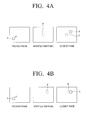
- FIGS. 4A and 4B are drawings illustrating a process of converting the frame rate using an image signal processing apparatus according to an exemplary embodiment of the present invention.
- a in a previous frame is displayed in a current frame as B and displayed in an interpolation frame as A'. That is, if a changed area output by the changed area extraction unit 104 is smaller than a preset reference area, and if a representative value output by the representative value calculation unit 106 is smaller than a preset reference representative value, the comparison unit 110 outputs the third factor. Accordingly, if the comparison unit 110 outputs the third factor, the control unit 120 controls the interpolation frame generation unit 130 to maintain the phase of the interpolation frame at 0.5 as it is.
- a in a previous frame is displayed in a current frame as B and displayed in an interpolation frame as B'. That is, if a changed area output by the changed area extraction unit 104 is larger than the preset reference area, or if a representative value output by the representative value calculation unit 106 is larger than the preset reference representative value, the comparison unit 110 outputs the first factor or the second factor. Accordingly, referring to the first factor or the second factor output from the comparison unit 110, the control unit 120 controls the interpolation frame generation unit 130 to make the phase of the interpolation frame closer to 0 or 1.
- the frame rate is converted to maintain the linearity as illustrated in FIG. 4A . That is, if the comparison unit 110 outputs the third factor, the phase of the interpolation frame does not change.
- the frame rate is converted not to maintain the linearity as illustrated in FIG. 4B .
- the phase of the interpolation frame changes to be closer to the previous frame or to the current frame. Whether to change the phase of the interpolation frame to be closer to 0 or 1 depends on the settings of the user.
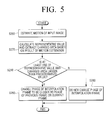
- FIG. 5 is a flowchart illustrating an image signal processing method of an image signal processing apparatus according to an exemplary embodiment of the present invention.
- the motion estimation unit 102 estimates motion of an input image (S200). Based on the results of the motion estimation, the representative value calculation unit 106 calculates a representative value and the changed area extraction unit 104 extracts a changed area (S220). Subsequently, the comparison unit 110 determines whether or not at least one of the representative value and the changed area is larger than predetermined values (S240). If at least one of the representative value and the changed area is larger than the predetermined values (S240-Y), the control unit 120 changes the phase of an interpolation frame to be closer to the phase of a previous frame or a current frame (S260). Alternatively, if both the representative value and the changed area are smaller than the predetermined values (S240-N), the control unit 120 does not change the phase of the interpolation frame (S280).
- an image signal processing apparatus to convert a frame rate by changing the phase of an interpolation frame according to the motion characteristics of an input unit so as not to generate halo artifacts, and an image signal processing method thereof are provided.
Landscapes
- Engineering & Computer Science (AREA)
- Multimedia (AREA)
- Signal Processing (AREA)
- Television Systems (AREA)
Applications Claiming Priority (1)
| Application Number | Priority Date | Filing Date | Title |
|---|---|---|---|
| KR1020080074800A KR101524062B1 (ko) | 2008-07-30 | 2008-07-30 | 영상신호 처리장치 및 그 방법 |
Publications (2)
| Publication Number | Publication Date |
|---|---|
| EP2150048A2 true EP2150048A2 (de) | 2010-02-03 |
| EP2150048A3 EP2150048A3 (de) | 2014-03-19 |
Family
ID=41268194
Family Applications (1)
| Application Number | Title | Priority Date | Filing Date |
|---|---|---|---|
| EP09156904.6A Ceased EP2150048A3 (de) | 2008-07-30 | 2009-03-31 | Bildsignalverarbeitungsvorrichtung und -verfahren |
Country Status (3)
| Country | Link |
|---|---|
| US (1) | US8279340B2 (de) |
| EP (1) | EP2150048A3 (de) |
| KR (1) | KR101524062B1 (de) |
Families Citing this family (3)
| Publication number | Priority date | Publication date | Assignee | Title |
|---|---|---|---|---|
| JP2010288098A (ja) * | 2009-06-12 | 2010-12-24 | Sony Corp | 画像フレーム補間装置、画像フレーム補間方法及び画像フレーム補間プログラム |
| KR20160028273A (ko) * | 2014-09-03 | 2016-03-11 | 삼성전자주식회사 | 병변 검출 보간 장치 및 방법 |
| KR102706803B1 (ko) * | 2016-12-29 | 2024-09-13 | 엘지디스플레이 주식회사 | 가상 현실 장치 |
Citations (1)
| Publication number | Priority date | Publication date | Assignee | Title |
|---|---|---|---|---|
| EP0648046A2 (de) * | 1993-10-11 | 1995-04-12 | THOMSON multimedia | Verfahren und Vorrichtung zum bewegungsausgeglichenen Interpolieren von zwischenliegenden Halbbildern oder Bildern |
Family Cites Families (10)
| Publication number | Priority date | Publication date | Assignee | Title |
|---|---|---|---|---|
| US5642170A (en) * | 1993-10-11 | 1997-06-24 | Thomson Consumer Electronics, S.A. | Method and apparatus for motion compensated interpolation of intermediate fields or frames |
| US5546130A (en) * | 1993-10-11 | 1996-08-13 | Thomson Consumer Electronics S.A. | Method and apparatus for forming a video signal using motion estimation and signal paths with different interpolation processing |
| GB2305569B (en) * | 1995-09-21 | 1999-07-21 | Innovision Res Ltd | Motion compensated interpolation |
| JP4083265B2 (ja) * | 1997-10-07 | 2008-04-30 | 株式会社日立製作所 | 画像信号の方式変換方法および装置 |
| US7408986B2 (en) * | 2003-06-13 | 2008-08-05 | Microsoft Corporation | Increasing motion smoothness using frame interpolation with motion analysis |
| EP1592256B1 (de) * | 2004-04-30 | 2009-06-17 | Panasonic Corporation | Korrektur der Bildstatusinformation |
| JP2006310985A (ja) * | 2005-04-26 | 2006-11-09 | Hitachi Ltd | フレームレート変換装置及び表示装置 |
| JP4303745B2 (ja) * | 2006-11-07 | 2009-07-29 | シャープ株式会社 | 画像表示装置及び方法、画像処理装置及び方法 |
| US20090208123A1 (en) * | 2008-02-18 | 2009-08-20 | Advanced Micro Devices, Inc. | Enhanced video processing using motion vector data |
| US9204086B2 (en) * | 2008-07-17 | 2015-12-01 | Broadcom Corporation | Method and apparatus for transmitting and using picture descriptive information in a frame rate conversion processor |
-
2008
- 2008-07-30 KR KR1020080074800A patent/KR101524062B1/ko not_active Expired - Fee Related
-
2009
- 2009-02-19 US US12/388,747 patent/US8279340B2/en not_active Expired - Fee Related
- 2009-03-31 EP EP09156904.6A patent/EP2150048A3/de not_active Ceased
Patent Citations (1)
| Publication number | Priority date | Publication date | Assignee | Title |
|---|---|---|---|---|
| EP0648046A2 (de) * | 1993-10-11 | 1995-04-12 | THOMSON multimedia | Verfahren und Vorrichtung zum bewegungsausgeglichenen Interpolieren von zwischenliegenden Halbbildern oder Bildern |
Also Published As
| Publication number | Publication date |
|---|---|
| EP2150048A3 (de) | 2014-03-19 |
| KR101524062B1 (ko) | 2015-06-01 |
| US20100026891A1 (en) | 2010-02-04 |
| KR20100013209A (ko) | 2010-02-09 |
| US8279340B2 (en) | 2012-10-02 |
Similar Documents
| Publication | Publication Date | Title |
|---|---|---|
| EP2026560B1 (de) | Bildverarbeitungsvorrichtung und Steuerverfahren | |
| JP4513819B2 (ja) | 映像変換装置、映像表示装置、映像変換方法 | |
| US5631706A (en) | Converter and method for converting video signals of interlace format to video signals of progressive format | |
| EP1990997A1 (de) | Vorrichtung und verfahren zur bildanzeige sowie vorrichtung und verfahren zur bildverarbeitung | |
| KR20040045525A (ko) | 스크롤링 텍스트나 그래픽 데이터를 검출할 수 있는움직임 추정장치 및 방법 | |
| JP2003163894A (ja) | 適応動き補償型フレーム及び/又はフィールドレート変換装置及びその方法 | |
| KR100727390B1 (ko) | 적응적인 영상크기 변환장치 및 그의 영상크기 변환방법 | |
| JP2011234342A (ja) | 画像処理装置及びその制御方法 | |
| JP2004343715A (ja) | フレームレート変換時のフレーム補間方法およびその装置 | |
| CN105282475A (zh) | 移动字幕检测与补偿方法及系统 | |
| US20080239144A1 (en) | Frame rate conversion device and image display apparatus | |
| JP5490236B2 (ja) | 画像処理装置および方法、画像表示装置および方法 | |
| EP2150048A2 (de) | Bildsignalverarbeitungsvorrichtung und -verfahren | |
| EP2680253B1 (de) | Bildverarbeitungsvorrichtung und Bildverarbeitungsverfahren | |
| EP2533523B1 (de) | Vorrichtung und verfahren zur korrektur von bewegungsvektoren sowie vorrichtung und verfahren zur verarbeitung von videosignalen | |
| JP5049882B2 (ja) | 補間フレーム作成装置及び補間フレーム作成方法及び放送受信装置 | |
| JP2010283548A (ja) | 映像補間装置及び映像表示装置 | |
| US9277202B2 (en) | Image processing device, image processing method, image display apparatus, and image display method | |
| EP1898353A3 (de) | Rahmeninterpolationsschaltung, Rahmeninterpolationsverfahren und Anzeigevorrichtung | |
| JP5484548B2 (ja) | 画像処理装置及びその制御方法 | |
| EP1903803A2 (de) | Rahmeninterpolationsschaltung, Rahmeninterpolationsverfahren und Anzeigevorrichtung | |
| CN104079799B (zh) | 影像移动检测方法、影像处理方法以及使用这些方法的装置 | |
| JP5559275B2 (ja) | 画像処理装置及びその制御方法 | |
| JP2010213287A (ja) | 映像処理装置及び映像表示装置 | |
| JP2010124257A5 (de) |
Legal Events
| Date | Code | Title | Description |
|---|---|---|---|
| PUAI | Public reference made under article 153(3) epc to a published international application that has entered the european phase |
Free format text: ORIGINAL CODE: 0009012 |
|
| AK | Designated contracting states |
Kind code of ref document: A2 Designated state(s): AT BE BG CH CY CZ DE DK EE ES FI FR GB GR HR HU IE IS IT LI LT LU LV MC MK MT NL NO PL PT RO SE SI SK TR |
|
| AX | Request for extension of the european patent |
Extension state: AL BA RS |
|
| RAP1 | Party data changed (applicant data changed or rights of an application transferred) |
Owner name: SAMSUNG ELECTRONICS CO., LTD. |
|
| PUAL | Search report despatched |
Free format text: ORIGINAL CODE: 0009013 |
|
| AK | Designated contracting states |
Kind code of ref document: A3 Designated state(s): AT BE BG CH CY CZ DE DK EE ES FI FR GB GR HR HU IE IS IT LI LT LU LV MC MK MT NL NO PL PT RO SE SI SK TR |
|
| AX | Request for extension of the european patent |
Extension state: AL BA RS |
|
| RIC1 | Information provided on ipc code assigned before grant |
Ipc: H04N 7/01 20060101AFI20140207BHEP |
|
| 17P | Request for examination filed |
Effective date: 20140918 |
|
| RBV | Designated contracting states (corrected) |
Designated state(s): AT BE BG CH CY CZ DE DK EE ES FI FR GB GR HR HU IE IS IT LI LT LU LV MC MK MT NL NO PL PT RO SE SI SK TR |
|
| AKX | Designation fees paid |
Designated state(s): DE GB NL |
|
| 17Q | First examination report despatched |
Effective date: 20150209 |
|
| STAA | Information on the status of an ep patent application or granted ep patent |
Free format text: STATUS: THE APPLICATION HAS BEEN REFUSED |
|
| 18R | Application refused |
Effective date: 20161202 |