EP2151264A1 - Extincteur à opercule déchirable - Google Patents
Extincteur à opercule déchirable Download PDFInfo
- Publication number
- EP2151264A1 EP2151264A1 EP09305719A EP09305719A EP2151264A1 EP 2151264 A1 EP2151264 A1 EP 2151264A1 EP 09305719 A EP09305719 A EP 09305719A EP 09305719 A EP09305719 A EP 09305719A EP 2151264 A1 EP2151264 A1 EP 2151264A1
- Authority
- EP
- European Patent Office
- Prior art keywords
- container
- lid
- fire extinguisher
- pressure
- sprayed
- Prior art date
- Legal status (The legal status is an assumption and is not a legal conclusion. Google has not performed a legal analysis and makes no representation as to the accuracy of the status listed.)
- Granted
Links
Images
Classifications
-
- A—HUMAN NECESSITIES
- A62—LIFE-SAVING; FIRE-FIGHTING
- A62C—FIRE-FIGHTING
- A62C13/00—Portable extinguishers which are permanently pressurised or pressurised immediately before use
- A62C13/76—Details or accessories
-
- A—HUMAN NECESSITIES
- A62—LIFE-SAVING; FIRE-FIGHTING
- A62C—FIRE-FIGHTING
- A62C13/00—Portable extinguishers which are permanently pressurised or pressurised immediately before use
- A62C13/66—Portable extinguishers which are permanently pressurised or pressurised immediately before use with extinguishing material and pressure gas being stored in separate containers
Definitions
- the present invention relates to a fire extinguisher.
- the present invention relates to an auxiliary pressure extinguisher, in which an additive is stored separately from the product to be sprayed and mixed with it during pressurization.
- the document FR 2,649,325 describes a fire extinguisher comprising a spray tank and a pressurized gas capsule surrounded by a protective tube.
- the protection tube has, in the lower part, a space in which is stored an additive.
- the pressure When pressurized, the pressure has the effect of opening an upper piston, allowing the pressurized gas to enter the space of the lower part of the tube.
- This has the effect of opening a lower piston, allowing the additive to mix with the product to be sprayed.
- the document FR 2 662 608 describes a fire extinguisher comprising a spray tank and a pressurized gas capsule.
- the fire extinguisher also has a capsule in which an additive is stored. When pressurized, the pressure has the effect of tearing a cap of the capsule, allowing the additive to mix with the product to be sprayed.
- the operculum has a polyethylene layer and an aluminum layer.
- the pressure at the lower lid is higher on the additive side than on the product side to be sprayed.
- the pressure difference is reversed.
- the principle is to mix the additive to the product to be sprayed by tearing a lid, under the effect of a pressure difference.
- the movement of the fire extinguisher may have the effect of packing the additive against the lid. This packing can lead to unwanted tearing of the lid if it is not strong enough.
- a too strong lid has the disadvantage of giving rise, during its tearing, to a sudden increase in pressure, especially in the case where the pressure is higher on the additive side. This sudden increase gives rise to the undesirable phenomenon of water hammer.
- a too strong operculum can also tear, at least partially, instead of tearing.
- the torn operculum can block the dip tube.
- a problem that the present invention proposes to solve is to provide an extinguisher that does not exhibit at least some of the aforementioned drawbacks of the prior art.
- the invention aims to provide a fire extinguisher in which the lid does not tear under the effect of settlement, and is not torn off during pressurization.
- the invention also aims to avoid the phenomenon of water hammer.
- Another object of the invention is to seal the lid in a wide range of temperatures.
- the solution proposed by the invention is an extinguisher comprising a reservoir containing a product to be sprayed and a container containing an additive intended to be mixed with the product to be sprayed, the container being closed by an operculum capable of tearing under the effect of a pressure difference, characterized in that said lid comprises successively a first polyethylene layer welded to said container, a first polyamide layer, a second polyethylene layer and a second polyamide layer.
- the seal has sufficient strength to resist settlement, and tears in case of pressure difference. It has been found that the presence of polyamide makes it possible to find a good compromise for the resistance of the lid.
- the polyethylene and polyamide layers contribute to the sealing of the cap in a wide temperature range, in particular at 60 ° C.
- the first layer made of polyethylene allows the lid to be fixed by welding. The alternation of four layers allows a better homogeneity of the lid, and improved compaction resistance.
- the total thickness of the lid is 200 microns.
- This thickness leads to a particularly advantageous compromise for the resistance of the lid.
- the extinguisher comprises a pressurized gas capsule, a percussion mechanism capable of releasing the gas contained in said pressurized gas capsule, and communication means capable of driving the pressurized gas released into said container, so as to create a pressure difference at said lid, the pressure in said container being greater than the pressure outside said container.
- the pressure difference has the effect of tearing the lid and not tear it. This avoids clogging problems, for example at a plunger tube.
- the container is arranged in the tank.
- said container is made of high density polyethylene.
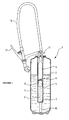
- the extinguisher 1 comprises a tank 2 in which there is a product to be sprayed 3, typically water.
- a capsule 4 of pressurized gas is fixed in the tank 2.
- a percussion mechanism 11 releases the gas contained in the capsule 4, just before the use of the extinguisher 1.
- the capsule 4 is surrounded by a protective tube 5 which makes it possible to protect the capsule 4 and the percussion mechanism 11 from contact with the product to be sprayed 3.
- the protection tube 5 extends beyond the lower end of the capsule 4.
- a piston 6 is provided in the protective tube 5, and a cover 7 closes the lower end of the protective tube 5.
- the lower part of the protective tube 5 defines, with the piston 6 and the lid 7, a container 8 in which there is an additive 9.
- the additive 9 is intended to be mixed with the product to be sprayed 3 to improve its extinguishing properties. This is for example a fluorinated additive.
- the extinguisher 1 also comprises a plunger tube 10 communicating with a lance 13 provided with an actuating handle 12.
- extinguisher 1 The operation of extinguisher 1 is as follows.
- the user wishes to use the extinguisher 1, he actuates the percussion mechanism 11, which has the effect of releasing the gas from the capsule 4.
- the pressure in the upper part of the protection tube 5 increases and opens the piston 6
- the pressurized gas then passes into the container 8.
- the pressure in the container 8 increases until the pressure difference at the lid 7 is sufficient to tear the lid 7.
- the additive 9 and the pressurized gas mix with the product to be sprayed 3.
- the user can then actuate the actuating handle 12. Under the effect of the pressure, the mixture of product to be sprayed and additive then leaves the tank 2 via the plunger tube 10 and the lance 13.
- the lid 7 comprises successively a first polyethylene layer welded to the lower end of the protection tube 5, a first polyamide layer, a second polyethylene layer and a second polyamide layer.
- the lid 7 may for example be made by coextrusion. It may be for example the film sold by Südpackmaschineen under the trade name Multifol GA 200 to produce food packaging. This film has a total thickness of 200 microns.
- the first layer of polyethylene is low density polyethylene (LDPE).
- the protection tube 5 can be made, at least at its lower end, of high density polyethylene (HDPE) to facilitate the sealing of the cover 7.
- HDPE high density polyethylene
- the container is arranged in the tank and is closed by a lid which tears when the pressure in the tank, outside the container, becomes greater than the pressure in the container.
Landscapes
- Health & Medical Sciences (AREA)
- Public Health (AREA)
- Business, Economics & Management (AREA)
- Emergency Management (AREA)
- Containers And Packaging Bodies Having A Special Means To Remove Contents (AREA)
- Packages (AREA)
- Fire-Extinguishing By Fire Departments, And Fire-Extinguishing Equipment And Control Thereof (AREA)
- Fire-Extinguishing Compositions (AREA)
- Slot Machines And Peripheral Devices (AREA)
- Geophysics And Detection Of Objects (AREA)
- Medicines Containing Antibodies Or Antigens For Use As Internal Diagnostic Agents (AREA)
- Wrappers (AREA)
- Nozzles (AREA)
Abstract
Description
- La présente invention se rapporte à un extincteur. En particulier, la présente invention se rapporte à un extincteur à pression auxiliaire, dans lequel un additif est stocké séparément du produit à pulvériser et mélangé avec celui-ci lors de la mise en pression.
- Le document
FR 2 649 325 - Le document
FR 2 662 608 - Dans le premier document, la pression au niveau de l'opercule inférieur est plus élevée du côté additif que du côté produit à pulvériser. Dans le deuxième document, la différence de pression est inversée. Dans les deux cas, le principe est de mélanger l'additif au produit à pulvériser grâce au déchirement d'un opercule, sous l'effet d'une différence de pression. Cependant, on peut rencontrer des difficultés dans la mise en oeuvre de ce principe.
- Le mouvement de l'extincteur, par exemple lors de son transport, peut avoir pour effet un tassement de l'additif contre l'opercule. Ce tassement peut conduire à un déchirement non désiré de l'opercule si celui-ci n'est pas assez résistant.
- Par ailleurs, un opercule trop résistant présente l'inconvénient de donner lieu, lors de son déchirement, à une brusque augmentation de pression, notamment dans le cas ou la pression est plus élevée côté additif. Cette brusque augmentation donne lieu au phénomène indésirable de coup de bélier.
- Un opercule trop résistant peut aussi s'arracher, au moins partiellement, au lieu de se déchirer. L'opercule arraché peut boucher le tube plongeur.
- Enfin, l'étanchéité de l'opercule doit être assurée dans une large plage de températures. Cependant, on a constaté, par exemple dans le cas d'un opercule bi-couche polyéthylène/aluminium, l'apparition de fuites à 60°C.
- Un problème que la présente invention propose de résoudre est de proposer un extincteur qui ne présente pas au moins certains des inconvénients précités de l'art antérieur.
- En particulier, l'invention vise à fournir un extincteur dans lequel l'opercule ne se déchire pas sous l'effet du tassement, et n'est pas arraché lors de la mise en pression. L'invention a également pour but d'éviter le phénomène de coup de bélier. Un autre but de l'invention est d'assurer l'étanchéité de l'opercule dans une large gamme de températures.
- La solution proposée par l'invention est un extincteur comprenant un réservoir contenant un produit à pulvériser et un récipient contenant un additif destiné à être mélangé avec le produit à pulvériser, le récipient étant fermé par un opercule apte à se déchirer sous l'effet d'une différence de pression, caractérisé par le fait que ledit opercule comprend successivement une première couche de polyéthylène soudée audit récipient, une première couche de polyamide, une deuxième couche de polyéthylène et une deuxième couche de polyamide.
- Grâce à ces caractéristiques, l'opercule présente une résistance suffisante pour résister au tassement, et se déchire en cas de différence de pression. On a constaté que la présence de polyamide permet de trouver un bon compromis pour la résistance de l'opercule. De plus, les couches en polyéthylène et en polyamide contribuent à l'étanchéité de l'opercule dans une large gamme de températures, en particulier à 60°C. La première couche en polyéthylène permet une fixation de l'opercule par soudage. L'alternance de quatre couches permet une meilleure homogénéité de l'opercule, et une résistance au tassement améliorée.
- De préférence, l'épaisseur totale de l'opercule est de 200 µm.
- Cette épaisseur conduit à un compromis particulièrement avantageux pour la résistance de l'opercule.
- Selon un mode de réalisation, l'extincteur comprend une capsule de gaz sous pression, un mécanisme de percussion apte à libérer le gaz contenu dans ladite capsule de gaz sous pression, et des moyens de communication aptes à conduire le gaz sous pression libéré dans ledit récipient, de manière à créer une différence de pression au niveau dudit opercule, la pression dans ledit récipient étant supérieure à la pression à l'extérieur dudit récipient.
- Dans ce cas, grâce aux caractéristiques de l'opercule, la différence de pression a pour effet de déchirer l'opercule et non de l'arracher. On évite ainsi des problèmes de bouchage, par exemple au niveau d'un tube plongeur.
- Avantageusement, le récipient est agencé dans le réservoir.
- De préférence, ledit récipient est réalisé en polyéthylène haute densité.
- L'invention sera mieux comprise, et d'autres buts, détails, caractéristiques et avantages de celle-ci apparaîtront plus clairement au cours de la description suivante d'un mode de réalisation particulier de l'invention, donné uniquement à titre illustratif et non limitatif, en référence aux dessins annexés. Sur ces dessins :
- la
figure 1 est une vue en coupe d'un extincteur selon un mode de réalisation de l'invention. - L'extincteur 1 comprend un réservoir 2 dans lequel se trouve un produit à pulvériser 3, typiquement de l'eau. Une capsule 4 de gaz sous pression est fixée dans le réservoir 2. Un mécanisme de percussion 11 permet de libérer le gaz contenu dans la capsule 4, juste avant l'utilisation de l'extincteur 1.
- La capsule 4 est entourée par un tube de protection 5 qui permet de protéger la capsule 4 et le mécanisme de percussion 11 du contact avec le produit à pulvériser 3.
- Le tube de protection 5 se prolonge au-delà de l'extrémité inférieure de la capsule 4. Comme on peut le voir sur la
figure 1 , un piston 6 est prévu dans le tube de protection 5, et un opercule 7 ferme l'extrémité inférieure du tube de protection 5. La partie basse du tube de protection 5 délimite, avec le piston 6 et l'opercule 7, un récipient 8 dans lequel se trouve un additif 9. L'additif 9 est destiné à être mélangé avec le produit à pulvériser 3 pour en améliorer les propriétés extinctrices. Il s'agit par exemple d'un additif fluoré. - L'extincteur 1 comprend également un tube plongeur 10 communiquant avec une lance 13 munie d'une poignée d'actionnement 12.
- Le fonctionnement de l'extincteur 1 est le suivant. Quand l'utilisateur désire utiliser l'extincteur 1, il actionne le mécanisme de percussion 11, ce qui a pour effet de libérer le gaz de la capsule 4. La pression dans la partie haute du tube de protection 5 augmente et ouvre le piston 6. Le gaz sous pression passe alors dans le récipient 8. La pression dans le récipient 8 augmente jusqu'à ce que la différence de pression au niveau de l'opercule 7 soit suffisante pour déchirer l'opercule 7. Après déchirement de l'opercule 7, l'additif 9 et le gaz sous pression se mélangent avec le produit à pulvériser 3.
- L'utilisateur peut alors actionner la poignée d'actionnement 12. Sous l'effet de la pression, le mélange de produit à pulvériser et d'additif sort alors du réservoir 2 en passant par le tube plongeur 10 et la lance 13.
- L'opercule 7 comprend successivement une première couche de polyéthylène soudée à l'extrémité inférieure du tube de protection 5, une première couche de polyamide, une deuxième couche de polyéthylène et une deuxième couche de polyamide. L'opercule 7 peut par exemple être réalisé par co-extrusion. Il peut s'agir par exemple du film vendu par Südpack Verpackungen sous la dénomination commerciale Multifol GA 200 pour réaliser des emballages alimentaires. Ce film présente une épaisseur totale de 200 µm. La première couche de polyéthylène est en polyéthylène basse densité (PEBD).
- Le tube de protection 5 peut être réalisé, au moins au niveau de son extrémité inférieure, en polyéthylène haute densité (PEHD) pour faciliter le soudage de l'opercule 7.
- Dans un mode de réalisation alternatif de l'invention, le récipient est agencé dans le réservoir et est fermé par un opercule qui se déchire lorsque la pression dans le réservoir, à l'extérieur du récipient, devient supérieure à la pression dans le récipient.
- Bien que l'invention ait été décrite en liaison avec un mode de réalisation particulier, il est bien évident qu'elle n'y est nullement limitée et qu'elle comprend tous les équivalents techniques des moyens décrits ainsi que leurs combinaisons si celles-ci entrent dans le cadre de l'invention.
Claims (5)
- Extincteur (1) comprenant un réservoir (2) contenant un produit à pulvériser (3) et un récipient (8) contenant un additif (9) destiné à être mélangé avec le produit à pulvériser, le récipient étant fermé par un opercule (7) apte à se déchirer sous l'effet d'une différence de pression, caractérisé par le fait que ledit opercule comprend successivement une première couche de polyéthylène soudée audit récipient, une première couche de polyamide, une deuxième couche de polyéthylène et une deuxième couche de polyamide.
- Extincteur selon la revendication 1, dans lequel l'épaisseur totale de l'opercule est de 200 µm.
- Extincteur selon l'une des revendications précédentes, comprenant une capsule (4) de gaz sous pression, un mécanisme de percussion (11) apte à libérer le gaz contenu dans ladite capsule de gaz sous pression, et des moyens de communication (5, 6) aptes à conduire le gaz sous pression libéré dans ledit récipient, de manière à créer une différence de pression au niveau dudit opercule, la pression dans ledit récipient étant supérieure à la pression à l'extérieur dudit récipient.
- Extincteur selon l'une des revendications précédentes, dans lequel le récipient est agencé dans le réservoir.
- Extincteur selon l'une des revendications précédentes, dans lequel ledit récipient est réalisé en polyéthylène haute densité.
Applications Claiming Priority (1)
| Application Number | Priority Date | Filing Date | Title |
|---|---|---|---|
| FR0855417A FR2934784B1 (fr) | 2008-08-05 | 2008-08-05 | Extincteur a opercule dechirable. |
Publications (2)
| Publication Number | Publication Date |
|---|---|
| EP2151264A1 true EP2151264A1 (fr) | 2010-02-10 |
| EP2151264B1 EP2151264B1 (fr) | 2011-01-12 |
Family
ID=40380322
Family Applications (1)
| Application Number | Title | Priority Date | Filing Date |
|---|---|---|---|
| EP09305719A Active EP2151264B1 (fr) | 2008-08-05 | 2009-07-31 | Extincteur à opercule déchirable |
Country Status (5)
| Country | Link |
|---|---|
| EP (1) | EP2151264B1 (fr) |
| AT (1) | ATE494930T1 (fr) |
| DE (1) | DE602009000562D1 (fr) |
| FR (1) | FR2934784B1 (fr) |
| HR (1) | HRP20110256T1 (fr) |
Cited By (1)
| Publication number | Priority date | Publication date | Assignee | Title |
|---|---|---|---|---|
| WO2014192009A1 (fr) * | 2013-05-31 | 2014-12-04 | Kanoo Amal Kishor | Générateur d'oxygène portatif |
Citations (2)
| Publication number | Priority date | Publication date | Assignee | Title |
|---|---|---|---|---|
| FR2649325A1 (fr) | 1989-07-07 | 1991-01-11 | Lahouati Michel | Extincteur perfectionne |
| FR2662608A1 (fr) | 1990-06-05 | 1991-12-06 | Rot | Cartouche frangible pour additifs d'extinction dans des extincteurs a eau mise sous pression au moment de l'emploi par un gaz comprime. |
-
2008
- 2008-08-05 FR FR0855417A patent/FR2934784B1/fr not_active Expired - Fee Related
-
2009
- 2009-07-31 EP EP09305719A patent/EP2151264B1/fr active Active
- 2009-07-31 DE DE602009000562T patent/DE602009000562D1/de active Active
- 2009-07-31 AT AT09305719T patent/ATE494930T1/de not_active IP Right Cessation
-
2011
- 2011-04-08 HR HR20110256T patent/HRP20110256T1/hr unknown
Patent Citations (2)
| Publication number | Priority date | Publication date | Assignee | Title |
|---|---|---|---|---|
| FR2649325A1 (fr) | 1989-07-07 | 1991-01-11 | Lahouati Michel | Extincteur perfectionne |
| FR2662608A1 (fr) | 1990-06-05 | 1991-12-06 | Rot | Cartouche frangible pour additifs d'extinction dans des extincteurs a eau mise sous pression au moment de l'emploi par un gaz comprime. |
Cited By (1)
| Publication number | Priority date | Publication date | Assignee | Title |
|---|---|---|---|---|
| WO2014192009A1 (fr) * | 2013-05-31 | 2014-12-04 | Kanoo Amal Kishor | Générateur d'oxygène portatif |
Also Published As
| Publication number | Publication date |
|---|---|
| ATE494930T1 (de) | 2011-01-15 |
| FR2934784A1 (fr) | 2010-02-12 |
| FR2934784B1 (fr) | 2010-08-27 |
| DE602009000562D1 (de) | 2011-02-24 |
| EP2151264B1 (fr) | 2011-01-12 |
| HRP20110256T1 (hr) | 2011-05-31 |
Similar Documents
| Publication | Publication Date | Title |
|---|---|---|
| EP0642839B1 (fr) | Procédé et dispositif de distribution et de conditionnement d'un produit fluide contenu dans un récipient pressurisé à l'aide d'un gaz propulseur | |
| FR2751303A1 (fr) | Dispositif pour l'ouverture et la fermeture d'un emballage, et emballage muni d'un tel dispositif | |
| WO1993004928A1 (fr) | Dispositif de mise sous pression d'une boite d'aerosol et boite d'aerosol adaptee a ce dispositif | |
| EP1205403A1 (fr) | Dispositif de conditionnement et de distribution sous pression d'un produit | |
| FR2973355A1 (fr) | Dispositif d'emballage adapte pour emballer separement un premier et un deuxieme fluide | |
| EP3755437B1 (fr) | Extincteur d'incendie | |
| EP2151264B1 (fr) | Extincteur à opercule déchirable | |
| EP0921026B1 (fr) | Circuit de dégazage pour réservoir à liquide | |
| EP0961732A1 (fr) | Verseur a bouchage pour des recipients, notamment pour des boites de conditionnement de liquides | |
| FR2957626A1 (fr) | Actionneur d'ouverture d'urgence a gaz d'un ouvrant d'aeronef, comportant des moyens d'echappement du gaz | |
| FR2685285A1 (fr) | Procede de conditionnement d'un produit liquide quelconque et flacon obtenu par ce procede. | |
| FR2936228A1 (fr) | Dispositif integre d'ouverture et de refermeture pour tous types de canettes de boisson gazeuses ou non | |
| EP1198393A1 (fr) | Valve et emballage pour cuisson d'aliments | |
| EP2607256A1 (fr) | Contenant avec membrane d'obturation pelable, destiné a recevoir un produit en poudre et destiné à présenter une surpression interne | |
| EP3313536B1 (fr) | Extincteur d'incendie | |
| EP1869534B1 (fr) | Ensemble valve régulé pour systèmes d'extincteurs d'incendie | |
| FR2936715A1 (fr) | Dispositif d'ejection d'un fluide a etancheite renforcee | |
| EP2938558A1 (fr) | Dispositif de transfert contrôlé de gaz ou de molécules gazeuses volatiles dans un récipient destiné à contenir un produit alimentaire liquide ou semi-liquide | |
| EP4450133B1 (fr) | Dose flottante d'additif pour un extincteur à eau | |
| FR2584456A1 (fr) | Dispositif de fermeture temporaire d'un orifice interne d'un propulseur | |
| FR2670389A1 (fr) | Extincteur a eau dont l'additif est contenu dans un tube souple. | |
| FR3063651B1 (fr) | Flacon d'additifs pour extincteur a base d'eau | |
| EP2145652B1 (fr) | Cartouche d'additif filmogène pour extincteur | |
| FR2933622A1 (fr) | Extincteur a pression permanente | |
| FR2898114A1 (fr) | Procede et dispositif de conservation et de distribution d'un produit dans un recipient muni d'une poche et recipient rechargeable. |
Legal Events
| Date | Code | Title | Description |
|---|---|---|---|
| PUAI | Public reference made under article 153(3) epc to a published international application that has entered the european phase |
Free format text: ORIGINAL CODE: 0009012 |
|
| AK | Designated contracting states |
Kind code of ref document: A1 Designated state(s): AT BE BG CH CY CZ DE DK EE ES FI FR GB GR HR HU IE IS IT LI LT LU LV MC MK MT NL NO PL PT RO SE SI SK SM TR |
|
| 17P | Request for examination filed |
Effective date: 20100706 |
|
| GRAP | Despatch of communication of intention to grant a patent |
Free format text: ORIGINAL CODE: EPIDOSNIGR1 |
|
| GRAS | Grant fee paid |
Free format text: ORIGINAL CODE: EPIDOSNIGR3 |
|
| GRAA | (expected) grant |
Free format text: ORIGINAL CODE: 0009210 |
|
| AK | Designated contracting states |
Kind code of ref document: B1 Designated state(s): AT BE BG CH CY CZ DE DK EE ES FI FR GB GR HR HU IE IS IT LI LT LU LV MC MK MT NL NO PL PT RO SE SI SK SM TR |
|
| REG | Reference to a national code |
Ref country code: GB Ref legal event code: FG4D Free format text: NOT ENGLISH |
|
| REG | Reference to a national code |
Ref country code: CH Ref legal event code: EP |
|
| REG | Reference to a national code |
Ref country code: IE Ref legal event code: FG4D Free format text: LANGUAGE OF EP DOCUMENT: FRENCH |
|
| REF | Corresponds to: |
Ref document number: 602009000562 Country of ref document: DE Date of ref document: 20110224 Kind code of ref document: P |
|
| REG | Reference to a national code |
Ref country code: DE Ref legal event code: R096 Ref document number: 602009000562 Country of ref document: DE Effective date: 20110224 |
|
| REG | Reference to a national code |
Ref country code: HR Ref legal event code: TUEP Ref document number: P20110256 Country of ref document: HR |
|
| REG | Reference to a national code |
Ref country code: NL Ref legal event code: T3 |
|
| REG | Reference to a national code |
Ref country code: HR Ref legal event code: T1PR Ref document number: P20110256 Country of ref document: HR |
|
| LTIE | Lt: invalidation of european patent or patent extension |
Effective date: 20110112 |
|
| PG25 | Lapsed in a contracting state [announced via postgrant information from national office to epo] |
Ref country code: ES Free format text: LAPSE BECAUSE OF FAILURE TO SUBMIT A TRANSLATION OF THE DESCRIPTION OR TO PAY THE FEE WITHIN THE PRESCRIBED TIME-LIMIT Effective date: 20110423 Ref country code: GR Free format text: LAPSE BECAUSE OF FAILURE TO SUBMIT A TRANSLATION OF THE DESCRIPTION OR TO PAY THE FEE WITHIN THE PRESCRIBED TIME-LIMIT Effective date: 20110413 Ref country code: NO Free format text: LAPSE BECAUSE OF FAILURE TO SUBMIT A TRANSLATION OF THE DESCRIPTION OR TO PAY THE FEE WITHIN THE PRESCRIBED TIME-LIMIT Effective date: 20110412 Ref country code: LV Free format text: LAPSE BECAUSE OF FAILURE TO SUBMIT A TRANSLATION OF THE DESCRIPTION OR TO PAY THE FEE WITHIN THE PRESCRIBED TIME-LIMIT Effective date: 20110112 Ref country code: LT Free format text: LAPSE BECAUSE OF FAILURE TO SUBMIT A TRANSLATION OF THE DESCRIPTION OR TO PAY THE FEE WITHIN THE PRESCRIBED TIME-LIMIT Effective date: 20110112 Ref country code: IS Free format text: LAPSE BECAUSE OF FAILURE TO SUBMIT A TRANSLATION OF THE DESCRIPTION OR TO PAY THE FEE WITHIN THE PRESCRIBED TIME-LIMIT Effective date: 20110512 Ref country code: PT Free format text: LAPSE BECAUSE OF FAILURE TO SUBMIT A TRANSLATION OF THE DESCRIPTION OR TO PAY THE FEE WITHIN THE PRESCRIBED TIME-LIMIT Effective date: 20110512 Ref country code: SE Free format text: LAPSE BECAUSE OF FAILURE TO SUBMIT A TRANSLATION OF THE DESCRIPTION OR TO PAY THE FEE WITHIN THE PRESCRIBED TIME-LIMIT Effective date: 20110112 |
|
| REG | Reference to a national code |
Ref country code: IE Ref legal event code: FD4D |
|
| PG25 | Lapsed in a contracting state [announced via postgrant information from national office to epo] |
Ref country code: FI Free format text: LAPSE BECAUSE OF FAILURE TO SUBMIT A TRANSLATION OF THE DESCRIPTION OR TO PAY THE FEE WITHIN THE PRESCRIBED TIME-LIMIT Effective date: 20110112 Ref country code: CY Free format text: LAPSE BECAUSE OF FAILURE TO SUBMIT A TRANSLATION OF THE DESCRIPTION OR TO PAY THE FEE WITHIN THE PRESCRIBED TIME-LIMIT Effective date: 20110112 Ref country code: BG Free format text: LAPSE BECAUSE OF FAILURE TO SUBMIT A TRANSLATION OF THE DESCRIPTION OR TO PAY THE FEE WITHIN THE PRESCRIBED TIME-LIMIT Effective date: 20110412 Ref country code: PL Free format text: LAPSE BECAUSE OF FAILURE TO SUBMIT A TRANSLATION OF THE DESCRIPTION OR TO PAY THE FEE WITHIN THE PRESCRIBED TIME-LIMIT Effective date: 20110112 Ref country code: AT Free format text: LAPSE BECAUSE OF FAILURE TO SUBMIT A TRANSLATION OF THE DESCRIPTION OR TO PAY THE FEE WITHIN THE PRESCRIBED TIME-LIMIT Effective date: 20110112 Ref country code: SI Free format text: LAPSE BECAUSE OF FAILURE TO SUBMIT A TRANSLATION OF THE DESCRIPTION OR TO PAY THE FEE WITHIN THE PRESCRIBED TIME-LIMIT Effective date: 20110112 |
|
| PG25 | Lapsed in a contracting state [announced via postgrant information from national office to epo] |
Ref country code: DK Free format text: LAPSE BECAUSE OF FAILURE TO SUBMIT A TRANSLATION OF THE DESCRIPTION OR TO PAY THE FEE WITHIN THE PRESCRIBED TIME-LIMIT Effective date: 20110112 Ref country code: EE Free format text: LAPSE BECAUSE OF FAILURE TO SUBMIT A TRANSLATION OF THE DESCRIPTION OR TO PAY THE FEE WITHIN THE PRESCRIBED TIME-LIMIT Effective date: 20110112 Ref country code: IE Free format text: LAPSE BECAUSE OF FAILURE TO SUBMIT A TRANSLATION OF THE DESCRIPTION OR TO PAY THE FEE WITHIN THE PRESCRIBED TIME-LIMIT Effective date: 20110112 |
|
| PLBE | No opposition filed within time limit |
Free format text: ORIGINAL CODE: 0009261 |
|
| STAA | Information on the status of an ep patent application or granted ep patent |
Free format text: STATUS: NO OPPOSITION FILED WITHIN TIME LIMIT |
|
| PG25 | Lapsed in a contracting state [announced via postgrant information from national office to epo] |
Ref country code: CZ Free format text: LAPSE BECAUSE OF FAILURE TO SUBMIT A TRANSLATION OF THE DESCRIPTION OR TO PAY THE FEE WITHIN THE PRESCRIBED TIME-LIMIT Effective date: 20110112 Ref country code: RO Free format text: LAPSE BECAUSE OF FAILURE TO SUBMIT A TRANSLATION OF THE DESCRIPTION OR TO PAY THE FEE WITHIN THE PRESCRIBED TIME-LIMIT Effective date: 20110112 Ref country code: SK Free format text: LAPSE BECAUSE OF FAILURE TO SUBMIT A TRANSLATION OF THE DESCRIPTION OR TO PAY THE FEE WITHIN THE PRESCRIBED TIME-LIMIT Effective date: 20110112 |
|
| 26N | No opposition filed |
Effective date: 20111013 |
|
| PG25 | Lapsed in a contracting state [announced via postgrant information from national office to epo] |
Ref country code: IT Free format text: LAPSE BECAUSE OF FAILURE TO SUBMIT A TRANSLATION OF THE DESCRIPTION OR TO PAY THE FEE WITHIN THE PRESCRIBED TIME-LIMIT Effective date: 20110112 Ref country code: MT Free format text: LAPSE BECAUSE OF FAILURE TO SUBMIT A TRANSLATION OF THE DESCRIPTION OR TO PAY THE FEE WITHIN THE PRESCRIBED TIME-LIMIT Effective date: 20110112 |
|
| REG | Reference to a national code |
Ref country code: DE Ref legal event code: R097 Ref document number: 602009000562 Country of ref document: DE Effective date: 20111013 |
|
| PG25 | Lapsed in a contracting state [announced via postgrant information from national office to epo] |
Ref country code: MC Free format text: LAPSE BECAUSE OF NON-PAYMENT OF DUE FEES Effective date: 20110731 |
|
| PG25 | Lapsed in a contracting state [announced via postgrant information from national office to epo] |
Ref country code: MK Free format text: LAPSE BECAUSE OF FAILURE TO SUBMIT A TRANSLATION OF THE DESCRIPTION OR TO PAY THE FEE WITHIN THE PRESCRIBED TIME-LIMIT Effective date: 20110112 |
|
| PG25 | Lapsed in a contracting state [announced via postgrant information from national office to epo] |
Ref country code: SM Free format text: LAPSE BECAUSE OF FAILURE TO SUBMIT A TRANSLATION OF THE DESCRIPTION OR TO PAY THE FEE WITHIN THE PRESCRIBED TIME-LIMIT Effective date: 20110112 |
|
| PG25 | Lapsed in a contracting state [announced via postgrant information from national office to epo] |
Ref country code: LU Free format text: LAPSE BECAUSE OF NON-PAYMENT OF DUE FEES Effective date: 20110731 |
|
| PG25 | Lapsed in a contracting state [announced via postgrant information from national office to epo] |
Ref country code: TR Free format text: LAPSE BECAUSE OF FAILURE TO SUBMIT A TRANSLATION OF THE DESCRIPTION OR TO PAY THE FEE WITHIN THE PRESCRIBED TIME-LIMIT Effective date: 20110112 |
|
| PG25 | Lapsed in a contracting state [announced via postgrant information from national office to epo] |
Ref country code: HU Free format text: LAPSE BECAUSE OF FAILURE TO SUBMIT A TRANSLATION OF THE DESCRIPTION OR TO PAY THE FEE WITHIN THE PRESCRIBED TIME-LIMIT Effective date: 20110112 |
|
| REG | Reference to a national code |
Ref country code: CH Ref legal event code: PL |
|
| GBPC | Gb: european patent ceased through non-payment of renewal fee |
Effective date: 20130731 |
|
| PG25 | Lapsed in a contracting state [announced via postgrant information from national office to epo] |
Ref country code: LI Free format text: LAPSE BECAUSE OF NON-PAYMENT OF DUE FEES Effective date: 20130731 Ref country code: CH Free format text: LAPSE BECAUSE OF NON-PAYMENT OF DUE FEES Effective date: 20130731 Ref country code: GB Free format text: LAPSE BECAUSE OF NON-PAYMENT OF DUE FEES Effective date: 20130731 |
|
| REG | Reference to a national code |
Ref country code: FR Ref legal event code: PLFP Year of fee payment: 8 |
|
| REG | Reference to a national code |
Ref country code: FR Ref legal event code: PLFP Year of fee payment: 9 |
|
| REG | Reference to a national code |
Ref country code: FR Ref legal event code: PLFP Year of fee payment: 10 |
|
| REG | Reference to a national code |
Ref country code: HR Ref legal event code: ODRP Ref document number: P20110256 Country of ref document: HR Payment date: 20190731 Year of fee payment: 11 |
|
| REG | Reference to a national code |
Ref country code: HR Ref legal event code: ODRP Ref document number: P20110256 Country of ref document: HR Payment date: 20200727 Year of fee payment: 12 |
|
| REG | Reference to a national code |
Ref country code: HR Ref legal event code: ODRP Ref document number: P20110256 Country of ref document: HR Payment date: 20210726 Year of fee payment: 13 |
|
| REG | Reference to a national code |
Ref country code: HR Ref legal event code: ODRP Ref document number: P20110256 Country of ref document: HR Payment date: 20220725 Year of fee payment: 14 |
|
| REG | Reference to a national code |
Ref country code: HR Ref legal event code: ODRP Ref document number: P20110256 Country of ref document: HR Payment date: 20230727 Year of fee payment: 15 |
|
| REG | Reference to a national code |
Ref country code: HR Ref legal event code: ODRP Ref document number: P20110256 Country of ref document: HR Payment date: 20240718 Year of fee payment: 16 |
|
| REG | Reference to a national code |
Ref country code: HR Ref legal event code: ODRP Ref document number: P20110256 Country of ref document: HR Payment date: 20250807 Year of fee payment: 17 |
|
| PGFP | Annual fee paid to national office [announced via postgrant information from national office to epo] |
Ref country code: NL Payment date: 20250821 Year of fee payment: 17 |
|
| PGFP | Annual fee paid to national office [announced via postgrant information from national office to epo] |
Ref country code: DE Payment date: 20250820 Year of fee payment: 17 |
|
| PGFP | Annual fee paid to national office [announced via postgrant information from national office to epo] |
Ref country code: BE Payment date: 20250820 Year of fee payment: 17 |
|
| PGFP | Annual fee paid to national office [announced via postgrant information from national office to epo] |
Ref country code: HR Payment date: 20250807 Year of fee payment: 17 |
|
| PGFP | Annual fee paid to national office [announced via postgrant information from national office to epo] |
Ref country code: FR Payment date: 20250828 Year of fee payment: 17 |