EP2153406B1 - Verringerung von bewegungsartefakten beim ct-scanning - Google Patents
Verringerung von bewegungsartefakten beim ct-scanning Download PDFInfo
- Publication number
- EP2153406B1 EP2153406B1 EP07725699A EP07725699A EP2153406B1 EP 2153406 B1 EP2153406 B1 EP 2153406B1 EP 07725699 A EP07725699 A EP 07725699A EP 07725699 A EP07725699 A EP 07725699A EP 2153406 B1 EP2153406 B1 EP 2153406B1
- Authority
- EP
- European Patent Office
- Prior art keywords
- image
- image processing
- processing method
- images
- collection
- Prior art date
- Legal status (The legal status is an assumption and is not a legal conclusion. Google has not performed a legal analysis and makes no representation as to the accuracy of the status listed.)
- Active
Links
Images


Classifications
-
- G—PHYSICS
- G06—COMPUTING OR CALCULATING; COUNTING
- G06T—IMAGE DATA PROCESSING OR GENERATION, IN GENERAL
- G06T7/00—Image analysis
- G06T7/20—Analysis of motion
-
- G—PHYSICS
- G06—COMPUTING OR CALCULATING; COUNTING
- G06T—IMAGE DATA PROCESSING OR GENERATION, IN GENERAL
- G06T5/00—Image enhancement or restoration
- G06T5/73—Deblurring; Sharpening
-
- G—PHYSICS
- G06—COMPUTING OR CALCULATING; COUNTING
- G06T—IMAGE DATA PROCESSING OR GENERATION, IN GENERAL
- G06T2207/00—Indexing scheme for image analysis or image enhancement
- G06T2207/10—Image acquisition modality
- G06T2207/10116—X-ray image
-
- G—PHYSICS
- G06—COMPUTING OR CALCULATING; COUNTING
- G06T—IMAGE DATA PROCESSING OR GENERATION, IN GENERAL
- G06T2207/00—Indexing scheme for image analysis or image enhancement
- G06T2207/20—Special algorithmic details
- G06T2207/20068—Projection on vertical or horizontal image axis
-
- G—PHYSICS
- G06—COMPUTING OR CALCULATING; COUNTING
- G06T—IMAGE DATA PROCESSING OR GENERATION, IN GENERAL
- G06T2207/00—Indexing scheme for image analysis or image enhancement
- G06T2207/30—Subject of image; Context of image processing
- G06T2207/30004—Biomedical image processing
Definitions
- the present invention relates to the reduction of motion artefacts in CT scanning.
- CBCT Cone beam computer tomography
- IGRT image guided radiotherapy
- Non-periodic or sporadic motion presents a difficulty.
- the method is able to take advantage of the redundant information that is available in extended field of view CBCT scanning geometry.
- projection-images containing moving structures can be discarded in order to obtain a consistent subset of projection-images.
- sporadic motion is gas pockets moving in the rectum and other bowel areas, as this is an example of a significant change that can take place near to a structure than commonly requires radiotherapeutic treatment, i.e. the prostate. Accordingly, the remainder of this application will describe the detection of such gas pockets and their movement, although it should be understood that the techniques are applicable to the detection of any sporadic movement in a CT scan and the alleviation of motion artefacts that result.
- the first step is to automatically detect moving gas in the rectum.
- the principal idea is to enhance low density features around the prostate in the individual X-ray images, project these features on the cranio-caudal axis (assuming that the gas predominantly moves in this direction) to form a 1-dimensional image, and combine successive 1D projections to form a 2D image. Moving gas will produce tilted lines in this image, identifying an angular range that needs to be discarded.
- tapers identifying the central part and the periphery and appropriate parker weighting accounting for the partial scan have to be generated and applied to the projection-data, to obtain an artefact free reconstruction based on the remaining projection-images.
- the method has been tested on 7 CBCT-scans of different prostate cancer patients enrolled in our adaptive RT protocol that exhibited substantial motion artefacts. Streak artefacts were substantially reduced and a sharpness of the gas-to-tissue interface was on average improved by a factor 2.
- the present invention therefore provides an image processing method comprising the steps of gathering a collection of two-dimensional x-ray images of a subject, ordered in time sequence, for each image of the collection, projecting at least part of the image to a projection axis, to derive a collection of one-dimensional images aligned with the projection axis and whose pixel values represent a sum of pixel values in the respective two-dimensional image transverse to the projection axis, assembling the one-dimensional images to form a single two dimensional image having a spatial dimension aligned with the projection axis and a time dimension transverse to the projection axis, and detecting tilted features in the two dimensional image.
- the new collection can then be used as the basis for a CT reconstruction omitting some of the motion artefacts that arise from a reconstruction using the original collection.
- the images of the collection preferably comprise images of substantially the same subject albeit from different viewpoints.
- the different viewpoints can, for example, comprise views along a plurality of directions in substantially the same plane, the plurality of directions converging on an image axis transverse to the plane.
- Such images are produced by an imaging system that rotates about a rotation axis that is within the field of view of the imaging system. That image axis is preferably parallel to and/or coincident with the projection axis.
- the projection step can involve summing the total pixel value along a direction transverse to the projection axis, which can then be normalised to create (in effect) an average value.
- the aim is to create a pixel value that represents the general level of brightness or intensity along the direction, so a sum or average will be appropriate.
- Other algorithms may be shown to be suitable.
- the projection axis is preferably parallel to an edge of the image, to ease the arithmetic processing load.
- the subject of the images is suitably a patient, particularly the prostate region of a patient as that tends to suffer particularly from the sporadic motion which the present invention is best able to deal with.
- the projection axis is preferably aligned with the craniocordal axis of the patient, as the sporadic movement is usually in that general direction. Other orientations may be adopted in cases where the movement is aligned in a different direction, however.
- the present invention further relates to an image processing apparatus containing a computing means adapted to perform the process of any one of the preceding claims, and to a CT scanner containing such an image processing apparatus.
- CBCT cone beam CT
- IGRT image guided RT techniques
- the mathematical model of computer tomography does however rely on an inherent assumption that the scanned object is static. When the object changes during scanning, however, this intra-scanning motion induces artefacts in the resulting reconstruction. Due to the slow rotation speed of CBCT apparatus integrated with the linear accelerators used in RT (of the order of 30s to 4 minutes per rotation), it is mainly blurring and streak artefacts that are induced. These artefacts hamper IGRT applications, as they reduce the success rate and accuracy of automatic registration techniques.
- motion artefacts can be managed by respiratory correlated imaging techniques, i.e. exploiting the periodic feature of such motion through retrospective sorting of consecutive projection images into different phase bins yielding four dimensional (4D) datasets.
- 4D four dimensional
- FOV extended field of view
- CBCT scans of prostate cancer patients were therefore acquired for an offline shrinking action level protocol based on bony alignment, or alternatively for an adaptive radiotherapy (ART) protocol initiating re-planning after the first week of treatment taking into account organ motion assessed over the first five CBCT scans.
- CBCT scans were made using Elekta Synergy 3.5 (Elekta Oncology Systems Ltd, Crawley, West Wales, United Kingdom) at a so-called medium FOV (40 cm diameter in the axial plane).
- the imager of the system operates at a frame-rate of 5.5 fps, images are stored at a resolution of 0.5 mm x 0.5 mm and processed at a resolution of 1 mm x 1mm.
- CBCT acquisition time (including reconstruction) takes about 2 min.
- the axial FOV of a CBCT scanner depends on the size of the imager and its position relative to the central axis. With a centrally positioned detector, a short scanning technique (rotating the system over 180° + twice the cone angle) with appropriate Parker Weighting provides an axial FOV equal to the effective size of the imager at the iso-center plane (typically 20 - 25 cm).
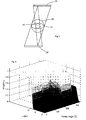
- Figure 2 illustrates the geometry, and shows that the flat panel detector 10 is partially displaced in the axial plane opposite to the central axis.
- the elliptical object 12 is too large to be completely projected on the panel 10; by partly displacing the detector 10, the FOV of the scanner is extended to the circle shown as 14, scanning each side of the object over only a section of a full rotation. Only the central part (circle 16) is seen over the full rotation.
- an extended FOV can be obtained. Doing so, the periphery 14 of the FOV is effectively scanned over 180', while the central part 16 is scanned over the full 360'.
- W u 1 - 1 2 ⁇ S ⁇ u - D + d , d - 1 2 ⁇ S ⁇ u + D - d , d with u being the axial detector coordinate, D half the size of the central region 16 containing redundant information, S a smooth S- shaped function of the form;
- S x d ⁇ 0 , x ⁇ - d 1 2 ⁇ 1 + sin ⁇ ⁇ arctan x R 2 arctan d R , x ⁇ d 1 , x ⁇ d R the source-to-detector distance and d a steepness parameter that needs to satisfy d ⁇ D/2.
- Equation 1 describes a trapezoid data weighting similar to a u profile at a gantry angle of 150°, as shown in Figure 3 .
- the advantage of the trapezoid shaped weighting function over a single S-shaped function as proposed by Wang Wang G. "X-ray micro-CT with a displaced detector array” Med Phys. 2002;c29: 1634-6 ) is an improved signal-to-noise ratio in the central region while maintaining smoothness at the edges to prevent high spatial frequency artefacts.
- Equation 1 The redundancy in the central region of the scan allows us to discard the part of the projection image corresponding to the central region of a subset of images, to re-establish consistency in the dataset. Subsequently, the data weighting described in Equation 1 needs to be adapted.
- Equation 3 effectively divides the projection images into 2 regions, the periphery 14 that is reconstructed similar to Equation 1 and the central area 16 that is reconstructed as if scanned using a short scan technique.
- the modified parker weighting ⁇ N ( ß,u ) also uses trapezoid shaped weighting to optimize signal-to-noise ratios.
- Equation 3 is shown graphically in Figure 3 ; in this example, the area of the projection images corresponding to the central region (u>-D) acquired over the first 90° were discarded. Projections acquired for gantry angles larger than 90° were weighted using a trapezoid parker function for u>-D and unweighted for u ⁇ -D. Note that at most images acquired over an arc of 180°-2x cone angle can be (partly) discarded.
- an automatic motion detection algorithm was developed. It is modified from the automatic breathing signal extraction system described by Zijp et al. ( Zijp L, Sonke J-J, van Herk M, "Extraction of the respiratory signal from sequential thorax Cone-Beam X-ray images", Proceedings of the 14th ICCR Seoul, Korea, 2004 ).
- the rectum in the proximity of the prostate is selected using a rectangular shaped volume of interest (VOI).
- VOI volume of interest
- the 3D VOI is projected onto each X-ray image with the appropriate gantry angle to crop the corresponding region of interest, after which low density features are enhanced using a gradient filter in the vertical direction.
- a computer algorithm detects these tilted features automatically, or (alternatively) several reconstructions are made assuming sporadic motion at different time points through the acquisition. The selection of the best reconstruction is then made visually or by its suitability for automatic image guidance.
- An automatic detection can operate by, for example:
- Table 1 shows the result of the analysis on the sharpness of the gas-to-tissue interface for the seven patients.
- the increase in the sharpness of the gas-to-tissue interface varies substantially between patients. This is mainly caused by the fact that some patients manifest motion over a large portion of the scan, such that the discarded sub-set of images is so large that the final image quality suffers and is only moderately improved relative to the original.
- the R 30-70 was 0.43 ⁇ 0.33 (1 SD), i.e., the width of the gas-to-tissue interface was reduced by more than a factor of 2.
- Table 1 Improvement in the sharpness of the gas-to-tissue interface due to the motion artefact reduction procedure expressed by the R 30-70 for 7 prostate cancer patients.
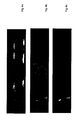
- Figure 6 illustrates the essential elements of the above-described process in schematic form.
- a series of images 20A, 20B, 20C, 20D etc are obtained from the scanning apparatus. Each of these is then condensed down to a one-dimensional line of pixels 22A, 22B, 22C, 22D etc by (in this example) summing the pixels horizontally and normalising to give an average pixel value for that line. These one-dimensional images are then juxtaposed to create a two dimensional composite image 24.
- This composite image 24 contains three general types of structure.
- the first is a continuous horizontal line across the image such as structure 26. This corresponds to a feature 28 in the image that is present in the redundant are of the image, and is therefore present in all the images. A streak will thus appear at that height in the composite image.
- the second is a horizontal line that extends part-way across the image, such as structure 30. This corresponds to a feature that is present in some images in the sequence but not others, and it likely to be a feature in the non-redundant are of the image.
- the last is a line in the image that is non-horizontal, i.e. sloping or tilted such as structure 32. This corresponds to a feature 34 in the image that moves vertically in the images at some point in the sequence. This indicates a change in the subject during the image sequence, and is highlighted by the process of the present invention.
Landscapes
- Engineering & Computer Science (AREA)
- Physics & Mathematics (AREA)
- General Physics & Mathematics (AREA)
- Theoretical Computer Science (AREA)
- Multimedia (AREA)
- Computer Vision & Pattern Recognition (AREA)
- Apparatus For Radiation Diagnosis (AREA)
- Image Processing (AREA)
Claims (17)
- Bildverarbeitungsverfahren, das die folgenden Schritte umfasst:Aufnehmen einer Sammlung von zweidimensionalen Röntgenbildern (20A, 20B, 20C, 20D) eines Aufnahmeobjekts, geordnet nach der zeitlichen Abfolge;Projizieren, für jedes Bild der Sammlung, mindestens eines Teils des Bildes auf eine Projektionsachse, um eine Sammlung von eindimensionalen Bildern (22A, 22B, 22C, 22D) abzuleiten, die auf die Projektionsachse ausgerichtet sind und deren Pixelwerte eine Summe von Pixelwerten in dem jeweiligen zweidimensionalen Bild, quer zur Projektionsachse, repräsentieren;Montieren der eindimensionalen Bilder zum Bilden eines einzigen zweidimensionalen Bildes (24), das eine räumliche Dimension, die auf die Projektionsachse ausgerichtet ist, und eine zeitliche Dimension, die quer zur Projektionsachse verlauft, aufweist;gekennzeichnet durch: Detektieren von Merkmalen (32), die im zweidimensionalen Bild in Bezug auf die zeitliche und die räumliche Dimension geneigt sind.
- Bildverarbeitungsverfahren nach Anspruch 1, bei dem eine neue Sammlung anschließend aufbereitet wird, die nach der Löschung von mindestens den Bildern, die zu den geneigten Merkmalen (32) beitragen, zur Originalsammlung wird.
- Bildverarbeitungsverfahren nach Anspruch 1, bei dem eine neue Sammlung anschließend aufbereitet wird, die nach der Entfernung der Teilmenge, die Bilder vor den geneigten Merkmalen (32) und Bilder, die zu ihnen beitragen enthält, zur Originalsammlung wird.
- Bildverarbeitungsverfahren nach Anspruch 1, bei dem eine neue Sammlung anschließend aufbereitet wird, die nach der Entfernung der Teilmenge, die Bilder nach den geneigten Merkmalen (32) und Bilder, die zu ihnen beitragen enthält, zur Originalsammlung wird.
- Bildverarbeitungsverfahren nach einem der vorhergehenden Ansprüche, bei dem das gesamte Bild projiziert wird.
- Bildverarbeitungsverfahren nach einem der vorhergehenden Ansprüche, bei dem die Bilder (20A, 20B, 20C, 20D) der Sammlung Bilder des im Wesentlichen gleichen Aufnahmeobjekts, wenn auch aus verschiedenen Blickpunkten, umfassen.
- Bildverarbeitungsverfahren nach Anspruch 6, bei dem die verschiedenen Blickpunkte Ansichten längs einer Vielzahl von Richtungen in der im Wesentlichen gleichen Ebene umfassen, wobei die Vielzahl von Richtungen auf eine zur Ebene quer verlaufende Bildachse konvergiert.
- Bildverarbeitungsverfahren nach Anspruch 7, bei dem die Bildachse zur Projektionsachse parallel ist.
- Bildverarbeitungsverfahren nach Anspruch 7, bei dem die Bildachse mit der Projektionsachse koinzident ist.
- Bildverarbeitungsverfahren nach einem der vorhergehenden Ansprüche, bei dem der Projektionsschritt das Summieren des Gesamtpixelwerts längs einer Richtung beinhaltet, die quer zur Projektionsachse verläuft.
- Bildverarbeitungsverfahren nach Anspruch 10, bei dem der Gesamtpixelwert anschließend normiert wird.
- Bildverarbeitungsverfahren nach Anspruch 10 oder Anspruch 11, bei dem die Projektionsachse zu einer Kante des Bildes parallel ist.
- Bildverarbeitungsverfahren nach einem der vorhergehenden Ansprüche, bei dem das Aufnahmeobjekt der Bilder (20A, 20B, 20C, 20D) ein Patient ist.
- Bildverarbeitungsverfahren nach Anspruch 13, bei dem die Bilder die Prostataregion des Patienten umfassen.
- Bildverarbeitungsverfahren nach Anspruch 13 oder Anspruch 14, bei dem die Projektionsachse auf die Schädel-Rückenmark-Achse des Patienten ausgerichtet ist.
- Bildverarbeitungsvorrichtung, die ein Rechenmittel enthält, das für das Ausführen des Verfahrens nach einem vorhergehenden Ansprüche ausgelegt ist.
- CT-Scanner, der eine Bildverarbeitungsvorrichtung nach Anspruch 16 enthält.
Applications Claiming Priority (1)
| Application Number | Priority Date | Filing Date | Title |
|---|---|---|---|
| PCT/EP2007/004812 WO2008145161A1 (en) | 2007-05-31 | 2007-05-31 | Motion artefact reduction in ct scanning |
Publications (2)
| Publication Number | Publication Date |
|---|---|
| EP2153406A1 EP2153406A1 (de) | 2010-02-17 |
| EP2153406B1 true EP2153406B1 (de) | 2012-08-01 |
Family
ID=39081807
Family Applications (1)
| Application Number | Title | Priority Date | Filing Date |
|---|---|---|---|
| EP07725699A Active EP2153406B1 (de) | 2007-05-31 | 2007-05-31 | Verringerung von bewegungsartefakten beim ct-scanning |
Country Status (5)
| Country | Link |
|---|---|
| US (1) | US8442294B2 (de) |
| EP (1) | EP2153406B1 (de) |
| JP (1) | JP5133405B2 (de) |
| CN (1) | CN101842807B (de) |
| WO (1) | WO2008145161A1 (de) |
Families Citing this family (10)
| Publication number | Priority date | Publication date | Assignee | Title |
|---|---|---|---|---|
| EP2147410B1 (de) * | 2007-05-17 | 2011-07-27 | Elekta AB (publ) | Kegelstrahl-CT-Rekonstruktion zur Aufnahmezeit |
| WO2009105645A1 (en) * | 2008-02-20 | 2009-08-27 | Imaging Sciences International Llc | Tomographic imaging motion scan quality rating |
| CN103403702A (zh) | 2010-12-24 | 2013-11-20 | 澳大利亚国立大学 | 动态多维图像数据的重构 |
| US10429271B2 (en) * | 2016-07-01 | 2019-10-01 | Microsoft Technology Licensing, Llc | Camera testing using reverse projection |
| WO2018115025A1 (en) * | 2016-12-21 | 2018-06-28 | Koninklijke Philips N.V. | Redundancy weighting for short scan off-center detector x-ray tomography |
| CN107316277B (zh) * | 2017-04-24 | 2020-12-18 | 苏州动影信息科技有限公司 | 一种医学锥束ct图像中运动伪影修正方法 |
| CN107157504B (zh) * | 2017-05-31 | 2022-01-25 | 上海联影医疗科技股份有限公司 | 一种螺旋ct扫描的控制方法 |
| CN111684492B (zh) * | 2017-06-26 | 2024-03-15 | 医科达有限公司 | 使用深度卷积神经网络来改善锥形束ct图像质量的方法 |
| US10945695B2 (en) * | 2018-12-21 | 2021-03-16 | Canon Medical Systems Corporation | Apparatus and method for dual-energy computed tomography (CT) image reconstruction using sparse kVp-switching and deep learning |
| US11033742B2 (en) | 2019-04-23 | 2021-06-15 | Medtronic, Inc. | Probabilistic entropy for detection of periodic signal artifacts |
Family Cites Families (12)
| Publication number | Priority date | Publication date | Assignee | Title |
|---|---|---|---|---|
| US4858128A (en) * | 1986-08-11 | 1989-08-15 | General Electric Company | View-to-view image correction for object motion |
| US7046831B2 (en) * | 2001-03-09 | 2006-05-16 | Tomotherapy Incorporated | System and method for fusion-aligned reprojection of incomplete data |
| JP3819283B2 (ja) | 2001-11-26 | 2006-09-06 | ジーイー・メディカル・システムズ・グローバル・テクノロジー・カンパニー・エルエルシー | X線ct装置 |
| JP2005529658A (ja) * | 2002-06-11 | 2005-10-06 | トモセラピー インコーポレイテッド | 融合整合投影及び正常誤差整合投影を使用して限定されたデータ画像を再構成する方法 |
| US7349564B2 (en) * | 2003-01-21 | 2008-03-25 | Elekta Ab (Publ) | Imaging internal structures |
| GB0318701D0 (en) * | 2003-08-08 | 2003-09-10 | Inst Of Cancer Res The | A method and apparatus for image processing |
| US7844317B2 (en) * | 2003-11-26 | 2010-11-30 | General Electric Company | Method and system for estimating three-dimensional respiratory motion |
| JP4438053B2 (ja) * | 2004-05-11 | 2010-03-24 | キヤノン株式会社 | 放射線撮像装置、画像処理方法及びコンピュータプログラム |
| US7583781B2 (en) * | 2005-09-22 | 2009-09-01 | Kabushiki Kaisha Toshiba | X-Ray CT apparatus and method of controlling the same |
| CN100382763C (zh) * | 2006-03-31 | 2008-04-23 | 北京航空航天大学 | 一种适用于三维ct扫描系统投影坐标原点的标定方法 |
| US7415093B2 (en) * | 2006-10-30 | 2008-08-19 | General Electric Company | Method and apparatus of CT cardiac diagnostic imaging using motion a priori information from 3D ultrasound and ECG gating |
| EP2147410B1 (de) * | 2007-05-17 | 2011-07-27 | Elekta AB (publ) | Kegelstrahl-CT-Rekonstruktion zur Aufnahmezeit |
-
2007
- 2007-05-31 JP JP2010509685A patent/JP5133405B2/ja active Active
- 2007-05-31 US US12/601,442 patent/US8442294B2/en active Active
- 2007-05-31 CN CN200780053157.9A patent/CN101842807B/zh active Active
- 2007-05-31 WO PCT/EP2007/004812 patent/WO2008145161A1/en not_active Ceased
- 2007-05-31 EP EP07725699A patent/EP2153406B1/de active Active
Also Published As
| Publication number | Publication date |
|---|---|
| US8442294B2 (en) | 2013-05-14 |
| JP5133405B2 (ja) | 2013-01-30 |
| CN101842807A (zh) | 2010-09-22 |
| JP2010527716A (ja) | 2010-08-19 |
| CN101842807B (zh) | 2013-07-31 |
| EP2153406A1 (de) | 2010-02-17 |
| US20100166286A1 (en) | 2010-07-01 |
| WO2008145161A1 (en) | 2008-12-04 |
Similar Documents
| Publication | Publication Date | Title |
|---|---|---|
| EP2153406B1 (de) | Verringerung von bewegungsartefakten beim ct-scanning | |
| US7466790B2 (en) | Systems and methods for improving a resolution of an image | |
| JP5207649B2 (ja) | 骨または他のカルシウム含有物質と軟部組織内の造影剤との自動差別化方法および装置 | |
| US7865006B2 (en) | Methods and apparatus for artifact reduction | |
| EP2102819B1 (de) | Vorrichtung, verfahren und computerprogramm zur herstellung eines korrigierten bildes eines zielbereiches aus aufgenommenen projektionsdaten | |
| US6810102B2 (en) | Methods and apparatus for truncation compensation | |
| US7706497B2 (en) | Methods and apparatus for noise estimation for multi-resolution anisotropic diffusion filtering | |
| US6266388B1 (en) | Methods and apparatus for two-pass cone beam image reconstruction | |
| US8724889B2 (en) | Method and apparatus for CT image reconstruction | |
| CN1235811A (zh) | 对于高衰减物体产生的虚影的校正 | |
| US7756312B2 (en) | Methods and apparatus for noise estimation | |
| JPH09182746A (ja) | もとの像データを強化するシステム | |
| JP5329103B2 (ja) | 画像処理装置及びx線ct装置 | |
| EP2471044B1 (de) | Erzeugung von zweidimensionalen projektionsdaten aus helikalen daten | |
| EP0989521B1 (de) | Fluoroskopische Bildrekonstruktion | |
| Köhler et al. | Artifact analysis of approximate helical cone‐beam CT reconstruction algorithms | |
| US6600802B1 (en) | Image space correction for multi-slice helical reconstruction with z-smoothing | |
| WO2015130388A1 (en) | Image generating apparatus, radiation tomography imaging apparatus, and image generating method and program | |
| JP6718448B2 (ja) | コンピュータ断層撮影のための画像再構成 | |
| US7054407B1 (en) | Methods and apparatus to facilitate reconstruction of images | |
| US7573973B2 (en) | Methods and systems to facilitate reducing cone beam artifacts in images | |
| US6647084B1 (en) | Method and apparatus for filtering projection data of a helical scan | |
| Shechter et al. | The frequency split method for helical cone‐beam reconstruction | |
| JP5214110B2 (ja) | X線ct装置 | |
| US7269244B2 (en) | Methods and apparatus for generating thick images in cone beam volumetric CT |
Legal Events
| Date | Code | Title | Description |
|---|---|---|---|
| PUAI | Public reference made under article 153(3) epc to a published international application that has entered the european phase |
Free format text: ORIGINAL CODE: 0009012 |
|
| 17P | Request for examination filed |
Effective date: 20091127 |
|
| AK | Designated contracting states |
Kind code of ref document: A1 Designated state(s): AT BE BG CH CY CZ DE DK EE ES FI FR GB GR HU IE IS IT LI LT LU LV MC MT NL PL PT RO SE SI SK TR |
|
| AX | Request for extension of the european patent |
Extension state: AL BA HR MK RS |
|
| DAX | Request for extension of the european patent (deleted) | ||
| GRAP | Despatch of communication of intention to grant a patent |
Free format text: ORIGINAL CODE: EPIDOSNIGR1 |
|
| GRAS | Grant fee paid |
Free format text: ORIGINAL CODE: EPIDOSNIGR3 |
|
| GRAA | (expected) grant |
Free format text: ORIGINAL CODE: 0009210 |
|
| AK | Designated contracting states |
Kind code of ref document: B1 Designated state(s): AT BE BG CH CY CZ DE DK EE ES FI FR GB GR HU IE IS IT LI LT LU LV MC MT NL PL PT RO SE SI SK TR |
|
| REG | Reference to a national code |
Ref country code: GB Ref legal event code: FG4D |
|
| REG | Reference to a national code |
Ref country code: CH Ref legal event code: EP Ref country code: AT Ref legal event code: REF Ref document number: 569019 Country of ref document: AT Kind code of ref document: T Effective date: 20120815 |
|
| REG | Reference to a national code |
Ref country code: IE Ref legal event code: FG4D |
|
| REG | Reference to a national code |
Ref country code: DE Ref legal event code: R096 Ref document number: 602007024326 Country of ref document: DE Effective date: 20120927 |
|
| REG | Reference to a national code |
Ref country code: NL Ref legal event code: VDEP Effective date: 20120801 |
|
| REG | Reference to a national code |
Ref country code: AT Ref legal event code: MK05 Ref document number: 569019 Country of ref document: AT Kind code of ref document: T Effective date: 20120801 |
|
| REG | Reference to a national code |
Ref country code: LT Ref legal event code: MG4D Effective date: 20120801 |
|
| PG25 | Lapsed in a contracting state [announced via postgrant information from national office to epo] |
Ref country code: IS Free format text: LAPSE BECAUSE OF FAILURE TO SUBMIT A TRANSLATION OF THE DESCRIPTION OR TO PAY THE FEE WITHIN THE PRESCRIBED TIME-LIMIT Effective date: 20121201 Ref country code: AT Free format text: LAPSE BECAUSE OF FAILURE TO SUBMIT A TRANSLATION OF THE DESCRIPTION OR TO PAY THE FEE WITHIN THE PRESCRIBED TIME-LIMIT Effective date: 20120801 Ref country code: CY Free format text: LAPSE BECAUSE OF FAILURE TO SUBMIT A TRANSLATION OF THE DESCRIPTION OR TO PAY THE FEE WITHIN THE PRESCRIBED TIME-LIMIT Effective date: 20120801 Ref country code: LT Free format text: LAPSE BECAUSE OF FAILURE TO SUBMIT A TRANSLATION OF THE DESCRIPTION OR TO PAY THE FEE WITHIN THE PRESCRIBED TIME-LIMIT Effective date: 20120801 Ref country code: FI Free format text: LAPSE BECAUSE OF FAILURE TO SUBMIT A TRANSLATION OF THE DESCRIPTION OR TO PAY THE FEE WITHIN THE PRESCRIBED TIME-LIMIT Effective date: 20120801 |
|
| PG25 | Lapsed in a contracting state [announced via postgrant information from national office to epo] |
Ref country code: LV Free format text: LAPSE BECAUSE OF FAILURE TO SUBMIT A TRANSLATION OF THE DESCRIPTION OR TO PAY THE FEE WITHIN THE PRESCRIBED TIME-LIMIT Effective date: 20120801 Ref country code: BE Free format text: LAPSE BECAUSE OF FAILURE TO SUBMIT A TRANSLATION OF THE DESCRIPTION OR TO PAY THE FEE WITHIN THE PRESCRIBED TIME-LIMIT Effective date: 20120801 Ref country code: PL Free format text: LAPSE BECAUSE OF FAILURE TO SUBMIT A TRANSLATION OF THE DESCRIPTION OR TO PAY THE FEE WITHIN THE PRESCRIBED TIME-LIMIT Effective date: 20120801 Ref country code: SI Free format text: LAPSE BECAUSE OF FAILURE TO SUBMIT A TRANSLATION OF THE DESCRIPTION OR TO PAY THE FEE WITHIN THE PRESCRIBED TIME-LIMIT Effective date: 20120801 Ref country code: GR Free format text: LAPSE BECAUSE OF FAILURE TO SUBMIT A TRANSLATION OF THE DESCRIPTION OR TO PAY THE FEE WITHIN THE PRESCRIBED TIME-LIMIT Effective date: 20121102 Ref country code: PT Free format text: LAPSE BECAUSE OF FAILURE TO SUBMIT A TRANSLATION OF THE DESCRIPTION OR TO PAY THE FEE WITHIN THE PRESCRIBED TIME-LIMIT Effective date: 20121203 Ref country code: SE Free format text: LAPSE BECAUSE OF FAILURE TO SUBMIT A TRANSLATION OF THE DESCRIPTION OR TO PAY THE FEE WITHIN THE PRESCRIBED TIME-LIMIT Effective date: 20120801 |
|
| PG25 | Lapsed in a contracting state [announced via postgrant information from national office to epo] |
Ref country code: NL Free format text: LAPSE BECAUSE OF FAILURE TO SUBMIT A TRANSLATION OF THE DESCRIPTION OR TO PAY THE FEE WITHIN THE PRESCRIBED TIME-LIMIT Effective date: 20120801 |
|
| PG25 | Lapsed in a contracting state [announced via postgrant information from national office to epo] |
Ref country code: CZ Free format text: LAPSE BECAUSE OF FAILURE TO SUBMIT A TRANSLATION OF THE DESCRIPTION OR TO PAY THE FEE WITHIN THE PRESCRIBED TIME-LIMIT Effective date: 20120801 Ref country code: EE Free format text: LAPSE BECAUSE OF FAILURE TO SUBMIT A TRANSLATION OF THE DESCRIPTION OR TO PAY THE FEE WITHIN THE PRESCRIBED TIME-LIMIT Effective date: 20120801 Ref country code: DK Free format text: LAPSE BECAUSE OF FAILURE TO SUBMIT A TRANSLATION OF THE DESCRIPTION OR TO PAY THE FEE WITHIN THE PRESCRIBED TIME-LIMIT Effective date: 20120801 Ref country code: RO Free format text: LAPSE BECAUSE OF FAILURE TO SUBMIT A TRANSLATION OF THE DESCRIPTION OR TO PAY THE FEE WITHIN THE PRESCRIBED TIME-LIMIT Effective date: 20120801 Ref country code: ES Free format text: LAPSE BECAUSE OF FAILURE TO SUBMIT A TRANSLATION OF THE DESCRIPTION OR TO PAY THE FEE WITHIN THE PRESCRIBED TIME-LIMIT Effective date: 20121112 |
|
| PG25 | Lapsed in a contracting state [announced via postgrant information from national office to epo] |
Ref country code: IT Free format text: LAPSE BECAUSE OF FAILURE TO SUBMIT A TRANSLATION OF THE DESCRIPTION OR TO PAY THE FEE WITHIN THE PRESCRIBED TIME-LIMIT Effective date: 20120801 Ref country code: SK Free format text: LAPSE BECAUSE OF FAILURE TO SUBMIT A TRANSLATION OF THE DESCRIPTION OR TO PAY THE FEE WITHIN THE PRESCRIBED TIME-LIMIT Effective date: 20120801 |
|
| PLBE | No opposition filed within time limit |
Free format text: ORIGINAL CODE: 0009261 |
|
| STAA | Information on the status of an ep patent application or granted ep patent |
Free format text: STATUS: NO OPPOSITION FILED WITHIN TIME LIMIT |
|
| 26N | No opposition filed |
Effective date: 20130503 |
|
| PG25 | Lapsed in a contracting state [announced via postgrant information from national office to epo] |
Ref country code: BG Free format text: LAPSE BECAUSE OF FAILURE TO SUBMIT A TRANSLATION OF THE DESCRIPTION OR TO PAY THE FEE WITHIN THE PRESCRIBED TIME-LIMIT Effective date: 20121101 |
|
| REG | Reference to a national code |
Ref country code: DE Ref legal event code: R097 Ref document number: 602007024326 Country of ref document: DE Effective date: 20130503 |
|
| PG25 | Lapsed in a contracting state [announced via postgrant information from national office to epo] |
Ref country code: MC Free format text: LAPSE BECAUSE OF FAILURE TO SUBMIT A TRANSLATION OF THE DESCRIPTION OR TO PAY THE FEE WITHIN THE PRESCRIBED TIME-LIMIT Effective date: 20120801 |
|
| REG | Reference to a national code |
Ref country code: CH Ref legal event code: PL |
|
| PG25 | Lapsed in a contracting state [announced via postgrant information from national office to epo] |
Ref country code: LI Free format text: LAPSE BECAUSE OF NON-PAYMENT OF DUE FEES Effective date: 20130531 Ref country code: CH Free format text: LAPSE BECAUSE OF NON-PAYMENT OF DUE FEES Effective date: 20130531 |
|
| REG | Reference to a national code |
Ref country code: IE Ref legal event code: MM4A |
|
| PG25 | Lapsed in a contracting state [announced via postgrant information from national office to epo] |
Ref country code: IE Free format text: LAPSE BECAUSE OF NON-PAYMENT OF DUE FEES Effective date: 20130531 |
|
| PG25 | Lapsed in a contracting state [announced via postgrant information from national office to epo] |
Ref country code: MT Free format text: LAPSE BECAUSE OF FAILURE TO SUBMIT A TRANSLATION OF THE DESCRIPTION OR TO PAY THE FEE WITHIN THE PRESCRIBED TIME-LIMIT Effective date: 20120801 |
|
| PG25 | Lapsed in a contracting state [announced via postgrant information from national office to epo] |
Ref country code: TR Free format text: LAPSE BECAUSE OF FAILURE TO SUBMIT A TRANSLATION OF THE DESCRIPTION OR TO PAY THE FEE WITHIN THE PRESCRIBED TIME-LIMIT Effective date: 20120801 |
|
| PG25 | Lapsed in a contracting state [announced via postgrant information from national office to epo] |
Ref country code: HU Free format text: LAPSE BECAUSE OF FAILURE TO SUBMIT A TRANSLATION OF THE DESCRIPTION OR TO PAY THE FEE WITHIN THE PRESCRIBED TIME-LIMIT; INVALID AB INITIO Effective date: 20070531 Ref country code: LU Free format text: LAPSE BECAUSE OF NON-PAYMENT OF DUE FEES Effective date: 20130531 |
|
| REG | Reference to a national code |
Ref country code: FR Ref legal event code: PLFP Year of fee payment: 10 |
|
| REG | Reference to a national code |
Ref country code: FR Ref legal event code: PLFP Year of fee payment: 11 |
|
| REG | Reference to a national code |
Ref country code: FR Ref legal event code: PLFP Year of fee payment: 12 |
|
| REG | Reference to a national code |
Ref country code: FR Ref legal event code: PLFP Year of fee payment: 17 |
|
| P01 | Opt-out of the competence of the unified patent court (upc) registered |
Effective date: 20230529 |
|
| PGFP | Annual fee paid to national office [announced via postgrant information from national office to epo] |
Ref country code: DE Payment date: 20250402 Year of fee payment: 19 |
|
| PGFP | Annual fee paid to national office [announced via postgrant information from national office to epo] |
Ref country code: FR Payment date: 20250401 Year of fee payment: 19 |
|
| PGFP | Annual fee paid to national office [announced via postgrant information from national office to epo] |
Ref country code: GB Payment date: 20260312 Year of fee payment: 20 |