EP2154267A2 - Dispositif de test en ligne d'un produit chimique dans un système contenant de l'eau - Google Patents
Dispositif de test en ligne d'un produit chimique dans un système contenant de l'eau Download PDFInfo
- Publication number
- EP2154267A2 EP2154267A2 EP09251907A EP09251907A EP2154267A2 EP 2154267 A2 EP2154267 A2 EP 2154267A2 EP 09251907 A EP09251907 A EP 09251907A EP 09251907 A EP09251907 A EP 09251907A EP 2154267 A2 EP2154267 A2 EP 2154267A2
- Authority
- EP
- European Patent Office
- Prior art keywords
- light
- water
- concentration
- chemical
- visual display
- Prior art date
- Legal status (The legal status is an assumption and is not a legal conclusion. Google has not performed a legal analysis and makes no representation as to the accuracy of the status listed.)
- Withdrawn
Links
- XLYOFNOQVPJJNP-UHFFFAOYSA-N water Substances O XLYOFNOQVPJJNP-UHFFFAOYSA-N 0.000 title claims abstract description 64
- 239000000126 substance Substances 0.000 title claims abstract description 53
- 238000012360 testing method Methods 0.000 title claims abstract description 40
- 230000000007 visual effect Effects 0.000 claims abstract description 21
- 238000002360 preparation method Methods 0.000 claims abstract description 7
- 239000003112 inhibitor Substances 0.000 claims description 46
- 238000000034 method Methods 0.000 claims description 34
- 238000010438 heat treatment Methods 0.000 claims description 18
- 239000000654 additive Substances 0.000 claims description 12
- 239000000203 mixture Substances 0.000 claims description 9
- 238000012544 monitoring process Methods 0.000 claims description 9
- 238000009472 formulation Methods 0.000 claims description 8
- 230000000996 additive effect Effects 0.000 claims description 6
- 238000002835 absorbance Methods 0.000 description 10
- 230000007797 corrosion Effects 0.000 description 10
- 238000005260 corrosion Methods 0.000 description 10
- 150000001875 compounds Chemical class 0.000 description 8
- 238000004140 cleaning Methods 0.000 description 7
- 238000001514 detection method Methods 0.000 description 7
- 239000002184 metal Substances 0.000 description 7
- 229910052751 metal Inorganic materials 0.000 description 7
- 230000015572 biosynthetic process Effects 0.000 description 5
- 230000000694 effects Effects 0.000 description 4
- 238000010521 absorption reaction Methods 0.000 description 3
- 238000011010 flushing procedure Methods 0.000 description 3
- 239000000463 material Substances 0.000 description 3
- QRUDEWIWKLJBPS-UHFFFAOYSA-N benzotriazole Chemical compound C1=CC=C2N[N][N]C2=C1 QRUDEWIWKLJBPS-UHFFFAOYSA-N 0.000 description 2
- 230000031700 light absorption Effects 0.000 description 2
- 238000004519 manufacturing process Methods 0.000 description 2
- 150000002739 metals Chemical class 0.000 description 2
- 239000002991 molded plastic Substances 0.000 description 2
- 239000004033 plastic Substances 0.000 description 2
- 229910001369 Brass Inorganic materials 0.000 description 1
- RYGMFSIKBFXOCR-UHFFFAOYSA-N Copper Chemical compound [Cu] RYGMFSIKBFXOCR-UHFFFAOYSA-N 0.000 description 1
- 229910001209 Low-carbon steel Inorganic materials 0.000 description 1
- 239000004411 aluminium Substances 0.000 description 1
- 229910052782 aluminium Inorganic materials 0.000 description 1
- XAGFODPZIPBFFR-UHFFFAOYSA-N aluminium Chemical compound [Al] XAGFODPZIPBFFR-UHFFFAOYSA-N 0.000 description 1
- 239000012964 benzotriazole Substances 0.000 description 1
- 239000010951 brass Substances 0.000 description 1
- 238000004364 calculation method Methods 0.000 description 1
- 238000004737 colorimetric analysis Methods 0.000 description 1
- 238000012505 colouration Methods 0.000 description 1
- 238000001816 cooling Methods 0.000 description 1
- 239000010949 copper Substances 0.000 description 1
- 229910052802 copper Inorganic materials 0.000 description 1
- 125000004122 cyclic group Chemical group 0.000 description 1
- PMPJQLCPEQFEJW-HPKCLRQXSA-L disodium;2-[(e)-2-[4-[4-[(e)-2-(2-sulfonatophenyl)ethenyl]phenyl]phenyl]ethenyl]benzenesulfonate Chemical compound [Na+].[Na+].[O-]S(=O)(=O)C1=CC=CC=C1\C=C\C1=CC=C(C=2C=CC(\C=C\C=3C(=CC=CC=3)S([O-])(=O)=O)=CC=2)C=C1 PMPJQLCPEQFEJW-HPKCLRQXSA-L 0.000 description 1
- 239000012530 fluid Substances 0.000 description 1
- 230000004907 flux Effects 0.000 description 1
- 239000000499 gel Substances 0.000 description 1
- 239000011521 glass Substances 0.000 description 1
- 239000000383 hazardous chemical Substances 0.000 description 1
- 230000002401 inhibitory effect Effects 0.000 description 1
- 230000005764 inhibitory process Effects 0.000 description 1
- 239000007788 liquid Substances 0.000 description 1
- 238000012423 maintenance Methods 0.000 description 1
- 238000005259 measurement Methods 0.000 description 1
- 229910044991 metal oxide Inorganic materials 0.000 description 1
- 150000004706 metal oxides Chemical class 0.000 description 1
- 230000002906 microbiologic effect Effects 0.000 description 1
- 238000003825 pressing Methods 0.000 description 1
- 239000010802 sludge Substances 0.000 description 1
- 229910000679 solder Inorganic materials 0.000 description 1
- 239000002195 soluble material Substances 0.000 description 1
- 239000008399 tap water Substances 0.000 description 1
- 235000020679 tap water Nutrition 0.000 description 1
- 238000004448 titration Methods 0.000 description 1
- 230000001960 triggered effect Effects 0.000 description 1
Images

Classifications
-
- F—MECHANICAL ENGINEERING; LIGHTING; HEATING; WEAPONS; BLASTING
- F24—HEATING; RANGES; VENTILATING
- F24D—DOMESTIC- OR SPACE-HEATING SYSTEMS, e.g. CENTRAL HEATING SYSTEMS; DOMESTIC HOT-WATER SUPPLY SYSTEMS; ELEMENTS OR COMPONENTS THEREFOR
- F24D19/00—Details
- F24D19/0092—Devices for preventing or removing corrosion, slime or scale
-
- G—PHYSICS
- G01—MEASURING; TESTING
- G01N—INVESTIGATING OR ANALYSING MATERIALS BY DETERMINING THEIR CHEMICAL OR PHYSICAL PROPERTIES
- G01N21/00—Investigating or analysing materials by the use of optical means, i.e. using sub-millimetre waves, infrared, visible or ultraviolet light
- G01N21/17—Systems in which incident light is modified in accordance with the properties of the material investigated
- G01N21/25—Colour; Spectral properties, i.e. comparison of effect of material on the light at two or more different wavelengths or wavelength bands
- G01N21/31—Investigating relative effect of material at wavelengths characteristic of specific elements or molecules, e.g. atomic absorption spectrometry
- G01N21/33—Investigating relative effect of material at wavelengths characteristic of specific elements or molecules, e.g. atomic absorption spectrometry using ultraviolet light
-
- G—PHYSICS
- G01—MEASURING; TESTING
- G01N—INVESTIGATING OR ANALYSING MATERIALS BY DETERMINING THEIR CHEMICAL OR PHYSICAL PROPERTIES
- G01N21/00—Investigating or analysing materials by the use of optical means, i.e. using sub-millimetre waves, infrared, visible or ultraviolet light
- G01N21/84—Systems specially adapted for particular applications
- G01N21/85—Investigating moving fluids or granular solids
-
- G—PHYSICS
- G01—MEASURING; TESTING
- G01N—INVESTIGATING OR ANALYSING MATERIALS BY DETERMINING THEIR CHEMICAL OR PHYSICAL PROPERTIES
- G01N33/00—Investigating or analysing materials by specific methods not covered by groups G01N1/00 - G01N31/00
- G01N33/18—Water
-
- C—CHEMISTRY; METALLURGY
- C02—TREATMENT OF WATER, WASTE WATER, SEWAGE, OR SLUDGE
- C02F—TREATMENT OF WATER, WASTE WATER, SEWAGE, OR SLUDGE
- C02F2103/00—Nature of the water, waste water, sewage or sludge to be treated
- C02F2103/02—Non-contaminated water, e.g. for industrial water supply
- C02F2103/023—Water in cooling circuits
-
- G—PHYSICS
- G01—MEASURING; TESTING
- G01N—INVESTIGATING OR ANALYSING MATERIALS BY DETERMINING THEIR CHEMICAL OR PHYSICAL PROPERTIES
- G01N2201/00—Features of devices classified in G01N21/00
- G01N2201/06—Illumination; Optics
- G01N2201/062—LED's
Definitions
- the invention relates to a method and apparatus suitable for in-line monitoring of the concentration of a chemical in a water-containing system e.g. a central heating system.
- Any system constructed of metal and containing water will, to some degree, suffer from the effects of corrosion and hardness scale formation depending on the quality of the water used in that system and the temperature to which the water is subjected.
- Systems will normally fall into two groups, open systems such as systems using cooling towers or closed systems such as chilled water systems or heating systems.
- the effects of corrosion are seen through system failure and the build up of corrosion debris whereas the effects of water hardness scale formation are a reduction in system performance, a build up of sludge and again system failure.
- chemicals usually termed 'inhibitors', are added to these systems at an appropriate concentration specific to that chemical.
- the introduction of the appropriate level of inhibitor and maintenance of that level are paramount in maintaining the systems as free as possible from corrosion and hardness scale formation.
- To maintain correct levels of inhibitor requires regular monitoring of inhibitor concentration by testing and then subsequent addition of chemical where levels are found to be low.
- the concept of the present invention is particularly applicable to the use of UV light and is described mainly in that context, but can be extended to the use of light having wavelength in the visible or infrared wavelength ranges.
- the apparatus suitable for in-line testing of the concentration of a selected chemical, and thus the concentration of any preparation in which it is contained in a water containing system, comprises :
- the apparatus suitable for in-line testing of the concentration of a selected chemical, and thus the concentration of any preparation in which it is contained in a water containing system, comprises :
- a method of in-line testing of the concentration of a selected chemical in water comprises passing light at a predetermined wavelength from a light source through the water to a photo cell which detects how much light has been absorbed by the selected chemical, the resulting signal is then transmitted to a pre-calibrated measuring and display means which calculates the concentration of the selected chemical and by reference to predetermined concentration thresholds provides a visual display of acceptable or non-acceptable additive concentration.
- a method of in-line testing of the concentration of a selected chemical in water comprises passing UV light at a predetermined wavelength from a UV light source through the water to a photo cell which detects how much UV light has been absorbed by the selected chemical, the resulting signal is then transmitted to a pre-calibrated measuring and display means which calculates the concentration of the selected chemical and by reference to predetermined concentration thresholds provides a visual display of acceptable or non-acceptable additive concentration.
- the method and apparatus can be used in the initial commissioning (set-up) of a water containing system and/or as ongoing monitoring of that system.
- the objective of this invention is to remove the hazards, reduce the amount of time required and improve the accuracy of the test.
- a compound commonly found in corrosion control preparations was selected, namely 1,2,3 Benzotriazole and tests were performed to establish the UV light wavelength at which it absorbed UV light. Having established that peak absorbance occurred at 290 nm, a UV light source (e.g. an LED) emitting at that same wavelength was selected. Experimentation established an excellent linear correlation between UV light absorption levels and concentration levels of the selected compound. Use of a second UV light source emitting at a different wavelength was used to exclude absorption from the background colour (typically derived from soluble and insoluble metal corrosion products) of the water in the system. Using suitable electronic circuitry, the resulting absorption could be translated into a visual display of 'traffic light' type warning lights indicating whether the composition (e.g. an inhibitor) was present in sufficient concentrations to be efficacious.
- a UV light source e.g. an LED
- tests were undertaken using 10mm cuvettes with various concentrations of the inhibitor in tap water at the 290nm wavelength.
- This provides a basis for the detection system.
- an inhibitor preparation contained a compound added specifically for the purpose of detection by light absorbance.
- the compound selected was 2,2'-[(1,1'-Biphenyl)-4,4'-diyldi-2,1-ethenediyl]-bis-benzenesulfonic acid disodium salt.
- Tests were performed to establish the UV light wavelength at which it absorbed UV light. Having established that peak absorbance occurred at 350 nm, a UV light source (e.g. an LED) emitting at that same wavelength was selected. Experimentation established an excellent linear correlation between UV light absorption levels and concentration levels of the selected compound.
- This provides a basis for the detection system
- a domestic central heating system consists principally of a boiler to heat water, a pump to circulate heated water around the system and radiators to transmit heat into the living/working space.
- Metals used in systems would normally be mild steel, copper, brass and aluminium. The heat and metals involved provide an ideal environment for water hardness scale formation and metal corrosion with the attendant problems previously described.
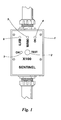
- the power source would normally be a battery and preferably the means to actuate the power source would be a push button ('Test' in Figure 1 ).
- the visual display should be simple to read and interpret and in a preferred embodiment consists of a red/amber/green light (e.g. LEDs) indicating fail/warn/pass.
- the apparatus will be contained in a housing for safety and convenience.
- the housing may be of metal or plastic.
- the apparatus will contain no user-serviceable parts and will have the following indicators and controls:
- the aims of the present invention are to provide an instant indication of system treatment levels. This should give the comfort factor of knowing the system is treated correctly and correct treatment improves system efficiency and longevity of system components.
- the concept of the unit has been extended to encapsulate not only the monitoring of the level of inhibitor but to develop the capabilities of the unit so that it can be used to commission central heating systems.
- the extension of the original idea is to produce a unit that can monitor and control the commissioning process and provide proof or otherwise that the process has been carried out correctly.
- the new central heating system is filled with water and a cleaner is added to give the correct concentration.
- the fluid in the system is then circulated for 1 hour to clean the system of metal oxides, solder and flux residues and to remove any material that entered the system during the fabrication process.
- the proposed instrument will comprise a sensor body tapped each end with 3/4"BSP threads for inclusion directly into the central heating circuit.
- the cleaning chemical and inhibitor will be introduced into the system at any convenient location.
- Conventional liquids or gels can be used to dose the system but for convenience it is envisaged that the cleaning chemical and the inhibitor will be introduced into the system using the Sentinel Rapid Dose concept.
- Sentinel Rapid-Dose is a recyclable, pressurised canister pre-filled with inhibitor (or cleaner) that can be used to dose any indirect central heating system.
- connection means to facilitate in-line connection into the water containing system, e.g. a unit tapped at each end with 3/4"BSP threads for inclusion directly into a central heating circuit.
- the concept relies on the absorbance of light of wavelength in the UV, visible or IR ranges by one or more components of cleaning or inhibitor treatment formulations.
- the source is preferably a light emitting diode (LED) which is preselected to emit UV light at a wavelength which will be absorbed by the chemical selected to be monitored in the water.
- LED light emitting diode
- different additives used sequentially in the commissioning protocol may be detected at the same wavelength by a single LED so long as the different additives contain the same detected component, or components that absorb at the same pre-selected wavelength,
- the concept could include more than one LED emitting at different wavelengths to detect different chemicals in respective additives.
- the apparatus preferably also has automatic compensation for background colouration of the water (typically derived from soluble and insoluble metal corrosion products) by the inclusion of a second UV light source set at a different wavelength to the first UV light source.
- the second UV light emitter/diode will look at a wide band of wavelengths and anything found that is different to the wavelength of the first UV light source is subtracted from the reading.
- the UV light-transparent portion through which water will pass in normal operation of the system, should be of a material able to withstand chemical attack from the water and should be stable at the operating temperature of the water containing system, which in the case of a central heating system would often be in the range 60 to 80 degrees Celsius. Glass would satisfy these requirements but is by nature fragile. A clear plastic would be preferable if a formulation with the ability to withstand the operating conditions could be found.
- the apparatus is shown fitted in-line to the pipe work of a central heating system containing the inhibitor by means of 3/4"BSP threads at each end.
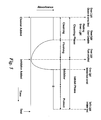
- the casing 1 which is of injection-moulded plastic (see Figure 3 ) is provided with a "Test' button 2, an 'On' LED indicator 3 and a visual display of three LED indicators 4,5,6 marked 'OK'(green), 'Warning'(amber) and 'Alarm'(red) respectively.
- the power source is a PP3 battery 7 and there are two emitters 8,9 (for example UV light sources) which are LEDs.
- the first emitter 8 is set to emit for example UV light at a wavelength known to be absorbed by the chemical in the water selected to be tested (for example 290nm for 1,2,3, Benzotriazole), and the second emitter 9 is set to emit for example UV light at a different wavelength or range of wavelengths away from the wavelength of the first emitter.
- the UV light -transparent portion through which water passes is a tube 10 made of a material able to withstand chemical attack from the water and stable at the operating temperature of the water-containing system with a wall thickness of approximately 1 mm.
- the detector 11 is a photo cell.
- an operative pushes the test button 2, causing power to flow to the two UV light emitters 8,9 (LEDs).
- UV light passes though the water in the tube 10 and to the photo cell 11.
- the level of absorption resulting from the selected chemical is calculated by reference to pre-determined calibration equation and this provides the concentration of that chemical. If the concentration falls within a predetermined range of acceptability the green ('OK') LED 4 is illuminated, if it is within a predetermined range below that the amber ('Warning') LED 5 is illuminated and if it is below that level the red ('Alarm') LED 6 is illuminated. The operative can see immediately whether additional inhibitor needs to be added.
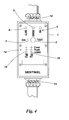
- the apparatus is shown fitted in-line to the pipe work of a central heating system containing the inhibitor by means of 3/4"BSP threads 12,13 at each end.
- the casing 1 which is of injection-moulded plastic (see Figure 3 ) is provided with a "Test' button 2, an 'On' LED indicator 3 and a visual display of three LED indicators 4,5,6 marked 'OK'(green), 'Warning'(amber) and 'Alarm'(red) respectively.
- the Red 'fail' LED lights 15 for clean, flush and inhibit will be lit to indicate a 'fail' situation.
- the top Green LED light for the clean in row 16 will be lit and the top Red LED in row 15 will be turned off.
- the top Green LED light for the clean will activate a timer which will run for 1 hour. During this period the top Green LED light for the clean will flash to indicate the cleaning process is being carried out. When the 1 hour period has elapsed the Green LED light for the clean will remain on constantly to indicate the clean has finished and has been carried out correctly. This indicates a 'pass' condition.
- the next stage of the commissioning sequence is to flush the system.
- the middle Green LED light for the flush in row 16 will be lit and the middle Red LED in row 15 will be turned off.
- the middle Green LED light for the flush will remain on constantly to indicate the flush has finished and has been carried out correctly. This indicates a 'pass' condition.
- the next stage of the commissioning sequence is to inhibit the system.
- the bottom Green LED light for the inhibitor in row 16 will be lit and the bottom Red LED in row 15 will be turned off.
- the Green LED light for the inhibitor will remain on constantly to indicate the inhibitor has been introduced to the correct concentration. This indicates a 'pass' condition.
- the processor When the three Green LED lights in row 16 are lit indicating a 'pass' condition for clean, flush and inhibition the processor will generate a unique number which will be displayed on the LCD screen. This unique number can be texted via a mobile phone to database to confirm the commissioning process has been carried out correctly.
- the level of inhibitor in the system can subsequently be determined by pressing the test button.
- the concept relies on the absorbance of light of wavelength in the UV, visible or IR ranges by one or more components of cleaning or inhibitor treatment formulations.
- the source is preferably a light emitting diode (LED) which is preselected to emit UV light at a wavelength which will be absorbed by the chemical selected to be monitored in the water.
- LED light emitting diode
- different additives used sequentially in the commissioning protocol may be detected at the same wavelength by a single LED so long as the different chemicals contain the same detected component, or components that absorb at the same pre-selected wavelength,
- the concept could include more than one LED emitting at different wavelengths to detect different chemicals in respective additives.
- a sequential serial number will be programmed into each device at manufacture.
- This number will be read by the processor program and converted to an alpha-numeric sequence using base 36 arithmetic (0-9 + A-Z) giving a range of 0-60 million combinations with 5 characters.
- the system status will be made printable and appended to the serial number.
- a 16 bit CRC (cyclic redundancy check) is calculated and also appended giving an 8 character sequence which is displayed on the LCD.
- a CRC is not something that can be easily calculated and will give a good degree of 'tamper proof whilst being simple to implement.
- a code in the processor will check to decipher the serial number and check the CRC to see that is genuine.
- the unit will have a facility to reset the 'pass' and 'fail' lights such that the Red LED lights for clean, flush and inhibit will be lit to indicate a 'fail' situation. This is to allow the unit to monitor and control any subsequent cleans that may be carried out during the life-time of the central heating system.
Landscapes
- Physics & Mathematics (AREA)
- Chemical & Material Sciences (AREA)
- Life Sciences & Earth Sciences (AREA)
- Health & Medical Sciences (AREA)
- Pathology (AREA)
- Analytical Chemistry (AREA)
- Biochemistry (AREA)
- General Health & Medical Sciences (AREA)
- General Physics & Mathematics (AREA)
- Immunology (AREA)
- Engineering & Computer Science (AREA)
- Spectroscopy & Molecular Physics (AREA)
- Medicinal Chemistry (AREA)
- Food Science & Technology (AREA)
- Thermal Sciences (AREA)
- Combustion & Propulsion (AREA)
- Mechanical Engineering (AREA)
- General Engineering & Computer Science (AREA)
- Investigating Or Analysing Materials By Optical Means (AREA)
- Physical Water Treatments (AREA)
Applications Claiming Priority (2)
| Application Number | Priority Date | Filing Date | Title |
|---|---|---|---|
| GBGB0814873.6A GB0814873D0 (en) | 2008-08-14 | 2008-08-14 | In-line testing |
| GBGB0905056.8A GB0905056D0 (en) | 2008-08-14 | 2009-03-25 | In-line testing |
Publications (2)
| Publication Number | Publication Date |
|---|---|
| EP2154267A2 true EP2154267A2 (fr) | 2010-02-17 |
| EP2154267A3 EP2154267A3 (fr) | 2012-04-25 |
Family
ID=39790766
Family Applications (1)
| Application Number | Title | Priority Date | Filing Date |
|---|---|---|---|
| EP09251907A Withdrawn EP2154267A3 (fr) | 2008-08-14 | 2009-07-30 | Dispositif de test en ligne d'un produit chimique dans un système contenant de l'eau |
Country Status (2)
| Country | Link |
|---|---|
| EP (1) | EP2154267A3 (fr) |
| GB (3) | GB0814873D0 (fr) |
Cited By (3)
| Publication number | Priority date | Publication date | Assignee | Title |
|---|---|---|---|---|
| EP2270471A1 (fr) * | 2009-07-03 | 2011-01-05 | Aquanet International Limited | Surveillance et contrôle d'un additif liquide |
| CN103808700A (zh) * | 2012-11-13 | 2014-05-21 | 汎锶科艺股份有限公司 | 农药检测装置 |
| CN115406874A (zh) * | 2017-07-28 | 2022-11-29 | 阿迪控股(2008)有限公司 | 自动测试设备和加药设备的组合 |
Families Citing this family (3)
| Publication number | Priority date | Publication date | Assignee | Title |
|---|---|---|---|---|
| GB2487783B (en) * | 2011-02-04 | 2016-02-24 | Adey Holdings 2008 Ltd | Pressure warning device for a hot water system |
| GB201209738D0 (en) | 2012-05-31 | 2012-07-18 | Ge Healthcare Bio Sciences Ab | Methods and apparatus for measuring the concentration of a substance in a solution |
| US11768133B2 (en) | 2017-07-28 | 2023-09-26 | Adey Holdings (2008) Limited | Chemical testing |
Citations (1)
| Publication number | Priority date | Publication date | Assignee | Title |
|---|---|---|---|---|
| EP0564948A1 (fr) * | 1992-04-09 | 1993-10-13 | Nalco Chemical Company | Contrôle par spectrometrie ultraviolette des inhibiteurs hydrosolubles de corrosion |
Family Cites Families (8)
| Publication number | Priority date | Publication date | Assignee | Title |
|---|---|---|---|---|
| US5125747A (en) * | 1990-10-12 | 1992-06-30 | Tytronics, Inc. | Optical analytical instrument and method having improved calibration |
| CA2106472A1 (fr) * | 1991-03-19 | 1992-09-20 | Boghos Awanes Manook | Appareil de mesure-controle de polluants organiques |
| JPH09304373A (ja) * | 1996-05-16 | 1997-11-28 | Meidensha Corp | 光学式水質測定器による赤水・黒水検知方法及び配水モニタ運転方法 |
| JP2002267595A (ja) * | 2001-03-07 | 2002-09-18 | Dkk Toa Corp | 小型多成分検出器 |
| WO2002074694A2 (fr) * | 2001-03-16 | 2002-09-26 | Ewatertek Inc. | Systeme et procede de transmission et de surveillance de la qualite de l'eau |
| GB0602014D0 (en) * | 2006-02-01 | 2006-03-15 | Salamander Engineering Ltd | Indicator |
| US7550746B2 (en) * | 2006-06-01 | 2009-06-23 | Ecolab Inc. | UV fluorometric sensor and method for using the same |
| GB0911766D0 (en) * | 2009-07-03 | 2009-08-19 | Aquanet Internat Ltd | Monitoring and control of liquid additive |
-
2008
- 2008-08-14 GB GBGB0814873.6A patent/GB0814873D0/en not_active Ceased
-
2009
- 2009-03-25 GB GBGB0905056.8A patent/GB0905056D0/en not_active Ceased
- 2009-07-30 EP EP09251907A patent/EP2154267A3/fr not_active Withdrawn
- 2009-07-30 GB GB0913243.2A patent/GB2462518B/en active Active
Patent Citations (1)
| Publication number | Priority date | Publication date | Assignee | Title |
|---|---|---|---|---|
| EP0564948A1 (fr) * | 1992-04-09 | 1993-10-13 | Nalco Chemical Company | Contrôle par spectrometrie ultraviolette des inhibiteurs hydrosolubles de corrosion |
Cited By (3)
| Publication number | Priority date | Publication date | Assignee | Title |
|---|---|---|---|---|
| EP2270471A1 (fr) * | 2009-07-03 | 2011-01-05 | Aquanet International Limited | Surveillance et contrôle d'un additif liquide |
| CN103808700A (zh) * | 2012-11-13 | 2014-05-21 | 汎锶科艺股份有限公司 | 农药检测装置 |
| CN115406874A (zh) * | 2017-07-28 | 2022-11-29 | 阿迪控股(2008)有限公司 | 自动测试设备和加药设备的组合 |
Also Published As
| Publication number | Publication date |
|---|---|
| GB0913243D0 (en) | 2009-09-02 |
| GB0905056D0 (en) | 2009-05-06 |
| GB2462518A (en) | 2010-02-17 |
| EP2154267A3 (fr) | 2012-04-25 |
| GB2462518B (en) | 2012-11-28 |
| GB0814873D0 (en) | 2008-09-17 |
Similar Documents
| Publication | Publication Date | Title |
|---|---|---|
| GB2462518A (en) | In-line testing of the concentration of a chemical in a water-containing system | |
| US8704174B2 (en) | Refined oil degradation level measuring instrument and refined oil degradation level measuring method | |
| US7349760B2 (en) | System and method for sensing and controlling the concentration of a chemical agent in a solution | |
| KR20190040278A (ko) | 수질 감지 | |
| WO2007143047A1 (fr) | Capteur fluorométrique uv et son procédé d'utilisation | |
| US10041924B2 (en) | Concentration-factor measurement device and method | |
| US5663489A (en) | Methods and apparatus for monitoring water process equipment | |
| HUP0102050A2 (hu) | Eljárás folyamatban használt vizes oldatok tenzidtartalmának automatikus ellenőrzésére és vezérlésére | |
| US5565619A (en) | Methods and apparatus for monitoring water process equipment | |
| CA2074663C (fr) | Moniteur de purete de vapeur | |
| JP2015025792A (ja) | 水質分析装置及び水質分析方法 | |
| US20230017495A1 (en) | Method and apparatus for detecting trace amounts of copper and silver in water | |
| JP2008250858A (ja) | 火災感知器および火災感知器の点検装置 | |
| JP2018036084A (ja) | 水質分析計 | |
| AU743103B2 (en) | Methods and apparatus for monitoring water process equipment | |
| JP2010022899A (ja) | 水中の水処理剤の濃度管理方法、ボイラ水中の水処理剤の濃度管理方法、及びこれら管理方法に用いられる水処理剤 | |
| EP1206694A1 (fr) | Systeme de regeneration automatique d'agent de gravure mettant en oeuvre un capteur tres precis pour le controle de la composition de l'agent de gravure | |
| EP2270471A1 (fr) | Surveillance et contrôle d'un additif liquide | |
| JP2001201497A (ja) | 硬度測定方法 | |
| EP3938757B1 (fr) | Système et procédé de détection d'un composé organique anticorrosion dans un échantillon d'eau | |
| CN205139003U (zh) | 一种探头式水质多参数在线监测仪 | |
| US8912500B1 (en) | UV radiation detector with a replaceable secondary window | |
| JP2008082934A (ja) | 被測定水中の被検成分濃度の測定方法 | |
| CA2785392A1 (fr) | Methode de detection d'une concentration d'ions de chlorate dans une solution aqueuse, appareil de detection d'une concentration d'ions de chlorate et module de controle | |
| GB2434861A (en) | A method of indicating the presence of a material in a liquid storage system |
Legal Events
| Date | Code | Title | Description |
|---|---|---|---|
| PUAI | Public reference made under article 153(3) epc to a published international application that has entered the european phase |
Free format text: ORIGINAL CODE: 0009012 |
|
| AK | Designated contracting states |
Kind code of ref document: A2 Designated state(s): AT BE BG CH CY CZ DE DK EE ES FI FR GB GR HR HU IE IS IT LI LT LU LV MC MK MT NL NO PL PT RO SE SI SK SM TR |
|
| AX | Request for extension of the european patent |
Extension state: AL BA RS |
|
| 17P | Request for examination filed |
Effective date: 20100325 |
|
| RIN1 | Information on inventor provided before grant (corrected) |
Inventor name: FARLEY, BRIAN JOHN Inventor name: DAY, PAUL Inventor name: MAWER, JOHN HENRY Inventor name: MARSHALL, ALAN |
|
| RAP1 | Party data changed (applicant data changed or rights of an application transferred) |
Owner name: AQUANET INTERNATIONAL LIMITED Owner name: SENTINEL PERFORMANCE SOLUTIONS LTD |
|
| RIN1 | Information on inventor provided before grant (corrected) |
Inventor name: EMPTAGE, LESLIE Inventor name: FARLEY, BRIAN JOHN Inventor name: DAY, PAUL Inventor name: MAWER, JOHN HENRY Inventor name: MARSHALL, ALAN |
|
| PUAL | Search report despatched |
Free format text: ORIGINAL CODE: 0009013 |
|
| RIC1 | Information provided on ipc code assigned before grant |
Ipc: G01N 33/18 20060101ALI20120305BHEP Ipc: G01N 21/85 20060101ALI20120305BHEP Ipc: G01N 21/33 20060101ALI20120305BHEP Ipc: C23F 11/08 20060101AFI20120305BHEP |
|
| AK | Designated contracting states |
Kind code of ref document: A3 Designated state(s): AT BE BG CH CY CZ DE DK EE ES FI FR GB GR HR HU IE IS IT LI LT LU LV MC MK MT NL NO PL PT RO SE SI SK SM TR |
|
| AX | Request for extension of the european patent |
Extension state: AL BA RS |
|
| RIC1 | Information provided on ipc code assigned before grant |
Ipc: G01N 33/18 20060101ALI20120316BHEP Ipc: G01N 21/85 20060101ALI20120316BHEP Ipc: G01N 21/33 20060101ALI20120316BHEP Ipc: C23F 11/08 20060101AFI20120316BHEP |
|
| 17Q | First examination report despatched |
Effective date: 20140219 |
|
| GRAP | Despatch of communication of intention to grant a patent |
Free format text: ORIGINAL CODE: EPIDOSNIGR1 |
|
| RIC1 | Information provided on ipc code assigned before grant |
Ipc: G01N 33/18 20060101ALI20150601BHEP Ipc: G01N 21/85 20060101ALI20150601BHEP Ipc: G01N 21/33 20060101AFI20150601BHEP |
|
| INTG | Intention to grant announced |
Effective date: 20150622 |
|
| RIN1 | Information on inventor provided before grant (corrected) |
Inventor name: EMPTAGE, LESLIE Inventor name: MAWER, JOHN HENRY Inventor name: FARLEY, BRIAN JOHN Inventor name: MARSHALL, ALAN Inventor name: DAY, PAUL |
|
| STAA | Information on the status of an ep patent application or granted ep patent |
Free format text: STATUS: THE APPLICATION HAS BEEN WITHDRAWN |
|
| 18W | Application withdrawn |
Effective date: 20150730 |