EP2154641A1 - Procédé et dispositif de conversion de messages entre plusieurs formats de données - Google Patents
Procédé et dispositif de conversion de messages entre plusieurs formats de données Download PDFInfo
- Publication number
- EP2154641A1 EP2154641A1 EP08014531A EP08014531A EP2154641A1 EP 2154641 A1 EP2154641 A1 EP 2154641A1 EP 08014531 A EP08014531 A EP 08014531A EP 08014531 A EP08014531 A EP 08014531A EP 2154641 A1 EP2154641 A1 EP 2154641A1
- Authority
- EP
- European Patent Office
- Prior art keywords
- data format
- message
- electronic message
- electronic
- format
- Prior art date
- Legal status (The legal status is an assumption and is not a legal conclusion. Google has not performed a legal analysis and makes no representation as to the accuracy of the status listed.)
- Withdrawn
Links
Images

Classifications
-
- G—PHYSICS
- G06—COMPUTING OR CALCULATING; COUNTING
- G06Q—INFORMATION AND COMMUNICATION TECHNOLOGY [ICT] SPECIALLY ADAPTED FOR ADMINISTRATIVE, COMMERCIAL, FINANCIAL, MANAGERIAL OR SUPERVISORY PURPOSES; SYSTEMS OR METHODS SPECIALLY ADAPTED FOR ADMINISTRATIVE, COMMERCIAL, FINANCIAL, MANAGERIAL OR SUPERVISORY PURPOSES, NOT OTHERWISE PROVIDED FOR
- G06Q10/00—Administration; Management
-
- G—PHYSICS
- G06—COMPUTING OR CALCULATING; COUNTING
- G06Q—INFORMATION AND COMMUNICATION TECHNOLOGY [ICT] SPECIALLY ADAPTED FOR ADMINISTRATIVE, COMMERCIAL, FINANCIAL, MANAGERIAL OR SUPERVISORY PURPOSES; SYSTEMS OR METHODS SPECIALLY ADAPTED FOR ADMINISTRATIVE, COMMERCIAL, FINANCIAL, MANAGERIAL OR SUPERVISORY PURPOSES, NOT OTHERWISE PROVIDED FOR
- G06Q30/00—Commerce
Definitions
- the present invention relates to the field of Electronic Data Interchange (EDI). More particularly, it relates to a computer-implemented method and a device for automatically converting messages between different data formats.
- the present invention also relates to a computer-implemented tool for generating new routines or modules automatically, given a sample message and a database of given modules for automatically converting messages between different data formats.
- Electronic Data Interchange may be defined as the computer-to-computer interchange of strictly formatted messages that represent documents. EDI implies a sequence of messages between two parties, either of whom may serve as originator or recipient. The formatted data representing the documents may be transmitted from originator to recipient by telecommunications or physically transported on electronic storage media.
- EDI EDI
- the usual processing of received messages is by computer only. Human intervention in the processing of a received message is typically intended only for error conditions, for quality review and for special situations.
- the transmission of binary or textual data is not EDI according to this definition, unless the data are treated as one or more data elements often EDI message and are not normally intended for human interpretation as part of online data processing ( Kantor, M. et al., April 29, 1996, Electronic Data Interchange EDI, National Institute of Standards and Technology ).
- message data formats In order to be interpretable by the receiver, message data formats must conform to a known structure.
- SWIFT for banks
- UN/EDIFACT for banks
- UN/EDIFACT for banks
- ANSI ASC X12 for banks
- GTDI for subcarrier X12
- GTDI for subcarrier X12
- VDA for subcarrier X12
- ODETTE Fortras
- a data format is characterized by a message's syntax and its semantics, wherein the syntax defines the structure of the message in terms of message components and their ordering and the semantics define the interpretation or meaning of the message components.
- modules for automatically converting messages or data between different formats have been built by hand, by a skilled person knowing both the data format of the sender and the data format of the receiver, e.g. a programmer.
- These message mapping modules or schemes also called converters, have a fixed association with a particular sender/receiver and convert a message from one format to another, thereby changing its syntax, its semantics and also the content possibly.
- the message mapping modules or converters may also be called participant or partner modules.
- message mapping systems according to the state of the art invoke a matching message conversion scheme based on the identity of the sender/receiver and the message format that is associated with them. As every sender and every receiver may use a different format for the same messages or data, potentially a large number of modules for automatically converting messages between different formats must be created and pre-installed.
- libraries/repositories of already existing modules for automatically converting data or messages between different formats are used.
- Such a module library/repository or database may often further reduce the task of creating a new module to selecting a most suitable or similar module from the library/repository and adapting it to a new message format.
- the method must also be adaptive in order to accommodate changing message format standards.
- a computer-implemented method for converting messages between different data formats in a network for electronic data interchange may comprise the steps of receiving (110) an electronic message from a participant of the network; determining (120) at least one first possible data format of the electronic message, based on the content of the electronic message; validating (130) the electronic message, based on the at least one first possible data format; and converting (140) the message from the first data format into a second predetermined data format, if the validating step succeeds.
- the at least one first possible data format may be determined automatically. Thereby, new participants may be integrated into the electronic data interchange system without manual intervention of a system administrator, associating a particular participant with a particular data format manually.
- the method may determine a plurality of first possible data formats of the electronic message, e.g. based on a likelihood, that the message complies with a given data format.
- the fact that a plurality of first possible data formats is automatically determined, instead of one, may be compensated by validating each of the entire determined set of possible data formats, resulting again in one single data format, if validation succeeds.
- the at least one possible data format may be determined from a machine-readable non-volatile memory comprising a multitude of possible data formats.
- the determination of possible data formats may be reduced to a search in the database.
- the probability of successfully determining and validating a matching data format may also be increased by simply extending the database.
- the step of converting may comprise the steps of retrieving a predetermined message mapping scheme associated with the first data format; and applying the predetermined message mapping scheme to the electronic message in order to convert it into the second data format.
- an association of the participant and the first data format may be stored in a machine-readable non-volatile memory for future reference, if the validating step succeeds.
- a single data format is associated with several participants, this allows an efficient storage of data formats ('call-by-reference').
- changes in the data format only have to be effected once and become immediately valid for all associated participants.
- the step of determining may comprise the steps of checking, whether an association of the participant and an associated data format has already been stored in the machine-readable non-volatile memory; and using the associated data format as the at least one possible data format of the electronic message, if yes.
- the determination of the data-format of an electronic message may take the identity of the sending participant into account, thereby reducing e.g. necessary search operations for a pertinent data format.
- the step of validating may comprise the steps of automatically requesting the participant to confirm the first data format via an electronic communication channel; and validating the electronic message if the first data format is confirmed by the participant.
- this aspect provides the advantage of automatically leveraging a participant's input.
- the electronic message may also be validated automatically, using the confirmed data format and validation rules associated with it, thereby validating the participant's confirmation in turn and hence providing an additional level of security.
- a request for confirming a data format for an invoice may comprise sending an actual invoice document generated using the data format to be confirmed, e.g. as a fax or pdf document to the participant and asking whether the actual invoice document conforms to the participants intentions.
- the data format may be determined based on a proper subset of bits of the electronic message, having a predetermined size.
- the subset of bits may be an initial bit sequence of the electronic message.
- the data format may further be determined based on statistical evaluations of the electronic message, e.g. on the number of angular brackets or ' ⁇ ' and '>'signs in a message, wherein a high number indicates an XML-document or the number of colons or ':' signs, indicating an EDI document. Using this additional information, cases of doubt may be resolved when the (initial) bit sequence is not decisive.
- the first possible data format of the electronic message may be determined using a neural network.
- a neural network By this, associations between contents of an electronic message and data formats may be learned automatically by a supervised learning algorithm, thereby rendering the method e.g. adaptive with respect to later additions of new data formats or changes within already existing data formats.
- neural networks have the capability to generalize from a set of training samples, thereby reducing a complexity of the system when compared with a hard-wiring approach.
- data format recognition does not fail due to a rigid recognition step.
- the fact that the neural network may determine a plurality of first possible data formats may be compensated by validating each of the entire determined set of possible data formats, resulting again in one single data format, if validation succeeds.
- a system for converting messages between different data formats in a network for electronic data interchange may comprise a back-end server and a front-end server, the front-end server comprising means for receiving an electronic message from a participant of the network; means for determining at least one first possible data format of the electronic message; means for validating the electronic message, based on the at least one first possible data format; and means for converting the message from the first data format into a second predetermined data format, if the validating step succeeds.
- EDI electronic data interchange
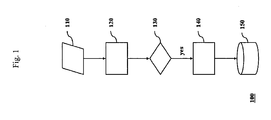
- Figure 1 shows a flowchart of a method for converting messages between different formats according to an embodiment of the invention.
- step 110 a message having a given data format is received form a participant in a network for electronic data interchange.
- the data format of the electronic message may be unknown.
- a format of the message may be determined or recognized by analyzing the message.
- the determination step determines at least one possible data format for the electronic message.
- step 130 the message is validated, based on the determined format.
- the step of validating may comprise checking whether the syntax of the message complies with the identified data format.
- the step of validating may comprise applying a set of validation rules to the message, wherein the validation rules are associated with the determined data format.
- step 140 the procedure may raise an exception indicating that the message is not valid.
- the validation step may be repeated for all members of the plurality of data formats. Assuming that the formats are disjoint, i.e. that a message always belongs to a single format, the plurality of data formats may then be reduced by validation to a single format.
- the step of validating the message may comprise the further steps of retrieving a module for automatically converting messages between different data formats associated with the determined format.
- the module may comprise rules for validating the message. Validating then comprises applying these format-specific rules comprised in the module.
- step 140 the message is automatically converted from the input format to an output format associated with the determined input format.
- the format of the message is converted to an internal standard format for further processing.
- the step of automatically converting uses the above-mentioned module, which may further comprise format-specific definitions for mapping the input format to an output format.
- the automatically converted message may be written to an intermediate storage 150, before further processing.
- the rule definition may be kept in the system as a binary file, for rapid processing. If validation fails, the whole process may be cancelled by raising an exception.
- the message may be recognized in step 120 by a neural network.
- the neural network is a multi-layer perceptron.
- a multi-layer perceptron comprises, besides an input and an output layer, also further hidden layers that define an input-to-output mapping of the neural network.
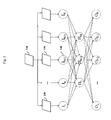
- Figure 3 shows a multilayer neural network used for determining a data format of a message according to an embodiment of the invention
- the received message 310 is first processed to obtain inputs 320, 330 etc. for different input nodes of the multi layer neural network.
- a feature map may be applied to the electronic message in order to extract a feature vector whose components are indicative of the possible message format.
- the first input 320 to the neural network may be given by a proper subset of bits of the received electronic message.
- the proper subset of bits is an initial sequence of bits of the electronic message, as EDI messages usually include identifying content at the beginning of the message.
- input 330 may comprise the results of statistical evaluations of the electronic message, for example the number of brackets or colons used in the messages, which indicate different data formats (XML, EDI or others).
- the inputs obtained from processing the received electronic message or the feature vector components are then individually fed into the different input nodes I 1 , ..., IN of the neural network.
- the neural network shown in figure 3 comprises a single hidden layer of so-called hidden neurons H 1 , ..., H M . Each input neuron is mapped to each hidden neuron first. Then the output of each hidden neuron is mapped to each of the so-called output neurons O 1 to O P ..
- a perceptron may comprise an input and an output layer and two (2) layers of hidden neurons. Every layer may comprise 512 neurons. Every neuron of a particular layer is fully connected with every neuron of the next layer (feedforward network). Thus, this particular network has 786.000 nodes, each node having an individual weight. Hence, the neural network may address 512 different formats uniquely. In total, 2 512 different formats may be addressed by a neural network
- 2 512 different formats may be input into the neural network for recognition.
- the first 512 bits of a message may be input into the system.
- the entire content of the message may be subjected to a statistical evaluation.
- the result may be represented by a 240 bit value, input to the neural network.
- 276 bits representing selected contents of the message e.g. bits from different positions of the message, are input to the network.
- 2 240 * 2 276 different input formats may be recognized.
- Structural criteria as well as the content of the message may be used for format recognition.
- the network may be trained using a backpropagation method. Only the input message and the expected result are needed for this training. Tests of the inventors have shown that different formats may correctly be recognized after around 20 training cycles.
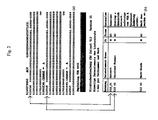
- Figure 4 shows an example of a table defining a set of mapping rules for mapping the contents of the incoming message to a different format
- the contents may be associated with standardized fields in a central database and then written to the database, as specified by the rules.
- the first column of the table defines a source field of an incoming message by stating the EDI "as" of the field of the inbound message. More particularly, each row in the first column comprises a sequence of 3D distinct numerals delimited by angular brackets, wherein the first numeral, here ⁇ 5110>, describes the type of the message. Second numeral in the sequence, e.g. ⁇ 511>, describes the "Satzart" (record type). The third numeral in sequence, e.g. ⁇ 511_03>, designates the data element or field within the structure of the source message.
- the second column term "business process repository”, rising three sub-columns "Feld, Beonia” and “Level” defines the target, to which the source information is to be mapped. More particularly, the column termed “Feld” defines for each field in the source message having a particular EDI-path described in a row of column 1 to which field in the target structure the information is to be mapped. E.g., the content of the field designated by the EDI-path ⁇ 5110 ⁇ 511> ⁇ 511_03> is mapped to field "a35#01".
- the second column termed “Bezeichung” comprises a natural language description of the meaning of the field defined in the second sub-column.
- the third sub-column defines a so-called “hierarchy level", which is a further aspect of the target structure, not relevant to the invention.
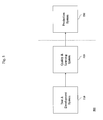
- Figure 5 shows an architecture 500 of an application system for converting messages according to an embodiment of the invention.
- the architecture comprises three individual systems 510, 520 and 530.
- a test and development system 510 may be used for learning individual formats and associating them with a set of transformation rules.
- a quality and learning system 520 may be used for learning the format learned in the first system, in the context of all other already known formats.
- a production system 530 may be used as an actual production system that inherits the knowledge derived in the second system 520.
- the inventive system is given data or messages whose format is not already known, then it is able to derive a most similar format.
- the inventive system may automatically recognise and process it from this moment on.
Landscapes
- Business, Economics & Management (AREA)
- Engineering & Computer Science (AREA)
- General Physics & Mathematics (AREA)
- Theoretical Computer Science (AREA)
- Economics (AREA)
- Marketing (AREA)
- Strategic Management (AREA)
- Physics & Mathematics (AREA)
- General Business, Economics & Management (AREA)
- Finance (AREA)
- Development Economics (AREA)
- Accounting & Taxation (AREA)
- Entrepreneurship & Innovation (AREA)
- Human Resources & Organizations (AREA)
- Operations Research (AREA)
- Quality & Reliability (AREA)
- Tourism & Hospitality (AREA)
- Information Transfer Between Computers (AREA)
- Computer And Data Communications (AREA)
Priority Applications (4)
| Application Number | Priority Date | Filing Date | Title |
|---|---|---|---|
| EP08014531A EP2154641A1 (fr) | 2008-08-14 | 2008-08-14 | Procédé et dispositif de conversion de messages entre plusieurs formats de données |
| DE112009002000.3T DE112009002000B4 (de) | 2008-08-14 | 2009-08-13 | Adaptives Verfahren und Vorrichtung zur Umwandlung von Nachrichten zwischen unterschiedlichen Datenformaten |
| US13/058,597 US20110173346A1 (en) | 2008-08-14 | 2009-08-13 | Adaptive method and device for converting messages between different data formats |
| PCT/EP2009/005880 WO2010017985A1 (fr) | 2008-08-14 | 2009-08-13 | Procédé et dispositif adaptatifs de conversion de messages entre différents formats de données |
Applications Claiming Priority (1)
| Application Number | Priority Date | Filing Date | Title |
|---|---|---|---|
| EP08014531A EP2154641A1 (fr) | 2008-08-14 | 2008-08-14 | Procédé et dispositif de conversion de messages entre plusieurs formats de données |
Publications (1)
| Publication Number | Publication Date |
|---|---|
| EP2154641A1 true EP2154641A1 (fr) | 2010-02-17 |
Family
ID=40032882
Family Applications (1)
| Application Number | Title | Priority Date | Filing Date |
|---|---|---|---|
| EP08014531A Withdrawn EP2154641A1 (fr) | 2008-08-14 | 2008-08-14 | Procédé et dispositif de conversion de messages entre plusieurs formats de données |
Country Status (4)
| Country | Link |
|---|---|
| US (1) | US20110173346A1 (fr) |
| EP (1) | EP2154641A1 (fr) |
| DE (1) | DE112009002000B4 (fr) |
| WO (1) | WO2010017985A1 (fr) |
Families Citing this family (22)
| Publication number | Priority date | Publication date | Assignee | Title |
|---|---|---|---|---|
| US20100138323A1 (en) * | 2008-12-01 | 2010-06-03 | Sap Ag | Flexible correspondence solution enhancing straight-through processing in treasury systems |
| US10938868B2 (en) * | 2012-12-07 | 2021-03-02 | Unisys Corporation | Application service integration |
| US9667740B2 (en) | 2013-01-25 | 2017-05-30 | Sap Se | System and method of formatting data |
| US20140297321A1 (en) * | 2013-03-30 | 2014-10-02 | Mckesson Financial Holdings | Method and apparatus for mapping message data |
| US9483476B2 (en) | 2013-04-03 | 2016-11-01 | Sap Se | System decommissioning through reverse archiving of data |
| CN104123309B (zh) * | 2013-04-28 | 2017-08-25 | 国际商业机器公司 | 用于数据管理的方法和系统 |
| US10679140B2 (en) * | 2014-10-06 | 2020-06-09 | Seagate Technology Llc | Dynamically modifying a boundary of a deep learning network |
| US10387888B2 (en) | 2016-07-08 | 2019-08-20 | Asapp, Inc. | Assisting entities in responding to a request of a user |
| US10083451B2 (en) | 2016-07-08 | 2018-09-25 | Asapp, Inc. | Using semantic processing for customer support |
| US10109275B2 (en) | 2016-12-19 | 2018-10-23 | Asapp, Inc. | Word hash language model |
| US10497004B2 (en) | 2017-12-08 | 2019-12-03 | Asapp, Inc. | Automating communications using an intent classifier |
| US10489792B2 (en) * | 2018-01-05 | 2019-11-26 | Asapp, Inc. | Maintaining quality of customer support messages |
| US10169315B1 (en) | 2018-04-27 | 2019-01-01 | Asapp, Inc. | Removing personal information from text using a neural network |
| US10810223B2 (en) | 2018-06-14 | 2020-10-20 | Accenture Global Solutions Limited | Data platform for automated data extraction, transformation, and/or loading |
| US11216510B2 (en) | 2018-08-03 | 2022-01-04 | Asapp, Inc. | Processing an incomplete message with a neural network to generate suggested messages |
| US10747957B2 (en) | 2018-11-13 | 2020-08-18 | Asapp, Inc. | Processing communications using a prototype classifier |
| US11551004B2 (en) | 2018-11-13 | 2023-01-10 | Asapp, Inc. | Intent discovery with a prototype classifier |
| WO2020191028A1 (fr) * | 2019-03-18 | 2020-09-24 | Siraj Technologies Ltd. | Convertisseur universel, dispositifs d'alimentation et poussoirs destinés à la connectivité de l'internet des objets industriel |
| US10992614B1 (en) * | 2019-10-21 | 2021-04-27 | Slack Technologies, Inc. | Format-dynamic string processing in group-based communication systems |
| US11425064B2 (en) | 2019-10-25 | 2022-08-23 | Asapp, Inc. | Customized message suggestion with user embedding vectors |
| US11165735B1 (en) * | 2020-08-31 | 2021-11-02 | Accenture Global Solutions Limited | Email validation |
| US12147777B2 (en) | 2022-12-01 | 2024-11-19 | International Business Machines Corporation | Experience based dispatch of regulated workloads in a cloud environment |
Citations (5)
| Publication number | Priority date | Publication date | Assignee | Title |
|---|---|---|---|---|
| US5557780A (en) * | 1992-04-30 | 1996-09-17 | Micron Technology, Inc. | Electronic data interchange system for managing non-standard data |
| US5608874A (en) * | 1994-12-02 | 1997-03-04 | Autoentry Online, Inc. | System and method for automatic data file format translation and transmission having advanced features |
| US20050138051A1 (en) * | 2003-12-19 | 2005-06-23 | Gardner Michael J. | Method for processing Electronic Data Interchange (EDI) data from multiple customers |
| US20060041840A1 (en) * | 2004-08-21 | 2006-02-23 | Blair William R | File translation methods, systems, and apparatuses for extended commerce |
| US20070143665A1 (en) * | 2005-12-16 | 2007-06-21 | Microsoft Corporation | XML specification for electronic data interchange (EDI) |
Family Cites Families (3)
| Publication number | Priority date | Publication date | Assignee | Title |
|---|---|---|---|---|
| US6772180B1 (en) * | 1999-01-22 | 2004-08-03 | International Business Machines Corporation | Data representation schema translation through shared examples |
| GB2419432A (en) * | 2004-10-20 | 2006-04-26 | Ibm | A method and system for creating hierarchical classifiers of software components in natural language processing |
| US20070288254A1 (en) * | 2006-05-08 | 2007-12-13 | Firestar Software, Inc. | System and method for exchanging transaction information using images |
-
2008
- 2008-08-14 EP EP08014531A patent/EP2154641A1/fr not_active Withdrawn
-
2009
- 2009-08-13 DE DE112009002000.3T patent/DE112009002000B4/de active Active
- 2009-08-13 US US13/058,597 patent/US20110173346A1/en not_active Abandoned
- 2009-08-13 WO PCT/EP2009/005880 patent/WO2010017985A1/fr not_active Ceased
Patent Citations (5)
| Publication number | Priority date | Publication date | Assignee | Title |
|---|---|---|---|---|
| US5557780A (en) * | 1992-04-30 | 1996-09-17 | Micron Technology, Inc. | Electronic data interchange system for managing non-standard data |
| US5608874A (en) * | 1994-12-02 | 1997-03-04 | Autoentry Online, Inc. | System and method for automatic data file format translation and transmission having advanced features |
| US20050138051A1 (en) * | 2003-12-19 | 2005-06-23 | Gardner Michael J. | Method for processing Electronic Data Interchange (EDI) data from multiple customers |
| US20060041840A1 (en) * | 2004-08-21 | 2006-02-23 | Blair William R | File translation methods, systems, and apparatuses for extended commerce |
| US20070143665A1 (en) * | 2005-12-16 | 2007-06-21 | Microsoft Corporation | XML specification for electronic data interchange (EDI) |
Non-Patent Citations (2)
| Title |
|---|
| KANTOR, M. ET AL., ELECTRONIC DATA INTERCHANGE EDI, NATIONAL INSTITUTE OF STANDARDS AND TECHNOLOGY, 29 April 1996 (1996-04-29) |
| R M HARRIS: "Using Artificial Neural Networks for Forensic File Type Identification", 11 May 2007 (2007-05-11), Purdue University, XP002506482, Retrieved from the Internet <URL:https://www.cerias.purdue.edu/assets/pdf/bibtex_archive/2007-19.pdf> [retrieved on 20081201] * |
Also Published As
| Publication number | Publication date |
|---|---|
| DE112009002000B4 (de) | 2020-04-09 |
| WO2010017985A1 (fr) | 2010-02-18 |
| DE112009002000T5 (de) | 2013-01-03 |
| US20110173346A1 (en) | 2011-07-14 |
Similar Documents
| Publication | Publication Date | Title |
|---|---|---|
| EP2154641A1 (fr) | Procédé et dispositif de conversion de messages entre plusieurs formats de données | |
| US10747858B2 (en) | Dynamic digital consent | |
| US9372721B2 (en) | System for processing data received from various data sources | |
| US11386177B2 (en) | System and method for document data extraction, data indexing, data searching and data filtering | |
| EP3588376A1 (fr) | Système et procédé d'enrichissement de données extraites ocr | |
| CN110362476A (zh) | 数据转换工具的验证方法、装置、计算机设备和存储介质 | |
| JP2022020543A (ja) | 技能用語評定方法および装置、電子機器、コンピュータ読み取り可能な媒体 | |
| CN121072476A (zh) | 端到端的多模态信息抽取方法、装置、电子设备及存储介质 | |
| US20170255649A1 (en) | System For Using Login Information And Historical Data To Determine Processing For Data Received From Various Data Sources | |
| CN120725813A (zh) | 一种智能审核方法、装置、设备及存储介质 | |
| US20250217799A1 (en) | Machine learning based systems and methods for identification of payment information from electronic mails | |
| CN119579121A (zh) | 基于多模态大语言模型的人力资源主数据管理录入方法 | |
| CN117591561A (zh) | 指标数据获取方法、装置、存储介质及电子设备 | |
| US7437714B1 (en) | Category partitioning markup language and tools | |
| CN116150723A (zh) | 一种行政审批流程权限的识别方法 | |
| CN116402056A (zh) | 文档信息的处理方法、装置及电子设备 | |
| CN115687471A (zh) | 查询业务处理方法、系统、装置、设备、介质和产品 | |
| US20210286988A1 (en) | Computer-implemented method for detecting document content from a document | |
| JP7405287B1 (ja) | 情報処理装置、コンピュータプログラム及び情報処理方法 | |
| US12541376B1 (en) | System and method for automated proxy autoconfiguration files | |
| US20240330252A1 (en) | Migrating databases for instances of a wire-transfer application between computing environments | |
| CN121808227A (zh) | 文档识别方法及计算机程序产品 | |
| CN121659966A (zh) | 英语笔译译文质量自动评估与优化修正系统及方法 | |
| CN120807120A (zh) | 模型训练方法、装置、设备、介质和程序产品 | |
| CN119514525A (zh) | 错误码的识别方法、装置、设备及存储介质 |
Legal Events
| Date | Code | Title | Description |
|---|---|---|---|
| PUAI | Public reference made under article 153(3) epc to a published international application that has entered the european phase |
Free format text: ORIGINAL CODE: 0009012 |
|
| AK | Designated contracting states |
Kind code of ref document: A1 Designated state(s): AT BE BG CH CY CZ DE DK EE ES FI FR GB GR HR HU IE IS IT LI LT LU LV MC MT NL NO PL PT RO SE SI SK TR |
|
| AX | Request for extension of the european patent |
Extension state: AL BA MK RS |
|
| AKY | No designation fees paid | ||
| STAA | Information on the status of an ep patent application or granted ep patent |
Free format text: STATUS: THE APPLICATION IS DEEMED TO BE WITHDRAWN |
|
| 18D | Application deemed to be withdrawn |
Effective date: 20100818 |
|
| REG | Reference to a national code |
Ref country code: DE Ref legal event code: 8566 |