EP2154834A1 - Dispositif d'acheminement doté d'un pare-feu orienté MPLS intégré - Google Patents
Dispositif d'acheminement doté d'un pare-feu orienté MPLS intégré Download PDFInfo
- Publication number
- EP2154834A1 EP2154834A1 EP20090167142 EP09167142A EP2154834A1 EP 2154834 A1 EP2154834 A1 EP 2154834A1 EP 20090167142 EP20090167142 EP 20090167142 EP 09167142 A EP09167142 A EP 09167142A EP 2154834 A1 EP2154834 A1 EP 2154834A1
- Authority
- EP
- European Patent Office
- Prior art keywords
- firewall
- vpn
- router
- packet
- packets
- Prior art date
- Legal status (The legal status is an assumption and is not a legal conclusion. Google has not performed a legal analysis and makes no representation as to the accuracy of the status listed.)
- Granted
Links
Images




Classifications
-
- H—ELECTRICITY
- H04—ELECTRIC COMMUNICATION TECHNIQUE
- H04L—TRANSMISSION OF DIGITAL INFORMATION, e.g. TELEGRAPHIC COMMUNICATION
- H04L63/00—Network architectures or network communication protocols for network security
- H04L63/02—Network architectures or network communication protocols for network security for separating internal from external traffic, e.g. firewalls
- H04L63/0272—Virtual private networks
-
- H—ELECTRICITY
- H04—ELECTRIC COMMUNICATION TECHNIQUE
- H04L—TRANSMISSION OF DIGITAL INFORMATION, e.g. TELEGRAPHIC COMMUNICATION
- H04L12/00—Data switching networks
- H04L12/28—Data switching networks characterised by path configuration, e.g. LAN [Local Area Networks] or WAN [Wide Area Networks]
- H04L12/46—Interconnection of networks
- H04L12/4633—Interconnection of networks using encapsulation techniques, e.g. tunneling
-
- H—ELECTRICITY
- H04—ELECTRIC COMMUNICATION TECHNIQUE
- H04L—TRANSMISSION OF DIGITAL INFORMATION, e.g. TELEGRAPHIC COMMUNICATION
- H04L12/00—Data switching networks
- H04L12/28—Data switching networks characterised by path configuration, e.g. LAN [Local Area Networks] or WAN [Wide Area Networks]
- H04L12/46—Interconnection of networks
- H04L12/4641—Virtual LANs, VLANs, e.g. virtual private networks [VPN]
-
- H—ELECTRICITY
- H04—ELECTRIC COMMUNICATION TECHNIQUE
- H04L—TRANSMISSION OF DIGITAL INFORMATION, e.g. TELEGRAPHIC COMMUNICATION
- H04L45/00—Routing or path finding of packets in data switching networks
- H04L45/02—Topology update or discovery
- H04L45/04—Interdomain routing, e.g. hierarchical routing
-
- H—ELECTRICITY
- H04—ELECTRIC COMMUNICATION TECHNIQUE
- H04L—TRANSMISSION OF DIGITAL INFORMATION, e.g. TELEGRAPHIC COMMUNICATION
- H04L45/00—Routing or path finding of packets in data switching networks
- H04L45/50—Routing or path finding of packets in data switching networks using label swapping, e.g. multi-protocol label switch [MPLS]
-
- H—ELECTRICITY
- H04—ELECTRIC COMMUNICATION TECHNIQUE
- H04L—TRANSMISSION OF DIGITAL INFORMATION, e.g. TELEGRAPHIC COMMUNICATION
- H04L45/00—Routing or path finding of packets in data switching networks
- H04L45/60—Router architectures
-
- H—ELECTRICITY
- H04—ELECTRIC COMMUNICATION TECHNIQUE
- H04L—TRANSMISSION OF DIGITAL INFORMATION, e.g. TELEGRAPHIC COMMUNICATION
- H04L63/00—Network architectures or network communication protocols for network security
- H04L63/02—Network architectures or network communication protocols for network security for separating internal from external traffic, e.g. firewalls
- H04L63/0227—Filtering policies
Definitions
- the invention relates to computer networks and, more specifically, network devices that route packets within computer networks.
- a computer network is a collection of interconnected computing devices that exchange data and share resources.
- the computing devices communicate data by dividing the data into small blocks called packets.
- the packets are individually routed across the network from a source device to a destination device.
- the destination device extracts the data from the packets and assembles the data into its original form. Dividing the data into packets enables the source device to resend only those individual packets that may be lost during transmission.
- a private network may include a number of devices, such as computers, owned or administered by a single enterprise. These devices may be grouped into a number of site networks, and these sites in turn may be geographically distributed over a wide area. Each site network may include one or more local area networks (LANs) connecting the devices at the particular site.
- LANs local area networks
- VPN Virtual Private Network
- a hub or central VPN site may be the network at the headquarters of the enterprise, while spoke site networks are typically networks at geographically distributed branch offices, sales offices, manufacturing or distribution facilities, or other remote site of the enterprise.
- the remote sites may establish VPN tunnels to hub site or between the remote sites to allow the computing devices within the remote sites to securely communicate with each other or with devices at the hub site through the Internet or another public network infrastructure of a network service provider.
- a number of communication protocols have been developed for establishing a VPN tunnel. In general, these protocols allow network devices to establish the VPN tunnel as one or more secure data flows across the public network infrastructure. For example, Internet Protocol Security (IPSec) protocols and Secure Sockets Layer (SSL) protocols make use of cryptographic technology to establish network "tunnels.” These tunnels allow packets conforming to other network protocols, such as Internet Protocol (IP) packets, to be encapsulated within encrypted packet streams flowing between the sites.
- IP Internet Protocol
- each customer site may include a customer edge router that is coupled via a network link to a corresponding provider edge router within the service provider network.
- the provider edge routers provide VPN services so that the customer's traffic is securely communicated between the VPN sites through the service provider's network and possibly other intermediate networks.
- VPN services provided by the network service provider is a multiprotocol label switching (MPLS) VPN.
- MPLS multiprotocol label switching
- an MPLS VPN utilizes creates label switched paths (LSPs) for carrying the customer's VPN traffic through the intermediate networks via defined paths. That is, the routers of the service provider's network support MPLS and establish LSPs between the customer's sites for carrying the customer's VPN traffic.
- LSPs label switched paths
- a firewall is typically a dedicated device that is configured to permit or deny traffic flows based on the service provider's security policies.
- MPLS traffic flowing through a firewall typically has no state in the data plane. That is, MPLS traffic consists of MPLS labels attached to encapsulated traffic, such as IP traffic. When passing through the firewall, the MPLS labels attached to MPLS packets typically have no meaning to the firewall. As such, the firewall device is unable to provide stateful analysis of the MPLS traffic, such as application of deep packet inspection using assembled application layer data.
- firewall devices are located entirely outside of the MPLS core of the service provider network and are able to apply firewall policies to Internet-Protocol (IP)-based traffic from each customer site external to the MPLS core.
- IP Internet-Protocol
- deployment of these firewall devices increases the number of devices that the service provider must manage and deploy. This increases the configuration and management burden on the service provider, as well as creates power, thermal, cooling, rack space and other issues for the administrator.
- an MPLS-aware firewall that allows firewall security policies to be applied to MPLS traffic.
- the MPLS-aware firewall may be integrated within a routing device, thus allowing a single device to provide both routing functionality, including MPLS support, as well as firewall services.
- a service provider may deploy a single device as described herein to provide MPLS VPN services to customers as well as apply firewall policies to the customer's MPLS VPN traffic.
- the techniques described herein may allow the service providers to avoid the requirement to deploy separate routers and non-MPLS aware firewalls when providing MPLS VPN services.
- the techniques described herein may be applied to achieve zone-based firewall services that allow zone-based security policies to be defined and applied for the different network interfaces of the firewall.
- the device described herein allows security zones to be defined for VPN tunnels carrying communications for customer VPNs. That is, the device provides a user interface by which VPN tunnels can be defined as logical interfaces for purposes of security policies, and these logical interfaces can be used like other physical interfaces to define zones to which policies are to be applied by the device.
- the invention is directed to a network router comprising a plurality of interfaces configured to send and receive packets, and a routing engine having a control unit that executes a routing protocol to maintain routing information specifying routes through a network, wherein the control unit executes at least one protocol to establish VPN tunnels for one or more customer VPNs.
- the network router further includes a forwarding engine configured by the routing engine to select next hops for the packets in accordance with the routing information, the forwarding plane having a switch fabric to forward the packets to the interfaces based on the selected next hops.
- the network router also includes a firewall integrated within the network router, the firewall configured to apply security functions to the packets.
- a flow control module of the forwarding engine directs one or more of the packets to the integrated firewall for application of the stateful firewall services.
- the network router provides a user interface by which a user specifies one or more zones to be recognized by the firewall when applying the stateful firewall services to the packets.
- the example user interface supports a text-based syntax that allows the user to define the zones by specifying the customer VPNs as interfaces associated with the zones. In other examples, a graphical user interface may readily be used.
- the user interface may be remotely accessed or deployed by a web browser, a management and provisioning system, or other device.
- a method in another embodiment, includes executing, with a routing engine of a router, at least one protocol to establish virtual private (VPN) tunnels for customer VPNs.
- the method further includes presenting, with the network router, a user interface by which a user specifies one or more zones to be recognized by a firewall integrated within the router, wherein the user interface supports a syntax that allows the user to define the zones by specifying one or more of the VPN tunnels for the customer VPNs as interfaces associated with the zones.
- VPN virtual private
- the method further includes receiving, from a network, packets at a plurality of interfaces of the router; directing, with a flow control module of a forwarding engine of the router, one or more of the received packets to the firewall for application of stateful firewall services; and applying stateful firewall services to the packets with the firewall of the network router based on the zones specified by the user. Further, the method includes, after applying stateful firewall services, forwarding at least some of the packets from the firewall to the forwarding engine; selecting next hops for the packets within the network with the forwarding engine; and forwarding the packets to the interfaces in accordance with the selected next hops.
- the integrated router and MPLS-aware firewall described herein may have certain advantages over conventional firewalls.
- device is able to provide firewall services that require deep packet inspection using assembled application layer data even though the VPN traffic may be encapsulated with one or more labels and, thus, typically has no state in the data plane.
- the integrated router and MPLS-aware firewall can apply intrusion detection and prevention, virus scanning, layer seven application layer security services and other services that require stateful analysis of the MPLS traffic carried over a VPN.
- the integrated router and MPLS-aware firewall may have certain advantages when deployed at the edge of a service provider network that provides MPLS-based VPN services. For example, in this situation the MPLS-aware firewall is able to apply firewall services even though it operates on asymmetric traffic, i.e., IP traffic and MPLS traffic, at the interface to and from the MPLS VPN core provided by the service provider network. Further, the device the integrated router and MPLS-aware firewall can easily service multiple customers of the service provider network.
- the MPLS-aware firewall may support virtual security systems. That is, the firewall may be logically partitioned into multiple virtual security systems to provide multi-tenant security services.
- the virtual security systems represent logically partitioned firewall instances providing separate security services, including MPLS-aware zone-based firewall services.
- the router may present the virtual security systems as logically independent firewalls that can be independently configured even though the virtual security systems may share computing resources of the integrated firewall.
- the router presents a user interface that allows a root system administrator or an administrator authorized for a specific virtual security system to define different zones and policies for different ones of the virtual security systems.
- FIG. 1 is a block diagram illustrating an example network environment in which a router includes an integrated MPLS-aware firewall.
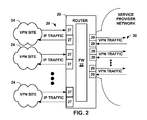
- FIG. 2 is a block diagram illustrating in further detail an example router that includes an integrated MPLS-aware firewall.
- FIG. 3 is a chart illustrating an example configuration of a router having an integrated MPLS-aware firewall for providing zone-based firewall services to MPLS and other network traffic.
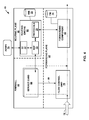
- FIG. 4 is a block diagram illustrating an example router that integrates a routing component and an MPLS-aware firewall using a shared forwarding plane.
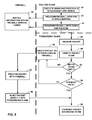
- FIG. 5 is a flowchart illustrating example operation of router of FIG. 4 in accordance with the principles of the invention.
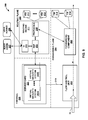
- FIG. 6 is a block diagram illustrating in further detail an example router that integrates a routing component and an MPLS-aware firewall using a shared forwarding plane.
- FIG. 7 is a flowchart further illustrating example operation of an MPLS-aware firewall router.
- FIG. 8 illustrates example mapping information provided by a routing component to an integrated firewall of a network device enabling security services to be applied to MPLS tunnels.
- FIG. 9 is a block diagram illustrating an example router having support for virtual security systems and integrating a routing component and an MPLS-aware firewall using a shared forwarding plane.
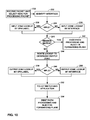
- FIG. 10 is a flowchart further illustrating example operation of an MPLS-aware firewall router having support for virtual security systems.
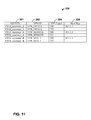
- FIG. 11 illustrates example mapping information provided by a routing component to an integrated firewall of a network device enabling security services to be applied to MPLS tunnels for different virtual security systems.
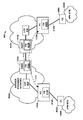
- FIG. 12 is a block diagram showing an inter-provider deployment of the MPLS, aware, zone-based firewall described herein.
- FIG. 1 is a block diagram illustrating an example network environment 2 in which a service provider network 4 provides connectivity between customer virtual private network (VPN) sites 6A-6N (collectively, VPN sites 6).
- VPN sites 6 includes customer edge (CE) routers 8A-8N connected to provider edge (PE) routers 10A-10N of service provider network 4 via network links 16A-16N.
- CE customer edge
- PE provider edge
- service provider network 4 supports provider-provisioned VPNs (PPVPNs).
- PE routers 10A-10N transport communications of customer VPN sites 6 through service provider network 4 and possibly other intermediate networks.
- Service provider network generally includes a set ofPE routers 10 at the edge of the network interconnected with internal routers and other network devices via high-speed network links.
- the internal routers may be label switched routers (LSRs) 14 that provide a Multi-protocol Label Switching (MPLS) MPLS core network.
- LSRs label switched routers
- MPLS Multi-protocol Label Switching
- PE routers 10 and LSRs 14 execute one or more routing protocols, such as Intermediate System to Intermediate System (ISIS) for distributing routing information.
- ISIS Intermediate System to Intermediate System
- PE routers 10 may execute the Multi-Protocol Border Gateway Protocol (mpBGP) for exchanging VPN routes associated with VPN sites 6 as well as VPN labels to be applied to the VPN communications.
- mpBGP Multi-Protocol Border Gateway Protocol
- administrators associated with service provider network 4 may configure PE routers 10 so as to provision VPN services for one or more customer VPNs.
- the administrators define a VPN identifier for each customer VPN (e.g.,, VPN_CUSTOMER_A), and PE routers 10 allocate VPN labels, VPN addresses, a router target, a router distinguisher, and all other state information necessary for the VPN.
- PE routers 10 exchange this information via mpBGP so as to form one or more end-to-end VPN tunnels 18.
- PE routers 10 may communicate with LSRs 14 to establish one or more MPLS tunnels in the form of one or more end-to-end label switch paths (LSPs) for transporting the VPN communications through service provider network 4 and possibly other intermediate networks.
- Traffic flowing along network links 16 to and from VPN sites 6 may take the form of Internet Protocol (IP) packets, and may be secured using Internet Protocol Security (IPSec) protocols, Secure Sockets Layer (SSL) protocols or other protocols that make use of cryptographic technology.
- IP Internet Protocol
- IPSec Internet Protocol Security
- SSL Secure Sockets Layer
- PE routers 10 provide ingress and egress for the IP traffic with respect to the Multi-protocol Label Switching (MPLS) services provided within service provider network 4.
- MPLS Multi-protocol Label Switching
- PE routers 10 operate as ingress and egress LSRs for communicating the IP packets of VPN sites 6 as encapsulated VPN packets traversing VPN tunnels 18 and optionally one or more LSPs.
- PE router 10A may receive IP traffic from VPN site 6A, and may then prepend a VPN label based on the corresponding customer VPN associated with the traffic.
- the VPN traffic may then be viewed as flowing along a VPN tunnel through service provider network 4, and the VPN tunnel 18 may be viewed as a form of an MPLS tunnel.
- One or more of these VPN tunnels 18 i.e., packet flows having VPN labels prepended to each packet
- PE router 10A may further prepend one or more MPLS labels to form an outer label stack on top of the VPN label of each VPN packet, and forward the VPN packets along one or more dedicated LSPs through service provider network 4.
- PE routers 10 and LSRs 14 may use any type of label switching protocol to establish the LSPs, such as MPLS protocols like Resource Reservation Protocol (RSVP) and the Label Distribution Protocol (LDP).
- RSVP Resource Reservation Protocol
- LDP Label Distribution Protocol
- each of PE routers 10 includes an integrated firewall (FW) 12A-12N (collectively, FWs 12).
- FWs 12 is an MPLS-aware firewall that allows service provider network 4 to apply firewall security policies at the IP-MPLS interface. That is, FWs 12 allow firewall security policies to be applied at the point where IP traffic enters or exits VPN tunnels 18.
- the MPLS-aware FWs 12 may be integrated within routing device (e.g., PE routers 12), thus allowing a single device to provide both routing functionality, including MPLS support, as well as firewall services. In this manner, the techniques described herein may allow the service provider to avoid the requirement to deploy separate non-MPLS aware firewalls between PE routers 10 and CE routers 8.
- FWs 12 of PE routers 10 may provide zone-based firewall services that allow zone-based security policies to be defined and applied for the different network interfaces of the PE router.
- the PE routers 10 provide a user interface that allows the service provider to define security zones with respect to customer VPNs that are supported by service provider network 4. That is, each of PE routers 10 may provide a user interface having a command syntax that allows individual customer VPNs to be defined and recognized by FWs 12 as logical interfaces, and these logical interfaces can be used like other physical interfaces of the PE routers to define zones and corresponding security polices to be applied to those zones.
- FIG. 2 is a block diagram illustrating an example of an MPLS-enabled router, such as PE routers 10 of FIG. 1 , that includes an integrated MPLS-aware firewall (FW) 22.
- FW 22 provides zone-based firewall services that allow zone-based security policies to be defined and applied for the different network interfaces of the router.
- router 20 includes physical interfaces 27 for sending and receiving IP traffic 28 to and from VPN sites 24 via physical network links.
- Router 20 provides a user interface that allows the service provider to define zones and corresponding security policies with respect to those physical interfaces.
- the user interface of router 20 allows the service provider to define security zones with respect to individual customer VPNs 30 that are used to securely tunnel communications through the service provider network.
- the system administrator may interact with the user interface to specify logical interfaces 29 or other identifiers for one or more of the established customer VPNs.
- the user interface supports a command syntax that allows the logical interfaces for the individual customer VPNs 30 to be used in conjunction with the physical interfaces 27 of router 20 to define zones and corresponding security polices to be applied by FW 22 to those zones.
- router 20 maintains mapping information to allow router 20 to apply zone-based security services to customer traffic associated with VPN labels and optionally additional MPLS labels, thereby providing a router having integrated MPLS-aware firewall.
- FIG. 3 is a chart illustrating an example configuration of FW 22 of router 20 for providing zone-based firewall services.
- the vertical axis represents all of the input interfaces of router 20, including N physical input interfaces (any of interfaces 27 of FIG. 2 for input links) as well as Y input VPNs (any of logical interfaces 29 for VPNs of which router 20 is the egress).
- the horizontal axis represents all of the output interfaces of router 20, including X physical output interfaces (any of interfaces 27 of FIG. 2 for output links) as well as Z output VPNs (any of logical interfaces 29 for VPNs of which router 20 is the ingress).
- a system administrator for the service provider network has interacted with the user interface of router 20 to define three distinct zones: (1) a first zone 30 for all MPLS traffic received via VPN 1, (2) a second zone 34 for all IP traffic output on physical interface OUTPUT INT X, and (3) a third zone 34 for all IP traffic received on physical interface INPUT INT 1.
- Router 20 may, for example, provide a text-based command line interface by which the system administer or software agent provides configuration data in conformance with a command syntax as follows:
- router 20 provides a syntax for defining security policies to be applied with respect to the defined zones.
- router 20 may support a syntax as follows:
- an administrator may provide configuration data as follows:
- FIG. 4 is a block diagram illustrating an example router that integrates a routing component and an MPLS-aware firewall.
- Router 40 may, for example, be a high-end router capable of deployment within a service provider network.
- forwarding plane 42 may be provided by dedicated forwarding integrated circuits normally associated with high-end routing and forwarding components of a network router.
- U.S. Patent Application 2008/0044181 entitled MULTI-CHASSIS ROUTER WITH MULTIPLEXED OPTICAL INTERCONNECTS, describes a multi-chassis router in which a multi-stage switch fabric, such as a 3-stage Clos switch fabric, is used as a high-end forwarding plane to relay packets between multiple routing nodes of the multi-chassis router.
- a multi-stage switch fabric such as a 3-stage Clos switch fabric
- router 10 integrates an MPLS-aware firewall 44 and a routing plane 46 that utilize a shared forwarding plane 42.
- Forwarding plane 42 is a rich and dynamic shared forwarding plane, optionally distributed over a multi-chassis router.
- forwarding plane 42 may be provided by dedicated forwarding integrated circuits normally associated with high-end routing components of a network router. Consequently, routing plane 46 and forwarding plane 42 operate as a high-end router, and firewall 44 has been tightly integrated within router 40 (e.g., by way of service cards 64) so as to use forwarding plane 42 of the routing components in a shared, cooperative manner. Further details of one example embodiment of router 40 can be found in U.S.
- Routing plane 46 provides a routing engine 68 that is primarily responsible for maintaining a routing information base (RIB) 72 to reflect the current topology of a network and other network entities to which router 40 is connected.
- routing engine 68 provides an operating environment for execution of routing protocols 70 that communicate with peer routers and periodically update RIB 72 to accurately reflect the topology of the network and the other network entities.
- Example protocols include routing and label switching protocols, such as mpBGP, ISIS, RSVP-TE and LDP, to establish VPNs, LSPs and for exchanging labels.
- forwarding component 80 maintains forwarding information base (FIB) 74 that associates network destinations or MPLS labels with specific next hops and corresponding interface ports of output interface cards of router 40.
- Routing engine 68 typically processes RIB 72 to perform route selection and generate FIB 74 based on selected routes and allocated MPLS labels. In this way, routes as well as labeling information can be programmed into forwarding plane 42. Routing engine 68 may generate FIB 74 in the form of a radix tree having leaf nodes that represent destinations within the network.
- U.S. Patent 7,184,437 provides details on an exemplary embodiment of a router that utilizes a radix tree for route resolution, the contents of which is incorporated herein by reference in its entirety.
- forwarding component 80 traverses the radix tree to a leaf node based on information within a header of the packet to ultimately select a next hop and output interface to which to forward the packet. Based on the selection, forwarding component may output the packet directly to the output interface or, in the case of a multi-stage switch fabric of a high-end router, may forward the packet to subsequent stages for switching to the proper output interface.
- Network services process (NSP) 73 of routing engine 46 communicates with and programs service cards 64 of firewall 44.
- routing engine may present a user interface (UI) 77 as described above so as to receive configuration data from administrator 79 defining firewall zones and policies with respect to physical interfaces, sub-interfaces or MPLS tunnels.
- UI user interface
- NSP 73 programs services cards 64 with corresponding configuration data, causing the service cards of firewall 44 to recognize the defined zones and apply the security policies when processing packets from forwarding plane 42.
- Each service card 64 may, for example, execute a microkernel that operates as a consumer of state information and listens for communications from NSP 73.
- routing plane 46 and firewall 44 interact so that firewall 44 is made aware of state information associated with the MPLS traffic flowing through the routing device.
- NSP 73 of routing engine 68 programs the service cards with information that associates customer VPNs with specific VPN labels and optionally one or more additional MPLS labels that have been used for tunneling the corresponding VPN traffic through the service provider network.
- NSP 73 may query protocols 70 and RIB 72 to provide the service cards 64 of firewall 44 with information maintained with the RIB for the VPN.
- NSP 73 may provide information that identifies a VPN tag and optionally one or more MPS tags may will be affixed to the header of the packet and mapping information to associate this these labels with a customer VPN identifier (e.g., a text string or other identifier) that may be utilized by the administrator when defining input zones and policies.
- a customer VPN identifier e.g., a text string or other identifier
- NSP 73 may provide mapping information that identifies a VPN label and optionally one or more MPLS labels to be applied by forwarding component 80 to IP traffic destined for the customer VPN, a corresponding next hop identifier for the traffic and a mapping to associate this ⁇ VPN label, next hop identifier> pair with a customer VPN identifier (e.g., a text string or other identifier) that may be utilized by the administrator when defining firewall zones and policies.
- the mapping information may provide other information useful in uniquely identifying the customer VPN, such as a route designator, a route target or other information.
- Forwarding plane 42 may include a flow control unit 75 to selectively direct packets to firewall 44 for processing.
- flow control unit 75 receives incoming packet flows 78 (e.g., IP traffic or VPN-encapsulated traffic) and determines whether to send the packets through the firewall 44 for processing within one or more of service cards 64, or whether to bypass the firewall 44.
- Service cards 24 receive packets from flow control unit 75, selectively provide firewall services to the packets in accordance with the defined zones and policies, and relay the packet or any response packets to forwarding plane 42 for forwarding by forwarding component 80 in accordance with FIB 74.
- Service cards 24 within firewall 44 may be installed along a backplane or other interconnect of router 40 to perform a variety of firewall services on the packets received from forwarding plane 42, such as filtering, logging, Intrusion Detection and Prevention (IDP) analysis, virus scanning, deep packet inspection.
- service card 24 may issue commands 36 to dynamically configure a flow table (not shown) within flow control unit 75 of forwarding plane 42. For example, when flow control unit 75 receives a packet and determines that the packet belongs to a new packet flow that does not match any of its filters, flow control unit 75 may send the packet to service cards 64 for processing.
- IDP Intrusion Detection and Prevention
- service cards 64 may issue a command 69 to install a dynamic filter within the flow table, such as an exact match filter that indicates particular actions to be performed when a packet is received that matches the filter.
- a dynamic filter such as an exact match filter that indicates particular actions to be performed when a packet is received that matches the filter.
- service cards 64 may install a filter within flow control unit 75 to specify that subsequent packets of this packet flow session may be processed on a straight path that bypasses firewall 44.
- flow control unit 75 checks the flow table, determines that the packet matches the new dynamic filter, and directs the packet on the appropriate path according to the dynamic filter.
- routing and firewall services are integrated within a single router 40 that uses a shared forwarding plane 42 suitable for high-speed forwarding functions required by MPLS routers, such as PE routers 10 of FIG. 1 .
- FIG. 5 is a flowchart illustrating example operation of router 40 of FIG. 4 in accordance with the principles of the invention.
- routing engine 68 executes protocols 70, such as mpBGP to exchange VPN information, including VPN identifiers, VPN routes and VPN labels (81).
- routing engine may optionally utilize RSVP-TE, LSP or other mPLS protocols to establish one or more MPLS tunnels (i.e., LSPs) for carrying the VPN traffic through the service provider network for various customer VPN sites (81).
- MPLS tunnels i.e., LSPs
- routing engine 68 updates RIB 72 and programs forwarding component 80 in accordance with the VPN routes, VPN labels as well as any additional MPLS labels allocated to carry the VPN traffic.
- NSP 73 of routing engine 46 programs service cards 64 of firewall 44 with a mapping that associates the customer VPN information with the specific VPN labels, and optionally any additional MPLS labels, used in communicating VPN traffic to and from the next hop(s) within the service provider network (82, 85). Further, NSP programs service cards 64 with configuration data received from the administrator defining firewall zones and policies with respect to either physical interfaces or the individual customer VPNs, causing the service cards of firewall 44 to recognize the defined zones and applying the security policies when processing packets from forwarding plane 42 (83, 85).
- router 40 receives a packet, which may be IP traffic from a VPN site or VPN traffic from a VPN tunnel (optionally carried by an LSP) through the service provider network (84).
- a flow control unit 75 of the forwarding plane 42 analyzes the received packet to identify a packet flow associated with the packet (86), e.g., using a flow-based provisioning logic to identify a five-tuple based on information carried in the header or body of the packet.
- flow control unit 75 references an internal flow table to determine whether belongs to a new packet flow or a packet flow already recognized by the router (88).
- the flow control unit 75 If flow control unit 75 does not find a match in the flow table (NO branch of 88), which indicates that the packet belongs to a new packet flow, the flow control unit directs the packet to service cards 64 of firewall 44 for firewall services (90).
- service cards 64 When the packet is directed to firewall 44, one of service cards 64 applies stateful firewall services to the packet (92).
- the service cards 64 may extract and assemble application layer data from the packet, and a deep packet inspection (DPI) engine may perform Intrusion Detection and Prevention (IDP) analysis and/or virus scanning to filter out bad packets.
- the service card 24 may perform ciphering, NAT or authentication services.
- service cards 64 After applying firewall services, service cards 64 then inject the packet into forwarding plane 42 for forwarding by forwarding component 80 in accordance with FIB 74 (96). At this time, service cards 64 of firewall 44 may signal flow control unit 75 and direct the flow control unit to install criteria in its internal flow table designating whether subsequent packets of the packet flow should be trusted such that firewall services need not be applied, or whether the subsequent packets should continue to be directed to firewall 44.
- flow control unit 75 finds a match in the flow table (YES branch of 88) for the received packet and the matching entry directs the packet onto a straight path for processing (YES branch of 94), flow control module 20 does not forward the packet to firewall 44 but signals forwarding component 80 that the packet can immediately be forwarded in accordance with FIB (74).
- flow control unit 75 directs the packet to service cards 64 of firewall 44 for firewall services (90, 92) and subsequent forwarding by forwarding component 88 (98).
- FIG. 6 is a block diagram illustrating in further detail an example router 100 that integrates a routing engine 104 and an MPLS-aware firewall 123 using a shared forwarding plane provided by forwarding engine 106.
- Route 100 may, for example, be incorporated within any of PE routers 10, router 20, or router 30 described above.
- Router 100 comprises a control unit 102 that includes a routing engine 104 and a forwarding engine 106.
- Routing engine 104 is primarily responsible for maintaining routing information base (RIB) 88 to reflect the current topology of a network and other network entities to which it is connected. In particular, routing engine 104 periodically updates RIB 108 to accurately reflect the topology of the network and other entities.
- Routing engine 104 also includes routing protocols 89 that perform routing operations, including protocols for establishing VPNs and optionally LSPs through a network.
- UI module 105 represents software executing on routing engine 104 that presents a command line interface (e.g., via a shell or Telnet session) for receiving configuration data as described herein, including firewall configuration data defining zones and zone-based policies for application by service cards 120 of firewall 123.
- NSP 73 of routing engine 46 communicates with and programs service cards 64 of firewall 123 as described above.
- forwarding application specific integrated circuits (ASICs) 90 of forwarding engine 106 maintain forwarding information base (FIB) 122 that associates network destinations or MPLS labels with specific next hops and corresponding interface ports.
- control unit 102 analyzes RIB 108 and generates FIB 122 in accordance with RIB 108.
- Router 100 includes interface cards 114A-114N ("IFCs 114") that receive and send packets via network links 116 and 117, respectively. IFCs 114 may be coupled to network links 116, 117 via a number of interface ports.
- flow control unit 118 of forwarding engine 106 may relay certain packets received from IFCs 94 to service cards 120A-120M ("service cards 120") in accordance with a flow filter table 124.
- Service cards 120 receive packets from flow control unit 118, selectively provide firewall services in accordance with information within the packet, and relay the packet or any response packets to control unit 102 for forwarding by forwarding ASICs 120.
- Forwarding ASICs 120 may comprise one or more dedicated packet forwarding integrated circuits.
- Flow control unit 118 includes flow-based provisioning logic 102 that distinguishes between packet flow sessions based on a five-tuple found within a header of each received packet and steers packets of the same flows to the same one of service cards 120 for application of stateful firewall services.
- Flow control unit 118 references flow filter table 104 as described above to determine whether a received packet corresponds to a trusted packet flow that may be processed via a straight path (i.e., bypassing service cards 120 entirely), or whether the received packet corresponds to an unknown or untrusted packet flow session and should therefore be sent to one of service cards 120 for further inspection and application of firewall services.
- service cards 120 may provide feedback to flow control unit 118 via service card communication module 106 (SERVICE CARD COMM. MODULE 106) to dynamically update flow table 124. That is, service cards 120 may update flow filter table 124 via commands 121 to service card communication module 108.
- each of forwarding engine 106 and routing engine 104 may comprise one or more dedicated processors, hardware, ASICs or the like, and may be communicatively coupled by a data communication channel.
- the data communication channel may be a high-speed network connection, bus, shared-memory or other data communication mechanism.
- Router 100 may further include a chassis (not shown) for housing control unit 102.
- the chassis has a number of slots (not shown) for receiving a set of cards, including IFCs 94 and service cards 120. Each card may be inserted into a corresponding slot of the chassis for electrically coupling the card to control unit 102 via a bus, backplane, or other electrical communication mechanism.
- Router 100 may operate according to program code having executable instructions fetched from a computer-readable storage medium (not shown). Examples of such media include random access memory (RAM), read-only memory (ROM), non-volatile random access memory (NVRAM), electrically erasable programmable read-only memory (EEPROM), flash memory, and the like.
- RAM random access memory
- ROM read-only memory
- NVRAM non-volatile random access memory
- EEPROM electrically erasable programmable read-only memory
- flash memory and the like.
- the functions of router 100 may be implemented by executing the instructions of the computer-readable storage medium with one or more processors, discrete hardware circuitry, firmware, software executing on a programmable processor, or a combination of any of the above.
- FIG. 7 is a flowchart illustrating exemplary operation of an MPLS-aware firewall, e.g., any of firewalls 12, 22, 44, 123 described above. For exemplary purposes, the flowchart of FIG. 7 will be explained in reference to firewall 123 and its one or more service cards 120 illustrated in FIG. 6 .
- firewall 123 Upon receiving a packet from packet from forwarding engine 106 (130), firewall 123 processes the packet to identify the input interface by which the packet was initially received by router 100 (132). In one example, either the IFC 114 upon which the packet was received or the forwarding engine 106 determines the specific input interface upon which the packet was received by router 100 and attaches information to the packet identifying the particular interface prior to relaying the packet to firewall 123 for processing.
- firewall 123 analyzes the header of the packet to determine if the input packet is an IP packet and not a VPN packet that has a VPN label and that was received from the service provider network via a VPN. If so, then firewall 123 accesses its internal configuration data and determines whether the administrator has defined any input zone that includes the physical interface upon which the packet was received (136).
- firewall 123 accesses the configuration data and determines whether the administrator has defined an input zone that for the customer VPN from which the packet was received (138). That is, firewall 123 reads the packet's inner VPN label and accesses the mapping information provided by NSP 103 of routing engine 104 to map the in VPN label to a customer VPN identifier, e.g., string or numerical identifier.
- the inner label of the received packet i.e., the VPN label, is typically a label previously allocated by the router using mpBGP and issued to an upstream LSR along the VPN tunnel.
- routing engine 104 has knowledge of this VPN label, and the mapping information provided to firewall 123 by NSP 103 maps this VPN label to the particular customer VPN identifier, thereby allowing the administrator to specify that customer VPN in policies and zones within the firewall configuration data.
- firewall 123 parses the configuration data to determine whether the administrator has defined any input zone that includes the customer VPN within the zone's collection of interfaces.
- firewall 123 determines whether the packet matches an existing packet flow session currently being processed by firewall 123 (140). If so, firewall 123 may place the packet on fast path processing for immediate forwarding by forwarding engine 106. For example, when fast path processing the packet, firewall 123 need not perform the computationally intensive task of initializing and updating session information for the new packet. Moreover, firewall 123 need not apply policies to the packet as such policies may have already been applied to the packet flow.
- firewall 123 performs a route lookup on the packet to determine a next hop and, based on the next hop, an output interface for the packet (144).
- one or more of service cards 120 of firewall 123 may be programmed by routing engine 104 and installed with a copy of all or a portion of FIB 122 as used by forwarding ASICs 120.
- FIB 122 of forwarding ASICs 130 may be stored in a shared memory accessible via service cards 120. In either case, firewall 123 traverses the FIB based on information within the packet so as to determine the next hop and corresponding output interface for the packet. Further, based on information installed within the copy of the FIB, firewall 123 determines based on the route lookup whether the packet will be output as IP traffic or as VPN traffic to be injected into the service provider network (146).
- firewall 123 accesses the configuration data and determines whether the administrator has defined any output zone that includes the output interface to which the IP packet is destined (148).
- firewall 123 accesses the configuration data and determines whether the administrator has defined any output zone that includes the customer VPN to which the packet will be output (150). That is, based on the route lookup, firewall 123 determines the inner forwarding equivalence class (FEC) label, i.e., the VPN label that will ultimately be prepended to the packet by the forwarding engine 106 when forwarding the packet. In addition, firewall 123 determines, based on the route lookup, the next hop to which the VPN packet will be forwarded.
- FEC forwarding equivalence class
- firewall 123 accesses the mapping data provided by NSP 103 of routing engine 104 to map the data pair ⁇ VPN label, next hop> to a specific customer VPN identifier.
- Firewall 123 uses both the VPN label to be applied to the packet as well as the next hop since, for VPN traffic leaving router 100 and entering the MPLS core of the service provider network, the VPN labels have likely been allocated by upstream routers along the VPN tunnels and, as such, may be duplicative.
- firewall 123 identifies the correct customer VPNs to which the packet is destined by indexing the mapping information provided by NSP 103 based on the unique pair: ⁇ VPN label, next hop> learned in the route lookup for the packet.
- firewall 123 accesses its configuration data to identify any output zone that the administrator has defined that includes the customer VPN to which the packet is destined.
- firewall 123 accesses its configuration data to identify any policy that has been defined for traffic traveling between the zones. At this time, firewall 123 also applies any packet flow criteria that have been defined by the policies. Upon identifying the matching policies, firewall 123 applies to the packet the actions specified by those policies (152).
- firewall 123 After applying the policies, firewall 123 processes the packet along a "first path" by initializing and creating session information to maintain state for the packet flow. Finally, firewall 123 injects the packet into forwarding engine 106 for forwarding in accordance with FIB 122 (154).
- router 100 integrates MPLS-aware, zone-based firewall security features in single network device. Moreover, a full mesh of zone-based policies can be defined and applied seamlessly with respect to physical interfaces as well as customer VPNs.
- FIG. 8 illustrates example mapping information 160 provided by a routing component to an integrated firewall of a network device (e.g., from NSP 73 of routing engine 68 to firewall 44 of router 40) to enable security services to be applied to MPLS-based customer VPNs.
- the forwarding plane 42 can dynamically identify the VPN tunnel, e.g., by the customer interface on which the traffic arrived, and communicate mapping information to firewall 44 and/or routing engine 68.
- the example mapping information 160 includes a plurality of entries, each entry listing a customer VPN identifier 162 (e.g., a text string or other identifier) that was provided by the administrator when defining input zones and policies via interaction with a user interface, such as UI 75.
- a customer VPN identifier 162 e.g., a text string or other identifier
- the first and second entries of mapping information include a customer VPN identifier "VPN_customer_A" representing a string specified by the administrator when defining an interface for an input zone for the firewall, as shown in the examples discussed above.
- the routing component e.g., NSP 73 of routing engine 68
- the first entry maps the customer VPN identifier to an MPLS label to be applied by the router's forwarding component (e.g., forwarding component 80) when encapsulating IP traffic destined for that particular customer's VPN site as well as a corresponding next hop identifier for the traffic.
- the second entry maps that same customer VPN identifier to a VPN label that is expected to be affixed to inbound traffic received from the customer's VPN site, optionally as an inner label of an MPLS label stack.
- mapping information 160 maps the string "VPN_Customer_A" to an ⁇ VPN label 100, next hop identifier 10.1.1.1> pair.
- the first entry resolves the string utilized in the firewall configuration data to a specific inner VPN label to be used for outbound VPN traffic to be injected into the service provider network, optionally along an LSP.
- the second entry of mapping information 160 maps the string "VPN_Customer_A" to a VPN label 750 previously allocated by the router and expected to be affixed to VPN traffic received by the inbound VPN tunnel for that customer VPN site.
- Mapping information 160 may be input by the administrator to resolve the firewall configuration information to specific VPN tunnels and next hops where necessary, or the routing component may determine this information dynamically based on the RIB and corresponding FIB utilized for routing and forwarding purposes. Other information may be used in addition to or in place of the next hop, such as a route designator or route target for the customer VPN.
- FIG. 9 is a block diagram illustrating another example of a router 200 that integrates a routing plane 206 and an MPLS-aware firewall 208 using a shared forwarding plane 204.
- router 200 may, for example, be incorporated within any ofPE routers 10, router 20, router 30 or router 100 described above.
- firewall 208 has been logically partitioned into multiple virtual security systems 240A-240X to provide multi-tenant security services. That is, virtual security systems 240 represent logically partitioned firewall instances providing separate security services, including MPLS-aware zone-based firewall services, that are applied by firewall 208.
- Router 200 presents virtual security systems 240 as logically independent firewalls that can be independently configured even though the virtual security systems may share computing resources of service cards 224.
- a root-level administrator 207 (“ROOT ADMIN 207") is a central, overarching security and system administrator that may control and administer a ROOT one of virtual security systems 240.
- ROOT ADMIN 207 is a central, overarching security and system administrator that may control and administer a ROOT one of virtual security systems 240.
- root-level administrator 207 can access and configure any custom VSYS specific security resources, as well as manage any shared security resources, such as a SHARED-UNTRUST zone, which is a commonly shared connection to the Internet used by multiple internal security zones.
- the root-level administrator 207 also controls the initial assignment of interfaces and zones.
- a root-level administrator 207 may interact with UI 215 to provide configuration data to define virtual security systems 240 and, for each of the virtual security systems, specify one or more virtual security system (VSYS) administrators 209 ("VSYS ADMINS 209").
- VSYS virtual security system
- Each of virtual security systems 240 is presented to the corresponding VSYS administrator 209 as a unique security domain, and the VSYS administrator 209 for each virtual system 240 can individualize their security domain by defining specific zones and policies to be applied to traffic associated with that virtual system 240.
- Each virtual security system 240 can be configured to have its own totally separated set of security zones, policy rule set and management domain. In this way, virtual security systems 240 logically segment integrated MPLS-aware firewall 208 into multiple security devices.
- Each VSYS administrator 209 may interact with US 215 in the manner described herein so as to provide configuration data for a specific virtual system 240, including defining firewall zones and policies with respect to physical interfaces, sub-interfaces, or customer VPNs.
- Management interfaces presented by UI 215 are specific to the particular virtual security system 240 being configured and managed, and each of the virtual security systems 240 appears as a discrete security device to the individual VSYS administrator 209. This means that each distinct virtual security system 240 may have, for example, its own web interface, operational management connections and views.
- the VSYS administrator 209 of one virtual security systems 240 is isolated to the configuration and operation of his or her own virtual system.
- router 200 provides a syntax for defining security policies to be applied with respect to the defined zones for specific virtual security systems 240.
- router 200 may support a syntax as follows:
- an administrator may provide configuration data as follows:
- each of virtual security systems 240 may share the same hardware resources provided by service cards 224.
- computing resources provided by service cards 224 may apply security policies for any of virtual security systems 240 to the network traffic associated with that particular virtual system.
- weightings, time quotas or percentages of CPU or other hardware usage can be allocated and enforced so as to ensure fair usage by virtual security systems 240 so that consumption of hardware resources by one of the virtual system, such as in response to a denial of service attack, does not impact the performance of all of the other virtual security systems.
- virtual security systems 240 may be allocated to specific service cards 224.
- router 200 may manage resources of routing engine 211 and forwarding plane 204 so as to provide a plurality of virtual routers, where each virtual security system 240 may optionally map to a different virtual router.
- a virtual router is a separate routing instance within router 200, and each instance may execute its own routing protocol and maintain its own settings, route table (RIB), and routing updates.
- Each virtual router participates in its own routing domain; multiple virtual routers allow a single device (e.g., router 200) to participate in multiple routing domains completely separated from each other. That is, routing engine 211 may maintain a logically separate RIB 212 for each virtual security system 240.
- routing engine 211 programs forwarding component 220 with a corresponding FIB 214 in accordance with the routes, as well as the MPLS labels associated with the routes, for the virtual system 240.
- routing engine 211 may program forwarding component 220 with logically isolated FIBs 212, one for each virtual security system 240, and forwarding component 220 applies the appropriate FIB when making packet forwarding decisions.
- NSP 213 programs firewall 208 with configuration data.
- NSP 213 programs configuration data for each of virtual security systems 240, causing the service cards 224 of firewall 208 to recognize the zones and security policies defined for the different virtual security systems when processing packets from forwarding plane 204.
- Each service card 224 may, for example, execute a microkernel that operates as a consumer of state information and listens for communications from NSP 213.
- routing plane 206 and firewall 208 interact so that firewall 208 provides support for multiple virtual security systems and is made aware of state information associated with the VPN traffic flowing through the routing device.
- NSP 213 of routing engine 211 programs the service cards 224 with information that creates virtual security systems 240 and then, for each of the virtual security system, associates customer VPNs for that virtual security system with specific VPN labels that have been used for tunneling the corresponding VPN traffic through the service provider network.
- NSP 213 may query the corresponding protocols 210 and RIB 212 for the respective virtual security system 240 to provide the service cards 224 of firewall 208 with information maintained with that specific RIB for that specific virtual security system.
- NSP 213 may provide information that identifies one or more VPN tags that will be affixed to the header of the packet and mapping information to associate this VPN label with a customer VPN identifier (e.g., a text string or other identifier) that may be utilized by the VSYS administrator 209 when defining input zones and policies for that particular virtual security system.
- a customer VPN identifier e.g., a text string or other identifier
- NSP 213 may provide mapping information that identifies any one or more VPN labels to be applied by forwarding component 220 to IP traffic destined for the customer VPN, a corresponding next hop identifier for the traffic and a mapping to associate this ⁇ VPN label, next hop identifier> pair with a customer VPN identifier (e.g., a text string or other identifier) that may be utilized by the VSYS administrator 209 when defining firewall zones and policies for that virtual security system.
- a customer VPN identifier e.g., a text string or other identifier
- Forwarding plane 204 may include a flow control unit 215 that operates in a manner similar to flow control unit 75 ( FIG. 4 ) to selectively direct packets to firewall 208 for processing.
- Service cards 224 may issue commands 219 to install dynamic filters within flow control unit 215 to control packet diversion to firewall 208.
- FIG. 10 is a flowchart illustrating exemplary operation of an MPLS-aware firewall, e.g., any of firewalls 12, 22, 44, 123, 200 described above.
- an MPLS-aware firewall e.g., any of firewalls 12, 22, 44, 123, 200 described above.
- the flowchart of FIG. 10 will be explained in reference to firewall 200 and its one or more service cards 224 illustrated in FIG. 9 .
- firewall 208 Upon receiving a packet from packet from forwarding plane 204 (230), firewall 208 first classifies the packet into one of virtual security systems 240 based on source and/or destination information for VLAN, interfaces, IP address or combinations thereof. Next, one or more of service cards 244 associated with the virtual security system 240 to which the packet is classified (associated) processes the packet to identify the input interface by which the packet was initially received by router 200 (232). In one example, either the IFC upon which the packet was received or the forwarding plane 204 determines the specific input interface upon which the packet was received by router 200 and attaches information to the packet identifying the particular interface prior to relaying the packet to firewall 208 for processing.
- firewall 208 i.e., the particular one or more service cards 224 of firewall 208 providing the execution environment for the virtual security system 240 for the packet
- firewall 208 analyzes the header of the packet to determine if the input packet is an IP packet and not a VPN packet that was received from the service provider network via a VPN tunnel. If so, then firewall 208 accesses root configuration data as well as configuration data for the specific virtual security system 240 associated with the packet to determine whether either the root administrator 207 or the VSYS administrator 209 has defined any input zone, for that specific virtual security system 240, that includes the physical interface upon which the packet was received (236).
- firewall 208 accesses root configuration data as well as configuration data for the specific virtual security system 240 associated with the packet to determine whether either the root administrator 207 or the VSYS administrator 209 has defined any input zone for that specific virtual security system 240 that includes the customer VPN from which the packet was received (238). That is, firewall 208 reads the packet's inner VPN label and accesses the mapping information provided by NSP 213 of routing engine 211 to map the inner VPN label to a customer VPN identifier, e.g., string or numerical identifier, used within the RIB 212 for that particular virtual security system 240.
- a customer VPN identifier e.g., string or numerical identifier
- firewall 208 determines whether the packet matches an existing packet flow session currently being processed by firewall 208 (240). If so, firewall 208 may place the packet on fast path processing for immediate forwarding by forwarding component 220. For example, when fast path processing the packet, firewall 208 need not perform the computationally intensive task of initializing and updating session information for the new packet. Moreover, firewall 208 need not apply policies to the packet as such policies may have already been applied to the packet flow.
- firewall 208 performs a route lookup on the packet to determine a next hop and, based on the next hop, an output interface for the packet (244).
- the service cards 224 to which virtual security systems 240 are allocated may be programmed by routing engine 211 and installed with a copy of all or a portion of FIBs 214 for the respective virtual system.
- FIBs 214 may be stored in a shared memory accessible via service cards 224.
- firewall 208 selects the FIB 214 for the virtual security system 240 associated with the packet and traverses that FIB based on information within the packet so as to determine the next hop and corresponding output interface for the packet. Further, based on information installed within the copy of the corresponding FIB, firewall 208 determines based on the route lookup whether the packet will be output as IP traffic or as VPN traffic having a prepended VPN label (246).
- firewall 208 accesses the root configuration data and the configuration data for the particular virtual security system 240 to determine whether the root administrator 207 or the corresponding VSYS administrator 209 has defined any output zone that includes the output interface to which the IP packet is destined (248).
- firewall 208 accesses the root configuration data and the configuration data for the particular virtual security system 240 to determine whether the root administrator 207 or the corresponding VSYS administrator 209 has defined any output zone that includes the customer VPN to which the packet will be output (250). That is, based on the route lookup, firewall 208 determines the outer forwarding equivalence class (FEC) label, the VPN label that will ultimately be prepended to the packet by forwarding component 220 when forwarding the packet using the FIB 214 for the particular virtual security system 240.
- FEC outer forwarding equivalence class
- firewall 208 determines, based on the route lookup using the copy of the appropriate FIB 214, the next hop to which the VPN packet will be forwarded.
- firewall 208 accesses the mapping data provided by NSP 213 of routing engine 211 to map the data pair ⁇ VPN label, next hop> to a specific customer VPN.
- Firewall 208 uses both the MPLS label to be applied to the packet as well as the next hop since, for VPN traffic leaving router 200 and entering the MPLS core, the VPN labels have likely been allocated by upstream LSRs along the VPN tunnels and, as such, may be duplicative.
- firewall 208 identifies the correct customer VPNs to which the packet is destined by indexing the mapping information provided by NSP 103 based on the unique pair: ⁇ VPN label, next hop> learned in the route lookup for the packet. Based on the customer VPN identified from the mapping, firewall 208 accesses its root configuration data as well as the configuration data for the specific virtual security system 240 to identify any zone that either root administrator 207 or the VSYS administrator 209 has defined that includes the customer VPN to which the packet is destined.
- firewall 208 accesses the root configuration data and the configuration data for the specific virtual security system 240 to identify any policy that either root administrator 207 or the VSYS administrator 209 has defined for traffic traveling between those zones. At this time, firewall 208 also applies any packet flow criteria that have been defined by the policies. Upon identifying the matching policies, firewall 208 applies to the packet the actions specified by those policies (252). In this way, zone and policy selection by firewall 208 is dependent on the particular virtual security system 240 to which the packet belongs.
- firewall 208 After applying the policies, firewall 208 processes the packet along a "first path" by initializing and creating session information to maintain state for the packet flow. Finally, firewall 208 injects the packet into forwarding component 220 for forwarding in accordance with the particular FIB 214 corresponding to the virtual security system 240 (254).
- router 200 integrates MPLS-aware, zone-based firewall security features in single physical network device that provides support for multiple virtual security systems. Moreover, each virtual security system can logically apply a full mesh of zone-based policies can be defined and applied seamlessly with respect to physical interfaces as well as customer VPNs.
- FIG. 11 illustrates example mapping information 300 provided by a routing component to an integrated firewall of a network device having support for virtual security devices (e.g., from NSP 213 of routing engine 211 to firewall 208 of router 200) to enable security services to be applied to MPLS tunnels.
- FIG. 11 will be described with respect to router 200 of FIG. 9 .
- the example mapping information 300 includes a plurality of entries, each entry listing a virtual security system identifier 301 (e.g., a text string or other identifier) that was provided by root administrator 207 when defining virtual security systems 240.
- mapping information 300 stores a customer VPN identifier 302 (e.g., a text string or other identifier) that was provided by either the root administrator 207 or the authorized VSYS administrator 209 when defining input zones and policies for the corresponding one of virtual security systems 240 via interaction with a user interface 215.
- the first and second entries of mapping information include a customer VPN identifier "VPN_customer_A" representing a string specified by the administrator when defining an interface for an input zone for the firewall, as shown in the examples discussed above.
- the routing component e.g., NSP 73 of routing engine 211
- the first entry maps the customer VPN identifier to a VPN label to be applied by the router's forwarding component (e.g., forwarding component 220) when encapsulating IP traffic destined for that particular customer's VPN site as well as a corresponding next hop identifier for the traffic.
- the second entry maps that same customer VPN identifier to a VPN label that is expected to be affixed as the inner label to inbound MPLS traffic received from the customer's VPN site.
- mapping information 300 corresponds to a first virtual security system (VSYS_customer_A) and the last two entries correspond to a second virtual security system (VSYS_customer_B).
- VSYS_customer_A first virtual security system
- VSYS_customer_B second virtual security system
- mapping information 300 is applicable only to virtual security system "VPN_Customer_A” and maps a VPN identifier "VPN_OFFICE” to an ⁇ VPN label 100, next hop identifier 10.1.1.1> pair. In this way, the first entry resolves the "VPN_OFFICE" string utilized in the firewall configuration data by the VSYS_administrator to a specific outbound VPN tunnel recognized within the first virtual security system.
- mapping information 300 is also only applicable to virtual security system "VPN_Customer_A" and maps the VPN identifier "VPN_OFFICE” to an VPN label 750 previously allocated by the router for this virtual security system. That is, MPLS label 750 is expected to be affixed to VPM traffic received by the inbound VPN tunnel for that customer VPN site of the virtual security system VSYS_customer_A.
- Mapping information 300 may be input by either root administrator 207 or the authorized VSYS_administrator 209 to resolve either root firewall configuration information or VSYS-specific configuration information to specific MPLS tunnels and next hops where necessary, or the routing component may determine this information dynamically based on the corresponding RIB and FIB utilized for routing and forwarding purposes for each virtual security system. Although shown as a single table, mapping information 300 may be partitioned and separated based on virtual security system and stored in separate data structures and/or memories so as to add an additional degree of separation for the virtual security systems.
- FIG. 12 is a block diagram illustrating an example network environment 400 in which two service provider networks 402A, 402B provide connectivity between customer virtual private network (VPN) sites 406A-406N (collectively, VPN sites 406).
- VPN virtual private network
- each service provider network 402 is operated by a different service provider, and PEs 411A, 411B operate at an inter-provider boundary.
- autonomous system border routers (ASBRs) 411A, 411B are coupled by a physical link 415 and exchange network traffic for VPN sites 406A, 406B.
- VPN sites 406A, 406B include customer edge (CE) routers 408A-8N connected to provider edge (PE) routers 410A-410N via network links 416A-416N.
- CE customer edge
- PE provider edge
- service provider networks 402A and 402B supports provider-provisioned VPNs (PPVPNs).
- PVPNs provider-provisioned VPNs
- administrators associated with service provider networks 402 may configure PE routers 410 and ASBRs 411 so as to provision VPN services for one or more customer VPNs for VPN sites 406.
- the administrators for the different service provider networks 402 separately define a VPN identifier for each customer VPN (e.g., VPN_CUSTOMER_A) traversing their respective service provider network 402, and PE routers 410 and ASBRs 411 allocate VPN labels, VPN addresses, a router target, a router distinguisher, and all other state information necessary for the VPN.
- each of service provider networks 402 may include additional internal label switched routers (LSRs) 414 that provide a Multi-protocol Label Switching (MPLS) MPLS core network within each service provider network 402.
- LSRs Multi-protocol Label Switching
- ASBRs 411 may communicate with LSRs 414 to establish one or more one or more label switch paths (LSPs) for transporting the VPN communications through service provider networks 404. or may be end-to-end LSPs spanning service provider networks 402 so as to originate and terminate at PE routers 412.
- Traffic flowing along network links 416 to and from VPN sites 406 may take the form of Internet Protocol (IP) packets, and may be secured using Internet Protocol Security (IPSec) protocols, Secure Sockets Layer (SSL) protocols or other protocols that make use of cryptographic technology.
- IP Internet Protocol
- IPSec Internet Protocol Security
- SSL Secure Sockets Layer
- PE routers 410 exchange VPN information, exchange VPN routes and agree on inner VPN labels via mpBGP so as to form one or more end-to-end VPN tunnels 418 for transporting communications of customer VPN sites 406 through service provider networks 402.
- ASBRs 411 and LSRs 414 might not directly participate in the mpBGP negotiation or VPN label assignment, but may utilize LDP or RSVP to allocate outer MPLS labels to be applied to the VPN communications for traversing service provider networks 402.
- PE routers 410 provide ingress and egress for the IP traffic with respect to the MPLS services and VPNs provided within service provider networks 404.
- PE routers 10 operate as ingress and egress routers for communicating the IP packets of VPN sites 6 as encapsulated VPN packets traversing VPN tunnels 418.
- PE router 410A may receive IP traffic from VPN site 406A, and may then prepend a VPN label based on the corresponding customer VPN associated with the traffic. The VPN traffic may then be viewed as flowing along a VPN tunnel 418 through service provider networks 402.
- One or more of these VPN tunnels i.e., packet flows having VPN labels prepended to each packet
- ASBRs 411 communicate to form an LSP between the two ASBRs, as opposed to an end-to-end VPN tunnel 418, so as to convey VPN communications between service provider networks.
- ASBRs 411 may utilize mpBGP to agree on inner VPN labels and outer MPLS labels to be assigned to the packets.
- each of PE routers 410 includes an integrated firewall (FW) 412A-412N (collectively, FWs 412) that is an MPLS-aware firewall that allows service provider networks 402 to apply firewall security policies at the IP-MPLS interface between the service provider networks and the customer VPN sites 406.
- FWs 412 located at the inter-provider boundary between service provider networks 402 includes an integrated firewall (FW) 413A, 413B that is an MPLS-aware firewall that allows service provider networks 404 to apply firewall security policies at the interface between the service provider networks.
- FWs 413 allow firewall security policies to be applied at the point where VPN traffic is communicated between service provider networks on link 415 via VPN tunnels 418.
- FWs 413 may be zone-based firewalls that allow firewall zones and security policies to be specified in reference to the customer VPNs provisioned by the service provider network in accordance with either of the examples set forth above.
- FWs 413 allow such techniques to be applied at an MPLS-MPLS interface typically found at an inter-provider boundary. That is, packets exchanged at the inter-provider boundary between service provider networks 4 packets are typically in the form of VPN packets having inner VPN labels and optionally additional outer MPLS labels.
- each ofPE routers 411 may provide a user interface having a command syntax that allows individual customer VPNs to be defined and recognized by FWs 12 as logical interfaces, and these logical interfaces can be used like other physical interfaces of the PE routers to define zones and corresponding security polices to be applied to those zones.
- these identifiers for the customer VPN are mapped to VPN labels to be applied on either side of FWs 413 (i.e., either to traverse link 415 or when internally communted to the MPLS core of the service provider network).
- system administrators may define a single firewall zone with respect to physical link 415 so as to be able to define common security policies to be applied to all traffic traversing the inter-provider boundary.
- the MPLS-aware FWs 413 may be integrated within routing device (e.g., PE routers 411), thus allowing a single device to be deployed by each service provider network 404 at the inter-provider boundary to provide both routing functionality, including MPLS and VPN support, as well as firewall services.
- FW 413 may implement any of the functions describes above with respect to FIGS. 1-11 including the user command syntax of the user interface and support for virtual security systems.
- the router may be an edge device, peering device, or core device of a Service Provider (SP) network.
- the router may be an edge router that provides broadband access, such as a Broadband Remote Access Server (BRAS) or a Broadband Network Gateway (BNG) or a Cable Modem Termination System (CMTS).
- the router may be an edge router that provides enterprise connectivity to public networks, such a Multi-Service Edge router (MSE).
- MSE Multi-Service Edge router
- the router may be an edge router that provides mobile access, such as a Gateway GPRS (General Packet Radio Services) Support Node (GGSN), a Packet Data Serving Node (PDSN), or a Public Data Network Gateway (PDN-GW)
- GGSN Gateway GPRS
- PDSN Packet Data Serving Node
- PDN-GW Public Data Network Gateway
- the router may be a data center device (e.g., and edge router) that provides routing and security functions for packets flowing in or out of a data center.
- the router may be a peering router that serves as a point of interconnection between network service providers.
- the router may be an aggregation router or core router within an IP network core of a service provider, such as a core router positioned between GGSNs or PDSNs or BNGs.
- the router may be a device associated with a private enterprise network.
- the techniques may be applied to any network device that implements layer three functionality in the control plane so as to be aware of the MPLS signaling utilized by a network when establishing MPLS VPNs.
- the network device may incorporate any of the functions described herein so as to provide an MPLS-aware firewall, such as a zone-based firewall in which MPLS VPNs and other interfaces of the device may be seamlessly specified by the administrator when defining zones and zone-based policies for the firewall services provided by the device.
Landscapes
- Engineering & Computer Science (AREA)
- Computer Networks & Wireless Communication (AREA)
- Signal Processing (AREA)
- Computer Security & Cryptography (AREA)
- Computer Hardware Design (AREA)
- Computing Systems (AREA)
- General Engineering & Computer Science (AREA)
- Data Exchanges In Wide-Area Networks (AREA)
Applications Claiming Priority (2)
| Application Number | Priority Date | Filing Date | Title |
|---|---|---|---|
| US8891608P | 2008-08-14 | 2008-08-14 | |
| US12/271,605 US8307422B2 (en) | 2008-08-14 | 2008-11-14 | Routing device having integrated MPLS-aware firewall |
Publications (2)
| Publication Number | Publication Date |
|---|---|
| EP2154834A1 true EP2154834A1 (fr) | 2010-02-17 |
| EP2154834B1 EP2154834B1 (fr) | 2017-10-04 |
Family
ID=41220136
Family Applications (1)
| Application Number | Title | Priority Date | Filing Date |
|---|---|---|---|
| EP09167142.0A Active EP2154834B1 (fr) | 2008-08-14 | 2009-08-04 | Dispositif d'acheminement doté d'un pare-feu orienté MPLS intégré |
Country Status (3)
| Country | Link |
|---|---|
| US (2) | US8307422B2 (fr) |
| EP (1) | EP2154834B1 (fr) |
| CN (1) | CN101656670B (fr) |
Cited By (16)
| Publication number | Priority date | Publication date | Assignee | Title |
|---|---|---|---|---|
| CN105224855A (zh) * | 2015-08-31 | 2016-01-06 | 联想(北京)有限公司 | 一种信息处理方法及电子设备 |
| CN106506147A (zh) * | 2016-10-27 | 2017-03-15 | 国网江苏省电力公司南京供电公司 | 一种基于国密算法实现IPsec‑VPN的方法 |
| WO2018080654A1 (fr) | 2016-10-28 | 2018-05-03 | Brocade Communications Systems, Inc. | Mise en correspondance d'identifiants de réseau basée sur des règles |
| EP3343847A1 (fr) * | 2016-12-30 | 2018-07-04 | Juniper Networks, Inc. | Exécution d'un service sur un paquet |
| EP3251301A4 (fr) * | 2015-01-28 | 2018-10-10 | Umbra Technologies Ltd. | Système et procédé pour un réseau virtuel mondial |
| EP3281435A4 (fr) * | 2015-04-07 | 2018-10-10 | Umbra Technologies Ltd. | Systèmes et procédés permettant de fournir un réseau virtuel mondial (gvn) |
| EP3414878A4 (fr) * | 2016-02-08 | 2019-10-02 | Cryptzone North America, Inc. | Protection de dispositifs réseau au moyen d'un pare-feu |
| WO2020010160A1 (fr) * | 2018-07-05 | 2020-01-09 | Cisco Technology, Inc. | Transmission de paquets complets entre des réseaux distants |
| US10841360B2 (en) | 2014-12-08 | 2020-11-17 | Umbra Technologies Ltd. | System and method for content retrieval from remote network regions |
| US10938785B2 (en) | 2014-10-06 | 2021-03-02 | Cryptzone North America, Inc. | Multi-tunneling virtual network adapter |
| US11388143B2 (en) | 2016-04-12 | 2022-07-12 | Cyxtera Cybersecurity, Inc. | Systems and methods for protecting network devices by a firewall |
| US11558347B2 (en) | 2015-06-11 | 2023-01-17 | Umbra Technologies Ltd. | System and method for network tapestry multiprotocol integration |
| US11630811B2 (en) | 2016-04-26 | 2023-04-18 | Umbra Technologies Ltd. | Network Slinghop via tapestry slingshot |
| US11681665B2 (en) | 2015-12-11 | 2023-06-20 | Umbra Technologies Ltd. | System and method for information slingshot over a network tapestry and granularity of a tick |
| US11711346B2 (en) | 2015-01-06 | 2023-07-25 | Umbra Technologies Ltd. | System and method for neutral application programming interface |
| US11876781B2 (en) | 2016-02-08 | 2024-01-16 | Cryptzone North America, Inc. | Protecting network devices by a firewall |
Families Citing this family (263)
| Publication number | Priority date | Publication date | Assignee | Title |
|---|---|---|---|---|
| US7610610B2 (en) | 2005-01-10 | 2009-10-27 | Mcafee, Inc. | Integrated firewall, IPS, and virus scanner system and method |
| US7675854B2 (en) | 2006-02-21 | 2010-03-09 | A10 Networks, Inc. | System and method for an adaptive TCP SYN cookie with time validation |
| US8584199B1 (en) | 2006-10-17 | 2013-11-12 | A10 Networks, Inc. | System and method to apply a packet routing policy to an application session |
| US8312507B2 (en) | 2006-10-17 | 2012-11-13 | A10 Networks, Inc. | System and method to apply network traffic policy to an application session |
| US8340634B2 (en) | 2009-01-28 | 2012-12-25 | Headwater Partners I, Llc | Enhanced roaming services and converged carrier networks with device assisted services and a proxy |
| US8635335B2 (en) | 2009-01-28 | 2014-01-21 | Headwater Partners I Llc | System and method for wireless network offloading |
| US8898293B2 (en) | 2009-01-28 | 2014-11-25 | Headwater Partners I Llc | Service offer set publishing to device agent with on-device service selection |
| US8250207B2 (en) | 2009-01-28 | 2012-08-21 | Headwater Partners I, Llc | Network based ambient services |
| US8406748B2 (en) | 2009-01-28 | 2013-03-26 | Headwater Partners I Llc | Adaptive ambient services |
| US8402111B2 (en) * | 2009-01-28 | 2013-03-19 | Headwater Partners I, Llc | Device assisted services install |
| US8275830B2 (en) | 2009-01-28 | 2012-09-25 | Headwater Partners I Llc | Device assisted CDR creation, aggregation, mediation and billing |
| US8391834B2 (en) | 2009-01-28 | 2013-03-05 | Headwater Partners I Llc | Security techniques for device assisted services |
| US8589541B2 (en) | 2009-01-28 | 2013-11-19 | Headwater Partners I Llc | Device-assisted services for protecting network capacity |
| US8924543B2 (en) | 2009-01-28 | 2014-12-30 | Headwater Partners I Llc | Service design center for device assisted services |
| US8924469B2 (en) | 2008-12-18 | 2014-12-30 | Headwater Partners I Llc | Enterprise access control and accounting allocation for access networks |
| US8548428B2 (en) | 2009-01-28 | 2013-10-01 | Headwater Partners I Llc | Device group partitions and settlement platform |
| US8725123B2 (en) | 2008-06-05 | 2014-05-13 | Headwater Partners I Llc | Communications device with secure data path processing agents |
| US8626115B2 (en) | 2009-01-28 | 2014-01-07 | Headwater Partners I Llc | Wireless network service interfaces |
| US8832777B2 (en) | 2009-03-02 | 2014-09-09 | Headwater Partners I Llc | Adapting network policies based on device service processor configuration |
| US8346225B2 (en) | 2009-01-28 | 2013-01-01 | Headwater Partners I, Llc | Quality of service for device assisted services |
| US9069599B2 (en) * | 2008-06-19 | 2015-06-30 | Servicemesh, Inc. | System and method for a cloud computing abstraction layer with security zone facilities |
| US20140201017A1 (en) | 2008-06-19 | 2014-07-17 | Servicemesh, Inc. | Systems and methods for providing repeated use of computing resources |
| US8307422B2 (en) | 2008-08-14 | 2012-11-06 | Juniper Networks, Inc. | Routing device having integrated MPLS-aware firewall |
| US8713627B2 (en) | 2008-08-14 | 2014-04-29 | Juniper Networks, Inc. | Scalable security services for multicast in a router having integrated zone-based firewall |
| US8190769B1 (en) | 2008-12-30 | 2012-05-29 | Juniper Networks, Inc. | Methods and apparatus for provisioning at a network device in response to a virtual resource migration notification |
| US8331362B2 (en) * | 2008-12-30 | 2012-12-11 | Juniper Networks, Inc. | Methods and apparatus for distributed dynamic network provisioning |
| US8054832B1 (en) | 2008-12-30 | 2011-11-08 | Juniper Networks, Inc. | Methods and apparatus for routing between virtual resources based on a routing location policy |
| US8255496B2 (en) | 2008-12-30 | 2012-08-28 | Juniper Networks, Inc. | Method and apparatus for determining a network topology during network provisioning |
| US8565118B2 (en) * | 2008-12-30 | 2013-10-22 | Juniper Networks, Inc. | Methods and apparatus for distributed dynamic network provisioning |
| US10237757B2 (en) | 2009-01-28 | 2019-03-19 | Headwater Research Llc | System and method for wireless network offloading |
| US10057775B2 (en) | 2009-01-28 | 2018-08-21 | Headwater Research Llc | Virtualized policy and charging system |
| US11973804B2 (en) | 2009-01-28 | 2024-04-30 | Headwater Research Llc | Network service plan design |
| US10326800B2 (en) | 2009-01-28 | 2019-06-18 | Headwater Research Llc | Wireless network service interfaces |
| US11985155B2 (en) | 2009-01-28 | 2024-05-14 | Headwater Research Llc | Communications device with secure data path processing agents |
| US9858559B2 (en) | 2009-01-28 | 2018-01-02 | Headwater Research Llc | Network service plan design |
| US9755842B2 (en) | 2009-01-28 | 2017-09-05 | Headwater Research Llc | Managing service user discovery and service launch object placement on a device |
| US12388810B2 (en) | 2009-01-28 | 2025-08-12 | Headwater Research Llc | End user device that secures an association of application to service policy with an application certificate check |
| US9392462B2 (en) | 2009-01-28 | 2016-07-12 | Headwater Partners I Llc | Mobile end-user device with agent limiting wireless data communication for specified background applications based on a stored policy |
| US8893009B2 (en) | 2009-01-28 | 2014-11-18 | Headwater Partners I Llc | End user device that secures an association of application to service policy with an application certificate check |
| US9253663B2 (en) | 2009-01-28 | 2016-02-02 | Headwater Partners I Llc | Controlling mobile device communications on a roaming network based on device state |
| US10200541B2 (en) | 2009-01-28 | 2019-02-05 | Headwater Research Llc | Wireless end-user device with divided user space/kernel space traffic policy system |
| US10264138B2 (en) | 2009-01-28 | 2019-04-16 | Headwater Research Llc | Mobile device and service management |
| US10783581B2 (en) | 2009-01-28 | 2020-09-22 | Headwater Research Llc | Wireless end-user device providing ambient or sponsored services |
| US9578182B2 (en) | 2009-01-28 | 2017-02-21 | Headwater Partners I Llc | Mobile device and service management |
| US12543031B2 (en) | 2009-01-28 | 2026-02-03 | Headwater Research Llc | Adapting network policies based on device service processor configuration |
| US10779177B2 (en) | 2009-01-28 | 2020-09-15 | Headwater Research Llc | Device group partitions and settlement platform |
| US11218854B2 (en) | 2009-01-28 | 2022-01-04 | Headwater Research Llc | Service plan design, user interfaces, application programming interfaces, and device management |
| US10248996B2 (en) | 2009-01-28 | 2019-04-02 | Headwater Research Llc | Method for operating a wireless end-user device mobile payment agent |
| US9565707B2 (en) | 2009-01-28 | 2017-02-07 | Headwater Partners I Llc | Wireless end-user device with wireless data attribution to multiple personas |
| US10715342B2 (en) | 2009-01-28 | 2020-07-14 | Headwater Research Llc | Managing service user discovery and service launch object placement on a device |
| US9980146B2 (en) | 2009-01-28 | 2018-05-22 | Headwater Research Llc | Communications device with secure data path processing agents |
| US10492102B2 (en) | 2009-01-28 | 2019-11-26 | Headwater Research Llc | Intermediate networking devices |
| US9955332B2 (en) | 2009-01-28 | 2018-04-24 | Headwater Research Llc | Method for child wireless device activation to subscriber account of a master wireless device |
| US12166596B2 (en) | 2009-01-28 | 2024-12-10 | Disney Enterprises, Inc. | Device-assisted services for protecting network capacity |
| US9351193B2 (en) | 2009-01-28 | 2016-05-24 | Headwater Partners I Llc | Intermediate networking devices |
| US9270559B2 (en) | 2009-01-28 | 2016-02-23 | Headwater Partners I Llc | Service policy implementation for an end-user device having a control application or a proxy agent for routing an application traffic flow |
| US8606911B2 (en) | 2009-03-02 | 2013-12-10 | Headwater Partners I Llc | Flow tagging for service policy implementation |
| US8793758B2 (en) | 2009-01-28 | 2014-07-29 | Headwater Partners I Llc | Security, fraud detection, and fraud mitigation in device-assisted services systems |
| US9954975B2 (en) | 2009-01-28 | 2018-04-24 | Headwater Research Llc | Enhanced curfew and protection associated with a device group |
| US10798252B2 (en) | 2009-01-28 | 2020-10-06 | Headwater Research Llc | System and method for providing user notifications |
| US12452377B2 (en) | 2009-01-28 | 2025-10-21 | Headwater Research Llc | Service design center for device assisted services |
| US9572019B2 (en) | 2009-01-28 | 2017-02-14 | Headwater Partners LLC | Service selection set published to device agent with on-device service selection |
| US8745191B2 (en) | 2009-01-28 | 2014-06-03 | Headwater Partners I Llc | System and method for providing user notifications |
| US12389218B2 (en) | 2009-01-28 | 2025-08-12 | Headwater Research Llc | Service selection set publishing to device agent with on-device service selection |
| US10841839B2 (en) | 2009-01-28 | 2020-11-17 | Headwater Research Llc | Security, fraud detection, and fraud mitigation in device-assisted services systems |
| US9557889B2 (en) | 2009-01-28 | 2017-01-31 | Headwater Partners I Llc | Service plan design, user interfaces, application programming interfaces, and device management |
| US9706061B2 (en) | 2009-01-28 | 2017-07-11 | Headwater Partners I Llc | Service design center for device assisted services |
| US12432130B2 (en) | 2009-01-28 | 2025-09-30 | Headwater Research Llc | Flow tagging for service policy implementation |
| US10064055B2 (en) | 2009-01-28 | 2018-08-28 | Headwater Research Llc | Security, fraud detection, and fraud mitigation in device-assisted services systems |
| US10484858B2 (en) | 2009-01-28 | 2019-11-19 | Headwater Research Llc | Enhanced roaming services and converged carrier networks with device assisted services and a proxy |
| US8351898B2 (en) | 2009-01-28 | 2013-01-08 | Headwater Partners I Llc | Verifiable device assisted service usage billing with integrated accounting, mediation accounting, and multi-account |
| US9647918B2 (en) | 2009-01-28 | 2017-05-09 | Headwater Research Llc | Mobile device and method attributing media services network usage to requesting application |
| FR2943873B1 (fr) * | 2009-03-25 | 2012-01-13 | Infovista Sa | Procede permettant a un systeme de surveillance du reseau d'un operateur de classifier des flux ip |
| US8619549B2 (en) * | 2009-05-14 | 2013-12-31 | Avaya Inc. | Location based load balancing of wireless access points and wireless switches |
| US8468271B1 (en) | 2009-06-02 | 2013-06-18 | Juniper Networks, Inc. | Providing privacy within computer networks using anonymous cookies |
| CN101599901B (zh) * | 2009-07-15 | 2011-06-08 | 杭州华三通信技术有限公司 | 远程接入mpls vpn的方法、系统和网关 |
| US10102352B2 (en) * | 2009-08-10 | 2018-10-16 | Arm Limited | Content usage monitor |
| US9960967B2 (en) | 2009-10-21 | 2018-05-01 | A10 Networks, Inc. | Determining an application delivery server based on geo-location information |
| US8953603B2 (en) | 2009-10-28 | 2015-02-10 | Juniper Networks, Inc. | Methods and apparatus related to a distributed switch fabric |
| US8442048B2 (en) | 2009-11-04 | 2013-05-14 | Juniper Networks, Inc. | Methods and apparatus for configuring a virtual network switch |
| US8873549B2 (en) * | 2010-02-17 | 2014-10-28 | Cisco Technology, Inc. | Managing L2VPN connectivity after a fiber node split |
| CN101783804A (zh) * | 2010-02-22 | 2010-07-21 | 建汉科技股份有限公司 | 可提高安全协定封包处理效能的方法 |
| US9282027B1 (en) * | 2010-03-31 | 2016-03-08 | Amazon Technologies, Inc. | Managing use of alternative intermediate destination computing nodes for provided computer networks |
| CN101834793A (zh) * | 2010-04-29 | 2010-09-15 | 电子科技大学 | 基于mpls/ops的虚拟专用网的实现方法 |
| US8774201B2 (en) * | 2010-09-10 | 2014-07-08 | Fujitsu Limited | Method and system for providing contextualized flow tags |
| US9215275B2 (en) | 2010-09-30 | 2015-12-15 | A10 Networks, Inc. | System and method to balance servers based on server load status |
| US9609052B2 (en) | 2010-12-02 | 2017-03-28 | A10 Networks, Inc. | Distributing application traffic to servers based on dynamic service response time |
| US9077683B2 (en) * | 2010-12-08 | 2015-07-07 | At&T Intellectual Property I, L.P. | Architecture for network management in a multi-service network |
| US8891406B1 (en) | 2010-12-22 | 2014-11-18 | Juniper Networks, Inc. | Methods and apparatus for tunnel management within a data center |
| US9191327B2 (en) | 2011-02-10 | 2015-11-17 | Varmour Networks, Inc. | Distributed service processing of network gateways using virtual machines |
| US8612744B2 (en) * | 2011-02-10 | 2013-12-17 | Varmour Networks, Inc. | Distributed firewall architecture using virtual machines |
| CN102739494B (zh) * | 2011-03-31 | 2016-07-06 | 鸿富锦精密工业(深圳)有限公司 | Ssl vpn网关及其自动控制ssl vpn通道的方法 |
| US9154826B2 (en) | 2011-04-06 | 2015-10-06 | Headwater Partners Ii Llc | Distributing content and service launch objects to mobile devices |
| US9497073B2 (en) | 2011-06-17 | 2016-11-15 | International Business Machines Corporation | Distributed link aggregation group (LAG) for a layer 2 fabric |
| US8804736B1 (en) * | 2011-09-23 | 2014-08-12 | Juniper Networks, Inc. | Network tunneling using a label stack delimiter |
| US8750129B2 (en) | 2011-10-06 | 2014-06-10 | International Business Machines Corporation | Credit-based network congestion management |
| US9065745B2 (en) * | 2011-10-06 | 2015-06-23 | International Business Machines Corporation | Network traffic distribution |
| US8897154B2 (en) | 2011-10-24 | 2014-11-25 | A10 Networks, Inc. | Combining stateless and stateful server load balancing |
| US8813169B2 (en) | 2011-11-03 | 2014-08-19 | Varmour Networks, Inc. | Virtual security boundary for physical or virtual network devices |
| US9529995B2 (en) | 2011-11-08 | 2016-12-27 | Varmour Networks, Inc. | Auto discovery of virtual machines |
| US9386088B2 (en) | 2011-11-29 | 2016-07-05 | A10 Networks, Inc. | Accelerating service processing using fast path TCP |
| US9094364B2 (en) | 2011-12-23 | 2015-07-28 | A10 Networks, Inc. | Methods to manage services over a service gateway |
| US10044582B2 (en) | 2012-01-28 | 2018-08-07 | A10 Networks, Inc. | Generating secure name records |
| US9059912B2 (en) * | 2012-02-27 | 2015-06-16 | Verizon Patent And Licensing Inc. | Traffic policing for MPLS-based network |
| US9118618B2 (en) | 2012-03-29 | 2015-08-25 | A10 Networks, Inc. | Hardware-based packet editor |
| EP2645645A1 (fr) * | 2012-03-30 | 2013-10-02 | British Telecommunications Public Limited Company | Routage de réseau par paquets |
| CN103368836B (zh) * | 2012-04-09 | 2016-12-14 | 中兴通讯股份有限公司 | 一种数字微波设备及其网管数据路由方法 |
| US10333827B2 (en) * | 2012-04-11 | 2019-06-25 | Varmour Networks, Inc. | Adaptive session forwarding following virtual machine migration detection |
| CN103516610B (zh) * | 2012-06-18 | 2017-12-15 | 华为技术有限公司 | 业务处理方法、设备和系统 |
| US8782221B2 (en) | 2012-07-05 | 2014-07-15 | A10 Networks, Inc. | Method to allocate buffer for TCP proxy session based on dynamic network conditions |
| CN102752147B (zh) * | 2012-07-17 | 2015-01-21 | 华为技术有限公司 | 创建网络设备的方法及装置 |
| US10002141B2 (en) | 2012-09-25 | 2018-06-19 | A10 Networks, Inc. | Distributed database in software driven networks |
| US10021174B2 (en) | 2012-09-25 | 2018-07-10 | A10 Networks, Inc. | Distributing service sessions |
| KR101692751B1 (ko) | 2012-09-25 | 2017-01-04 | 에이10 네트워크스, 인코포레이티드 | 데이터망 부하 분산 |
| US9843484B2 (en) | 2012-09-25 | 2017-12-12 | A10 Networks, Inc. | Graceful scaling in software driven networks |
| US8676159B1 (en) * | 2012-09-28 | 2014-03-18 | Juniper Networks, Inc. | Mobile network interoperability |
| US8953618B2 (en) * | 2012-10-10 | 2015-02-10 | Telefonaktiebolaget L M Ericsson (Publ) | IP multicast service leave process for MPLS-based virtual private cloud networking |
| US9596271B2 (en) | 2012-10-10 | 2017-03-14 | International Business Machines Corporation | Dynamic virtual private network |
| US9800545B2 (en) * | 2012-10-11 | 2017-10-24 | Cable Television Laboratories, Inc. | Role based router functionality |
| US9762484B2 (en) | 2012-10-11 | 2017-09-12 | Cable Television Laboratories, Inc. | Role based router functionality |
| US10110553B2 (en) * | 2012-10-11 | 2018-10-23 | Cable Television Laboratories, Inc. | Adaptive prefix delegation |
| CN103812959B (zh) * | 2012-11-15 | 2017-05-31 | 中国电信股份有限公司 | 集中管理ip地址的方法与系统 |
| US20140146664A1 (en) * | 2012-11-26 | 2014-05-29 | Level 3 Communications, Llc | Apparatus, system and method for packet switching |
| US9417922B2 (en) | 2012-12-03 | 2016-08-16 | Cutting Edge Consulting Associates, Inc. | Systems and methods for protecting an identity in network communications |
| US9338225B2 (en) | 2012-12-06 | 2016-05-10 | A10 Networks, Inc. | Forwarding policies on a virtual service network |
| CN102970229A (zh) * | 2012-12-18 | 2013-03-13 | 网神信息技术(北京)股份有限公司 | 数据转发的方法及装置 |
| US9531846B2 (en) | 2013-01-23 | 2016-12-27 | A10 Networks, Inc. | Reducing buffer usage for TCP proxy session based on delayed acknowledgement |
| US9900252B2 (en) | 2013-03-08 | 2018-02-20 | A10 Networks, Inc. | Application delivery controller and global server load balancer |
| WO2014159862A1 (fr) | 2013-03-14 | 2014-10-02 | Headwater Partners I Llc | Portage de justificatif d'identité automatisé pour des dispositifs mobiles |
| US9124652B1 (en) | 2013-03-15 | 2015-09-01 | Google Inc. | Per service egress link selection |
| US9820316B2 (en) * | 2013-03-15 | 2017-11-14 | Aerohive Networks, Inc. | Preventing asymmetric routing using network tunneling |
| US9992107B2 (en) * | 2013-03-15 | 2018-06-05 | A10 Networks, Inc. | Processing data packets using a policy based network path |
| US10027761B2 (en) | 2013-05-03 | 2018-07-17 | A10 Networks, Inc. | Facilitating a secure 3 party network session by a network device |
| WO2014179753A2 (fr) | 2013-05-03 | 2014-11-06 | A10 Networks, Inc. | Facilitation de trafic de réseau sécurisé grâce à un contrôleur de distribution d'application |
| WO2014186986A1 (fr) * | 2013-05-24 | 2014-11-27 | 华为技术有限公司 | Procédé, dispositif et système de retransmission de flux |
| US9191404B2 (en) * | 2013-06-05 | 2015-11-17 | Cisco Technology, Inc. | Probabilistic flow management |
| US9311123B2 (en) * | 2013-07-02 | 2016-04-12 | Hillstone Networks, Corp. | Distributed virtual security appliance and flow-based forwarding system using virtual machines |
| US9391903B2 (en) * | 2013-07-15 | 2016-07-12 | Calix, Inc. | Methods and apparatuses for distributed packet flow control |
| US9680760B2 (en) * | 2013-07-16 | 2017-06-13 | Cisco Technology, Inc. | Adaptive marking for WRED with intra-flow packet priorities in network queues |
| US9319293B2 (en) | 2013-07-31 | 2016-04-19 | Calix, Inc. | Methods and apparatuses for network flow analysis and control |
| US9240938B2 (en) | 2013-09-23 | 2016-01-19 | Calix, Inc. | Distributed system and method for flow identification in an access network |
| US8724626B1 (en) | 2013-10-07 | 2014-05-13 | tw telecom holdings inc. | Redirecting network traffic based on content |
| US9864623B2 (en) | 2013-11-21 | 2018-01-09 | Centurylink Intellectual Property Llc | Physical to virtual network transport function abstraction |
| US10230770B2 (en) | 2013-12-02 | 2019-03-12 | A10 Networks, Inc. | Network proxy layer for policy-based application proxies |
| US10091238B2 (en) | 2014-02-11 | 2018-10-02 | Varmour Networks, Inc. | Deception using distributed threat detection |
| US10264025B2 (en) | 2016-06-24 | 2019-04-16 | Varmour Networks, Inc. | Security policy generation for virtualization, bare-metal server, and cloud computing environments |
| US9560081B1 (en) | 2016-06-24 | 2017-01-31 | Varmour Networks, Inc. | Data network microsegmentation |
| US9973472B2 (en) | 2015-04-02 | 2018-05-15 | Varmour Networks, Inc. | Methods and systems for orchestrating physical and virtual switches to enforce security boundaries |
| US9942152B2 (en) | 2014-03-25 | 2018-04-10 | A10 Networks, Inc. | Forwarding data packets using a service-based forwarding policy |
| US9942162B2 (en) | 2014-03-31 | 2018-04-10 | A10 Networks, Inc. | Active application response delay time |
| US9948493B2 (en) | 2014-04-03 | 2018-04-17 | Centurylink Intellectual Property Llc | Network functions virtualization interconnection gateway |
| US9237129B2 (en) * | 2014-05-13 | 2016-01-12 | Dell Software Inc. | Method to enable deep packet inspection (DPI) in openflow-based software defined network (SDN) |
| US9906422B2 (en) | 2014-05-16 | 2018-02-27 | A10 Networks, Inc. | Distributed system to determine a server's health |
| US9992229B2 (en) | 2014-06-03 | 2018-06-05 | A10 Networks, Inc. | Programming a data network device using user defined scripts with licenses |
| US10129122B2 (en) | 2014-06-03 | 2018-11-13 | A10 Networks, Inc. | User defined objects for network devices |
| US9986061B2 (en) | 2014-06-03 | 2018-05-29 | A10 Networks, Inc. | Programming a data network device using user defined scripts |
| US10225327B2 (en) | 2014-08-13 | 2019-03-05 | Centurylink Intellectual Property Llc | Remoting application servers |
| US9898318B2 (en) | 2014-08-15 | 2018-02-20 | Centurylink Intellectual Property Llc | Multi-line/multi-state virtualized OAM transponder |
| US9838337B1 (en) * | 2014-09-30 | 2017-12-05 | Juniper Networks, Inc. | Automatic virtual local area network (VLAN) provisioning in data center switches |
| US10268467B2 (en) | 2014-11-11 | 2019-04-23 | A10 Networks, Inc. | Policy-driven management of application traffic for providing services to cloud-based applications |
| US9426125B2 (en) | 2014-12-22 | 2016-08-23 | Verizon Digital Media Services Inc. | Real-time reconfigurable web application firewall for a distributed platform |
| US9537872B2 (en) | 2014-12-31 | 2017-01-03 | Dell Software Inc. | Secure neighbor discovery (SEND) using pre-shared key |
| US9998425B2 (en) | 2015-01-27 | 2018-06-12 | Sonicwall Inc. | Dynamic bypass of TLS connections matching exclusion list in DPI-SSL in a NAT deployment |
| US10333840B2 (en) * | 2015-02-06 | 2019-06-25 | Cisco Technology, Inc. | System and method for on-demand content exchange with adaptive naming in information-centric networks |
| JP6310874B2 (ja) * | 2015-03-12 | 2018-04-11 | 株式会社日立製作所 | インシデント検知システム |
| US9438634B1 (en) | 2015-03-13 | 2016-09-06 | Varmour Networks, Inc. | Microsegmented networks that implement vulnerability scanning |
| US9294442B1 (en) | 2015-03-30 | 2016-03-22 | Varmour Networks, Inc. | System and method for threat-driven security policy controls |
| US10193929B2 (en) | 2015-03-13 | 2019-01-29 | Varmour Networks, Inc. | Methods and systems for improving analytics in distributed networks |
| US10178070B2 (en) * | 2015-03-13 | 2019-01-08 | Varmour Networks, Inc. | Methods and systems for providing security to distributed microservices |
| US9609026B2 (en) | 2015-03-13 | 2017-03-28 | Varmour Networks, Inc. | Segmented networks that implement scanning |
| US9467476B1 (en) | 2015-03-13 | 2016-10-11 | Varmour Networks, Inc. | Context aware microsegmentation |
| US10009381B2 (en) | 2015-03-30 | 2018-06-26 | Varmour Networks, Inc. | System and method for threat-driven security policy controls |
| US9380027B1 (en) | 2015-03-30 | 2016-06-28 | Varmour Networks, Inc. | Conditional declarative policies |
| US9525697B2 (en) | 2015-04-02 | 2016-12-20 | Varmour Networks, Inc. | Delivering security functions to distributed networks |
| US10581976B2 (en) | 2015-08-12 | 2020-03-03 | A10 Networks, Inc. | Transmission control of protocol state exchange for dynamic stateful service insertion |
| US10243791B2 (en) | 2015-08-13 | 2019-03-26 | A10 Networks, Inc. | Automated adjustment of subscriber policies |
| US9483317B1 (en) | 2015-08-17 | 2016-11-01 | Varmour Networks, Inc. | Using multiple central processing unit cores for packet forwarding in virtualized networks |
| US10673742B2 (en) * | 2015-09-10 | 2020-06-02 | Telefonaktiebolaget Lm Ericsson (Publ) | Multicast state reduction via tunneling in a routed system |
| US10320644B1 (en) * | 2015-09-14 | 2019-06-11 | Amazon Technologies, Inc. | Traffic analyzer for isolated virtual networks |
| US9882833B2 (en) | 2015-09-28 | 2018-01-30 | Centurylink Intellectual Property Llc | Intent-based services orchestration |
| US9794174B2 (en) * | 2015-09-30 | 2017-10-17 | Juniper Networks, Inc. | Fast path content delivery over metro access networks |
| US9917774B2 (en) | 2015-09-30 | 2018-03-13 | Juniper Networks, Inc. | Content caching in metro access networks |
| US10341185B2 (en) * | 2015-10-02 | 2019-07-02 | Arista Networks, Inc. | Dynamic service insertion |
| US9723027B2 (en) | 2015-11-10 | 2017-08-01 | Sonicwall Inc. | Firewall informed by web server security policy identifying authorized resources and hosts |
| US10594656B2 (en) * | 2015-11-17 | 2020-03-17 | Zscaler, Inc. | Multi-tenant cloud-based firewall systems and methods |
| US11277383B2 (en) | 2015-11-17 | 2022-03-15 | Zscaler, Inc. | Cloud-based intrusion prevention system |
| US11159486B2 (en) | 2015-11-17 | 2021-10-26 | Zscaler, Inc. | Stream scanner for identifying signature matches |
| US10164907B2 (en) | 2015-11-25 | 2018-12-25 | Telefonaktiebolaget Lm Ericsson (Publ) | Method and system for completing loosely specified MDTs |
| US10498764B2 (en) * | 2015-12-08 | 2019-12-03 | Jpu.Io Ltd | Network routing and security within a mobile radio network |
| US10191758B2 (en) | 2015-12-09 | 2019-01-29 | Varmour Networks, Inc. | Directing data traffic between intra-server virtual machines |
| US9860259B2 (en) | 2015-12-10 | 2018-01-02 | Sonicwall Us Holdings Inc. | Reassembly free deep packet inspection for peer to peer networks |
| US9954765B2 (en) | 2016-01-08 | 2018-04-24 | Telefonaktiebolaget Lm Ericsson (Publ) | Graph construction for computed spring multicast |
| US9762599B2 (en) | 2016-01-29 | 2017-09-12 | Varmour Networks, Inc. | Multi-node affinity-based examination for computer network security remediation |
| US9680852B1 (en) | 2016-01-29 | 2017-06-13 | Varmour Networks, Inc. | Recursive multi-layer examination for computer network security remediation |
| US9521115B1 (en) | 2016-03-24 | 2016-12-13 | Varmour Networks, Inc. | Security policy generation using container metadata |
| CN109075984B (zh) | 2016-03-28 | 2021-06-01 | 瑞典爱立信有限公司 | 计算的spring组播的多点到多点树 |
| US10333962B1 (en) | 2016-03-30 | 2019-06-25 | Amazon Technologies, Inc. | Correlating threat information across sources of distributed computing systems |
| US10178119B1 (en) | 2016-03-30 | 2019-01-08 | Amazon Technologies, Inc. | Correlating threat information across multiple levels of distributed computing systems |
| US10142290B1 (en) * | 2016-03-30 | 2018-11-27 | Amazon Technologies, Inc. | Host-based firewall for distributed computer systems |
| US10148675B1 (en) | 2016-03-30 | 2018-12-04 | Amazon Technologies, Inc. | Block-level forensics for distributed computing systems |
| US9787639B1 (en) | 2016-06-24 | 2017-10-10 | Varmour Networks, Inc. | Granular segmentation using events |
| US10755334B2 (en) | 2016-06-30 | 2020-08-25 | Varmour Networks, Inc. | Systems and methods for continually scoring and segmenting open opportunities using client data and product predictors |
| US10972437B2 (en) * | 2016-08-08 | 2021-04-06 | Talari Networks Incorporated | Applications and integrated firewall design in an adaptive private network (APN) |
| CN106302466B (zh) * | 2016-08-17 | 2019-04-26 | 东软集团股份有限公司 | 一种防火墙的管理方法及系统 |
| US10860335B1 (en) * | 2016-09-29 | 2020-12-08 | Cisco Technology, Inc. | Network configuration interface system and method |
| CN106685956B (zh) * | 2016-12-27 | 2019-10-11 | 上海斐讯数据通信技术有限公司 | 一种路由器的vpn网络连接方法及系统 |
| US10554494B1 (en) | 2017-01-04 | 2020-02-04 | Juniper Networks, Inc. | Automatic ICCP provisioning and VLAN provisioning on an inter-chassis link in a MC-LAG |
| US10659352B2 (en) | 2017-05-31 | 2020-05-19 | Juniper Networks, Inc. | Signaling private context forwarding tables for a private forwarding layer |
| US10382333B2 (en) * | 2017-05-31 | 2019-08-13 | Juniper Networks, Inc. | Fabric path context-based forwarding for virtual nodes |
| US10432523B2 (en) | 2017-05-31 | 2019-10-01 | Juniper Networks, Inc. | Routing protocol signaling of multiple next hops and their relationship |
| US10476817B2 (en) * | 2017-05-31 | 2019-11-12 | Juniper Networks, Inc. | Transport LSP setup using selected fabric path between virtual nodes |
| US10389635B2 (en) | 2017-05-31 | 2019-08-20 | Juniper Networks, Inc. | Advertising selected fabric paths for service routes in virtual nodes |
| US10868836B1 (en) * | 2017-06-07 | 2020-12-15 | Amazon Technologies, Inc. | Dynamic security policy management |
| US10516650B2 (en) | 2017-09-13 | 2019-12-24 | Netabstraction, Inc. | Dynamic, user-configurable virtual private network |
| US10735371B2 (en) | 2017-09-21 | 2020-08-04 | Mastercard International Incorporated | Systems and methods for accessing computer networks using a virtual infrastructure |
| US10511546B2 (en) | 2017-09-29 | 2019-12-17 | Juniper Networks, Inc. | Connecting virtual nodes in a network device using abstract fabric interfaces |
| US10673901B2 (en) | 2017-12-27 | 2020-06-02 | Cisco Technology, Inc. | Cryptographic security audit using network service zone locking |
| US11710125B1 (en) * | 2018-03-19 | 2023-07-25 | Worldpay, Llc | Systems and methods for automated validation for proprietary security implementations |
| US10917436B2 (en) * | 2018-03-20 | 2021-02-09 | Cisco Technology, Inc. | On-demand security policy provisioning |
| US11102186B2 (en) * | 2018-04-26 | 2021-08-24 | Vmware, Inc. | Packet capture in software-defined networking (SDN) environments |
| EP3804238B1 (fr) | 2018-05-30 | 2022-09-07 | Telefonaktiebolaget LM Ericsson (publ) | Procédé et appareil de fourniture de service dans un réseau de communication |
| US10904136B2 (en) | 2018-08-06 | 2021-01-26 | Telefonaktiebolaget Lm Ericsson (Publ) | Multicast distribution tree versioning for minimizing multicast group traffic disruption |
| CN110875913A (zh) * | 2018-09-03 | 2020-03-10 | 阿里巴巴集团控股有限公司 | 数据传输方法和系统 |
| US10999251B2 (en) * | 2018-09-28 | 2021-05-04 | Juniper Networks, Inc. | Intent-based policy generation for virtual networks |
| US10757009B2 (en) | 2018-11-20 | 2020-08-25 | Amazon Technologies, Inc. | Global-scale connectivity using scalable virtual traffic hubs |
| US11201854B2 (en) | 2018-11-30 | 2021-12-14 | Cisco Technology, Inc. | Dynamic intent-based firewall |
| US11082337B2 (en) * | 2019-02-15 | 2021-08-03 | Juniper Networks, Inc. | Support for multiple virtual networks over an underlay network topology |
| US11575563B2 (en) | 2019-05-31 | 2023-02-07 | Varmour Networks, Inc. | Cloud security management |
| US11310284B2 (en) | 2019-05-31 | 2022-04-19 | Varmour Networks, Inc. | Validation of cloud security policies |
| US11290494B2 (en) | 2019-05-31 | 2022-03-29 | Varmour Networks, Inc. | Reliability prediction for cloud security policies |
| US11290493B2 (en) | 2019-05-31 | 2022-03-29 | Varmour Networks, Inc. | Template-driven intent-based security |
| US11863580B2 (en) | 2019-05-31 | 2024-01-02 | Varmour Networks, Inc. | Modeling application dependencies to identify operational risk |
| US11711374B2 (en) | 2019-05-31 | 2023-07-25 | Varmour Networks, Inc. | Systems and methods for understanding identity and organizational access to applications within an enterprise environment |
| US11277337B2 (en) * | 2019-06-06 | 2022-03-15 | Cisco Technology, Inc. | Systems and methods for routing network traffic using labels |
| US11122054B2 (en) | 2019-08-27 | 2021-09-14 | Bank Of America Corporation | Security tool |
| US12335730B2 (en) | 2019-10-24 | 2025-06-17 | Ford Global Technologies, Llc | Accepting or rejecting a data message in a vehicle network |
| US11899757B2 (en) * | 2019-12-02 | 2024-02-13 | Cox Automotive, Inc. | Systems and methods for temporary digital content sharing |
| US11140132B1 (en) * | 2019-12-10 | 2021-10-05 | Amazon Technologies, Inc. | Network flow management |
| US12218835B2 (en) | 2020-05-22 | 2025-02-04 | Juniper Networks, Inc. | Bitmask route target in targeted distribution of information using a routing protocol |
| CN112165460B (zh) * | 2020-09-10 | 2023-07-25 | 杭州安恒信息技术股份有限公司 | 流量检测方法、装置、计算机设备和存储介质 |
| US12470521B2 (en) * | 2020-10-20 | 2025-11-11 | Charter Communications Operating, Llc | Routing network traffic using router-terminated virtual private network (VPN) client sessions |
| US11539624B2 (en) | 2020-11-24 | 2022-12-27 | Arista Networks, Inc. | Fine-grained control over routing resolution behavior |
| US11876817B2 (en) | 2020-12-23 | 2024-01-16 | Varmour Networks, Inc. | Modeling queue-based message-oriented middleware relationships in a security system |
| US11818152B2 (en) | 2020-12-23 | 2023-11-14 | Varmour Networks, Inc. | Modeling topic-based message-oriented middleware within a security system |
| CN112953827A (zh) * | 2020-12-31 | 2021-06-11 | 江苏省未来网络创新研究院 | 一种基于分段路由实现可编程虚拟路由器业务链功能的方法 |
| US12050693B2 (en) | 2021-01-29 | 2024-07-30 | Varmour Networks, Inc. | System and method for attributing user behavior from multiple technical telemetry sources |
| US11777978B2 (en) | 2021-01-29 | 2023-10-03 | Varmour Networks, Inc. | Methods and systems for accurately assessing application access risk |
| US11088996B1 (en) * | 2021-02-10 | 2021-08-10 | SecureCo, Inc. | Secure network protocol and transit system to protect communications deliverability and attribution |
| US11831605B2 (en) * | 2021-03-29 | 2023-11-28 | Nokia Solutions And Networks Oy | Router firewall |
| US11824773B2 (en) | 2021-03-30 | 2023-11-21 | Amazon Technologies, Inc. | Dynamic routing for peered virtual routers |
| US12160366B2 (en) | 2021-03-30 | 2024-12-03 | Amazon Technologies, Inc. | Multi-tenant offloaded protocol processing for virtual routers |
| US11601365B2 (en) * | 2021-03-30 | 2023-03-07 | Amazon Technologies, Inc. | Wide area networking service using provider network backbone network |
| US11310155B1 (en) * | 2021-03-30 | 2022-04-19 | Amazon Technologies, Inc. | Virtual router workload offloading |
| US11734316B2 (en) | 2021-07-08 | 2023-08-22 | Varmour Networks, Inc. | Relationship-based search in a computing environment |
| CN119906631A (zh) | 2021-10-04 | 2025-04-29 | 瞻博网络公司 | 用于连续部署的网络策略生成 |
| CN115174139B (zh) * | 2022-05-26 | 2024-04-09 | 华为技术有限公司 | 节点隔离方法、交换设备及以太网存储系统 |
| CN115694920A (zh) * | 2022-10-11 | 2023-02-03 | 中国交通信息科技集团有限公司 | 一种适合工业现场的全程加密高集成边缘计算安全网关 |
| US12483499B2 (en) | 2023-03-27 | 2025-11-25 | Amazon Technologies, Inc. | Custom configuration of cloud-based multi-network-segment gateways |
| US12021743B1 (en) | 2023-03-27 | 2024-06-25 | Amazon Technologies, Inc. | Software-defined multi-network-segment gateways for scalable routing of traffic between customer-premise network segments and cloud-based virtual networks |
| US12489707B1 (en) | 2023-06-21 | 2025-12-02 | Amazon Technologies, Inc. | Modification of routing and forwarding information for cloud network traffic using customer-specified rules |
| CN117081990B (zh) * | 2023-10-16 | 2024-01-26 | 北京长亭科技有限公司 | 一种mpls流量代理方法、系统、设备及存储介质 |
| US12613991B2 (en) * | 2023-12-07 | 2026-04-28 | Cvs Pharmacy, Inc. | Credential to guarantee identity |
| CN118827109B (zh) * | 2023-12-22 | 2025-11-14 | 中国移动通信集团浙江有限公司 | 安全域的识别方法和装置 |
Citations (4)
| Publication number | Priority date | Publication date | Assignee | Title |
|---|---|---|---|---|
| US5469208A (en) | 1993-05-26 | 1995-11-21 | Intel Corporation | Dequantization using decrements and multiply |
| US7184437B1 (en) | 2002-07-17 | 2007-02-27 | Juniper Networks, Inc. | Scalable route resolution |
| US20070209058A1 (en) * | 2006-03-03 | 2007-09-06 | Anantharamaiah Prasanna | Vendor-neutral policy based mechanism for enabling firewall service in an MPLS-VPN service network |
| US20080044181A1 (en) | 2006-08-21 | 2008-02-21 | Juniper Networks, Inc. | Multi-chassis router with multiplexed optical interconnects |
Family Cites Families (22)
| Publication number | Priority date | Publication date | Assignee | Title |
|---|---|---|---|---|
| US6321334B1 (en) | 1998-07-15 | 2001-11-20 | Microsoft Corporation | Administering permissions associated with a security zone in a computer system security model |
| US7757271B2 (en) | 2000-04-19 | 2010-07-13 | Hewlett-Packard Development Company, L.P. | Computer system security service |
| US7860999B1 (en) * | 2000-10-11 | 2010-12-28 | Avaya Inc. | Distributed computation in network devices |
| US6996102B2 (en) * | 2000-12-21 | 2006-02-07 | Nortel Networks Limited | Method and apparatus for routing data traffic across a multicast-capable fabric |
| US7302700B2 (en) * | 2001-09-28 | 2007-11-27 | Juniper Networks, Inc. | Method and apparatus for implementing a layer 3/layer 7 firewall in an L2 device |
| CN100359885C (zh) * | 2002-06-24 | 2008-01-02 | 武汉烽火网络有限责任公司 | 以策略流方式转发数据的方法和数据转发设备 |
| US7305464B2 (en) * | 2002-09-03 | 2007-12-04 | End Ii End Communications, Inc. | Systems and methods for broadband network optimization |
| US7283529B2 (en) * | 2003-03-07 | 2007-10-16 | International Business Machines Corporation | Method and system for supporting a dedicated label switched path for a virtual private network over a label switched communication network |
| US20050080901A1 (en) * | 2003-10-14 | 2005-04-14 | Reader Scot A. | Method and apparatus for controlling access to multicast data streams |
| US7587591B2 (en) | 2003-10-31 | 2009-09-08 | Juniper Networks, Inc. | Secure transport of multicast traffic |
| WO2005043814A1 (fr) * | 2003-10-31 | 2005-05-12 | Juniper Networks, Inc. | Application de controle d'acces sur des transmissions multidiffusion |
| US8250150B2 (en) | 2004-01-26 | 2012-08-21 | Forte Internet Software, Inc. | Methods and apparatus for identifying and facilitating a social interaction structure over a data packet network |
| GB2418110B (en) * | 2004-09-14 | 2006-09-06 | 3Com Corp | Method and apparatus for controlling traffic between different entities on a network |
| US7499419B2 (en) | 2004-09-24 | 2009-03-03 | Fortinet, Inc. | Scalable IP-services enabled multicast forwarding with efficient resource utilization |
| US20070022479A1 (en) * | 2005-07-21 | 2007-01-25 | Somsubhra Sikdar | Network interface and firewall device |
| EP1758334A1 (fr) * | 2005-08-26 | 2007-02-28 | Matsushita Electric Industrial Co., Ltd. | Établissement des sessions média avec adaptation de média |
| US8144628B2 (en) * | 2005-12-13 | 2012-03-27 | Cisco Technology, Inc. | Acknowledgement-based rerouting of multicast traffic |
| US8543667B2 (en) * | 2008-01-14 | 2013-09-24 | Akamai Technologies, Inc. | Policy-based content insertion |
| US8339959B1 (en) | 2008-05-20 | 2012-12-25 | Juniper Networks, Inc. | Streamlined packet forwarding using dynamic filters for routing and security in a shared forwarding plane |
| US8307422B2 (en) | 2008-08-14 | 2012-11-06 | Juniper Networks, Inc. | Routing device having integrated MPLS-aware firewall |
| US8316435B1 (en) | 2008-08-14 | 2012-11-20 | Juniper Networks, Inc. | Routing device having integrated MPLS-aware firewall with virtual security system support |
| US8300532B1 (en) | 2008-09-23 | 2012-10-30 | Juniper Networks, Inc. | Forwarding plane configuration for separation of services and forwarding in an integrated services router |
-
2008
- 2008-11-14 US US12/271,605 patent/US8307422B2/en active Active
-
2009
- 2009-08-04 EP EP09167142.0A patent/EP2154834B1/fr active Active
- 2009-08-14 CN CN200910166159XA patent/CN101656670B/zh active Active
-
2012
- 2012-11-05 US US13/669,303 patent/US8955100B2/en active Active
Patent Citations (4)
| Publication number | Priority date | Publication date | Assignee | Title |
|---|---|---|---|---|
| US5469208A (en) | 1993-05-26 | 1995-11-21 | Intel Corporation | Dequantization using decrements and multiply |
| US7184437B1 (en) | 2002-07-17 | 2007-02-27 | Juniper Networks, Inc. | Scalable route resolution |
| US20070209058A1 (en) * | 2006-03-03 | 2007-09-06 | Anantharamaiah Prasanna | Vendor-neutral policy based mechanism for enabling firewall service in an MPLS-VPN service network |
| US20080044181A1 (en) | 2006-08-21 | 2008-02-21 | Juniper Networks, Inc. | Multi-chassis router with multiplexed optical interconnects |
Non-Patent Citations (1)
| Title |
|---|
| "Method and System of MPLS based Firewall/Access Control", IP.COM JOURNAL, IP.COM INC., WEST HENRIETTA, NY, US, 30 May 2008 (2008-05-30), XP013125123, ISSN: 1533-0001 * |
Cited By (56)
| Publication number | Priority date | Publication date | Assignee | Title |
|---|---|---|---|---|
| US10938785B2 (en) | 2014-10-06 | 2021-03-02 | Cryptzone North America, Inc. | Multi-tunneling virtual network adapter |
| US12335329B2 (en) | 2014-12-08 | 2025-06-17 | Umbra Technologies Ltd. (Uk) | System and method for content retrieval from remote network regions |
| US12126671B2 (en) | 2014-12-08 | 2024-10-22 | Umbra Technologies Ltd. | System and method for content retrieval from remote network regions |
| US11503105B2 (en) | 2014-12-08 | 2022-11-15 | Umbra Technologies Ltd. | System and method for content retrieval from remote network regions |
| US10841360B2 (en) | 2014-12-08 | 2020-11-17 | Umbra Technologies Ltd. | System and method for content retrieval from remote network regions |
| US11711346B2 (en) | 2015-01-06 | 2023-07-25 | Umbra Technologies Ltd. | System and method for neutral application programming interface |
| US10630505B2 (en) | 2015-01-28 | 2020-04-21 | Umbra Technologies Ltd. | System and method for a global virtual network |
| US12289183B2 (en) | 2015-01-28 | 2025-04-29 | Umbra Technologies Ltd. | System and method for a global virtual network |
| US11881964B2 (en) | 2015-01-28 | 2024-01-23 | Umbra Technologies Ltd. | System and method for a global virtual network |
| EP3251301A4 (fr) * | 2015-01-28 | 2018-10-10 | Umbra Technologies Ltd. | Système et procédé pour un réseau virtuel mondial |
| US11240064B2 (en) | 2015-01-28 | 2022-02-01 | Umbra Technologies Ltd. | System and method for a global virtual network |
| US12160328B2 (en) | 2015-04-07 | 2024-12-03 | Umbra Technologies Ltd. | Multi-perimeter firewall in the cloud |
| US12184451B2 (en) | 2015-04-07 | 2024-12-31 | Umbra Technologies Ltd. | Systems and methods for providing a global virtual network (GVN) |
| US10574482B2 (en) | 2015-04-07 | 2020-02-25 | Umbra Technologies Ltd. | Multi-perimeter firewall in the cloud |
| US10659256B2 (en) | 2015-04-07 | 2020-05-19 | Umbra Technologies Ltd. | System and method for virtual interfaces and advanced smart routing in a global virtual network |
| US10756929B2 (en) | 2015-04-07 | 2020-08-25 | Umbra Technologies Ltd. | Systems and methods for providing a global virtual network (GVN) |
| EP4683296A3 (fr) * | 2015-04-07 | 2026-02-18 | Umbra Technologies Ltd. | Pare-feu multi-périmètres dans le nuage |
| US12341706B2 (en) | 2015-04-07 | 2025-06-24 | Umbra Technologies Ltd. | System and method for virtual interfaces and advanced smart routing in a global virtual network |
| US12316554B2 (en) | 2015-04-07 | 2025-05-27 | Umbra Technologies Ltd. | Multi-perimeter firewall in the cloud |
| US12309001B2 (en) | 2015-04-07 | 2025-05-20 | Umbra Technologies Ltd. | Systems and methods for providing a global virtual network (GVN) |
| US11418366B2 (en) | 2015-04-07 | 2022-08-16 | Umbra Technologies Ltd. | Systems and methods for providing a global virtual network (GVN) |
| EP3281435A4 (fr) * | 2015-04-07 | 2018-10-10 | Umbra Technologies Ltd. | Systèmes et procédés permettant de fournir un réseau virtuel mondial (gvn) |
| US11271778B2 (en) | 2015-04-07 | 2022-03-08 | Umbra Technologies Ltd. | Multi-perimeter firewall in the cloud |
| US11799687B2 (en) | 2015-04-07 | 2023-10-24 | Umbra Technologies Ltd. | System and method for virtual interfaces and advanced smart routing in a global virtual network |
| US11750419B2 (en) | 2015-04-07 | 2023-09-05 | Umbra Technologies Ltd. | Systems and methods for providing a global virtual network (GVN) |
| US11558347B2 (en) | 2015-06-11 | 2023-01-17 | Umbra Technologies Ltd. | System and method for network tapestry multiprotocol integration |
| CN105224855A (zh) * | 2015-08-31 | 2016-01-06 | 联想(北京)有限公司 | 一种信息处理方法及电子设备 |
| CN105224855B (zh) * | 2015-08-31 | 2019-01-15 | 联想(北京)有限公司 | 一种信息处理方法及电子设备 |
| US12229088B2 (en) | 2015-12-11 | 2025-02-18 | Umbra Technologies Ltd. | System and method for information slingshot over a network tapestry and granularity of a tick |
| US11681665B2 (en) | 2015-12-11 | 2023-06-20 | Umbra Technologies Ltd. | System and method for information slingshot over a network tapestry and granularity of a tick |
| US11876781B2 (en) | 2016-02-08 | 2024-01-16 | Cryptzone North America, Inc. | Protecting network devices by a firewall |
| EP3414878A4 (fr) * | 2016-02-08 | 2019-10-02 | Cryptzone North America, Inc. | Protection de dispositifs réseau au moyen d'un pare-feu |
| US11388143B2 (en) | 2016-04-12 | 2022-07-12 | Cyxtera Cybersecurity, Inc. | Systems and methods for protecting network devices by a firewall |
| US12105680B2 (en) | 2016-04-26 | 2024-10-01 | Umbra Technologies Ltd. | Network slinghop via tapestry slingshot |
| US12450201B2 (en) | 2016-04-26 | 2025-10-21 | Umbra Technologies Ltd. | Systems and methods for routing data to a parallel file system |
| US11789910B2 (en) | 2016-04-26 | 2023-10-17 | Umbra Technologies Ltd. | Data beacon pulser(s) powered by information slingshot |
| US12271348B2 (en) | 2016-04-26 | 2025-04-08 | Umbra Technologies Ltd. | Network slinghop via tapestry slingshot |
| US11743332B2 (en) | 2016-04-26 | 2023-08-29 | Umbra Technologies Ltd. | Systems and methods for routing data to a parallel file system |
| US11630811B2 (en) | 2016-04-26 | 2023-04-18 | Umbra Technologies Ltd. | Network Slinghop via tapestry slingshot |
| CN106506147B (zh) * | 2016-10-27 | 2022-04-12 | 国网江苏省电力公司南京供电公司 | 一种基于国密算法实现IPsec-VPN的方法 |
| CN106506147A (zh) * | 2016-10-27 | 2017-03-15 | 国网江苏省电力公司南京供电公司 | 一种基于国密算法实现IPsec‑VPN的方法 |
| EP4701141A3 (fr) * | 2016-10-28 | 2026-04-22 | Avago Technologies International Sales Pte. Limited | Mappage d'identifiant de réseau basé sur des règles |
| EP3985929A1 (fr) * | 2016-10-28 | 2022-04-20 | Avago Technologies International Sales Pte. Limited | Mappage d'identifiant de réseau basé sur des règles |
| EP3533189A4 (fr) * | 2016-10-28 | 2020-04-15 | Avago Technologies International Sales Pte. Limited | Mise en correspondance d'identifiants de réseau basée sur des règles |
| WO2018080654A1 (fr) | 2016-10-28 | 2018-05-03 | Brocade Communications Systems, Inc. | Mise en correspondance d'identifiants de réseau basée sur des règles |
| CN108270671B (zh) * | 2016-12-30 | 2021-03-16 | 瞻博网络公司 | 一种用于对分组执行服务的设备及其方法 |
| CN108270671A (zh) * | 2016-12-30 | 2018-07-10 | 瞻博网络公司 | 对分组执行服务 |
| EP3343847A1 (fr) * | 2016-12-30 | 2018-07-04 | Juniper Networks, Inc. | Exécution d'un service sur un paquet |
| US10250500B2 (en) | 2016-12-30 | 2019-04-02 | Juniper Networks, Inc. | Performing a service on a packet |
| US20220006757A1 (en) * | 2018-07-05 | 2022-01-06 | Cisco Technology, Inc. | Stretched epg and micro-segmentation in multisite fabrics |
| US11159451B2 (en) | 2018-07-05 | 2021-10-26 | Cisco Technology, Inc. | Stretched EPG and micro-segmentation in multisite fabrics |
| US12294532B2 (en) * | 2018-07-05 | 2025-05-06 | Cisco Technology, Inc. | Stretched EPG and micro-segmentation in multisite fabrics |
| EP4164180A1 (fr) * | 2018-07-05 | 2023-04-12 | Cisco Technology, Inc. | Transmission par paquets avec état entre réseaux distants à travers un réseau publique |
| US20240244012A1 (en) * | 2018-07-05 | 2024-07-18 | Cisco Technology, Inc. | Stretched epg and micro-segmentation in multisite fabrics |
| WO2020010160A1 (fr) * | 2018-07-05 | 2020-01-09 | Cisco Technology, Inc. | Transmission de paquets complets entre des réseaux distants |
| US11949602B2 (en) * | 2018-07-05 | 2024-04-02 | Cisco Technology, Inc. | Stretched EPG and micro-segmentation in multisite fabrics |
Also Published As
| Publication number | Publication date |
|---|---|
| EP2154834B1 (fr) | 2017-10-04 |
| CN101656670B (zh) | 2013-08-14 |
| CN101656670A (zh) | 2010-02-24 |
| US8955100B2 (en) | 2015-02-10 |
| US20100043068A1 (en) | 2010-02-18 |
| US20130074177A1 (en) | 2013-03-21 |
| US8307422B2 (en) | 2012-11-06 |
Similar Documents
| Publication | Publication Date | Title |
|---|---|---|
| EP2154834B1 (fr) | Dispositif d'acheminement doté d'un pare-feu orienté MPLS intégré | |
| US8316435B1 (en) | Routing device having integrated MPLS-aware firewall with virtual security system support | |
| EP3588857B1 (fr) | Utilisation de plusieurs itinéraires de réseau privé virtuel ethernet (evpn) pour les interfaces de service correspondantes d'une interface d'abonné | |
| CN113169967B (zh) | 动态的基于意图的防火墙 | |
| US10693679B2 (en) | Using multiple ethernet virtual private network (EVPN) routes for corresponding service interfaces of a subscriber interface | |
| EP3410654B1 (fr) | Établissement de lsp de transport utilisant un trajet de tissu sélectionné entre des noeuds virtuels | |
| US10454821B2 (en) | Creating and maintaining segment routed traffic engineering policies via border gateway protocol | |
| US7948986B1 (en) | Applying services within MPLS networks | |
| US12010030B2 (en) | FlowSpec message processing method and system, and apparatus | |
| US10659352B2 (en) | Signaling private context forwarding tables for a private forwarding layer | |
| US11881963B2 (en) | Service-based transport classes for mapping services to tunnels | |
| EP3580897B1 (fr) | Procédé et appareil de chaînage de service dynamique avec routage de segment pour bng | |
| CN100372336C (zh) | 多协议标签交换虚拟专用网及其控制和转发方法 | |
| US20180351864A1 (en) | Advertising selected fabric paths for service routes in virtual nodes | |
| US12368612B2 (en) | Service-based transport classes for mapping services to tunnels | |
| WO2014176989A1 (fr) | Procédé et système de gestion de réseau, entité de réseau virtuel et dispositif de réseau | |
| EP3804238B1 (fr) | Procédé et appareil de fourniture de service dans un réseau de communication | |
| Wu et al. | YANG data model for L3VPN service delivery | |
| Litkowski et al. | YANG Data Model for L3VPN service delivery | |
| Weldeselasie | Layer 3 Multiprotocol Label Switching Virtual Private Network | |
| Litkowski et al. | RFC 8299: YANG Data Model for L3VPN Service Delivery | |
| Gurung | Implementation of MPLS VPN | |
| CN119011692A (zh) | 一种信息处理方法及装置 |
Legal Events
| Date | Code | Title | Description |
|---|---|---|---|
| PUAI | Public reference made under article 153(3) epc to a published international application that has entered the european phase |
Free format text: ORIGINAL CODE: 0009012 |
|
| AK | Designated contracting states |
Kind code of ref document: A1 Designated state(s): AT BE BG CH CY CZ DE DK EE ES FI FR GB GR HR HU IE IS IT LI LT LU LV MC MK MT NL NO PL PT RO SE SI SK SM TR |
|
| AX | Request for extension of the european patent |
Extension state: AL BA RS |
|
| 17P | Request for examination filed |
Effective date: 20100621 |
|
| STAA | Information on the status of an ep patent application or granted ep patent |
Free format text: STATUS: EXAMINATION IS IN PROGRESS |
|
| 17Q | First examination report despatched |
Effective date: 20161020 |
|
| GRAP | Despatch of communication of intention to grant a patent |
Free format text: ORIGINAL CODE: EPIDOSNIGR1 |
|
| STAA | Information on the status of an ep patent application or granted ep patent |
Free format text: STATUS: GRANT OF PATENT IS INTENDED |
|
| RIC1 | Information provided on ipc code assigned before grant |
Ipc: H04L 12/46 20060101AFI20170313BHEP Ipc: H04L 12/715 20130101ALI20170313BHEP Ipc: H04L 12/773 20130101ALI20170313BHEP Ipc: H04L 29/06 20060101ALI20170313BHEP Ipc: H04L 12/723 20130101ALI20170313BHEP |
|
| INTG | Intention to grant announced |
Effective date: 20170327 |
|
| RAP1 | Party data changed (applicant data changed or rights of an application transferred) |
Owner name: JUNIPER NETWORKS, INC. |
|
| GRAS | Grant fee paid |
Free format text: ORIGINAL CODE: EPIDOSNIGR3 |
|
| GRAJ | Information related to disapproval of communication of intention to grant by the applicant or resumption of examination proceedings by the epo deleted |
Free format text: ORIGINAL CODE: EPIDOSDIGR1 |
|
| GRAL | Information related to payment of fee for publishing/printing deleted |
Free format text: ORIGINAL CODE: EPIDOSDIGR3 |
|
| STAA | Information on the status of an ep patent application or granted ep patent |
Free format text: STATUS: EXAMINATION IS IN PROGRESS |
|
| GRAR | Information related to intention to grant a patent recorded |
Free format text: ORIGINAL CODE: EPIDOSNIGR71 |
|
| STAA | Information on the status of an ep patent application or granted ep patent |
Free format text: STATUS: GRANT OF PATENT IS INTENDED |
|
| GRAA | (expected) grant |
Free format text: ORIGINAL CODE: 0009210 |
|
| STAA | Information on the status of an ep patent application or granted ep patent |
Free format text: STATUS: THE PATENT HAS BEEN GRANTED |
|
| INTC | Intention to grant announced (deleted) | ||
| INTG | Intention to grant announced |
Effective date: 20170816 |
|
| AK | Designated contracting states |
Kind code of ref document: B1 Designated state(s): AT BE BG CH CY CZ DE DK EE ES FI FR GB GR HR HU IE IS IT LI LT LU LV MC MK MT NL NO PL PT RO SE SI SK SM TR |
|
| REG | Reference to a national code |
Ref country code: GB Ref legal event code: FG4D |
|
| REG | Reference to a national code |
Ref country code: CH Ref legal event code: EP |
|
| REG | Reference to a national code |
Ref country code: AT Ref legal event code: REF Ref document number: 934997 Country of ref document: AT Kind code of ref document: T Effective date: 20171015 |
|
| REG | Reference to a national code |
Ref country code: IE Ref legal event code: FG4D |
|
| REG | Reference to a national code |
Ref country code: DE Ref legal event code: R096 Ref document number: 602009048652 Country of ref document: DE |
|
| REG | Reference to a national code |
Ref country code: NL Ref legal event code: FP |
|
| REG | Reference to a national code |
Ref country code: LT Ref legal event code: MG4D |
|
| REG | Reference to a national code |
Ref country code: AT Ref legal event code: MK05 Ref document number: 934997 Country of ref document: AT Kind code of ref document: T Effective date: 20171004 |
|
| PG25 | Lapsed in a contracting state [announced via postgrant information from national office to epo] |
Ref country code: SE Free format text: LAPSE BECAUSE OF FAILURE TO SUBMIT A TRANSLATION OF THE DESCRIPTION OR TO PAY THE FEE WITHIN THE PRESCRIBED TIME-LIMIT Effective date: 20171004 Ref country code: LT Free format text: LAPSE BECAUSE OF FAILURE TO SUBMIT A TRANSLATION OF THE DESCRIPTION OR TO PAY THE FEE WITHIN THE PRESCRIBED TIME-LIMIT Effective date: 20171004 Ref country code: ES Free format text: LAPSE BECAUSE OF FAILURE TO SUBMIT A TRANSLATION OF THE DESCRIPTION OR TO PAY THE FEE WITHIN THE PRESCRIBED TIME-LIMIT Effective date: 20171004 Ref country code: FI Free format text: LAPSE BECAUSE OF FAILURE TO SUBMIT A TRANSLATION OF THE DESCRIPTION OR TO PAY THE FEE WITHIN THE PRESCRIBED TIME-LIMIT Effective date: 20171004 Ref country code: NO Free format text: LAPSE BECAUSE OF FAILURE TO SUBMIT A TRANSLATION OF THE DESCRIPTION OR TO PAY THE FEE WITHIN THE PRESCRIBED TIME-LIMIT Effective date: 20180104 |
|
| PG25 | Lapsed in a contracting state [announced via postgrant information from national office to epo] |
Ref country code: IS Free format text: LAPSE BECAUSE OF FAILURE TO SUBMIT A TRANSLATION OF THE DESCRIPTION OR TO PAY THE FEE WITHIN THE PRESCRIBED TIME-LIMIT Effective date: 20180204 Ref country code: AT Free format text: LAPSE BECAUSE OF FAILURE TO SUBMIT A TRANSLATION OF THE DESCRIPTION OR TO PAY THE FEE WITHIN THE PRESCRIBED TIME-LIMIT Effective date: 20171004 Ref country code: GR Free format text: LAPSE BECAUSE OF FAILURE TO SUBMIT A TRANSLATION OF THE DESCRIPTION OR TO PAY THE FEE WITHIN THE PRESCRIBED TIME-LIMIT Effective date: 20180105 Ref country code: HR Free format text: LAPSE BECAUSE OF FAILURE TO SUBMIT A TRANSLATION OF THE DESCRIPTION OR TO PAY THE FEE WITHIN THE PRESCRIBED TIME-LIMIT Effective date: 20171004 Ref country code: BG Free format text: LAPSE BECAUSE OF FAILURE TO SUBMIT A TRANSLATION OF THE DESCRIPTION OR TO PAY THE FEE WITHIN THE PRESCRIBED TIME-LIMIT Effective date: 20180104 Ref country code: LV Free format text: LAPSE BECAUSE OF FAILURE TO SUBMIT A TRANSLATION OF THE DESCRIPTION OR TO PAY THE FEE WITHIN THE PRESCRIBED TIME-LIMIT Effective date: 20171004 |
|
| REG | Reference to a national code |
Ref country code: DE Ref legal event code: R097 Ref document number: 602009048652 Country of ref document: DE |
|
| PG25 | Lapsed in a contracting state [announced via postgrant information from national office to epo] |
Ref country code: DK Free format text: LAPSE BECAUSE OF FAILURE TO SUBMIT A TRANSLATION OF THE DESCRIPTION OR TO PAY THE FEE WITHIN THE PRESCRIBED TIME-LIMIT Effective date: 20171004 Ref country code: EE Free format text: LAPSE BECAUSE OF FAILURE TO SUBMIT A TRANSLATION OF THE DESCRIPTION OR TO PAY THE FEE WITHIN THE PRESCRIBED TIME-LIMIT Effective date: 20171004 Ref country code: SK Free format text: LAPSE BECAUSE OF FAILURE TO SUBMIT A TRANSLATION OF THE DESCRIPTION OR TO PAY THE FEE WITHIN THE PRESCRIBED TIME-LIMIT Effective date: 20171004 Ref country code: CZ Free format text: LAPSE BECAUSE OF FAILURE TO SUBMIT A TRANSLATION OF THE DESCRIPTION OR TO PAY THE FEE WITHIN THE PRESCRIBED TIME-LIMIT Effective date: 20171004 |
|
| PLBE | No opposition filed within time limit |
Free format text: ORIGINAL CODE: 0009261 |
|
| STAA | Information on the status of an ep patent application or granted ep patent |
Free format text: STATUS: NO OPPOSITION FILED WITHIN TIME LIMIT |
|
| REG | Reference to a national code |
Ref country code: FR Ref legal event code: PLFP Year of fee payment: 10 |
|
| PG25 | Lapsed in a contracting state [announced via postgrant information from national office to epo] |
Ref country code: SM Free format text: LAPSE BECAUSE OF FAILURE TO SUBMIT A TRANSLATION OF THE DESCRIPTION OR TO PAY THE FEE WITHIN THE PRESCRIBED TIME-LIMIT Effective date: 20171004 Ref country code: IT Free format text: LAPSE BECAUSE OF FAILURE TO SUBMIT A TRANSLATION OF THE DESCRIPTION OR TO PAY THE FEE WITHIN THE PRESCRIBED TIME-LIMIT Effective date: 20171004 Ref country code: RO Free format text: LAPSE BECAUSE OF FAILURE TO SUBMIT A TRANSLATION OF THE DESCRIPTION OR TO PAY THE FEE WITHIN THE PRESCRIBED TIME-LIMIT Effective date: 20171004 Ref country code: PL Free format text: LAPSE BECAUSE OF FAILURE TO SUBMIT A TRANSLATION OF THE DESCRIPTION OR TO PAY THE FEE WITHIN THE PRESCRIBED TIME-LIMIT Effective date: 20171004 |
|
| 26N | No opposition filed |
Effective date: 20180705 |
|
| PG25 | Lapsed in a contracting state [announced via postgrant information from national office to epo] |
Ref country code: SI Free format text: LAPSE BECAUSE OF FAILURE TO SUBMIT A TRANSLATION OF THE DESCRIPTION OR TO PAY THE FEE WITHIN THE PRESCRIBED TIME-LIMIT Effective date: 20171004 |
|
| PG25 | Lapsed in a contracting state [announced via postgrant information from national office to epo] |
Ref country code: MC Free format text: LAPSE BECAUSE OF FAILURE TO SUBMIT A TRANSLATION OF THE DESCRIPTION OR TO PAY THE FEE WITHIN THE PRESCRIBED TIME-LIMIT Effective date: 20171004 |
|
| REG | Reference to a national code |
Ref country code: CH Ref legal event code: PL |
|
| REG | Reference to a national code |
Ref country code: NL Ref legal event code: MM Effective date: 20180901 |
|
| PG25 | Lapsed in a contracting state [announced via postgrant information from national office to epo] |
Ref country code: LU Free format text: LAPSE BECAUSE OF NON-PAYMENT OF DUE FEES Effective date: 20180804 Ref country code: CH Free format text: LAPSE BECAUSE OF NON-PAYMENT OF DUE FEES Effective date: 20180831 Ref country code: LI Free format text: LAPSE BECAUSE OF NON-PAYMENT OF DUE FEES Effective date: 20180831 |
|
| REG | Reference to a national code |
Ref country code: BE Ref legal event code: MM Effective date: 20180831 |
|
| REG | Reference to a national code |
Ref country code: IE Ref legal event code: MM4A |
|
| PG25 | Lapsed in a contracting state [announced via postgrant information from national office to epo] |
Ref country code: NL Free format text: LAPSE BECAUSE OF NON-PAYMENT OF DUE FEES Effective date: 20180901 |
|
| PG25 | Lapsed in a contracting state [announced via postgrant information from national office to epo] |
Ref country code: IE Free format text: LAPSE BECAUSE OF NON-PAYMENT OF DUE FEES Effective date: 20180804 |
|
| PG25 | Lapsed in a contracting state [announced via postgrant information from national office to epo] |
Ref country code: BE Free format text: LAPSE BECAUSE OF NON-PAYMENT OF DUE FEES Effective date: 20180831 |
|
| PG25 | Lapsed in a contracting state [announced via postgrant information from national office to epo] |
Ref country code: MT Free format text: LAPSE BECAUSE OF NON-PAYMENT OF DUE FEES Effective date: 20180804 |
|
| PG25 | Lapsed in a contracting state [announced via postgrant information from national office to epo] |
Ref country code: TR Free format text: LAPSE BECAUSE OF FAILURE TO SUBMIT A TRANSLATION OF THE DESCRIPTION OR TO PAY THE FEE WITHIN THE PRESCRIBED TIME-LIMIT Effective date: 20171004 |
|
| PG25 | Lapsed in a contracting state [announced via postgrant information from national office to epo] |
Ref country code: PT Free format text: LAPSE BECAUSE OF FAILURE TO SUBMIT A TRANSLATION OF THE DESCRIPTION OR TO PAY THE FEE WITHIN THE PRESCRIBED TIME-LIMIT Effective date: 20171004 Ref country code: HU Free format text: LAPSE BECAUSE OF FAILURE TO SUBMIT A TRANSLATION OF THE DESCRIPTION OR TO PAY THE FEE WITHIN THE PRESCRIBED TIME-LIMIT; INVALID AB INITIO Effective date: 20090804 |
|
| PG25 | Lapsed in a contracting state [announced via postgrant information from national office to epo] |
Ref country code: MK Free format text: LAPSE BECAUSE OF NON-PAYMENT OF DUE FEES Effective date: 20171004 Ref country code: CY Free format text: LAPSE BECAUSE OF FAILURE TO SUBMIT A TRANSLATION OF THE DESCRIPTION OR TO PAY THE FEE WITHIN THE PRESCRIBED TIME-LIMIT Effective date: 20171004 |
|
| P01 | Opt-out of the competence of the unified patent court (upc) registered |
Effective date: 20230520 |
|
| PGFP | Annual fee paid to national office [announced via postgrant information from national office to epo] |
Ref country code: DE Payment date: 20250724 Year of fee payment: 17 |
|
| PGFP | Annual fee paid to national office [announced via postgrant information from national office to epo] |
Ref country code: GB Payment date: 20250724 Year of fee payment: 17 |
|
| PGFP | Annual fee paid to national office [announced via postgrant information from national office to epo] |
Ref country code: FR Payment date: 20250725 Year of fee payment: 17 |