EP2154897A2 - Procédé et appareil de codage de vidéos - Google Patents
Procédé et appareil de codage de vidéos Download PDFInfo
- Publication number
- EP2154897A2 EP2154897A2 EP20090007227 EP09007227A EP2154897A2 EP 2154897 A2 EP2154897 A2 EP 2154897A2 EP 20090007227 EP20090007227 EP 20090007227 EP 09007227 A EP09007227 A EP 09007227A EP 2154897 A2 EP2154897 A2 EP 2154897A2
- Authority
- EP
- European Patent Office
- Prior art keywords
- intra prediction
- component
- processing
- block
- performs
- Prior art date
- Legal status (The legal status is an assumption and is not a legal conclusion. Google has not performed a legal analysis and makes no representation as to the accuracy of the status listed.)
- Withdrawn
Links
Images




Classifications
-
- H—ELECTRICITY
- H04—ELECTRIC COMMUNICATION TECHNIQUE
- H04N—PICTORIAL COMMUNICATION, e.g. TELEVISION
- H04N19/00—Methods or arrangements for coding, decoding, compressing or decompressing digital video signals
- H04N19/42—Methods or arrangements for coding, decoding, compressing or decompressing digital video signals characterised by implementation details or hardware specially adapted for video compression or decompression, e.g. dedicated software implementation
- H04N19/436—Methods or arrangements for coding, decoding, compressing or decompressing digital video signals characterised by implementation details or hardware specially adapted for video compression or decompression, e.g. dedicated software implementation using parallelised computational arrangements
-
- H—ELECTRICITY
- H04—ELECTRIC COMMUNICATION TECHNIQUE
- H04N—PICTORIAL COMMUNICATION, e.g. TELEVISION
- H04N19/00—Methods or arrangements for coding, decoding, compressing or decompressing digital video signals
- H04N19/10—Methods or arrangements for coding, decoding, compressing or decompressing digital video signals using adaptive coding
- H04N19/102—Methods or arrangements for coding, decoding, compressing or decompressing digital video signals using adaptive coding characterised by the element, parameter or selection affected or controlled by the adaptive coding
- H04N19/103—Selection of coding mode or of prediction mode
- H04N19/11—Selection of coding mode or of prediction mode among a plurality of spatial predictive coding modes
-
- H—ELECTRICITY
- H04—ELECTRIC COMMUNICATION TECHNIQUE
- H04N—PICTORIAL COMMUNICATION, e.g. TELEVISION
- H04N19/00—Methods or arrangements for coding, decoding, compressing or decompressing digital video signals
- H04N19/10—Methods or arrangements for coding, decoding, compressing or decompressing digital video signals using adaptive coding
- H04N19/169—Methods or arrangements for coding, decoding, compressing or decompressing digital video signals using adaptive coding characterised by the coding unit, i.e. the structural portion or semantic portion of the video signal being the object or the subject of the adaptive coding
- H04N19/17—Methods or arrangements for coding, decoding, compressing or decompressing digital video signals using adaptive coding characterised by the coding unit, i.e. the structural portion or semantic portion of the video signal being the object or the subject of the adaptive coding the unit being an image region, e.g. an object
- H04N19/176—Methods or arrangements for coding, decoding, compressing or decompressing digital video signals using adaptive coding characterised by the coding unit, i.e. the structural portion or semantic portion of the video signal being the object or the subject of the adaptive coding the unit being an image region, e.g. an object the region being a block, e.g. a macroblock
-
- H—ELECTRICITY
- H04—ELECTRIC COMMUNICATION TECHNIQUE
- H04N—PICTORIAL COMMUNICATION, e.g. TELEVISION
- H04N19/00—Methods or arrangements for coding, decoding, compressing or decompressing digital video signals
- H04N19/10—Methods or arrangements for coding, decoding, compressing or decompressing digital video signals using adaptive coding
- H04N19/169—Methods or arrangements for coding, decoding, compressing or decompressing digital video signals using adaptive coding characterised by the coding unit, i.e. the structural portion or semantic portion of the video signal being the object or the subject of the adaptive coding
- H04N19/18—Methods or arrangements for coding, decoding, compressing or decompressing digital video signals using adaptive coding characterised by the coding unit, i.e. the structural portion or semantic portion of the video signal being the object or the subject of the adaptive coding the unit being a set of transform coefficients
-
- H—ELECTRICITY
- H04—ELECTRIC COMMUNICATION TECHNIQUE
- H04N—PICTORIAL COMMUNICATION, e.g. TELEVISION
- H04N19/00—Methods or arrangements for coding, decoding, compressing or decompressing digital video signals
- H04N19/50—Methods or arrangements for coding, decoding, compressing or decompressing digital video signals using predictive coding
- H04N19/593—Methods or arrangements for coding, decoding, compressing or decompressing digital video signals using predictive coding involving spatial prediction techniques
-
- H—ELECTRICITY
- H04—ELECTRIC COMMUNICATION TECHNIQUE
- H04N—PICTORIAL COMMUNICATION, e.g. TELEVISION
- H04N19/00—Methods or arrangements for coding, decoding, compressing or decompressing digital video signals
- H04N19/60—Methods or arrangements for coding, decoding, compressing or decompressing digital video signals using transform coding
- H04N19/61—Methods or arrangements for coding, decoding, compressing or decompressing digital video signals using transform coding in combination with predictive coding
-
- H—ELECTRICITY
- H04—ELECTRIC COMMUNICATION TECHNIQUE
- H04N—PICTORIAL COMMUNICATION, e.g. TELEVISION
- H04N19/00—Methods or arrangements for coding, decoding, compressing or decompressing digital video signals
- H04N19/90—Methods or arrangements for coding, decoding, compressing or decompressing digital video signals using coding techniques not provided for in groups H04N19/10-H04N19/85, e.g. fractals
- H04N19/91—Entropy coding, e.g. variable length coding [VLC] or arithmetic coding
Definitions
- the embodiments discussed herein are directed to a video coding apparatus and a video coding method for performing intra prediction coding.
- Video data generally contain a large amount of information, and it would be very costly if such data are stored in a medium or transmitted over a network without modification. Therefore, conventionally, many technical developments and standardization efforts have been widely made to compress-code video data using lossless or lossy compression techniques.
- Typical examples include the MPEG-1, the MPEG-2, the MPEG-4, and the MPEG-4 AVC/H.264, all of which are standardized by the Moving Picture Experts Group (MPEG).
- interframe motion prediction is adopted in coding.
- highly correlative portions of frames are searched and positional difference (motion vectors) and pixel value difference (prediction errors) of the portions are coded.
- intra prediction coding is adopted in addition to the coding with the interframe motion prediction.
- intra prediction coding differences between original pixels and prediction values (N x N prediction pixels) generated from previously coded pixels (local decoded pixels) in the same picture, are calculated and the calculated differences are coded.
- N x N pixels to be coded N is 4 or 8 in the MPEG-4 AVC/H.264
- N x N prediction pixels N is 4 or 8 in the MPEG-4 AVC/H.264
- FIG. 8 a processing order of blocks included in a macroblock (16 x 16 pixels of luma components) that is a unit of processing is indicated. As depicted in FIG. 8 , the processing is performed in order from 0 to 15. In the example depicted in FIG. 8 , each block has a size of 4 x 4.
- FIG. 9 is a schematic of pixels used for generating the N x N prediction pixels.
- the N x N prediction pixels are generated using hatched pixels depicted in FIG. 9 .
- a previously processed block herein is either another block in the same macroblock or a block in a vertically or horizontally neighboring macroblock.
- a block to be processed is the third block in a macroblock (see FIG. 8 )
- a previously processed block N-1 will be the second block processed in the same macroblock
- a previously processed block M will be the first block processed in the same macroblock.
- the block to be processed is the zero-th block in a macroblock
- the previously processed block N-1 will be the fifth block processed in the macroblock neighboring on the left
- the previously processed block M will be the tenth block processed in the macroblock neighboring at the top.
- FIG. 10 is a conceptual schematic of how the N x N prediction pixels are generated.
- nine ways can be used to generate a 4 x 4 luma component block. Depending on predetermined conditions, one of the nine prediction modes is selected.
- pixels with uppercase letters are pixels used for generating the N x N prediction pixels, and those with lowercase letters are pixels to be predicted.
- Each arrow indicates that a pixel value at its origination is used as a prediction value of its destination.
- a prediction value for each of pixels a, e, i, and m will be a pixel value of a pixel A; a prediction value for each of pixels b, f, j, and n will be a pixel value of a pixel B; a prediction value for each of pixels c, g, k, and O will be a pixel value of a pixel C; and a prediction value for each of pixels d, h, l, and p will be a pixel value of a pixel D.
- a prediction value, used for intra prediction coding takes a local decoded value of a previously coded block within the same picture. Therefore, coding of a next block cannot be started unless coding of a previous block is completed. As a result, the processing per block cannot be parallelized, inhibiting speedup of the coding process.
- the block processing itself is not parallelized, and macroblock coding cannot be drastically sped up.
- the present invention is made to solve the above described problems, and an object of the invention is to provide a video coding apparatus and method capable of performing intra prediction coding at a higher speed.
- a video coding apparatus includes an intra prediction mode determining unit that fixedly selects a mode in which same intra prediction values are used for all blocks to be processed in a macroblock; and an intra prediction coding unit that performs intra prediction coding separately for an AC component and a DC component of a block to be processed.
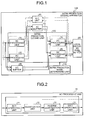
- FIG. 1 is a block diagram of a structure of the intra prediction coding apparatus 100 according to the first embodiment of the present invention.
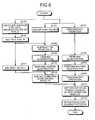
- FIG. 2 is a block diagram of a structure of an alternate current (AC) processing unit.
- FIG. 3 is a block diagram of a structure of a direct current (DC) processing unit.
- FIG. 4 is a schematic of a process for fixedly selecting a DC prediction mode.
- FIG. 5 is a schematic of timing for performing an AC process and a DC process.
- the intra prediction coding apparatus 100 includes an intra prediction mode determining unit 110, an intra prediction coding unit 120, a DC buffer 30, a variable length coding (VLC) unit 40, an AC buffer 50, and a local decoded pixel buffer 60. Each of these units will be explained below. Note that the intra prediction coding apparatus 100 also includes sixteen AC processing units 10 and four DC processing units 20; however, parallel processing is still possible in fewer numbers of these units.
- VLC variable length coding
- the intra prediction mode determining unit 110 fixedly selects a DC prediction mode in which same intra prediction values are used for all blocks in a macroblock. More specifically, the intra prediction mode determining unit 110 restricts the nine intra prediction modes specified in the MPEG-4 AVC/H.264 (see FIG. 10 ) so that only the DC prediction mode (Mode 2 in FIG. 10 ) is selectable.
- the prediction value for all blocks to be processed is an average of local decoded values of pixels positioning at pixels A, B, C, D, I, J, K, and L.
- the intra prediction coding unit 120 includes a plurality of AC processing units 10 and a plurality of DC processing units 20, and performs intra prediction coding separately for AC components and DC components of a block to be processed.
- c(i, j) and p(i, j) denote a 4 x 4 array of pixel values in a block to be coded and a 4 x 4 array of prediction values, respectively
- C(i, j) and P(i, j) denote results of discrete cosine transform (DCT) performed on c(i, j) and p(i, j), respectively.
- DCT discrete cosine transform
- x is an average of local decoded values of the pixels at A, B, C, D, I, J, K, and L in FIG. 4 .
- the intra prediction coding unit 120 has 16 AC processing units 10 and four DC processing units 20; however, parallel processing is still possible in fewer numbers of these units.
- Each of the AC processing units 10 accepts any of the 16 blocks (each block is made of 4 x 4 pixels) included in the macroblock simultaneously, and performs an AC component processing. More specifically, the AC processing unit 10 performs the DCT operation to c(i, j) that is the 4 x 4 array of the pixel values of the block to be coded, to obtain C(i, j). At this time, the DC component C(0, 0) is set to 0.
- the AC processing unit 10 subsequently performs quantization, inverse quantization, and inverse discrete cosine transform (IDCT) operation to C(i, j) (15 AC coefficients but not the DC component).
- the AC processing unit 10 then outputs quantized DCT coefficients (only the AC components) and results of the IDCT operations (only the AC components).
- An internal structure of the AC processing unit 10 will be described later with reference to FIG. 2 .
- Each of the DC processing units 20 accepts the DC component in the block from the DC buffer 30, the results of the IDCT operation (only the AC components) in the block from the AC buffer 50, and the local decoded pixel, used for generating intra DC prediction values for the block, from the local decoded pixel buffer 60, to perform a DC component processing.
- the DC processing unit 20 adds up the 16 pixel values of c(i, j) using the adding module that adds up the pixel values to obtain the DC component C(0, 0). This value is the same as C(0, 0) obtained when the DCT operation is performed on c(i, j).
- the DC processing unit 20 obtains 16x by multiplying 16 by "x" that is the average of the local decoded values of the pixels at A, B, C, D, I, J, K, and L. This is because the DC value is scaled by 16 in the DCT operation according to the MPEG-4 AVC/H.264.
- the DC processing unit 20 subsequently subtracts 16x from C(0, 0). Furthermore, the intra prediction coding apparatus 100 performs quantization and inverse quantization, and outputs a quantized result of the error of the DC component intra predictions to the VLC unit 40.
- the DC processing unit 20 also multiplies 16x by 4 to obtain 64x. This is because the DCT coefficient values are scaled by four in the quantization and the inverse quantization according to the MPEG-4 AVC/H.264.
- the DC processing unit 20 adds 64x to the result of the inverse quantization.
- the DC processing unit 20 then adds the result of the addition (scalar value) to each element of the results of the IDCT operation performed for the AC components (4 x 4 vector values), and divides each of the results by a scaling value 64 to obtain local decoded pixel c'(i, j). Then, the DC processing unit 20 outputs the results to the local decoded pixel buffer 60.
- Each of the DC processing units 20 then outputs the results of the quantization performed for the intra prediction errors of the DC components to the VLC unit 40, and outputs the local decoded results for the block to the local decoded pixel buffer 60.
- An internal structure of the DC processing unit 20 will be explained later with reference to FIG. 3 .
- the AC component processing performed by the respective AC processing units 10 are not affected by the intra prediction values. In other words, the processing can be performed in parallel, regardless of other block processing to be referred to during the intra prediction.
- the AC components can be processed at a rate N times faster.
- the DC component processing need to wait for the completion of other block processing to be referred to during the intra prediction. Therefore, all of the blocks cannot be processed simultaneously.
- the intra DC prediction only depends on the blocks neighboring at the top and on the left. Therefore, based on this fact and the block processing order, the DC component processing can be parallelized up to four to achieve processing at a rate four times faster.
- Blocks to be referred to when the fifth, the sixth, the ninth, and the tenth blocks, whose DC component processing are parallelized, are processed will be described with reference to the example depicted in FIG. 8 .
- the fifth block the fourth block in the same macroblock and the fifteenth block in a macroblock neighboring at the top are referred to; for the sixth block, the third and fourth blocks in the same macroblock are referred to; for the ninth block, the eighth and third blocks in the same macroblock are referred to; and for the tenth block, the fifteenth block in a macroblock neighboring on the left and the eighth block in the same macroblock are referred to.
- the neighboring macroblocks are assumed to be processed before the current macroblock.
- the DC buffer 30 simultaneously accepts 16 blocks included in a macroblock, calculates and saves the sum of the 16 coefficients (DC values) for each of the blocks. Then, the DC buffer 30 outputs the DC values of the blocks to the DC processing unit 20.
- the VLC unit 40 receives the AC components of the quantized DCT coefficients of each of the blocks output from the AC processing units 10, and the quantized results of the DC component intra prediction error of each of the blocks output from the DC processing units 20. The VLC unit 40 then performs variable length coding to these inputs, and outputs coded video.
- the AC buffer 50 stores therein the IDCT operation results (only the AC components) output from the parallelized AC processing units 10, and outputs the same to the DC processing units 20.
- the local decoded pixel buffer 60 stores therein the local decoded results for each of the blocks.
- the local decoded pixel buffer 60 also outputs local decoded pixel, required for generating the intra DC prediction values, to the DC processing units 20.
- the AC processing unit 10 will now be explained in detail with reference to FIG. 2 .
- the AC processing unit 10 includes a DCT operating unit 11, a quantization unit 12, an inverse quantization unit 13, and an IDCT operating unit 14. Each of these elements will now be explained.
- the DCT operating unit 11 performs the DCT operation on received 4 x 4 pixels, and outputs DCT operation results with the DC component being set to zero to the quantization unit 12.
- the quantization unit 12 quantizes the 15 DCT coefficients of the AC components other than the DC component.
- the inverse quantization unit 13 inversely quantizes the 15 quantized DCT coefficients of the AC components other than the DC component.
- the IDCT operating unit 14 performs the IDCT operation to the DCT coefficients including the 15 inversely-quantized AC components and the DC component with a coefficient value being set to zero, and outputs the local decoded results not including the DC component.
- the DC processing unit 20 will be explained in detail with reference to FIG. 3 .
- the DC processing unit 20 includes a subtractor 21, a quantizing unit 22, an inverse quantizing unit 23, an adder 24, a multiplier 25, an adder 26, a divider 27, and a DC predicting unit 28. Processes performed by these elements will now be explained.
- the subtractor 21 subtracts DC prediction values, output from the DC predicting unit 28, from the DC values in the block input to the DC processing unit 20.
- the quantizing unit 22 performs quantization to the DC prediction error.
- the inverse quantizing unit 23 inversely quantizes the quantized DC prediction error.
- the adder 24 adds the scaled DC prediction value, output from the multiplying unit 25, to the quantized and then inversely-quantized DC prediction errors, and outputs the local decoded results of the DC components.
- the multiplier 25 multiples the DC prediction value, output from the DC predicting unit 28, by four.
- the adder 26 adds the local decoded results of the DC components, output from the adder 24, to each of the local decoded results (4 x 4 coefficients) of the AC components input to the DC processing unit 20.
- the divider 27 divides each of the outputs from the adder 26 (4 x 4 coefficients) by 64, and outputs the final local decoded results for the block.
- the DC processing unit 20 receives the local decoded results of the blocks neighboring at the top and the left including the pixels used for generating the intra DC prediction values.
- the DC predicting unit 28 calculates the DC prediction values based on these local decoded results.
- the numbers in rectangles indicate block numbers (an order of coding processing according to the MPEG-4 AVC/H.264).
- the AC processing 16 blocks in a macroblock are processed simultaneously in parallel as described above.
- FIG. 6 is an illustrative flowchart of the intra prediction coding process performed by the intra prediction coding apparatus according to the first embodiment.
- the intra prediction coding apparatus 100 performs the DCT operation to the 4 x 4 array of the pixel values c(i, j) included in the block to be coded as the AC component processing to obtain C(i, j) (Step S101).
- the DC component C(0, 0) is set to zero.
- the intra prediction coding apparatus 100 performs the quantization (Step S102), the inverse quantization (Step S103), and the IDCT operation (Step S104) to C(i, j) (15 AC coefficients but not the DC component).
- the intra prediction coding apparatus 100 adds up the 16 pixel values of c(i, j) as the DC component processing to obtain the DC component C(0, 0) (Step S105). This value is the same as C(0, 0) obtained when the DCT operation is performed on c(i, j).
- the intra prediction coding apparatus 100 obtains x that is the average of the local decoded values of the pixels at A, B, C, D, I, J, K, and L, because the DC prediction mode is fixedly selected (Step S106).
- the intra prediction coding apparatus 100 then multiplies x by 16 to obtain 16x (Step S107). This is because the DC value is scaled by 16 in the DCT operation according to the MPEG-4 AVC/H.264.
- the intra prediction coding apparatus 100 subtracts 16x from C(0, 0) (Step S108).
- the intra prediction coding apparatus 100 then performs the quantization (Step S109) and the inverse quantization (Step S110).
- the intra prediction coding apparatus 100 multiplies 16x by 4 to obtain 64x (Step S111). This is because the DCT coefficient values are scaled by 4 in the quantization and the inverse quantization according to the MPEG-4 AVC/H.264.
- the intra prediction coding apparatus 100 then adds 64x to the results of the inverse quantization obtained at Step S110 (Step S112).
- the intra prediction coding apparatus 100 then adds the result of the addition (scalar value), obtained at Step S112, to each element of the results of the IDCT operation performed for the AC components (4 x 4 vector value) (Step S113), and divides the result by a scaling factor 64 (Step S114) to obtain local decoded pixel values c' (i, j).
- the intra prediction coding apparatus 100 fixedly selects the DC prediction mode in which same intra prediction values are used for all blocks to be processed in a macroblock, and performs intra prediction coding separately for the AC component and for the DC component in the block to be processed. Therefore, intra prediction coding can be performed at a higher speed.
- the intra prediction coding apparatus 100 includes the plural AC processing units 10, each performing the AC component processing; therefore, the AC processing units 10 can perform the AC component processing in parallel. This accelerates the AC component processing, further enabling intra prediction coding to be performed at a higher speed.
- the intra prediction coding apparatus 100 includes the plural DC processing units 20, each performing the DC component processing; therefore, the DC processing units 20 can perform the DC component processing in parallel. This accelerates the DC component processing, further enabling intra prediction coding to be performed at a higher speed.
- the intra prediction coding apparatus 100 uses an adding module for adding the pixel values to calculate the DC component. Therefore, intra prediction coding can be performed at a higher speed.
- the DC component is calculated using the adding module for adding the pixel values.
- the present invention is not limited to this, and the DC component may also be calculated using the DCT operation module that performs the DCT operation.
- Each of the structural components of the units depicted in the schematics is only conceptual in function, and is not necessarily physically configured as depicted in the schematics. That is, the specific patterns of distribution and unification of the units are not limited to those depicted in schematics. All or part of the components can be functionally or physically distributed or unified in arbitrary units, according to various loads and the state of use.
- the intra prediction coding unit 120 and the intra prediction mode determining unit 110 may be unified.
- all or arbitrary part of the processing functions performed by the units can be achieved by a Central Processing Unit (CPU) and a computer program analyzed and executed by the CPU, or can be achieved as hardware using wired logics.
- CPU Central Processing Unit
Landscapes
- Engineering & Computer Science (AREA)
- Multimedia (AREA)
- Signal Processing (AREA)
- Computing Systems (AREA)
- Theoretical Computer Science (AREA)
- Compression Or Coding Systems Of Tv Signals (AREA)
Applications Claiming Priority (1)
| Application Number | Priority Date | Filing Date | Title |
|---|---|---|---|
| JP2008209315A JP5187062B2 (ja) | 2008-08-15 | 2008-08-15 | 動画像符号化装置および動画像符号化方法 |
Publications (2)
| Publication Number | Publication Date |
|---|---|
| EP2154897A2 true EP2154897A2 (fr) | 2010-02-17 |
| EP2154897A3 EP2154897A3 (fr) | 2010-05-12 |
Family
ID=41320847
Family Applications (1)
| Application Number | Title | Priority Date | Filing Date |
|---|---|---|---|
| EP20090007227 Withdrawn EP2154897A3 (fr) | 2008-08-15 | 2009-05-29 | Procédé et appareil de codage de vidéos |
Country Status (3)
| Country | Link |
|---|---|
| US (1) | US20100040143A1 (fr) |
| EP (1) | EP2154897A3 (fr) |
| JP (1) | JP5187062B2 (fr) |
Cited By (1)
| Publication number | Priority date | Publication date | Assignee | Title |
|---|---|---|---|---|
| CN108155969A (zh) * | 2016-12-02 | 2018-06-12 | 北京深鉴科技有限公司 | 一种针对变长编码数据的解码电路 |
Families Citing this family (6)
| Publication number | Priority date | Publication date | Assignee | Title |
|---|---|---|---|---|
| US8619857B2 (en) * | 2010-04-09 | 2013-12-31 | Sharp Laboratories Of America, Inc. | Methods and systems for intra prediction |
| WO2011136896A1 (fr) * | 2010-04-27 | 2011-11-03 | Sony Corporation | Prédiction intra-trame adaptative limite pour améliorer une qualité vidéo subjective |
| PT3370420T (pt) * | 2010-12-21 | 2019-10-31 | Ntt Docomo Inc | Codificação com intra-predição melhorada utilizando representações planares |
| US9277212B2 (en) * | 2012-07-09 | 2016-03-01 | Qualcomm Incorporated | Intra mode extensions for difference domain intra prediction |
| JP6080077B2 (ja) | 2014-07-15 | 2017-02-15 | パナソニックIpマネジメント株式会社 | 画像符号化方法及び画像符号化装置 |
| EP3840387B1 (fr) | 2018-10-12 | 2024-03-06 | Guangdong Oppo Mobile Telecommunications Corp., Ltd. | Procédé de codage/décodage de signal d'image et dispositif associé |
Citations (4)
| Publication number | Priority date | Publication date | Assignee | Title |
|---|---|---|---|---|
| US6466620B1 (en) | 1998-08-31 | 2002-10-15 | Daewoo Electronics Co., Ltd. | Method and apparatus for adaptively coding video signals |
| US20050147307A1 (en) | 2003-12-19 | 2005-07-07 | Shinji Kitamura | Image encoding apparatus and image encoding method |
| US20060188164A1 (en) | 2005-02-18 | 2006-08-24 | Samsung Electronics Co., Ltd. | Apparatus and method for predicting coefficients of video block |
| US20060222066A1 (en) | 2005-04-04 | 2006-10-05 | Samsung Electronics Co., Ltd. | Intra prediction method and apparatus |
Family Cites Families (15)
| Publication number | Priority date | Publication date | Assignee | Title |
|---|---|---|---|---|
| US5130797A (en) * | 1989-02-27 | 1992-07-14 | Mitsubishi Denki Kabushiki Kaisha | Digital signal processing system for parallel processing of subsampled data |
| JP3085465B2 (ja) * | 1989-10-31 | 2000-09-11 | オリンパス光学工業株式会社 | 画像データの符号化装置および符号化方法 |
| US5568278A (en) * | 1991-03-19 | 1996-10-22 | Olympus Optical Co., Ltd. | Image data coding and decoding method and apparatus with a plurality of DCT's, quantizers, and VLC's |
| JP2871139B2 (ja) * | 1991-03-19 | 1999-03-17 | オリンパス光学工業株式会社 | 画像デ―タの符号化装置および復号化装置 |
| US5379070A (en) * | 1992-10-02 | 1995-01-03 | Zoran Corporation | Parallel encoding/decoding of DCT compression/decompression algorithms |
| US6005622A (en) * | 1996-09-20 | 1999-12-21 | At&T Corp | Video coder providing implicit or explicit prediction for image coding and intra coding of video |
| US6591015B1 (en) * | 1998-07-29 | 2003-07-08 | Matsushita Electric Industrial Co., Ltd. | Video coding method and apparatus with motion compensation and motion vector estimator |
| US6650784B2 (en) * | 2001-07-02 | 2003-11-18 | Qualcomm, Incorporated | Lossless intraframe encoding using Golomb-Rice |
| US7830959B2 (en) * | 2003-12-26 | 2010-11-09 | Electronics And Telecommunications Research Institute | Apparatus and method for performing intra prediction for image decoder |
| KR20060008523A (ko) * | 2004-07-21 | 2006-01-27 | 삼성전자주식회사 | 영상의 인트라 예측 방법 및 그 장치 |
| JP4633562B2 (ja) * | 2005-07-06 | 2011-02-16 | 大日本印刷株式会社 | 体積型ホログラム感光性組成物 |
| KR101127221B1 (ko) * | 2005-07-15 | 2012-03-29 | 삼성전자주식회사 | 주파수 공간에서 컬러 성분간 예측을 이용한 컬러영상부호화/복호화 방법 및 장치 |
| JP4246723B2 (ja) * | 2005-08-29 | 2009-04-02 | 日本電信電話株式会社 | フレーム内予測符号化制御方法、フレーム内予測符号化制御装置、フレーム内予測符号化制御プログラムおよびそのプログラムを記録したコンピュータ読み取り可能な記録媒体 |
| JP5089878B2 (ja) * | 2005-10-28 | 2012-12-05 | パナソニック株式会社 | 画像符号化装置 |
| JP4707118B2 (ja) * | 2007-03-28 | 2011-06-22 | 株式会社Kddi研究所 | 動画像符号化装置および動画像復号装置のイントラ予測方式 |
-
2008
- 2008-08-15 JP JP2008209315A patent/JP5187062B2/ja not_active Expired - Fee Related
-
2009
- 2009-05-29 US US12/457,053 patent/US20100040143A1/en not_active Abandoned
- 2009-05-29 EP EP20090007227 patent/EP2154897A3/fr not_active Withdrawn
Patent Citations (4)
| Publication number | Priority date | Publication date | Assignee | Title |
|---|---|---|---|---|
| US6466620B1 (en) | 1998-08-31 | 2002-10-15 | Daewoo Electronics Co., Ltd. | Method and apparatus for adaptively coding video signals |
| US20050147307A1 (en) | 2003-12-19 | 2005-07-07 | Shinji Kitamura | Image encoding apparatus and image encoding method |
| US20060188164A1 (en) | 2005-02-18 | 2006-08-24 | Samsung Electronics Co., Ltd. | Apparatus and method for predicting coefficients of video block |
| US20060222066A1 (en) | 2005-04-04 | 2006-10-05 | Samsung Electronics Co., Ltd. | Intra prediction method and apparatus |
Non-Patent Citations (1)
| Title |
|---|
| MITCHELL ET AL.: "MPEG Video compression standard", 1 January 1996, CHAPMAN AND HALL DIGITAL MULTIMEDIA STANDARDS SERIES, article "MPEG Video compression standard, MPEG coding principles" |
Cited By (1)
| Publication number | Priority date | Publication date | Assignee | Title |
|---|---|---|---|---|
| CN108155969A (zh) * | 2016-12-02 | 2018-06-12 | 北京深鉴科技有限公司 | 一种针对变长编码数据的解码电路 |
Also Published As
| Publication number | Publication date |
|---|---|
| EP2154897A3 (fr) | 2010-05-12 |
| JP5187062B2 (ja) | 2013-04-24 |
| JP2010045690A (ja) | 2010-02-25 |
| US20100040143A1 (en) | 2010-02-18 |
Similar Documents
| Publication | Publication Date | Title |
|---|---|---|
| EP3448038B1 (fr) | Procédé de décodage pour la intra-prédiction d'un bloc en commençant par des pixels à la limite du bloc | |
| KR101684038B1 (ko) | 동화상 복호 장치, 동화상 부호화 장치, 동화상 복호 방법, 및 동화상 부호화 방법 | |
| EP2744210A1 (fr) | Transformées adaptatives de blocs résiduels en fonction du mode de prédiction intérieure | |
| EP4266683A2 (fr) | Appareil de codage d'image animée, appareil de décodage d'image animée, procédé de codage d'image animée et procédé de décodage d'image animée | |
| US8315467B2 (en) | Image encoding device and image encoding method | |
| EP2154897A2 (fr) | Procédé et appareil de codage de vidéos | |
| EP1691559B1 (fr) | Méthode et dispositif pour le codage d'une image vidéo en mode inter ou intra | |
| EP4210328A1 (fr) | Compression vidéo utilisant un affinement de modèle basé sur une limite | |
| JP2011166592A (ja) | 画像符号化装置及び画像復号装置 | |
| JPWO2016194380A1 (ja) | 動画像符号化装置、動画像符号化方法および動画像符号化プログラムを記憶する記録媒体 | |
| He et al. | High-performance H. 264/AVC intra-prediction architecture for ultra high definition video applications | |
| US20120218443A1 (en) | Decoder-derived geometric transformations for motion compensated inter prediction | |
| EP3844961B1 (fr) | Modélisation de contexte à coefficient pour le codage de vidéo | |
| Babionitakis et al. | A real-time H. 264/AVC VLSI encoder architecture | |
| KR20180018903A (ko) | 참조 프레임 선택 방법 및 그 장치 | |
| US11856227B2 (en) | Transform architecture in video encoding systems | |
| Orlandić et al. | A low-complexity MPEG-2 to H. 264/AVC wavefront intra-frame transcoder architecture | |
| Jun | A parallel HEVC encoder scheme based on Multi-core platform |
Legal Events
| Date | Code | Title | Description |
|---|---|---|---|
| PUAI | Public reference made under article 153(3) epc to a published international application that has entered the european phase |
Free format text: ORIGINAL CODE: 0009012 |
|
| AK | Designated contracting states |
Kind code of ref document: A2 Designated state(s): AT BE BG CH CY CZ DE DK EE ES FI FR GB GR HR HU IE IS IT LI LT LU LV MC MK MT NL NO PL PT RO SE SI SK TR |
|
| AX | Request for extension of the european patent |
Extension state: AL BA RS |
|
| PUAL | Search report despatched |
Free format text: ORIGINAL CODE: 0009013 |
|
| AK | Designated contracting states |
Kind code of ref document: A3 Designated state(s): AT BE BG CH CY CZ DE DK EE ES FI FR GB GR HR HU IE IS IT LI LT LU LV MC MK MT NL NO PL PT RO SE SI SK TR |
|
| AX | Request for extension of the european patent |
Extension state: AL BA RS |
|
| 17P | Request for examination filed |
Effective date: 20101112 |
|
| 17Q | First examination report despatched |
Effective date: 20110520 |
|
| STAA | Information on the status of an ep patent application or granted ep patent |
Free format text: STATUS: THE APPLICATION IS DEEMED TO BE WITHDRAWN |
|
| 18D | Application deemed to be withdrawn |
Effective date: 20151201 |