EP2155179B1 - Axomadol zur schmerzbehandlung bei arthrose - Google Patents
Axomadol zur schmerzbehandlung bei arthrose Download PDFInfo
- Publication number
- EP2155179B1 EP2155179B1 EP08758440A EP08758440A EP2155179B1 EP 2155179 B1 EP2155179 B1 EP 2155179B1 EP 08758440 A EP08758440 A EP 08758440A EP 08758440 A EP08758440 A EP 08758440A EP 2155179 B1 EP2155179 B1 EP 2155179B1
- Authority
- EP
- European Patent Office
- Prior art keywords
- pain
- acid
- axomadol
- use according
- osteoarthritis
- Prior art date
- Legal status (The legal status is an assumption and is not a legal conclusion. Google has not performed a legal analysis and makes no representation as to the accuracy of the status listed.)
- Not-in-force
Links
Classifications
-
- A—HUMAN NECESSITIES
- A61—MEDICAL OR VETERINARY SCIENCE; HYGIENE
- A61K—PREPARATIONS FOR MEDICAL, DENTAL OR TOILETRY PURPOSES
- A61K31/00—Medicinal preparations containing organic active ingredients
- A61K31/13—Amines
- A61K31/135—Amines having aromatic rings, e.g. ketamine, nortriptyline
-
- A—HUMAN NECESSITIES
- A61—MEDICAL OR VETERINARY SCIENCE; HYGIENE
- A61P—SPECIFIC THERAPEUTIC ACTIVITY OF CHEMICAL COMPOUNDS OR MEDICINAL PREPARATIONS
- A61P19/00—Drugs for skeletal disorders
-
- A—HUMAN NECESSITIES
- A61—MEDICAL OR VETERINARY SCIENCE; HYGIENE
- A61P—SPECIFIC THERAPEUTIC ACTIVITY OF CHEMICAL COMPOUNDS OR MEDICINAL PREPARATIONS
- A61P19/00—Drugs for skeletal disorders
- A61P19/02—Drugs for skeletal disorders for joint disorders, e.g. arthritis, arthrosis
-
- A—HUMAN NECESSITIES
- A61—MEDICAL OR VETERINARY SCIENCE; HYGIENE
- A61P—SPECIFIC THERAPEUTIC ACTIVITY OF CHEMICAL COMPOUNDS OR MEDICINAL PREPARATIONS
- A61P25/00—Drugs for disorders of the nervous system
-
- A—HUMAN NECESSITIES
- A61—MEDICAL OR VETERINARY SCIENCE; HYGIENE
- A61P—SPECIFIC THERAPEUTIC ACTIVITY OF CHEMICAL COMPOUNDS OR MEDICINAL PREPARATIONS
- A61P25/00—Drugs for disorders of the nervous system
- A61P25/04—Centrally acting analgesics, e.g. opioids
-
- A—HUMAN NECESSITIES
- A61—MEDICAL OR VETERINARY SCIENCE; HYGIENE
- A61P—SPECIFIC THERAPEUTIC ACTIVITY OF CHEMICAL COMPOUNDS OR MEDICINAL PREPARATIONS
- A61P29/00—Non-central analgesic, antipyretic or antiinflammatory agents, e.g. antirheumatic agents; Non-steroidal antiinflammatory drugs [NSAID]
Definitions
- the invention relates to the use of axomadol for the treatment of pain in osteoarthritis.
- Osteoarthritis ( Arthrosis deformans ) is the most common human joint disease. It is a dynamic, but slowly progressive, degenerative disease of cartilage and other joint tissues, especially in older individuals, with intermittent inflammatory episodes. Due to the lack of inflammatory parameters, limited mobility, short-term joint stiffness and radiological features, it can be differentiated from other rheumatic diseases.
- Osteoarthritis or joint wear is a joint damage that begins with a breakdown of the articular cartilage. In severe cases, it eventually leads to remodeling in the neighboring bone, the joint surface is destroyed. The consequences of the disease are therefore pain and stiffness of the joint with movement restrictions. The joints can deform and eventually ossify completely. Osteoarthritis is usually a slowly progressive event. The cartilage layer subsequently becomes thicker and the chondrocytes become metabolically more active. Changes in the subchondral trabeculae lead to a reduced pressure relief by the cancellous bone. The repair tissue is more heavily loaded and as the disease progresses, the balance changes with respect to destruction. Radiologically, a joint space narrowing is visible and at the edges osteophytes are formed.
- hip and knee arthrosis are defined as primary cartilage disorders associated with painful movement restrictions (onset pain, stress pain) and walking disability, respectively. Inflammation like synovitis may or may not be established.
- osteoarthritis The leading and early symptoms of osteoarthritis are pain (early triad: onset pain, fatigue pain, stress pain, late triad: persistent pain, night pain, muscle pain). They are accompanied by movement restrictions, weather sensitivity, crepitation. Pain causes in osteoarthritis mainly result from irritation in periarticular tendon and ligament attachments, secondary inflammation, joint capsular stretching, irritation, increased pressure in the subchondral bone and microfractures.
- the European League against Rheumatism (EULAR) recommends the Lequesne Index, which is the physician's overall assessment and the patient's pain assessment.
- the FDA recommends the evaluation of pain and function by the Western Ontario McMaster Universities Osteoarthritis Index (WOMAC) and the Lequesne Indices , in addition to assessing the swelling, redness and compressive strength of the joint.
- WOMAC Western Ontario McMaster Universities Osteoarthritis Index
- the Osteoarthritis Research Society recommends the scales of the WOMAC pain score as the main outcome measure for drugs used in the symptomatic treatment of osteoarthritis, as a secondary objective criteria for the WOMAC movement restriction score or the Lequesne index, as well as the overall judgment of the physician and the patients.
- Opioid analgesics are not part of the routine repertoire of the treatment of osteoarthritis, but are inevitable in certain situations.
- conventional opioid analgesics show some significant side effects, especially constipation, nausea, vomiting, headache, sedation, fatigue, respiratory depression, allergies, and sometimes hypotension. These side effects make long-term therapy of chronic pain in osteoarthritis difficult. Therefore, the indication for treatment with conventional Opioidanalgetika usually only after exhausting all other therapeutic options, for example, in patients who are not able to operate, but suffer from massive, other analgesic substances unresponsive rest pain.
- the object of the invention was therefore to find compounds which are effective in combating pain in osteoarthritis and show advantages over conventional analgesics.
- the invention relates to the use of axomadol for the manufacture of a medicament for the treatment of pain in osteoarthritis.
- axomadol combines excellent efficacy in the treatment of osteoarthritis pain and a reduced spectrum of side effects.
- axomadol has a better analgesic efficacy in the chronic inflammatory pain model compared to conventional analgesics, e.g. Morphine, oxycodone and tramadol.
- Axomadol ie, (1 RS, 3 RS, 6 RS) -6-dimethylaminomethyl-1- (3-methoxyphenyl) -cyclohexane-1,3-diol, is a synthetic, centrally acting analgesic that heavy in the treatment of moderate to , acute or chronic pain is effective.
- Axomadol can be used in the form of its free base or as a salt or solvate.
- EP-A 0 753 506 describes the synthesis of axomadol and its analgesic efficacy in the mouse tail-flick test.
- Out WO 01/57232 is the stereoselective synthesis of axomadol by enzymatic racemate resolution of the corresponding ester precursor known.
- WO 02/43714 discloses Axomadol for the treatment of increased urinary urgency or urinary incontinence.
- WO 03/024444 describes that a drug combination containing axomadol and a muscarinic antagonist can also be used to treat urinary incontinence.
- WO 02/067916 describes the dissolution behavior of the axomadol hydrochloride salt and the solubility of the axomadol saccharinate in water.
- WO 2005/009329 discloses pharmaceutical formulations of sustained release axomadol.
- axomadol means (1RS, 3RS, 6RS) -6-dimethylaminomethyl-1- (3-methoxyphenyl) -cyclohexane-1,3-diol, its pharmaceutically acceptable salts and solvates.
- Suitable pharmaceutically acceptable salts include salts of inorganic and / or organic acids such as acetic acid, 2,2-dichloroacetic acid, acylated amino acids, preferably acetylated amino acids such as N-acetylalanine, N-acetylcysteine, N-acetylglycine, N-acetylisoleucine, N- Acetylleucine, N-acetylmethionine, N-acetylphenylalanine, N-acetylproline, N-acetylserine, N-acetylthreonine, N-acetyltyrosine, N-acetylvaline, adipic acid, alginic acid, ascorbic acid, L-aspartic acid, benzenesulfonic acid, benzoic acid, 4-acetamidobenzoic acid, (+ ) -Camric acid, (-) - camphorsic acid, (+)
- Axomadol may also be present in any proportion as a mixture of the salts of the abovementioned organic and inorganic acids.
- the medicament is a solid dosage form.
- the medicament is formulated for oral administration.
- other forms of administration are also possible, for example for buccal, sublingual, transmucosal, rectal, intralumbar, intraperitoneal, transdermal, intravenous, intramuscular, intragluteal, intracutaneous and subcutaneous administration.
- the medicament preferably contains suitable additives and / or auxiliaries.
- suitable additives and / or auxiliaries in the context of the invention are all substances known to the person skilled in the art from the prior art for achieving galenic formulations.
- the choice of these excipients and the amounts to be used depend on how the drug is to be administered, i. oral, intravenous, intraperitoneal, intradermal, intramuscular, intranasal, buccal or local.
- preparations in the form of tablets, chewable tablets, dragees, capsules, granules, drops, juices or syrups are suitable, for parenteral, topical and inhalative administration solutions, suspensions, readily reconstitutable dry preparations and sprays.
- suppositories for rectal use.
- the application in a depot in dissolved form, a carrier film or a plaster, optionally with the addition of the Skin penetration promoting agents are examples of suitable percutaneous administration forms.
- excipients and additives for the oral administration forms are disintegrants, lubricants, binders, fillers, mold release agents, optionally solvents, flavorings, sugars, in particular vehicles, diluents, dyes, antioxidants, etc.
- Waxes or fatty acid esters and for parenteral application agents carriers, preservatives, suspension aids, etc. can be used.
- Excipients may be, for example: water, ethanol, 2-propanol, glycerol, ethylene glycol, propylene glycol, polyethylene glycol, polypropylene glycol, glucose, fructose, lactose, sucrose, dextrose, molasses, starch, modified starch, gelatin, sorbitol, inositol, mannitol, microcrystalline cellulose , Methylcellulose, carboxymethylcellulose, cellulose acetate, shellac, cetyl alcohol, polyvinylpyrrolidone, paraffins, waxes, natural and synthetic gums, acacia, alginates, dextran, saturated and unsaturated fatty acids, stearic acid, magnesium stearate, zinc stearate, glyceryl stearate, sodium lauryl sulfate, edible oils, sesame oil, coconut oil, Peanut oil, soybean oil, lecithin, sodium lactate, polyoxyethylene and -propy
- a solid formulation such as a tablet
- the active ingredient of the drug with a pharmaceutical carrier, e.g. conventional tablet ingredients, such as corn starch, lactose, sucrose, sorbitol, talc, magnesium stearate, dicalcium phosphate or pharmaceutically acceptable gums, and pharmaceutical diluents, e.g. Water, granulated to form a solid composition containing the active ingredient in a homogeneous distribution.
- a homogeneous distribution is understood here to mean that the active ingredient is distributed uniformly over the entire composition, so that it can be readily subdivided into equally effective unit dose forms, such as tablets, capsules, dragees.
- the solid composition is then subdivided into unit dose forms.
- the tablets or pills may also be coated or otherwise compounded to provide a sustained release dosage form.
- Suitable coating agents are i.a. polymeric acids and mixtures of polymeric acids with materials such as e.g. Shellac, cetyl alcohol and / or cellulose acetate.
- the amounts of axomadol administered to patients vary depending on the weight of the patient, the mode of administration and the severity of the disease.
- the medicament contains axomadol in an amount of 10 to 2,000 mg, more preferably 15 to 1,000 mg, even more preferably 20 to 500 mg, based on the free base.
- axomadol may be released with a delay.
- the medicament is formulated for once daily administration, twice daily (bid) or three times a day administration, with twice daily administration (bid) being particularly preferred.
- Delayed release of axomadol can be achieved, for example, by retarding with the aid of a matrix, a coating or osmotic-release systems (cf., for example, US Pat WO 2005/009329 ).
- the medicament may be in the form of a simple tablet and coated tablet (e.g., as a film-coated tablet or dragee).
- the tablets are usually round and biconvex, but oblong forms are also possible.
- Granules, spheroids, pellets or microcapsules filled in sachets or capsules or compressed into disintegrating tablets are also possible.
- axomadol Preference is given to medicaments containing at least 0.001 to 99.999% by weight of axomadol, in particular low, effective dosages in order to avoid side effects.
- the medicament preferably contains 0.01% to 99.99% by weight of axomadol, more preferably 0.1 to 90%, even more preferably 0.5 to 80%, most preferably 1.0 to 50 wt .-% and in particular 5.0 to 20 wt .-%.
- the medicament is an oral dosage form which is formulated for twice-daily administration and contains axomadol in an amount of from 10 to 2000 mg, based on the free base.
- Axomadol shows pronounced antihyperalgesic efficacy demonstrated in the Complete Freund Adjuvant (CFA) animal model.
- Axomadol is used according to the invention for the treatment of pain in osteoarthritis.
- Arthrosis is preferably selected from the group consisting of gonarthrosis, coxarthrosis and spondylarthrosis.
- the painful osteoarthritis is preferably osteoarthritis within the meaning of ICD-10 (International Statistical Classification of Diseases and Related Health Problems, WHO edition, preferably as of 2007).
- Arthrosis is preferably selected from polyarthrosis [M15], coxarthrosis [M16], gonarthrosis [M17], rhizarthrosis [M18], other arthrosis [M19] and arthrosis of the spine [M47].
- the terms in parentheses refer to the nomenclature used in ICD-10.
- osteoarthritis is polyarthrosis [M15], it is preferably selected from the group consisting of primary, generalized (osteo) arthrosis [M15.0], Heberden's node (with arthropathy) [M15.1], Bouchard Node (with arthropathy) [M15.2], secondary, multiple arthrosis (post-traumatic polyarthrosis) [M15.3], erosive (osteo) arthrosis [M15.4], other polyarthrosis [M15.8] and unspecified polyarthritis (generalized (osteo) arthrosis without further details) [M15.9].
- arthrosis is coxarthrosis [M16], it is preferably selected from the group consisting of bilateral primary coxarthrosis [M16.0], other primary coxarthrosis (unilateral or unexplained) [M16.1], bilateral coxarthrosis as Consequences of dysplasia [M16.2], other dysplastic coxarthrosis (unilateral or unspecified) [M16.3], bilateral, post-traumatic coxarthrosis [M16.4], other post-traumatic coxarthrosis [M16.5] (unilateral or unspecified) , other, bilateral secondary coxarthrosis [M16.6], other secondary coxarthrosis (unilateral or unspecified) [M16.7] and unspecified coxarthrosis [M16.9].
- M16.0 bilateral primary coxarthrosis
- M16.1 bilateral coxarthrosis as Consequences of dysplasia
- M16.3 other dysplastic coxarthrosis (unilateral or unspecified)
- osteoarthritis is gonarthrosis [M17], it is preferably selected from the group consisting of bilateral primary gonarthrosis [M17.0], other primary gonarthrosis (unilateral or unspecified) [M17.1], bilateral, posttraumatic Gonarthrosis [M17.2], other post-traumatic gonarthrosis [M17.3] (unilateral or unspecified), other, bilateral secondary gonarthrosis [M17.4], other secondary gonarthrosis (unilateral or unspecified) [M17.5] and unspecified gonarthrosis [M17.9].
- arthrosis is rhizarthrosis [M18], it is preferably selected from the group consisting of bilateral primary rhizarthrosis [M18.0], other primary rhizarthrosis (unilateral or unspecified) [M18.1], bilateral, posttraumatic Rhizarthrosis [M18.2], other post-traumatic rhizarthrosis [M18.3] (unilateral or unspecified), other, bilateral secondary rhizarthrosis [M18.4], other secondary rhizarthrosis (unilateral or unspecified) [M18.5] and unspecified rhizarthrosis [M18.9].
- osteoarthritis is other osteoarthritis [M19], it is preferably selected from the group consisting of primary arthrosis of other joints (primary arthrosis without further details) [M19.0], posttraumatic arthrosis of other joints (posttraumatic arthrosis without further details ) [M19.1], other secondary arthrosis (secondary osteoarthritis without further details) [M19.2], other specified arthrosis [M19.8] and unspecified osteoarthritis [M19.9].
- the pain is moderate to severe.
- the pain is selected from the group consisting of onset pain, stress pain, fatigue pain, peri-articular pressure pain, radiating pain (eg knee pain in existing coxarthrosis), rest pain after prolonged persistence in the same position, persistent pain, spontaneous pain, movement pain, night pain, muscle pain, Endlagenriti, ossärem pain as spontaneous and resting pain.
- the pain is hyperalgesia or allodynia. Hyperalgesia is preferably thermally or mechanically induced.
- the medicaments according to the invention show only slight side effects, it may be advantageous, for example to avoid certain forms of dependence, to use not only axomadol but also morphine antagonists, in particular naloxone, naltrexone and / or levallorphan.
- the invention relates to axomadol for use in a method of treating osteoarthritis pain in which axomadol is administered to a patient in a pharmaceutically acceptable amount.
- patients with hip or knee OA were divided into 5 groups. Patients in 3 of these groups received different daily doses of axomadol (based on the free base 44, 66 and 110 mg twice daily), one group received tramadol (100 mg twice daily) and one group was treated with placebo twice daily.
- a clinically relevant decrease in perset set pain intensity could be demonstrated as a function of dosage (higher efficacy at higher doses) and the results in the patient group receiving axomadol 110 mg twice daily were statistically significant (p ⁇ 0.05) compared to the placebo group ,
- the occurrence of the most common adverse events was higher in the patient group who received 110 mg axomadol hydrochloride twice daily than in any other treatment group.
- the most common adverse events were nausea, constipation, excessive sweating, dizziness, vomiting, headache, dry mouth and drowsiness.
- patients with knee OA were divided into 4 groups. Two of the patient groups received different doses of axomadol hydrochloride: 100 mg and 150 mg in free base, twice daily after a titration time of 2 weeks, during which the dose of axomadol was increased weekly. Another group of patients received oxycodone CR (20 mg twice daily) after a titration time in which oxycodone CR increased from 10 mg to 20 mg was increased twice daily. Another group received placebo twice daily.
- Several secondary endpoints confirmed these results for the full analysis set as well as for the per protocol set.
- CFA Rat Complete Freund Adjuvant Animal Model
- CFA complete Freund's adjuvant
- CFA hyperalgesia for mechanical or thermal stimuli is limited to the inflamed paw.
- the experimental animals used were Sprague Dawley rats from a commercial breeder (Janvier, Belgium) weighing 140-160 g.
- the rat CFA-HA was induced by subplantar injection of CFA (100 ⁇ l of the 1 mg / ml mycobacteria (M. tuberculosis, heat-killed) / oil suspension (IFA; Difco)) into the right hind paw (ipsilateral).
- the injection day was defined as day 0 (d 0).
- % Inhibition of HA (1 - HA reading / HA pre-value) ⁇ 100
- HA Prevalence withdrawal threshold contralateral - withdrawal threshold ipsilateral before substance administration
- HA measurement value withdrawal threshold strictlyateral - withdrawal threshold ipsilateral after substance administration
- the substance was administered intravenously (i.v.) to the maximum possible dose.
- the highest possible dose was defined as that dose which did not show any side effects affecting the measurement nor a strong antinociceptive effect on the untreated paw and a further dose increase caused this effect.
- the maximum efficacy was determined by the maximum achievable hyperalgesia inhibition that could be achieved in a dose range that did not induce 1. no overlap with antinociceptive effects on the contralateral paw and / or 2. no adverse effects to the extent that the Interpretation of the measured values influenced.
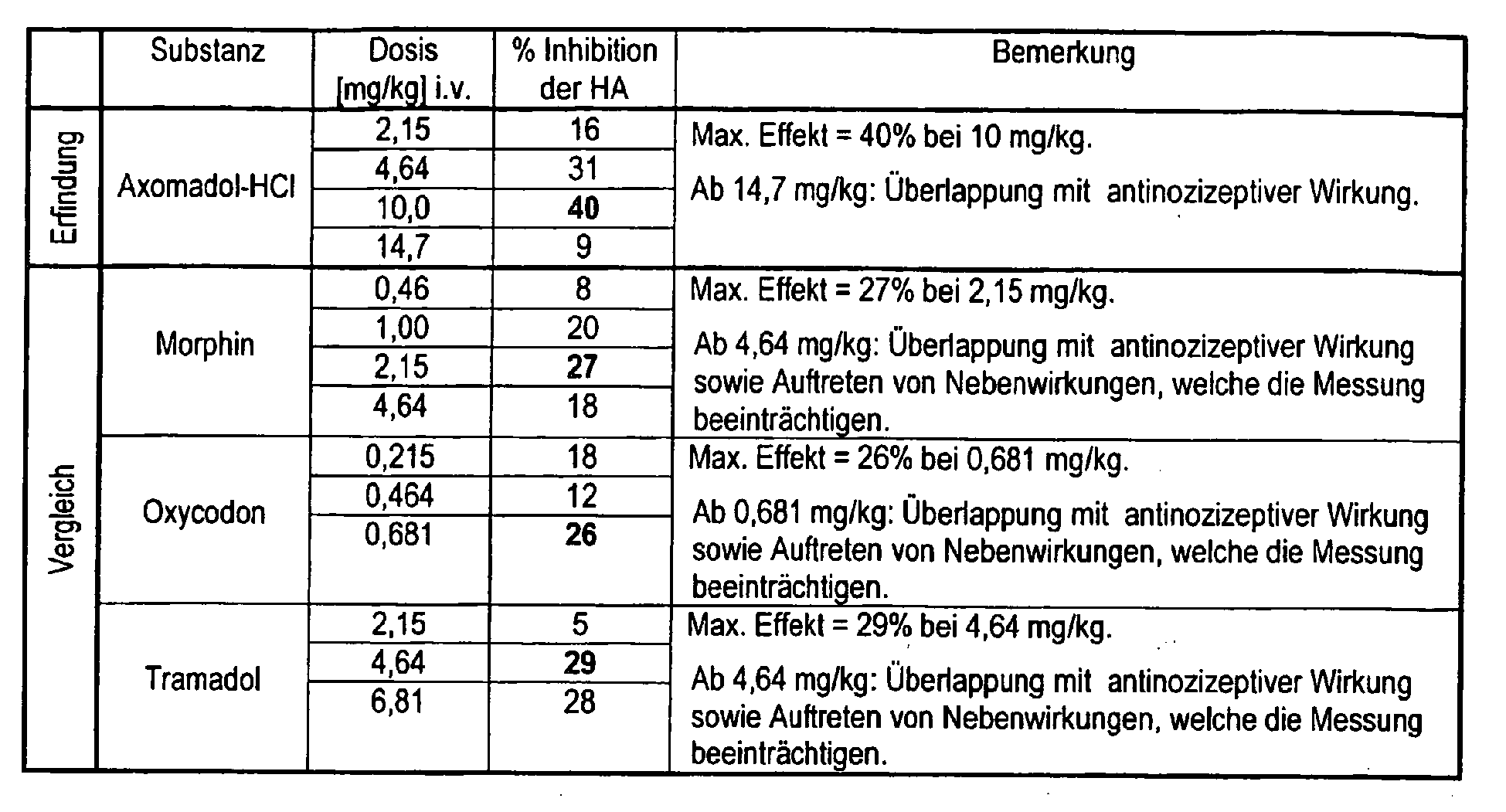
- Axomadol significantly reduces CFA-induced hyperalgesia.
- a maximum anti-hyperalgesic effect of 40% was achieved after intravenous administration of 10 mg / kg axomadol HCl. Higher doses led to a decrease in the antihyperalgesic effect to 9% and an overlap with an additional antinociceptive effect.
Landscapes
- Health & Medical Sciences (AREA)
- Medicinal Chemistry (AREA)
- Veterinary Medicine (AREA)
- Public Health (AREA)
- General Health & Medical Sciences (AREA)
- Animal Behavior & Ethology (AREA)
- Life Sciences & Earth Sciences (AREA)
- Chemical & Material Sciences (AREA)
- Pharmacology & Pharmacy (AREA)
- Chemical Kinetics & Catalysis (AREA)
- Organic Chemistry (AREA)
- General Chemical & Material Sciences (AREA)
- Nuclear Medicine, Radiotherapy & Molecular Imaging (AREA)
- Bioinformatics & Cheminformatics (AREA)
- Engineering & Computer Science (AREA)
- Epidemiology (AREA)
- Pain & Pain Management (AREA)
- Biomedical Technology (AREA)
- Neurology (AREA)
- Rheumatology (AREA)
- Physical Education & Sports Medicine (AREA)
- Neurosurgery (AREA)
- Immunology (AREA)
- Orthopedic Medicine & Surgery (AREA)
- Acyclic And Carbocyclic Compounds In Medicinal Compositions (AREA)
- Pharmaceuticals Containing Other Organic And Inorganic Compounds (AREA)
- Medicines Containing Material From Animals Or Micro-Organisms (AREA)
- Medicines Containing Antibodies Or Antigens For Use As Internal Diagnostic Agents (AREA)
Description
- Die Erfindung betrifft die Verwendung von Axomadol zur Behandlung von Schmerz bei Arthrose.
- Arthrose (Osteoarthritis, Arthrosis deformans) ist die am weitesten verbreitete menschliche Gelenkerkrankung. Sie ist eine dynamische, aber langsam progrediente, degenerative Erkrankung des Knorpels und anderer Gelenkgewebe, vor allem bei älteren Individuen, mit intermittierenden entzündlichen Episoden. Aufgrund der fehlenden Entzündungsparameter, eingeschränkter Beweglichkeit, kurzfristiger Gelenksteifigkeit und radiologischer Merkmale kann sie von anderen rheumatischen Erkrankungen abgegrenzt werden.
- Die Arthrose oder der Gelenkverschleiß ist ein Gelenkschaden, die mit einem Abbau des Gelenkknorpels beginnt. In schweren Fällen kommt es schließlich zu Umbauprozessen im benachbarten Knochen, die Gelenkoberfläche wird zerstört. Die Folgen der Erkrankung sind daher Schmerzen und Steifigkeit des Gelenks mit Bewegungseinschränkungen. Die Gelenke können sich verformen und schließlich ganz verknöchern. Eine Arthrose ist ein zumeist langsam fortschreitendes Geschehen. Die Knorpelschicht wird in Folge zuerst dicker und die Chondrozyten werden metabolisch aktiver. Veränderungen der subchondralen Trabekel führen zu einer verminderten Druckentlastung durch den spongiösen Knochen. Das Reparationsgewebe wird stärker belastet und mit fortschreitender Krankheitsdauer ändert sich das Gleichgewicht hinsichtlich einer Destruktion. Röntgenologisch wird eine Gelenkspaltverengung sichtbar und an den Rändern werden Osteophyten gebildet. Bezüglich weiterer Einzelheiten kann beispielsweise vollumfänglich verwiesen werden auf D. Höffler et al., AVP Therapieempfehlungen der Arzneimittelkommission der Deutschen Ärzteschaft, Arzneiverordnung in der Praxis, "Degenerative Gelenkerkrankungen", 2. Auflage 2001; und H. Bröll et al., CliniCum, Sonderausgabe September 2001, Konsensus-Statement, "Arthrose, Diagnostik & Therapie".
- Prinzipiell können alle Gelenke von arthrotischen Veränderungen betroffen sein. Am meisten betroffen sind jedoch die Kniegelenke (Gonarthrose) und Hüftgelenke (Koxarthrose), auf denen viel Gewicht lastet. Häufig kommt die Erkrankung auch in den kleinen Wirbelsäulengelenken (Spondylarthrose) sowie in den Fingergelenken vor. Gemäß der ICD-10 sind Hüft- und Knie-Arthrose als primäre Knorpelerkrankungen definiert, die mit schmerzhaften Bewegungseinschränkungen (Anlaufschmerz, Belastungsschmerz) bzw. Gehbehinderungen einhergehen. Eine Entzündung, wie eine Synovitis, kann, muss aber nicht etabliert sein.
- Leit- und Frühsymptom von Arthrose sind Schmerzen (Frühtrias: Anlaufschmerz, Ermüdungsschmerz, Belastungsschmerz; Spättrias: Dauerschmerz, Nachtschmerz, Muskelschmerz). Sie werden von Bewegungseinschränkungen, Wetterfühligkeit, Krepitation begleitet. Schmerzursachen bei der Arthrose resultieren vorwiegend aus Reizzuständen in periartikulären Sehnen- und Bandansätzen, sekundären Entzündungen, Gelenkkapseldehnung, Reizergüssen, Druckerhöhung im subchondralen Knochen und Mikrofrakturen.
- In frühen Stadien treten Schmerzen nur bei Belastung auf und lassen bei fortgeführter Bewegung, z.B. bei längerem Gehen, nach wenigen Minuten wieder nach. Tritt eine Entzündung hinzu, zeigen sich die typischen Beschwerden der aktivierten Arthrose: das Gelenk schmerzt, fühlt sich warm an und ist geschwollen. Die Beweglichkeit ist eingeschränkt. Oft klingt die Entzündung auch ohne Behandlung ab. Dies erklärt den meist schubweisen Verlauf der Arthrose: Phasen stärkerer Schmerzen und Bewegungseinschränkung wechseln sich mit Phasen geringer Schmerzhaftigkeit und guter Beweglichkeit ab. Je weiter die Abnutzungserscheinungen fortschreiten, desto rascher folgt eine Schmerzphase auf die andere. Schließlich bleibt der Schmerz andauernd bestehen.
- In der Behandlung stehen mehrere nicht-medikamentöse und medikamentöse Alternativen zur Verfügung, die einzeln oder in Kombination zur Anwendung kommen:
- allgemeine Maßnahmen, z.B. Schwimmen, Radfahren, gezielte Gymnastik, Benutzung von Gehhilfen, Diät, etc.;
- physikalische Therapie, z.B. Wärmepackungen, Elektrotherapie und Bewegungstherapie, etc.;
- Pharmakotherapie;
- Orthopädie-Technik, z.B. Bandagen, Orthesen, etc.; und
- operative Therapie, z.B. Transplantation von autologen Knorpelzellen, künstlicher Gelenkersatz, etc.
- Zur Beurteilung des Erfolges einer bestimmten Therapie empfiehlt die European League Against Rheumatism (EULAR) den Lequesne Index, d.h. die Gesamtbewertung durch den Arzt und die Schmerzeinschätzung des Patienten. Von der FDA werden neben der Bewertung von Schwellung, Rötung und Druckfestigkeit des Gelenks die Bewertung des Schmerzes und der Funktion mittels des Western-Ontario-McMaster-Universities-Osteoarthritis-Index (WOMAC)- und des Lequesne-Indices empfohlen. Die Osteoarthritis Research Society empfiehlt für Arzneimittel, die zur symptomatischen Behandlung der Arthrose eingesetzt werden, die Skalen des WOMAC-Schmerzscores als Hauptzielkriterium, als Nebenzielkriterien den Bewegungseinschränkungsscore des WOMAC oder den Lequesne Index, außerdem die Gesamtbeurteilung durch den Arzt und die Patienten.
- Das pharmakotherapeutische Spektrum der zur Therapie der Arthrose angebotenen Wirkstoffgruppen umfasst
- nicht-opioide Analgetika, z.B. Paracetamol;
- nichtsteroidale Antirheumatika/Antiphlogistika (NSAR), z.B. Acemetacin, Acetylsalicylsäure, Aceclofenac, Diclofenac, Ibuprofen, Ketoprofen, Mefenaminsäure, Tiaprofensäure, Indometacin, Lonazolac, Naproxen, Proglumetacin, Meloxicam, Piroxicam, Rofecoxib, Celecoxib;
- Opioidanalgetika, z.B. Dihydrocodein, Tramadol (Fleischmann et al, CURRENT THERAPEUTIC RESEARCH 2001, 62(2) S 113-128), Tilidin-Naloxon, Morphin, Buprenorphin, Oxycodon, Fentanyl und Hydromorphon;
- perkutan applizierbare Antiphlogistika und Hyperämika;
- Glucocorticosteroid-Kristallsuspensionen für intraartikuläre Injektionen; und
- weitere Wirkstoffe zur oralen oder intraartikulären Injektionen, z.B. Glucosamin, Ademetionion, Oxaceprol, Hyaluronsäure, etc.
- Opioidanalgetika gehören nicht zum Routine-Repertoire der medikamentösen Behandlung von Arthrose, sind aber in bestimmten Situationen unumgänglich. Herkömmliche Opioidanalgetika zeigen allerdings zum Teil erhebliche Nebenwirkungen, insbesondere Obstipation, Übelkeit, Erbrechen, Kopfschmerzen, Sedierung, Müdigkeit, Atemdepression, Allergien und mitunter Blutdruckabfall. Diese Nebenwirkungen erschweren eine Langzeittherapie chronischer Schmerzzustände bei Arthrose. Daher ergibt sich die Indikation für eine Behandlung mit herkömmlichen Opioidanalgetika meist erst nach Ausschöpfen aller anderen therapeutischen Möglichkeiten, beispielsweise bei Patienten, die nicht operationsfähig sind, aber an massiven, auf andere analgetisch wirkende Substanzen nicht ansprechende Ruheschmerzen leiden.
- Es besteht ein Bedarf an alternativen pharmakotherapeutischen Behandlungsmethoden der Arthrose, welche sich durch eine wirksame Schmerzbekämpfung und ein verbessertes Nebenwirkungsprofil auszeichnen.
- Aufgabe der Erfindung war es daher Verbindungen aufzufinden, welche bei der Schmerzbekämpfung bei Arthrose wirksam sind und Vorteile gegenüber herkömmlichen Analgetika zeigen.
- Diese Aufgabe wird durch den Gegenstand der Patentansprüche gelöst.
- Die Erfindung betrifft die Verwendung von Axomadol zur Herstellung eines Medikaments zur Behandlung von Schmerz bei Arthrose.
- Es wurde überraschend gefunden, dass Axomadol eine hervorragende Wirksamkeit bei der Behandlung von Schmerz bei Arthrose und ein verringertes Nebenwirkungsspektrum auf sich vereint. Darüber hinaus wurde gefunden, dass Axomadol im chronischen Entzündungsschmerzmodell eine bessere analgetische Wirksamkeit im Vergleich zu herkömmlichen Analgetika, wie z.B. Morphin, Oxycodon und Tramadol, zeigt.
- Axomadol, d.h. (1RS,3RS,6RS)-6-Dimethylaminomethyl-1-(3-methoxyphenyl)-cyclohexan-1,3-diol, ist ein synthetisches, zentral wirkendes Analgetikum, welches bei der Behandlung von mäßigem bis schwerem, akutem oder chronischem Schmerz wirksam ist. Axomadol kann in Form ihrer freien Base oder als Salz oder Solvat eingesetzt werden.
-
EP-A 0 753 506 beschreibt die Synthese von Axomadol und Untersuchungen zu dessen analgetischer Wirksamkeit im Tail-Flick-Test an der Maus. AusWO 01/57232 WO 02/43714 WO 03/024444 WO 02/067916 WO 2005/009329 offenbart pharmazeutische Formulierungen von Axomadol mit verzögerter Wirkstofffreisetzung. - Zum Zwecke der Beschreibung bedeutet "Axomadol" (1 RS,3RS,6RS)-6-Dimethylaminomethyl-1-(3-methoxyphenyl)-cyclohexan-1,3-diol, dessen pharmazeutisch verträglichen Salze und Solvate.
- Geeignete pharmazeutisch verträgliche Salze umfassen Salze anorganischer und/oder organischer Säuren, wie z.B. Essigsäure, 2,2-Dichloressigsäure, acylierte Aminosäuren, vorzugsweise acetylierte Aminosäuren, wie z.B. N-Acetylalanin, N-Acetylcystein, N-Acetylglycin, N-Acetylisoleucin, N-Acetylleucin, N-Acetylmethionin, N-Acetylphenylalanin, N-Acetylprolin, N-Acetylserin, N-Acetylthreonin, N-Acetyltyrosin, N-Acetylvalin, Adipinsäure, Alginsäure, Ascorbinsäure, L-Asparaginsäure, Benzensulfonsäure, Benzoesäure, 4-Acetamidobenzoesäure, (+)-Camphersäure, (-)-Camphersäure, (+)-Camphersulfonsäure, (-)-Camphersulfonsäure, (+)-Campher-10-sulfonsäure, (-)-Campher-10-sulfonsäure, (±)-Campher-10-sulfonsäure, Caprinsäure, Capronsäure, Caprylsäure, Kationenaustauscher-Harze, Zimtsäure, Zitronensäure, Cyclohexylsulfaminsäure, Schwefelsäuremonododecylester, Ethan-1,2-disulfonsäure, Ethansulfonsäure, 2-Hydroxyethansulfonsäure, Ameisensäure, Fumarsäure, Schleimsäure (Mucinsäure, Galactarsäure), Gentisinsäure, Glucosemonocarbonsäure (Glucoheptonsäure), D-Gluconsäure, D-Glucuronsäure, L-Glutaminsäure, α-Oxoglutarsäure (α-Ketoglutarsäure), Hydroxyessigsäure (Glycolsäure), Hippursäure (N-Benzoylglycin), Bromwasserstoff, Chlorwasserstoff, (+)-L-Milchsäure, (±)-DL-Milchsäure, Lactobionsäure (4-O-β-D-Galactopyranosyl-D-gluconsäure), Maleinsäure, (-)-L-Äpfelsäure, Malonsäure, (±)-DL-Mandelsäure, Methansulfonsäure, Naphthalin-2-sulfonsäure, Naphthalin-2,5-disulfonsäure, 1-Hydroxy-2-naphthalincarbonsäure, Nikotinsäure, Salpetersäure, Ölsäure (Oleinsäure), Molkensäure (Orotsäure, Uracil-6-carbonsäure), Oxalsäure, Palmitinsäure, Pamoasäure (Embonsäure), Phosphorsäure, L-Pyroglutaminsäure, Salicylsäure, Acetylsalicylsäure, 4-Aminosalicylsäure, Sebacinsäure, Stearinsäure, Bernsteinsäure, Schwefelsäure, Gerbsäure (Tanninsäure), (+)-L-Weinsäure, (±)-DL-Weinsäure, Thiocyansäure, p-Toluensulfonsäure und Undecylensäure. Bevorzugte Salze sind das Hydrochlorid, das Saccharinat, das Dihydrogenphosphat, das Hydrogenphosphat und das Phosphat.
- Axomadol kann auch als Mischung der Salze der vorstehend genannten organischen und anorganischen Säuren in jedem beliebigen Verhältnis vorliegen.
- In einer bevorzugten Ausführungsform handelt es sich bei dem Medikament um eine feste Arzneiform. Vorzugsweise ist das Medikament zur oralen Verabreichung konfektioniert. Es sind jedoch auch andere Verabreichungsformen möglich, beispielsweise zur buccalen, sublingualen, transmucosalen, rektalen, intralumbalen, intraperitonealen, transdermalen, intravenösen, intramuskulären, intraglutealen, intrakutanen und subkutanen Applikation.
- Je nach Konfektionierung enthält das Medikament vorzugsweise geeignete Zusatz- und/oder Hilfsstoffe. Geeignete Zusatz- und/oder Hilfsstoffe im Sinne der Erfindung sind alle dem Fachmann aus dem Stand der Technik bekannten Stoffe zur Erreichung galenischer Formulierungen. Die Auswahl dieser Hilfsstoffe sowie die einzusetzenden Mengen hängen davon ab, wie das Arzneimittel appliziert werden soll, d.h. oral, intravenös, intraperitoneal, intradermal, intramuskulär, intranasal, buccal oder lokal.
- Für die orale Applikation eignen sich Zubereitungen in Form von Tabletten, Kautabletten, Dragees, Kapseln, Granulaten, Tropfen, Säften oder Sirupen, für die parenterale, topische und inhalative Applikation Lösungen, Suspensionen, leicht rekonstituierbare Trockenzubereitungen sowie Sprays. Eine weitere Möglichkeit sind Suppositorien zur rektalen Anwendung. Die Anwendung in einem Depot in gelöster Form, einer Trägerfolie oder einem Pflaster, gegebenenfalls unter Zusatz von die Hautpenetration fördernden Mitteln, sind Beispiele für geeignete perkutane Applikationsformen.
- Beispiele für Hilfs- und Zusatzstoffe für die oralen Applikationsformen sind Sprengmittel, Gleitmittel, Binder, Füllmittel, Formtrennmittel, gegebenenfalls Lösungsmittel, Geschmacksstoffe, Zucker, insbesondere Trägermittel, Verdünnungsmittel, Farbstoffe, Antioxidantien etc.
- Für Suppositorien können u.a. Wachse bzw. Fettsäureester und für parenterale Applikationsmittel Trägerstoffe, Konservierungsmittel, Suspensionshilfsmittel etc. verwendet werden.
- Hilfsstoffe können beispielsweise sein: Wasser, Ethanol, 2-Propanol, Glycerin, Ethylenglycol, Propylenglycol, Polyethylenglycol, Polypropylenglycol, Glucose, Fructose, Lactose, Saccharose, Dextrose, Melasse, Stärke, modifizierte Stärke, Gelatine, Sorbitol, Inositol, Mannitol, mikrokristalline Cellulose, Methylcellulose, Carboxymethylcellulose, Celluloseacetat, Schellack, Cetylalkohol, Polyvinylpyrrolidon, Paraffine, Wachse, natürliche und synthetische Gummis, Akaziengummi, Alginate, Dextran, gesättigte und ungesättigte Fettsäuren, Stearinsäure, Magnesiumstearat, Zinkstearat, Glycerylstearat, Natriumlaurylsulfat, genießbare Öle, Sesamöl, Kokusnussöl, Erdnussöl, Sojabohnenöl, Lecithin, Natriumlactat, Polyoxyethylen- und -propylenfettsäureester, Sorbitanfettsäureester, Sorbinsäure, Benzoesäure, Citronensäure, Ascorbinsäure, Tanninsäure, Natriumchlorid, Kaliumchlorid, Magnesiumchlorid, Calciumchlorid, Magnesiumoxid, Zinkoxid, Siliciumdioxid, Titanoxid, Titandioxid, Magnesiumsulfat, Zinksulfat, Calciumsulfat, Pottasche, Calciumphosphat, Dicalciumphosphat, Kaliumbromid, Kaliumiodid, Talkum, Kaolin, Pectin, Crospovidon, Agar und Bentonit.
- Die Herstellung dieser Arzneimittel und pharmazeutischen Zusammensetzungen erfolgt mit Hilfe von im Stand der Technik der pharmazeutischen Technologie wohlbekannten Mitteln, Vorrichtungen, Methoden und Verfahren, wie sie beispielsweise in " Remington's Pharmaceutical Sciences", Hrsg. A.R. Gennaro, 17. Ed., Mack Publishing Company, Easton, Pa. (1985), insbesondere in Teil 8, Kapitel 76 bis 93, beschrieben sind.
- So kann z.B. für eine feste Formulierung, wie eine Tablette, der Wirkstoff des Arzneimittels mit einem pharmazeutischen Träger, z.B. herkömmlichen Tabletteninhaltsstoffen, wie Maisstärke, Lactose, Saccharose, Sorbitol, Talkum, Magnesiumstearat, Dicalciumphosphat oder pharmazeutisch akzeptable Gummis, und pharmazeutischen Verdünnungsmitteln, wie z.B. Wasser, granuliert werden, um eine feste Zusammensetzung zu bilden, die den Wirkstoff in homogener Verteilung enthält. Unter einer homogenen Verteilung wird hier verstanden, dass der Wirkstoff gleichmäßig über die gesamte Zusammensetzung verteilt ist, so dass diese ohne weiteres in gleich wirksame Einheitsdosis-Formen, wie Tabletten, Kapseln, Dragees unterteilt werden kann. Die feste Zusammensetzung wird anschließend in Einheitsdosis-Formen unterteilt. Die Tabletten oder Pillen können auch überzogen oder auf andere Weise kompoundiert werden, um eine Dosisform mit verzögerter Freisetzung bereitzustellen. Geeignete Beschichtungsmittel sind u.a. polymere Säuren und Mischungen von polymeren Säuren mit Materialien wie z.B. Schellack, Cetylalkohol und/oder Celluloseacetat.
- Die an Patienten zu verabreichenden Mengen an Axomadol variieren in Abhängigkeit vom Gewicht des Patienten, von der Applikationsart und dem Schweregrad der Erkrankung. In einer bevorzugten Ausführungsform enthält das Medikament Axomadol in einer Menge von 10 bis 2.000 mg, bevorzugter 15 bis 1.000 mg, noch bevorzugter 20 bis 500 mg, bezogen auf die freie Base.
- Aus oral, rektal oder perkutan anwendbaren Zubereitungsformen kann Axomadol verzögert freigesetzt werden. Bevorzugt ist das Medikament zur einmal täglichen Verabreichung, zur zweimal täglichen Verabreichung (bid) oder zur dreimal täglichen Verabreichung konfektioniert, wobei die zweimal täglichen Verabreichung (bid) besonders bevorzugt ist.
- Eine verzögerte Freisetzung von Axomadol kann beispielsweise durch Retardierung mit Hilfe einer Matrix, eines Überzugs oder osmotisch wirkender Freisetzungssysteme erreicht werden (vgl. z.B.
WO 2005/009329 ). - In einer bevorzugten Ausführungsform
- ist das Medikament zur oralen Verabreichung konfektioniert; und/oder
- ist das Medikament eine feste und/oder verpresste und/oder filmbeschichtete Arzneiform; und/oder
- setzt das Medikament Axomadol aus einer Matrix verzögert frei; und/oder
- enthält das Medikament Axomadol in einer Menge von 0,001 bis 99,999 Gew.-%, bevorzugter 0,1 bis 99,9 Gew.-%, noch bevorzugter 1,0 bis 99,0 Gew.-%, noch bevorzugter 2,5 bis 80 Gew.-%, am bevorzugtesten 5,0 bis 50 Gew.-% und insbesondere 7,5 bis 40 Gew.-%, bezogen auf das Gesamtgewicht des Medikaments; und/oder
- enthält das Medikament einen pharmazeutisch verträglichen Träger und/oder pharmazeutisch verträgliche Hilfsstoffe; und/oder
- weist das Medikament eine Gesamtmasse im Bereich von 25 bis 2.000 mg, bevorzugter 50 bis 1.800 mg, noch bevorzugter 60 bis 1.600 mg, noch bevorzugter 70 bis 1.400 mg, am bevorzugtesten 80 bis 1.200 mg und insbesondere 100 bis 1.000 mg auf, und/oder
- ist das Medikament ausgewählt aus der Gruppe bestehend aus Tabletten, Kapseln, Pellets und Granulaten.
- Das Medikament kann als einfache Tablette und als überzogene Tablette (z.B. als Filmtablette oder Dragee) vorliegen. Die Tabletten sind üblicherweise rund und bikonvex, oblong Formen sind jedoch ebenfalls möglich. Granulate, Sphäroide, Pellets oder Mikrokapseln, welche in Sachets oder Kapseln gefüllt oder zu zerfallenden Tabletten verpresst sind, sind ebenfalls möglich.
- Bevorzugt sind Medikamente, die wenigstens 0,001 bis 99,999 Gew.-% Axomadol enthalten, insbesondere niedrige, wirksame Dosierungen, um Nebenwirkungen zu vermeiden. Das Medikament enthält bevorzugt 0,01 Gew.-% bis 99,99 Gew.-% Axomadol, bevorzugter 0,1 bis 90 Gew.-%, noch bevorzugter 0,5 bis 80 Gew.-%, am bevorzugtesten 1,0 bis 50 Gew.-% und insbesondere 5,0 bis 20 Gew.-%.
- Besonders bevorzugt handelt es sich bei dem Medikament um eine orale Darreichungsform, welche zur zweimal täglichen Verabreichung konfektioniert ist und Axomadol in einer Menge von 10 bis 2.000 mg enthält, bezogen auf die freie Base. Axomadol zeigt eine ausgeprägte antihyperalgetische Wirksamkeit, welche im Complete Freund Adjuvant (CFA) Tiermodell nachgewiesen wurde.
- Erfindungsgemäß wird Axomadol zur Behandlung von Schmerz bei Arthrose verwendet. Bevorzugt ist die Arthrose ausgewählt aus der Gruppe bestehend aus Gonarthrose, Koxarthrose und Spondylarthrose.
- Bevorzugt handelt es sich bei der schmerzenden Arthrose um Arthrose im Sinne der ICD-10 (Internationale statistische Klassifikation der Krankheiten und verwandter Gesundheitsprobleme, WHO Ausgabe, vorzugsweise Stand 2007). Bevorzugt ist die Arthrose ausgewählt aus Polyarthrose [M15], Koxarthrose [M16], Gonarthrose [M17], Rhizarthrose [M18], Sonstige Arthrose [M19] und Arthrose der Wirbelsäule [M47]. Die in Klammern angegebenen Bezeichnungen beziehen sich auf die in der ICD-1 0 verwendete Nomenklatur.
- Handelt es sich bei der Arthrose um Polyarthrose [M15], so ist diese vorzugsweise ausgewählt aus der Gruppe bestehend aus primärer, generalisierter (Osteo-)Arthrose [M15.0], Heberden-Knoten (mit Arthropathie) [M15.1], Bouchard-Knoten (mit Arthropathie) [M15.2], sekundärer, multipler Arthrose (posttraumatische Polyarthrose) [M15.3], erosiver (Osteo-)Arthrose [M15.4], sonstiger Polyarthrose [M15.8] und nicht näher bezeichneter Polyarthrose (generalisierter (Osteo-)Arthrose ohne nähere Angabe) [M15.9].
- Handelt es sich bei der Arthrose um Koxarthrose [M16], so ist diese vorzugsweise ausgewählt aus der Gruppe bestehend aus beidseitiger primärer Koxarthrose [M16.0], sonstiger primärer Koxarthrose (einseitig oder ohne nähere Angabe) [M16.1], beidseitiger Koxarthrose als Folge einer Dysplasie [M16.2], sonstige dysplasische Koxarthrose (einseitig oder ohne nähere Angabe) [M16.3], beidseitiger, posttraumatischer Koxarthrose [M16.4], sonstiger posttraumatischer Koxarthrose [M16.5] (einseitig oder ohne nähere Angabe), sonstiger, beidseitiger sekundärer Koxarthrose [M16.6], sonstiger sekundärer Koxarthrose (einseitig oder ohne nähere Angabe) [M16.7] und nicht näher bezeichneter Koxarthrose [M16.9].
- Handelt es sich bei der Arthrose um Gonarthrose [M17], so ist diese vorzugsweise ausgewählt aus der Gruppe bestehend aus beidseitiger primärer Gonarthrose [M17.0], sonstiger primärer Gonarthrose (einseitig oder ohne nähere Angabe) [M17.1], beidseitiger, posttraumatischer Gonarthrose [M17.2], sonstiger posttraumatischer Gonarthrose [M17.3] (einseitig oder ohne nähere Angabe), sonstiger, beidseitiger sekundärer Gonarthrose [M17.4], sonstiger sekundärer Gonarthrose (einseitig oder ohne nähere Angabe) [M17.5] und nicht näher bezeichneter Gonarthrose [M17.9].
- Handelt es sich bei der Arthrose um Rhizarthrose [M18], so ist diese vorzugsweise ausgewählt aus der Gruppe bestehend aus beidseitiger primärer Rhizarthrose [M18.0], sonstiger primärer Rhizarthrose (einseitig oder ohne nähere Angabe) [M18.1], beidseitiger, posttraumatischer Rhizarthrose [M18.2], sonstiger posttraumatischer Rhizarthrose [M18.3] (einseitig oder ohne nähere Angabe), sonstiger, beidseitiger sekundärer Rhizarthrose [M18.4], sonstiger sekundärer Rhizarthrose (einseitig oder ohne nähere Angabe) [M18.5] und nicht näher bezeichneter Rhizarthrose [M18.9].
- Handelt es sich bei der Arthrose um Sonstige Arthrose [M19], so ist diese vorzugsweise ausgewählt aus der Gruppe bestehend aus primärer Arthrose sonstiger Gelenke (primäre Arthrose ohne nähere Angabe) [M19.0], posttraumatischer Arthrose sonstiger Gelenke (posttraumatische Arthrose ohne nähere Angabe) [M19.1], sonstiger sekundärer Arthrose (sekundäre Arthrose ohne nähere Angabe) [M19.2], sonstiger näher bezeichneter Arthrose [M19.8] und nicht näher bezeichneter Arthrose [M19.9].
- Bevorzugt ist der Schmerz mäßig bis stark. In einer bevorzugten Ausführungsform ist der Schmerz ausgewählt aus der Gruppe bestehend aus Anlaufschmerz, Belastungsschmerz, Ermüdungsschmerz, periartikulärem Druckschmerz, ausstrahlendem Schmerz (z.B. Knieschmerz bei bestehender Koxarthrose), Ruheschmerz nach längerem Verharren in gleicher Stellung, Dauerschmerz, Spontanschmerz, Bewegungsschmerz, Nachtschmerz, Muskelschmerz, Endlagenschmerz, ossärem Schmerz als Spontan- und Ruheschmerz. Bevorzugt ist der Schmerz Hyperalgesie oder Allodynie. Die Hyperalgesie ist bevorzugt thermisch oder mechanisch induziert. Auch wenn die erfindungsgemäßen Medikamente lediglich geringe Nebenwirkungen zeigen, kann es beispielsweise zur Vermeidung von bestimmten Formen der Abhängigkeit von Vorteil sein, neben Axomadol auch Morphinantagonisten, insbesondere Naloxon, Naltrexon und/oder Levallorphan, zu verwenden.
- Ferner betrifft die Erfindung Axomadol zur Verwendung in einem Verfahren zur Behandlung von Schmerz bei Arthrose, bei dem Axomadol in einer pharmazeutisch verträglichen Menge an einen Patienten verabreicht wird.
- Die folgenden Beispiele dienen zur näheren Erläuterung der Erfindung.
- Es wurden zwei Studien mit einer Behandlungsdauer von jeweils 4 Wochen zur Bestimmung der Wirksamkeit und Sicherheit von Axomadol in Patienten mit mittleren bis schweren chronischen Schmerzen aufgrund von Osteoarthritis (Arthrose, OA) der funktionellen Klasse I-III durchgeführt. Beide Studien hatten ein randomisiertes, multizentrisches, doppelblindes, Doppeldummy, placebo- und aktivkontrolliertes Parallelgruppen Studiendesign.
- Patienten, die mit Axomadol behandelt wurden, zeigten eine klinisch signifikante Abnahme der Schmerzintensität nach 4 Wochen.
- Während der gesamten Studiendauer traten in beiden Studien unerwünschte Wirkungen in den mit aktiver Substanz behandelten Patientengruppen häufiger auf als in den Patientengruppen, an die das Placebo verabreicht wurde. Diese unerwünschten Wirkungen sind im Allgemeinen typisch für zentral wirksame Analgetika.
- In dieser Studie wurden die Patienten mit Hüft- oder Knie-OA in 5 Gruppen unterteilt. Den Patienten in 3 dieser Gruppen wurden unterschiedliche Tagesdosierungen von Axomadol verabreicht (bezogen auf die freie Base 44, 66 und 110 mg je zweimal täglich), eine Gruppe bekam Tramadol (100 mg zweimal täglich) und eine Gruppe wurde mit Placebo zweimal täglich behandelt.
- In allen Patientengruppen wurde zu jedem Bewertungszeitpunkt eine Abnahme der Schmerzintensität im Vergleich zum Baseline-Schmerz festgestellt. Im full analysis set wurde am Tag 29 eine klinisch relevante Abnahme der Schmerzintensität in den Patientengruppen festgestellt, die mit Axomadol behandelt wurden. Für die Tramadol- und die Placebogruppe wurde diese Verbesserung nicht beobachtet.
- Eine klinisch relevante Abnahme der Schmerzintensität im per protocol set konnte in Abhängigkeit der Dosierung gezeigt werden (höhere Wirksamkeit bei höherer Dosierung) und die Ergebnisse der Patientengruppe, die 110 mg Axomadol zweimal täglich erhielt, waren statistisch signifikant (p < 0.05) im Vergleich zur Placebogruppe.
- Das Auftreten der häufigsten unerwünschten Wirkungen war in der Patientengruppe, die 110 mg Axomadolhydrochlorid zweimal täglich erhielt höher als in jeder anderen Behandlungsgruppe. Die häufigsten unerwünschten Wirkungen waren Übelkeit, Verstopfung, übermäßiges Schwitzen, Schwindel, Erbrechen, Kopfschmerz, trockener Mund und Schläfrigkeit.
- In dieser Studie wurden die Patienten mit Knie-OA in 4 Gruppen unterteilt. Zwei der Patientengruppen erhielten unterschiedliche Dosierungen an Axomadolhydrochlorid: 100 mg und 150 mg bezogen auf die freie Base, jeweils zweimal täglich nach einer Titrationszeit von 2 Wochen, in der die Dosierung von Axomadol wöchentlich gesteigert wurde. Eine weitere Patientengruppe erhielt Oxycodon CR (20 mg zweimal täglich) nach einer Titrationszeit, in der Oxycodon CR von 10 mg auf 20 mg zweimal täglich gesteigert wurde. Eine weitere Gruppe erhielt Placebo zweimal täglich.
- Die Analyse der durchschnittlichen Schmerzintensität der letzten 24 h am Tag 29 zeigte für die Patientengruppe, die 100 mg Axomadol zweimal täglich erhielt einen statistisch signifikanten Unterschied (p = 0,0190) im Vergleich zu Placebo im full analysis set.
- Im per protocol set zeigten sowohl beide Axomadolgruppen (p = 0.0068 für die100 mg Axomadolgruppe und p = 0,0079 für die 150 mg Axomadolgruppe) wie auch die Oxycodongruppe (p = 0,0154) einen statistisch signifikanten Unterschied für den primären Endpunkt im Vergleich zur Placebogruppe. Verschiedene sekundäre Endpunkte bestätigten diese Resultate für das full analysis set als auch für das per protocol set.
- In der Studie B traten in den drei aktiven Gruppen mehr unerwünschte Wirkungen auf als in der Placebogruppe. Diese unerwünschten Wirkungen waren für die Axomadolgruppen in den meisten Fällen leicht bis moderat. Die Häufigkeit unerwünschter Nebenwirkungen, die für den individuellen Patienten zum Abbruch der Studie führten war jedoch in der Oxycodongruppe (31,5 % der Patienten) zweimal so hoch wie in den beiden Axomadolgruppen (16,3% in der 100 mg Gruppe und 17,7% in der 150 mg Gruppe). Die häufigsten unerwünschten Wirkungen waren Verstopfung, Übelkeit, Erbrechen und trockener Mund.
- Die Untersuchung zur Bestimmung der antihyperalgetischen Wirkung von Axomadol im chronischen Entzündungsschmerz, wurde in dem Complete Freund Adjuvant Tiermodell (CFA) an der Ratte durchgeführt.
- Ein Modell zur chronischen Entzündung stellt die durch komplettes Freund's Adjuvans (CFA) ausgelöste Monoarthritis dar. Durch Injektion einer geringen Menge von CFA (100 µg M. tuberculosis) in die Hinterpfote kommt es zu einer lokalen zeitlich auf 2-4 Wochen begrenzten Entzündungsreaktion. Die parallel auftretende
- Hyperalgesie (daher auch der Name CFA-Hyperalgesie (CFA-HA), der nachfolgend verwendet wird) auf mechanische bzw. thermische Stimuli ist auf die entzündete Pfote beschränkt.
- Als Versuchstiere wurden Sprague Dawley-Ratten eines kommerziellen Züchters (Janvier, Belgien) mit einem Gewicht von 140-160 g verwendet. Die CFA-HA bei der Ratte wurde durch subplantare Injektion von CFA (100 µl der 1 mg/ml Mycobakterien (M. tuberculosis, hitzegetötet) /Öl-Suspension (IFA; Difco)) in die rechte Hinterpfote (ipsilateral) induziert. Der Injektionstag wurde als Tag 0 (d 0) definiert.
- Die Hyperalgesie auf einen mechanischen taktilen Stimulus wurde mittels elektronischem von Frey Messgerät bestimmt (Somedic Electronic von Frey System; Somedic Sales AB, Hörby, Schweden). Mit dem von Frey Filament wurde die Pfote subplantar gereizt. Zur Quantifizierung der Sensitivität sowohl der ipsi- als auch der contralateralen Pfote auf den mechanischen Stimulus wurde die Pfotenwegziehschwelle in Gramm des aufgebrachten Drucks angegeben. Aus den vier Messwerten pro Pfote wurde der Median gebildet. Die Wegziehschwelle der ipsi- und contralateralen Pfote wurde an Tag 1 nach CFA Injektion vor (= Vorwert) und zu verschiedenen Zeitpunkten (15, 30 und 60 Minuten) nach Substanzgabe (Messwert) bestimmt. Die Wirksamkeit einer Substanz wurde als % Inhibition der Hyperalgesie wie folgt berechnet:
% Inhibition der HA = (1 - HA Messwert / HA Vorwert) × 100
HA Vorwert = Wegziehschwelle contralateral - Wegziehschwelle ipsilateral vor Substanzgabe
HA Messwert = Wegziehschwelle contratateral - Wegziehschwelle ipsilateral nach Substanzgabe - Insgesamt wurden pro Versuchstiergruppe 10 Ratten eingesetzt. Der Mittelwert ± SEM wurde aus den Medianen der Einzeltiere berechnet. Die Signifikanzberechnung erfolgte mit Hilfe der Zwei-Faktor-Analyse der Varianz (ANOVA) für wiederholte Messungen. Im Falle eines signifikanten Behandlungseffektes erfolgte ein paarweiser Vergleich zu verschiedenen Messzeitpunkten durch einen Fisher's-Signifikanz-Test, gefolgt von einem post-hoc Dunnett-Test. Die Ergebnisse wurden als statistisch signifikant bewertet bei p < 0,05.
- Für die Bestimmung der maximalen Wirksamkeit (efficacy) wurde die Substanz bis zur maximal möglichen Dosis intravenös (i.v.) appliziert. Die höchstmögliche Dosis wurde definiert als diejenige Dosis, welche noch keine die Messung beeinflussenden Nebenwirkungen sowie keinen starken antinozizeptiven Effekt auf die unbehandelte Pfote zeigte und eine weitere Dosissteigerung diesen Effekt bewirkte.
- Die maximale Wirksamkeit (efficacy) wurde anhand der maximal erreichbaren Inhibition der Hyperalgesie bestimmt, die in einem Dosisbereich erreicht werden konnte, der 1. keine Überlappung mit antinociceptiven Effekten an der kontralateralen Pfote und / oder 2. keine Nebenwirkungen in dem Maße induzierte, die die Interpretation der Messwerte beeinflusste.
- Axomadol vermindert die CFA-induzierte Hyperalgesie signifikant.
- Eine maximale antihyperalgetische Wirkung von 40% wurde nach intravenöser Gabe von 10 mg/kg Axomadol-HCI erreicht. Höhere Dosierungen führten zu einer Abnahme der antihyperalgetischen Wirkung auf 9% sowie einer Überlappung mit einer zusätzlichen antinozizeptiven Wirkung.
- Im Vergleich zu Axomadol-HCI wurde nach Gabe der zentralwirksamen Analgetika Morphin, Oxycodon und Tramadol (s. Tabelle) eine deutlich geringere maximale Wirkung erreicht (in jedem Fall < 30 % Inhibition der Hyperalgesie).
- Die Ergebnisse der Untersuchungen mit Axomadol-HCI sowie weiterer zentral wirksamer Analgetika sind in der nachfolgenden Tabelle zusammengefasst:
Claims (9)
- Verwendung von Axomadol zur Herstellung eines Medikaments zur Behandlung von Schmerz bei Arthrose.
- Verwendung nach dem vorstehenden Anspruch, dadurch gekennzeichnet, dass das Medikament eine feste Arzneiform ist.
- Verwendung nach Anspruch 1 oder 2, dadurch gekennzeichnet, dass das Medikament zur oralen Verabreichung konfektioniert ist.
- Verwendung nach einem der vorstehenden Ansprüche, dadurch gekennzeichnet, dass das Medikament zur zweimal täglichen Verabreichung (bid) konfektioniert ist.
- Verwendung nach einem der vorstehenden Ansprüche, dadurch gekennzeichnet, dass das Medikament Axomadol in einer Menge von 10 bis 2.000 mg enthält.
- Verwendung nach einem der vorstehenden Ansprüche, dadurch gekennzeichnet, dass Axomadol als Hydrochlorid vorliegt.
- Verwendung nach einem der vorstehenden Ansprüche, dadurch gekennzeichnet, dass die Arthrose ausgewählt ist aus der Gruppe bestehend aus Gonarthrose, Koxarthrose und Spondylarthrose.
- Verwendung nach einem der vorstehenden Ansprüche, dadurch gekennzeichnet, dass der Schmerz mäßig bis stark ist.
- Verwendung nach einem der vorstehenden Ansprüche, dadurch gekennzeichnet, dass der Schmerz ausgewählt ist aus der Gruppe bestehend aus Anlaufschmerz, Belastungsschmerz, Ermüdungsschmerz, periartikulärem Druckschmerz, ausstrahlendem Schmerz, Ruheschmerz nach längerem Verharren in gleicher Stellung, Dauerschmerz, Spontanschmerz, Bewegungsschmerz, Nachtschmerz, Muskelschmerz, Endlagenschmerz und ossärem Schmerz als Spontan- und Ruheschmerz.
Priority Applications (3)
| Application Number | Priority Date | Filing Date | Title |
|---|---|---|---|
| PL08758440T PL2155179T3 (pl) | 2007-05-11 | 2008-05-09 | Aksomadol do zwalczania bólu w chorobie zwyrodnieniowej stawów |
| SI200830139T SI2155179T1 (sl) | 2007-05-11 | 2008-05-09 | Aksomadol za zdravljenje bolečine pri artrozi |
| CY20111100191T CY1111328T1 (el) | 2007-05-11 | 2011-02-16 | Χαρακτηρισμος: αξομαδολη για τη θεραπεια πονου σε αρθριτιδα |
Applications Claiming Priority (2)
| Application Number | Priority Date | Filing Date | Title |
|---|---|---|---|
| DE102007022790A DE102007022790A1 (de) | 2007-05-11 | 2007-05-11 | Axomadol zur Schmerzbehandlung bei Arthrose |
| PCT/EP2008/003755 WO2008138558A1 (de) | 2007-05-11 | 2008-05-09 | Axomadol zur schmerzbehandlung bei arthrose |
Publications (2)
| Publication Number | Publication Date |
|---|---|
| EP2155179A1 EP2155179A1 (de) | 2010-02-24 |
| EP2155179B1 true EP2155179B1 (de) | 2010-12-01 |
Family
ID=39672675
Family Applications (1)
| Application Number | Title | Priority Date | Filing Date |
|---|---|---|---|
| EP08758440A Not-in-force EP2155179B1 (de) | 2007-05-11 | 2008-05-09 | Axomadol zur schmerzbehandlung bei arthrose |
Country Status (21)
| Country | Link |
|---|---|
| US (2) | US20080306161A1 (de) |
| EP (1) | EP2155179B1 (de) |
| JP (1) | JP2010526786A (de) |
| KR (1) | KR20100017781A (de) |
| CN (1) | CN101742993A (de) |
| AT (1) | ATE489947T1 (de) |
| AU (1) | AU2008250621A1 (de) |
| CA (1) | CA2685379A1 (de) |
| CY (1) | CY1111328T1 (de) |
| DE (2) | DE102007022790A1 (de) |
| DK (1) | DK2155179T3 (de) |
| ES (1) | ES2357355T3 (de) |
| HR (1) | HRP20110127T1 (de) |
| IL (1) | IL202001A0 (de) |
| MX (1) | MX2009012096A (de) |
| PL (1) | PL2155179T3 (de) |
| PT (1) | PT2155179E (de) |
| RU (1) | RU2009145804A (de) |
| SI (1) | SI2155179T1 (de) |
| WO (1) | WO2008138558A1 (de) |
| ZA (1) | ZA200907646B (de) |
Families Citing this family (4)
| Publication number | Priority date | Publication date | Assignee | Title |
|---|---|---|---|---|
| US20110060053A1 (en) | 2002-09-09 | 2011-03-10 | Gruenenthal Gmbh | Crystalline Modifications of 6-Dimethylaminomethyl-1-(3-methoxyphenyl)-cyclohexane-1,3-diol |
| WO2011008298A2 (en) * | 2009-07-16 | 2011-01-20 | Nectid, Inc. | Novel axomadol dosage forms |
| WO2011023392A1 (en) | 2009-08-28 | 2011-03-03 | Grünenthal GmbH | Pharmaceutical combination comprising 6-dimethylaminomethyl-1-(3-methoxy-phenyl)-cyclohexane-1,3-diol or 6-dimethylaminomethyl-1-(3-hydroxy-phenyl)-cyclohexane-1,3-diol and an antiepileptic |
| US20120022294A1 (en) * | 2010-06-30 | 2012-01-26 | Gruenenthal Gmbh | Axomadol or a Metabolite Thereof for Use in the Treatment of Irritable Bowel Syndrome |
Family Cites Families (11)
| Publication number | Priority date | Publication date | Assignee | Title |
|---|---|---|---|---|
| DE19525137C2 (de) * | 1995-07-11 | 2003-02-27 | Gruenenthal Gmbh | 6-Dimethylaminomethyl-1-phenyl-cyclohexanverbin -dungen als Zwischenprodukte zur Herstellung pharmazeutischer Wirkstoffe |
| DE10004926A1 (de) * | 2000-02-04 | 2001-08-09 | Gruenenthal Gmbh | Verfahren zur enzymatischen Racematspaltung von Aminomethyl-Aryl-Cyclohexanol-Derivaten |
| DE10059413A1 (de) * | 2000-11-30 | 2002-06-20 | Gruenenthal Gmbh | Verwendung von substituierten 6-Dimethylaminomethyl-1-phenyl-cyclohexanverbindungen zur Therapie der Harninkontinenz |
| DE10109763A1 (de) | 2001-02-28 | 2002-09-05 | Gruenenthal Gmbh | Pharmazeutische Salze |
| US20050176790A1 (en) * | 2001-02-28 | 2005-08-11 | Johannes Bartholomaus | Pharmaceutical salts |
| DE10146275A1 (de) * | 2001-09-18 | 2003-04-24 | Gruenenthal Gmbh | Kombination ausgewählter Opioide mit Muscarin-Antagonisten zur Therapie der Harninkontinenz |
| ATE465726T1 (de) * | 2002-11-22 | 2010-05-15 | Gruenenthal Gmbh | Verwendung von (1r, 2r)-3-(3-dimenthylamino-1- ethyl-2-methyl-propyl)-phenol zur behandlung von entzündungsschmerz |
| DE10333835A1 (de) | 2003-07-24 | 2005-03-10 | Gruenenthal Gmbh | 6-Dimethylaminomethyl-1-(3-methoxy-phenyl)-cyclohexane-1,3-diol enthaltendes Arzneimittel mit verzögerter Wirkstofffreisetzung |
| JP5259183B2 (ja) * | 2004-07-01 | 2013-08-07 | グリューネンタール・ゲゼルシャフト・ミット・ベシュレンクテル・ハフツング | 乱用に対して保護された経口剤形 |
| DE102005009217A1 (de) * | 2005-02-25 | 2006-08-31 | Grünenthal GmbH | Phosphatsalze der 6-Dimethylaminomethyl-1-(3-methoxyphenyl)-1,3-dihydroxy-cyclohexanverbindungen |
| KR20070112812A (ko) * | 2005-02-25 | 2007-11-27 | 그뤼넨탈 게엠베하 | (1rs,3rs,6rs)-6-디메틸아미노메틸-1-(3-메톡시-페닐)사이클로헥산-1,3-디올 하이드로클로라이드의 결정질 형태 |
-
2007
- 2007-05-11 DE DE102007022790A patent/DE102007022790A1/de not_active Withdrawn
-
2008
- 2008-05-09 RU RU2009145804/15A patent/RU2009145804A/ru not_active Application Discontinuation
- 2008-05-09 PL PL08758440T patent/PL2155179T3/pl unknown
- 2008-05-09 MX MX2009012096A patent/MX2009012096A/es active IP Right Grant
- 2008-05-09 DK DK08758440.5T patent/DK2155179T3/da active
- 2008-05-09 DE DE502008001951T patent/DE502008001951D1/de active Active
- 2008-05-09 AT AT08758440T patent/ATE489947T1/de active
- 2008-05-09 JP JP2010506858A patent/JP2010526786A/ja active Pending
- 2008-05-09 AU AU2008250621A patent/AU2008250621A1/en not_active Abandoned
- 2008-05-09 CA CA002685379A patent/CA2685379A1/en not_active Abandoned
- 2008-05-09 WO PCT/EP2008/003755 patent/WO2008138558A1/de not_active Ceased
- 2008-05-09 KR KR1020097025938A patent/KR20100017781A/ko not_active Withdrawn
- 2008-05-09 EP EP08758440A patent/EP2155179B1/de not_active Not-in-force
- 2008-05-09 ES ES08758440T patent/ES2357355T3/es active Active
- 2008-05-09 HR HR20110127T patent/HRP20110127T1/hr unknown
- 2008-05-09 CN CN200880015678A patent/CN101742993A/zh active Pending
- 2008-05-09 SI SI200830139T patent/SI2155179T1/sl unknown
- 2008-05-09 PT PT08758440T patent/PT2155179E/pt unknown
- 2008-05-09 US US12/118,231 patent/US20080306161A1/en not_active Abandoned
-
2009
- 2009-10-30 ZA ZA200907646A patent/ZA200907646B/xx unknown
- 2009-11-09 IL IL202001A patent/IL202001A0/en unknown
-
2010
- 2010-09-10 US US12/879,562 patent/US20100331424A1/en not_active Abandoned
-
2011
- 2011-02-16 CY CY20111100191T patent/CY1111328T1/el unknown
Also Published As
| Publication number | Publication date |
|---|---|
| ATE489947T1 (de) | 2010-12-15 |
| HK1141436A1 (en) | 2010-11-12 |
| IL202001A0 (en) | 2010-06-16 |
| HRP20110127T1 (hr) | 2011-03-31 |
| ZA200907646B (en) | 2010-07-28 |
| EP2155179A1 (de) | 2010-02-24 |
| US20100331424A1 (en) | 2010-12-30 |
| AU2008250621A1 (en) | 2008-11-20 |
| PT2155179E (pt) | 2011-03-07 |
| KR20100017781A (ko) | 2010-02-16 |
| PL2155179T3 (pl) | 2011-05-31 |
| SI2155179T1 (sl) | 2011-03-31 |
| DE102007022790A1 (de) | 2008-11-20 |
| JP2010526786A (ja) | 2010-08-05 |
| DK2155179T3 (da) | 2011-03-07 |
| CA2685379A1 (en) | 2008-11-20 |
| MX2009012096A (es) | 2009-11-23 |
| DE502008001951D1 (de) | 2011-01-13 |
| ES2357355T3 (es) | 2011-04-25 |
| RU2009145804A (ru) | 2011-06-20 |
| CY1111328T1 (el) | 2015-08-05 |
| CN101742993A (zh) | 2010-06-16 |
| WO2008138558A1 (de) | 2008-11-20 |
| US20080306161A1 (en) | 2008-12-11 |
Similar Documents
| Publication | Publication Date | Title |
|---|---|---|
| EP2148669B1 (de) | Tapentadol zur schmerzbehandlung bei arthrose | |
| DE60016602T2 (de) | Zusammensetzung enthaltend ein tramadol und ein antikonvulsives arzneimittel | |
| AT389997B (de) | Verfahren zur herstellung analgetischer und anti-inflammatorischer mittel | |
| EP1696904A1 (de) | Verwendung von rotigotin zur behandlung oder zur prävention des dopaminergen neuronenverlustes | |
| WO2008110323A1 (de) | Verwendung von 1-phenyl-3-dimethylamino-propanverbindungen zur therapie des neuropathieschmerzes | |
| EP2244703B1 (de) | Arzneimittel sowie deren herstellung und verwendung bei der behandlung von schmerzhaften neuropathien | |
| DE3390116C2 (de) | Verbesserte, Koffein enthaltende, analgetische und antiinflammatorische Mittel | |
| CN106456637A (zh) | (s)‑吡吲哚及其药学上可接受的盐的药学用途 | |
| EP2155179A1 (de) | Axomadol zur schmerzbehandlung bei arthrose | |
| DE102011005232A1 (de) | Adenosin und seine Derivate zur Verwendung in der Schmerztherapie | |
| WO2002066031A1 (de) | Verwendung von buprenorphin zur therapie der harninkontinenz | |
| DE60121142T2 (de) | Zusammensetzung die paracetamol und niflumic säure enthält | |
| EP0870499A1 (de) | Orale Anwendung von (+)-0-Demethyltramadol als Schmerzmittel | |
| Weber et al. | (312/776): Efficacy and safety of tapentadol HCl in patients with pain after bunionectomy | |
| WO2009098008A2 (de) | 3-(2-dimethylaminomethyl-cyclohexyl)-phenol gegen polyneuropathischen schmerz | |
| Alkhamesi et al. | (312/756): Aerosolized bupivacaine reduces post-laparoscopic pain: A randomized controlled double blinded clinical trial | |
| AT389999B (de) | Verfahren zur herstellung analgetischer und antiinflammatorischer mittel | |
| Backonja et al. | (312/745): Gabapentin exposure and pain reduction in patients with postherpetic neuralgia: analysis of a phase 2a randomized, double-blind, placebo controlled study of neurontin and XP13512 | |
| DE102004011392A1 (de) | Schwache bis mittelstarke Opioide oder Kombinationen dieser Opioide mit Antidepressiva für die Behandlung von Depressionen, Angststörungen und Schmerzen | |
| Secaucus | D11-Non-Opioid Analgesics: Other | |
| HK1141436B (en) | Axomadol for treating pain from arthritis |
Legal Events
| Date | Code | Title | Description |
|---|---|---|---|
| PUAI | Public reference made under article 153(3) epc to a published international application that has entered the european phase |
Free format text: ORIGINAL CODE: 0009012 |
|
| 17P | Request for examination filed |
Effective date: 20091211 |
|
| AK | Designated contracting states |
Kind code of ref document: A1 Designated state(s): AT BE BG CH CY CZ DE DK EE ES FI FR GB GR HR HU IE IS IT LI LT LU LV MC MT NL NO PL PT RO SE SI SK TR |
|
| AX | Request for extension of the european patent |
Extension state: AL BA MK RS |
|
| RIN1 | Information on inventor provided before grant (corrected) |
Inventor name: BLOMS-FUNKE, PETRA Inventor name: SCHIENE, KLAUS Inventor name: LEFEBER, CLAUDIA Inventor name: BOTHMER, JOHN |
|
| GRAP | Despatch of communication of intention to grant a patent |
Free format text: ORIGINAL CODE: EPIDOSNIGR1 |
|
| DAX | Request for extension of the european patent (deleted) | ||
| GRAS | Grant fee paid |
Free format text: ORIGINAL CODE: EPIDOSNIGR3 |
|
| GRAA | (expected) grant |
Free format text: ORIGINAL CODE: 0009210 |
|
| REG | Reference to a national code |
Ref country code: HK Ref legal event code: DE Ref document number: 1141436 Country of ref document: HK |
|
| AK | Designated contracting states |
Kind code of ref document: B1 Designated state(s): AT BE BG CH CY CZ DE DK EE ES FI FR GB GR HR HU IE IS IT LI LT LU LV MC MT NL NO PL PT RO SE SI SK TR |
|
| REG | Reference to a national code |
Ref country code: GB Ref legal event code: FG4D Free format text: NOT ENGLISH |
|
| REG | Reference to a national code |
Ref country code: CH Ref legal event code: EP |
|
| REG | Reference to a national code |
Ref country code: IE Ref legal event code: FG4D |
|
| REF | Corresponds to: |
Ref document number: 502008001951 Country of ref document: DE Date of ref document: 20110113 Kind code of ref document: P |
|
| REG | Reference to a national code |
Ref country code: HR Ref legal event code: TUEP Ref document number: P20110127 Country of ref document: HR |
|
| REG | Reference to a national code |
Ref country code: RO Ref legal event code: EPE |
|
| REG | Reference to a national code |
Ref country code: PT Ref legal event code: SC4A Free format text: AVAILABILITY OF NATIONAL TRANSLATION Effective date: 20110228 Ref country code: DK Ref legal event code: T3 |
|
| REG | Reference to a national code |
Ref country code: NL Ref legal event code: T3 |
|
| REG | Reference to a national code |
Ref country code: SE Ref legal event code: TRGR |
|
| REG | Reference to a national code |
Ref country code: HR Ref legal event code: T1PR Ref document number: P20110127 Country of ref document: HR |
|
| REG | Reference to a national code |
Ref country code: NO Ref legal event code: T2 Effective date: 20101201 |
|
| REG | Reference to a national code |
Ref country code: GR Ref legal event code: EP Ref document number: 20110400338 Country of ref document: GR Effective date: 20110317 |
|
| REG | Reference to a national code |
Ref country code: EE Ref legal event code: FG4A Ref document number: E005005 Country of ref document: EE Effective date: 20110228 |
|
| REG | Reference to a national code |
Ref country code: ES Ref legal event code: FG2A Ref document number: 2357355 Country of ref document: ES Kind code of ref document: T3 Effective date: 20110425 |
|
| REG | Reference to a national code |
Ref country code: PL Ref legal event code: T3 |
|
| REG | Reference to a national code |
Ref country code: HU Ref legal event code: AG4A Ref document number: E010443 Country of ref document: HU |
|
| REG | Reference to a national code |
Ref country code: SK Ref legal event code: T3 Ref document number: E 9346 Country of ref document: SK |
|
| REG | Reference to a national code |
Ref country code: HK Ref legal event code: GR Ref document number: 1141436 Country of ref document: HK |
|
| PLBE | No opposition filed within time limit |
Free format text: ORIGINAL CODE: 0009261 |
|
| STAA | Information on the status of an ep patent application or granted ep patent |
Free format text: STATUS: NO OPPOSITION FILED WITHIN TIME LIMIT |
|
| 26N | No opposition filed |
Effective date: 20110902 |
|
| REG | Reference to a national code |
Ref country code: DE Ref legal event code: R097 Ref document number: 502008001951 Country of ref document: DE Effective date: 20110902 |
|
| PGFP | Annual fee paid to national office [announced via postgrant information from national office to epo] |
Ref country code: ES Payment date: 20120607 Year of fee payment: 5 |
|
| REG | Reference to a national code |
Ref country code: HR Ref legal event code: ODRP Ref document number: P20110127 Country of ref document: HR Payment date: 20130408 Year of fee payment: 6 |
|
| PGFP | Annual fee paid to national office [announced via postgrant information from national office to epo] |
Ref country code: BG Payment date: 20130328 Year of fee payment: 6 Ref country code: MC Payment date: 20130326 Year of fee payment: 6 |
|
| PGFP | Annual fee paid to national office [announced via postgrant information from national office to epo] |
Ref country code: PL Payment date: 20130312 Year of fee payment: 6 |
|
| PGFP | Annual fee paid to national office [announced via postgrant information from national office to epo] |
Ref country code: GB Payment date: 20130508 Year of fee payment: 6 Ref country code: CH Payment date: 20130514 Year of fee payment: 6 Ref country code: DE Payment date: 20130531 Year of fee payment: 6 Ref country code: DK Payment date: 20130513 Year of fee payment: 6 Ref country code: EE Payment date: 20130416 Year of fee payment: 6 Ref country code: SE Payment date: 20130513 Year of fee payment: 6 Ref country code: IE Payment date: 20130510 Year of fee payment: 6 Ref country code: CZ Payment date: 20130424 Year of fee payment: 6 Ref country code: CY Payment date: 20130411 Year of fee payment: 6 Ref country code: SK Payment date: 20130418 Year of fee payment: 6 Ref country code: NO Payment date: 20130510 Year of fee payment: 6 Ref country code: IS Payment date: 20130404 Year of fee payment: 6 Ref country code: LU Payment date: 20130528 Year of fee payment: 6 Ref country code: LT Payment date: 20130417 Year of fee payment: 6 |
|
| PGFP | Annual fee paid to national office [announced via postgrant information from national office to epo] |
Ref country code: HU Payment date: 20130411 Year of fee payment: 6 Ref country code: GR Payment date: 20130412 Year of fee payment: 6 Ref country code: BE Payment date: 20130531 Year of fee payment: 6 Ref country code: FI Payment date: 20130513 Year of fee payment: 6 Ref country code: NL Payment date: 20130510 Year of fee payment: 6 Ref country code: SI Payment date: 20130422 Year of fee payment: 6 Ref country code: LV Payment date: 20130422 Year of fee payment: 6 Ref country code: RO Payment date: 20130411 Year of fee payment: 6 Ref country code: TR Payment date: 20130409 Year of fee payment: 6 Ref country code: IT Payment date: 20130516 Year of fee payment: 6 Ref country code: FR Payment date: 20130531 Year of fee payment: 6 Ref country code: PT Payment date: 20130508 Year of fee payment: 6 |
|
| REG | Reference to a national code |
Ref country code: DE Ref legal event code: R082 Ref document number: 502008001951 Country of ref document: DE |
|
| PGFP | Annual fee paid to national office [announced via postgrant information from national office to epo] |
Ref country code: HR Payment date: 20130408 Year of fee payment: 6 |
|
| REG | Reference to a national code |
Ref country code: PT Ref legal event code: MM4A Free format text: LAPSE DUE TO NON-PAYMENT OF FEES Effective date: 20141110 |
|
| REG | Reference to a national code |
Ref country code: HR Ref legal event code: PBON Ref document number: P20110127 Country of ref document: HR Effective date: 20140509 |
|
| REG | Reference to a national code |
Ref country code: DE Ref legal event code: R119 Ref document number: 502008001951 Country of ref document: DE |
|
| REG | Reference to a national code |
Ref country code: NL Ref legal event code: V1 Effective date: 20141201 |
|
| REG | Reference to a national code |
Ref country code: LT Ref legal event code: MM4D Effective date: 20140509 |
|
| PG25 | Lapsed in a contracting state [announced via postgrant information from national office to epo] |
Ref country code: LU Free format text: LAPSE BECAUSE OF NON-PAYMENT OF DUE FEES Effective date: 20140509 |
|
| REG | Reference to a national code |
Ref country code: CH Ref legal event code: PL |
|
| REG | Reference to a national code |
Ref country code: DK Ref legal event code: EBP Effective date: 20140531 |
|
| REG | Reference to a national code |
Ref country code: EE Ref legal event code: MM4A Ref document number: E005005 Country of ref document: EE Effective date: 20140531 Ref country code: AT Ref legal event code: MM01 Ref document number: 489947 Country of ref document: AT Kind code of ref document: T Effective date: 20140509 |
|
| GBPC | Gb: european patent ceased through non-payment of renewal fee |
Effective date: 20140509 |
|
| PG25 | Lapsed in a contracting state [announced via postgrant information from national office to epo] |
Ref country code: PT Free format text: LAPSE BECAUSE OF NON-PAYMENT OF DUE FEES Effective date: 20141110 Ref country code: BG Free format text: LAPSE BECAUSE OF NON-PAYMENT OF DUE FEES Effective date: 20141231 Ref country code: RO Free format text: LAPSE BECAUSE OF NON-PAYMENT OF DUE FEES Effective date: 20140509 Ref country code: CH Free format text: LAPSE BECAUSE OF NON-PAYMENT OF DUE FEES Effective date: 20140531 Ref country code: LI Free format text: LAPSE BECAUSE OF NON-PAYMENT OF DUE FEES Effective date: 20140531 Ref country code: GR Free format text: LAPSE BECAUSE OF NON-PAYMENT OF DUE FEES Effective date: 20141203 Ref country code: LT Free format text: LAPSE BECAUSE OF NON-PAYMENT OF DUE FEES Effective date: 20140509 Ref country code: SK Free format text: LAPSE BECAUSE OF NON-PAYMENT OF DUE FEES Effective date: 20140509 Ref country code: MC Free format text: LAPSE BECAUSE OF NON-PAYMENT OF DUE FEES Effective date: 20140602 Ref country code: EE Free format text: LAPSE BECAUSE OF NON-PAYMENT OF DUE FEES Effective date: 20140531 Ref country code: CZ Free format text: LAPSE BECAUSE OF NON-PAYMENT OF DUE FEES Effective date: 20140509 Ref country code: SE Free format text: LAPSE BECAUSE OF NON-PAYMENT OF DUE FEES Effective date: 20140510 Ref country code: FI Free format text: LAPSE BECAUSE OF NON-PAYMENT OF DUE FEES Effective date: 20140509 Ref country code: NO Free format text: LAPSE BECAUSE OF NON-PAYMENT OF DUE FEES Effective date: 20140531 |
|
| REG | Reference to a national code |
Ref country code: GR Ref legal event code: ML Ref document number: 20110400338 Country of ref document: GR Effective date: 20141203 |
|
| REG | Reference to a national code |
Ref country code: SK Ref legal event code: MM4A Ref document number: E 9346 Country of ref document: SK Effective date: 20140509 |
|
| REG | Reference to a national code |
Ref country code: SE Ref legal event code: EUG |
|
| REG | Reference to a national code |
Ref country code: IE Ref legal event code: MM4A |
|
| REG | Reference to a national code |
Ref country code: DE Ref legal event code: R119 Ref document number: 502008001951 Country of ref document: DE Effective date: 20141202 |
|
| PG25 | Lapsed in a contracting state [announced via postgrant information from national office to epo] |
Ref country code: IS Free format text: LAPSE BECAUSE OF FAILURE TO SUBMIT A TRANSLATION OF THE DESCRIPTION OR TO PAY THE FEE WITHIN THE PRESCRIBED TIME-LIMIT Effective date: 20141201 Ref country code: AT Free format text: LAPSE BECAUSE OF NON-PAYMENT OF DUE FEES Effective date: 20140509 Ref country code: HU Free format text: LAPSE BECAUSE OF NON-PAYMENT OF DUE FEES Effective date: 20140510 Ref country code: LV Free format text: LAPSE BECAUSE OF NON-PAYMENT OF DUE FEES Effective date: 20140509 Ref country code: SI Free format text: LAPSE BECAUSE OF NON-PAYMENT OF DUE FEES Effective date: 20140510 Ref country code: CY Free format text: LAPSE BECAUSE OF NON-PAYMENT OF DUE FEES Effective date: 20140509 Ref country code: HR Free format text: LAPSE BECAUSE OF NON-PAYMENT OF DUE FEES Effective date: 20140509 Ref country code: NL Free format text: LAPSE BECAUSE OF NON-PAYMENT OF DUE FEES Effective date: 20141201 |
|
| PGFP | Annual fee paid to national office [announced via postgrant information from national office to epo] |
Ref country code: MT Payment date: 20130527 Year of fee payment: 6 |
|
| REG | Reference to a national code |
Ref country code: FR Ref legal event code: ST Effective date: 20150130 Ref country code: SI Ref legal event code: KO00 Effective date: 20150106 |
|
| PG25 | Lapsed in a contracting state [announced via postgrant information from national office to epo] |
Ref country code: IT Free format text: LAPSE BECAUSE OF NON-PAYMENT OF DUE FEES Effective date: 20140509 Ref country code: DK Free format text: LAPSE BECAUSE OF NON-PAYMENT OF DUE FEES Effective date: 20140531 Ref country code: DE Free format text: LAPSE BECAUSE OF NON-PAYMENT OF DUE FEES Effective date: 20141202 Ref country code: IE Free format text: LAPSE BECAUSE OF NON-PAYMENT OF DUE FEES Effective date: 20140509 |
|
| PG25 | Lapsed in a contracting state [announced via postgrant information from national office to epo] |
Ref country code: GB Free format text: LAPSE BECAUSE OF NON-PAYMENT OF DUE FEES Effective date: 20140509 Ref country code: FR Free format text: LAPSE BECAUSE OF NON-PAYMENT OF DUE FEES Effective date: 20140602 |
|
| REG | Reference to a national code |
Ref country code: ES Ref legal event code: FD2A Effective date: 20150701 |
|
| PG25 | Lapsed in a contracting state [announced via postgrant information from national office to epo] |
Ref country code: ES Free format text: LAPSE BECAUSE OF NON-PAYMENT OF DUE FEES Effective date: 20140510 |
|
| PG25 | Lapsed in a contracting state [announced via postgrant information from national office to epo] |
Ref country code: PL Free format text: LAPSE BECAUSE OF NON-PAYMENT OF DUE FEES Effective date: 20140509 |
|
| REG | Reference to a national code |
Ref country code: PL Ref legal event code: LAPE |
|
| PG25 | Lapsed in a contracting state [announced via postgrant information from national office to epo] |
Ref country code: MT Free format text: LAPSE BECAUSE OF NON-PAYMENT OF DUE FEES Effective date: 20140531 |
|
| PG25 | Lapsed in a contracting state [announced via postgrant information from national office to epo] |
Ref country code: BE Free format text: LAPSE BECAUSE OF NON-PAYMENT OF DUE FEES Effective date: 20140531 |
|
| PG25 | Lapsed in a contracting state [announced via postgrant information from national office to epo] |
Ref country code: TR Free format text: LAPSE BECAUSE OF NON-PAYMENT OF DUE FEES Effective date: 20140509 |
|
| PG25 | Lapsed in a contracting state [announced via postgrant information from national office to epo] |
Ref country code: MT Free format text: LAPSE BECAUSE OF NON-PAYMENT OF DUE FEES Effective date: 20140509 |