EP2156823A1 - Processus de préparation de composés pharmaceutiques poudrés stériles sous la forme de micro et nano particules - Google Patents
Processus de préparation de composés pharmaceutiques poudrés stériles sous la forme de micro et nano particules Download PDFInfo
- Publication number
- EP2156823A1 EP2156823A1 EP08162386A EP08162386A EP2156823A1 EP 2156823 A1 EP2156823 A1 EP 2156823A1 EP 08162386 A EP08162386 A EP 08162386A EP 08162386 A EP08162386 A EP 08162386A EP 2156823 A1 EP2156823 A1 EP 2156823A1
- Authority
- EP
- European Patent Office
- Prior art keywords
- solvent
- particle size
- triamcinolone acetonide
- sterile
- passed
- Prior art date
- Legal status (The legal status is an assumption and is not a legal conclusion. Google has not performed a legal analysis and makes no representation as to the accuracy of the status listed.)
- Withdrawn
Links
- 238000000034 method Methods 0.000 title claims abstract description 26
- 150000001875 compounds Chemical class 0.000 title claims abstract description 21
- 238000002360 preparation method Methods 0.000 title claims abstract description 12
- 239000002105 nanoparticle Substances 0.000 title description 2
- 239000011859 microparticle Substances 0.000 title 1
- 239000002245 particle Substances 0.000 claims abstract description 33
- 229960002117 triamcinolone acetonide Drugs 0.000 claims abstract description 16
- YNDXUCZADRHECN-JNQJZLCISA-N triamcinolone acetonide Chemical compound C1CC2=CC(=O)C=C[C@]2(C)[C@]2(F)[C@@H]1[C@@H]1C[C@H]3OC(C)(C)O[C@@]3(C(=O)CO)[C@@]1(C)C[C@@H]2O YNDXUCZADRHECN-JNQJZLCISA-N 0.000 claims abstract description 16
- 239000002904 solvent Substances 0.000 claims abstract description 15
- 239000000706 filtrate Substances 0.000 claims abstract description 10
- 238000001914 filtration Methods 0.000 claims abstract description 7
- 239000002244 precipitate Substances 0.000 claims abstract description 3
- 239000000725 suspension Substances 0.000 claims description 27
- 230000003993 interaction Effects 0.000 claims description 17
- XLYOFNOQVPJJNP-UHFFFAOYSA-N water Substances O XLYOFNOQVPJJNP-UHFFFAOYSA-N 0.000 claims description 14
- 238000001704 evaporation Methods 0.000 claims description 3
- 230000008020 evaporation Effects 0.000 claims description 2
- CSCPPACGZOOCGX-UHFFFAOYSA-N Acetone Chemical compound CC(C)=O CSCPPACGZOOCGX-UHFFFAOYSA-N 0.000 description 30
- 239000000843 powder Substances 0.000 description 25
- 238000003756 stirring Methods 0.000 description 13
- 239000007787 solid Substances 0.000 description 9
- 230000001954 sterilising effect Effects 0.000 description 9
- 239000012528 membrane Substances 0.000 description 7
- 230000015572 biosynthetic process Effects 0.000 description 6
- 239000013078 crystal Substances 0.000 description 6
- 229960005294 triamcinolone Drugs 0.000 description 6
- GFNANZIMVAIWHM-OBYCQNJPSA-N triamcinolone Chemical compound O=C1C=C[C@]2(C)[C@@]3(F)[C@@H](O)C[C@](C)([C@@]([C@H](O)C4)(O)C(=O)CO)[C@@H]4[C@@H]3CCC2=C1 GFNANZIMVAIWHM-OBYCQNJPSA-N 0.000 description 6
- 238000010438 heat treatment Methods 0.000 description 4
- 239000000047 product Substances 0.000 description 3
- IJGRMHOSHXDMSA-UHFFFAOYSA-N Atomic nitrogen Chemical compound N#N IJGRMHOSHXDMSA-UHFFFAOYSA-N 0.000 description 2
- IAYPIBMASNFSPL-UHFFFAOYSA-N Ethylene oxide Chemical compound C1CO1 IAYPIBMASNFSPL-UHFFFAOYSA-N 0.000 description 2
- 230000000052 comparative effect Effects 0.000 description 2
- 238000001035 drying Methods 0.000 description 2
- 238000002604 ultrasonography Methods 0.000 description 2
- 230000015556 catabolic process Effects 0.000 description 1
- 238000006731 degradation reaction Methods 0.000 description 1
- 230000000593 degrading effect Effects 0.000 description 1
- 230000000694 effects Effects 0.000 description 1
- 230000002209 hydrophobic effect Effects 0.000 description 1
- 229910052757 nitrogen Inorganic materials 0.000 description 1
- 239000003960 organic solvent Substances 0.000 description 1
- 238000001556 precipitation Methods 0.000 description 1
- 230000007928 solubilization Effects 0.000 description 1
- 238000005063 solubilization Methods 0.000 description 1
- 238000000527 sonication Methods 0.000 description 1
- 238000004659 sterilization and disinfection Methods 0.000 description 1
- 238000000108 ultra-filtration Methods 0.000 description 1
Images




Classifications
-
- A—HUMAN NECESSITIES
- A61—MEDICAL OR VETERINARY SCIENCE; HYGIENE
- A61K—PREPARATIONS FOR MEDICAL, DENTAL OR TOILETRY PURPOSES
- A61K9/00—Medicinal preparations characterised by special physical form
- A61K9/14—Particulate form, e.g. powders, Processes for size reducing of pure drugs or the resulting products, Pure drug nanoparticles
-
- A—HUMAN NECESSITIES
- A61—MEDICAL OR VETERINARY SCIENCE; HYGIENE
- A61K—PREPARATIONS FOR MEDICAL, DENTAL OR TOILETRY PURPOSES
- A61K31/00—Medicinal preparations containing organic active ingredients
- A61K31/56—Compounds containing cyclopenta[a]hydrophenanthrene ring systems; Derivatives thereof, e.g. steroids
- A61K31/58—Compounds containing cyclopenta[a]hydrophenanthrene ring systems; Derivatives thereof, e.g. steroids containing heterocyclic rings, e.g. danazol, stanozolol, pancuronium or digitogenin
Definitions
- the present invention concerns a process for the preparation of sterile powdered pharmaceutical compounds characterized by narrow particle size distribution.
- the process of the present invention makes use of sterilizing filtration through a 0.22 micron filter followed by treatment with a high pressure homogeniser.
- Pharmaceutical compounds usually require to be stored in sterile conditions. Sterilization is performed through different methods, e.g. gamma rays or by use of ethylene oxide.
- W02007/051774 discloses a process for the preparation of sterile powdered pharmaceutical compounds, which process comprises: a) solubilization of the pharmaceutical compound in water or in an organic solvent at a concentration close to saturation; b) sterilizing filtration of the solution by passing it through a hydrophobic filter (0,22 microns membrane); c) evaporating the solvent at constant temperature while subjecting the solution to high intensity ultrasound.
- the process of the present invention comprises the following steps:
- step c) the compound is precipitated by evaporation of the solvent and/or by addition of a non-solvent.
- a preferred embodiment of this invention relates to a process for the preparation of a sterile powder pharmaceutical powder characterized by a narrow particle size distribution and by an average particle size by volume comprised between 0.001 ⁇ m and 50 ⁇ m, preferably between 0.005 ⁇ m and 25 ⁇ m.
- the pharmaceutical powdered compound of the present invention is triamcinolone acetonide.
- step d it is possible to influence the average particle size of the powdered compound by changing the process conditions in step d).
- the most important parameters which can be changed in step d are: operating pressure, number of passages and dimension of the interaction chamber.
- an operating pressure of from 50 bar to about 3000 bar is used, more preferably form 200 to 2500 bar.
- the number of passages can also influence the particle size of the powder. When leaving all other conditions unchanged, by increasing the number of passages it is possible to reduce the average particle size of the powder. In general, it is possible to use a number of passages comprised between 1 and 150, more preferably from 1 to 50.
- the dimension of the interaction chamber is another parameter that can be varied in order to influence particle size distribution. A decrease in the size of the interaction chamber will lead to a decrease in the particle size of the powder. Interaction chambers having a size comprised from 30 ⁇ m to 300 ⁇ m are preferred, from 60 ⁇ m to 200 ⁇ m are most preferred.
- the process of the present invention produces, by changing the operative conditions of the homogenizer, powders having different average particle size.
- a pharmaceutical powder preferably triamcinolone acetonide, having conventional size, e.g. average size in volume comprised between 10 and 50 ⁇ m, as well as very fine powders with narrow particle size distribution, e.g. powders having average size in volume comprised between 0.05 and 1.00 ⁇ m, preferably from 0.10 ⁇ m to 0.70 ⁇ m and wherein 90 % by volume of the particles have a diameter equal to or lower than twice the average diameter by volume.
- conventional size e.g. average size in volume comprised between 10 and 50 ⁇ m
- very fine powders with narrow particle size distribution e.g. powders having average size in volume comprised between 0.05 and 1.00 ⁇ m, preferably from 0.10 ⁇ m to 0.70 ⁇ m and wherein 90 % by volume of the particles have a diameter equal to or lower than twice the average diameter by volume.
- Step a) can be performed at room temperature, at high temperature or even at temperatures below room temperature. It is important that the room is classified as class A.
- the filtration of step a) is preferably performed by using a nitrogen pressure of from 0.5 to 1.5 bar.
- the filtrate is collected in a sterile vessel in a class A room.
- the suspension After precipitation, it is possible to pass the suspension directly into the homogenizer.
- the solvent is optionally removed, either partly or completely. In this case, it is important that the temperature is such that the product is stable and the solvent is volatile. In certain cases, it is possible to apply vacuum to maintain the temperature low.
- the powder is preferably dried for storage.
- the preferred drying method depends on the size of the particles. For particles larger than 1 ⁇ m, it is preferred to filter the suspension by using a 0.45 ⁇ m membrane. After filtration, the obtained solid is dried under vacuum.
- the dried powder is preferably passed through a sieve with from 70 to 250 micron meshes. In this way, possible agglomerates are removed.
- Fig. 1 shows the particle size distribution of the sterile powder of example 1.
- Fig. 2 shows the particle size distribution of the sterile powder of example 2.
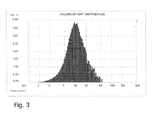
- Fig. 3 shows the particle size distribution of the sterile powder of example 3.
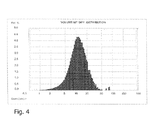
- Fig. 4 shows the particle size distribution of the sterile powder of example 4.
- Fig. 5 shows the particle size distribution of the sterile powder of example 5.
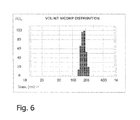
- Fig. 6 shows the particle size distribution of the sterile powder of example 6.
- Fig. 7 shows the particle size distribution of the sterile powder of example 1 before passing the powder in the homogenizer.
- the particle size of the powdered compounds was measured by using a NICOMP 780 Accusizer in the case of particles larger than 1 ⁇ m. For particles having size from 1 nm to 1 ⁇ m, a NICOMP Submicron was used.
- Triamcinolone acetonide used in the examples is commercially available from Farmabios.
- the suspension was passed three times in the homogenizer equipped with an interaction chamber of 100 ⁇ m and at a pressure of 1800 bar.
- the suspension is filtered on a 0.45 ⁇ m membrane.
- the solid remaining on the filter is dried in a oven under vacuum.
- the dried powder is then passed on a 70 ⁇ m sieve to remove possible agglomerates.
- the suspension was passed three times in the homogenizer equipped with an interaction chamber of 100 ⁇ m and at a pressure of 1800 bar.
- the suspension is filtered on a 0.45 ⁇ m membrane.
- the solid remaining on the filter is dried in a oven under vacuum.
- the dried powder is then passed on a 70 ⁇ m sieve to remove possible agglomerates.
- the suspension was passed three times in the homogenizer equipped with an interaction chamber of 100 ⁇ m and at a pressure of 1800 bar. Then, the homogenizer is equipped with an interaction chamber of 87 ⁇ m and the suspension is passed through the homogenizer 8 times at a pressure of 2000 bar. The suspension is then dried under vacuum. The obtained solid is passed on a 70 ⁇ m sieve.
- the suspension was passed three times in the homogenizer equipped with an interaction chamber of 100 ⁇ m and at a pressure of 1800 bar. Then, the homogenizer is equipped with an interaction chamber of 87 ⁇ m and the suspension is passed through the homogenizer 22 times at a pressure of 2000 bar. The suspension is then dried under vacuum. The obtained solid is passed on a 70 ⁇ m sieve.
- Example 1 of WO 2007/051774 was repeated.
- a 250 ml one neck round bottomed flask with a thermostatic jacket and a magnetic stirrer containing 140 ml of acetone 2.5 g of triamcinolone acetonide were added.
- the suspension was heated to 50-60 °C under stirring until the solid was fully solubilized.
- the solution was then passed through a 0.22 micron filter and collected.
- the solution was kept at 25-30 °C under vacuum and acetone was evaporated, while the solution was subjected to ultrasound. After complete drying of acetone, the solid was passed through a 70 micron sieve.
- Table 1 shows a comparison of the particle size distribution obtained in example 3, 4 and comparative example 1. It is evident that the use of a high pressure homogenizer leads to a narrower particle size distribution than obtained by using sonication.
Landscapes
- Health & Medical Sciences (AREA)
- Chemical & Material Sciences (AREA)
- Medicinal Chemistry (AREA)
- Pharmacology & Pharmacy (AREA)
- Epidemiology (AREA)
- Life Sciences & Earth Sciences (AREA)
- Animal Behavior & Ethology (AREA)
- General Health & Medical Sciences (AREA)
- Public Health (AREA)
- Veterinary Medicine (AREA)
- Engineering & Computer Science (AREA)
- Bioinformatics & Cheminformatics (AREA)
- Steroid Compounds (AREA)
Priority Applications (1)
| Application Number | Priority Date | Filing Date | Title |
|---|---|---|---|
| EP08162386A EP2156823A1 (fr) | 2008-08-14 | 2008-08-14 | Processus de préparation de composés pharmaceutiques poudrés stériles sous la forme de micro et nano particules |
Applications Claiming Priority (1)
| Application Number | Priority Date | Filing Date | Title |
|---|---|---|---|
| EP08162386A EP2156823A1 (fr) | 2008-08-14 | 2008-08-14 | Processus de préparation de composés pharmaceutiques poudrés stériles sous la forme de micro et nano particules |
Publications (1)
| Publication Number | Publication Date |
|---|---|
| EP2156823A1 true EP2156823A1 (fr) | 2010-02-24 |
Family
ID=40276139
Family Applications (1)
| Application Number | Title | Priority Date | Filing Date |
|---|---|---|---|
| EP08162386A Withdrawn EP2156823A1 (fr) | 2008-08-14 | 2008-08-14 | Processus de préparation de composés pharmaceutiques poudrés stériles sous la forme de micro et nano particules |
Country Status (1)
| Country | Link |
|---|---|
| EP (1) | EP2156823A1 (fr) |
Cited By (3)
| Publication number | Priority date | Publication date | Assignee | Title |
|---|---|---|---|---|
| JP2017019845A (ja) * | 2010-04-21 | 2017-01-26 | ホビオネ インテル エージー | 医薬品有効成分の粒子加工のための方法 |
| WO2022015940A1 (fr) | 2020-07-16 | 2022-01-20 | Ocular Therapeutix, Inc. | Insert oculaire contenant un glucocorticoïde |
| EP4393473A1 (fr) * | 2022-12-30 | 2024-07-03 | Yung Shin Pharmaceutical Ind. Co., Ltd. | Procédé de fabrication de médicament |
Citations (7)
| Publication number | Priority date | Publication date | Assignee | Title |
|---|---|---|---|---|
| WO1990003782A2 (fr) * | 1988-10-05 | 1990-04-19 | The Upjohn Company | Poudres cristallines solides finement divisees par une precipitation dans un anti-solvant |
| US5803966A (en) * | 1995-11-01 | 1998-09-08 | Alcon Laboratories, Inc. | Process for sizing prednisolone acetate using a supercritical fluid anti-solvent |
| US20030059472A1 (en) * | 2001-09-26 | 2003-03-27 | Sean Brynjelsen | Preparation of submicron sized nanoparticles via dispersion lyophilization |
| EP1348431A1 (fr) * | 2002-03-29 | 2003-10-01 | ACS DOBFAR S.p.A. | Procédé de préparation de nanoparticules à base de paclitaxel et albumine |
| EP1782797A1 (fr) * | 2005-11-02 | 2007-05-09 | Pharmatex Italia Srl | Procédé de préparation de composés pharmaceutiques stériles pulvérulents |
| WO2007103294A2 (fr) * | 2006-03-07 | 2007-09-13 | Novavax, Inc. | Compositions nano-structurees et leurs procedes de fabrication et d'utilisation |
| WO2008011136A2 (fr) * | 2006-07-20 | 2008-01-24 | Sicor Inc. | Procédé de préparation d'un ingrédient pharmaceutique actif stérile solide |
-
2008
- 2008-08-14 EP EP08162386A patent/EP2156823A1/fr not_active Withdrawn
Patent Citations (8)
| Publication number | Priority date | Publication date | Assignee | Title |
|---|---|---|---|---|
| WO1990003782A2 (fr) * | 1988-10-05 | 1990-04-19 | The Upjohn Company | Poudres cristallines solides finement divisees par une precipitation dans un anti-solvant |
| US5803966A (en) * | 1995-11-01 | 1998-09-08 | Alcon Laboratories, Inc. | Process for sizing prednisolone acetate using a supercritical fluid anti-solvent |
| US20030059472A1 (en) * | 2001-09-26 | 2003-03-27 | Sean Brynjelsen | Preparation of submicron sized nanoparticles via dispersion lyophilization |
| EP1348431A1 (fr) * | 2002-03-29 | 2003-10-01 | ACS DOBFAR S.p.A. | Procédé de préparation de nanoparticules à base de paclitaxel et albumine |
| EP1782797A1 (fr) * | 2005-11-02 | 2007-05-09 | Pharmatex Italia Srl | Procédé de préparation de composés pharmaceutiques stériles pulvérulents |
| WO2007051774A2 (fr) | 2005-11-02 | 2007-05-10 | Pharmatex Italia Srl | Procede destine a preparer des composes pharmaceutiques steriles, en poudre |
| WO2007103294A2 (fr) * | 2006-03-07 | 2007-09-13 | Novavax, Inc. | Compositions nano-structurees et leurs procedes de fabrication et d'utilisation |
| WO2008011136A2 (fr) * | 2006-07-20 | 2008-01-24 | Sicor Inc. | Procédé de préparation d'un ingrédient pharmaceutique actif stérile solide |
Cited By (6)
| Publication number | Priority date | Publication date | Assignee | Title |
|---|---|---|---|---|
| JP2017019845A (ja) * | 2010-04-21 | 2017-01-26 | ホビオネ インテル エージー | 医薬品有効成分の粒子加工のための方法 |
| EP2560620B1 (fr) * | 2010-04-21 | 2020-09-16 | Hovione Inter Ltd | Procédé de traitement de particules de principes actifs pharmaceutiques |
| WO2022015940A1 (fr) | 2020-07-16 | 2022-01-20 | Ocular Therapeutix, Inc. | Insert oculaire contenant un glucocorticoïde |
| EP4393473A1 (fr) * | 2022-12-30 | 2024-07-03 | Yung Shin Pharmaceutical Ind. Co., Ltd. | Procédé de fabrication de médicament |
| JP2024095925A (ja) * | 2022-12-30 | 2024-07-11 | 永信藥品工業股▲ふん▼有限公司 | 薬物の製造方法 |
| JP7638319B2 (ja) | 2022-12-30 | 2025-03-03 | 永信藥品工業股▲ふん▼有限公司 | 薬物の製造方法 |
Similar Documents
| Publication | Publication Date | Title |
|---|---|---|
| EP1263470B1 (fr) | PROCEDE POUR LA PRODUCTION D'UN COMPLEXE COENZYME Q10 - $g(g)-CYCLODEXTRINE | |
| EP2156823A1 (fr) | Processus de préparation de composés pharmaceutiques poudrés stériles sous la forme de micro et nano particules | |
| EP3485887B1 (fr) | Composition pharmaceutique de tecovirimat à administration par voie intraveineuse et sa méthode de préparation | |
| WO2006108637A3 (fr) | Procede de production soigneuse de suspensions de particules tres fines, particules tres fines correspondantes et leur utilisation | |
| Nasri et al. | Sardinelle protein isolate as a novel material for oil microencapsulation: Novel alternative for fish by-products valorisation | |
| US20050255164A1 (en) | Solid nano pharmaceutical formulation and preparation method thereof | |
| US9259396B2 (en) | Method of preparing soy isoflavone nanoparticles by precipitation with compressed antisolvent (PCA) using a supercritical fluid | |
| Diem et al. | Synthesis of Gold Nanoparticles Stabilized in Dextran Solution by Gamma Co‐60 Ray Irradiation and Preparation of Gold Nanoparticles/Dextran Powder | |
| Nagaraj et al. | Biomimetic of hydroxyapatite with Tridax procumbens leaf extract and investigation of antibiofilm potential in Staphylococcus aureus and Escherichia coli | |
| Raj et al. | State-of-the-art supercritical fluid techniques for nanosponge engineering: An in-depth review of advances and clinical impact | |
| WO2011015226A1 (fr) | Procédé de préparation de composés pharmaceutiques stériles en poudre sous forme de microparticules et nanoparticules | |
| CN104826129A (zh) | 一种纳米型中药槲皮素-plga及其制备方法 | |
| US20250114462A1 (en) | Hydrophilic functionalized particles in the delivery of hydrophobic drugs | |
| EP1782797A1 (fr) | Procédé de préparation de composés pharmaceutiques stériles pulvérulents | |
| WO2007116632A1 (fr) | Microparticules, dispersion de microparticules et procédé et appareil servant à produire celle-ci | |
| EP4306482A1 (fr) | Méthode de production d'un matériau | |
| Sheng et al. | Continuous and scalable process for the production of hollow crystals of a poorly water-soluble active pharmaceutical ingredient for dissolution enhancement and inhaled delivery | |
| Alazzawi et al. | Microwave-assisted green synthesis of silver nanoparticles using turnip root (Brassica rapa subsp. Rapa) extract and their antibacterial efficacy | |
| Jafari et al. | Optimization and development of drug loading in hydroxyapatite–polyvinyl alcohol nanocomposites via response surface modeling approach | |
| Hilweh et al. | GREEN SYNTHESIS OF ZNO-NPS USING ROSEMARY LEAVES | |
| CN114569540A (zh) | 一种多酚纳米条带及其制备方法和在辐射防护中的应用 | |
| CN108096218B (zh) | 一种载柴胡皂甙a的纳米颗粒及其制备方法 | |
| KR102410707B1 (ko) | 방사선을 이용한 항바이러스성 구리나노입자의 제조방법 및 이에 의해 제조된 항바이러스성 구리나노입자 | |
| Malathi et al. | Chitosan-Based Nano-Delivery System | |
| JP3808086B1 (ja) | チアミンラウリル硫酸塩結晶及びその製造方法 |
Legal Events
| Date | Code | Title | Description |
|---|---|---|---|
| PUAI | Public reference made under article 153(3) epc to a published international application that has entered the european phase |
Free format text: ORIGINAL CODE: 0009012 |
|
| AK | Designated contracting states |
Kind code of ref document: A1 Designated state(s): AT BE BG CH CY CZ DE DK EE ES FI FR GB GR HR HU IE IS IT LI LT LU LV MC MT NL NO PL PT RO SE SI SK TR |
|
| AX | Request for extension of the european patent |
Extension state: AL BA MK RS |
|
| 17P | Request for examination filed |
Effective date: 20100823 |
|
| 17Q | First examination report despatched |
Effective date: 20100929 |
|
| AKX | Designation fees paid |
Designated state(s): AT BE BG CH CY CZ DE DK EE ES FI FR GB GR HR HU IE IS IT LI LT LU LV MC MT NL NO PL PT RO SE SI SK TR |
|
| STAA | Information on the status of an ep patent application or granted ep patent |
Free format text: STATUS: THE APPLICATION IS DEEMED TO BE WITHDRAWN |
|
| 18D | Application deemed to be withdrawn |
Effective date: 20130420 |