EP2157171A1 - Procédé de modification locale de l'élasticité d'un substrat conçu pour la croissance de ses cellules - Google Patents
Procédé de modification locale de l'élasticité d'un substrat conçu pour la croissance de ses cellules Download PDFInfo
- Publication number
- EP2157171A1 EP2157171A1 EP08014921A EP08014921A EP2157171A1 EP 2157171 A1 EP2157171 A1 EP 2157171A1 EP 08014921 A EP08014921 A EP 08014921A EP 08014921 A EP08014921 A EP 08014921A EP 2157171 A1 EP2157171 A1 EP 2157171A1
- Authority
- EP
- European Patent Office
- Prior art keywords
- substrate
- laser
- cells
- elasticity
- spatial
- Prior art date
- Legal status (The legal status is an assumption and is not a legal conclusion. Google has not performed a legal analysis and makes no representation as to the accuracy of the status listed.)
- Granted
Links
- 239000000758 substrate Substances 0.000 title claims abstract description 69
- 238000000034 method Methods 0.000 title claims abstract description 39
- 230000010261 cell growth Effects 0.000 title claims 3
- 230000005855 radiation Effects 0.000 claims abstract description 17
- 238000000151 deposition Methods 0.000 claims abstract description 8
- 230000012010 growth Effects 0.000 claims abstract description 6
- 230000008021 deposition Effects 0.000 claims abstract description 4
- 210000004027 cell Anatomy 0.000 claims description 60
- 239000004971 Cross linker Substances 0.000 claims description 11
- 210000002569 neuron Anatomy 0.000 claims description 11
- 229920002401 polyacrylamide Polymers 0.000 claims description 7
- 239000002245 particle Substances 0.000 claims description 5
- 230000004044 response Effects 0.000 claims description 5
- 230000008859 change Effects 0.000 claims description 4
- 239000011159 matrix material Substances 0.000 claims description 4
- 229920000936 Agarose Polymers 0.000 claims description 3
- 102000008186 Collagen Human genes 0.000 claims description 3
- 108010035532 Collagen Proteins 0.000 claims description 3
- 102000009123 Fibrin Human genes 0.000 claims description 3
- 108010073385 Fibrin Proteins 0.000 claims description 3
- BWGVNKXGVNDBDI-UHFFFAOYSA-N Fibrin monomer Chemical compound CNC(=O)CNC(=O)CN BWGVNKXGVNDBDI-UHFFFAOYSA-N 0.000 claims description 3
- 108090000190 Thrombin Proteins 0.000 claims description 3
- 230000009087 cell motility Effects 0.000 claims description 3
- 229920001436 collagen Polymers 0.000 claims description 3
- 230000007423 decrease Effects 0.000 claims description 3
- 229950003499 fibrin Drugs 0.000 claims description 3
- 230000001537 neural effect Effects 0.000 claims description 3
- 229960004072 thrombin Drugs 0.000 claims description 3
- 102000010834 Extracellular Matrix Proteins Human genes 0.000 claims description 2
- 108010037362 Extracellular Matrix Proteins Proteins 0.000 claims description 2
- 238000010521 absorption reaction Methods 0.000 claims description 2
- 210000004102 animal cell Anatomy 0.000 claims description 2
- 238000009826 distribution Methods 0.000 claims description 2
- 210000003527 eukaryotic cell Anatomy 0.000 claims description 2
- 210000002744 extracellular matrix Anatomy 0.000 claims description 2
- 210000005260 human cell Anatomy 0.000 claims description 2
- 210000004962 mammalian cell Anatomy 0.000 claims description 2
- 239000002243 precursor Substances 0.000 claims description 2
- 230000005670 electromagnetic radiation Effects 0.000 claims 1
- 230000001939 inductive effect Effects 0.000 claims 1
- 230000001678 irradiating effect Effects 0.000 claims 1
- 239000005445 natural material Substances 0.000 claims 1
- 239000013618 particulate matter Substances 0.000 claims 1
- 239000000499 gel Substances 0.000 description 52
- 239000000463 material Substances 0.000 description 15
- 238000010438 heat treatment Methods 0.000 description 6
- 210000002241 neurite Anatomy 0.000 description 6
- 239000011521 glass Substances 0.000 description 5
- 108090000623 proteins and genes Proteins 0.000 description 5
- 102000004169 proteins and genes Human genes 0.000 description 5
- 230000000694 effects Effects 0.000 description 4
- 238000004630 atomic force microscopy Methods 0.000 description 3
- 230000003247 decreasing effect Effects 0.000 description 3
- 230000001419 dependent effect Effects 0.000 description 3
- 238000001727 in vivo Methods 0.000 description 3
- 230000033001 locomotion Effects 0.000 description 3
- 230000004048 modification Effects 0.000 description 3
- 238000012986 modification Methods 0.000 description 3
- 210000000663 muscle cell Anatomy 0.000 description 3
- 230000009467 reduction Effects 0.000 description 3
- 238000010420 art technique Methods 0.000 description 2
- 230000008901 benefit Effects 0.000 description 2
- 239000012620 biological material Substances 0.000 description 2
- 238000004113 cell culture Methods 0.000 description 2
- 239000013013 elastic material Substances 0.000 description 2
- 238000000338 in vitro Methods 0.000 description 2
- 230000001394 metastastic effect Effects 0.000 description 2
- 206010061289 metastatic neoplasm Diseases 0.000 description 2
- 230000005012 migration Effects 0.000 description 2
- 238000013508 migration Methods 0.000 description 2
- 230000003287 optical effect Effects 0.000 description 2
- 238000002135 phase contrast microscopy Methods 0.000 description 2
- 229920000642 polymer Polymers 0.000 description 2
- 238000002360 preparation method Methods 0.000 description 2
- 210000001519 tissue Anatomy 0.000 description 2
- 241000894006 Bacteria Species 0.000 description 1
- 241000233866 Fungi Species 0.000 description 1
- 230000002730 additional effect Effects 0.000 description 1
- 239000007864 aqueous solution Substances 0.000 description 1
- 150000001875 compounds Chemical class 0.000 description 1
- 239000000356 contaminant Substances 0.000 description 1
- 230000001276 controlling effect Effects 0.000 description 1
- 210000003618 cortical neuron Anatomy 0.000 description 1
- 238000004132 cross linking Methods 0.000 description 1
- 238000012258 culturing Methods 0.000 description 1
- 230000007646 directional migration Effects 0.000 description 1
- 239000000428 dust Substances 0.000 description 1
- 229920001971 elastomer Polymers 0.000 description 1
- 238000005516 engineering process Methods 0.000 description 1
- 230000006872 improvement Effects 0.000 description 1
- 230000003993 interaction Effects 0.000 description 1
- 230000002452 interceptive effect Effects 0.000 description 1
- 230000007246 mechanism Effects 0.000 description 1
- 238000002715 modification method Methods 0.000 description 1
- 210000000947 motile cell Anatomy 0.000 description 1
- 230000007514 neuronal growth Effects 0.000 description 1
- 238000000059 patterning Methods 0.000 description 1
- 230000008569 process Effects 0.000 description 1
- 239000002096 quantum dot Substances 0.000 description 1
- 230000001105 regulatory effect Effects 0.000 description 1
- 238000000518 rheometry Methods 0.000 description 1
- 239000005060 rubber Substances 0.000 description 1
- 229920002379 silicone rubber Polymers 0.000 description 1
- 239000007779 soft material Substances 0.000 description 1
- 230000007480 spreading Effects 0.000 description 1
- 238000003892 spreading Methods 0.000 description 1
- 210000000225 synapse Anatomy 0.000 description 1
- 230000001225 therapeutic effect Effects 0.000 description 1
- 230000009466 transformation Effects 0.000 description 1
Images


Classifications
-
- C—CHEMISTRY; METALLURGY
- C12—BIOCHEMISTRY; BEER; SPIRITS; WINE; VINEGAR; MICROBIOLOGY; ENZYMOLOGY; MUTATION OR GENETIC ENGINEERING
- C12N—MICROORGANISMS OR ENZYMES; COMPOSITIONS THEREOF; PROPAGATING, PRESERVING, OR MAINTAINING MICROORGANISMS; MUTATION OR GENETIC ENGINEERING; CULTURE MEDIA
- C12N5/00—Undifferentiated human, animal or plant cells, e.g. cell lines; Tissues; Cultivation or maintenance thereof; Culture media therefor
- C12N5/0068—General culture methods using substrates
-
- C—CHEMISTRY; METALLURGY
- C12—BIOCHEMISTRY; BEER; SPIRITS; WINE; VINEGAR; MICROBIOLOGY; ENZYMOLOGY; MUTATION OR GENETIC ENGINEERING
- C12N—MICROORGANISMS OR ENZYMES; COMPOSITIONS THEREOF; PROPAGATING, PRESERVING, OR MAINTAINING MICROORGANISMS; MUTATION OR GENETIC ENGINEERING; CULTURE MEDIA
- C12N2535/00—Supports or coatings for cell culture characterised by topography
- C12N2535/10—Patterned coating
Definitions
- the present invention deals with a method for locally modifying the elasticity of an elastic substrate, the substrate being designed for the growth of living cells thereon and/or therein, and with uses of such a method.
- the present invention is based on the observation that the behavior of cells is dependent upon the elasticity of a substrate the cells are distributed in.
- previous techniques of using UV lamps for setting up a desired elasticity in a cell substrate see for example Burton and Taylor, Nature, 385, 1997 , reducing the crosslinks in silicon rubbers and thus softening these rubbers in order to decrease the elasticity, or Wong et al., Langmuir, 19, 2003 in which photoinitializers were used with UV lamps to stiffen polyacrylamide gels).
- the object of the present invention to provide a method which is able to modify the elasticity of a substrate used for the growth of living cells thereon and/or therein precisely, with a low expenditure of time and with a high spatial resolution.
- the basic idea of the present invention is to use a laser (e.g. a UV laser) adapted and arranged to realize a sufficient energy density in the substrate whose elasticity shall be modified and to focus its laser beam to a precisely defined location in or on the substrate.
- a sufficient energy density herein means that the energy locally introduced into the substrate material is high enough in order to modify the stiffness, elastic modulus and/or the elasticity of the elastic substrate, e.g. by breaking corresponding crosslinkers of the substrate material (i.e. reducing the number of crosslinkers per volume).
- the necessary energy density in order to accomplish this is dependent upon the specific substrate material and upon the strength of the desired elasticity modification. If therefore the locally introduced energy density is higher than a substrate material dependent threshold, the stiffness of the material is decreased.
- the introduced energy density in varied materials may have significantly different effects.
- the energy in a crosslinked polyacrylamide gel the energy may break crosslinks causing the gel to become less stiff, while in a protein based gel the energy may denature or otherwise change the protein causing changes which may include gel stiffening (i.e. the energy deposit increases the gel stiffness).
- the local deposition of the energy in an arbitrary spatial area to be modified with respect to the local elasticity is realized by focusing the laser radiation onto the spatial area.
- a spatial area can for example be a dot-like area, a line-like area, a curve-like area or the like or any combination thereof in the substrate. If a plurality of such spatial areas are treated with energy deposits, a defined spatial pattern of locally varying elasticity can be realized (under the assumption that the respective local energy deposits are varied spatially). Thus, a path for cell guidance can be created inside the substrate (or also at the surface of the substrate).
- this path for cell guidance can have a gradient-shaped variation of the elasticity: This means that for example along a straight line through the substrate of a cross-linked gel, the energy deposit is increased step by step so that the stiffness of the substrate material at the corresponding spatial areas is decreased step by step in this direction, while in a protein gel the stiffness may be increased.
- the corresponding spatial areas can be modified with respect to the local elasticity, elastic modulus and/or stiffness before they are populated with living cells to be grown or distributed inside the substrate. It is therefore possible to realize a predetermined spatial pattern of modified areas inside a three-dimensional substrate (which can, preferably, be a gel, polymer, protein such as a collagen matrix or similar elastic materials which might be used with motile cells) with areas of larger elasticity and areas of smaller elasticity.
- a three-dimensional substrate which can, preferably, be a gel, polymer, protein such as a collagen matrix or similar elastic materials which might be used with motile cells
- the spatial structure of said pattern is realized in an appropriate way, it is therefore possible to realize cell guidance paths inside or on the substrate which allow contacts to be formed between a first cell type and a second, same or different cell type: It is for example known that neurons prefer substrate materials with higher elasticity (softer materials) and that muscle cells prefer substrate materials with lower elasticity (stiffer materials). For example if the corresponding stiffer pattern areas are realized adjacent to areas of less stiffness, muscle cells can be distributed adjacent to neurons in order to allow a contact between those two cell types. This is only one example of many possible single cell or tissue interactions which can be controlled or guided by a specific spatially elastic patterned substrate. Therefore, cell cultures with a co-culturing of multiple cell types are possible with the present invention.
- the spatial areas modified with respect to their elasticity are populated after the local energy deposition therein is that in general the energy deposit necessary in order to realize the desired elasticity is of an amount that may kill or harm the cells. It is possible, however, by optimizing certain experimental parameters such as radiation wavelength, duration, power, and proximity to cells to overcome this limitation and modify the substrate elasticity with cells present.
- a microscope objective preferably the objective of an inverted microscope (e.g. a conventionally inverted fluorescence microscope) can be used.
- the laser to introduce the energy can be a UV laser or other laser employed to realize a sufficient energy deposit.
- an infrared laser preferably a Ti:sapphire laser and/or an infrared laser with a wavelength between 750 nm and 1064 nm can be used.
- the laser can be a continuous wave laser or a pulsed laser, in the latter case preferably with a pulse frequency between 5 and 30 Hz depositing prefereably 100-500 ⁇ J per pulse.
- a gel such as but not limited to polyacrylamide, agarose, fibrin and/or thrombin, or a collagen matrix can be used.
- the cells used to populate the substrate can be any type which interact with a substrate, such as but not limited to eukaryotic cells, especially mammalian cells, such as human cells or animal cells, especially neurons and/or neuronal precursors and muscle cells.
- eukaryotic cells especially mammalian cells, such as human cells or animal cells, especially neurons and/or neuronal precursors and muscle cells.
- mammalian cells such as human cells or animal cells, especially neurons and/or neuronal precursors and muscle cells.
- many other cell types can conceivably be used, such as prokaryotes, bacertia, and fungi.
- the hypothesized fundamental mechanism of the effect used in the invention is that a laser (especially a UV laser) locally heating a substrate/gel is able to locally disrupt the crosslinking bonds in the substrate/gel.
- the stiffness of the substrate/gel is proportional to the number of crosslinkers per volume. By effectively decreasing the crosslinkers inside the substrate/gel, the latter becomes softer, i.e. more easily deformed.
- the number of crosslinkers per volume can then be effectively locally reduced by focusing the laser beam, which strongly heats the gel, thus locally disrupting the crosslinkers and locally softening the gel.
- the applied laser still locally heats the gel, but may induce more complex and varied effects which may include local denaturing or other changes leading to softening or stiffening of the gel.
- the invention therefore allows a precise spatial modification of the elasticity of the substrate, e.g. by local laser-induced reduction of crosslinkers inside the substrate.
- This allows realizing spatial patterns with varying elasticity inside a three-dimensional gel which can be used for guiding the movement of cells grown on or in these substrates.
- crosslinkers which give a gel its stiffness can be broken, which results in a softer material.
- the use of a focused laser beam gives precise spatial control of the elasticity, even spatial areas with a diameter of 1 ⁇ m or smaller can be precisely modified with respect to their elasticity.
- the method according to the invention allows a previously unrealized precision and control in preparing elastic substrates of varied elasticity.
- Previous techniques according to the state of the art have not been able to produce high-spatial resolution elasticity modifications, well controlled elastic changes and/or precise, sophisticated, and widely varied elastic patterns on very soft materials.
- Another of the essential advantages of the technique according to the invention is concurrently being able to precisely control the change in the stiffness, elastic modulus and/or elasticity by regulating the power and the time of laser exposure. For example by using no power or repeated full power, the stiffness can be left unchanged or can be effectively locally reduced to nearly 0.
- the spatial and elastic precision provided by the present invention allows a previously unexplored size of substrate elasticity changes. This increase in precision allows individual cells or cell extensions to be guided along the generated elastic patterns, providing a previously inaccessible level of elastic patterning precision to cell culture studies.
- the method according to the invention also offers the possibility of creating elastic patterns in two-dimensional space as well as in three-dimensional space: Due to the precise positioning possible with a focused laser (i.e. the precise positioning of the beam focus) not only an xy-control in one defined plane, but also a z-control perpendicular to that plane can be realized (the latter being a critical feature for potential in vivo applications).
- the method can be used in vitro as well as in vivo: It has a wide variety of applications in biophysical sciences and biotechnology, for biomedical applications both in diagnostics and in therapeutic treatment (in vitro applications as well as in vivo applications).
- elastic patterns realized with the method are a valuable technique to separate different cells. For example, in the metastatic transformation of normal tissue cells to more motile aggressive cancerous cells, it has been measured that the cells' elasticity also decreases (becomes softer). If cell spreading and movement are governed by the ratio of the substrate elasticity (which can be modified according to the invention) to cell elasticity, then softer cells are able to move on softer materials better than on stiffer cells. This can open a new technique to separate softer metastatic cells from stiffer normal cells, e.g. by using elastic gradients (i.e. gradient patterns).
- the substrate 1 here a polyacrylamide gel
- the optical elements 2, 5, 6, 3 and the glass plate 4 are arranged and positioned such that the laser beam 2a of the UV laser 2 is focused inside the three-dimensional substrate 1 ( figure 1b ).
- the focus F of the laser beam 2a has been moved through the substrate 1 (see line in figure 1b indicating a laser softened gel trace).
- the laser softened gel trace shown in figure 1b has been realized as a gradient trace, i.e. while moving the focus F through the substrate 1, the intensity of the laser beam has been gradually increased.
- a pulsed 337 nM UV laser has been used which can create small scale (smaller than 2 ⁇ m) inhomogenities since the laser is not constantly on while scanning the gel, but being pulsed at about 5 to 30 Hz depositing between 100 and 300 ⁇ J per pulse.
- a continuous wave laser can be used, which then creates smoother or more continuous patterns.
- a UV laser for example also a continuous wave infrared laser with a wavelength between 750 and 1064 nm can be used (e.g. a Ti:sapphire laser).
- FIG 1b it can be seen that the gel 1 is adhered to a glass cover slip 4 which is placed in the microscope stage.
- the microscope objective 3 focuses the laser radiation 2a onto a precisely defined point F (focus) in three-dimensional space, where heating causes the gel crosslinkers to break and locally softens the gel. This softening can be seen in the phase contrast microscopy as a darkening of the gel (see figures 2 to 5 ) .
- an inverted microscope is used, where the microscope objective 3 is below the sample 1.
- the laser beam is emitted from the objective and precisely focused on the polyacrylamide gel, heating the gel only at the laser focus and not in adjacent regions so that the above mentioned precise heating and softening of the gel (while simultaneously darkening the gel, see figures) occurs.
- the amount necessary for softening the gel in a defined manner is readily controlled by the applied laser intensity and/or by the applied exposure time.
- any spatial pattern may be generated with freedom both in the spatial distribution and elasticity reduction of the gel.
- gels such as agarose ( Balgude et al, Biomaterials, 22, 2001 ), polymers, meltable materials, synthetic or natural extra-cellular matrix type material gels, or fibrin/thrombin ( Ju et al., Biomaterials, 28, 2007 ) can be used.
- infrared or visible wavelength lasers are used: Normally infrared wavelengths are not highly absorbed by aqueous solutions, such as gels, so that the energy deposit, which can be realized with infrared lasers might be not sufficient. If therefore additional compounds, such as for example microscopic dust particles or the like or specific fluorophores, such as rhodamines or quantum dots, are introduced into the gel, it is possible to radically increase the absorption efficiency of the infrared laser light and to induce a significantly higher local heating.
- additional compounds such as for example microscopic dust particles or the like or specific fluorophores, such as rhodamines or quantum dots
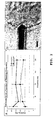
- Figure 2 shows a measured laser-induced reduction in gel elasticity according to the above described example.
- the gel and the pattern elasticities are shown using atomic force microscopy (AFM) rheology.
- AFM atomic force microscopy
- the measured area is shown in phase contrast with the AFM cantilever over the patterned area (scale bar is 10 ⁇ m).
- Figures 3 to 5 show further generated patterns in phase contrast microscopy images.
- primary embryonic rat cortical neurons were grown on the patterned substrate and are shown to turn preferentially towards and grow along the softer patterned areas.
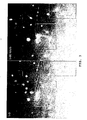
- Figure 3 shows on overview of neuronal growth on elastic patterns.
- the generated elastic patterns as darker structures in the left panel at time zero.
- the right panel one can see that after 90 hrs. neurons which came in contact with the generated patterns followed these patterns.
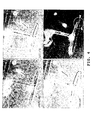
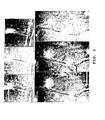
- Several regions of interest marked as A, B and C are shown at higher magnification in figures 4 and 5 .
- the neurons were observed to turn towards and extend preferentially along the softer regions.
- the growth of the neurons was continuously observed and recorded while they were cultured on the microscope stage in a pH and temperature controlled chamber well known for one skilled.
- FIG 4 the inset A of figure 3 is shown and the migration of neurites (extensions of neurons) can be seen over time.
- the neurites extended along the softer patterned regions and when they reach the end of an elastic pattern, they were observed to turn approximately 180° to continue migrating along the pattern (see white arrows).
- the bottom panels at times 4250 and 5250 mins., when the neurite reached the end of the pattern, it split in two where half of the neurite turned nearly 180° in order to remain the pattern, demonstrating the strength of the elastic pattern as a guidance technique.
- the process can be used to guide cells, particularly neurons, together to form intercellular connections, such as a synapse. Therefore, the elastic patterns realized according to the invention can be used as cell guidance patterns as well as cell connection patterns.
Landscapes
- Life Sciences & Earth Sciences (AREA)
- Engineering & Computer Science (AREA)
- Health & Medical Sciences (AREA)
- Chemical & Material Sciences (AREA)
- Biomedical Technology (AREA)
- Biotechnology (AREA)
- Organic Chemistry (AREA)
- Bioinformatics & Cheminformatics (AREA)
- Genetics & Genomics (AREA)
- Wood Science & Technology (AREA)
- Zoology (AREA)
- Microbiology (AREA)
- Biochemistry (AREA)
- General Engineering & Computer Science (AREA)
- General Health & Medical Sciences (AREA)
- Cell Biology (AREA)
- Micro-Organisms Or Cultivation Processes Thereof (AREA)
- Apparatus Associated With Microorganisms And Enzymes (AREA)
- Immobilizing And Processing Of Enzymes And Microorganisms (AREA)
Priority Applications (1)
| Application Number | Priority Date | Filing Date | Title |
|---|---|---|---|
| EP20080014921 EP2157171B1 (fr) | 2008-08-22 | 2008-08-22 | Procédé de modification locale de l'élasticité d'un substrat conçu pour la croissance de ses cellules |
Applications Claiming Priority (1)
| Application Number | Priority Date | Filing Date | Title |
|---|---|---|---|
| EP20080014921 EP2157171B1 (fr) | 2008-08-22 | 2008-08-22 | Procédé de modification locale de l'élasticité d'un substrat conçu pour la croissance de ses cellules |
Publications (3)
| Publication Number | Publication Date |
|---|---|
| EP2157171A1 true EP2157171A1 (fr) | 2010-02-24 |
| EP2157171A8 EP2157171A8 (fr) | 2010-04-07 |
| EP2157171B1 EP2157171B1 (fr) | 2015-02-25 |
Family
ID=40291151
Family Applications (1)
| Application Number | Title | Priority Date | Filing Date |
|---|---|---|---|
| EP20080014921 Not-in-force EP2157171B1 (fr) | 2008-08-22 | 2008-08-22 | Procédé de modification locale de l'élasticité d'un substrat conçu pour la croissance de ses cellules |
Country Status (1)
| Country | Link |
|---|---|
| EP (1) | EP2157171B1 (fr) |
Citations (3)
| Publication number | Priority date | Publication date | Assignee | Title |
|---|---|---|---|---|
| EP0402718A1 (fr) * | 1989-06-03 | 1990-12-19 | Kanegafuchi Kagaku Kogyo Kabushiki Kaisha | Dispositif de contrôle de cellules |
| US5137800A (en) * | 1989-02-24 | 1992-08-11 | Stereographics Limited Partnership | Production of three dimensional bodies by photopolymerization |
| EP0841361A1 (fr) * | 1996-11-06 | 1998-05-13 | Ethicon, Inc. | Mélanges de polyoxaesters absorbables contenant de groupes amine et/ou amide |
-
2008
- 2008-08-22 EP EP20080014921 patent/EP2157171B1/fr not_active Not-in-force
Patent Citations (3)
| Publication number | Priority date | Publication date | Assignee | Title |
|---|---|---|---|---|
| US5137800A (en) * | 1989-02-24 | 1992-08-11 | Stereographics Limited Partnership | Production of three dimensional bodies by photopolymerization |
| EP0402718A1 (fr) * | 1989-06-03 | 1990-12-19 | Kanegafuchi Kagaku Kogyo Kabushiki Kaisha | Dispositif de contrôle de cellules |
| EP0841361A1 (fr) * | 1996-11-06 | 1998-05-13 | Ethicon, Inc. | Mélanges de polyoxaesters absorbables contenant de groupes amine et/ou amide |
Non-Patent Citations (6)
| Title |
|---|
| BALGUDE ET AL., BIOMATERIALS, 2001, pages 22 |
| BURTON K. ET AL: "Traction forces of cytokinesis measured with optically modified elastic substrata", NATURE, NATURE PUBLISHING GROUP, LONDON, UK, vol. 385, no. 6615, 30 January 1997 (1997-01-30), pages 450 - 454, XP002513301, ISSN: 0028-0836 * |
| BURTON; TAYLOR, NATURE, 1997, pages 385 |
| JU ET AL., BIOMATERIALS, 2007, pages 28 |
| WONG ET AL., LANGMUIR, 2003, pages 19 |
| WONG JOYCE Y. ET AL: "Directed movement of vascular smooth muscle cells on gradient-compliant hydrogels", LANGMUIR, ACS, WASHINGTON, DC, US, vol. 19, no. 5, 1 January 2003 (2003-01-01), pages 1908 - 1913, XP002513302, ISSN: 0743-7463, [retrieved on 20021112] * |
Also Published As
| Publication number | Publication date |
|---|---|
| EP2157171A8 (fr) | 2010-04-07 |
| EP2157171B1 (fr) | 2015-02-25 |
Similar Documents
| Publication | Publication Date | Title |
|---|---|---|
| Pradhan et al. | Fundamentals of laser‐based hydrogel degradation and applications in cell and tissue engineering | |
| US8048641B2 (en) | Micropatterning of biological molecules using laser ablation | |
| Hosokawa et al. | Nondestructive isolation of single cultured animal cells by femtosecond laser-induced shockwave | |
| JP2022507083A (ja) | 生体材料に対応する三次元構造を印刷するための組成物と方法 | |
| KR20220131302A (ko) | 형질감염 및 세포의 클론 집단 생성을 위한 장치 및 방법 | |
| CN1685773A (zh) | 以全息光学陷阱制造、筛分和融合材料的装置和方法 | |
| Mauclair et al. | Ultrafast laser micro-cutting of stainless steel and PZT using a modulated line of multiple foci formed by spatial beam shaping | |
| Antkowiak et al. | Application of dynamic diffractive optics for enhanced femtosecond laser based cell transfection | |
| Patz et al. | Three‐dimensional direct writing of B35 neuronal cells | |
| Engelhardt | Direct laser writing | |
| JP2002515266A (ja) | 電磁気エネルギーにより熱酵素反応を活性化するための方法および装置 | |
| Ronchi et al. | At the cutting edge: applications and perspectives of laser nanosurgery in cell biology. | |
| Günther et al. | High precision patterning of biomaterials using the direct laser interference patterning technology | |
| Jeong et al. | Prospect for feedback guided surgery with ultra-short pulsed laser light | |
| EP2157171B1 (fr) | Procédé de modification locale de l'élasticité d'un substrat conçu pour la croissance de ses cellules | |
| US10655147B2 (en) | Method for the optoinjection of exogenous material into a biological cell | |
| WO2003042723A2 (fr) | Procede et dispositif de guidage de cellule optique | |
| EP1817404B1 (fr) | Photoporation de cellules | |
| Anggraini et al. | Guided axon outgrowth of neurons by molecular gradients generated from femtosecond laser-fabricated micro-holes | |
| Hosokawa et al. | Cell manipulations by optical tweezers and laser ablation | |
| Serien et al. | Laser printing of biomaterials | |
| Heinz et al. | Laser inactivation protein patterning of cell culture microenvironments | |
| Saksena et al. | Laser Direct Write Bioprinting Enriched Cell Types in the Breast Tumor Microenvironment | |
| Livnat et al. | Three-dimensional guidance of DRG neurite outgrowth using multi-photon photo-ablation | |
| Matei et al. | Laser processing of ormosils for tissue engineering applications |
Legal Events
| Date | Code | Title | Description |
|---|---|---|---|
| PUAI | Public reference made under article 153(3) epc to a published international application that has entered the european phase |
Free format text: ORIGINAL CODE: 0009012 |
|
| AK | Designated contracting states |
Kind code of ref document: A1 Designated state(s): AT BE BG CH CY CZ DE DK EE ES FI FR GB GR HR HU IE IS IT LI LT LU LV MC MT NL NO PL PT RO SE SI SK TR |
|
| AX | Request for extension of the european patent |
Extension state: AL BA MK RS |
|
| RIN1 | Information on inventor provided before grant (corrected) |
Inventor name: EHRLICHER, ALLEN Inventor name: KAES, JOSEF Inventor name: ROBITZKY, ANDREA |
|
| 17P | Request for examination filed |
Effective date: 20100817 |
|
| AKX | Designation fees paid |
Designated state(s): AT BE BG CH CY CZ DE DK EE ES FI FR GB GR HR HU IE IS IT LI LT LU LV MC MT NL NO PL PT RO SE SI SK TR |
|
| GRAP | Despatch of communication of intention to grant a patent |
Free format text: ORIGINAL CODE: EPIDOSNIGR1 |
|
| INTG | Intention to grant announced |
Effective date: 20140827 |
|
| GRAS | Grant fee paid |
Free format text: ORIGINAL CODE: EPIDOSNIGR3 |
|
| GRAA | (expected) grant |
Free format text: ORIGINAL CODE: 0009210 |
|
| AK | Designated contracting states |
Kind code of ref document: B1 Designated state(s): AT BE BG CH CY CZ DE DK EE ES FI FR GB GR HR HU IE IS IT LI LT LU LV MC MT NL NO PL PT RO SE SI SK TR |
|
| REG | Reference to a national code |
Ref country code: GB Ref legal event code: FG4D |
|
| REG | Reference to a national code |
Ref country code: CH Ref legal event code: EP |
|
| REG | Reference to a national code |
Ref country code: IE Ref legal event code: FG4D |
|
| REG | Reference to a national code |
Ref country code: DE Ref legal event code: R096 Ref document number: 602008036746 Country of ref document: DE Effective date: 20150409 |
|
| REG | Reference to a national code |
Ref country code: AT Ref legal event code: REF Ref document number: 712028 Country of ref document: AT Kind code of ref document: T Effective date: 20150415 |
|
| REG | Reference to a national code |
Ref country code: NL Ref legal event code: VDEP Effective date: 20150225 |
|
| REG | Reference to a national code |
Ref country code: AT Ref legal event code: MK05 Ref document number: 712028 Country of ref document: AT Kind code of ref document: T Effective date: 20150225 |
|
| REG | Reference to a national code |
Ref country code: LT Ref legal event code: MG4D |
|
| PG25 | Lapsed in a contracting state [announced via postgrant information from national office to epo] |
Ref country code: ES Free format text: LAPSE BECAUSE OF FAILURE TO SUBMIT A TRANSLATION OF THE DESCRIPTION OR TO PAY THE FEE WITHIN THE PRESCRIBED TIME-LIMIT Effective date: 20150225 Ref country code: FI Free format text: LAPSE BECAUSE OF FAILURE TO SUBMIT A TRANSLATION OF THE DESCRIPTION OR TO PAY THE FEE WITHIN THE PRESCRIBED TIME-LIMIT Effective date: 20150225 Ref country code: SE Free format text: LAPSE BECAUSE OF FAILURE TO SUBMIT A TRANSLATION OF THE DESCRIPTION OR TO PAY THE FEE WITHIN THE PRESCRIBED TIME-LIMIT Effective date: 20150225 Ref country code: NO Free format text: LAPSE BECAUSE OF FAILURE TO SUBMIT A TRANSLATION OF THE DESCRIPTION OR TO PAY THE FEE WITHIN THE PRESCRIBED TIME-LIMIT Effective date: 20150525 Ref country code: LT Free format text: LAPSE BECAUSE OF FAILURE TO SUBMIT A TRANSLATION OF THE DESCRIPTION OR TO PAY THE FEE WITHIN THE PRESCRIBED TIME-LIMIT Effective date: 20150225 Ref country code: HR Free format text: LAPSE BECAUSE OF FAILURE TO SUBMIT A TRANSLATION OF THE DESCRIPTION OR TO PAY THE FEE WITHIN THE PRESCRIBED TIME-LIMIT Effective date: 20150225 |
|
| PG25 | Lapsed in a contracting state [announced via postgrant information from national office to epo] |
Ref country code: LV Free format text: LAPSE BECAUSE OF FAILURE TO SUBMIT A TRANSLATION OF THE DESCRIPTION OR TO PAY THE FEE WITHIN THE PRESCRIBED TIME-LIMIT Effective date: 20150225 Ref country code: AT Free format text: LAPSE BECAUSE OF FAILURE TO SUBMIT A TRANSLATION OF THE DESCRIPTION OR TO PAY THE FEE WITHIN THE PRESCRIBED TIME-LIMIT Effective date: 20150225 Ref country code: IS Free format text: LAPSE BECAUSE OF FAILURE TO SUBMIT A TRANSLATION OF THE DESCRIPTION OR TO PAY THE FEE WITHIN THE PRESCRIBED TIME-LIMIT Effective date: 20150625 Ref country code: GR Free format text: LAPSE BECAUSE OF FAILURE TO SUBMIT A TRANSLATION OF THE DESCRIPTION OR TO PAY THE FEE WITHIN THE PRESCRIBED TIME-LIMIT Effective date: 20150526 |
|
| PG25 | Lapsed in a contracting state [announced via postgrant information from national office to epo] |
Ref country code: NL Free format text: LAPSE BECAUSE OF FAILURE TO SUBMIT A TRANSLATION OF THE DESCRIPTION OR TO PAY THE FEE WITHIN THE PRESCRIBED TIME-LIMIT Effective date: 20150225 |
|
| PG25 | Lapsed in a contracting state [announced via postgrant information from national office to epo] |
Ref country code: CZ Free format text: LAPSE BECAUSE OF FAILURE TO SUBMIT A TRANSLATION OF THE DESCRIPTION OR TO PAY THE FEE WITHIN THE PRESCRIBED TIME-LIMIT Effective date: 20150225 Ref country code: DK Free format text: LAPSE BECAUSE OF FAILURE TO SUBMIT A TRANSLATION OF THE DESCRIPTION OR TO PAY THE FEE WITHIN THE PRESCRIBED TIME-LIMIT Effective date: 20150225 Ref country code: SK Free format text: LAPSE BECAUSE OF FAILURE TO SUBMIT A TRANSLATION OF THE DESCRIPTION OR TO PAY THE FEE WITHIN THE PRESCRIBED TIME-LIMIT Effective date: 20150225 Ref country code: RO Free format text: LAPSE BECAUSE OF FAILURE TO SUBMIT A TRANSLATION OF THE DESCRIPTION OR TO PAY THE FEE WITHIN THE PRESCRIBED TIME-LIMIT Effective date: 20150225 Ref country code: EE Free format text: LAPSE BECAUSE OF FAILURE TO SUBMIT A TRANSLATION OF THE DESCRIPTION OR TO PAY THE FEE WITHIN THE PRESCRIBED TIME-LIMIT Effective date: 20150225 |
|
| REG | Reference to a national code |
Ref country code: DE Ref legal event code: R097 Ref document number: 602008036746 Country of ref document: DE |
|
| PG25 | Lapsed in a contracting state [announced via postgrant information from national office to epo] |
Ref country code: PL Free format text: LAPSE BECAUSE OF FAILURE TO SUBMIT A TRANSLATION OF THE DESCRIPTION OR TO PAY THE FEE WITHIN THE PRESCRIBED TIME-LIMIT Effective date: 20150225 |
|
| PG25 | Lapsed in a contracting state [announced via postgrant information from national office to epo] |
Ref country code: IT Free format text: LAPSE BECAUSE OF FAILURE TO SUBMIT A TRANSLATION OF THE DESCRIPTION OR TO PAY THE FEE WITHIN THE PRESCRIBED TIME-LIMIT Effective date: 20150225 |
|
| PLBE | No opposition filed within time limit |
Free format text: ORIGINAL CODE: 0009261 |
|
| STAA | Information on the status of an ep patent application or granted ep patent |
Free format text: STATUS: NO OPPOSITION FILED WITHIN TIME LIMIT |
|
| 26N | No opposition filed |
Effective date: 20151126 |
|
| PG25 | Lapsed in a contracting state [announced via postgrant information from national office to epo] |
Ref country code: SI Free format text: LAPSE BECAUSE OF FAILURE TO SUBMIT A TRANSLATION OF THE DESCRIPTION OR TO PAY THE FEE WITHIN THE PRESCRIBED TIME-LIMIT Effective date: 20150225 |
|
| REG | Reference to a national code |
Ref country code: DE Ref legal event code: R119 Ref document number: 602008036746 Country of ref document: DE |
|
| PG25 | Lapsed in a contracting state [announced via postgrant information from national office to epo] |
Ref country code: MC Free format text: LAPSE BECAUSE OF FAILURE TO SUBMIT A TRANSLATION OF THE DESCRIPTION OR TO PAY THE FEE WITHIN THE PRESCRIBED TIME-LIMIT Effective date: 20150225 Ref country code: LU Free format text: LAPSE BECAUSE OF FAILURE TO SUBMIT A TRANSLATION OF THE DESCRIPTION OR TO PAY THE FEE WITHIN THE PRESCRIBED TIME-LIMIT Effective date: 20150822 |
|
| REG | Reference to a national code |
Ref country code: CH Ref legal event code: PL |
|
| GBPC | Gb: european patent ceased through non-payment of renewal fee |
Effective date: 20150822 |
|
| PG25 | Lapsed in a contracting state [announced via postgrant information from national office to epo] |
Ref country code: LI Free format text: LAPSE BECAUSE OF NON-PAYMENT OF DUE FEES Effective date: 20150831 Ref country code: CH Free format text: LAPSE BECAUSE OF NON-PAYMENT OF DUE FEES Effective date: 20150831 |
|
| PG25 | Lapsed in a contracting state [announced via postgrant information from national office to epo] |
Ref country code: BE Free format text: LAPSE BECAUSE OF FAILURE TO SUBMIT A TRANSLATION OF THE DESCRIPTION OR TO PAY THE FEE WITHIN THE PRESCRIBED TIME-LIMIT Effective date: 20150225 |
|
| REG | Reference to a national code |
Ref country code: IE Ref legal event code: MM4A |
|
| REG | Reference to a national code |
Ref country code: FR Ref legal event code: ST Effective date: 20160429 |
|
| PG25 | Lapsed in a contracting state [announced via postgrant information from national office to epo] |
Ref country code: IE Free format text: LAPSE BECAUSE OF NON-PAYMENT OF DUE FEES Effective date: 20150822 Ref country code: DE Free format text: LAPSE BECAUSE OF NON-PAYMENT OF DUE FEES Effective date: 20160301 Ref country code: GB Free format text: LAPSE BECAUSE OF NON-PAYMENT OF DUE FEES Effective date: 20150822 |
|
| PG25 | Lapsed in a contracting state [announced via postgrant information from national office to epo] |
Ref country code: FR Free format text: LAPSE BECAUSE OF NON-PAYMENT OF DUE FEES Effective date: 20150831 |
|
| PG25 | Lapsed in a contracting state [announced via postgrant information from national office to epo] |
Ref country code: MT Free format text: LAPSE BECAUSE OF FAILURE TO SUBMIT A TRANSLATION OF THE DESCRIPTION OR TO PAY THE FEE WITHIN THE PRESCRIBED TIME-LIMIT Effective date: 20150225 |
|
| PG25 | Lapsed in a contracting state [announced via postgrant information from national office to epo] |
Ref country code: HU Free format text: LAPSE BECAUSE OF FAILURE TO SUBMIT A TRANSLATION OF THE DESCRIPTION OR TO PAY THE FEE WITHIN THE PRESCRIBED TIME-LIMIT; INVALID AB INITIO Effective date: 20080822 Ref country code: BG Free format text: LAPSE BECAUSE OF FAILURE TO SUBMIT A TRANSLATION OF THE DESCRIPTION OR TO PAY THE FEE WITHIN THE PRESCRIBED TIME-LIMIT Effective date: 20150225 |
|
| PG25 | Lapsed in a contracting state [announced via postgrant information from national office to epo] |
Ref country code: CY Free format text: LAPSE BECAUSE OF FAILURE TO SUBMIT A TRANSLATION OF THE DESCRIPTION OR TO PAY THE FEE WITHIN THE PRESCRIBED TIME-LIMIT Effective date: 20150225 |
|
| PG25 | Lapsed in a contracting state [announced via postgrant information from national office to epo] |
Ref country code: TR Free format text: LAPSE BECAUSE OF FAILURE TO SUBMIT A TRANSLATION OF THE DESCRIPTION OR TO PAY THE FEE WITHIN THE PRESCRIBED TIME-LIMIT Effective date: 20150225 |
|
| PG25 | Lapsed in a contracting state [announced via postgrant information from national office to epo] |
Ref country code: PT Free format text: LAPSE BECAUSE OF FAILURE TO SUBMIT A TRANSLATION OF THE DESCRIPTION OR TO PAY THE FEE WITHIN THE PRESCRIBED TIME-LIMIT Effective date: 20150225 |