EP2157331B1 - Dispositif de freinage doté d'un agencement excentrique d'un composant à friction - Google Patents
Dispositif de freinage doté d'un agencement excentrique d'un composant à friction Download PDFInfo
- Publication number
- EP2157331B1 EP2157331B1 EP20080014643 EP08014643A EP2157331B1 EP 2157331 B1 EP2157331 B1 EP 2157331B1 EP 20080014643 EP20080014643 EP 20080014643 EP 08014643 A EP08014643 A EP 08014643A EP 2157331 B1 EP2157331 B1 EP 2157331B1
- Authority
- EP
- European Patent Office
- Prior art keywords
- friction
- friction component
- brake
- braking
- annular
- Prior art date
- Legal status (The legal status is an assumption and is not a legal conclusion. Google has not performed a legal analysis and makes no representation as to the accuracy of the status listed.)
- Ceased
Links
- 230000009471 action Effects 0.000 claims description 3
- 230000005284 excitation Effects 0.000 claims description 3
- 230000000694 effects Effects 0.000 description 8
- 238000004140 cleaning Methods 0.000 description 3
- 238000010276 construction Methods 0.000 description 2
- 238000010438 heat treatment Methods 0.000 description 2
- 238000000034 method Methods 0.000 description 2
- 230000008569 process Effects 0.000 description 2
- 230000005540 biological transmission Effects 0.000 description 1
- 238000001816 cooling Methods 0.000 description 1
- 230000004907 flux Effects 0.000 description 1
- 238000012423 maintenance Methods 0.000 description 1
- 230000000737 periodic effect Effects 0.000 description 1
- 239000007787 solid Substances 0.000 description 1
Images


Classifications
-
- B—PERFORMING OPERATIONS; TRANSPORTING
- B60—VEHICLES IN GENERAL
- B60T—VEHICLE BRAKE CONTROL SYSTEMS OR PARTS THEREOF; BRAKE CONTROL SYSTEMS OR PARTS THEREOF, IN GENERAL; ARRANGEMENT OF BRAKING ELEMENTS ON VEHICLES IN GENERAL; PORTABLE DEVICES FOR PREVENTING UNWANTED MOVEMENT OF VEHICLES; VEHICLE MODIFICATIONS TO FACILITATE COOLING OF BRAKES
- B60T13/00—Transmitting braking action from initiating means to ultimate brake actuator with power assistance or drive; Brake systems incorporating such transmitting means, e.g. air-pressure brake systems
- B60T13/74—Transmitting braking action from initiating means to ultimate brake actuator with power assistance or drive; Brake systems incorporating such transmitting means, e.g. air-pressure brake systems with electrical assistance or drive
- B60T13/741—Transmitting braking action from initiating means to ultimate brake actuator with power assistance or drive; Brake systems incorporating such transmitting means, e.g. air-pressure brake systems with electrical assistance or drive acting on an ultimate actuator
-
- B—PERFORMING OPERATIONS; TRANSPORTING
- B60—VEHICLES IN GENERAL
- B60T—VEHICLE BRAKE CONTROL SYSTEMS OR PARTS THEREOF; BRAKE CONTROL SYSTEMS OR PARTS THEREOF, IN GENERAL; ARRANGEMENT OF BRAKING ELEMENTS ON VEHICLES IN GENERAL; PORTABLE DEVICES FOR PREVENTING UNWANTED MOVEMENT OF VEHICLES; VEHICLE MODIFICATIONS TO FACILITATE COOLING OF BRAKES
- B60T13/00—Transmitting braking action from initiating means to ultimate brake actuator with power assistance or drive; Brake systems incorporating such transmitting means, e.g. air-pressure brake systems
- B60T13/74—Transmitting braking action from initiating means to ultimate brake actuator with power assistance or drive; Brake systems incorporating such transmitting means, e.g. air-pressure brake systems with electrical assistance or drive
- B60T13/741—Transmitting braking action from initiating means to ultimate brake actuator with power assistance or drive; Brake systems incorporating such transmitting means, e.g. air-pressure brake systems with electrical assistance or drive acting on an ultimate actuator
- B60T13/743—Transmitting braking action from initiating means to ultimate brake actuator with power assistance or drive; Brake systems incorporating such transmitting means, e.g. air-pressure brake systems with electrical assistance or drive acting on an ultimate actuator with a spring accumulator
-
- F—MECHANICAL ENGINEERING; LIGHTING; HEATING; WEAPONS; BLASTING
- F16—ENGINEERING ELEMENTS AND UNITS; GENERAL MEASURES FOR PRODUCING AND MAINTAINING EFFECTIVE FUNCTIONING OF MACHINES OR INSTALLATIONS; THERMAL INSULATION IN GENERAL
- F16D—COUPLINGS FOR TRANSMITTING ROTATION; CLUTCHES; BRAKES
- F16D55/00—Brakes with substantially-radial braking surfaces pressed together in axial direction, e.g. disc brakes
- F16D55/24—Brakes with substantially-radial braking surfaces pressed together in axial direction, e.g. disc brakes with a plurality of axially-movable discs, lamellae, or pads, pressed from one side towards an axially-located member
- F16D55/26—Brakes with substantially-radial braking surfaces pressed together in axial direction, e.g. disc brakes with a plurality of axially-movable discs, lamellae, or pads, pressed from one side towards an axially-located member without self-tightening action
- F16D55/28—Brakes with only one rotating disc
-
- F—MECHANICAL ENGINEERING; LIGHTING; HEATING; WEAPONS; BLASTING
- F16—ENGINEERING ELEMENTS AND UNITS; GENERAL MEASURES FOR PRODUCING AND MAINTAINING EFFECTIVE FUNCTIONING OF MACHINES OR INSTALLATIONS; THERMAL INSULATION IN GENERAL
- F16D—COUPLINGS FOR TRANSMITTING ROTATION; CLUTCHES; BRAKES
- F16D59/00—Self-acting brakes, e.g. coming into operation at a predetermined speed
- F16D59/02—Self-acting brakes, e.g. coming into operation at a predetermined speed spring-loaded and adapted to be released by mechanical, fluid, or electromagnetic means
-
- F—MECHANICAL ENGINEERING; LIGHTING; HEATING; WEAPONS; BLASTING
- F16—ENGINEERING ELEMENTS AND UNITS; GENERAL MEASURES FOR PRODUCING AND MAINTAINING EFFECTIVE FUNCTIONING OF MACHINES OR INSTALLATIONS; THERMAL INSULATION IN GENERAL
- F16D—COUPLINGS FOR TRANSMITTING ROTATION; CLUTCHES; BRAKES
- F16D65/00—Parts or details
- F16D65/02—Braking members; Mounting thereof
- F16D2065/13—Parts or details of discs or drums
- F16D2065/134—Connection
- F16D2065/1356—Connection interlocking
- F16D2065/1364—Connection interlocking with relative movement axially
-
- F—MECHANICAL ENGINEERING; LIGHTING; HEATING; WEAPONS; BLASTING
- F16—ENGINEERING ELEMENTS AND UNITS; GENERAL MEASURES FOR PRODUCING AND MAINTAINING EFFECTIVE FUNCTIONING OF MACHINES OR INSTALLATIONS; THERMAL INSULATION IN GENERAL
- F16D—COUPLINGS FOR TRANSMITTING ROTATION; CLUTCHES; BRAKES
- F16D2121/00—Type of actuator operation force
- F16D2121/18—Electric or magnetic
- F16D2121/20—Electric or magnetic using electromagnets
-
- F—MECHANICAL ENGINEERING; LIGHTING; HEATING; WEAPONS; BLASTING
- F16—ENGINEERING ELEMENTS AND UNITS; GENERAL MEASURES FOR PRODUCING AND MAINTAINING EFFECTIVE FUNCTIONING OF MACHINES OR INSTALLATIONS; THERMAL INSULATION IN GENERAL
- F16D—COUPLINGS FOR TRANSMITTING ROTATION; CLUTCHES; BRAKES
- F16D2121/00—Type of actuator operation force
- F16D2121/18—Electric or magnetic
- F16D2121/20—Electric or magnetic using electromagnets
- F16D2121/22—Electric or magnetic using electromagnets for releasing a normally applied brake
-
- F—MECHANICAL ENGINEERING; LIGHTING; HEATING; WEAPONS; BLASTING
- F16—ENGINEERING ELEMENTS AND UNITS; GENERAL MEASURES FOR PRODUCING AND MAINTAINING EFFECTIVE FUNCTIONING OF MACHINES OR INSTALLATIONS; THERMAL INSULATION IN GENERAL
- F16D—COUPLINGS FOR TRANSMITTING ROTATION; CLUTCHES; BRAKES
- F16D2129/00—Type of operation source for auxiliary mechanisms
- F16D2129/06—Electric or magnetic
- F16D2129/065—Permanent magnets
Definitions
- the present invention relates to a braking device for braking a rotary body of an electric machine, wherein an axis of rotation is predetermined by the rotary body.
- the brake device includes an annular first friction component and a second friction component that rubs against the first friction component for braking.
- WO 2006/087017 A1 is an electromagnetic brake with a permanent magnet, in particular for electric drives known. It has a brake body which comprises a sleeve-shaped permanent magnet, an electromagnet provided with an excitation coil, an outer ring embodied as an outer pole, and an inner ring designed as an inner pole.
- a non-rotatably connected to a shaft anchor plate is tightened by the magnetic force of the permanent magnet against the force of return springs to the brake body or the end faces of the outer ring and the inner ring.
- the permanent magnetic field is compensated so far that the armature disc lifted by spring force from the brake body and thereby the brake is released.
- the object of the present invention is thus to reduce the wear of the friction partners of a braking device and to shorten the running-in process.
- this object is achieved by a braking device for braking a rotary body of an electric machine, wherein an axis of rotation is predetermined by the rotary body having an annular first and a second friction component which rubs for braking on the first friction component, wherein the first friction component eccentric to the axis of rotation is arranged.
- the inventive eccentric arrangement of the annular friction component that does not constantly contribute to the same portions of the brake surfaces for braking. Rather, surface portions of the brake surfaces are used periodically, so that time and again periods of non-use are given. During these periods of non-use, the respective brake element can cool down. Overall, the brake component then heats less and the wear of the brake surfaces is reduced. The eccentric movement also leads to a self-cleaning effect of wear residues.
- the braking device according to the invention is designed as a permanent magnet-excited brake with electric coil and permanent magnet.
- This type of brake allows the construction of a brake body without moving parts, which in particular reduces wear and maintenance.
- the first friction component may in this case have an annular outer pole and a concentric annular inner pole.
- the second friction component forms the armature for closing the magnetic circuit. Due to the closed magnetic circuit high magnetic force can be exerted on the armature.
- the second friction component may also be annular. As a result, the braking force can be distributed as uniformly as possible on the circumference.
- the brake device according to the invention may have a flange, with which the rotary body rotatably connected and with which the second friction component is rotatably connected.
- the flange allows the brake to be shrunk onto the shaft of an engine without much effort.
- the braking device according to the invention may be designed as a spring-applied brake.
- the brake is usually released by an electric coil, but remains in the de-energized state of the coil in the braking position.
- the first friction component may be attached to a flange, on which the rotary body is rotatably mounted. As already mentioned above, such a flange allows the shrink-fitting, for example, to a shaft of an electric motor.
- the second friction component may be annular, and the first friction component having two axially opposite friction surfaces, wherein one of these friction surfaces is pressed for braking to a third friction component.
- the third friction component which will usually be attached to the housing of the brake device, so can absorb the axial force of the brake.
- the first friction component has an armature of a magnetic circuit to which a spring also acts to urge the armature against the action of the magnetic circuit to the second friction component.
- the armature performs the functions of a frictional component of closing the magnetic circuit and receiving the spring force, and is thus used multifunctionally.
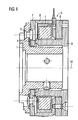
- FIGS. 1 and 2 each described the principle of a PE brake and a spring-applied brake.
- PE brake has a flange 1, which can be shrunk onto the shaft, for example, an electric motor.
- an anchor ring 2 is mounted at the foot of the flange 1.
- the anchor ring 2 is fastened here by means of rivets 3 and springs 4 to the foot of the flange 1 so that it can be lifted slightly in the axial direction of this.
- the anchor ring 2 is axially opposed by an annular brake body 5.
- the brake body 5 has a permanent magnet 6 and a coil 7.
- the coil 7 is surrounded by an outer ring 8, which forms an outer pole.
- a flange-like inner ring 9 rests against the inside of the coil 7 and the permanent magnet 6 or 6.
- the inner ring forms an inner pole, which lies radially within the outer ring 8.
- the Flanschfuß of the inner ring 9 forms the yoke for the poles.
- the inner ring 9 and the anchor ring 2 form closed magnetic circuits. If the coil 7 is de-energized, the magnetic flux caused by the permanent magnet 6 causes the anchor ring 2 to be attracted to the outer pole 8 and the inner pole 9 counter to the spring force of the spring 4. The rotating anchor ring 2 thus rubs against the outer ring 8 and the inner ring 9 , which are usually attached to a motor housing or end shield, so that the friction partners or friction components together generate a braking torque.
- the anchor ring 2, the outer ring 8 and the inner ring 9 are each formed annularly.
- the rings are arranged concentrically with each other. This results in the described high heating and increased wear.
- the brake body 5 is arranged eccentrically relative to the axis of rotation 10 of the flange 1. Out FIG. 1 this is not apparent.
- FIG. 3 schematically are the surfaces of the friction partner of a brake (the surfaces thus symbolize the friction components), shown axially projected on each other.
- the narrow annular surface 12 represents, for example, the outer ring 8.
- the axis of rotation 10 which forms the center of the annular surface 11 is slightly offset from the center 13 of the narrower annular surface 12 is.
- the outer ring 8 or the brake body 5 is arranged eccentrically with respect to the anchor ring 2 or the flange 1.
- the region of the wider annular surface 11 which is not covered by the narrower annular surface 12 does not contribute to the braking effect. Consequently, this area of the brake can cool down. Only those areas below the narrow annular surface 12 contribute to the braking effect. However, since all areas of the wider annular surface 11 are rotated during a revolution under the narrower annular surface 12, carry in During a revolution, all sections of the wide annular surface 11 and the anchor ring 2 to the braking effect at.
- a friction partner is annular.
- the brake body 5 is thus mounted in the concrete example so eccentric to the shaft in the housing of engine, transmission or winch.
- sufficient eccentricity for example, twice the width of the outer pole 8 or the annular surface 12 or difference in the ring widths of the rings 2 and 8 or the annular surfaces 11 and 12, there is no continuous annular slip track on the brake disc. The wear can be reduced by the eccentricity.
- FIG. 2 a spring pressure brake is shown in cross section.
- a flange 21 serves as the flange 1 of the example of FIG. 1 for receiving a shaft or for shrinking onto the shaft.
- a respective friction lining 22, 23 are attached to both axial sides.
- the friction linings 22 and 23 may also be integrally connected to each other.
- An armature 24 of a brake body 25 is pressed by a spring 26 on the friction lining 22.
- On the opposite axial side of the friction lining 23 is pressed against a friction plate 27, which represents a third friction partner. Since the friction disc 27 is connected via the housing 28 of the spring-applied brake firmly to the base of the spring 26, the friction disc 27 takes on the force of the spring 26.
- the brake can be released by an electromagnet.
- This consists of an annular core 28, in which a coil 29 is housed.
- the annular core 28 has for this purpose a corresponding U-profile.
- the leg ends of the U-profile represent the poles of the electromagnet. They attract the anchor ring 24 against the force of the spring 26 or more circumferentially distributed springs as soon as the coil 29 or a plurality of coils are energized accordingly.
- the anchor ring 24 is annular. Rather, the armature of the electromagnet can also be formed, for example, rectangular.
- the flange 21 is formed with its annular friction linings 22 and 23 and the anchor ring 24 concentric with the axis of rotation 30 of a motor shaft. This also results in the high wear on the friction surfaces. According to the invention, therefore, the rotating friction partner, here the flange 21, with the friction linings 22 and 23 is formed eccentrically with respect to the axis of rotation 30. Since the flange 21 still rotates about the axis of rotation 30, the friction surfaces of the friction linings 22 and 23 sweep a significantly larger area on the anchor ring 24 than its own surface.
- the movement of the friction surface 22 with respect to the anchor ring 24 and the friction surface 23 with respect to the friction disc 27 can in turn be based on FIG. 3 be explained.
- the wider annular surface 11 corresponds to the anchor ring 24.
- the narrower annular surface 12 corresponds to the friction lining 22.
- not the wider annular surface 11 but the narrower annular surface 12 rotates about the axis of rotation 10 and not about its own center 13.
- a point Q which is located on the narrow annular surface 12 and which is furthest away from the axis of rotation 10, covers the wide annular surface 11 always in its outer area.
- a point R which is likewise located on the narrow annular surface 12 and which is closest to the axis of rotation 10, always covers an inner region of the wide annular surface 12.
- points Q, R were selected here which lie radially in the center of the ring ,
- the annular narrower friction lining can be eccentrically attached to the armature or the anchor ring 24. The annular friction lining would then rub against the base of the flange 21.
- an annular friction lining could also be arranged eccentrically on the disc 27, which also rubs against the flange 21 during braking.
- FIG. 3 would then correspond to the wider annular surface 11 of a surface on the foot of the flange 21. This annular surface 11 rotates about the axis of rotation 10.
- annular friction lining 12 on the anchor ring 24 and / or the disc 27 would correspond to the narrower annular surface, which does not rotate here. It would thus result in conditions as in the example according to FIG. 1 in which also the wider annular surface 11 rotates below the narrower annular surface 12.
- ratios must be realized in which a wide annular surface rotates below or above a narrower eccentric annular surface, or that a narrower annular surface extends under / on a wider annular surface around the axis of the wider one Ring surface rotates.
- the claimed friction surface of the respective friction disc increases, that the cooling of the friction surfaces improves and that the wear is reduced.
- the run-in behavior also improves and a self-cleaning effect develops, because the friction surfaces run over the edges of the friction partner.
Landscapes
- Engineering & Computer Science (AREA)
- General Engineering & Computer Science (AREA)
- Mechanical Engineering (AREA)
- Transportation (AREA)
- Physics & Mathematics (AREA)
- Electromagnetism (AREA)
- Braking Arrangements (AREA)
Claims (9)
- Dispositif de freinage pour freiner une pièce de révolution d'une machine électrique, un axe ( 10, 30 ) de rotation étant prescrit par la pièce de révolution, comprenant- un premier élément ( 12 ) de friction annulaire, et- un deuxième élément ( 11 ) de friction, qui frotte sur le premier élément ( 12 ) de friction pour le freinage, caractérisé en ce que- le premier élément ( 12 ) de friction est disposé de manière excentrée par rapport à l'axe ( 10, 30 ) de rotation.
- Dispositif de freinage suivant la revendication 1, qui est constitué en frein à excitation par un aimant permanent, ayant une bobine ( 7 ) électrique et un aimant ( 6 ) permanent.
- Dispositif de freinage suivant la revendication 2 dans lequel, le premier élément ( 12 ) de friction a un pôle ( 8 ) extérieur annulaire et un pôle ( 9 ) intérieur annulaire concentrique et dans lequel le deuxième élément ( 11 ) de friction forme la culasse ( 2 ) de fermeture du circuit magnétique.
- Dispositif de freinage suivant l'une des revendications précédentes, dans lequel le deuxième élément ( 11 ) de friction est constitué sous forme annulaire.
- Dispositif de freinage suivant la revendication 4, qui a une bride ( 1 ) par laquelle la pièce de révolution peut être rendue solidaire en rotation et par laquelle le deuxième élément ( 11 ) de friction est solidarisé en rotation.
- Dispositif de freinage suivant la revendication 1, qui est constitué sous la forme d'un frein à pression par ressort.
- Dispositif de freinage suivant la revendication 6 dans lequel, le premier élément ( 12 ) de friction est mis sur une bride ( 21 ) sur laquelle la pièce de révolution peut être montée en étant solidaire en rotation.
- Dispositif de freinage suivant la revendication 6 ou 7 dans lequel, le deuxième élément ( 11 ) de friction est constitué de manière annulaire et le premier élément ( 11 ) de friction a deux surfaces de friction opposées axialement et dans lequel l'une de ces surfaces de friction est repoussée sur un troisième élément ( 24 ) de friction pour le freinage.
- Dispositif de freinage suivant l'une des revendications 6 à 8, dans lequel le premier élément ( 12 ) de friction comporte une culasse ( 14 ) d'un circuit magnétique qu'attaque aussi un ressort ( 26 ) pour repousser la culasse ( 24 ) sur le deuxième élément ( 11 ) de friction à l'encontre de l'action du circuit magnétique.
Priority Applications (2)
| Application Number | Priority Date | Filing Date | Title |
|---|---|---|---|
| DE200850002622 DE502008002622D1 (de) | 2008-08-18 | 2008-08-18 | Bremsvorrichtung mit exzentrischer Anordnung einer Reibkomponente |
| EP20080014643 EP2157331B1 (fr) | 2008-08-18 | 2008-08-18 | Dispositif de freinage doté d'un agencement excentrique d'un composant à friction |
Applications Claiming Priority (1)
| Application Number | Priority Date | Filing Date | Title |
|---|---|---|---|
| EP20080014643 EP2157331B1 (fr) | 2008-08-18 | 2008-08-18 | Dispositif de freinage doté d'un agencement excentrique d'un composant à friction |
Publications (2)
| Publication Number | Publication Date |
|---|---|
| EP2157331A1 EP2157331A1 (fr) | 2010-02-24 |
| EP2157331B1 true EP2157331B1 (fr) | 2011-02-16 |
Family
ID=40243988
Family Applications (1)
| Application Number | Title | Priority Date | Filing Date |
|---|---|---|---|
| EP20080014643 Ceased EP2157331B1 (fr) | 2008-08-18 | 2008-08-18 | Dispositif de freinage doté d'un agencement excentrique d'un composant à friction |
Country Status (2)
| Country | Link |
|---|---|
| EP (1) | EP2157331B1 (fr) |
| DE (1) | DE502008002622D1 (fr) |
Cited By (1)
| Publication number | Priority date | Publication date | Assignee | Title |
|---|---|---|---|---|
| CN108019447A (zh) * | 2016-10-31 | 2018-05-11 | 北京精密机电控制设备研究所 | 一种高制动转矩密度永磁式制动器 |
Families Citing this family (3)
| Publication number | Priority date | Publication date | Assignee | Title |
|---|---|---|---|---|
| ITBO20110310A1 (it) * | 2011-05-30 | 2012-12-01 | Deserti Meccanica S R L | Freno elettromagnetico a pressione di molle equipaggiato con magneti permanenti. |
| DE102012001701B3 (de) * | 2012-01-31 | 2013-03-14 | Kendrion Magneta Gmbh | Federdruckbremse mit einem Magnetgehäuse |
| DE102020103661A1 (de) | 2020-02-12 | 2021-08-12 | Wittenstein Se | Haltebremse für einen Antrieb |
Family Cites Families (4)
| Publication number | Priority date | Publication date | Assignee | Title |
|---|---|---|---|---|
| DE19646493A1 (de) * | 1996-11-11 | 1998-05-14 | Mayr Christian Gmbh & Co Kg | Einrichtung zur Geräuschdämpfung bei mechanischen Bremsen |
| JP2008530967A (ja) | 2005-02-15 | 2008-08-07 | ケンドリオン ビンダー マグネーテ ゲゼルシャフト ミット ベシュレンクテル ハフツング | 永久磁石を備えた電磁ブレーキ |
| DE102005022898A1 (de) * | 2005-05-18 | 2006-11-23 | Chr. Mayr Gmbh + Co Kg | Segmentbremse |
| DE102006031674A1 (de) * | 2006-07-08 | 2008-01-10 | Chr. Mayr Gmbh + Co Kg | Elektromagnetische Scheibenbremse |
-
2008
- 2008-08-18 EP EP20080014643 patent/EP2157331B1/fr not_active Ceased
- 2008-08-18 DE DE200850002622 patent/DE502008002622D1/de active Active
Cited By (1)
| Publication number | Priority date | Publication date | Assignee | Title |
|---|---|---|---|---|
| CN108019447A (zh) * | 2016-10-31 | 2018-05-11 | 北京精密机电控制设备研究所 | 一种高制动转矩密度永磁式制动器 |
Also Published As
| Publication number | Publication date |
|---|---|
| DE502008002622D1 (de) | 2011-03-31 |
| EP2157331A1 (fr) | 2010-02-24 |
Similar Documents
| Publication | Publication Date | Title |
|---|---|---|
| EP1599928B1 (fr) | Moteur electrique comportant un aimant permanent | |
| EP2061141B1 (fr) | Machine électrique dotée de freins magnétiques directement sur le rotor | |
| EP1817837B1 (fr) | Entraineur a hysteresis reglable | |
| WO2001070552A1 (fr) | Systeme de freinage electromecanique de roue | |
| DE3327123A1 (de) | Antriebsanordnung fuer signalverarbeitende geraete | |
| DE102009038928A1 (de) | Elektromotor | |
| DE102004054397B4 (de) | Elektromagnetisches Stellglied | |
| WO2003081064A1 (fr) | Dispositif de couplage d'un ensemble carter d'un equipement de couplage avec un ensemble rotor d'une machine electrique | |
| EP2157331A1 (fr) | Dispositif de freinage doté d'un agencement excentrique d'un composant à friction | |
| DE102015006384B3 (de) | Bremsanordnung und Verfahren zum Betreiben einer Bremsanordnung | |
| EP3646439A1 (fr) | Rotor pour une machine électrique | |
| DE102022211061A1 (de) | Bremseinrichtung für ein Fahrzeug und Verfahren zum Betreiben einer Bremseinrichtung | |
| DE102015001647B4 (de) | Bremsanordnung | |
| DE102016124390A1 (de) | Motor vom Innenrotortyp | |
| EP1717935A2 (fr) | Machine électrique | |
| DE102018006725A1 (de) | Elektromagnetisch betätigbare Bremsanordnung und Verfahren zur Inbetriebnahme oder Wartung einer elektromagnetisch betätigbaren Bremsanordnung | |
| DE102013202459A1 (de) | Haltebremse | |
| DE102016214629A1 (de) | Stelleinheit zur Veränderung des Kompressionsverhältnisses eines Verbrennungsmotors sowie Antriebseinheit mit einem Verbrennungsmotor und einer solchen Stelleinheit | |
| EP2555394B1 (fr) | Engrenage électrique pour une presse | |
| EP2275700B1 (fr) | Embrayage à friction électromagnétique | |
| DE102022002717A1 (de) | Elektromotor mit Bremsanordnung | |
| WO2012175455A2 (fr) | Moteur électrique | |
| WO2018197133A1 (fr) | Stator segmenté pour moteur électrique du type à rotor interne | |
| DE102016202008B3 (de) | Aktuatoranordnung | |
| DE102019215563A1 (de) | Stator einer elektrischen Maschine |
Legal Events
| Date | Code | Title | Description |
|---|---|---|---|
| PUAI | Public reference made under article 153(3) epc to a published international application that has entered the european phase |
Free format text: ORIGINAL CODE: 0009012 |
|
| 17P | Request for examination filed |
Effective date: 20090918 |
|
| AK | Designated contracting states |
Kind code of ref document: A1 Designated state(s): AT BE BG CH CY CZ DE DK EE ES FI FR GB GR HR HU IE IS IT LI LT LU LV MC MT NL NO PL PT RO SE SI SK TR |
|
| AX | Request for extension of the european patent |
Extension state: AL BA MK RS |
|
| GRAP | Despatch of communication of intention to grant a patent |
Free format text: ORIGINAL CODE: EPIDOSNIGR1 |
|
| GRAS | Grant fee paid |
Free format text: ORIGINAL CODE: EPIDOSNIGR3 |
|
| AKX | Designation fees paid |
Designated state(s): DE |
|
| GRAA | (expected) grant |
Free format text: ORIGINAL CODE: 0009210 |
|
| AK | Designated contracting states |
Kind code of ref document: B1 Designated state(s): DE |
|
| REF | Corresponds to: |
Ref document number: 502008002622 Country of ref document: DE Date of ref document: 20110331 Kind code of ref document: P |
|
| REG | Reference to a national code |
Ref country code: DE Ref legal event code: R096 Ref document number: 502008002622 Country of ref document: DE Effective date: 20110331 |
|
| PLBE | No opposition filed within time limit |
Free format text: ORIGINAL CODE: 0009261 |
|
| STAA | Information on the status of an ep patent application or granted ep patent |
Free format text: STATUS: NO OPPOSITION FILED WITHIN TIME LIMIT |
|
| 26N | No opposition filed |
Effective date: 20111117 |
|
| REG | Reference to a national code |
Ref country code: DE Ref legal event code: R097 Ref document number: 502008002622 Country of ref document: DE Effective date: 20111117 |
|
| PGFP | Annual fee paid to national office [announced via postgrant information from national office to epo] |
Ref country code: DE Payment date: 20181019 Year of fee payment: 11 |
|
| REG | Reference to a national code |
Ref country code: DE Ref legal event code: R119 Ref document number: 502008002622 Country of ref document: DE |
|
| PG25 | Lapsed in a contracting state [announced via postgrant information from national office to epo] |
Ref country code: DE Free format text: LAPSE BECAUSE OF NON-PAYMENT OF DUE FEES Effective date: 20200303 |