EP2157444A2 - Procédé et appareil de détermination d'une position d'un dispositif de communication - Google Patents
Procédé et appareil de détermination d'une position d'un dispositif de communication Download PDFInfo
- Publication number
- EP2157444A2 EP2157444A2 EP09165266A EP09165266A EP2157444A2 EP 2157444 A2 EP2157444 A2 EP 2157444A2 EP 09165266 A EP09165266 A EP 09165266A EP 09165266 A EP09165266 A EP 09165266A EP 2157444 A2 EP2157444 A2 EP 2157444A2
- Authority
- EP
- European Patent Office
- Prior art keywords
- signal
- time
- measured
- received
- transmitted
- Prior art date
- Legal status (The legal status is an assumption and is not a legal conclusion. Google has not performed a legal analysis and makes no representation as to the accuracy of the status listed.)
- Withdrawn
Links
- 238000000034 method Methods 0.000 title claims abstract description 48
- 238000004891 communication Methods 0.000 title claims description 16
- 230000005540 biological transmission Effects 0.000 claims abstract description 22
- XLYOFNOQVPJJNP-UHFFFAOYSA-N water Substances O XLYOFNOQVPJJNP-UHFFFAOYSA-N 0.000 claims description 9
- 238000004590 computer program Methods 0.000 claims description 6
- 239000000835 fiber Substances 0.000 claims description 6
- 229920005594 polymer fiber Polymers 0.000 claims description 6
- 238000004364 calculation method Methods 0.000 claims description 2
- 238000010586 diagram Methods 0.000 description 15
- 238000011161 development Methods 0.000 description 9
- 230000001419 dependent effect Effects 0.000 description 2
- 108010076504 Protein Sorting Signals Proteins 0.000 description 1
- 230000015572 biosynthetic process Effects 0.000 description 1
- 238000005516 engineering process Methods 0.000 description 1
- 238000005259 measurement Methods 0.000 description 1
- 238000012986 modification Methods 0.000 description 1
- 230000004048 modification Effects 0.000 description 1
Images



Classifications
-
- G—PHYSICS
- G01—MEASURING; TESTING
- G01S—RADIO DIRECTION-FINDING; RADIO NAVIGATION; DETERMINING DISTANCE OR VELOCITY BY USE OF RADIO WAVES; LOCATING OR PRESENCE-DETECTING BY USE OF THE REFLECTION OR RERADIATION OF RADIO WAVES; ANALOGOUS ARRANGEMENTS USING OTHER WAVES
- G01S13/00—Systems using the reflection or reradiation of radio waves, e.g. radar systems; Analogous systems using reflection or reradiation of waves whose nature or wavelength is irrelevant or unspecified
- G01S13/02—Systems using reflection of radio waves, e.g. primary radar systems; Analogous systems
-
- G—PHYSICS
- G01—MEASURING; TESTING
- G01S—RADIO DIRECTION-FINDING; RADIO NAVIGATION; DETERMINING DISTANCE OR VELOCITY BY USE OF RADIO WAVES; LOCATING OR PRESENCE-DETECTING BY USE OF THE REFLECTION OR RERADIATION OF RADIO WAVES; ANALOGOUS ARRANGEMENTS USING OTHER WAVES
- G01S5/00—Position-fixing by co-ordinating two or more direction or position line determinations; Position-fixing by co-ordinating two or more distance determinations
- G01S5/02—Position-fixing by co-ordinating two or more direction or position line determinations; Position-fixing by co-ordinating two or more distance determinations using radio waves
Definitions
- the invention relates to a method and apparatus for determining a position of a communication device.
- the technical field of the invention relates to the positioning or location of a communication device or device, such as a wireless communication device, mobile device, MDA or PDA.
- the Applicant internally known solutions to determine a one-dimensional position of a communication device.
- the distance of the communication device is calculated by a stationary base station, wherein the signals for position determination between the communication device and the base station are exchanged via a radiating cable and over air and the distance of the communication device to the radiating cable is constant.
- An example of such a constant distance between the radiating cable and the communication device is when the communication device is installed in a train or the like and the radiating cable is laid parallel to the tracks.
- this object is achieved by a method having the features of patent claim 1 and / or by a device having the features of patent claim 14.
- a computer program product which, on a program-controlled device, causes the execution of the above steps a) to e) of the method for determining a position of a first device.
- a computer program product such as a computer program means can be provided or supplied, for example, as a storage medium, such as a memory card, USB stick, floppy, CD-ROM, DVD or even in the form of a downloadable file from a server in a network. This can be done, for example, in a wireless communication network by the transmission of a corresponding file with the computer program product or the computer program means.
- An advantage of the present invention is that a two-dimensional position determination or location determination of the first device relative to the position of the second device is made possible.
- the two-dimensional position determination is made possible according to the invention by the following:
- a first curve of possible positions of the first device in an XY plane can be provided, where X is the horizontal distance of the first device to the second device and Y is the vertical distance of the first device to the second device.
- a second curve of possible positions of the first device in the X-Y plane can be provided.
- intersection of the first curve with the second curve corresponds to the position of the first device relative to the second device.
- the actual position of the first device may also be determined by a plausibility check due to the linear dependence between the transit time and the distance between the first device and the second device are determined.
- step c) of the method according to the invention namely the measurement of the signal strength of the second signal received by the second device, is described in " Indoor Radiated-Mode Leaky Feeder Propagation at 2.0GHz ", YP Zhang, IEEE Transactions on Vehicular Technology, Vol. 50, No. 2, March 2001 , described.
- step d namely the measuring of the transit time between the transmission of the first signal to the reception of the second signal, in the DE 10 2006 045 350 A1 described.
- the first signal and the second signal are transmitted at least partially wirelessly.
- the at least two different media cause a different signal propagation time and a different signal attenuation.
- the at least two different media are formed as a radiating cable and air, a radiating cable and water, a fiber optic cable and air, a fiber optic cable and water, a polymer fiber cable and air or a polymer fiber cable and water.
- a calibration is carried out on a known reference position of the first device for determining a reference transit time and a reference signal strength of the second signal received by the second device.
- the position of the first device is dependent on the signal strength measured by the second device, on the travel time measured by the second device, on the known reference position of the first device, on the measured reference travel time and the measured reference signal strength of the received second Calculated signal.
- the position of the first device is determined as a function of the measured signal strength of the received second signal, the measured transit time, of a known delay time between a third time of receipt of the first signal by the first device and a fourth time of the second device Transmitting the second signal by the first device and a second device known transmission power of the second signal from the second device calculated.
- the second signal is formed with a data field which contains a delay time information which indicates the respective delay time, which corresponds to the respective difference between the fourth time and the third time.
- a third signal is transmitted from the first device to the second device before or after the first signal, which has a data field which includes delay information indicating the respective delay time, which of the respective difference between the fourth time and the third time.
- the third signal preferably contains a further data field which includes transmission power information indicating the respective transmission power of the first device.
- the further data field can also be transmitted by means of a fourth signal from the first device to the second device.
- At least one calibration step for determining the delay time between the third time and the fourth time is carried out before the execution of step a). Subsequently, the determined delay time in the second device before the execution of step a) is stored.
- the first device is designed as a mobile device and / or the second device as a stationary device.
- the absolute position of the first device can also be calculated from the calculated relative position of the first device according to the invention to the second device and the known absolute position of the second device.
- the first device is designed as a stationary device and the second device as a mobile device.
- the first device is designed as a mobile, wireless communication device, in particular as a mobile radio device, notebook, PDA or MDA.
- the device has a timer means which measures the difference between the second time and the first time.
- the first signal is formed with at least one address field, wherein the respective address field has an address of a first device as a receiver of the first signal.
- the device has a channel coding means, which is set up to code the first signal in such a way that it can only be decoded by a predeterminable quantity of the number N of the first devices.
- FIG. 1 shows a schematic flow diagram of a first embodiment of the inventive method for determining a position P of a first device 10th
- FIG. 1 has the method steps R1 to R5:
- a first signal X1 is transmitted from a second device 20 to the first device 10.
- the first device 10 is a mobile device. This can be designed as a mobile, wireless communication device, in particular as a mobile device, notebook, PDA or MDA.
- the second device 20 is, for example, a fixed device, such as a base station.
- a second signal X2 is transmitted from the first device 10 to the second device 20.
- the first signal X1 and the second signal X2 are transmitted via at least two different media 30, 40.
- the first signal X1 and the second signal X2 are transmitted, for example, at least partially wirelessly.
- the at least two different media 30, 40 cause a different signal propagation time and a different signal attenuation of the first and second signals X1, X2.
- the at least two different media 30, 40 are formed as a radiating cable and air, a radiating cable and water, a fiber optic cable and air, a fiber optic cable and water, a polymer fiber cable and air or a polymer fiber cable and water.
- a radiating cable is for example from the DE 69627599 T2 known. Such radiating cables are also known as "Leaky Wave Cable”, “Leaky Coax” or “Radiating Cable”.
- the signal strength E of the second signal X2 received from the second device 20 is measured.
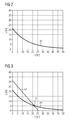
- FIG. 2 an exemplary XY diagram for illustrating a first curve K1 of possible positions of the first device 10 as a function of the measured signal strength E.
- FIG. 6 a schematic block diagram of an embodiment of the signal run of the first and second signals X1, X2 and the resulting transit time D between the times T1 and T2.
- FIG. 3 shows next to the first curve K1 according to FIG. 2 a second curve K2 possible positions of the first device 10 as a function of the measured transit time D shown.
- the position P of the first device 10 is calculated as a function of the measured signal strength E of the received second signal X 2 and the measured transit time D. This results in the position P with respect to FIG. 3 for example, as an intersection point P between the first curve K1 and the second curve K2.
- FIG. 4 shows a schematic flow diagram of a second embodiment of the inventive method for determining a position P of the first device 10th
- FIG. 4 has the method steps S1 to S6, wherein the method steps S2 to S5 the method steps R1 to R4 of FIG. 1 correspond. For this reason, the method steps S2 to S5 are no longer explained below, but in this regard, the method steps R1 to R4 of the FIG. 1 directed.
- a calibration for determining a reference propagation time and a reference signal strength of the second signal X 2 received by the second device 20 is performed.
- the reference delay time is measured from the first time T1 of the transmission of the first signal X1 to the second time T2 of the reception of the second signal X2.
- the Reference signal strength of the second signal X2 received by the second device 20 from the second device 20 is measured.
- the method steps S2 to S5 correspond to those with reference to FIG. 1 explained method steps R1 to R4.
- the position P of the first device 10 is determined as a function of the signal strength E measured by the second device 20, the transit time D measured by the second device 20, the known reference position of the first device 10, the measured reference transit time and the measured reference signal strength of the first device 10 received second signal X2 calculated.
- FIG. 5 is a schematic flow diagram of a third embodiment of the inventive method for determining the position P of the first device 10 is shown.
- the third exemplary embodiment of the method according to the invention has the method steps T1 to T6:
- At least one calibration step is performed.
- the delay time V determined by the at least one calibration step is stored in the second device 20.
- the second device 20 may comprise a memory device.
- the delay time V is the time required for the first device 10 to generate and send the second signal X2 after a detected receipt of the first signal X1.
- an unknown position P of the first device can be determined.
- a first signal X1 is transmitted from the second device 20 to the first device 10, which is at the initially unknown position P.
- a second signal X2 is transmitted from the first device 10 to the second device 20, the first signal X1 and the second signal X2 being transmitted via at least two different media 30, 40 ,
- the second signal X2 can be formed with a data field which includes a delay time information which indicates the respective delay time V, which corresponds to the respective difference between the fourth time T4 and the third time T3.
- the process step T1 could be omitted.
- a third signal S3 from the first device 10 to the second device 20 may also be present before or after the second signal X2 be transferred.
- the third signal S3 preferably has a data field which contains a delay information which indicates the respective delay time V, which corresponds to the respective difference between the fourth time T4 and the third time T3.
- the signal strength E of the second signal X2 received from the second device 20 is measured.
- the transit time D from the first time T1 of transmitting the first signal X1 to the second time T2 of receiving the second signal X2 is measured.
- the position P of the first device 10 is determined by the measured signal strength E of the received second signal X2, the measured transit time D, the second device 20 known delay time V and one of the second device 20 known transmission power S of the second signal X2 from the second Device 20 is calculated.
- FIG. 7 shows a schematic block diagram of an embodiment of an arrangement 1 with the device 20 according to the invention for determining a position P of a first device 10th
- FIG. 7 Without limitation of generality are in FIG. 7 the two different media 30, 40 are formed as a radiating cable 30 and as air 40.
- the reference numeral A10 designates the antenna array of the first apparatus 10
- the reference numeral A30 designates the antenna array of the radiating cable 30.
- reference numerals X1 and X2 schematically show the signal sequences of the first signal X1 and the second signal X2 in FIG FIG. 7 ,
- the device 20 is suitable for determining the position P of the first device 10 and has for this purpose a transmitting means 21, a receiving means 22, a first measuring means 23, a second measuring means 24 and a calculating means 25.
- the transmission means 21 is adapted to transmit a first signal X1 to the first device 10, wherein the first signal X1 is adapted to initiate a transmission of a second signal X2 from the first device 10 receiving the first signal X1.
- the first signal X1 and the second signal X2 are transmitted via at least two different media 30, 40.
- the receiving means 22 is adapted to receive the second signal X2 sent from the first device 10.
- the first measuring means 23 is adapted to measure the signal strength E of the received second signal X2.
- the second measuring means 24 is set up to measure the transit time D from the first time T1 of the transmission of the first signal X1 to the second time T2 of the reception of the second signal X2 (see FIG FIG. 6 ).
- the second measuring means 24 is designed, for example, as a timer.
- the calculation means 25 is set up to calculate the position P of the first device 10 as a function of the measured signal strength E of the received second signal X2 and the measured transit time D.
- FIG. 7 Without limitation of generality is in FIG. 7 only a first device 10 drawn. However, it is possible with the device 20, the respective position of a number N; N ⁇ 1; from first devices 10. Then, the respective first device 10 is adapted to transmit the second signal X2 to the device 20 in response to the first signal X1 sent from the device 20. For example, then the first signal X1 can be formed with at least one address field, wherein the respective address field has an address of a first device 10 as a receiver of the first signal X1.
- the device 20 may comprise a channel coding means (not shown) which is adapted to code the first signal X1 such that it can only be decoded by a predetermined amount, for example exactly one, the number N of the first devices 10.
Landscapes
- Engineering & Computer Science (AREA)
- Radar, Positioning & Navigation (AREA)
- Remote Sensing (AREA)
- Physics & Mathematics (AREA)
- General Physics & Mathematics (AREA)
- Computer Networks & Wireless Communication (AREA)
- Position Fixing By Use Of Radio Waves (AREA)
- Mobile Radio Communication Systems (AREA)
- Radar Systems Or Details Thereof (AREA)
Applications Claiming Priority (1)
| Application Number | Priority Date | Filing Date | Title |
|---|---|---|---|
| DE102008038246.9A DE102008038246B4 (de) | 2008-08-18 | 2008-08-18 | Verfahren, Computerprogrammprodukt, Gerät und Anordnung zum Bestimmen einer Position einer Kommunikations-Vorrichtung |
Publications (2)
| Publication Number | Publication Date |
|---|---|
| EP2157444A2 true EP2157444A2 (fr) | 2010-02-24 |
| EP2157444A3 EP2157444A3 (fr) | 2011-10-05 |
Family
ID=41323574
Family Applications (1)
| Application Number | Title | Priority Date | Filing Date |
|---|---|---|---|
| EP09165266A Withdrawn EP2157444A3 (fr) | 2008-08-18 | 2009-07-13 | Procédé et appareil de détermination d'une position d'un dispositif de communication |
Country Status (3)
| Country | Link |
|---|---|
| US (1) | US8428615B2 (fr) |
| EP (1) | EP2157444A3 (fr) |
| DE (1) | DE102008038246B4 (fr) |
Families Citing this family (2)
| Publication number | Priority date | Publication date | Assignee | Title |
|---|---|---|---|---|
| US20130275770A1 (en) * | 2011-12-22 | 2013-10-17 | Michael Berger | Always-available embedded theft reaction subsystem |
| JP6597651B2 (ja) * | 2017-01-18 | 2019-10-30 | 株式会社デンソー | 携帯端末検出装置、携帯端末検出方法 |
Citations (1)
| Publication number | Priority date | Publication date | Assignee | Title |
|---|---|---|---|---|
| US20070285233A1 (en) * | 2006-06-08 | 2007-12-13 | Mitsubishi Electric Corporation | Approach detecting system |
Family Cites Families (9)
| Publication number | Priority date | Publication date | Assignee | Title |
|---|---|---|---|---|
| US5019822A (en) * | 1973-07-09 | 1991-05-28 | The United States Of America As Represented By The Secretary Of The Navy | Marine object detector |
| FR2736225B1 (fr) * | 1995-06-27 | 1997-08-01 | Gec Alsthom Transport Sa | Dispositif permettant de s'affranchir des problemes de diaphonie lors de la localisation d'un vehicule se deplacant le long de moyens de propagation d'ondes electromagnetiques |
| US5809429A (en) | 1995-09-22 | 1998-09-15 | Andrew Corporation | Radiating coaxial cable and radio communication system using same |
| WO2002063327A2 (fr) * | 2001-02-06 | 2002-08-15 | Itt Manufacturing Enterprises, Inc. | Procede et appareil pour determiner la position d'un dispositif de communication mobile |
| DE202005002477U1 (de) * | 2005-02-15 | 2005-06-09 | Interflex Datensysteme Gmbh & Co. Kg | Vorrichtung zum Detektieren von Personen und/oder Gegenständen |
| DE102006045350A1 (de) | 2006-09-26 | 2007-03-22 | Siemens Ag | Verfahren zur Abstandsermittlung zwischen Netzknoten in einem Nachrichtennetzwerk |
| US8010067B2 (en) * | 2006-10-16 | 2011-08-30 | Goliath Solutions, Llc | Long range RFID transmitter power tracking loop |
| KR101033200B1 (ko) * | 2006-10-20 | 2011-05-06 | 주식회사 케이티 | Rfid와 통신망을 이용한 이동체 위치 확인 서비스시스템 및 그 방법 |
| US20080153509A1 (en) * | 2006-12-21 | 2008-06-26 | Christopher Piekarski | Method for locating a mobile communication device |
-
2008
- 2008-08-18 DE DE102008038246.9A patent/DE102008038246B4/de not_active Expired - Fee Related
-
2009
- 2009-07-13 EP EP09165266A patent/EP2157444A3/fr not_active Withdrawn
- 2009-08-18 US US12/542,755 patent/US8428615B2/en not_active Expired - Fee Related
Patent Citations (1)
| Publication number | Priority date | Publication date | Assignee | Title |
|---|---|---|---|---|
| US20070285233A1 (en) * | 2006-06-08 | 2007-12-13 | Mitsubishi Electric Corporation | Approach detecting system |
Also Published As
| Publication number | Publication date |
|---|---|
| US20100039312A1 (en) | 2010-02-18 |
| DE102008038246B4 (de) | 2014-08-28 |
| US8428615B2 (en) | 2013-04-23 |
| EP2157444A3 (fr) | 2011-10-05 |
| DE102008038246A1 (de) | 2010-02-25 |
Similar Documents
| Publication | Publication Date | Title |
|---|---|---|
| DE102013200618B4 (de) | Erzeugen einer Innenraum-Funkkarte, Orten eines Ziels im Innenraum | |
| EP3131065A1 (fr) | Procede et systeme de controle d'acces | |
| EP2098088A1 (fr) | Procédé et dispositif pour déterminer la position d'un terminal dans un réseau de télécommunication mobile | |
| WO2016193265A1 (fr) | Procédé de transformation d'une indication de position en un système de coordonnées local | |
| DE112015006034T5 (de) | Zugpositions-detektiereinrichtung | |
| DE112020005751T5 (de) | Kommunikationsvorrichtung und Positionsidentifizierungsverfahren | |
| DE102016204750A1 (de) | Autorisierung der Nutzung eines Kraftfahrzeugs | |
| DE102015016557B4 (de) | Autorisierung der Nutzung eines Kraftfahrzeugs | |
| WO2018219618A1 (fr) | Procédé et dispositif permettant la localisation d'un véhicule pour un transfert d'énergie par induction | |
| EP3433139A1 (fr) | Autorisation d'utiliser un véhicule à moteur | |
| DE102018115337A1 (de) | System und Verfahren zum Detektieren von fingierter Information über einen Fahrzeugstandort | |
| DE102008038246B4 (de) | Verfahren, Computerprogrammprodukt, Gerät und Anordnung zum Bestimmen einer Position einer Kommunikations-Vorrichtung | |
| EP2237119A2 (fr) | Procédé de vérification du fonctionnement d'un système d'assistance au conducteur d'un véhicule automobile et véhicule automobile | |
| EP1153314A1 (fr) | Procede et dispositif pour determiner une position | |
| EP3338262B1 (fr) | Procédé de détermination de la fin d'un embouteillage dans la circulation routière et dispositifs associés | |
| EP3482384B1 (fr) | Détermination de places de stationnement libres éloignées latéralement | |
| WO2020192988A1 (fr) | Procédé pour la localisation d'un véhicule automobile | |
| EP3433140B1 (fr) | Autorisation d'utiliser un véhicule à moteur | |
| DE102018211350A1 (de) | System und verfahren zur lokalisierung eines mobilen endgeräts sowie verfahren zum erzeugen von datensätzen | |
| DE102005038300A1 (de) | Navigationsvorrichtung mit GPS und TMC und Verfahren davon | |
| DE102016206526A1 (de) | Verfahren zum Bereitstellen von Feldstärkeninformationen und zur Positionsbestimmung | |
| WO2022063673A1 (fr) | Procédé de reconnaissance d'un signal gnss manipulé ou falsifié | |
| DE102010019150B4 (de) | Verfahren und Vorrichtung zur Bestimmung eines relativen Horizontalwinkels | |
| DE102019206466A1 (de) | Verfahren und Vorrichtung zum Betreiben eines drahtlosen Kommunikationsnetzwerks | |
| EP1865740A2 (fr) | Déterminations spatiales de terminaux mobiles dans un réseau radio mobile et leurs utilisations |
Legal Events
| Date | Code | Title | Description |
|---|---|---|---|
| PUAI | Public reference made under article 153(3) epc to a published international application that has entered the european phase |
Free format text: ORIGINAL CODE: 0009012 |
|
| AK | Designated contracting states |
Kind code of ref document: A2 Designated state(s): AT BE BG CH CY CZ DE DK EE ES FI FR GB GR HR HU IE IS IT LI LT LU LV MC MK MT NL NO PL PT RO SE SI SK SM TR |
|
| PUAL | Search report despatched |
Free format text: ORIGINAL CODE: 0009013 |
|
| AK | Designated contracting states |
Kind code of ref document: A3 Designated state(s): AT BE BG CH CY CZ DE DK EE ES FI FR GB GR HR HU IE IS IT LI LT LU LV MC MK MT NL NO PL PT RO SE SI SK SM TR |
|
| RIC1 | Information provided on ipc code assigned before grant |
Ipc: G01S 5/00 20060101ALI20110830BHEP Ipc: G01S 13/02 20060101AFI20110830BHEP |
|
| 17P | Request for examination filed |
Effective date: 20111205 |
|
| RAP1 | Party data changed (applicant data changed or rights of an application transferred) |
Owner name: SIEMENS AKTIENGESELLSCHAFT |
|
| 17Q | First examination report despatched |
Effective date: 20151015 |
|
| STAA | Information on the status of an ep patent application or granted ep patent |
Free format text: STATUS: THE APPLICATION IS DEEMED TO BE WITHDRAWN |
|
| 18D | Application deemed to be withdrawn |
Effective date: 20160226 |