EP2157471A2 - Dispositif pour la prévention de la suppression de la mélatonine par la lumière pendant la nuit - Google Patents
Dispositif pour la prévention de la suppression de la mélatonine par la lumière pendant la nuit Download PDFInfo
- Publication number
- EP2157471A2 EP2157471A2 EP09177466A EP09177466A EP2157471A2 EP 2157471 A2 EP2157471 A2 EP 2157471A2 EP 09177466 A EP09177466 A EP 09177466A EP 09177466 A EP09177466 A EP 09177466A EP 2157471 A2 EP2157471 A2 EP 2157471A2
- Authority
- EP
- European Patent Office
- Prior art keywords
- light
- melatonin
- lens
- night
- human
- Prior art date
- Legal status (The legal status is an assumption and is not a legal conclusion. Google has not performed a legal analysis and makes no representation as to the accuracy of the status listed.)
- Withdrawn
Links
- YJPIGAIKUZMOQA-UHFFFAOYSA-N Melatonin Natural products COC1=CC=C2N(C(C)=O)C=C(CCN)C2=C1 YJPIGAIKUZMOQA-UHFFFAOYSA-N 0.000 title claims abstract description 146
- DRLFMBDRBRZALE-UHFFFAOYSA-N melatonin Chemical compound COC1=CC=C2NC=C(CCNC(C)=O)C2=C1 DRLFMBDRBRZALE-UHFFFAOYSA-N 0.000 title claims abstract description 146
- 229960003987 melatonin Drugs 0.000 title claims abstract description 145
- 230000001629 suppression Effects 0.000 title claims description 27
- 230000002265 prevention Effects 0.000 title description 5
- 238000004519 manufacturing process Methods 0.000 claims abstract description 44
- 210000001525 retina Anatomy 0.000 claims abstract description 10
- 230000003287 optical effect Effects 0.000 claims description 23
- 229940124543 ultraviolet light absorber Drugs 0.000 claims description 4
- 239000006097 ultraviolet radiation absorber Substances 0.000 claims description 4
- 239000011521 glass Substances 0.000 claims description 2
- 239000005336 safety glass Substances 0.000 claims description 2
- 230000000903 blocking effect Effects 0.000 abstract description 13
- 230000002401 inhibitory effect Effects 0.000 abstract description 5
- 208000026310 Breast neoplasm Diseases 0.000 description 24
- 206010006187 Breast cancer Diseases 0.000 description 23
- 230000028327 secretion Effects 0.000 description 20
- 206010028980 Neoplasm Diseases 0.000 description 14
- 210000003296 saliva Anatomy 0.000 description 13
- 201000011510 cancer Diseases 0.000 description 12
- 230000000694 effects Effects 0.000 description 11
- 230000002060 circadian Effects 0.000 description 8
- 230000027288 circadian rhythm Effects 0.000 description 7
- 210000004560 pineal gland Anatomy 0.000 description 6
- 230000033764 rhythmic process Effects 0.000 description 6
- 241000282412 Homo Species 0.000 description 5
- 230000036541 health Effects 0.000 description 5
- 241001465754 Metazoa Species 0.000 description 4
- 239000000463 material Substances 0.000 description 4
- 238000012360 testing method Methods 0.000 description 4
- 201000004569 Blindness Diseases 0.000 description 3
- 208000019888 Circadian rhythm sleep disease Diseases 0.000 description 3
- 241000700159 Rattus Species 0.000 description 3
- 206010041349 Somnolence Diseases 0.000 description 3
- 238000000540 analysis of variance Methods 0.000 description 3
- 230000003078 antioxidant effect Effects 0.000 description 3
- 238000003556 assay Methods 0.000 description 3
- 229940088597 hormone Drugs 0.000 description 3
- 239000005556 hormone Substances 0.000 description 3
- 238000000034 method Methods 0.000 description 3
- SFLSHLFXELFNJZ-QMMMGPOBSA-N (-)-norepinephrine Chemical compound NC[C@H](O)C1=CC=C(O)C(O)=C1 SFLSHLFXELFNJZ-QMMMGPOBSA-N 0.000 description 2
- 208000005623 Carcinogenesis Diseases 0.000 description 2
- 208000001333 Colorectal Neoplasms Diseases 0.000 description 2
- 208000007590 Disorders of Excessive Somnolence Diseases 0.000 description 2
- 101000633613 Homo sapiens Probable threonine protease PRSS50 Proteins 0.000 description 2
- 101000821981 Homo sapiens Sarcoma antigen 1 Proteins 0.000 description 2
- 208000001456 Jet Lag Syndrome Diseases 0.000 description 2
- 102100029523 Probable threonine protease PRSS50 Human genes 0.000 description 2
- 102100021466 Sarcoma antigen 1 Human genes 0.000 description 2
- 230000002411 adverse Effects 0.000 description 2
- 238000004458 analytical method Methods 0.000 description 2
- 239000003963 antioxidant agent Substances 0.000 description 2
- 230000015572 biosynthetic process Effects 0.000 description 2
- 230000036952 cancer formation Effects 0.000 description 2
- 231100000504 carcinogenesis Toxicity 0.000 description 2
- 239000011248 coating agent Substances 0.000 description 2
- 238000000576 coating method Methods 0.000 description 2
- 230000006378 damage Effects 0.000 description 2
- 230000001419 dependent effect Effects 0.000 description 2
- 230000007717 exclusion Effects 0.000 description 2
- 230000004313 glare Effects 0.000 description 2
- JYGXADMDTFJGBT-VWUMJDOOSA-N hydrocortisone Chemical compound O=C1CC[C@]2(C)[C@H]3[C@@H](O)C[C@](C)([C@@](CC4)(O)C(=O)CO)[C@@H]4[C@@H]3CCC2=C1 JYGXADMDTFJGBT-VWUMJDOOSA-N 0.000 description 2
- -1 hydroxyindol-O-methyl Chemical group 0.000 description 2
- 238000000338 in vitro Methods 0.000 description 2
- 208000033915 jet lag type circadian rhythm sleep disease Diseases 0.000 description 2
- 239000003550 marker Substances 0.000 description 2
- 210000001640 nerve ending Anatomy 0.000 description 2
- 230000000422 nocturnal effect Effects 0.000 description 2
- 229960002748 norepinephrine Drugs 0.000 description 2
- SFLSHLFXELFNJZ-UHFFFAOYSA-N norepinephrine Natural products NCC(O)C1=CC=C(O)C(O)=C1 SFLSHLFXELFNJZ-UHFFFAOYSA-N 0.000 description 2
- 150000003254 radicals Chemical class 0.000 description 2
- 238000011160 research Methods 0.000 description 2
- QZAYGJVTTNCVMB-UHFFFAOYSA-N serotonin Chemical compound C1=C(O)C=C2C(CCN)=CNC2=C1 QZAYGJVTTNCVMB-UHFFFAOYSA-N 0.000 description 2
- 239000000126 substance Substances 0.000 description 2
- 238000003786 synthesis reaction Methods 0.000 description 2
- 238000002834 transmittance Methods 0.000 description 2
- 230000001296 transplacental effect Effects 0.000 description 2
- 230000000007 visual effect Effects 0.000 description 2
- 208000017164 Chronobiology disease Diseases 0.000 description 1
- 206010009944 Colon cancer Diseases 0.000 description 1
- OMFXVFTZEKFJBZ-UHFFFAOYSA-N Corticosterone Natural products O=C1CCC2(C)C3C(O)CC(C)(C(CC4)C(=O)CO)C4C3CCC2=C1 OMFXVFTZEKFJBZ-UHFFFAOYSA-N 0.000 description 1
- 229920000742 Cotton Polymers 0.000 description 1
- 230000005778 DNA damage Effects 0.000 description 1
- 231100000277 DNA damage Toxicity 0.000 description 1
- 102100034323 Disintegrin and metalloproteinase domain-containing protein 2 Human genes 0.000 description 1
- 238000008157 ELISA kit Methods 0.000 description 1
- 108090000790 Enzymes Proteins 0.000 description 1
- 102000004190 Enzymes Human genes 0.000 description 1
- 229940123457 Free radical scavenger Drugs 0.000 description 1
- 101000780288 Homo sapiens Disintegrin and metalloproteinase domain-containing protein 2 Proteins 0.000 description 1
- 101001064302 Homo sapiens Lipase member I Proteins 0.000 description 1
- 101000725916 Homo sapiens Putative tumor antigen NA88-A Proteins 0.000 description 1
- QIVBCDIJIAJPQS-VIFPVBQESA-N L-tryptophane Chemical compound C1=CC=C2C(C[C@H](N)C(O)=O)=CNC2=C1 QIVBCDIJIAJPQS-VIFPVBQESA-N 0.000 description 1
- 102100030659 Lipase member I Human genes 0.000 description 1
- 241000124008 Mammalia Species 0.000 description 1
- FUSGACRLAFQQRL-UHFFFAOYSA-N N-Ethyl-N-nitrosourea Chemical compound CCN(N=O)C(N)=O FUSGACRLAFQQRL-UHFFFAOYSA-N 0.000 description 1
- 101710202061 N-acetyltransferase Proteins 0.000 description 1
- 208000000236 Prostatic Neoplasms Diseases 0.000 description 1
- 208000028017 Psychotic disease Diseases 0.000 description 1
- 102100027596 Putative tumor antigen NA88-A Human genes 0.000 description 1
- 208000032140 Sleepiness Diseases 0.000 description 1
- 108090000992 Transferases Proteins 0.000 description 1
- 102000004357 Transferases Human genes 0.000 description 1
- QIVBCDIJIAJPQS-UHFFFAOYSA-N Tryptophan Natural products C1=CC=C2C(CC(N)C(O)=O)=CNC2=C1 QIVBCDIJIAJPQS-UHFFFAOYSA-N 0.000 description 1
- 230000001154 acute effect Effects 0.000 description 1
- 238000003149 assay kit Methods 0.000 description 1
- 230000008901 benefit Effects 0.000 description 1
- 230000008827 biological function Effects 0.000 description 1
- 230000033228 biological regulation Effects 0.000 description 1
- 210000000481 breast Anatomy 0.000 description 1
- 230000005907 cancer growth Effects 0.000 description 1
- 210000004027 cell Anatomy 0.000 description 1
- 238000006243 chemical reaction Methods 0.000 description 1
- 230000008632 circadian clock Effects 0.000 description 1
- 208000029078 coronary artery disease Diseases 0.000 description 1
- OMFXVFTZEKFJBZ-HJTSIMOOSA-N corticosterone Chemical compound O=C1CC[C@]2(C)[C@H]3[C@@H](O)C[C@](C)([C@H](CC4)C(=O)CO)[C@@H]4[C@@H]3CCC2=C1 OMFXVFTZEKFJBZ-HJTSIMOOSA-N 0.000 description 1
- 238000013480 data collection Methods 0.000 description 1
- 230000003247 decreasing effect Effects 0.000 description 1
- 230000002950 deficient Effects 0.000 description 1
- 230000001934 delay Effects 0.000 description 1
- 201000001098 delayed sleep phase syndrome Diseases 0.000 description 1
- 208000033921 delayed sleep phase type circadian rhythm sleep disease Diseases 0.000 description 1
- 230000003001 depressive effect Effects 0.000 description 1
- 230000001627 detrimental effect Effects 0.000 description 1
- 238000003745 diagnosis Methods 0.000 description 1
- 230000035622 drinking Effects 0.000 description 1
- 238000003912 environmental pollution Methods 0.000 description 1
- 229940011871 estrogen Drugs 0.000 description 1
- 239000000262 estrogen Substances 0.000 description 1
- 208000030533 eye disease Diseases 0.000 description 1
- 230000004438 eyesight Effects 0.000 description 1
- 238000001914 filtration Methods 0.000 description 1
- 230000006870 function Effects 0.000 description 1
- 230000002650 habitual effect Effects 0.000 description 1
- 230000008821 health effect Effects 0.000 description 1
- 201000010235 heart cancer Diseases 0.000 description 1
- 208000019622 heart disease Diseases 0.000 description 1
- 208000024348 heart neoplasm Diseases 0.000 description 1
- 230000003054 hormonal effect Effects 0.000 description 1
- 229960000890 hydrocortisone Drugs 0.000 description 1
- 230000002267 hypothalamic effect Effects 0.000 description 1
- 230000036737 immune function Effects 0.000 description 1
- 238000001727 in vivo Methods 0.000 description 1
- 238000011670 long-evans rat Methods 0.000 description 1
- 238000004020 luminiscence type Methods 0.000 description 1
- 230000003278 mimic effect Effects 0.000 description 1
- 238000012986 modification Methods 0.000 description 1
- 230000004048 modification Effects 0.000 description 1
- 230000004770 neurodegeneration Effects 0.000 description 1
- 208000015122 neurodegenerative disease Diseases 0.000 description 1
- 210000001672 ovary Anatomy 0.000 description 1
- 230000003389 potentiating effect Effects 0.000 description 1
- 238000003908 quality control method Methods 0.000 description 1
- 230000005855 radiation Effects 0.000 description 1
- 239000002516 radical scavenger Substances 0.000 description 1
- 238000011552 rat model Methods 0.000 description 1
- 230000009467 reduction Effects 0.000 description 1
- 230000002829 reductive effect Effects 0.000 description 1
- 230000003252 repetitive effect Effects 0.000 description 1
- 230000004044 response Effects 0.000 description 1
- 230000000284 resting effect Effects 0.000 description 1
- 230000002000 scavenging effect Effects 0.000 description 1
- 230000035945 sensitivity Effects 0.000 description 1
- 229940076279 serotonin Drugs 0.000 description 1
- 208000019116 sleep disease Diseases 0.000 description 1
- 230000037321 sleepiness Effects 0.000 description 1
- 238000001228 spectrum Methods 0.000 description 1
- 230000002889 sympathetic effect Effects 0.000 description 1
- 230000001360 synchronised effect Effects 0.000 description 1
- 210000004881 tumor cell Anatomy 0.000 description 1
Images



Classifications
-
- G—PHYSICS
- G02—OPTICS
- G02C—SPECTACLES; SUNGLASSES OR GOGGLES INSOFAR AS THEY HAVE THE SAME FEATURES AS SPECTACLES; CONTACT LENSES
- G02C5/00—Constructions of non-optical parts
- G02C5/001—Constructions of non-optical parts specially adapted for particular purposes, not otherwise provided for or not fully classifiable according to technical characteristics, e.g. therapeutic glasses
-
- A—HUMAN NECESSITIES
- A61—MEDICAL OR VETERINARY SCIENCE; HYGIENE
- A61M—DEVICES FOR INTRODUCING MEDIA INTO, OR ONTO, THE BODY; DEVICES FOR TRANSDUCING BODY MEDIA OR FOR TAKING MEDIA FROM THE BODY; DEVICES FOR PRODUCING OR ENDING SLEEP OR STUPOR
- A61M21/00—Other devices or methods to cause a change in the state of consciousness; Devices for producing or ending sleep by mechanical, optical, or acoustical means, e.g. for hypnosis
-
- G—PHYSICS
- G02—OPTICS
- G02C—SPECTACLES; SUNGLASSES OR GOGGLES INSOFAR AS THEY HAVE THE SAME FEATURES AS SPECTACLES; CONTACT LENSES
- G02C7/00—Optical parts
- G02C7/10—Filters, e.g. for facilitating adaptation of the eyes to the dark; Sunglasses
-
- G—PHYSICS
- G02—OPTICS
- G02C—SPECTACLES; SUNGLASSES OR GOGGLES INSOFAR AS THEY HAVE THE SAME FEATURES AS SPECTACLES; CONTACT LENSES
- G02C7/00—Optical parts
- G02C7/10—Filters, e.g. for facilitating adaptation of the eyes to the dark; Sunglasses
- G02C7/104—Filters, e.g. for facilitating adaptation of the eyes to the dark; Sunglasses having spectral characteristics for purposes other than sun-protection
-
- G—PHYSICS
- G02—OPTICS
- G02C—SPECTACLES; SUNGLASSES OR GOGGLES INSOFAR AS THEY HAVE THE SAME FEATURES AS SPECTACLES; CONTACT LENSES
- G02C7/00—Optical parts
- G02C7/12—Polarisers
-
- A—HUMAN NECESSITIES
- A61—MEDICAL OR VETERINARY SCIENCE; HYGIENE
- A61M—DEVICES FOR INTRODUCING MEDIA INTO, OR ONTO, THE BODY; DEVICES FOR TRANSDUCING BODY MEDIA OR FOR TAKING MEDIA FROM THE BODY; DEVICES FOR PRODUCING OR ENDING SLEEP OR STUPOR
- A61M21/00—Other devices or methods to cause a change in the state of consciousness; Devices for producing or ending sleep by mechanical, optical, or acoustical means, e.g. for hypnosis
- A61M2021/0005—Other devices or methods to cause a change in the state of consciousness; Devices for producing or ending sleep by mechanical, optical, or acoustical means, e.g. for hypnosis by the use of a particular sense, or stimulus
- A61M2021/0044—Other devices or methods to cause a change in the state of consciousness; Devices for producing or ending sleep by mechanical, optical, or acoustical means, e.g. for hypnosis by the use of a particular sense, or stimulus by the sight sense
Definitions
- the present invention relates to a device for inhibiting melatonin suppressing light and in particular to a device for preventing the suppression of melatonin levels that normally occurs upon exposure to broad spectrum wavelength light at night.
- a form of environmental pollution that has attracted recent interest is light pollution, in the form of light trespass, up-light that obscures the night sky and glare or side-light that blinds at night.
- light pollution in the form of light trespass, up-light that obscures the night sky and glare or side-light that blinds at night.
- exposure to light at night may have detrimental effects on the health of both animals and humans.
- Melatonin secretion from the pineal gland has been implicated in the etiology of these adverse health effects of night light exposure.
- Melatonin N-acetyl-5-methoxytryptamine
- Melatonin is the principal hormone of the pineal gland, and mediates many biological functions, particularly those that are controlled by the duration of light and darkness.
- Melatonin is synthesized from tryptophan through serotonin, which is N-acetylated by the enzyme n-acetyl transferase or NAT, and then methylated by hydroxyindol-O-methyl transferase.
- the enzyme NAT is the rate-limiting enzyme for the synthesis of melatonin, and is increased by norepinephrine at the sympathetic nerve endings in the pineal gland. Norepinephrine is released at night or in the dark phase from these nerve endings.
- melatonin secretion is controlled mainly by light and dark phases.
- the secretion of melatonin in the human is circadian, with high levels at night and low levels in the morning.
- the light/dark cycle is a pervasive and prominent Zeitgeber of the regulation of circadian timing system: in the presence of light, the output from the Retino-Hypothalamic Tract inhibits the melatonin synthesis, whereas darkness stimulates it.
- the melatonin rhythm is generated by an endogenous pacemaker located in the anterior hypothalamic suprachiasmatic nuclei (SCN).
- SCN anterior hypothalamic suprachiasmatic nuclei
- melatonin secretion starts at 2100 hrs (9pm) and increases to a peak at 0200 hr (2am) and then falls to a nadir about 0600 hr (6am).
- a curious characteristic of the melatonin rhythm is that it can be acutely interrupted by exposure to light. It has been shown that light exposure in the early subjective night delays the timing of the circadian clock while light exposure in the late subjective night advances the timing of the clock. Exposure to light at either time suppresses melatonin secretion.
- melatonin's functions have yet to be defined, but this hormone appears to: 1) Synchronize the circadian rhythms of the body, 2) Stimulate immune function, 3) Inhibit growth of cancer cells in vitro, and 4) Reduce the progression and promotion of cancer in vivo.
- melatonin inhibits the growth of breast tumor cells, and in animals blocks the growth of breast cancer.
- Melatonin has recently been demonstrated to be a potent antioxidant by scavenging highly reactive hydroxyl radicals, and in vitro protects DNA from free radical damage. This effect is concentration dependent.
- Antioxidant activity may be one of the ways that melatonin helps to prevent cancers. In animals, removal of the pineal gland can increase the growth of some cancers.
- women with profound bilateral blindness have high melatonin levels and a significantly decreased incidence of cancer of the breast, as described in Hahn RA, Profound bilateral blindness and the incidence of breast cancer, Epidemiology 1991;2:208-10 .
- the wavelengths compared were 660 nm (red), 595 nm (amber), 525 nm (green), 497 nm (blue/green), and 470 nm (blue) and light of each wavelength was administered using light-emitting diodes equated for irradiance of 130 muW/cm2.
- Fifteen volunteers participated in all five wavelength conditions and a no light control condition, with each condition conducted over two consecutive evenings.
- Half-hourly saliva samples were collected from 19:00 to 02:00 on night 1 and until 01:00 on night 2.
- Light was administered for the experimental conditions on the first night only from midnight to 02:00. Percentage melatonin suppression on night 1 and dim light melatonin onset (DLMO) for each night were calculated.
- the shorter wavelengths of 470, 497, and 525 nm showed the greatest melatonin suppression, 65% to 81%.
- the shorter wavelengths also showed the greatest DLMO delay on night 2, ranging from 27 to 36 min. There was much less suppression of melatonin by higher wavelengths, such as red or amber light.
- the green light pulse (520 nm) given at 24.00 h suppressed the pineal and plasma melatonin to the day-time level for at least 2 h, while the red light (660 nm) pulse suppressed pineal melatonin only transiently and did not suppress the plasma melatonin at all.
- the present invention provides a device for inhibiting melatonin suppressing light.
- the device includes a means for selectively blocking light of a wavelength capable of suppressing melatonin production in a human.
- the present invention provides an optical filter, and the use thereof, designed to prevent melatonin suppression by light at night by preventing light of certain wavelengths, known to maximally suppress melatonin, from reaching the retina of the eye.
- the present invention provides a lens, and the use thereof, that includes an optical filter that selectively blocks light of a wavelength capable of suppressing melatonin production in a human.
- the lens being suitable for use in eyewear for humans who are exposed to melatonin suppressing light at peak melatonin production times.
- the present invention provides a lens having an optical filter that is operable to block light having a wavelength that suppresses melatonin production, and a polarizing layer.
- the present invention provides a lens operable by a user who is exposed light at peak melatonin production times at night, the lens comprising an optical filter that selectively blocks more than 50 percent of incident wavelengths of light having a wavelength range less than at or about 530 nm, wherein the lens inhibits the suppression of melatonin production by light when used at peak melatonin production times.
- the present invention provides the use of a lens according to an embodiment of the present invention for preventing the suppression of melatonin production in a human during peak melatonin production times, the lens being operable to selectively block more than 50 percent of incident wavelengths of light having a wavelength range less than at or about 530 nm from reaching the retina in a human.
- Eyewear is used as a broad term to encompass such items as eyeglasses, goggles, contact lenses and the like, that are used in connection with the eyes of a user to either shield/protect the eyes from harmful substances, for example chemicals in the context of goggles or to enhance the eyesight of the user, for example contact lenses. It will be understood that the term “eyewear” is not limited to the above examples, and describes any device used in connection with the eyes that contains a viewing window of sorts.
- Melatonin suppressing light is light that has a wavelength that suppresses the production or secretion of melatonin in a human.
- Melatonin suppressing light is preferably, but not limited to, light having a wavelength in the green spectrum.
- Substantially transmitting when used in terms of wavelength of light, is defined as transmitting more than 1 percent of the incident radiation at each and every wavelength.
- Substantially blocking when used in terms of wavelength of light, is defined as blocking over 50 percent of the incident wavelength at each and every wavelength.
- the present invention provides a device for inhibiting melatonin suppressing light.
- the device has means for selectively blocking light having a wavelength capable of suppressing melatonin levels in a human.
- the means for selectively blocking light preferably blocks a sufficient amount of the light, having a wavelength capable of suppressing melatonin level, to result in the prevention of at least about 50% of the melatonin suppression.
- the device may be, but is not limited to, for example eyewear, a lightbulb, a light cover, a lens, or any other device that may be utilized for the purpose of preventing light of wavelengths that suppress melatonin levels in a human. In use, the device prevents light of wavelengths that suppress melatonin levels from reaching the retina of a human, thereby preventing suppression of melatonin levels in the human.
- the present invention provides an optical filter that selectively blocks light of a wavelength capable of suppressing melatonin production in a human.
- the optical filter preferably blocks a sufficient amount of the light, having a wavelength capable of suppressing melatonin level, to result in the prevention of at least about 50% of the melatonin suppression.
- Another embodiment of the present invention provides a lens that includes an optical filter that selectively blocks light of a wavelength capable of suppressing melatonin production in a human.
- the lens being suitable for use in eyewear for humans who are exposed to melatonin suppressing light at peak melatonin production times.
- the lens may be made from any material that is suitable to be used in eyewear, examples of such material include, but are not limited to, glass or plastic.
- the present invention provides a lens having an optical filter that is operable to block light having a wavelength that suppresses melatonin production in a human, and a polarizing layer.
- the polarizing layer being operable to selectively absorb reflected glare in one direction.
- the polarizing layer may have any form that is suitable to be used in a lens.
- the polarizing layer may be a polarized film that can be laminated to the surface of the lens, such as PP10 polarized lens material produced by Polaroid.
- Other suitable embodiments of the polarizing layer will be known by a person skilled in the art.
- the lens may also include an ultraviolet light absorber laminated to at least one side of the lens or the lens may be treated or coated with an ultra violet filter such as an ultra violet light blocking dye.
- the ultraviolet light absorber being operable to absorb UV rays and preferably operable to absorb 100% of harmful UV rays.
- the embodiments described above provide a lens that is operable to prevent light of certain melatonin suppressive wavelengths from reaching the retina of the eye.
- an optical filter may be applied to the surface of an incandescent or fluorescent light bulb to block light of specific short wavelengths from being emitted.
- the optical filter that is used preferably selectively blocks light of a wavelength capable of suppressing melatonin production in a human.
- Another embodiment is the application of an optical filter, to block light of specific short wavelengths, into the semi-opaque lens of a nightlight.
- the optical filter being capable of selectively blocking light of a wavelength capable of suppressing melatonin production in a human.
- the present invention provides a lens that can be incorporated into eyewear that a night shift worker can wear in order to prevent the melatonin suppressing wavelengths from reaching their retinas. By preventing the melatonin suppressing light from reaching the retina, melatonin will continue to be produced thereby reducing the risks to the worker that are associated with a lack of melatonin production, for example reducing the possible risk of breast cancer.
- An alternative embodiment of the present invention is a light cover for use in conjunction with a light source.
- the light cover may include an optical filter that is operable to selectively block light from the light source having a wavelength capable of suppressing melatonin production in a human.
- the cover being operable to releasably attach to the light source to channel the light emitted from the light source through the cover.
- the cover may be any shape or form as long as it is operable to cover the light source that it is to be used with, for example if the light source is an oblong strip light, then the cover is preferably oblong and of a size that will fit around the light source to contain the light source therein.
- the light cover may also be permanently attached to the light source, for example the light cover may be a coating on the light source, or the light source may be manufactured from a material that selectively blocks light having a wavelength capable of suppressing melatonin production in a human.
- An additional benefit of the invention may include the reduction of the incidence and severity of jet lag in travelers across multiple time zones where out of phase exposure to light may disturb the normal circadian rhythm of melatonin.
- the present invention also relates to the following items:
- a yellow filter lens was provided that allowed selective exclusion of all wavelengths below 530nm while maintaining relatively good color recognition and a visual light transmittance in daylight of approximately 63% and a visual light transmittance in nightlight of approximately 73%.
- Figure 1 illustrates the technical characteristics of the lenses having an edge at +/- 530nm, and above 530nm filters out approximately 8% of longer wavelengths.
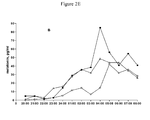
- the Dim Light Melatonin Onset (DLMO) test as described in Lewy et al, The endogenous melatonin profile as a marker for circadian phase position. J Biol Rhythms. 1999 Jun;14(3):227-36 ; Kayumov et al, Exogenous melatonin shifts dim light melatonin onset in post-traumatic delayed sleep phase syndrome. Sleep 2002; 25: 18 , was used as a marker of circadian phase, and was the time of the first saliva melatonin level to cross the DLMO threshold. The threshold was defined as 20% of the maximum raw value of endogenous melatonin.
- the subjects were randomly assigned to wear the yellow filter lenses incorporated into goggles on either the second or third night. On the alternate night, the subj ects were exposed to the bright light without wearing goggles. On all nights, 13 saliva samples were collected at regular one-hour intervals beginning at 20:00 h (8:00pm). Subjects were placed in a well lit room (800 1x) designed to mimic a shift-work environment. The exact luminescence of the rooms was determined using a luxometer.
- Saliva specimens were collected using the Sali-Saver TM (ALPCO - American Laboratory Products Company, NH, USA).
- the Sali-Saver TM consists of a small cotton roll that is placed between the cheek and the gum for 3-5 min in order to collect saliva specimen (up to 2 ml can be collected at a time).
- Saliva specimens were analyzed immediately after collection of the last sample.
- Saliva melatonin was determined by Direct Saliva Melatonin ELISA kit from Buhlman
- the data illustrates that wearing light-filtering goggles to block wavelengths less than 530nm allows close to normal melatonin onset and peak secretion in subjects during night-time exposure to bright light.
Landscapes
- Health & Medical Sciences (AREA)
- Physics & Mathematics (AREA)
- Ophthalmology & Optometry (AREA)
- Optics & Photonics (AREA)
- General Health & Medical Sciences (AREA)
- General Physics & Mathematics (AREA)
- Life Sciences & Earth Sciences (AREA)
- Veterinary Medicine (AREA)
- Psychology (AREA)
- Engineering & Computer Science (AREA)
- Anesthesiology (AREA)
- Biomedical Technology (AREA)
- Heart & Thoracic Surgery (AREA)
- Hematology (AREA)
- Acoustics & Sound (AREA)
- Animal Behavior & Ethology (AREA)
- Public Health (AREA)
- Spectroscopy & Molecular Physics (AREA)
- Radiation-Therapy Devices (AREA)
- Eyeglasses (AREA)
- Prostheses (AREA)
- Optical Filters (AREA)
- Blocking Light For Cameras (AREA)
- Adhesives Or Adhesive Processes (AREA)
- Liquid Crystal (AREA)
- Road Signs Or Road Markings (AREA)
- Laser Surgery Devices (AREA)
- Non-Portable Lighting Devices Or Systems Thereof (AREA)
- Eye Examination Apparatus (AREA)
Applications Claiming Priority (2)
| Application Number | Priority Date | Filing Date | Title |
|---|---|---|---|
| US40630602P | 2002-08-28 | 2002-08-28 | |
| EP03790601A EP1546792B1 (fr) | 2002-08-28 | 2003-08-28 | Utilisation d'un filtre optique pour la prevention de la suppression de la secretion de melatonine par la lumiere en periode nocturne |
Related Parent Applications (1)
| Application Number | Title | Priority Date | Filing Date |
|---|---|---|---|
| EP03790601.3 Division | 2003-08-28 |
Publications (2)
| Publication Number | Publication Date |
|---|---|
| EP2157471A2 true EP2157471A2 (fr) | 2010-02-24 |
| EP2157471A3 EP2157471A3 (fr) | 2010-03-03 |
Family
ID=31978281
Family Applications (2)
| Application Number | Title | Priority Date | Filing Date |
|---|---|---|---|
| EP09177466A Withdrawn EP2157471A3 (fr) | 2002-08-28 | 2003-08-28 | Dispositif pour la prevention de la suppression de la secretion de melatonine par la lumiere en periode nocturne |
| EP03790601A Expired - Lifetime EP1546792B1 (fr) | 2002-08-28 | 2003-08-28 | Utilisation d'un filtre optique pour la prevention de la suppression de la secretion de melatonine par la lumiere en periode nocturne |
Family Applications After (1)
| Application Number | Title | Priority Date | Filing Date |
|---|---|---|---|
| EP03790601A Expired - Lifetime EP1546792B1 (fr) | 2002-08-28 | 2003-08-28 | Utilisation d'un filtre optique pour la prevention de la suppression de la secretion de melatonine par la lumiere en periode nocturne |
Country Status (8)
| Country | Link |
|---|---|
| US (1) | US7520607B2 (fr) |
| EP (2) | EP2157471A3 (fr) |
| AT (1) | ATE469371T1 (fr) |
| AU (1) | AU2003264202A1 (fr) |
| CA (1) | CA2497261C (fr) |
| DE (1) | DE60332747D1 (fr) |
| ES (1) | ES2346648T3 (fr) |
| WO (1) | WO2004021071A1 (fr) |
Cited By (3)
| Publication number | Priority date | Publication date | Assignee | Title |
|---|---|---|---|---|
| CN102444867A (zh) * | 2010-10-13 | 2012-05-09 | 周卓辉 | 可减缓褪黑激素抑制现象的照明装置 |
| US20180113327A1 (en) * | 2006-03-20 | 2018-04-26 | High Performance Optics, Inc. | High Performance Selective Light Wavelength Filtering Providing Improved Contrast Sensitivity |
| US11701315B2 (en) | 2006-03-20 | 2023-07-18 | High Performance Optics, Inc. | High energy visible light filter systems with yellowness index values |
Families Citing this family (79)
| Publication number | Priority date | Publication date | Assignee | Title |
|---|---|---|---|---|
| US8403478B2 (en) * | 2001-11-02 | 2013-03-26 | High Performance Optics, Inc. | Ophthalmic lens to preserve macular integrity |
| US8500274B2 (en) | 2000-11-03 | 2013-08-06 | High Performance Optics, Inc. | Dual-filter ophthalmic lens to reduce risk of macular degeneration |
| US7520607B2 (en) | 2002-08-28 | 2009-04-21 | Melcort Inc. | Device for the prevention of melationin suppression by light at night |
| US7748845B2 (en) * | 2002-08-28 | 2010-07-06 | Robert Casper | Method and device for preventing alterations in circadian rhythm |
| JP5032749B2 (ja) | 2005-03-16 | 2012-09-26 | パナソニック株式会社 | 光フィルタおよび照明装置 |
| US9377569B2 (en) * | 2006-03-20 | 2016-06-28 | High Performance Optics, Inc. | Photochromic ophthalmic systems that selectively filter specific blue light wavelengths |
| US8360574B2 (en) * | 2006-03-20 | 2013-01-29 | High Performance Optics, Inc. | High performance selective light wavelength filtering providing improved contrast sensitivity |
| US20070216861A1 (en) * | 2006-03-20 | 2007-09-20 | Andrew Ishak | Ophthalmic system combining ophthalmic components with blue light wavelength blocking and color-balancing functionalities |
| US8113651B2 (en) | 2006-03-20 | 2012-02-14 | High Performance Optics, Inc. | High performance corneal inlay |
| US7841714B2 (en) | 2008-02-07 | 2010-11-30 | Quantum Modulation Scientific Inc. | Retinal melatonin suppressor |
| US7984989B2 (en) | 2008-02-07 | 2011-07-26 | Gruber Jake A | Retinal melatonin suppressor comprising a filter layer |
| US8253336B2 (en) | 2010-07-23 | 2012-08-28 | Biological Illumination, Llc | LED lamp for producing biologically-corrected light |
| US9681522B2 (en) | 2012-05-06 | 2017-06-13 | Lighting Science Group Corporation | Adaptive light system and associated methods |
| US9532423B2 (en) | 2010-07-23 | 2016-12-27 | Lighting Science Group Corporation | System and methods for operating a lighting device |
| US9827439B2 (en) | 2010-07-23 | 2017-11-28 | Biological Illumination, Llc | System for dynamically adjusting circadian rhythm responsive to scheduled events and associated methods |
| US9024536B2 (en) | 2011-12-05 | 2015-05-05 | Biological Illumination, Llc | Tunable LED lamp for producing biologically-adjusted light and associated methods |
| US8760370B2 (en) | 2011-05-15 | 2014-06-24 | Lighting Science Group Corporation | System for generating non-homogenous light and associated methods |
| US8743023B2 (en) | 2010-07-23 | 2014-06-03 | Biological Illumination, Llc | System for generating non-homogenous biologically-adjusted light and associated methods |
| US8324808B2 (en) | 2010-07-23 | 2012-12-04 | Biological Illumination, Llc | LED lamp for producing biologically-corrected light |
| US8841864B2 (en) | 2011-12-05 | 2014-09-23 | Biological Illumination, Llc | Tunable LED lamp for producing biologically-adjusted light |
| US8686641B2 (en) | 2011-12-05 | 2014-04-01 | Biological Illumination, Llc | Tunable LED lamp for producing biologically-adjusted light |
| US8401231B2 (en) | 2010-11-09 | 2013-03-19 | Biological Illumination, Llc | Sustainable outdoor lighting system for use in environmentally photo-sensitive area |
| US9606277B2 (en) | 2011-01-17 | 2017-03-28 | University Of Utah Research Foundation | Apparatus and methods for reducing frequency or severity of photophobic responses or modulating circadian cycles |
| US10359552B2 (en) | 2011-01-17 | 2019-07-23 | University Of Utah Research Foundation | Methods, systems, and apparatus for reducing the frequency and/or severity of photophobic responses or for modulating circadian cycles |
| US9764157B2 (en) | 2011-01-17 | 2017-09-19 | University Of Utah Research Foundation | Methods, systems, and apparatus for reducing the frequency and/or severity of photophobic responses or for modulating circadian cycles |
| US9900956B2 (en) | 2011-01-31 | 2018-02-20 | Industrial Technology Research Institute | Multi-function lighting system |
| TWI545990B (zh) | 2011-01-31 | 2016-08-11 | 財團法人工業技術研究院 | 具有多功能用途的照明系統及其控制方法 |
| US9173269B2 (en) | 2011-05-15 | 2015-10-27 | Lighting Science Group Corporation | Lighting system for accentuating regions of a layer and associated methods |
| US8901850B2 (en) | 2012-05-06 | 2014-12-02 | Lighting Science Group Corporation | Adaptive anti-glare light system and associated methods |
| US8754832B2 (en) | 2011-05-15 | 2014-06-17 | Lighting Science Group Corporation | Lighting system for accenting regions of a layer and associated methods |
| TWI401063B (zh) * | 2011-05-25 | 2013-07-11 | Nat Univ Tsing Hua | 用以量測褪黑激素抑制程度之裝置 |
| EP2713883B1 (fr) * | 2011-05-31 | 2024-07-10 | Clarencew Pty Ltd. | Procédés pour prévenir et traiter des états neurologiques liés à la fonction motrice |
| US9778490B2 (en) | 2011-11-04 | 2017-10-03 | Spy Optic Inc. | Therapeutic eyewear |
| US9289574B2 (en) | 2011-12-05 | 2016-03-22 | Biological Illumination, Llc | Three-channel tuned LED lamp for producing biologically-adjusted light |
| US9913341B2 (en) | 2011-12-05 | 2018-03-06 | Biological Illumination, Llc | LED lamp for producing biologically-adjusted light including a cyan LED |
| US9220202B2 (en) | 2011-12-05 | 2015-12-29 | Biological Illumination, Llc | Lighting system to control the circadian rhythm of agricultural products and associated methods |
| US8866414B2 (en) | 2011-12-05 | 2014-10-21 | Biological Illumination, Llc | Tunable LED lamp for producing biologically-adjusted light |
| US8963450B2 (en) | 2011-12-05 | 2015-02-24 | Biological Illumination, Llc | Adaptable biologically-adjusted indirect lighting device and associated methods |
| US9402294B2 (en) | 2012-05-08 | 2016-07-26 | Lighting Science Group Corporation | Self-calibrating multi-directional security luminaire and associated methods |
| US9006987B2 (en) | 2012-05-07 | 2015-04-14 | Lighting Science Group, Inc. | Wall-mountable luminaire and associated systems and methods |
| US8680457B2 (en) | 2012-05-07 | 2014-03-25 | Lighting Science Group Corporation | Motion detection system and associated methods having at least one LED of second set of LEDs to vary its voltage |
| CN104969099A (zh) | 2012-09-26 | 2015-10-07 | 8797625加拿大有限公司 | 多层光干涉滤片 |
| US9174067B2 (en) | 2012-10-15 | 2015-11-03 | Biological Illumination, Llc | System for treating light treatable conditions and associated methods |
| US9347655B2 (en) | 2013-03-11 | 2016-05-24 | Lighting Science Group Corporation | Rotatable lighting device |
| KR20140112874A (ko) * | 2013-03-14 | 2014-09-24 | 삼성전자주식회사 | 카메라 모듈을 갖는 전자 장치 |
| US20140268731A1 (en) | 2013-03-15 | 2014-09-18 | Lighting Science Group Corpporation | Low bay lighting system and associated methods |
| DK2982224T3 (en) | 2013-04-04 | 2019-01-21 | Circadian Zirclight Inc | LIGHTING SYSTEMS TO PROTECT CIRCADIC NEUROENDOCRINE FUNCTION |
| US9798163B2 (en) | 2013-05-05 | 2017-10-24 | High Performance Optics, Inc. | Selective wavelength filtering with reduced overall light transmission |
| WO2015009350A1 (fr) | 2013-07-16 | 2015-01-22 | Leeo, Inc. | Dispositif électronique doté d'une surveillance de l'environnement |
| US9116137B1 (en) | 2014-07-15 | 2015-08-25 | Leeo, Inc. | Selective electrical coupling based on environmental conditions |
| US10627650B2 (en) | 2013-09-10 | 2020-04-21 | Mitsui Chemicals, Inc. | Optical material and use thereof |
| US9857503B2 (en) | 2013-09-10 | 2018-01-02 | Mitsui Chemicals, Inc. | Optical material and use thereof |
| WO2015073933A1 (fr) | 2013-11-15 | 2015-05-21 | University Of Utah Research Foundation | Procédé et appareil de filtration de lumière de nanoparticule |
| US10234608B2 (en) | 2013-11-15 | 2019-03-19 | University Of Utah Research Foundation | Nanoparticle light filtering method and apparatus |
| US20150234207A1 (en) * | 2014-02-17 | 2015-08-20 | Daniel Koifman | Device and method for selective wavelength filtration and selective wavelength transmission for therapeutic effect |
| US9683102B2 (en) | 2014-05-05 | 2017-06-20 | Frontier Scientific, Inc. | Photo-stable and thermally-stable dye compounds for selective blue light filtered optic |
| US9372477B2 (en) | 2014-07-15 | 2016-06-21 | Leeo, Inc. | Selective electrical coupling based on environmental conditions |
| US9092060B1 (en) | 2014-08-27 | 2015-07-28 | Leeo, Inc. | Intuitive thermal user interface |
| US10078865B2 (en) | 2014-09-08 | 2018-09-18 | Leeo, Inc. | Sensor-data sub-contracting during environmental monitoring |
| US9445451B2 (en) | 2014-10-20 | 2016-09-13 | Leeo, Inc. | Communicating arbitrary attributes using a predefined characteristic |
| US10026304B2 (en) | 2014-10-20 | 2018-07-17 | Leeo, Inc. | Calibrating an environmental monitoring device |
| US20160235940A1 (en) * | 2015-02-17 | 2016-08-18 | Daniel Andrew Koifman | Device and method for selective wavelength filtration and selective wavelength transmission for therapeutic effect |
| US9943042B2 (en) | 2015-05-18 | 2018-04-17 | Biological Innovation & Optimization Systems, LLC | Grow light embodying power delivery and data communications features |
| US9788387B2 (en) | 2015-09-15 | 2017-10-10 | Biological Innovation & Optimization Systems, LLC | Systems and methods for controlling the spectral content of LED lighting devices |
| US9844116B2 (en) | 2015-09-15 | 2017-12-12 | Biological Innovation & Optimization Systems, LLC | Systems and methods for controlling the spectral content of LED lighting devices |
| US20180338911A1 (en) * | 2015-10-28 | 2018-11-29 | David B. Welch | Eye Drops |
| US9801013B2 (en) | 2015-11-06 | 2017-10-24 | Leeo, Inc. | Electronic-device association based on location duration |
| US10805775B2 (en) | 2015-11-06 | 2020-10-13 | Jon Castor | Electronic-device detection and activity association |
| US10212766B2 (en) * | 2015-12-18 | 2019-02-19 | Musco Corporation | Lighting optimized for melanopic vision |
| CN108431677B (zh) | 2015-12-22 | 2020-02-07 | 依视路国际公司 | 用于刺激非视觉生理效应的方法和眼科元件 |
| EP3419966B1 (fr) | 2016-02-22 | 2020-03-25 | Alcon Inc. | Monomères vinyliques absorbant les uv et leurs utilisations |
| WO2017145022A1 (fr) | 2016-02-22 | 2017-08-31 | Novartis Ag | Monomères vinyliques absorbant les uv et la lumière visible, et leurs utilisations |
| WO2017175873A1 (fr) * | 2016-04-07 | 2017-10-12 | 株式会社坪田ラボ | Lunettes de perte de poids |
| US10595376B2 (en) | 2016-09-13 | 2020-03-17 | Biological Innovation & Optimization Systems, LLC | Systems and methods for controlling the spectral content of LED lighting devices |
| CN110538381B (zh) | 2018-05-29 | 2021-06-22 | 华为技术有限公司 | 光照调整方法及终端 |
| US20200018982A1 (en) * | 2018-07-14 | 2020-01-16 | Beau David Whitaker | Protecting horses and other animals from blue light |
| US11707595B2 (en) | 2018-09-25 | 2023-07-25 | Koninklijke Philips N.V. | Controlling light exposure for circadian phase management |
| CN111044461B (zh) * | 2018-10-12 | 2022-07-01 | 周卓煇 | 光源对褪黑激素分泌的抑制程度的量化装置 |
| US10598547B1 (en) * | 2018-10-12 | 2020-03-24 | National Tsing Hua University | Device for measuring melatonin suppression induced by light source |
Citations (2)
| Publication number | Priority date | Publication date | Assignee | Title |
|---|---|---|---|---|
| US5402190A (en) * | 1991-10-16 | 1995-03-28 | Suzanne Maureen Waldman | Biological cycle affecting goggles |
| WO2002020079A1 (fr) * | 2000-09-08 | 2002-03-14 | Koninklijke Philips Electronics N.V. | Procédé pour vérifier l'état de vigilence d'un humain et source lumineuse à cet effet |
Family Cites Families (21)
| Publication number | Priority date | Publication date | Assignee | Title |
|---|---|---|---|---|
| US1971941A (en) * | 1932-07-22 | 1934-08-28 | Gen Electric | Electric discharge lamp device |
| US3112886A (en) * | 1960-02-01 | 1963-12-03 | Leonard H Kushner | Color control |
| US3826751A (en) * | 1970-12-07 | 1974-07-30 | American Optical Corp | Selective optical filter and method of manufacture |
| US4500810A (en) * | 1980-11-25 | 1985-02-19 | North American Philips Lighting Corporation | Fluorescent lamp having integral light-filtering means and starting aid |
| US4952046A (en) * | 1982-02-26 | 1990-08-28 | Stephens James B | Optical lenses with selective transmissivity functions |
| US4719248A (en) * | 1985-08-08 | 1988-01-12 | Bausch & Lomb Incorporated | Ultraviolet blocking agents for contact lenses |
| US5177509A (en) * | 1987-02-26 | 1993-01-05 | Suntiger, Inc. | Ultraviolet radiation and blue light blocking polarizing lens |
| US4878748A (en) * | 1987-02-26 | 1989-11-07 | Suntiger, Inc. | Ultraviolet radiation and blue light blocking polarizing lens |
| US5167228A (en) | 1987-06-26 | 1992-12-01 | Brigham And Women's Hospital | Assessment and modification of endogenous circadian phase and amplitude |
| US5274403A (en) * | 1987-08-28 | 1993-12-28 | Gott George M | Lens useful in inhibiting the production of melatonin and lens produced thereby |
| US5083858A (en) * | 1989-04-17 | 1992-01-28 | Girerd Rene J | Photobiologic sunglasses and transmitters |
| US6638963B1 (en) | 1990-12-04 | 2003-10-28 | Oregon Health And Science University | Methods for treating circadian rhythm disorders |
| US6019476A (en) * | 1996-06-24 | 2000-02-01 | Kirschner; Kevin A. | Full spectrum filtering for fluorescent lighting |
| JP3357803B2 (ja) * | 1996-10-30 | 2002-12-16 | タレックス光学工業株式会社 | 眼鏡用偏光膜および偏光眼鏡 |
| DE29712246U1 (de) * | 1997-07-11 | 1997-11-13 | Bock Manfred | Lampenkörper mit Farbmischvorrichtung |
| US6156743A (en) | 1999-10-18 | 2000-12-05 | Whitcomb; John E. | Method of decreasing fatigue |
| GB2378656A (en) | 2001-08-14 | 2003-02-19 | Stephen Bryce Hayes | Means for modulation of circadian rhythms |
| US7520607B2 (en) | 2002-08-28 | 2009-04-21 | Melcort Inc. | Device for the prevention of melationin suppression by light at night |
| US10252079B2 (en) | 2003-06-06 | 2019-04-09 | Koninklijke Philips N.V. | Hand-held light therapy apparatus |
| US6926405B2 (en) * | 2003-06-06 | 2005-08-09 | Younger Mfg. Co. | Eyewear lens having selective spectral response |
| EP1648561A4 (fr) | 2003-07-14 | 2010-02-10 | Charles A Czeisler | Procede pour modifier ou retablir le cycle circadien en utilisant un rayonnement lumineux de faible longueur d'onde |
-
2003
- 2003-08-28 US US10/525,958 patent/US7520607B2/en not_active Expired - Lifetime
- 2003-08-28 ES ES03790601T patent/ES2346648T3/es not_active Expired - Lifetime
- 2003-08-28 EP EP09177466A patent/EP2157471A3/fr not_active Withdrawn
- 2003-08-28 AT AT03790601T patent/ATE469371T1/de not_active IP Right Cessation
- 2003-08-28 AU AU2003264202A patent/AU2003264202A1/en not_active Abandoned
- 2003-08-28 DE DE60332747T patent/DE60332747D1/de not_active Expired - Lifetime
- 2003-08-28 WO PCT/CA2003/001324 patent/WO2004021071A1/fr not_active Ceased
- 2003-08-28 EP EP03790601A patent/EP1546792B1/fr not_active Expired - Lifetime
- 2003-08-28 CA CA2497261A patent/CA2497261C/fr not_active Expired - Fee Related
Patent Citations (2)
| Publication number | Priority date | Publication date | Assignee | Title |
|---|---|---|---|---|
| US5402190A (en) * | 1991-10-16 | 1995-03-28 | Suzanne Maureen Waldman | Biological cycle affecting goggles |
| WO2002020079A1 (fr) * | 2000-09-08 | 2002-03-14 | Koninklijke Philips Electronics N.V. | Procédé pour vérifier l'état de vigilence d'un humain et source lumineuse à cet effet |
Non-Patent Citations (19)
| Title |
|---|
| "human circadian rhythms", INT. J. CHRONOBIOL., vol. 4, no. 2, 1976, pages 97 - 110 |
| AHMED ET AL.: "Phase response curve of low-intensity green light in winter depressives", SLEEP RESEARCH, vol. 24, 1995, pages 508 |
| BENIASHVILI ET AL.: "Effect of light/dark regimen on N-nitrosoethylurea-induced transplacental carcinogenesis in rats", CANCER LETT., vol. 163, no. 1, 10 February 2001 (2001-02-10), pages 51 - 7 |
| DAVIS S ET AL.: "Night shift work, light at night, and risk of breast cancer", J NATL CANCER INST, vol. 93, 2001, pages 1557 - 62 |
| GOONERATNE ET AL.: "The validity and feasibility of saliva melatonin assessment in the elderly", J. PINEAL RES., vol. 34, no. 2, March 2003 (2003-03-01), pages 88 - 94 |
| HAHN RA: "Profound bilateral blindness and the incidence of breast cancer", EPIDEMIOLOGY, vol. 2, 1991, pages 208 - 10 |
| HANSEN J: "Increased breast cancer risk among women who work predominantly at night", EPIDEMIOLOGY, vol. 12, 2001, pages 74 - 7 |
| HANSEN, J.: "Light at night, shiftwork, and breast cancer risk", J. NATL CANCER INST., vol. 93, no. 20, 17 October 2001 (2001-10-17), pages 1513 - 5 |
| HONMA S ET AL.: "Light suppression of nocturnal pineal and plasma melatonin in rats depends on wavelength and time of day", NEUROSCI LETT, vol. 147, 1992, pages 201 - 4 |
| JOHNS: "A new method for measuring daytime sleepiness", SLEEP, vol. 14, no. 6, December 1991 (1991-12-01), pages 540 - 5 |
| KAWACHI I ET AL.: "Prospective study of shift work and risk of coronary heart disease in women", CIRCULATION, vol. 92, 1995, pages 3178 - 82 |
| KAYUMOV ET AL.: "Exogenous melatonin shifts dim light melatonin onset in post-traumatic delayed sleep phase syndrome", SLEEP, vol. 25, 2002, pages 18 |
| LEWY ET AL.: "The endogenous melatonin profile as a marker for circadian phase position", J BIOL RHYTHMS, vol. 14, no. 3, June 1999 (1999-06-01), pages 227 - 36 |
| MARY L BLOOD ET AL: "Serengeti vermilion sunglasses inhibit the suppressant effect of bright light on melatonin secretion", JOURNAL OF SLEEP RESEARCH, BLACKWELL SCIENTIFIC, OXFORD, GB, 1 January 1993 (1993-01-01), pages 394, XP008157753, ISSN: 0962-1105 * |
| REITER: "Potential biological consequences of excessive light exposure:melatonin suppression, DNA damage, cancer and neurodegenerative diseases", NEUROENDOCRINOL LETT., vol. 23, no. 2, July 2002 (2002-07-01), pages 9 - 13 |
| SCHERNHAMMER ES ET AL.: "Rotating night shifts and risk of breast cancer in women participating in the nurses' health study", J NATL CANCER INST, vol. 93, 2001, pages 1563 - 8 |
| SCHERNHAMMER ET AL.: "Night-shift work and risk of colorectal cancer in the nurses' health study", J NATL. CANCER INST., vol. 95, no. 11, 4 June 2003 (2003-06-04), pages 825 - 8 |
| TYNES ET AL.: "Incidence of breast cancer in Norweigan female radio and telegraph operators", CANCER CAUSES CONTROL., vol. 7, no. 2, March 1996 (1996-03-01), pages 197 - 204 |
| WRIGHT HR; LACK LC: "Effect of light wavelength on suppression and phase delay of the melatonin rhythm", CHRONOBIOL INT, vol. 18, 2001, pages 801 - 8 |
Cited By (5)
| Publication number | Priority date | Publication date | Assignee | Title |
|---|---|---|---|---|
| US20180113327A1 (en) * | 2006-03-20 | 2018-04-26 | High Performance Optics, Inc. | High Performance Selective Light Wavelength Filtering Providing Improved Contrast Sensitivity |
| US10551637B2 (en) * | 2006-03-20 | 2020-02-04 | High Performance Optics, Inc. | High performance selective light wavelength filtering providing improved contrast sensitivity |
| US11701315B2 (en) | 2006-03-20 | 2023-07-18 | High Performance Optics, Inc. | High energy visible light filter systems with yellowness index values |
| US11774783B2 (en) | 2006-03-20 | 2023-10-03 | High Performance Optics, Inc. | High performance selective light wavelength filtering providing improved contrast sensitivity |
| CN102444867A (zh) * | 2010-10-13 | 2012-05-09 | 周卓辉 | 可减缓褪黑激素抑制现象的照明装置 |
Also Published As
| Publication number | Publication date |
|---|---|
| CA2497261A1 (fr) | 2004-03-11 |
| ES2346648T3 (es) | 2010-10-19 |
| ATE469371T1 (de) | 2010-06-15 |
| CA2497261C (fr) | 2012-07-31 |
| EP1546792A1 (fr) | 2005-06-29 |
| AU2003264202A1 (en) | 2004-03-19 |
| US20060119954A1 (en) | 2006-06-08 |
| DE60332747D1 (de) | 2010-07-08 |
| EP1546792B1 (fr) | 2010-05-26 |
| EP2157471A3 (fr) | 2010-03-03 |
| US7520607B2 (en) | 2009-04-21 |
| WO2004021071A1 (fr) | 2004-03-11 |
Similar Documents
| Publication | Publication Date | Title |
|---|---|---|
| US7520607B2 (en) | Device for the prevention of melationin suppression by light at night | |
| KR101511623B1 (ko) | 일주기 리듬의 변경을 방지하는 장치 | |
| JP4928054B2 (ja) | 人間被験者の注意力の制御方法及びこの方法に使用する光源 | |
| US10384070B2 (en) | Spectacles for light therapy | |
| Sasseville et al. | Blue blocker glasses impede the capacity of bright light to suppress melatonin production | |
| International Commission on Non-Ionizing Radiation Protection | ICNIRP statement—protection of workers against ultraviolet radiation | |
| US20150192800A1 (en) | Optimization of light filters and illuminants and products derived therefrom | |
| Coppens et al. | Wavelength dependence of intraocular straylight | |
| TW202223497A (zh) | 用於色盲及弱視輔助之光譜眩光控制之眼鏡 | |
| ES2927849T3 (es) | Elemento óptico | |
| Rosenthal et al. | A multicenter study of the light visor for seasonal affective disorder: no difference in efficacy found between two different intensities | |
| Rosenfield | Living with blue light exposure | |
| Glickman et al. | Optimizing the potential utility of blue-blocking glasses for sleep and circadian health | |
| Boyce | Lemmings, light, and health | |
| US20250123500A1 (en) | Blue-light regulating eyewear for supporting healthy circadian rhythms and providing eye protection throughout daytime and nighttime hours | |
| Good | Light and eye damage | |
| Moseley et al. | The suitability of sunglasses used by patients following ingestion of psoralen | |
| MORRISSETTE et al. | Users' and nonusers' evaluations of the CPF 550 lenses | |
| Belkin et al. | Protection against exposure to ultraviolet radiation | |
| Martinsons | Photobiological safety | |
| JP7198460B1 (ja) | 光照射装置 | |
| Roberts et al. | Artificial lighting and the blue light hazard | |
| Schierz | Lighting for the elderly: Physiological basics and their consequences | |
| US9750918B2 (en) | Methods and devices for improving sleep performance in subject exposed to light at night | |
| Lewis | Basic concepts in environmental lighting |
Legal Events
| Date | Code | Title | Description |
|---|---|---|---|
| PUAI | Public reference made under article 153(3) epc to a published international application that has entered the european phase |
Free format text: ORIGINAL CODE: 0009012 |
|
| PUAL | Search report despatched |
Free format text: ORIGINAL CODE: 0009013 |
|
| AC | Divisional application: reference to earlier application |
Ref document number: 1546792 Country of ref document: EP Kind code of ref document: P |
|
| AK | Designated contracting states |
Kind code of ref document: A2 Designated state(s): AT BE BG CH CY CZ DE DK EE ES FI FR GB GR HU IE IT LI LU MC NL PT RO SE SI SK TR |
|
| AK | Designated contracting states |
Kind code of ref document: A3 Designated state(s): AT BE BG CH CY CZ DE DK EE ES FI FR GB GR HU IE IT LI LU MC NL PT RO SE SI SK TR |
|
| RAP1 | Party data changed (applicant data changed or rights of an application transferred) |
Owner name: MELCORT INC. |
|
| RIN1 | Information on inventor provided before grant (corrected) |
Inventor name: SOLO, PETER Inventor name: CASPER, ROBERT Inventor name: WARDROP, JENNIFER Inventor name: SPILKIN, JONATHAN |
|
| 17P | Request for examination filed |
Effective date: 20100816 |
|
| 17Q | First examination report despatched |
Effective date: 20100909 |
|
| STAA | Information on the status of an ep patent application or granted ep patent |
Free format text: STATUS: THE APPLICATION HAS BEEN WITHDRAWN |
|
| 18W | Application withdrawn |
Effective date: 20130125 |