EP2157531A2 - Fingerabdruckaufnahmevorrichtung, Fingerabdruckautentifizierungsvorrichtung, Fingerabdruckaufnahmeverfahren und Fingerabdruckautentifizierungsverfahren - Google Patents
Fingerabdruckaufnahmevorrichtung, Fingerabdruckautentifizierungsvorrichtung, Fingerabdruckaufnahmeverfahren und Fingerabdruckautentifizierungsverfahren Download PDFInfo
- Publication number
- EP2157531A2 EP2157531A2 EP09008509A EP09008509A EP2157531A2 EP 2157531 A2 EP2157531 A2 EP 2157531A2 EP 09008509 A EP09008509 A EP 09008509A EP 09008509 A EP09008509 A EP 09008509A EP 2157531 A2 EP2157531 A2 EP 2157531A2
- Authority
- EP
- European Patent Office
- Prior art keywords
- fingerprint
- image
- unit
- resolution
- feature
- Prior art date
- Legal status (The legal status is an assumption and is not a legal conclusion. Google has not performed a legal analysis and makes no representation as to the accuracy of the status listed.)
- Withdrawn
Links
Images













Classifications
-
- G—PHYSICS
- G06—COMPUTING OR CALCULATING; COUNTING
- G06T—IMAGE DATA PROCESSING OR GENERATION, IN GENERAL
- G06T3/00—Geometric image transformations in the plane of the image
- G06T3/40—Scaling of whole images or parts thereof, e.g. expanding or contracting
- G06T3/4053—Scaling of whole images or parts thereof, e.g. expanding or contracting based on super-resolution, i.e. the output image resolution being higher than the sensor resolution
-
- G—PHYSICS
- G06—COMPUTING OR CALCULATING; COUNTING
- G06V—IMAGE OR VIDEO RECOGNITION OR UNDERSTANDING
- G06V40/00—Recognition of biometric, human-related or animal-related patterns in image or video data
- G06V40/10—Human or animal bodies, e.g. vehicle occupants or pedestrians; Body parts, e.g. hands
- G06V40/12—Fingerprints or palmprints
- G06V40/1335—Combining adjacent partial images (e.g. slices) to create a composite input or reference pattern; Tracking a sweeping finger movement
-
- G—PHYSICS
- G06—COMPUTING OR CALCULATING; COUNTING
- G06V—IMAGE OR VIDEO RECOGNITION OR UNDERSTANDING
- G06V40/00—Recognition of biometric, human-related or animal-related patterns in image or video data
- G06V40/10—Human or animal bodies, e.g. vehicle occupants or pedestrians; Body parts, e.g. hands
- G06V40/12—Fingerprints or palmprints
- G06V40/1347—Preprocessing; Feature extraction
- G06V40/1353—Extracting features related to minutiae or pores
-
- G—PHYSICS
- G06—COMPUTING OR CALCULATING; COUNTING
- G06V—IMAGE OR VIDEO RECOGNITION OR UNDERSTANDING
- G06V40/00—Recognition of biometric, human-related or animal-related patterns in image or video data
- G06V40/10—Human or animal bodies, e.g. vehicle occupants or pedestrians; Body parts, e.g. hands
- G06V40/12—Fingerprints or palmprints
- G06V40/1347—Preprocessing; Feature extraction
- G06V40/1359—Extracting features related to ridge properties; Determining the fingerprint type, e.g. whorl or loop
Definitions
- the embodiments discussed herein are related to a device used for acquirement of a fingerprint image for carrying out personal authentication, etc., based on fingerprint information, an apparatus used for fingerprint authentication by the fingerprint image and methods therefor.
- the fingerprint (a pattern composed of a ridgeline that can be in contact with a fingerprinting surface of a fingerprint sensor and a valley line not in contact with a fingerprinting surface thereof) of a finger of an authenticated person is taken as image information (a fingerprint image), using a capacitive sensing fingerprint sensor or an optical fingerprint sensor.
- Feature information e.g., a ridgeline shape and position information on a branch point and an end point
- pre-registered registered information registered feature information
- a ridgeline pattern formed of the shape of a ridgeline and a feature point given by position information on an end point and a branch point of a ridgeline are mainly used as feature information.
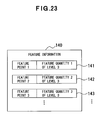
- the ridgeline pattern is referred to as "feature quantity of level 1" and the feature point is referred to as "feature quantity of level 2".
- Such a small-sized fingerprint sensor has a sensor area smaller than a finger, thus is incapable of acquiring an image of the whole fingerprint simply through one time image-taking.
- a fingerprint sensor having a small area acquires an image of the whole fingerprint by synthesizing a plurality of partial images that are taken consecutively through the sensor surface of the fingerprint sensor.
- a sweep fingerprint sensor is a fingerprint sensor that is equivalent to such a fingerprint sensor (e.g., see Patent Document 1: Japanese Laid-Open Patent Publication No. 10-91769 and Patent Document 2: Japanese Laid-Open Patent Publication No. 2003-208620 ).
- This sweep fingerprint sensor is sufficiently shorter than a finger and has a square fingerprinting surface of a small area (sensor surface/image-taking surface).
- the sweep fingerprint sensor is thus used in such a way that a plurality of partial images of a fingerprint are taken as the finger is moved relative to the fingerprinting surface or the fingerprinting surface (fingerprint sensor) is moved relative to the finger, and that the whole of a fingerprint image is restructured out of the plurality of partial images.
- Information of a feature point (a branch point and an end point of a ridgeline) is extracted and generated from such a restructured fingerprint image, and personal authentication is carried out based on the information. Moving the finger relative to the fingerprinting surface is referred to as "sweep or slide".
- Nonpatent Literature 1 A. Jain and A. Ross, "Fingerprint Mosaicking", in Proceeding of IEEE International Conference on Acoustics, Speech, and Signal Processing (ICASSP), 4, pp. 4064-4067, (Orland, FL), May 2002 ).
- Patent Document 3 Japanese Laid-Open Patent Publication No. 2002-024831 discloses an invention that enables verifying a fingerprint image read by a cellular phone with a registered fingerprint image at sufficiently high authentication precision.
- Patent Document 4 Japanese Laid-Open Patent Publication No. 2004-005619 discloses an invention that enables verifying with a registered fingerprint image at sufficiently high authentication precision even in a case where only the partial fingerprint image is acquirable.
- Patent Document 5 Japanese Laid-Open Patent Publication No. 2001-344605 ) discloses an invention that the reproducibility of feature points extracted from each of a plurality of fingerprint images is estimated to sort out a feature point to be used.
- Nonpatent Literature 2 Anil Jain, Yi Chen and Meltem Demirkus, "Pores and Ridges: High-Resolution Fingerprint Matching Using Level 3 Features", IEEE TRANSACTIONS ON PATTERN ANALYSIS AND MACHINE INTELLIGENCE, VOL. 29, NO. 1, pp. 15-27, JANUARY 2007 ).
- Patent Document 6 Japanese Laid-Open Patent Publication No. 2007-271690 .
- a sweep fingerprint sensor When a sweep fingerprint sensor is used for inputting a fingerprint image, operation of moving a finger and a sensor surface relative to each other is required at the time of inputting a fingerprint. Since acquiring the fingerprint depends on an operation method in this manner, an image of the whole fingerprint may not be acquired if the operation method by a user is not proper. In such a case, synthesizing a plurality of images does not produce the whole image but produces only the image of a partial area of the fingerprint (e.g., only a fingertip).
- a flat fingerprint sensor When a flat fingerprint sensor is used for inputting a fingerprint image, for example, only the image of a partial area is produced if the way of pressing the user's finger is not proper to cause such a situation that the user's finger is not brought into contact with a sensor surface in a sufficient area. Even if a plurality of images are synthesized, therefore, only the image of a partial area of the fingerprint may be acquirable. In other words, using a small-sized fingerprint sensor may lead to a disadvantageous case where a sufficient capability of distinguishing a person from another person may not be acquired when the user's operation method is not proper.
- a feature quantity of level 3 is acquired as described above.
- the method therefore, requires a fingerprint sensor having a high-resolution (about 1000 dpi or higher), and incorporating such a fingerprint sensor into a small-sized information equipment is difficult because of problems of price and mounting size.
- Patent Document 6 According to the super-resolution processing (Patent Document 6) carried out by a digital camera etc., an amount of positional shift between low-resolution images is detected at a precision of magnitude of smaller than one pixel, and the low-resolution images are synthesized in accordance with the detected amount of positional shift.
- an overall positional shift occurs due to the extension/contraction of skin. Because of this, even if position matching is successful in a partial area between images, the same position matching is not successful in other areas. Hence the super-resolution processing used in a digital camera cannot be applied directly to the fingerprint image.
- Patent Documents 1 to 6 and Nonpatent Literatures 1 and 2 present no disclosure or suggestion related to the above requirements and problems and no disclosure or suggestion about a configuration etc., that solve the problems.
- An object of the present invention is to improve extraction of a feature quantity using a low-resolution fingerprint image in carrying out fingerprint authentication using a fingerprint image.
- Another object of the present invention is to improve the precision of fingerprint authentication by enhancing a low-resolution fingerprint image in resolution in carrying out fingerprint authentication using a fingerprint image.
- a fingerprint image acquiring device including a fingerprint image input unit to which fingerprint images are input consecutively; an image correlating unit to correlate a plurality of fingerprint images input from the fingerprint image input unit, the image correlating unit matching the input fingerprint images in position; a resolution enhancing determining unit to determine whether an area making resolution enhancing possible is present by detecting an area overlapping between fingerprint images as a result of image correlating and estimating similarity between the fingerprint images; an image synthesizing unit to synthesize the fingerprint images based on a result of the position matching by the image correlating unit; and a resolution enhancing unit to enhance a resolution of the area making resolution enhancing possible in the fingerprint image, wherein a fingerprint image is generated by partially enhancing the fingerprint image input to the fingerprint image input unit in resolution.
- a resolution enhancing process is carried out on an area making resolution enhancing possible in a plurality of consecutively input low resolution fingerprint images to acquire a fingerprint image that is partially or wholly enhanced in resolution.
- a feature quantity can be extracted from such a fingerprint image, so that the precision of feature quantity extraction is improved.
- a fingerprint authenticating apparatus including: a fingerprint image input unit to which fingerprint images are input consecutively; an image correlating unit to match a plurality of fingerprint images in position; a resolution enhancing determining unit to determine whether an area making resolution enhancing possible is present by detecting an area overlapping between fingerprint images as a result of image correlating and estimating similarity between the fingerprint images; an image synthesizing unit to synthesize the fingerprint images based on a result of the position matching by the image correlating unit; a resolution enhancing unit to enhance a resolution of the area making resolution enhancing possible in the fingerprint image; a feature information generating unit to generate feature information from a fingerprint image enhanced in resolution by the resolution enhancing unit; and a fingerprint verification unit to verify acquired feature information with pre-registered feature information.
- the resolution enhancing process is carried out on an area making resolution enhancing possible in a plurality of consecutively input low resolution fingerprint images to acquire a fingerprint image that is partially or wholly enhanced in resolution.
- a feature quantity is extracted from such a fingerprint image to carry out fingerprint verification, so that the precision of fingerprint verification is improved.
- a fingerprint image acquiring method including: consecutively taking in fingerprint images; matching a plurality of fingerprint images in position; determining whether an area making resolution enhancing possible is present by detecting an area overlapping between fingerprint images as a result of image correlating and estimating similarity between the fingerprint images; synthesizing the fingerprint images based on a result of the position matching; and enhancing a resolution of the area making resolution enhancing possible in the fingerprint image, wherein a fingerprint image is generated by partially enhancing the consecutively input fingerprint images in resolution.
- a fingerprint image enhanced in resolution can be acquired.
- a fingerprint authenticating method including: consecutively taking in fingerprint images; matching a plurality of fingerprint images in position; determining whether an area making resolution enhancing possible is present by detecting an area overlapping between fingerprint images as a result of image correlating and estimating similarity between the fingerprint images; synthesizing the fingerprint images based on a result of the position matching; enhancing a resolution of the area making resolution enhancing possible in the fingerprint image; generating feature information from a synthesized image enhanced in resolution; and verifying acquired feature information with pre-registered feature information.
- a feature quantity extracted from a fingerprint image enhanced in resolution is used to improve the precision of fingerprint authentication.
- a computer-readable recording medium having recorded thereon a fingerprint image acquiring program to be executed by a computer, the program including: consecutively taking in fingerprint images; matching a plurality of fingerprint images in position; determining whether an area making resolution enhancing possible is present by detecting an area overlapping between fingerprint images as a result of image correlating and estimating similarity between the fingerprint images; synthesizing the fingerprint images matched in position based on a result of the position matching; and enhancing a resolution of the area making resolution enhancing possible in the fingerprint image, wherein a fingerprint image is generated by partially enhancing the fingerprint images consecutively input by the computer in resolution.
- a computer-readable recording medium having recorded thereon a fingerprint authenticating program to be executed by a computer, the program including: consecutively taking in fingerprint images; matching a plurality of fingerprint images in position; determining whether an area making resolution enhancing possible is present by detecting an area overlapping between fingerprint images as a result of image correlating and estimating similarity between the fingerprint images; synthesizing the fingerprint images matched in position based on a result of the position matching; enhancing a resolution of the area making resolution enhancing possible in the fingerprint image; generating feature information from a synthesized image enhanced in resolution; and verifying acquired feature information with pre-registered feature information.
- whether resolution enhancing is possible is determined for each area of a fingerprint image using a feature quantity that can be extracted from the fingerprint image acquired by a low-resolution fingerprint sensor, and a resolution enhancing process is carried out on an area making resolution enhancing possible to give the area a higher resolution, and then a feature quantity present in the fingerprint image is extracted.
- a feature quantity is thus extracted from a fingerprint image enhanced in resolution by the resolution enhancing process to carry out fingerprint authentication using the extracted feature quantity.
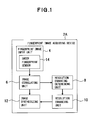
- FIG. 1 is a block diagram of a fingerprint image acquiring device
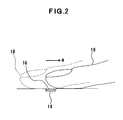
- Figs. 2 and 3 depict examples of a sweep fingerprint sensor
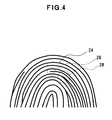
- Fig. 4 depicts a feature quantity of a fingerprint
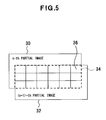
- Fig. 5 depicts detection and division of an overlapping area of partial images of a fingerprint image
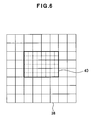
- Fig. 6 depicts a synthesized image
- Fig. 7 depicts a configuration example of a resolution enhancing determining unit. Configurations of Figs. 1 to 7 are presented as examples, and therefore the present invention is not limited by such configurations.
- This fingerprint image acquiring device 2A uses a sweep fingerprint sensor for acquiring a fingerprint image.
- the fingerprint image acquiring device 2A includes a fingerprint image input unit 4, an image correlating unit 6, a resolution enhancing determining unit 8, a resolution enhancing unit 10, and an image synthesizing unit 12.
- a sweep fingerprint sensor 14 is used as the fingerprint image input unit 4.
- the fingerprint image input unit 4 is an example of a fingerprint image input means (unit) that turns fingerprint input by a user into an image to intermittently detect a plurality of partial images.
- Fingerprint detecting methods carried out by the sweep fingerprint sensor 14 working as a biometric information input means include, for example, a capacitive sensing method, a heat-sensitive method, an electric field method, and an optical method.
- the sweep fingerprint sensor 14 may carry out any one of these methods. Fingerprint reading may be carried out in such a way as depicted in Fig. 2 that the user moves a finger 18 toward its base, specifically, from the vicinity of the first joint to the fingertip, for example, in an arrowed direction a while touching a sensor surface 16 of the sweep fingerprint sensor 14 with the finger 18.
- the sweep fingerprint sensor 14 may be provided with a moving mechanism 22 that moves a sensor unit 20 relative to the finger 18, as depicted in Fig. 3 , in which case moving the sensor unit 20 in an arrowed direction b eliminates a need for the user to move the finger 18.
- An existing sweep fingerprint sensor can be used as the sweep fingerprint sensor 14, so that the detailed description of the sweep fingerprint sensor 14 will be omitted.
- the sweep fingerprint sensor 14 consecutively reads two-dimensional images to acquire a plurality of partial images.
- the sweep fingerprint sensor 14 acquires a plurality of partial images through the sweeping move of the finger 18, which partial images are buffered and saved in the fingerprint image input unit 4.
- the image correlating unit 6 is a calculating means that calculates an amount of shift between partial images, and also serves as an image correlating means (unit) that restructures an image of the whole finger.
- This image correlating unit 6 carries out comparison between adjacent partial images among a plurality of partial images input to the fingerprint image input unit 4 and determines a relative positional relation in which an overlapping area between the partial images are most similar to each other to calculate an amount of shift.
- an image of the whole fingerprint can be restructured by image synthesis.
- the resolution enhancing determining unit 8 is a resolution enhancing determining means (unit) that detects an overlapping area as a result of correlating partial images to divide the overlapping area into small areas of block shapes ( Fig. 5 ), and that calculates a similarity level between partial images for each small area to compare the calculated similarity level with a given threshold and determine whether resolution enhancing is possible. For example, when a similarity level is high in a small area, resolution enhancing is determined to be possible if the similarity level is equal to or higher than the given threshold.
- the resolution enhancing determining unit 8 carries out the process of detecting an overlapping area, dividing the overlapping area into small areas, etc., in such a way as depicted in Fig. 5 that when an overlapping area 34 is formed between a n-th partial image 30 and a (n+1)-th partial image 32, the overlapping area 34 is detected and is divided into a plurality of areas (small areas) 36 each smaller than the overlapping area 34.
- the resolution enhancing unit 10 is a means that receives an amount of shift and information of an area determined to be an area making resolution enhancing possible (the upper left coordinate, vertical width, and lateral width of each partial image) to determine a processing range in each partial image.
- An amount of positional shift in the processing range is determined at precision of decimal pixels.
- Methods of determining an amount of positional shift at precision of decimal pixels include a method of generating a pixel value at a decimal pixel position in each pixel by linear interpolation etc., and then calculating a similarity level and a method of estimating an amount of positional shift at precision of decimal pixels based on a similarity level calculated at an integer pixel position.
- the resolution enhancing unit 10 superposes images in the corresponding processing ranges in partial images while considering an amount of positional shift determined at precision of decimal pixels, carries out the pixel value interpolation process, and generates a high-resolution image of each object.
- the interpolation process is carried out as a known interpolation process, and therefore is not described further. The above process is carried out on all areas determined to be areas making resolution enhancing possible.
- the image synthesizing unit 12 synthesizes partial images based on an amount of shift.
- the image synthesizing unit 12 converts the resolution of a synthesized image to adjust the converted resolution to the resolution of a high-resolution image. Based on the amount of shift and area information, the image synthesizing unit 12 then disposes the high-resolution image on the synthesized image to generate a synthesized image 38 ( Fig. 6 ) partially enhanced in resolution. On this synthesized image 38, a high-resolution area 40 is formed, as depicted in Fig. 6 .
- Such a process is repeated in order of partial images buffered in the fingerprint image input unit 4 to generate a synthesized image of the whole fingerprint.
- the resolution enhancing determining unit 8 includes an overlapping area detecting unit 82, an area dividing unit 84, a feature quantity extracting unit 86, and a feature quantity comparing unit 88.
- the overlapping area detecting unit 82 is a detecting means that receives correlating output from the image correlating unit 6 to detect an area where adjacent fingerprint images overlap, i.e., an overlapping area.
- the area dividing unit 84 is an area dividing means (unit) that receives a result of detection of an overlapping area from the overlapping area detecting unit 82 to divide the overlapping area into smaller areas.
- the feature quantity extracting unit 86 is a feature quantity extracting means (unit) that extracts a feature quantity present in the overlapping area.
- the feature quantity comparing unit 88 is a means that compares extracted feature quantities with each other.
- the resolution enhancing determining unit 8 thus divides an overlapping area between fingerprint images into small areas, estimates reproducibility between the fingerprint images for each smaller area, and determines whether resolution enhancing is possible as a result of the estimation.
- the resolution enhancing unit 10 receives the result of determination from the resolution enhancing determining unit 8 to carry out the resolution enhancing process on an area making resolution enhancing possible in the fingerprint image.
- the area dividing means is included as the means that divides a fingerprint image area by area, thus an overlapping area between fingerprint images is divided into small areas. This allows determining whether resolution enhancing is possible for each small area. As a result, even if a fingerprint image is partially distorted, only the area without distortion can be extracted from the fingerprint image to generate a high-resolution image, which improves the precision of fingerprint authentication to be described later.
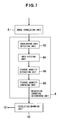
- FIG. 8 and 9 are flowcharts of a procedure of acquiring a fingerprint image.
- a configuration depicted by Figs. 8 and 9 is presented as an example, and therefore the present invention is not limited by such a configuration.
- This procedure is an example of a fingerprint image acquiring method or a fingerprint image acquiring program, and, as depicted in Fig. 8 , is executed through a fingerprint image input step by the fingerprint image input unit 4 (step S1), a correlating step by the image correlating unit 6 (step S2), a resolution enhancing determining step by the resolution enhancing determining unit 8 (step S3), a resolution enhancing step by the resolution enhancing unit 10 (step S4), and an image synthesizing step by the image synthesizing unit 12 (step S5).
- step S11 the head partial image of a finger is read in (step S11), and the next partial image is read in (step S12).
- step S13 an amount of shift
- step S14 an overlapping area is divided into small areas.
- step S15 Whether resolution enhancing between the partial images is possible is determined for each small area (step S15).
- step S17 When a determination result (step 16) is that resolution enhancing is possible, a high-resolution image is generated (step S17).
- step S18 a high-resolution image generated by connecting the partial images is synthesized (step S18).
- step S19 Whether all partial images have been processed is then determined (step S19).
- step S19 the procedure flow returns to step S12, from which all partial images are processed.
- step S19 the procedure is ended.
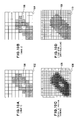
- Figs. 10A-10D depict a super-resolution process on a fingerprint image.
- This resolution enhancing process is an example of a processing method for resolution enhancing or a processing program for resolution enhancing.
- a process of image interpolation using a plurality of images e.g., super-resolution process can be employed for this resolution enhancing process.
- a binary image is used in the example of Figs. 10A-10D
- a multi-value image may also be used.
- Position matching is carried out between a plurality of images (two images in Figs. 10A-10D ). In a partial area in a fingerprint image, for example, a fingerprint image 102 (image 1) of Fig. 10A and a fingerprint image 104 (image 2) of Fig. 10B are matched in position. As depicted in Fig.
- an image 106 is acquired as a result of position matching.
- 108 denotes a sweat gland pore in Figs. 10A, 10B, and 10C .
- a verification process used in fingerprint authentication may be carried out in this position matching process.
- a positional shift between images is determined in pixel values smaller than pixel values of the resolution of the original images.
- a pixel value is calculated from pixel values of the original two images that correspond to each other. In this example, when the pixel value of either of the original images is 1 (colored), the pixel value after super-resolution is determined to be 1.
- an image 110 after super-resolution is acquired, as depicted in Fig. 10D .
- the average of pixels of both images may be calculated.
- an image having a resolution higher than the resolution of the original images can be acquired.
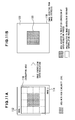
- FIG. 11A-11B depict a process of partially enhancing a fingerprint image in resolution.
- an area with a high similarity level is selected in an overlapping area 116 between a fingerprint image 112 (image 1) and a fingerprint image 114 (image 2), and resolution conversion is carried out by synthesizing (super-resolution) the fingerprint image 112 (image 1) with the fingerprint image 114 (image 2) only in the selected area as resolution conversion is carried out by an ordinary interpolation process in the other area.
- Fig. 11B in an image 118 resulting from image synthesis, 120 represents the area subjected to resolution conversion by the super-resolution process and 122 represents the area subjected to image conversion by the ordinary interpolation process.
- the area is divided into small areas, each of which is then subjected to a verification process to calculate a similarity level.
- a given threshold is set against the similarity level, and when the similarity level compared with the threshold is found to be larger than the threshold, a divided area is determined to be an area making super-resolution possible, which is then subjected to resolution conversion by super-resolution.
- the corresponding pixel value may be calculated (average calculation etc.) using the two images or may be determined based on one of the two images.
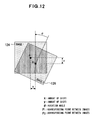
- Fig. 12 is an explanatory diagram of an amount of shift between fingerprint images.
- an amount of positional shift between a point P1 and a point P2 corresponding to each other between the images 124 and 126 is determined to be an amount of shift between the images 124 and 126.
- This amount of shift is defined by an amount of shift x in the horizontal direction (X axis direction), an amount of shift y in the vertical direction (Y axis direction), and a rotation angle ⁇ . These values are used for correlating pixels at the time of image synthesis.
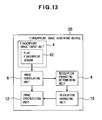
- FIG. 13 is a block diagram of a fingerprint image acquiring device
- Fig. 14 depicts an example of a flat fingerprint sensor
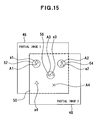
- Fig. 15 depicts correlating of feature points
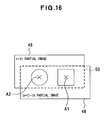
- Fig. 16 depicts detection and division of an overlapping area of partial images.
- Configurations of Figs. 13 to 16 are presented as examples, and therefore the present invention is not limited by such configurations.
- Figs. 13 and 14 the same components as the components of Fig. 1 are denoted by the same reference numerals.
- This fingerprint image acquiring device 2B uses a flat fingerprint sensor for acquiring a fingerprint image.
- the fingerprint image acquiring device 2B includes the fingerprint image input unit 4, the image correlating unit 6, the resolution enhancing determining unit 8, the resolution enhancing unit 10, and the image synthesizing unit 12, as in the first embodiment.
- a flat fingerprint sensor 42 is used as the fingerprint image input unit 4.
- the fingerprint image input unit 4 serves as the fingerprint image input means, but requires a finger operating method different from that of the first embodiment because the flat fingerprint sensor 42 is used as the fingerprint image input unit 4.
- a user presses the user's finger to a sensor surface 44 of the flat fingerprint sensor 42, as depicted in Fig. 14 . Through this operation, one partial image is acquired. Because a plurality of partial images are needed in the present invention, the user carries out fingerprint reading operation a plurality of times. Partial images input in this manner are buffered in the fingerprint image input unit 4.
- fingerprint image input can be carried out also in such a manner that image-taking (scanning) across the whole sensor surface 44 is carried out a plurality of times while the user's finger is kept in contact with the sensor surface 44 to input a plurality of fingerprint images.
- a fingerprint image is taken as an image that is partially lopsided to the whole of the user's finger.
- fingerprint images with their major parts enhanced in resolution can be acquired at once, so that a fingerprint image including a feature point of a higher level can be acquired efficiently.
- the image correlating unit 6 is the means that, for example, receives two partial images to compare the partial images with each other, and that determines a relative positional relation in which overlapping images in an overlapping area are most similar to each other to calculate an amount of shift. Two images may be selected in the order of input of images, or may be selected in accordance with a different selection criterion. The image correlating unit 6 thus determines a relative positional relation in which overlapping images in an overlapping area are most similar to each other and calculates an amount of shift. For comparison between partial images, the images themselves may be used or a feature quantity extracted from the images, such as a ridgeline pattern and a feature point, may be used.
- An image correlating method using a feature point is carried out by the same process as that of fingerprint verification using a feature point. The process is carried out in such a way that feature points extracted from partial images are verified with each other to determine an amount of shift in which the number of matching feature points becomes greater.
- the resolution enhancing determining unit 8 makes a determination on resolution enhancing using both feature point and ridgeline pattern to reduce the effect of a distortion due to the extension/contraction of the skin that varies for every fingerprint reading operation. For this determination, a feature point present in an overlapping area is acquired. In this case, a feature point extracted by the image correlating unit 6 may be used for the determination or another feature point may be newly extracted.
- the resolution enhancing determining unit 8 thus carries out the fingerprint verification process in the same procedure as the image correlating procedure, using feature points acquired from partial images, and correlates matching feature points with each other ( Fig. 15 ).
- feature points A1, A2, A3, and A4 of a fingerprint image 46 are compared with feature points a1, a2, a3, and a4 of a fingerprint image 48 (partial image 2), respectively, and matching feature points are correlated with each other as sets of feature points A1 and a1, A2 and a2, and A3 and a3 to determine an overlapping area 50.
- small areas 52, 54, and 56 represent correlating areas for the sets of feature points A1 and a1, A2 and a2, and A3 and a3, being divided as circular small areas 52, 54, and 56 based on the matching feature points A1 and a1, A2 and a2, and A3 and a3 as references.
- the radius of the circle is fixed or variable, and the size of the circle is desirably smaller than the size of the sensor surface 44.
- the radius of the circle is fixed, and the ridgeline patterns 24 ( Fig. 4 ) in the small areas 52, 54, and 56 in each partial image are extracted.
- Position matching is carried out at the reference points (center of the circle) of the corresponding small areas 52, 54, and 56 to compare the ridgeline patterns to calculate similarity levels, which are then compared to a given threshold to determine whether resolution enhancing is possible.
- the whole of the overlapping area 50 is not the subject of determination, but only the vicinities of the feature points A1 and a1, A2 and a2, and A3 and a3 that are indicated as characteristic areas are the subject of determination.
- the resolution enhancing unit 10 receives an amount of shift and information of an area determined to be an area making resolution enhancing possible (the central coordinate and radius of a circle in each partial image) to determine a processing range in each partial image.
- An amount of positional shift in the processing range is determined at precision of decimal pixels.
- Methods of determining an amount of positional shift at precision of decimal pixels includes a method of generating a pixel value at a decimal pixel position in each pixel by linear interpolation, etc., and calculating a similarity level and a method of estimating an amount of positional shift at precision of decimal pixels based on a similarity level calculated at an integer pixel position.
- the resolution enhancing unit 10 superposes images in the corresponding processing ranges of partial images while considering an amount of positional shift determined at precision of decimal pixels, carries out the pixel value interpolation process, and generates a high-resolution image of each object.
- the interpolation process is carried out as a known interpolation process, and therefore is not described further. The above process is carried out on all areas determined to be areas making resolution enhancing possible.
- the image synthesizing unit 12 synthesizes partial images based on an amount of shift.
- the image synthesizing unit 12 converts the resolution of a synthesized image to adjust the converted resolution to the resolution of a high-resolution image. Based on the amount of shift and area information, the image synthesizing unit 12 then disposes the high-resolution image on the synthesized image to generate a synthesized image partially enhanced in resolution.
- Such a process is repeated in order of partial images buffered in the fingerprint image input unit 4 to generate a synthesized image of the whole fingerprint.
- an area may be divided using a given shape based on the position of a feature point as a reference.
- the interior of the given shape is the subject of the determination, and a method of dividing a fingerprint image may be selected as a method that is fit to the type of a fingerprint sensor, which is the fingerprint image input means, or to a verification method.
- Fig. 17 is a flowchart of a procedure of determining resolution enhancing.
- a configuration of Fig. 17 is presented as an example, and therefore the present invention is not limited by such a configuration.
- the processes of acquiring a fingerprint image and constructing an image are executed in the same manner as in the first embodiment, and the above procedure of acquiring a fingerprint image ( Figs. 8 and 9 ) is used.
- the procedure of determining whether resolution enhancing is possible in this embodiment is an example of a method for the determination process or a program for the determination process.
- an overlapping area between partial images is detected (step S21), and feature points in the overlapping area are acquired (step S22) to correlate the feature points with each other (step S23).
- step S24 Based on the correlated feature points, ridgeline patterns in small areas are acquired (step S24), and the ridgeline patterns are compared with each other between small areas correlated with each other to carry out the determination (step S25).
- Whether all correlated feature points have been processed is determined (step S26). When all correlated feature points have not been processed yet (NO at step S26), the procedure returns to step S24. When all correlated feature points have been processed (YES at step S26), the procedure is ended.
- FIG. 18 is a block diagram of a fingerprint authenticating apparatus
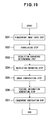
- Fig. 19 depicts a flowchart of a procedure of fingerprint authentication
- Fig. 20 depicts a configuration example of a feature information generating unit and a fingerprint verification unit
- Fig. 21 depicts a configuration example of feature information
- Fig. 22 depicts a configuration example of the feature information generating unit and another fingerprint verification unit
- Fig. 23 depicts a configuration example of feature information
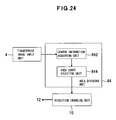
- Fig. 24 depicts a configuration example of the area dividing unit ( Fig. 7 ), Fig.
- FIG. 25 depicts another configuration example of the feature information generating unit
- Fig. 26 depicts a configuration example of a client apparatus
- Fig. 27 depicts a configuration example of the client apparatus and a server.
- Configurations of Figs. 18 to 27 are presented as examples, and therefore the present invention is not limited by such configurations.
- Figs. 18 , 22 , and 24 to 27 the same components as the components of Fig. 1 and 13 are denoted by the same reference numerals.
- the fingerprint authenticating apparatus 60 is constructed by using either of the fingerprint image acquiring device 2A ( Fig. 1 ) or the fingerprint image acquiring device 2B ( Fig. 13 ). As depicted in Fig. 18 , the fingerprint authenticating apparatus 60 includes the fingerprint image acquiring device 2A or 2B, the feature information generating unit 62, and the fingerprint verification unit 64.
- the fingerprint image acquiring apparatus 2A or 2B includes the fingerprint image input unit 4, the image correlating unit 6, the resolution enhancing determining unit 8, the resolution enhancing unit 10, and the image synthesizing unit 12. These components are the same components of the first and second embodiment ( Figs. 1 and 13 ), and therefore are denoted by the same reference numerals and are omitted in further description.
- the feature information generating unit 62 acquires a synthesized fingerprint image (synthesized image) from the image synthesizing unit 12.
- This synthesized image is enhanced only partially in resolution, so that a process of extracting a feature quantity classified in level 3 cannot be applied to the whole of the image. Applying this extracting process to the image ends up extracting a feature quantity that cannot offer sufficient authentication precision.
- a feature quantity to be extracted is, therefore, a feature quantity of level 1 and level 2 that can be acquired from a low-resolution fingerprinting image.
- a case of a feature point as feature quantity of level 2 is described herein.
- a feature point is extracted from a synthesized image, and feature information made up of the extracted feature point is generated.
- the fingerprint verification unit 64 registers the generated feature information when set to a register mode by the initial setting. In an operation state following the completion of the initial setting, therefore, feature information generated by the feature information generating unit 62 is input, and is verified with the pre-registered registered feature information to determine whether a person is the authentic person.
- the fingerprint verification unit 64 has a comparing means that makes a comparison using a feature point or a function equivalent to the comparing means, thus making a comparison and a verification using feature points in both pieces of feature information.
- the fingerprint verification unit 64 then compares a similarity level resulting from the above comparison and verification with a given threshold to determine whether a person is the authentic person.
- the procedure of fingerprint authentication by the fingerprint authenticating apparatus 60 is an example of a fingerprint authenticating method or a fingerprint authenticating program. As depicted in Fig. 19 , the procedure is carried out by executing a fingerprint image input step by the fingerprint image input unit 4 (step S31), a correlating step by the image correlating unit 6 (step S32), a resolution enhancing determining step by the resolution enhancing determining unit 8 (step S33), a resolution enhancing step by the resolution enhancing unit 10 (step S34), and an image synthesizing step by the image synthesizing unit 12 (step S35). These steps are the same as the steps of the first and second embodiments. Following the image synthesizing step, a feature information generating step by the feature information generating unit 62 (step S36) and a fingerprint verification step by the fingerprint verification unit 64 (step S37) are executed.
- FIG. 28 depicts a fingerprint authenticating apparatus in which a sweep fingerprint sensor is used as the fingerprint image inputting means
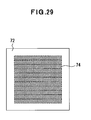
- Fig. 29 depicts an example of a generated synthesized image
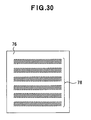
- Fig. 30 depicts an example of a generated synthesized image.
- Configurations of Figs. 28 , 29 and 30 are presented as examples, and therefore the present invention is not limited by such configurations.
- Fig. 28 the same components as components of Figs. 1 and 18 are denoted by the same reference numerals.
- the fingerprint image input unit 4 provided as the sweep fingerprint sensor 14, the image correlating unit 6, the resolution enhancing determining unit 8, and the resolution enhancing unit 10 are the same components as described in the first embodiment ( Fig. 1 ), and therefore are denoted by the same reference numerals and is omitted in further description.
- the image synthesizing unit 12 receives a high-resolution image generated by the resolution enhancing unit 10 to synthesize partial images with the high-resolution image, and acquires the range of the high-resolution image in a synthesized image.
- a high-resolution image generated by the resolution enhancing unit 10 to synthesize partial images with the high-resolution image, and acquires the range of the high-resolution image in a synthesized image.
- an overlapping area is often formed as a square because of vertical operation of a finger, so that a high-resolution image is formed also as a square in many cases.
- the range of the high-resolution image in a synthesized image is determined by acquiring the upper left coordinate, vertical width, and lateral width of the high-resolution image in the synthesized image.
- the high-resolution image is not an image of such a simple shape as square
- an area (number of pixels) occupied by the high-resolution image may be acquired. Every time partial images are synthesized, the same process is repeated in succession to acquire the area occupied by the high-resolution image in the synthesized image.
- the feature information generating unit 62 acquires the synthesized image and the area occupied by the high-resolution image to compare the value of the area with a given threshold.
- the feature quantity extracting means for extracting a feature quantity classified in level 3 is used to acquire a feature quantity.
- the value of the area is smaller than the given threshold, only the feature quantity classified in level 1 or level 2 is acquired.
- the fingerprint verification unit 64 confirms the types of feature quantities making up registered feature information and of feature quantities making up feature information generated at the time of authentication.
- the fingerprint verification unit 64 carries out comparison and verification through the feature quantity comparing means using a feature quantity of level 3 (feature quantity comparing units 6421, 6422, 6423 ... of Fig. 22 ).
- An example of the fingerprint verification method using a feature quantity of level 3 is described in Nonpatent Literature 2.
- the fingerprint verification unit 64 carries out comparison and verification through the feature quantity comparing means using a feature quantity of level 1 or level 2 (feature quantity comparing units 6421, 6422, 6423 ... of Fig. 22 ).
- Whether a person is the authentic person is thus determined by the result of determination on whether a similarity level resulting from the above comparison and verification exceeds a given threshold. While only one of a feature quantity of level 3 and a feature quantity of level 1 or level 2 is used in this embodiment, both feature quantities may be used simultaneously.
- the fingerprint authenticating apparatus 60A using the sweep fingerprint sensor 14 as the fingerprint image inputting means may operate in the form of local authentication ( Fig. 26 ) and of server authentication ( Fig. 27 ) in the same manner as in the third embodiment.
- FIG. 31 depicts a fingerprint authenticating apparatus using a flat fingerprint sensor as the fingerprint image inputting means
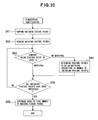
- Fig. 32 is a flowchart of a procedure of fingerprint verification. Configurations of Figs. 31 and 32 are presented as examples, and therefore the present invention is not limited by such configurations.
- Fig. 31 the same components as the components of Figs. 13 and 18 are denoted by the same reference numerals.
- the fingerprint image input unit 4 provided as a sweep fingerprint sensor 42, the image correlating unit 6, the resolution enhancing determining unit 8, and the resolution enhancing unit 10 are the same components as described in the second embodiment ( Fig. 13 ), and therefore is omitted in further description.
- the image synthesizing unit 12 synthesizes input partial images with a high-resolution image, updates the position of a feature point used for generating the high-resolution image to a position in a synthesized image, and correlates the feature point with the high-resolution image to store them.
- the position of an already stored feature point is also updated to a position in the high-resolution image in succession. If feature points correlated with high-resolution images generated in different times of synthesis are the same, a high-resolution image generated later and the feature point are stored in priority. Whether feature points are the same is determined by comparing the positions of the feature points in a synthesized image. If the distance between two feature points is within a given threshold, the feature points are determined to be the same. In addition to the position of a feature point, the type of the feature point may also be used for the determination.
- the feature information generating unit 62 receives a high-resolution image correlated with a feature point, acquires position information on a sweat gland pore and the shape of outline of a ridgeline from the high-resolution image, and generates feature information composed of the feature point and the feature quantity of level 3.
- the fingerprint verification unit 64 is the means that carries out verification using feature points included in feature information, carrying out further comparison and verification between a set of feature points considered to be matching to each other, using feature quantities of level 3 correlated with the feature points. When the result of the comparison and verification is no matching, the set of feature points are determined to be no matching. Whether a person is the authentic person is determined based on the total number of matching feature points.
- This procedure of fingerprint verification is an example of a processing method for verifying and a processing program for verifying.
- step S41 feature points are compared and verified (step S41) to acquire matching feature points (step S42), which are then compared using a feature point of level 3 (step S43).
- step S43 the result of comparison at step S43 is no matching, the feature points are determined to be no matching (reduction in the number of matching feature points) (step S44).
- step S45 whether all matching feature points have been processed is determined (step S45).
- the procedure returns to step S43.
- YES at step S45 a determination is made based on the total number of matching feature points (step S46), after which the fingerprint verification procedure is ended.
- the fingerprint authenticating apparatus 60B using the flat fingerprint sensor 42 as the fingerprint image inputting unit 4 may also operate in the form of local authentication ( Fig. 26 ) and of server authentication ( Fig. 27 ) in the same manner as in the third embodiment.
- FIG. 33 is a flowchart of a procedure of feature quantity extraction according to a sixth embodiment.
- a configuration of Fig. 33 is presented as an example, and therefore the present invention is not limited by such a configuration.
- a common minutia is selected from minutiae extracted from fingerprint images.
- a ridgeline pattern and a minutia that can be acquired by a low-resolution sensor may be used as feature information.
- reproducibility is estimated for each area in an image using a feature quantity that can be extracted by a low-resolution finger print sensor, and resolution enhancing is carried out in an area of high reproducibility to extract a feature quantity of level 3, as in the above embodiments.
- this embodiment includes a process of determining whether resolution enhancing is possible based on the reproducibility of a ridgeline pattern in that area.
- the configurations of the first to fifth embodiments are used in this procedure.
- This procedure is an example of a processing method or a processing program for feature quantity extraction.
- a ridgeline pattern is extracted from each fingerprint image (step S51), and a minutia is extracted from each fingerprint image (step S52).
- the corresponding relation of minutiae between fingerprint images is examined (step S53), and position matching between the images is carried out using minutiae acquired in common (step S54). Ridgeline patterns near the common minutiae are compared to estimate reproducibility (step S55).
- the resolution enhancing process is then carried out only in the area of high reproducibility (high matching level) (step S56).
- high matching level pixels corresponding to each other between images are compared, and an intermediate pixel is determined by interpolation to enhance a resolution.
- a feature quantity of level 3 is then extracted from an area enhanced in resolution (step S57), after which the procedure is ended.
- FIG. 34 depicts a hardware configuration of the fingerprint authenticating apparatus
- Fig. 35 depicts a portable apparatus equipped with the fingerprint authenticating apparatus.
- Configurations of Figs. 34 and 35 are presented as examples, and therefore the present invention is not limited by such configurations.
- the same components as components of Figs. 1 and 18 are denoted by the same reference numerals.
- the fingerprint authenticating apparatus 60 ( Fig. 18 ), 60A ( Fig. 28 ), or 60B ( Fig. 31 ) has a computer serving as an information processing means that acquires an image and that authenticates a fingerprint, as depicted in Fig. 34 .
- the fingerprint authenticating apparatus 60, 60A or 60B includes a CPU (Central Processing Unit) 902, a program memory unit 904, a data memory unit 906, a RAM (Random Access Memory) 908, an input/output unit 910, a display unit 912, and the fingerprint image input unit 4, which are interconnected through a bus 914.
- a CPU Central Processing Unit
- program memory unit 904 a data memory unit 906
- RAM Random Access Memory
- the CPU 902 is a control means that executes an application program, such as an OS (Operating System) and authentication program, to carry out processes of fingerprint image acquiring, resolution enhancing, and verifying, and other processes of storing and calculating various data.
- the CPU 902 and the RAM 908 jointly make up the image correlating unit 6, the resolution enhancing determining unit 8, the resolution enhancing unit 10, the image synthesizing unit 12, the feature information generating unit 62, the fingerprint verification unit 64, etc.
- the RAM 908 is a work area.
- the display unit 912 is an information display means, and is composed of, for example, an LCD (Liquid Crystal Display).
- the input/output unit 910 is used for information input/output, etc., and a keyboard, etc., is used for inputting information.
- the fingerprint image input unit 4 is provided as a low-resolution fingerprint sensor that is the sweep fingerprint sensor 14 or the flat fingerprint sensor 42, serving as a fingerprint image taking means.
- the program memory unit 904 is an example of a memory means that records a program thereon, and is composed of a recording medium allowing data reading/writing thereon by a computer.
- the program memory unit 904 stores therein such routines as OS and application programs including the above image acquiring program, resolution enhancing processing program, and image verification program.
- the data memory unit 906 is an example of a storage means that stores data therein, which data includes a fingerprint image, high-resolution image, and a synthesized image. Storage of other necessary data may be set in accordance with each of the above embodiments.
- the fingerprint authenticating apparatus 60, 60A, or 60B is, for example, incorporated in the portable apparatus 920 ( Fig. 35 ), which includes a case unit 922, a case unit 944, and a hinge unit 926 via which the case units 922 and 944 can be opened and closed as depicted in Fig. 35 .
- the case unit 922 has a keyboard 928 (an example of the input unit of the input/output unit 910) and the sweep fingerprint sensor 14.
- the case unit 924 has the display unit 912.
- the portable apparatus 920 carries out resolution enhancing on a fingerprint image taken in from the low-resolution sweep fingerprint sensor 14, as described above, to enable highly reliable fingerprint authentication.
- the resolution enhancing determining unit may include: a feature quantity extracting unit to extract a feature quantity from a fingerprint image; and a feature quantity comparing unit to compare extracted feature quantities between fingerprint images, and wherein reproducibility is estimated based on a feature quantity extracted from a fingerprint image to determine whether resolution enhancing is possible.
- the feature quantity may include any one of a ridgeline shape (ridgeline pattern) and an end point and a branch point of a ridgeline (feature point).
- the resolution enhancing determining unit may further include an area dividing unit to divide an overlapping area into small areas, and wherein reproducibility between fingerprint images is estimated for each small area to determine whether resolution enhancing is possible, and an area making resolution enhancing possible is enhanced in resolution.
- the area dividing unit may include a sensor information acquiring unit to acquire sensor information indicative of a fingerprint sensor used as the fingerprint image input unit; and an area shape selecting unit to receive the sensor information from the sensor information acquiring unit to select an area shape for dividing the fingerprint image in accordance with the sensor information, and wherein the fingerprint image is divided into area shapes according to the fingerprint sensor.
- division can be carried out using area shapes fit to the type of a fingerprint sensor.
- the overlapping area may be divided into block shapes when a sweep fingerprint sensor is used as the fingerprint image input unit.
- division may be carried out using a given shape based on a position of a feature point as a reference when a flat fingerprint sensor is used as the fingerprint image input unit.
- division is carried out using a circle or square based on the position of a feature point as a reference when a flat fingerprint sensor is used. This enables generation of a high-resolution image in an area near a feature point that is important for authentication capability.
- the above fingerprint authenticating apparatus having the fingerprint image acquiring device may preferably include: a feature information generating unit to generate feature information from a fingerprint image generated by the image synthesizing unit; and a fingerprint verification unit to verify acquired feature information with pre-registered feature information.
- the feature information generating unit may include: a feature quantity extracting unit to extract a plurality of types of feature quantities; an image area acquiring unit to acquire an area of a high-resolution image from the fingerprint image enhanced in resolution by the resolution enhancing unit; and a feature quantity extraction selecting unit to select a feature quantity based on the area that is acquired.
- whether or not to extract a feature quantity classified in level 3 is determined based on the size of an area enhanced in resolution. This can improve the stability of fingerprint verification using a feature quantity of level 3.
- information of an outline of a ridgeline may be extracted as a feature quantity.
- information of the outline of a ridgeline can be used as a feature quantity.
- a position of a sweat gland pore on a ridgeline mat be extracted as a feature quantity.
- the position of a sweat gland pore on a ridgeline can be used as a feature quantity.
- the fingerprint verification unit may include: a plurality of feature quantity comparing units to compare a plurality of types of feature quantities extracted from the fingerprint image; a comparison selecting unit to select one of the feature quantity comparing units in accordance with a type of the feature quantity; and a verification determining unit to verify the feature information with each other based on a comparison result given by the feature quantity comparing unit selected by the comparison selecting unit.
- the above fingerprint authenticating apparatus may preferably include: a resolution enhancing unit to generate a high-resolution image in an area of a given shape based on a feature point as a reference; an image synthesizing unit to update information of a position of a feature point to information of the position of the feature point in a synthesized image every time partial images are synthesized, the image synthesizing unit correlating the feature point with a high-resolution image to store the correlated feature point and high-resolution image; a feature information generating unit to extract either or both of information of an outline of a ridgeline and a position of a sweat gland pore from a high-resolution image, the feature information generating unit correlating the extracted information or position with a feature point to generate feature information; and a fingerprint verification unit to verify feature points included in each piece of feature information with each other, the fingerprint verification unit further verifying feature points determined to be matching with each other in terms of either or both of information of an outline of a ridgeline and a position of a sweat gland
- a high-resolution image near a feature point is generated and a feature quantity classified in level 3 is extracted. This can realize the fingerprint verification method using both feature point and feature quantity of level 3.
- the embodiments of the present invention can offer the following effects.
- the embodiments discussed herein are related to fingerprint authentication using a fingerprint image, and is useful with such an advantage of facilitating extraction of a feature quantity using a low-resolution fingerprint image to improve the precision of fingerprint authentication.
Landscapes
- Engineering & Computer Science (AREA)
- Physics & Mathematics (AREA)
- General Physics & Mathematics (AREA)
- Theoretical Computer Science (AREA)
- Human Computer Interaction (AREA)
- Multimedia (AREA)
- Computer Vision & Pattern Recognition (AREA)
- Collating Specific Patterns (AREA)
- Image Input (AREA)
- Image Processing (AREA)
- Measurement Of The Respiration, Hearing Ability, Form, And Blood Characteristics Of Living Organisms (AREA)
Applications Claiming Priority (1)
| Application Number | Priority Date | Filing Date | Title |
|---|---|---|---|
| JP2008211407A JP5206218B2 (ja) | 2008-08-20 | 2008-08-20 | 指紋画像取得装置、指紋認証装置、指紋画像取得方法及び指紋認証方法 |
Publications (2)
| Publication Number | Publication Date |
|---|---|
| EP2157531A2 true EP2157531A2 (de) | 2010-02-24 |
| EP2157531A3 EP2157531A3 (de) | 2016-08-03 |
Family
ID=41347664
Family Applications (1)
| Application Number | Title | Priority Date | Filing Date |
|---|---|---|---|
| EP09008509.3A Withdrawn EP2157531A3 (de) | 2008-08-20 | 2009-06-30 | Fingerabdruckaufnahmevorrichtung, Fingerabdruckautentifizierungsvorrichtung, Fingerabdruckaufnahmeverfahren und Fingerabdruckautentifizierungsverfahren |
Country Status (3)
| Country | Link |
|---|---|
| US (1) | US8224043B2 (de) |
| EP (1) | EP2157531A3 (de) |
| JP (1) | JP5206218B2 (de) |
Cited By (6)
| Publication number | Priority date | Publication date | Assignee | Title |
|---|---|---|---|---|
| CN102270297A (zh) * | 2011-07-21 | 2011-12-07 | 中国人民解放军国防科学技术大学 | 一种指纹图像增强方法 |
| EP3113072A1 (de) * | 2015-06-30 | 2017-01-04 | Samsung Electronics Co., Ltd. | Verfahren und vorrichtungen zur aktualisierung von benutzerauthentifizierungsdaten |
| EP3249578A1 (de) * | 2016-05-27 | 2017-11-29 | Guangdong Oppo Mobile Telecommunications Corp., Ltd. | Fingerabdruckentriegelungsverfahren und endgerät |
| CN110136456A (zh) * | 2019-05-12 | 2019-08-16 | 苏州科技大学 | 基于深度强化学习的交通信号灯防堵塞控制方法和系统 |
| CN112926389A (zh) * | 2021-01-25 | 2021-06-08 | 北京航空航天大学合肥创新研究院(北京航空航天大学合肥研究生院) | 一种手指静脉识别系统 |
| US20220058772A1 (en) * | 2017-10-09 | 2022-02-24 | Huawei Technologies Co., Ltd. | Image Processing Method and Device |
Families Citing this family (63)
| Publication number | Priority date | Publication date | Assignee | Title |
|---|---|---|---|---|
| US20050267520A1 (en) * | 2004-05-12 | 2005-12-01 | Modesitt D B | Access and closure device and method |
| US8300980B2 (en) * | 2008-03-18 | 2012-10-30 | Sony Corporation | System, method and computer program product for providing a high resolution texture within an image |
| US8833657B2 (en) * | 2010-03-30 | 2014-09-16 | Willie Anthony Johnson | Multi-pass biometric scanner |
| US8971588B2 (en) * | 2011-03-30 | 2015-03-03 | General Electric Company | Apparatus and method for contactless high resolution handprint capture |
| RU2475185C1 (ru) * | 2011-08-10 | 2013-02-20 | Общество С Ограниченной Ответственностью "Абилма" | Система регистрации папиллярных узоров |
| WO2013056195A1 (en) * | 2011-10-13 | 2013-04-18 | Biogy, Inc. | Biometric apparatus and method for touch-sensitive devices |
| JP2013206187A (ja) * | 2012-03-28 | 2013-10-07 | Fujitsu Ltd | 情報変換装置、情報検索装置、情報変換方法、情報検索方法、情報変換プログラム、情報検索プログラム |
| JP5862413B2 (ja) * | 2012-03-28 | 2016-02-16 | 富士通株式会社 | 情報変換規則生成プログラム、情報変換規則生成装置および情報変換規則生成方法 |
| JPWO2014077024A1 (ja) * | 2012-11-19 | 2017-01-05 | コニカミノルタ株式会社 | 画像処理装置、画像処理方法および画像処理プログラム |
| US8953853B2 (en) * | 2013-03-15 | 2015-02-10 | Google Technology Holdings LLC | Sensing characteristics of adjacent fingers for user authentication |
| KR101967033B1 (ko) | 2014-04-10 | 2019-04-08 | 아이비코리아 유한회사 | 터치-가동 디바이스용 생체인식 센서 |
| WO2015190535A1 (ja) * | 2014-06-10 | 2015-12-17 | 株式会社 東芝 | 無線通信用集積回路、無線通信端末及び無線通信方法 |
| US9400914B2 (en) * | 2014-10-24 | 2016-07-26 | Egis Technology Inc. | Method and electronic device for generating fingerprint enrollment data |
| CN105989349B (zh) * | 2014-10-24 | 2019-11-01 | 神盾股份有限公司 | 指纹的注册数据产生方法和电子装置 |
| WO2016105558A1 (en) * | 2014-12-24 | 2016-06-30 | Sciometrics Llc | Unobtrusive identity matcher: a tool for real-time verification of identity |
| US9721142B2 (en) | 2015-06-26 | 2017-08-01 | Synaptics Incorporated | Multi-resolution fingerprint sensor |
| KR101774746B1 (ko) * | 2015-08-13 | 2017-09-05 | 주식회사 슈프리마 | 지문 인증 방법 및 그 지문 인증 방법을 이용한 장치 |
| US10002285B2 (en) * | 2015-09-25 | 2018-06-19 | Qualcomm Incorporated | Fast, high-accuracy, large-scale fingerprint verification system |
| CN107025419B (zh) * | 2016-01-29 | 2020-11-10 | 北京小米移动软件有限公司 | 指纹模板录入方法及装置 |
| US10445547B2 (en) | 2016-05-04 | 2019-10-15 | Invensense, Inc. | Device mountable packaging of ultrasonic transducers |
| US10656255B2 (en) | 2016-05-04 | 2020-05-19 | Invensense, Inc. | Piezoelectric micromachined ultrasonic transducer (PMUT) |
| US10670716B2 (en) | 2016-05-04 | 2020-06-02 | Invensense, Inc. | Operating a two-dimensional array of ultrasonic transducers |
| US10315222B2 (en) | 2016-05-04 | 2019-06-11 | Invensense, Inc. | Two-dimensional array of CMOS control elements |
| DE112017002345T5 (de) * | 2016-05-06 | 2019-01-17 | Sony Corporation | Anzeigesteuereinrichtung und Bildgebungseinrichtung |
| US11673165B2 (en) | 2016-05-10 | 2023-06-13 | Invensense, Inc. | Ultrasonic transducer operable in a surface acoustic wave (SAW) mode |
| US10452887B2 (en) | 2016-05-10 | 2019-10-22 | Invensense, Inc. | Operating a fingerprint sensor comprised of ultrasonic transducers |
| US10706835B2 (en) | 2016-05-10 | 2020-07-07 | Invensense, Inc. | Transmit beamforming of a two-dimensional array of ultrasonic transducers |
| US10632500B2 (en) | 2016-05-10 | 2020-04-28 | Invensense, Inc. | Ultrasonic transducer with a non-uniform membrane |
| US10441975B2 (en) | 2016-05-10 | 2019-10-15 | Invensense, Inc. | Supplemental sensor modes and systems for ultrasonic transducers |
| US10562070B2 (en) | 2016-05-10 | 2020-02-18 | Invensense, Inc. | Receive operation of an ultrasonic sensor |
| US10539539B2 (en) | 2016-05-10 | 2020-01-21 | Invensense, Inc. | Operation of an ultrasonic sensor |
| KR102359556B1 (ko) * | 2016-11-11 | 2022-02-08 | 삼성전자주식회사 | 지문 영상을 이용한 사용자 인증 방법 및 사용자 인증을 위한 부호화 모델 생성 방법 |
| EP3542307B1 (de) * | 2016-11-15 | 2024-08-07 | Fingerprint Cards Anacatum IP AB | Verfahren und elektronische vorrichtung zur registrierung von fingerabdrücken |
| EP3355239A1 (de) * | 2017-01-27 | 2018-08-01 | Nxp B.V. | Fingerabdruckverifizierungsvorrichtung |
| KR102668332B1 (ko) | 2017-02-24 | 2024-05-23 | 삼성디스플레이 주식회사 | 지문 인식 장치 및 지문 인식 방법 |
| KR102320024B1 (ko) * | 2017-04-24 | 2021-11-01 | 삼성전자 주식회사 | 생체 인증 정보에 기반한 인증 방법 및 장치 |
| US10474862B2 (en) | 2017-06-01 | 2019-11-12 | Invensense, Inc. | Image generation in an electronic device using ultrasonic transducers |
| US10643052B2 (en) | 2017-06-28 | 2020-05-05 | Invensense, Inc. | Image generation in an electronic device using ultrasonic transducers |
| JP6978665B2 (ja) * | 2017-07-25 | 2021-12-08 | 富士通株式会社 | 生体画像処理装置、生体画像処理方法及び生体画像処理プログラム |
| JP7011152B2 (ja) * | 2017-08-30 | 2022-01-26 | 富士通株式会社 | 生体画像処理装置、生体画像処理方法、及び生体画像処理プログラム |
| WO2019109010A1 (en) | 2017-12-01 | 2019-06-06 | Invensense, Inc. | Darkfield tracking |
| US10984209B2 (en) | 2017-12-01 | 2021-04-20 | Invensense, Inc. | Darkfield modeling |
| US10997388B2 (en) | 2017-12-01 | 2021-05-04 | Invensense, Inc. | Darkfield contamination detection |
| US11151355B2 (en) * | 2018-01-24 | 2021-10-19 | Invensense, Inc. | Generation of an estimated fingerprint |
| US10755067B2 (en) | 2018-03-22 | 2020-08-25 | Invensense, Inc. | Operating a fingerprint sensor comprised of ultrasonic transducers |
| JP2020107969A (ja) * | 2018-12-26 | 2020-07-09 | オリンパス株式会社 | 画像取得装置、判定方法、及び判定プログラム |
| US10936843B2 (en) | 2018-12-28 | 2021-03-02 | Invensense, Inc. | Segmented image acquisition |
| WO2020240715A1 (ja) * | 2019-05-28 | 2020-12-03 | 日本電気株式会社 | 情報処理装置、情報処理方法及び記録媒体 |
| US11188735B2 (en) | 2019-06-24 | 2021-11-30 | Invensense, Inc. | Fake finger detection using ridge features |
| US11216681B2 (en) | 2019-06-25 | 2022-01-04 | Invensense, Inc. | Fake finger detection based on transient features |
| US11216632B2 (en) | 2019-07-17 | 2022-01-04 | Invensense, Inc. | Ultrasonic fingerprint sensor with a contact layer of non-uniform thickness |
| US11176345B2 (en) | 2019-07-17 | 2021-11-16 | Invensense, Inc. | Ultrasonic fingerprint sensor with a contact layer of non-uniform thickness |
| US11232549B2 (en) | 2019-08-23 | 2022-01-25 | Invensense, Inc. | Adapting a quality threshold for a fingerprint image |
| US11392789B2 (en) | 2019-10-21 | 2022-07-19 | Invensense, Inc. | Fingerprint authentication using a synthetic enrollment image |
| JP7322980B2 (ja) * | 2020-02-10 | 2023-08-08 | 日本電気株式会社 | 画像処理装置、画像処理方法、及び、プログラム |
| CN115551650A (zh) | 2020-03-09 | 2022-12-30 | 应美盛公司 | 具有非均匀厚度的接触层的超声指纹传感器 |
| US11243300B2 (en) | 2020-03-10 | 2022-02-08 | Invensense, Inc. | Operating a fingerprint sensor comprised of ultrasonic transducers and a presence sensor |
| US11328165B2 (en) | 2020-04-24 | 2022-05-10 | Invensense, Inc. | Pressure-based activation of fingerprint spoof detection |
| TWI773991B (zh) * | 2020-05-19 | 2022-08-11 | 財團法人工業技術研究院 | 指紋辨識方法及電子互動裝置 |
| US11995909B2 (en) | 2020-07-17 | 2024-05-28 | Tdk Corporation | Multipath reflection correction |
| US12174295B2 (en) | 2020-08-07 | 2024-12-24 | Tdk Corporation | Acoustic multipath correction |
| US12416807B2 (en) | 2021-08-20 | 2025-09-16 | Tdk Corporation | Retinal projection display system |
| US12260050B2 (en) | 2021-08-25 | 2025-03-25 | Tdk Corporation | Differential receive at an ultrasonic transducer |
Citations (6)
| Publication number | Priority date | Publication date | Assignee | Title |
|---|---|---|---|---|
| JPH1091769A (ja) | 1996-06-14 | 1998-04-10 | Thomson Csf | 指紋読み取りシステム |
| JP2001344605A (ja) | 2000-05-31 | 2001-12-14 | Ricoh Co Ltd | 個人認証方法、その装置及びそのシステム |
| JP2002024831A (ja) | 2000-07-10 | 2002-01-25 | Casio Comput Co Ltd | 指紋認証装置及び指紋認証システム |
| JP2003208620A (ja) | 2002-01-17 | 2003-07-25 | Fujitsu Ltd | 生体情報を用いた本人認証方法、プログラム、記録媒体及び装置 |
| JP2004005619A (ja) | 2003-04-28 | 2004-01-08 | Casio Comput Co Ltd | 指紋認証装置及び指紋認証方法 |
| JP2007271690A (ja) | 2006-03-30 | 2007-10-18 | Matsushita Electric Ind Co Ltd | 撮像装置 |
Family Cites Families (15)
| Publication number | Priority date | Publication date | Assignee | Title |
|---|---|---|---|---|
| JPH11134494A (ja) * | 1997-10-30 | 1999-05-21 | Nippon Telegr & Teleph Corp <Ntt> | 画像の高品質化方法およびその装置およびその方法を記録した記録媒体 |
| US6898301B2 (en) | 2000-07-10 | 2005-05-24 | Casio Computer Co., Ltd. | Authentication system based on fingerprint and electronic device employed for the system |
| JP3780830B2 (ja) * | 2000-07-28 | 2006-05-31 | 日本電気株式会社 | 指紋識別方法及び装置 |
| US7203347B2 (en) * | 2001-06-27 | 2007-04-10 | Activcard Ireland Limited | Method and system for extracting an area of interest from within a swipe image of a biological surface |
| US7043061B2 (en) * | 2001-06-27 | 2006-05-09 | Laurence Hamid | Swipe imager with multiple sensing arrays |
| US20030115490A1 (en) * | 2001-07-12 | 2003-06-19 | Russo Anthony P. | Secure network and networked devices using biometrics |
| JP4262471B2 (ja) * | 2002-11-12 | 2009-05-13 | 富士通株式会社 | 生体特徴データ取得装置 |
| DE10261665B3 (de) * | 2002-12-20 | 2004-03-25 | Smiths Heimann Biometrics Gmbh | Einrichtung und Verfahren zur störungsarmen Aufnahme von hochaufgelösten zweidimensionalen Bildern |
| EP1636735A1 (de) * | 2003-06-21 | 2006-03-22 | Aprilis, Inc. | Akquisition von hochauflösenden biometrischen bildern |
| JP4592341B2 (ja) * | 2004-06-29 | 2010-12-01 | セコム株式会社 | 生体情報認証装置 |
| US20060026427A1 (en) * | 2004-07-30 | 2006-02-02 | Jefferson Stanley T | Method and system for entity authentication using an untrusted device and a trusted device |
| JP4339221B2 (ja) * | 2004-09-30 | 2009-10-07 | Necインフロンティア株式会社 | 画像構成方法、指紋画像構成装置およびプログラム |
| JP4851240B2 (ja) * | 2006-06-05 | 2012-01-11 | 株式会社トプコン | 画像処理装置及びその処理方法 |
| GB2459602B (en) * | 2007-02-21 | 2011-09-21 | Pixel Velocity Inc | Scalable system for wide area surveillance |
| US20090060286A1 (en) * | 2007-09-04 | 2009-03-05 | General Electric Company | Identification system and method utilizing iris imaging |
-
2008
- 2008-08-20 JP JP2008211407A patent/JP5206218B2/ja not_active Expired - Fee Related
-
2009
- 2009-06-30 EP EP09008509.3A patent/EP2157531A3/de not_active Withdrawn
- 2009-06-30 US US12/494,953 patent/US8224043B2/en not_active Expired - Fee Related
Patent Citations (6)
| Publication number | Priority date | Publication date | Assignee | Title |
|---|---|---|---|---|
| JPH1091769A (ja) | 1996-06-14 | 1998-04-10 | Thomson Csf | 指紋読み取りシステム |
| JP2001344605A (ja) | 2000-05-31 | 2001-12-14 | Ricoh Co Ltd | 個人認証方法、その装置及びそのシステム |
| JP2002024831A (ja) | 2000-07-10 | 2002-01-25 | Casio Comput Co Ltd | 指紋認証装置及び指紋認証システム |
| JP2003208620A (ja) | 2002-01-17 | 2003-07-25 | Fujitsu Ltd | 生体情報を用いた本人認証方法、プログラム、記録媒体及び装置 |
| JP2004005619A (ja) | 2003-04-28 | 2004-01-08 | Casio Comput Co Ltd | 指紋認証装置及び指紋認証方法 |
| JP2007271690A (ja) | 2006-03-30 | 2007-10-18 | Matsushita Electric Ind Co Ltd | 撮像装置 |
Non-Patent Citations (3)
| Title |
|---|
| A. JAIN; A. ROSS: "Proceeding of IEEE International Conference on Acoustics", May 2002, SPEECH, AND SIGNAL PROCESSING, article "Fingerprint Mosaicking", pages: 4064 - 4067 |
| ANIL JAIN; YI CHEN; MELTEM DEMIRKUS: "Pores and Ridges: High-Resolution Fingerprint Matching Using Level 3 Features", IEEE TRANSACTIONS ON PATTERN ANALYSIS AND MACHINE INTELLIGENCE, vol. 29, no. 1, January 2007 (2007-01-01), pages 15 - 27 |
| TRAKA M ET AL: "Panoramic view construction", SIGNAL PROCESSING. IMAGE COMMUNICAT, ELSEVIER SCIENCE PUBLISHERS, AMSTERDAM, NL, vol. 18, no. 6, 1 July 2003 (2003-07-01), pages 465 - 481, XP004427613, ISSN: 0923-5965 * |
Cited By (11)
| Publication number | Priority date | Publication date | Assignee | Title |
|---|---|---|---|---|
| CN102270297A (zh) * | 2011-07-21 | 2011-12-07 | 中国人民解放军国防科学技术大学 | 一种指纹图像增强方法 |
| EP3113072A1 (de) * | 2015-06-30 | 2017-01-04 | Samsung Electronics Co., Ltd. | Verfahren und vorrichtungen zur aktualisierung von benutzerauthentifizierungsdaten |
| US10678896B2 (en) | 2015-06-30 | 2020-06-09 | Samsung Electronics Co., Ltd. | Methods and apparatuses for updating user authentication data |
| US11699300B2 (en) | 2015-06-30 | 2023-07-11 | Samsung Electronics Co., Ltd. | Methods and apparatuses for updating user authentication data |
| EP3249578A1 (de) * | 2016-05-27 | 2017-11-29 | Guangdong Oppo Mobile Telecommunications Corp., Ltd. | Fingerabdruckentriegelungsverfahren und endgerät |
| US10061969B2 (en) | 2016-05-27 | 2018-08-28 | Guangdong Oppo Mobile Telecommunications Corp., Ltd. | Fingerprint unlocking method and terminal |
| US10248836B2 (en) | 2016-05-27 | 2019-04-02 | Guangdong Oppo Mobile Telecommunications Corp., Ltd. | Fingerprint unlocking method and terminal |
| US20220058772A1 (en) * | 2017-10-09 | 2022-02-24 | Huawei Technologies Co., Ltd. | Image Processing Method and Device |
| CN110136456A (zh) * | 2019-05-12 | 2019-08-16 | 苏州科技大学 | 基于深度强化学习的交通信号灯防堵塞控制方法和系统 |
| CN112926389A (zh) * | 2021-01-25 | 2021-06-08 | 北京航空航天大学合肥创新研究院(北京航空航天大学合肥研究生院) | 一种手指静脉识别系统 |
| CN112926389B (zh) * | 2021-01-25 | 2024-04-05 | 北京航空航天大学合肥创新研究院(北京航空航天大学合肥研究生院) | 一种手指静脉识别系统 |
Also Published As
| Publication number | Publication date |
|---|---|
| US20100046810A1 (en) | 2010-02-25 |
| JP5206218B2 (ja) | 2013-06-12 |
| EP2157531A3 (de) | 2016-08-03 |
| JP2010049379A (ja) | 2010-03-04 |
| US8224043B2 (en) | 2012-07-17 |
Similar Documents
| Publication | Publication Date | Title |
|---|---|---|
| US8224043B2 (en) | Fingerprint image acquiring device, fingerprint authenticating apparatus, fingerprint image acquiring method, and fingerprint authenticating method | |
| EP3107037B1 (de) | Elektronische vorrichtung mit minimaler sensorfläche und verfahren zur verarbeitung von fingerabdrucksinformationen dafür | |
| JP4169185B2 (ja) | 画像連結方法、プログラム及び装置 | |
| EP2128817B1 (de) | Bildleseeinrichtung, bildleseprogramm und bildleseverfahren | |
| JP4785985B2 (ja) | 順次的画像位置合わせ | |
| US8538095B2 (en) | Method and apparatus for processing biometric images | |
| JP3780830B2 (ja) | 指紋識別方法及び装置 | |
| KR100775409B1 (ko) | 생체 정보 입력 장치, 생체 인증 장치, 생체 정보 처리방법, 생체 정보 처리 프로그램을 기록한 컴퓨터 판독가능한 기록 매체 | |
| US8824746B2 (en) | Biometric information processing device, biometric-information processing method, and computer-readable storage medium | |
| TWI222030B (en) | Method for acquiring fingerprints by the linear fingerprint sensor | |
| KR20040025568A (ko) | 슬라이스 데이터의 이동량 및 기울기에 기초한 재구성화상 데이터의 생성 | |
| JP5482803B2 (ja) | 生体情報処理装置、生体情報処理方法及び生体情報処理プログラム | |
| KR102785399B1 (ko) | 지문 인식 방법 및 디바이스 | |
| US10740589B2 (en) | Skin information processing method, skin information processing device, and non-transitory computer-readable medium | |
| JP3902473B2 (ja) | 生体情報を用いた本人認証方法 | |
| CN113722692B (zh) | 身份识别的装置及其方法 | |
| US10657358B2 (en) | Information processing apparatus, method and non-transitory computer-readable storage medium | |
| US10430629B2 (en) | Non-transitory computer-readable medium storing information processing program and information processing device | |
| CN112204571A (zh) | 认证用户的方法 | |
| JP6442873B2 (ja) | 指紋画像処理装置、指紋画像処理方法及びプログラム | |
| KR20150139397A (ko) | 극소 센싱 영역을 포함하는 전자 장치 및 이의 지문 정보 프로세싱 방법 | |
| KR100699026B1 (ko) | 스위핑 센서를 채용한 지문인식기용 지문 템플릿 생성장치 및 그 방법 | |
| HK40018384A (en) | Authentication information processing method and authentication information processing apparatus |
Legal Events
| Date | Code | Title | Description |
|---|---|---|---|
| PUAI | Public reference made under article 153(3) epc to a published international application that has entered the european phase |
Free format text: ORIGINAL CODE: 0009012 |
|
| AK | Designated contracting states |
Kind code of ref document: A2 Designated state(s): AT BE BG CH CY CZ DE DK EE ES FI FR GB GR HR HU IE IS IT LI LT LU LV MC MK MT NL NO PL PT RO SE SI SK TR |
|
| AX | Request for extension of the european patent |
Extension state: AL BA RS |
|
| PUAL | Search report despatched |
Free format text: ORIGINAL CODE: 0009013 |
|
| AK | Designated contracting states |
Kind code of ref document: A3 Designated state(s): AT BE BG CH CY CZ DE DK EE ES FI FR GB GR HR HU IE IS IT LI LT LU LV MC MK MT NL NO PL PT RO SE SI SK TR |
|
| AX | Request for extension of the european patent |
Extension state: AL BA RS |
|
| RIC1 | Information provided on ipc code assigned before grant |
Ipc: G06K 9/00 20060101ALI20160627BHEP Ipc: G06T 3/40 20060101ALI20160627BHEP Ipc: G06K 9/36 20060101ALI20160627BHEP Ipc: G06K 9/20 20060101AFI20160627BHEP |
|
| 17P | Request for examination filed |
Effective date: 20170111 |
|
| RBV | Designated contracting states (corrected) |
Designated state(s): AT BE BG CH CY CZ DE DK EE ES FI FR GB GR HR HU IE IS IT LI LT LU LV MC MK MT NL NO PL PT RO SE SI SK TR |
|
| 17Q | First examination report despatched |
Effective date: 20170707 |
|
| STAA | Information on the status of an ep patent application or granted ep patent |
Free format text: STATUS: THE APPLICATION HAS BEEN WITHDRAWN |
|
| 18W | Application withdrawn |
Effective date: 20171214 |