EP2157642A2 - Procédé de fabrication d'une cellule bipolaire et cellule bipolaire pour une batterie bipolaire - Google Patents
Procédé de fabrication d'une cellule bipolaire et cellule bipolaire pour une batterie bipolaire Download PDFInfo
- Publication number
- EP2157642A2 EP2157642A2 EP09166611A EP09166611A EP2157642A2 EP 2157642 A2 EP2157642 A2 EP 2157642A2 EP 09166611 A EP09166611 A EP 09166611A EP 09166611 A EP09166611 A EP 09166611A EP 2157642 A2 EP2157642 A2 EP 2157642A2
- Authority
- EP
- European Patent Office
- Prior art keywords
- bipolar
- grid
- bipolar plate
- lamination
- film
- Prior art date
- Legal status (The legal status is an assumption and is not a legal conclusion. Google has not performed a legal analysis and makes no representation as to the accuracy of the status listed.)
- Withdrawn
Links
- 238000004519 manufacturing process Methods 0.000 title claims description 21
- 238000000034 method Methods 0.000 claims abstract description 64
- 229920001169 thermoplastic Polymers 0.000 claims abstract description 38
- 239000004416 thermosoftening plastic Substances 0.000 claims abstract description 38
- 238000003475 lamination Methods 0.000 claims abstract description 33
- 239000003365 glass fiber Substances 0.000 claims abstract description 24
- 239000000463 material Substances 0.000 claims abstract description 18
- 238000010030 laminating Methods 0.000 claims abstract description 13
- 239000000945 filler Substances 0.000 claims abstract description 8
- 238000007731 hot pressing Methods 0.000 claims abstract description 6
- 150000001875 compounds Chemical class 0.000 claims description 32
- 239000002184 metal Substances 0.000 claims description 25
- 229910052751 metal Inorganic materials 0.000 claims description 25
- 239000012815 thermoplastic material Substances 0.000 claims description 22
- 239000000758 substrate Substances 0.000 claims description 20
- 238000003754 machining Methods 0.000 claims description 13
- -1 polypropylene Polymers 0.000 claims description 13
- 239000004743 Polypropylene Substances 0.000 claims description 11
- 229920001155 polypropylene Polymers 0.000 claims description 10
- 230000000295 complement effect Effects 0.000 claims description 8
- 238000001721 transfer moulding Methods 0.000 claims description 7
- 238000001746 injection moulding Methods 0.000 claims description 6
- 239000004417 polycarbonate Substances 0.000 claims description 6
- 229920000515 polycarbonate Polymers 0.000 claims description 6
- 239000007858 starting material Substances 0.000 claims description 2
- 229920000840 ethylene tetrafluoroethylene copolymer Polymers 0.000 description 40
- 239000002253 acid Substances 0.000 description 24
- 125000006850 spacer group Chemical group 0.000 description 22
- 229920000642 polymer Polymers 0.000 description 21
- 239000006229 carbon black Substances 0.000 description 17
- 229920000049 Carbon (fiber) Polymers 0.000 description 16
- 239000004917 carbon fiber Substances 0.000 description 16
- VNWKTOKETHGBQD-UHFFFAOYSA-N methane Chemical compound C VNWKTOKETHGBQD-UHFFFAOYSA-N 0.000 description 16
- 239000002245 particle Substances 0.000 description 15
- 238000005245 sintering Methods 0.000 description 14
- 239000011888 foil Substances 0.000 description 12
- 238000002156 mixing Methods 0.000 description 12
- 239000000203 mixture Substances 0.000 description 11
- 238000001816 cooling Methods 0.000 description 10
- OKTJSMMVPCPJKN-UHFFFAOYSA-N Carbon Chemical compound [C] OKTJSMMVPCPJKN-UHFFFAOYSA-N 0.000 description 9
- 239000011231 conductive filler Substances 0.000 description 9
- 229920006358 Fluon Polymers 0.000 description 6
- 229910052782 aluminium Inorganic materials 0.000 description 6
- XAGFODPZIPBFFR-UHFFFAOYSA-N aluminium Chemical compound [Al] XAGFODPZIPBFFR-UHFFFAOYSA-N 0.000 description 6
- 238000010438 heat treatment Methods 0.000 description 6
- 239000000126 substance Substances 0.000 description 6
- ATJFFYVFTNAWJD-UHFFFAOYSA-N Tin Chemical compound [Sn] ATJFFYVFTNAWJD-UHFFFAOYSA-N 0.000 description 5
- 229910052799 carbon Inorganic materials 0.000 description 5
- 239000003795 chemical substances by application Substances 0.000 description 5
- 229920001343 polytetrafluoroethylene Polymers 0.000 description 5
- 239000004810 polytetrafluoroethylene Substances 0.000 description 5
- 239000000843 powder Substances 0.000 description 5
- ADTHJEKIUIOLBX-UHFFFAOYSA-N 1,1,3,4,4,5,5,6,6,6-decafluoro-3-(trifluoromethyl)hex-1-ene Chemical compound FC(C(F)(F)F)(C(C(C(F)(F)F)(C=C(F)F)F)(F)F)F ADTHJEKIUIOLBX-UHFFFAOYSA-N 0.000 description 4
- 229920001780 ECTFE Polymers 0.000 description 4
- 229910020220 Pb—Sn Inorganic materials 0.000 description 4
- 239000002131 composite material Substances 0.000 description 4
- 230000006835 compression Effects 0.000 description 4
- 238000007906 compression Methods 0.000 description 4
- 229920001577 copolymer Polymers 0.000 description 4
- 239000003792 electrolyte Substances 0.000 description 4
- QHSJIZLJUFMIFP-UHFFFAOYSA-N ethene;1,1,2,2-tetrafluoroethene Chemical group C=C.FC(F)=C(F)F QHSJIZLJUFMIFP-UHFFFAOYSA-N 0.000 description 4
- 229920002620 polyvinyl fluoride Polymers 0.000 description 4
- 238000007789 sealing Methods 0.000 description 4
- XEEYBQQBJWHFJM-UHFFFAOYSA-N Iron Chemical compound [Fe] XEEYBQQBJWHFJM-UHFFFAOYSA-N 0.000 description 3
- 238000004070 electrodeposition Methods 0.000 description 3
- 230000002349 favourable effect Effects 0.000 description 3
- 239000011521 glass Substances 0.000 description 3
- 239000000155 melt Substances 0.000 description 3
- 238000002844 melting Methods 0.000 description 3
- 230000008018 melting Effects 0.000 description 3
- 239000007769 metal material Substances 0.000 description 3
- 239000004745 nonwoven fabric Substances 0.000 description 3
- 238000003825 pressing Methods 0.000 description 3
- 230000001681 protective effect Effects 0.000 description 3
- VGGSQFUCUMXWEO-UHFFFAOYSA-N Ethene Chemical compound C=C VGGSQFUCUMXWEO-UHFFFAOYSA-N 0.000 description 2
- 239000005977 Ethylene Substances 0.000 description 2
- PXHVJJICTQNCMI-UHFFFAOYSA-N Nickel Chemical compound [Ni] PXHVJJICTQNCMI-UHFFFAOYSA-N 0.000 description 2
- 239000002033 PVDF binder Substances 0.000 description 2
- 229920001774 Perfluoroether Polymers 0.000 description 2
- 241000872198 Serjania polyphylla Species 0.000 description 2
- QAOWNCQODCNURD-UHFFFAOYSA-N Sulfuric acid Chemical compound OS(O)(=O)=O QAOWNCQODCNURD-UHFFFAOYSA-N 0.000 description 2
- RTAQQCXQSZGOHL-UHFFFAOYSA-N Titanium Chemical compound [Ti] RTAQQCXQSZGOHL-UHFFFAOYSA-N 0.000 description 2
- 238000000748 compression moulding Methods 0.000 description 2
- 238000013461 design Methods 0.000 description 2
- 238000009826 distribution Methods 0.000 description 2
- 239000000835 fiber Substances 0.000 description 2
- MSKQYWJTFPOQAV-UHFFFAOYSA-N fluoroethene;prop-1-ene Chemical group CC=C.FC=C MSKQYWJTFPOQAV-UHFFFAOYSA-N 0.000 description 2
- 229920002313 fluoropolymer Polymers 0.000 description 2
- 239000004811 fluoropolymer Substances 0.000 description 2
- 239000011357 graphitized carbon fiber Substances 0.000 description 2
- 239000000178 monomer Substances 0.000 description 2
- 238000000465 moulding Methods 0.000 description 2
- 239000011148 porous material Substances 0.000 description 2
- 229920001897 terpolymer Polymers 0.000 description 2
- CURLTUGMZLYLDI-UHFFFAOYSA-N Carbon dioxide Chemical compound O=C=O CURLTUGMZLYLDI-UHFFFAOYSA-N 0.000 description 1
- 206010010219 Compulsions Diseases 0.000 description 1
- 229920002449 FKM Polymers 0.000 description 1
- 229910000978 Pb alloy Inorganic materials 0.000 description 1
- 229910045601 alloy Inorganic materials 0.000 description 1
- 239000000956 alloy Substances 0.000 description 1
- 238000005275 alloying Methods 0.000 description 1
- PNEYBMLMFCGWSK-UHFFFAOYSA-N aluminium oxide Inorganic materials [O-2].[O-2].[O-2].[Al+3].[Al+3] PNEYBMLMFCGWSK-UHFFFAOYSA-N 0.000 description 1
- 229910003481 amorphous carbon Inorganic materials 0.000 description 1
- 238000013459 approach Methods 0.000 description 1
- 239000011324 bead Substances 0.000 description 1
- 230000005540 biological transmission Effects 0.000 description 1
- 235000011089 carbon dioxide Nutrition 0.000 description 1
- 239000000919 ceramic Substances 0.000 description 1
- 239000007795 chemical reaction product Substances 0.000 description 1
- 239000011248 coating agent Substances 0.000 description 1
- 238000000576 coating method Methods 0.000 description 1
- 238000010276 construction Methods 0.000 description 1
- 230000007797 corrosion Effects 0.000 description 1
- 238000005260 corrosion Methods 0.000 description 1
- 238000000151 deposition Methods 0.000 description 1
- 230000008021 deposition Effects 0.000 description 1
- 238000005137 deposition process Methods 0.000 description 1
- 230000007613 environmental effect Effects 0.000 description 1
- 238000001125 extrusion Methods 0.000 description 1
- 239000011152 fibreglass Substances 0.000 description 1
- 238000011049 filling Methods 0.000 description 1
- 229920001973 fluoroelastomer Polymers 0.000 description 1
- 229910052742 iron Inorganic materials 0.000 description 1
- 229910000464 lead oxide Inorganic materials 0.000 description 1
- WABPQHHGFIMREM-UHFFFAOYSA-N lead(0) Chemical compound [Pb] WABPQHHGFIMREM-UHFFFAOYSA-N 0.000 description 1
- 239000011159 matrix material Substances 0.000 description 1
- 229910001092 metal group alloy Inorganic materials 0.000 description 1
- 150000002739 metals Chemical class 0.000 description 1
- 229910052759 nickel Inorganic materials 0.000 description 1
- 230000003647 oxidation Effects 0.000 description 1
- 238000007254 oxidation reaction Methods 0.000 description 1
- YEXPOXQUZXUXJW-UHFFFAOYSA-N oxolead Chemical compound [Pb]=O YEXPOXQUZXUXJW-UHFFFAOYSA-N 0.000 description 1
- 230000002093 peripheral effect Effects 0.000 description 1
- 239000000049 pigment Substances 0.000 description 1
- 229920000379 polypropylene carbonate Polymers 0.000 description 1
- 238000002360 preparation method Methods 0.000 description 1
- 239000011164 primary particle Substances 0.000 description 1
- 230000002787 reinforcement Effects 0.000 description 1
- 238000005488 sandblasting Methods 0.000 description 1
- 239000007787 solid Substances 0.000 description 1
- 239000002904 solvent Substances 0.000 description 1
- 210000002023 somite Anatomy 0.000 description 1
- 238000004381 surface treatment Methods 0.000 description 1
- 239000010936 titanium Substances 0.000 description 1
- 229910052719 titanium Inorganic materials 0.000 description 1
- 238000013022 venting Methods 0.000 description 1
- 238000003466 welding Methods 0.000 description 1
Images




Classifications
-
- H—ELECTRICITY
- H01—ELECTRIC ELEMENTS
- H01M—PROCESSES OR MEANS, e.g. BATTERIES, FOR THE DIRECT CONVERSION OF CHEMICAL ENERGY INTO ELECTRICAL ENERGY
- H01M4/00—Electrodes
- H01M4/02—Electrodes composed of, or comprising, active material
- H01M4/14—Electrodes for lead-acid accumulators
-
- H—ELECTRICITY
- H01—ELECTRIC ELEMENTS
- H01M—PROCESSES OR MEANS, e.g. BATTERIES, FOR THE DIRECT CONVERSION OF CHEMICAL ENERGY INTO ELECTRICAL ENERGY
- H01M10/00—Secondary cells; Manufacture thereof
- H01M10/04—Construction or manufacture in general
- H01M10/0413—Large-sized flat cells or batteries for motive or stationary systems with plate-like electrodes
- H01M10/0418—Large-sized flat cells or batteries for motive or stationary systems with plate-like electrodes with bipolar electrodes
-
- H—ELECTRICITY
- H01—ELECTRIC ELEMENTS
- H01M—PROCESSES OR MEANS, e.g. BATTERIES, FOR THE DIRECT CONVERSION OF CHEMICAL ENERGY INTO ELECTRICAL ENERGY
- H01M10/00—Secondary cells; Manufacture thereof
- H01M10/06—Lead-acid accumulators
- H01M10/18—Lead-acid accumulators with bipolar electrodes
-
- H—ELECTRICITY
- H01—ELECTRIC ELEMENTS
- H01M—PROCESSES OR MEANS, e.g. BATTERIES, FOR THE DIRECT CONVERSION OF CHEMICAL ENERGY INTO ELECTRICAL ENERGY
- H01M4/00—Electrodes
- H01M4/02—Electrodes composed of, or comprising, active material
- H01M4/14—Electrodes for lead-acid accumulators
- H01M4/16—Processes of manufacture
-
- H—ELECTRICITY
- H01—ELECTRIC ELEMENTS
- H01M—PROCESSES OR MEANS, e.g. BATTERIES, FOR THE DIRECT CONVERSION OF CHEMICAL ENERGY INTO ELECTRICAL ENERGY
- H01M4/00—Electrodes
- H01M4/02—Electrodes composed of, or comprising, active material
- H01M4/64—Carriers or collectors
- H01M4/66—Selection of materials
- H01M4/665—Composites
- H01M4/666—Composites in the form of mixed materials
-
- H—ELECTRICITY
- H01—ELECTRIC ELEMENTS
- H01M—PROCESSES OR MEANS, e.g. BATTERIES, FOR THE DIRECT CONVERSION OF CHEMICAL ENERGY INTO ELECTRICAL ENERGY
- H01M4/00—Electrodes
- H01M4/02—Electrodes composed of, or comprising, active material
- H01M4/64—Carriers or collectors
- H01M4/66—Selection of materials
- H01M4/665—Composites
- H01M4/667—Composites in the form of layers, e.g. coatings
-
- H—ELECTRICITY
- H01—ELECTRIC ELEMENTS
- H01M—PROCESSES OR MEANS, e.g. BATTERIES, FOR THE DIRECT CONVERSION OF CHEMICAL ENERGY INTO ELECTRICAL ENERGY
- H01M4/00—Electrodes
- H01M4/02—Electrodes composed of, or comprising, active material
- H01M4/64—Carriers or collectors
- H01M4/70—Carriers or collectors characterised by shape or form
- H01M4/72—Grids
- H01M4/73—Grids for lead-acid accumulators, e.g. frame plates
-
- Y—GENERAL TAGGING OF NEW TECHNOLOGICAL DEVELOPMENTS; GENERAL TAGGING OF CROSS-SECTIONAL TECHNOLOGIES SPANNING OVER SEVERAL SECTIONS OF THE IPC; TECHNICAL SUBJECTS COVERED BY FORMER USPC CROSS-REFERENCE ART COLLECTIONS [XRACs] AND DIGESTS
- Y02—TECHNOLOGIES OR APPLICATIONS FOR MITIGATION OR ADAPTATION AGAINST CLIMATE CHANGE
- Y02E—REDUCTION OF GREENHOUSE GAS [GHG] EMISSIONS, RELATED TO ENERGY GENERATION, TRANSMISSION OR DISTRIBUTION
- Y02E60/00—Enabling technologies; Technologies with a potential or indirect contribution to GHG emissions mitigation
- Y02E60/10—Energy storage using batteries
-
- Y—GENERAL TAGGING OF NEW TECHNOLOGICAL DEVELOPMENTS; GENERAL TAGGING OF CROSS-SECTIONAL TECHNOLOGIES SPANNING OVER SEVERAL SECTIONS OF THE IPC; TECHNICAL SUBJECTS COVERED BY FORMER USPC CROSS-REFERENCE ART COLLECTIONS [XRACs] AND DIGESTS
- Y02—TECHNOLOGIES OR APPLICATIONS FOR MITIGATION OR ADAPTATION AGAINST CLIMATE CHANGE
- Y02P—CLIMATE CHANGE MITIGATION TECHNOLOGIES IN THE PRODUCTION OR PROCESSING OF GOODS
- Y02P70/00—Climate change mitigation technologies in the production process for final industrial or consumer products
- Y02P70/50—Manufacturing or production processes characterised by the final manufactured product
Definitions
- the present invention relates to a method for producing a bipolar cell for a bipolar battery.
- a lead acid battery with such a bipolar battery structure is for example in the WO 98/40920 disclosed.
- bipolar plates which are electrically conductive and separate successive permeable separators filled with electrolyte.
- electrolytic deposition processes proceed on the basis of Nernst potentials corresponding to the electrochemical series of voltages, targeted alloying of the Pb layer with respect to type and content with other metals is possible only to a limited extent or even impossible. Furthermore, electrodeposited lead layers typically have a very rough surface.
- a bipolar plate is usually connected to a negative grid filled with negative paste and to a positive grid filled with positive paste to form a bipolar cell for a bipolar battery.
- the present invention has for its object to provide a method for producing a bipolar cell for a bipolar battery, which is reliable and easy to carry out even in mass production and generates a reliable connection between the grid and the bipolar plate of the bipolar cell.
- the at least one grid is applied to the bipolar plate by an injection molding process or by transfer molding, preferably directly from the melt.
- two grids in particular a grating on the positive side (hereinafter referred to as “positive grating”) and a grating on the negative side (hereinafter referred to as “negative grating”) provided and laminated with opposite sides of the bipolar plate.
- positive grating a grating on the positive side
- negative grating a grating on the negative side
- At least one grid is produced by machining a film.
- such a film can be made by peeling off a block of starting material.
- thermoplastic-containing material It has proven to be particularly favorable if the block from which the film is produced by peeling is produced by a hot-pressing process ("hot-compression molding” method) from a thermoplastic-containing material.
- the at least one grid of the bipolar plate does not have to have electrical conductivity.
- the at least one grid of the bipolar plate does not contain any metallic material.
- At least one grid which contains a thermoplastic material, in particular polypropylene (PP) and / or polycarbonate (PC).
- PP polypropylene
- PC polycarbonate
- At least one grid contains a thermoplastic compound, which in turn contains at least one thermoplastic material and at least one filler.
- thermoplastic material may in particular contain a fluorothermoplastic material.
- thermoplastic material consists entirely of one or more fluorothermoplastic materials.
- Suitable fluorothermoplastic materials are, in particular, PFA (perfluoroalkoxy copolymer), MFA (tetrafluoroethylene-perfluoromethylvinyl ether), FEP (fluoroethylene propylene), ETFE (ethylene tetrafluoroethylene), ECTFE (ethylene-chlorotrifluoroethylene), HTE (terpolymer prepared from the monomers hexafluoropropylene, tetrafluoroethylene and ethylene ), THV (tetrafluoroethylene-hexafluoropropylene-vinylidene fluoride), PVDF (polyvinylidene fluoride) and / or PFV (polyvinyl fluoride).
- PFA perfluoroalkoxy copolymer
- MFA tetrafluoroethylene-perfluoromethylvinyl ether
- FEP fluoroethylene propylene
- ETFE ethylene tetrafluoroethylene
- melt-processable tetrafluoroethylene copolymer may also be used as the fluorothermoplastic material; such melt-processable tetrafluoroethylene copolymers are particularly useful in the WO 00/08071 A2 and in the WO 01/60911 A1 which are expressly referred to in this respect and which are made part of this description so far.
- thermoplastic material contains a non-fluorinated thermoplastic material, in particular Polyproyplen (PP) and / or polycarbonate, and preferably consists entirely of one or more non-fluorinated thermoplastic materials, in particular polypropylene and / or polycarbonate.
- PP Polyproyplen
- polycarbonate a non-fluorinated thermoplastic material
- non-fluorinated thermoplastic materials in particular polypropylene and / or polycarbonate.
- At least one grid contains as filler glass fibers.
- the lamination process is preferably carried out in a heated laminate press.
- the lamination may in principle be carried out under a variable during the lamination or under a substantially constant during the lamination pressure.
- a bipolar plate which comprises at least one substrate and at least one metal-containing foil which are already laminated together before the lamination of the at least one grid and the bipolar plate.
- the substrate of the bipolar plate receives a metallic layer with a particularly high electrochemical resistance.
- the laminated metal-containing film has a significantly lower roughness of the surface than a metallic layer produced by an electrodeposition process. Further, unlike a metallic layer formed by the electrodeposition process, the laminated film has no pores.
- the metal-containing film is preferably predominantly or completely formed of metallic material, preferably of lead or a lead alloy.
- the substrate of the bipolar plate is laminated on both sides with a metal-containing film.
- bipolar plate which has already been laminated from a substrate and at least one metal-containing foil
- the lamination of the at least one grid and the bipolar plate is preferably carried out at least temporarily at a temperature of at least about 100 ° C, preferably at a temperature of at least about 200 ° C.
- laminating the at least one grid and the bipolar plate is preferably at least temporarily under a pressure of at least about 15 N / cm 2 , preferably at least about 30 N / cm 2 .
- the present invention further relates to a bipolar cell for a bipolar battery.
- the invention is based on the further object to provide a bipolar cell for a bipolar battery, which is reliable and easy to produce even in mass production and in which at least one grid is reliably connected to a bipolar plate.
- a bipolar cell for a bipolar battery which comprises a bipolar plate and at least one grid which is laminated to the bipolar plate or by an injection molding or transfer molding, preferably directly from the melt, is applied to the bipolar plate comprises.
- This bipolar cell is preferably produced by a method according to any one of claims 1 to 14.
- the at least one lattice of the bipolar cell produced according to the invention is preferably filled with negative paste or positive paste only after the lamination process.
- the bipolar cell produced according to the invention is particularly suitable for use in a bipolar lead-acid battery.
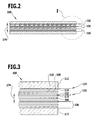
- FIG. 1 schematically illustrated, designated as a whole by 100 bipolar lead-acid battery comprises a negative end cell 102, a positive end cell 104, a bipolar cell 106 disposed between the negative end cell 102 and the positive end cell 104 and two each between the bipolar cell 106 and the negative end cell 102 and spacers (hereinafter referred to as "spacers") 108 disposed on the positive end cell 104.
- spacers spacers
- Each of the spacers 108 is substantially rectangular and frame-shaped (see 6 and 7 ) and surrounds a substantially rectangular, central passage opening 110, in which in the operating state of the bipolar lead acid battery 100 is a respective separator in the form of a (not shown in the figures) glass fiber mat is added, which is impregnated with an electrolyte, for example with sulfuric acid.
- the negative end cell 102 includes an outside end plate 112 (made of aluminum, for example), a negative plate 114 and a negative grid 116 facing the spacer 108 and the bipolar cell 106.
- the positive end cell 104 includes an outer end plate 112 (made of aluminum, for example), a positive plate 118 and a positive grid 120 facing the spacer 108 and the bipolar cell 106.
- the bipolar cell 106 includes a centrally located bipolar plate 122, a positive grid 120 facing the negative end cell 102, and a negative grid 116 facing the positive end cell 104.
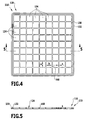
- each of these grids is provided with a plurality of approximately square passage openings 124 which are shown in FIG Operation of the bipolar lead-acid battery 100 are filled with a negative or a positive paste.
- the negative paste, with which the negative grid 116 is filled, contains in particular lead.
- the positive paste, with which the positive grid 120 is filled, contains in particular lead oxide.
- a negative grid 116 filled with negative paste, a spacer 108 with the separator in the form of an electrolyte-impregnated glass fiber mat and a positive grid 120 filled with positive paste together form a 2-volt electrochemical cell 126.
- bipolar lead acid battery 100 thus comprises two electrochemical 2-volt cells and thus has a nominal voltage of 4 volts.
- the bipolar lead acid battery 100 is supplemented with an additional bipolar cell 106 and an additional spacer 108 with separator between the negative end cell 102 and the positive end cell 104.
- Fig. 1 is provided to seal the electrolyte space between each spacer 108 and the respective adjacent negative grid 116 or positive grid 120 each have an annular peripheral sealing element 128.
- Each of these sealing elements 128 can be formed, for example, from a fluoroelastomer, in particular Viton.
- each negative grating 116 and each positive grating 120 on its end face 130 facing the respective adjacent spacer 108 has an annular groove 132 which extends annularly around the passage openings 124 of the respective grating (see FIGS 4 and 5 ).
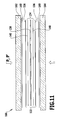
- Each bipolar plate 122 comprises a substrate 134, which is laminated on both sides with a metal-containing film 136 (see Fig. 11 ).
- the substrate 134 of the bipolar plate 122 can, as in Fig. 11 schematically illustrated, a centrally disposed carbon fiber nonwoven 138 and two on both sides of the carbon fiber nonwoven 138 laminated electrically conductive thermoplastic-compound films 140 include.
- the substrate 134 can also be formed from a single, electrically conductive thermoplastic-compound film 140.
- the proportion of the electrically conductive filler to the thermoplastic compound is preferably about 5 percent by weight to about 30 percent by weight.
- carbon black instead of carbon black, it is also possible, for example, to use carbon semolina made from electrographite, for example carbon semolina with the designation EG 31, which is marketed by SGL Carbon AG, Wiesbaden, Germany.
- thermoplastic material used is preferably a fluorothermoplastic material.
- Suitable fluorothermoplastic materials include PFA (perfluoroalkoxy copolymer), MFA (tetrafluoroethylene-perfluoromethylvinyl ether), FEP (fluoroethylene propylene), ETFE (ethylene tetrafluoroethylene), ECTFE (ethylene-chlorotrifluoroethylene), HTE (terpolymer made from the monomers hexafluoropropylene, tetrafluoroethylene and ethylene ), THV (tetrafluoroethylene-hexafluoropropylene-vinylidene fluoride), PVDF (polyvinylidene fluoride) and / or PFV (polyvinyl fluoride).
- PFA perfluoroalkoxy copolymer
- MFA tetrafluoroethylene-perfluoromethylvinyl ether
- FEP fluoroethylene propylene
- ETFE ethylene tetrafluoroethylene
- ECTFE ethylene
- melt-processable tetrafluoroethylene copolymer may also be used as the fluorothermoplastic material; such melt-processable tetrafluoroethylene copolymers are particularly useful in the WO 00/08071 A2 and in the WO 01/60911 A1 described.
- thermoplastics for example polypropylene.
- thermoplastic material and the electrically conductive filler are fused in a hot-pressing process ("hot-compression molding” method) into a solid bond between a polymer matrix and the filler.
- thermoplastic compound produced by mixing the thermoplastic material and the electrically conductive filler by the hot pressing process a block can be made, are then prepared by peeling films of the thermoplastic compound.
- the block of the thermoplastic compound can be made in particular in the form of a hollow cylinder.
- Typical thicknesses of the films made by peeling from the block are from about 0.05 mm to about 0.5 mm.
- thermoplastic compound can also be produced by the melt extrusion process.
- thermoplastic material and an electrically conductive filler For the preparation of the mixture of a thermoplastic material and an electrically conductive filler, a powder of the thermoplastic material and a powder of the electrically conductive filler in a commercial tumble mixer are introduced and by rotating the mixing vessel over a period of at least one hour at a rotational speed in Range from about 60 rpm to about 120 rpm, wherein preferably every minute the direction of rotation is changed.
- thermoplastic compound 142 produced by this mixing of the components is converted into an in Fig. 8 shown schematically, substantially hollow cylindrical die 144 is introduced, which is closed at its lower end by an end wall 146 which carries a along the longitudinal axis of the die 144 extending central mandrel 148.
- a ram 152 is slidably guided along the longitudinal axis 154 of the die 144.
- the powdery thermoplastic compound 142 is first pre-pressed at a ram pressure P1 of at least about 30 bar for a period of at least about three minutes (see Fig. 8 ).
- the temperature T is increased to a temperature of at least about 250 ° C for a period of, for example, about two hours, preferably to a temperature above the melting temperature of the thermoplastic material contained in the thermoplastic compound, and then over a holding period of maintained for at least about another 60 hours.
- the hot die 144 is removed from the sintering furnace 156 and again transferred to a press (see Fig. 10 ).
- the mold 144 with the polymer composition then cools within about six hours, for example, to an outside temperature of at most about 80 ° C.
- thermoplastic compound 142 melted into a composite is pushed out of the die 144, thus obtaining a hollow cylindrical shaped body 158.
- the hollow cylindrical molded body 158 is slid onto a profiled mandrel and clamped in a conventional peeling machine, as marketed for example by KELLER HCW GmbH, Ibbenbühren-Laggenbeck, Germany.
- the force transmission required for rotating the hollow-cylindrical shaped body 158 takes place by means of profiling on the mandrel surface from the rotating mandrel onto the shaped body 158.
- an electrically conductive thermoplastic compound film 140 is peeled off from the outer periphery of the molded body 158.
- the mixing of the components ETFE and carbon black takes place by turning the mixing vessel over a period of 90 minutes at a lower rotational speed of 75 rpm and an upper rotational speed of 90 rpm, with the direction of rotation being changed every minute.
- the mold with the pre-pressed mixture of ETFE and 20 percent by weight of carbon black contained therein is transferred to a sintering furnace 156.
- the temperature T is increased to 290 ° C over a period of two hours and then maintained for a further 72 hours.
- no pressure is exerted on the polymer mass.
- the hot die 144 is removed from the sintering furnace 156 and again transferred to a press. Applying a constant pressure P2 of 65 bar then cools the mold 144 with the polymer composition within 6 hours to an outside temperature of 60 ° C to 70 ° C.
- the polymer composition is extruded from the die 144 to obtain a hollow cylindrical molded article 158.
- the hollow cylindrical shaped body 158 of ETFE and 20 percent by weight carbon black is slid onto a profiled mandrel and clamped in a peeling machine from KELLER.
- a thermoplastic compound film 140 is peeled off from the outer periphery of the hollow cylindrical molded body 158.
- the peeling speed for film production is about 11 m / min.
- the film thickness for the production of the film 140 made of ETFE and 20 weight percent carbon black is about 100 microns.
- a protective film 160 between the above-described layer structure and an upper press plate 162 and a lower press plate 164 of the heated laminate press 166 is further introduced.
- This protective film 160 may, for example, consist of a fluoropolymer material, in particular of polytetrafluoroethylene (PTFE).
- PTFE polytetrafluoroethylene
- the heated laminate press 166 is evacuated to a final pressure of, for example, at most about 10 mbar.
- a starting pressure P is applied to the layers of the bipolar plate 122 to be laminated with each other by means of the pressing plates 162 and 164.
- the temperature of the layers to be laminated (by means of a hot oil flowing through the pressure plates 162 and 164) is raised from room temperature to a temperature of, for example, at least 250 ° C.
- the starting pressure is maintained for a period of, for example, at least 5 minutes.
- the contact pressure is increased from the starting pressure to a final pressure P 'of, for example, at least 200 N / cm 2 .
- the increased pressure is maintained at the elevated temperature for a hold time of, for example, at least 5 minutes.
- the temperature is lowered to, for example, at most 100 ° C during a cooling time of, for example, about 1.5 hours while maintaining the increased contact pressure of, for example, at least 200 N / cm 2 .
- the contact pressure is lowered to zero, the laminate press 166 ventilated and taken from the carbon fiber nonwoven 138, the electrically conductive thermoplastic-compound films 140 and the metal-containing films 136 laminate taken, which Bipolar plate 122 forms.
- the protective films 160 do not bond with the metal-containing films 136 and therefore remain behind in the laminate press 166.
- the above-mentioned films have a length of, for example, about 1,200 mm and a width of, for example, about 330 mm.
- a film of PTFE with a thickness of 100 ⁇ m is inserted between these films and the press plates 162, 164 of the laminate press 166 on both sides.
- the reinforcement of the electrically conductive thermoplastic-compound foils 140 with the carbon-fiber non-woven 138 results in a further increase in the conductivity of the bipolar plate 122.
- thermoplastic compound film 140 by downwardly forming the thermoplastic compound film 140 by means of a peeling process, allows the production of such highly-filled thermoplastic compound films 140 that rely on the use of a carbon fiber Non-woven fabric 138 can be dispensed with to improve the electrical conductivity of the substrate 134 of the bipolar plate 122.
- thermoplastic compound foils 140 and the carbon fiber nonwoven fabric 138 of FIG Fig. 1 schematically illustrated embodiment of a substrate 134 replaced by a single electrically conductive thermoplastic-compound film 140.
- the lamination process for making the bipolar plate 122 without the carbon fiber nonwoven 138 is performed as described above in the context of a carbon fiber nonwoven substrate 134.
- the application of the Pb layer on both sides of the bipolar plate 122 is carried out by using a Pb film after the lamination process.
- the alloy of the Pb film to stabilize against oxidation contains a small amount of tin (Sn), for example, a proportion of up to a maximum of about 5 weight percent Sn.
- thermoplastic compound film which need not have electrical conductivity, can be prepared in the same manner as described above for the electrically conductive thermoplastic-compound films 140 of the bipolar plate 122, but preferably with replacement of the electrically conductive filler a non-electrically conductive filler.
- thermoplastic compound films from which the grids 116 and 120 are produced in particular glass fibers, preferably short glass fibers of the E glass type, can be used.
- the negative grid 116 and the positive grid 120 may also be made by machining a film of unfilled thermoplastic material.
- the grids 116 and 120 may be made of the same thermoplastic material as the thermoplastic compound foils 140 of the bipolar plate 122; alternatively, however, other suitable materials for the grids 116 and 120 may be used.
- the grids 116 and 120 can in particular be made of a thermoplastic material, preferably polypropylene (PP) and / or polycarbonate (PC).
- PP polypropylene
- PC polycarbonate
- the mixing of the components ETFE and 20% by weight short glass fibers is carried out by rotating the mixing vessel over a period of 90 minutes at a lower rotational speed of 75 rpm and an upper rotational speed of 90 rpm, the direction of rotation being changed every minute.
- the die 144 with the pre-pressed mixture of ETFE and 20 weight percent short glass fibers contained therein is transferred to a sintering furnace 156.
- the temperature is increased to 310 ° C over a period of 2.3 hours and then held for a further 24 hours.
- the hot die 144 is removed from the sintering furnace 156 and again transferred to a press.
- the polymer composition is extruded from the die 144 to obtain a hollow cylindrical molded article 158.
- the hollow cylindrical shaped body 158 made of ETFE and 20 weight percent short glass fibers is slid onto a profiled mandrel and clamped in a peeling machine of the manufacturer KELLER.
- the peeling speed for film production is 11 m / min.
- ETFE's 20% by weight short fiberglass thermoplastic non-conductive thermoplastic compound film is used for the negative grating 116 (anode) and with a thickness of 1.2 mm for the positive grating 120 (cathode).
- thermoplastic compound foils produced in the manner described above by a hot pressing method and a peeling method negative grids 116 and positive grids 120 are machined with the contours shown in FIGS 4 and 5 produced.
- the length of a grid 116 or 120 is about 360 mm and the width of a grid 116 or 120 is about 325 mm, for example.
- the substantially square passage openings 124 of the grids 116, 120 have for example a length a of approximately 28 mm and a width b of likewise approximately 28 mm.
- the width s of the webs 168 between the passage openings 124 is for example about 3 mm.
- the outboard sides of the metal-containing films 136 of the bipolar plate 122 may be before or after lamination with the gratings 116 and 120 be subjected to a surface treatment.
- it may be provided to clean and roughen the outsides of the metal-containing films 136 by "sandblasting" using glass beads, alumina or dry ice (CO 2 ).
- the negative grid 116 and the positive grid 120 may also be directly melt-deposited on the bipolar plate 122 by injection molding or by transfer molding.
- the spacers 108 of the bipolar lead-acid battery 100 can be made of a film of a thermoplastic fluoropolymer material or of polytetrafluoroethylene (PTFE) by machining with the in the 6 and 7 shown outer contour can be produced.
- PTFE polytetrafluoroethylene
- the negative plate 114 of the negative end cell 102 of the bipolar lead-acid battery 100 comprises the same substrate 134 as the bipolar plate 122, but only on one side, namely on the negative grid 116 side facing the negative plate 114, with a metal-containing foil, such as a lead / Tin foil, provided.
- the negative plate 114 may be made of the substrate and the metal-containing foil by a lamination method according to the lamination method of the bipolar plate 122.
- the positive plate 118 of the positive end cell 104 of the bipolar lead-acid battery 100 comprises the same substrate 134 as the bipolar plate 122, but is only one-sided, namely on its side facing the positive grid 120, with a metal-containing foil, for example a lead / tin foil. Mistake.
- the positive plate 118 can be fabricated from the substrate and the metal-containing film by a laminating method corresponding to the laminating method for manufacturing the bipolar plate 122.
- the negative plate 114 of the negative end cell 102 may be connected to the negative grid 116 by a laminating method corresponding to the laminating method for manufacturing the bipolar integrated cell 106.
- the positive plate 118 of the positive end cell 104 may be connected to the positive grid 120 by a laminating method corresponding to the laminating method for manufacturing the bipolar integrated cell 106.
- the positive grids 120 of the bipolar cells 106 and the positive end cell 104 are filled with positive paste.
- the negative grids 116 of the bipolar cells 106 and the negative end cell 102 are filled with negative paste.
- bipolar cells 106 and spacers 108 with glass fiber mats and the negative end cell 102 and the positive end cell 104 in the in the Fig. 1 to 3 are assembled together, they are using a pressure in the Longitudinal direction 174 of the bipolar lead acid battery 100 pressed against each other and braced by suitable bracing devices in this position against each other.
- the electrolyte can be filled through the filling openings (not shown) in the spacers 108 into the glass fiber mats serving as separators.
- the bipolar lead acid battery 100 is ready for use and can be charged.
- spacers 108 and the negative gratings 116 as well as the positive gratings 120 are formed from a material containing thermoplastic material, successive spacers 108 and grids 116, 120 may be joined by welding into a cell stack in the longitudinal direction 174 of the bipolar lead acid battery 100.
- the sealing elements 128 between the spacers 108 and the same adjacent grids 116 and 120 may be omitted.
- the method described above for producing a bipolar lead acid battery 100 is particularly environmentally friendly and ensures a particularly high chemical resistance of the lead layers in the metal-containing films 136, in particular on the side of the lead layers facing the negative gratings (anode gratings) 116.
- bipolar design of the bipolar lead-acid battery 100 reduces the need for lead at the same power and thus leads to a particularly environmentally friendly end product.
Landscapes
- Chemical & Material Sciences (AREA)
- Chemical Kinetics & Catalysis (AREA)
- Electrochemistry (AREA)
- General Chemical & Material Sciences (AREA)
- Engineering & Computer Science (AREA)
- Manufacturing & Machinery (AREA)
- Composite Materials (AREA)
- Materials Engineering (AREA)
- Secondary Cells (AREA)
- Cell Separators (AREA)
- Battery Electrode And Active Subsutance (AREA)
Applications Claiming Priority (1)
| Application Number | Priority Date | Filing Date | Title |
|---|---|---|---|
| DE102008036318A DE102008036318A1 (de) | 2008-07-29 | 2008-07-29 | Verfahren zur Herstellung einer Bipolarzelle und Bipolarzelle für eine bipolare Batterie |
Publications (2)
| Publication Number | Publication Date |
|---|---|
| EP2157642A2 true EP2157642A2 (fr) | 2010-02-24 |
| EP2157642A3 EP2157642A3 (fr) | 2012-02-29 |
Family
ID=41264442
Family Applications (1)
| Application Number | Title | Priority Date | Filing Date |
|---|---|---|---|
| EP09166611A Withdrawn EP2157642A3 (fr) | 2008-07-29 | 2009-07-28 | Procédé de fabrication d'une cellule bipolaire et cellule bipolaire pour une batterie bipolaire |
Country Status (2)
| Country | Link |
|---|---|
| EP (1) | EP2157642A3 (fr) |
| DE (1) | DE102008036318A1 (fr) |
Cited By (4)
| Publication number | Priority date | Publication date | Assignee | Title |
|---|---|---|---|---|
| EP2613381A1 (fr) | 2012-01-04 | 2013-07-10 | Centurion Bipolair B.V. | Procédé de fabrication de cellule bipolaire et batterie bipolaire |
| EP2613393A1 (fr) | 2012-01-04 | 2013-07-10 | Centurion Bipolair B.V. | Batterie au plomb-acide bipolaire et procédé de fabrication |
| CN103560275A (zh) * | 2013-10-11 | 2014-02-05 | 河南超威电源有限公司 | 双极电池 |
| CN111883779A (zh) * | 2019-12-24 | 2020-11-03 | 湖北小凡智造科技有限公司 | 一种铅酸蓄电池的双极板及其蓄电池 |
Citations (3)
| Publication number | Priority date | Publication date | Assignee | Title |
|---|---|---|---|---|
| WO1998040920A2 (fr) | 1997-03-12 | 1998-09-17 | Nederlandse Organisatie Voor Toegepast-Natuurwetenschappelijk Onderzoek Tno | Procede pour fabriquer une plaque bipolaire |
| WO2000008071A2 (fr) | 1998-08-06 | 2000-02-17 | Omlidon Technologies Llc | (poly)tetrafluoroethylene pouvant etre traite par fusion |
| WO2001060911A1 (fr) | 2000-02-16 | 2001-08-23 | Omlidon Technologies Llc | Poly(tetrafluoroethylene) pouvant etre traite a l'etat fondu |
Family Cites Families (7)
| Publication number | Priority date | Publication date | Assignee | Title |
|---|---|---|---|---|
| JPS60150556A (ja) * | 1984-01-13 | 1985-08-08 | Japan Storage Battery Co Ltd | 鉛蓄電池用格子 |
| US4964878A (en) * | 1988-06-01 | 1990-10-23 | Electrosource, Inc. | Lead-acid rechargeable storage battery |
| FR2682536A1 (fr) * | 1991-10-14 | 1993-04-16 | Sorapec | Electrodes bipolaires pour accumulateur au plomb. |
| US5225292A (en) * | 1992-01-16 | 1993-07-06 | Globe-Union Inc. | Internally folded expanded metal electrode for battery construction |
| US5688615A (en) * | 1995-11-03 | 1997-11-18 | Globe-Union, Inc. | Bipolar battery and method of making same |
| US5800946A (en) * | 1996-12-06 | 1998-09-01 | Grosvenor; Victor L. | Bipolar lead-acid battery plates |
| DE69908386T2 (de) * | 1999-07-01 | 2003-11-27 | Squirrel Holdings Ltd., George Town | Bipolarelektrode für elektrochemische redox-reaktionen |
-
2008
- 2008-07-29 DE DE102008036318A patent/DE102008036318A1/de not_active Withdrawn
-
2009
- 2009-07-28 EP EP09166611A patent/EP2157642A3/fr not_active Withdrawn
Patent Citations (3)
| Publication number | Priority date | Publication date | Assignee | Title |
|---|---|---|---|---|
| WO1998040920A2 (fr) | 1997-03-12 | 1998-09-17 | Nederlandse Organisatie Voor Toegepast-Natuurwetenschappelijk Onderzoek Tno | Procede pour fabriquer une plaque bipolaire |
| WO2000008071A2 (fr) | 1998-08-06 | 2000-02-17 | Omlidon Technologies Llc | (poly)tetrafluoroethylene pouvant etre traite par fusion |
| WO2001060911A1 (fr) | 2000-02-16 | 2001-08-23 | Omlidon Technologies Llc | Poly(tetrafluoroethylene) pouvant etre traite a l'etat fondu |
Cited By (4)
| Publication number | Priority date | Publication date | Assignee | Title |
|---|---|---|---|---|
| EP2613381A1 (fr) | 2012-01-04 | 2013-07-10 | Centurion Bipolair B.V. | Procédé de fabrication de cellule bipolaire et batterie bipolaire |
| EP2613393A1 (fr) | 2012-01-04 | 2013-07-10 | Centurion Bipolair B.V. | Batterie au plomb-acide bipolaire et procédé de fabrication |
| CN103560275A (zh) * | 2013-10-11 | 2014-02-05 | 河南超威电源有限公司 | 双极电池 |
| CN111883779A (zh) * | 2019-12-24 | 2020-11-03 | 湖北小凡智造科技有限公司 | 一种铅酸蓄电池的双极板及其蓄电池 |
Also Published As
| Publication number | Publication date |
|---|---|
| EP2157642A3 (fr) | 2012-02-29 |
| DE102008036318A1 (de) | 2010-02-04 |
Similar Documents
| Publication | Publication Date | Title |
|---|---|---|
| DE602005002916T2 (de) | Separator zur Verwendung in einer Lithiumionensekundärbatterie | |
| DE112008002146B4 (de) | Zelle für Brennstoffzelle, und Brennstoffzelle | |
| DE10122366B4 (de) | Verfahren zum Herstellen einer Batteriezelle | |
| DE102021130262A1 (de) | Verfahren zur Herstellung von lösungsmittelfreien mehrschichtigen Elektroden | |
| EP1359633B1 (fr) | Elément galvanique avec des électrodes minces | |
| DE69716483T2 (de) | Verfahren zur herstellung einer bipolaren platte | |
| DE112014006933B4 (de) | Verfahren zum Herstellen einer Beschichtung aus Kohlenstoffpartikeln oder Metalloxidpartikeln mit Submikrongröße auf den Oberflächen von Partikeln aus einem aktiven Elektrodenmaterial für eine Lithium-Sekundärbatterie | |
| DE102018107321A1 (de) | Elektrische Zwischenverbindungen für Batteriezellen | |
| DE102022109368A1 (de) | Elektrodenbeschichtung unter verwendung eines porösen stromkollektors | |
| DE102013106114A1 (de) | Lithium-Ionen-Zelle für eine Sekundärbatterie | |
| DE69900713T2 (de) | Separatormaterial für Lithium-Akkumulatoren | |
| DE102016217369A1 (de) | Elektrode mit erhöhtem Aktivmaterialanteil | |
| EP2157641B1 (fr) | Procédé de fabrication d'une plaque bipolaire et plaque bipolaire pour une batterie bipolaire au plomb | |
| DE102016217383A1 (de) | Verfahren zur Herstellung von Elektroden mit verbesserter Stromsammlerstruktur | |
| DE112010006075B4 (de) | Brennstoffzelle und Herstellungsverfahren dafür | |
| EP1302993A2 (fr) | Procédé de fabrication d'une unité électrodes-séparateurs pour éléments galvaniques | |
| DE102008036318A1 (de) | Verfahren zur Herstellung einer Bipolarzelle und Bipolarzelle für eine bipolare Batterie | |
| EP1570113B1 (fr) | Procede de production de metaux etires revetus et utilisation de ces metaux en tant que derivateurs de courant dans des composants electrochimiques | |
| DE102023108210B3 (de) | Verfahren zur Herstellung einer Elektrolytschicht, die von einer im Trockenverfahren hergestellten Elektrodenschicht getragen ist | |
| DE19836651A1 (de) | Mehrschichtige Elektrode für elektrochemische Anwendungen | |
| KR101279174B1 (ko) | 2차 전지의 전극 구조 및 그 제조 방법 | |
| DE102008036320B4 (de) | Verfahren zur Herstellung einer Bipolarplatte und Bipolarplatte für eine bipolare Batterie | |
| WO2023280984A1 (fr) | Procédé amélioré de production de plaque polaire | |
| EP3614476A1 (fr) | Accumulateur lithium-ion à structure en sandwich et son procédé de fabrication | |
| DE102023131567B3 (de) | System zum herstellen von elektroden mit verbesserter kantenqualität und verfahren |
Legal Events
| Date | Code | Title | Description |
|---|---|---|---|
| PUAI | Public reference made under article 153(3) epc to a published international application that has entered the european phase |
Free format text: ORIGINAL CODE: 0009012 |
|
| AK | Designated contracting states |
Kind code of ref document: A2 Designated state(s): AT BE BG CH CY CZ DE DK EE ES FI FR GB GR HR HU IE IS IT LI LT LU LV MC MK MT NL NO PL PT RO SE SI SK SM TR |
|
| RIC1 | Information provided on ipc code assigned before grant |
Ipc: H01M 10/04 20060101ALI20110831BHEP Ipc: H01M 4/73 20060101ALI20110831BHEP Ipc: H01M 4/14 20060101AFI20110831BHEP Ipc: H01M 10/18 20060101ALI20110831BHEP Ipc: H01M 4/16 20060101ALI20110831BHEP |
|
| PUAL | Search report despatched |
Free format text: ORIGINAL CODE: 0009013 |
|
| AK | Designated contracting states |
Kind code of ref document: A3 Designated state(s): AT BE BG CH CY CZ DE DK EE ES FI FR GB GR HR HU IE IS IT LI LT LU LV MC MK MT NL NO PL PT RO SE SI SK SM TR |
|
| RIC1 | Information provided on ipc code assigned before grant |
Ipc: H01M 4/16 20060101ALI20120125BHEP Ipc: H01M 4/73 20060101ALI20120125BHEP Ipc: H01M 10/04 20060101ALI20120125BHEP Ipc: H01M 10/18 20060101ALI20120125BHEP Ipc: H01M 4/14 20060101AFI20120125BHEP |
|
| STAA | Information on the status of an ep patent application or granted ep patent |
Free format text: STATUS: THE APPLICATION IS DEEMED TO BE WITHDRAWN |
|
| 18D | Application deemed to be withdrawn |
Effective date: 20120830 |