EP2158953A2 - Vorrichtung, Verfahren und Programm zur Videospielverarbeitung - Google Patents
Vorrichtung, Verfahren und Programm zur Videospielverarbeitung Download PDFInfo
- Publication number
- EP2158953A2 EP2158953A2 EP09252057A EP09252057A EP2158953A2 EP 2158953 A2 EP2158953 A2 EP 2158953A2 EP 09252057 A EP09252057 A EP 09252057A EP 09252057 A EP09252057 A EP 09252057A EP 2158953 A2 EP2158953 A2 EP 2158953A2
- Authority
- EP
- European Patent Office
- Prior art keywords
- command
- player
- released
- video game
- player character
- Prior art date
- Legal status (The legal status is an assumption and is not a legal conclusion. Google has not performed a legal analysis and makes no representation as to the accuracy of the status listed.)
- Withdrawn
Links
Images


Classifications
-
- A63F13/10—
-
- A—HUMAN NECESSITIES
- A63—SPORTS; GAMES; AMUSEMENTS
- A63F—CARD, BOARD, OR ROULETTE GAMES; INDOOR GAMES USING SMALL MOVING PLAYING BODIES; VIDEO GAMES; GAMES NOT OTHERWISE PROVIDED FOR
- A63F13/00—Video games, i.e. games using an electronically generated display having two or more dimensions
- A63F13/50—Controlling the output signals based on the game progress
- A63F13/53—Controlling the output signals based on the game progress involving additional visual information provided to the game scene, e.g. by overlay to simulate a head-up display [HUD] or displaying a laser sight in a shooting game
- A63F13/537—Controlling the output signals based on the game progress involving additional visual information provided to the game scene, e.g. by overlay to simulate a head-up display [HUD] or displaying a laser sight in a shooting game using indicators, e.g. showing the condition of a game character on screen
-
- A63F13/12—
-
- A—HUMAN NECESSITIES
- A63—SPORTS; GAMES; AMUSEMENTS
- A63F—CARD, BOARD, OR ROULETTE GAMES; INDOOR GAMES USING SMALL MOVING PLAYING BODIES; VIDEO GAMES; GAMES NOT OTHERWISE PROVIDED FOR
- A63F13/00—Video games, i.e. games using an electronically generated display having two or more dimensions
- A63F13/30—Interconnection arrangements between game servers and game devices; Interconnection arrangements between game devices; Interconnection arrangements between game servers
-
- A—HUMAN NECESSITIES
- A63—SPORTS; GAMES; AMUSEMENTS
- A63F—CARD, BOARD, OR ROULETTE GAMES; INDOOR GAMES USING SMALL MOVING PLAYING BODIES; VIDEO GAMES; GAMES NOT OTHERWISE PROVIDED FOR
- A63F13/00—Video games, i.e. games using an electronically generated display having two or more dimensions
- A63F13/40—Processing input control signals of video game devices, e.g. signals generated by the player or derived from the environment
- A63F13/42—Processing input control signals of video game devices, e.g. signals generated by the player or derived from the environment by mapping the input signals into game commands, e.g. mapping the displacement of a stylus on a touch screen to the steering angle of a virtual vehicle
-
- A—HUMAN NECESSITIES
- A63—SPORTS; GAMES; AMUSEMENTS
- A63F—CARD, BOARD, OR ROULETTE GAMES; INDOOR GAMES USING SMALL MOVING PLAYING BODIES; VIDEO GAMES; GAMES NOT OTHERWISE PROVIDED FOR
- A63F13/00—Video games, i.e. games using an electronically generated display having two or more dimensions
- A63F13/45—Controlling the progress of the video game
-
- A—HUMAN NECESSITIES
- A63—SPORTS; GAMES; AMUSEMENTS
- A63F—CARD, BOARD, OR ROULETTE GAMES; INDOOR GAMES USING SMALL MOVING PLAYING BODIES; VIDEO GAMES; GAMES NOT OTHERWISE PROVIDED FOR
- A63F13/00—Video games, i.e. games using an electronically generated display having two or more dimensions
- A63F13/80—Special adaptations for executing a specific game genre or game mode
- A63F13/822—Strategy games; Role-playing games
-
- A—HUMAN NECESSITIES
- A63—SPORTS; GAMES; AMUSEMENTS
- A63F—CARD, BOARD, OR ROULETTE GAMES; INDOOR GAMES USING SMALL MOVING PLAYING BODIES; VIDEO GAMES; GAMES NOT OTHERWISE PROVIDED FOR
- A63F13/00—Video games, i.e. games using an electronically generated display having two or more dimensions
- A63F13/80—Special adaptations for executing a specific game genre or game mode
- A63F13/833—Hand-to-hand fighting, e.g. martial arts competition
-
- A—HUMAN NECESSITIES
- A63—SPORTS; GAMES; AMUSEMENTS
- A63F—CARD, BOARD, OR ROULETTE GAMES; INDOOR GAMES USING SMALL MOVING PLAYING BODIES; VIDEO GAMES; GAMES NOT OTHERWISE PROVIDED FOR
- A63F2300/00—Features of games using an electronically generated display having two or more dimensions, e.g. on a television screen, showing representations related to the game
- A63F2300/80—Features of games using an electronically generated display having two or more dimensions, e.g. on a television screen, showing representations related to the game specially adapted for executing a specific type of game
- A63F2300/8029—Fighting without shooting
Definitions
- the present invention relates to a technique for controlling progress of a video game.
- RPG Role Playing Game
- a technique for carrying out a play (battle) to another player operating another video game processing device such as a friend by utilizing a communication function such as wireless (radio) communication or wired (cable) communication (for example, see Patent Literature 1: Japanese Patent Application Publication No. 2005-6766 ).
- the present invention was conceived in consideration of the circumstances encountered in the prior art mentioned above, and it is an object of the present invention to provide a technique capable of preventing one sided battle and carrying out communication play in which a battle rich in variety is carried out.
- a video game processing device for controlling progress of a video game by displaying a player character operated by a player.
- the video game processing device according to the present invention includes a communicator configured to carry out data communication with any of other video game processing devices respectively operated by other players.
- the video game processing device also includes a command distributor configured to distribute commands to each of a plurality of other player characters operated by each of the other players of the other video game processing devices connected to each other by the communicator, each of the commands causing a predetermined special effect to the player character when the player instructs the video game processing device to execute the command.
- the video game processing device also includes a command releaser configured to perform a command releasing operation, at a time when a predetermined releasing condition is satisfied, in which by erasing one or more command from the commands retained by the player character the one or more command is released.
- the video game processing device also includes a command visualizer configured to visualize the released commands released by the command releaser as icons.
- the video game processing device also includes a distance determiner configured to determine a distance between each of the released command icons iconified by the command visualizer and the player character.
- the video game processing device also includes a command acquirer configured to cause the player character to newly retain any of the released commands in the case where the distance determiner determines that the player character exists inside a predetermined distance from the released command icon indicating the released command.
- the command distributor is configured to determine at random the commands to be retained by the player character.
- the command distributor may be configured to determine the commands to be retained by the player character so as not to overlap the command to be retained with any of the commands that have been distributed to each of the other player characters.
- the video game processing device may further include a command notifier configured to notify the player of only the commands distributed to the player character without notifying the player of the command distributed to each of the other player characters.
- the predetermined releasing condition may be satisfied at a time when a hit point of the player character becomes less than a predetermined value, the player character is attacked with a predetermined attack, or a predetermined time elapses for a battle time.
- the video game processing device may further include a level setter configured to set, at a time when the player character carries out a battle with the other player character operated by the other player in the other corresponding video game processing device with which a communication connection is established by the communicator, a level on the game for the player character so as to be commonly set to the player characters participating in the battle.
- a level setter configured to set, at a time when the player character carries out a battle with the other player character operated by the other player in the other corresponding video game processing device with which a communication connection is established by the communicator, a level on the game for the player character so as to be commonly set to the player characters participating in the battle.
- the distance determiner is configured to determine that a collision is caused when a coordinate region in which the released command icon is positioned or a collision determination region provided in a specific region from a central coordinate of the released command icon is overlapped with at least a portion of a coordinate position at which the player character is positioned.
- a video game processing method of controlling progress of a video game by displaying a player character operated by a player includes carrying out data communication with any of other video game processing devices respectively operated by other players.
- the video game processing method also includes distributing commands to each of a plurality of other player characters operated by each of the other players of the other video game processing devices connected to each other, each of the commands causing a predetermined special effect to the player character when the player instructs the video game processing device to execute the command.
- the video game processing method also includes performing a command releasing operation, at a time when a predetermined releasing condition is satisfied, in which by erasing one or more command from the commands retained by the player character the one or more command is released.
- the video game processing method also includes visualizing the released commands as icons.
- the video game processing method also includes determining a distance between each of the released command icons and the player character.
- the video game processing method also includes causing the player character to newly retain any of the released commands in the case where it is determined that the player character exists inside a predetermined distance from the released command icon indicating the released command.
- a video game processing program product for controlling progress of a video game by displaying player characters operated by players.
- the video game processing program product according to the present invention causes a computer to execute the steps carrying out data communication with any of other video game processing devices respectively operated by other players.
- the steps also include distributing commands to each of a plurality of other player characters operated by each of the other players of the other video game processing devices connected to each other, each of the commands causing a predetermined special effect to the player character when the player instructs the video game processing device to execute the command.
- the steps also include performing a command releasing operation, at a time when a predetermined releasing condition is satisfied, in which by erasing one or more command from the commands retained by the player character the one or more command is released.
- the steps also include visualizing the released commands as icons.
- the steps also include determining a distance between each of the released command icons and the player character.
- the steps also include causing the player character to newly retain any of the released commands in the case where it is determined that the player character exists inside a predetermined distance from the released command icon indicating the released command.
- FIG. 1 is a view showing a network relationship between a main player terminal and other player terminals
- FIG. 2 is a block diagram showing one example of a configuration of the main player terminal shown in FIG. 1 ;
- FIG. 3 is a flowchart showing one example of a battle process
- FIG. 4 is an explanation view showing one example of a of retained (owned) command data table
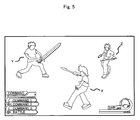
- FIG. 5 is an explanation view showing one example of a battle screen
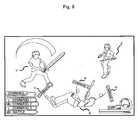
- FIG. 6 is an explanation view showing another example of the battle screen
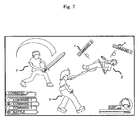
- FIG. 7 is an explanation view showing still another example of the battle screen.
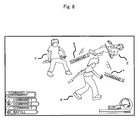
- FIG. 8 is an explanation view showing a further example of the battle screen.
- FIG. 1 is a block diagram showing a player terminal 100 representing one embodiment of a video game processing device according to the present invention and other player terminals 200 and 300 of the other video game processing devices each having a configuration similar to that of the player terminal 100.
- the player terminal 100 is managed by a user "A”.
- the player terminal 100 is operated or controlled by the user "A”, whereby the game proceeds in accordance with this operation.
- the player terminal 200 is managed by a user "B”.
- the player terminal 200 is operated or controlled by the user "B", whereby the game proceeds in accordance with this operation.
- the player terminal 300 is managed by a user "C”.
- the player terminal 300 is operated or controlled by the user "C”, whereby the game proceeds in accordance with this operation.
- Each of the player terminals 100, 200 and 300 has a communication function for carrying out wireless communication.
- various information processing devices such as portable game equipments, install-type game equipments, computer devices, portable phones and the like may be applicable.
- FIG. 2 is a block diagram showing a configuration example of the player terminal 100.
- the player terminal 100 includes a game program read-out unit 10, a control unit 11, a storage unit 12, an infrared ray transmitting/receiving unit 13, a display unit 14, a voice output unit 15, and a player operation receiving unit 16.
- the player terminals 200 and 300 also include substantially the same units as mentioned above.
- the game program read-out unit 10 detachably receives a game cartridge 20 in which a memory medium for storing a game program is embedded.
- the game program read-out unit 10 serves to read out a necessary game program from the memory medium in the inserted game cartridge 20.
- the memory medium embedded in the game cartridge 20 is one in which a video game program classified to the RPG is stored.
- the control unit 11 serves to execute the game program read out by the game program read-out unit 10 and cause the video game to proceed in response to operations of the player, i.e., the player "A" in this embodiment.
- the storage unit 12 is a memory medium for storing the game program or data necessary for progress of the video game.
- the storage unit 12 is composed of a nonvolatile memory such as a RAM.
- various kinds of information such as a retained command data table in which retained command data set and updated at a time when a communication play with the other terminals 200 and 300 is carried out are included are stored, which will be described later.
- the infrared ray transmitting/receiving unit 13 serves to transmit and receive the infrared ray for the communication with the player terminals 200, 300.
- the display unit 14 displays a play condition on a game screen in accordance with progress of the game or operations by the player under the control of the control unit 11.
- the display unit 14 is composed of a liquid crystal device, for example.
- the voice output unit 15 outputs voice (audio) in accordance with progress of the game or operations by the player under the control of the control unit 11.
- the player operation receiving unit 16 includes a plurality of buttons and the like and is operated by the operations of the user "A".
- the control unit 11 is informed of a result thereof.
- the player terminal 100 of the present embodiment adopts a system for reading out the game program from the game cartridge 20.
- the player terminal 100 may be configured so that the game program is downloaded by means of wireless or wired communication.
- FIG. 3 is a flowchart showing one example of a battle process executed by the player terminal 100.
- the case where the communication play or battle is executed among the player terminals 100, 200 and 300, in which a player character "X" operated by the user "A” in the player terminal 100, a player character “Y” operated by the user “B” in the player terminal 200, and a player character “Z” operated by the user "C” in the player terminal 300 are battled in a predetermined battle field will be explained as one example.
- Step S101 a communication with the other player terminal through the infrared ray transmitting/receiving unit 13 is established by the control unit 11 (Step S101).
- the control unit 11 controls the infrared ray transmitting/receiving unit 13 so as to establish the communication between the player terminal 100 and each of the player terminals 200, 300.
- the communication between the player terminals 200 and 300 is established by the control units 11 in the same manner. Further, it is to be noted that the establishment of the communication may be achieved by a known technique.
- the control unit 11 requires to carry out the communication play to the player terminals 200 and 300 in the case where the operation of the user "A" received by the player operation receiving unit 16 indicates a communication play requirement (Step S102).
- the "communication play requirement” is a requirement for carrying out the communication play of the player character "X” to the player character “Y” operated by the user “B” in the player terminal 200 or the player character “Z” operated by the user “C” in the player terminal 300.
- control unit 11 causes the display unit 14 to display a selection button which can select the "communication play requirement", for example, on the game screen displayed in the display unit 14 in the case where the communication is established between the player terminal 100 and each of the player terminals 200 and 300. Then, at Step S102, the control unit 11 executes the communication play requirement to the player terminals 200 and 300 in accordance with the reception of a push-down operation of the selection button by means of the player operation receiving unit 16.
- the player terminals 200 and 300 receiving the communication play requirement from the player terminal 100 carry out confirmation display, on the game screens displayed in the display units 14 provided in the respective player terminals 200 and 300, for confirming whether the communication play requirement from the player character "X" operated by the user "A" of the player terminal 100 is accepted or not.
- the communication play "OK” is made as a response to the requirement.
- the communication play "NG” is made as a response to the requirement.
- Step S104 a level setting process for setting a level of the player character "X” is carried out
- Step S105 a command to be retained by the player character "X” is determined and distributed (or given)
- the levels of all the player characters participating in the communication play can be made uniform to thereby preliminarily avoid possibility of causing a case such that, in a battle between players having a large difference in their levels, one of the players feels insufficiency or the other of the players losses win without amusing the battle, and this makes possible to carry out the battle under approximately fair condition even if the battle is done between players who meet first with each other.
- a plurality of motion patterns are distributed (or given) to each of the player characters.
- the setting is made such that as the level of the player character increases, many commands are acquired and the selection of the motion patterns is thereby widened, or the level of the even the same command also increases in accordance with increase of the level of the player character, whereby an effect at a time of activating such a command is increased.
- the battle is caused to start after distributing the same number of plural kinds of commands to each of the player characters at timing to start the play, for example.
- the commands to be distributed may be randomly determined by weighting the amusement in the game or distribute a set of preliminarily prepared commands relatively favorable in the battle or a set of preliminarily prepared commands relatively unfavorable in the battle, whereby somewhat advantage or disadvantage may be provided to the contents of the commands to be distributed.
- the control unit 11 may shuffle plural kinds of commands and then distribute them to the players. At this time, by mixing ones which are extremely available for the battle or play in the contents of the commands to be distributed, an amusement in change may be increased even at the time of merely distributing the commands.
- the card in the trump game it may take a system in which it is not made apparent what contents of commands are distributed to what player characters other than the contents distributed to the own player. By adopting such a system, it is possible to obtain an amusement of assuming, in progress of the game and the battle, what player characters retain what contents of commands.
- the control unit 11 determines, at Step S105, the commands (retained command data) to be retained by the player character "X” and registers them to a retained command data table. Further, the control unit 11 receives notification of the commands to be retained by the player characters "Y” and “Z” from the player terminals 200 and 300, respectively, and then sets the commands in the retained command data table in the similar manner mentioned above.
- FIG. 4 is an explanation view showing an example of the retained command data table.
- the retained command data table is a table in which command retained data distributed and retained by the respective player characters "X", "Y” and “Z” are stored. The commands shown by the retained command data registered in the retained command data table become usable for the respective player characters "X", "Y” and "Z” in the communication play.
- Command 1 in the table is an essential command for the battle such as "fight”, which is determined as an "essential command”, necessarily distributed to each of the player characters and is never released. This is because the player character is prevented from falling in a substantially battle-impossible condition by taking out all the commands by the other players in the case where "scramble of commands", which will be explained hereinafter, is executed.
- the player terminal 100 causes the display unit 14 to display only the retained commands of the player character "X" available in inspection in the case where the retained command browsing requirement is received from the player "A".
- the control unit 11 When the retained commands are distributed, the control unit 11 discloses a battle in a predetermined field (Step S106). During the battle, the control unit 11 receives, for example, the selection of the retained command of the player character "X" from the player "A” and executes play or operation in accordance with the selection of the retained command. Furthermore, the control unit 11 executes a subtraction process of an HP (Hit Point) of the player character "X" in accordance with damage applied to the player character "X".
- HP Home Point
- the control unit 11 monitors whether the HP of the player character "X" becomes less than a predetermined threshold value "X" or not (Step S107), whether the retained commands of the other player characters "Y” and “Z” are released or not (Step S108), and whether the battle is terminated or not (Step S109).
- the control unit 11 determines that the battle is terminated at a time when a predetermined battle time elapses, when the HPs of all the characters other than any one player character becomes zero (0) (i.e., they become a battle-impossible condition), or when any one of the players "A", "B” and “C” carries out a battle ending operation ("Yes" at Step S109).
- Step S110 the control unit 11 determines one or more command to be released (hereinafter, referred to as a "released command") from the commands retained by the player character "X" by referring to the retained command data table.
- the control unit 11 erases the released command from the retained commands of the player character "X", and performs a command releasing operation in which an icon indicating the released command (hereinafter, referred to as a "released command icon”) splashes around the player character "X" on the battle screen displayed in the display unit 14.
- the number of commands to be released may always be determined or may be determined in accordance with strength of finally applied attack, the degree of lowering less than the threshold value of the HP or the like. Otherwise, interest or taste may be enhanced by randomly determining the number of commands to be released every time.
- the selection as to what command is to be released may be made, after the number of commands to be released has been determined, in accordance with the ascending order (or descending order) of frequency in use, the ascending order (or descending order) of offensive power, the alphabetic order of the command names or the like. Otherwise, the selection may be made at random every time.
- the state that the released command icons are respectively splashed around the player characters "Y” and “Z” is also displayed in the display unit 14 in the similar manner mentioned above. More specifically, in the case where the HP of the player character “Z” becomes less than the threshold value "X" by the attack of the player character "X”, in the command releasing operation, for example, as shown in FIG. 7 , the state that the released command icons "d” and "e” are splashed around the player character "Z” is displayed in the display unit 14.
- the splashed released command icons are displayed so as to be fixed within the battle screen (i.e., fixed at a predetermined coordinate position in the game field or game space) or so as to be moved (i.e., so that the coordinate position is moved in the game field or game space).
- Step S111 the control unit 11 executes the controlling of the collision determination "ON” state (Step S111).
- the control unit 11 is in a state of tracing the position coordinates about all the splashed released command icons and monitoring whether a part of each of the player characters enters a coordinate range in which any of the released command icons is positioned or a collision determination range provided in a specific range from the central coordinate of each of the released command icons. In this case, the control unit 11 determines a distance between each of the released command icons and the player character "X".
- the respective player characters "X”, “Y”, and “Z” move toward positions at which the released command icons are splashed for picking up the splashed released command icons to acquire the released commands in accordance with operations of the players "A", “B” and “C”, as shown in FIG. 8 .
- any of the player characters by oneself can pick up the released commands that have been released by oneself. According to such settings, it is possible to increase participants of a pick-up battle of the released commands, and it can be expected that amusement in battle increases.
- the player terminal may be configured to control so that each player character cannot acquire the released command that have been released by oneself.
- the player character of which command has been released does not participate in the pick-up battle of the released command until a predetermined time elapses, by which the setting may be adjusted such that the other player can acquire the command released by oneself more easily than the player character reacquires it.
- the control may be executed so that only the player character that carries out an attack causing the commands to be released can pick up the released commands.
- each of the released command icons "d” and “e” splashed due to the fact that the HP of the player character “Z” becomes less than the threshold value by the attack of the player character “Y” becomes the collision determination "ON” state.
- it is determined that a portion of the body of the player character enters a display region of the icon that is, collision determination is carried out
- it is determined what player character collides with it and the corresponding command is added to the retained commands of the determined player character.
- the control unit 11 determines that the player character "X” collides with the released command icon ("Yes" at Step S112).
- the control unit 11 then erases the collided released command icon from the battle screen, and adds the command indicated by the collided released command icon to the retained commands of the player character "X" (Step S113). Namely, in the case where it is determined that the player character "X" exists inside a predetermined distance from the released command icon indicating the released command, the player character "X" is caused to newly retain the released command.
- Step S114 Thereafter, in the case where each of the commands indicated by the released command icons is retained in any of the player characters and all the released command icons are thereby erased ("Yes” at Step S114), the control unit 11 executes the controlling of the collision determination "OFF" and releases the collision monitoring state (Step S115). The control unit 11 then causes the processing flow to shift to the process of Step S107.
- the video game processing device is configured so that the control relating to each of the player characters "X”, “Y” and “Z” is carried out by the corresponding player terminal 100, 200 or 300, for example, it may be configured so that the player terminal 100 functions as a server to carry out the control relating to the respective player characters "X", "Y” and "Z" as a whole.
- the video game processing device may be configured so that the battle is continued even if the pick-up battle of the command is carried out and the attack and the like can be made even in the state that the command is being released.
- the video game processing device for controlling the progress of the video game by displaying the player characters "X" operated by the player “A” is configured so as to have a communication establishment function for establishing the communication connection for carrying out the data communication with the other video game processing devices (player terminals 200, 300), that is, to carry out data communication with any of other video game processing devices (player characters 200, 300) respectively operated by the other players "B", "C".
- the communication connection is established, when the player character "X” carries out the battle with the other player characters "Y” and “Z” operated by the other players "B", “C", the retained command to be retained by the player character "X" is applied (or distributed) to the player character "X".
- each of the commands causes a predetermined special effect to the player character "X" when the player "A” instructs the video game processing device (player terminal 100) to execute the command.
- the command releasing operation in which by erasing one or more command from the commands retained by the player character "X” the one or more command is released is performed. Namely, one or more retained command retained by the player character "X” is deleted from the commands retained by the player character "X”, thus releasing the retained command.
- the command releasing operation in which the released command icon representing the command released from the player character "X" is splashed within the screen, is performed.
- a distance between each of the released command icons released by the player characters "Y” and "Z” and the player character “X” is determined. Namely, the collision determination, in which in the other video game processing device, it is determined whether the released command icons representing the commands released from the other player characters "Y” and “Z” as well as the player character “X” are collided with the player character "X" on the battle screen or not, is executed. In accordance with the determination such that the player character "X" collides with any of the released command icons by the collision determination, the collided released command icon is erased from the battle screen, and the command represented by the collided released command icon is applied (or distributed) to the player character "X" as command to be retained by the player character "X".
- the present invention has the feature in which newly retained command is distributed without using a command beforehand retained, so that it becomes possible to take balance between the retained commands retained by the respective player characters.
- the commands applied (or distributed) at the battle starting time can be released if the predetermined releasing conditions are satisfied, and the released commands can be acquired by the other player character. Therefore, the communication play in which the battle rich in variety is developed can be carried out.
- the video game processing device (player terminal 100) has the feature to notify the player "A” of only the retained commands distributed to the player character "X” without notifying the player "A” of the retained commands distributed to the other player characters "Y” and "Z".
- the player "A” of the player character "X” from being notified what kinds of commands are distributed to the other player characters "Y” and "Z”. Therefore, since the battle can be controlled while predicting the command retained by the counter player, the communication play in which the battle rich in variety is developed can be carried out.
- the video game processing device may be configured so that, for example, when the player character is attacked with a predetermined attack (for example, an attack using a specific command for releasing the command) or when the predetermined time elapses for the battle time, the predetermined releasing condition is satisfied.
- a predetermined attack for example, an attack using a specific command for releasing the command
- the predetermined time elapses for the battle time
- the video game processing device player terminal 100
- the video game processing device player terminal 100
- the level on the game for the player character "X” is set so as to be commonly set to the player characters participating in the battle.
- the levels on the game of the respective player characters "X", "Y” and “Z” that carry out the battle play can be made uniform, thereby controlling the game so as to carry out the communication play without causing one sided battle.
- the video game processing device determines that the collision is caused at a time when the coordinate range in which the released command icon is positioned or the collision determination region provided in the specific range from the central coordinate of the released command icon is overlapped with at least a portion of the coordinate position at which the player character "X" is positioned, and according to this determination, the player character "X" is caused to retain the command represented by the released command icon. Therefore, the command corresponding to the player character that first reaches the position at which the released command icon is splashed can be distributed to the player character, thereby easily making determination in a pick-up battle of the released command.
- the respective player terminals 100, 200 and 300 are configured so as to carry out short distance communication by means of infrared ray, any other communication method may be adopted. Further, there may be also adopted a method in which game information is delivered to the respective player terminals 100, 200 and 300 from an online video game control server.
- control may be made so that only the player character having a specific command (for example, a "command scramble” command) can divest (or acquire) the released command.
- a specific command for example, a "command scramble” command
- this "command scramble” command is vanished if it is used for predetermined times or vanished as a specified time elapses after acquiring the command. Furthermore, concerning the acquisition of the "command scramble” command, it may suddenly appear on the battle screen during the battle so as to be taken on a first-come-first-served basis. Moreover, as a so-called hidden item, the "command scramble” command may be acquired by taking a specific action at a specific portion.
- the present invention is not limited to this example.
- the present invention can be applied to any other video games than the RPG so long as a battle is carried out using a command.
- the video game processing device executes the various processes described above in accordance with a control program (video game processing program) stored in the database provided for itself.
Landscapes
- Engineering & Computer Science (AREA)
- Multimedia (AREA)
- Physics & Mathematics (AREA)
- Optics & Photonics (AREA)
- Human Computer Interaction (AREA)
- User Interface Of Digital Computer (AREA)
- Input From Keyboards Or The Like (AREA)
Applications Claiming Priority (1)
| Application Number | Priority Date | Filing Date | Title |
|---|---|---|---|
| JP2008219191A JP2010051514A (ja) | 2008-08-28 | 2008-08-28 | ビデオゲーム処理装置、ビデオゲーム処理方法、およびビデオゲーム処理プログラム |
Publications (2)
| Publication Number | Publication Date |
|---|---|
| EP2158953A2 true EP2158953A2 (de) | 2010-03-03 |
| EP2158953A3 EP2158953A3 (de) | 2010-12-22 |
Family
ID=41351693
Family Applications (1)
| Application Number | Title | Priority Date | Filing Date |
|---|---|---|---|
| EP09252057A Withdrawn EP2158953A3 (de) | 2008-08-28 | 2009-08-25 | Vorrichtung, Verfahren und Programm zur Videospielverarbeitung |
Country Status (3)
| Country | Link |
|---|---|
| US (1) | US8317621B2 (de) |
| EP (1) | EP2158953A3 (de) |
| JP (1) | JP2010051514A (de) |
Families Citing this family (8)
| Publication number | Priority date | Publication date | Assignee | Title |
|---|---|---|---|---|
| JP5503672B2 (ja) | 2012-01-31 | 2014-05-28 | 株式会社スクウェア・エニックス | ゲームシステム |
| JP5546572B2 (ja) | 2012-03-29 | 2014-07-09 | 株式会社スクウェア・エニックス | ビデオゲーム処理装置、およびビデオゲーム処理プログラム |
| JP5695621B2 (ja) * | 2012-09-19 | 2015-04-08 | 株式会社バンダイナムコゲームス | プログラム、ゲーム装置及びサーバ |
| JP5746291B2 (ja) * | 2013-09-05 | 2015-07-08 | 株式会社バンダイナムコエンターテインメント | プログラム及びゲームシステム |
| JP6184634B1 (ja) | 2017-04-19 | 2017-08-23 | 株式会社 ディー・エヌ・エー | 情報処理装置、ゲームプログラム、及び、情報処理方法 |
| JP6885590B2 (ja) * | 2017-06-30 | 2021-06-16 | 株式会社 ディー・エヌ・エー | 情報処理装置、ゲームプログラム、及び、情報処理方法 |
| JP6513840B2 (ja) * | 2018-01-25 | 2019-05-15 | グリー株式会社 | サーバ、サーバの制御方法、及びプログラム |
| JP7718680B2 (ja) * | 2021-06-30 | 2025-08-05 | 株式会社コナミデジタルエンタテインメント | ゲームシステム、ゲーム制御装置及びプログラム |
Citations (2)
| Publication number | Priority date | Publication date | Assignee | Title |
|---|---|---|---|---|
| JP2005006766A (ja) | 2003-06-17 | 2005-01-13 | Nintendo Co Ltd | ゲームシステム、ゲーム装置およびゲームプログラム |
| JP2008219191A (ja) | 2007-02-28 | 2008-09-18 | Kyocera Kinseki Corp | 圧電発振器 |
Family Cites Families (13)
| Publication number | Priority date | Publication date | Assignee | Title |
|---|---|---|---|---|
| JPH10333834A (ja) * | 1997-05-30 | 1998-12-18 | Namco Ltd | 情報記憶媒体及び画像生成装置 |
| JP3551856B2 (ja) * | 1999-09-08 | 2004-08-11 | セイコーエプソン株式会社 | 仮想的な世界を表示するシステムおよび方法 |
| JP2002210235A (ja) * | 2001-01-24 | 2002-07-30 | Square Co Ltd | ビデオゲームシステムおよびその制御方法、ならびにビデオゲームのプログラムおよびそのプログラムを記録したコンピュータ読取り可能な記録媒体。 |
| JP4955160B2 (ja) * | 2001-08-21 | 2012-06-20 | ヤフー株式会社 | 対戦型ネットワークゲームシステム |
| JP3482602B2 (ja) | 2001-08-21 | 2003-12-22 | コナミ株式会社 | 対戦型ゲームのプログラム |
| JP2003079941A (ja) * | 2001-09-14 | 2003-03-18 | Square Co Ltd | ビデオゲームのプログラムを記録したコンピュータ読み取り可能な記録媒体及びビデオゲームのプログラム及びビデオゲーム処理方法及びビデオゲーム処理装置 |
| JP3990252B2 (ja) * | 2002-10-15 | 2007-10-10 | 株式会社バンダイナムコゲームス | ゲームシステム、プログラム及び情報記憶媒体 |
| JP4804240B2 (ja) * | 2006-06-22 | 2011-11-02 | 日本電信電話株式会社 | シューティングゲームの敵機攻撃制御方法、その装置、そのプログラム及びその記録媒体 |
| JP4340725B2 (ja) * | 2006-10-31 | 2009-10-07 | 株式会社スクウェア・エニックス | ビデオゲーム処理装置、ビデオゲーム処理方法およびビデオゲーム処理プログラム |
| JP4651604B2 (ja) * | 2006-11-16 | 2011-03-16 | 株式会社スクウェア・エニックス | ビデオゲーム処理装置、およびビデオゲーム処理プログラム |
| JP4137156B2 (ja) * | 2006-12-04 | 2008-08-20 | 株式会社スクウェア・エニックス | ビデオゲーム処理装置、ビデオゲーム処理方法、およびビデオゲーム処理プログラム |
| JP4137157B2 (ja) * | 2006-12-07 | 2008-08-20 | 株式会社スクウェア・エニックス | ビデオゲーム処理装置、ビデオゲーム処理方法、およびビデオゲーム処理プログラム |
| JP4410809B2 (ja) * | 2007-05-25 | 2010-02-03 | 株式会社スクウェア・エニックス | ビデオゲーム装置、ビデオゲーム処理プログラム及びプログラム記録媒体 |
-
2008
- 2008-08-28 JP JP2008219191A patent/JP2010051514A/ja active Pending
-
2009
- 2009-08-24 US US12/546,105 patent/US8317621B2/en active Active
- 2009-08-25 EP EP09252057A patent/EP2158953A3/de not_active Withdrawn
Patent Citations (2)
| Publication number | Priority date | Publication date | Assignee | Title |
|---|---|---|---|---|
| JP2005006766A (ja) | 2003-06-17 | 2005-01-13 | Nintendo Co Ltd | ゲームシステム、ゲーム装置およびゲームプログラム |
| JP2008219191A (ja) | 2007-02-28 | 2008-09-18 | Kyocera Kinseki Corp | 圧電発振器 |
Also Published As
| Publication number | Publication date |
|---|---|
| US8317621B2 (en) | 2012-11-27 |
| EP2158953A3 (de) | 2010-12-22 |
| JP2010051514A (ja) | 2010-03-11 |
| US20100056282A1 (en) | 2010-03-04 |
Similar Documents
| Publication | Publication Date | Title |
|---|---|---|
| US8317621B2 (en) | Video game processing device, video game processing method and video game processing program | |
| US8858314B1 (en) | Video game with expedited combat | |
| US20130288766A1 (en) | Game device, game system, control method, and program | |
| JP6547035B1 (ja) | ゲームプログラム、方法、および情報処理装置 | |
| US8951126B2 (en) | Game system | |
| US9669308B2 (en) | Non-transitory computer readable recording medium, game server, and control method | |
| JP5467174B1 (ja) | 情報処理装置、及び、ゲームプログラム | |
| JP6159459B1 (ja) | ゲームプログラム、方法および情報処理装置 | |
| JP2018051263A (ja) | ゲームプログラム、方法、および情報処理装置 | |
| US20190299099A1 (en) | Storage medium having stored therein information processing program, information processing apparatus, information processing system, and information processing method | |
| JP6480039B1 (ja) | ゲームプログラム、方法、および情報処理装置 | |
| JP2019150721A (ja) | ゲームプログラム、方法、および情報処理装置 | |
| JP5687380B1 (ja) | 端末装置 | |
| JP2019092655A (ja) | ゲームプログラム、方法、および情報処理装置 | |
| JP7136715B2 (ja) | ゲームプログラム、方法、および情報処理装置 | |
| JP2017209574A (ja) | ゲームプログラム、方法及び情報処理装置 | |
| JP6547015B1 (ja) | ゲームプログラム、方法、および情報処理装置 | |
| JP6209245B1 (ja) | ゲームプログラム、方法及び情報処理装置 | |
| JP7094914B2 (ja) | ゲームプログラム、方法、および情報処理装置 | |
| JP2018086409A (ja) | ゲームプログラム、方法、および情報処理装置 | |
| US9017166B2 (en) | Matching network game players by giving the perception of being the first to request participation | |
| JP2016024803A (ja) | 端末装置 | |
| JP2019122493A (ja) | ゲームプログラム、方法、および情報処理装置 | |
| JP2018057822A (ja) | ゲームプログラム、方法および情報処理装置 | |
| JP2018057424A (ja) | ゲームプログラム、方法および情報処理装置 |
Legal Events
| Date | Code | Title | Description |
|---|---|---|---|
| PUAI | Public reference made under article 153(3) epc to a published international application that has entered the european phase |
Free format text: ORIGINAL CODE: 0009012 |
|
| AK | Designated contracting states |
Kind code of ref document: A2 Designated state(s): AT BE BG CH CY CZ DE DK EE ES FI FR GB GR HR HU IE IS IT LI LT LU LV MC MK MT NL NO PL PT RO SE SI SK SM TR |
|
| AX | Request for extension of the european patent |
Extension state: AL BA RS |
|
| PUAL | Search report despatched |
Free format text: ORIGINAL CODE: 0009013 |
|
| AK | Designated contracting states |
Kind code of ref document: A3 Designated state(s): AT BE BG CH CY CZ DE DK EE ES FI FR GB GR HR HU IE IS IT LI LT LU LV MC MK MT NL NO PL PT RO SE SI SK SM TR |
|
| AX | Request for extension of the european patent |
Extension state: AL BA RS |
|
| RIC1 | Information provided on ipc code assigned before grant |
Ipc: A63F 13/12 20060101AFI20091205BHEP Ipc: A63F 13/10 20060101ALI20101118BHEP |
|
| 17P | Request for examination filed |
Effective date: 20110622 |
|
| 17Q | First examination report despatched |
Effective date: 20170613 |
|
| STAA | Information on the status of an ep patent application or granted ep patent |
Free format text: STATUS: THE APPLICATION HAS BEEN WITHDRAWN |
|
| 18W | Application withdrawn |
Effective date: 20170707 |