EP2158954A1 - Verdampfungsgerät, verdampfungsverfahren und verfahren zur herstellung von methacrolein oder (meth)acrylsäure - Google Patents
Verdampfungsgerät, verdampfungsverfahren und verfahren zur herstellung von methacrolein oder (meth)acrylsäure Download PDFInfo
- Publication number
- EP2158954A1 EP2158954A1 EP08752785A EP08752785A EP2158954A1 EP 2158954 A1 EP2158954 A1 EP 2158954A1 EP 08752785 A EP08752785 A EP 08752785A EP 08752785 A EP08752785 A EP 08752785A EP 2158954 A1 EP2158954 A1 EP 2158954A1
- Authority
- EP
- European Patent Office
- Prior art keywords
- raw material
- liquid raw
- evaporation
- evaporator
- gas
- Prior art date
- Legal status (The legal status is an assumption and is not a legal conclusion. Google has not performed a legal analysis and makes no representation as to the accuracy of the status listed.)
- Withdrawn
Links
- 238000001704 evaporation Methods 0.000 title claims abstract description 161
- 230000008020 evaporation Effects 0.000 title claims abstract description 132
- 238000000034 method Methods 0.000 title claims description 44
- STNJBCKSHOAVAJ-UHFFFAOYSA-N Methacrolein Chemical compound CC(=C)C=O STNJBCKSHOAVAJ-UHFFFAOYSA-N 0.000 title claims description 10
- CERQOIWHTDAKMF-UHFFFAOYSA-N Methacrylic acid Chemical compound CC(=C)C(O)=O CERQOIWHTDAKMF-UHFFFAOYSA-N 0.000 title claims description 9
- 239000007788 liquid Substances 0.000 claims abstract description 176
- 239000002994 raw material Substances 0.000 claims abstract description 124
- 238000010438 heat treatment Methods 0.000 claims abstract description 105
- 238000006555 catalytic reaction Methods 0.000 claims abstract description 46
- 230000020169 heat generation Effects 0.000 claims abstract description 20
- 238000012856 packing Methods 0.000 claims abstract description 11
- 238000007599 discharging Methods 0.000 claims abstract description 9
- HGINCPLSRVDWNT-UHFFFAOYSA-N Acrolein Chemical compound C=CC=O HGINCPLSRVDWNT-UHFFFAOYSA-N 0.000 claims description 50
- XLYOFNOQVPJJNP-UHFFFAOYSA-N water Chemical compound O XLYOFNOQVPJJNP-UHFFFAOYSA-N 0.000 claims description 44
- DKGAVHZHDRPRBM-UHFFFAOYSA-N Tert-Butanol Chemical compound CC(C)(C)O DKGAVHZHDRPRBM-UHFFFAOYSA-N 0.000 claims description 27
- 238000007664 blowing Methods 0.000 claims description 19
- 238000004519 manufacturing process Methods 0.000 claims description 6
- 239000000203 mixture Substances 0.000 description 35
- 238000006243 chemical reaction Methods 0.000 description 33
- 239000007789 gas Substances 0.000 description 30
- 238000007254 oxidation reaction Methods 0.000 description 24
- 230000007246 mechanism Effects 0.000 description 22
- 230000003197 catalytic effect Effects 0.000 description 21
- 239000003054 catalyst Substances 0.000 description 17
- VQTUBCCKSQIDNK-UHFFFAOYSA-N Isobutene Chemical compound CC(C)=C VQTUBCCKSQIDNK-UHFFFAOYSA-N 0.000 description 12
- 150000001875 compounds Chemical class 0.000 description 11
- QVGXLLKOCUKJST-UHFFFAOYSA-N atomic oxygen Chemical compound [O] QVGXLLKOCUKJST-UHFFFAOYSA-N 0.000 description 8
- 238000010586 diagram Methods 0.000 description 8
- 239000001301 oxygen Substances 0.000 description 8
- 229910052760 oxygen Inorganic materials 0.000 description 8
- 238000009835 boiling Methods 0.000 description 6
- 238000004821 distillation Methods 0.000 description 5
- VWDWKYIASSYTQR-UHFFFAOYSA-N sodium nitrate Chemical compound [Na+].[O-][N+]([O-])=O VWDWKYIASSYTQR-UHFFFAOYSA-N 0.000 description 5
- CSCPPACGZOOCGX-UHFFFAOYSA-N Acetone Chemical compound CC(C)=O CSCPPACGZOOCGX-UHFFFAOYSA-N 0.000 description 4
- -1 and the remainder Substances 0.000 description 4
- BTANRVKWQNVYAZ-UHFFFAOYSA-N butan-2-ol Chemical compound CCC(C)O BTANRVKWQNVYAZ-UHFFFAOYSA-N 0.000 description 4
- 238000009826 distribution Methods 0.000 description 4
- 230000000694 effects Effects 0.000 description 4
- 239000012535 impurity Substances 0.000 description 4
- 239000000463 material Substances 0.000 description 4
- 239000003112 inhibitor Substances 0.000 description 3
- 150000002894 organic compounds Chemical class 0.000 description 3
- 239000000047 product Substances 0.000 description 3
- 238000000926 separation method Methods 0.000 description 3
- 230000002194 synthesizing effect Effects 0.000 description 3
- IJGRMHOSHXDMSA-UHFFFAOYSA-N Atomic nitrogen Chemical compound N#N IJGRMHOSHXDMSA-UHFFFAOYSA-N 0.000 description 2
- 239000006227 byproduct Substances 0.000 description 2
- 125000004432 carbon atom Chemical group C* 0.000 description 2
- 238000007865 diluting Methods 0.000 description 2
- 239000003085 diluting agent Substances 0.000 description 2
- 238000006703 hydration reaction Methods 0.000 description 2
- 239000011261 inert gas Substances 0.000 description 2
- 230000003647 oxidation Effects 0.000 description 2
- 239000000376 reactant Substances 0.000 description 2
- 238000001577 simple distillation Methods 0.000 description 2
- SMZOUWXMTYCWNB-UHFFFAOYSA-N 2-(2-methoxy-5-methylphenyl)ethanamine Chemical compound COC1=CC=C(C)C=C1CCN SMZOUWXMTYCWNB-UHFFFAOYSA-N 0.000 description 1
- NIXOWILDQLNWCW-UHFFFAOYSA-N 2-Propenoic acid Natural products OC(=O)C=C NIXOWILDQLNWCW-UHFFFAOYSA-N 0.000 description 1
- 229910000831 Steel Inorganic materials 0.000 description 1
- 238000010521 absorption reaction Methods 0.000 description 1
- 239000002518 antifoaming agent Substances 0.000 description 1
- 238000003889 chemical engineering Methods 0.000 description 1
- 239000007795 chemical reaction product Substances 0.000 description 1
- WBSVIJYYSBSHSI-UHFFFAOYSA-N cobalt nickel oxomolybdenum Chemical compound [Mo]=O.[Ni].[Co] WBSVIJYYSBSHSI-UHFFFAOYSA-N 0.000 description 1
- 230000000052 comparative effect Effects 0.000 description 1
- 238000005336 cracking Methods 0.000 description 1
- 238000013461 design Methods 0.000 description 1
- 238000001514 detection method Methods 0.000 description 1
- 238000004231 fluid catalytic cracking Methods 0.000 description 1
- 125000000524 functional group Chemical group 0.000 description 1
- 230000001788 irregular Effects 0.000 description 1
- 238000005259 measurement Methods 0.000 description 1
- 229910052757 nitrogen Inorganic materials 0.000 description 1
- 238000006116 polymerization reaction Methods 0.000 description 1
- QQONPFPTGQHPMA-UHFFFAOYSA-N propylene Natural products CC=C QQONPFPTGQHPMA-UHFFFAOYSA-N 0.000 description 1
- 125000004805 propylene group Chemical group [H]C([H])([H])C([H])([*:1])C([H])([H])[*:2] 0.000 description 1
- 238000007670 refining Methods 0.000 description 1
- 239000010959 steel Substances 0.000 description 1
- 239000000126 substance Substances 0.000 description 1
- 125000000391 vinyl group Chemical group [H]C([*])=C([H])[H] 0.000 description 1
Images

Classifications
-
- B—PERFORMING OPERATIONS; TRANSPORTING
- B01—PHYSICAL OR CHEMICAL PROCESSES OR APPARATUS IN GENERAL
- B01D—SEPARATION
- B01D3/00—Distillation or related exchange processes in which liquids are contacted with gaseous media, e.g. stripping
- B01D3/009—Distillation or related exchange processes in which liquids are contacted with gaseous media, e.g. stripping in combination with chemical reactions
-
- B—PERFORMING OPERATIONS; TRANSPORTING
- B01—PHYSICAL OR CHEMICAL PROCESSES OR APPARATUS IN GENERAL
- B01D—SEPARATION
- B01D1/00—Evaporating
- B01D1/14—Evaporating with heated gases or vapours or liquids in contact with the liquid
-
- B—PERFORMING OPERATIONS; TRANSPORTING
- B01—PHYSICAL OR CHEMICAL PROCESSES OR APPARATUS IN GENERAL
- B01B—BOILING; BOILING APPARATUS ; EVAPORATION; EVAPORATION APPARATUS
- B01B1/00—Boiling; Boiling apparatus for physical or chemical purposes ; Evaporation in general
- B01B1/005—Evaporation for physical or chemical purposes; Evaporation apparatus therefor, e.g. evaporation of liquids for gas phase reactions
-
- B—PERFORMING OPERATIONS; TRANSPORTING
- B01—PHYSICAL OR CHEMICAL PROCESSES OR APPARATUS IN GENERAL
- B01B—BOILING; BOILING APPARATUS ; EVAPORATION; EVAPORATION APPARATUS
- B01B1/00—Boiling; Boiling apparatus for physical or chemical purposes ; Evaporation in general
- B01B1/08—Boiling apparatus provided with reflux condenser
-
- B—PERFORMING OPERATIONS; TRANSPORTING
- B01—PHYSICAL OR CHEMICAL PROCESSES OR APPARATUS IN GENERAL
- B01D—SEPARATION
- B01D3/00—Distillation or related exchange processes in which liquids are contacted with gaseous media, e.g. stripping
- B01D3/14—Fractional distillation or use of a fractionation or rectification column
- B01D3/143—Fractional distillation or use of a fractionation or rectification column by two or more of a fractionation, separation or rectification step
- B01D3/148—Fractional distillation or use of a fractionation or rectification column by two or more of a fractionation, separation or rectification step in combination with at least one evaporator
-
- C—CHEMISTRY; METALLURGY
- C07—ORGANIC CHEMISTRY
- C07C—ACYCLIC OR CARBOCYCLIC COMPOUNDS
- C07C45/00—Preparation of compounds having >C = O groups bound only to carbon or hydrogen atoms; Preparation of chelates of such compounds
- C07C45/27—Preparation of compounds having >C = O groups bound only to carbon or hydrogen atoms; Preparation of chelates of such compounds by oxidation
- C07C45/32—Preparation of compounds having >C = O groups bound only to carbon or hydrogen atoms; Preparation of chelates of such compounds by oxidation with molecular oxygen
- C07C45/37—Preparation of compounds having >C = O groups bound only to carbon or hydrogen atoms; Preparation of chelates of such compounds by oxidation with molecular oxygen of >C—O—functional groups to >C=O groups
-
- C—CHEMISTRY; METALLURGY
- C07—ORGANIC CHEMISTRY
- C07C—ACYCLIC OR CARBOCYCLIC COMPOUNDS
- C07C45/00—Preparation of compounds having >C = O groups bound only to carbon or hydrogen atoms; Preparation of chelates of such compounds
- C07C45/27—Preparation of compounds having >C = O groups bound only to carbon or hydrogen atoms; Preparation of chelates of such compounds by oxidation
- C07C45/32—Preparation of compounds having >C = O groups bound only to carbon or hydrogen atoms; Preparation of chelates of such compounds by oxidation with molecular oxygen
- C07C45/37—Preparation of compounds having >C = O groups bound only to carbon or hydrogen atoms; Preparation of chelates of such compounds by oxidation with molecular oxygen of >C—O—functional groups to >C=O groups
- C07C45/38—Preparation of compounds having >C = O groups bound only to carbon or hydrogen atoms; Preparation of chelates of such compounds by oxidation with molecular oxygen of >C—O—functional groups to >C=O groups being a primary hydroxyl group
-
- C—CHEMISTRY; METALLURGY
- C07—ORGANIC CHEMISTRY
- C07C—ACYCLIC OR CARBOCYCLIC COMPOUNDS
- C07C47/00—Compounds having —CHO groups
- C07C47/20—Unsaturated compounds having —CHO groups bound to acyclic carbon atoms
- C07C47/21—Unsaturated compounds having —CHO groups bound to acyclic carbon atoms with only carbon-to-carbon double bonds as unsaturation
- C07C47/22—Acryaldehyde; Methacryaldehyde
-
- C—CHEMISTRY; METALLURGY
- C07—ORGANIC CHEMISTRY
- C07C—ACYCLIC OR CARBOCYCLIC COMPOUNDS
- C07C51/00—Preparation of carboxylic acids or their salts, halides or anhydrides
- C07C51/16—Preparation of carboxylic acids or their salts, halides or anhydrides by oxidation
- C07C51/21—Preparation of carboxylic acids or their salts, halides or anhydrides by oxidation with molecular oxygen
- C07C51/23—Preparation of carboxylic acids or their salts, halides or anhydrides by oxidation with molecular oxygen of oxygen-containing groups to carboxyl groups
- C07C51/235—Preparation of carboxylic acids or their salts, halides or anhydrides by oxidation with molecular oxygen of oxygen-containing groups to carboxyl groups of —CHO groups or primary alcohol groups
-
- Y—GENERAL TAGGING OF NEW TECHNOLOGICAL DEVELOPMENTS; GENERAL TAGGING OF CROSS-SECTIONAL TECHNOLOGIES SPANNING OVER SEVERAL SECTIONS OF THE IPC; TECHNICAL SUBJECTS COVERED BY FORMER USPC CROSS-REFERENCE ART COLLECTIONS [XRACs] AND DIGESTS
- Y02—TECHNOLOGIES OR APPLICATIONS FOR MITIGATION OR ADAPTATION AGAINST CLIMATE CHANGE
- Y02P—CLIMATE CHANGE MITIGATION TECHNOLOGIES IN THE PRODUCTION OR PROCESSING OF GOODS
- Y02P20/00—Technologies relating to chemical industry
- Y02P20/10—Process efficiency
Definitions
- the present invention relates to an evaporation device and a method for evaporation that evaporates part of a liquid raw material that comprises two or more components and that is used in gas-phase catalytic reaction accompanied with heat generation, and a method for producing methacrolein or (meth)acrylic acid using the method for evaporation.
- the present application claims the priority of Japanese Patent Application No. 2007-129,038 filed at the Japan Patent Office on May 15, 2007, the contents of which are hereby incorporated herein by reference.
- useful compounds are produced by reacting organic compounds with oxygen through gas-phase catalytic reactions.
- the gas-phase catalytic reaction is generally carried out by supplying a feed gas containing an organic compound which is a raw material to be oxidized and oxygen to a reactor for the gas-phase catalytic reaction.
- a reactor for the gas-phase catalytic reaction there are a variety of types depending on holding methods of a catalyst layer, however, a tubular reactor equipped with a reaction tube in which the catalyst layer is formed is popular and well known.
- the feed gas to be supplied to the reactor for the gas-phase catalytic reaction is generally supplied from an evaporation device in which a liquid containing an organic compound which is a raw material to be oxidized (liquid raw material) is evaporated.
- an evaporator type evaporation device is popular, which is composed of an evaporator to hold the liquid and a heating device to supply heat quantity to the liquid inside the evaporator through a heating medium, and for example, a multitubular heating method in which a multitubular heat exchanger is connected to the evaporator and the liquid is heated with the multitubular heat exchanger, a vessel with an outer jacket method in which a jacket for heating is provided outside the evaporator and the evaporator is heated with the jacket, and a trace piping method in which a trace piping is provided outside the evaporator and the evaporator is heated with the trace piping can be listed (for example, refer to non-Patent Document 1).
- reaction result is obtained by selecting an optimum catalyst and optimum values of reaction conditions such as composition of chemical components to be supplied to the reaction, reaction temperature, and reaction pressure.
- reaction conditions such as composition of chemical components to be supplied to the reaction, reaction temperature, and reaction pressure.
- reaction condition is shifted from an optimum condition, and hence the reaction result is deteriorated.
- the time for the feed gas to pass through the reaction tube of the tubular reactor is generally from about 0.1 second to about several seconds. Consequently, the variation in the feed rate of the feed gas that becomes a problem in the gas-phase catalytic reaction is the one to be caused in such a short cycle as from one tenth of the residence time to several tens of times as large as the residence time. Therefore, it is important to suppress the variation in the feed rate or the composition of the feed gas in such a short cycle as about the aforementioned residence time to stably carry out the gas-phase catalytic reaction accompanied with heat generation.
- the suppress of the variation in the feed rate of the feed gas from the evaporator type evaporation device to the reactor can be attained by suppressing variation in the feed rate of the feed gas to the evaporator and variation in the heat quantity to be supplied from the heating medium in the case that the substantially whole quantity of the liquid raw material is evaporated.
- the feed rate of the liquid raw material and the heat quantity to be supplied can be controlled by publicly known methods, and can be controlled, for example, by controlling temperature and flow rate of the heating medium.
- the liquid raw material contains two or more components that are supplied to the reactor after being evaporated
- variation in the vapor composition is liable to occur in the case that part of the liquid raw material is evaporated (part of the liquid raw material is not evaporated) because the volatilities of these components are usually different.
- a liquid composition and a gas composition are greatly different, and the gas composition considerably varies with disturbance.
- Non-Patent Document 1 Outline of Process Design, pp. 63-72, Chemical Engineering Society, published on August, 1973
- the present invention that solves the above-mentioned subject has the following modes.
- part of a liquid raw material that contains two or more components and that is used in gas-phase catalytic reaction accompanied with heat generation can be stably evaporated.
- the method for evaporation of the present invention is suitably used in a method for producing methacrolein or (meth)acrylic acid.
- the evaporation device of the present invention is provided with an evaporation section which is equipped with an evaporator having a vapor take-out port at the top of the evaporator, a column section, the bottom of which is connected to the vapor take-out port of the evaporator, a liquid supply pipe connected to a middle or upper position of the column section, a vapor lead-out pipe connected to the top of the column section, and a liquid discharge pipe connected to the evaporator.
- the liquid raw material when a liquid raw material is supplied from the liquid supply pipe, the liquid raw material is introduced into a middle or upper position of the column section, flows down inside the column section, and introduced into the evaporator from the bottom of the column section through the vapor take-out port. Then, in the evaporator, the heat quantity necessary for evaporating part of the liquid raw material is supplied to the liquid raw material with a heating mechanism through the heating medium and the liquid raw material is evaporated.
- the vapor inside the evaporator transfers through the vapor take-out port to the column section, rises upward in the column section, and is drawn out of the vapor lead-out pipe connected to the top of the column section and supplied to the reactor for gas-phase catalytic reaction. Further, the components left behind without being evaporated in the liquid raw material are discharged from the liquid discharge pipe to outside the evaporation device.
- the evaporation section means a portion where the evaporator and the heating mechanism are combined, and does not include the column section.
- the evaporation section is provided with the evaporator having the vapor take-out port at the top of the evaporator and the liquid discharging portion at the bottom of the evaporator, and the heating mechanism which supplies heat quantity to the liquid existing inside the evaporator through the heating medium. Further, the liquid discharge pipe is connected to the liquid discharging portion.
- the heating mechanism the one that has a mechanism of heating the liquid raw material from inside or outside or both inside and outside the evaporator to evaporate the liquid raw material can be used.
- a heating mechanism of inside heating type or outside heating type the same one as the one that is used in the conventional evaporator type can be used.
- a multitubular heat exchanger can be listed, and as the inside heating type, an outer jacket, trace piping, and the like can be listed. Among them, the multitubular heat exchanger is preferable because the quantity of the liquid raw material to be treated is large.
- the evaporation section that uses the multitubular heat exchanger as the heating mechanism the one in which the evaporator and the heat exchanger are connected with the piping with which the liquid raw material is discharged from the liquid discharging portion and transferred to the heat exchanger and with the piping with which the liquid raw material and its vapor heated in the heat exchanger are introduced into the evaporator can be listed.
- thermosyphon type that does not have a pump between the heat exchanger and the evaporator
- a forced circulation type that has a pump between the heat exchanger and the evaporator.
- the forced circulation type is preferable from the viewpoint of stability of the heat quantity to be supplied to the liquid raw material.
- a heating medium-blowing pipe that directly blows the heating medium into the evaporator can be listed.
- the heating medium can be directly blown into the liquid raw material inside the evaporator by setting up the heating medium-blowing pipe.
- These heating mechanisms can be used alone or in a combination of two or more kinds.
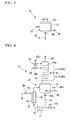
- FIG. 1 is a schematic configuration diagram of evaporation section 11 which is equipped with a tubular heat exchanger.
- evaporator 12 has vapor take-out port 12a at the top and liquid discharging portion 12b at the bottom.
- Liquid discharge pipe 13 is connected to the liquid discharging portion 12b and the components which are not evaporated in the liquid raw material inside evaporator 12 can be discharged outside the system.
- a heating mechanism equipped with multitubular heat exchanger 14 is installed on the evaporator 12 as the heating mechanism.
- the heating mechanism is composed of the heat exchanger 14, piping 15, one end of which is connected to the liquid discharge pipe 13 and the other end of which is connected to the inlet of the heat exchanger 14, piping 16, one end of which is connected to the outlet of the heat exchanger 14 and the other end of which is connected to the body of the evaporator 12, heating medium supply pipe 18 which supplies the heating medium, and heating medium discharge pipe 19 which discharges the heating medium.
- Pump 17 is provided on the piping 15, by which the liquid raw material inside the evaporator 12 can be forced to circulate through the liquid discharge pipe 13, the piping 15, the heat exchanger 14, and the piping 16 to the evaporator 12.
- the pump 17 may not be provided.
- the heating medium supply pipe 18 and the heating medium discharge pipe 19 are respectively connected to the heat exchanger 14, by which the heat quantity necessary for evaporation can be supplied to the liquid raw material through the heating medium at the heat exchanger 14.
- a control valve to adjust the feed rate of the liquid raw material may be provided on the heating medium supply pipe 18.
- Figure 2 is a schematic configuration diagram of evaporation section 21 which is equipped with an outer jacket as the heating mechanism.
- Figures 2 and 3 the same numerals as those of Figure 1 are attached to the constitutional elements corresponding to the constitutional elements shown in Figure 1 , and the explanations thereof are omitted.
- the evaporation section 21 is composed of, as the heating mechanism, outer jacket 22, heating medium supply pipe 23 which supplies the heating medium to the outer jacket 22, and heating medium discharge pipe 24 which discharges the heating medium inside the outer jacket 22.
- the outer jacket 22 is installed on the outside of the evaporator 12, by which the evaporator 12 is heated through the heating medium and the heat quantity necessary for evaporation can be supplied to the liquid raw material contained in the evaporator 12.
- FIG. 3 is a schematic configuration diagram of evaporation section 31 which is equipped with a trace piping as the heating mechanism.
- the evaporation section 31 is composed of, as the heating mechanism, trace piping 32, heating medium supply pipe 33 which supplies the heating medium to the trace piping 32, and heating medium discharge pipe 34 which discharges the heating medium inside the trace piping 32.
- the trace piping 32 is installed on the outside of the evaporator 12, by which the evaporator 12 is heated through the heating medium and the heat quantity necessary for evaporation can be supplied to the liquid raw material.
- the column section is composed of at least one of a plate column and a packed column.
- a column containing plates is called as the plate column and a column containing packings is called as the packed column.
- the column section may contain both of the plates and the packings.
- a sieve tray with a weir As the plate to be used in the plate column, a sieve tray with a weir, a sieve tray without a weir, a turbogrid plate, or the like can be listed. These trays may be properly selected in accordance with the properties of the liquid raw material to be treated. For example, when the liquid raw material contains an easily polymerizable material, the sieve tray without a weir is preferable.
- the easily polymerizable material means a compound having a polymerizable functional group (for example, vinyl group).
- packings to be used in the packed column irregular packings or regular packings to be used in an absorption column or distillation column can be listed. These packings may be properly selected in accordance with the properties of the liquid raw material to be handled. For example, when the liquid raw material is an easily polymerizable material, the regular packings are suitable.
- the column section preferably has a structure in which the liquid holdup inside the column section is small.
- a column section which is composed of a plate column having a plate number of 1 to 10 or a packed column having a packed length equivalent to theoretical plate number of 0.5 to 5 can be listed.
- the packed length in the packed column is a height of the packings being packed inside the column (a filling part), and in the case that there are a plurality of filling parts, it is a sum of the height of each filling part.
- the upper limit of the plate number of the plate column or the upper limit of the theoretical plate number of the packed column is selected from the viewpoint that the pressure inside the evaporator should not be unnecessarily raised or the equipment cost should be suppressed.
- the plate number of the plate column is preferably 3 to 7.
- the theoretical plate number of the packed column is preferably 1.5 to 3.5.
- the liquid supply pipe that supplies the liquid raw material is connected to a middle or upper position of the column section.
- the middle position of the column section is the portion where the plate or the filling part is provided, and in the case of the plate column, it is from the lower edge of the plate that is set at the lowermost side to the upper edge of the plate that is set at the uppermost side, and in the case of the packed column, it is from the lower edge of the filling part that is arranged at the lowermost side to the upper edge of the filling part that is arranged at the uppermost side.
- the middle or upper position of the column section is the position between the lower edge of the middle position and the top of the column section.
- the position where the liquid supply pipe is connected is preferably a position between the upper edge of the middle position and the top of the column section (upper position).
- the number of the liquid supply pipe may be one or two or more.
- components to be used in gas-phase catalytic reaction accompanied with heat generation can be supplied from each liquid supply pipe to the column section.
- a control valve to adjust the feed rate of a liquid may be provided on the liquid supply pipe.
- the vapor lead-out pipe that leads out the vapor inside the column section is connected to the top of the column section.
- the other end of the vapor lead-out pipe is connected to the reactor for gas-phase catalytic reaction and the vapor inside the column section can be supplied to the reactor.
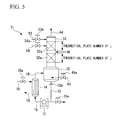
- FIGS 4 and 5 The preferable embodiments of the evaporation device of the present invention are shown in Figures 4 and 5 .
- Figures 4 and 5 the same numerals as those of Figure 1 are attached to the constitutional elements corresponding to the constitutional elements shown in Figure 1 , and the explanations thereof are omitted.
- Evaporation device 41 shown in Figure 4 is equipped with evaporation section 42 and plate column 43 which constitutes a column section, and vapor lead-out pipe 44 is connected to the top of the plate column 43.
- the evaporation section 42 has the constitution of the evaporation section 11 shown in Figure 1 and further, as a heating mechanism, has the constitution of the heating medium-blowing pipe 45, through which the heating medium is blown into the evaporator 12.
- control valve 13a to adjust the discharge quantity of the liquid raw material, control valve 18a to adjust the feed rate of the heating medium, and control valve 45a to adjust the quantity of blowing the heating medium into the evaporator are provided on the liquid discharge pipe 13, on the heating medium supply pipe 18, and on the heating medium-blowing pipe 45, respectively.
- the plate column 43 is installed on the vapor take-out port (not shown in the figure) of the evaporator 12.
- a plurality of plates (trays) 43a are provided inside the plate column 43.
- Liquid supply pipes 46 and 47 are connected at the middle position of the plate column 43 (position marked as M in Figure 4 ) and the upper position, respectively, and control valves 46a and 47a to adjust the feed rate of the liquid raw material are provided on these pipes, respectively.
- Evaporation device 51 shown in Figure 5 is different from the evaporation device 41 in that the column section is constituted of packed column 52.
- Two filling parts 52a are provided in the packed column 52.
- Liquid supply pipes 53 and 54 are connected at positions upper than the middle position of the packed column 52 (position marked as M in Figure 5 ), and control valves 53a and 54a to adjust the feed rate of the liquid raw material are provided on the liquid supply pipes 53 and 54, respectively.
- a supply piping for the aids at a proper position of the evaporation device of the present invention.
- incidental facilities such as apparatuses of various measurements and controls may be provided at an optional position such as evaporation section, column section, liquid supply pipe, or vapor lead-out pipe.
- the evaporation device of the present invention can stably carry out evaporation of a liquid raw material that contains two or more components and that is used in gas-phase catalytic reaction accompanied with heat generation because a column section is provided on a evaporator and a liquid supply pipe is connected to a specified position of the column section.
- a column section is provided on a evaporator and a liquid supply pipe is connected to a specified position of the column section.
- the evaporation device of the present invention is useful as the evaporation device which evaporates a liquid raw material that contains two or more components and that is used in gas-phase catalytic reaction, and in particular, it is preferable in the case that the liquid raw material having a ratio (k l /k m ) of 1.5 or more and the heating medium to be blown into the evaporator are used, when a volatility of a component having the highest volatility among components which are not evaporated (non-evaporating components) and have substantial concentrations is defined as k l , and a volatility of a component having the lowest volatility among components which are evaporated (evaporating components) and have substantial concentrations is defined as k m , in the composition of the whole components summed up with the liquid raw material and the heating medium to be blown into the evaporator.
- a component has substantial concentration means that the component is one of the evaporating components or non-evaporating components, the concentration of which has to be controlled and is at least above the analytical detection limit.
- the component having the lowest volatility among the evaporating components which have substantial concentrations or the component having the highest volatility among the non-evaporating components which have substantial concentrations is called key component.
- the method for evaporation of the present invention is a method for evaporating part of the liquid raw material and has a step of supplying the liquid raw material to the evaporation device of the present invention.
- the liquid raw material is supplied from the liquid supply pipe to the evaporation device of the present invention and firstly introduced into the middle or upper position of the column section, flowed down inside the column section, and introduced into the evaporator from the bottom of the column section through the vapor take-out port. Subsequently, in the evaporation section, the liquid raw material is evaporated with the heating mechanism, the heat quantity necessary for evaporating part of the liquid raw material being supplied to the liquid raw material through the heating medium.
- the vapor inside the evaporator is transferred to the column section through the vapor take-out port, raised up inside the column section, drawn out of the vapor lead-out pipe connected to the top of the column section, and supplied to the reactor for gas-phase catalytic reaction. Further, the components left behind without being evaporated in the liquid raw material are discharged from the liquid discharge pipe to outside the evaporation device.
- the evaporator equipped with a heating medium-blowing pipe which directly blows the heating medium into the evaporator and to carry out the step of blowing the components to be used in the gas-phase catalytic reaction or vapors thereof as the heating medium from the heating medium-blowing pipe into the evaporator.
- gas-phase catalytic reaction accompanied with heat generation there are many cases where water is added to a feed gas as a diluent to suppress temperature rise of a catalyst layer in a reactor or to improve catalyst selectivity or life. In these cases, it is useful to use water vapor as the heating medium and to blow necessary quantity of water or water vapor as the diluent directly into the liquid raw material inside the evaporator.
- the heating mechanism of the evaporation section the heating medium-blowing pipe may be used alone or in combination with another heating mechanism (multitubular heat exchanger, outer jacket, trace piping, or the like).
- another heating mechanism multitubular heat exchanger, outer jacket, trace piping, or the like.
- the method for evaporation of the present invention is particularly preferable, as mentioned above, in the case that the liquid raw material having a ratio (k l /k m ) of 1.5 or more and the heating medium to be blown into the evaporator are evaporated, when a volatility of a component having the highest volatility among components which are not evaporated (non-evaporating components) and have substantial concentrations is defined as k l , and a volatility of a component having the lowest volatility among components which are evaporated (evaporating components) and have substantial concentrations is defined as k m , in the composition of the whole components summed up with the liquid raw material and the heating medium to be blown into the evaporator.
- “have substantial concentrations” means what has been mentioned above.
- volatility k i of the ith component (i is an integer of from 1 to n) which composes the liquid raw material and the heating medium to be blown into the evaporator is defined by the following equation (1).
- k i p i / x i
- x i molar fraction of i component in the liquid inside the evaporation device
- p i partial pressure of i component in a gas that is in equilibrium with x i .
- the component having the lowest volatility among the evaporating components is the mth component and its volatility is k m .
- the component having the highest volatility among the non-evaporating components is the lth component and its volatility is k l .
- the method for evaporation of the present invention is preferably used in the case that the liquid raw material having the ratio of the k l to the k m , that is (k l /k m ), of 1.5 or more and the heating medium to be blown into the evaporator are evaporated.
- the method for evaporation of the present invention is preferably used in evaporation of the liquid raw material having the ratio (k l /k m ) of 2 or more.
- the volatility of each component is obtained by the foregoing equation (1).
- gas-phase catalytic reaction (gas-phase catalytic oxidation reaction) between tertiary butyl alcohol or (meth)acrolein and oxygen
- Methacrolein or methacrylic acid is produced by the gas-phase catalytic oxidation reaction of tertiary butyl alcohol.
- methacrylic acid is produced by the gas-phase catalytic oxidation reaction of methacrolein.
- acrylic acid is produced by the gas-phase catalytic oxidation reaction of acrolein.
- the method for evaporation of the present invention is suitable, in particular, in the case that the liquid raw material containing tertiary butyl alcohol or (meth)acrolein and water vapor as the heating medium are used.
- the typical example of the feed gas composition of the gas-phase catalytic oxidation reaction of tertiary butyl alcohol is 5% of tertiary butyl alcohol, 10% of oxygen, 5% of water, and the remainder, inert gas such as nitrogen.
- water does not directly participate in the gas-phase catalytic oxidation reaction of tertiary butyl alcohol, however, it has the effect of diluting the reactant gas or the like, and hence it is one of the necessary components in the feed gas.
- tertiary butyl alcohol is generally synthesized by hydration reaction from one of the products of naphtha cracking, that is, an isobutene-containing fraction having 4 carbon atoms or from an isobutene-containing by-product gas having 4 carbon atoms from fluid catalytic cracking apparatus, and the products include, in addition to tertiary butyl alcohol, water and impurities such as multimers of isobutene and secondary butyl alcohol.
- tertiary butyl alcohol synthesized as mentioned above is usually used directly without carrying out separation of water as the liquid raw material to be used for the gas-phase catalytic oxidation reaction of tertiary butyl alcohol.
- the liquid raw material to be used for the gas-phase catalytic oxidation reaction of tertiary butyl alcohol usually contains tertiary butyl alcohol, water, multimers of isobutene, secondary butyl alcohol, and the like.
- Impurities such as multimers of isobutene, secondary butyl alcohol, and high boiling point compounds originated from the catalyst of hydration reaction are included in the liquid raw material, though they are at low concentrations. These impurities are not preferable for the catalysts or products qualities of the gas-phase catalytic oxidation reaction, and they are preferably discharged from the evaporation device without being evaporated at the evaporation device.
- the content ratio of tertiary butyl alcohol to water in the liquid raw material is variable depending on a production process of tertiary butyl alcohol.
- water content in the liquid raw material is large as compared with the target feed gas composition suitable for the gas-phase catalytic oxidation reaction of tertiary butyl alcohol, part of water is separated without being evaporated.
- water content in the liquid raw material is small, water may be added to the liquid raw material at the evaporation device, or water vapor may be directly blown into the evaporator as the heating medium from the heating medium-blowing pipe using evaporation device provided with the heating medium-blowing pipe.
- the component having substantial concentration and having the lowest volatility among the evaporating components is water
- the component having substantial concentration and having the highest volatility among the non-evaporating components is tertiary butyl alcohol.
- the relative volatility in the composition summed up with the quantities of the liquid raw material and water vapor to be blown into the evaporator is about 2.5, and variation in the vapor composition caused by disturbance is large in the case of a conventional evaporation device, however, such a liquid raw material can be stably evaporated according to the present invention.
- the typical example of the feed gas composition of the gas-phase catalytic oxidation reaction of (meth)acrolein is 5% of (meth)acrolein, 10% of oxygen, and 10% of water. Water does not directly participate in the gas-phase catalytic oxidation reaction of (meth)acrolein, however, it has the effect of diluting the reactant gas or the like, and hence it is one of the necessary components in the feed gas.
- (meth)acrolein can be produced by the gas-phase catalytic oxidation reaction of at least one compound of tertiary butyl alcohol, isobutene, and propylene with oxygen, and the typical composition of the reaction products is 4% of low boiling point compounds such as acetone, 86% of (meth)acrolein, and 10% of water (all of which is in mol%).
- Water produced as a by-product in the reaction for synthesizing (meth)acrolein mentioned above is usually used directly as the liquid raw material for the gas-phase catalytic oxidation reaction of (meth)acrolein because water is a necessary component in the feed gas of the gas-phase catalytic oxidation reaction of (meth)acrolein, as stated above. Further, inhibitors and polymerized compounds are contained in (meth)acrolein, though they are at low concentrations.
- the liquid raw material for the gas-phase catalytic oxidation reaction of (meth)acrolein usually contains, in addition to the low boiling compounds such as (meth)acrolein, water, and acetone, the high boiling compounds such as inhibitors and polymerized compounds, though they are at low concentrations, and they are preferably discharged from the evaporation device without being evaporated at the evaporation device.
- compositional ratio of water to (meth)acrolein in the foregoing liquid raw material is low as compared with that in the vapor to be supplied to the oxidation reactor. Consequently, at least one component of water and water vapor is added to the liquid raw material using the evaporation device of the present invention at the time of evaporating the liquid raw material containing (meth)acrolein, and the compositional ratio of water to (meth)acrolein in the vapor to be supplied to the oxidation reactor can be easily raised.
- the component having substantial concentration and having the lowest volatility among the evaporating components is water
- the component having substantial concentration and having the highest volatility among the non-evaporating components is (meth)acrolein.
- the relative volatility in the composition summed up with the quantities of the liquid raw material and water vapor to be blown into the evaporator is about 4, and variation in the vapor composition is large in the case of a conventional evaporation device, however, such a liquid raw material can be stably evaporated according to the present invention.
- the feed gas to be supplied to the reactor to be used for carrying out the reaction was produced using the evaporation device 41 having the constitution shown in Figure 4 .
- a vertical multitubular heat exchanger was used as the heat exchanger 14, and heating was carried out using a thermosyphon type (pump 17 not being used) and water vapor having the pressure of 0.3 MPa as the heating medium.
- the plate column 43 the one equipped with 5 sieve trays without weirs was used.
- the composition of the liquid raw material to be used for the gas-phase catalytic oxidation reaction mentioned above was 60 mol% of tertiary butyl alcohol, 39.9 mol% of water, and 0.1 mol% of secondary butyl alcohol, all of which were high boiling point compounds.
- the component having substantial concentration and having the lowest volatility among the evaporating components is water, and the component having substantial concentration and having the highest volatility among the non-evaporating components is tertiary butyl alcohol.
- the relative volatility in the composition summed up with the quantities of the liquid raw material and water vapor to be blown into the evaporator is about 2.5.
- the aforementioned liquid raw material was supplied to the liquid supply pipe 47 (on the uppermost tray) of the evaporation device 41. Twenty mol% of water vapor with respect to the liquid raw material was directly blown into the evaporator 12 through the heating medium-blowing pipe 45, and at the same time, the liquid raw material was heated and evaporated at the heat exchanger 14 and the resultant vapor was drawn out of the top of the plate column 43 through the vapor lead-out pipe 44 and supplied to the reactor. In the supplied liquid raw material, 0.01 mol% of tertiary butyl alcohol and 2 mol% of water were discharged from the liquid discharge pipe 13 without being evaporated.
- the feed rate of the liquid raw material, the discharged quantity of the non-evaporating components in the liquid raw material, and the quantity of the water vapor to be blown into the evaporator 12 were controlled within the error of ⁇ 0.5% by a computer controlled system of flow rate controllers provided in the evaporation device 41.
- the preset value for the control of the flow rate of the water vapor was set adopting a control system which slowly changes the preset value using cascade control by the liquid surface in the evaporator 12.
- the reactor to which the liquid raw material for the oxidation reaction was supplied was a multitubular reactor using steel tubes (reaction tubes) having inside diameter of 25 mm and length of 5 m, and a mechanism of circulating niter outside the reaction tubes was provided to remove the heat of reaction.
- a publicly known molybdenum-cobalt-nickel oxide catalyst was used for the catalyst layer located at the center part of the reactor.
- a thermocouple was provided in the reactor so that the temperature distribution along the direction of the feed gas flow can be measured.
- composition (composition at the inlet of the reactor) of the vapor supplied from the evaporation device (feed gas) was 5 mol% of tertiary butyl alcohol, 10 mol% of oxygen, 5 mol% of water, and the remainder such as other inert gas components.
- the gas temperature and the pressure at the entrance of the catalyst layer were 295°C and 0.14Mpa, respectively. Under this condition, the vapor from the evaporation device 41 was supplied to the reactor and the gas-phase catalytic oxidation reaction was carried out and methacrolein was synthesized.
- Example 2 The same procedure as in Example 1 was carried out to synthesize methacrolein using the same evaporation device 41 as in Example 1 except that the plate column 41 was not equipped, and the liquid supply pipe 47 was connected directly to the body of the evaporator 12, and the vapor lead-out pipe 44 is connected to the vapor take-out port of the evaporator 12.
- the differences between the maximum temperatures of the catalyst layers of respective reaction tubes and the temperature of the niter during a short time were as large as 30 ⁇ 7°C and a stable state could not be maintained.
- part of a liquid raw material that contains two or more components and that is used in gas-phase catalytic reaction accompanied with heat generation can be stably evaporated and hence variation in a feed rate or a gas composition of a feed gas in a short cycle can be suppressed.
Landscapes
- Chemical & Material Sciences (AREA)
- Organic Chemistry (AREA)
- Chemical Kinetics & Catalysis (AREA)
- Engineering & Computer Science (AREA)
- Oil, Petroleum & Natural Gas (AREA)
- Organic Low-Molecular-Weight Compounds And Preparation Thereof (AREA)
- Vaporization, Distillation, Condensation, Sublimation, And Cold Traps (AREA)
Applications Claiming Priority (2)
| Application Number | Priority Date | Filing Date | Title |
|---|---|---|---|
| JP2007129038 | 2007-05-15 | ||
| PCT/JP2008/058925 WO2008143126A1 (ja) | 2007-05-15 | 2008-05-15 | 蒸発器および蒸発方法、メタクロレインまたは(メタ)アクリル酸の製造方法 |
Publications (2)
| Publication Number | Publication Date |
|---|---|
| EP2158954A1 true EP2158954A1 (de) | 2010-03-03 |
| EP2158954A4 EP2158954A4 (de) | 2015-09-02 |
Family
ID=40031834
Family Applications (1)
| Application Number | Title | Priority Date | Filing Date |
|---|---|---|---|
| EP08752785.9A Withdrawn EP2158954A4 (de) | 2007-05-15 | 2008-05-15 | Verdampfungsgerät, verdampfungsverfahren und verfahren zur herstellung von methacrolein oder (meth)acrylsäure |
Country Status (5)
| Country | Link |
|---|---|
| EP (1) | EP2158954A4 (de) |
| JP (1) | JP5451071B2 (de) |
| KR (1) | KR101175841B1 (de) |
| CN (1) | CN101743045A (de) |
| WO (1) | WO2008143126A1 (de) |
Cited By (1)
| Publication number | Priority date | Publication date | Assignee | Title |
|---|---|---|---|---|
| EP3945086A1 (de) | 2020-07-30 | 2022-02-02 | Röhm GmbH | C-4 basiertes verfahren zur herstellung von mma unter rückführung und recyclierung von methacrolein |
Families Citing this family (2)
| Publication number | Priority date | Publication date | Assignee | Title |
|---|---|---|---|---|
| JP5919645B2 (ja) * | 2011-05-10 | 2016-05-18 | 三菱レイヨン株式会社 | 原料ガスの供給方法、メタクロレイン又はメタクリル酸の製造方法 |
| EP3838363A1 (de) * | 2019-12-17 | 2021-06-23 | BP Chemicals Limited | Trennverfahren und -vorrichtung |
Family Cites Families (14)
| Publication number | Priority date | Publication date | Assignee | Title |
|---|---|---|---|---|
| GB577241A (en) * | 1941-12-17 | 1946-05-10 | Standard Oil Dev Co | An improved process for the purification of organic liquids by fractional distillation |
| US4009083A (en) * | 1971-09-02 | 1977-02-22 | The Dow Chemical Company | Regeneration of liquid desiccants and acid gas absorbing liquid desiccants |
| JPS547768B2 (de) * | 1973-01-06 | 1979-04-10 | ||
| JPS50108208A (de) * | 1974-02-07 | 1975-08-26 | ||
| DE3339051A1 (de) * | 1983-10-28 | 1985-05-09 | Henkel KGaA, 4000 Düsseldorf | Verfahren zur verbesserten destillativen aufarbeitung von glycerin |
| JPH0739745A (ja) * | 1993-07-30 | 1995-02-10 | Seta Giken:Kk | 気液接触装置 |
| US5527980A (en) * | 1994-02-24 | 1996-06-18 | Phillips Petroleum Company | Regeneration of hydrogen fluoride alkylation catalyst |
| DE10115277A1 (de) * | 2001-03-28 | 2002-06-13 | Basf Ag | Verfahren zur kontinuierlichen Gewinnung von(Meth)acrylsäure |
| JP2002316804A (ja) * | 2001-04-19 | 2002-10-31 | Sumitomo Chem Co Ltd | 塩素精製法 |
| DE10300499A1 (de) * | 2003-01-08 | 2003-10-23 | Basf Ag | Verfahren der rektifikativen Auftrennung von (Meth)acrylmonomere enthaltenden Fluiden |
| JP4019272B2 (ja) * | 2003-03-05 | 2007-12-12 | 株式会社ササクラ | 低沸点有機物含有排水の処理方法及び装置 |
| WO2005007609A1 (de) * | 2003-07-11 | 2005-01-27 | Basf Aktiengesellschaft | Thermisches trennverfahren zur abtrennung wenigstens eines (meth)acrylmonomere angereichert enthaltenden stoffstroms |
| CN1697676A (zh) * | 2003-11-17 | 2005-11-16 | 三菱化学株式会社 | 易聚合化合物的容器 |
| JP2007129038A (ja) | 2005-11-02 | 2007-05-24 | Sony Corp | 半導体装置およびその製造方法 |
-
2008
- 2008-05-15 EP EP08752785.9A patent/EP2158954A4/de not_active Withdrawn
- 2008-05-15 KR KR1020097024843A patent/KR101175841B1/ko active Active
- 2008-05-15 WO PCT/JP2008/058925 patent/WO2008143126A1/ja not_active Ceased
- 2008-05-15 JP JP2008528038A patent/JP5451071B2/ja active Active
- 2008-05-15 CN CN200880024915A patent/CN101743045A/zh active Pending
Non-Patent Citations (1)
| Title |
|---|
| See references of WO2008143126A1 * |
Cited By (1)
| Publication number | Priority date | Publication date | Assignee | Title |
|---|---|---|---|---|
| EP3945086A1 (de) | 2020-07-30 | 2022-02-02 | Röhm GmbH | C-4 basiertes verfahren zur herstellung von mma unter rückführung und recyclierung von methacrolein |
Also Published As
| Publication number | Publication date |
|---|---|
| CN101743045A (zh) | 2010-06-16 |
| EP2158954A4 (de) | 2015-09-02 |
| KR101175841B1 (ko) | 2012-08-24 |
| JP5451071B2 (ja) | 2014-03-26 |
| JPWO2008143126A1 (ja) | 2010-08-05 |
| KR20100003305A (ko) | 2010-01-07 |
| WO2008143126A1 (ja) | 2008-11-27 |
Similar Documents
| Publication | Publication Date | Title |
|---|---|---|
| CN100469752C (zh) | 用于分离至少一股含富集的(甲基)丙烯酸单体的料流的热分离方法 | |
| US7319168B2 (en) | Process for producing aliphatic carboxylic acid | |
| US9018416B2 (en) | Thermal separation process | |
| KR101213520B1 (ko) | 탄화수소함유 공급 스트림의 분리 프로세스 | |
| US8076510B2 (en) | Process for starting-up a heterogeneously catalyzed partial gas phase oxidation of acrolein to acrylic acid or of methacrolein to methacrylic acid | |
| EP1284815A2 (de) | Vorrichtung zur kontrollierten und optimierten zugabe von reaktanten in ein kontinuierliches strömungssystem und verfahren zu dessen gebrauch | |
| KR102666786B1 (ko) | 에틸렌계 불포화 카르복실산의 tert-부틸 에스테르의 제조 | |
| US20220259131A1 (en) | A process for the continuous production of either acrolein or acrylic acid as the target product from propene | |
| CN102958900B (zh) | 邻苯二甲酸酯的液相氢化方法 | |
| WO2012090690A1 (ja) | アクリロニトリルの精製方法 | |
| JP5512083B2 (ja) | 反応器内部の反応速度制御方法、反応装置及びジメチルエーテルの製造方法。 | |
| KR20040014280A (ko) | 아크릴산의 제조방법 | |
| EP2158954A1 (de) | Verdampfungsgerät, verdampfungsverfahren und verfahren zur herstellung von methacrolein oder (meth)acrylsäure | |
| CN1096451C (zh) | 乙烯的催化气相氧化法 | |
| US11767284B2 (en) | Method for producing unsaturated carboxylic ester | |
| US20080021238A1 (en) | Apparatus For (Meth) Acrylic Acid Production And Process For Producing (Meth) Acrylic Acid | |
| EP3390462B1 (de) | Olefinpolymerisierungsverfahren | |
| US7476299B2 (en) | Vessel for easily polymerizable compound | |
| EP1688407B1 (de) | Verfahren zur aufreinigung von (meth)acrylsäure | |
| US6610865B2 (en) | Process for the epoxidation of olefins | |
| TW202610721A (zh) | 迴路反應器以及製備加成產物的方法 | |
| CN107848935B (zh) | 单体生产中使用的材料的惰性的确定方法 | |
| CN107848934A (zh) | 确定单体生产中使用的材料的惰性的方法 | |
| CN116782992A (zh) | α,β-烯键式不饱和羧酸的两阶段制备方法及用于该目的的设备 | |
| KR19990007872A (ko) | 에틸렌의 촉매기상산화방법 |
Legal Events
| Date | Code | Title | Description |
|---|---|---|---|
| PUAI | Public reference made under article 153(3) epc to a published international application that has entered the european phase |
Free format text: ORIGINAL CODE: 0009012 |
|
| 17P | Request for examination filed |
Effective date: 20091118 |
|
| AK | Designated contracting states |
Kind code of ref document: A1 Designated state(s): AT BE BG CH CY CZ DE DK EE ES FI FR GB GR HR HU IE IS IT LI LT LU LV MC MT NL NO PL PT RO SE SI SK TR |
|
| AX | Request for extension of the european patent |
Extension state: AL BA MK RS |
|
| DAX | Request for extension of the european patent (deleted) | ||
| RA4 | Supplementary search report drawn up and despatched (corrected) |
Effective date: 20150803 |
|
| RIC1 | Information provided on ipc code assigned before grant |
Ipc: B01D 1/14 20060101AFI20150728BHEP Ipc: B01D 3/14 20060101ALI20150728BHEP Ipc: C07C 45/38 20060101ALI20150728BHEP Ipc: C07C 47/22 20060101ALI20150728BHEP Ipc: C07C 51/235 20060101ALI20150728BHEP Ipc: C07C 57/055 20060101ALI20150728BHEP |
|
| 17Q | First examination report despatched |
Effective date: 20161220 |
|
| STAA | Information on the status of an ep patent application or granted ep patent |
Free format text: STATUS: THE APPLICATION IS DEEMED TO BE WITHDRAWN |
|
| 18D | Application deemed to be withdrawn |
Effective date: 20170503 |