EP2159198A1 - Procédé de dégradation de polluants dans l'eau et/ou dans le sol - Google Patents
Procédé de dégradation de polluants dans l'eau et/ou dans le sol Download PDFInfo
- Publication number
- EP2159198A1 EP2159198A1 EP20080015396 EP08015396A EP2159198A1 EP 2159198 A1 EP2159198 A1 EP 2159198A1 EP 20080015396 EP20080015396 EP 20080015396 EP 08015396 A EP08015396 A EP 08015396A EP 2159198 A1 EP2159198 A1 EP 2159198A1
- Authority
- EP
- European Patent Office
- Prior art keywords
- water
- soil
- colloidal
- metal oxide
- particles
- Prior art date
- Legal status (The legal status is an assumption and is not a legal conclusion. Google has not performed a legal analysis and makes no representation as to the accuracy of the status listed.)
- Withdrawn
Links
- XLYOFNOQVPJJNP-UHFFFAOYSA-N water Substances O XLYOFNOQVPJJNP-UHFFFAOYSA-N 0.000 title claims abstract description 102
- 239000002689 soil Substances 0.000 title claims abstract description 97
- 238000000034 method Methods 0.000 title claims abstract description 78
- 239000003344 environmental pollutant Substances 0.000 title claims abstract description 58
- 231100000719 pollutant Toxicity 0.000 title claims abstract description 57
- 230000015556 catabolic process Effects 0.000 title claims abstract description 15
- 238000006731 degradation reaction Methods 0.000 title claims abstract description 15
- 238000004519 manufacturing process Methods 0.000 claims abstract description 11
- 239000002245 particle Substances 0.000 claims description 149
- UQSXHKLRYXJYBZ-UHFFFAOYSA-N Iron oxide Chemical compound [Fe]=O UQSXHKLRYXJYBZ-UHFFFAOYSA-N 0.000 claims description 122
- 229910044991 metal oxide Inorganic materials 0.000 claims description 93
- 150000004706 metal oxides Chemical class 0.000 claims description 89
- 239000000725 suspension Substances 0.000 claims description 48
- XEEYBQQBJWHFJM-UHFFFAOYSA-N Iron Chemical compound [Fe] XEEYBQQBJWHFJM-UHFFFAOYSA-N 0.000 claims description 37
- -1 metal oxide metal oxide Chemical class 0.000 claims description 33
- 229910052742 iron Inorganic materials 0.000 claims description 21
- 238000007254 oxidation reaction Methods 0.000 claims description 21
- 230000003647 oxidation Effects 0.000 claims description 20
- 229910052751 metal Inorganic materials 0.000 claims description 17
- 239000000370 acceptor Substances 0.000 claims description 16
- 239000002184 metal Substances 0.000 claims description 16
- 230000015572 biosynthetic process Effects 0.000 claims description 14
- 238000005086 pumping Methods 0.000 claims description 12
- PNEYBMLMFCGWSK-UHFFFAOYSA-N Alumina Chemical compound [O-2].[O-2].[O-2].[Al+3].[Al+3] PNEYBMLMFCGWSK-UHFFFAOYSA-N 0.000 claims description 10
- AMWRITDGCCNYAT-UHFFFAOYSA-L hydroxy(oxo)manganese;manganese Chemical compound [Mn].O[Mn]=O.O[Mn]=O AMWRITDGCCNYAT-UHFFFAOYSA-L 0.000 claims description 10
- 229910052500 inorganic mineral Inorganic materials 0.000 claims description 10
- 239000011707 mineral Substances 0.000 claims description 10
- 239000013078 crystal Substances 0.000 claims description 9
- 244000005700 microbiome Species 0.000 claims description 9
- VYPSYNLAJGMNEJ-UHFFFAOYSA-N Silicium dioxide Chemical compound O=[Si]=O VYPSYNLAJGMNEJ-UHFFFAOYSA-N 0.000 claims description 8
- 238000010438 heat treatment Methods 0.000 claims description 8
- PXHVJJICTQNCMI-UHFFFAOYSA-N Nickel Chemical compound [Ni] PXHVJJICTQNCMI-UHFFFAOYSA-N 0.000 claims description 6
- 230000009056 active transport Effects 0.000 claims description 6
- 238000002156 mixing Methods 0.000 claims description 6
- 230000001939 inductive effect Effects 0.000 claims description 5
- 238000010525 oxidative degradation reaction Methods 0.000 claims description 5
- 230000009057 passive transport Effects 0.000 claims description 5
- 229910052814 silicon oxide Inorganic materials 0.000 claims description 5
- 239000004411 aluminium Substances 0.000 claims description 4
- XAGFODPZIPBFFR-UHFFFAOYSA-N aluminium Chemical compound [Al] XAGFODPZIPBFFR-UHFFFAOYSA-N 0.000 claims description 4
- XUIMIQQOPSSXEZ-UHFFFAOYSA-N Silicon Chemical compound [Si] XUIMIQQOPSSXEZ-UHFFFAOYSA-N 0.000 claims description 3
- RTAQQCXQSZGOHL-UHFFFAOYSA-N Titanium Chemical compound [Ti] RTAQQCXQSZGOHL-UHFFFAOYSA-N 0.000 claims description 3
- 229910052782 aluminium Inorganic materials 0.000 claims description 3
- 239000010941 cobalt Substances 0.000 claims description 3
- 229910017052 cobalt Inorganic materials 0.000 claims description 3
- GUTLYIVDDKVIGB-UHFFFAOYSA-N cobalt atom Chemical compound [Co] GUTLYIVDDKVIGB-UHFFFAOYSA-N 0.000 claims description 3
- 230000001678 irradiating effect Effects 0.000 claims description 3
- WPBNNNQJVZRUHP-UHFFFAOYSA-L manganese(2+);methyl n-[[2-(methoxycarbonylcarbamothioylamino)phenyl]carbamothioyl]carbamate;n-[2-(sulfidocarbothioylamino)ethyl]carbamodithioate Chemical compound [Mn+2].[S-]C(=S)NCCNC([S-])=S.COC(=O)NC(=S)NC1=CC=CC=C1NC(=S)NC(=O)OC WPBNNNQJVZRUHP-UHFFFAOYSA-L 0.000 claims description 3
- 229910052759 nickel Inorganic materials 0.000 claims description 3
- 229910052710 silicon Inorganic materials 0.000 claims description 3
- 239000010703 silicon Substances 0.000 claims description 3
- 230000000638 stimulation Effects 0.000 claims description 3
- 239000010936 titanium Substances 0.000 claims description 3
- 229910052719 titanium Inorganic materials 0.000 claims description 3
- 229910021645 metal ion Inorganic materials 0.000 claims description 2
- 239000003673 groundwater Substances 0.000 abstract description 15
- 150000002894 organic compounds Chemical class 0.000 abstract description 14
- 238000011109 contamination Methods 0.000 abstract description 11
- 230000007480 spreading Effects 0.000 abstract description 11
- 238000003892 spreading Methods 0.000 abstract description 11
- 230000004888 barrier function Effects 0.000 abstract description 7
- 238000005202 decontamination Methods 0.000 abstract description 4
- 230000003588 decontaminative effect Effects 0.000 abstract description 4
- 239000000084 colloidal system Substances 0.000 description 93
- 235000013980 iron oxide Nutrition 0.000 description 74
- 238000006722 reduction reaction Methods 0.000 description 39
- 230000009467 reduction Effects 0.000 description 38
- 239000013049 sediment Substances 0.000 description 33
- AEIXRCIKZIZYPM-UHFFFAOYSA-M hydroxy(oxo)iron Chemical compound [O][Fe]O AEIXRCIKZIZYPM-UHFFFAOYSA-M 0.000 description 32
- VBMVTYDPPZVILR-UHFFFAOYSA-N iron(2+);oxygen(2-) Chemical class [O-2].[Fe+2] VBMVTYDPPZVILR-UHFFFAOYSA-N 0.000 description 32
- 229910052595 hematite Inorganic materials 0.000 description 31
- 239000011019 hematite Substances 0.000 description 31
- LIKBJVNGSGBSGK-UHFFFAOYSA-N iron(3+);oxygen(2-) Chemical compound [O-2].[O-2].[O-2].[Fe+3].[Fe+3] LIKBJVNGSGBSGK-UHFFFAOYSA-N 0.000 description 31
- 239000000243 solution Substances 0.000 description 22
- 229910052598 goethite Inorganic materials 0.000 description 20
- 150000002430 hydrocarbons Chemical class 0.000 description 20
- 238000002474 experimental method Methods 0.000 description 18
- 230000002829 reductive effect Effects 0.000 description 16
- VTLYFUHAOXGGBS-UHFFFAOYSA-N Fe3+ Chemical compound [Fe+3] VTLYFUHAOXGGBS-UHFFFAOYSA-N 0.000 description 14
- 150000001875 compounds Chemical class 0.000 description 13
- 239000000203 mixture Substances 0.000 description 13
- 229930195733 hydrocarbon Natural products 0.000 description 12
- 239000007788 liquid Substances 0.000 description 12
- 238000011065 in-situ storage Methods 0.000 description 11
- JEIPFZHSYJVQDO-UHFFFAOYSA-N iron(III) oxide Inorganic materials O=[Fe]O[Fe]=O JEIPFZHSYJVQDO-UHFFFAOYSA-N 0.000 description 11
- 230000000813 microbial effect Effects 0.000 description 11
- 150000001450 anions Chemical class 0.000 description 10
- 238000006243 chemical reaction Methods 0.000 description 10
- 238000005067 remediation Methods 0.000 description 10
- 235000010755 mineral Nutrition 0.000 description 9
- 239000007787 solid Substances 0.000 description 9
- CWYNVVGOOAEACU-UHFFFAOYSA-N Fe2+ Chemical compound [Fe+2] CWYNVVGOOAEACU-UHFFFAOYSA-N 0.000 description 8
- 241001494297 Geobacter sulfurreducens Species 0.000 description 8
- 239000006285 cell suspension Substances 0.000 description 8
- 239000006185 dispersion Substances 0.000 description 8
- 239000002609 medium Substances 0.000 description 8
- 150000001768 cations Chemical class 0.000 description 7
- 238000002296 dynamic light scattering Methods 0.000 description 7
- 239000011159 matrix material Substances 0.000 description 7
- 238000005259 measurement Methods 0.000 description 7
- 230000009257 reactivity Effects 0.000 description 7
- 238000003756 stirring Methods 0.000 description 7
- 239000000126 substance Substances 0.000 description 7
- HEMHJVSKTPXQMS-UHFFFAOYSA-M Sodium hydroxide Chemical compound [OH-].[Na+] HEMHJVSKTPXQMS-UHFFFAOYSA-M 0.000 description 6
- 150000004945 aromatic hydrocarbons Chemical class 0.000 description 6
- 230000003197 catalytic effect Effects 0.000 description 6
- 239000000463 material Substances 0.000 description 6
- 238000000746 purification Methods 0.000 description 6
- 239000000523 sample Substances 0.000 description 6
- OKTJSMMVPCPJKN-UHFFFAOYSA-N Carbon Chemical compound [C] OKTJSMMVPCPJKN-UHFFFAOYSA-N 0.000 description 5
- CURLTUGMZLYLDI-UHFFFAOYSA-N Carbon dioxide Chemical compound O=C=O CURLTUGMZLYLDI-UHFFFAOYSA-N 0.000 description 5
- 229910019142 PO4 Inorganic materials 0.000 description 5
- 238000004458 analytical method Methods 0.000 description 5
- 230000001419 dependent effect Effects 0.000 description 5
- 238000000502 dialysis Methods 0.000 description 5
- 230000000694 effects Effects 0.000 description 5
- 229960002413 ferric citrate Drugs 0.000 description 5
- NPFOYSMITVOQOS-UHFFFAOYSA-K iron(III) citrate Chemical compound [Fe+3].[O-]C(=O)CC(O)(CC([O-])=O)C([O-])=O NPFOYSMITVOQOS-UHFFFAOYSA-K 0.000 description 5
- 239000002105 nanoparticle Substances 0.000 description 5
- 150000003839 salts Chemical class 0.000 description 5
- 241000894006 Bacteria Species 0.000 description 4
- 239000004215 Carbon black (E152) Substances 0.000 description 4
- LFQSCWFLJHTTHZ-UHFFFAOYSA-N Ethanol Chemical compound CCO LFQSCWFLJHTTHZ-UHFFFAOYSA-N 0.000 description 4
- 238000002441 X-ray diffraction Methods 0.000 description 4
- 150000001338 aliphatic hydrocarbons Chemical class 0.000 description 4
- 229910052799 carbon Inorganic materials 0.000 description 4
- 239000012530 fluid Substances 0.000 description 4
- 150000008282 halocarbons Chemical class 0.000 description 4
- BHEPBYXIRTUNPN-UHFFFAOYSA-N hydridophosphorus(.) (triplet) Chemical compound [PH] BHEPBYXIRTUNPN-UHFFFAOYSA-N 0.000 description 4
- 230000001965 increasing effect Effects 0.000 description 4
- SZVJSHCCFOBDDC-UHFFFAOYSA-N iron(II,III) oxide Inorganic materials O=[Fe]O[Fe]O[Fe]=O SZVJSHCCFOBDDC-UHFFFAOYSA-N 0.000 description 4
- NBIIXXVUZAFLBC-UHFFFAOYSA-K phosphate Chemical compound [O-]P([O-])([O-])=O NBIIXXVUZAFLBC-UHFFFAOYSA-K 0.000 description 4
- 239000010452 phosphate Substances 0.000 description 4
- 238000001179 sorption measurement Methods 0.000 description 4
- 238000003786 synthesis reaction Methods 0.000 description 4
- 230000032258 transport Effects 0.000 description 4
- UHOVQNZJYSORNB-UHFFFAOYSA-N Benzene Chemical compound C1=CC=CC=C1 UHOVQNZJYSORNB-UHFFFAOYSA-N 0.000 description 3
- OKKJLVBELUTLKV-UHFFFAOYSA-N Methanol Chemical compound OC OKKJLVBELUTLKV-UHFFFAOYSA-N 0.000 description 3
- FAPWRFPIFSIZLT-UHFFFAOYSA-M Sodium chloride Chemical compound [Na+].[Cl-] FAPWRFPIFSIZLT-UHFFFAOYSA-M 0.000 description 3
- YXFVVABEGXRONW-UHFFFAOYSA-N Toluene Chemical compound CC1=CC=CC=C1 YXFVVABEGXRONW-UHFFFAOYSA-N 0.000 description 3
- 230000009471 action Effects 0.000 description 3
- QVGXLLKOCUKJST-UHFFFAOYSA-N atomic oxygen Chemical compound [O] QVGXLLKOCUKJST-UHFFFAOYSA-N 0.000 description 3
- 238000009412 basement excavation Methods 0.000 description 3
- 239000011324 bead Substances 0.000 description 3
- 230000008901 benefit Effects 0.000 description 3
- 238000009835 boiling Methods 0.000 description 3
- 229910002092 carbon dioxide Inorganic materials 0.000 description 3
- 239000011248 coating agent Substances 0.000 description 3
- 238000000576 coating method Methods 0.000 description 3
- 230000007613 environmental effect Effects 0.000 description 3
- 230000005294 ferromagnetic effect Effects 0.000 description 3
- 239000000446 fuel Substances 0.000 description 3
- 229910021519 iron(III) oxide-hydroxide Inorganic materials 0.000 description 3
- NDLPOXTZKUMGOV-UHFFFAOYSA-N oxo(oxoferriooxy)iron hydrate Chemical compound O.O=[Fe]O[Fe]=O NDLPOXTZKUMGOV-UHFFFAOYSA-N 0.000 description 3
- 229910052760 oxygen Inorganic materials 0.000 description 3
- 239000001301 oxygen Substances 0.000 description 3
- 239000004576 sand Substances 0.000 description 3
- 229920006395 saturated elastomer Polymers 0.000 description 3
- JSPLKZUTYZBBKA-UHFFFAOYSA-N trioxidane Chemical class OOO JSPLKZUTYZBBKA-UHFFFAOYSA-N 0.000 description 3
- 239000002351 wastewater Substances 0.000 description 3
- 229910003145 α-Fe2O3 Inorganic materials 0.000 description 3
- 229910006297 γ-Fe2O3 Inorganic materials 0.000 description 3
- 229910006299 γ-FeOOH Inorganic materials 0.000 description 3
- IJGRMHOSHXDMSA-UHFFFAOYSA-N Atomic nitrogen Chemical compound N#N IJGRMHOSHXDMSA-UHFFFAOYSA-N 0.000 description 2
- YNQLUTRBYVCPMQ-UHFFFAOYSA-N Ethylbenzene Chemical compound CCC1=CC=CC=C1 YNQLUTRBYVCPMQ-UHFFFAOYSA-N 0.000 description 2
- 241000010919 Geobacter grbiciae Species 0.000 description 2
- TWRXJAOTZQYOKJ-UHFFFAOYSA-L Magnesium chloride Chemical compound [Mg+2].[Cl-].[Cl-] TWRXJAOTZQYOKJ-UHFFFAOYSA-L 0.000 description 2
- 241000863432 Shewanella putrefaciens Species 0.000 description 2
- NINIDFKCEFEMDL-UHFFFAOYSA-N Sulfur Chemical compound [S] NINIDFKCEFEMDL-UHFFFAOYSA-N 0.000 description 2
- 239000005864 Sulphur Substances 0.000 description 2
- CUPCBVUMRUSXIU-UHFFFAOYSA-N [Fe].OOO Chemical class [Fe].OOO CUPCBVUMRUSXIU-UHFFFAOYSA-N 0.000 description 2
- WQHONKDTTOGZPR-UHFFFAOYSA-N [O-2].[O-2].[Mn+2].[Fe+2] Chemical class [O-2].[O-2].[Mn+2].[Fe+2] WQHONKDTTOGZPR-UHFFFAOYSA-N 0.000 description 2
- 230000003213 activating effect Effects 0.000 description 2
- 150000007824 aliphatic compounds Chemical class 0.000 description 2
- 230000001580 bacterial effect Effects 0.000 description 2
- 239000013590 bulk material Substances 0.000 description 2
- 239000001569 carbon dioxide Substances 0.000 description 2
- 230000008859 change Effects 0.000 description 2
- 238000012512 characterization method Methods 0.000 description 2
- 239000003153 chemical reaction reagent Substances 0.000 description 2
- 238000005345 coagulation Methods 0.000 description 2
- 230000015271 coagulation Effects 0.000 description 2
- 150000001896 cresols Chemical class 0.000 description 2
- 239000010779 crude oil Substances 0.000 description 2
- 238000005695 dehalogenation reaction Methods 0.000 description 2
- 238000011033 desalting Methods 0.000 description 2
- 238000010790 dilution Methods 0.000 description 2
- 239000012895 dilution Substances 0.000 description 2
- 150000002009 diols Chemical class 0.000 description 2
- 238000001914 filtration Methods 0.000 description 2
- 239000011521 glass Substances 0.000 description 2
- 150000004820 halides Chemical class 0.000 description 2
- 125000005842 heteroatom Chemical group 0.000 description 2
- XLYOFNOQVPJJNP-UHFFFAOYSA-M hydroxide Chemical compound [OH-] XLYOFNOQVPJJNP-UHFFFAOYSA-M 0.000 description 2
- 239000012535 impurity Substances 0.000 description 2
- 238000005342 ion exchange Methods 0.000 description 2
- VCJMYUPGQJHHFU-UHFFFAOYSA-N iron(III) nitrate Inorganic materials [Fe+3].[O-][N+]([O-])=O.[O-][N+]([O-])=O.[O-][N+]([O-])=O VCJMYUPGQJHHFU-UHFFFAOYSA-N 0.000 description 2
- 238000012417 linear regression Methods 0.000 description 2
- NUJOXMJBOLGQSY-UHFFFAOYSA-N manganese dioxide Chemical compound O=[Mn]=O NUJOXMJBOLGQSY-UHFFFAOYSA-N 0.000 description 2
- PPNAOCWZXJOHFK-UHFFFAOYSA-N manganese(2+);oxygen(2-) Chemical class [O-2].[Mn+2] PPNAOCWZXJOHFK-UHFFFAOYSA-N 0.000 description 2
- 150000002739 metals Chemical class 0.000 description 2
- 231100000252 nontoxic Toxicity 0.000 description 2
- 230000003000 nontoxic effect Effects 0.000 description 2
- 230000000704 physical effect Effects 0.000 description 2
- 238000001556 precipitation Methods 0.000 description 2
- 238000002360 preparation method Methods 0.000 description 2
- 239000000047 product Substances 0.000 description 2
- 239000011780 sodium chloride Substances 0.000 description 2
- 238000003860 storage Methods 0.000 description 2
- 239000002352 surface water Substances 0.000 description 2
- 235000013759 synthetic iron oxide Nutrition 0.000 description 2
- QNRATNLHPGXHMA-XZHTYLCXSA-N (r)-(6-ethoxyquinolin-4-yl)-[(2s,4s,5r)-5-ethyl-1-azabicyclo[2.2.2]octan-2-yl]methanol;hydrochloride Chemical compound Cl.C([C@H]([C@H](C1)CC)C2)CN1[C@@H]2[C@H](O)C1=CC=NC2=CC=C(OCC)C=C21 QNRATNLHPGXHMA-XZHTYLCXSA-N 0.000 description 1
- QTBSBXVTEAMEQO-UHFFFAOYSA-M Acetate Chemical compound CC([O-])=O QTBSBXVTEAMEQO-UHFFFAOYSA-M 0.000 description 1
- NLXLAEXVIDQMFP-UHFFFAOYSA-N Ammonia chloride Chemical compound [NH4+].[Cl-] NLXLAEXVIDQMFP-UHFFFAOYSA-N 0.000 description 1
- CPELXLSAUQHCOX-UHFFFAOYSA-M Bromide Chemical compound [Br-] CPELXLSAUQHCOX-UHFFFAOYSA-M 0.000 description 1
- UXVMQQNJUSDDNG-UHFFFAOYSA-L Calcium chloride Chemical compound [Cl-].[Cl-].[Ca+2] UXVMQQNJUSDDNG-UHFFFAOYSA-L 0.000 description 1
- VEXZGXHMUGYJMC-UHFFFAOYSA-M Chloride anion Chemical compound [Cl-] VEXZGXHMUGYJMC-UHFFFAOYSA-M 0.000 description 1
- 241000196324 Embryophyta Species 0.000 description 1
- KRHYYFGTRYWZRS-UHFFFAOYSA-M Fluoride anion Chemical compound [F-] KRHYYFGTRYWZRS-UHFFFAOYSA-M 0.000 description 1
- 241001135750 Geobacter Species 0.000 description 1
- 241000282412 Homo Species 0.000 description 1
- VEXZGXHMUGYJMC-UHFFFAOYSA-N Hydrochloric acid Chemical compound Cl VEXZGXHMUGYJMC-UHFFFAOYSA-N 0.000 description 1
- WTDHULULXKLSOZ-UHFFFAOYSA-N Hydroxylamine hydrochloride Chemical compound Cl.ON WTDHULULXKLSOZ-UHFFFAOYSA-N 0.000 description 1
- 229910021578 Iron(III) chloride Inorganic materials 0.000 description 1
- 241001465754 Metazoa Species 0.000 description 1
- 238000004813 Moessbauer spectroscopy Methods 0.000 description 1
- 239000007832 Na2SO4 Substances 0.000 description 1
- CTQNGGLPUBDAKN-UHFFFAOYSA-N O-Xylene Chemical compound CC1=CC=CC=C1C CTQNGGLPUBDAKN-UHFFFAOYSA-N 0.000 description 1
- 241001518135 Shewanella algae Species 0.000 description 1
- PMZURENOXWZQFD-UHFFFAOYSA-L Sodium Sulfate Chemical compound [Na+].[Na+].[O-]S([O-])(=O)=O PMZURENOXWZQFD-UHFFFAOYSA-L 0.000 description 1
- VMHLLURERBWHNL-UHFFFAOYSA-M Sodium acetate Chemical compound [Na+].CC([O-])=O VMHLLURERBWHNL-UHFFFAOYSA-M 0.000 description 1
- QAOWNCQODCNURD-UHFFFAOYSA-L Sulfate Chemical compound [O-]S([O-])(=O)=O QAOWNCQODCNURD-UHFFFAOYSA-L 0.000 description 1
- 239000007983 Tris buffer Substances 0.000 description 1
- JAQXDZTWVWLKGC-UHFFFAOYSA-N [O-2].[Al+3].[Fe+2] Chemical class [O-2].[Al+3].[Fe+2] JAQXDZTWVWLKGC-UHFFFAOYSA-N 0.000 description 1
- 238000002835 absorbance Methods 0.000 description 1
- 239000002253 acid Substances 0.000 description 1
- 239000000654 additive Substances 0.000 description 1
- 230000002776 aggregation Effects 0.000 description 1
- 238000004220 aggregation Methods 0.000 description 1
- 150000001298 alcohols Chemical class 0.000 description 1
- 150000001335 aliphatic alkanes Chemical class 0.000 description 1
- 150000001337 aliphatic alkines Chemical class 0.000 description 1
- 125000001931 aliphatic group Chemical group 0.000 description 1
- 150000001336 alkenes Chemical class 0.000 description 1
- 229910000323 aluminium silicate Inorganic materials 0.000 description 1
- 235000012211 aluminium silicate Nutrition 0.000 description 1
- 230000004099 anaerobic respiration Effects 0.000 description 1
- 150000001491 aromatic compounds Chemical class 0.000 description 1
- 125000003118 aryl group Chemical group 0.000 description 1
- 238000003556 assay Methods 0.000 description 1
- 125000004429 atom Chemical group 0.000 description 1
- 230000002567 autonomic effect Effects 0.000 description 1
- 230000008953 bacterial degradation Effects 0.000 description 1
- 230000000975 bioactive effect Effects 0.000 description 1
- 238000005842 biochemical reaction Methods 0.000 description 1
- 230000004071 biological effect Effects 0.000 description 1
- 235000012206 bottled water Nutrition 0.000 description 1
- 229920005549 butyl rubber Polymers 0.000 description 1
- 239000001110 calcium chloride Substances 0.000 description 1
- 229910001628 calcium chloride Inorganic materials 0.000 description 1
- 238000004364 calculation method Methods 0.000 description 1
- 150000001721 carbon Chemical class 0.000 description 1
- BVKZGUZCCUSVTD-UHFFFAOYSA-N carbonic acid Chemical compound OC(O)=O BVKZGUZCCUSVTD-UHFFFAOYSA-N 0.000 description 1
- 239000003054 catalyst Substances 0.000 description 1
- 238000004113 cell culture Methods 0.000 description 1
- 238000005119 centrifugation Methods 0.000 description 1
- 239000003795 chemical substances by application Substances 0.000 description 1
- 150000001805 chlorine compounds Chemical class 0.000 description 1
- 238000004140 cleaning Methods 0.000 description 1
- 238000010276 construction Methods 0.000 description 1
- 230000007797 corrosion Effects 0.000 description 1
- 238000005260 corrosion Methods 0.000 description 1
- 150000001924 cycloalkanes Chemical class 0.000 description 1
- 150000001925 cycloalkenes Chemical class 0.000 description 1
- 150000001926 cycloalkines Chemical class 0.000 description 1
- 230000003247 decreasing effect Effects 0.000 description 1
- 239000003651 drinking water Substances 0.000 description 1
- 238000001493 electron microscopy Methods 0.000 description 1
- 230000008030 elimination Effects 0.000 description 1
- 238000003379 elimination reaction Methods 0.000 description 1
- 230000002708 enhancing effect Effects 0.000 description 1
- 238000003912 environmental pollution Methods 0.000 description 1
- 230000005293 ferrimagnetic effect Effects 0.000 description 1
- 238000000684 flow cytometry Methods 0.000 description 1
- 125000002485 formyl group Chemical class [H]C(*)=O 0.000 description 1
- 238000005194 fractionation Methods 0.000 description 1
- 239000012737 fresh medium Substances 0.000 description 1
- 239000013505 freshwater Substances 0.000 description 1
- 239000000295 fuel oil Substances 0.000 description 1
- 239000010439 graphite Substances 0.000 description 1
- 229910002804 graphite Inorganic materials 0.000 description 1
- 239000010763 heavy fuel oil Substances 0.000 description 1
- XLYOFNOQVPJJNP-ZSJDYOACSA-N heavy water Substances [2H]O[2H] XLYOFNOQVPJJNP-ZSJDYOACSA-N 0.000 description 1
- 238000006460 hydrolysis reaction Methods 0.000 description 1
- 238000011534 incubation Methods 0.000 description 1
- 239000008235 industrial water Substances 0.000 description 1
- 230000036512 infertility Effects 0.000 description 1
- 238000001764 infiltration Methods 0.000 description 1
- 230000008595 infiltration Effects 0.000 description 1
- 238000011081 inoculation Methods 0.000 description 1
- 150000002500 ions Chemical class 0.000 description 1
- 150000002505 iron Chemical class 0.000 description 1
- 150000004698 iron complex Chemical class 0.000 description 1
- RBTARNINKXHZNM-UHFFFAOYSA-K iron trichloride Chemical compound Cl[Fe](Cl)Cl RBTARNINKXHZNM-UHFFFAOYSA-K 0.000 description 1
- KEHCHOCBAJSEKS-UHFFFAOYSA-N iron(2+);oxygen(2-);titanium(4+) Chemical class [O-2].[O-2].[O-2].[Ti+4].[Fe+2] KEHCHOCBAJSEKS-UHFFFAOYSA-N 0.000 description 1
- IEECXTSVVFWGSE-UHFFFAOYSA-M iron(3+);oxygen(2-);hydroxide Chemical compound [OH-].[O-2].[Fe+3] IEECXTSVVFWGSE-UHFFFAOYSA-M 0.000 description 1
- 239000004816 latex Substances 0.000 description 1
- 229920000126 latex Polymers 0.000 description 1
- 229910001629 magnesium chloride Inorganic materials 0.000 description 1
- 230000005291 magnetic effect Effects 0.000 description 1
- 229910000000 metal hydroxide Inorganic materials 0.000 description 1
- 150000004692 metal hydroxides Chemical class 0.000 description 1
- 239000002923 metal particle Substances 0.000 description 1
- 239000013528 metallic particle Substances 0.000 description 1
- 239000003068 molecular probe Substances 0.000 description 1
- 238000012544 monitoring process Methods 0.000 description 1
- 239000002159 nanocrystal Substances 0.000 description 1
- 229910052757 nitrogen Inorganic materials 0.000 description 1
- 238000010606 normalization Methods 0.000 description 1
- 150000007523 nucleic acids Chemical class 0.000 description 1
- 102000039446 nucleic acids Human genes 0.000 description 1
- 108020004707 nucleic acids Proteins 0.000 description 1
- 239000003305 oil spill Substances 0.000 description 1
- 239000007800 oxidant agent Substances 0.000 description 1
- AHKZTVQIVOEVFO-UHFFFAOYSA-N oxide(2-) Chemical compound [O-2] AHKZTVQIVOEVFO-UHFFFAOYSA-N 0.000 description 1
- 230000000737 periodic effect Effects 0.000 description 1
- 150000002978 peroxides Chemical class 0.000 description 1
- 239000003208 petroleum Substances 0.000 description 1
- 238000004375 physisorption Methods 0.000 description 1
- 239000013641 positive control Substances 0.000 description 1
- 239000000843 powder Substances 0.000 description 1
- 239000002244 precipitate Substances 0.000 description 1
- 230000001376 precipitating effect Effects 0.000 description 1
- 230000002250 progressing effect Effects 0.000 description 1
- 230000005855 radiation Effects 0.000 description 1
- 230000035484 reaction time Effects 0.000 description 1
- 238000011084 recovery Methods 0.000 description 1
- 238000000611 regression analysis Methods 0.000 description 1
- 238000011160 research Methods 0.000 description 1
- 230000000241 respiratory effect Effects 0.000 description 1
- 230000029058 respiratory gaseous exchange Effects 0.000 description 1
- 239000011435 rock Substances 0.000 description 1
- 238000004626 scanning electron microscopy Methods 0.000 description 1
- 238000007789 sealing Methods 0.000 description 1
- 238000004062 sedimentation Methods 0.000 description 1
- 210000002966 serum Anatomy 0.000 description 1
- 239000000377 silicon dioxide Substances 0.000 description 1
- LIVNPJMFVYWSIS-UHFFFAOYSA-N silicon monoxide Chemical class [Si-]#[O+] LIVNPJMFVYWSIS-UHFFFAOYSA-N 0.000 description 1
- 238000004513 sizing Methods 0.000 description 1
- 229910021647 smectite Inorganic materials 0.000 description 1
- 239000001632 sodium acetate Substances 0.000 description 1
- 235000017281 sodium acetate Nutrition 0.000 description 1
- 229910000030 sodium bicarbonate Inorganic materials 0.000 description 1
- 229910052938 sodium sulfate Inorganic materials 0.000 description 1
- 239000002904 solvent Substances 0.000 description 1
- 241000894007 species Species 0.000 description 1
- 238000001228 spectrum Methods 0.000 description 1
- 230000004936 stimulating effect Effects 0.000 description 1
- 229910021653 sulphate ion Inorganic materials 0.000 description 1
- 238000004441 surface measurement Methods 0.000 description 1
- 238000001308 synthesis method Methods 0.000 description 1
- 239000011269 tar Substances 0.000 description 1
- 239000002641 tar oil Substances 0.000 description 1
- 238000012360 testing method Methods 0.000 description 1
- 239000011573 trace mineral Substances 0.000 description 1
- 235000013619 trace mineral Nutrition 0.000 description 1
- 229910052723 transition metal Inorganic materials 0.000 description 1
- 150000003624 transition metals Chemical class 0.000 description 1
- LENZDBCJOHFCAS-UHFFFAOYSA-N tris Chemical compound OCC(N)(CO)CO LENZDBCJOHFCAS-UHFFFAOYSA-N 0.000 description 1
- 229910052721 tungsten Inorganic materials 0.000 description 1
- 239000010937 tungsten Substances 0.000 description 1
- 235000013343 vitamin Nutrition 0.000 description 1
- 239000011782 vitamin Substances 0.000 description 1
- 229940088594 vitamin Drugs 0.000 description 1
- 229930003231 vitamin Natural products 0.000 description 1
- 238000004065 wastewater treatment Methods 0.000 description 1
- 239000008096 xylene Substances 0.000 description 1
Images


Classifications
-
- C—CHEMISTRY; METALLURGY
- C02—TREATMENT OF WATER, WASTE WATER, SEWAGE, OR SLUDGE
- C02F—TREATMENT OF WATER, WASTE WATER, SEWAGE, OR SLUDGE
- C02F3/00—Biological treatment of water, waste water, or sewage
- C02F3/28—Anaerobic digestion processes
- C02F3/286—Anaerobic digestion processes including two or more steps
-
- B—PERFORMING OPERATIONS; TRANSPORTING
- B09—DISPOSAL OF SOLID WASTE; RECLAMATION OF CONTAMINATED SOIL
- B09C—RECLAMATION OF CONTAMINATED SOIL
- B09C1/00—Reclamation of contaminated soil
- B09C1/002—Reclamation of contaminated soil involving in-situ ground water treatment
-
- B—PERFORMING OPERATIONS; TRANSPORTING
- B09—DISPOSAL OF SOLID WASTE; RECLAMATION OF CONTAMINATED SOIL
- B09C—RECLAMATION OF CONTAMINATED SOIL
- B09C1/00—Reclamation of contaminated soil
- B09C1/08—Reclamation of contaminated soil chemically
-
- C—CHEMISTRY; METALLURGY
- C02—TREATMENT OF WATER, WASTE WATER, SEWAGE, OR SLUDGE
- C02F—TREATMENT OF WATER, WASTE WATER, SEWAGE, OR SLUDGE
- C02F1/00—Treatment of water, waste water, or sewage
- C02F1/70—Treatment of water, waste water, or sewage by reduction
-
- C—CHEMISTRY; METALLURGY
- C02—TREATMENT OF WATER, WASTE WATER, SEWAGE, OR SLUDGE
- C02F—TREATMENT OF WATER, WASTE WATER, SEWAGE, OR SLUDGE
- C02F2101/00—Nature of the contaminant
- C02F2101/10—Inorganic compounds
- C02F2101/105—Phosphorus compounds
-
- C—CHEMISTRY; METALLURGY
- C02—TREATMENT OF WATER, WASTE WATER, SEWAGE, OR SLUDGE
- C02F—TREATMENT OF WATER, WASTE WATER, SEWAGE, OR SLUDGE
- C02F2101/00—Nature of the contaminant
- C02F2101/30—Organic compounds
- C02F2101/32—Hydrocarbons, e.g. oil
-
- C—CHEMISTRY; METALLURGY
- C02—TREATMENT OF WATER, WASTE WATER, SEWAGE, OR SLUDGE
- C02F—TREATMENT OF WATER, WASTE WATER, SEWAGE, OR SLUDGE
- C02F2103/00—Nature of the water, waste water, sewage or sludge to be treated
- C02F2103/007—Contaminated open waterways, rivers, lakes or ponds
-
- C—CHEMISTRY; METALLURGY
- C02—TREATMENT OF WATER, WASTE WATER, SEWAGE, OR SLUDGE
- C02F—TREATMENT OF WATER, WASTE WATER, SEWAGE, OR SLUDGE
- C02F2103/00—Nature of the water, waste water, sewage or sludge to be treated
- C02F2103/06—Contaminated groundwater or leachate
Definitions
- the present invention relates to a method for the degradation of pollutants in water and/or soil. More specific, the present invention relates to a method for the on-site decontamination or re-mediation of water and/or soil which are contaminated with organic compounds. Moreover, the invention relates to a method for forming a barrier against the spreading of a contamination with pollutants within the water and/or soil, especially within groundwater (aquifer). Further, the invention relates to means for use in these methods, and to the production of such means.
- hydrocarbon compounds both aliphatic and aromatic hydrocarbons.
- Possible sources of such hydrocarbon compounds are, for example, products derived from crude oil, such as petrol, diesel, tar etc.
- hydrocarbon compounds may be liquids themselves, or compositions containing both liquid components and solid components dissolved therein, so that they may seep into the soil and/or groundwater.
- the overall mobility of such compounds is usually dependent of external factors, such as, the ambient temperature at the site, etc.
- the seeping of hydrocarbon compounds into the soil can be assisted by water flow, for example, by rain or surface water.
- the organic compounds can spread further and may eventually arrive in the groundwater, where further spreading of the pollutant can be assisted by the natural flow within the aquifer, leading to a progressing spreading of the pollution. Since even very small amounts of hydrocarbons can contaminate large amounts of water, which is then unsuitable for consumption by living organisms, such as plants, animals or humans, water and/or soil contaminated with hydrocarbons has to be expensively treated in order to become suitable for consumption.
- a common way of treatment is the excavation of contaminated soil, which is then decontaminated off-site.
- This method requires that large amounts of contaminated soil are moved and subsequently treated (decontaminated).
- the shear amount of contaminated soil may require the removal of so much soil that the excavation method becomes impractical.
- the most polluted volume of soil comprising the original source of pollution could be removed, the residual pollutants having spread to adjacent sites might still require the treatment of huge volumes of soil.
- the contamination might not be accessible from the surface at all, for example, in cases of subsurface sites where the primary source of pollution originates in or below a building (e.g. in case of a leaking fuel oil tank integrated in a building), or in cases where the contamination has spread underneath a structure, such as a building, a street, or the like. Or the pollution might threaten to spread into a sensitive subsurface area, such as, e.g. an aquifer used for water consumption. In such cases, in addition to the removal of the primary source of contamination, it might become necessary to restrict further spreading of the contamination by construing a barrier.
- One possibility for forming a barrier is the digging of trenches and/or the introduction of impenetrable materials, which, however, might not always be possible for reasons of site accessibility and/or costs.
- nanoscale metal particles such as colloidal suspensions of nanoscale metallic particles, which are directly pumped into polluted subsurface sites, where they enhance the reductive dehalogenation of halogenated hydrocarbons.
- suspensions of nanoscale particles comprising metallic iron which is considered to be no hazard to sensitive sites, are used for the in situ remediation of sites polluted with halogenated hydrocarbons, as described, for example by W. Zhang in Journal of Nanoparticle Research 5: 323-332, 2003 .
- a method of making and using nanoscale metal for the in situ environmental remediation of chlorinated solvents is also described in US 6,777,449 B2 and US 7,301,066 B2 .
- certain indigenous micro-organisms are capable of the oxidative degradation of hydrocarbon pollutants under anaerobic conditions.
- the ubiquitous bacteria Geobacter sulfurreducens, Geobacter Grbiciae, Shewanella alga, Shewanella putrefaciens, and the like are known to accumulate at sites of hydrocarbon contamination, as they can use aliphatic or aromatic hydrocarbon compounds as carbon sources under anaerobic conditions.
- these bacteria can use ferric iron oxides, which are usually present in the soil or sediment matrix, as a respiratory equivalent (electron acceptor) under anaerobic conditions (cf. e.g. E.E. Roden and J.M. Zachara, Environ. Sci. Technol. 1996, 30, 1618-1628 ).
- the biological or bacterial degradation of pollutants usually occurs on a very slow time scale. This seems to be caused by the limited accessibility of the iron oxide minerals which are generally insoluble under environmental conditions.
- the present invention provides the following five aspects.
- the present invention provides a method for the degradation of pollutants in water and/or soil, wherein colloidal particles comprising at least one metal oxide are used to oxidise the pollutants.
- the present invention provides a use of the method according to the first aspect for the decontamination of pollutants in water and/or soil, which comprises the stimulation of the biological oxidation of the pollutants.
- the present invention provides a use of the method according to the first aspect for the formation of a biobarrier in water and/or soil, especially in an aquifer or in a sediment.
- the present invention provides a colloidal suspension that can be used in the first, second or third aspect of the present invention.
- the present invention provides a method for the production of a colloidal suspension according to the fourth aspect of the present invention.
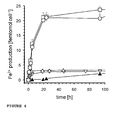
- Figure 1 shows the Fe(III) reduction of colloidal and bulk ferrihydrite by Geobacter sulfurreducens at different initial Fe(III) concentrations.
- Figure 2 shows the Fe(III) reduction of different colloidal ferrihydrite species by Geobacter sulfurreducens at different initial Fe(III) concentrations.
- Figure 3 shows the Surface normalized maximum reaction rates for colloidal hematite ( ⁇ ), 335 nm colloidal ferrihydrite ( ⁇ ), 12.2 nm ( ⁇ ) and 32.6 nm ( ⁇ ) ferrihydrite colloids, colloidal akaganeite ( ), colloidal goethite ( ), bulk goethite ( ), bulk hematite ( ) and bulk ferrihydrite ( ). Error bars indicate standard deviations among individual experiments.
- Figure 4 shows the catalytic effect of a small amount of a colloidal iron oxide added to a large volume of bulk iron oxide.
- the present invention provides a method for the degradation of pollutants in water and/or soil wherein colloidal particles comprising at least one metal oxide are used to oxidise the pollutants.
- the term "pollutant” means an organic compound.
- the term “pollutant” may refer to one specific organic compound, or to a mixture comprising more than one organic compound.
- a preferred organic compound is, for example, a hydrocarbon, either aliphatic or aromatic, which may optionally be substituted ("functionalized"), such as, for example, partially halogenated, oxidised etc.
- the pollutant comprises at least one hydrocarbon, more preferred one to fifty different hydrocarbons, and most preferred one to thirty hydrocarbons.
- These hydrocarbon compounds may be liquids themselves or compositions containing both liquid and solid components.
- Preferred hydrocarbon compounds are, for example, products derived from crude oil, such as petroleum, diesel, tar oil etc.
- BTEX hydrocarbon compounds A preferred example for hydrocarbon compounds are the so-called BTEX compounds, wherein BTEX is an acronym used for the compounds benzene, toluene, ethylbenzene, and xylene.
- BTEX hydrocarbons may also refer to related compounds, such as, for example, substituted cresols.
- the present invention is not restricted to the compounds given as examples in the above, but is suitable for use with any organic compound that is biologically degradable with metal oxides as electron acceptors under anaerobic or iron-reducing conditions.
- Preferred examples for pollutants are saturated aliphatic compounds, such as, for example, alkanes, either straight-chain or branched, cycloalkanes, or the like, unsaturated aliphatic compounds, such as, for example, alkenes or alkines, both either straight-chain or branched, cycloalkenes, cycloalkines, or the like, wherein the compounds may be functionalized etc.
- unsaturated aliphatic compounds such as, for example, alkenes or alkines, both either straight-chain or branched, cycloalkenes, cycloalkines, or the like, wherein the compounds may be functionalized etc.
- partially oxidised compounds such as, for example, alkohols, cresols, and the like, or carbon acids, or the like.
- compounds comprising heteroatoms such as, for example, heterocyclic aliphatic or aromatic compounds comprising one or more heteroatom selected from the group comprising nitrogen, oxygen, and sulphur,
- the term "degradation of pollutants in water and/or soil” means a chemical or biochemical reaction, by which a pollutant is degraded in water and/or soil.
- a pollutant may be degraded by an oxidation or reduction reaction.
- an aliphatic hydrocarbon may be oxidised to a corresponding alcohol, either the mono- or diol, aldehyde, carbon acid, or the like, and eventually to carbon dioxide.
- An aromatic hydrocarbon may also be oxidised to a corresponding alcohol, either the mono- or diol, acetate, or the like, and eventually to carbon dioxide, carbonic acid, or the like.
- a pollutant is degraded by an oxidation reaction.
- the oxidative degradation is a biological degradation, wherein the pollutant is degraded by a microorganism.
- water and/or soil means water, either in a pure state, such as fresh water or salt water, or water in a mixture with soil, such as groundwater, or soil, either in a dry state, such as sand, or a mixture of water and soil, such as soil saturated with water, for example in an aquifer or in a lake sediment.
- water and/or soil refers to all types of aquifers, such as, for example fractured rock or other fractured aquifers, porous aquifers, carst aquifers, and the like.
- soil also means a sediment, such as, for example, a lake sediment, sea sediment, or the like.
- soil and sediment both mean all types of solid matrix which can conduct water, if a hydrological gradient is present or applied.
- Soil and sediment refers to porous media or matrices.
- aquifers which are considered as conductive media, are known to be either carst, fractured, sedimentary or other aquifers.
- water and/or soil refers to a mixture of water and soil.
- the mixture of water and soil are an aquifer (groundwater), a sediment, such as a lake bottom or a sea bottom, a natural or artificial sediment which is part of a water treatment plant or an autonomic water purification system, or of a microbial fuel cell.
- aquifer groundwater
- sediment such as a lake bottom or a sea bottom
- natural or artificial sediment which is part of a water treatment plant or an autonomic water purification system
- microbial fuel cell microbial fuel cell.
- Examples for the use of sediments used in water treatment plants are the production or recovery of potable water from surface or waste water, for example by bank filtration, domestic or industrial water purification systems, or the like.
- Autonomous water purification systems are used in remote areas and/or hostile environments, such as, for example, in deserts, in a spacecraft, polar station etc.
- autonomous water purification systems are decentralised water treatment facilities, or other types of water treatment with porous media, or the like.
- the present invention also enhances the phosphate elimination by precipitation or adsorption of phosphate to the metal oxide materials used.
- the invention also allows to produce a conductive layer which allows to stimulate denitrification with electrical systems as electron supply.
- the mixture of water and soil is an aquifer (groundwater) or a sediment.
- the term "at least one metal oxide” means a compound or a particle comprising one or more metal oxides, preferably one to three metal oxides, further preferred one or two metal oxides.
- metal oxide means metal oxides, which comprise metal cations and the oxide anion (O 2- ).
- metal oxide also means metal hydroxyoxides, metal hydroxides, or the like.
- the metal cations may be cations derived from any metallic element of the periodic table, particularly any metallic main group element or any element of the transition metals. A metal cation is obtained by oxidation of the corresponding metal atom. A metal cation may have any oxidation state from +1 to +7.
- a metal cation has an oxidation state from +2 to +7, further preferred from +2 to +4, still further preferred an oxidation state of +2 or +3, and especially preferred an oxidation state of +3.
- the metal oxide particles of the present invention are usually composed from metal cations and oxide anions only, but they may comprise other anions such as, for example, halogenide (halide) anions, such as fluoride (F - ), chloride (Cl - ), bromide (Br - ) or the like, or other oxygen based anions, such as peroxide (O 2 2- ), hydroxide (OH - ) or the like, or composed anions, such as sulphate (SO 4 2- ), phosphate (PO 4 3- ) or the like.
- the metal oxide particles may comprise such other anions on the surface of the particle, either in form of single other anion(s) attached to the surface, or in form of one or more layers of such other anions covering the particle surface, either partially or completely.
- a metal oxide particle in an aqueous environment and/or originating from an aqueous environment usually comprises hydroxide anions on its surface.
- the degree of surface coverage by hydroxide anions is dependent on the proton concentration of the aqueous environment, i.e. its pH value.
- the degree of surface coverage i.e.
- a metal oxide particle, or its surface, respectively is in ionic equilibrium with the surroundings.
- the metal oxide particles in an aqueous environment are mostly electroneutral, i.e. their net electric charge is within a range of -5 to +5, preferably within a range of -3 to +3, more preferred within a range of -2 to +2, and especially preferred -1, or +1, or about zero.
- a metal oxide particle may also comprise chloride anions or other anions on its surface.
- a metal oxide particle is either a single crystal of the respective metal oxide, or composed of a multi-crystal structure of the respective metal oxide, such as, for example, an aggregate, agglomerate or conglomerate, composed of several crystalline components.
- the metal oxide particle is stable in the application form used in the method of the present invention, especially in a colloidal solution, and does neither decompose nor form further aggregates, agglomerates or conglomerates.
- the metal oxide particle may undergo changes in the physical and chemical state, which are distinct from the application form. Examples for such changes are aggregation, especially with soil or sediment particles, adsorption, especially on soil or sediment particles, precipitation, coagulation, or the like.
- the metal oxide particle may have any shape, either predetermined by the shape of a single crystal, or by the shape of the aggregate, agglomerate or conglomerate.
- the shape of the metal oxide particle is spherical, cubic, rhombic, hexagonal, or an aggregate of smaller particles or crystals.
- the particle is a stable dispersed particle or aggregate, which can be monodisperse crystals or aggregates of smaller particles.
- a particle consisting of an aggregate of smaller particles does not form further aggregates.
- the metal oxide particles may comprise particles with more than one of the above shape.
- the term "colloidal particles comprising at least one metal oxide” means a dispersion of the metal oxide particles in a liquid dispergant. Sometimes, this dispersion is also referred to as a colloidal suspension or a colloid.
- the liquid dispergant may be any suitable dispergant for dispersing the metal oxide particles.
- Preferred liquid dispergants are water, alcohols, such as ethanol, methanol and the like, as well as mixtures thereof. These dispergants may have different pH values and/or salt concentrations.
- the liquid dispergant comprises water.
- the dispergant is water.
- water means water at different pH and/or having different salt concentrations.
- the stability of the colloidal suspension is dependant on the proton concentration or pH value of the suspension medium.
- the pH value of the medium is from 6.5 to 9.0, further preferred from 7.0 to 8.5, still further preferred from 7.5 to 8.0, and most preferred about 8.0.
- the term "stable" means that the colloidal suspension does not show a coagulation of the dispersed particles.
- the stable colloidal suspension was found to remain in the colloidal state without requiring either mechanical means, such as, for example, stirring, shaking or the like, or additives, such as, for example, dispersion agents, or the like. It was found that a stable particle may be either monodisperse or an aggregate of smaller particles, which does not aggregate further.
- the colloidal suspension comprises additional components which are used to adjust properties such as, for example, the pH value, the ionic strength, or the like, of the colloidal suspension.
- properties such as, for example, the pH value, the ionic strength, or the like.
- the surface features of the colloidal particles such as, for example, the surface charge of the particles, their zeta-potential, their pKa value, or the like, which all contribute to the environmental behaviour of the particles, for example, govern the transport and adsorption properties of the particles.
- the intended spreading of the particle in the porous media especially, the mobility of the particles in the water and/or soil.
- the surface properties will allow for the adsorption of the particles to the matrix after a certain intended travel distance. Furthermore, the surface properties are adjusted to provide the optimal reactivity towards microbial reduction.
- the ionic strength of the suspension is adjusted by dialysis, dilution, desalting with chromatograpic or ion exchange methods and other means suitable for reducing the ionic strength.
- the colloidal suspension (dispersion) of colloidal metal oxide particles shows the physical properties of the dispergant so that the dispersion is liquid and basically behaves like a solution of the metal oxide particles.
- the colloidal suspension of the metal oxide particles may be stored and transported like a liquid, e.g. by pouring, pumping etc.
- the colloidal suspension comprising the metal oxide particles is a stable dispersion of the metal oxide particles in the dispergant (stable state).
- a stable dispersion means a dispersion which does not change its state or its physical properties for at least one month, preferably for at least two months, and especially preferred for at least three months.
- a suspension of metal oxide particles which is stable for at least three months
- the method according to the present invention produces excellent results in the oxidative degradation of pollutants in water and/or soil. Surprisingly, it was found that especially the anaerobic degradation of pollutants by iron-reducing micro-organisms is strongly enhanced by stimulating the respiration activity.
- the colloidal particles according to the present invention are up to three hundred-fold faster reducible than bulk iron oxides present in the water and/or soil. It is presumed that the metal oxide colloids serve as electron acceptors for anaerobic respiration. Moreover, the colloidal particles exhibit a surprising catalytic effect as electron shuttles to the solid electron accepting ferric oxide phases. So it was found that adding colloids according to the present invention strongly enhances the usually kinetically inhibited reduction of solid bulk iron oxides.
- the total amount of iron oxides available for bacterial reduction is highly enhanced by the addition of metal oxide colloids according to the present invention, especially, by adding iron oxide colloids. It is presumed that the colloids become adsorbed in this state and thereby activate the surface of the bulk iron oxides present in the water and/or soil, thereby increasing their bioavailability.
- the method according to the present invention advantageously enhances the microbial activity in the water and/or soil also for metal oxides, which are usually not bioavailable for micro-organisms, such as, for example, iron oxide minerals such as goethite and hematite, thus providing an increased biological degradation of the pollutants.
- the method according to the present invention allows for the oxidation of much more pollutants than could be oxidised by the added colloid alone (excess electron acceptor capability).
- the colloidal suspension comprising colloidal metal oxide particles used in the inventive method allows for an easy handling of the metal oxide particles.
- the colloid comprising the metal oxide particles may be introduced into the water and/or soil comprising the pollutants by means of passive or active transport reactions, for example, by passive or active infiltration.
- the two fluid components water and colloid may be simply combined or mixed.
- the mixing is assisted by means of stirring, shaking, or the like.
- the fluid property of the colloid allows for adding the colloid to the solid soil, or vice versa.
- This may, for example, be carried out by pouring the liquid colloid onto the soil in situ, or by adding the soil to a container, or the like, which comprises the colloid, preferably assisted by mixing, such as, for example, stirring or shaking.
- a similar procedure may also be carried out in the case of a mixture of water and soil already present, such as, for example, in a water treatment or purification plant, or system, or the like.
- the colloid may be transported to the site comprising the pollutant by means of passive transport, for example by natural groundwater flow, or by means of active transport, for example by directly pumping the colloid into the subsurface of the polluted site.
- this method allows to reach obstructed sites of polluted soil in situ, without carrying out major work in order to allow access to the sites.
- the colloids can thereby be introduced directly at the preferred site of biodegration and create a biobarrier where the oxidation of the pollutants takes place.
- a further advantage is that the biobarrier will form in the most conductive areas of the aquifer as the water-colloid mix will preferably infiltrate or pass through the most conductive flow paths.
- the colloids will be directly pumped to the preferred points of bioremediation, adsorb there and serve as electron acceptors and as electron shuttles to the matrix.
- the metal oxide particles comprise a metal oxide comprising a metal abundant in the natural environment of the water and/or soil.
- abundant metals are iron, aluminium, titanium, manganese, silicon, cobalt, nickel and the like.
- the metal oxide particles comprise metals selected from the group consisting of iron, aluminium, titanium, manganese, silicon, cobalt, and nickel.
- the metal oxide may also comprise other elements as impurities, especially, if the metal oxide in obtained from natural sources. It was found that metal oxide particles comprising any one of these metal oxides are particularly suitable for use in the present invention because they form especially stable colloids.
- the metal oxide particles comprising these metal oxides are easily available and are non-toxic, i.e. they do not pollute the water and/or soil further. In fact, such metal oxides are known to be part of natural soil or sediments.
- the metal oxide particles comprise an iron oxide or a mixed oxide comprising iron oxide and at least one of the group consisting of aluminium oxide, manganese oxide, and silicon oxide.
- the metal oxide particles comprise an iron oxide or a mixed oxide comprising iron oxide and at least one of the group consisting of aluminium oxide, manganese oxide, and silicon oxide.
- the metal oxide particles comprise pure iron oxides, pure manganese oxides, mixed iron-manganese oxides, as well as mixtures thereof with silicon oxides or aluminium/silicon oxides (aluminium silicates).
- iron oxides are naturally occurring iron oxides (referred to as natural iron oxides in the following) and synthetic iron oxides.
- the iron cation usually has an oxidation state of +2 or +3.
- iron oxide refers to iron oxides as well as to iron oxyhydroxides and iron oxide-hydroxide/chlorides, in which part of the oxide anions are replaced by hydroxide anions, or hydroxide and chloride anions, respectively.
- iron oxides or iron oxyhydroxides which comprise iron cations in the oxidation state +2 only, or which comprise iron cations in the oxidation state +3 only, or which comprise iron cations in both the oxidation states +2 and +3.
- ferric iron oxides which comprise iron cations in the oxidation state +3, and especially preferred are ferric iron oxides which comprise iron cations in the oxidation state +3 only.
- Preferred iron oxides consist of synthetic or natural iron oxides which are either synthesized de nuovo or produced from natural materials. Such natural materials can be, for example, iron oxides, which are milled to produce particles small enough to produce the stable colloidal suspension according to the present invention. Preferably, natural materials are milled to a particle size of 500 nm or smaller, more preferred 400 nm or smaller, and most preferred to a particle size of from 100 nm to 400 nm. Furthermore, natural colloidal particles can be extracted, concentrated, handled, and used similar to synthetic particles. However, natural metal oxides may require to check for impurity levels. Especially preferred are synthetically produced natural metal oxides.
- Preferred examples for natural iron oxides which comprise iron cations in the oxidation state +3 only, are, for example, hematite ( ⁇ -Fe 2 O 3 ), maghemite ( ⁇ -Fe 2 O 3 ), goethite ( ⁇ -FeO(OH)), ferrihydrite (Fe 5 HO 8 •4H 2 O), akaganéite (Fe(III)O(OH,Cl), lepidocrocite ( ⁇ -FeOOH) or the like.
- Other preferred natural metal oxides are magnetite (FeO•Fe 2 O 3 ), and manganese oxide and manganese dioxide minerals.
- the mineralogical identity of metal oxides can be determined by usual methods, such as, for example by characterization with X-ray diffraction, Mössbauer spectroscopy, LDS or other suitable methods.
- Preferred examples for synthetic iron oxides are hematite ( ⁇ -Fe 2 O 3 ), maghemite ( ⁇ -Fe 2 O 3 ), goethite ( ⁇ -FeO(OH)), ferrihydrite (Fe 5 HO 8 •4H 2 O), akaganéite (Fe(III)O(OH,Cl), lepidocrocite ( ⁇ -FeOOH), magnetite (FeO•Fe 2 O 3 ), and manganese oxides and/or dioxides.
- iron oxide particles are particularly suitable for use in the present invention because they form especially stable colloids. Moreover, iron oxide particles are easily available and are non-toxic, i.e. they do not pollute the water and/or soil further. In fact, iron is one of the most abundant elements on earth, and is found in form of iron oxides, at least in traces, in most soils or sediments.
- Examples for a mixed oxide comprising iron oxide and at least one of the group consisting of aluminium oxide, manganese oxide, and silicon oxide are mixed iron-aluminium-oxides, such as smectite, mixed iron-titanium oxides, and mixed iron-manganese oxides.
- iron oxide particles can be used to provide a coating of iron oxide on the surface of a particle consisting of another oxide, for example a silica particle.
- the iron oxide-coated particles are colloidal particles. Such particles can be advantageously used to enhance the colonisation of soil or sediment, and thus enhance the bioactivity thereof.
- the colloidal iron oxide particles can also be adjusted so that they form a coating on any matrix particle present in the soil or sediment in situ.
- the metal oxide particles comprise an iron oxide. Still further preferred, the metal oxide particles comprise an natural iron oxide, preferably a natural iron oxide comprising iron cations in the oxidation state +3. Further preferred, the metal oxide particles consist of a natural iron oxide comprising iron cations in the oxidation state +3 only. Most preferred, the metal oxide particles consist of one natural iron oxide selected from the group consisting of hematite ( ⁇ -Fe 2 O 3 ), maghemite ( ⁇ -Fe 2 O 3 ), goethite ( ⁇ -FeO(OH)), ferrihydrite (Fe 5 HO 8 •4H 2 O), akaganéite (Fe(III)O(OH,Cl), and lepidocrocite ( ⁇ -FeOOH).
- hematite ⁇ -Fe 2 O 3
- maghemite ⁇ -Fe 2 O 3
- goethite ⁇ -FeO(OH)
- ferrihydrite Fe 5 HO 8 •4H 2 O
- the metal oxide particles comprise a metal oxide that has a magnetic property.
- the metal oxide may be ferromagnetic or ferrimagnetic, preferably the metal oxide is a ferromagnetic metal oxide.
- Preferred examples for ferromagnetic iron oxides are magnetite or maghemite.
- the iron oxide particles may be prepared by known methods. General synthesis methods may be found, for example, in "Iron Oxides in the Lab” by U. Schwertmann and R.M. Cornell, VCH, Weinheim, 1991. However, it was found that especially stable colloidal suspensions of iron oxide particles useful for the present invention were preferably obtained by producing the colloidal particles in situ. Suitable methods for producing such stable colloidal suspensions comprise steps for inducing iron oxide formation in a suitable solution comprising iron ions by means of, for example, adjusting the pH value, adjusting the ionic strength of the solution, heating the solution, irradiating the solution, and the like. Preferably, the pH value is rapidly adjusted to a basic pH value of 8 or higher, more preferred to 10 or higher.
- the ionic strength is adjusted by reducing the ionic strength, preferably by dialysis, dilution, desalting with chromatograpic or ion exchange methods or other means suitable for reducing the ionic strength.
- the heating is carried out at temperatures of 90°C or higher, more preferred at boiling temperature. Heating may be carried out under increased pressure, preferably in a sealed system. Irradiation may be carried out using a microwave source, which also leads to heating of the solution.
- the size of the particles is usually dependent from the corresponding growth rates of the individual oxide particles, and may thus be adjusted by reaction time.
- the metal oxide particles have a particle size of from 1 to 2000 nm.
- particle size refers to the mean particle size of the metal oxide particles present in the colloidal suspension.
- the particle size refers to the average/largest dimension of either a monodisperse metal oxide crystal alone or an aggregate of particles forming a stable colloid. Examples for metal oxides forming such aggregates are ferrihydrite and goethite, which appear to consist of nanocrystals that aggregate to large although defined particles.
- the particle size refers to the average/largest diameter of the monodisperse crystal or aggregate, depending on the measuring method used.
- the particle size refers to the particle size as determined by dynamic light scattering (DLS) in a diluted aqueous colloidal sample.
- DLS dynamic light scattering
- Further suitable methods for determining the particle size comprise a zeta sizer, electron microscopy and the like.
- the metal oxide particles have a particle size of from 3 to 2000 nm, still further preferred from 10 to 500 nm, and most preferred from 30 to 300 nm. It was found that metal oxide particles having a particle size of 10 to 500 nm are especially suitable to form the stable colloidal suspension required for the method according to the present invention. Particles larger than 2000 nm do not produce a stable colloid.
- iron oxide particles it was found that they show an optimum effect in the method of the present invention, if they have a particle size of from 5 to 500 nm, preferably from 30 to 400 nm, and most preferred from 100 to 400 nm. Particularly, in the case of ferrihydrite, goethite, and hematite, it was found that particles with a size of from 100 to 400 nm are especially effective in the method for the degradation of pollutants in water and/or soil according to the present invention. Surprisingly, the bioavailability of the iron oxide particles according to the present invention is independent from the nature of the iron oxide comprised in the colloid. It was found that below a particle size of 500 nm the iron oxide becomes readily available even though the corresponding iron oxide will not be reducible as a bulk phase.
- the colloid is brought into contact with the water and/or soil comprising the pollutants by means of mixing, and/or active or passive transport.
- the two fluid components water and colloid may be simply combined or mixed.
- the mixing is assisted by means of stirring, or the like.
- the fluid property of the colloid allows for adding the colloid to the solid soil, or vice versa. This may, for example, be carried out by pouring the liquid colloid onto the soil in situ, or by adding the soil to a container, or the like, which comprises the colloid, preferably assisted by mixing, such as, for example, stirring.
- a similar procedure may also be carried out in the case of a mixture of water and soil already present, such as, for example, in a water treatment or purification plant, or system, or the like.
- the colloid may be transported to the site comprising the pollutant by means of passive transport, for example by natural groundwater flow, or by means of active transport, for example by directly pumping the colloid into the polluted site.
- passive transport for example by natural groundwater flow
- active transport for example by directly pumping the colloid into the polluted site.
- this method allows to reach obstructed sites of polluted soil in situ, without carrying out major work in order to allow access to the sites.
- the addition of the colloid comprising metal oxide particles to water and/or soil comprising pollutants highly enhances the microbial activity in the water and/or soil.
- the microbes metabolise the pollutants, which are thereby degraded and removed from the water and/or soil.
- the colloid comprising metal oxide particles not only acts as an electron acceptor for the microbes, especially in an anaerobic environment that is found, for example, in a subsurface site, but also enhances the availability of other mineral electron acceptors present in the water and/or soil, such as, for example, bulk metal oxide particles.
- the use of the colloid according to the invention allows to oxidise more pollutant molecules than could be oxidised by the colloidal particles alone.
- the colloid comprising metal oxide particles exhibits a catalytic effect in activating the bulk material since a small amount of colloid may activate a much larger amount of bulk material for the biological degradation of the pollutant.
- the colloidal particles are further used to activate or enhance the availability of other mineral electron acceptors present in the water and/or soil, especially that of bulk metal oxides.
- the colloid is pumped into the water and/or soil. It was found that pumping of the colloid allows for reaching remote sites of water and/or soil contaminated with pollutants. Thus, it is possible to bring the colloid into contact with remote sites of water and/or soil, such as, for example, deep sea sediments, or aquifer underneath buildings or other structures. Moreover, by adjusting the pressure used for pumping the colloid into the water and/or soil it is possible to increase or decrease the flow velocity of the colloid. This allows for a faster (slower) spreading of the colloid in the water and/or soil, and, consequently, influences the reactivity of the colloid.
- the pumping pressure also influences the immediate spreading of the colloid in the water and/or soil, and thus not only the area or volume accessible from a single point of entry, but also the amount or concentration of colloid provided per volume unit.
- the colloid is pumped into the water and/or soil at a single point, or at more than one point, either simultaneously or successively.
- the colloid may be pumped into the water and/or soil at 1, 2, 3, 4, 5, or more points. It is also feasible to pump the colloid into the water and/or soil at 10, 20, 30, 40, 50 or more points. The number of points will be selected according to the corresponding conditions.
- An example scenario for a preferred use of the inventive method is e.g. a fuel spill comprising aromatic hydrocarbons, which have leaked into the groundwater.
- a fuel spill comprising aromatic hydrocarbons, which have leaked into the groundwater.
- the mass of the soil contaminated with fuel was already excavated, the residual fuel still present in the subsurface is constantly dissolving into the groundwater, producing a BTEX-plume.
- the plume is prolonging and has crossed a property boundary, perhaps underneath a valuable structure, such as, for example, a building, street etc., directly demanding remediation action.
- the plume is only produced from residual hydrocarbons left after the initial remediation action (excavation), only small local concentrations of aromatic hydrocarbons are expected.
- the present invention allows the construction of a biobarrier in order to remediate the plume of aromatic hydrocarbons directly in the aquifer (subsurface site).
- the colloid may be pumped into one or more holes (wells) drilled downstream of the polluted site, with respect to the natural flow of the groundwater, thereby creating a bioactive barrier for the pollutant.
- the pollutant will then be passively transported with the groundwater flow to the colloid-treated site. It is a further advantage of the colloid that it is stable in the pumping so that it does not block the pumping equipment or the entry holes (wells). Further, by adjusting the properties of the metal oxide particles, it is possible to obtain a colloid having desired properties.
- the colloid shall only stay in suspension for a certain time and then naturally adsorb to the aquifer matrix.
- a biobarrier i.e. a stationary site of enhanced biological activity, where biodegration of the pollutant takes place, by providing a suitable electron acceptor.
- the success of the treatment can be monitored in downstream groundwater wells either by monitoring the change of pollutant concentrations or more preferably by compound specific stable isotope analysis.
- the colloids are injected with probes into sediments of lakes or rivers for decontamination.
- This embodiment does also include enhanced bank filtration used in water treatment.
- the sediment is punctured with the probe and the colloid suspension is injected through the probe into the sediment. This needs to be performed with adequate pumping rates in order to not fluidise the sediment.
- the success of the treatment can be monitored by measuring the concentration of the pollutant itself or by stable isotope fractionation.
- the colloidal suspension is used to remediate sea, lake or river sediments, e.g. after an oil spill.
- the colloid suspension may be poured onto the unsaturated parts of the shore where it then penetrates the sediment down to the saturated zone. The wave energy will further spread the colloid in the area of the capillary fringe where the pollutants are mostly located.
- the colloid In the sea, lake or river water itself, the colloid is pumped with tubings into the sea, lake or river and released just above the sediment. Due to its high physical density, the colloid suspension spreads on the ground and settles onto the sediment where it can fulfil its electron accepting function.
- iron oxide colloids can function as a phosphorous sink, e.g. removing phosphate from the water, and store phosphorous in the sediment.
- the colloid suspension is used to activate biofilters in decentralised waste water treatment plants.
- the colloid suspension is poured or pumped into the sand filter where it adsorbs to the exposed surfaces of the sand particles. It thereby activates these surfaces for micro-organisms with respect to electron accepting properties but also with respect to colonisation, thus resulting in a preferred forming of biofilms on the surfaces.
- a preferred function of the colloids is here also the removal of phosphorous from the waste water by chemically binding the phosphorous and precipitating it as an iron-complex. This improves the category of cleaning of the waste water plant.
- the application here is also a general coating of the surfaces of the matrix with metal oxides.
- a colloid comprising iron oxide particles having a particle size of from 1 to 500 nm is brought into contact with water and/or soil comprising a pollutant by means of pumping the colloid into the water and/or soil. More preferred, the particle size of the iron oxide particles is 100 to 400 nm. It was found that these iron oxide particles are especially effective in the present invention.
- the indigenous micro-organisms of the water and/or soil are used to fulfil the function of the colloids.
- metal-reducing organisms are omnipresent in nature and especially in anoxic habitats where they will use the colloids.
- Preferred examples are bacteria, especially those selected from the group consisting of Geobacter sulfurreducens (DSM No.: 12127), Geobacter Grbiciae, and Shewanella putrefaciens.
- the inventive method is used for the formation of a biobarrier in water and/or soil.
- biobarrier means a site where the oxidation of the pollutants takes place, which is formed in conductive areas of an aquifer preventing the further spreading of a pollutant therein.
- the present invention provides a colloidal suspension comprising colloidal particles comprising at least one metal oxide metal oxide for use in the method according of the present invention.
- the present invention provides a method for the production of a colloidal suspension that can be used in the method according of the present invention.
- the method for the production of the colloidal suspension comprises at least one step for inducing metal oxide formation in a solution comprising corresponding metal ions, wherein the at least one step for inducing metal oxide formation is selected from adjusting the pH value of the solution, adjusting the ionic strength of the solution, heating the solution, and irradiating the solution.
- Colloidal ferrihydrite (336 nm diameter) was synthesized by dissolving 0.1 M ferric citrate and adjusting the solution to a pH value of 8.0 by adding a 32% solution of sodium hydroxide under vigorous stirring. At pH 8.0, stirring was continued for 30 min.
- Colloidal hematite (134 nm diameter) was synthesized by adding 100 mL of a 0.1 Fe(NO 3 ) 3 solution to 1 L of boiling and vigorously stirred water, whereupon nanoparticles start to form in the solution.
- Colloidal goethite was synthesized by dropwise adding 1.0 L of a 0.48 M solution of NaHC03 to a 1.0 L of a stirred 0.4 M solution of Fe(NO 3 ) 3 •9H 2 O. The suspension was then microwaved at 200 W until boiling occurred. Immediately after heating, the suspension was plunged into an ice bath until it reached 20°C. After dialysis, the pH of the suspension was quickly adjusted to pH 12 using a 5 M NaOH solution. The suspension was then heated at 90°C for 24 h. Finally, the resulting suspension was filtered using 0.22 ⁇ m filters (MilliQ).
- Colloidal akaganèite (157 nm diameter) was sythesized by preparing and sealing 100 mL of a 0.37 M aqueous ferric chloride solution in a pressure tube, which was heated to 60°C for 18 hours. At the end of the hydrolysis reaction, a yellow precipitate had formed.
- Dynamic light scattering was applied to measure particle sizes of the water-dispersed and diluted colloidal samples, using a ZetaSizerNano ZS and a HPPS 5001 (both Malvern Instruments, Worcestershire, UK) with low volume sizing cuvettes. At least triplicate measurements of 30 sec each were done. 80 nm calibration latex beads were measured to confirm the accurateness of the method. As DLS is an indirect measurement, the particle size was also checked by Scanning Electron Microscopy, which confirmed the data obtained by DLS of the particle sizes mentioned above.
- X-ray-diffraction and BET-surface measurements were performed with aliquots that had previously been frozen rapidly to -80°C, lyophilized, sealed and stored at 4°C in a desiccator.
- X-ray diffraction (XRD) patterns were obtained using a Philips PW 1050 diffractometer (Philips, Eindhoven, Netherlands) equipped with a diffracted-beam graphite monochromator.
- the specific surface area of the sample material was determined using N 2 -physisorption at 77.35 K. The calculations were performed from 11-point isotherms according to the Braunauer-Emmet-Teller equation. A Quantachrome Autosorb 1 (Syosset, NY, USA) was applied to perform the analysis. Before the measurement, sample material was degassed under vacuum at 35°C overnight. This mild treatment was chosen in order to prevent structural changes of the dried iron oxides due to heating. All samples were measured at least two times with a reproducible standard deviation of less than 1% (exception bulk hematite 2.3%) of the obtained specific surface area. An Al 2 O 3 -bead standard with a specific surface area of 79.8 +0.4 m 2 /g was applied for external calibration.
- Geobacter sulfurreducens DSM No.: 12127 was obtained from the German Collection of Microorganisms and Cell Cultures (Braunschweig, Germany). The strain was cultivated using standard anaerobic techniques at 30°C in the dark. Autoclaved, anoxic low salt medium was used throughout the study, consisting of 0.1 g/L NaCl, 4 mg/L MgCl 2 ⁇ 6H 2 , 25 mg/L NH 4 Cl, 50 mg/L KCl and 15 mg/L CaCl 2 2H 2 O. The medium was supplemented with trace elements solution SL10, selenite-tungsten and vitamins solutions. 10 ⁇ M Na 2 SO 4 was added as sulphur source.
- the medium was buffered with 10 mM Tris/HCl at pH 6.8. This low-salt medium was applied to ensure colloid stability. Sodium acetate (10 mM) was added as sole energy and carbon source. All chemicals (except ferric citrate for precultivation) were at least ACS grade.
- Cell suspension Precultures were grown with 50 mM technical grade ferric citrate (pH 7.0) as electron acceptor. After growth to the late exponential phase, cells were harvested by centrifugation and resuspended in fresh medium in an anoxic glove box (O 2 content ⁇ 3 ppm). Remaining Fe 2+ in the cell suspension was ⁇ 2 mM. These cell suspensions were immediately added to the reduction experiments in a 1:10 ratio to yield final cell densities of around 2 ⁇ 10 9 cells/ml. Flow-cytometry was applied to measure the exact cell densities of the individual experiments using a LSRII (Becton Dickson Bioscience, Franklin Lakes, NJ, USA), thereby allowing a per-cell normalization of reduction rates.
- LSRII Becton Dickson Bioscience, Franklin Lakes, NJ, USA
- Paraformaldehyde-fixed cells from the cell suspensions were stained by SYBR ® Green I nucleic acid stain (Molecular Probes, Eugene, OR, USA), diluted in 0.22 ⁇ m-filtered Dulbecco's-PBS and counted at a wavelength of 510 nm in Trucount TM bead (Becton Dickson) calibrated measurements.
- Microbial reduction experiments were performed in batch incubations, initiated in anoxic (20/80 % CO 2 /N 2 ) and sterile 100 ml glass serum bottles sealed with butyl rubber stoppers.
- the specific colloidal or bulk iron oxides were added to the medium and the bacterial cell suspension via sterile and anoxic syringes and needles. Colloids stayed stable during the entire reaction.
- abiotic controls were performed by adding the cell suspension through a 0.22 ⁇ m filter, thereby retaining the bacteria.
- the first samples for Fe 2+ analysis were withdrawn. From then on, the experimental vessels were shaken at 300 rpm at 30°C in the dark.
- Iron reduction was assessed by Fe 2+ concentration measurements using the ferrozine assay. 0.2 ml aliquots were withdrawn from the experiment, diluted 1:10 in 1 M HCL and shaken at 1400 rpm for 24 hours to remove all adsorbed Fe 2+ from iron oxide surfaces. Total iron measurements were treated with 10% v/v hydroxylamine-HCL to enforce a complete reduction of all Fe(III) to Fe 2+ . Subsequently, aliquots from this preparation were diluted with ferrozine, incubated for 10 min and shaken again for 30 sec. Absorbance at 560 nm was measured using a Wallac 1420 Viktor 3 plate reader (Perkin Elmer, MA, USA).
- colloidal hematite, goethite and akaganeite of the same size were also reduced to 77.8 - 100.0 % at rates of 0.067 and 0.505-0.603 femtomol h -1 cell -1 ferrous iron production, as compared to colloidal ferrihydrite which was reduced at 0.680-1.645 femtomol h -1 cell -1 . Even more, this is also the first report of akaganeite being reduced by Geobacter at all.
- iron oxide initial Fe(III) concentration [femtomol cell -1 ] Reduced [%] Max reduction rate [femtomol h -1 cell -1 ] ferric citrate 86.3 85.6 6.106 12 nm ferrihydrite 18.6 83.9 0.939 32 nm ferrihydrite 23.6 86.2 2.410 335 nm ferrihydrite 0.9 100.0 0.680 335 nm ferrihydrite 2.9 100.0 1.094 335 nm ferrihydrite 9.2 96.7 1.645 bulk ferrihydrite 33.1 24.9 0.041 bulk ferrihydrite 86.7 1.0 0.005 bulk ferrihydrite 170.9 3.7 0.067 colloidal hematite 3.0 100.0 0.505 colloidal hematite 5.9 100.0 0.603 colloidal hematite 16.5 84.0 0.334 bulk hematite 13.4 6.2 0.017 bulk hematite 69.3 11.4 0.049 colloidal goethite 1.49 80.5
- the present invention provides a method for the biological remediation of sites polluted with hydrocarbons, which is versatile, universally applicable, easy to use and cost-efficient, without requiring to further strain the already polluted environment. Moreover, the present invention provides a method for forming a biobarrier against the further spreading of a contamination, especially in an aquifer or in a sediment. Moreover, the present invention provides colloidal suspensions for use in the remediation of polluted sites and for use in the formation of a biobarrier in an aquifer or in a sediment, as well as a method for the production of such colloidal suspensions.
Landscapes
- Life Sciences & Earth Sciences (AREA)
- Engineering & Computer Science (AREA)
- Environmental & Geological Engineering (AREA)
- Soil Sciences (AREA)
- Hydrology & Water Resources (AREA)
- Water Supply & Treatment (AREA)
- Microbiology (AREA)
- Biodiversity & Conservation Biology (AREA)
- Chemical & Material Sciences (AREA)
- Organic Chemistry (AREA)
- Processing Of Solid Wastes (AREA)
- Treatment Of Water By Oxidation Or Reduction (AREA)
Priority Applications (5)
| Application Number | Priority Date | Filing Date | Title |
|---|---|---|---|
| EP20080015396 EP2159198A1 (fr) | 2008-09-01 | 2008-09-01 | Procédé de dégradation de polluants dans l'eau et/ou dans le sol |
| PCT/EP2009/006296 WO2010022983A1 (fr) | 2008-09-01 | 2009-08-31 | Procédé de dégradation de polluants dans l'eau et/ou le sol |
| EP09809297.6A EP2334608B8 (fr) | 2008-09-01 | 2009-08-31 | Procédé de dégradation de polluants dans l'eau et/ou dans le sol |
| US13/061,587 US8921091B2 (en) | 2008-09-01 | 2009-08-31 | Method for the degradation of pollutants in water and/or soil |
| DK09809297.6T DK2334608T3 (en) | 2008-09-01 | 2009-08-31 | PROCEDURE FOR DEGRADING POLLUTANTS IN WATER AND / OR EARTH |
Applications Claiming Priority (1)
| Application Number | Priority Date | Filing Date | Title |
|---|---|---|---|
| EP20080015396 EP2159198A1 (fr) | 2008-09-01 | 2008-09-01 | Procédé de dégradation de polluants dans l'eau et/ou dans le sol |
Publications (1)
| Publication Number | Publication Date |
|---|---|
| EP2159198A1 true EP2159198A1 (fr) | 2010-03-03 |
Family
ID=39941589
Family Applications (2)
| Application Number | Title | Priority Date | Filing Date |
|---|---|---|---|
| EP20080015396 Withdrawn EP2159198A1 (fr) | 2008-09-01 | 2008-09-01 | Procédé de dégradation de polluants dans l'eau et/ou dans le sol |
| EP09809297.6A Active EP2334608B8 (fr) | 2008-09-01 | 2009-08-31 | Procédé de dégradation de polluants dans l'eau et/ou dans le sol |
Family Applications After (1)
| Application Number | Title | Priority Date | Filing Date |
|---|---|---|---|
| EP09809297.6A Active EP2334608B8 (fr) | 2008-09-01 | 2009-08-31 | Procédé de dégradation de polluants dans l'eau et/ou dans le sol |
Country Status (4)
| Country | Link |
|---|---|
| US (1) | US8921091B2 (fr) |
| EP (2) | EP2159198A1 (fr) |
| DK (1) | DK2334608T3 (fr) |
| WO (1) | WO2010022983A1 (fr) |
Cited By (4)
| Publication number | Priority date | Publication date | Assignee | Title |
|---|---|---|---|---|
| WO2012123331A1 (fr) * | 2011-03-11 | 2012-09-20 | Fundació Privada Institut Català De Nanotecnologia | Production de biogaz |
| DE102018103952A1 (de) * | 2018-02-21 | 2019-08-22 | Universität Duisburg-Essen | Nano-Goethit als Agglomerisations- und Dekontaminationspartikel |
| CN110487987A (zh) * | 2019-08-08 | 2019-11-22 | 中国农业科学院农业环境与可持续发展研究所 | 流域农业面源污染的frn-cssi联合溯源示踪解析方法 |
| CN116965308A (zh) * | 2023-07-03 | 2023-10-31 | 中国海洋大学 | 岛礁种植的深海沉积物改良农作物土、制备方法及改良剂 |
Families Citing this family (12)
| Publication number | Priority date | Publication date | Assignee | Title |
|---|---|---|---|---|
| CN105512417B (zh) * | 2015-12-17 | 2018-09-18 | 中国环境科学研究院 | 基于粒子追踪的孔隙地下水污染物三维运移模拟方法 |
| CN105948280A (zh) * | 2016-07-22 | 2016-09-21 | 中国环境科学研究院 | 以赤铁矿中Fe3+为电子受体的厌氧生物氧化水污染修复方法 |
| US10549455B2 (en) * | 2018-03-25 | 2020-02-04 | Radical Plastics Inc. | Utilization of fine mineral matter in the conversion of non-biodegradable plastic and in remediation of soils polluted with non-biodegradable plastic |
| US11667058B2 (en) | 2018-03-25 | 2023-06-06 | Radical Plastics, Inc. | Utilization of fine mineral matter in the conversion of non-biodegradable plastic and in remediation of soils polluted with non-biodegradable plastic |
| CN109081454A (zh) * | 2018-09-10 | 2018-12-25 | 中国环境科学研究院 | 铁还原生化处理对垃圾渗滤液膜工艺浓缩液的减量方法 |
| CN109626591B (zh) * | 2018-12-06 | 2020-07-28 | 北京大学 | 利用微生物与赤铁矿在光照条件下协同还原六价铬的方法 |
| WO2021087160A1 (fr) | 2019-10-29 | 2021-05-06 | Radical Plastics, Inc. | Compositions et procédés d'utilisation d'une matière minérale fine en tant que catalyseur pour un recyclage chimique |
| CN110776225A (zh) * | 2019-11-18 | 2020-02-11 | 深圳市承亿生物科技有限公司 | 一种生物酵素原位降解河道底於泥的方法 |
| CN116997639A (zh) | 2020-11-18 | 2023-11-03 | 雷迪克塑料公司 | 用于提升热或催化裂化或原位重油催化裂化的产物品质的细矿物质 |
| CN112759048B (zh) * | 2020-12-21 | 2022-10-11 | 上海熊猫机械(集团)有限公司 | 一种pac溶液智能投加控制方法 |
| CN113479994B (zh) * | 2021-07-14 | 2022-07-29 | 南开大学 | 一种石墨烯-磁铁矿导电骨架电极及其制备方法和应用、处理石化废水的方法 |
| CN114108319B (zh) * | 2021-12-03 | 2023-09-22 | 山西大学 | 一种内嵌希瓦氏菌的凝胶纤维制备方法及应用 |
Citations (10)
| Publication number | Priority date | Publication date | Assignee | Title |
|---|---|---|---|---|
| US5741427A (en) | 1996-03-14 | 1998-04-21 | Anesys Corp. | Soil and/or groundwater remediation process |
| US5857810A (en) | 1995-11-07 | 1999-01-12 | Battelle Memorial Institute | In-situ chemical barrier and method of making |
| WO2000050345A2 (fr) * | 1999-02-25 | 2000-08-31 | Minox Corporation Usa | Concentres d'oxydes mineraux liquides destines au traitement de l'eau et des eaux usees |
| EP1151807A1 (fr) * | 1999-07-29 | 2001-11-07 | Hazama Corporation | Agent de purification du sol et procede de purification du sol |
| WO2003093179A1 (fr) * | 2002-04-16 | 2003-11-13 | Nanyang Technological University | Compositions et procedes pour le traitement d'eaux usees et d'autres dechets |
| US6777449B2 (en) | 2000-12-21 | 2004-08-17 | Case Logic, Inc. | Method of making and using nanoscale metal |
| US20040222151A1 (en) * | 2001-12-10 | 2004-11-11 | Ming-Kuo Lee | Method and system for forming an in situ groundwater filter |
| EP1593729A1 (fr) * | 2002-12-20 | 2005-11-09 | Ishihara Sangyo Kaisha, Ltd. | Materiau pour traiter une substance nocive et procede de traitement de substance nocive a l'aide dudit materiau |
| EP1650168A1 (fr) * | 2004-10-19 | 2006-04-26 | Toda Kogyo Corporation | Particules composites de fer pour la purification du sol ou des eaux souterraines, agent de purification contenant lesdites particules et procédé de purification du sol ou des eaux souterraines |
| EP1661864A1 (fr) * | 2004-11-29 | 2006-05-31 | Toda Kogyo Corporation | Agent de purification pour purifier des sols ou des réservoirs souterrains pollués, procédé pour producer cet agent, and procédé de traitement des sols ou des réservoirs souterrains pollués avec cet agent |
Family Cites Families (2)
| Publication number | Priority date | Publication date | Assignee | Title |
|---|---|---|---|---|
| US5846434A (en) * | 1996-03-01 | 1998-12-08 | University Of Georgia Research Foundation | In-situ groundwater remediation by selective colloid mobilization |
| US8080163B2 (en) * | 2002-12-04 | 2011-12-20 | Blue Water Technologies, Inc. | Water treatment method |
-
2008
- 2008-09-01 EP EP20080015396 patent/EP2159198A1/fr not_active Withdrawn
-
2009
- 2009-08-31 US US13/061,587 patent/US8921091B2/en active Active
- 2009-08-31 EP EP09809297.6A patent/EP2334608B8/fr active Active
- 2009-08-31 DK DK09809297.6T patent/DK2334608T3/en active
- 2009-08-31 WO PCT/EP2009/006296 patent/WO2010022983A1/fr not_active Ceased
Patent Citations (11)
| Publication number | Priority date | Publication date | Assignee | Title |
|---|---|---|---|---|
| US5857810A (en) | 1995-11-07 | 1999-01-12 | Battelle Memorial Institute | In-situ chemical barrier and method of making |
| US5741427A (en) | 1996-03-14 | 1998-04-21 | Anesys Corp. | Soil and/or groundwater remediation process |
| WO2000050345A2 (fr) * | 1999-02-25 | 2000-08-31 | Minox Corporation Usa | Concentres d'oxydes mineraux liquides destines au traitement de l'eau et des eaux usees |
| EP1151807A1 (fr) * | 1999-07-29 | 2001-11-07 | Hazama Corporation | Agent de purification du sol et procede de purification du sol |
| US6777449B2 (en) | 2000-12-21 | 2004-08-17 | Case Logic, Inc. | Method of making and using nanoscale metal |
| US7301066B2 (en) | 2000-12-21 | 2007-11-27 | Arcadis G&M, Inc. | Method of making and using nanoscale metal |
| US20040222151A1 (en) * | 2001-12-10 | 2004-11-11 | Ming-Kuo Lee | Method and system for forming an in situ groundwater filter |
| WO2003093179A1 (fr) * | 2002-04-16 | 2003-11-13 | Nanyang Technological University | Compositions et procedes pour le traitement d'eaux usees et d'autres dechets |
| EP1593729A1 (fr) * | 2002-12-20 | 2005-11-09 | Ishihara Sangyo Kaisha, Ltd. | Materiau pour traiter une substance nocive et procede de traitement de substance nocive a l'aide dudit materiau |
| EP1650168A1 (fr) * | 2004-10-19 | 2006-04-26 | Toda Kogyo Corporation | Particules composites de fer pour la purification du sol ou des eaux souterraines, agent de purification contenant lesdites particules et procédé de purification du sol ou des eaux souterraines |
| EP1661864A1 (fr) * | 2004-11-29 | 2006-05-31 | Toda Kogyo Corporation | Agent de purification pour purifier des sols ou des réservoirs souterrains pollués, procédé pour producer cet agent, and procédé de traitement des sols ou des réservoirs souterrains pollués avec cet agent |
Non-Patent Citations (3)
| Title |
|---|
| E.E. RODEN; J.M. ZACHARA, ENVIRON. SCI. TECHNOL., vol. 30, 1996, pages 1618 - 1628 |
| W. ZHANG, JOURNAL OF NANOPARTICLE RESEARCH, vol. 5, 2003, pages 323 - 332 |
| ZHANG ET AL: "The effect of Fe<0>/Fe<2+>/Fe<3+> on nitrobenzene degradation in the anaerobic sludge", 13 April 2007, JOURNAL OF HAZARDOUS MATERIALS, ELSEVIER, PAGE(S) 57 - 64, ISSN: 0304-3894, XP022028001 * |
Cited By (6)
| Publication number | Priority date | Publication date | Assignee | Title |
|---|---|---|---|---|
| WO2012123331A1 (fr) * | 2011-03-11 | 2012-09-20 | Fundació Privada Institut Català De Nanotecnologia | Production de biogaz |
| US9416373B2 (en) | 2011-03-11 | 2016-08-16 | Fundació Privada Institut Catalá De Nanotechologia | Biogas production |
| DE102018103952A1 (de) * | 2018-02-21 | 2019-08-22 | Universität Duisburg-Essen | Nano-Goethit als Agglomerisations- und Dekontaminationspartikel |
| CN110487987A (zh) * | 2019-08-08 | 2019-11-22 | 中国农业科学院农业环境与可持续发展研究所 | 流域农业面源污染的frn-cssi联合溯源示踪解析方法 |
| CN116965308A (zh) * | 2023-07-03 | 2023-10-31 | 中国海洋大学 | 岛礁种植的深海沉积物改良农作物土、制备方法及改良剂 |
| CN116965308B (zh) * | 2023-07-03 | 2024-01-30 | 中国海洋大学 | 岛礁种植的深海沉积物改良农作物土、制备方法及改良剂 |
Also Published As
| Publication number | Publication date |
|---|---|
| EP2334608B8 (fr) | 2018-01-17 |
| US20110275878A1 (en) | 2011-11-10 |
| US8921091B2 (en) | 2014-12-30 |
| WO2010022983A8 (fr) | 2010-05-20 |
| EP2334608B1 (fr) | 2017-11-15 |
| WO2010022983A1 (fr) | 2010-03-04 |
| EP2334608A1 (fr) | 2011-06-22 |
| DK2334608T3 (en) | 2018-02-12 |
Similar Documents
| Publication | Publication Date | Title |
|---|---|---|
| EP2334608B1 (fr) | Procédé de dégradation de polluants dans l'eau et/ou dans le sol | |
| Klimkova et al. | Zero-valent iron nanoparticles in treatment of acid mine water from in situ uranium leaching | |
| Cundy et al. | Use of iron-based technologies in contaminated land and groundwater remediation: A review | |
| Gong et al. | Immobilization of mercury in field soil and sediment using carboxymethyl cellulose stabilized iron sulfide nanoparticles | |
| Luo et al. | Remediation of arsenic-contaminated groundwater using media-injected permeable reactive barriers with a modified montmorillonite: sand tank studies | |
| Krok et al. | Remediation of zinc-contaminated groundwater by iron oxide in situ adsorption barriers–From lab to the field | |
| Digiacomo et al. | Immobilization of Cr (VI) by sulphate green rust and sulphidized nanoscale zerovalent iron in sand media: batch and column studies | |
| Keane | Fate, transport and toxicity of nanoscale zero-valent iron (nZVI) used during superfund remediation | |
| Simeonidis et al. | Nanoparticles for heavy metal removal from drinking water | |
| Wang et al. | In situ precipitation of hydrous ferric oxide (HFO) for remediation of subsurface iodine contamination | |
| Vodyanitskii | Artificial permeable redox barriers for purification of soil and ground water: A review of publications | |
| Huang et al. | Sedimentation kinetics and stability mechanisms of iron and manganese colloids in simulated groundwater | |
| Ranjan et al. | Applications of nanomaterials in subsurface remediation techniques: Challenges and future prospects | |
| Vodyanitskii et al. | Role of zero-valent iron in the degradation of organochlorine substances in groundwater | |
| Andrade et al. | Iron Oxide Nanomaterials for the Removal of Cr (VI) and Pb (II) from Contaminated River After Mariana Mining Disaster | |
| Chowdhury | Removal of Arsenic from Contaminated Water by Granular Activated Carbon Embedded with Nano scale Zero-valent Iron. | |
| Chowdhury | Application of mixed iron oxides in subsurface remediation technologies | |
| Feng et al. | Stabilization of compound lead and arsenic contaminated soils by using two iron-based materials: Long-term efficacy | |
| Linley | Polymeric coatings for targeted nanoparticle delivery to subsurface contaminants | |
| Wu et al. | Research progress of nanomaterials about removal of toxic metal ions and organics used in water treatment | |
| Scott | Inorganic nanoparticles for environmental remediation | |
| イブラヒム,モハメド,アブデルハク,マーモウン | Improvement of Iron Nanoparticles Reactive Performance via Coating Modification towards Contaminants Removal from Water | |
| Usman | Geochemistry and Remediation of Fe, Mn, and as in Groundwater from Quaternary Alluvium, Lower Kelantan Basin, North-Eastern Coast of Peninsular Malaysia | |
| Digiacomo | Mobility and Reactivity of Sulfate Green Rust and Sulfidized Nanoscale Zerovalent Iron for In-Situ Remediation of Chromium Contaminated Sites | |
| D’Couto | Development of a low-cost sustainable water filter: A study of the removal of water pollutants As (V) and Pb (II) using magnetite nanoparticles |
Legal Events
| Date | Code | Title | Description |
|---|---|---|---|
| PUAI | Public reference made under article 153(3) epc to a published international application that has entered the european phase |
Free format text: ORIGINAL CODE: 0009012 |
|
| AK | Designated contracting states |
Kind code of ref document: A1 Designated state(s): AT BE BG CH CY CZ DE DK EE ES FI FR GB GR HR HU IE IS IT LI LT LU LV MC MT NL NO PL PT RO SE SI SK TR |
|
| AX | Request for extension of the european patent |
Extension state: AL BA MK RS |
|
| STAA | Information on the status of an ep patent application or granted ep patent |
Free format text: STATUS: THE APPLICATION HAS BEEN WITHDRAWN |
|
| 18W | Application withdrawn |
Effective date: 20100706 |