EP2159231A1 - Procédé de production d'un polysaccharide hydrosoluble - Google Patents
Procédé de production d'un polysaccharide hydrosoluble Download PDFInfo
- Publication number
- EP2159231A1 EP2159231A1 EP08764789A EP08764789A EP2159231A1 EP 2159231 A1 EP2159231 A1 EP 2159231A1 EP 08764789 A EP08764789 A EP 08764789A EP 08764789 A EP08764789 A EP 08764789A EP 2159231 A1 EP2159231 A1 EP 2159231A1
- Authority
- EP
- European Patent Office
- Prior art keywords
- water
- protein
- soluble soybean
- polysaccharide
- soybean polysaccharide
- Prior art date
- Legal status (The legal status is an assumption and is not a legal conclusion. Google has not performed a legal analysis and makes no representation as to the accuracy of the status listed.)
- Withdrawn
Links
Images
Classifications
-
- C—CHEMISTRY; METALLURGY
- C08—ORGANIC MACROMOLECULAR COMPOUNDS; THEIR PREPARATION OR CHEMICAL WORKING-UP; COMPOSITIONS BASED THEREON
- C08B—POLYSACCHARIDES; DERIVATIVES THEREOF
- C08B37/00—Preparation of polysaccharides not provided for in groups C08B1/00 - C08B35/00; Derivatives thereof
- C08B37/0006—Homoglycans, i.e. polysaccharides having a main chain consisting of one single sugar, e.g. colominic acid
- C08B37/0045—Homoglycans, i.e. polysaccharides having a main chain consisting of one single sugar, e.g. colominic acid alpha-D-Galacturonans, e.g. methyl ester of (alpha-1,4)-linked D-galacturonic acid units, i.e. pectin, or hydrolysis product of methyl ester of alpha-1,4-linked D-galacturonic acid units, i.e. pectinic acid; Derivatives thereof
-
- A—HUMAN NECESSITIES
- A23—FOODS OR FOODSTUFFS; TREATMENT THEREOF, NOT COVERED BY OTHER CLASSES
- A23C—DAIRY PRODUCTS, e.g. MILK, BUTTER OR CHEESE; MILK OR CHEESE SUBSTITUTES; PREPARATION THEREOF
- A23C11/00—Milk substitutes, e.g. coffee whitener compositions
- A23C11/02—Milk substitutes, e.g. coffee whitener compositions containing at least one non-milk component as source of fats or proteins
- A23C11/10—Milk substitutes, e.g. coffee whitener compositions containing at least one non-milk component as source of fats or proteins containing or not lactose but no other milk components as source of fats, carbohydrates or proteins
- A23C11/103—Milk substitutes, e.g. coffee whitener compositions containing at least one non-milk component as source of fats or proteins containing or not lactose but no other milk components as source of fats, carbohydrates or proteins containing only proteins from pulses, oilseeds or nuts, e.g. nut milk
- A23C11/106—Addition of, or treatment with, microorganisms
-
- A—HUMAN NECESSITIES
- A23—FOODS OR FOODSTUFFS; TREATMENT THEREOF, NOT COVERED BY OTHER CLASSES
- A23C—DAIRY PRODUCTS, e.g. MILK, BUTTER OR CHEESE; MILK OR CHEESE SUBSTITUTES; PREPARATION THEREOF
- A23C9/00—Milk preparations; Milk powder or milk powder preparations
- A23C9/12—Fermented milk preparations; Treatment using microorganisms or enzymes
- A23C9/13—Fermented milk preparations; Treatment using microorganisms or enzymes using additives
-
- A—HUMAN NECESSITIES
- A23—FOODS OR FOODSTUFFS; TREATMENT THEREOF, NOT COVERED BY OTHER CLASSES
- A23C—DAIRY PRODUCTS, e.g. MILK, BUTTER OR CHEESE; MILK OR CHEESE SUBSTITUTES; PREPARATION THEREOF
- A23C9/00—Milk preparations; Milk powder or milk powder preparations
- A23C9/152—Milk preparations; Milk powder or milk powder preparations containing additives
- A23C9/154—Milk preparations; Milk powder or milk powder preparations containing additives containing thickening substances, eggs or cereal preparations; Milk gels
- A23C9/1542—Acidified milk products containing thickening agents or acidified milk gels, e.g. acidified by fruit juices
-
- A—HUMAN NECESSITIES
- A23—FOODS OR FOODSTUFFS; TREATMENT THEREOF, NOT COVERED BY OTHER CLASSES
- A23L—FOODS, FOODSTUFFS OR NON-ALCOHOLIC BEVERAGES, NOT OTHERWISE PROVIDED FOR; PREPARATION OR TREATMENT THEREOF
- A23L11/00—Pulses, i.e. fruits of leguminous plants, for production of food; Products from legumes; Preparation or treatment thereof
- A23L11/60—Drinks from legumes, e.g. lupine drinks
- A23L11/65—Soy drinks
-
- A—HUMAN NECESSITIES
- A23—FOODS OR FOODSTUFFS; TREATMENT THEREOF, NOT COVERED BY OTHER CLASSES
- A23L—FOODS, FOODSTUFFS OR NON-ALCOHOLIC BEVERAGES, NOT OTHERWISE PROVIDED FOR; PREPARATION OR TREATMENT THEREOF
- A23L2/00—Non-alcoholic beverages; Dry compositions or concentrates therefor; Preparation or treatment thereof
- A23L2/52—Adding ingredients
-
- A—HUMAN NECESSITIES
- A23—FOODS OR FOODSTUFFS; TREATMENT THEREOF, NOT COVERED BY OTHER CLASSES
- A23L—FOODS, FOODSTUFFS OR NON-ALCOHOLIC BEVERAGES, NOT OTHERWISE PROVIDED FOR; PREPARATION OR TREATMENT THEREOF
- A23L2/00—Non-alcoholic beverages; Dry compositions or concentrates therefor; Preparation or treatment thereof
- A23L2/52—Adding ingredients
- A23L2/66—Proteins
-
- A—HUMAN NECESSITIES
- A23—FOODS OR FOODSTUFFS; TREATMENT THEREOF, NOT COVERED BY OTHER CLASSES
- A23L—FOODS, FOODSTUFFS OR NON-ALCOHOLIC BEVERAGES, NOT OTHERWISE PROVIDED FOR; PREPARATION OR TREATMENT THEREOF
- A23L29/00—Foods or foodstuffs containing additives; Preparation or treatment thereof
- A23L29/20—Foods or foodstuffs containing additives; Preparation or treatment thereof containing gelling or thickening agents
- A23L29/206—Foods or foodstuffs containing additives; Preparation or treatment thereof containing gelling or thickening agents of vegetable origin
-
- A—HUMAN NECESSITIES
- A23—FOODS OR FOODSTUFFS; TREATMENT THEREOF, NOT COVERED BY OTHER CLASSES
- A23L—FOODS, FOODSTUFFS OR NON-ALCOHOLIC BEVERAGES, NOT OTHERWISE PROVIDED FOR; PREPARATION OR TREATMENT THEREOF
- A23L33/00—Modifying nutritive qualities of foods; Dietetic products; Preparation or treatment thereof
- A23L33/10—Modifying nutritive qualities of foods; Dietetic products; Preparation or treatment thereof using additives
- A23L33/17—Amino acids, peptides or proteins
- A23L33/185—Vegetable proteins
-
- C—CHEMISTRY; METALLURGY
- C08—ORGANIC MACROMOLECULAR COMPOUNDS; THEIR PREPARATION OR CHEMICAL WORKING-UP; COMPOSITIONS BASED THEREON
- C08J—WORKING-UP; GENERAL PROCESSES OF COMPOUNDING; AFTER-TREATMENT NOT COVERED BY SUBCLASSES C08B, C08C, C08F, C08G or C08H
- C08J3/00—Processes of treating or compounding macromolecular substances
- C08J3/24—Crosslinking, e.g. vulcanising, of macromolecules
-
- A—HUMAN NECESSITIES
- A23—FOODS OR FOODSTUFFS; TREATMENT THEREOF, NOT COVERED BY OTHER CLASSES
- A23V—INDEXING SCHEME RELATING TO FOODS, FOODSTUFFS OR NON-ALCOHOLIC BEVERAGES AND LACTIC OR PROPIONIC ACID BACTERIA USED IN FOODSTUFFS OR FOOD PREPARATION
- A23V2002/00—Food compositions, function of food ingredients or processes for food or foodstuffs
-
- A—HUMAN NECESSITIES
- A23—FOODS OR FOODSTUFFS; TREATMENT THEREOF, NOT COVERED BY OTHER CLASSES
- A23V—INDEXING SCHEME RELATING TO FOODS, FOODSTUFFS OR NON-ALCOHOLIC BEVERAGES AND LACTIC OR PROPIONIC ACID BACTERIA USED IN FOODSTUFFS OR FOOD PREPARATION
- A23V2250/00—Food ingredients
- A23V2250/50—Polysaccharides, gums
-
- C—CHEMISTRY; METALLURGY
- C08—ORGANIC MACROMOLECULAR COMPOUNDS; THEIR PREPARATION OR CHEMICAL WORKING-UP; COMPOSITIONS BASED THEREON
- C08J—WORKING-UP; GENERAL PROCESSES OF COMPOUNDING; AFTER-TREATMENT NOT COVERED BY SUBCLASSES C08B, C08C, C08F, C08G or C08H
- C08J2305/00—Characterised by the use of polysaccharides or of their derivatives not provided for in groups C08J2301/00 or C08J2303/00
- C08J2305/06—Pectin; Derivatives thereof
Definitions
- the present invention relates to a method for producing a novel water-soluble soybean polysaccharide which enables to stabilize a protein that has not been sufficiently stabilized with the conventional water-soluble soybean polysaccharide, in a pH range around the isoelectric point of the protein, and also relates to a novel dispersion stabilizer for a protein, containing the produced polysaccharide as an active ingredient.
- Patent Document 1 describes that a water-soluble soybean polysaccharide is obtained by degrading water-insoluble vegetable fibers containing a protein under acidic conditions around the isoelectric point of the protein at a high temperature.
- pectin and carboxymethylcellulose other than water-soluble soybean polysaccharides have been used as a dispersion stabilizer for a protein under acidic conditions.
- a milk protein can be dispersed and stabilized in a pH range around the isoelectric point of a milk protein, i.e. in a pH range of about 4.2 to 4.8, which is a pH range such that stabilization with the water-soluble soybean polysaccharides is difficult, but the beverage produced have viscous or pasty mouth feel. It is difficult to obtain a beverage having a low viscosity in a pH range around the isoelectric point of the milk protein.
- a milk protein has a positive charge under acidic conditions at or below the isoelectric point.
- Polysaccharides particularly pectin and a water-soluble soybean polysaccharide.
- Non-Patent Document 1 It is thought that aggregation and precipitation of proteins are suppressed due to electric repulsion and steric hindrance by ionic and hydrophobic bonding to the protein surface via own negative charges of polysaccharides which distribute to dispersion stability of a milk protein.
- a lot of approaches to increasing the negative charges of the polysaccharides have been made so far.
- carboxymethylcellulose as mentioned above is increased negative charges by introducing carboxymethyl group into cellulose.
- a stabilizer which enables to stabilize the dispersion of a milk protein at a low viscosity in a pH range around the isoelectric point of the milk protein has not been obtained yet.
- investigation focused on the molecular mass of stabilizers has not been known so far.
- An object of the present invention is to provide a novel water-soluble soybean polysaccharide which is produced by imparting a function of stabilizing a protein in a pH range around the isoelectric point of the protein to a water-soluble soybean polysaccharide.
- Another object of the present invention is to provide a novel dispersion stabilizer which enables to stabilize the dispersion of a protein in a pH range around the isoelectric point of the protein, and acidic protein food and beverage using the dispersion stabilizer.
- a molecular mass of a polysaccharide to be added contributes much to dispersion stability of a protein in a pH range around the isoelectric point.
- the present invention has been completed based on the finding that a water-soluble polysaccharide which has been obtained by crosslinking water-soluble soybean polysaccharide can stabilize a protein in a pH range around the isoelectric point of the milk protein, while such stabilization could not be attained by the conventional water-soluble soybean polysaccharides.
- the present invention is:
- a novel water-soluble soybean polysaccharide having a high molecular mass different from the conventional can be obtained, and novel acidic protein beverage and food can be provided by using the water-soluble soybean polysaccharide which enables to stabilize the dispersion of a protein which has not hitherto been able to be stabilized, in a pH range of the isoelectric point of the protein.
- the water-soluble soybean polysaccharide used in the present invention includes water-soluble soybean polysaccharides obtained by various methods, and, for example, water-soluble soybean polysaccharides as described in Patent Document 1 can be used.
- a water-soluble soybean polysaccharide can be obtained by extracting a raw material such as defatted soybean cake (soymeal) and okara which is by-product in the production of tofu, soy milk or soy protein isolate, under aqueous conditions at a high temperature under a weakly acidic conditions of the isoelectric point of the protein, and subjecting the extract to solid-liquid separation.
- the water-soluble soybean polysaccharide obtained in this manner may be subjected to crosslinking reaction of the extraction filtrate or purified extraction filtrate, or may be subjected to crosslinking reaction of a further dried product from the extraction filtrate or its purified product.
- the crosslinking treatment enables to directly form an intramolecular or intermolecular crosslinkage of water-soluble soybean polysaccharides, or may construct a crosslinkage via a crosslinking agent.
- a direct intermolecular crosslinking method for polysaccharides it is carried out by adding an aqueous solution of various acids including a mineral acid such as hydrochloric acid to a water-soluble soybean polysaccharide at a rate of 2 to 50 mmol per 100 g of the polysaccharide, adjusting the water content to 0.5 to 20%, and then heating the mixture at 100°C to 160°C.
- a crosslinking reaction may be carried out by treating a water-soluble soybean polysaccharide with an enzyme or a radiation.
- the heating time is preferably 10 minutes or longer, more preferably 30 minutes or longer, and preferably not more than 4 hours, more preferably not more than 2 hours.
- the heating pH and heating temperature are high, the water-soluble soybean polysaccharide is sometimes degraded by ⁇ -elimination, and when the heating pH and heating temperature are low, crosslinking reactivity is poor.
- crosslinkage formation takes place in the water-soluble soybean polysaccharides, thereby producing a high molecular fraction and enabling to enhance an ability to stabilize the dispersion of a protein.
- the water-soluble soybean polysaccharides obtained by using a phosphoric acid compound or its salt as a crosslinking agent contains a phosphoric acid diester bond in the molecule and is a water-soluble soybean polysaccharide which is polymerized by phosphoric acid diester bonds, as confirmed in Example 3 described later.
- starch modified starch, dextrin, cellulose, microcrystalline cellulose, fermented cellulose, various modified celluloses, agar, carrageenan, furcellaran, guar gum, locust bean gum, tamarind seed polysaccharides, tara gum, gum arabic, tragacanth gum, karaya gum, pectin, xanthan gum, pullulan, gellan gum, etc.), proteins (e.g. milk protein, soybean protein, etc.), and fractions thereof. Two or more of the polymer materials can be mixed together.
- the water-soluble soybean polysaccharide is not a main component in the crosslinked compound, it is desirable that the water-soluble soybean polysaccharide is incorporated in an amount of not less than the half of the crosslinked compound so as to achieve a stronger effect.
- the water-soluble soybean polysaccharide obtained by the above-described method has contained a polysaccharide component with a molecular mass of 0.5 million to 10 million when analyzed by gel filtration HPLC (TSKgel-G-5000 PWXL; TOSOH 7.8 mm ⁇ 30 cm).
- the molecular mass of the water-soluble soybean polysaccharide has been a value measured using a standard reference pullulan P-82 (Showa Denko K.K.). In this case, analysis conditions have been as follows: mobile phase, 50 mM sodium acetate solution (pH 5.0); flow rate, 1.0 ml/min; sugar has been detected with an RI detector.
- a total peak area has been equivalent to the total mass of the polysaccharide, and the ratio of the peak area of the polysaccharide ingredient with a molecular mass of 0.5 million to 10 million to the total peak area has been calculated as a content rate of the high molecular fraction.
- Dispersion stability of the protein becomes effective when the content rate of the high molecular fraction of the water-soluble soybean polysaccharide obtained is 5% or more, preferably 20% or more, and more preferably 30% or more.
- the content rate of the high molecular fraction in the water-soluble soybean polysaccharide not exceeding 95% is preferable because the limitation of use by the viscosity etc. is few.
- starch modified starch, various celluloses, agar, carrageenan, furcellaran, guar gum, locust bean gum, tamarind seed polysaccharides, tara gum, gum arabic, tragacanth gum, karaya gum, pectin, xanthan gum, pullulan, gellan gum, etc.) as well as proteins (e.g. gelatin, etc.).
- the acidic protein food and beverage of the present invention are acidic protein food and beverage containing animal and vegetable proteins, regardless of whether the food and beverage are solid or liquid form.
- animal proteins refer to mainly animal milk such as cow milk and goat milk, and specific examples include cow milk, skim milk, whole milk powder, skim milk powder, whey powder, sweetened milk, condensed milk, concentrated milk, processed milk fortified with minerals (e.g. calcium, etc.) or vitamins, and fermented milk.
- the vegetable proteins include soybean milk obtained mainly from soybeans, and specific examples include soybean milk, defatted soybean milk, soybean milk powder, defatted soybean milk powder, soybean protein isolate, and fermented products thereof.
- the acidic protein beverage among the acidic protein food and beverage is protein beverage obtained by fermenting a beverage using animal milk, soybean milk or the like, or by adding fruit juices or organic acids (e.g. citric acid, lactic acid, etc.) or inorganic acids (e.g. phosphoric acid) to the beverage, to make the pH range acidic.
- organic acids e.g. citric acid, lactic acid, etc.
- inorganic acids e.g. phosphoric acid
- the acidic protein food among the acidic protein food and beverage includes acidic frozen dessert such as acidic ice cream and frozen yogurt obtained by adding organic acids or fruit juices to frozen dessert containing milk components such as ice cream; acidic dessert obtained by adding organic acids or fruit juices, etc. to gelled food such as pudding and bavarois; coffee beverage; acidic cream; yogurt and the like; using the above animal milk or soy milk as a raw material.
- an acidic protein beverage with a viscosity of 10 mPa ⁇ s or less can be prepared by using the dispersion stabilizer of the present invention in a mixing ratio of, for example, Table 1 as shown later.
- a lactic acid bacterium could not live.
- food and beverage having a pH range at which a lactic acid bacterium can be alive can be made.
- a lactic acid bacterium beverage of non-heating and living bacterium can be prepared using lactic acid bacterium-fermented milk.
- the protein dispersion stabilizer of the present invention is particularly effective for acidic food and beverage having a protein concentration of 10% by weight or less, and good protein dispersion stability is shown around a pH range in the vicinity of the isoelectric point of the protein by adding 0.05 to 2.0% by weight, more preferably 0.1 to 1.5% by weight, and further preferably 0.2 to 1.0% by weight of such stabilizer to the acidic food and beverage.
- protein food and beverage having a pH of about 4.2 to 5.2 can be prepared, and it can prevent from aggregation particularly at a pH of 4.4 to 4.6. If the concentration of the dispersion stabilizer is high, there is a case to affect a flavor of food and beverage, and if the concentration of the dispersion stabilizer is low, there is a case being not able to fulfill an ability of dispersion stabilization.
- a 5% aqueous solution of water-soluble soybean polysaccharide (SOYAFIVE S-DA100: manufactured by Fuji Oil Co., Ltd.) was prepared and heated in a boiling water bath for 5 minutes.
- Sodium trimetaphosphate was dissolved in the aqueous polysaccharide solution so as to have a final concentration of 2% and the resulting solution was adjusted to pH 12 with an aqueous sodium hydroxide solution.
- the reaction solution was allowed to react with stirring at 60°C for one hour.
- the insolubles produced were removed by centrifugation (8,000 rpm, 30 minutes) to obtain a supernatant as polysaccharides.
- the polysaccharide solution was precipitated with ethanol having a final concentration of 60% by weight, and purified with an aqueous ethanol solution of 90% by weight to give the precipitates, which were then air-dried to obtain a water-soluble soybean polysaccharide A.
- Water-soluble soybean polysaccharides B, C, D, E, F, and G were obtained in a similar manner to the production procedure of water-soluble soybean polysaccharide A except that the pH was adjusted to 8, 9, 10, 11, 13, and 14, respectively, after addition of sodium trimetaphosphate in the production of water-soluble soybean polysaccharide A.
- Water-soluble soybean polysaccharides H, I, J, K, and L were obtained in a similar manner to the production procedure of water-soluble soybean polysaccharide A except that the reaction temperature was set to 40°C, 50°C, 70°C, 80°C, and 90°C, respectively, in the production of water-soluble soybean polysaccharide A.
- a 2.5% aqueous solution of water-soluble soybean polysaccharide (SOYAFIVE S-DA100) was prepared and dextrin (PINEDEX #100, manufactured by Matsutani Chemical Industry Co., Ltd.) was dissolved in the solution to a concentration of 2.5%.
- dextrin PINEDEX #100, manufactured by Matsutani Chemical Industry Co., Ltd.
- Trimetaphosphoric acid was dissolved in the aqueous polysaccharide solution so as to have a final concentration of 2% and the resulting solution was adjusted to pH 12 with an aqueous sodium hydroxide solution.
- the reaction solution was allowed to react with stirring at 60°C for one hour.
- the insolubles produced were removed by centrifugation (8,000 rpm, 30 minutes) to obtain a supernatant as polysaccharides.
- the polysaccharide solution was precipitated with an aqueous ethanol solution having a concentration of 60% by weight, and purified with an aqueous ethanol solution of 90% by weight to give the precipitates, which were then air-dried to obtain a water-soluble soybean polysaccharide M.
- a 2.5% aqueous solution of water-soluble soybean polysaccharide (SOYAFIVE S-DA100) was prepared and HM pectin (USP-H: manufactured by Sansho Co., Ltd.) was dissolved in the solution to a concentration of 2.5%.
- the resulting solution was heated in a boiling water bath for 5 minutes.
- Trimetaphosphoric acid was dissolved in the aqueous polysaccharide solution so as to have a final concentration of 2% and the solution was adjusted to pH 12 with an aqueous sodium hydroxide solution.
- the reaction solution was allowed to react with stirring at 60°C for one hour.
- the insolubles produced were removed by centrifugation (8,000 rpm, 30 minutes) to obtain a supernatant as polysaccharides.
- the polysaccharide solution was precipitated with an aqueous ethanol solution having a concentration of 60% by weight, and purified with an aqueous ethanol solution of 90% by weight to give the precipitates, which were then air-dried to obtain a water-soluble soybean polysaccharide N.
- the polysaccharide solution was precipitated with an aqueous ethanol solution of 60% by weight, and purified with an aqueous ethanol solution of 90% by weight to give the precipitates, which were then air-dried to obtain a water-soluble soybean polysaccharide O.
- the molecular mass of water-soluble soybean polysaccharides was determined according to the above-described gel filtration HPLC for measurement of molecular mass distribution.
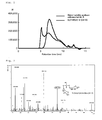
- Water-soluble soybean polysaccharide A and water-soluble soybean polysaccharide are shown in Fig. 1 . From this Figure, it was able to confirm that the water-soluble soybean polysaccharide was polymerized by crosslinking. With respect to quantification of the high molecular fraction, it was assumed that a total peak area was equivalent to the total mass of the polysaccharide, and the ratio of the peak area of the polysaccharide component with a molecular mass of 0.5 million to 10 million to the total peak area was quantified.
- aqueous solution containing 21% by weight of skim milk powder (manufactured by Yotsuba Co., Ltd.) was prepared and sterilized under heating at 95°C with stirring. After cooling, commercially available plain yogurt was inoculated thereto and fermented in a constant temperature oven of 40°C until the pH became 4.6. The fermented yogurt was homogenized with a homogenizer (150 kgf) by crushing the curd.
- Viscosity One week after the preparation, viscosity was measured with a BM-type viscometer (rotor No. 1, 60 rpm, 1 min).
- the precipitation rate was expressed in terms of the following criteria:
- Supernatant The presence or absence of aggregation after heat sterilization of the supernatant, and the presence or absence of the supernatant on the upper surface of the solution was judged visually. The symbol "+” indicated that there was a supernatant and the symbol “ ⁇ ” indicated that there was no supernatant.
- Stability of the acidic milk beverages was improved with the water-soluble polysaccharides which had been crosslinked with dextrin, starch, or pectin, respectively, i.e. both of water-soluble polysaccharides M and N.
- the water-soluble soybean polysaccharide O which had been treated by simultaneous deesterification showed a very high stability to the beverages.
- Water-soluble soybean polysaccharide A was degraded with Pectinex Ultra SP-L (manufactured by Novozymes A/S Co.) and served as a sample for mass spectrometry.
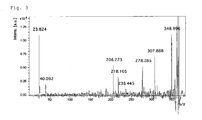
- MALDI-TOF-MS analysis and MS/MS analysis were carried out on the water-soluble soybean polysaccharide degraded by the enzyme ( Figs. 2 and 3 ).
- the mass peak of 365 was considered to be derived from a structure that the phosphoric acid residue was positioned at the central site and arabinose residues were linked to the both ends, and it was supposed that the water-soluble soybean polysaccharide A had a phosphoric acid diester structure wherein sugar chains were crosslinked via the phosphoric acid residues.
- the homogenized solution was filled into a cup container, immersed in cold water to form a jelly, which was stored in a refrigerator for one week.
- the resulting jelly was a jelly being free from protein aggregation and syneresis phenomenon at the stage during treatment and after storage, and having a refreshing acidity.
Landscapes
- Chemical & Material Sciences (AREA)
- Life Sciences & Earth Sciences (AREA)
- Polymers & Plastics (AREA)
- Engineering & Computer Science (AREA)
- Health & Medical Sciences (AREA)
- Food Science & Technology (AREA)
- Nutrition Science (AREA)
- Chemical Kinetics & Catalysis (AREA)
- Medicinal Chemistry (AREA)
- Organic Chemistry (AREA)
- Microbiology (AREA)
- Dispersion Chemistry (AREA)
- Botany (AREA)
- Mycology (AREA)
- General Health & Medical Sciences (AREA)
- Molecular Biology (AREA)
- Biochemistry (AREA)
- Materials Engineering (AREA)
- Proteomics, Peptides & Aminoacids (AREA)
- Oil, Petroleum & Natural Gas (AREA)
- Agronomy & Crop Science (AREA)
- Dairy Products (AREA)
- Jellies, Jams, And Syrups (AREA)
- Polysaccharides And Polysaccharide Derivatives (AREA)
- Beans For Foods Or Fodder (AREA)
- Non-Alcoholic Beverages (AREA)
- General Preparation And Processing Of Foods (AREA)
Applications Claiming Priority (2)
| Application Number | Priority Date | Filing Date | Title |
|---|---|---|---|
| JP2007150724 | 2007-06-06 | ||
| PCT/JP2008/059773 WO2008149738A1 (fr) | 2007-06-06 | 2008-05-28 | Procédé de production d'un polysaccharide hydrosoluble |
Publications (2)
| Publication Number | Publication Date |
|---|---|
| EP2159231A1 true EP2159231A1 (fr) | 2010-03-03 |
| EP2159231A4 EP2159231A4 (fr) | 2012-07-18 |
Family
ID=40093557
Family Applications (1)
| Application Number | Title | Priority Date | Filing Date |
|---|---|---|---|
| EP08764789A Withdrawn EP2159231A4 (fr) | 2007-06-06 | 2008-05-28 | Procédé de production d'un polysaccharide hydrosoluble |
Country Status (7)
| Country | Link |
|---|---|
| US (1) | US8128980B2 (fr) |
| EP (1) | EP2159231A4 (fr) |
| JP (1) | JP5381708B2 (fr) |
| KR (1) | KR101535688B1 (fr) |
| CN (1) | CN101765611B (fr) |
| BR (1) | BRPI0812232A2 (fr) |
| WO (1) | WO2008149738A1 (fr) |
Cited By (1)
| Publication number | Priority date | Publication date | Assignee | Title |
|---|---|---|---|---|
| WO2011088943A1 (fr) * | 2010-01-22 | 2011-07-28 | Unilever Nv | Utilisation prébiotique de polysaccharide de soja hydrosoluble |
Families Citing this family (20)
| Publication number | Priority date | Publication date | Assignee | Title |
|---|---|---|---|---|
| WO2010052883A1 (fr) * | 2008-11-06 | 2010-05-14 | 不二製油株式会社 | Composition détergente |
| WO2010061570A1 (fr) * | 2008-11-27 | 2010-06-03 | 不二製油株式会社 | Procédé de dispersion d'un matériau particulaire |
| JP5321028B2 (ja) * | 2008-12-10 | 2013-10-23 | 不二製油株式会社 | 食品用物性改良剤 |
| KR101056794B1 (ko) | 2010-07-29 | 2011-08-12 | 주식회사 엠에스씨 | 수용성 대두 식이섬유 제조 방법, 이에 의한 다당류 및 이들을 첨가한 식품 |
| CN102793019A (zh) * | 2011-05-25 | 2012-11-28 | 周鑫 | 一种奶酪复合物 |
| FR2976945B1 (fr) | 2011-06-24 | 2017-12-29 | Fuji Oil Co Ltd | Polysaccharide pectique et procede de production de celui-ci |
| JP5246387B1 (ja) * | 2011-10-20 | 2013-07-24 | 不二製油株式会社 | 水溶性大豆多糖類およびその製造法 |
| JP5561434B2 (ja) * | 2012-07-25 | 2014-07-30 | 不二製油株式会社 | デニッシュ生地の製造方法 |
| JP5668892B2 (ja) * | 2013-01-17 | 2015-02-12 | 不二製油株式会社 | エステル化水溶性大豆多糖類 |
| JP5622879B2 (ja) * | 2013-03-05 | 2014-11-12 | サッポロビール株式会社 | 豆乳発酵飲料及びその製造方法 |
| CN103859051B (zh) * | 2013-09-29 | 2016-01-20 | 浙江工业大学 | 一种果汁豆奶及其制备方法 |
| CN103772524A (zh) * | 2014-01-21 | 2014-05-07 | 江南大学 | 一种提高稳定乳蛋白粒子能力的水溶性大豆多糖的制备方法 |
| KR101713178B1 (ko) * | 2015-01-29 | 2017-03-07 | 강원대학교산학협력단 | 키토산 가교 수용성 다당류의 제조방법 |
| JP6665432B2 (ja) * | 2015-06-29 | 2020-03-13 | 不二製油株式会社 | ジャム類用離水低減剤 |
| JP7194511B2 (ja) * | 2018-04-27 | 2022-12-22 | アサヒ飲料株式会社 | 飲料、容器詰め飲料、菌体または菌体処理物の凝集抑制方法および飲料の製造方法 |
| CN112851828A (zh) * | 2021-01-14 | 2021-05-28 | 江南大学 | 一种用于稳定酸性乳清蛋白饮料的可溶性大豆多糖制备方法及应用 |
| CN114052260B (zh) * | 2021-11-23 | 2024-05-31 | 南京财经大学 | 一种抑制高浓度蛋白热致凝胶的方法 |
| CN114376064A (zh) * | 2021-12-22 | 2022-04-22 | 云南猫哆哩集团食品有限责任公司 | 一种交联罗望子多糖胶的制备方法、冰棍稳定剂及其应用 |
| CN114404321B (zh) * | 2022-01-29 | 2024-01-02 | 广州栋方生物科技股份有限公司 | 一种白及多糖稳定性溶液体系及其制备方法和应用 |
| WO2025028209A1 (fr) | 2023-08-01 | 2025-02-06 | 不二製油グループ本社株式会社 | Polysaccharide acide et son procédé de production |
Family Cites Families (16)
| Publication number | Priority date | Publication date | Assignee | Title |
|---|---|---|---|---|
| JPS6140302A (ja) * | 1984-07-31 | 1986-02-26 | Nichiden Kagaku Kk | 架橋多糖類 |
| US5587197A (en) | 1990-02-07 | 1996-12-24 | Fuji Oil Company, Ltd. | Process for production of water-soluble vegetable fiber |
| JP2599477B2 (ja) | 1990-02-09 | 1997-04-09 | 不二製油株式会社 | 水溶性植物繊維の製造方法 |
| US6004616A (en) | 1990-02-07 | 1999-12-21 | Fuji Oil Company, Ltd. | Biodegradable vegetable film |
| JPH03280768A (ja) | 1990-03-29 | 1991-12-11 | Nec Corp | Icカード電話方式 |
| US5736371A (en) * | 1991-06-04 | 1998-04-07 | A Et S Biovecteurs | Biodegradable particulate vector for transporting molecules having biological activity |
| JPH05230101A (ja) | 1992-02-24 | 1993-09-07 | Fuji Oil Co Ltd | 水溶性多糖類の水不溶化法 |
| JP3213648B2 (ja) * | 1993-03-03 | 2001-10-02 | 日本たばこ産業株式会社 | 水溶性多糖の製造方法 |
| JP3280768B2 (ja) | 1993-08-20 | 2002-05-13 | 三栄源エフ・エフ・アイ株式会社 | 酸性乳飲料の製造方法 |
| JPH11240902A (ja) * | 1998-02-25 | 1999-09-07 | Fuji Oil Co Ltd | 水溶性ヘミセルロースの製造法 |
| WO2000024273A1 (fr) | 1998-10-28 | 2000-05-04 | San-Ei Gen F.F.I., Inc. | Compositions contenant du sucralose, et applications correspondantes |
| JP2000279104A (ja) * | 1999-01-26 | 2000-10-10 | Sanei Gen Ffi Inc | 良好な物性を有する製剤組成物 |
| DE102004030182A1 (de) * | 2004-06-22 | 2006-01-12 | Stockhausen Gmbh | Wasserabsorbierendes Polysaccharid sowie ein Verfahren zu seiner Herstellung |
| KR100863870B1 (ko) * | 2004-06-21 | 2008-10-15 | 에보닉 스톡하우젠 게엠베하 | 수분 흡수성 다당류 및 이의 제조방법 |
| KR100688075B1 (ko) * | 2005-06-08 | 2007-03-02 | 주식회사 신동방씨피 | 수용성 대두 올리고당류 분말의 제조방법 |
| CN1970578B (zh) * | 2006-11-30 | 2010-05-12 | 华南理工大学 | 豆渣中水溶性大豆多糖的微波提取方法 |
-
2008
- 2008-05-28 BR BRPI0812232-6A2A patent/BRPI0812232A2/pt not_active IP Right Cessation
- 2008-05-28 CN CN2008801002384A patent/CN101765611B/zh not_active Expired - Fee Related
- 2008-05-28 EP EP08764789A patent/EP2159231A4/fr not_active Withdrawn
- 2008-05-28 KR KR1020097025359A patent/KR101535688B1/ko not_active Expired - Fee Related
- 2008-05-28 JP JP2009517813A patent/JP5381708B2/ja not_active Expired - Fee Related
- 2008-05-28 US US12/451,900 patent/US8128980B2/en not_active Expired - Fee Related
- 2008-05-28 WO PCT/JP2008/059773 patent/WO2008149738A1/fr not_active Ceased
Cited By (1)
| Publication number | Priority date | Publication date | Assignee | Title |
|---|---|---|---|---|
| WO2011088943A1 (fr) * | 2010-01-22 | 2011-07-28 | Unilever Nv | Utilisation prébiotique de polysaccharide de soja hydrosoluble |
Also Published As
| Publication number | Publication date |
|---|---|
| US8128980B2 (en) | 2012-03-06 |
| JPWO2008149738A1 (ja) | 2010-08-26 |
| CN101765611B (zh) | 2013-08-07 |
| US20100136204A1 (en) | 2010-06-03 |
| JP5381708B2 (ja) | 2014-01-08 |
| WO2008149738A1 (fr) | 2008-12-11 |
| EP2159231A4 (fr) | 2012-07-18 |
| CN101765611A (zh) | 2010-06-30 |
| KR20100017625A (ko) | 2010-02-16 |
| KR101535688B1 (ko) | 2015-07-09 |
| BRPI0812232A2 (pt) | 2014-12-16 |
Similar Documents
| Publication | Publication Date | Title |
|---|---|---|
| US8128980B2 (en) | Method for production of water-soluble polysaccharide | |
| EP2725038B1 (fr) | Polysaccharide pectique et son procédé de fabrication | |
| CN104395347B (zh) | 豆科种子多糖类琥珀酸衍生物酯及其制造方法 | |
| JP4568281B2 (ja) | 解重合ペクチンを安定剤として使用して食品を調製するためのプロセス | |
| WO2000043424A1 (fr) | Pectine, procede de fabrication correspondant, aliments a base de proteines acides utilisant ladite pectine et procede de fabrication correspondant | |
| JP3387457B2 (ja) | 酸性蛋白食品及びその製造法並びに安定化剤 | |
| CN101454349B (zh) | 新型的具有稳定性的水溶性多糖类及其制造方法 | |
| WO2010044255A1 (fr) | Procédé de production d’un polysaccharide phosphorylé soluble dans l’eau | |
| JP6680210B2 (ja) | 水溶性エンドウ多糖類及びその製造方法 | |
| JP2001354702A (ja) | ペクチン及びその製造法並びにそれを使用した酸性蛋白食品及びその製造法 | |
| JP2025118830A (ja) | 水溶性大豆多糖類及びその製造方法 | |
| JP6665783B2 (ja) | 水溶性エンドウ多糖類の製造方法 | |
| JP2010022223A (ja) | 酵素で脱エステルしたペクチンを用いた酸性タンパク食品及びその製造法 | |
| WO2025028209A1 (fr) | Polysaccharide acide et son procédé de production |
Legal Events
| Date | Code | Title | Description |
|---|---|---|---|
| PUAI | Public reference made under article 153(3) epc to a published international application that has entered the european phase |
Free format text: ORIGINAL CODE: 0009012 |
|
| 17P | Request for examination filed |
Effective date: 20091208 |
|
| AK | Designated contracting states |
Kind code of ref document: A1 Designated state(s): AT BE BG CH CY CZ DE DK EE ES FI FR GB GR HR HU IE IS IT LI LT LU LV MC MT NL NO PL PT RO SE SI SK TR |
|
| AX | Request for extension of the european patent |
Extension state: AL BA MK RS |
|
| DAX | Request for extension of the european patent (deleted) | ||
| A4 | Supplementary search report drawn up and despatched |
Effective date: 20120618 |
|
| RIC1 | Information provided on ipc code assigned before grant |
Ipc: A23C 9/152 20060101ALI20120612BHEP Ipc: A23C 9/13 20060101ALI20120612BHEP Ipc: A23L 2/38 20060101ALI20120612BHEP Ipc: C08B 37/00 20060101AFI20120612BHEP |
|
| 17Q | First examination report despatched |
Effective date: 20130524 |
|
| GRAP | Despatch of communication of intention to grant a patent |
Free format text: ORIGINAL CODE: EPIDOSNIGR1 |
|
| INTG | Intention to grant announced |
Effective date: 20151119 |
|
| STAA | Information on the status of an ep patent application or granted ep patent |
Free format text: STATUS: THE APPLICATION IS DEEMED TO BE WITHDRAWN |
|
| 18D | Application deemed to be withdrawn |
Effective date: 20160330 |