EP2159578A1 - Unité de moyeu - Google Patents
Unité de moyeu Download PDFInfo
- Publication number
- EP2159578A1 EP2159578A1 EP08765286A EP08765286A EP2159578A1 EP 2159578 A1 EP2159578 A1 EP 2159578A1 EP 08765286 A EP08765286 A EP 08765286A EP 08765286 A EP08765286 A EP 08765286A EP 2159578 A1 EP2159578 A1 EP 2159578A1
- Authority
- EP
- European Patent Office
- Prior art keywords
- sensor
- outer circumferential
- vehicle
- hub unit
- axle
- Prior art date
- Legal status (The legal status is an assumption and is not a legal conclusion. Google has not performed a legal analysis and makes no representation as to the accuracy of the status listed.)
- Withdrawn
Links
- 230000008859 change Effects 0.000 claims abstract description 11
- 238000005096 rolling process Methods 0.000 claims description 27
- 238000000034 method Methods 0.000 description 9
- 238000001514 detection method Methods 0.000 description 8
- 230000002093 peripheral effect Effects 0.000 description 8
- 238000003466 welding Methods 0.000 description 6
- 238000010276 construction Methods 0.000 description 5
- 230000008569 process Effects 0.000 description 5
- 238000004519 manufacturing process Methods 0.000 description 4
- XLYOFNOQVPJJNP-UHFFFAOYSA-N water Substances O XLYOFNOQVPJJNP-UHFFFAOYSA-N 0.000 description 4
- WABPQHHGFIMREM-UHFFFAOYSA-N lead(0) Chemical compound [Pb] WABPQHHGFIMREM-UHFFFAOYSA-N 0.000 description 3
- 239000000314 lubricant Substances 0.000 description 3
- 238000003825 pressing Methods 0.000 description 3
- 230000009467 reduction Effects 0.000 description 3
- 239000004576 sand Substances 0.000 description 3
- 230000004308 accommodation Effects 0.000 description 2
- 238000009825 accumulation Methods 0.000 description 2
- 230000009471 action Effects 0.000 description 2
- 230000004323 axial length Effects 0.000 description 2
- 238000005452 bending Methods 0.000 description 2
- 239000004519 grease Substances 0.000 description 2
- 210000001503 joint Anatomy 0.000 description 2
- 239000000463 material Substances 0.000 description 2
- 230000002265 prevention Effects 0.000 description 2
- 230000000717 retained effect Effects 0.000 description 2
- 238000007789 sealing Methods 0.000 description 2
- 238000004073 vulcanization Methods 0.000 description 2
- 230000008901 benefit Effects 0.000 description 1
- 210000000078 claw Anatomy 0.000 description 1
- 238000010586 diagram Methods 0.000 description 1
- 239000000428 dust Substances 0.000 description 1
- 230000004907 flux Effects 0.000 description 1
- 238000003780 insertion Methods 0.000 description 1
- 230000037431 insertion Effects 0.000 description 1
- 238000000465 moulding Methods 0.000 description 1
- 230000003449 preventive effect Effects 0.000 description 1
- 239000011347 resin Substances 0.000 description 1
- 229920005989 resin Polymers 0.000 description 1
Images









Classifications
-
- G—PHYSICS
- G01—MEASURING; TESTING
- G01P—MEASURING LINEAR OR ANGULAR SPEED, ACCELERATION, DECELERATION, OR SHOCK; INDICATING PRESENCE, ABSENCE, OR DIRECTION, OF MOVEMENT
- G01P1/00—Details of instruments
- G01P1/02—Housings
- G01P1/026—Housings for speed measuring devices, e.g. pulse generator
-
- B—PERFORMING OPERATIONS; TRANSPORTING
- B60—VEHICLES IN GENERAL
- B60B—VEHICLE WHEELS; CASTORS; AXLES FOR WHEELS OR CASTORS; INCREASING WHEEL ADHESION
- B60B27/00—Hubs
- B60B27/0005—Hubs with ball bearings
-
- B—PERFORMING OPERATIONS; TRANSPORTING
- B60—VEHICLES IN GENERAL
- B60B—VEHICLE WHEELS; CASTORS; AXLES FOR WHEELS OR CASTORS; INCREASING WHEEL ADHESION
- B60B27/00—Hubs
- B60B27/0015—Hubs for driven wheels
- B60B27/0021—Hubs for driven wheels characterised by torque transmission means from drive axle
- B60B27/0026—Hubs for driven wheels characterised by torque transmission means from drive axle of the radial type, e.g. splined key
-
- B—PERFORMING OPERATIONS; TRANSPORTING
- B60—VEHICLES IN GENERAL
- B60B—VEHICLE WHEELS; CASTORS; AXLES FOR WHEELS OR CASTORS; INCREASING WHEEL ADHESION
- B60B27/00—Hubs
- B60B27/0047—Hubs characterised by functional integration of other elements
- B60B27/0068—Hubs characterised by functional integration of other elements the element being a sensor
-
- B—PERFORMING OPERATIONS; TRANSPORTING
- B60—VEHICLES IN GENERAL
- B60B—VEHICLE WHEELS; CASTORS; AXLES FOR WHEELS OR CASTORS; INCREASING WHEEL ADHESION
- B60B27/00—Hubs
- B60B27/0078—Hubs characterised by the fixation of bearings
- B60B27/0084—Hubs characterised by the fixation of bearings caulking to fix inner race
-
- B—PERFORMING OPERATIONS; TRANSPORTING
- B60—VEHICLES IN GENERAL
- B60B—VEHICLE WHEELS; CASTORS; AXLES FOR WHEELS OR CASTORS; INCREASING WHEEL ADHESION
- B60B27/00—Hubs
- B60B27/0094—Hubs one or more of the bearing races are formed by the hub
-
- F—MECHANICAL ENGINEERING; LIGHTING; HEATING; WEAPONS; BLASTING
- F16—ENGINEERING ELEMENTS AND UNITS; GENERAL MEASURES FOR PRODUCING AND MAINTAINING EFFECTIVE FUNCTIONING OF MACHINES OR INSTALLATIONS; THERMAL INSULATION IN GENERAL
- F16C—SHAFTS; FLEXIBLE SHAFTS; ELEMENTS OR CRANKSHAFT MECHANISMS; ROTARY BODIES OTHER THAN GEARING ELEMENTS; BEARINGS
- F16C33/00—Parts of bearings; Special methods for making bearings or parts thereof
- F16C33/72—Sealings
- F16C33/76—Sealings of ball or roller bearings
- F16C33/78—Sealings of ball or roller bearings with a diaphragm, disc, or ring, with or without resilient members
- F16C33/7886—Sealings of ball or roller bearings with a diaphragm, disc, or ring, with or without resilient members mounted outside the gap between the inner and outer races, e.g. sealing rings mounted to an end face or outer surface of a race
-
- F—MECHANICAL ENGINEERING; LIGHTING; HEATING; WEAPONS; BLASTING
- F16—ENGINEERING ELEMENTS AND UNITS; GENERAL MEASURES FOR PRODUCING AND MAINTAINING EFFECTIVE FUNCTIONING OF MACHINES OR INSTALLATIONS; THERMAL INSULATION IN GENERAL
- F16C—SHAFTS; FLEXIBLE SHAFTS; ELEMENTS OR CRANKSHAFT MECHANISMS; ROTARY BODIES OTHER THAN GEARING ELEMENTS; BEARINGS
- F16C33/00—Parts of bearings; Special methods for making bearings or parts thereof
- F16C33/72—Sealings
- F16C33/76—Sealings of ball or roller bearings
- F16C33/80—Labyrinth sealings
- F16C33/805—Labyrinth sealings in addition to other sealings, e.g. dirt guards to protect sealings with sealing lips
-
- F—MECHANICAL ENGINEERING; LIGHTING; HEATING; WEAPONS; BLASTING
- F16—ENGINEERING ELEMENTS AND UNITS; GENERAL MEASURES FOR PRODUCING AND MAINTAINING EFFECTIVE FUNCTIONING OF MACHINES OR INSTALLATIONS; THERMAL INSULATION IN GENERAL
- F16C—SHAFTS; FLEXIBLE SHAFTS; ELEMENTS OR CRANKSHAFT MECHANISMS; ROTARY BODIES OTHER THAN GEARING ELEMENTS; BEARINGS
- F16C41/00—Other accessories, e.g. devices integrated in the bearing not relating to the bearing function as such
- F16C41/007—Encoders, e.g. parts with a plurality of alternating magnetic poles
-
- G—PHYSICS
- G01—MEASURING; TESTING
- G01P—MEASURING LINEAR OR ANGULAR SPEED, ACCELERATION, DECELERATION, OR SHOCK; INDICATING PRESENCE, ABSENCE, OR DIRECTION, OF MOVEMENT
- G01P3/00—Measuring linear or angular speed; Measuring differences of linear or angular speeds
- G01P3/42—Devices characterised by the use of electric or magnetic means
- G01P3/44—Devices characterised by the use of electric or magnetic means for measuring angular speed
- G01P3/443—Devices characterised by the use of electric or magnetic means for measuring angular speed mounted in bearings
-
- G—PHYSICS
- G01—MEASURING; TESTING
- G01P—MEASURING LINEAR OR ANGULAR SPEED, ACCELERATION, DECELERATION, OR SHOCK; INDICATING PRESENCE, ABSENCE, OR DIRECTION, OF MOVEMENT
- G01P3/00—Measuring linear or angular speed; Measuring differences of linear or angular speeds
- G01P3/42—Devices characterised by the use of electric or magnetic means
- G01P3/44—Devices characterised by the use of electric or magnetic means for measuring angular speed
- G01P3/48—Devices characterised by the use of electric or magnetic means for measuring angular speed by measuring frequency of generated current or voltage
- G01P3/481—Devices characterised by the use of electric or magnetic means for measuring angular speed by measuring frequency of generated current or voltage of pulse signals
- G01P3/487—Devices characterised by the use of electric or magnetic means for measuring angular speed by measuring frequency of generated current or voltage of pulse signals delivered by rotating magnets
-
- F—MECHANICAL ENGINEERING; LIGHTING; HEATING; WEAPONS; BLASTING
- F16—ENGINEERING ELEMENTS AND UNITS; GENERAL MEASURES FOR PRODUCING AND MAINTAINING EFFECTIVE FUNCTIONING OF MACHINES OR INSTALLATIONS; THERMAL INSULATION IN GENERAL
- F16C—SHAFTS; FLEXIBLE SHAFTS; ELEMENTS OR CRANKSHAFT MECHANISMS; ROTARY BODIES OTHER THAN GEARING ELEMENTS; BEARINGS
- F16C19/00—Bearings with rolling contact, for exclusively rotary movement
- F16C19/02—Bearings with rolling contact, for exclusively rotary movement with bearing balls essentially of the same size in one or more circular rows
- F16C19/14—Bearings with rolling contact, for exclusively rotary movement with bearing balls essentially of the same size in one or more circular rows for both radial and axial load
- F16C19/18—Bearings with rolling contact, for exclusively rotary movement with bearing balls essentially of the same size in one or more circular rows for both radial and axial load with two or more rows of balls
- F16C19/181—Bearings with rolling contact, for exclusively rotary movement with bearing balls essentially of the same size in one or more circular rows for both radial and axial load with two or more rows of balls with angular contact
- F16C19/183—Bearings with rolling contact, for exclusively rotary movement with bearing balls essentially of the same size in one or more circular rows for both radial and axial load with two or more rows of balls with angular contact with two rows at opposite angles
- F16C19/184—Bearings with rolling contact, for exclusively rotary movement with bearing balls essentially of the same size in one or more circular rows for both radial and axial load with two or more rows of balls with angular contact with two rows at opposite angles in O-arrangement
- F16C19/185—Bearings with rolling contact, for exclusively rotary movement with bearing balls essentially of the same size in one or more circular rows for both radial and axial load with two or more rows of balls with angular contact with two rows at opposite angles in O-arrangement with two raceways provided integrally on a part other than a race ring, e.g. a shaft or housing
-
- F—MECHANICAL ENGINEERING; LIGHTING; HEATING; WEAPONS; BLASTING
- F16—ENGINEERING ELEMENTS AND UNITS; GENERAL MEASURES FOR PRODUCING AND MAINTAINING EFFECTIVE FUNCTIONING OF MACHINES OR INSTALLATIONS; THERMAL INSULATION IN GENERAL
- F16C—SHAFTS; FLEXIBLE SHAFTS; ELEMENTS OR CRANKSHAFT MECHANISMS; ROTARY BODIES OTHER THAN GEARING ELEMENTS; BEARINGS
- F16C19/00—Bearings with rolling contact, for exclusively rotary movement
- F16C19/02—Bearings with rolling contact, for exclusively rotary movement with bearing balls essentially of the same size in one or more circular rows
- F16C19/14—Bearings with rolling contact, for exclusively rotary movement with bearing balls essentially of the same size in one or more circular rows for both radial and axial load
- F16C19/18—Bearings with rolling contact, for exclusively rotary movement with bearing balls essentially of the same size in one or more circular rows for both radial and axial load with two or more rows of balls
- F16C19/181—Bearings with rolling contact, for exclusively rotary movement with bearing balls essentially of the same size in one or more circular rows for both radial and axial load with two or more rows of balls with angular contact
- F16C19/183—Bearings with rolling contact, for exclusively rotary movement with bearing balls essentially of the same size in one or more circular rows for both radial and axial load with two or more rows of balls with angular contact with two rows at opposite angles
- F16C19/184—Bearings with rolling contact, for exclusively rotary movement with bearing balls essentially of the same size in one or more circular rows for both radial and axial load with two or more rows of balls with angular contact with two rows at opposite angles in O-arrangement
- F16C19/186—Bearings with rolling contact, for exclusively rotary movement with bearing balls essentially of the same size in one or more circular rows for both radial and axial load with two or more rows of balls with angular contact with two rows at opposite angles in O-arrangement with three raceways provided integrally on parts other than race rings, e.g. third generation hubs
-
- F—MECHANICAL ENGINEERING; LIGHTING; HEATING; WEAPONS; BLASTING
- F16—ENGINEERING ELEMENTS AND UNITS; GENERAL MEASURES FOR PRODUCING AND MAINTAINING EFFECTIVE FUNCTIONING OF MACHINES OR INSTALLATIONS; THERMAL INSULATION IN GENERAL
- F16C—SHAFTS; FLEXIBLE SHAFTS; ELEMENTS OR CRANKSHAFT MECHANISMS; ROTARY BODIES OTHER THAN GEARING ELEMENTS; BEARINGS
- F16C2326/00—Articles relating to transporting
- F16C2326/01—Parts of vehicles in general
- F16C2326/02—Wheel hubs or castors
Definitions
- the present invention relates to a hub unit and more particularly to a hub unit which includes a rotation speed detector for detecting a rotation speed of a wheel mounted on an axle, for example.
- a rotation speed detector for detecting a wheel rotation speed is mounted on a hub unit of a vehicle such as an automotive vehicle.
- the rotation detector is used as an information input unit for an anti-lock braking system (ABS) of an automotive vehicle, for example.
- ABS anti-lock braking system
- a rotation detector which is fixed to an inner ring side of a hub unit and which has a pulse generator (a pulser ring) which rotates together with an inner ring and a sensor which is held in a stationary state to a sensor holder (a cover member) which is fixed to an outer ring side of the hub unit, whereby a change in rotation of the pulser ring which rotates in association with rotation of a wheel is detected by the sensor (refer to Patent Documents 1, 2, 3).
- Patent Document 1 describes a technique in which a head of a sensor can be mounted in an accommodation pocket (a holding portion) in a clip-on manner by the elastic force of a clip portion and an annular ring portion of the sensor holder is fitted on an outer circumferential surface of an inner side end portion of an outer member (an outer ring) so as to be mounted thereon.
- Patent Document 2 describes a technique in which a length of a claw portion which abuts a lower end (a distal end) of a front surface of a sensor with the sensor inserted into an accommodation pocket is specified, and similar to Patent Document 1, an annular ring portion of the sensor holder is fitted on an outer circumferential surface of an inner side end portion of an outer member (an outer ring) so as to be mounted thereon.
- the invention has been made in view of the situations described above, and an object thereof is to provide a hub unit which prevents the intrusion of foreign matters into a peripheral portion of a sensor of a rotation speed detector. Another object of the invention is to provide a hub unit which enables a stable mounting of a rotation speed detector even in the event that a width of a bearing in the hub unit is attempted to be reduced by restricting an axial dimension of the bearing.
- a hub unit having a stationary-side member mounted on a vehicle body side so as not to rotate for supporting a wheel rotatably on a vehicle body, a rotating-side member disposed concentrically with the stationary-side member and mounted on a wheel side so as to rotate together with the wheel on a raceway surface of the stationary-side member via rolling elements, and a rotation speed detector mounted at vehicle inner side end portions of the rotating-side member and the stationary-side member for detecting a change in rotation speed of the wheel, characterized in that the rotation speed detector comprises:
- the annular cover member which holds and fixes the head portion of the sensor of the rotation speed detector may be fixedly fitted in an inner circumferential surface of the outer ring. According to this configuration, compared with a case in which the cover member is fitted on an outer circumferential surface of the outer ring, a smaller rotation speed detector can be mounted, thereby making it possible to realize a reduction in production costs. In addition, since an axial dimension of an outer ring fixed portion which is fitted in the inner circumferential surface of the outer ring can be secured sufficiently even in the event that a width of a bearing in the hub unit is attempted to be reduced by restricting an axial dimension of the bearing, the rotation speed detector can be mounted stably.
- the seal portion is provided in the rotation speed detector for sealing a gap between the pulser ring and the cover member at a vehicle inner side end portion in the axial direction of a rolling element disposition space which is defined between the rotating-side member and the stationary-side member (that is, the outer ring and inner ring).
- a rolling element disposition space which is defined between the rotating-side member and the stationary-side member (that is, the outer ring and inner ring).
- the seal portion can include a first seal member which is fixed to a vehicle outer side of the detected portion of the pulser ring and an outside diameter end portion of which is incorporated in a seal groove formed on an inner circumferential portion of the outer ring fixed portion of the cover member and a second seal member which is fixed to a vehicle outer side of the cover portion of the cover member and an inside diameter end portion of which is incorporated in a seal groove formed on the pulser ring or the inner ring.
- the first seal member can seal in the lubricant on an inner side of the detected portion of the pulser ring, and the second seal member can prevent effectively intrusion of foreign matters into the rolling element disposition space on an outer side of the detected portion.
- a lubricant for example, grease
- the cover member of the rotation speed detector can be configured so that a vehicle inner side end face in the axial direction of the cover portion forms the same plane as that formed by a vehicle inner side end face in the axial direction of the outer ring.
- the head portion of the sensor is fixed by being pushed in from a radial direction with respect to the holding portion of the cover member. As this occurs, since the cover portion and the vehicle inner side end face of the outer ring form the same plane, the head portion can simply be pushed into the holding portion without being interrupted by the end portion of the outer ring.
- the holding portion of the cover member preferably includes a spring piece which presses the head portion of the sensor from a vehicle inner side in the axial direction to thereby be brought into engagement with an engagement portion formed on the head portion.
- the cover member desirably comprises:
- the gap (which is a labyrinth gap) is defined between the distal end portion of the circumferential wall portion of the cover member and the outer circumferential surface of the axle.
- the size of the gap is 0.1 to 0.5 mm, for example.
- the direction in which the distal end portion of the circumferential wall is bent may be towards either the vehicle outer side or the vehicle inner side.
- a wide range of the outer circumferential surface of the axle is covered by the bent portion.
- the axle can be made to have a straight outer circumferential portion an outside diameter of which stays the same in the axial direction and a tapered outer circumferential portion an outside diameter of which increases continuously towards the vehicle inner side.
- the circumferential wall portion can be made to be disposed directly above the straight outer circumferential portion of the axle.
- the bent portion can be made to comprise a first bent portion which is bent towards the vehicle inner side along the straight outer circumferential portion of the axle and a second bent portion which is bent towards the vehicle inner side along the tapered outer circumferential portion from a position lying directly above a connecting portion on the first bent portion between the straight outer circumferential portion and the tapered outer circumferential portion of the axle.
- An inclination angle of the second bent portion relative to the first bent portion is desirably larger than an inclination angle of the tapered outer circumferential portion relative to the straight outer circumferential portion of the axle.
- a circumferential length of the sensor mounting hole can be made to be formed the same as a width of the sensor, and a stopper can be made to be formed on the sensor so as to project in a width direction to thereby be brought into abutment with the main body portion when the sensor is inserted through the sensor mounting hole in the main body portion.
- the cover member desirably comprises:
- the hub unit according to the invention is configured as described above, and the seal portion is mounted at the distal end portion of the circumferential wall portion of the cover member in which the sensor is mounted. This prevents foreign matters which flow down along the outer circumferential surface of the axle from intruding the peripheral portion of the sensor. Because of this, a fear that foreign matters accumulate or adhere to the sensor or the pulser ring is reduced, thereby making it possible to detect the rotation speed of the wheel with high accuracy over a long period of time.
- a stopper portion with which the sensor inserted into the sensor mounting hole in the main body portion is brought into abutment can be provided at a distal end portion of the guide wall portion.
- the guide wall portion is provided to hold the sensor inserted in the sensor mounting hole by clamping the sensor between itself and the circumferential wall portion, and an engagement portion can be provided on the circumferential wall portion to resiliently press the clamped sensor against the guide wall portion side and is brought into engagement with the sensor in a pressed condition.
- the positioning of the sensor in the axial direction can be facilitated.
- the engagement portion provided on the circumferential wall portion being brought into engagement with the sensor, not only is the positioning of the sensor in the axial direction ensured further, but also the sensor is prevented from being shifted in the radial direction.
- a circumferential length of the sensor mounting hole can be formed the same as a width of the sensor.
- cover member can be fabricated by including:
- Fig. 1 is a drawing showing an example of a sectional construction of a hub unit according to a first embodiment of the invention
- Fig. 2 is an exploded perspective view showing an example of a rotation speed detector
- Fig. 3 is an enlarged view of a portion A in Fig. 1
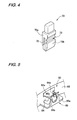
- Fig. 4 is an enlarged view of a portion B in Fig. 2
- Fig. 5 is an enlarged view of a portion C in Fig. 2 .
- a left-hand side of the figure denotes a vehicle outer side
- a right-hand side denotes a vehicle inner side.
- a rotating-side member includes concepts of an axle, a constant velocity joint, a hub wheel and an inner ring
- a stationary-side member includes concepts of an outer ring and a vehicle body side member.
- a hub unit 1 is interposed between a drive axle 2 and an axle case 3, so as to support rotatably a wheel (the drive axle 2), not shown, relative to a vehicle body (the axle case 3).
- the hub unit 1 includes a hub wheel 4, a rolling bearing 5 and a rotation speed detector 6 which is mounted at vehicle inner side end portions of an inner ring and an outer ring of the rolling bearing 5 for detecting a change in rotation speed of the wheel.
- the hub wheel 4 has a shaft portion 41 which is spline fitted on the drive axle 2 and a hub flange 42 for fixing the wheel, not shown, at a vehicle outer side end portion of the shaft portion 41.
- Bolt insertion holes 43a through which bolts 43 are inserted are formed in the hub flange 42, and the wheel is fixed via the bolts 43.
- the rolling bearing 5 is made up of a double row outwardly oriented angular contact bearing.
- the rolling bearing 5 includes an outer ring 52 which is mounted on a vehicle body side so as not to rotate and an inner ring 51 which is disposed concentrically with the outer ring 52 and which is mounted on a wheel side so as to rotate together with the wheel via rolling elements 53 (hereinafter, also referred to as balls 53) which roll on an inner circumferential surface 52a of the outer ring 52 as a raceway surface.
- the rolling bearing 5 utilizes part of an outer circumferential surface of the shaft portion of the hub wheel 4 as a vehicle outer side inner ring and includes the inner ring 51 which is press fitted on an outer circumference of the shaft portion 41 and which constitutes a vehicle inner side single row inner ring, the outer ring 52 which is press fitted in an inner circumference of the axle case 3 and which has double (two) raceway grooves, the plurality of balls 53 which are installed in double rows, and two crown type cages 54, 54. Consequently, in this embodiment, a form is adopted in which the outer 52 ring stays stationary while the inner ring 51 (the hub wheel 4) is allowed to rotate.
- the rotation speed detector 6 includes an annular pulser ring 60 on which magnetic poles (N poles, S poles) having different polarities are formed to be aligned alternately in a circumferential direction, a head portion 70 of a sensor for detecting a change in rotation of the pulser ring 60 and an annular cover member 80 which holds the head portion 70.
- the head portion 70 of the sensor detects a change in rotation of the pulser ring 60 to thereby detect a change in rotation of the wheel.
- the pulser ring 60 has a pulser ring supporting portion 62 which includes a cylindrical inner ring fixed portion 62a which is fixedly fitted on an outer circumferential surface 51a of the inner ring 51 and a flange portion 62b which is provided to project radially outwards from the inner ring fixed portion 62a in a flange-like manner, and a pulser ring main body 61 on which N poles and S poles are alternately magnetized and which constitutes a detected portion which is bonded and fixed to an end face of the flange portion 62b.
- the pulser ring 60 is press fitted on an outer circumference of the inner ring 51 of the rolling bearing 5 so as to be fixed at a vehicle inner side end portion in an axial direction and rotates together with the inner ring 51 (refer to Fig. 1 ).
- the head portion 70 is formed from a polymeric material such as a resin and is formed by insert molding a sensor 71 (refer to Fig. 3 ) such as an IC (Integrated Circuit) chip having a magnetic circuit.
- the sensor 71 can detect rotation of the pulser ring 60 by detecting a voltage generated in the magnetic circuit by a change in magnetic flux density by the rotation of the pulser ring 60.
- a lead wire 79 is pulled out of the head portion 70.
- the cover member 80 has a cylindrical outer ring fixed portion 81 and an annular cover portion 82 which extends radially inwards from a vehicle inner side end portion of the outer ring fixed portion 81.
- An opening 82a is formed in a predetermined circumferential position of the cover portion 82 so as to penetrate therethrough in a thickness direction, and a holding portion 83 is provided to correspond to the opening 82a for holding the head portion 70 on the vehicle inner side.
- the outer ring fixed portion 81 is provided to extend in the axial direction (towards the vehicle outer side) from an outer circumferential edge of the cover portion 82 and is fixedly fitted in the inner circumferential surface 52a of the outer ring 52.
- the cover portion 82 is disposed on the vehicle outer side to face the pulser ring main body 61 (the detected portion) of the pulser ring 60 in the axial direction, and the holding portion 83, which fixedly holds the head portion 70, is provided on an opposite side to the pulser ring main body 61 (the detected portion) across the cover portion 82 in the axial direction.
- a seal member 90 for sealing a gap between the pulser ring 60 and the cover member 80 is provided at a vehicle inner side end portion in the axial direction of a rolling element disposition space 53a which is defined between the outer ring 52 and the inner ring 51.
- the seal portion 90 is formed as an elastic seal member such as a rubber material and includes a first seal member 91 which is bonded and fixed (for example, vulcanization bonded) to the pulser ring 60 side and a second seal member 92 which is bonded and fixed (for example, vulcanization bonded) to the cover member 80 side.
- the first seal member 91 is bonded and fixed to a vehicle inner side of the pulser ring main body (the detected portion) of the pulser ring 60, that is, the flange portion 62b and an outside diameter end portion thereof is incorporated in a seal groove 81d formed in an inner circumferential portion 81a of the outer ring fixed portion 81.
- the first seal member 91 is also incorporated in another seal groove 81d formed in the inner circumferential portion 81a of the outer ring fixed portion 81 at an inside diameter end portion thereof.
- the first seal member 91 which is fixed to the pulser ring 60 is closely attached to the cover member 80 while being deformed elastically and functions to prevent a lubricant such as grease, for example, which is sealed in an interior of the rolling element disposition space 53a from flowing out thereof.
- the second seal member 92 is bonded and fixed to a vehicle outer side of the cover portion 82 of the cover member 80 and an inside diameter end portion is incorporated in a seal groove 51d formed in the inner ring 51.
- the second seal member 92 is not provided in the opening 82a which allows the detected portion and the sensor 71 to face each other therethrough (the second seal member 92 is penetrated so that an opening coinciding with a shape of the opening 82a is formed therein), even in the event that the second seal member 92 is not cut out to the shape of the opening 82a, this affects little the detection accuracy of the sensor 71.
- the second seal member 92 which is fixed to the cover member 80 is closely attached to the inner ring 51 while being deformed elastically and has a function to prevent intrusion of water and/or dust into the rolling element disposition space 53a from an exterior space.
- the intrusion preventive effect becomes larger when the opening 82a is closed by the second seal member 92.
- the seal groove into which the second seal member 92 is incorporated is formed in the inner ring 51
- the seal groove may be formed in the pulser ring 60.
- a configuration may be adopted in which the respective seal members are made to be deformed elastically so that the seal members are pressed against the facing members, whereby the seal grooves 51d, 81d which correspond to the seal members are omitted.
- the head portion 70 includes groove-like guide rail portions 72, 72 which extend in a longitudinal direction (in a push-in direction in which the head portion 70 is pushed in) on both side portions 70a, 70a, respectively, and an engagement portion 73 which is raised and recessed in a bellows-like manner at an upper portion 70h.
- the holding portion 83 of the cover member 80 has a pair of guide pieces 84, 84 for guiding the head portion 70 of the sensor 71 which is pushed in along the push-in direction on the vehicle inner side in the axial direction and a spring piece 85 which presses the head portion 70 from the same vehicle inner side so as to be brought into engagement with the engagement portion 73 of the head portion 70.
- the holding portion 83 can hold the head portion 70 so as to clamp it in the axial direction.
- the pair of guide pieces 84, 84 rise so as to face each other in the circumferential direction putting the opening 82a in the cover portion 82 therebetween, and end faces 84a, 84a of the guide pieces 84, 84 are formed so as to extend in the longitudinal direction.
- the spring piece 85 has a spring base portion 85a which rises from an inner circumferential edge of the cover portion 82 and a spring operating portion 85b which is bent in a radial direction (radially outwards) from the spring base portion 85a.
- the spring operating portion 85b is formed to include a pressing portion 85c which presses against the engagement portion 73 of the head portion 70 to thereby be brought into engagement therewith.
- the spring piece 85 is formed so as to surround from a distal end to the upper portion of the head portion 70 when the head portion 70 is mounted in the holding portion 83.
- the head portion 70 is pushed in radially (refer to Fig. 2 ) towards the holding portion 83, whereby the head portion 70 is fixed in a predetermined position in the holding portion 83.
- the head portion 70 is held in the holding portion 83 with end portions of the guide pieces 84 of the holding portion 83 fitted in the guide rail portions 72 of the head portion 70.
- the end faces 84a, 84a of the guide pieces 84 are brought into abutment with or close proximity to bottoms of the guide rail portions 72, 72, whereby the head portion 70 is positioned with respect to the circumferential direction.
- the head portion 70 Since the end portions of the guide pieces 84 enter the groove-like guide rail portions 72 at the same time as the head portion 70 is positioned circumferentially, the head portion 70 is also positioned with respect to the axial direction. By this configuration, when the head portion 70 is pushed in towards the holding portion 83, the head portion 70 is guided in the push-in direction via the guide rail portions 72 and the guide pieces 84 (refer to Figs. 4, 5 ).
- the pressing portion 85c of the spring piece 85 of the holding portion 83 is in engagement with the engagement portion 73 of the head portion 70 so as to press against the engagement portion 73.
- the head portion 70 is positioned in the radial direction with respect to the holding portion 83 by the pressing portion 85c being brought into engagement with a predetermined recessed position of the engagement portion 73.
- the head portion 70 is held by the guide pieces 84 and the spring piece 85 therebetween, whereby the dislocation of the head portion 70 is suppressed.
- the cover member 80 is disposed so that a vehicle inner side end face 82p in the axial direction of the cover portion 82 forms the same plane as a vehicle inner side end face 52b in the axial direction of the outer ring 52.
- the head portion 70 can be fixed so that a lower portion 70c of the head portion 70 is brought into abutment (contact) with the vehicle inner side end face 52b of the outer ring 52. Consequently, the pressure from the spring piece 85 can be received by the outer ring 52, thereby making it possible to enhance further the stability in holding the head portion 70. As is shown in Fig.
- the vehicle inner side end face 52b may be formed in a position which is spaced apart from the head portion 70 (in an offset position) as is shown by a vehicle inner side end face 52b' of the outer ring 52 which is represented by a broken line, and as this occurs, the assembling properties are enhanced.
- the rotation speed detector 6 can be mounted in a stable manner by the construction described above even though a reduction in width of the bearing in the hub unit 1 is realized by restricting an axial dimension of the bearing.
- the invention is not limited to the embodiment that has been described heretofore, and hence, the invention can be applied to embodiments which are altered variously in accordance with objects and applications without departing from the scope of the invention.
- the rotation speed detector 6 is described as being applied to the hub unit 1 of the drive axle of the motor vehicle, the invention may be applied to a hub unit for a driven axle.
- FIG. 6 is a front sectional view of a hub unit 150 in which a rotation speed detector 100 of the hub unit according to a second embodiment of the invention is mounted
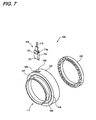
- Fig. 7 is an exploded perspective view of the rotation speed detector 100 as viewed form a vehicle outer side
- Fig. 8 is a perspective view of a cover member 117 with a sensor 116 removed therefrom
- Fig. 9 is a front view of the rotation speed detector 100
- the Fig. 10 is a side sectional view of the same detector.
- a rotation speed detector 100 of the second embodiment of the invention will be described.
- a hub unit 150 of the vehicle will be described.
- a right-hand side of the figure denotes a "vehicle outer side”
- a left-hand side of the figure denotes a "vehicle inner side.”
- the hub unit 150 of this embodiment includes a hub wheel 101 and a rolling bearing 103 for supporting rotatably the hub wheel 101 relative to a vehicle body (an axle housing 102) and is interposed between the axle housing 102 and a constant velocity joint 104 (CVJ).
- CVJ constant velocity joint 104
- a vehicle outer side end portion of the constant velocity joint 104 is spline fitted in the hub wheel 101, so that a drive force of the constant velocity joint 104 is transmitted to a wheel (not shown) which is mounted on a flange portion 101a of the hub wheel 101.
- a portion of the constant velocity joint 104 which is other than the spline fitted portion includes a straight outer circumferential portion 104a whose outside diameter stays constant and a tapered outer circumferential portion 104b whose outside diameter increases gradually as the portion extends towards a vehicle inner side end face.
- an "axle" includes concepts of both the hub wheel 101 and the constant velocity joint 104.
- the rolling bearing 103 of this embodiment is a double row angular contact ball bearing and includes a pair of inner rings (a vehicle outer side inner ring 105 and a vehicle inner side inner ring 106) which are press fitted on an outer circumferential surface of the hub wheel 101 and are pressed in the axial direction by the constant velocity joint 104 to thereby be allowed to rotate together with the hub wheel 101, an outer ring 108 which is fixed to the axle housing 102 via a mounting flange portion 107, and a plurality of rolling elements (balls 109) which are interposed between the pair of inner rings 105, 106 and the outer ring 108.
- a pair of inner rings a vehicle outer side inner ring 105 and a vehicle inner side inner ring 106
- the inner rings 105, 106 are each made up of a larger diameter portion and a small diameter portion which are joined together continuously, and inner ring raceway surfaces 111, 112 are provided at a joint portion therebetween on which the balls 109 are allowed to roll.
- a large diameter portion side end face portion 105a (a vehicle outer side end face portion) of the vehicle outer side inner ring 105 is brought into abutment with a lower end portion of the flange portion 101 a of the hub wheel 101.
- a large diameter portion side end face portion 106a (a vehicle inner side end face portion) of the vehicle inner side inner ring 106 is brought into abutment with the constant velocity joint 104.
- Respective small diameter portion side end face portions of the inner rings 105, 106 are disposed to face each other in a butt joint manner.
- outer ring raceway surfaces 113 are formed on an inner circumferential surface of the outer ring 108.
- the plurality of balls 109 are retained by cages 114.
- the rotation speed detector 100 will be described. As is shown in Figs. 7 and 8 , the rotation speed detector 100 of this embodiment includes a pulser ring 115 which rotates together with the hub wheel 101, a sensor 116 for detecting a rotation speed of the pulser ring 115 (a rotation speed of the wheel), and a ring-shaped cover member 117 for supporting the sensor 116.
- the pulser ring 115 has a ring shape and N poles and S poles are magnetized alternately in a circumferential direction on the pulser ring 115.
- the pulser ring 115 is fixed to an outer circumferential surface of the large diameter portion of the vehicle inner side inner ring 106 (refer to Fig. 6 ). By this configuration, the pulser ring 115 is allowed to rotate together with the inner ring 106 (that is, the hub wheel 101).
- the sensor 116 includes a head portion 118 and a lead wire 119.
- a sloping surface portion 121 is formed on a front surface portion (a vehicle inner side surface with the sensor 116 mounted accordingly) of the head portion 118 at a distal end portion thereof.
- a concave groove portion 122 is formed on the front surface portion of the head portion 118 in a direction which is at right angles to a longitudinal direction of the head portion 118.
- a pair of stopper portions 118a are provided on both side surface portions of the head portion 118 so as to project in a width direction.
- the cover member 117 is fixed in place by a connecting portion 124 provided at an axial end portion (a vehicle outer side end portion) of a short cylindrical main body portion 123 being press fitted in a gap defined between the axle housing 102 and the outer ring 108.
- a sensor mounting hole 125 is provided in a radial direction in a predetermined position of the main body portion 123 so that the head portion 118 of the sensor 116 is inserted therethrough.
- an inner width (a circumferential length) of the sensor mounting hole 125 is referred to as W1 and a width of the head portion 118 of the sensor 116 is referred to as W2, the inner width W1 of the sensor mounting hole 125 is almost the same as the width W2 of the head portion 118.
- a width W3 of a portion of the head portion 118 where the pair of stopper portions 118a are provided is larger than the inner width W1 of the main body portion 123 of the cover member 117. Namely, W1 ⁇ W2 ⁇ W3. As is shown in Fig.
- an axial length of the sensor mounting hole 125 is referred to as L1 and a thickness of the head portion 118 of the sensor 116 is referred to as L2, the length L1 of the sensor mounting hole 125 is slightly larger than the thickness L2 of the head portion 118.
- An annular circumferential wall portion 126 is provided at the other axial end portion (a vehicle inner side end portion) of the main body portion 123 of the cover member 117 so as to extend radially inwards (towards an axis of the constant velocity joint 104).
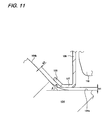
- a distal end portion (a lower end portion) of the circumferential wall portion 126 is disposed directly above the straight outer circumferential portion 104a of the constant velocity joint 104 so as to define a minute gap e1 (a labyrinth gap) defined therebetween and is bent at almost right angles towards a vehicle inner side along the straight outer circumferential portion 104a, so as to form a first bent portion 127.
- a distal end portion of the first bent portion 127 is disposed directly above a connecting portion between the straight outer circumferential portion 104a and the tapered outer circumferential portion 104b of the constant velocity joint 104 and is bent towards the vehicle inner side along the tapered outer circumferential portion 104b, so as to form a second bent portion 128.
- a minute gap e2 (a labyrinth gap) is defined between the second bent portion 128 and the tapered outer circumferential portion 104b of the axle 104.
- the respective gaps e1, e2 desirably have a gap size of 0.1 to 0.5 mm.
- the outer circumferential surface (the straight outer circumferential portion 104a and the tapered outer circumferential portion 104b) of the constant velocity joint 104 is covered over a large area by the first and second bent portions 127, 128 via the minute gaps e1, e2, whereby foreign matters which flow down along the outer circumferential surface of the constant velocity joint 104 are made difficult to intrude the circumferential portion of the head portion 118 of the sensor 116.
- An inclination angle ⁇ of the second bent portion 128 relative to the first bent portion 127 of the circumferential wall portion 126 is larger than an inclination angle ⁇ of the tapered outer circumferential portion 104b relative to the straight outer circumferential portion 104a of the constant velocity joint 104.
- An elongated projection 129 projecting towards the connecting portion 124 side is provided on a rear surface portion (a vehicle outer side surface in a mounted condition) of the circumferential wall portion 126 of the cover member 117 so as to extend along a full circumference of the circumferential wall portion 126.
- a concave grove is provided on a front surface portion of the circumferential wall portion 126 so as to extend along the full circumference of the circumferential wall portion 126.
- This elongated projection 129 has a function to press the head portion 118 of the sensor 116 which is inserted through the inserted sensor mounting hole 125 in the main body portion 123 in the axial direction.
- the pulser ring 115 is mounted on an outer circumferential surface of the vehicle inner side inner ring 106.
- the inner ring 106 is press fitted on the hub wheel 101 on which a wheel (not shown) is mounted. Because of this, the pulser ring 115 rotates together with the wheel.
- the connecting portion 124 of the main body portion of the cover member 117 is press fitted in the gap defined between the axle housing 102 and the outer ring 108. Because of this, the cover member 117 is mounted on a vehicle body (the axle housing 102) in a stationary manner.
- the head portion 118 of the sensor 116 is inserted into the sensor mounting hole 125 provided in the main body portion 123 of the cover member 117. Since the sloping surface portion 121 is formed at the distal end portion of the head portion 118, the head portion 118 is easily inserted through the sensor mounting hole 125. The head portion 118 inserted through the sensor mounting hole 125 allows the pair of stopper portions 118a to be brought into abutment with an outer circumferential surface of the main body portion 123 of the cover member 117. The head portion 118 of the sensor 116 is positioned in the radial direction by the abutment of the stopper portions 118a with the main body portion 123.
- the elongated projection 129 of the circumferential wall portion 126 fits in the concave groove portion 122 on the head portion 118, so as to press the head portion 118 in the axial direction.
- the head portion 118 of the sensor 116 is positioned in the axial direction and the head portion 118 is positioned in the radial direction in a more ensured manner, whereby the prevention of dislocation of the head portion 118 is realized. Since the width W2 of the head portion 118 is almost the same as the inner width W1 of the sensor mounting hole 125, there occurs no such situation that the head portion 118 is shifted in the circumferential direction.
- the head portion 118 of the sensor 116 is positioned in the circumferential direction.
- the head portion 118 of the sensor 116 is held in the cover member 117 while being positioned with respect to the axial direction, radial direction and circumferential direction.
- the pulser ring 115 and the head portion 118 are disposed so as to face each other.
- the first and second bent portions 127, 128 which are provided at the distal end portion 126a of the circumferential wall portion 126 are disposed so as to be spaced by the minute gaps e1, e2 (the labyrinth gaps) apart from the outer circumferential surface (the straight outer circumferential portion 104a and the tapered circumferential portion 104b) of the constant velocity joint 104. Because of this, a peripheral space portion of the head portion 118 of the sensor 116 is closed, whereby foreign matters (sand, mud, dirty, rain water and the like) which flow down along the outer circumferential surface of the constant velocity joint 104 are prevented from intruding the periphery of the sensor 116.
- first and second bent portions 127, 128 are disposed so as not to contact the outer circumferential surface of the constant velocity joint 104, there is caused no such fear that the outer circumferential surface of the constant velocity joint 104 is worn or the cover member is shifted.
- the detection accuracy of the sensor 116 is prevented from being affected badly by accumulation of the foreign matters which intrude the periphery of the sensor 116 or adhesion thereof to the pulser ring 115 or the head portion 118 of the sensor 116, highly accurate detection results can be obtained at all times.
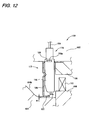
- the distal end portion of the circumferential wall portion 126 is described as being bent towards the vehicle inner side. However, as with a cover member 117 shown in Fig. 12 , a distal end portion of a circumferential wall portion 126 may be bent towards the vehicle outer side.
- FIG. 13 is a front sectional view of a hub unit 250 in which a rotation speed detector 200 of the hub unit according to a third embodiment of the invention is mounted
- Fig. 14 is an exploded perspective view of the rotation speed detector 200 as viewed from a vehicle outer side
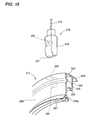
- Fig. 15 is a perspective view of a cover member 217 with a sensor 216 removed therefrom
- Fig. 16 is a front view of the rotation speed detector 200
- Fig. 17 is a side sectional view of the same detector.
- a rotation speed detector 200 of a hub unit according to the third embodiment of the invention will be described.
- a hub unit 250 of the vehicle will be described.
- a right hand side as viewed in the figure denotes a "vehicle outer side” and similarly, a left hand side denotes a "vehicle inner side.”
- the hub unit 250 of this embodiment includes a hub wheel 201 and a rolling bearing 203 for supporting rotatably the hub wheel 201 relative to a vehicle body (an axle housing 202) and is interposed between the axle housing 202 and a constant velocity joint 204 (CVJ).
- CVJ constant velocity joint 204
- a vehicle outer side end portion of the constant velocity joint 204 is spline fitted in the hub wheel 201, so that a drive force of the constant velocity joint 204 is transmitted to a wheel (not shown) mounted on a flange portion 201a of the hub wheel 201.
- An outside diameter of the constant velocity joint 204 on a vehicle inner side increases gradually as it extends towards a vehicle inner side end face thereof.
- the rolling bearing 203 of this embodiment is a double row angular contact ball bearing and includes a pair of inner rings (a vehicle outer side inner ring 205 and a vehicle inner side inner ring 206) which are press fitted on an outer circumferential surface of the hub wheel 201 and are pressed in the axial direction by the constant velocity joint 204 to thereby be allowed to rotate together with the hub wheel 201, an outer ring 208 which is fixed to the axle housing 202 via a mounting flange portion 207, and a plurality of rolling elements (balls 209) which are interposed between the pair of inner rings 205, 206 and the outer ring 208.
- a pair of inner rings a vehicle outer side inner ring 205 and a vehicle inner side inner ring 206
- the inner rings 205, 206 are each made up of a larger diameter portion and a small diameter portion which are joined together continuously, and inner ring raceway surfaces 211, 212 are provided at a joint portion therebetween on which the balls 209 are allowed to roll.
- a large diameter portion side end face portion 205a (a vehicle outer side end face portion) of the vehicle outer side inner ring 205 is brought into abutment with a lower end portion of the flange portion 201a of the hub wheel 201.
- a large diameter portion side end face portion 206a (a vehicle inner side end face portion) of the vehicle inner side inner ring 206 is brought into abutment with the constant velocity joint 204.
- Respective small diameter portion side end face portions of the inner rings 205, 206 are disposed to face each other in a butt joint manner.
- outer ring raceway surfaces 213 are formed on an inner circumferential surface of the outer ring 208.
- the plurality of balls 209 are retained by cages 214.
- the rotation speed detector 200 will be described. As is shown in Figs. 14 and 15 , the rotation speed detector 200 of the third embodiment includes a pulser ring 215 which rotates together with the hub wheel 201, a sensor 216 for detecting a rotation speed of the pulser ring 215 (a rotation speed of the wheel), and a ring-shaped cover member 217 for supporting the sensor 216.
- the pulser ring 215 has a ring shape and N poles and S poles are magnetized alternately in a circumferential direction on the pulser ring 215.
- the pulser ring 215 is fixed to an outer circumferential surface of the large diameter portion of the vehicle inner side inner ring 206 (refer to Fig. 13 ). By this configuration, the pulser ring 215 is allowed to rotate together with the inner ring 206 (that is, the hub wheel 201).
- the sensor 216 includes a head portion 218 and a lead wire 219.
- a sloping surface portion 221 is formed on a front surface portion (a vehicle inner side surface with the sensor 216 mounted accordingly) of the head portion 218 at a distal end portion thereof.
- a concave groove portion 222 is formed on the front surface portion of the head portion 218 in a direction which is at right angles to a longitudinal direction of the head portion 218.
- the cover member 217 is fixed in place by a connecting portion 224 provided at an axial end portion (a vehicle outer side end portion) of a short cylindrical main body portion 223 being press fitted in a gap defined between the axle housing 202 and the outer ring 208.
- a sensor mounting hole 225 is provided in a radial direction in a predetermined position of the main body portion 223 so that the head portion 218 of the sensor 216 is inserted therethrough.
- an inner width (a circumferential length) of the sensor mounting hole 225 is referred to as W1 and a width of the head portion 218 of he sensor 216 is referred to as W2, the inner width W1 of the sensor mounting hole 225 is slightly larger than the width W2 of the head portion 218.
- the length L1 of the sensor mounting hole 225 is slightly larger than the thickness L2 of the head portion 218.
- An annular circumferential wall portion 226 is provided at the other axial end portion (a vehicle outer side end portion) of the main body portion 223 of the cover member 217 so as to extend radially inwards (towards an axis of the constant velocity joint 204).
- a distal end portion 226a of the circumferential wall portion 226 is bent at a predetermined angle towards a vehicle outer side, and a seal member 227 is secured to the distal end portion 226a along a full circumference thereof.
- This circumferential wall portion 226 has a length which enables the seal member 227 which is secured to the distal end portion 226a to be brought into sliding contact with an outer circumferential surface of the constant velocity joint 204 when the cover member 217 is press fitted in the gap defined between the axle housing 202 and the outer ring 208.
- An elongated projection 228 projecting towards the connecting portion 124 side is provided on a rear surface portion (a vehicle outer side surface in a mounted condition) of the circumferential wall portion 226 of the cover member 217 so as to extend along a full circumference of the circumferential wall portion 226.
- a concave grove is provided on a front surface portion of the circumferential wall portion 226 so as to extend along the full circumference of the circumferential wall portion 226.
- This elongated projection 228 has a function to press the head portion 218 of the sensor 216 which is inserted through the inserted sensor mounting hole 225 in the main body portion 223 in the axial direction.
- a guide wall portion 229 is provided on a position on an inner circumferential surface of the main body portion 223 of the cover member 217 which lies between the connecting portion 224 and the circumferential wall portion 226 so as to extend therefrom radially inwards.
- the guide wall portion 229 is secured to the inner circumferential surface of the main body portion 223 through welding.
- a detection hole 231 is provided at a portion on the guide wall portion 229 corresponding to the sensor mounting hole 225 in the main body portion 223 (a portion on which the head portion 218 of the sensor 216 is disposed), and a distal end portion of the guide wall portion 229 is bent towards the circumferential wall portion 226, a stopper portion 232 being formed at the portion so bent.
- the head portion 218 of the sensor 216 which is inserted through the sensor mounting hole 225 in the main body portion 223 of the cover member 217 moves radially inwards while forcibly expanding (elastically deforming) the circumferential wall portion 226 by being guided by the guide wall portion 229, and the distal end portion thereof is brought into abutment with the stopper portion 232.
- the circumferential wall portion 226 elastically restores, and the elongated projection 228 fits in the concave groove portion 222 on the head portion 218.
- the head portion 218 of the sensor 216 is positioned in the axial direction and the radial direction to thereby be held in place.
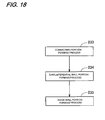
- the cover member 217 is fabricated through a connecting portion forming process 233 of forming a cylindrical connecting portion 224, a circumferential wall forming process 234 of forming a circumferential wall portion 226 by bending an axial end portion of the connecting portion 224 radially inwards and a guide wall portion forming process 235 of welding an outer circumferential surface of a disc-shaped guide wall portion 229 to an inner circumferential surface of the connecting portion 224 in parallel with the circumferential wall portion 226.
- a process of mounting a seal member 227 at a distal end portion 226a of the circumferential wall portion 226 may be implemented before welding the connecting portion 224 and the guide wall portion 229 together or after the welding of the two portions.
- both the portions may be connected together by welding the circumferential wall portion 226 to one end portion of the connecting portion 224.
- the pulser ring 215 is mounted on an outer circumferential surface of the vehicle inner side inner ring 206.
- the inner ring 206 is press fitted on the hub wheel 201 on which a wheel (not shown) is mounted. Because of this, the pulser ring 215 rotates together with the wheel.
- the connecting portion 224 of the min body portion of the cover 217 is press fitted in the gap defined between the axle housing 202 and the outer ring 208. Because of this, the cover member 217 is mounted on a vehicle body (the axle housing 202) in a stationary manner.
- the head portion 218 of the sensor 216 is inserted into the sensor mounting hole 225 provided in the main body portion 223 of the cover member 217. Since the sloping surface portion 221 is formed at the distal end portion of the head portion 218, the head portion 218 is easily inserted through the sensor mounting hole 225. The head portion 218 brings the distal end portion thereof into abutment with the stopper portion 232 while being guided by the guide wall portion 229. By this action, the head portion 218 of the sensor 216 is positioned in the radial direction. In this state, the elongated projection 228 of the circumferential wall portion 226 fits in the concave groove portion 222 on the head portion 218, so as to press the head portion 218 in the axial direction.
- the head portion 218 of the sensor 216 is positioned in the axial direction and the head portion 218 is positioned in the radial direction in a more ensured manner, whereby the prevention of dislocation of the head portion 218 is realized. Since the width W2 of the head portion 218 is only slightly smaller than the inner width W1 of the sensor mounting hole 225, the head portion 218 shifts slightly in the circumferential direction. By this configuration, the head portion 218 of the sensor 216 is positioned in the circumferential direction.
- the head portion 218 of the sensor 216 is held in the cover member 217 while being positioned with respect to the axial direction, radial direction and circumferential direction.
- the pulser ring 215 and the head portion 218 are disposed so as to face each other.
- the inner width W1 of the sensor mounting hole 225 is desirably made almost the same as the width W2 of the head portion 218.
- the seal member 227 mounted at the distal end portion 226a of the circumferential wall portion 226 is brought into sliding contact with the outer circumferential surface of the constant velocity joint 204.
- a peripheral space portion of the head portion 218 of the sensor 216 is closed, whereby foreign matters (sand, mud, dirty, rain water and the like) which flow down along the outer circumferential surface of the constant velocity joint 204 are prevented from intruding the periphery of the sensor 216.
- the detection accuracy of the sensor 216 is prevented from being affected badly by accumulation of the foreign matters which intrude the periphery of the sensor 216 or adhesion thereof to the pulser ring 215 or the head portion 218 of the sensor 216, highly accurate detection results can be obtained at all times.
Landscapes
- Engineering & Computer Science (AREA)
- Mechanical Engineering (AREA)
- General Engineering & Computer Science (AREA)
- Physics & Mathematics (AREA)
- General Physics & Mathematics (AREA)
- Transmission And Conversion Of Sensor Element Output (AREA)
- Rolling Contact Bearings (AREA)
Applications Claiming Priority (4)
| Application Number | Priority Date | Filing Date | Title |
|---|---|---|---|
| JP2007152959A JP4984142B2 (ja) | 2007-06-08 | 2007-06-08 | ハブユニット |
| JP2007155254A JP5104049B2 (ja) | 2007-06-12 | 2007-06-12 | 回転速度検出装置 |
| JP2007172038A JP5104067B2 (ja) | 2007-06-29 | 2007-06-29 | 回転速度検出装置 |
| PCT/JP2008/060473 WO2008152987A1 (fr) | 2007-06-08 | 2008-06-06 | Unité de moyeu |
Publications (1)
| Publication Number | Publication Date |
|---|---|
| EP2159578A1 true EP2159578A1 (fr) | 2010-03-03 |
Family
ID=40129592
Family Applications (1)
| Application Number | Title | Priority Date | Filing Date |
|---|---|---|---|
| EP08765286A Withdrawn EP2159578A1 (fr) | 2007-06-08 | 2008-06-06 | Unité de moyeu |
Country Status (3)
| Country | Link |
|---|---|
| EP (1) | EP2159578A1 (fr) |
| CN (1) | CN101680909B (fr) |
| WO (1) | WO2008152987A1 (fr) |
Cited By (4)
| Publication number | Priority date | Publication date | Assignee | Title |
|---|---|---|---|---|
| WO2011121384A1 (fr) * | 2010-04-02 | 2011-10-06 | Aktiebolaget Skf | Ensemble roulement pourvu d'une cible et d'un capteur, et procédé de montage d'un tel ensemble roulement sur une structure |
| EP2618162A1 (fr) * | 2012-01-17 | 2013-07-24 | Jtekt Corporation | Dispositif de roulement de roue avec capteur de vitesse intégré |
| WO2013120541A1 (fr) * | 2012-02-16 | 2013-08-22 | Schaeffler Technologies AG & Co. KG | Système de roulement de roue pourvu d'une protection de codeur et d'un dispositif de centrage |
| US11231069B2 (en) | 2019-10-17 | 2022-01-25 | Aktiebolaget Skf | Wheel hub bearing provided with a wireless power transfer device |
Families Citing this family (3)
| Publication number | Priority date | Publication date | Assignee | Title |
|---|---|---|---|---|
| US8474920B2 (en) * | 2011-06-15 | 2013-07-02 | GM Global Technology Operations LLC | Protective cap for a vehicle wheel hub |
| CN102981181A (zh) * | 2012-12-04 | 2013-03-20 | 朱德兵 | 一种滚动式运动纵波传感器装置及其使用方法 |
| CN109774373A (zh) * | 2019-01-31 | 2019-05-21 | 上海蔚来汽车有限公司 | 汽车轮速传感器的保护端盖、车轮组件及汽车 |
Family Cites Families (9)
| Publication number | Priority date | Publication date | Assignee | Title |
|---|---|---|---|---|
| JP3811581B2 (ja) | 1999-02-02 | 2006-08-23 | 株式会社ジェイテクト | 回転速度検出装置 |
| JP2000221205A (ja) * | 1999-02-02 | 2000-08-11 | Koyo Seiko Co Ltd | 回転速度検出装置 |
| JP3857453B2 (ja) * | 1999-02-02 | 2006-12-13 | 株式会社ジェイテクト | 回転速度検出装置 |
| JP5103704B2 (ja) * | 2001-09-12 | 2012-12-19 | 株式会社ジェイテクト | パルサリングおよび回転検出装置 |
| JP2003254985A (ja) * | 2002-03-04 | 2003-09-10 | Nsk Ltd | 回転速度検出装置付転がり軸受ユニット |
| JP2005098941A (ja) * | 2003-09-26 | 2005-04-14 | Ntn Corp | ワイヤレスセンサ付軸受装置 |
| JP2005241351A (ja) | 2004-02-25 | 2005-09-08 | Ntn Corp | 回転速度検出装置付き軸受装置 |
| JP2005299764A (ja) * | 2004-04-09 | 2005-10-27 | Ntn Corp | 回転速度検出装置付き車輪用軸受装置 |
| JP2005315632A (ja) | 2004-04-27 | 2005-11-10 | Ntn Corp | 回転速度検出装置付き軸受装置 |
-
2008
- 2008-06-06 EP EP08765286A patent/EP2159578A1/fr not_active Withdrawn
- 2008-06-06 WO PCT/JP2008/060473 patent/WO2008152987A1/fr not_active Ceased
- 2008-06-06 CN CN2008800193100A patent/CN101680909B/zh not_active Expired - Fee Related
Non-Patent Citations (1)
| Title |
|---|
| See references of WO2008152987A1 * |
Cited By (6)
| Publication number | Priority date | Publication date | Assignee | Title |
|---|---|---|---|---|
| WO2011121384A1 (fr) * | 2010-04-02 | 2011-10-06 | Aktiebolaget Skf | Ensemble roulement pourvu d'une cible et d'un capteur, et procédé de montage d'un tel ensemble roulement sur une structure |
| EP2618162A1 (fr) * | 2012-01-17 | 2013-07-24 | Jtekt Corporation | Dispositif de roulement de roue avec capteur de vitesse intégré |
| WO2013120541A1 (fr) * | 2012-02-16 | 2013-08-22 | Schaeffler Technologies AG & Co. KG | Système de roulement de roue pourvu d'une protection de codeur et d'un dispositif de centrage |
| CN104220274A (zh) * | 2012-02-16 | 2014-12-17 | 舍弗勒技术有限两合公司 | 具有编码器保护和定心设备的车轮轴承装置 |
| US9377055B2 (en) | 2012-02-16 | 2016-06-28 | Schaeffler Technologies AG & Co. KG | Wheel bearing arrangement with encoder protection and centering device |
| US11231069B2 (en) | 2019-10-17 | 2022-01-25 | Aktiebolaget Skf | Wheel hub bearing provided with a wireless power transfer device |
Also Published As
| Publication number | Publication date |
|---|---|
| CN101680909A (zh) | 2010-03-24 |
| CN101680909B (zh) | 2012-11-21 |
| WO2008152987A1 (fr) | 2008-12-18 |
Similar Documents
| Publication | Publication Date | Title |
|---|---|---|
| EP2159578A1 (fr) | Unité de moyeu | |
| CN106030137B (zh) | 带旋转速度检测装置的滚动轴承单元 | |
| CN102066791A (zh) | 轴承密封件 | |
| WO2018110626A1 (fr) | Dispositif d'étanchéité | |
| JP2005133772A (ja) | シール装置およびそれを用いた転がり軸受装置 | |
| JP5104049B2 (ja) | 回転速度検出装置 | |
| JP2002541417A (ja) | エンコーダを有するボールベアリング | |
| US20070177834A1 (en) | Seal device with sensor and rolling bearing device using the seal device | |
| JP4508704B2 (ja) | センサ付軸受装置 | |
| JP2006183701A (ja) | センサ付きシール装置およびそれを用いた転がり軸受装置 | |
| JP5067718B2 (ja) | センサー付き転がり軸受装置 | |
| JP2006183712A (ja) | センサ付きシール装置およびそれを用いた転がり軸受装置 | |
| JP3440800B2 (ja) | 回転速度検出装置付転がり軸受ユニット | |
| EP1780549B1 (fr) | Dispositif d'étanchéité avec capteur et dispositif de roulement l'utilisant | |
| JP5061652B2 (ja) | 着磁パルサリング、及びこれを用いたセンサ付き転がり軸受装置 | |
| JP2005140188A (ja) | センサ付きシール装置およびそれを用いた転がり軸受装置 | |
| JP5035754B2 (ja) | センサー付き転がり軸受装置 | |
| JP4547567B2 (ja) | シール装置およびそれを用いた転がり軸受装置 | |
| WO2010004696A1 (fr) | Dispositif d'étanchéité avec codeur magnétique, et dispositif de palier pour roue utilisant le dispositif d'étanchéité | |
| JP4656917B2 (ja) | 回転速度検出装置付車輪用軸受装置 | |
| JP2010048290A (ja) | 磁気エンコーダ付き密封装置 | |
| EP1672371A1 (fr) | Dispositif de palier pour le moyeu d'une roue d'un véhicule à moteur comprenant un dispositif d'étanchéité et un dispositif de détection de rotation | |
| JP2003240007A (ja) | 車輪用軸受 | |
| JP5104067B2 (ja) | 回転速度検出装置 | |
| JP2005140187A (ja) | センサ付きシール装置およびそれを用いた転がり軸受装置 |
Legal Events
| Date | Code | Title | Description |
|---|---|---|---|
| PUAI | Public reference made under article 153(3) epc to a published international application that has entered the european phase |
Free format text: ORIGINAL CODE: 0009012 |
|
| 17P | Request for examination filed |
Effective date: 20091223 |
|
| AK | Designated contracting states |
Kind code of ref document: A1 Designated state(s): AT BE BG CH CY CZ DE DK EE ES FI FR GB GR HR HU IE IS IT LI LT LU LV MC MT NL NO PL PT RO SE SI SK TR |
|
| AX | Request for extension of the european patent |
Extension state: AL BA MK RS |
|
| DAX | Request for extension of the european patent (deleted) | ||
| STAA | Information on the status of an ep patent application or granted ep patent |
Free format text: STATUS: THE APPLICATION HAS BEEN WITHDRAWN |
|
| 18W | Application withdrawn |
Effective date: 20150303 |