EP2163524B2 - Verfahren zur Behandlung von ammoniumhaltigem Abwasser - Google Patents
Verfahren zur Behandlung von ammoniumhaltigem Abwasser Download PDFInfo
- Publication number
- EP2163524B2 EP2163524B2 EP08016104.5A EP08016104A EP2163524B2 EP 2163524 B2 EP2163524 B2 EP 2163524B2 EP 08016104 A EP08016104 A EP 08016104A EP 2163524 B2 EP2163524 B2 EP 2163524B2
- Authority
- EP
- European Patent Office
- Prior art keywords
- ammonium
- oxidizing bacteria
- nitrite
- phase
- heavy phase
- Prior art date
- Legal status (The legal status is an assumption and is not a legal conclusion. Google has not performed a legal analysis and makes no representation as to the accuracy of the status listed.)
- Active
Links
Images
Classifications
-
- C—CHEMISTRY; METALLURGY
- C02—TREATMENT OF WATER, WASTE WATER, SEWAGE, OR SLUDGE
- C02F—TREATMENT OF WATER, WASTE WATER, SEWAGE, OR SLUDGE
- C02F3/00—Biological treatment of water, waste water, or sewage
- C02F3/30—Aerobic and anaerobic processes
- C02F3/302—Nitrification and denitrification treatment
-
- C—CHEMISTRY; METALLURGY
- C02—TREATMENT OF WATER, WASTE WATER, SEWAGE, OR SLUDGE
- C02F—TREATMENT OF WATER, WASTE WATER, SEWAGE, OR SLUDGE
- C02F3/00—Biological treatment of water, waste water, or sewage
- C02F3/30—Aerobic and anaerobic processes
- C02F3/301—Aerobic and anaerobic treatment in the same reactor
-
- Y—GENERAL TAGGING OF NEW TECHNOLOGICAL DEVELOPMENTS; GENERAL TAGGING OF CROSS-SECTIONAL TECHNOLOGIES SPANNING OVER SEVERAL SECTIONS OF THE IPC; TECHNICAL SUBJECTS COVERED BY FORMER USPC CROSS-REFERENCE ART COLLECTIONS [XRACs] AND DIGESTS
- Y02—TECHNOLOGIES OR APPLICATIONS FOR MITIGATION OR ADAPTATION AGAINST CLIMATE CHANGE
- Y02W—CLIMATE CHANGE MITIGATION TECHNOLOGIES RELATED TO WASTEWATER TREATMENT OR WASTE MANAGEMENT
- Y02W10/00—Technologies for wastewater treatment
- Y02W10/10—Biological treatment of water, waste water, or sewage
Definitions
- the invention relates to a process for the treatment of ammonium-containing wastewater in a single-stage deammonifying single-basin plant, in which first by means of aerobic oxidizing bacteria (AOB) ammonium is converted to nitrite and then by means of anaerobic oxidizing bacteria (AMOX), in particular by means of Planctomycetes, ammonium and nitrite are converted into elemental nitrogen, wherein in the process resulting excess sludge is discharged from the basin.
- AOB aerobic oxidizing bacteria
- AMOX anaerobic oxidizing bacteria
- nitrogen elimination is meant the conversion of biologically available nitrogen compounds such as ammonium (NH 4 ), nitrite (NO 2 ) and nitrate (NO 3 ) to elemental nitrogen (N 2 ), which as a harmless end product outgases into the ambient air.
- NH 4 ammonium
- NO 2 nitrite
- NO 3 nitrate
- N 2 elemental nitrogen
- ammonium is oxidized by oxygen via the intermediate nitrite to nitrate.
- the nitrate is reduced in a first reduction step to nitrite and in a second reduction step to nitrogen.
- Deammonification is an efficient method for biological nitrogen elimination in high ammonium wastewater.
- two groups of bacteria are involved, on the one hand the aerobic ammonium oxidizing bacteria (AOB), which convert ammonium to nitrite, and on the other hand the anaerobic ammonium oxidizing and elemental nitrogen producing bacteria (AMOX), especially Planctomycetes, which take this step complete with the help of the previously produced nitrite.
- AOB aerobic ammonium oxidizing bacteria
- AMOX anaerobic ammonium oxidizing and elemental nitrogen producing bacteria
- the aerobic ammonium oxidizing bacteria (AOB) produce 10 times more new bacterial mass relative to the metabolic rate than the anaerobic ammonium oxidizing bacteria (AMOX).
- the residence time of the sludge in the one-sludge system or in the one-Bekken system must therefore be at least as long that the slow-growing anaerobic ammonium oxidizing bacteria (AMOX) can accumulate.
- a method for single-stage biological Deammon Eaton of the aforementioned type is already known from WO 2007/033393 A1 known.
- the EP 0 391 023 B1 , the EP 0 327 184 B1 and the WO 00/05176 A1 also describe methods for single-stage and two-stage deammonification.
- AMOX anaerobic ammonium oxidizing bacteria
- AOB aerobic ammonium oxidizing bacteria
- a sufficiently high wastewater temperature (> 25 ° C) is the basis for the existence or the growth of the anaerobic ammonium oxidizing bacteria (AMOX).
- AMOX anaerobic ammonium oxidizing bacteria
- NOB nitrate-forming bacteria
- AMOX anaerobic ammonium oxidizing bacteria
- the invention has for its object to provide an improved and economically feasible method for the treatment of ammonium-containing wastewater available.
- a method in which the discharged excess sludge is separated into a heavy phase, which contains predominantly the anaerobic ammonium oxidizing bacteria (AMOX), and into a light phase, wherein the heavy phase is returned to the plant and disposed of the light phase becomes.
- AMOX anaerobic ammonium oxidizing bacteria
- anaerobic ammonium oxidizing bacteria By disposing of the light phase and returning the heavy phase to the basin, the slow-growing group of anaerobic ammonium oxidizing bacteria (AMOX) can be enriched.
- the temperature of the wastewater which influences the existence or the growth of the anaerobic ammonium oxidizing bacteria (AMOX), is no longer of decisive importance by the method according to the invention, so that the deammonification is still effective even with waste water at a temperature of about 15 ° C and can be applied reliably.
- AMOX anaerobic ammonium oxidizing bacteria
- the temperature affects all bacteria more or less in the same way (about a doubling of the turnover rate per 10 ° C temperature increase).
- conventional deammonification in a single-basin system at low temperatures would require such a large tank volume that it would no longer be economical.
- the retention of the AMOX by the method according to the invention enables an efficient process even at lower temperatures.
- anaerobic ammonium oxidizing bacteria AMOX
- NOB nitrate-forming bacteria
- the aerated phase can be operated at higher oxygen concentrations at the beginning of the process (> 0.4 mg O 2 / l) and the efficiency of nitrite formation by the aerobic ammonium oxidizing bacteria (AOB) can be increased by a factor of> 2.
- a particularly advantageous development of the present method is also achieved by carrying out the separation of the excess sludge into a heavy phase and a light phase in a hydrocyclone.
- a hydrocyclone also called centrifugal separator
- the excess sludge can be particularly fast and reliable in a heavy phase, which is recycled by an underflow of the cyclone in the tank, and a light phase, which is discharged through the upper reaches of the system, separate.
- the separation of the excess sludge into a heavy phase and a light phase is carried out in a centrifuge.
- a centrifuge separates the excess sludge by utilizing the inertia of mass. The heavier, higher density sludge fraction migrates outward due to its inertia and displaces the lighter, lower density sludge fraction into the center of the centrifuge.
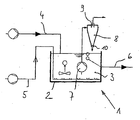
- the invention allows for various embodiments. To further clarify its basic principle, one of them is shown in the drawing and will be described below. This shows in the single figure a side view of a single-basin plant for the treatment of ammonium-containing wastewater.
- the single-basin system 1 has a basin 2 for receiving the ammonium-containing waste water 3, an inlet 4, a ventilation 5 and a drain 6.
- the ammonium contained in the wastewater 3 is first converted into nitrite by means of aerobic oxidizing bacteria (AOB).
- AOB aerobic oxidizing bacteria
- AMOX anaerobic oxidizing bacteria
- the ammonium and the previously reacted nitrite are converted into elemental nitrogen.
- ABO aerobic oxidizing bacteria
- AMOX anaerobic oxidizing bacteria
- excess sludge formed in the reactions is introduced into a hydrocyclone 8.
- the excess sludge is separated into a heavy phase containing predominantly the anaerobic ammonium oxidizing bacteria (AMOX) and a light phase.
- the light phase is removed and disposed of by the overflow 9 of the hydrocyclone 8 and the heavy phase is through the lower reaches 10 of the hydrocyclone 8 back into the tank 2 of the one-tank. Annex 1 kept.
Landscapes
- Life Sciences & Earth Sciences (AREA)
- Water Supply & Treatment (AREA)
- Microbiology (AREA)
- Hydrology & Water Resources (AREA)
- Engineering & Computer Science (AREA)
- Environmental & Geological Engineering (AREA)
- Biodiversity & Conservation Biology (AREA)
- Chemical & Material Sciences (AREA)
- Organic Chemistry (AREA)
- Purification Treatments By Anaerobic Or Anaerobic And Aerobic Bacteria Or Animals (AREA)
- Removal Of Specific Substances (AREA)
- Micro-Organisms Or Cultivation Processes Thereof (AREA)
- Physical Water Treatments (AREA)
- Treatment Of Sludge (AREA)
Description
- Die Erfindung betrifft ein Verfahren zur Behandlung von ammoniumhaltigem Abwasser in einer einstufigen deammonifizierenden Ein-Becken-Anlage, bei welchem zunächst mittels aerob oxidierender Bakterien (AOB) Ammonium zu Nitrit umgesetzt wird und anschließend mittels anaerob oxidierender Bakterien (AMOX), insbesondere mittels Planctomyceten, Ammonium und Nitrit in elementaren Stickstoff umgesetzt werden, wobei bei dem Verfahren entstehender Überschussschlamm aus dem Becken abgeführt wird.
- In herkömmlichen Kläranlagen wird heute fast ausschließlich die biologische Nitrifikation/Denitrifikation zur Stickstoffelimination eingesetzt. Unter Stickstoffelimination versteht man die Umwandlung von biologisch verfügbaren Stickstoffverbindungen wie Ammonium (NH4), Nitrit (NO2) und Nitrat (NO3) zu elementarem Stickstoff (N2), welcher als harmloses Endprodukt in die Umgebungsluft ausgast. Bei der Nitrifikation wird Ammonium durch Sauerstoff über das Zwischenprodukt Nitrit zu Nitrat oxidiert. Bei der anschließenden Denitrifikation wird das Nitrat in einem ersten Reduktionsschritt zu Nitrit und in einem zweiten Reduktionsschritt zu Stickstoff reduziert.
- Die Deammonifikation ist ein effizientes Verfahren zur biologischen Stickstoffelimination bei Abwassem mit hohen Ammoniumkonzentrationen. Bei der einstufigen biologischen Deammonifikation mit suspendierter Biomasse sind zwei Bakteriengruppen beteiligt, einerseits die aerob Ammonium oxidierenden Bakterien (AOB), welche Ammonium zu Nitrit umsetzen, und andererseits die anaerob Ammonium oxidierenden und elementaren Stickstoff produzierenden Bakterien (AMOX), insbesondere Planctomyceten, welche diesen Schritt mit Hilfe des zuvor produzierten Nitrits vollziehen.
- Die aerob Ammonium oxidierenden Bakterien (AOB) produzieren bezogen auf den Stoffumsatz 10-mal mehr neue Bakterienmasse als die anaerob Ammonium oxidierenden Bakterien (AMOX). Die Aufenthaltszeit des Schlamms im Ein-Schlamm-System bzw. in der Ein-Bekken-Anlage muss also mindestens so lang sein, dass sich die langsamwüchsigen anaerob Ammonium oxidierenden Bakterien (AMOX) anreichern können.
- Ein Verfahren zur einstufigen biologischen Deammonifikation der eingangs genannten Art ist bereits aus der
WO 2007/033393 A1 bekannt. DieEP 0 391 023 B1 , dieEP 0 327 184 B1 und dieWO 00/05176 A1 - Als nachteilig erweisen sich hierbei insbesondere die wesentlich längeren Generationszeiten der anaerob Ammonium oxidierenden Bakterien (AMOX), welche um den Faktor 10 länger als die aerob Ammonium oxidierenden Bakterien (AOB) sind. Dadurch kann sich ein stabiles System nur dann ausbilden, wenn die Aufenthaltszeit des Schlamms bzw. der Bakterien im Becken ausreichend groß ist. Dies bedingt wiederum große Reaktionsvolumina und entsprechend ausgebildete Bekken.
- Weiterhin ist eine ausreichend hohe Abwassertemperatur (> 25°C) Grundlage für die Existenz bzw. das Wachstum der anaerob Ammonium oxidierenden Bakterien (AMOX). Das Aufheizen des Abwassers ist energetisch jedoch sehr aufwändig, weshalb die beschriebenen Verfahren bei Abwässern mit niedrigen Temperaturen nicht wirtschaftlich einsetz- bzw. durchführbar sind.
- Weiterhin erweist sich die Anwesenheit von solchen Bakteriengruppen (NOB) als nachteilig, welche das gebildete Nitrit unter aeroben Bedingungen in Nitrat umwandeln. Diese Gruppe Bakterien hat gegenüber den anaerob Ammonium oxidierenden Bakterien (AMOX) um den Faktor 10 kürzere Generationszeiten. Zum Ausgleich dieser unterschiedlichen Generationszeiten ist bereits daran gedacht worden, die belüftete Phase des Ein-Schlamm-Systems auf einem sehr niedrigen Sauerstoffniveau zu betreiben (< 0,4 mg O2/l). Hierdurch steht den Nitrat bildenden Bakterien (NOB) kein bzw. wenig Sauerstoff zur Umsetzung des Nitrits zur Verfügung, was wiederum für die anaerob Ammonium oxidierenden Bakterien (AMOX) sehr vorteilhaft ist. Die reduzierte Sauerstoffzufuhr während der belüfteten Phase hat jedoch den Nachteil, dass auch die aerobe Umwandlung des Ammoniums in Nitrit sauerstofflimitiert ist und dadurch sehr langsam verläuft.
- Der Erfindung liegt die Aufgabe zugrunde, ein verbessertes und wirtschaftlich durchführbares Verfahren zur Behandlung von ammoniumhaltigem Abwasser zur Verfügung zu stellen.
- Diese Aufgabe wird mit einem Verfahren gemäß den Merkmalen des Anspruchs 1 gelöst. Die weitere Ausgestaltung des erfindungsgemäßen Verfahrens ist den Unteransprüchen zu entnehmen.
- Erfindungsgemäß ist also ein Verfahren vorgesehen, bei welchem der abgeführte Überschussschlamm in eine schwere Phase, welche mehrheitlich die anaerob Ammonium oxidierenden Bakterien enthält (AMOX), und in eine leichte Phase separiert wird, wobei die schwere Phase in die Anlage zurückgeführt und die leichte Phase entsorgt wird. Dadurch dass die beiden Bakteriengruppen (aerob/anaerob) nicht wie bei anderen biologischen Abwasserreinigungssystemen im Flockenverbund auftreten und jeweils eine unterschiedliche Dichte aufweisen, kann der Überschussschlamm in eine schwere und eine leichte Phase getrennt werden. Die Planctomyceten (AMOX) wachsen sehr dicht mit einer Dichte von ca. 1010 Bakterien/ml. Durch die Entsorgung der leichten Phase und die Rückführung der schweren Phase in das Becken kann die langsamwüchsige Gruppe der anaerob Ammonium oxidierenden Bakterien (AMOX) angereichert werden. Der Anteil der anaerob Ammonium oxidierenden Bakterien (AMOX), welcher in einem Ein-Schlamm-System mit unspezifischem Überschussschlammabzug weniger als 10% der Biomasse ausmacht, kann durch das erfindungsgemäße Verfahren auf über 30% angehoben werden. Hierdurch kann das Reaktionsvolumen des Bekkens entsprechend verkleinert und die Prozessstabilität der Anlage gesteigert werden.
- Die Temperatur des Abwassers, welche die Existenz bzw. das Wachstum der anaerob Ammonium oxidierenden Bakterien (AMOX) beeinflusst, ist durch das erfindungsgemäße Verfahren nicht mehr von entscheidender Bedeutung, sodass die Deammonifikation auch bei Abwasser mit einer Temperatur von ca. 15°C noch effektiv und prozesssicher angewendet werden kann.
- Die Temperatur beeinflusst alle Bakterien mehr oder weniger in gleicher Weise (etwa eine Verdoppelung der Umsatzgeschwindigkeit je 10°C Temperaturerhöhung). Allerdings würde bei konventioneller Deammonifikation in einer Ein-Becken-Anlage bei niedrigen Temperaturen ein so großes Beckenvolumen erforderlich werden, dass es nicht mehr wirtschaftliCh wird. Der Rückhalt der AMOX durch das erfindungsgemäße Verfahren ermöglicht auch bei niedrigeren Temperaturen einen effizienten Prozess.
- Durch die Rückführung der schweren Phase und die damit verbundene Anreicherung verschieben sich auch die Anteile der anaerob Ammonium oxidierenden Bakterien (AMOX) zu den Nitrat bildenden Bakterien (NOB) zu Gunsten der anaerob Ammonium oxidierenden Bakterien (AMOX). Hierdurch kann die belüftete Phase zu Beginn des Prozesses bei höheren Sauerstoffkonzentrationen betrieben werden (> 0,4 mg O2/l) und die Effizienz der Nitritbildung durch die aerob Ammonium oxidierenden Bakterien (AOB) kann um den Faktor > 2 gesteigert werden.
- Eine besonders vorteilhafte Weiterbildung des vorliegenden Verfahrens wird auch dadurch geschaffen, dass die Separierung des Überschussschlammes in eine schwere Phase und eine leichte Phase in einem Hydrozyklon durchgeführt wird. Durch einen Hydrozyklon, auch Fliehkraftabscheider genannt, lässt sich der Überschussschlamm besonders schnell und prozesssicher in eine schwere Phase, welche durch einen Unterlauf des Zyklons in das Becken zurückgeführt wird, und eine leichte Phase, welche durch den Oberlauf aus dem System abgeführt wird, trennen.
- In einer alternativen Abwandlung des erfindungsgemäßen Verfahrens ist vorgesehen, dass die Separierung des Überschussschlamms in eine schwere Phase und eine leichte Phase in einer Zentrifuge durchgeführt wird Eine Zentrifuge separiert den Überschussschlamm unter Ausnutzung der Massenträgheit. Die schwere Schlammfraktion mit der höheren Dichte wandert aufgrund ihrer Trägheit nach außen und verdrängt die leichtere Schlammfraktion mit der geringeren Dichte in die Mitte der Zentrifuge.
- Weiterhin ist es möglich, dass die Separierung des Überschussschlammes in eine schwere Phase und eine leichte Phase durch Sedimentation erfolgt. Hierbei erfolgt die Trennung des Überschussschlamms in ein schwere und eine leichte Phase unter dem Einfluss der Schwerkraft.
- Die Erfindung lässt verschiedene Ausführungsformen zu. Zur weiteren Verdeutlichung ihres Grundprinzips ist eine davon in der Zeichnung dargestellt und wird nachfolgend beschrieben. Diese zeigt in der einzigen Figur eine Seitenansicht einer Ein-Becken-Anlage zur Behandlung von ammoniumhaltigem Abwasser.
- Die Figur zeigt eine Ein-Becken-Anlage 1 zur Behandlung von ammoniumhaltigem Abwasser 3. Die Ein-Becken-Anlage 1 weist ein Becken 2 zur Aufnahme des ammoniumhaltigem Abwassers 3, einen Zulauf 4, eine Belüftung 5 und einen Ablauf 6 auf. Das in dem Abwasser 3 enthaltene Ammonium wird mittels aerob oxidierender Bakterien (AOB) zunächst in Nitrit umgesetzt. Anschließend wird mittels anaerob oxidierender Bakterien (AMOX), insbesondere mittels Planctomyceten, das Ammonium und das zuvor umgesetzte Nitrit in elementaren Stickstoff umgesetzt. Mittels einer Pumpe 7 wird bei den Reaktionen entstehender Überschussschlamm in einen Hydrozyklon 8 eingeleitet. In dem Hydrozyklon 8 wird der Überschussschlamm in ein schwere Phase, welche mehrheitlich die anaerob Ammonium oxidierenden Bakterien (AMOX) enthält, und eine leichte Phase getrennt. Die leichte Phase wird durch den Überlauf 9 des Hydrozyklons 8 abgeführt und entsorgt und die schwere Phase wird durch den Unterlauf 10 des Hydrozyklons 8 zurück in das Becken 2 der Ein-Becken. Anlage 1 geführt.
Claims (4)
- Verfahren zur Behandlung von ammoniumhaltigem Abwasser in einer einstufigen deammonifizierenden Ein-Becken-Anlage, bei welchem zunächst mittels aerob oxidierender Bakterien (AOB) Ammonium zur Nitrit umgesetzt wird und anschließend mittels anaerob oxidierender Bakterien (AMOX), insbesondere mittels Planctomyceten, Ammonium und Nitrit in elementaren Stickstoff umgesetzt werden, wobei bei dem Verfahren entstehender Überschussschlamm aus dem Becken abgeführt wird, dadurch gekennzeichnet, dass der abgeführte Überschussschlamm in eine schwere Phase, welche mehrheitlich die anaerob Ammonium oxidierenden Bakterien (AMOX) enthält, und in eine leichte Phase separiert wird, wobei die schwere Phase in die Anlage zurückgeführt wird.
- Verfahren nach Anspruch 1, dadurch gekennzeichnet, dass die Separierung des Überschussschlamms in eine schwere Phase und eine leichte Phase in einem Hydrozyklon durchgeführt wird.
- Verfahren nach den Ansprüchen 1 oder 2, dadurch gekennzeichnet, dass die Separierung des Überschussschlamms in eine schwere Phase und eine leichte Phase in einer Zentrifuge durchgeführt wird.
- Verfahren nach zumindest einem der vorhergehenden Ansprüche, dadurch gekennzeichnet, dass die Separierung des Überschussschlamms in eine schwere Phase und eine leichte Phase durch Sedimentation erfolgt.
Priority Applications (16)
| Application Number | Priority Date | Filing Date | Title |
|---|---|---|---|
| PL08016104T PL2163524T5 (pl) | 2008-09-12 | 2008-09-12 | Proces do traktowania wody ściekowej zawierającej amon |
| RS20120093A RS52263B (sr) | 2008-09-12 | 2008-09-12 | Postupak za obradu otpadne vode koja sadrži amonijak |
| DK08016104.5T DK2163524T4 (de) | 2008-09-12 | 2008-09-12 | : Fremgangsmåde til behandling af ammoniumholdigt spildevand |
| EP08016104.5A EP2163524B2 (de) | 2008-09-12 | 2008-09-12 | Verfahren zur Behandlung von ammoniumhaltigem Abwasser |
| AT08016104T ATE537124T1 (de) | 2008-09-12 | 2008-09-12 | Verfahren zur behandlung von ammoniumhaltigem abwasser |
| SI200830569T SI2163524T1 (sl) | 2008-09-12 | 2008-09-12 | Postopek obdelave odpadnih voda ki vsebujejo amonij |
| ES08016104T ES2383442T5 (es) | 2008-09-12 | 2008-09-12 | Procedimiento para el tratamiento de aguas residuales con contenido en amonio |
| PT08016104T PT2163524E (pt) | 2008-09-12 | 2008-09-12 | Processo para o tratamento de águas residuais que contêm amónio |
| EP20090000829 EP2163525B1 (de) | 2008-09-12 | 2009-01-22 | Verfahren zur Behandlung von ammoniumhaltigem Abwasser |
| RU2011114120/05A RU2477709C2 (ru) | 2008-09-12 | 2009-08-07 | Способ очистки аммонийсодержащих сточных вод |
| JP2011526581A JP5309217B2 (ja) | 2008-09-12 | 2009-08-07 | アンモニウム含有廃水の処理方法 |
| PCT/IB2009/006727 WO2010029399A1 (de) | 2008-09-12 | 2009-08-07 | Verfahren zur behandlung von ammomiumhaltigem abwasser |
| US13/062,543 US20110198284A1 (en) | 2008-09-12 | 2009-08-07 | Method for the treatment of wastewater containing ammonia |
| CA2770466A CA2770466C (en) | 2008-09-12 | 2009-08-07 | Method for the treatment of wastewater containing ammonia |
| BRPI0919051A BRPI0919051A2 (pt) | 2008-09-12 | 2009-08-07 | processo para o tratamento de águas residuais contendo amônio |
| HRP20120226AT HRP20120226T1 (hr) | 2008-09-12 | 2012-03-12 | Postupak obrade otpadnih voda, koje sadrže amonijak |
Applications Claiming Priority (1)
| Application Number | Priority Date | Filing Date | Title |
|---|---|---|---|
| EP08016104.5A EP2163524B2 (de) | 2008-09-12 | 2008-09-12 | Verfahren zur Behandlung von ammoniumhaltigem Abwasser |
Publications (3)
| Publication Number | Publication Date |
|---|---|
| EP2163524A1 EP2163524A1 (de) | 2010-03-17 |
| EP2163524B1 EP2163524B1 (de) | 2011-12-14 |
| EP2163524B2 true EP2163524B2 (de) | 2018-07-11 |
Family
ID=40317075
Family Applications (2)
| Application Number | Title | Priority Date | Filing Date |
|---|---|---|---|
| EP08016104.5A Active EP2163524B2 (de) | 2008-09-12 | 2008-09-12 | Verfahren zur Behandlung von ammoniumhaltigem Abwasser |
| EP20090000829 Active EP2163525B1 (de) | 2008-09-12 | 2009-01-22 | Verfahren zur Behandlung von ammoniumhaltigem Abwasser |
Family Applications After (1)
| Application Number | Title | Priority Date | Filing Date |
|---|---|---|---|
| EP20090000829 Active EP2163525B1 (de) | 2008-09-12 | 2009-01-22 | Verfahren zur Behandlung von ammoniumhaltigem Abwasser |
Country Status (15)
| Country | Link |
|---|---|
| US (1) | US20110198284A1 (de) |
| EP (2) | EP2163524B2 (de) |
| JP (1) | JP5309217B2 (de) |
| AT (1) | ATE537124T1 (de) |
| BR (1) | BRPI0919051A2 (de) |
| CA (1) | CA2770466C (de) |
| DK (1) | DK2163524T4 (de) |
| ES (1) | ES2383442T5 (de) |
| HR (1) | HRP20120226T1 (de) |
| PL (1) | PL2163524T5 (de) |
| PT (1) | PT2163524E (de) |
| RS (1) | RS52263B (de) |
| RU (1) | RU2477709C2 (de) |
| SI (1) | SI2163524T1 (de) |
| WO (1) | WO2010029399A1 (de) |
Cited By (2)
| Publication number | Priority date | Publication date | Assignee | Title |
|---|---|---|---|---|
| CN110171912A (zh) * | 2019-06-25 | 2019-08-27 | 扬州市职业大学(扬州市广播电视大学) | 一种循环疏通式工业废水处理装置 |
| EP3868857B1 (de) * | 2014-05-21 | 2023-12-13 | Nuvoda LLC | Verfahren zur biologischen wasserbehandlung |
Families Citing this family (22)
| Publication number | Priority date | Publication date | Assignee | Title |
|---|---|---|---|---|
| WO2013039582A1 (en) * | 2011-09-16 | 2013-03-21 | Babak Rezania | Methods and apparatus for nitrogen removal from wastewater |
| US8900892B2 (en) | 2011-12-28 | 2014-12-02 | Ledengin, Inc. | Printing phosphor on LED wafer using dry film lithography |
| SG11201501891TA (en) | 2012-09-13 | 2015-04-29 | D C Water & Sewer Authority | Method and apparatus for nitrogen removal in wastewater treatment |
| WO2014047459A1 (en) | 2012-09-21 | 2014-03-27 | D.C. Water & Sewer Authority | Method and apparatus for water treatment using screens |
| EP3483123B1 (de) * | 2012-11-27 | 2025-08-27 | Hampton Roads Sanitation District | Verfahren und vorrichtung zur abwasserbearbeitung mit gravimetrischer auswahl |
| EP2792646B1 (de) * | 2013-04-16 | 2015-05-27 | Demon GmbH | Verfahren und Anlage zur Behandlung von ammoniumhaltigem Abwasser |
| ES2640065T3 (es) * | 2013-04-16 | 2017-10-31 | Paques I.P. B.V. | Proceso para eliminación biológica de nitrógeno de aguas residuales |
| CN105829252B (zh) | 2013-10-22 | 2019-04-02 | 那沃达有限责任公司 | 使用天然产生的生物生长培养基减少被污染流体中的物质 |
| CN107108291B (zh) | 2014-06-30 | 2021-05-14 | 汉普顿道路卫生局 | 使用外部选择处理废水的方法和设备 |
| US9902635B2 (en) | 2014-07-23 | 2018-02-27 | Hampton Roads Sanitation District | Method for deammonification process control using pH, specific conductivity, or ammonia |
| WO2016034774A1 (en) * | 2014-09-03 | 2016-03-10 | Kemira Oyj | Method for nitrogen removal from aqueous medium |
| JP6630054B2 (ja) * | 2015-03-31 | 2020-01-15 | オルガノ株式会社 | 排水処理方法及び排水処理装置 |
| DE102015213417A1 (de) | 2015-07-16 | 2017-01-19 | Dennert Poraver Gmbh | Verfahren und Anlage zur Behandlung von ammoniumhaltigem Abwasser |
| ES2821148T3 (es) | 2016-07-15 | 2021-04-23 | Paques Ip Bv | Proceso para el tratamiento de aguas residuales que contienen material orgánico y amoníaco |
| BR112019012125A2 (pt) | 2016-12-16 | 2019-11-05 | Paques Ip Bv | reator aerado com separação interna de sólidos |
| CN106698747B (zh) * | 2016-12-22 | 2019-04-26 | 重庆淼森环保工程有限公司 | 一种废水中的氨氮处理方法 |
| CN109502746B (zh) * | 2018-11-26 | 2021-11-09 | 中广核环保产业有限公司 | 基于厌氧氨氧化的污水处理工艺 |
| CN109354187B (zh) * | 2018-11-26 | 2021-10-08 | 同济大学 | 一种净化分离厌氧铵氧化菌的装置及其应用 |
| RU189953U1 (ru) * | 2019-03-15 | 2019-06-11 | Федеральное государственное автономное образовательное учреждение высшего образования "Национальный исследовательский Томский государственный университет" (ТГУ, НИ ТГУ) | Установка для биологической очистки коммунальных сточных вод от соединений азота и фосфора |
| JP7441619B2 (ja) * | 2019-07-29 | 2024-03-01 | 前澤工業株式会社 | 排水処理装置及び排水処理方法 |
| US11999641B2 (en) * | 2021-03-12 | 2024-06-04 | Hampton Roads Sanitation District | Method and apparatus for multi-deselection in wastewater treatment |
| AU2022232524A1 (en) | 2021-03-12 | 2023-09-28 | D.C. Water and Sewer Authority | Method and apparatus for nutrient removal using anoxic biofilms |
Family Cites Families (42)
| Publication number | Priority date | Publication date | Assignee | Title |
|---|---|---|---|---|
| US2337507A (en) * | 1940-08-03 | 1943-12-21 | Paul M Thayer | Sewage treatment method and apparatus |
| US4552663A (en) * | 1984-07-31 | 1985-11-12 | Air Products And Chemicals, Inc. | Process for the removal of ammoniacal nitrogen in the BOD sorption zone of a wastewater treatment plant |
| DE68920601T2 (de) * | 1988-02-05 | 1995-07-06 | Gist Brocades Nv | Anoxische Ammoniakoxidation. |
| FR2643065B1 (fr) * | 1989-02-14 | 1991-06-14 | Omnium Traitement Valorisa | Procede et installation de traitement biologique, y compris nitrification et denitratation, d'une eau residuaire a traiter |
| FR2664289B1 (fr) | 1990-07-05 | 1995-09-22 | Commissariat Energie Atomique | Procede microbiologique de detection de produits toxiques mineraux ou organiques utilisant des souches de levures du genre saccharomyces. |
| MX9303445A (es) * | 1992-06-10 | 1994-01-31 | Pacques Bv | Sistema y proceso para purificar agua de desperdicio que contiene compuestos nitrogenados. |
| FR2707623B1 (fr) * | 1993-07-13 | 1995-09-15 | Omnium Traitement Valorisa | Procédé de traitement d'effluents azotés. |
| JPH08103795A (ja) * | 1994-10-04 | 1996-04-23 | Kurita Water Ind Ltd | 嫌気性処理装置 |
| US5658458A (en) * | 1995-11-08 | 1997-08-19 | Micronair, Inc. | Apparatus for removing suspended inert solids from a waste stream |
| JP3171553B2 (ja) * | 1996-02-16 | 2001-05-28 | 日本碍子株式会社 | 微生物固定化担体の分離方法及びこれを利用した廃水の処理方法 |
| EP0888256A1 (de) * | 1996-03-14 | 1999-01-07 | Wehrle-Werk Ag | Verfahren und vorrichtung zur reinigung von abwasser |
| NL1005343C1 (nl) | 1996-08-23 | 1998-02-26 | Univ Delft Tech | Werkwijze voor het behandelen van ammoniak-houdend afvalwater. |
| NL1003866C2 (nl) * | 1996-08-23 | 1998-02-26 | Grontmij Advies & Techniek Bv | Biologische zuivering van afvalwater. |
| LU90231B1 (fr) * | 1998-03-20 | 1999-09-21 | Andre Welter | Procédé et installation de dénitrification biologique d'eaux résiduaires |
| DK1113997T3 (da) | 1998-07-24 | 2009-11-02 | Paques Bio Syst Bv | Fremgangsmåde til behandling af spildevand, der indeholder ammoniak |
| DE19908186C2 (de) * | 1999-02-25 | 2001-08-09 | Infineon Technologies Ag | Integrierte Schaltkreis, Verfahren zu seiner Herstellung, Gußform zur Durchführung des Verfahrens und Verfahren zur Funktionsprüfung des integrierten Schaltkreises |
| JP3937664B2 (ja) * | 1999-10-12 | 2007-06-27 | 栗田工業株式会社 | 生物学的窒素除去方法および装置 |
| RU2185338C2 (ru) * | 2000-05-31 | 2002-07-20 | Воронов Юрий Викторович | Способ глубокой биологической очистки сточных вод от азота аммонийных солей |
| US20050218074A1 (en) * | 2004-04-06 | 2005-10-06 | Pollock David C | Method and apparatus providing improved throughput and operating life of submerged membranes |
| JP3899848B2 (ja) * | 2001-06-12 | 2007-03-28 | 栗田工業株式会社 | 脱窒方法および脱窒装置 |
| JP2003024981A (ja) * | 2001-07-16 | 2003-01-28 | Kurita Water Ind Ltd | 生物脱窒方法及び生物脱窒装置 |
| JP2003024985A (ja) * | 2001-07-18 | 2003-01-28 | Kurita Water Ind Ltd | 脱窒装置及び脱窒方法 |
| JP3937764B2 (ja) * | 2001-07-23 | 2007-06-27 | 栗田工業株式会社 | 脱窒装置 |
| JP4867098B2 (ja) * | 2001-07-26 | 2012-02-01 | 栗田工業株式会社 | 生物脱窒処理方法及び装置 |
| AU2002335112A1 (en) * | 2001-10-19 | 2003-04-28 | University Of Maryland Biotechnology Institute | Anaerobic ammonium oxidation for water treatment in recirculating aquaculture |
| JP2003154394A (ja) * | 2001-11-22 | 2003-05-27 | Ebara Corp | 生物学的窒素除去方法及び装置 |
| JP2003154390A (ja) * | 2001-11-22 | 2003-05-27 | Ebara Corp | アンモニア含有汚水の処理方法及び処理装置 |
| NL1021466C2 (nl) * | 2002-09-16 | 2004-03-18 | Univ Delft Tech | Werkwijze voor het behandelen van afvalwater. |
| US7082893B2 (en) * | 2003-04-03 | 2006-08-01 | University Of Maryland Biotechnology Institute | Aquaculture nitrogen waste removal |
| US20070218537A1 (en) * | 2004-03-30 | 2007-09-20 | Kumamoto Technology And Industry Foundation | Method For Treating Ammonia-Containing Wastewater |
| RU38756U1 (ru) * | 2004-04-02 | 2004-07-10 | Закрытое акционерное общество МП "РИВВКОС" | Устройство для биологической очистки сточных вод |
| AU2005240524C1 (en) * | 2004-04-22 | 2009-12-24 | Evoqua Water Technologies Llc | Filtration apparatus comprising a membrane bioreactor and a treatment vessel for digesting organic materials |
| JP3907004B2 (ja) * | 2004-05-14 | 2007-04-18 | 株式会社日立プラントテクノロジー | 廃水処理方法及び装置 |
| US7879238B2 (en) * | 2004-09-30 | 2011-02-01 | Kurita Water Industries, Ltd. | Process and apparatus for treating nitrogeneous liquor |
| JP4618419B2 (ja) * | 2005-03-03 | 2011-01-26 | 株式会社日立プラントテクノロジー | 亜硝酸含有液の酸化処理方法 |
| JP4600817B2 (ja) * | 2005-03-14 | 2010-12-22 | 株式会社日立プラントテクノロジー | アンモニア含有水の処理方法 |
| RU2296110C1 (ru) * | 2005-08-15 | 2007-03-27 | Общество с ограниченной ответственностью "Урал Процесс Инжиниринг Компания" (УПЕК) | Способ биологической очистки сточных вод |
| AT502391B1 (de) | 2005-09-20 | 2007-03-15 | Univ Innsbruck Inst Fuer Umwel | Verfahren zur behandlung von ammoniumhaltigem abwasser |
| US20080156726A1 (en) * | 2006-09-06 | 2008-07-03 | Fassbender Alexander G | Integrating recycle stream ammonia treatment with biological nutrient removal |
| JP4680945B2 (ja) * | 2007-02-01 | 2011-05-11 | 住友重機械エンバイロメント株式会社 | 嫌気性処理システム及び嫌気性処理方法 |
| JP2008221160A (ja) * | 2007-03-14 | 2008-09-25 | Kobelco Eco-Solutions Co Ltd | 脱窒処理装置および脱窒処理方法 |
| EP2366673B1 (de) * | 2010-03-10 | 2014-05-07 | Demon GmbH | Verfahren zur biologischen Reinigung von ammoniumhaltigem Abwasser |
-
2008
- 2008-09-12 RS RS20120093A patent/RS52263B/sr unknown
- 2008-09-12 SI SI200830569T patent/SI2163524T1/sl unknown
- 2008-09-12 ES ES08016104T patent/ES2383442T5/es active Active
- 2008-09-12 PL PL08016104T patent/PL2163524T5/pl unknown
- 2008-09-12 AT AT08016104T patent/ATE537124T1/de active
- 2008-09-12 PT PT08016104T patent/PT2163524E/pt unknown
- 2008-09-12 DK DK08016104.5T patent/DK2163524T4/de active
- 2008-09-12 EP EP08016104.5A patent/EP2163524B2/de active Active
-
2009
- 2009-01-22 EP EP20090000829 patent/EP2163525B1/de active Active
- 2009-08-07 WO PCT/IB2009/006727 patent/WO2010029399A1/de not_active Ceased
- 2009-08-07 JP JP2011526581A patent/JP5309217B2/ja active Active
- 2009-08-07 CA CA2770466A patent/CA2770466C/en active Active
- 2009-08-07 US US13/062,543 patent/US20110198284A1/en not_active Abandoned
- 2009-08-07 BR BRPI0919051A patent/BRPI0919051A2/pt not_active Application Discontinuation
- 2009-08-07 RU RU2011114120/05A patent/RU2477709C2/ru not_active IP Right Cessation
-
2012
- 2012-03-12 HR HRP20120226AT patent/HRP20120226T1/hr unknown
Cited By (2)
| Publication number | Priority date | Publication date | Assignee | Title |
|---|---|---|---|---|
| EP3868857B1 (de) * | 2014-05-21 | 2023-12-13 | Nuvoda LLC | Verfahren zur biologischen wasserbehandlung |
| CN110171912A (zh) * | 2019-06-25 | 2019-08-27 | 扬州市职业大学(扬州市广播电视大学) | 一种循环疏通式工业废水处理装置 |
Also Published As
| Publication number | Publication date |
|---|---|
| PL2163524T3 (pl) | 2012-07-31 |
| DK2163524T3 (da) | 2012-04-02 |
| DK2163524T4 (de) | 2018-10-29 |
| EP2163524B1 (de) | 2011-12-14 |
| SI2163524T1 (sl) | 2012-07-31 |
| CA2770466A1 (en) | 2010-03-18 |
| ATE537124T1 (de) | 2011-12-15 |
| ES2383442T5 (es) | 2019-01-24 |
| EP2163524A1 (de) | 2010-03-17 |
| EP2163525B1 (de) | 2015-04-29 |
| EP2163525A1 (de) | 2010-03-17 |
| ES2383442T3 (es) | 2012-06-21 |
| RS52263B (sr) | 2012-10-31 |
| HRP20120226T1 (hr) | 2012-06-30 |
| RU2477709C2 (ru) | 2013-03-20 |
| BRPI0919051A2 (pt) | 2015-12-08 |
| CA2770466C (en) | 2015-11-17 |
| JP5309217B2 (ja) | 2013-10-09 |
| PT2163524E (pt) | 2012-03-19 |
| RU2011114120A (ru) | 2012-10-20 |
| WO2010029399A1 (de) | 2010-03-18 |
| PL2163524T5 (pl) | 2018-12-31 |
| US20110198284A1 (en) | 2011-08-18 |
| JP2012501845A (ja) | 2012-01-26 |
Similar Documents
| Publication | Publication Date | Title |
|---|---|---|
| EP2163524B2 (de) | Verfahren zur Behandlung von ammoniumhaltigem Abwasser | |
| EP2366673B1 (de) | Verfahren zur biologischen Reinigung von ammoniumhaltigem Abwasser | |
| EP2792646B1 (de) | Verfahren und Anlage zur Behandlung von ammoniumhaltigem Abwasser | |
| DE102008050349B4 (de) | Verfahren zur Ausfällung von Phosphor aus phosphatbelastetem Abwasser | |
| DE3873112T2 (de) | Abwasserbehandlungsverfahren. | |
| HUE030995T2 (en) | Waste activated process for stripping phosphorus and magnesium from slurry and struvite production system | |
| EP0497114B1 (de) | Verfahren zum Reinigen von Phosphate und Stickstoffverbindungen enthaltende Abwässern | |
| DE3244483A1 (de) | Verfahren und vorrichtung zum fernhalten von schwermetallen von abwasserklaeranlagen | |
| DE3703203A1 (de) | Verfahren und vorrichtung zur reinigung von abwasser | |
| DE102015203484B4 (de) | Verfahren zur Schlammbehandlung und Schlammbehandlungsanlage | |
| DE102013103704B4 (de) | Verfahren zur Optimierung der biologischen Nährstoffeliminierung aus Abwasser | |
| DE102016115554A1 (de) | Anlage zur Gewinnung von Phosphatsalzen und biologische Kläranlage sowie Verfahren zum Betreiben dieser Anlagen | |
| DE102005063228B4 (de) | Anaerobe Reinigung von Abwasser | |
| DE4331927C2 (de) | Verfahren zur biochemischen Entfernung von Stickstoff und Phosphor aus Abwasser | |
| DE69729249T2 (de) | Abwasserreinigungsverfahren | |
| EP0609641A1 (de) | Einrichtung und Verfahren zum weitergehenden Reinigen von Ablaufwasser aus einer biologischen Kläranlage | |
| EP0379040A1 (de) | Vorrichtung und Verfahren zur Reinigung von Abwasser | |
| DE102004003071B4 (de) | Verfahren zur Abwasserreinigung | |
| DE102024131874A1 (de) | Verfahren und Vorrichtung zur Abreicherung von Phosphor aus Abwasser | |
| DE4223285A1 (de) | Verfahren zum Denitrifizieren von nitrathaltigem Abwasser | |
| DE102015017268B3 (de) | Verfahren zum Betreiben einer Biogasanlage | |
| DE1459488A1 (de) | Verfahren zur Reinigung von Abwaessern,insbesondere haeuslichen Abwaessern | |
| DE102019207604A1 (de) | Verfahren und Vorrichtung zur Abwasserreinigung | |
| DE3043820A1 (de) | Verfahren und vorrichtung zur biologischen reinigung von abwasser | |
| SE509259C2 (sv) | Förfarande för att avskilja i avloppsvatten förekommande syreförbrukande ämnen och kvävehaltiga ämnen |
Legal Events
| Date | Code | Title | Description |
|---|---|---|---|
| PUAI | Public reference made under article 153(3) epc to a published international application that has entered the european phase |
Free format text: ORIGINAL CODE: 0009012 |
|
| AK | Designated contracting states |
Kind code of ref document: A1 Designated state(s): AT BE BG CH CY CZ DE DK EE ES FI FR GB GR HR HU IE IS IT LI LT LU LV MC MT NL NO PL PT RO SE SI SK TR |
|
| AX | Request for extension of the european patent |
Extension state: AL BA MK RS |
|
| 17P | Request for examination filed |
Effective date: 20100917 |
|
| AKX | Designation fees paid |
Designated state(s): AT BE BG CH CY CZ DE DK EE ES FI FR GB GR HR HU IE IS IT LI LT LU LV MC MT NL NO PL PT RO SE SI SK TR |
|
| AXX | Extension fees paid |
Extension state: BA Payment date: 20100917 Extension state: RS Payment date: 20100917 |
|
| 17Q | First examination report despatched |
Effective date: 20101029 |
|
| GRAP | Despatch of communication of intention to grant a patent |
Free format text: ORIGINAL CODE: EPIDOSNIGR1 |
|
| GRAS | Grant fee paid |
Free format text: ORIGINAL CODE: EPIDOSNIGR3 |
|
| GRAA | (expected) grant |
Free format text: ORIGINAL CODE: 0009210 |
|
| AK | Designated contracting states |
Kind code of ref document: B1 Designated state(s): AT BE BG CH CY CZ DE DK EE ES FI FR GB GR HR HU IE IS IT LI LT LU LV MC MT NL NO PL PT RO SE SI SK TR |
|
| AX | Request for extension of the european patent |
Extension state: BA RS |
|
| REG | Reference to a national code |
Ref country code: GB Ref legal event code: FG4D Free format text: NOT ENGLISH |
|
| REG | Reference to a national code |
Ref country code: CH Ref legal event code: EP |
|
| REG | Reference to a national code |
Ref country code: IE Ref legal event code: FG4D |
|
| REG | Reference to a national code |
Ref country code: RO Ref legal event code: EPE |
|
| REG | Reference to a national code |
Ref country code: DE Ref legal event code: R096 Ref document number: 502008005824 Country of ref document: DE Effective date: 20120308 |
|
| REG | Reference to a national code |
Ref country code: HR Ref legal event code: TUEP Ref document number: P20120226 Country of ref document: HR |
|
| REG | Reference to a national code |
Ref country code: PT Ref legal event code: SC4A Free format text: AVAILABILITY OF NATIONAL TRANSLATION Effective date: 20120306 |
|
| REG | Reference to a national code |
Ref country code: NL Ref legal event code: T3 |
|
| REG | Reference to a national code |
Ref country code: DK Ref legal event code: T3 |
|
| REG | Reference to a national code |
Ref country code: SE Ref legal event code: TRGR |
|
| REG | Reference to a national code |
Ref country code: NO Ref legal event code: T2 Effective date: 20111214 |
|
| REG | Reference to a national code |
Ref country code: GR Ref legal event code: EP Ref document number: 20120400590 Country of ref document: GR Effective date: 20120417 |
|
| REG | Reference to a national code |
Ref country code: SK Ref legal event code: T3 Ref document number: E 11448 Country of ref document: SK |
|
| REG | Reference to a national code |
Ref country code: EE Ref legal event code: FG4A Ref document number: E006489 Country of ref document: EE Effective date: 20120306 |
|
| REG | Reference to a national code |
Ref country code: ES Ref legal event code: FG2A Ref document number: 2383442 Country of ref document: ES Kind code of ref document: T3 Effective date: 20120621 |
|
| PG25 | Lapsed in a contracting state [announced via postgrant information from national office to epo] |
Ref country code: CY Free format text: LAPSE BECAUSE OF FAILURE TO SUBMIT A TRANSLATION OF THE DESCRIPTION OR TO PAY THE FEE WITHIN THE PRESCRIBED TIME-LIMIT Effective date: 20111214 |
|
| REG | Reference to a national code |
Ref country code: HR Ref legal event code: T1PR Ref document number: P20120226 Country of ref document: HR |
|
| PG25 | Lapsed in a contracting state [announced via postgrant information from national office to epo] |
Ref country code: IS Free format text: LAPSE BECAUSE OF FAILURE TO SUBMIT A TRANSLATION OF THE DESCRIPTION OR TO PAY THE FEE WITHIN THE PRESCRIBED TIME-LIMIT Effective date: 20120414 |
|
| REG | Reference to a national code |
Ref country code: PL Ref legal event code: T3 |
|
| PLBI | Opposition filed |
Free format text: ORIGINAL CODE: 0009260 |
|
| PLAX | Notice of opposition and request to file observation + time limit sent |
Free format text: ORIGINAL CODE: EPIDOSNOBS2 |
|
| 26 | Opposition filed |
Opponent name: PAQUES I.P. B.V. Effective date: 20120914 |
|
| REG | Reference to a national code |
Ref country code: DE Ref legal event code: R026 Ref document number: 502008005824 Country of ref document: DE Effective date: 20120914 |
|
| PLAF | Information modified related to communication of a notice of opposition and request to file observations + time limit |
Free format text: ORIGINAL CODE: EPIDOSCOBS2 |
|
| PLBB | Reply of patent proprietor to notice(s) of opposition received |
Free format text: ORIGINAL CODE: EPIDOSNOBS3 |
|
| REG | Reference to a national code |
Ref country code: HU Ref legal event code: AG4A Ref document number: E014534 Country of ref document: HU |
|
| PG25 | Lapsed in a contracting state [announced via postgrant information from national office to epo] |
Ref country code: MC Free format text: LAPSE BECAUSE OF NON-PAYMENT OF DUE FEES Effective date: 20120930 |
|
| PLAB | Opposition data, opponent's data or that of the opponent's representative modified |
Free format text: ORIGINAL CODE: 0009299OPPO |
|
| R26 | Opposition filed (corrected) |
Opponent name: PAQUES I.P. B.V. Effective date: 20120914 |
|
| REG | Reference to a national code |
Ref country code: DE Ref legal event code: R082 Ref document number: 502008005824 Country of ref document: DE Representative=s name: PATENTANWALTSKANZLEI DIPL.-ING. JOERG SCHEFFLE, DE |
|
| PG25 | Lapsed in a contracting state [announced via postgrant information from national office to epo] |
Ref country code: MT Free format text: LAPSE BECAUSE OF FAILURE TO SUBMIT A TRANSLATION OF THE DESCRIPTION OR TO PAY THE FEE WITHIN THE PRESCRIBED TIME-LIMIT Effective date: 20111214 |
|
| REG | Reference to a national code |
Ref country code: CH Ref legal event code: PFA Owner name: DEMON GMBH, CH Free format text: FORMER OWNER: CYKLAR-STULZ GMBH, CH |
|
| RAP2 | Party data changed (patent owner data changed or rights of a patent transferred) |
Owner name: DEMON GMBH |
|
| REG | Reference to a national code |
Ref country code: DE Ref legal event code: R082 Ref document number: 502008005824 Country of ref document: DE Representative=s name: PATENTANWALTSKANZLEI DIPL.-ING. JOERG SCHEFFLE, DE Effective date: 20131115 Ref country code: DE Ref legal event code: R081 Ref document number: 502008005824 Country of ref document: DE Owner name: DEMON GMBH, CH Free format text: FORMER OWNER: CYKLAR-STULZ GMBH, GOMMISWALD, CH Effective date: 20131115 Ref country code: DE Ref legal event code: R082 Ref document number: 502008005824 Country of ref document: DE Representative=s name: SCHEFFLER, JOERG, DIPL.-ING., DE Effective date: 20131115 |
|
| APAH | Appeal reference modified |
Free format text: ORIGINAL CODE: EPIDOSCREFNO |
|
| APBM | Appeal reference recorded |
Free format text: ORIGINAL CODE: EPIDOSNREFNO |
|
| APBP | Date of receipt of notice of appeal recorded |
Free format text: ORIGINAL CODE: EPIDOSNNOA2O |
|
| REG | Reference to a national code |
Ref country code: EE Ref legal event code: HC1A Ref document number: E006489 Country of ref document: EE |
|
| REG | Reference to a national code |
Ref country code: SI Ref legal event code: SP73 Owner name: DEMON GMBH; CH Effective date: 20140328 |
|
| REG | Reference to a national code |
Ref country code: HR Ref legal event code: PNAN Ref document number: P20120226 Country of ref document: HR Owner name: DEMON GMBH, CH |
|
| REG | Reference to a national code |
Ref country code: AT Ref legal event code: HC Ref document number: 537124 Country of ref document: AT Kind code of ref document: T Owner name: DEMON GMBH, CH Effective date: 20140605 |
|
| APBQ | Date of receipt of statement of grounds of appeal recorded |
Free format text: ORIGINAL CODE: EPIDOSNNOA3O |
|
| REG | Reference to a national code |
Ref country code: NL Ref legal event code: TD Effective date: 20140813 |
|
| REG | Reference to a national code |
Ref country code: DE Ref legal event code: R082 Ref document number: 502008005824 Country of ref document: DE Representative=s name: SCHEFFLER, JOERG, DIPL.-ING., DE |
|
| REG | Reference to a national code |
Ref country code: FR Ref legal event code: PLFP Year of fee payment: 8 |
|
| REG | Reference to a national code |
Ref country code: FR Ref legal event code: PLFP Year of fee payment: 9 |
|
| REG | Reference to a national code |
Ref country code: HR Ref legal event code: ODRP Ref document number: P20120226 Country of ref document: HR Payment date: 20170906 Year of fee payment: 10 |
|
| REG | Reference to a national code |
Ref country code: FR Ref legal event code: PLFP Year of fee payment: 10 |
|
| PGFP | Annual fee paid to national office [announced via postgrant information from national office to epo] |
Ref country code: LU Payment date: 20170925 Year of fee payment: 10 Ref country code: HR Payment date: 20170906 Year of fee payment: 10 |
|
| PGFP | Annual fee paid to national office [announced via postgrant information from national office to epo] |
Ref country code: PT Payment date: 20170829 Year of fee payment: 10 Ref country code: BG Payment date: 20170920 Year of fee payment: 10 Ref country code: LV Payment date: 20170922 Year of fee payment: 10 Ref country code: SI Payment date: 20170831 Year of fee payment: 10 |
|
| APBU | Appeal procedure closed |
Free format text: ORIGINAL CODE: EPIDOSNNOA9O |
|
| PUAH | Patent maintained in amended form |
Free format text: ORIGINAL CODE: 0009272 |
|
| STAA | Information on the status of an ep patent application or granted ep patent |
Free format text: STATUS: PATENT MAINTAINED AS AMENDED |
|
| 27A | Patent maintained in amended form |
Effective date: 20180711 |
|
| AK | Designated contracting states |
Kind code of ref document: B2 Designated state(s): AT BE BG CH CY CZ DE DK EE ES FI FR GB GR HR HU IE IS IT LI LT LU LV MC MT NL NO PL PT RO SE SI SK TR |
|
| AX | Request for extension of the european patent |
Extension state: BA RS |
|
| REG | Reference to a national code |
Ref country code: DE Ref legal event code: R102 Ref document number: 502008005824 Country of ref document: DE |
|
| REG | Reference to a national code |
Ref country code: CH Ref legal event code: AELC |
|
| REG | Reference to a national code |
Ref country code: FR Ref legal event code: PLFP Year of fee payment: 11 |
|
| REG | Reference to a national code |
Ref country code: NL Ref legal event code: FP |
|
| REG | Reference to a national code |
Ref country code: DK Ref legal event code: T4 Effective date: 20181016 |
|
| REG | Reference to a national code |
Ref country code: SE Ref legal event code: RPEO |
|
| REG | Reference to a national code |
Ref country code: EE Ref legal event code: LD4A Ref document number: E006489 Country of ref document: EE |
|
| REG | Reference to a national code |
Ref country code: NO Ref legal event code: TB2 |
|
| REG | Reference to a national code |
Ref country code: ES Ref legal event code: DC2A Ref document number: 2383442 Country of ref document: ES Kind code of ref document: T5 Effective date: 20190124 |
|
| PG25 | Lapsed in a contracting state [announced via postgrant information from national office to epo] |
Ref country code: CZ Free format text: LAPSE BECAUSE OF FAILURE TO SUBMIT A TRANSLATION OF THE DESCRIPTION OR TO PAY THE FEE WITHIN THE PRESCRIBED TIME-LIMIT Effective date: 20111214 |
|
| PG25 | Lapsed in a contracting state [announced via postgrant information from national office to epo] |
Ref country code: LV Free format text: LAPSE BECAUSE OF NON-PAYMENT OF DUE FEES Effective date: 20180912 Ref country code: RO Free format text: LAPSE BECAUSE OF NON-PAYMENT OF DUE FEES Effective date: 20180912 |
|
| PG25 | Lapsed in a contracting state [announced via postgrant information from national office to epo] |
Ref country code: PT Free format text: LAPSE BECAUSE OF NON-PAYMENT OF DUE FEES Effective date: 20190312 |
|
| REG | Reference to a national code |
Ref country code: SK Ref legal event code: MM4A Ref document number: E 11448 Country of ref document: SK Effective date: 20180912 |
|
| PG25 | Lapsed in a contracting state [announced via postgrant information from national office to epo] |
Ref country code: LU Free format text: LAPSE BECAUSE OF NON-PAYMENT OF DUE FEES Effective date: 20180912 |
|
| REG | Reference to a national code |
Ref country code: SI Ref legal event code: KO00 Effective date: 20190509 |
|
| PG25 | Lapsed in a contracting state [announced via postgrant information from national office to epo] |
Ref country code: GR Free format text: LAPSE BECAUSE OF NON-PAYMENT OF DUE FEES Effective date: 20190402 Ref country code: SK Free format text: LAPSE BECAUSE OF NON-PAYMENT OF DUE FEES Effective date: 20180912 Ref country code: SI Free format text: LAPSE BECAUSE OF NON-PAYMENT OF DUE FEES Effective date: 20180913 Ref country code: BG Free format text: LAPSE BECAUSE OF NON-PAYMENT OF DUE FEES Effective date: 20190430 |
|
| PG25 | Lapsed in a contracting state [announced via postgrant information from national office to epo] |
Ref country code: HR Free format text: LAPSE BECAUSE OF NON-PAYMENT OF DUE FEES Effective date: 20180912 |
|
| REG | Reference to a national code |
Ref country code: DE Ref legal event code: R082 Ref document number: 502008005824 Country of ref document: DE Representative=s name: CREUTZBURG, TOM, DIPL.-ING., DE |
|
| REG | Reference to a national code |
Ref country code: CH Ref legal event code: U11 Free format text: ST27 STATUS EVENT CODE: U-0-0-U10-U11 (AS PROVIDED BY THE NATIONAL OFFICE) Effective date: 20251001 |
|
| PGFP | Annual fee paid to national office [announced via postgrant information from national office to epo] |
Ref country code: FI Payment date: 20250922 Year of fee payment: 18 |
|
| PGFP | Annual fee paid to national office [announced via postgrant information from national office to epo] |
Ref country code: LT Payment date: 20250828 Year of fee payment: 18 Ref country code: DK Payment date: 20250922 Year of fee payment: 18 Ref country code: DE Payment date: 20250930 Year of fee payment: 18 |
|
| PGFP | Annual fee paid to national office [announced via postgrant information from national office to epo] |
Ref country code: NO Payment date: 20250919 Year of fee payment: 18 |
|
| PGFP | Annual fee paid to national office [announced via postgrant information from national office to epo] |
Ref country code: TR Payment date: 20250909 Year of fee payment: 18 Ref country code: PL Payment date: 20250829 Year of fee payment: 18 Ref country code: NL Payment date: 20250922 Year of fee payment: 18 |
|
| PGFP | Annual fee paid to national office [announced via postgrant information from national office to epo] |
Ref country code: BE Payment date: 20250919 Year of fee payment: 18 Ref country code: HU Payment date: 20250918 Year of fee payment: 18 Ref country code: GB Payment date: 20250923 Year of fee payment: 18 |
|
| PGFP | Annual fee paid to national office [announced via postgrant information from national office to epo] |
Ref country code: FR Payment date: 20250926 Year of fee payment: 18 Ref country code: AT Payment date: 20250918 Year of fee payment: 18 |
|
| PGFP | Annual fee paid to national office [announced via postgrant information from national office to epo] |
Ref country code: SE Payment date: 20250922 Year of fee payment: 18 |
|
| PGFP | Annual fee paid to national office [announced via postgrant information from national office to epo] |
Ref country code: EE Payment date: 20250922 Year of fee payment: 18 Ref country code: IE Payment date: 20250919 Year of fee payment: 18 |
|
| PGFP | Annual fee paid to national office [announced via postgrant information from national office to epo] |
Ref country code: IT Payment date: 20250930 Year of fee payment: 18 |
|
| PGFP | Annual fee paid to national office [announced via postgrant information from national office to epo] |
Ref country code: CH Payment date: 20251001 Year of fee payment: 18 |
|
| PGFP | Annual fee paid to national office [announced via postgrant information from national office to epo] |
Ref country code: ES Payment date: 20251020 Year of fee payment: 18 |