EP2165016B2 - Verfahren zur herstellung von gefärbten nähfäden - Google Patents
Verfahren zur herstellung von gefärbten nähfäden Download PDFInfo
- Publication number
- EP2165016B2 EP2165016B2 EP08773614.6A EP08773614A EP2165016B2 EP 2165016 B2 EP2165016 B2 EP 2165016B2 EP 08773614 A EP08773614 A EP 08773614A EP 2165016 B2 EP2165016 B2 EP 2165016B2
- Authority
- EP
- European Patent Office
- Prior art keywords
- thread
- dye
- mixture
- preparation
- accordance
- Prior art date
- Legal status (The legal status is an assumption and is not a legal conclusion. Google has not performed a legal analysis and makes no representation as to the accuracy of the status listed.)
- Active
Links
Images

Classifications
-
- D—TEXTILES; PAPER
- D06—TREATMENT OF TEXTILES OR THE LIKE; LAUNDERING; FLEXIBLE MATERIALS NOT OTHERWISE PROVIDED FOR
- D06P—DYEING OR PRINTING TEXTILES; DYEING LEATHER, FURS OR SOLID MACROMOLECULAR SUBSTANCES IN ANY FORM
- D06P1/00—General processes of dyeing or printing textiles, or general processes of dyeing leather, furs, or solid macromolecular substances in any form, classified according to the dyes, pigments, or auxiliary substances employed
- D06P1/44—General processes of dyeing or printing textiles, or general processes of dyeing leather, furs, or solid macromolecular substances in any form, classified according to the dyes, pigments, or auxiliary substances employed using insoluble pigments or auxiliary substances, e.g. binders
- D06P1/46—General processes of dyeing or printing textiles, or general processes of dyeing leather, furs, or solid macromolecular substances in any form, classified according to the dyes, pigments, or auxiliary substances employed using insoluble pigments or auxiliary substances, e.g. binders using compositions containing natural macromolecular substances or derivatives thereof
-
- D—TEXTILES; PAPER
- D02—YARNS; MECHANICAL FINISHING OF YARNS OR ROPES; WARPING OR BEAMING
- D02G—CRIMPING OR CURLING FIBRES, FILAMENTS, THREADS, OR YARNS; YARNS OR THREADS
- D02G3/00—Yarns or threads, e.g. fancy yarns; Processes or apparatus for the production thereof, not otherwise provided for
- D02G3/22—Yarns or threads characterised by constructional features, e.g. blending, filament/fibre
- D02G3/40—Yarns in which fibres are united by adhesives; Impregnated yarns or threads
-
- D—TEXTILES; PAPER
- D02—YARNS; MECHANICAL FINISHING OF YARNS OR ROPES; WARPING OR BEAMING
- D02G—CRIMPING OR CURLING FIBRES, FILAMENTS, THREADS, OR YARNS; YARNS OR THREADS
- D02G3/00—Yarns or threads, e.g. fancy yarns; Processes or apparatus for the production thereof, not otherwise provided for
- D02G3/44—Yarns or threads characterised by the purpose for which they are designed
- D02G3/46—Sewing-cottons or the like
-
- D—TEXTILES; PAPER
- D06—TREATMENT OF TEXTILES OR THE LIKE; LAUNDERING; FLEXIBLE MATERIALS NOT OTHERWISE PROVIDED FOR
- D06P—DYEING OR PRINTING TEXTILES; DYEING LEATHER, FURS OR SOLID MACROMOLECULAR SUBSTANCES IN ANY FORM
- D06P1/00—General processes of dyeing or printing textiles, or general processes of dyeing leather, furs, or solid macromolecular substances in any form, classified according to the dyes, pigments, or auxiliary substances employed
- D06P1/0004—General aspects of dyeing
-
- D—TEXTILES; PAPER
- D06—TREATMENT OF TEXTILES OR THE LIKE; LAUNDERING; FLEXIBLE MATERIALS NOT OTHERWISE PROVIDED FOR
- D06P—DYEING OR PRINTING TEXTILES; DYEING LEATHER, FURS OR SOLID MACROMOLECULAR SUBSTANCES IN ANY FORM
- D06P1/00—General processes of dyeing or printing textiles, or general processes of dyeing leather, furs, or solid macromolecular substances in any form, classified according to the dyes, pigments, or auxiliary substances employed
- D06P1/44—General processes of dyeing or printing textiles, or general processes of dyeing leather, furs, or solid macromolecular substances in any form, classified according to the dyes, pigments, or auxiliary substances employed using insoluble pigments or auxiliary substances, e.g. binders
-
- D—TEXTILES; PAPER
- D06—TREATMENT OF TEXTILES OR THE LIKE; LAUNDERING; FLEXIBLE MATERIALS NOT OTHERWISE PROVIDED FOR
- D06P—DYEING OR PRINTING TEXTILES; DYEING LEATHER, FURS OR SOLID MACROMOLECULAR SUBSTANCES IN ANY FORM
- D06P1/00—General processes of dyeing or printing textiles, or general processes of dyeing leather, furs, or solid macromolecular substances in any form, classified according to the dyes, pigments, or auxiliary substances employed
- D06P1/44—General processes of dyeing or printing textiles, or general processes of dyeing leather, furs, or solid macromolecular substances in any form, classified according to the dyes, pigments, or auxiliary substances employed using insoluble pigments or auxiliary substances, e.g. binders
- D06P1/52—General processes of dyeing or printing textiles, or general processes of dyeing leather, furs, or solid macromolecular substances in any form, classified according to the dyes, pigments, or auxiliary substances employed using insoluble pigments or auxiliary substances, e.g. binders using compositions containing synthetic macromolecular substances
- D06P1/5207—Macromolecular compounds obtained by reactions involving only carbon-to-carbon unsaturated bonds
- D06P1/5214—Polymers of unsaturated compounds containing no COOH groups or functional derivatives thereof
-
- D—TEXTILES; PAPER
- D06—TREATMENT OF TEXTILES OR THE LIKE; LAUNDERING; FLEXIBLE MATERIALS NOT OTHERWISE PROVIDED FOR
- D06P—DYEING OR PRINTING TEXTILES; DYEING LEATHER, FURS OR SOLID MACROMOLECULAR SUBSTANCES IN ANY FORM
- D06P1/00—General processes of dyeing or printing textiles, or general processes of dyeing leather, furs, or solid macromolecular substances in any form, classified according to the dyes, pigments, or auxiliary substances employed
- D06P1/44—General processes of dyeing or printing textiles, or general processes of dyeing leather, furs, or solid macromolecular substances in any form, classified according to the dyes, pigments, or auxiliary substances employed using insoluble pigments or auxiliary substances, e.g. binders
- D06P1/52—General processes of dyeing or printing textiles, or general processes of dyeing leather, furs, or solid macromolecular substances in any form, classified according to the dyes, pigments, or auxiliary substances employed using insoluble pigments or auxiliary substances, e.g. binders using compositions containing synthetic macromolecular substances
- D06P1/5264—Macromolecular compounds obtained otherwise than by reactions involving only unsaturated carbon-to-carbon bonds
- D06P1/5292—Macromolecular compounds obtained otherwise than by reactions involving only unsaturated carbon-to-carbon bonds containing Si-atoms
-
- Y—GENERAL TAGGING OF NEW TECHNOLOGICAL DEVELOPMENTS; GENERAL TAGGING OF CROSS-SECTIONAL TECHNOLOGIES SPANNING OVER SEVERAL SECTIONS OF THE IPC; TECHNICAL SUBJECTS COVERED BY FORMER USPC CROSS-REFERENCE ART COLLECTIONS [XRACs] AND DIGESTS
- Y10—TECHNICAL SUBJECTS COVERED BY FORMER USPC
- Y10T—TECHNICAL SUBJECTS COVERED BY FORMER US CLASSIFICATION
- Y10T428/00—Stock material or miscellaneous articles
- Y10T428/29—Coated or structually defined flake, particle, cell, strand, strand portion, rod, filament, macroscopic fiber or mass thereof
- Y10T428/2913—Rod, strand, filament or fiber
- Y10T428/2933—Coated or with bond, impregnation or core
-
- Y—GENERAL TAGGING OF NEW TECHNOLOGICAL DEVELOPMENTS; GENERAL TAGGING OF CROSS-SECTIONAL TECHNOLOGIES SPANNING OVER SEVERAL SECTIONS OF THE IPC; TECHNICAL SUBJECTS COVERED BY FORMER USPC CROSS-REFERENCE ART COLLECTIONS [XRACs] AND DIGESTS
- Y10—TECHNICAL SUBJECTS COVERED BY FORMER USPC
- Y10T—TECHNICAL SUBJECTS COVERED BY FORMER US CLASSIFICATION
- Y10T428/00—Stock material or miscellaneous articles
- Y10T428/29—Coated or structually defined flake, particle, cell, strand, strand portion, rod, filament, macroscopic fiber or mass thereof
- Y10T428/2913—Rod, strand, filament or fiber
- Y10T428/2933—Coated or with bond, impregnation or core
- Y10T428/2962—Silane, silicone or siloxane in coating
Definitions
- the invention relates to a process for the production of colored sewing threads, in particular of airbag threads, in which on the thread both a thread properties improving preparation and a dye is applied.
- Colored sewing threads are used on the one hand for the production of textiles, on the other hand also for special applications, for example for the sewing of airbags.
- the threads used for sewing airbags are dyed on the one hand to give the threads a manufacturer's mark, on the other hand, the color used to create a contrast in the field of a finished seam, so that it can be easily checked for accuracy.
- Filaments of the type mentioned are furthermore usually provided with a special preparation (or “finishing” or “finishing”), which determine or improve the sewing properties of the thread.
- a special preparation or “finishing” or “finishing”
- different preparations are used which, for example, have an effect on the sliding properties, rub resistance or static charging of the thread.
- the sutures are first wound on dye bobbins which are then fed to a dyeing bath in which the dye bobbins remain for a time until the sutures have been given the desired color.
- the respective desired preparation is then applied to the dyed threads by means of a suitable preparation method, whereby it is necessary to carry out such preparation methods to rewind the thread from the dyeing coil to another coil, so that the preparation is targeted in the area between the two Coils can be applied.
- WO 98/22224 A discloses a method according to the preamble of claims 1 and 2.
- US 4,501,590 A discloses a similar process in which a mixture containing a dye and a preparation is introduced into the suture during sewing of a suture.
- JP 2000 199142 A discloses a process for producing an airbag yarn in which dyeing and resin treatment are performed simultaneously.
- US 4,583,987 A discloses a method of making a suture in which a mixture containing a dye and a lubricant is applied to the suture.
- US 2,098,333 discloses a method of treating a suture wherein a treating agent altering the suture properties is applied to the suture with a godet, the suture being brought into contact with the godet at continuously varying intervals and lifted off the godet to provide the treatment in continuously varying amounts Apply intervals to the thread.
- the treating agent contains a saponifying agent and a dye.
- An object of the invention is to improve a method of the type mentioned in that it can be carried out with reduced economic effort.
- the metering system may comprise a sponge applicator.
- the mixture is supplied to the sponge in particular continuously, so that it can be applied by the sponge as evenly as possible on the thread.
- the thread first passes through an application area and then a subsequent homogenization in the conveying direction.
- the mixture of preparation and dye is applied to the thread, whereupon, in the region of equalization, at least to a certain degree, equalization of the applied mixture over the length of the continuous thread is produced.
- the mixture of preparation and dye could be applied to the thread via a godet immersed at least in some areas in a godet bath. Both the metering system and the godet bath will be explained in more detail in the description of the figures.
- gluing (bonding) of the twisted thread components can take place.
- bonding for example, two to three Vorzwirne be twisted together, with centered a Schmelzklebefaden is introduced between the Vorzwirne during the twisting process.
- a heating of the hot-melt adhesive thread takes place, so that it liquefies distributed between the twisted Vorzwirnen and these glued together. This prevents a twisted thread from being able to open again during the sewing process.
- a method according to the invention has a particularly advantageous effect, as it always happened in known from the prior art method that the said bond when introducing the wound on a dyeing bobbin thread into a dyebath solved again, so that costly production losses occurred when sewing airbags with unclean bonded airbag threads.
- Such problems can be excluded according to the invention, since it is no longer necessary to introduce the bonded threads in a dyebath.
- the thread is wound by means of said rewinding immediately onto a ready-made coil (final presentation), so that it is already present in a ready-to-sell form after the rewinding operation has been carried out.
- the weight of the mixture is 4% to 8%, in particular approximately 6%, of the total weight of the finished thread.
- Such threads are particularly suitable for the production of airbags.
- dye and preparation are only mixed in such a way before application of the mixture to the thread that the color in the preparation is not completely dissolved.
- This has the consequence that, although the preparation is applied relatively evenly to the thread by means of dosing or godet bath, due to the incomplete solution of the dye in the preparation, however, no uniform coloring of the thread can be achieved.
- a thread colored with such a mixture can have a certain irregular color pattern, yet it is easily possible to recognize the particular color which can serve to identify a manufacturer.
- the color is then evened out over the length of the thread ("smearing"), so that the quality inspection of the seams produced is not impaired.
- the preparation used in the context of the invention may include, for example, silicones, paraffins, waxes, emulsifiers and / or antistatic agents.
- silicones paraffins
- waxes waxes
- emulsifiers emulsifiers
- antistatic agents emulsifiers
- the mixture used according to the invention comprises a dye which is suitable for dyeing waxes or oils.
- a dye which is suitable for dyeing waxes or oils.
- Such dyes dissolve relatively well and evenly in a preparation.
- the threads used for a method as described above preferably consist of polyamide, polyester, polypropylene, aromatic polyamides, polyacrylonitrile, polytetrafluoroethylene or polyethylene.
- the invention further relates to a sewing thread, in particular an airbag thread, with a yarn properties improving preparation and a dye, wherein the outermost layer of the sewing thread is formed by a mixture of preparation and dye.
- a sewing thread in particular an airbag thread
- a yarn properties improving preparation and a dye wherein the outermost layer of the sewing thread is formed by a mixture of preparation and dye.
- Such a thread can preferably be produced by a method described above. It differs from prior art threads in that it does not uniformly "stain" over has the entire cross section of the thread.
- the thread of the invention has no colorless preparation as the outermost layer, but rather an outermost layer in which both preparation and dye are present.
- the said outermost layer is only partially dyed by the dye, which essentially relates to the state of the thread before the sewing process.
- the explained “smearing" of the dye is effected, so that then the sewn thread substantially complete coloring of the outermost layer is present.
- Fig. 1 shows a dosing system 1, through which a thread 6 is moved in the context of a rewinding operation from left to right.
- the dosing system 1 has an application area consisting of two sponge halves 2, 3 and a homogenization area following in the conveying direction of the thread, which is formed by two sponge halves 4, 5.
- the two sponge halves 2, 3 are supplied in a manner not shown continuously with a mixture of preparation and dye.
- a still relatively uneven layer is formed along the outer circumference of the thread 6, which is formed by the mixture of preparation and dye.
- the thread carrying the said layer is pulled between the two sponge halves 4, 5, which are not supplied with a mixture.
- the sponge halves 4, 5 are used exclusively to even out the mixture already on the thread surface.
- the two sponge halves 4, 5 in the transport direction of the thread 6 have a significantly greater extent than the two sponge halves 2, 3 of the application area.
- the extent of the sponge halves 4, 5 in said direction is in particular 3 to 7 times the extent of the sponge halves 2, 3 in the corresponding direction.
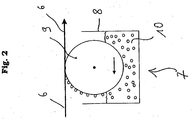
- Fig. 2 shows a godet bath 7 with a godet trough 8, in which a rotatable about an axis godet 9 is partially immersed.
- the godet trough 8 is filled in about half way with a mixture 10 of preparation and dye.
- a thread 6 is wound one or more times.
- the invention also includes methods in which a thread according to several dosing systems connected in series Fig. 1 passes.
- a combination of metering systems and godet baths is also conceivable.
Landscapes
- Engineering & Computer Science (AREA)
- Textile Engineering (AREA)
- Chemical & Material Sciences (AREA)
- Chemical Kinetics & Catalysis (AREA)
- Mechanical Engineering (AREA)
- Coloring (AREA)
- Treatments For Attaching Organic Compounds To Fibrous Goods (AREA)
- Yarns And Mechanical Finishing Of Yarns Or Ropes (AREA)
- Artificial Filaments (AREA)
Description
- Die Erfindung betrifft ein Verfahren zur Herstellung von gefärbten Nähfäden, insbesondere von Airbagfäden, bei dem auf den Faden sowohl eine die Fadeneigenschaften verbessernde Präparation als auch ein Farbstoff aufgebracht wird.
- Gefärbte Nähfäden werden zum einen für die Herstellung von Textilien, zum anderen aber auch für Spezialanwendungen, beispielsweise für das Nähen von Airbags, eingesetzt. Die für das Nähen von Airbags verwendeten Fäden werden einerseits gefärbt, um den Fäden eine Herstellerkennzeichnung zu verleihen, andererseits dient die Farbgebung zur Erzeugung eines Kontrasts im Bereich einer fertigen Naht, so dass diese leichter auf Fehlerfreiheit geprüft werden kann.
- Fäden der genannten Art sind weiterhin üblicherweise mit einer speziellen Präparation (oder auch "Ausrüstung" bzw. "Avivage") versehen, welche die Näheigenschaften des Fadens bestimmen bzw. verbessern. Je nach Anwendungsfall werden unterschiedliche Präparationen verwendet, die beispielsweise Auswirkungen auf die Gleiteigenschaften, die Scheuerfestigkeit oder die statische Aufladung des Fadens haben.
- Bei üblichen Verfahren zur Herstellung von gefärbten, mit einer Präparation versehenen Nähfäden werden die Fäden zuerst auf Färbespulen gewickelt, die dann einem Färbebad zugeführt werden, in welchem die Färbespulen eine gewisse Zeit verbleiben, bis die Fäden die gewünschte Farbe erhalten haben. Nach Abschluss des Färbevorgangs wird dann die jeweils gewünschte Präparation mittels eines geeigneten Präparierverfahrens auf die gefärbten Fäden aufgebracht, wobei es zur Durchführung solcher Präparierverfahren nötig ist, den Faden von der Färbespule auf eine weitere Spule umzuspulen, so dass die Präparation gezielt in dem Bereich zwischen beiden Spulen aufgebracht werden kann.
-
WO 98/22224 A US 4,501,590 A offenbart ein ähnliches Verfahren, bei dem ein einen Farbstoff und eine Präparation enthaltendes Gemisch während des Vernähens eines Nähfadens in den Nähfaden eingebracht wird. -
JP 2000 199142 A -
US 4,583,987 A offenbart ein Verfahren zur Herstellung eines Nähfadens, bei dem ein Gemisch enthaltend einen Farbstoff und ein Gleitmittel auf den Nähfaden aufgebracht wird. -
US 2,098,333 offenbart ein Verfahren zur Behandlung eines Fadens, bei dem ein die Fadeneigenschaften veränderndes Behandlungsmittel mit einer Galette auf den Faden aufgebracht wird, wobei der Faden in kontinuierlich variierenden Abständen mit der Galette in Kontakt gebracht und von der Galette abgehoben wird, um das Behandlungsmittel in kontinuierlich variierenden Abständen auf den Faden aufzubringen. Das Behandlungsmittel enthält ein Verseifungsmittel und einen Farbstoff. - Eine Aufgabe der Erfindung besteht darin, ein Verfahren der eingangs genannten Art dahingehend zu verbessern, dass es mit verringertem wirtschaftlichem Aufwand durchführbar wird.
- Diese Aufgabe wird erfindungsgemäß durch ein Verfahren mit den Merkmalen des Anspruchs 1 gelöst. Bei dem Verfahren werden Präparation und Farbstoff vermischt und anschließend gemeinsam als Gemisch auf den Faden aufgebracht. Erfindungsgemäß wird das Gemisch mittels eines Dosiersystems, insbesondere mittels eines Schwämmchenapplikators, auf den Faden aufgebracht, wobei der Faden im Dosiersystem einen Applikationsbereich und einen in Förderrichtung darauf folgenden Vergleichmäßigungsbereich durchläuft.
- Durch das Vermischen und anschließende gemeinsame Aufbringen von Präparation und Farbstoff wird der Vorgang des Färbens gewissermaßen in das Präparierverfahren integriert, so dass eine Herstellung von gefärbten Fäden durch ein Verfahren gemäß Anspruch 1 ermöglicht wird, bei dem bisher übliche zeitaufwändige Färbeprozesse praktisch komplett entfallen können, wodurch die Wirtschaftlichkeit der Herstellung signifikant erhöht wird. Dabei wird im Rahmen der Erfindung bewusst in Kauf genommen, dass beim Aufbringen einer mit einem Farbstoff vermischten Präparation nicht in jedem Fall eine reproduzierbare und gleichmäßige Einfärbung des Fadens erreicht wird, so wie dies üblicherweise für die Herstellung von Textilien erforderlich ist. Erfindungsgemäß wurde nämlich erkannt, dass es bei bestimmten Anwendungsfällen, insbesondere bei der Produktion von Airbagfäden, keine Rolle spielt, ob ein Farbton des Fadens exakt getroffen wird und reproduzierbar erzeugbar ist. Vielmehr genügt es bei der Herstellung von Airbagfäden, wenn eine bestimmte Farbe nur qualitativ erkannt werden kann, wobei es darüber hinaus nicht nötig ist, dass die Farbe vor dem Nähvorgang gleichmäßig über die Länge des Fadens verteilt ist.
- Bei der Erprobung der Erfindung hat sich darüber hinaus ergeben, dass beim Nähen eines erfindungsgemäß ungleichmäßig eingefärbten Fadens durch die Reibung zwischen Faden und zu vernähendem Material eine Vergleichmäßigung der Farbe über die Länge des Fadens bewirkt wird, indem die Farbe während des Nähvorgangs entlang des Fadens "verschmiert" wird. Der Faden weist also nach dem Nähvorgang über seine gesamte Länge aufgrund des genannten "Verschmierens" eine im Wesentlichen gleichmäßige Färbung auf, so dass die Qualität einer erzeugten Naht anhand von Kontrastunterschieden zwischen Faden und vernähtem Material über die gesamte Länge des Fadens problemlos geprüft werden kann.
Zudem kann auch mit einem erfindungsgemäß ungleichmäßig eingefärbten Faden erreicht werden, dass die aufgebrachte Farbe vor dem Nähvorgang als Herstellerkennzeichnung erkennbar ist, da für eine solche Erkennung keine gleichmäßige Verteilung der Farbe über die Länge des Fadens erforderlich ist. - Wenn gemäß Anspruch 1 ein Dosiersystem verwendet wird, kann das Dosiersystem einen Schwämmchenapplikator umfassen. Dabei wird das Gemisch dem Schwämmchen insbesondere kontinuierlich zugeführt, so dass es vom Schwämmchen möglichst gleichmäßig auf den Faden aufgebracht werden kann.
Im Rahmen eines Dosiersystems gemäß Anspruch 1 durchläuft der Faden zuerst einen Applikationsbereich und anschließend einen in Förderrichtung darauf folgenden Vergleichmäßigungsbereich. Im Rahmen des Applikationsbereichs wird das Gemisch aus Präparation und Farbstoff auf den Faden aufgebracht, woraufhin im Vergleichmäßigungsbereich zumindest bis zu einem gewissen Grad eine Vergleichmäßigung des aufgebrachten Gemisches über die Länge des durchlaufenden Fadens erzeugt wird. - Alternativ zu dem genannten, im Rahmen der Erfindung eingesetzten Dosiersystem könnte das Gemisch aus Präparation und Farbstoff über eine zumindest bereichsweise in ein Galettenbad eintauchende Galette auf den Faden aufgebracht werden.
Sowohl das Dosiersystem als auch das Galettenbad werden im Rahmen der Figurenbeschreibung noch näher erläutert. - Bevorzugt ist es, wenn vor dem Aufbringen des Gemisches aus Präparation und Farbstoff ein Zwirnvorgang erfolg, da insbesondere für die Herstellung von Airbagfäden in der Regel nur verzwirnte Fäden eingesetzt werden.
- Vor dem Aufbringen des Gemisches kann ein Verkleben (Bondieren) der verzwirnten Fadenkomponenten erfolgen. Im Rahmen eines solchen Verklebens können beispielsweise zwei bis drei Vorzwirne miteinander verzwirnt werden, wobei zentriert ein Schmelzklebefaden zwischen die Vorzwirne während des Zwirnvorgangs eingebracht wird. Anschließend erfolgt dann ein Erhitzen des Schmelzklebefadens, so dass sich dieser verflüssigt zwischen den verzwirnten Vorzwirnen verteilt und diese miteinander verklebt. So wird verhindert, dass sich ein verzwirnter Faden während des Nähvorgangs wieder aufdrehen kann.
- Wenn die verzwirnten Fadenkomponenten (Vorzwirne) miteinander verklebt sind, wirkt sich ein erfindungsgemäßes Verfahren besonders vorteilhaft aus, da es bei aus dem Stand der Technik bekannten Verfahren immer wieder vorkam, dass sich die genannte Verklebung beim Einbringen des auf eine Färbespule gewickelten Fadens in ein Färbebad wieder gelöst hat, so dass kostenaufwändige Produktionsausfälle beim Nähen von Airbags mit unsauber verklebten Airbagfäden auftraten. Derartige Probleme können erfindungsgemäß ausgeschlossen werden, da es nicht mehr nötig ist, die verklebten Fäden in ein Färbebad einzubringen.
- Wie bereits erwähnt, ist es also vorteilhaft, das Gemisch aus Präparation und Farbstoff in einem färbebadfreien Prozess auf den Faden aufzubringen, wobei dieses Aufbringen bevorzugt während eines Umspulvorgangs erfolgt. Ein solcher Umspulvorgang kann beispielsweise mit einer Geschwindigkeit von bis zu 1000 m/min. durchgeführt werden. Auf diese Weise lässt sich ein erfindungsgemäßes Verfahren auf wirtschaftlich vorteilhafte Weise in äußerst kurzer Zeit durchführen.
- Besonders bevorzugt ist es, wenn der Faden mittels des genannten Umspulvorgangs gleich auf eine Fertigspule (Endaufmachung) gewickelt wird, so dass er nach Durchführung des Umspulvorgangs bereits in einer vertriebsfertigen Form vorliegt.
- Besonders vorteilhaft ist es, wenn eine solche Menge an Gemisch auf den Faden aufgebracht wird, dass das Gewicht des Gemisches 4 % bis 8 %, insbesondere ungefähr 6 % des Gesamtgewichts des fertigen Fadens beträgt. Derartige Fäden eignen sich besonders für die Herstellung von Airbags.
- Erfindungsgemäß werden Farbstoff und Präparation vor dem Aufbringen des Gemisches auf den Faden lediglich derart vermischt, dass die Farbe in der Präparation nicht vollständig gelöst ist. Dies hat dann zur Folge, dass mittels Dosiersystem oder Galettenbad zwar die Präparation relativ gleichmäßig auf den Faden aufgebracht wird, aufgrund der nicht vollständigen Lösung des Farbstoffs in der Präparation jedoch keine gleichmäßige Einfärbung des Fadens erzielt werden kann. Ein mit einem solchen Gemisch eingefärbter Faden kann also beispielsweise ein gewisses unregelmäßiges Farbmuster aufweisen, wobei es dennoch problemlos möglich ist, die jeweilige Farbe, die zur Kennzeichnung eines Herstellers dienen kann, zu erkennen. Wie bereits erläutert, ergibt sich in der Folge beim Nähvorgang dann jedoch eine Vergleichmäßigung der Farbe über die Länge des Fadens ("Verschmieren"), so dass die Qualitätsprüfung der erzeugten Nähte nicht beeinträchtigt wird.
- Die im Rahmen der Erfindung zum Einsatz gelangende Präparation kann beispielsweise Silikone, Paraffine, Wachse, Emulgatoren und/oder Antistatika beinhalten. Auch der Einsatz zusätzlicher, hier nicht explizit aufgeführter Komponenten ist möglich.
- Besonders bevorzugt ist es, wenn das erfindungsgemäß eingesetzte Gemisch einen Farbstoff beinhaltet, welcher zum Einfärben von Wachsen oder Ölen geeignet ist. Derartige Farbstoffe lösen sich vergleichsweise gut und gleichmäßig in einer Präparation auf.
Die für ein wie vorstehend beschriebenes Verfahren eingesetzten Fäden bestehen bevorzugt aus Polyamid, Polyester, Polypropylen, aromatischen Polyamiden, Polyacrylnitril, Polytetrafluoräthylen oder Polyäthylen. - Die Erfindung betrifft ferner einen Nähfaden, insbesondere einen Airbagfaden, mit einer die Fadeneigenschaften verbessernden Präparation und einem Farbstoff, wobei die äußerste Schicht des Nähfadens durch ein Gemisch aus Präparation und Farbstoff gebildet ist. Ein solcher Faden lässt sich bevorzugt durch ein vorstehend beschriebenes Verfahren herstellen. Er unterscheidet sich von Fäden gemäß Stand der Technik dadurch, dass er keine einheitliche "Durchfärbung" über den gesamten Querschnitt des Fadens besitzt. Zudem besitzt der erfindungsgemäße Faden keine farblose Präparation als äußerste Schicht, sondern vielmehr eine äußerste Schicht, in der sowohl Präparation als auch Farbstoff vorhanden sind.
- Dabei ist die genannte äußerste Schicht nur bereichsweise durch den Farbstoff eingefärbt, wobei dies im Wesentlichen den Zustand des Fadens vor dem Nähvorgang betrifft. Durch den Nähvorgang wird das erläuterte "Verschmieren" des Farbstoffs bewirkt, so dass dann beim vernähten Faden eine im Wesentlichen komplette Färbung der äußersten Schicht vorhanden ist.
- Weitere bevorzugte Ausführungsformen der Erfindung sind in den Unteransprüchen angegeben.
- Die Erfindung wird nachfolgend anhand von Ausführungsbeispielen unter Bezugnahme auf die Zeichnungen beschrieben; dabei zeigt:
- Fig. 1
- eine schematische Darstellung eines Dosiersystems, welches zur Aufbringung des erfindungsgemäßen Gemisches geeignet ist, und
- Fig. 2
- eine schematische Darstellung eines Galettenbades, welches ebenfalls die genannte Funktion besitzt.
-
Fig. 1 zeigt ein Dosiersystem 1, durch welches ein Faden 6 im Rahmen eines Umspulvorgangs von links nach rechts hindurch bewegt wird. Das Dosiersystem 1 besitzt einen aus zwei Schwämmchenhälften 2, 3 bestehenden Applikationsbereich und einen in Förderrichtung des Fadens darauf folgenden Vergleichmäßigungsbereich, der durch zwei Schwämmchenhälften 4, 5 gebildet wird. - Die beiden Schwämmchenhälften 2, 3 werden auf nicht näher dargestellte Weise kontinuierlich mit einem Gemisch aus Präparation und Farbstoff versorgt. Wenn der Faden 6 zwischen den beiden Schwämmchenhälften 2, 3 hindurchgezogen wird, entsteht entlang des äußeren Umfangs des Fadens 6 eine noch relativ ungleichmäßige Schicht, die durch das Gemisch aus Präparation und Farbstoff gebildet wird.
- In der Folge wird der die genannte Schicht tragende Faden zwischen den beiden Schwämmchenhälften 4, 5 hindurchgezogen, welche nicht mit Gemisch versorgt werden. Die Schwämmchenhälften 4, 5 dienen ausschließlich dazu, das bereits auf der Fadenoberfläche befindliche Gemisch zu vergleichmäßigen. Dabei besitzen die beiden Schwämmchenhälften 4, 5 in Transportrichtung des Fadens 6 eine deutlich größere Ausdehnung als die beiden Schwämmchenhälften 2, 3 des Applikationsbereichs. Die Ausdehnung der Schwämmchenhälften 4, 5 in der genannten Richtung beträgt insbesondere das 3- bis 7-fache der Ausdehnung der Schwämmchenhälften 2, 3 in der entsprechenden Richtung.
- Durch die Schwämmchenhälften 4,5 wird in der Regel zumindest ein gleichmäßiger Auftrag der Präparation auf der Fadenoberfläche erreicht. Falls der Farbstoff in der Präparation nicht gleichmäßig gelöst ist, ergibt sich eine Vergleichmäßigung des Farbstoffs in der äußersten Schicht des Fadens 6 erst durch den Nähvorgang.
-
Fig. 2 zeigt ein Galettenbad 7 mit einem Galettentrog 8, in den eine um eine Achse drehbare Galette 9 bereichsweise eintaucht. Der Galettentrog 8 ist in etwa bis zur Hälfte mit einem Gemisch 10 aus Präparation und Farbstoff gefüllt. Um die Galette 9 ist während der Durchführung eines beispielhaften Verfahrens ein Faden 6 einfach oder mehrfach gewickelt. - Wenn nun der Faden 6 im Rahmen eines Umspulvorgangs über die Galette 9 geführt wird, ist sichergestellt, dass der Faden über seine gesamte Länge je nach Anzahl der Galettenwicklungen einmal oder mehrmals in das Gemisch 10 eingetaucht wird, so dass durch diesen temporär erfolgenden Tauchvorgang an der Oberfläche des Fadens 6 eine Schicht aus Präparation und Farbstoff erzeugt wird.
- Die Erfindung umfasst auch Verfahren, bei denen ein Faden mehrere hintereinander geschaltete Dosiersysteme gemäß
Fig. 1 durchläuft. Auch eine Kombination von Dosiersystemen und Galettenbädern ist grundsätzlich denkbar. -
- 1
- Dosiersystem
- 2
- Schwämmchenhälfte
- 3
- Schwämmchenhälfte
- 4
- Schwämmchenhälfte
- 5
- Schwämmchenhälfte
- 6
- Faden
- 7
- Galettenbad
- 8
- Galettentrog
- 9
- Galette
- 10
- Gemisch
Claims (12)
- Verfahren zur Herstellung von gefärbten Nähfäden (6), insbesondere von Airbagfäden, bei dem auf den Faden (6) sowohl eine die Fadeneigenschaften verbessernde Präparation als auch ein Farbstoff aufgebracht wird, wobei Präparation und Farbstoff vermischt und anschließend gemeinsam als Gemisch (10) auf den Faden aufgebracht werden und wobei das Gemisch (10) mittels eines Dosiersystems (1) auf den Faden (6) aufgebracht wird,
dadurch gekennzeichnet,
dass der Faden (6) im Dosiersystem (1) einen Applikationsbereich (2, 3) und einen in Förderrichtung darauf folgenden Vergleichmäßigungsbereich (4, 5) durchläuft, und
dass Farbstoff und Präparation derart vermischt werden, dass die Farbe in der Präparation nicht vollständig gelöst ist. - Verfahren nach Anspruch 1,
dadurch gekennzeichnet,
dass vor dem Aufbringen des Gemisches (10) ein Zwirnvorgang und insbesondere ein Verkleben (Bondieren) der verzwirnten Fadenkomponenten erfolgt. - Verfahren nach einem der vorhergehenden Ansprüche,
dadurch gekennzeichnet,
dass das Gemisch (10) in einem färbebadfreien Prozess auf den Faden (6) aufgebracht wird. - Verfahren nach einem der vorhergehenden Ansprüche,
dadurch gekennzeichnet,
dass das Gemisch (10) während eines Umspulvorgangs auf den Faden (6) aufgebracht wird, wobei der Umspulvorgang insbesondere mit einer Geschwindigkeit von bis zu 1000m/min. durchgeführt wird. - Verfahren nach einem der vorhergehenden Ansprüche,
dadurch gekeinnzeichnet,
dass eine solche Menge an Gemisch (10) auf den Faden (6) aufgebracht wird, dass das Gewicht des Gemisches (10) 4% bis 8%, insbesondere ungefähr 6% des Gesamtgewichts des fertigen Fadens (6) beträgt. - Verfahren nach einem der vorhergehenden Ansprüche,
dadurch gekennzeichnet,
dass die Präparation Silikone, Paraffine, Wachse, Emulgatoren und/oder Antistatika beinhaltet,
und/oder dass das Gemisch (10) einen Farbstoff beinhaltet, welcher zum Einfärben von Wachsen oder Ölen geeignet ist. - Verfahren nach einem der vorhergehenden Ansprüche,
dadurch gekennzeichnet,
dass der Faden (6) aus Polyamid, Polyester, Polypropylen, aromatischen Polyamiden, Polyacrylnitril, Polytetrafluoräthylen oder Polyäthylen besteht. - Nähfaden, insbesondere Airbagfaden, mit einer die Fadeneigenschaften verbessernden Präparation und einem Farbstoff, wobei die äußerste Schicht des Fadens (6) durch ein Gemisch aus Präparation und Farbstoff gebildet ist,
dadurch gekennzeichnet,
dass die durch das Gemisch aus Präparation und Farbstoff gebildete äußerste Schicht nur bereichsweise durch den Farbstoff eingefärbt ist. - Nähfaden nach Anspruch 8,
dadurch gekennzeichnet,
dass die Präparation Silikone, Paraffine, Wachse, Emulgatoren und/oder Antistatika beinhaltet, und/oder dass das Gemisch (10) einen Farbstoff beinhaltet, welcher zum Einfärben von Wachsen oder Ölen geeignet ist. - Nähfaden nach einem der Ansprüche 8 oder 9,
dadurch gekennzeichnet,
dass der Faden (6) aus Polyamid, Polyester, Polypropylen, aromatischen Polyamiden, Polyacrylnitril, Polytetrafluoräthylen oder Polyäthylen besteht. - Nähfaden nach einem der Ansprüche 8 bis 10,
dadurch gekennzeichnet,
dass der Faden (6) als Zwirn ausgebildet ist. - Nähfaden nach einem der Ansprüche 8 bis 11,
dadurch gekennzeichnet,
dass die verzwirnten Fadenkomponenten verklebt (bondiert) sind.
Priority Applications (1)
| Application Number | Priority Date | Filing Date | Title |
|---|---|---|---|
| PL08773614T PL2165016T5 (pl) | 2007-07-04 | 2008-06-24 | Sposób produkcji barwionych nici do szycia |
Applications Claiming Priority (2)
| Application Number | Priority Date | Filing Date | Title |
|---|---|---|---|
| DE102007031037A DE102007031037A1 (de) | 2007-07-04 | 2007-07-04 | Verfahren zur Herstellung von gefärbten Nähfäden |
| PCT/EP2008/005104 WO2009003615A2 (de) | 2007-07-04 | 2008-06-24 | Verfahren zur herstellung von gefärbten nähfäden |
Publications (3)
| Publication Number | Publication Date |
|---|---|
| EP2165016A2 EP2165016A2 (de) | 2010-03-24 |
| EP2165016B1 EP2165016B1 (de) | 2013-12-18 |
| EP2165016B2 true EP2165016B2 (de) | 2017-12-27 |
Family
ID=39952168
Family Applications (1)
| Application Number | Title | Priority Date | Filing Date |
|---|---|---|---|
| EP08773614.6A Active EP2165016B2 (de) | 2007-07-04 | 2008-06-24 | Verfahren zur herstellung von gefärbten nähfäden |
Country Status (9)
| Country | Link |
|---|---|
| US (1) | US20110016842A1 (de) |
| EP (1) | EP2165016B2 (de) |
| CN (1) | CN101765688B (de) |
| DE (1) | DE102007031037A1 (de) |
| ES (1) | ES2448869T5 (de) |
| MX (1) | MX2009014170A (de) |
| PL (1) | PL2165016T5 (de) |
| PT (1) | PT2165016E (de) |
| WO (1) | WO2009003615A2 (de) |
Families Citing this family (5)
| Publication number | Priority date | Publication date | Assignee | Title |
|---|---|---|---|---|
| KR101957332B1 (ko) * | 2012-11-30 | 2019-06-19 | 코오롱인더스트리 주식회사 | 에어백용 폴리에스테르 봉제사 및 그의 제조방법 |
| CN104820850A (zh) * | 2015-04-23 | 2015-08-05 | 汉广瑞丰包装(北京)有限公司 | 缝纫封口线的加工装置、缝纫封口线以及防拆包装袋 |
| KR20190011757A (ko) | 2016-05-24 | 2019-02-07 | 트와인 솔루션즈 엘티디. | 실 및 그 일부를 처리하기 위한 시스템, 기기 및 방법 |
| SE539997C2 (en) | 2016-08-28 | 2018-02-20 | Inventech Europe Ab | A treatment unit for in-line treatment of threads |
| CN108978276A (zh) * | 2018-08-09 | 2018-12-11 | 界首市恒仁服饰有限公司 | 一种涤纶面料的染色处理方法 |
Citations (2)
| Publication number | Priority date | Publication date | Assignee | Title |
|---|---|---|---|---|
| DE4333716C1 (de) † | 1993-10-03 | 1995-02-02 | Graf & Co Gmbh | Verfahren und Vorrichtungen zur Aufbringung von Präparationen auf Garne bzw. Fäden am laufenden Faden |
| EP0919649A2 (de) † | 1997-11-28 | 1999-06-02 | COUSIN Filterie SA | Nähgarn aus synthetischen Multifilamenten sowie Verfahren zur Herstellung eines derartigen Nähgarnes |
Family Cites Families (11)
| Publication number | Priority date | Publication date | Assignee | Title |
|---|---|---|---|---|
| GB412600A (en) * | 1931-10-28 | 1934-06-28 | British Celanese | Improvements in apparatus for applying treating agents to yarns and like products |
| ES437758A1 (es) * | 1974-06-11 | 1977-01-16 | Carlos Humberto Da Silva Cardo | Procedimiento para la tincion de materiales de hilatura sin produccion de efluentes. |
| DE3006687A1 (de) * | 1980-02-22 | 1981-08-27 | Hoechst Ag, 6000 Frankfurt | Verfahren fuer das gleichzeitige faerben und bondieren von naehseide aus polyesterfilamenten |
| JPS591788A (ja) * | 1982-06-25 | 1984-01-07 | 蛇の目ミシン工業株式会社 | ミシン糸の簡易迅速染色法 |
| DE3500168A1 (de) * | 1985-01-04 | 1986-07-17 | Chemische Fabrik Tübingen R. Beitlich GmbH & Co, 7400 Tübingen | Verfahren zum einbadigen faerben und avivieren von naehgarn sowie mittel zu seiner durchfuehrung |
| US5944852A (en) * | 1996-10-23 | 1999-08-31 | Solutia Inc. | Dyeing process |
| WO1998022224A1 (en) * | 1996-11-20 | 1998-05-28 | Threlkeld James O | Method for treating travelling textile material |
| WO1998048100A1 (es) * | 1997-04-18 | 1998-10-29 | Clariant International Ltd | Procedimiento para la tintura y acabado simultaneo de hilos de coser |
| US6436484B1 (en) * | 1997-12-09 | 2002-08-20 | Coats American, Inc. | Processes for coating sewing thread |
| JP2000199142A (ja) * | 1998-12-25 | 2000-07-18 | Sanesu Seni Kogyo Kk | エアバック用縫糸の製造方法 |
| DE19926356A1 (de) * | 1999-06-10 | 2000-12-14 | Clariant Gmbh | Verfahren zum Färben und Aufhellen synthetischer und cellulosischer Fasern |
-
2007
- 2007-07-04 DE DE102007031037A patent/DE102007031037A1/de not_active Withdrawn
-
2008
- 2008-06-24 CN CN200880022654.7A patent/CN101765688B/zh active Active
- 2008-06-24 US US12/667,635 patent/US20110016842A1/en not_active Abandoned
- 2008-06-24 PT PT87736146T patent/PT2165016E/pt unknown
- 2008-06-24 EP EP08773614.6A patent/EP2165016B2/de active Active
- 2008-06-24 PL PL08773614T patent/PL2165016T5/pl unknown
- 2008-06-24 MX MX2009014170A patent/MX2009014170A/es active IP Right Grant
- 2008-06-24 ES ES08773614.6T patent/ES2448869T5/es active Active
- 2008-06-24 WO PCT/EP2008/005104 patent/WO2009003615A2/de not_active Ceased
Patent Citations (2)
| Publication number | Priority date | Publication date | Assignee | Title |
|---|---|---|---|---|
| DE4333716C1 (de) † | 1993-10-03 | 1995-02-02 | Graf & Co Gmbh | Verfahren und Vorrichtungen zur Aufbringung von Präparationen auf Garne bzw. Fäden am laufenden Faden |
| EP0919649A2 (de) † | 1997-11-28 | 1999-06-02 | COUSIN Filterie SA | Nähgarn aus synthetischen Multifilamenten sowie Verfahren zur Herstellung eines derartigen Nähgarnes |
Non-Patent Citations (3)
| Title |
|---|
| Bedienungs- und Installationsanleitung des Single-Lun hot, erstellt 2/95 † |
| Foto des bereits Anfang 2006 installierten Single-Lub hot-Applikators † |
| Lieferschein-Nr: 20066020019 vom. 2.2.2006 † |
Also Published As
| Publication number | Publication date |
|---|---|
| ES2448869T5 (es) | 2018-04-04 |
| ES2448869T3 (es) | 2014-03-17 |
| EP2165016A2 (de) | 2010-03-24 |
| PT2165016E (pt) | 2014-03-04 |
| MX2009014170A (es) | 2010-03-04 |
| CN101765688A (zh) | 2010-06-30 |
| PL2165016T5 (pl) | 2018-06-29 |
| WO2009003615A3 (de) | 2009-02-19 |
| EP2165016B1 (de) | 2013-12-18 |
| DE102007031037A1 (de) | 2009-01-08 |
| CN101765688B (zh) | 2014-07-16 |
| WO2009003615A2 (de) | 2009-01-08 |
| PL2165016T3 (pl) | 2014-05-30 |
| US20110016842A1 (en) | 2011-01-27 |
Similar Documents
| Publication | Publication Date | Title |
|---|---|---|
| EP2165016B2 (de) | Verfahren zur herstellung von gefärbten nähfäden | |
| DD201921A5 (de) | Verfahren und vorrichtung zur herstellung synthetischer garne und garnaehnlicher strukturen | |
| DE2849372C2 (de) | Verfahren zum kontinuierlichen Bemustern von Textilmaterial | |
| WO2018219751A1 (de) | Verfahren und schmelzspinnvorrichtung zur herstellung eines gekräuselten mehrfarbigen verbundfadens | |
| WO2020094485A1 (de) | Verfahren und vorrichtung zum aufwickeln eines multifilen fadens | |
| DE1804856A1 (de) | Verfahren und Vorrichtung zum Registerhalten von Garnen | |
| DE2159064A1 (de) | Verfahren und Maschine zum Herstellen von Seilen | |
| DE2526107A1 (de) | Verfahren und vorrichtung zur herstellung gezwirnten garns sowie nach dem verfahren hergestelltes garn | |
| DE3306808C2 (de) | Verfahren und Vorrichtung zum Aufbringen einer Substanz oder eines Substanzgemisches auf ein Garn | |
| DE1471892C3 (de) | Verfahren und Vorrichtungen zur Her stellung von gezwirntem Glasgarn | |
| DE2436997A1 (de) | Naehfaden aus coregarn | |
| DE102008005379A1 (de) | Verfahren zum Herstellen von Feinstrumpfwaren | |
| DE10124162A1 (de) | Lufttexturierter Faden sowie Verfahren zu dessen Herstellung | |
| DE1510508A1 (de) | Verfahren zur Herstellung mehrfarbiger Faeden | |
| DE1435550A1 (de) | Verfahren und Vorrichtung zur Herstellung gekraeuselter,hochelastischer vollsynthetischer Faeden | |
| DE3910258A1 (de) | Naehgarn aus polyetherketonen | |
| DE2028618C3 (de) | Verfahren zur Verbesserung der Gummihaftung von Polyesterfasern | |
| AT223427B (de) | Angelleine | |
| DE1941950A1 (de) | Verfahren zur Herstellung von Garnen aus Kunststoffbaendchen | |
| DE19709677A1 (de) | Garn, insbesondere Nähgarn | |
| DE1941294A1 (de) | Verfahren,einen heissgereckten Kunststoffaden weich und geschmeidig zu machen | |
| DE254634C (de) | ||
| DE102005046492A1 (de) | Verfahren zur Herstellung eines Garnes und Garn | |
| DE1061666B (de) | Verfahren zum Erzeugen von zum Umwandeln in Textilgarne geeigneten Streifen aus durch ein Bindemittel vereinigten Fasern | |
| DE2147015A1 (de) | Verfahren zur Herstellung von Texturseide nach dem Falschdrahtverfahren aus ungereckten Chemieseiden |
Legal Events
| Date | Code | Title | Description |
|---|---|---|---|
| PUAI | Public reference made under article 153(3) epc to a published international application that has entered the european phase |
Free format text: ORIGINAL CODE: 0009012 |
|
| 17P | Request for examination filed |
Effective date: 20100127 |
|
| AK | Designated contracting states |
Kind code of ref document: A2 Designated state(s): AT BE BG CH CY CZ DE DK EE ES FI FR GB GR HR HU IE IS IT LI LT LU LV MC MT NL NO PL PT RO SE SI SK TR |
|
| AX | Request for extension of the european patent |
Extension state: AL BA MK RS |
|
| RIN1 | Information on inventor provided before grant (corrected) |
Inventor name: STABENOW, MICHAEL Inventor name: KAEGI, HEINZ |
|
| 17Q | First examination report despatched |
Effective date: 20101022 |
|
| DAX | Request for extension of the european patent (deleted) | ||
| GRAP | Despatch of communication of intention to grant a patent |
Free format text: ORIGINAL CODE: EPIDOSNIGR1 |
|
| INTG | Intention to grant announced |
Effective date: 20130812 |
|
| GRAS | Grant fee paid |
Free format text: ORIGINAL CODE: EPIDOSNIGR3 |
|
| GRAA | (expected) grant |
Free format text: ORIGINAL CODE: 0009210 |
|
| AK | Designated contracting states |
Kind code of ref document: B1 Designated state(s): AT BE BG CH CY CZ DE DK EE ES FI FR GB GR HR HU IE IS IT LI LT LU LV MC MT NL NO PL PT RO SE SI SK TR |
|
| REG | Reference to a national code |
Ref country code: GB Ref legal event code: FG4D Free format text: NOT ENGLISH |
|
| REG | Reference to a national code |
Ref country code: CH Ref legal event code: EP |
|
| REG | Reference to a national code |
Ref country code: AT Ref legal event code: REF Ref document number: 645710 Country of ref document: AT Kind code of ref document: T Effective date: 20140115 |
|
| REG | Reference to a national code |
Ref country code: IE Ref legal event code: FG4D Free format text: LANGUAGE OF EP DOCUMENT: GERMAN |
|
| REG | Reference to a national code |
Ref country code: RO Ref legal event code: EPE |
|
| REG | Reference to a national code |
Ref country code: DE Ref legal event code: R096 Ref document number: 502008011094 Country of ref document: DE Effective date: 20140213 |
|
| REG | Reference to a national code |
Ref country code: PT Ref legal event code: SC4A Free format text: AVAILABILITY OF NATIONAL TRANSLATION Effective date: 20140224 |
|
| REG | Reference to a national code |
Ref country code: ES Ref legal event code: FG2A Ref document number: 2448869 Country of ref document: ES Kind code of ref document: T3 Effective date: 20140317 |
|
| REG | Reference to a national code |
Ref country code: NL Ref legal event code: VDEP Effective date: 20131218 |
|
| PG25 | Lapsed in a contracting state [announced via postgrant information from national office to epo] |
Ref country code: NO Free format text: LAPSE BECAUSE OF FAILURE TO SUBMIT A TRANSLATION OF THE DESCRIPTION OR TO PAY THE FEE WITHIN THE PRESCRIBED TIME-LIMIT Effective date: 20140318 Ref country code: SE Free format text: LAPSE BECAUSE OF FAILURE TO SUBMIT A TRANSLATION OF THE DESCRIPTION OR TO PAY THE FEE WITHIN THE PRESCRIBED TIME-LIMIT Effective date: 20131218 Ref country code: LT Free format text: LAPSE BECAUSE OF FAILURE TO SUBMIT A TRANSLATION OF THE DESCRIPTION OR TO PAY THE FEE WITHIN THE PRESCRIBED TIME-LIMIT Effective date: 20131218 Ref country code: HR Free format text: LAPSE BECAUSE OF FAILURE TO SUBMIT A TRANSLATION OF THE DESCRIPTION OR TO PAY THE FEE WITHIN THE PRESCRIBED TIME-LIMIT Effective date: 20131218 Ref country code: FI Free format text: LAPSE BECAUSE OF FAILURE TO SUBMIT A TRANSLATION OF THE DESCRIPTION OR TO PAY THE FEE WITHIN THE PRESCRIBED TIME-LIMIT Effective date: 20131218 |
|
| REG | Reference to a national code |
Ref country code: LT Ref legal event code: MG4D |
|
| PG25 | Lapsed in a contracting state [announced via postgrant information from national office to epo] |
Ref country code: LV Free format text: LAPSE BECAUSE OF FAILURE TO SUBMIT A TRANSLATION OF THE DESCRIPTION OR TO PAY THE FEE WITHIN THE PRESCRIBED TIME-LIMIT Effective date: 20131218 |
|
| REG | Reference to a national code |
Ref country code: PL Ref legal event code: T3 |
|
| PG25 | Lapsed in a contracting state [announced via postgrant information from national office to epo] |
Ref country code: IS Free format text: LAPSE BECAUSE OF FAILURE TO SUBMIT A TRANSLATION OF THE DESCRIPTION OR TO PAY THE FEE WITHIN THE PRESCRIBED TIME-LIMIT Effective date: 20140418 Ref country code: EE Free format text: LAPSE BECAUSE OF FAILURE TO SUBMIT A TRANSLATION OF THE DESCRIPTION OR TO PAY THE FEE WITHIN THE PRESCRIBED TIME-LIMIT Effective date: 20131218 |
|
| PG25 | Lapsed in a contracting state [announced via postgrant information from national office to epo] |
Ref country code: SK Free format text: LAPSE BECAUSE OF FAILURE TO SUBMIT A TRANSLATION OF THE DESCRIPTION OR TO PAY THE FEE WITHIN THE PRESCRIBED TIME-LIMIT Effective date: 20131218 Ref country code: CZ Free format text: LAPSE BECAUSE OF FAILURE TO SUBMIT A TRANSLATION OF THE DESCRIPTION OR TO PAY THE FEE WITHIN THE PRESCRIBED TIME-LIMIT Effective date: 20131218 Ref country code: NL Free format text: LAPSE BECAUSE OF FAILURE TO SUBMIT A TRANSLATION OF THE DESCRIPTION OR TO PAY THE FEE WITHIN THE PRESCRIBED TIME-LIMIT Effective date: 20131218 Ref country code: CY Free format text: LAPSE BECAUSE OF FAILURE TO SUBMIT A TRANSLATION OF THE DESCRIPTION OR TO PAY THE FEE WITHIN THE PRESCRIBED TIME-LIMIT Effective date: 20131218 |
|
| REG | Reference to a national code |
Ref country code: DE Ref legal event code: R026 Ref document number: 502008011094 Country of ref document: DE |
|
| PLBI | Opposition filed |
Free format text: ORIGINAL CODE: 0009260 |
|
| PLAX | Notice of opposition and request to file observation + time limit sent |
Free format text: ORIGINAL CODE: EPIDOSNOBS2 |
|
| 26 | Opposition filed |
Opponent name: AMANN & SOEHNE GMBH & CO. KG Effective date: 20140915 |
|
| PG25 | Lapsed in a contracting state [announced via postgrant information from national office to epo] |
Ref country code: DK Free format text: LAPSE BECAUSE OF FAILURE TO SUBMIT A TRANSLATION OF THE DESCRIPTION OR TO PAY THE FEE WITHIN THE PRESCRIBED TIME-LIMIT Effective date: 20131218 |
|
| REG | Reference to a national code |
Ref country code: DE Ref legal event code: R026 Ref document number: 502008011094 Country of ref document: DE Effective date: 20140915 |
|
| PG25 | Lapsed in a contracting state [announced via postgrant information from national office to epo] |
Ref country code: LU Free format text: LAPSE BECAUSE OF FAILURE TO SUBMIT A TRANSLATION OF THE DESCRIPTION OR TO PAY THE FEE WITHIN THE PRESCRIBED TIME-LIMIT Effective date: 20140624 Ref country code: MC Free format text: LAPSE BECAUSE OF FAILURE TO SUBMIT A TRANSLATION OF THE DESCRIPTION OR TO PAY THE FEE WITHIN THE PRESCRIBED TIME-LIMIT Effective date: 20131218 |
|
| REG | Reference to a national code |
Ref country code: CH Ref legal event code: PL |
|
| PLBB | Reply of patent proprietor to notice(s) of opposition received |
Free format text: ORIGINAL CODE: EPIDOSNOBS3 |
|
| REG | Reference to a national code |
Ref country code: IE Ref legal event code: MM4A |
|
| PG25 | Lapsed in a contracting state [announced via postgrant information from national office to epo] |
Ref country code: CH Free format text: LAPSE BECAUSE OF NON-PAYMENT OF DUE FEES Effective date: 20140630 Ref country code: LI Free format text: LAPSE BECAUSE OF NON-PAYMENT OF DUE FEES Effective date: 20140630 Ref country code: IE Free format text: LAPSE BECAUSE OF NON-PAYMENT OF DUE FEES Effective date: 20140624 |
|
| PG25 | Lapsed in a contracting state [announced via postgrant information from national office to epo] |
Ref country code: SI Free format text: LAPSE BECAUSE OF FAILURE TO SUBMIT A TRANSLATION OF THE DESCRIPTION OR TO PAY THE FEE WITHIN THE PRESCRIBED TIME-LIMIT Effective date: 20131218 |
|
| REG | Reference to a national code |
Ref country code: FR Ref legal event code: PLFP Year of fee payment: 8 |
|
| PGFP | Annual fee paid to national office [announced via postgrant information from national office to epo] |
Ref country code: GB Payment date: 20150618 Year of fee payment: 8 |
|
| PGFP | Annual fee paid to national office [announced via postgrant information from national office to epo] |
Ref country code: FR Payment date: 20150619 Year of fee payment: 8 |
|
| PG25 | Lapsed in a contracting state [announced via postgrant information from national office to epo] |
Ref country code: MT Free format text: LAPSE BECAUSE OF FAILURE TO SUBMIT A TRANSLATION OF THE DESCRIPTION OR TO PAY THE FEE WITHIN THE PRESCRIBED TIME-LIMIT Effective date: 20131218 |
|
| PG25 | Lapsed in a contracting state [announced via postgrant information from national office to epo] |
Ref country code: BG Free format text: LAPSE BECAUSE OF FAILURE TO SUBMIT A TRANSLATION OF THE DESCRIPTION OR TO PAY THE FEE WITHIN THE PRESCRIBED TIME-LIMIT Effective date: 20131218 |
|
| PG25 | Lapsed in a contracting state [announced via postgrant information from national office to epo] |
Ref country code: GR Free format text: LAPSE BECAUSE OF FAILURE TO SUBMIT A TRANSLATION OF THE DESCRIPTION OR TO PAY THE FEE WITHIN THE PRESCRIBED TIME-LIMIT Effective date: 20140319 Ref country code: IT Free format text: LAPSE BECAUSE OF FAILURE TO SUBMIT A TRANSLATION OF THE DESCRIPTION OR TO PAY THE FEE WITHIN THE PRESCRIBED TIME-LIMIT Effective date: 20131218 |
|
| PG25 | Lapsed in a contracting state [announced via postgrant information from national office to epo] |
Ref country code: TR Free format text: LAPSE BECAUSE OF FAILURE TO SUBMIT A TRANSLATION OF THE DESCRIPTION OR TO PAY THE FEE WITHIN THE PRESCRIBED TIME-LIMIT Effective date: 20131218 Ref country code: HU Free format text: LAPSE BECAUSE OF FAILURE TO SUBMIT A TRANSLATION OF THE DESCRIPTION OR TO PAY THE FEE WITHIN THE PRESCRIBED TIME-LIMIT; INVALID AB INITIO Effective date: 20080624 Ref country code: BE Free format text: LAPSE BECAUSE OF FAILURE TO SUBMIT A TRANSLATION OF THE DESCRIPTION OR TO PAY THE FEE WITHIN THE PRESCRIBED TIME-LIMIT Effective date: 20140630 |
|
| GBPC | Gb: european patent ceased through non-payment of renewal fee |
Effective date: 20160624 |
|
| REG | Reference to a national code |
Ref country code: FR Ref legal event code: ST Effective date: 20170228 |
|
| PG25 | Lapsed in a contracting state [announced via postgrant information from national office to epo] |
Ref country code: FR Free format text: LAPSE BECAUSE OF NON-PAYMENT OF DUE FEES Effective date: 20160630 |
|
| PG25 | Lapsed in a contracting state [announced via postgrant information from national office to epo] |
Ref country code: GB Free format text: LAPSE BECAUSE OF NON-PAYMENT OF DUE FEES Effective date: 20160624 |
|
| PUAH | Patent maintained in amended form |
Free format text: ORIGINAL CODE: 0009272 |
|
| STAA | Information on the status of an ep patent application or granted ep patent |
Free format text: STATUS: PATENT MAINTAINED AS AMENDED |
|
| 27A | Patent maintained in amended form |
Effective date: 20171227 |
|
| AK | Designated contracting states |
Kind code of ref document: B2 Designated state(s): AT BE BG CH CY CZ DE DK EE ES FI FR GB GR HR HU IE IS IT LI LT LU LV MC MT NL NO PL PT RO SE SI SK TR |
|
| REG | Reference to a national code |
Ref country code: DE Ref legal event code: R102 Ref document number: 502008011094 Country of ref document: DE |
|
| REG | Reference to a national code |
Ref country code: ES Ref legal event code: DC2A Ref document number: 2448869 Country of ref document: ES Kind code of ref document: T5 Effective date: 20180404 |
|
| PG25 | Lapsed in a contracting state [announced via postgrant information from national office to epo] |
Ref country code: LV Free format text: LAPSE BECAUSE OF FAILURE TO SUBMIT A TRANSLATION OF THE DESCRIPTION OR TO PAY THE FEE WITHIN THE PRESCRIBED TIME-LIMIT Effective date: 20171227 |
|
| PGFP | Annual fee paid to national office [announced via postgrant information from national office to epo] |
Ref country code: AT Payment date: 20200619 Year of fee payment: 13 |
|
| REG | Reference to a national code |
Ref country code: AT Ref legal event code: MM01 Ref document number: 645710 Country of ref document: AT Kind code of ref document: T Effective date: 20210624 |
|
| PG25 | Lapsed in a contracting state [announced via postgrant information from national office to epo] |
Ref country code: AT Free format text: LAPSE BECAUSE OF NON-PAYMENT OF DUE FEES Effective date: 20210624 |
|
| PGFP | Annual fee paid to national office [announced via postgrant information from national office to epo] |
Ref country code: PL Payment date: 20250612 Year of fee payment: 18 |
|
| PGFP | Annual fee paid to national office [announced via postgrant information from national office to epo] |
Ref country code: PT Payment date: 20250612 Year of fee payment: 18 |
|
| PGFP | Annual fee paid to national office [announced via postgrant information from national office to epo] |
Ref country code: RO Payment date: 20250617 Year of fee payment: 18 |
|
| PGFP | Annual fee paid to national office [announced via postgrant information from national office to epo] |
Ref country code: ES Payment date: 20250728 Year of fee payment: 18 |
|
| PGFP | Annual fee paid to national office [announced via postgrant information from national office to epo] |
Ref country code: DE Payment date: 20250827 Year of fee payment: 18 |